Between The Wines November 2022
hidden Treasures
Hidden Treasures
Trends & observations
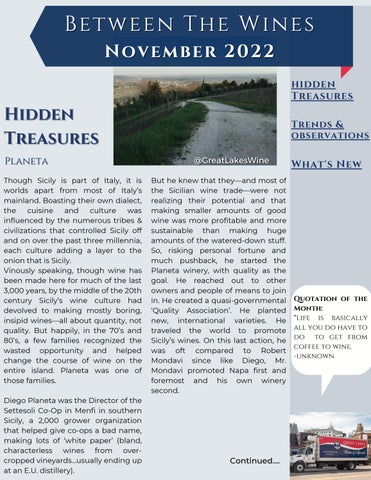
Planeta Though Sicily is part of Italy, it is worlds apart from most of Italy’s mainland. Boasting their own dialect, the cuisine and culture was influenced by the numerous tribes & civilizations that controlled Sicily off and on over the past three millennia, each culture adding a layer to the onion that is Sicily. Vinously speaking, though wine has been made here for much of the last 3,000 years, by the middle of the 20th century Sicily’s wine culture had devolved to making mostly boring, insipid wines—all about quantity, not quality. But happily, in the 70’s and 80’s, a few families recognized the wasted opportunity and helped change the course of wine on the entire island. Planeta was one of those families. Diego Planeta was the Director of the Settesoli Co-Op in Menfi in southern Sicily, a 2,000 grower organization that helped give co-ops a bad name, making lots of ‘white paper’ (bland, characterless wines from overcropped vineyards…usually ending up at an E.U. distillery).
What's New But he knew that they—and most of the Sicilian wine trade—were not realizing their potential and that making smaller amounts of good wine was more profitable and more sustainable than making huge amounts of the watered-down stuff. So, risking personal fortune and much pushback, he started the Planeta winery, with quality as the goal. He reached out to other owners and people of means to join in. He created a quasi-governmental ‘Quality Association’. He planted new, international varieties. He traveled the world to promote Sicily’s wines. On this last action, he was oft compared to Robert Mondavi since like Diego, Mr. Mondavi promoted Napa first and foremost and his own winery second.
Continued....
Quotation of the Month: "life is basically all you do have to do to get from coffee to wine. -unknown
Between The Wines November 2022
Hidden Treasures Continued.. Planeta Fast forward to today, the Planeta family has six separate, unique wineries located within Sicily’s best growing zones (as well as a baller hotel & restaurant), each winery producing its own unique wines…yet all part of the family and adhering to the quality proposition Diego proposed. There are still plenty of boring wines from Sicily, and there are still lots of sleepers/values. But now, thanks to families like the Planeta’s, there are some top-flight, world-class wines as well. Sicily is hot, and we don’t just mean the weather.
Quotation of the Month: "life is basically all you have to do to get from coffee to wine. -unknown
Trends & Observations Don't hold your breathe For those reading this that are lucky enough to travel to Europe periodically, you know of the charm & beauty…and the occasional sticker shock. Not only are many consumer items more expensive there than here, but when shopping and one sees a lovely something or other and they think ‘it’s only 100 euro’…but then you convert to good old U.S. dollars, and its suddenly $139. Buzz kill. Indeed, we have suffered through conversion rates of as high as $1.46 to €1 (2007). But good news for European travelers right now: the dollar and Euro are essentially at parity, so that €100 tie cost $100. For the rest of us consumers, there might be good news as well: ostensibly, a case of wine that costs €100 a case now would cost $100 (rather than the $110 to $115 we’ve been at over the past year or so). So we should see lower prices on imported wine now, right? Well, maybe. You see, the vast majority of the wines we import are purchased through ‘Importers’, who usually bill in U.S. dollars. This way we are shielded from fluctuations to some degree and can offer consistent pricing; when the Euro spikes up a bit, we don’t usually know because most of the importers ‘eat it’.
Between The Wines november 2022
And now it appears they are pocketing the difference, and we can’t say we blame them. Add to this, there are all sorts of increased costs separate from the cost of the wine itself, such as shipping. It used to cost us about $1,800 for a ‘container’ to be shipped here full of wine from France; last we checked, it was just over $3,000. And that’s just one part of the ancillary charges used to determine a wine’s cost. So, if you are looking for the price of imported wines to drop by 10-15%, don’t hold your breath. But if you have some vacation time stored up, head to Europe this year…we don’t think it will ever be cheaper to go!
What's New
Castello di Verrazzano We sometimes think Chianti is the Rodney Dangerfield of wine: it gets no respect. Well, not completely true, for there are some Tuscan properties that are highly lauded, though it is typically for their ‘Super Tuscan’ rather than their Chianti Classico: Tignanello gets much more love than Antinori’s delicious Chianti Classico Peppoli for example. And to be fair, there is a lot of crappy Chianti out there, so the Chianti name does have some baggage. But when Chianti Classico is done right, it is one of this writer’s favorite wines on earth. Happily, Verrazzano plays in the high-quality world. If our readers like wines with history, we don’t think we offer a wine from anywhere with a more impressive C.V. Giovanni da Verrazzano was an Italian explorer. Indeed, he was the first European explorer to enter New York Harbor and sail up the Hudson River…in 1524. The Verrazzano-Narrows Bridge (connecting Brooklyn with Staten Island) is named after him. The Castle on the property dates back to 1150, built on the site of an ancient (even then) Etruscan settlement in what is now known as Greve-in-Chianti. The first vines were planted there in 1170, and grapes have been grown here ever since. In 1398, the first documented use of the term Chianti was used, making it the world’s first delineated wine zone.
Between The Wines november 2022
In 1924, the property was one of the original founders of the modern day ‘Consorzio del Chianti’, using the black rooster as its symbol (the term Classico was added in 1932). And in 1958, the Cappellini family purchased the property and commenced restoring it to its former glory and today is a showplace of history and quality, including organic vineyards; we get to enjoy the fruits of their labors today. Perfectly styled, it is modern and rich and balanced, yet with streaks of traditional Chianti woven in. Wearing a gorgeous, classic label, these are wines worth looking for. In a sea of OK wines with little history or authenticity, Castello di Verrazzano’s 1,000 year+ history stands out. Drink some history tonight!