!e Lyceum
A Publication of !e Committee on Masonic Education
WB
RW:. Chad M. Lacek, 33˚
WB:. Darin A. Lahners, PM, FILOR
RW:. Robert H. Johnson, FILOR
WB:. Scott S.


A Publication of !e Committee on Masonic Education
WB
RW:. Chad M. Lacek, 33˚
WB:. Darin A. Lahners, PM, FILOR
RW:. Robert H. Johnson, FILOR
WB:. Scott S.
Brethren and Friends,
It is with great pleasure that this issue of !e Lyceum is placed into your hands, for it is one that speaks in a particularly meaningful way to the heart of Masonic inquiry. !is month’s theme, “!e Science of Awe,” is not merely timely; it is essential. In an age when information comes easily but contemplation does not, the articles gathered here call us back to one of the rst duties of the serious student: to wonder. Across these pages, our contributors remind us that awe is not opposed to reason, nor is reverence the enemy of understanding. Rather, wonder is o en the beginning of true knowledge, and it is through that sense of humility before the vastness of creation that both science and spirituality nd their highest purpose.
!is issue is especially rich in the way it explores the heavens and the great questions they awaken within us. From Bro. Jim Stapleton’s illuminating treatment of solar eclipses to Bro. Ken Moore’s thoughtful re%ections on the deep and ancient relationship between astronomy and Freemasonry, the reader is encouraged to look upward with renewed appreciation. R.W. Chad Lacek’s “!e !umbprint on the Plans” o"ers a powerful meditation on order, law, and design in the natural world, while the featured piece by W.B. Darin Lahners beautifully weaves together personal experience, cosmology, symbolism, and spiritual re%ection. !ese articles do more than inform; they invite a posture of attentive wonder, and in so doing, they ful ll one of the noblest functions of Masonic education.
!e philosophical and re%ective o"erings in this issue are no less compelling. “Deism and Wonder” opens a window into the language of reverence found in the scienti c imagina-
tion, while “Wonder Before Certainty” challenges us to remember that intellectual maturity does not require the abandonment of mystery. “!e Conundrum of Science” continues this line of inquiry with seriousness and balance, urging us toward a union of intellect and heart rather than a false choice between them. Even “Life Is Short, Shoot the Ball,” in its direct and practical way, contributes something profoundly valuable to the issue’s larger theme: the reminder that awareness of mortality should not diminish us, but awaken us to more purposeful living. Together, these pieces create a conversation that is at once scholarly, deeply human, and unmistakably Masonic.
!is edition also re%ects the living vitality of our wider Masonic community. Notices regarding the Midwest Conference on Masonic Education, Kansas Masonic Con, and other gatherings remind us that the work of education is not con ned to the printed page. It continues in conference halls, lodge rooms, conversations among brethren, and the quiet moments when an article lingers in the mind long a er it has been read.
Gratitude is due to every contributor who has lent their voice, experience, and study to this month’s publication. It is equally tting to thank those brethren who read closely, share generously, and carry these ideas back into their lodges and circles of fellowship. May this issue not only instruct, but inspire; not only provoke thought, but deepen reverence; and not only celebrate knowledge, but rekindle in each of us the enduring desire for Light.

-R.H. Johnson, Editor-In-Chief

by WB:. Dr. Bernard Davis Jr., Chairman- Masonic Education Committee

One of the simplest but most important habits in Masonic education is learning to pause and really notice the world around us, and this month’s theme, !e Science of Awe, encourages us to do just that. Modern science keeps uncovering new details about the universe; its size, its age, and the forces that shape it. Instead of making things feel distant or impersonal, these discoveries o en have the opposite e"ect by reminding us that creation is far larger and more intricate than we can fully understand, and that sense of wonder is where real learning begins.
Awe plays a meaningful role in our growth as Masons. When something truly amazes us, it slows us down, it opens our minds, and it puts us in a posture where we are ready to learn. !at openness is essential to Masonic education. Whether we’re studying ritual, exploring symbolism, or learning from the sciences, awe helps us approach new ideas with humility rather than certainty. Awe also strengthens our Brotherhood. When we recognize that we are all part of something much larger than ourselves, it becomes easier to practice patience, empathy, and understanding. It becomes easier to see each Brother as a fellow seeker, someone navigating the same mysteries and working toward the same improvement.
Our Cra has always encouraged the study of the liberal arts and sciences, not because every Brother needs to be an expert in physics or astronomy, but because these elds train us to recognize order, structure, and purpose. When we see harmony in nature or precision in the cosmos, we are reminded that the Great Architect’s design is intention-
al, expansive, and ongoing. As you read this month’s issue, I encourage you to re%ect on the moments that have inspired awe in your own life. What did they reveal to you? How did they shape your understanding of your place in the world? And how can we use that sense of wonder to deepen our Masonic education and strengthen our Lodge?
May we continue to approach our work with curiosity, humility, and a sense of wonder.
Fraternally,
Dr. Bernard Davis Jr,
Dr. Bernard Davis Jr., Chairman Grand Lodge AF&AM Illinois


by Jim Stapleton
Originally Published on !e Midnight Freemasons Blog
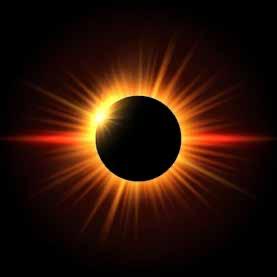
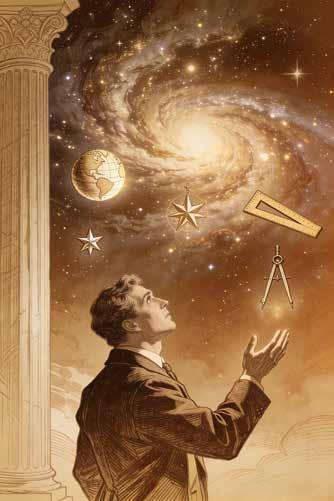
A total solar eclipse occurred on April 8, 2024, and had impacted a wide swath of North America. It was estimated that more than 40 million Americans were in the path of the eclipse. Excitement had built up for this event. Locations along the path of totality braced for increased tourism and crowds. Plans for activities such as watch parties, live online viewing programs, and special airline %ights that followed the path of the eclipse. !e interest in the event was understandable. A er all, the next time a total solar eclipse would impact a large area of North America won’t be until 2045.
However, humans have not always been excited about observing celestial occurrences like eclipses. Since ancient times, people have looked to the skies and studied the heavens. !ey observed the way the moon changed shape and traveled across the night sky. Patterns were recognized amongst the stars that resembled people and animals, which led the ancients to describe them as constellations along with accompanying stories. !ough one of the most terrifying and awe-inspiring phenomena that ancient civilizations observed had to have been a solar eclipse.
!e sun has long held a place of extreme importance in many cultures throughout the course of history. !ey believed that the sun possessed incredible power. It provided warmth, was vital for agriculture, and aided navigation. !e sun is so powerful that it can cause eye damage and potentially blindness if gazed upon directly. As a result, ancient cultures believed the sun held supernatural powers. “It was regularly worshiped as a god – Amun-Ra to the Egyptians and Helios to the Greeks – or as a goddess, such as Amaterasu for the Japanese and Saule for many Baltic cultures.” When solar eclipses occurred, earlier civilizations thought they were bad omens. Since they lacked scienti c understanding, they invented explanations for the sudden disappearance of the sun during an eclipse.
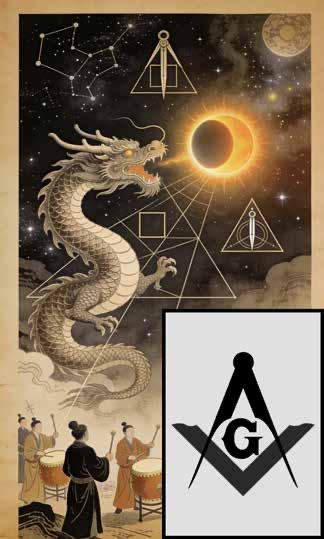
Some of the oldest records of solar eclipses are from ancient China. !e Chinese Emperors feared that solar eclipses were signs from heaven that the stability of their power might be in danger. So, there was a tremendous emphasis on recording and predicting solar eclipses. !e people of ancient China believed that a celestial dragon devoured the sun when the light disappeared. It became a custom to
try to scare away the dragon during eclipses by banging drums and making loud noises. Since eclipses are temporary, it is easy to see how people could assume that their interventions had an impact when the sunlight eventually returned.
In Hindu mythology, it was believed that the serpent god, Rahu Ketu, wanted to devour the sun. To prevent this from happening, Vishnu cut o" his head. However, this did not solve the problem. !e head, Rahu, still wanted to catch the sun and the moon. Sometimes he would successfully catch them, causing an eclipse. !ough with his head no longer attached to his body, the captured sun and moon would eventually fall out of his neck.
!e Vikings believed that Sköll and Hati, two giant wolves, would chase the sun and moon, trying to devour them. Eventually, Hati would catch up with the sun and consume it. When an eclipse would happen, the Vikings would holler and make loud noises to scare Hati away.6
Interestingly, it seems that various ancient cultures believed that some sort of deity or mythical creature was responsible for eclipses. Of course, we have an understanding of the cause of such planetary phenomena in modern times. By utilizing geometry, astronomers can precisely predict when and where eclipses will happen. As Masons, we are taught to study the liberal arts and sciences. So, we should make sure we learn more about the science behind astronomical events, which leads to a better understanding of the universe.
Citations
https://www.brown.edu/news/2024-03-22/total-solar-eclipse
https://source.colostate.edu/ancient-cultures-explained-eclipses/ Han, Y., & Qiao, Q. (2009). Records of solar
eclipse observations in ancient China. Science in China, 52(11), 1639-1645.
https://doi.org/10.1007/s11433-009-0241-8
https://eclipse2017.nasa.gov/eclipse-history#:~:text=In%20Ancient%20China%2C%20 solar%20and,the%20Moon%20during%20 lunar%20eclipses
https://blogs.loc.gov/folklife/2017/08/solareclipse-awe-wonder-and-belief/
https://vikingr.org/other-beings/skoll-hati

by Bob Johnson
Originally published on Deism.com
Wonder is not only beautiful and inspiring, it is also essential to true natural progress. Wonder causes us to ask questions which causes us to discover and to learn. !e knowledge we gain by learning enables us to make advances in every eld known to humanity. !ose advances, if governed by our innate reason and innate conscience, improve our lives and improve humanity as a whole.
When we objectively look at nature and the universe, they seem designed to inspire constant wonder, awe and inspiration. !ey are teeming with fascinating and wonderful designs that promote life and beauty. From the creative intelligence-based workings of DNA to beautiful sunrises and sunsets to galaxy clusters, wonder is found in us and wonder is found all around us. !is inspiration to wonder and awe is the basis of science. It inspires some people to work diligently to discover the how and why regarding these natural wonders. !is, for example, is what caused Marie Curie, who was the rst woman to win a Nobel Prize and the rst person to win two Noble Prizes, one in physics and one in chemistry, to say,
"We must not forget that when radium was discovered no one knew that it would prove useful in hospitals. !e work was one of pure science. And this is a proof that scienti"c work
must not be considered from the point of view of the direct usefulness of it. It must be done for itself, for the beauty of science, and then there is always the chance that a scienti"c discovery may become like the radium a bene"t for humanity."
Due to the advancement of our God-given innate reason and wonder, over centuries of hard work by brave individuals who loved their God-given wonder and reason more than they feared the threats and violence of religions, God-given reason began to prevail over dogmatic religious systems in Europe, rst during the Renaissance in the 15th and 16th centuries, followed by the Enlightenment during the 17th and 18th centuries. !is work has continued in all the world and as !omas Paine pointed out, “the mind once enlightened cannot again become dark.”
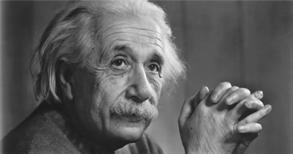
*Editors Note* Continuing the theme of "Wonder," we look now at one of the foremost minds of the 20th century, Albert Einstein.
(!e following quotes are taken from !e Quotable Einstein, Princeton University Press unless otherwise noted.
"My religion consists of a humble admiration of the illimitable superior spirit who reveals himself in the slight details we are able to per-
ceive with our frail and feeble minds. !at deeply emotional conviction of the presence of a superior reasoning power, which is revealed in the incomprehensible universe, forms my idea of God."
(!e following is from Einstein and Religion by Max Jammer, Princeton University Press)
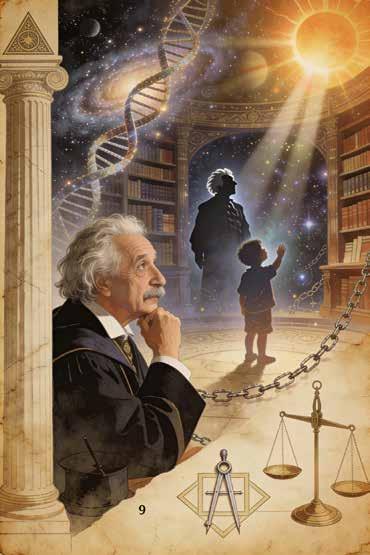
"I'm not an atheist, and I don't think I can call myself a pantheist. We are in the position of a little child entering a huge library "lled with books in many languages. !e child knows someone must have written those books. It does not know how. It does not understand the languages in which they are written. !e child dimly suspects a mysterious order in the arrangement of the books but doesn't know what it is. !at, it seems to me, is the attitude of even the most intelligent human being toward God. We see the universe marvelously arranged and obeying certain laws but only dimly understand these laws. Our limited minds grasp the mysterious force that moves the constellations."
(!e following quote is from Albert Einstein's essay Physics & Reality) "!e very fact that the totality of our sense experiences is such that by means of thinking (operations with concepts, and the creation and use of de"nite functional relations between them, and the coordination of sense experiences to these concepts) it can be put in order, this fact is one which leaves us in awe, but which we shall never understand. One may say 'the eternal mystery of the world is its comprehensibility.' It is one of the
great realizations of Immanuel Kant that the postulation of a real external world would be senseless without this comprehensibility.
"In speaking here of "comprehensibility," the expression is used in its most modest sense. It implies: the production of some sort of order among sense impressions, this order being produced by the creation of general concepts, relations between these concepts, and by de"nite relations of some kind between the concepts and sense experience. It is in this sense that the world of our sense experiences is comprehensible. !e fact that it is comprehensible is a miracle."
"!e fanatical Atheists are like slaves who are still feeling the weight of their chains which they have thrown o# a er hard struggle. !ey are creatures who – in their grudge against traditional religion as the 'opium of the masses' – cannot hear the music of the spheres."
"A new type of thinking is essential if mankind is to survive and move to higher levels."
!e following is from !e Society for General Systems Research, Yearbook of the Society for General Systems Research (Palo Alto, CA: !e Society for General Systems Research, 1956), "!e world that we have made as a result of the level of thinking that we have done so far, has created problems we cannot solve at the level of thinking at which we created them. . . . We shall require a substantially new manner of thinking if humankind is to survive."
"I don't try to imagine a God; it su%ces to stand in awe of the structure of the world, insofar as it allows our inadequate senses to appreciate it."
"Science without religion is lame, religion without science is blind."
"I cannot imagine a God who rewards and
punishes the objects of his creation, whose purposes are modeled a er our own - a God, in short, who is but a re&ection of human frailty. It is enough for me to contemplate the mystery of conscious life perpetuating itself through all eternity, to re&ect upon the marvelous structure of the universe which we can dimly perceive and to try humbly to comprehend even an in"nitesimal part of the intelligence manifested in Nature."
"!e foundation of morality should not be made dependent on myth nor tied to any authority lest doubt about the myth or the legitimacy of the authority imperil the foundation of sound judgment and action."
"A man’s ethical behavior should be based e#ectually on sympathy, education, and social ties and needs; no religious basis is necessary. Man would indeed be in a poor way if he had to be restrained by fear of punishment and hope of reward a er death."
"!e scientist is possessed by the sense of universal causation. His religious feeling takes the form of a rapturous amazement at the harmony of natural law, which reveals an intelligence of such superiority that , compared with it, all the systematic thinking and acting of human beings is an utterly insigni"cant re&ection."
"I appeal to all men and women, whether they be eminent or humble, to declare that they will refuse to give any further assistance to war or the preparation of war."
"It is my belief that the problem of bringing peace to the world on a supranational basis will be solved only by employing Gandhi's method on a larger scale."
!e following is from Elsa Einstein, Albert Einstein's wife, regarding Einstein's development of the theory of general relativity. It's
taken from the outstanding book Einstein and Religion by Max Jammer. It's originally taken from Charles Chaplin's autobiography.
"!e Doctor came down in his dressing gown as usual for breakfast but he hardly touched a thing. I thought something was wrong, so I asked what was troubling him. 'Darling,' he said, 'I have a wonderful idea.' And a er drinking his co#ee, he went to the piano and started playing. Now and again he would stop, making a few notes then repeat: 'I've got a wonderful idea, a marvelous idea!' I said: '!en for goodness' sake tell me what it is, don't keep me in suspense.' He said: 'It's di%cult, I still have to work it out.'"
She told me he continued playing the piano and making notes for about half an hour, then went upstairs to his study, telling her that he did not wish to be disturbed, and remained there for two weeks. 'Each day I sent him up his meals, she said, 'and in the evening he would walk a little for exercise, then return to his work again. Eventually,' she said, 'he came down from his study looking very pale. '!at's it,' he told me, wearily putting two sheets of paper on the table. And that was his theory of relativity.'"
*Editors Note* As these quotes and text from the articles by Bob Johnson of Deism.Com have given us an idea of his belief, Einstein did in fact, write something referred to as, "!e God Letter." As a continuation to what we've printed, we include another piece on the context of that letter, because it is paramount in understanding his thoughts--that they not be taken out of context or used for defamatory or anti-religious purposes.
!e famous “God Letter” from Albert Einstein to the Jewish philosopher and author Erik Gutkind in which Einstein equates the word “God” with “human weakness” needs
to be taken in context. Many people attempt to make it mean Einstein did not believe in God and was an Atheist. is is an incorrect assumption.
Einstein wrote the letter to Gutkind in regards to Gutkind's book, Choose Life: !e Biblical Call to Revolt (PDF). It is important to keep this fact in mind when reading Einstein's “God Letter” as it makes very clear that Einstein was addressing the Bible god and not Nature's God when he wrote, “!e word God is for me nothing more than the expression and product of human weakness, the Bible a collection of honorable, but still purely primitive, legends...”
Einstein wrote, "!e scientist is possessed by the sense of universal causation. His religious feeling takes the form of a rapturous amazement at the harmony of natural law, which reveals an intelligence of such superiority that, compared with it, all the systematic thinking and acting of human beings is an utterly insigni"cant re&ection."
by Chris Hathaway
Looking back at the pandemic, it was a time to remember, or maybe it was a year we would all like to forget. COVID rose into the millions worldwide, and in many places around the world, people are still wearing masks and under tight restrictions. In a normal year, I would say not many people give thought to eventually dying, but during the COVID-times, it was di"erent. During that time, death was all around us. If you are a Mason, you should be prepared and okay with eventually passing away from this earth and into the next. But are we? And, even if we are, are we making the most out of our time here? Life is short, and we need to make it count.
In our Masonic Rites, given at the funeral of Freemasons, we say ‘the cradle and the co&n stand side by side…that at the moment you begin to live, you also begin to die.’ I was discussing this line with a friend who pointed out that, scienti cally, that was not exactly accurate, which is okay by me because much of our teachings are symbolic and not meant to be literal. A er a little digging, though, I found that we actually begin to die around the age of 25--not that that is any better! We are fresh out of school, beginning our careers, starting families, understanding how mortgages and 401(k)s work, and you are rewarded with the process of dying. How lovely! But this lesson teaches us the urgency of living a ful lling life pleasing to our creator, our families, and our communities. Whatever you have on your to-do list, do it NOW. What are you waiting for? My grandpa once told me
if you wait until you have time to do something, you will never do it.
In a song called Death Bed by Powfu he says this:
“Yeah, I don't wanna fall asleep, I don't wanna pass away. I been thinking of our future 'cause I'll never see those days”
Can you imagine being on your deathbed knowing you did not give it everything you had? Are you forming relationships with people so you have a legacy? Everything that I am today is due to someone else giving me their time and teachings. I hope to be their legacy, even if it's just bits and pieces of me. Do the same for someone else. As 1 Corinthians says "Charity extends beyond the grave, through the boundless realms of eternity."
So, love your people today, tomorrow, and the next day. Don’t wait until the funeral to give your speech about them. Say it now, write it now. I fall into this trap constantly. I get too busy to slow down and make that extra phone call or go out of my way for that extra visit. I have never regretted an extra e"ort, and you won’t either.
As my middle school basketball coach liked to say, “Life’s short, shoot the ball!”
by Ken Moore, Historian Manito Lodge No. 90
*Editors Note* !is essay was an address given to a gathering of Brothers at the request of their Grand Master at that time. Becasue it sets the tone, I chose to include Woshipful Brother Ken Moore's opening remarks as he began his keynote at Chinguacousy Lodge No. 738 on September 30, 2019.
WM, W. Bro. Martin, thank you very much for welcoming me here this evening.
I have prepared a discussion regarding some of the many links between astronomy and Freemasonry. I’m very grateful for the opportunity to share it with you, my brethren at Chinguacousy Lodge, and on an occasion near the Autumnal Equinox, when there are 12 hours a day, 12 hours a night, and the Sun – which is an emblem of knowledge- lights us equally, should you live anywhere, on our tilted Earth.
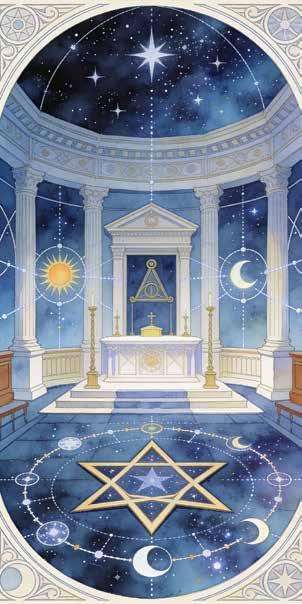
Here, in a Masonic Lodge Room, symbols are all around. Many of these symbols represent things from beyond this Earth, the Sun to rule the day, the Moon to rule the night, and, in the East, just to the Worshipful Master’s right, there is a ve-pointed star-shaped symbol. !is is meant to represent Venus. But why is it here?
To uncover why this may be, let’s imagine the Temple Building has no roof. It’s high twelve and as we sit here, under the midday Sun, we’re traveling through space on an Earth that is turning. If you’re facing west, you are turning backward, and the horizon is rising. A er the midday Sun, as it would appear to us, disappears below the western horizon, all natural light is eventually diminished except
that from the stars above, as they appear to fall in the sky. Or so it may be.
During some years, just before nightfall, a bright object appears near the western horizon. !at luminary, in the west, is Venus. Venus is a planet. Earlier observers, including the ancient Greeks and Egyptians, mistook it for two separate stars, but it is the planet second nearest to the Sun. Venus is always closer to the Sun than is the Earth. Venus shines because –either before the day begins or a er the day ends- the light from the Sun, which itself is hidden below one of our horizons, is being re%ected back to Earth. In a Masonic Lodge, Venus is shown in the East, where learning originated, and shown as originally mistaken to be a star. !is tells of the journey we are on and how astronomy has continually helped to raise ignorance from despair. Let’s recall that to early man, the Universe was alive with forces and powers beyond their comprehension. In this, our modern time, it is di&cult to fully comprehend the e"ect of what appeared to be happening in the heavens, as it occurred to early man. We can hardly imagine their terror of the comet or sense their awe and reverence for the Sun and the Moon because we are too well educated. We, in fact, know much about the architecture and proportions that make the Universe a vast machine. !e questions, which we pondered as a result of unaided visual observations, have all been answered. !rough research and exploration, we are now learning about cosmic events that occur hundreds of thousands of light-years away, well beyond the perimeter of the Milky Way. !e study of astronomy is pushing back the frontiers of science, and the connection between astronomy and Freemasonry is ancient.
According to Greek mythology, which goes back to the very dawn of civilization, one of their Gods, Zeus, was nourished in infancy from the milk of a goat. In gratitude, Zeus placed this goat up in the sky to remain forevermore as a constellation, but rst gave one of the goat’s horns to his nurses with the assurance that it would forever pour for them whatever they desired. !at horn of plenty is the cornucopia; it is a symbol of abundance. !e cornucopia is the jewel of the Stewards’ o&ce. It is found on both their collars and their wands, too. !e one-horned goat from which it came is found in the constellation Capricorn, which adds another signi cance. Our Sun begins its passage through the constellation of Capricorn at the Winter Solstice, when it is also at 900 degrees to the tropic of Capricorn, on Dec 21st. At the Winter Solstice, the Earth’s axis is tilted directly away from the Sun, and a er that, each day begins to get longer. Cornucopia marks the change of season and the coming spring. !ese allegorical and also the more conspicuous lessons woven throughout each Masonic degree are, by all accounts, very old, and astronomy is one of the many things Freemasonry is intended to convey to its members. To e"ectively express how intricate the relationship between astronomy and the Cra in fact is, we must rediscover a very important day in history, the day on which you were made a Mason. On the day you were initiated, your Mother Lodge o&cially began with knocks from the East, wherefrom the Sun rises. Next to speak, Bro. Junior Warden was seated 1⁄2 way across the Lodge room to mark the midday Sun. Bro. Senior Warden informed all that he closes the Lodge from his chair in the west, where the Sun sets. !is is done to convey an informed and intimate understanding of where we are on Earth, and also within the solar system.
You are each too expert in the principles of Freemasonry to require much reminder that
our Lodges are opened in the name of the Great AOTU. Perhaps, you may even recall that, a er being received in open Lodge for the very rst time, Brother Chaplain o"ered prayer to the Almighty Father and Supreme Governor of the Universe. So mote it was. You then rose from kneeling and perambulated the lodge, going from east to west by way of the south, as does the Sun. Your circumambulation about the Altar was in imitation of the course of the Sun.
A er perambulating the Lodge, you were brought to the center, hoodwinked. You hadn’t seen an open lodge room, so the predominant wish of your heart was indeed knowledge, literally and metaphorically light. A er you asked for light, you were shown what it is about us here today, but rst, the Worshipful Master imparted some things quite profound to you. When you were initiated, the most modern understandings regarding creation were revealed to you, as they are to all Apprentices, and as they have been since time immemorial. A er taking your Obligation, you were told: In the beginning God created the Heaven and the Earth. !e Earth was without form and void; and darkness was upon the face of the deep. And the spirit of God moved upon the face of the waters, and God said let there be light. And there was light.
To put that which is told and also demonstrated to all new Masons into context, let me summarize some important things astronomy has helped to discover: Less than 15 billion years ago, all around us was a void. Stillness and utter darkness were all around. All of matter was without form and, in a single place. Scientists call this a state of singularity. !en, at this single place in what is the center of the ever-expanding Universe, a Big Bang occurred. All of creation began. And there was light.
Every material thing we have ever been able
to de ne, to measure, or in any way have come to know, originated from a single place. From a purely scienti c perspective, every single thing you are grateful for came from the singularity. How then came to be that which, like a singularity, science does not measure? Where did morality, virtue, brotherly love, and the indefatigable spirit of mankind begin?
!e entire Universe, which surrounds us, came from a single source, far removed from our earthly abode. And just like how the Universe began, your initiation to the Cra began in a state of complete and utter darkness. !e creation of the Universe and that of a newly obligated brother among Masons each occurred in the center. Your journey as an Ancient, Free & Accepted Mason, it also commenced with a tremendous Bang. And there was light.
by RWB Chad M. Lacek, 33˚
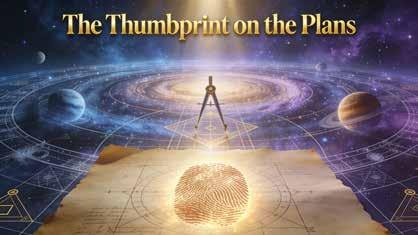
Freemasonry has long encouraged the study of the Liberal Arts and Sciences. !is is not o"ered as a casual suggestion, nor as an academic formality. It is a directive with purpose. We are meant to study, not simply to know more, but to understand more. !e world around us is not a backdrop. It is a text, and we are expected to read it.
At rst, this instruction can seem modest. We are told that the Liberal Arts polish and adorn the mind, and that Geometry is the foundation of our art. Many hear this and think of school lessons, formulas, and diagrams long forgotten. It is easy to assume that the point is education in the ordinary sense. It is not.
!e study of the sciences, and Geometry in particular, trains us to recognize order. It teaches us that beneath what appears to be complexity lies structure, and beneath structure lies consistency. It gives us a way to look at the world that goes beyond surface impressions.
Once you begin to see this way, the world changes. Consider the motion of the heavens.
!e planets do not wander aimlessly through the sky. !eir paths are exact. !eir movements can be calculated with astonishing precision. Eclipses occur at predicted times. Seasons arrive in their proper order. !e same patterns repeat, not approximately, but reliably.
Closer to home, the same principle holds. !e tides rise and fall according to measurable forces. Light behaves in predictable ways. Matter organizes itself into stable forms. Even the smallest particles follow rules that can be studied, described, and anticipated. !is is not chaos. It is order of the highest kind.
!e study of science reveals these patterns. Geometry gives us the language to describe them. Together, they allow us to see that the universe operates according to unfailing laws. We rely on them every day. We build structures that stand because we trust these laws. We navigate the world because we trust these laws. We make predictions because we trust these laws. But trust invites a question. In whom do we trust?
Freemasonry does not approach this question timidly. It does not suggest that the order we observe is accidental, nor does it treat it as a mystery beyond consideration. Instead, it invites us to reason from what we see.
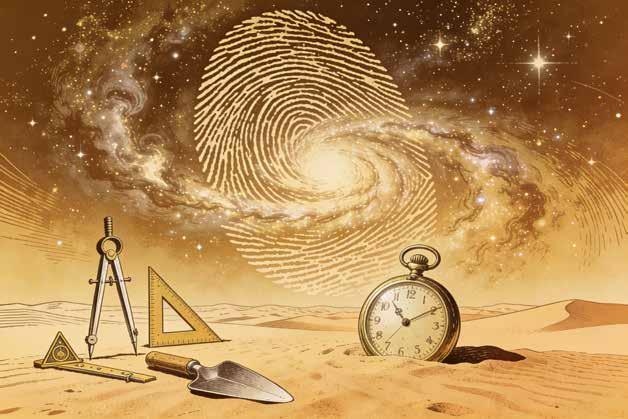
Imagine yourself alone in a vast desert. !ere is no sign of life. No footprints. No roads. No evidence that anyone has ever passed that way. As you walk, you come upon a pocket watch lying in the sand. It is intact. It is running. !e time it displays matches the clock on your cell phone.
You would not hesitate for a moment in your conclusion. !e watch did not assemble itself. It did not wind itself. It did not arrive there by chance. Its very existence, and its continued operation, are proof that it was made, and that it was handled by an intelligent being. !e watch is not merely a suggestion of a maker, It is proof of one.
!e universe presents us with something far greater than a watch. We do not observe a single mechanism, but an entire system of interdependent processes, each operating with precision. !e more closely we examine it, the more intricate it becomes. From the movement of galaxies to the behavior of the smallest particles, everything follows laws that are consistent and intelligible.
!is is not a loose arrangement. It is a coherent system. When we discover order, we are not discovering randomness that happens to repeat. We are discovering structure that has been laid out in advance. !e laws of physics are not suggestions. !ey are constraints that govern everything that exists.
!is is where the lessons of the Liberal Arts and Sciences become clear. !e order we observe is not merely evidence of a system. It is the signature of its author. !e pocket watch in the desert tells us that someone was there. !e order of the universe tells us that Someone is here. Not in a distant or abstract
way, but in the very structure of reality itself. Every predictable orbit, every consistent law, every measurable relationship is a mark le behind by the intelligence that designed it. It is, quite literally, the Creator’s thumbprint on the plans.
We o en think of proof as something conned to mathematics or experiment. Something that can be written down and veri ed step by step. But there is another kind of proof, one that arises from recognition. When the human mind encounters order of a certain kind, it cannot help but infer intention. We recognize design because we are capable of it ourselves. We know what it means to plan, to measure, to construct. When we see those same qualities on a scale far beyond our own, the conclusion follows naturally.
Freemasonry begins with the assumption of a Great Architect of the Universe. !e study of the Liberal Arts and Sciences does not replace that assumption. It con rms it, reinforces it, and gives it depth. Astronomy shows us the scale of the design. Physics reveals the rules that govern it. Geometry provides the framework through which it can be understood. Each discipline adds clarity, not by changing the conclusion, but by making it unavoidable. At the same time, this study teaches humility. We are not the authors of these plans. We are the observers of them. Our understanding is partial, our tools are limited, and our perspective is narrow. Yet even within those limits, we can see enough to recognize that the universe is not self-creating. It bears the marks of intention.
Freemasonry does not ask us to solve the universe. It asks us to study it. To observe carefully, to think honestly, and to draw conclusions that are consistent with what we see. !e more we do this, the more di&cult it becomes to dismiss the order around us as accidental. !e patterns are too consistent. !e structure is too precise. !e system is too complete. !e thumbprints are everywhere.
!e study of the Liberal Arts and Sciences is therefore not an academic exercise. It is a method of learning to recognize the work of the Great Architect. Every law we discover, every pattern we understand, every measurement we con rm brings us one step closer to appreciating His designs. We may never meet the Architect. !at is not required. It is enough to see His work, and to recognize His mark upon it.
Freemasonry BCY Website Entry https://freemasonry.bcy.ca
References in masonic writings to the sun, the moon, the starry rmament and the blazing star combined with the fondness of masonic artists and architects for representations of zodiacs and star charts have led both non-masons, anti-masons, and a few freemasons, to believe that astrology is somehow an integral part of the history, if not the beliefs and practices of Freemasonry. But nowhere in the rituals or practices of Freemasonry is there any hint of astrology, or belief in divination.
Several late-twentieth century books either claimed to link Freemasonry to astrology, or have been quoted by others attempting to forge such a link. David Ovason’s !e Secret Zodiacs of Washington DC is critiqued elsewhere on this site (Link in the by line).
!e following notes demonstrate that at least two recent books do not prove Freemasonry’s links to astrology.
By Joy Hancox
ISBN 0-224-03046-9. 320pp. hardcover London, Jonathan Cape, 1992.
Joy Hancox has written an interesting book detailing her discovery of the history and meaning of a collection of seventeenth century drawings which came into her possession.
!is book elicited enough interest in masonic circles to be reviewed by Bro. the Rev. N.B. Cryer in the 1991 edition of Ars Quatuor Coronatorum, Vol. 104 where he noted:
"Joy Hancox does not attempt to make any suggestions about the implications for Freemasonry as that is, she readily admits, not her
"eld or principal interest. !e book has enough fascination for the reader in the main revelations that it pro#ers but its pointers towards Freemasonry are also not hidden, Here at least is a source of new thinking and evidence that we shall ignore to our loss."
Bro. Cryer is perhaps overgenerous. !is book is an interesting study of a "collection of 516 drawings which by their texture, watermarks and occasional notations have proved to be a gathered selection of architectural, nautical, symbolic and even cabbalistic representations from the late sixteenth to the early eighteenth century." But the connection to Freemasonry is tenuous.
Hancox is neither an academic nor an historian and her work raises the question of academic rigour. !at Byrom was a freemason, and a member of the Royal Society, and that he associated with the founders of modern Freemasonry is documented. But this does not prove that astrology was incorporated into the teachings of Freemasonry. Freemasonry teaches us to explore the liberal arts and sciences which include astronomy and mathematics—which incorporated astrology. But this does not mean that Freemasonry incorporated astrology into its teachings or practices.
Hancox demonstrates that John Byrom (1691-1763), the collector of these drawings, was an associate of Drs. James Anderson and John Desaguliers, two proponents of the founding of the Grand Lodge of England in 1717; and that they were of his circle of friends and associates. But this is no proof that they participated in his astrological studies or included these studies in their under-
standing of Freemasonry.
As an example of Hancox’s imagination getting ahead of the facts, she notes that Byrom "writes in his journal that he told the Sun Club he was going to establish a Cabala Club." Without a single other citation to this club, Hancox makes numerous allusions to its assumed membership and meetings. She admits "an unexpected silence about the further meetings of the Cabala Club" [p. 13.] but appears to keep mentioning it just as a reason to keep using the word "cabala."
She assumes that these drawings were of use to Byrom "... who included them with others as source material for study at his Cabala Club." [p. 124.] And "later came to the conclusion that this group met in London in rented accommodation to discuss the drawings." [p. 295 n2,2] In the face of a complete absence of references or documentation, she poses the question: "...had the Cabala Club gone underground?" [p. 13.] !en again, maybe the club never existed except as a chance remark by Byrom to his friends.
"It seemed evident to [an unidenti"ed librarian at the !eosophical Society] that the group using the drawings had come to a halt, otherwise they would have been passed on by Byrom to his successor." [p. 17.] !e existence of any group is speculation. !ere’s no membership list and no record of meetings—only one entry in Byrom’s diary.
Hancox spends much of her book detailing her search for links, and many there are. Corrolation, causality and signi cance is a di"erent matter though. Another member of the Quatuor Coronati Lodge, Terence O. Haunch, has written "Unless, that is, there really was some sort of inner esoteric circle, but of this my mundane and sceptical outlook makes me doubt." [p. 20.]
In attempting to link the drawings with cer-
tain London theatres, Hancox notes "it is dif"cult to date the drawings with precision" [p. 126.] placing some of them "pre-1647 possibly 1600" while the handwriting on others could be anywhere from 1570 to 1730, yet claims that "Despite the absence of watermarks, I would suggest that the parametric drawings are contemporary with the theatres." [p. 127.] In fact, Hancox has not really demonstrated that any of these drawings had any bearing on the original construction of these buildings.
Two quotes su&ce to exemplify the level of supposition and conjecture underpinning the whole book: "One of the drawings has a most unusual watermark in the shape of a pentalpha." She writes, "Its presence as a watermark must mean that the paper-maker was either a freemason or a Rosicrucian" [p. 167.] She ignores the fact that the pentagram had other meaning and uses during the period and was not exclusively cabalistic, masonic or Rosicrucian.
Referring to another of the drawings, Hancox notes "...its connection with the Royal Society and Byrom’s Cabala Club. In the centre is the six-pointed star, which immediately links it to the masonic movement...." [p. 172.] Again, the hexagram was not exclusively masonic, being found on German tavern signs and in hermetic treatises.
Hancox further suggests "Alternatively it could have been lodged with a secret group within the Royal Society." [p. 231.] It is easy to make conjectures. But without further proof, this is nothing but idle speculation.
!ese notes are not intended as a review of Hancox’s book, but more as a counterpoint to those who would claim that her book supports any theory of a link between Freemasonry and astrology. In her own words, this was never her intention.
!e Sun in the Church: Cathedrals as Solar
Observatories
J.L. Heilbron.
Harvards University Press, Cambridge, Massachusetts, London, England.
Second Printing 1999
Includes bibliographical references and index.
ISBN 0-674-85433-0 (alk. paper)
J.L. Heilbron has written a comprehensive and solid study on how the needs of astronomy were incorporated into the architecture of mediaeval cathedrals. Detailed and well footnoted, this book should be of interest to students of both history and architecture. But it does not, as some might wish, demonstrate any alliance or interest between the practitioners of astrology and the stonemasons who built the cathedrals, or the clerics who commissioned them.
Mediaeval astrology is sometimes termed the equivalent or precursor of today’s astronomy. But astronomy and astrology were co-existent streams of study, the former being the mechanics of the latter but the latter not requiring the former as a purpose or reason. Granted, many practitioners of astronomy also practiced and believed in astrology. But they are clearly two separate studies.
In 819 CE Archbishop of Mainz, Rabanus Maurus, wrote "Astronomy... teaches the laws of the steller world.... which is built up on the investigation of natural phenomena in order to determine the course of the sun, of the moon, and the stars, and to e#ect a proper reckoning of time." He doesn't mention any connection with the purposes or functions of astrology.
Masonic author, Art deHoyos, notes that in a letter written to a friend, Albert Pike wrote: 'I think that no speculations are more barren than those in regard to the astronomical character of the symbols of Masonry, except those about the Numbers and their combinations of the Kabalah. All that is said about Numbers in that lecture, if not mere jugglery, amounts to
nothing .... !e astronomical explanations of them, however plausible, would only show that they taught no truths, moral or religious. As to tricks played with Numbers, they only show what freaks of absurdity, if not insanity, the human intellect can indulge."
Heilbron notes that to the early mediaeval academic, mathamatics "included astronomy and astrology...the exactness of the one and the complexity of the other." [p. 84.] He goes on to note: "Eventually the passion for accurate prediction, realized in astronomy, could not survive in the same mind with tolerance for the fuzzy forecasts of astrology." [p. 84.]
!e books presents a list of mediaeval astronomers who wrote of their distate for astrology: Giovanni Domenico Cassini, the Sun King’s astronomer for 40 years, who lost his faith in astrology; Domenico Guglielmini, who broke with astrology; Geminiano Montanari (1665), who was an opponant of astrology and published a well circulated lampoon, Astrologia in 1685 [p. 85]; Giambattista Riccioli, author of Almagestum novum and Francesco Maria Grimaldi, who despised astrology [p. 85.] and wrote: "If the public did not believe in astrology, books on astronomy would not sell."
As an example of the con%ict between popular belief and academic knowledge, Heilbron notes that at the University of Bologna "every year one of the three professors of mathematics had to publish an astrological almanac "whether he believed in his forecasts or not" [p. 85.]
!e Sun in the Church is well written and clear in its premise that the Church encouraged clearly de ned areas of science. But it doesn't imply that the Church, stonemasons, or astronomers necessarily or willingly practiced astrology or that divination was their goal. Many of the astronomers cited were de nite in their distaste for astrology. !e use of astronomy in the prediction of the motion
of stars and planets is not the same as the prediction of events on Earth. Stonemasons and architects designed structures to predict the former, not the latter.
by Darin A. Lahners, FILOR
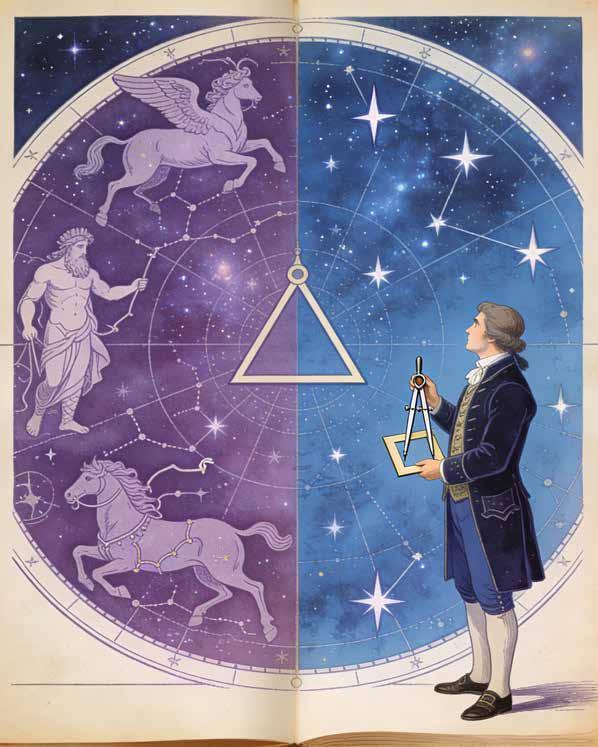
One of my favorite lines from ritual comes from the Fellowcra degree's Middle Chamber lecture. “Numberless worlds are around us-all framed by the same Divine Artist-which roll through the vast expanse and conducted by the same unerring law of nature.” As much as we know from scienti c advancement, there is still so much we are ignorant of. !e prevailing thought is that the universe is innite; however, some recent arguments have arisen to challenge this theory. We know that the universe is vast, however we do not know if it is in nite.
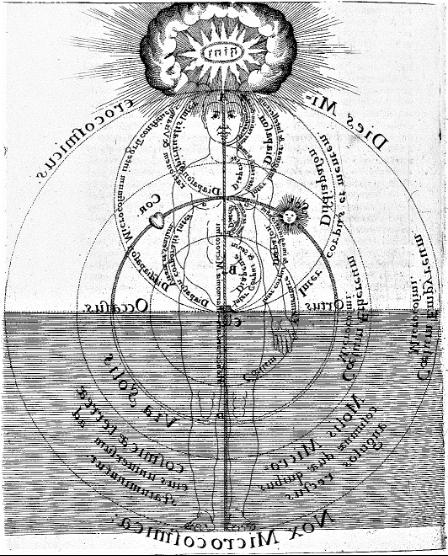
!e line reminds me of the hermetic axiom: Quod est superius est sicut quod inferius, et quod inferius est sicut quod est superius. !at which is above is like to that which is below, and that which is below is like to that which is above.
I’ve always taken the ritual to mean that there are worlds around us that cannot be perceived except with the aid of modern science, and worlds that modern science cannot explain.
Many brethren may or may not want to admit when they have some experience that cannot be explained by our current understanding of science. I think that there’s a better than average chance that many of you have witnessed something that might be considered supernatural, or highly strange. I am going to share one of my own experiences to illustrate the point of this article.
You might think me mad, or think that I am telling a falsehood, and the story is so odd that I wouldn’t blame you if you did, but I assure you that this event is one of many strange events that I have witnessed during my lifetime. My point is that science is not yet able to explain everything, and that sometimes the only plausible explanation is one in which you realize that the Great Architect is as mysterious as it is wise.
I don’t know how many of you brethren believe in omens, but one that has been prevalent in my family is seeing a bird in the house prior to a family member’s death, on
my maternal side. Prior to my great-grandmother’s death, my brother, who was 2 or 3 at the time, came to my dad in great excitement, talking about the bird that was in his room. My dad and I quickly ran to my brother’s room. My brother, Scott, was adamant about the bird, his face re%ecting the amazement of what he was seeing. !ere was no bird that my dad or I could see, however it was clear to me that it was one that my brother could see. Shortly therea er, we received the news that my great-grandmother had passed away.
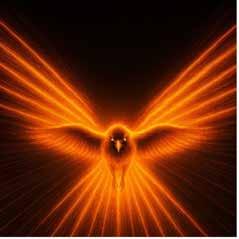
Long before I became a Freemason, Mother’s Day in 2002 was spent at my parents’ house. As my Aunt Carol (my mother’s sister) and my Uncle Dennis were telling me goodbye, I saw what I can only describe as a spectral, %aming black bird with trails of light coming from it %y over his head. !e encounter lasted a second or two. It appeared and disappeared. I was trans xed by it. I knew exactly what it meant. I also knew that no one else had seen it, because I believe that if my daughter, who was not even two years old at the time, she would have had some reaction. It was just so profoundly transformative. Without any doubt, I knew that there was something greater than us all. I was so convinced that they were going to have an accident, I called my parents when I got home to ask them if they had heard if they had gotten home okay. !ey had. My uncle passed away from a brain aneurysm within a week of this happening.
Our modern understanding of science does not diminish the sense of mystery that I felt during this experience, and that I still feel in recounting it. As a so-called “Esoteric Mason, ” it has been my goal to use Freemasonr y, and the study of the Seven Liberal Arts and Sciences, as well as esoteric knowledge, to attempt to understand the heavenly realms, both those seen and unseen. I have always had a fascination with Astronomy, and it is only when you are able to gaze through a telescope to see in greater detail the planets, Mars, Venus, Jupiter, and Saturn, that you really understand how small each of us really is in the vastness of the universe. Yet, I also know that the supernatural event that I experienced gave me the same feeling.
!e more that modern Cosmology learns about the universe, the more apparent it becomes that knowledge does not conquer wonder. Each scienti c innovation pulls back a layer of the veil only to reveal yet another one behind it. here was a time when man arrogantly believed that the Earth was the center of the universe, and that the sun and planets revolved around it. Today, we know this to be false. We know that our world is just a drop of water in a cosmic ocean.
Yet, this realization does not render us insigni cant in a spiritual sense. On the contrar y, it suggests that consciousness allows us to be capable of re%ecting upon the Great Architect’s creation and stand in awe before it. Returning to the Middle Chamber Lecture, we are taught: “!e letter G has a still higher and holier signi"cance. It alludes to the sacred name of Deity before Whom all Masons from the youngest Entered Apprentice who stands in the Northeast corner of the lodge to the Worshipful Master who presides in the East, together with all created intelligences, should with reverence most humbly bow.” To apprehend the scale of the universe is to confront this humility, and humility must always be a
prerequisite for wisdom.
Science is not an adversary of faith but a disciplined form of wonder. It is a methodology that teaches the mind to observe carefully, to question honestly, and to accept results based on those observations. Religions and other spiritual traditions o"er a language for those mysteries that lie beyond quanti cation. Where science describes how the heavens move, spirituality asks why their beauty moves us at all. Scienti c theorems and reverence for the Great Architect are not opposing forces but complementary tools, each illuminating di"erent aspects of the same reality.
!is is what is meant when we re%ect upon the macrocosm and the microcosm, the above and the below. When we are taught in the Middle Chamber lecture, “By geometry we may curiously trace nature through her various windings to her most concealed recesses. By it we discover the power, wisdom, and goodness of the Grand Arti"cer of the Universe, and view with delight the proportions which connect this vast machine. By it, we discover how the planets move in their respective orbits and demonstrate their various revolutions. By it we account for the return of seasons, and the variety of scenes which each season displays to the discerning eye ” !e patterns that the Liberal Arts and Sciences uncover in nature, such as the archetypal repetition of forms of sacred Geometry and the symmetry of physical laws, highlight the correspondence between microcosm and macrocosm that were expressed in the Ancient Mystery Cults; a tradition that Freemasonry continues.
It is humanity’s collective profound sense of wonder that is the true bridge between science and spirituality. It is Wonder that keeps the scienti c mind honest and the esoteric seeker grounded. Wonder reminds us that no
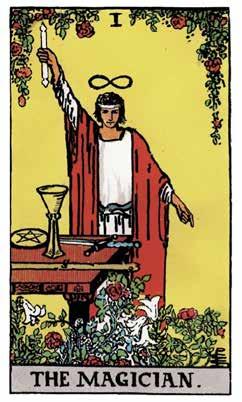
matter how much we come to know, there will always remain something beyond our grasp of understanding, something that requires belief. Every time we stand beneath the starry decked canopy, the vault of heaven, whether through our ritual’s words, our personal experiences, or the lens of modern cosmology, we must realize that we are participants in a creation far greater than ourselves, shaped by laws we can study, and surrounded by meaning we can only approach with humility, gratitude, and awe.
by Robert H. Johnson, FILOR
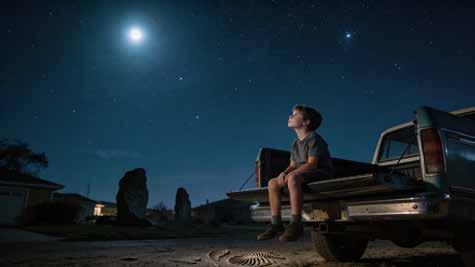
Before ever becoming a Mason, I’d always been an inquisitive person. As an adult, it led to higher education, and as a teen, it led to questioning authority, asking why people needed to do this or that.
Going far enough back, I nd myself as a kid at night sitting on the back of my grandfather’s Dotson truck, tailgate down, and eyes up.
!ere, in the opaque skies over Southern California, I could make out a few stars. I’d look up and imagine I was staring at a distant world described in one of my grandfather’s National Geographic or Popular Mechanics magazines.
What color was the sky there? Was there oxygen there? What elements did we need on a world to let humans exist…out there? !e fascination with outer space, other worlds, and what else could exist in the vastness of space never le me. Over time, my fascination changed to archaeology. I’d think about the logic of trying to understand what was here on earth before moving out there
into space.
As most of us do, even if we never talk about it out loud, I began to have questions about our origin, about what caused humans, animals, plants, and all that exists to be here on the Earth.
Existential crisis imminent! I was 11 years old.
I remember lying in bed, late at night, on the other side of the wall, I could hear my dad talking to his son on the phone, my half-brother in New York. It wasn’t uncommon for the late phone calls. We lived in Naples, Italy, and late for us was evening for them.
Far from my old neighborhood in Garden Grove, California, I lay there and listened to my dad say, “I’ve got cancer. My lungs. It’s not good. We’re coming back to the states, to San Diego, for treatment.” A er a pause, I heard him say we’d %y into New York and stay with my brother for a few days before driving across the country, seeing the sights, and
settling in San Diego.
Dad died that August. My rst foray with death. And just like that, mom packed up the house, cashed out dad’s life insurance, and we moved to the Midwest.
Other worlds, life in space, past life and civilizations on earth, and now death.
Up to this point, I’d been raised Roman Catholic, and at about sixth grade, I remember, I thought this whole system, this book [the Bible], was nothing but a story, a fairytale with lessons for kids and adults alike. I became obsessed with studying the world’s religions, something for which I later received my degree.
While this was happening, I also began an a"air with the sciences. Science was real. You could conduct a set of steps and get observable results. Replicable results.
And just like that, Werner Heisenberg’s o en-quoted quote was true for me as well. “!e "rst sip from the glass of natural sciences will turn you into an atheist…”
As I progressed in my education, read books, attended lectures, participated in debates, and began writing, I found myself yet again on a threshold. Knowing a fair amount about the world we live in, its peoples, cultures, religions, and customs, and all the while reconciling this with my other passion, mathematics, became a paradox.
I had lost my wonder. I saw that things were just the way they were, black or white. A %aw my therapist, Faya, would call me out on o en. I refused to assign anything that had not been explained in the world as a miracle of God or to just “have faith” when we hadn’t, as a species, gured out what we wanted to know yet. To do this, to me, was an excuse for
lazy thinking.
Instead, it was, as the scienti c community calls it, “God’s Receding Pocket.” Everything we fail to understand ts into this “pocket.” As we gure things out, the pocket gets smaller and smaller. “Would we ever know it all?” I wondered.
“Ah…” I wondered, yet again. !e idea of “knowing” was intriguing to me. Do people really “know?" Or do they just have convictions in their beliefs? To know this, I had to ask myself what *I* knew, and conversely, what *I* believed. !ey couldn’t be the same, or could they?
I knew what people believed. And I believed what *I* knew.
Perhaps it was my age, or a life event—this was about the time of the birth of my rst son, that my thoughts returned to the origin of humankind. Knowing that Earth had a twin in its formative years, and that they collided. !is led to the formation of our moon, which caused tides, which led to tide pools, and then to a melting pot of bacteria and cellular life. Each subsequent environment allows for biological changes to amend the organisms growing within, creating diversity.
I mentioned earlier my love of mathematics. Well, I began to wonder—how truly rare is life? !at all these things had occurred in such a way as to allow what we now marveled at, as our world, to exist at all.
It was, by all our scienti c calculations, impossible. Creation and our existence were essentially the greatest lottery ever won. In a world where religions had looked for miracles, they had failed to bear witness to the greatest of all miracles. !at each of us is comprised of just the right cells, just the right ratios, just the right combination of electrical
signals and receptive senses that we are…us. !at we are here!
When the ancient gods of Sumerian lore discussed where to hide the greatest secret from man, one god said, “Let us place the secrets on the highest mountaintop.” But another god pointed out that man was tireless and driven. He would surely nd it. Another god suggested, “Let us hide them at the bottom of the oceans.” And another god said, “Yes, but as our brother has said. Man is mad for power and will stop at nothing to create ways to grasp the secrets.” At last, the king of the gods spoke. “Let us bury the secrets. Let us place them deep within the place man will never look—in his own heart.”
!us, the miracle—the spectacle of our “ mere” existence, is something that we should be in constant awe of.
!e idea of an all-powerful Creator eluded me. If this “architect” existed, it must be as Dr. Michio Kaku has said, “A mathematician.” Life is too rare for it not to be intelligently designed, no?
In the nite, there is the in nite. !e probability of life existing or manifesting in the way it has, with the simple elements available in our section of the universe, is monumentally small. We call this calculation the Abiogenesis. !ere are several versions of this calculation, to be sure. Most will agree, however, that Abiogenesis says the odds are as close to zero as you can imagine. Simply put, we should not be here.
While it is impossibly close to zero, it isn’t zero. If I then tell you that the probability is, for imaginative purposes, an arbitrary number like 0.02%, we have a place our minds can begin to rationalize, in a sense, how rare we are. But let us rip the veil asunder! If the universe is, as we may say, nearly in nite, that is,
beyond any rational conception we can form, then there we nd expansion.
Any probability we may measure in relation to our existence is then multiplied by the size of the enclosed system in which we live. !is is or is nearly in nite.
!ink 0.02% * In nity = an in nite digit. Said di"erently, life like ours must mathematically exist everywhere, in nitely.
Now we nish the quote by Heisenberg I began earlier, “!e "rst sip from the glass of natural sciences will turn you into an atheist… but at the bottom of the glass, God is waiting for you.”
In May of 2008, in an interview published in L’Osservatore Romano, Jesuit Father José Gabriel Funes, director of the Vatican Observatory (appointed by Pope Benedict XVI), argued that alien life ts within faith because it expands God’s creative scope. He said, “Ruling out the existence of aliens would be like ‘putting limits’ on God’s creative freedom.” He also mentioned in the same interview that any extraterrestrials we encounter would be our Brothers. What a wild concept to think about! !e largest church organization in the world had an opinion on this issue.
In essence, the discovery of life outside our world does not limit God but expands God. Giordano Bruno thought similarly. As did Cayatno Ripoll, Benjamin Franklin, !omas Je"erson, and a slew of others. !ey looked to the natural world and concluded that even if man had not created books and attributed them to their gods, even if religions had never developed into dogmatic systems, there would be one church all around us, which is our world and the cosmos. !e divine scriptures were the natural laws that governed reality.
“…on the seventh day, our ancient brethren consecrated as a day of rest from their labors, thereby enjoying frequent opportunities to contemplate the glorious works of the Creation…”
It was in the words of !omas Paine that I now saw, at almost 26 years of age, the mathematics of God. Of a “Divine Mathematician.” I no longer needed to believe. I knew. Awe, Wonder, Inspiration, Discovery, Progression.
To the glory of the Great Architect of the Universe, we give thanks for the wonder and magic manifest through a code, a mathematics, a working divine. We stand in Awe.
by Scott S. Dueball, PSEO, PM
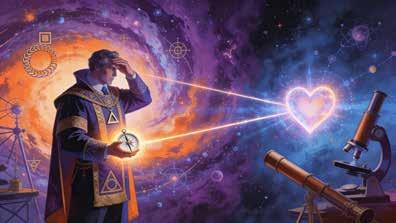
Before venturing further into a newer domain of science, it is essential to re%ect on our station as Master Masons seeking to become better men. In this transitional phase, we maintain a delicate relationship with the intellect. As Mystics, we believe that God created all in the divine image, encompassing both the head and the heart. Yet, as men living on the material plane, we cannot simply abandon the intellect as it was divinely given; instead, we strive to restore and cultivate a harmonious balance between heart and intellect. !is journey is not merely about equilibrium (two parts in dynamic balance), but about achieving a profound union (parts have become one)—a union that safeguards us against fallacious beliefs and misguided faith.
While we seek this union, there is a real risk in relying solely on faith without the guidance of intellect. Such reliance can lead to madness. Intellect is important, especially when we face demonstrable facts that challenge our beliefs. It is easy to accept weak ideas, whether in daily life—by trusting %awed people or systems—or in spiritual matters, where we might rely on surface-level meanings instead of seeking deeper understanding through real experience. Speaking
of those who take spiritual symbols literally and miss out on their true, esoteric meaning with transformative power.
!e Senior Deacon’s lecture tells us that “a survey of nature…"rst determined man to imitate the divine plan.” If our aim is to understand nature, then science is our chief method of attaining this awareness. Expanding our understanding of nature broadens our awareness of what is possible. Meanwhile, the scienti c method tends to stall our consideration of what might be possible. !e scienti c community accepts truth in rigid, conservative, and structured ways. To that end, Neuroscientist and researcher, Julia Mossbridge, highlights that our brains are conditioned to ignore anomalies, the persistent presence of which points to new possibilities (Mossbridge, 2024). If the data don’t support the current hypothesis or a logical next step, we have extensive, so-called post hoc statistical methods to remove them from the data. A scienti c fact begins as a mere possibility, evolves into an idea, then a hypothesis, and only a er rigorous testing and repetition does it earn broad acceptance from the scienti c community. In Mossbridge’s opinion, treating such possibilities and anomalies removes them from achieving
the status of acceptance. For the scienti c community to accept a new truth, a su&cient number of people who are more open to possibilities than strict scienti c proof must rst support the idea.
What I am suggesting is that there is always a limit to what is possible for an individual to believe. By examining emerging evidence, we raise the ceiling on what we previously considered possible. We are freed from the limits we have been conditioned to accept, opening ourselves to explore new, previously unimaginable possibilities. From the perspective of the von Neumann–Wigner interpretation of quantum theory, possibilities become more nite only as we become aware of them. In this case, the possibilities are in nite and vague until we become aware; then they are incredible and de nite.
In summary, the pursuit of scienti c understanding and spiritual growth is not about favoring intellect over faith or vice versa, but about forging a true union between the two. By remaining open to new evidence and possibilities, we expand our capacity for awareness and break free from self-imposed limitations. Ultimately, embracing both heart and intellect allows us to approach the mysteries of nature with humility and curiosity, advancing not just knowledge, but genuine wisdom.
!is article began as a section of a larger dissertation and was edited using AI for this publication.




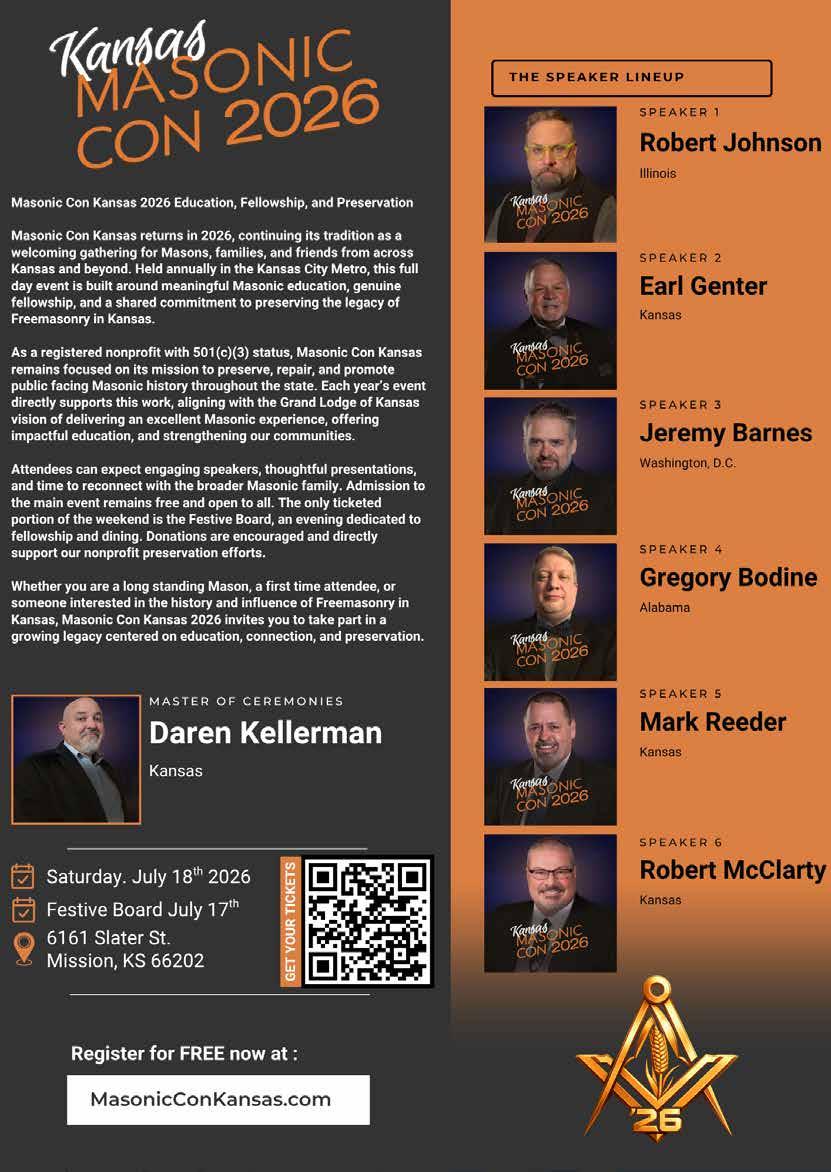
Midwest Conference on Masonic Education – April 24-26 - 2026, Omaha, NE

Esotericon - June 20th, 2026, Manassas, VA at Manasseh Lodge
Kansas Masonic Con - July 17th and 18th, 2026 Mission, KS at Rosedale Lodge No. 333
Yes! Masonic Con Chicago will be back in September of 2026.

For more visit, MasonicConferences.com
If your lodge or organization is having an Educational Event (not related to instruction or charities), please let us know. Email the details to: Admin@wcypodcast.com
Please give us at least a month notice so that we can ensure it is added.