
General Order #: 25-17
PURPOSE
Date: July 24, 2025
HATE CRIMES HANDOUT
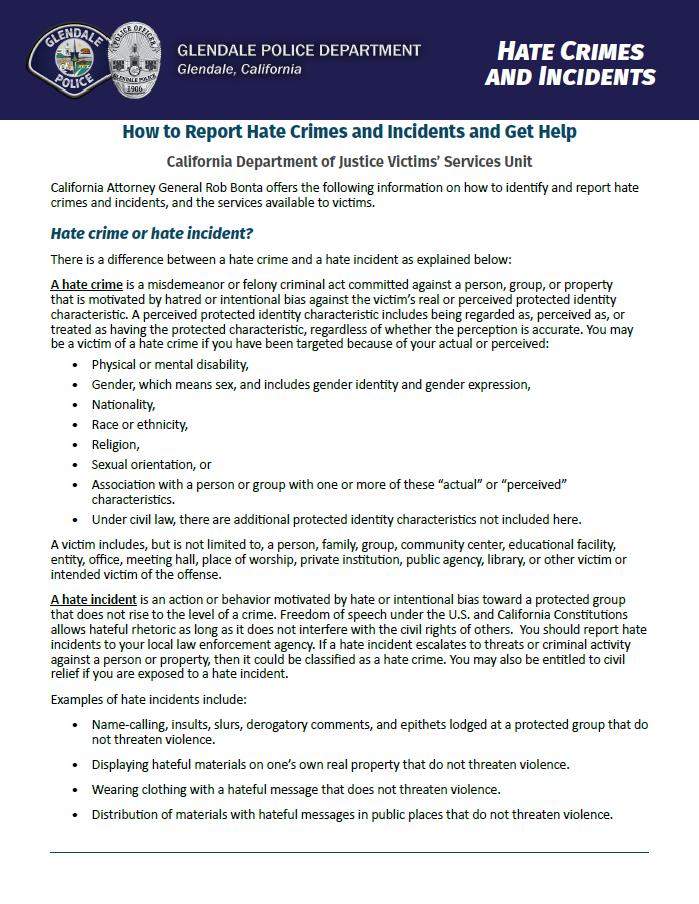
Penal Code section 422.92, subdivision (a), requires that “every state and local law enforcement agency in this state shall make available a brochure on hate crimes to victims of these crimes and the public.” To assist the Glendale Police Department in meeting its statutory obligations, we have adopted the attached handout.
PROCESS
Any time an officer contacts a victim of a Hate Crime or Hate Incident, this informational handout shall be given to the victim. If prudent and the victim has access, a pdf version may be emailed or the officer may refer them to the Glendale Police website which has a link to the brochure.
Hard copies of this brochure are available on the Patrol floor in the forms room, a pdf copy is attached, and the Glendale Police website has online access.
DEFINITIONS
A hate crime is a misdemeanor or felony criminal act committed against a person, group, or property that is motivated by hatred or intentional bias against the victim’s real or perceived protected identity characteristic. A perceived protected identity characteristic includes being regarded as, perceived as, or treated as having the protected characteristic, regardless of whether the perception is accurate.
Characteristics include:
• Physical or mental disability,
• Gender, which means sex, and includes gender identity and gender expression,
• Nationality,
• Race or ethnicity,
• Religion,
• Sexual orientation, or
• Association with a person or group with one or more of these “actual” or “perceived” characteristics. Under civil law, there are additional protected identity characteristics not included here.
A victim includes, but is not limited to, a person, family, group, community center, educational facility, entity, office, meeting hall, place of worship, private institution, public agency, library, or other victim or intended victim of the offense.
A hate incident is an action or behavior motivated by hate or intentional bias toward a protected group that does not rise to the level of a crime. Freedom of speech under the U.S. and California Constitutions allows hateful rhetoric as long as it does not interfere with the civil rights of others.
Examples of hate incidents include:
• Name-calling, insults, slurs, derogatory comments, and epithets lodged at a protected group that do not threaten violence.
• Displaying hateful materials on one’s own real property that do not threaten violence.
• Wearing clothing with a hateful message that does not threaten violence.
• Distribution of materials with hateful messages in public places that do not threaten violence.