Hazardous Waste
Chemical classification and labelling hazards to protect people. It now falls under the UN Committee of Experts for Transport of Dangerous Goods (TDG). It has, since then, evolved under the GHS Sub-Committee of Experts with the 6th revision published in 2015.
South African businesses that don’t adopt the new hazardous chemical warning symbols may lose international trade opportunities due to noncompliance with global packaging and labelling regulations, warns the Responsible Packaging Management Association of South Africa (RPMASA).
m
m
ab
le
Ac
ut
et
ox
ici
ty
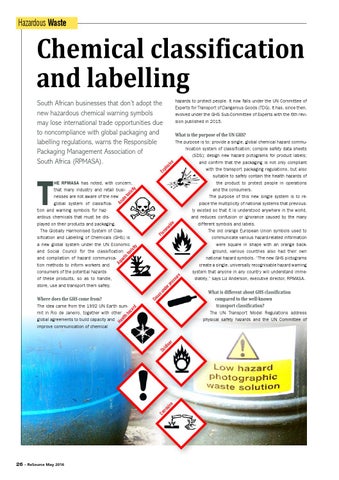
he RPMASA has noted, with concern, that many industry and retail businesses are not aware of the new global system of classification and warning symbols for hazardous chemicals that must be displayed on their products and packaging. The Globally Harmonised System of Classification and Labelling of Chemicals (GHS) is a new global system under the UN Economic and Social Council for the classification and compilation of hazard communication methods to inform workers and consumers of the potential hazards of these products, so as to handle, store, use and transport them safely.
Ga se su nd er
Where does the GHS come from? ha za rd
The idea came from the 1992 UN Earth summit in Rio de Janeiro, together with other global agreements to build capacity and improve communication of chemical
What is different about GHS classification compared to the well-known transport classification?
ita nt
Ox
idi s
er
He alt h
The UN Transport Model Regulations address physical safety hazards and the UN Committee of
Co
rro
siv e
Irr 26 – ReSource May 2016
The purpose is to: provide a single, global chemical hazard communication system of classification; compile safety data sheets (SDS); design new hazard pictograms for product labels; and confirm that the packaging is not only compliant with the transport packaging regulations, but also suitable to safely contain the health hazards of the product to protect people in operations and the consumers. The purpose of this new single system is to replace the multiplicity of national systems that previously existed so that it is understood anywhere in the world, and reduces confusion or ignorance caused by the many different symbols and labels. The old orange European Union symbols used to communicate various hazard-related information were square in shape with an orange background, various countries also had their own national hazard symbols. “The new GHS pictograms create a single, universally recognisable hazard warning system that anyone in any country will understand immediately,” says Liz Anderson, executive director, RPMASA.
pr es su re
Aq
ua
tic
to
xic
ity
Fla
T
Ex
plo siv
e
What is the purpose of the UN GHS?