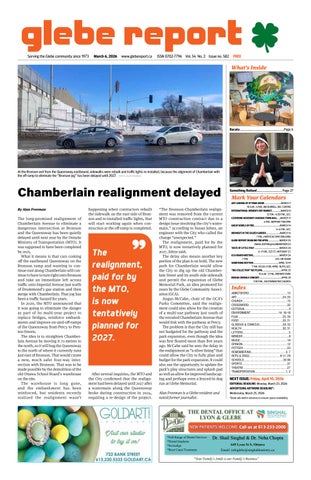
By Alan Freeman
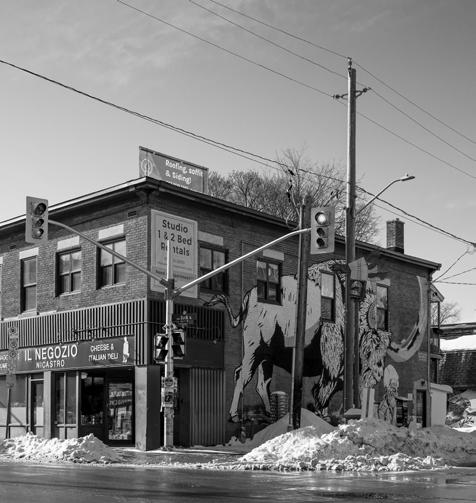
The long-promised realignment of Chamberlain Avenue to eliminate a dangerous intersection at Bronson and the Queensway has been quietly delayed until next year by the Ontario Ministry of Transportation (MTO). It was supposed to have been completed by 2025.
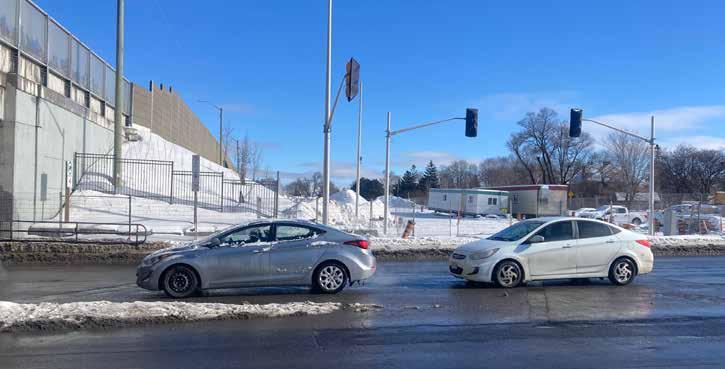
What it means is that cars coming off the eastbound Queensway on the Bronson ramp and wanting to continue east along Chamberlain will continue to have to turn right onto Bronson and take an immediate left across traffic onto Imperial Avenue just north of Drummond’s gas station and then merge with Chamberlain. That jog has been a traffic hazard for years.
In 2020, the MTO announced that it was going to eliminate the danger as part of its multi-year project to replace bridges, reinforce embankments and improve on-and-off-ramps of the Queensway from Percy to Preston Streets.
The idea is to straighten Chamberlain Avenue by moving it 70 metres to the north, so it will hug the Queensway to the north of where it currently runs just east of Bronson. That would create a new, much safer four-way intersection with Bronson. That was to be made possible by the demolition of the old Ottawa School Board’s warehouse on the site.
The warehouse is long gone, and the embankment has been reinforced, but residents recently realized the realignment wasn’t
happening when contractors rebuilt the sidewalk on the east side of Bronson and re-installed traffic lights, that will start working again when construction at the off-ramp is completed.
The realignment, paid for by the MTO, is now tentatively planned for 2027.
After several inquiries, the MTO and the City confirmed that the realignment had been delayed until 2027 after a watermain along the Queensway broke during construction in 2024, requiring a re-design of the project.

“The Bronson-Chamberlain realignment was removed from the current MTO construction contract due to a design issue involving the city’s watermain,” according to Susan Johns, an engineer with the City who called the change “unexpected.”
The realignment, paid for by the MTO, is now tentatively planned for 2027, Johns said.
The delay also means another key portion of the plan is on hold. The new path for Chamberlain would allow the City to dig up the old Chamberlain Street and its south-side sidewalk and permit the expansion of Glebe Memorial Park, an idea promoted for years by the Glebe Community Association (GCA).
Angus McCabe, chair of the GCA’s Parks Committee, said the realignment could also allow for the creation of a multi-use pathway just south of the rerouted Chamberlain Avenue that would link with the pathway at Percy.
The problem is that the City still has not budgeted for the pathway and the park expansion, even though the idea was first floated more than five years ago. McCabe said he sees the delay in the realignment as “a silver lining” that could allow the City to fully plan and budget for the park expansion. It could also use the opportunity to update the park’s play structures and splash pad as well as allow for improved landscaping and perhaps even a fenced-in dog run at Glebe Memorial.
Alan Freeman is a Glebe resident and noted former journalist.

NEXT ISSUE: Friday, April 10, 2026
EDITORIAL DEADLINE: Monday, March 23, 2026
ADVERTISING ARTWORK DEADLINE*: Wednesday, March 25, 2026 *Book ads well in advance to ensure space availability.











By Mark Redwood
If you’ve walked, biked, taken the bus or driven along Bank Street lately, you already know that change is coming.
Since 2023, the City of Ottawa has been studying how to improve Bank Street for pedestrians, cyclists and transit users. After consultations, including a well-attended open house last September, a draft plan is now coming together. The plan focuses largely on incremental improvements – including peak-hour bus lanes – aimed at balancing traffic flow with safety and accessibility.
For many residents, though, the question remains: what else could make Bank Street safer, more comfortable and more welcoming, especially for people moving through the neighbourhood on foot or by bike?
To help answer that question, the Glebe Community Association’s Transportation Committee launched a rapid community survey this past November. The goal was simple: gather local feedback on a set of modest, practical ideas that could complement the city’s plan before the community submits its input.
The response was strong. In just one week, 268 residents completed the survey, and more than 100 people provided written comments – thoughtful, detailed reflections on everything from traffic flow to pedestrian safety to the future of transit in the Glebe.
Here are a few highlights from what we heard.
Despite the title of the city project –“Bank Street Active Transportation and Transit Priority Feasibility Study” –very little on active transportation has been retained. One clear takeaway from the survey is that many residents want safer, more continuous routes through the neighbourhood, especially around Lansdowne, one of the busiest and most complex areas for all road users.
Among the most positively viewed ideas was the creation of a safe cycling route through the Lansdowne site, helping riders avoid difficult stretches of Bank Street near Holmwood and connect more easily to existing cycling routes.
This reflects a broader theme in the survey responses – people are looking for practical ways to reduce conflict between different types of road users, especially in areas where space is tight and activity levels are high.
Safety measures matter – but opinions differ on how to achieve them
Many of the proposed improvements focused on pedestrian safety – things like clearer crossings, traffic calming and other design features that encourage slower driving in busy areas.
In general, these kinds of measures were well received. But the survey also showed that not every safety idea is universally popular.
For example, the proposal to install protective barriers or bollards beside bus lanes generated one of the most

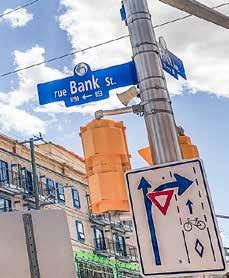
divided responses. Some residents see barriers as an important protection for pedestrians and cyclists; others worry about clutter, winter maintenance and impacts on traffic flow. In other words, even when residents agree on the goal – safer streets – they don’t always agree on the best way to get there.
Residents are engaged –and thoughtful
One of the most striking observations we had wasn’t tied to any single proposal. It was the depth of engagement. More than 100 written comments covered a wide range of perspectives. Some residents emphasized the importance of making walking and cycling safer, especially for families and older adults. Others stressed the need to keep traffic moving efficiently, particularly given growing congestion and major events at Lansdowne. Many people pointed
out that they use Bank Street in multiple ways – as pedestrians, cyclists, transit riders, and drivers – depending on the day. That reality shaped much of the feedback: residents want a street that works well for everyone, not just for one group.
There was also a strong sense that Bank Street improvements shouldn’t be considered in isolation. Respondents mentioned neighbouring streets, neighbourhoods, transit reliability, enforcement of traffic rules and the broader impact of development and growth in the area.
What happens next?
The survey was not intended to settle every question about Bank Street. Instead, it provides a snapshot of community thinking at a moment when decisions are taking shape.
The GCA will use these results to help inform its submissions to the City as the Bank Street plan moves forward. It’s also a fact that the narrow breadth of the Bank Street corridor limits what is possible in the Glebe. As a result, many ideas won’t make it into the final design. The survey, however, helps to ensure that local voices remain part of the conversation.
For more insight into the work of the GCA on Transportation in our neighbourhood, please visit the website at https://glebeca.ca/traffic-committee/.
Mark Redwood is a member of the Glebe Community Association’s Transportation Committee.

By Roger Smith
The attic at Walter Hendelman’s house on Fourth Avenue rarely sat empty. He and his wife Teena opened it up to relatives, friends and friends of friends who came to Ottawa to work or study and needed a place to stay for a few weeks, a few months or longer. And guests never paid a cent.
Steven Naor, among the first of what became known as “the boarders,” spoke at Walter’s funeral after he died at 88 in late January.
“The price of being an attic dweller,” said Naor, “was that you had to engage with Walter and with Teena in conversation, sharing thoughts and ideas, cooking and participating in meals. You had to become part of the family.”
That speaks volumes about Walter’s generosity, sense of community and inquiring mind. He was a doctor, scientist and professor, chatty and opinionated, an activist and volunteer, a lifelong learner, a musician and singer, an avid skater, skier and cyclist who was still riding his bike last summer.
“He was always involved in something, always this high-energy person,” says his daughter Lisanne. “When he talked to people, he always showed such a genuine interest. The professor in him would come out.”
Born in Montreal, Walter graduated from McGill University with degrees in psychology and medicine, then did four years of postgraduate work in developmental neuroscience in the United States. Opting for research and teaching instead of clinical practice, he returned to Canada in 1968 and was a professor of neuroanatomy at the University of Ottawa for 42 years. He took a sabbatical in his 50s to go back to work as a hospital intern, and he got a master’s degree in education at 65.
Walter literally wrote the book on the brain. His seminal textbook, The Atlas of Functional Neuroanatomy, has been translated into French and Italian and in his 80s, he developed a website to make the book more accessible.
“He was very bright, very intelligent, very inquisitive, always trying to understand things,” said his nephew, Murray Kronick.
As a teenager, Walter was a lifeguard at Pripstein’s summer camp in the Laurentians. He played guitar and, according to family legend, gave a few tips to a camper named Leonard who was learning the instrument. The boy’s last name was Cohen. Yes, that Leonard Cohen.
At camp, Walter also met Teena, a counsellor who became the love of his life. They married in 1962, had two daughters and supported each other
in community, human rights and religious activism. “He was devoted to my mother,” Lisanne said at Walter’s funeral. “They were true partners.”
They were avid potters, donating the potters’ wheel that is still in use at the Glebe Community Centre. To celebrate their 50th anniversary, they hosted a concert at Dominion-Chalmers. And they were deeply committed to their Jewish faith. They co-founded the Ottawa Reconstructionist Havurah, a more liberal group that started in the late ’80s with living-room services and studies. Renamed OR Haneshamah, it now has its own rabbi and a congregation of about 100.
“It’s a great testament to Walter’s vision, his commitment to community and to his Jewish heritage,” said Rabbi Elizabeth Bolton.
Walter’s faith helped him through his two greatest losses – the deaths of his daughter Devra in 2004 and of his beloved Teena in 2017. But Walter, unwilling to let grief or heart issues slow him down, found purpose in a busy life – bridge and fitness classes at Abbotsford, choir trips to Cuba, learning the saxophone, keeping up Teena’s garden, protesting against Lansdowne and the destruction of trees to make way for the new Ottawa hospital.
“Positive, always engaged, always moving forward,” said Pat Goyeche at Abbotsford. “He picked up his feet and kept going. Always a doer, he wasn’t resting on his laurels.”
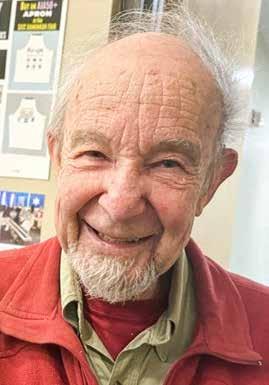
About 18 months ago, Walter reluctantly moved out of his house into a condo in the old Ottawa Board of Education building at Second and Percy. What helped persuade him – that building is where Teena used to work. Walter, being Walter, showed up for a meeting of the condo gardening committee before he’d even moved in!
Walter kept in touch with his wide network of friends right until the end. For example, the day before he died, in an email to set up a get together, he gave me a brief report on his health. “I

He was a doctor, scientist and professor, chatty and opinionated, an activist and volunteer, a lifelong learner, a musician and singer, an avid skater, skier and cyclist who was still riding his bike last summer.
have not had any major or minor cardiac-related health issues – yet,” wrote Walter. The next day, he slipped away while sitting on the couch, by the fireplace, listening to music on CBC radio. A sudden but gentle way to go.
“I think he would have appreciated the circumstances,” said Lisanne. “but not the timing – he still had lots of plans, he always had lots of plans.”
Roger Smith, copy editor of the Glebe Report, was a friend and neighbour of Walter Hendelman.


LISA BUTLER
BEN CAMPBELL-ROSSER
OLIVER CAMPBELL-ROSSER
JENNY CHUNG
DARRELL COX
DUDLEIGH COYLE
JOHN CRUMP
JOHN DANCE
CLARE ROGERS DAVIDSON
CHRISTIE DIEKMEYER
ELLYN DUKE-WATSON
EMMA FAZAKAS
PAM FITCH
ALAN FREEMAN
TAMARA GLAVINOVICH
CAITLIN IMRIE
JULIE IRETON
BOB IRVINE
LAURA KELLY
MAUREEN KORP
SHIRLEY LEE
TAMARA LEVINE
TYLER LOCEY
COOPER LOVE
EMMA MACMILLAN
CAROL MARTIN
CATHERINE MCKENNEY
SHAWN MENARD
JEFF MOBERG
YASIR NAQVI
ANANT NAGPUR
PAUL O’BRIEN
NICOLAS ORTIZ
NICOLETTE PILYPAITIS
PETER POLGAR
MARK REDWOOD
SUE REIVE
PETER ROBB
KATE ROBERTS
TOM ROBERTS
MARISA ROMANO
SARAH ROUTLIFFE
BHAGWANT SANDHU
KATE REEKIE
PETER SIMPSON
ROBIN SMALL
ROGER SMITH
SUE STEFKO
ANNIKA WHITFORD
DELLA WILKINSON
TONY WOHLFARTH
FEN WOODSTOCK
ZEUS
I write this on a Sunday morning, the last day of the Olympics, after the men’s hockey matchup between Canada and the U.S. Once again, disappointment is the order of the day –yes, we got silver, but we lost gold. The women’s game had already produced the same result – an overtime loss to the Americans for a silver medal.
The Canadian men played well, in fact extraordinarily well, outshot the Americans by far, never gave up – all the sports clichés. But in the end, in a three-on-three overtime, luck looked the other way, the Americans scored, and Canada met sudden death. OK, it was the game that died, but it felt like Canada.
I am not a hockey fan – have never played the game, never watched it. As an adult, I once went to a junior hockey game and enjoyed the ambiance of the arena, the smell, the cold air, the hot dogs . . . but the game itself? Meh.
And secretly, I have always been slightly embarrassed that Canada’s game is an aggressive sport characterized by fighting and missing teeth. Of course, I don’t say that. No one wants
to be the outlier, the naysayer, the party pooper.
But come the Olympics and given the horrendous bullying that Canada has had to endure from the U.S. while the American public remains mostly oblivious and Congress sits on its hands, it all boiled down to winning at hockey. Our national pride is so tied up in the game that it sweeps all else aside.
I’m not sure what the lesson is in all of this. We lost the gold, settled for silver. We tried hard, we acquitted ourselves well. But the ultimate prize was not ours.
Maybe we take comfort in the fact that it was essentially luck that decided the game. If luck goes against us once, it can work for us another time.
We have the skills, the heart, all the wherewithal to succeed. All we need is a little luck. Hockey tells us that with luck, we can still win. We can still beat back the Americans and regain our economy, our dignity, our sovereignty!
–Liz McKeen
Established in 1973, the Glebe Report, published by the Glebe Report Association, is a monthly not-forprofit community newspaper with a circulation of 7,500 copies It is delivered free to Glebe homes and businesses Advertising from merchants in the Glebe and elsewhere pays all its costs, and the paper receives no government grants or direct subsidies The Glebe Report is made available at select locations such as the Glebe Community Centre, the Old Ottawa South Community Centre and Brewer Pool, and is printed by Winchester Print www.glebereport.ca
EDITOR............................ Liz McKeen editor@glebereport.ca
COPY EDITOR.................... Roger Smith
LAYOUT DESIGNER............. Jock Smith layout@glebereport.ca
GRAPEVINE EDITOR............ Lesie Siu grapevine@glebereport.ca
WEBSITE EDITOR............... Kayleigh Osborne website@glebereport.ca
ADVERTISING MANAGER...... Judy Field advertising@glebereport.ca 613-858-4804
BOOKKEEPER.................... Susanne Ledbetter accounting@glebereport.ca
DISTRIBUTION MANAGER.....
COMMERCIAL DISTRIBUTORS Murray Kronick circulation@glebereport.ca Teddy Cormier, Eleanor Crowder
PROOFREADERS................ Mrtha Bowers, Jennifer D’Costa, Jeanette Rive
AREA CAPTAINS................. Martha Bowers, Bob Brocklebank, Judy Field, Deb Hogan & Dave Yurach, Lynn & Dave Johnston, Elena Kastritsa, Brenda Perras, Julie Stephens, Della Wilkinson
The Glebe Report strives to be inclusive and to represent the full diversity of the community we serve.
Ackerman-Katz Family, Jennie Aliman, Lawrence Ambler, Nico Arabackyj, Aubry family, Alessandra & Stefania Bartucci, Selena Beattie, Adrian Becklumb, Joanne Benoit, Carolyn Best, Daisy & Nettie Bonsall, Martha Bowers, Bowie family, Bridgett family, Bob Brocklebank, Ben and Oliver Campbell-Rosser, Nico Cauchi, Bill Congdon, Chiu-Panczyk Family, Sebastian, Cameron & Anna Cino, Henry, Abigail and Matthew Campbell, Claypool Family, JJ Comptois, June Creelman, Marni Crossley, Olivia, Maisy and Mark Dance, Dawson family, Richard DesRochers, Davies Family, Roslyn Demarsh, Marilyn Deschamps, DiekmeyerBastianon family, Dingle family, Delia Elkin, Patrick Farley, James & Oliver Frank, Judy Field, Federico Family, The Foo Family, Liane Gallop, Joann Garbig, Camilo Velez Gorman, Barbara Greenwood, Marjolein Groenevelt, Ryleigh and Hayden Hendy, Oliver, Martin, Sarah & Simon Hicks, Cheryle Hothersall, Jennifer Humphries, Sandiso Johnston, Tani, Pete & Bryce NisbetJones, Jungclaus Family, Elena Kastritsa, Michael Khare, Lambert family, Fenton & Cora Hui Litster, Leith and Lulu Lambert, Kathleen Larocque, Brams and Jane Leswick, Alison Lobsinger, Aanika, Jaiden and Vinay Lodha, Andy Lunney, Vanessa Lyon, Pat Marshall, Catherine McArthur, Ian McKercher, John and Helen Marsland, Matthew McLinton, Josephine & Elise Meloche, Julie Monaghan, Vivian Moulds, Karen Mount, Diane Munier, Benjamin MunterRecto, Rafi & Ellie Naqvi, Imogen & Maddy North, Xavier and Heath Nuss, Sachiko Okuda, Nicholas & Reuben Ott, Matteo and Adriano Padoin-Castillo, Finn Pedersen, Miles PersohnHough, Brenda Perras, Brenda Quinlan, Annabel and Joseph Quon, Kalia and Elijah Quon, Beatrice Raffoul, Frederick and Kasper Raji Kermany, Bruce Rayfuse, Kate Reekie, Thomas Reevely, Mary & Steve Reid, Jacqueline Reilly-King, Luke Robertson, Anna Roper, Frank Schreiner, Short family, Cathy Simons, Andrew Soares, Heidi Stelzl, Stephenson family, Elsie Sutherland, Cameron & Quinn Swords, Ruth Swyers, Tomlin Boys, John & Maggie Thomson, Tom Trottier, Trudeau family, Will, Georgie & Blaire Turner, Zosia Vanderveen, Veevers family, Carina and Matteo Vella, Nick Walker, Vanessa Wen, Paul Wernick, Hope, Jax and Ash Wilson, Howard & Elizabeth Wong, Berkan Yazici, Martin Zak.
CARRIERS NEEDED FOR:
FH13 - Lakeside Ave.
GA7 - Bell St S. East Side: McLean St.
SE9 - Wilton Crescent
SE11 - Fifth Ave:
SE13
If


Editor, Glebe Report
Re: “Third places for our kids,” Glebe Report, February 2026.
I very much agree with Alex Campbell’s letter to the editor in the Glebe Report which discusses the importance of common outdoor spaces for our kids.
In particular, school yards (such as Mutchmor) should be shared when school is out so kids can be kids and hang around.
We can’t expect increased density in our cities without thinking of these common areas.
Thanks for promoting this idea.
Christie Diekmeyer
Editor, Glebe Report
To all charitable organizations, please do me a favour by observing my requests:
No more address labels please. Even if I were to use them, it would be only one, not a sheet of them.
Do not scatter my first or last name throughout your lengthy letters. The fact is we will never meet in person, and I am not your best friend. We both know it.
I do not need report cards on how my donations are doing, with photos of people of all ages. A simple thankyou note is enough.
Do not mail diplomas, certificates or loyalty cards. I am not interested.
You offer matching donations, with deadlines to double or triple donations, always with dates extended. Deadlines are extended automatically, but you make it sound like a special
Call for submissions for May 2026
All the colours of the spectrum
Colour dictates what we perceive and feel. It is the lens we use to explore and understand our world. We perceive a warning in the scarlet of a berry, feel peace in the emerald of a forest canopy or wonder at the light of a stardrenched sky. Whether you write about the blue of grief, a golden moment or the infrared of things unseen, we want to read your poems about colour, the silent animator of our environment. We are looking for poetry that reflects the complexity of the human experience of colour – poems that bleed, poems that glow or poems that speak volumes on the absence of colour.
As usual, poems should be:
• Original and unpublished in any medium (no poems submitted elsewhere, please);
• No more than 30 lines each;
• On any aspect of the theme within the bounds of public discourse; and
• Submitted on or before Monday, April 20, 2026. Poets in the National Capital Region of all ages welcome (school-age poets, please indicate your grade and school). Please send your entries (up to five poems that meet the criteria) to editor@glebereport.ca. Remember to send us your contact information and your grade and school if you are in school.
Deadline: Monday, April 20, 2026
favour. Must you?
Your envelopes always say urgent. Really?
Stop sending a nickel glued to the page.
You want me to go online to donate to make it easy for me – which I doubt.
You suggest donations of $100 or more. How did you come up with a figure like that, may I ask?
Please stop sending pens. What would I do with so many pens – I can only use one at a time. Also, stop sending items like gloves, bags, notepads, probably left over from some marketing campaign.
Stop asking for my donation in the name of somebody to honour. I have honoured them twice now, that’s enough.
This may sound rude, complaining or offensive to somebody, but this is the truth. I am sorry, but you need to reflect on this and stop what you’re doing.
Perhaps you can educate me as to what to do with all those address labels we no longer use.

By Bhagwant Sandhu
Unlike their commercial counterparts, community newspapers like the Glebe Report are not instruments of profit-making. They are instruments of participation – to connect neighbours, to share concerns and celebrations, to make visible the quiet work of community life.
And what part of the Glebe Report does that best?
Hands down, it’s the letters to the editor.
Letters are where the paper stops being a publication and becomes a conversation. They are how residents speak in their own voices – sometimes passionate, sometimes practical, always personal. A letter can raise a question about traffic safety, celebrate a local initiative, challenge an idea, or simply thank a neighbour. In doing

so, it reminds us that the Glebe is not just a postal code but a community of thinking, caring, and engaged people.
In an age of anonymous socialmedia posts, a letter to the editor is something different. It asks us to pause, reflect and put our name to our words. That small act carries weight. It signals respect – for the issue, for the reader and for the neighbourhood we share.
So, consider writing in. Agree, disagree, propose, applaud. Your perspective matters. A community newspaper thrives when its pages reflect the diversity, thoughtfulness and spirit of its readers.
The Glebe Report belongs to all of us. Let’s make sure our voices are heard.
Bhagwant Sandhu is the current chair of the Glebe Report board of directors.

Evermore Books will open in spring at 857B Bank Street, just south of Fifth Avenue. “Evermore Books is an independent boutique romance-focused bookstore dedicated to celebrating love stories in all their forms.” (evermorebooks.ca)
One Academy The Glebe will open a gym at 900 Bank Street, the old beer store, in spring. “One Academy is bringing our signature HiFLUX training to Ottawa’s Glebe neighbourhood. Our 60-minute classes combine functional strength training and conditioning in a format designed to challenge every fitness level.” (oneacademymylife.com)
Goldie’s will be coming to the Glebe at the corner of O’Connor and Third Avenue, in the former home of O’Connor Confectionary, currently being renovated. “A neighbourhood convenience shop with gourmet sandwiches and coffee. Coming soon to the Glebe!” (@goldiesottawa)
Encore Fashions at 109A Fourth Avenue (corner of Bank and Fourth) will close in the summer. Their last day of business will be May 23, the day of the Great Glebe Garage Sale, when all their remaining clothing items will be sold for $1. (encorefashions.ca)
Like Butter & Co. opened March 1 at 539 Bank Street, transitioning from Goody Mart. Like Butter & Co is an “elevated vintage boutique & creative studio.” (@likebutterandco)

By Sue Stefko
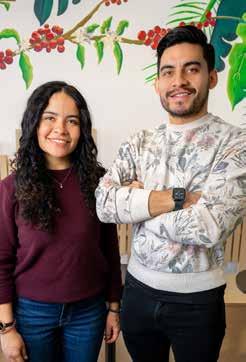
Siblings Diego and Aleja Bobadilla came to Canada from Colombia about two years ago with the intention of setting up a coffee shop. Bacata is proof they succeeded, but it wasn’t easy.
As newcomers without an established business track record, it was difficult to find a property owner willing to rent to the young entrepreneurs. The search ultimately brought them to 684 Bronson Avenue, owned by the person who ran the previous restaurant, PIZA. While the building itself is for sale, the owner has said that he’ll ensure their lease is protected. The location doesn’t have the foot traffic and mainstreet vibe they hoped for, but it is close to the Glebe, Dow’s Lake, Little Italy and Carleton University, and they could see the area’s potential.
They named the shop Bacata, the Indigenous name for their hometown Bogotá. Meaning “field of cultivation,” the name reflects ideas of growth, cultivation and resilience, a fitting symbol for both their Colombian roots and their journey as new business owners.
Even before opening, the business
pandebono (cheese buns) and chocolate santafereño (hot chocolate with cheese). When it did open in January 2025, the coffee shop was packed, largely with Colombians eager for a taste of home. The response was so strong that Aleja and Diego briefly considered pivoting from their original vision as a coffee shop to focus more heavily on Colombian comfort foods and treats.
Ultimately, they stayed with their original idea, a decision that proved fortunate as the initial wave of nostalgia began to fade. New customers came from the surrounding neighbourhood, along with lovers of fine coffee from across the city.
“Colombian coffee is complex, naturally sweet with a bright acidity, thanks to Colombia’s high elevation, volcanic soil and humid climate,” says Aleja, noting that Bacata is the city’s only café that exclusively sells Colombian beans. They come from a single, family-run farm, where cherries are hand-picked at peak ripeness to ensure consistent quality.
The beans are then carefully roasted at Bacata, with close attention paid to temperature, timing and airflow
acidity, fruitiness and the bean’s natural flavours.
The siblings see their beans as the key to future growth, particularly given the café’s limited size. They are exploring additional roasting spaces that would allow them to increase volume without sacrificing their painstaking attention to detail and quality. This, they hope, will expand online bean sales and help toward their long-term goal of selling across Canada. They’re also using Uber Eats to expand sales beyond the café’s limited space.


Palm Sunday - March 29, 8am & 10:30am
Holy Eucharist - March 30, 10am
Holy Eucharist - March 31, 10am
Holy Eucharist - April 1, 10am
Maundy Thursday - April 2, 7pm
Good Friday - April 3, 11am
Easter Vigil - April 4, 8pm
Easter Sunday - April 5, 8am & 10:30am
Avenue | 613-234-4024
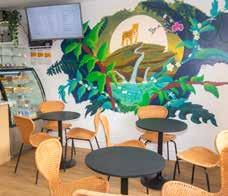
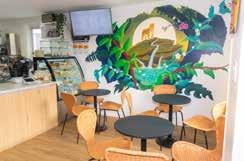
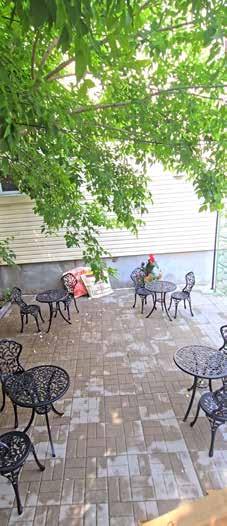
Perhaps due to its small footprint, the shop exudes a warm, cozy vibe. The café was completely renovated after its brief stint as PIZA in 2024, with hand-painted jungle scenes evoking Bobadilla’s homeland. Images of native fauna, such as jaguars and hummingbirds, alongside orchids, Colombia’s national flower, bring the walls to life. In the summer months, a patio, a rare amenity for businesses in this neighbourhood, helps extend the café’s capacity.
Community is central to the duo’s vision. The café’s website was created by Nicolas Ortiz, another Colombian, who also manages its social media presence alongside his partner Andrea Cárdenas Gaviria. Ortiz offered to build
the website free of charge to gain exposure, a collaboration Aleja sees as two businesses helping each other grow. The artist behind the murals and the café’s two part-time staff are also members of the Latin American community. The sense of community also extends to the neighbourhood – a year after opening, “local residents still come by and welcome us to the neighbourhood,” says Aleja, who describes herself as “the co-founder, CEO, head baker and chief dishwasher” – a familiar reality in small businesses. She and her brother have fully embraced the area, moving to Chinatown to be closer to the café. On days when the long hours allow, Aleja walks to work and finds moments of calm in Commissioner’s Park, along the O-Train path or by Dow’s Lake, appreciating the diverse greenspace that the neighbourhood offers.
As Bacata enters its second year, Aleja is committed to nurturing a space where great coffee, cultural pride and community connection continue to come together.
Sue Stefko is vice president of the Glebe Annex Community Association and a regular contributor to the Glebe Report



By Dudleigh Coyle
Rudy Koop, a long-time Renfrew Avenue resident and Rink Rat at Glebe Memorial Rink on Glendale, passed away this February.
Rudy was one of the original Rink Rat team members when I moved with my family to Ottawa in 1984 and got involved with this incredible volunteer effort. Not only did Rudy do regular flooding, snow clearing and set-ups and take-downs for the annual rink party, he served faithfully for 30 years as our treasurer. Two years ago, we crowned him “elder statesman” as he proudly modelled his Rink Rat hoodie and reminisced about the number of hot dogs he’d eaten at freezing cold rink parties in the park. Quiet-spoken, salt-of-the-earth, steady eddy – that was our dear friend who said a quiet “yes” to every ask. So long Rudy, catch up with you when I do.
Glebe Memorial is the outdoor rink at 75 Glendale, one of more than 200
rinks in the City of Ottawa Outdoor Rink Program. Community volunteers have kept Glebe Memorial going strong for over 50 years. Currently we have 28 adult volunteers who work evening shifts and seven paid student supervisors who work weekday afternoons and weekends. I reckon that through the years we’ve had over 90 parent volunteers. Many, like me, are now grandparents. Through the years, more than 110 students have had the best winter job ever – getting paid to supervise and play endless hours of shinny hockey. At Glebe Memorial, everyone is welcome and everybody skates – that’s actually our number one rule. If you are a youngster learning to skate, you can expect the big kids to show you the smaller rink surface or maybe even include you in the current shinny game.
We are proud of our board-less rink that allows little ones to skate across the surface and over the snowbanks to play for awhile or plop down for a quick break. As well, pucks find their way into the snow and then emerge in the spring as happy surprises for youngsters searching them out.
Special note for parents in the north end of the Glebe: we would love to include you in our volunteer supervising group known fondly as the Glebe Rink Rats. The job is not onerous. Adult volunteer supervisors do one evening shift a month from 7 to 9:30 p.m. Be in touch with me (dudleighcoyle@gmail.com) and I will explain. You can also follow us on Instagram at “glendalerink.”
Dudleigh Coyle has volunteered as the Chief Rink Rat at Glebe Memorial for more than 40 years.
By Paul O’Brien
If you’ve lived in the Glebe since the late 1990s (yes, back when Daniel Alfredsson was a neighbour), you likely crossed paths with Ed O’Brien at Nicastro’s, La Strada, Von’s, Corpus Christi Elementary School, Brewer Arena or Glebe Little League. Or perhaps you had the good fortune of attending one of the famous holiday parties he and his wife, Michelle, hosted on Fourth Avenue, where the wine flowed, the music was loud and the conversations stretched late into the night.
For our family, the Glebe isn’t just a neighbourhood. It’s home. It’s where my parents built their life together and where my brother Redmond, my sister Claire and I grew up. Like so many Glebe parents, Dad spent early mornings tying skates and teaching lessons that had little to do with the scoreboard, but everything to do with character. Work hard. Be a good person. Help others. Shoot for the stars.
Born and raised in Ottawa, the youngest of seven children, Ed built an extraordinary career as a cardiologist and researcher. He spent more than two decades at the University of Ottawa Heart Institute before later serving as chief of cardiology at the Libin Cardiovascular Institute in Calgary. Patients trusted him. Colleagues respected him. He brought intensity and precision to his work, along with deep compassion. Calgary marked an important professional chapter, but Ottawa and especially the Glebe always remained home.


In 2021, during the uncertainty of the pandemic, my parents returned to the neighbourhood. It felt like a full-circle moment. Around that time, Dad also began working at Capital Cardiology, continuing to care for patients in the city he loved. Soon after, he became a grandfather, a role he embraced with wholehearted joy.
In January 2025, he received the devastating news that he had metastatic prostate cancer. Given a prognosis measured in years, he focused on living


in the moment and making the most of every day with his family and friends.
Dad spent that final chapter making memories with his beloved wife, children, their partners and his grandchildren, Gloria and Mimi. He would push Mimi in her pink stroller through the Glebe and play with Gloria by Patterson’s Creek. Together, they would stop for fresh bread at The Wild Oat and pick up a frozen lasagna from the Glebe Meat Market. Those small outings brought him enormous joy and marked a chapter of grandparenthood he cherished deeply. There were skates on the canal, long summer days at the cottage, evenings cheering on the Sens and dinners at home filled with good food, wine and jazz. Even as his pain grew, he did not retreat from life. He leaned into it, drawing the people he loved even closer.
As a cardiologist, Dad devoted his life to caring for hearts. He studied them, treated them and worked to protect them. The heart he carried within him was his greatest gift. It was steady, courageous, humorous and generous. It beat strongest for his family.
He passed away on January 29 at the age of 65, surrounded by his loving family. Though his time was cut far too short, his presence and influence live on in the lives he touched and in the neighbourhood he called home.
Paul O’Brien is the son of Dr. Edward O’Brien.
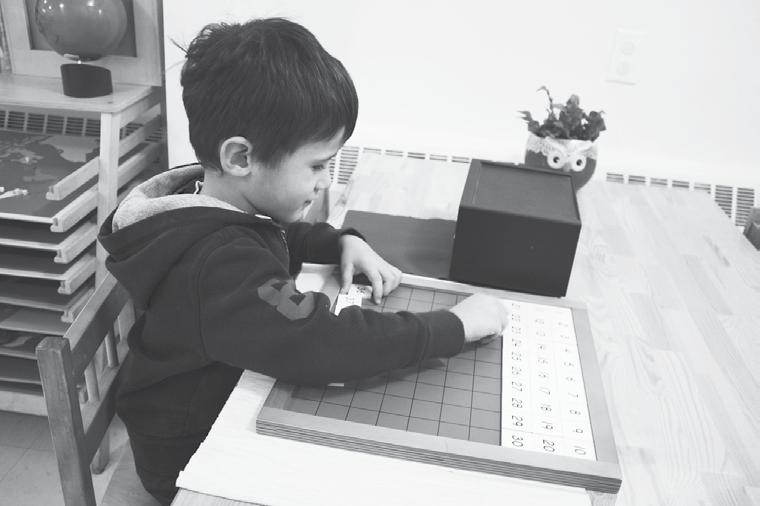
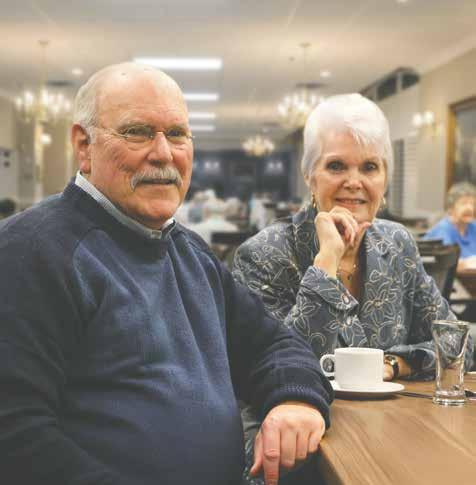
Leave the scraping, salting, and shovelling behind — and sit down to something exceptional instead. At Villagia In The Glebe, dining is a daily highlight, with chefprepared menus, beautifully presented meals, and restaurant-style service that turns every dinner into an occasion.
Between courses, enjoy engaging activities, welcoming neighbours, and the comfort of knowing everything is taken care of. Located in one of Ottawa’s most charming neighbourhoods, Villagia offers independent living with support when you need it. Experience the taste of retirement living!
By Tamara Levine
A little hope can go a long way. Larry and I had finally made up our minds to leave 37 Craig St. where we’d lived for 42 years. We had loved our century-old house, but with three storeys, laundry in the basement and no walk-in shower, it was not a house to get old in. We bought a condo in March, put the house up for sale and hoped for the best. Asher and Genevieve, a young couple with three little girls, would live there now. We divested, wept and packed. We arranged for our mail to be redirected and moved at the end of August.
In July, our eight-year-old granddaughter Freya was hopeful but a bit nervous about going to sleepover camp for two weeks. Freya wears her heart on her sleeve, letting us know when she feels excluded and why she is jealous of her otherwise adored big sister Vida. But Vida would be at camp too, and Freya sort of knew what to expect after her week there the previous summer.
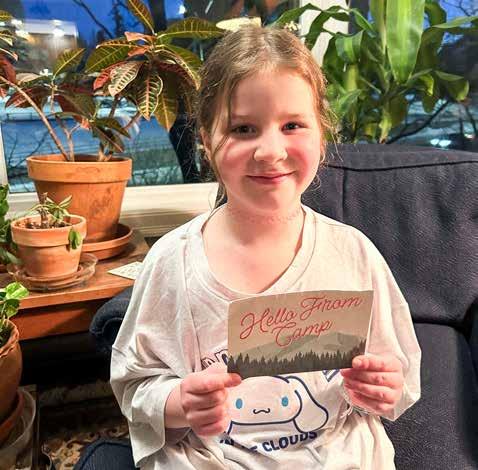
Vida and Freya, in pigtails and baseball caps turned backwards, hugged their mom and dad goodbye and boarded the yellow school bus for camp, duffle bags and knapsacks overflowing. Inside each knapsack was a pack of stamped, pre-addressed “Hello from Camp” retro-style postcards to send to their parents and grandparents. Grandparents were instructed to send letters before the kids left for camp, so they’d get mail soon after they arrived.
The week before the kids were leaving, Larry and I dutifully sent letters stuffed with shiny colourful stickers to camp. We never heard from Vida, although she swears she wrote to us. We received one postcard from Freya. The kids had a blast at camp. Then they spent a week with us at the cottage before we put on the last push toward the big move.
The new owners at Craig St. let us know if mail for us arrived there. When I heard from Asher in October that we had a letter, I stopped by the house. The envelope was addressed in beautiful handwriting to Bubbe and Papa, which is what Vida and Freya call us.
There was a return address in Kanata but no name.
I sat in the car in front of the old house and opened the envelope. A note in the same flowing script read “I found the enclosed postcard in a library book that I borrowed. Seeing that it was being used as a bookmark, I assume it is a cherished item, maybe a postcard from a grandchild to papa? Great decorations on the card. Best wishes!” Inside the note was Freya’s postcard, replete with stickers, dated July 16. In pink lettering, it read “Dear Bubbe and Papa. I miss you a lot. I can’t wait to go the cottage. From Freya.”
I was stunned. Why did Freya’s postcard take three months to reach us? Where had it been delivered in the first place? Who had used it as a bookmark in a library book? What was the book they and the mystery sender had been reading? But mostly I was overwhelmed by the kindness of the person who found the postcard, took the time and effort to salvage it, write a note, put a stamp on an envelope and mail it to a complete stranger.
A few weeks later, I wrote to the nameless sender: “To the kind person who found my granddaughter’s postcard in a library book and took the time and effort to put it in the mail to us along with a beautiful note. Freya, age 8, sent us the postcard in July from her summer camp. It had the right address. Why it didn’t arrive at our house last summer remains a mystery. So does how it became a bookmark in a book at the Ottawa Public Library. Another twist is that we moved out of our house in August, so we might never have received your letter. Thankfully, the new owners told us about it. We were thrilled to receive it along with Freya’s missive. Freya was too! Please know how touched we were by your thoughtful gesture at a time when we are all in need of kindness.”
It was a tough year. Wars raged on. Despots were elected. Climate catastrophe wreaked havoc. Closer to home, the move from our house was physically exhausting and an emotional upheaval from which we were still recovering. But as the sun dappled the plants through our new bay window, a little kindness brought a welcome ray of hope.
Recreation has evolved in many ways over the past 20 years, from shifting trends to rising program costs, but its heart remains the same. There is still something timeless about the joy of camp games, the anticipation of starting a new class and the simple connection that happens when people learn side by side.
One area we believe holds exciting potential in Ottawa is multi-generational programming. Most classes and workshops target specific age groups, but what if a grandparent and grandchild could learn something new together? What if families could share a creative experience rather than attending separate programs? While we already offer family favourites such as pottery, yoga and preschool programs, we see an opportunity to expand our workshop offerings in ways that bring generations together.
This spring, we’re exploring new ideas, and we’d love to hear from our community. If you teach art, life skills or have another engaging workshop idea that could bring people of different ages together, please email info@gnag. ca with your proposal. We aim to keep these programs affordable and accessible and would love your help in growing our offerings!
GNAG Theatre
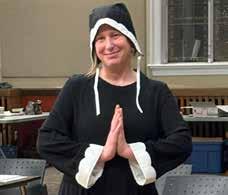
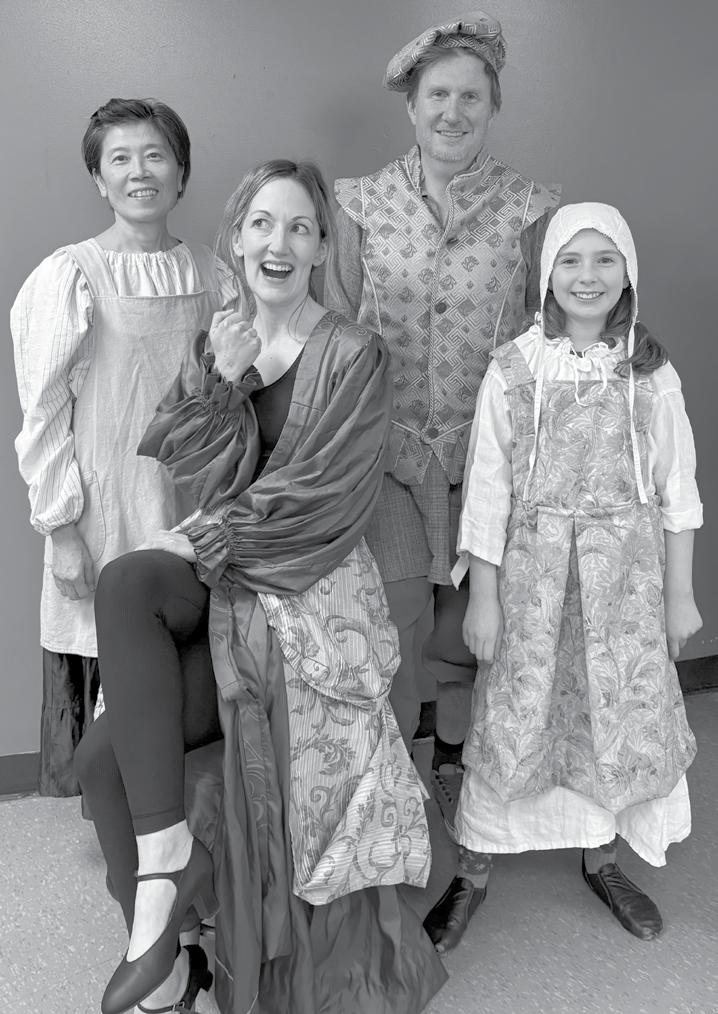
There is definitely Something Rotten! happening at the centre! This year’s musical is so much fun. Rehearsals are full of laughs and spontaneous applause as 40 actors of all ages, along with a busy crew of 15, bring the show to life.
The story follows the Bottom Brothers and their troupe, Elizabethan players desperate to create the hit that will make them as famous as Shakespeare. When they peer into the future, they invent The Musical. Their experiments with this bold new form, and their confidence in the mega-title of The Biggest Hit The World Has Ever Seen, set audiences to giggles and guffaws.
You’ll recognize lines from Shakespeare’s greatest plays one moment, then bounce along to rhythms inspired by Mame, Rent, Annie, Godspell and Les Misérables. The cast are even discovering musical nods to favourites like A Chorus Line
Borrowing its plot from Shakespeare’s best-known works, Something Rotten! is a love story, a tale of theatrical piracy and a fantasy. Above all, it is a joyful celebration of theatre-making.

Sarah Routliffe GNAG Executive Director
Audiences embraced the show so enthusiastically when it played at the Stratford Festival in 2024 that it is returning there again this summer.
Lauren Saindon once again works musical magic, blending voices to deliver the full pleasure of the show’s melodies and lyrics. She continues to take our actors to new heights, encouraging new skills and confidence. At this point in rehearsals, the building rocks vocally every week.
Mary Tsai returns as choreographer, assisted by Helena Forbes, with Audrey Darcovitch serving as dance captain. The chorus of Rockettes is an especially busy and energetic group.
GNAG Theatre is a unique program, welcoming actors from 8 to 80 to spend the winter learning and collaborating as they stage a major production. You’ll recognize some of our leads from many past shows. Alongside younger performers and adults new to theatre, they form a tight-knit company. Theatre builds teamwork as well as the thrill of performance. Singing lifts the winter blues and dance keeps everyone on their toes.
The ensemble even includes several families, echoing the script itself, where caring for family and the collaboration between two Bottom brothers are central to the story.
Eleanor Crowder directs, with the strong support of stage managers Monty Rogers and Luc Asselin. Now in its 25th season, GNAG Theatre once again brings you a joyous celebration of the putative birth of The Musical.
Special Note: Wine will be available for purchase at the Thursday, Friday, and Saturday evening performances.
Show Dates & Times:
Preview: Tuesday, April 14 – 7 p.m.
Wednesday, April 15 – 7 p.m.
Thursday, April 16 – 7 p.m.
Friday, April 17 – 7 p.m.
Saturday, April 18 – 2 p.m. & 7 p.m.
Sunday, April 19 – 2 p.m. & 7 p.m.
Tickets went on sale Tuesday, March 2.
Spring program registration opens on Tuesday, March 10! We have a wide range of options for you and your family, with something for all ages and interests. Be sure to register early to help avoid potential program cancellations.

Many of our programs break for the summer, so this is your last opportun ity to try something new before fall. We hope to see you this spring!


Our February board meeting took place as the ploughs continued their work on the Rideau Canal. It has been a good winter – at least for those who like to be out in the snow or on the ice. I’ve tried to skate on the canal as often as possible. As I do, I try not to look at the mess on the former Great Lawn at Lansdowne. Gone is the site of wild laughter and toboggans hurtling downhill.
The excavation of the toboggan hill is the first stage of construction of a new events centre, and the large number of trucks entering and exiting the site via Queen Elizabeth Place and Wilton Street to lumber onto Bank Street continues to be an annoyance. The good news is that this stage of construction should end sometime in March.
Now that Lansdowne 2.0 is a reality, there will be less GCA volunteer time required. For that reason, the board voted to put the Lansdowne Committee on hiatus “for the time being.” Other committees – Planning, Transportation, Environment and Parks –will continue to monitor Lansdowne as related to their mandates.
Plans for Isabella Street
Besides, there are other construction projects on the horizon, including a proposal to build a 19-storey residential high-rise on 178-200 Isabella Street, facing the Queensway. This site has

John Crump President, Glebe Community Association www.glebeca.ca
been empty and fenced off for years. The new building would have 229 units and underground parking for 99 cars and 242 bicycles. A zoning amendment for this project passed City Council in 2023, and the developer, Minto, has now submitted a site plan.
The GCA Planning Committee has looked at the plan and submitted comments to the City. While the association supports development of this site and welcomes additional housing units in the community, there are some issues to be addressed. These include concerns that the building will “cantilever over the public realm” meaning there will be less room to plant trees along the street. It’s also unclear who will be responsible for the trees – the developer or the city? And there are questions about what the back of the building will be like where it abuts residential homes on Pretoria. These and other comments were submitted to the city in late February, and we will keep residents updated as this project progresses.
The board also heard about a recent meeting between the GCA’s president and vice-president, the Glebe Business Improvement Area (BIA) and Councillor Shawn Menard’s office on street parking in the community. The Glebe has a patchwork of one-, two- and

three-hour parking on its streets, and there are issues around parking regulations and the lack of clear signage, particularly around school zones and event days. The councillor’s office will look into the rationale for the different parking timelines and come back with information before any further discussion about how to rationalize parking. While the GCA supports the idea of a review, no changes can be made without thorough and transparent consultation with the community.
The GCA was one of several community associations that sponsored a “Community Conversation on Homelessness” at Knox Presbyterian Church in February, a highly successful event that sold out at 400 tickets. The evening was attended by representatives of three levels of government as well as by Keith Hambly from Dunn House (supportive housing) in Toronto, who described the services they provide to their clients. Rob Boyd presented how Ottawa Inner City Health brings health care to people in shelters and supportive housing. Meeting people where they are is so important for them, helping to
keep them out of emergency rooms. The GCA, along with many other partners, will continue to push all three levels of government to increase funding to end homelessness in our city.
Unfortunately, our application to Forêt Capitale Forest’s Tiny Forest Together program did not receive funding. However, we are exploring options to self-fund the project. We submitted a project titled “Replacing Invasive Species with Native Plants in Brown’s Inlet Park and the Greenspace extending to Bank Street Bridge” to the City of Ottawa’s recently launched Community-led Greening & Gardening Initiatives program, and we look forward to more positive results.
We have been in contact with Circular Materials and Miller Waste Systems after hearing from Glebe residents confused by the new Extended Producer Responsibility program; an article on page 18 of this Glebe Report clarifies what goes into the bins and how to replace broken bins.
The next GCA board meeting is Tuesday, March 24 at the Glebe Community Centre. Everyone is welcome to attend.




It has been a long winter in Ottawa. It started snowing on November 1, and it really didn’t stop with cold weather and a lot of freeze-thaw cycles. I recently had a chance to meet with our snow operations team at the Hurdman Yard. I asked a lot of questions – such as how the snow removal schedule gets chosen and the maintenance quality standard criteria that go into it – and they shared a lot of answers. Arterial roads, business districts and collectors usually get priority. In addition, we are prioritized in Capital Ward when Winterlude is running (a major perk). Garbage day is also a big factor – ideally, they don’t want these large trucks trying to pass each other. I was impressed with all the care that goes into the operation and made sure to thank the operators who do this day in and day out and have prioritized sidewalks to a much greater degree than in the past.
The long winter has also meant the Rideau Winter Trail has been groomed for longer, the Canal open longer, the downhill ski season more enjoyable and winter rinks (such as Windsor, Brantwood, Brewer Oval, Glebe Memorial, Heron Park and our brandnew addition at Sylvia Holden) with better ice. A huge thank you to the volunteers who maintain these rinks and trails. Every day as I head to City Hall

or meet with residents in the ward or participate in a community event or consultation, I see neighbours and residents making our community and the City a better place to live in.
There are some big things happening this spring that have taken a long time to achieve. We’re happy to say that a brand-new community building will be opening in Heron Park along with new programming for kids this summer (just off Clover near Heron). Check it out if you get a chance!
We will be celebrating the Lees Field (People’s Park) victory for residents, stopping greenspace from being bulldozed for an urban freeway and instead looking to preserve greenspace and adding mixed-use affordable housing. We will hold a BBQ and games at the park with everyone welcome in the spring.
Eighteen and under free transit will be launching on July 1. Anyone in that age group will be able to ride transit without charge all day every day in the summer, during all holidays, all weekends and after 5 p.m. on weekdays during the school year. My team

Councillor, Capital Ward N 613-580-2487 www.shawnmenard.ca
secured this major policy change in the last city budget.
Brewer Pool is on track to re-open on March 2 with a brand-new air handler for clean air and longevity of the pool.
The Alternate Neighbourhood Crisis Response (ANCHOR) has been a prototype for a better way to address issues relating to mental health and substance-use crises because it dispatches skilled unarmed response teams to people in crisis, offers supports and is community-led.
In its first pilot year, ANCHOR received 4,464 calls – 92.7 per cent were received through 211 while 7.3 per cent were transferred from 911. The support provided onsite includes well-being check, crisis counselling, crisis de-escalation and referrals for ongoing case management and system navigation.
In the recent budget, we secured an expansion of ANCHOR westward to serve the Glebe Annex. Eventually, it should be expanded to other areas of the ward.
There is always more work to do. We have ongoing issues with our transit system reliability – both buses and trains; it’s not acceptable to leave residents without a reliable means of getting around our city. Affordability concerns continue to haunt our city with a job market that is now in trouble. And despite new investment and progress on environmental issues, the effects of climate change and unhealthy air continue to keep me up at night. Whenever possible, my team and I try to compartmentalize these issues into our sphere of influence. Even if we can only help in a small way, how can we improve people’s quality of life today? Thank you for reading this column. I am incredibly proud to be a part of this vibrant and caring community. If you’re interested in reading more about the work we’ve been doing, you can visit shawnmenard.ca/ CapitalWardReport2025.







By Darrell Cox
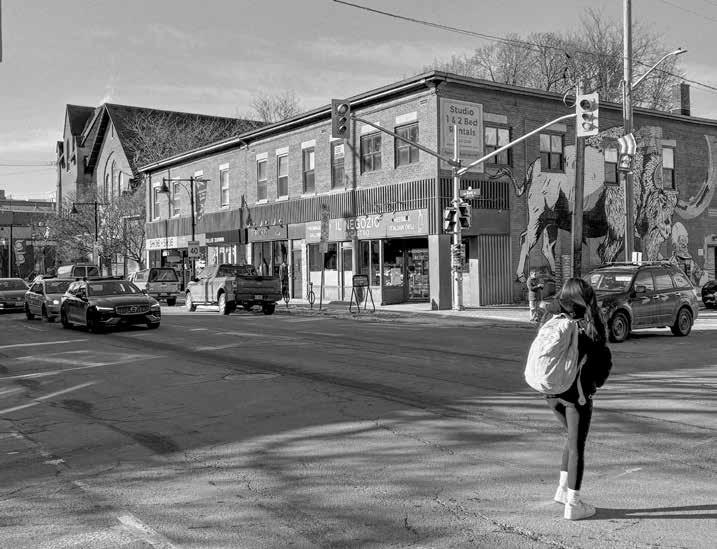
Bank Street is the heart of the Glebe. It’s where neighbours meet for coffee, families shop for everyday needs and visitors come to discover what makes our community unique. The Glebe Business Improvement Area (BIA) strongly supports efforts to improve transit reliability and active transportation. These investments help create a more connected, sustainable city. At the same time, changes to Bank Street must balance these goals with the practical needs of small businesses and the customers who support them.
The City of Ottawa’s Bank Street Active Transportation and Transit Priority Feasibility Study proposes removing 16 on-street parking spaces in selected areas on Bank Street to implement full-time dedicated bus lanes to improve transit travel times. While the intent of improving transit is laudable, the removal of on-street parking raises concerns for the economic vitality of our main street and the hundreds of small businesses that depend on convenient access for customers, deliveries and short-stay visits.
On-street parking plays a unique role in main street retail districts. For local businesses, these short visits add up to meaningful foot traffic and sales. On-street parking also supports customers with mobility challenges, families with young children and seniors who may find longer walks from offstreet lots difficult.
Beyond convenience, on-street parking contributes to the overall feel and
safety of a main street. Research in urban planning has shown that parked cars act as a buffer between moving traffic and sidewalks, helping to create a more comfortable pedestrian environment. They also provide visible signs of activity and turnover, reinforcing the perception of a safe community and that businesses are accessible and open for quick visits.
Research conducted for the BIA by the Canadian Urban Institute indicates that approximately 50 per cent of visitors travel from more than 12 kilometres away. Many of these visitors come by car, because of limited transit options from their neighbourhoods, the need to make multiple stops or to carry purchases. For these customers, on-street parking is often the most visible and practical option. Reducing it without viable, convenient alternatives risks discouraging these visits altogether.
Small, independent businesses operate on thin margins and are already navigating economic uncertainty and rising operating costs. Even modest declines in customer traffic can have outsized impacts on their viability. Studies of retail and urban economics consistently show that convenience of access is a key factor in where people choose to shop and dine, particularly when they are deciding between main-street districts and more car-oriented commercial areas with abundant parking.
While some customers arrive by foot, bike or transit – and the BIA

welcomes and encourages these modes – main streets thrive on a mix of access options. A street design that prioritizes one mode to the exclusion of others risks narrowing the customer base that local businesses rely on. The goal should not be “cars versus transit” but rather a street that works for everyone.
Transit advocacy groups have suggested that all on-street parking on Bank Street in the Glebe should be removed to make way for full-time dedicated bus lanes. While improving transit speed and reliability is important, a one-size-fits-all approach does not reflect the realities of a neighbourhood main street.
Removing all on-street parking could undermine the very street life and economic activity that makes Bank Street vibrant. A lively main street is not just about moving people through efficiently; it’s about enabling people to stop, linger, shop and connect.
There are ways to improve transit performance without fully eliminating on-street parking. Targeted, time-limited bus lanes during peak periods, strategic curbside management, improved enforcement of stopping zones and better use of side-street
and off-street parking can all contribute to a more balanced solution. Design solutions should be context-sensitive and grounded in data about how the street is used by residents, visitors and businesses.
The Glebe BIA believes that Bank Street can support better transit and active transportation while still maintaining the access that the BIA businesses need to thrive. We support thoughtful, evidence-based street design that recognizes the multiple roles Bank Street plays: transit route, walking corridor, commercial main street serving the broader city. As the City moves forward with planning and consultation, we encourage decision-makers to work closely with local businesses and residents to find solutions that improve transit without unintentionally weakening the economic and social fabric of the Glebe. A healthy main street depends on balance – and when Bank Street thrives, the whole community benefits.
Darrell Cox is executive director of the Glebe Business Improvement Area (BIA).





By Julie Ireton
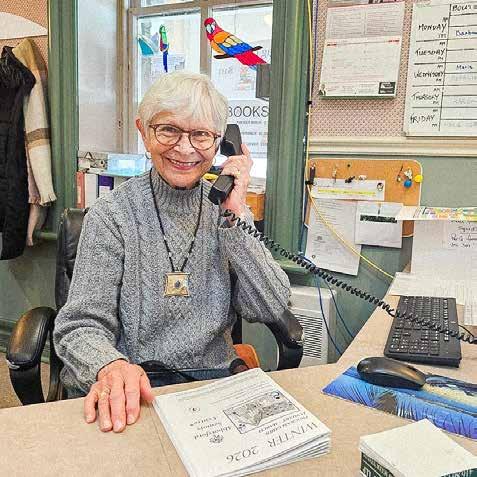
Among the 800 members of Abbotsford at the Glebe Centre is a diversity of ages, backgrounds and needs, but there’s a common thread that weaves together many of their stories: the discovery of a community that helps through the good times and the bad.
The seniors centre, in the old stone house across from Lansdowne Park, offers exercise classes, language and writing courses, social events, crafting, collecting and much more for members who are 55 plus. In October of last year, Abbotsford celebrated its 50th anniversary.
Claudia McKeen, 67, was first introduced to Abbotsford when she was invited in as a speaker. The retired pharmacist and former owner of the Glebe Apothecary later found the centre provided a respite when her husband attended the Dementia Day Program a few years ago.
McKeen says it’s the caregiver
support group for spouses of those with dementia that’s meant the most to her.
“That’s my lifeline,” she said. “It’s so important to me for coping and sharing. We’ve all become good friends.”
McKeen lost her husband last fall but remains part of the group.
“I feel a responsibility to go and support others. I need to be there for them. There’s a wealth of wisdom around the room. It’s give and take,” she said.
That group is just one of the reasons that Abbotsford holds a special place in Carol Shipley’s life. Her husband, 93, also suffers from dementia.
“The biggest thing to me is it’s a community,” said Shipley, who recently turned 90.
Shipley says she also enjoys the centre’s exercise classes, along with the laughs and conversations in the dining room afterwards.
“We talk about everything from politics, to getting older, to sex,” laughed Shipley.
As a member, she’s taken conversational Spanish, Zumba, ukulele lessons and jazz dance with Mary Tsai.
“I adore it,” she said.
Exercise classes were the gateway into the senior centre for Katharine Ham, who is both a member and a volunteer.
Ham, a former public health nurse, finds herself at the centre several days a week: working out, playing bridge or volunteering at the reception desk.
“I’d say that Abbotsford House is my saviour,” said Ham, who moved to Ottawa from Kingston four years ago. “It’s not only kept me really busy, but it’s introduced me to a lot of new people.”
Regis Alcorn worked in Ottawa recreational centres throughout her career and knew all about the offerings at Abbotsford long before she retired.
She started out as a volunteer and after COVID pandemic restrictions waned, Alcorn started looking at the programs on offer, including the yoga classes.
“I’m quite active and it’s part of my week to drop by the centre,” said Alcorn, who was also involved in the garden tour and working on the garden at Lansdowne Park.
Abbotsford volunteer Barbara Duggan worked in long-term care, including at the Glebe Centre, before her retirement. Now she works at the clothing boutique inside the senior centre each week.
“It’s a great little spot. We meet clients of the various programs. They come in to look around and browse or sometimes bring in contributions for us to sell,” said Duggan. “It’s a charity, and money raised helps support the centre so that’s very valuable.”
For Duggan, part of Abbotsford’s success is the hardworking staff members who are passionate about what they do.
“You can tell it’s more than just a job for them,” she said. “And I can tell you the people who come in, they appreciate the programing. It handles a lot of issues from acquiring new skills to addressing the lonely factor.”
The Glebe Centre Community Programs and Services at Abbotsford are part of a registered charity; The Glebe Centre Inc., which includes a 254-bed long-term care home. Find out more about our services and programming by dropping by 950 Bank Street (the old stone house) Monday to Friday, 8:30 a.m. to 4:30 p.m., telephoning 613-2305730 or by checking out all The Glebe Centre facilities and seniors services on our website www.glebecentre.ca.
Julie Ireton is a journalist and frequent Glebe Report contributor on Abbotsford.






By Ben and Oliver Campbell-Rosser
Humans are drawn to nature. We are espe cially attracted to the col ours, songs and flight of wild birds. Putting up a bird feeder is an easy way to bring these dazzling creatures closer to us. But is it a good idea to put up a bird feeder? The answer is more complicated than one might expect.


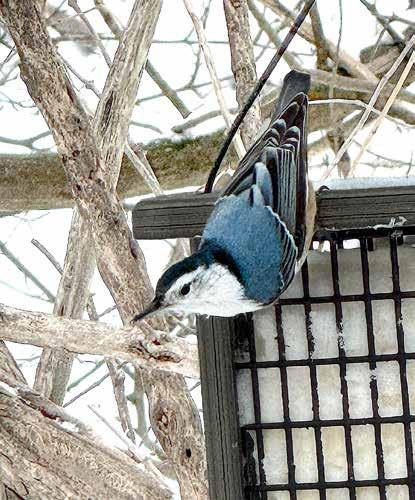
The main benefit of a bird feeder is that it can increase the survival rate of birds during harsh conditions, such as winter, or stressful times, such as migration or breeding. A feeder may bring birds into our spaces, increasing biodiversity and assisting with insect and weed control. Birds at feeders also increase our awareness of the natural world. This can create a broader appreciation of the environment and wildlife. Connections with nature have been shown to benefit human mental wellbeing.
The drawbacks of bird feeders are that they concentrate birds together in greater numbers and bring different species into close contact. The negatives can include increases in disease, predation, collisions and rodents. Fortunately, each of these concerns can be addressed.
Birds may infect one another, or the feeder itself could harbour pathogens or parasites. Having two or more feeders each with a different feed can reduce crowding and provide some separation of species. Feeders need to be cleaned and disinfected on a regular basis. Swapping out a dirty feeder with a clean one is an easy fix. Forgo feeders that allow droppings to accumulate with the feed.
Predators, like hawks and cats, can target a feeder. Feeders ought to be near enough vegetation to provide sufficient cover from hawks, and far enough from the ground to be out of the reach of cats. Having a feeder up during only the winter months will greatly diminish the opportunities for cats.
Many millions of birds are killed annually by flying into windows which reflect the sky or outdoor foliage. The proximity of feeders can increase the number of strikes. Picture windows situated at right angles to one another can be deadly. Glass needs to be made visible to birds by adhering anti-collision tape or other products. Keeping shutters, blinds or curtains closed may help. Go outside and imagine what a bird might see.
Many commercial feeders are designed to be squirrel proof. Minimizing the amount of uneaten feed and shells on the ground beneath a feeder will reduce its appeal to other rodents. To reduce ground spillage, purchase already shelled seeds. Avoid
feeds containing products that the birds at your feeder may not want. Determine which type of birds you wish to attract, and which type of feeder and feed works best for those birds. Common feeder types include hopper, platform, seed tube, suet cage and hummingbird. Common feeds include peanuts, cracked corn, suet and seeds such as sunflower, nyjer and millet. Provide high-quality birdfeed. Avoid bread and processed foods. In the Glebe, some of the more common native species at a winter feeder are blackcapped chickadee, whitebreasted nuthatch, redbreasted nuthatch, northern cardinal, American goldfinch, darkeyed junco, downy woodpecker and hairy woodpecker. Chickadees will feed from your hand. Cardinals are shy. Goldfinch love nyjer seed. Juncos feed primarily on spillage on the ground. Woodpeckers prefer suet. Some non-native species at the feeder include the house sparrow and European starling. Large numbers of either of these species can temporarily dominate a feeder. The domestic (or rock) pigeon can also be abundant but usually feeds on the ground.
There is the concern that bird feeders might alter the normal feeding or migratory behaviours of certain species. This is true in some cases, but global warming and habitat loss have more profound effects on the lives of birds. It has been estimated that North America has nearly three billion fewer wild birds today than in 1970, reflecting a 25-per-cent drop in total numbers. This reduction has affected most North American species.
Feeding wild birds is an amazing way to connect with nature. It is, though, a responsibility. Location of your feeder requires some thought. One ought to choose feeders and feed suitable for the desired species and seasons. You need to commit to monitoring your feeder and keeping it filled and clean. This will require some time and a bit of money. If the best practices are followed, a bird feeder can enhance the lives of both birds and humans.
Oliver and Ben Campbell-Rosser are residents of the Glebe, and Glebe Report carriers. Oliver is a Grade 8 student in the Virtual Learning Option at Agincourt Road Public School. Ben is a retired academic.
By Pam Fitch
Oh no don’t let the rain come down
My roof’s got a hole in it and I might drown (Serendipity Singers, 1964)
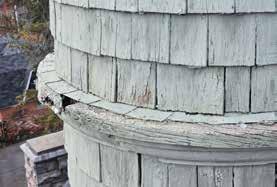
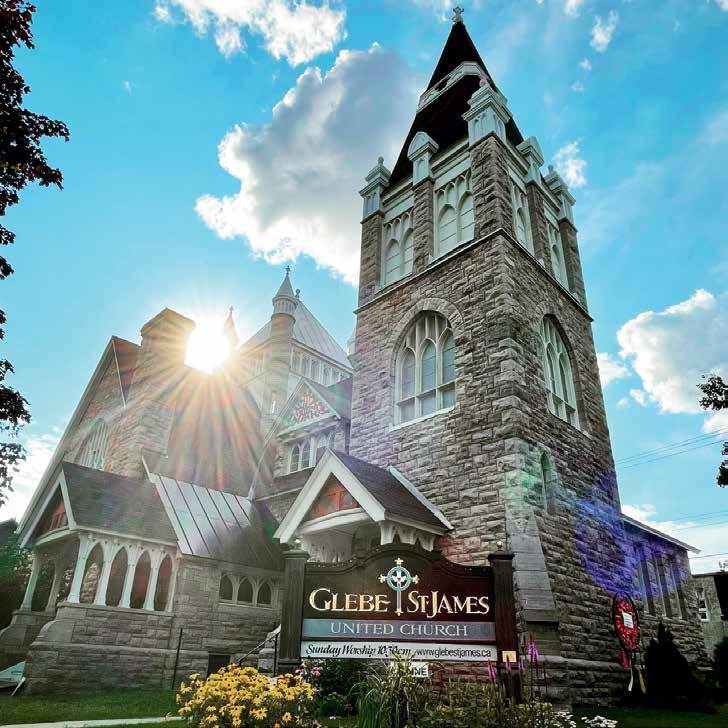
Glebe-St. James United Church’s lantern tower with its four distinctive turrets has developed significant leaks that have rotted a small board in the soaring wood slat ceiling. Water drips into the chancel right on the spot where Rev. Dr. Teresa Burnett-Cole leads services.
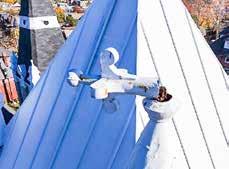
The leaks intensify during major rainstorms, an increasingly common occurrence due to climate change. The worst leaks come from the two westerly turrets on the parking-lot side. The turrets in the worst condition are located by the parking lot on First Avenue in the northwest and southwest corners. Two of the original tin finials have fallen off these turrets, further contributing to leaks. Last summer, one finial fell into the parking lot, just missing a car (and thankfully, its occupants); the other one partially toppled a few weeks later, and the congregation is grateful to an eagle-eyed neighbour who reported it listing to the side.
Our church began as the Glebe Presbyterian Mission at the corner of Third and O’Connor. As people began moving into the neighbourhood, the mission created the Glebe Presbyterian Church, at the corner of First and Lyon. Church leaders engaged John H. W. Watts, the first curator of the National Gallery, as its architect. The cornerstone was laid in 1904. This church later became Glebe United Church when the United Church of Canada formed a national union between Methodist and
Presbyterian congregations in 1925. In 1973, it became Glebe-St. James United Church when its neighbour, St. James United Church, was sold and became the Glebe Community Centre.
Glebe-St. James features a complicated Gothic Revival roof deck with many angles. Our roofing experts from Aquila Roofing tell us that if we do not repair the west-side turret damage this year, we could be facing a complete failure of the roof within five years. The cost of repairing the entire church roof at this point is close to $1 million, although there are parts of the roof that are not in critical need of repair.
To repair the west side turrets and roof, replace the finials and redo two other small sections will cost in the vicinity of $300,000, and this is the path that Glebe-St. James has chosen.
It is important to note that all United churches operate like small businesses, and they do not have regular funding from other church sources. There is no central agency that provides money for congregations. All funds derive from congregational givings, bequests, space rentals and fundraising like the GSJ Bazaar in November or the Great Glebe Garage Sale. We are fortunate







to have a generous congregation and a rich partnership with the Glebe
tessori School.
We intend to finance the repairs by congregational donations and pledges. We also hope that community members who have attended concerts or use the church will consider supporting the campaign. We have applied for a $25,000 grant from the region, and we expect to receive a loan from the United Church of Canada for the balance.
At the time of writing, we are almost 30 per cent of the way to our goal.
Glebe-St. James plays an important role as a “third place” in the Glebe, an environment where people can relax, socialize and connect with others
outside their homes or workplaces. You can come and go as you please. Third places are accessible, inclusive and help you feel like you belong. The congregation warmly welcomes people of all ages, genders, races and capacities. It contributes to community outreach, particularly focusing on food insecurity. The congregation shares the building with the Glebe Montessori School, and the Glebe Neighbourhood Activities Group rents space for tutoring and summer camps. Other community groups like Scouts consider this church their home and have built permanent storage for their equipment on the grounds.
If you or your group wish to know more about Glebe-St. James and our roof project, go to www.glebestjames. ca/the-roof-at-glebe-st-james-needsyour-help.
To contribute to our roof repair project, go to the donate page for details: www.glebestjames.ca/ donations#Donate.
Pam Fitch is a member of the congregation of Glebe-St. James United Church.

By Caitlin Imrie
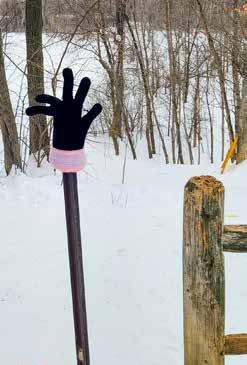
This morning on my walk, I saw a common winter sight: a lonely glove, put somewhere visible in hopes that their owner might come back to find them. But what happens if they are not found?
Every year, Ottawa residents lose countless mittens and gloves. These lonely mittens end up in lost-andfounds at schools, community centres and other public spaces; most are eventually sent to landfill. At the same time, many residents face Ottawa’s cold winters without mittens.
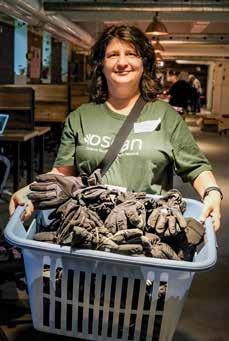
What if it was possible to reduce waste while providing warmth to those who need it? Last year, the Ottawa South Eco-Action Network (OSEAN) and Eco West Enders launched a pilot project called the Lonely Mitten Project to do just that. Its early success has been overwhelming.
The Lonely Mitten Project collected over 6,000 lone gloves and mittens from schools, public buildings and designated drop-off sites throughout Ottawa. Over 30 volunteers gathered, transported, washed, mended and paired mittens and gloves, then helped to distribute over 2,500 pairs back into the community. A further 1,500 were matched by the Conseil des écoles catholiques du Centre-est and given to students who needed them.
The matching process sometimes calls for creativity due to the variety we receive. There are perfect, near-perfect and “creative” matches. Perfect matches are straightforward. Near-perfect matches may be mittens that are slightly different shades or brands. Sometimes, we create pairs where the mittens complement rather than match

each other. Once paired, we deliver the pairs to local schools and community organizations such as the Caldwell Family Centre, the Brookfield Community Food Cupboard, Street Outreach Society and Steps off the Streets.
This project captured the imagination of people across Ottawa and received media attention. We were interviewed for various CBC Radio and Radio Canada programs, most recently In Town and Out in early February.
We expect the project to grow even bigger in 2026. In December, the Lonely Mitten Project was awarded a $1,000 grant from Awesome Ottawa. We plan to use this award to help cover storage costs, room rentals for events, materials and refreshments for volunteers.
This year, we are so grateful for the generosity of Browns Cleaners, who have agreed to wash the mittens for us. Our main priorities now are spreading the word, finding space to store and sort and recruiting more hands to help with the work.
The Lonely Mitten Project is representative of OSEAN’s deeper values: environmental stewardship, social activism, public education, outreach and collaboration. OSEAN has been working on environmental stewardship projects for more than 10 years. Some of the projects we will be continuing this year include:
• The Pollinator Patch Program where volunteers plant and grow nativeto-Ontario pollinator plants to help expand and protect biodiversity.
Since 2022, our Pollinator Patch Program has resulted in more than 8,000 native plants being replanted.
• Waste diversion projects that prevent valuable objects from needlessly ending in landfill, such as Pumpkins
for the Planet (a project that re-homes carved and intact pumpkins for a second life as food) and Swap and Drop Ottawa (a project that helps redistribute household items directly from one home to another.)
• Protection of greenspaces through tree planting and invasive species removal as well as our recent collaboration with numerous local groups to protect the valuable and distinct forested land and meadows called the Southern Corridor.
We also collaborate with city councillors to advocate for changes at the municipal level to ensure that projects consider risk management and climate mitigation as well as biodiversity loss. We cannot solve the multiple crises facing our city by treating them in isolation.
At OSEAN, we want to build relationships with people who appreciate the


Make this summer one to remember with Elmwood Discover Camps, where girls aged 4 to 13 explore bold ideas, build lastin f riendships, and grow through joyful, hands-on learning Wit exciting weekly themes, expert-led workshops, and a warm, joy environment, every day sparks creativity, conf idence, and connection Whether your daughter is diving into science, painting a masterpiece, or racing through outdoor challenges, will be supported, celebrated, and inspired, all summer long
and give your daughter a summer of discovery, growth, and fun!
importance of protecting our environment, diverting waste and building community. Together, we can use that people power to create even more visible, accessible ways for people to make positive change across Ottawa.
Check out our website at OSEAN.org to find drop-off locations for lonely mittens, sign up to volunteer with the Lonely Mitten Project and to learn what you can do to help your local area and community.
Caitlin Imrie is a retired public servant and resident of the Glebe since 2008. As an active member of the Ottawa South Eco Action Network, she helps to coordinate the Lonely Mitten Project, which aims to reduce waste while providing mittens and gloves to those who need them.
Sunday, March 29 at 10:30 AM Thursday, April 2 at 7 pm Friday, April 3 at 10:30 AM Celebrate the Resurrection! Sunday, April 5 at 10:30 AM
By Kate Reekie
As of January, Ontario’s new recycling rules have shifted responsibility for collecting and processing blue and black box recycling from the City to the producers of paper and packaging, organized collectively under Circular Materials.
Residents receiving curbside pickup can now put almost all packaging waste out in their recycling bins, often leaving very little household waste to go into the regular garbage.
But before we get too excited about thinking a lot more of our packaging waste will now be diverted from landfill, we need to understand that a number of these materials are unlikely to get recycled. This is because their end-markets are insufficiently lucrative to make recycling financially viable and because the province has given producers two years of leeway before imposing mandatory recycling targets, which are not particularly ambitious in any case and most will not be increased until 2032. Through these weak rules and inaction in other areas, it’s clear that Ontario has largely abdicated its responsibility to reduce waste and pollution across the province.
Enter a group of intrepid volunteers from Old Ottawa South and the Glebe who have been teaming up to organize collection drives each spring and fall for items that can be reused, recycled or repurposed. The list of items to be collected is relatively constant from drive to drive, so to make them worthwhile, residents wishing to participate are advised to collect items over the course of the year. Designating a spot in your home for reuse is a good practice – a storage bin in the garage, basement or laundry room or a few shoeboxes or shelves in an unused bookshelf would do the trick. Kids are generally enthusiastic collectors, so getting them engaged in maintaining your home reuse centre is a great way to build their understanding from an early age.
The next collection will be held in Brewer Park on Saturday, April 25. The list of items to be collected is on the poster on this page.
Items collected for reuse will be repurposed in several creative ways, often locally. For example, reusable shopping bags and small glass jars will be reused by local food banks. Plastic plant pots and trays are sent to local native plant nurseries for reuse. Milk bags (the outer 4-litre bags) are woven into durable, waterproof sleeping mats for people experiencing homelessness. Unmatched mittens or gloves in good condition are directed to local community groups who match them and donate them to those in need. The Rideau Wildlife Sanctuary is eager to receive meal insulators from food delivery boxes. Egg cartons go to local farmers to reuse, and any that are damaged or of a non-standard size can be used by the Humane Society for animal bedding. Old crayon bits are melted down and remade into new crayons. And dry-cleaning bags are taken to the Ottawa South Firehall, which reuses them for their pottery studio.
At the same time, these collection drives are also a great opportunity for residents to get rid of recyclable materials so they will actually get recycled. For example, plastic bread and milk bag tags, pull tabs from cans, bread bags and mesh fruit and vegetable bags are collected and sent to Earthub (earthub. ca), a wonderful local business that specializes in hard-to-recycle items and will even arrange regular pick-up from your door for your ultimate convenience! Old socks of any composition are sent away to be turned into new socks, hats and other products. Scrap metal and electronics are collected as well for recycling, with any usable electronics put back into circulation through our local Buy Nothing Facebook groups.
Individual actions really do help –not only to keep stuff out of the landfill but also to fill pressing needs in our city. Start your home-based reuse centre today and start saving for the next collection on April 25!
Kate Reekie is a member of the Glebe Community Association’s Environment Committee. Anyone interested in helping as a volunteer in this collection drive can reach out to environment@glebeca.ca.


Park Saturday, April 25, 10 a.m. to 2 p.m.
The Enviro Crew of Old Ottawa South and the Glebe Environment Committeee are holding their twice-yearly “big collection” of items that we can recycle, reuse or repurpose. Here’s the current list.
• Egg cartons
• Milk bags (outer only, clean please)
• Bread bags (no crumbs)
• Dry cleaner bags
• Bread & milk bag tabs
• Pull tabs (from cans)
• Markers, pens, etc.
• Crayons
• Printer cartridges
• Batteries
• Razors, blades & packaging
• Plastic plant pots & trays
• Plastic mesh (fruit & veg. bags)
• Reusable shopping bags
• Fluorescent bulbs and tubes, LEDs (no incandescent)
• Scrap metal
• E-waste (smart phones, tablets, video and audio equipment)
• Old socks (any material)
• Usable mitts & gloves (odd or pairs)
• Contact lenses & packaging (ask for ziploc bags in advance: envirocrewoos@gmail.com)
• Small glass jars with lids (250 mL)
• Meal insulators

Let me guide you through the selling process by sharing the knowledge you need to make confident decisions, and practical suggestions to enhance your home's appeal, often at no cost.
Faulkner Real Estate was honoured as New Business of the Year by the Ottawa Chamber of Commerce for taking a principled stand against conflicts of interest, introducing lower commission models, and empowering consumers through education.
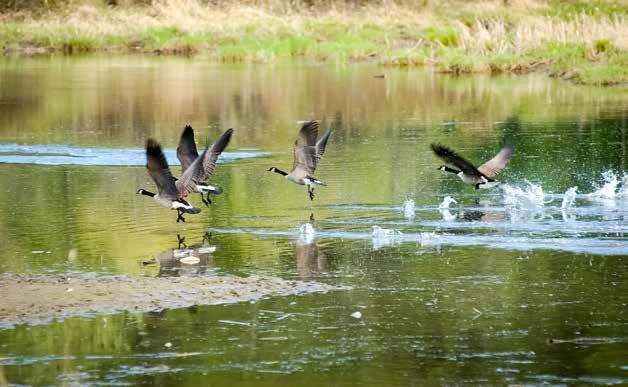
Please save these items for our spring collection and drop them at Brewer Park (corner of Cameron and Seneca) on collection day.
Please feel free to contact us with any questions you may have about waste reduction. envirocrewoos@gmail.com and environment@glebeca.ca

By Della Wilkinson
The Glebe Community Association’s Environment Committee has been hearing from Glebe residents who are unclear about the new recycling program. Among the most common concerns:
• what should go into the blue and black bins under the Extended Producer Responsibility (EPR) recycling program.
• how residents get broken or missing bins replaced.
After confusion in early January about whether residents must pay for replacement blue and black bins, the Environment Committee contacted Circular Materials and Miller Waste to get some answers to these basic questions.
Let’s start by clarifying the roles and responsibilities between these two organizations. Circular Materials is a not-for-profit organization that designs and monitors recycling systems to help producers meet their obligations under EPR. Miller Waste has been contracted by Circular Materials to collect residential recycling and to provide replacement recycling bins.
A visual list of accepted materials can be found on the Circular Materials web page www.circularmaterials.ca/ resident-provinces/ontario/, but the simple rule is if you buy a consumable
product, the packaging and the container should go into the recycling with the following exceptions:
• alcohol containers
• aerosol sprays showing a toxic, corrosive or flammable symbol (however, cooking and cosmetic spray containers are recyclable)
• books
• cooking pots
• diapers
• hazardous materials such as paint and batteries
• toys
Residents can pick up a replacement blue or black bin (not green bins, which are managed by the City of Ottawa) free of charge at Miller Waste Systems (East), 1815 Bantree Street. Residents must have a form of identification, such as a driver’s licence, that shows their address and complete a form.
Miller Waste is open 8 a.m. to 5 p.m. Monday through Friday except statutory holidays.
We have asked how residents with mobility issues or those who do not own a car can get their bins replaced and are awaiting an answer from Circular Materials.
Of course, the best option is to give materials a second life, which is why the GCA Environment Committee is once again collaborating with the Enviro Crew of Old Ottawa South on
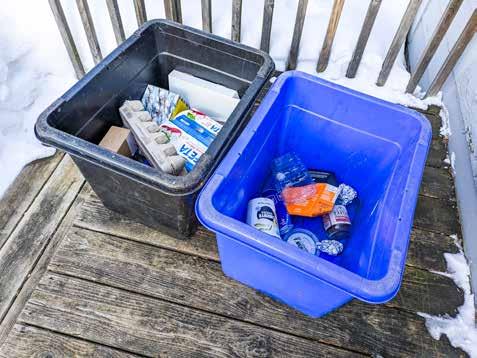
a “big collection” of items that we can recycle, reuse or repurpose. We will have our spring collection on Saturday, April 25 between 10 a.m. and 2 p.m. Drop recyclables at Brewer Park, corner of Cameron and Seneca. Please feel free to contact us with any questions you may have about waste reduction – envirocrewoos@gmail. com and environment@glebeca.ca.
Della Wilkinson is chair of the Glebe Community Association’s Environment Committee.



The Rideau Chorale ends its 10th anniversary season on April 25 at Southminster church.
By Peter Robb
The Rideau Chorale closes its successful 10th anniversary season with a pairing of 20th century masterpieces that attempt to offer solace, solidarity and hope in uncertain times.
The concert called Solace and Solidarity will be performed on April 25 at 7:30 p.m. at Southminster Church. The choir will be joined by Matthew Larkin (organ), Sonya Sweeney (mezzo), Michelle Gott (harp) and Zac Pulak (percussion).
The pieces chosen by artistic director Kevin Reeves are the Requiem by the French composer Maurice Duruflé and Chichester Psalms by the American, Leonard Bernstein.
Musically they provide a distinct contrast.
“I chose Duruflé’s Requiem and Bernstein’s Chichester Psalms not only because they contrast with each other stylistically, but also because they are beautifully composed and challenging for singers,” Reeves said.
Duruflé’s Requiem was composed in memory of his father who died in Paris in 1945 just after liberation. It was finished in 1947 and is considered one of the major works of the century.
The piece is built on Duruflé’s own early training in a cathedral choir where he was influenced by the haunting tradition of plainsong and Gregorian chant. As the composer himself said in his program notes: “My Requiem is composed throughout on the Gregorian themes of the Mass for the Dead. I have done my best to reconcile, as far as possible, Gregorian rhythm as established by the Benedictines of Solesmes with the demands of modern metre.”
The composer says his Requiem “is not an ethereal work which sings of detachment from earthly worries. It reflects, in the immutable form of the Christian prayer, the agony of man faced with the mystery
The piece brings forward the idea of solace and hope and in turn offers comfort and a sense of solidarity.
The Requiem is paired with Bernstein’s Chichester Psalms, written in 1965 in a tonal style, that contrasts deeply with the Duruflé.
Bernstein was at the height of his fame in 1965 as a conductor and as a composer.
The Psalms follow in the wake of West Side Story and other important works and in the aftermath of the assassination of John F. Kennedy and the death of a close friend.
Just after the assassination, in early December 1963, Bernstein received a letter from the dean of the Cathedral of Chichester in England, requesting a piece for a music festival, with “a hint of West Side Story about the music,” according to the official website leonardbernstein.com.
The composer provided what he called a “suite of Psalms, or selected verses from Psalms” under the working title, Psalms of Youth.
Bernstein wrote the piece to be sung in Hebrew, setting the musical shape of the piece in a typical four-part Christian choral piece, intentionally cre ating solidarity between the traditions.
The website says that in his composition, Bernstein was pleading for peace for Israel, which was in the building crisis that ended in the 1967 Six-Day War.
Tickets for the April 25 concert are available at zeffy.com/en-CA/ticketing/solace-and-solidarity.
It has been quite a year for the choir, says mem bership coordinator Marty McCurdy. “Over 10 years, Rideau Chorale has fulfilled its role as a commun ity choir.”
With this anniversary celebration ending, McCurdy says the choir is “actively seeking to recruit new members from students (to) those recently retired. We welcome new members just beginning to explore their singing voices and offer music that challenges our more experienced singers. We are proud of our role in the community and look forward to the next 10 years providing great music to audiences from our community and beyond.”
Peter Robb sings tenor in Rideau Chorale.

Founded in 2013 and presented without interruption ever since, Doors Open for Music at Southminster (DOMS) offers free 45-minute concerts every Wednesday at 12 noon, September through June, at Southminster United Church, 15 Aylmer Avenue. Concerts are live in person and live streamed on YouTube. The series is sustained by freewill offerings.
The church is wheelchair accessible and on OC Transpo routes 6 and 7. Seniors (65+) ride free on Wednesdays on OC Transpo buses and O-Train service.
A special thank you to Colonel By Retirement Home for welcoming DOMS concert attendees each week with complimentary coffee and cookies!
March 11 – Trio for Peace
Andrew Paul MacDonald (archtop guitar), Wilhelm Magner (viola) and Carmen Picard (piano) play Schumann’s Märchenerzählungen trio and world premieres by MacDonald and Ottawa’s own John Armstrong.
March 18 – Fantasies and Sonatas
Acclaimed classical pianist Roman Timofeev performs Mozart’s Sonatas in C (K. 309) and C minor (K. 457), and Fantasia in C minor (K. 475).









By Peter Simpson
Remember those old posters that quipped, “Beer — it’s not just for breakfast anymore!” Now beer is even the key to a luxuriously simple dessert. The key is the right kind of beer — one that is dark, that is (usually) higher in alcohol content (AVB), and has flavours such as chocolate, vanilla, caramel or coffee. In other words, what we’re looking for is a stout or porter, which are available fresh from local breweries. Current examples include Dominion City’s “Between Two Evils” Barrel Aged Imperial Stout (10 % ABV), with hints of chocolate, or the “Tourmente” Imperial Sweet Stout (10.5 % ABV) from Brasserie du bas Canada, made with vanillas from Madagascar and Uganda.
Last year when I had two cans of a strong mocha stout in my beer fridge, I changed their destiny to dessert. I’ve done it several times since with different beers, most recently with Flora Hall’s Imperial Chocolate Stout (10.2 % ABV), which was aged in oak foeders and then enriched with Madagascar vanilla and chocolate nibs.
Otherwise, you need only three other ingredients that you probably already have in your kitchen: butter, brown sugar and vanilla ice cream. You start by pouring the beer into a saucepan — if the stout comes in cans, use two, and if it comes in 750ml bottles, as barrel-aged beers often do, use it all (except for the tithe you pour into a glass to enjoy while cooking, if that’s your thing.)
Put the saucepan onto a hearty simmer, as your goal is to reduce the beer by at least twothirds of its original volume, and ideally closer to three-quarters. This cooks off the alcohol and deepens the sweet, earthy flavours.
A tip tip: While pouring in the beer, tip the pan as you would a glass to prevent excessive foaming. The beer may foam as it heats, but stirring it will settle the foam. (If it foams over, you have the pan too hot!)
Next, add a half cup of butter (real or vegan), and a half cup of brown sugar into the reduced beer, and stir until all is melted. Taste and add more butter or sugar as needed — you likely will need more sugar. An optional step is to stir a rounded teaspoon of cornstarch into a small amount of water, then stir that into the sauce for a bit more thickness.
Remove the pan from the heat and set aside while you scoop vanilla ice cream into bowls, ideally bowls you’ve chilled in the fridge or freezer. Skip factory ice creams and try superior options from local producers such as Moo Shu, Merry Dairy or Haven’s Creamery. You need great ice cream to make a great dessert.
Once you are ready to serve, spoon a few tablespoons of the sauce onto the ice cream. Serve immediately, as the hot sauce will start to melt that cold ice cream. At this point the combination of temperatures, colours and flavours is sublime. You can find other uses for these sauces, perhaps on a cake, or a different flavour of ice cream, or even as part of a main, savoury dish of meat or poultry. As they say, beer — it isn’t just for dessert anymore!
Peter Simpson is part of the team at Flora Hall Brewing. pete@florahallbrewing.ca


• RANDALL’S KNOWLEDGEABLE SPECIALISTS can guide you on style, fabric and colour. Plus Randall’s takes care of measuring, installation and guarantees the fit. Easy peasy!
• FLEXIBLE VIEWS, open from either the top or bottom to control how much light enters the room without sacrificing privacy.
• MAXIMIZE ENERGY EFFICIENCY by keeping the upper half closed in the summer to keep your room cool, and open in the winter to allow the sun to help warm up your space.



By Marisa Romano
Mary Lou Bienefeld has been volunteering with the Centretown Community Food Centre (CCFC) for 20 years. Her job at our local food bank is to greet clients and give them access to the food. Her weekly three-hour shift is on Thursday afternoon. “When I arrive home, I am happy,” she says with a warm smile.
At the Food Centre, she enjoys the interaction with people and the community spirit that bonds volunteers, clients and staff. She relishes the connection that she makes with returning clients and the life stories they tell. The easiness and curiosity with which she approaches people stem from her years lived in the United Kingdom and Tanzania and her experience as a schoolteacher.
Volunteering at a food bank was something she had never considered before stepping into the Centre back then. She did it for the first time when a fellow teacher and neighbour asked her to cover one of her shifts. And she never left.
Founded and supported by the Centretown Churches Social Action Committee (CCSAC) – a collective of 22 churches in downtown Ottawa – the Food Centre has been serving food-insecure people since 1978. Its extensive catchment area includes Centretown West, the Glebe, Old Ottawa South and Old Ottawa East. The centre operates with no government funding. The Ottawa Food Bank provides about 60 per cent of the food; the rest is purchased with donations from CCSAC and its member churches and from local residents. The annual “Walk for the Centre,” the fundraising event that contributes a significant portion of the Centre’s funding, also raises awareness of the serious food insecurity facing so many in our community. And food donations by businesses and individuals help the Centre keep costs down.
When Bienefeld started volunteering, the centre was in the basement of Centretown United Church at 507 Bank Street; the dark and gloomy space functioned as an emergency food and clothing centre. Yes, emergency and temporary – no one would have expected back then to see the need for food banks to last this long. The 2023 relocation to the larger, brighter and more welcoming space at 370 Catherine
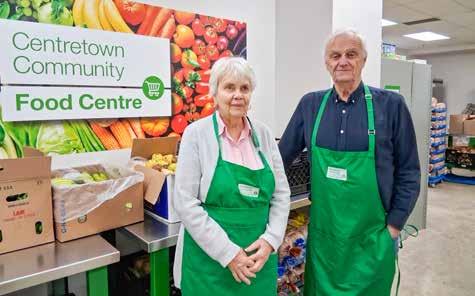
Street has allowed for a reorganization of food distribution from a “hamper style” to a “supermarket style,” giving clients more choices in their food selection. The centre welcomes everyone regardless of religion, culture or social status by offering halal meat to its Muslim clients, tofu, gluten free products and milk alternatives to people with intolerances and allergies.
The average number of clients served each month has recently risen to a staggering 1,500. During her shift, Bienefeld greets a broad spectrum or people, including students, seniors, newcomers and working families. Surprising to most of us, food-insecure people and regular clients of the Food Centre are also Glebe residents; people whom we may pass when strolling along Bank Street.
Many of us contribute by donating money and food, but what else can we do? “Spread awareness,” urged Dennis Hansen, current manager of the Food Centre, in a recent interview. Awareness to increase donations, but mainly awareness of how the Food Centre works and where it is located so everybody in our community who is vulnerable or needs help has a safe and welcoming place to go for support.
And if you want to experience the happiness that Bienefeld does, contact the Centretown Community Food Centre and join the pool of 80-plus volunteers who donate their time to help our neighbours in need.
Marisa Romano is a Glebe resident who loves food and the people who make it.


Centretown Community Food Centre
370 Catherine Street Walk-in Hours: Monday, Tuesday, Thursday: noon to 3 p m Friday: 9 a m to noon
Soupe aux carottes
This is Mary Lou Bienefeld’s celebratory recipe for the 2026 UN International Year of Volunteerism; it’s one of her husband’s favourites. The ingredients are pantry staples and on the list of food available at the Centretown Community Food Centre.
Makes 3-4 servings
Ingredients:
3 tbsp butter (or margarine)
1 lb carrots, diced
1 potato (or sweet potato) diced
1 onion, sliced 1 tsp salt ½ tsp pepper ½ tsp sugar
1 clove of garlic
3 cups chicken (or vegetable) broth
1 tsp of chervil or oregano or marjoram
* ½ cup of split red lentils can be added to the ingredients. In this case, you will need to add extra broth, about 1.5 cups.
Directions: Throw all the ingredients in a large pot, cover and simmer for 30 minutes. Add 1 tsp of preferred herb. Partially blend according to preference and serve.







By Emma MacMillan
Looking for free things to do this March Break with your kids? Every March Break, the Ottawa Public Library provides free programming, events, crafts, story times and more for kids.
True to form, between March 16 and March 21, the Ottawa Public Library’s Sunnyside Branch is offering daily programming with the theme of Curious Creatures!
On Monday, March 16, the break will kick off with My Imaginary Friend, a story time and craft event for kids aged four to six. Later that afternoon, we will have our Create a Creature program, which will feature a quick-dry clay craft for kids of all ages to design their own mythical animal.
On Tuesday, we will do an improv program, Get Wild, for kids aged nine to 12 to participate in imaginative play.
On Wednesday, we will start with a bug-themed Storytime and bingo game for ages four to six (You’re Bugging Me!). In the afternoon, Parrot Partners will visit with their adorable birds to meet, feed and take pictures with!
On Thursday, They Came from Outer Space, for kids aged seven to nine will feature an alien-themed craft where kids will trace their forms on paper and recreate themselves as extraterrestrial creatures.
For parents used to our regular
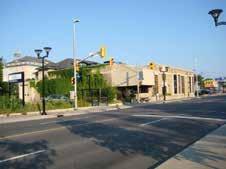
a March Break “Curious Creatures” extravaganza!
weekday programming, don’t despair! Babytime will take place in the morning on Tuesday, March 17, and a special bilingual Storytime with a craft at the end will be held on Thursday –it’s titled Lions, Tigers and Bears. That Storytime is designed for children ages four to six, but younger kids are welcome as well. On Saturday morning from 10:15 to 11:30, we will be opening our toyboxes for our usual Stay & Play, which is a free-play opportunity for younger kids and toddlers.
Keep your eyes peeled for more details and updates on our website at Ottawa.bibliocommons.com or come visit us in the children’s section for more information.
Please note that some programs require registration, which opened to the public on February 9. You (or your child) will need to have an Ottawa Public Library card to register for these programs.
Hope to see you soon!
Emma MacMillan is the children’s librarian at the Sunnyside Branch of the Ottawa Public Library.


By Lisa Butler
The Ottawa Guild of Potters (OGP) is once again hosting the Great Bowls of Fire at the Glebe Community Centre on Saturday, March 14. This annual event helps raise much-needed funds in support of the Ottawa Food Bank. Food security matters!
Patrons can look forward to selecting a beautifully handcrafted pottery bowl and choosing their favourite soup and bread from some of Ottawa’s best restaurants and bakeries for a delicious take-home meal.
Guild potters have been hard at work crafting bowls in preparation for this year’s event. Seventeen featured potters have each donated 25 bowls to choose from, with other potters broadening the selection with their own donations of beautifully handcrafted bowls.
Some of the best restaurants and bakeries in the city will provide soup and bread ready for guests to take home and enjoy with their friends and family. This year’s partnering restaurants and

bakeries include All About The Soup, Black Walnut Bakery, Coconut Lagoon, Le Poisson Bleu, Les Fougères, On Union Street, Stofa Restaurant, Strawberry Blonde Bakery, The Red Apron, True Loaf Bread Company, Thyme and Again, Top Shelf Preserves and Your Bread Box.
We will have live music this year by Off the Record, a group of local musicians.
Many of our potters, restaurants and bakeries participate each year, and familiar faces from the community also return annually to support the
Ottawa Food Bank. The OGP has held this fun event for more than 21 years at the same location, raising more than $248,000. With your support, we are on track to easily surpassing the quarter of a million dollar mark this year. That’s a lot of beautiful handmade bowls and yummy soup!
Now more than ever, people in our community are depending on the Ottawa Food Bank for help, and the OGP is looking forward to another successful fundraiser. Gather your friends and family and come see us on Saturday, March 14 from 4 to 6 p.m. at the
Glebe Community Centre.
Tickets are $58 each and are available on Eventbrite.ca.
For more information, please contact: GBOF@ottawaguildofpotters. ca or go to ottawaguildofpotters.ca/ events-great-bowls-of-fire.
To see all the featured potters and handcrafted bowls, keep an eye on the OGP Facebook (ottawaguildofpotters) and Instagram (ottawapotters) accounts leading up to the event.
Lisa Butler is communications co-chair for the Ottawa Guild of Potters.







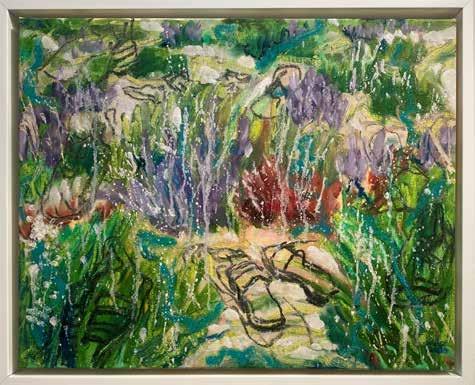
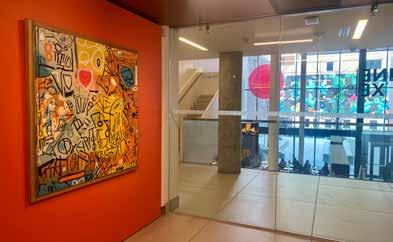
By Maureen Korp
A new exhibition of work by 16 Ottawa artists in the glass-walled Annexe Gallery of the Ottawa Art Gallery is entitled “Chroma”. What is “chroma”? Colour remembered. Two interior walls, coloured orange, serve to pull the casual passerby into the gallery. All works are available for rent or purchase.
“Cityscape 89,” 2025, a mixed media painting by Dave Fortier, aka DAWD, is framed by one of the orange walls. Fortier's composition is a tumble of yellows, browns, blues. Its colours present a multitude of bits and pieces of unnoticed detritus along familiar routes of urban signscapes, vehicular traffic. Are there faces to be seen out there? Is that a heart in between bits of text turned upside-down and sideways?
The DAWD work hangs in a glasswalled alcove of the Annexe, which looks out to another wall outside on Daly Avenue on which is the famed EEPMON mural, “Chaos Bloom – Tidal Wave,” 2024. To be able to see the work of both DAWD and EEPMON at the same time makes for an unexpected visual dialogue.
Whatever is built anywhere, by any creature, is built within the mathematics of nature. “Underdeveloped Illusionism,” 2024, a painting by Mark Garland, measures two large eyes, dark profiles looking at one another, both overlooking a river teeming with fish. Words are there, half-remembered, reversed and broken, all within labelled, measured boundaries: three inches wide to the left, 24 inches tall to the right. Whose version is correct?
As we fall asleep, hypnagogic moments might take shape very like those seen in three small framed monoprints by Lawrence Finet: “Exploded I,” 2018, “Reconstructed 2,” 2018, and “Exploded 3,” 2018. Finet's work is a meditative series of actions half-remembered, the fluid ovoids of skateboards, of half-lost footprints, half-melted snowbanks.




wall behind them are several paintings, but they are not looking at them. What are the women talking about? In this setting in the Gallery, they are the embodiment of bold complementary colours: blue and orange, yellow and purple, red and green. Do they know?
All of us have known moments of indecision. Two paintings by Colette Greco-Riddle might work colour and line into visual recollections of those feelings. “Wishful Thinking,” 2022, for example, is a loose, open, gently stroked study of yellow, orange, white. Not so, “Pressure Points,” 2022. Its blocks of red, yellow, orange crowd into centre.
Do little flowers remind you of childhood, school friends or grandma?
Two small paintings on wood panels by Heather Assaf might evoke those thoughts. “Fantasy Floral 9,” 2025 is a gathering of soft pinks, yellows, blue. The flowers of “Fantasy Floral 24,” 2025 are held upright in a vase. Nearby is a purple shadow.
Another day, another possibility, as we see in “There is a Way Out,” 2018, an oil painting by Tavi Weisz. Someone left sandals behind in a thicket of flowery shrubs and water splashes. Does she swim alone? Maybe not. Another Weisz oil painting, “We are not Lost,” 2018, opens a way through for the rest of us with its cheerful rose, pinks, purples. Colour is a marker of location. Unlike numbers, colours are not ever neutral. No colour is remembered without reason, no colour chosen without purpose. In the work of Julian Garner, we see the motifs of folk tales and old beliefs. “Alone Together,” 2025, an acrylic painting on wood, for example, presents a nun-like figure. Her robes are not black, however. They are a deep red adorned with a floral design of yellow. In her hands, she is holding a miniature town with its church centred. Overhead, a bird is watching.
The world surrounding, seen and remembered in colour.
The primary colours of pigment, of paint, as students learn in art class, are red, yellow and blue. The secondary colours – green, orange, purple –are those made by mixing any two of the three primary colours. How then does one get to the fabled array inside a box of Crayola 48s? Leslie Hossack may have asked similar questions as we see in “Crayola,” 2022, a digital chromogenic print replete with Pythagorean proportions in its eight vertical stripes.
In Sharon Lafferty's acrylic painting entitled “At the Gallery,” 2025, we see two women in conversation. On the
Maureen Korp is a writer, historian and scholar. Her most recent book, THERE and HERE, a small collection of poetry, is available in bookstores.
“Chroma”
Continuing until April 19 Annexe Gallery of the Ottawa Art Gallery 50 Mackenzie King Bridge Sunday and Tuesday 10 a.m. – 6 p.m.

By Nicolette Pilypaitis
Art Lending of Ottawa (ALO) is a unique, not-for-profit, collective of approximately 40 professional local artists. With the goal of bringing high quality art to the National Capital Region, ALO organizes seasonal shows, where collectors can purchase, lease or rent-to-own any piece on display. This flexible fee structure means that the price of original art is no longer a barrier to enjoyment on a temporary or permanent basis.
Since 2025, live art demonstrations have become an additional, exciting feature at ALO shows. The demo artist for the March show is member Sue Daugherty. Daugherty studied visual art, earning her master’s degree at the University of Guelph. Since that time, she has taught art to secondary, college and university students. Daugherty has also participated in exhibitions at venues across Ontario. Her residency at the Ottawa School of Art culminated in a solo show. Daugherty’s skills include printmaking, photography, collage and painting. In recent years, she has



focused on working with soft pastels, for the sensitivity and directness of the medium. The March live art demonstration will offer the opportunity to watch her at work. Visitors will be able to see her choice of art materials, observe her techniques and ask questions about her process.
ALO shows are always open to the public, and there is no entry fee. Come out and support your local art community by viewing the art on display and watching the live art demo. You never know, you may decide to purchase a
Screen suggestion
one-of-a-kind piece of art as a gift or borrow a piece to brighten your home or office space. Be sure to ask about ALO’s unique art lending program.
Join us Saturday, March 7 from 10 a.m. to 4 p.m. at the Jim Durrell Recreation Centre, 1265 Walkley Road. Admission and parking are free. And tuck May 30 into your calendar for the ALO summer show!
Nicolette Pilypaitis is an artist and Art Lending of Ottawa member.
Director: Felipe Bustos Sierra (UK, 2026)
Suggested by Tony Wohlfarth
Everybody to Kenmure Street takes place over one day in the Pollokshields neighbourhood of Glasgow. Early in the morning of May 13, 2021, an immigration enforcement van from the UK Home Office arrived on Kenmure Street to arrest two Sikh men – Sumit Sehdev and Lakhvir Singh – to deport them. Both had lived in Glasgow for 10 years.
First, a few curious locals convene outside their homes, suspicious of something nefarious afoot. Then, the progressively minded arrive after a text alert is sent to a local activist network. Hours later, the crowd had swelled to the length and breadth of the entire block, badly outnumbering the immigration enforcement on site. An enterprising participant – Van Man, as he was called – crawled underneath to prevent the van’s departure.
This is the first feature-length film by director Felipe Bustos Sierra. He pieced together the events depicted through videos taken by those on Kenmure Street that day.
This Scottish documentary had its world premiere at the 2026 Sundance Film Festival and went on to win a Special Jury Award. It screens next at the Glasgow International Film Festival in late February, then will be released theatrically via CONIC.film. Log on here for updates: https://www.conic.film/films.
If these events sound familiar, think about recent events in Minneapolis. Residents used a Signal chat to mobilize their community; different results, yet the similarities are striking.
Recommended.
Running time: 1hr, 38 mins
Tony Wohlfarth is a Glebe resident and a freelance film writer. He covered the 2026 Sundance Film Festival virtually.
Hamnet (US, 2025)
Director: Chloé Zhao
Review by Kate Roberts
When I first considered writing about Hamnet, my gut reaction was like considering a marathon. More succinctly, “How would – no. Why? No.” I could see no path to put this movie into words. But reticence be damned, I can’t seem to get it out of my head. A week later and here I am still thinking about Hamnet. Fine, FINE. People run marathons all the time; how hard could this be?
Hamnet gives us a peek into the early life of William Shakespeare (Paul Mescal). How he met his wife, Agnes (Jessie Buckley), the early years with their children, when his career took him away from home and how the death of his son Hamnet (Jacobi Jupe) prefaced his famous tragedy, Hamlet. Note that this story takes place 400 years ago when the alphabet was still an opinion of preference and that “Hamnet” and “Hamlet” were interchangeable. It is speculative – the characters are based on real people, but the emotions and motivations are what-ifs. It’s good to know this before diving in, because into the deep end we go.
Let’s start with the ambiance. Hamnet has this inexplicable way of feeling light and dark at the same time. The sun could be shining, birds chirping, people smiling, but there’s a consistent damp glow to every scene. Credit for this eerie filter goes to natural lighting and strategic window placement. If we’re picking apart all the symbolism, I’d go scene by scene and note the setting, tone and which characters favour shadow to sunbeams. Agnes, our woman of the wild, is like a tree without roots, always reaching for the sky, the dirt, the animals, and she’s the only character who wears bright colours, like a fallen leaf. She is a glimmer of wild magic, weaving spells and envisioning futures, breathing wonder and life into every interaction. When her son dies, suddenly, horribly, everything stops. Her connection to nature broken, her future black, her spirit this echoing, empty shell. Agnes’ wardrobe fades from bright red to muted blues, dull like the rest of the characters.
And who can blame her. We see these kids grow up. Full of imagination and eagerly onboard with their mother’s casual spellcasting. Hamnet and his twin sister are each other’s shadows, play-acting in the


garden and swapping clothes to confound their parents. There is so much love in their modest little family that we’re hoping the synopsis is wrong.
To say that I cried is a colossal understatement. I had to remind myself, repeatedly, that this is just a movie, it’s not real. Our sweet little Hamnet doesn’t pass away peacefully in the night. No, no. Remember that, up to now, we’ve been influenced by Agnes and her connection to the supernatural. So, when Hamnet crawls into bed with his plague-ridden twin sister and tells her that Death is in the room, we believe him. We feel just outside the frame, like a character without dialogue. Hamnet swears that he’ll swap places with his twin, that Death can’t tell them apart, that she will survive if he takes her place. If you heard someone gasp-sobbing in the theatre, that was probably me.
My emotional capacity was already bubbling over and burning the stovetop when months later, in a haze of grief, Agnes finds out that Will – absent, distant Will – has written a play by the same name as their son. How dare he. She takes her rage all the way to London, to the first row of the Globe Theatre. She is the most disruptive audience member. The early scenes, especially, explain more about Will’s grief than anything he’s said to Agnes in person. Watching and listening, line after line, Hamlet brings Agnes back to life.
This scene is a work of art. Agnes and Will were on completely different levels after Hamnet’s death, at war with each other, speaking but never getting through. In this one, beautiful moment, they
understand each other and their grief completely. Agnes leans against the stage and Will hides in the wings while the players unknowingly connect them. Their only direct interaction (which Will may not even hear) is a whispered beg from Agnes to turn around and look at her. Keeners will note that this request is a bookend to the story of Orpheus and Eurydice that Will told her when they first met, where Orpheus’ desperate look at the underworld made his lover disappear forever. In Hamnet’s version, Agnes solidifies. I could dissect this movie forever, but I’d have to watch it again, and I don’t think I’m hydrated enough. I couldn’t even tell you what, specifically, makes Hamnet so devastating. The plot points, sure, but there’s a subtle and powerful buildup that brings colours, tones, feelings and light all crashing down. Something is irreparably broken until, miraculously, grief finds relief in words. I can’t say if I sobbed because I was sad or hopeful or relieved – all of the above, probably. Imagine finding something that communicates what you could never explain and there’s this overwhelming feeling of, “Yes. That.” Hamnet is a composure-cracking 9/10.
Running time: 2 hrs, 5 mins
Kate Roberts grew up in the Glebe and is a movie addict who has been writing reviews since 2013. Her reviews can be found at plentyofpopcorn. wordpress.com.




By Clare Davidson Rogers
Before anyone starts pointing fingers, we hasten to say that Something Rotten! is a musical and a rollicking comedy set in Shakespearean England. This latest production of the GNAG Theatre Group will be presented at the Glebe Community Centre in April, and with over 30 members in the cast, it’s quite possible that you’ll see a neighbour on stage there. In fact, a big part of the fun for the cast members is being able to share their performance with friends, family and neighbours in the audience.
So, what gets one of your neighbours out of the house for one or two evenings each week from September to April, rehearsing and preparing to sing, dance and act, and what keeps some of them coming back? Sometimes it’s just general interest. Jennifer Ford, a Centretown resident, saw the theatre course offering in the GNAG program guide and tried out for The Sound of Music in 2008; she has been involved in both performing and set design for many subsequent plays.
Sometimes the reason for joining is closer to home. Janine Brooks-Jean, a Glebe resident, remembers being one of the parents whose kids were in the cast of Fiddler on the Roof in 2016. “I would come with the other parents and pick up the kids, and I saw how much fun everyone was having, and I thought I would like to do something like that,” she says. This led to both mother and son trying out the next year, and Janine is now in her sixth production. She especially likes the music, and the pace of the rehearsal schedule allows her to fit it in, even with a busy lifestyle.
Sometimes the connection isn’t quite as immediate. Leonore Evans, another Glebite, got to know the theatre program a decade ago when her daughter was in several of the plays, but she only decided to try it herself in 2023 when The Drowsy Chaperone was being presented. Something Rotten! will be her third play. She finds the theatre “a great winter hobby.” She especially loves the dance element but is also in awe of
the teaching skills and talent of music director/pianist Lauren Saindon. Leo’s enthusiasm is infectious; it was not long after she joined that her cottage neighbour David Chernushenko, an Old Ottawa South resident (and former city councillor) got a knock on the door and a personal invitation to add his tenor voice to Drowsy. He’d done some theatre and choir work in









the past and had seen a number of past performances, so he needed little persuasion. A published author himself, he finds it interesting that even with a given script, there is still so much creative room for participants: “I guess what’s engaging the creative part of the brain is that it’s all three, it’s words, it’s dance, it’s music, and all at the same time,” says Chernushenko. Experience is not required, as several participants can attest. When Jean-François Harbour and Helena Forbes saw a Facebook posting for Drowsy Chaperone, Helena (a self-confessed musical nerd) was immediately determined to try out for one of her favourites, but J-F was a bit shy. “I had never done theatre in my life, so it was all new, and I had no idea what to expect, but everyone was so welcoming,” he says. The family atmosphere impressed them so much that they now have both daughters joining them in the cast of Something Rotten!
Of course, not everyone in the play is from the local neighbourhood, and not everyone has been involved for multiple years. Alison Manning is in her first play at the community centre – she drives to and from her home in Barrhaven for every rehearsal, but she notes that she has work ties and friendships with cast members and has been thrilled by performances dating back to Oliver in 2015. Will Ball and daughter Zoe come in from Westboro. Both were enticed by Glebe friends, but the performing fun and the friendly company make them believe their second play is only the beginning. Regardless of what neighbourhood they come from or how long they’ve been involved, one thing is certain – all these players are devoting hours of effort and preparation to bring hilarious musical entertainment to your doorstep. Something Rotten! is directed by Eleanor Crowder and will play at the Glebe Community Centre from April 14 to 19. Tickets will be available March 2 at GNAG.ca.
Clare Davidson Rogers is office manager at the Glebe Neighbourhood Activities Group (GNAG) and a community theatre enthusiast.









By Bob Irvine
Martin (“Marty”) and Molly Shmidlap of 4044 Third Avenue will receive this year’s Nobel Prize in Ornithology, the Nobel Committee has announced. This is a new category recently established by the committee.
Marty and Molly and their daughter Mindy are now en route to Stockholm for the forthcoming ceremony
window, Marty and Molly – with the aid of high-powered binoculars and cameras – began to tirelessly track every move of the mourning doves. Thanks to groceries delivered to their door and a treadmill installed in their kitchen, they could watch the mourning doves all day while eating well and keeping fit.
How did things proceed?
Marty soon became fascinated –maybe make that obsessed – with the courtship ritual performed by a male mourning dove in front of a prospective life-partner. This involves the male bowing repeatedly before the female, then performing complicated aerial
way.” Marty surmised that this was the equivalent of a man saying to his spouse: “After I do a No. 1, I will always put the toilet seat down afterwards.”
Marty and Molly described these and many other actions by courting males in an article published in Nature. This, in turn, has become a Rosetta stone for ornithologists researching other species.
Marty and Molly also published a self-help manual geared for men about to get married. Titled Men, Marriage and Mourning Doves: Life Lessons from Our Feathered Friends. The book has remained on the New York Times bestseller list for months.


protective shelter the “Maple Dome,” thank the mourning doves profusely and invite them to come back anytime. Published in November, the book is already shooting to the top of lists of best-selling books for children everywhere.
What’s next for the Shmidlaps?







Mindy has become an acclaimed children’s author in her own right. Some Three Cheers for Chicken Hawks, Scavengers of the Skies Let’s Get Down and Dirty: The World of Earthworms Up Close and Per. Mindy has also published an Good Night Loon. It teaches new parents how to make soothing bird
On Marty and Molly’s next project, I should first give you some background. Mourning doves are the closest living relative of the now-extinct passenger pigeon. They are expressly covered under the Canada-U.S. Migratory Birds Convention of 1916. Every year, mourning doves head south for the winter, often reaching parts of Mexico. And every year, American hunters harvest roughly 15 million mourning doves. Marty and Molly are calling on Prime Minister Carney – working in partnership with Mexican president Claudia Sheinbaum – to make this massive American slaughter a major shared grievance against the U.S. in the upcoming CUSMA negotiations.
At 10 a.m. on Wednesday, April 1, the Glebe Report is hosting a meet-andgreet with Marty and Molly for anyone who has not yet realized that this is Bob’s latest April Fool’s spoof. To see mourning doves in action, Bob invites you to check out “Mourning Doves Fill the Cornell Feeders.”
Bob Irvine is a former Glebe resident who likes to see the lighter side of life.





Yasir Naqvi
MP, Ottawa Centre
N 613-946-8682 E yasir.naqvi@parl.gc.ca
Food insecurity was already a reality for too many households, and the past year has brought even more uncertainty. Global tensions, threats to our economy and the return of Donald Trump to the world stage have worsened an already fragile situation. One thing is clear: we cannot rely on the systems of the past.
Last fall, the federal government tabled a budget to build a resilient economy for all Canadians. This means addressing systemic issues that have made our economy fragile. Real change takes time, but it will lay a stronger foundation for future generations.
At the same time, we must act to ease the hardships Canadians are facing today. Tangible solutions are needed to support those struggling right now, particularly families dealing with food insecurity. In Ottawa, visits to food banks have reached levels we never could have imagined. For the first time in our history, one in four households is going without enough to eat. These struggles are not unique to our community. They are the everyday realities of families across the country.
I’ve seen the strength of our community in Ottawa Centre, where neighbours support one another. Building on that spirit, our government is acting on food insecurity with both immediate and long-term solutions. I’ll start by highlighting the new measures aimed at helping Canadians who need it most.
First, we listened to organizations working every day on food insecurity, including Food Banks Canada and the Parkdale Food Centre, and introduced the Canada Groceries and Essentials Benefit to put more money back into Canadians’ pockets. The benefit increases the former GST credit by 25 per cent for five years starting this July and includes a one-time top-up this year. A family of four could receive up to $1,890 this year, and more than 12
million Canadians will benefit.
The government is also working to keep food affordable by supporting producers and supply chains. We are investing $500 million to help businesses manage supply chain costs without passing them on to shoppers, along with $150 million to support small and medium businesses that keep food moving from farms to tables. To boost domestic food production, farmers can now immediately expense new greenhouse buildings, encouraging more local supply.
Finally, $20 million is being directed to food banks and local organizations to provide immediate support. At the same time, a National Food Security Strategy is being developed to strengthen food production, improve access to affordable food and bring more transparency to grocery pricing.
As Carissa Davis, community advocacy coordinator at Parkdale Food Centre, put it: “We need immediate actions that reduce harm and provide tangible relief. And we need bold, structural reforms that address the root causes of poverty. This benefit is a small win. I am proud of our community for making it happen. But small wins cannot be the finish line.”
She is right. These measures matter, but they are not enough. To truly end food insecurity, we must address the root causes of affordability challenges in Canada, starting with housing. Studies show that rising rents are one of the biggest drivers of food insecurity. When most of a person’s income goes toward housing, food is often the first thing to be cut.
That is why the government has introduced legislation to launch Build Canada Homes, focused on building affordable housing faster across the country. Using modern construction methods and Canadian-made materials, the agency will deliver homes sooner while supporting jobs and strengthening Canadian industries. By maximizing every federal dollar, Build Canada Homes will accelerate housing delivery and help build more stable communities over the long term, with Ottawa among the first cities chosen to launch the program.
Food insecurity is not an abstract issue. Families are living it every day in Ottawa Centre and across Canada. Addressing it means acting now while also investing in long-term solutions that make life more affordable and stable. Our community has shown what is possible when we look out for one another, and our government has a responsibility to match that care with action, so fewer people are forced to make impossible choices.
As we look forward to the work that needs to be done in 2026, I’ll be laser-focused on addressing the toxic drug crisis and homelessness emergency affecting our community. I am hoping that Ontario will soon approve the use of Injectable Opioid Agonist Treatment (IOAT) – a therapy already used in other parts of Canada that provides an alternative to fentanyl and the strong opioids that some of our neighbours are addicted to. IOAT is injected on site, taking away the diversion being seen in the community that is causing a lot of concern from community members and providing neighbours using substances a safer place to use.
With new data showing that more than 85,000 people in the province, including over 20,000 children and youth, are without a home, the time for political games is over. This year, I’m also fighting for real, tangible actions that our provincial government can take immediately to address housing and affordability issues. Some common-sense solutions I’ll be bringing forward to the Legislative Assembly include:
• Bringing Back Real Rent Control – In Ontario, there is nothing stopping a landlord from jacking up a unit’s rent between tenants. And for units built after 2018, there are no rent controls, meaning landlords can increase rent by any amount annually. You don’t deserve to get priced out of your own neighbourhood, and that’s why I co-sponsored the Rent Stabilization Act, a bill that would bring back rent stabilization and vacancy controls. Without strong rent and vacancy protections for tenants, renters will continue to be locked out of the market and risk falling into homelessness.
• Combatting Youth Homelessness
James provides legal services to Glebe residents, offers home visits and welcomes new clients.
613 565-5297
mccullochlawyer@rogers.com
– Of the approximately 1,000 kids who age out of the Ontario child welfare system each year, 580 go straight into homelessness. Experts say it would only take about $15 million to divert those kids into stable housing – that’s just 0.0064516129 per cent of last year’s $232.5 billion Ontario budget.

McKenney
• Enacting A Maximum Heat Law –Safe housing means livable temperatures, and the government’s refusal to establish maximum heat regulations for the province shows a deep disregard for tenant health and dignity. I’m pushing forward a private member’s bill that would cap maximum apartment temperatures at 26°C and force landlords to ensure that, on hot days in record-breaking summer heats, every tenant has access to a cool home.
• Banning AGIs – Above Guideline Rent Increases (AGIs) are requests landlords make to the Landlord Tenant Board to increase rents beyond the provincial rent guideline. This loophole in our rental laws squeezes Ontario tenants and makes it easy for big landlords to charge renters more than they can afford. Banning AGIs will prevent landlords from driving up rents on low-income tenants and stop those tenants from falling into homelessness.
• Homes Ontario – We all know that Ontario’s housing crisis can’t be solved by the private market. Homes Ontario is a bold plan to finance and deliver hundreds of thousands of permanently affordable and publicly built homes. It will prioritize non-market, non-profit, co-op and supportive-housing providers who are focused on affordability, not extraction.
To hear more about these solutions, join me at 6 p.m. on Wednesday, March 11 at the Mayfair Theatre (1074 Bank Street) for a brief conversation with our community’s foremost housing experts, followed by a screening of Thinking Beyond the Market: A Film About Genuinely Affordable Housing. You can RSVP online at catherinemckenney.com/ housing-solutions-townhall. Together we’re going to make 2026 a year of solutions-oriented politics.

By Sue Reive
With Ottawa winter comes a lot of snow shovelling. While it’s a good workout, the repetitive action of shovelling can place a lot of stress on the body. Biceps tendinitis is one injury that results from excessive lifting, shovelling and overhead activities.
The biceps muscle runs from the shoulder to the forearm. It has two tendons in the shoulder area, one of which – the long head of biceps – attaches to the top of the cup of the joint (glenoid). This makes the tendon vulnerable to impingement during shoulder movement. The other tendon attaches to the bony process of the shoulder blade called the coracoid process. The two tendons join to form the muscle belly in the mid arm and then continues as one tendon across the elbow joint to attach onto the radius and deep fascia of the forearm. The biceps functions to bend the elbow and turn the palm up, and it helps to flex the arm when reaching overhead.
The biceps tendon can be strained with repetitive motion, a fall or lifting a heavy load. The long head of the biceps tendon is especially at risk as it runs under the roof of the shoulder joint, the acromion. Roughening of the acromion surface due to age-related degeneration can cause wear and tear of the tendon (tendinosis) or inflammation (tendinitis). Sometimes
a tear in the long head of the biceps tendon can occur if overloaded, causing a “popeye muscle” as the muscle belly bulges just above the elbow. Symptoms of biceps tendinitis include pain in the front of the shoulder, sometimes at rest or after activity, and acute pain during activity involving lifting or overhead movements. The pain can radiate down into the muscle belly. Alternatively, biceps tendinitis can cause pain in the elbow where the tendon attaches to the forearm. In this case, the pain would occur with a biceps curl exercise or carrying groceries.
After an initial diagnosis, imaging may be required. Treatment of biceps tendinitis includes rest to allow the tendon to heal. Active assisted exercises are important to help prevent a frozen shoulder from developing. Exercises to help strengthen the muscle are incorporated when the tendon has sufficiently healed. It is all about load management. The recovery time for tendinitis varies depending on the extent of the injury. Minor tendinitis usually requires six weeks to heal. What is important is to avoid re-injuring the tendon.
So, keep the load light when shovelling, take frequent breaks, and maybe wait for some of the snow to melt!
Sue Reive is a physiotherapist at Ottawa Physiotherapy and Sport Clinics – Glebe.


By Annika Whitford
Amid the constant rush of daily life, when was the last time you gave yourself five mindful minutes? Something more calming than reaching for a screen?
As countless studies show higher screen use, especially by young adults and seniors, Canada’s Centre for Addiction and Mental Health reports that adult mental and physical health worsened by roughly 12 per cent between 2020 and 2025.
Too often, we pay attention to our mental health only when it slips into crisis, when well-being should a daily practice. Mindful journaling is a simple, accessible and powerful way to start. Journaling can help you notice your thoughts, process your emotions and build self-awareness. Our brains are naturally wired to notice the negatives; with practice, we can retrain it to focus on the positives. Just five minutes a day of gratitude journaling has been shown to promote happiness, self-compassion, self-awareness and resilience. It gives you a chance to reconnect, reflect, reset and grow, one mindful moment at a time.
Positive psychology explores how people can develop thoughts and behaviours that build well-being, contentment and meaning in life. Simple practices like gratitude journaling can help cultivate a healthier mindset, shaping our responses to life’s ups and downs and improving overall well-being.
Gratitude is about noticing, appreciating, and savouring the good in life. A gratitude journal is a collection of those moments. Focusing on what we are grateful for reinforces a positive memory bias, helping counter negative thinking and shifting attention away from stress, anxiety or depression. It creates space to process feelings and gain clarity, helping practitioners timprove coping skills, problem-solving and present-moment awareness.
Your brain is like a muscle that can be trained.

Practising gratitude rewires it to focus on positives and filter out negatives. As Alex Ikonn reminds us, “You don’t get healthy and fit by reading about going to the gym. You get fit by being in the gym and doing the reps.”
The 5-Minute Journal Guide
Created by Ikonn and UJ Ramadas, the Five-Minute Journal is a guided notebook filled with daily prompts, inspiring quotes and weekly challenges. It helps train your mind to focus on the good in life. With a focus on morning intentions and evening reflections, keep your journal close to make daily mindfulness a simple habit.
Morning Routine:
Begin your day with gratitude, intention and affirmation by answering the journal’s prompts.
1. Three things you are grateful for.
2. Three things or actions that would make the day great.
3. Your daily affirmation.

Tips: Connect with the feeling behind your responses. Keep your intentions small and achievable. Your daily affirmation should focus your mind, boost self-confidence and reinforce your intention. Be specific.
Evening Routine:
End your day with a kind and honest reflection. Doing this regularly helps us see that each day holds value and meaning.
1. Three amazing things that happened during the day.
2. What you could have done to make the day even better.
Amazing moments, big and small, show up every day. It is not about being perfect; it is about accepting the day and building mental resilience to boost well-being.
If you are curious about journaling, join our community journaling challenge this March. With a coffee or tea in hand, a pen and an open page, gift yourself five mindful minutes each day. Change does not require a leap into greatness. It starts with one small, steady step. One day, you will turn back through those pages and realize the distance you have travelled.
Use your own journal, or try The Five-Minute Journal, a product of the company Intelligent Change. Follow Cup of Tea Psychotherapy’s “communi-tea” on Instagram @cupofteapsychotherapy to stay up to date with the challenge. We look forward to supporting you on your first step on your journaling journey.
Annika Whitford is a Glebe resident and marketing specialist at Cup of Tea Psychotherapy, newly located at 150 Isabella Street, Suite 215. Founded by psychotherapist Chantal Riel, the team offers evidence-based, holistic and trauma-informed care for teens and adults.




By Ellyn Duke Watson & Cooper Love
Across
1 Unit of electric current (3)
5 Mexican beer brand (3)
8 Everyone has one, nobody has two, but some people have a ‘double’ (4)
11 Wine bar in the Glebe is named after this street that it resides on (6,6)
13 Common verb suffix (3)
14 Open up, as a flag (6)
16 Waterlogged (5)
17 Relatives (3)
18 A pair of hand drums called ‘macho’ and ‘hembra’ (6)
20 Federal research and innovation body (3)
23 Titanic’s downfall (7)
25 ___ mate (South American tea) (5)
28 Small black-capped songbird (9)
32 3-Down sings about these sweet little things (4)
33 Protein-rich bean (4)
34 With an apostrophe in the middle, Newfoundland slang for a guy (2)
36 Take a risk (6)
38 Hot spring that erupts (6)
39 Loneliest number (3)
40 With the name Mike, a box of candies (3)
42 Climbing plant (4)
44 Worker’s pay (5)
46 2026 Winter Olympics host country (5)
48 Russian revolutionary leader (5)
49 Spanish for “two hands” (3,5)
Down
1 Brits call this leafy green ‘rocket’ (7)
2 Artwork such as the one underneath the 417 overpass above Bank Street (5)
3 Christine of Fleetwood Mac (5)
4 Olympic freestyle skier Mikael (9)
6 Mouth the words (3-4)
7 Thai restaurant newly opened at Bank and Holmwood (5,2,4)
9 Female chicken (3)
10 A metal subgenre featuring acts such as Korn, Limp Bizkit, Linkin Park (2)
12 Famous street in Ottawa with bars, restaurants, and City Hall (5)
15 Sport equipment used in frisbee golf (4)
17 Japanese carp found in ponds (3)
19 Monastery often housing nuns (5)
21 Sunday morning garment (4)
22 Disguised or anonymous (9)
24 Liquid squeezed from a tube (3)
26 German white wine (8)
27 Chevrolet minivan model (8)
29 Laughing scavengers in The Lion King (7)
30 To some people, it’s just a number (3)
31 Pedal-assist vehicle (1-4)
35 Chinese duck dish, or what Beijing was formerly known as (6)
37 Legal rule (3)
39 Roman poet who wrote Metamorphoses (4)
40 Social media platform, abbr. (2)
41 A class for a newcomer to learn the language, abbr. (3)
43 Tall deciduous tree found all over the world (3)
45 Art gallery in downtown Toronto, abbr. (3)
47 Informal affirmative (2)
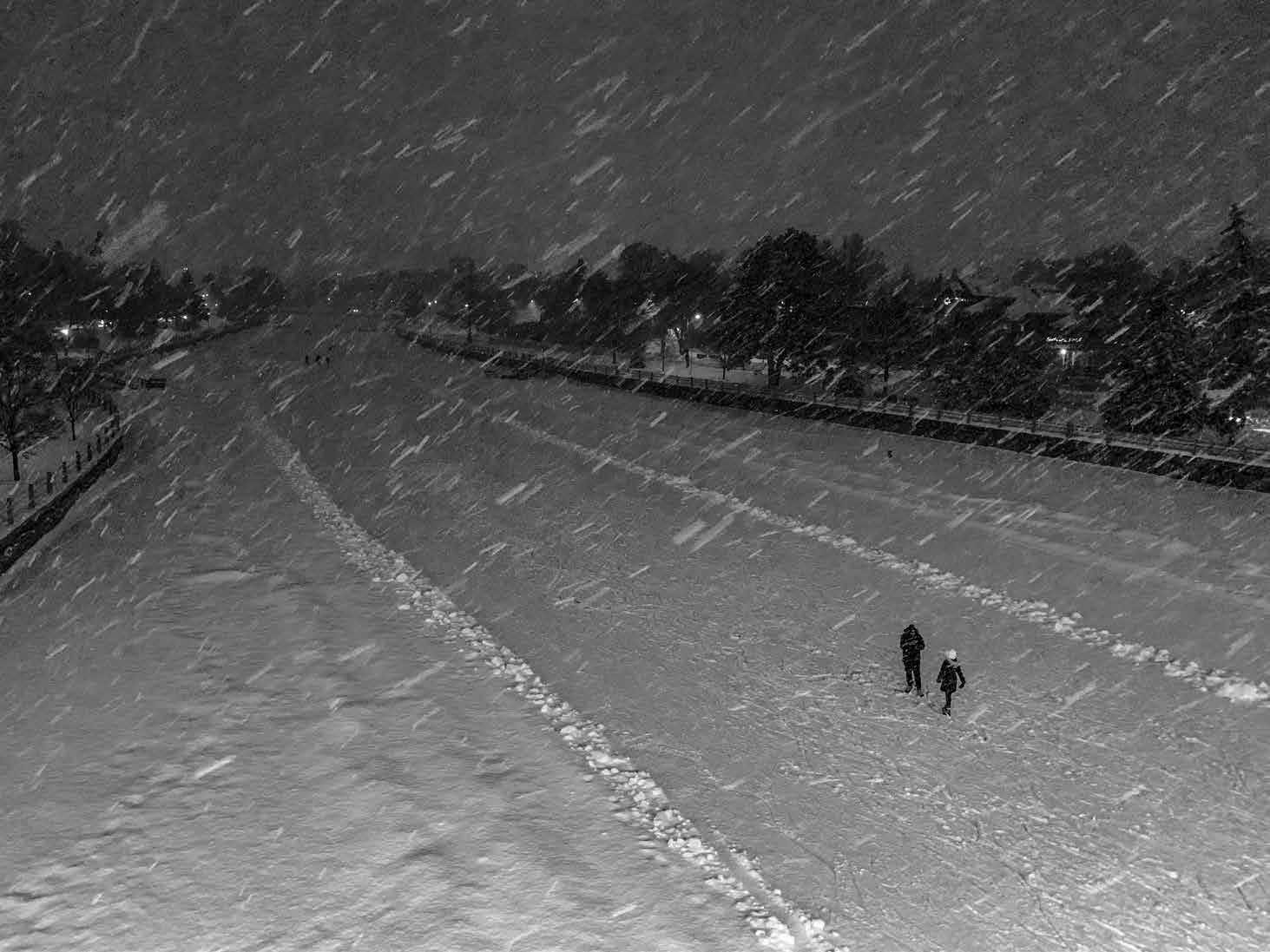

Lineups of stressed guinea pigs are getting help from certified rodentologists at Rippeyoung & Associates. “Most are citing inability to nap and feared weight loss as key concerns,” explained Rippeyoung.
Data also shows that the surge in clients is due to increased stress at the newly successful start-up, ChatGPeeg, which surprisingly surged ahead of AI Copilot.
“We’ve just signed a lucrative contract with the Feral Government,” bragged Zeus, CEO, CFO and POO of GiddyPigs.com – and the brains behind ChatGPeeg. “I knew that laconic little mice (LLMs) were just not going to have the brain power. But the guinea pig is born with the ability to chunk, and our hallucinations are very believable. We have a flare for believable falsities. And we’re cute.”
But ChatGPeeg employees are stressed. “I can’t take it! I can’t take it!” said a frustrated Floof. “If I get one more query to interpret the Davos speech, I will quit! I am so tired of making things up about Thucydides!”
Concerned about impacts on profit, Zeus brought in professionals immediately. Luckily, Rippeyoung & Associates had been testing new therapies to deal with increased stresses due to the shift to a multi-polar neighbourhood and increased confusion as Glebe stores remove signs from their windows.
“Guinea pigs are not hamsters. They don’t just get on a wheel and run. They’re deep thinkers. They need naps, deep naps,” explained Rippeyoung. “We found that support carrots really go a long way to help them get to that deep nap place, along with a bit of soft jazz.”
Indeed, the new Deep Nap (DN) Therapy seems to work. To date, ChatGPeeg’s productivity has doubled, and employee satisfaction is at an alltime high.
If you are a rodent in need, contact Rippeyoung & Associates where Geoff Taylor, Vanessa Cardinal, Leily Shafaee Millward and Esteban Rivera are there to help. Feral Government employees accepted.






and
the
By Tamara Glavinovic
Mid-winter at the Glebe Cooperative Nursery School is anything but quiet. While the snow still blankets the playground and the air carries the February chill, the toddlers and preschoolers are filling their days with movement and discovery, both indoors and out.
The toddlers have been delighting in imaginative play with colourful scarves, transforming the classroom into a winter sky. With arms stretched high, they wave scarves above their heads, watching them drift downward like snowflakes. Some twirl in place, others try to catch the “snow” before it touches the ground.
Circle time conversations have centred around all the things they love about winter. For some, the highlight is building snowmen with carefully chosen sticks and carrots. For others, it is the promise of hot chocolate after coming in from the cold. These discussions naturally spill over into story time, where new books about opposites – hot and cold, big and small, fast and slow – spark lively participation. Counting has also been a focus, with the tale of the five little ducks who went out to play bringing enthusiastic quacking and careful finger counting as each duck waddles off and returns to their mama duck.
The preschoolers have taken on the role of scientists. A plastic tub of water has become a laboratory for exploring the concept of density. Objects are held up for inspection: “Will it sink? Will it float?” When the object is dropped into the water, the children tally the results on a board, comparing their hypotheses with the outcomes. Through play, they are not only learning about buoyancy but also practising observation, patience and the joy of testing an idea.
Space has also captured the imagination of the preschool class. As a parent, I am also re-learning the many things I have forgotten over the years.
“Mummy – do you know that you can’t go to Jupiter?”
“Why?”
“There’s too much lava.”
“That’s not good.”
“Mummy, do you know that you also can’t go to Saturn?”
“No, why is that?”
“Too stormy.”
“Tricky. Let’s stay here on Earth.”
The preschoolers have used the classroom projector to explore the Milky Way, zooming through space with chants of “Zoom zoom zoom, we’re going to the moon”. They have learned about the planets, discussing why Earth is a uniquely perfect home. Jupiter is too intense, Mars is too dusty, Saturn is too stormy, and Pluto isn’t even a planet any longer.
Beyond science and space, the days are rich with creativity. The children have decorated small birds in cheerful colours, perhaps in hopeful anticipation of spring. Counting activities using jewels have added a tactile and visual dimension to learning their numbers. Sensory water play –complete with plants and small toy bugs – has invited exploration and storytelling.
This month, we welcome returning and prospective families to our open house. It is always a wonderful opportunity to showcase the warmth, collaboration and joyful learning that define our co-op community. We also continue to enjoy our monthly French classes, courtesy of our partners at l’Alliance Française.
The Glebe Cooperative Nursery School will be closed for March Break from March 16 to 20. Until then, the toddlers and preschoolers will continue to enjoy the final weeks of winter.
The bears are still hibernating – but not for much longer.
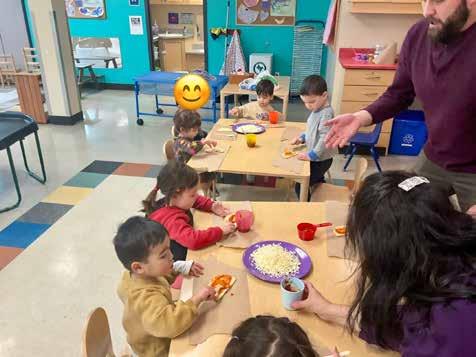


By Fen Woodstock
The Glebe Collegiate Institute music department consists of 10 ensembles, three teachers and more than 200 students, making it one of the largest music programs in Ottawa. Every other year the Glebe music students go on an out-of-country trip to share their skills with other parts of the world and engage in new cultures while honing their musical abilities and passions.
This year, they’re looking forward to a trip to Spain from April 2 to 10. To raise money for this experience, Glebe is hosting a concert on March 27 at Southminster United Church. All proceeds will benefit students who wouldn’t otherwise be able to go.
Sandra Christie, head of the music department, has worked at Glebe for the past 11 years. I caught up with her to get her thoughts on the music department, as well as to ask her about the Spain trip.
How do you see the band trip benefitting the school community?
These types of trips are really special for our students’ musical development. Our music department tries to focus on inclusivity and making the experience something that our students can feel safe in. These students are able to see everything we’ve been working on throughout the year in real life, such as Spanish music that we’ve practised together. We talk about how culture and arts are connected, and this trip allows students to experience the colours, architecture, communities and connect it all to the music.
What are some of the experiences that students are expected to have on this trip?
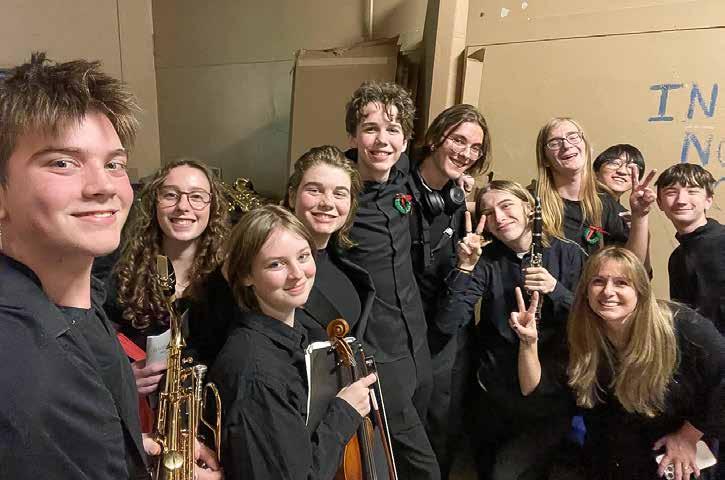
during our practices, meaning there is so much support within ensembles and sections. It’s very friendly, while still maintaining a high level of performance standard. The kids here take music because they love it, not because they feel like they have to, and that makes it so special.
What skills or confidence do you see the band students at Glebe take into other parts of their life?
In every end-of-year reflection, I ask the students that same question. The biggest thing that comes up is communication and confidence. The ensembles require so much communication to make a piece function, and they build this through countless practices. Even the quietest students grow into this confidence throughout the year. Music really transforms people. Playing in an ensemble is one of the greatest things you can do for your body and mind. These kids are some of the most likely to succeed because of what they’ve learnt from music.
Why should people come to the fundraiser?
Well, these trips are a lot of work, News from Glebe Collegiate Institute
The chaperones and I have never been to Spain, but we always try to involve as many cultural experiences as possible in these trips. We’ll be travelling through Barcelona, Zaragoza, Madrid and Seville. All of these areas are so different and have so many unique opportunities. We’ll be having a flamenco evening, learning how to dance and seeing shows. We’ll have a tapas-making lunch, as well as tours of the architecture. We’ve also got at least three performances booked, where we have no idea what our audience will look like.
What has been your favourite part of working with the students of Glebe and the music department?
I’ve taught at many different schools, and I love teaching music, but the students at Glebe are really special. They come from such diverse backgrounds, and they’re so willing to try anything new. Many of the students in the music program take private lessons, though most of them use a different instrument in the bands here at Glebe. Because of this, so much learning happens here
but so much fun. All of our fundraising money goes back to the students to make the trips more affordable for them. These experiences give students who may never be able to travel globally that opportunity. All the students on this trip are committed to the best performances possible and can’t wait to show what they’ve learned at the end of March.
If you’re interested in hearing excellent live music and supporting the Glebe Collegiate Spain trip, please come to the fundraising concert on Friday, March 27, 7 p.m. at Southminster United Church, 15 Aylmer
613 233 4775
www.donnaedwards houseportraits.com
FB: Donna Edwards Art
Avenue. Tickets are $12 for adults and $5 for children 12 and under. Purchase tickets via Eventbrite (www.eventbrite. ca/e/glebe-collegiate-music-fundraiser-tickets-1980904298080) or scan the QR code below.
Fen Woodstock is a Grade 11 student at Glebe Collegiate Institute.



By Robin Small
High school is often described as a formative time, a period of self-discovery amidst a whirlwind of new experiences and expectations. Navigating this landscape can be significantly more complex for students who feel their identities are marginalized or underrepresented within the broader school community. This reality underscores the critical importance of affinity groups, representation and a commitment to celebrating diversity in all its forms.
At Glebe Collegiate Institute, the conversation around belonging is important. A recent, powerful speech by a Grade 10 student, Faith Yvy Ngako Epie, underscored the importance of finding spaces where students can be their authentic selves.
Epie spoke candidly about her initial struggles to find her place. This experience is not unique. For many students from diverse backgrounds, the pressure to conform or assimilate can be exhausting.
This is where affinity groups become building blocks of connection, by

offering a space for sharing. “It was one of the first spaces where I did not feel like I had to edit myself to exist,” Epie said. “A space where our stories made sense . . . A space where we could laugh, vent, learn and grow without having to justify who we are.”
Glebe is actively working to cultivate an inclusive environment that addresses multiple intersections of identity. Its EquiUnity team is comprised of students from a variety of backgrounds with a vast array of lived experiences, and its mission is to build unity and community.
Glebe’s Balance and Bridge Program, led by Jay Watts, champions mental health and offers opportunities for students to be involved in anti-bullying work. At February’s professional development day, Watts’s student team spoke to teachers about the realities of bullying.
Creating a welcoming school also means dismantling physical and social barriers for students with disabilities. Anti-ableist initiatives are crucial to ensure that every student has equitable access to education and the full school experience. This involves moving beyond mere accommodations to fostering an environment that actively values neurodiversity and different abilities.
It means challenging stereotypes and recognizing that intelligence and potential are not limited by physical or cognitive differences. By prioritizing

anti-ableism, we are working towards a community where every student’s contribution is recognized and valued.
On February 18, the Glebe Collegiate Unified Team was recognized with a banner from Special Olympics Ontario’s sport director, Johnny Byrne, for its commitment to building inclusive sport opportunities and an inclusive culture.
In a world where conflict remains a persistent issue, fostering positive spaces within our schools is vital. This goes beyond acknowledging all religious holidays or a specific month as a one-off to celebrate a group. It involves actively challenging misconceptions and creating an environment where all students feel safe, respected and seen.
A key component of fostering inclusion is reframing the narratives we share. “A lot of the time, Black history is taught as if it is only about struggle,” she said. “But Black excellence, especially Black Canadian excellence, is about so much more than surviving.
“True representation involves highlighting excellence, resilience and joy across all communities. It means learning about figures like Viola Desmond and Harry Jerome, as was suggested, and recognizing that excellence can also be ‘persistence . . . choosing yourself in spaces that were not built with you in mind’.”
By supporting affinity groups, committing to anti-ableism and fostering environments that celebrate everyone,
we are taking vital steps toward a more equitable and enriching educational experience for everyone. Drawing inspiration from Ashley Banks, Epie said, “High school is about discovering who you are when the world keeps trying to label you.”
Robin Small is the principal of Glebe Collegiate Institute.
March Crossword answers
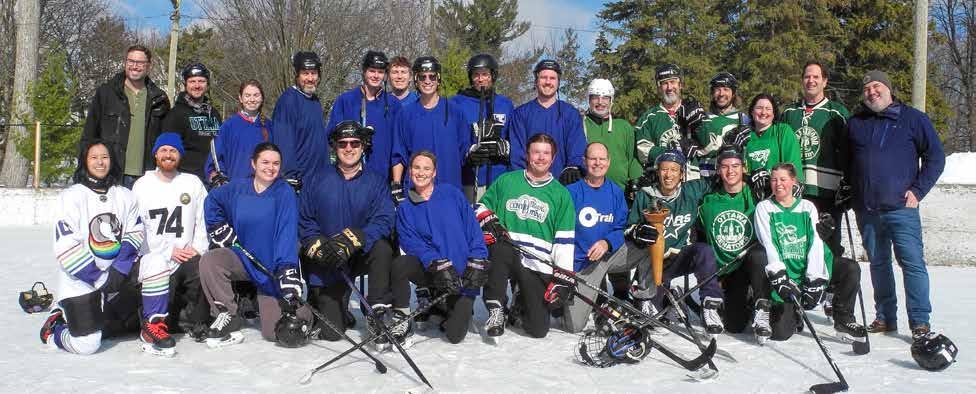

The Glebe hockey team in this year’s Capital Cup came up a little short in two tight games, getting defeated by rivals Old Ottawa East and Old Ottawa South, but team members put up a valiant effort.
Next year, Luca Vella and Mark Dance, members of the Glebe team, promise efforts to recruit more of the Glebe’s talented women and men hockey players to try to turn the tide.
The Capital Cup is organized
annually by Councillor Shawn Menard and is played on one of Capital Ward’s fine outdoor rinks – this year’s games were at Old Ottawa South’s Windsor Park on Valentine’s Day in perfect winter weather.
In the end, the OOE Hosers triumphed, running their string of consecutive victories to four. Glebe has won just once in the 19-year history of the Capital Cup. There’s an opportunity to improve this record.



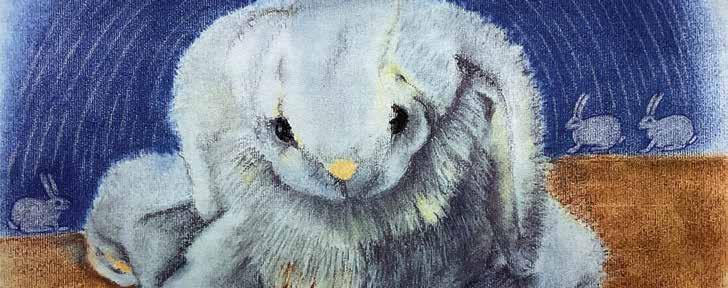



This space is a free community bulletin board for Glebe residents Send your GRAPEVINE message and your name, email address, street
Messages without complete information will not be accepted. FOR SALE items must be less than $1,000. While the
we advise readers to exercise due caution and best judgment when responding to the notices
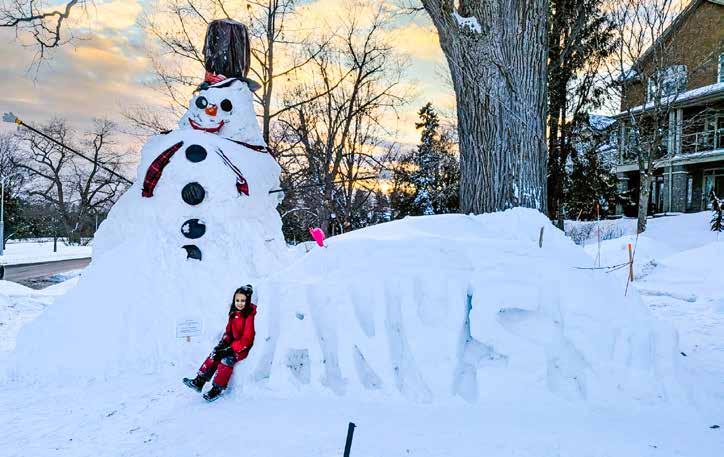
ABBOTSFORD Speakers series: END OF LIFE
OPTIONS: Tues. March 25 Lori Mell, a volunteer with Dying with Dignity, will present on End-of-Life Options, including MAID (Medical Assistance in Dying) Learn about the options available to mitigate or end suffering at life’s end, including palliative care, treatment options and MAID The presentation will cover current legislation on MAID, the process for applying in Ontario and an explanation of the experience by a loved one JAPANESE
CANADIAN INTERNMENT AND REDRESS: Tues. March 18 Sachiko Okuda, a volunteer with the Ottawa Japanese Community Association whose parents were born on Vancouver Island, will present on Japanese Canadian Internment and Japanese Canadian Redress During the Second World War, Sachiko’s parents, along with 22,000 other Japanese Canadians, were forcibly uprooted, interned and dispossessed Sachiko’s presentation balances the story of systemic racism with the story of the community’s resilience and the ultimate achievement of redress These presentations will be held live and on Zoom simultaneously To attend in-person or online, please phone 613-230-5730 and leave your name and email address
BENT UP GOOD: Live social event featuring music and entertainment at Glebe Central Pub, 779 Bank Street Sat March 28 at 9 p m
‘BIG COLLECTION’ RECYCLING EVENT, Sat April 25, 10 a m and 2 p m Enviro Crew of Old Ottawa South and the GCA Environment Committee are again collaborating on a “big collection” of items to recycle, reuse or repurpose Save your items now and drop recyclables on April 25 at Brewer Park, corner of Cameron and Seneca Items include scrap metal, e-waste, egg cartons, markers, pens, batteries, printer cartridges, reusable shopping bags, outer milk bags, bread bags and more
CALLING GLEBE ARTISTS! THE GLEBE ART IN THE GARDEN TOUR 2026 will be held on July 4 and 5 We are accepting applications from local artists who live, work or have studios in the Glebe We are looking for a variety of high-quality, original artwork from painters, potters, sculptors, photographers We also have a few spots available for guest artists who may exhibit their work in the garden of a Glebe resident The deadline for submission is April 30 For information and an application form please contact glebearttour@ hotmail ca or visit our website glebearttour ca
CATWAO INTERNATIONAL WOMEN’S DAY
MARKET: Sun March 8, 12-4:30 p m at the Glebe Community Centre, 175 Third Ave Join
us to celebrate International Women’s Day with women entrepreneurs from around the world More than 45 talented women will be showcasing their work, offering clothing and jewellery, handcrafted goods, photography, oil paintings, knitted creations, delicious foods, candles, books, pottery and much more This is a wonderful opportunity to support women entrepreneurs, discover new products and celebrate the creativity and hard work of women from diverse backgrounds
FMX WORLD TOUR: FMX World Tour is an extreme action sport competition that tours the USA, Canada, Mexico and select European countries, featuring death-defying freestyle motocross stunts and tricks Watch riders soar through the air performing incredible aerial maneuvers Sat March 14, 2:30 pm at The Arena at TD Place
GLEBE COLLEGIATE MUSIC FUNDRAISER: Join us for an evening of music featuring the Glebe Collegiate band and choir on Fri March 27, 7 p m (doors open at 6:30) at Southminster United Church, 15 Aylmer Ave In the spring of 2026, Glebe students will travel to Barcelona, Seville and Madrid to perform and deepen their understanding of music Your support helps make this incredible opportunity accessible to all students Tickets: Adults $12, Children 12 and under $5 Sponsorship opportunities available from $50-$750 For more information, contact steve@steveduncan ca or visit www eventbrite ca/e/glebe-collegiate-music-fundraiser-tickets-1980904298080
GREAT BOWLS OF FIRE: The Ottawa Guild of Potters is hosting its annual fundraiser for the Ottawa Food Bank on Sat March 14, 4-6 p m at the Glebe Community Centre, 175 Third Ave Patrons choose one of the beautiful hand-crafted pottery bowls donated by guild members, then select soup and bread from some of the region’s favourite restaurants and bakeries – all packaged up enjoy at home with friends and family Over the past 20 years, Great Bowls of Fire has raised more than $248,000 in support of the Ottawa Food Bank Tickets go on sale in February For more information, contact GBoF@ottawaguildofpotters ca (This event has sold out)
LANSDOWNE FARMERS’ MARKET: Support local at the Ottawa Farmers’ Market at Lansdowne! Find the best fresh produce, baked goods, pantry staples, crafts, hot meals and more from friendly producers in the Ottawa region The Ottawa Farmers’ Market is a producer-only organization featuring over 85 local vendors Every Sunday (March 1, 8, 15, 22, 29) from 10 a m -3 p m at the Aberdeen Pavilion, 1000 Exhibition Way
MIDNIGHT IN THE GILDED GARDEN: Pride
Capital Volleyball presents its annual soirée on Sat March 14, 7 p m -midnight at the Horticulture Building, 1525 Princess Patricia Way A night of dark florals, candlelit excess and Victorian-gothic elegance awaits! Ottawa’s biggest 2SLGBTQ+ event features explosive performances and entertainment, live DJs and dancing, cashless bars and light canapés Ages 19+ Tickets $35 per person For more information and tickets, visit www eventbrite ca/e/midnight-in-the-gilded-garden-tickets-1979830655787
TASTE OF LITTLE ITALY: Taste of Little Italy Ottawa returns Tues March 24 from 6pm9pm at the Preston Event Centre, 523 Saint Anthony Street Now in its third year, this event is bigger and better than ever! Savour mouthwatering small plates from 15 Little Italy restaurants and cafes with unlimited samples, enjoy music from a DJ and discover unique finds from local retailers Cash bar provided Tickets are limited and must be purchased in advance at www eventbrite ca/e/taste-of-little-italy-ottawa-2026tickets-1981356133532
THE ROCK ORCHESTRA BY CANDLELIGHT: A 90-minute concert featuring rock and metal hits performed by a chamber orchestra in a candlelit setting, breathing beautifully dark energy into legendary rock anthems Fri March 20, 7 p m at The Arena at TD Place
UKRAINIAN PYSANKA WORKSHOPS: The Ukrainian Women’s Association Ottawa Branch invites you to join us for our annual Ukrainian Pysanka (Easter egg) workshops Sat March 14 and Sat March 21 at 9 a m , 12 noon or 3 p m at the Ukrainian Banquet Hall, 1000 Byron Ave This year we are offering workshops in both the traditional wax resist method and the Lemko drop-pull method Cost: $45 per session All materials will be provided Spaces are limited, so be sure to reserve your spot early! Registration through eventbrite ca www eventbrite ca/e/pysankaworkshops-tickets-1981757490000
BHAT BOY PAINTING: A panel of three orange parrot tulips on a purple background 25”X11” $275 Call Sue 613-230-4327 after 4 p m
FRAMED PRINT: Charming framed print of two cherubs 15”X12” $25 Call Sue 613-2304327 after 4 p m
WOMEN’S GOLD PENDANT ON CHAIN, Indigenous design Reward Call 613-237-3033
WHERE TO FIND THE Glebe Report

Feleena’s Mexican Café Fourth Avenue Wine Bar
Glebe Central Pub
Glebe Collegiate Institute
Glebe Community Centre
Glebe Meat Market
Glebe Physiotherapy
Glebe Tailoring
Goldart Jewellery Studio
Happy Goat Coffee
Hillary's Cleaners
Hogan’s Food Store
Ichiban Bakery
Irene’s Pub
Isabella Pizza
Kettleman’s
Kunstadt Sports
Lansdowne Dental
LCBO Lansdowne
Little Victories Coffee Loblaws
Marble Slab Creamery
Mayfair Theatre Metro Glebe
Nicastro Oat Couture
Octopus Books Olga’s Quickie
RBC/Royal Bank Subway
Sultan Ahmet
Sunset Grill
The Flag Shop Ottawa
The Ten Spot
Thr33's Company Snack Bar
TD Bank Lansdowne
TD Bank Pretoria
The Works
Von’s Bistro
Wall Space Gallery
Whole Health Pharmacy Wild Oat
3 Brothers Shawarma and Poutine