
Della Wilkinson honoured for work on fingerprints
By Jennifer Humphries
What do former Supreme Court Justice Rosalie Abella, sprinter Andre De Grasse and Glebe resident Della Wilkinson have in common? On New Year’s Day, they were among 80 Canadians newly appointed to the Order of Canada by Governor General Mary Simon.
Wilkinson is widely known in our community as chair of the Glebe Community Association’s Environment Committee and for organizing events on how to shrink your home’s energy consumption and how to plant native pollinators and canopy trees in your garden.
But her appointment to the Order of Canada is for markedly different achievements of revolutionizing fingerprint detection and positioning Canada as a global leader in forensic identification.
“Canada is an amazing country to bestow such an honour on an immigrant who arrived on its shores 35 years ago and spent a career figuring out how science could give a voice to the victims of crime,” Wilkinson told me.
Immigrating to Canada in 1990 with a PhD in chemistry from Cambridge University, Wilkinson began her career at the National Research Council (NRC), soon moving to the RCMP.
Her early work related to fingerprints on skin, which are difficult to detect because of the similarity of the chemical components of fingerprints to those present on the skin’s surface. The research involved collaboration with a Civic Hospital pathologist and night-time visits to the morgue, leading to new methods that made fingerprinton-skin recovery possible. The murders of Kristen French and Leslie Mahaffy at that time lent particular urgency to her work.
Investigating Contaminated Crime Scenes
Wilkinson spent much of her career engaged with Crime Scene Investigators (CSIs), some of whom were on CBRNE Response Teams (CBRNE stands for chemical, biological, nuclear, radiological and explosive). These teams were responsible for recovering evidence from contaminated crime scenes. It occurred to her that expecting techniques used in everyday investigations to work in the presence of chemical, biological or explosive materials was
unrealistic. The US Department of Defense agreed and in 1998 funded her research on the impact of chemical agents on physical evidence such as fingerprints, footwear and DNA. Wilkinson identified ways to overcome many of these difficulties and thereby help CSIs in a range of settings.
For example, after anthrax attacks on the heels of the September 11 terrorist attacks, Wilkinson received further funding from the US to develop protocols for anthrax-contaminated evidence. And because criminals often use arson to destroy evidence, Wilkinson partnered with the NRC Fire Lab in Carleton Place to develop ways to recover evidence from fire-damaged buildings.
Canada’s first court challenge to fingerprint evidence came in 2017. The case was a residential break-and-enter in Surrey, B.C., and the defence attorney called upon world-renowned fingerprint critic and author Dr. Simon Cole. Wilkinson advised the Crown on its strategy to address this unprecedented


challenge and counter Dr. Cole’s criticisms of fingerprint evidence that was developed in an American legal context. She was declared an expert witness in fingerprints by the presiding judge of the B.C. Supreme Court and testified on scientific research that supported fingerprint evidence as practised in Canada. The court ruled that the fingerprint evidence was valid.
Giving a Voice to Victims
Fundamental to Wilkinson’s approach was her focus on victims.
“The victims of crime, not the perpetrators, are the people for whom you are working,” she told her students in Trent University’s Master of Forensic Science Program. Her career goal, ultimately, was to help achieve justice for the people who suffer at the hands of criminals.
Wilkinson made Canada a world leader in fingerprint recovery, but she

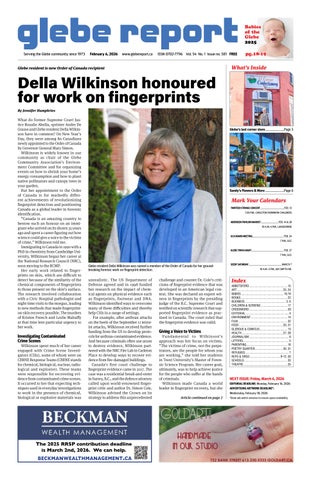
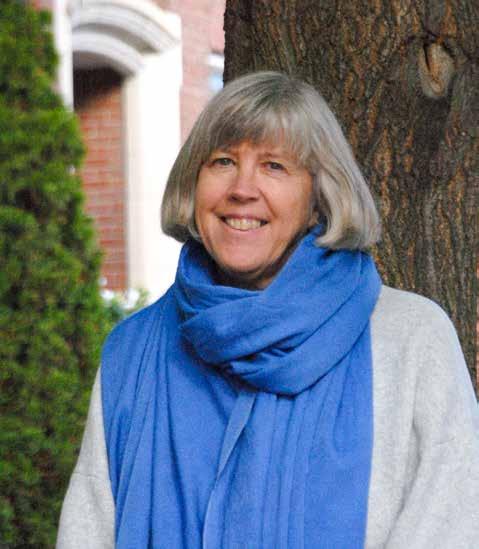
Glebe resident Della Wilkinson was named a member of the Order of Canada for her groundbreaking forensic work on fingerprint detection.



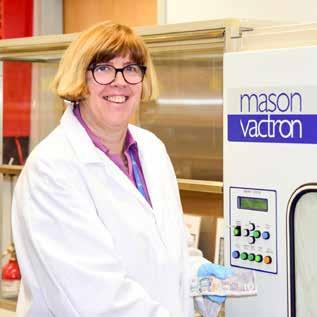
Della Wilkinson
Continued from page 1
is quick to thank collaborators along the way, including local police forces, national police organizations and international agencies such as the FBI and authorities in The Netherlands, Australia and the UK. Yet despite her desire to spread credit, many of these connections were established by Wilkinson herself or arose from invitations to share her expertise. Case in point is her founding of the Canadian Friction Ridge Working Group (CanFRWG) to provide an ongoing forum for critical information sharing among investigators nationwide. In addition, Wilkinson has authored or co-authored more than 30 scholarly articles – the last one before her retirement involved 16 authors from several countries. What does she consider her top accomplishments? One is having engaged strong new people to carry on the work; another is having established
Canadian standards and protocols for the use of fingerprint evidence in the courts.
Post-retirement, Wilkinson is applying herself to another passion, protecting the environment. What began as a concern when she and her husband had their first child is now a central focus of her life. Luckily for us, she’s using her tremendous skills and energy to make life in our community greener and more sustainable.
Jennifer Humphries is a member of the GCA-EC and enjoys working with Della Wilkinson and our dedicated group. The Committee welcomes new members who can offer their creativity and their time (a little or a lot!) to greening the Glebe. Email us for info and/or to share ideas at environment@ glebeca.ca.


The Glebe’s last corner store has closed
By Jennie Aliman
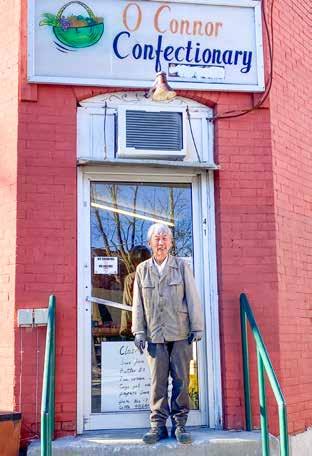
The last remaining corner store in the Glebe, the O’Connor Confectionary, closed on November 30, more than three decades after Dehou Xiao and his wife, Baohua Chang, started running it.
Xiao came to Canada from China in 1989 after the events of Tiananmen Square. He had been a professor of electrical engineering at Huazhong University of Science and Technology in Wuhan. Once here, he got a job as a technician and was able to send for his wife and 16-year-old son. His wife Chang had been a statistician in China. In Canada, neither Xiao nor Chang were able to find employment in their fields, so they eventually took over the O’Connor Confectionary in 1994. Their son attended Glebe Collegiate and later the University of Ottawa, studying electrical engineering.
Xiao and Chang were in the store seven days a week from 7:30 in the morning until 9 or 10 at night, tending to the last-minute household needs of nearby Glebe residents – newspapers, cigarettes, milk, chips, lottery tickets, stamps and long-distance phone cards. They also took in laundry and cut keys. The work was hard, and the long hours were punishing.
Though the Glebe Annex still retains corner stores – Abbas Grocery and Hogan’s Food Store – the closure of the O’Connor Confectionary marks the end of an era in the Glebe.
In an article about the store in the Glebe Report in 2002, Chang talked about her feelings about Canada. “When we became citizens,” she said, “we lost our Chinese citizenship. So, Canada is our country now. We like it; it is a good country. People are very nice to
me, and the Glebe is a good neighbourhood.” When asked if she missed China, she replied, “Well, both my husband and I have family there – sisters, brothers and other family. And we have not been able to go back. I liked China.” The article’s author notes: “And a tiny tear rolled down her cheek.” (The story by Boyce Richardson appeared in the November 8, 2002 of the Glebe Report and can be read in the archives – click on Past Issues at the bottom of the glebereport.ca website).
I asked Dehou to share some memories of his time at O’Connor Confectionary.
“One night in 2019, it was very cold at 9:30 p.m. when I was closing the store. I warmed my old car. I closed my car door by mistake. I had another key in my Kanata home. It was too late to rent a car. So, I went to [a Glebe neighbour] Peter’s home to ask for help. Without any hesitation, he gave his car keys to me. So, I drove his car to my home. I sent a carton of cigarettes for his help. He said, ‘No, we are good friends, you do not need to do this.’ I will always remember that.”
“Every year I received a bottle of wine from [customers] Kim, Anthony and Robin’s family. This year they did the same. So, every year before Christmas, my wife Baohua asks me to buy a gift for them.”
Asked what he would do now that he is retired, Dehou said, “I do not have any plans right now for my retirement. Maybe play Chinese chess or do some garden work with my wife.”
Thank you, Dehou and Baohua, for running our corner store for so many years. Newspapers (including the Glebe Report!), last-minute ingredients, popsicles on a hot day and penny candy for the kids – we will all miss you.
Heritage Ottawa gears up for second grand online auction
By Nassim Barakat
Heritage Ottawa is putting history “on the block” again. From March 8 to 14, the non-profit registered charity will host its second Grand Online Auction, a digital fundraiser featuring rare books, fine art, experience packages and family outings, among other exciting items.
The event builds on the success of the inaugural 2024 auction, which raised more than $17,000 to support the group’s work protecting the capital’s heritage places and architectural landmarks and sharing its history through walking tours, lectures and publications.
“This auction has become more than a fundraiser . . . it’s a way for the community to celebrate Ottawa’s heritage while enjoying unique experiences,” said Katherine Spencer-Ross, president of Heritage Ottawa.
Organizers say the 2026 edition will have a broader scope, with more cultural and tourism partners such as the Stratford Festival, Parc Omega and Saunders Farm, alongside themed baskets that bundle theatre tickets, dining and overnight stays.
According to Paul Bennett, chair of the Auction Organizing Committee, the move reflects a lesson learned from 2024: “Packages generate excitement and encourage higher bids, which directly strengthens our ability to protect at-risk heritage buildings.”
The auction is open to all, and bidding takes place entirely online, a format that has widened participation in the event beyond Ottawa’s borders. For Spencer-Ross, that reach matters: “Our heritage isn’t just a local concern. These auctions give us a platform to show the value of Ottawa’s history to a much broader audience.”
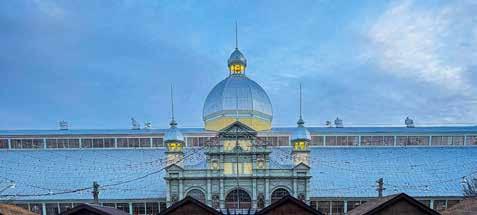
For more than half a century, Heritage Ottawa has been a leading voice in protecting the city’s architectural treasures. The organization played a key role
in the campaign to preserve the historic Aberdeen Pavilion at Lansdowne Park – it was once slated for demolition – and has consistently advocated for the effective adaptive reuse of heritage sites across the city.
More recently, its advocacy helped prevent a widely unpopular and inappropriate addition to the Château Laurier Hotel, secure protections for the Booth Street complex and drew attention to the ongoing challenges facing Ottawa’s built heritage amid rapid development pressures.
Beyond activism, the group runs popular walking tours, publishes research and provides a platform for local voices to connect history with community identity.
Donations are still being accepted,



Jennie Aliman lives five doors down from The O’Connor Confectionary and has been shopping there for 38 years.
Heritage Ottawa played a key role in preserving the historic Aberdeen Pavilion. Heritage Ottawa’s second Grand Online Auction fundraiser will take place from March 8 to 14. Details at www. heritageottawa.org. PHOTO: JOCK SMITH
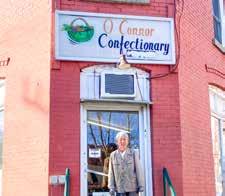
Dehou Xiao, long-time owner, along with his wife Baohua Chang, of the O’Connor Confectionary. The store, the last of its kind in the Glebe, closed in November. PHOTO: PETER ISWOLSKY
ahead of the March 8 launch. Details are available at www.heritageottawa.org.
Nassim G. Barakat is a conference interpreter, translator, news editor and member of the Heritage Ottawa 2026

A Glimpse of the Glebe
Contributors this month
ROBYN AARON
JENNIE ALIMAN
NASSIM BARAKAT
BHAT BOY
ALEX CAMPBELL
SYLVIE CHARTRAND
JUNE CREELMAN
JOHN DANCE
JENNY DEMARK
ELLYN DUKE WATSON
PEG DUNCAN
TAMARA GLAVINOVIC
PAT GOYECHE
JOANNE HALL
RYAN HAMPEL
JENNIFER HUMPHRIES
GRACE HUNTLEY
CHARLENE JACKSON
JESSICA JAGODICS
MAUREEN KORP
SADIE LARONDE
TANYA LARY
DAVID LONGBOTTOM
COOPER LOVE
TARA MAHMUD
CAROL MARTIN
CATHERINE MCKENNEY
IAN MCKERCHER
ALEX MCKINNON
JAMES MEDCRAFT
SHAWN MENARD
YASIR NAQVI
ASSAN OMAR
DAVID O’NEILL
BARBARA POPEL
RENU PILLAY
SUE REIVE
JEANETTE RIVE
CLARE DAVIDSON ROGERS
MARISA ROMANO
SARAH ROUTLIFFE
DEBORAH-ANNE TUNNEY
CECILE WILSON
PAT WILSON
TONY WOHLFARTH
LILY WOLDERUFAEL
ZEUS
Nipissing and Mississauga First Nations.
A Ray of hope
I have long railed at the grey concrete monstrosity lodged across from Dow’s Lake – the future Ottawa Hospital parking garage. Its enormous bulk has slowly risen on one of the most beautiful 10.8 acres in Ottawa at the juncture of Dow’s Lake and the Rideau Canal, the Experimental Farm, the Arboretum and Commissioners’ Park, and adjacent to one of the most interesting Ottawa neighbourhoods, Little Italy with its array of restaurants, pubs and shops. It is stunning to think that decision happened.
However, recent news coming out of the NCC, working with the Ottawa Hospital, may have introduced a ray of hope. While a rooftop park on top of the garage had been proposed earlier, slightly more detailed plans have recently been released. These plans are by no means set in stone and will likely change (get less ambitious) as time goes by. However, I live in hope that some of this may happen.
According to the recent plan, the rooftop park will have four tennis courts and a clubhouse, a playground for children, “viewing swings,” seating, gardens and plantings, and a large open lawn for events. Raised
planters will provide seating along a path that leads up to the roof, termed a “folded path” that will wind back on itself. If I read the artist’s rendering correctly, the path up to the roof will enter off Prince of Wales. There will also be elevator and stair access to the roof.
The garage itself is about four storeys high, and will accommodate 2,863 parking spaces, including 200 spaces for use by visitors to nearby NCC and other destinations. Also proposed are 156 secured bike parking spaces indoors and 126 outside bike parking spots.
Finally, there will be some kind of covered pedestrian walkway across the top of the garage connecting the nearest O-train station to the main hospital building.
My fervent hope is that at least some of this will come to pass. If I may add a further suggestion, if the grey concrete garage itself could be completely covered in vines, that would further mitigate the sadness of this visual blight on the landscape.
–Liz McKeen
www.glebereport.ca
Established in 1973, the Glebe Report, published by the Glebe Report Association, is a monthly not-forprofit community newspaper with a circulation of 7,500 copies. It is delivered free to Glebe homes and businesses. Advertising from merchants in the Glebe and elsewhere pays all its costs, and the paper receives no government grants or direct subsidies. The Glebe Report is made available at select locations such as the Glebe Community Centre, the Old Ottawa South Community Centre and Brewer Pool, and is printed by Winchester Print.
EDITOR............................ Liz McKeen editor@glebereport.ca
COPY EDITOR.................... Roger Smith
LAYOUT DESIGNER............. Jock Smith layout@glebereport.ca
GRAPEVINE EDITOR............ Sam Woods grapevine@glebereport.ca
WEBSITE EDITOR............... Kayleigh Osborne website@glebereport.ca
ADVERTISING MANAGER...... Judy Field advertising@glebereport.ca 613-858-4804
BOOKKEEPER.................... Susanne Ledbetter accounting@glebereport.ca
DISTRIBUTION MANAGER.....
COMMERCIAL DISTRIBUTORS Murray Kronick circulation@glebereport.ca Teddy Cormier, Eleanor Crowder
PROOFREADERS................ Jennifer D’Costa, Jeanette Rive
AREA CAPTAINS................. Martha Bowers, Bob Brocklebank, Judy Field, Deb Hogan & Dave Yurach, Lynn & Dave Johnston, Elena Kastritsa, Brenda Perras, Julie Stephens, Della Wilkinson
The Glebe Report strives to be inclusive and to represent the full diversity of the community we serve.
Ackerman-Katz Family, Jennie Aliman, Lawrence Ambler, Nico Arabackyj, Aubry family, Alessandra & Stefania Bartucci, Selena Beattie, Adrian Becklumb, Joanne Benoit, Carolyn Best, Daisy & Nettie Bonsall, Martha Bowers, Bowie family, Bridgett family, Bob Brocklebank, Ben and Oliver Campbell-Rosser, Nico Cauchi, Bill Congdon, Chiu-Panczyk Family, Sebastian, Cameron & Anna Cino, Henry, Abigail and Matthew Campbell, Claypool Family, JJ Comptois, June Creelman, Marni Crossley, Olivia, Maisy and Mark Dance, Dawson family, Richard DesRochers, Davies Family, Roslyn Demarsh, Marilyn Deschamps, DiekmeyerBastianon family, Dingle family, Delia Elkin, Patrick Farley, James & Oliver Frank, Judy Field, Federico Family, The Foo Family, Liane Gallop, Joann Garbig, Camilo Velez Gorman, Barbara Greenwood, Marjolein Groenevelt, Ryleigh and Hayden Hendy, Oliver, Martin, Sarah & Simon Hicks, Cheryle Hothersall, Jennifer Humphries, Sandiso Johnston, Tani, Pete & Bryce NisbetJones, Jungclaus Family, Elena Kastritsa, Michael Khare, Lambert family, Fenton & Cora Hui Litster, Leith and Lulu Lambert, Kathleen Larocque, Brams and Jane Leswick, Alison Lobsinger, Aanika, Jaiden and Vinay Lodha, Andy Lunney, Vanessa Lyon, Pat Marshall, Catherine McArthur, Ian McKercher, John and Helen Marsland, Matthew McLinton, Josephine & Elise Meloche, Julie Monaghan, Vivian Moulds, Karen Mount, Diane Munier, Benjamin MunterRecto, Rafi & Ellie Naqvi, Imogen & Maddy North, Xavier and Heath Nuss, Sachiko Okuda, Nicholas & Reuben Ott, Matteo and Adriano Padoin-Castillo, Finn Pedersen, Miles PersohnHough, Brenda Perras, Brenda Quinlan, Annabel and Joseph Quon, Kalia and Elijah Quon, Beatrice Raffoul, Frederick and Kasper Raji Kermany, Bruce Rayfuse, Kate Reekie, Thomas Reevely, Mary & Steve Reid, Jacqueline Reilly-King, Luke Robertson, Anna Roper, Frank Schreiner, Short family, Cathy Simons, Andrew Soares, Heidi Stelzl, Stephenson family, Elsie Sutherland, Cameron & Quinn Swords, Ruth Swyers, Tomlin Boys, John & Maggie Thomson, Tom Trottier, Trudeau family, Will, Georgie & Blaire Turner, Zosia Vanderveen, Veevers family, Carina and Matteo Vella, Nick Walker, Vanessa Wen, Paul Wernick, Hope, Jax and Ash Wilson, Howard & Elizabeth Wong, Berkan Yazici, Martin Zak.

Third places for our kids
Editor, Glebe Report
As our community continues to grapple with the realities of rising childhood anxiety and the well-documented harms of excessive screen time, it has never been more important to think seriously about the environments in which our children grow up. Urban design circles often discuss “third places” for adults; those informal, accessible spaces outside home and work where people can simply exist, connect and feel part of a community. But children need third places just as urgently, and in many ways even more so. They need spaces where they can gather freely, move their bodies, negotiate friendships and feel a sense of belonging that isn’t mediated by a screen or tied to a cost of admission.
This is why the current situation at the Mutchmor Public School playground deserves our attention. Many parents in the neighbourhood have noticed that children are routinely asked to leave the playground
Another side to the story
Editor, Glebe Report
Re: “Andrew Fleck – Glebe Parents Day Care amalgamation a success despite initial controversy,” Glebe Report, December 2025.
I was taken aback by this article and the biased, one-sided take on the acquisition of Glebe Parents Daycare by the Andrew Fleck organization. The article only quotes the executive director of Andrew Fleck and one set of parents whose opinion aligns with the new organization. It paints an inaccurate picture of what the amalgamation was like for many staff members and parents. It does not accurately explain or reflect why so many staff members resigned nor why some parents withdrew their children. One of the more disturbing statements is “a lot of the teachers just seemingly walked out overnight.” This is a false depiction of reality. I find it appalling that the hard-working and dedicated staff members who had to make the heartbreaking decision to leave the work and children they love are described in this way. It is one thing to claim success but to do that while explicitly and implicitly disparaging former staff and Glebe Parents Day Care with erroneous and misleading statements and claims lacks integrity. This is very sad indeed.
Joanne Hall

immediately after school hours so that a private organization can have exclusive use of the space. The same restrictions often apply on PD days – days when families are searching for exactly the kind of unstructured, local outdoor play that a schoolyard is meant to provide.
No one disputes that liability concerns exist. Schools and boards have legitimate responsibilities, and no one wants to see those dismissed. But liability is not an unsolvable problem. Other cities, school districts and even schools belonging to the same board have found ways to keep schoolyards open to the public outside instructional hours while still managing risk. Solutions exist: shared-use agreements, community partnerships, insurance frameworks and clear signage outlining expectations. What’s missing is not the ability to solve the problem, but the will to recognize that the opportunity cost of not solving it is far greater.
When we close off neighbourhood spaces (especially those built with public funds), we send a message that children’s presence in their own community is conditional. We tell them that play is something to be purchased, scheduled or supervised by
an organization. And because this arrangement is treated as a default, with no clear public policy guiding it, we reduce the number of places where kids can simply be kids. In a time when so many families are trying to reduce screen time, encourage outdoor activity and support children’s mental health, this is exactly the opposite of what we should be doing.
The Mutchmor playground is not just a patch of asphalt and equipment. It is one of the few remaining free, walkable, child-friendly spaces in an urban neighbourhood. It is a meeting place for families, a safe haven for kids walking home, a social hub and a blessing for parents who need a moment while their children run and play. Restricting access to such a space should be a last resort, not a default.
As a community, we should be asking: What kind of neighbourhood do we want our children to grow up in? One where public spaces are treated as shared assets that strengthen community life, or one where access is increasingly privatized and conditional?
I hope we choose the former.
Alex Campbell
The Kindness of strangers
Editor, Glebe Report
Snow removal operators are making snow mountains on the street
Editor, Glebe Report
An operator has dumped all the snow from a driveway into the street, with piles that are intruding into the twoway section of First Avenue between O’Connor and The Driveway. The operator has not put any of it on the client’s property. Companies that had begun to cart the snow away have noticed that their competitor has not so have returned to the practice of plowing driveway snow onto the street.
Not only is this an inconvenience when the city snowplow then pushes the snow into our driveway, it limits visibility and removes parking spaces from an area that is already short of on-street parking, particularly when the canal is active or when there are events at Lansdowne. There are city bylaws against dumping snow on the street, and the companies need to be reminded annually of the prohibition.
I just heard them clearing the driveway from today’s snowfall and am not looking forward to the addition to the pile in the parking space next door.
Peg Duncan
Around 5:30 p.m. on January 6, I was heading to an appointment on Second Avenue when, after parking, my car got stuck in the snow and would not move forward or reverse. I got out and tried shovelling for a few minutes, but my car was not moving. After 20 minutes, a very kind man named Brian asked if I needed help, to which I said yes, please. He tried moving my car, but I was still stuck.
At that moment, another man and his family were walking by and asked if we needed help. Brian said yes, and while he was trying to reverse, the other man and his family pushed my car. I learned that they also lived across the street on Second Avenue. When nothing seemed to work and my anxiety started to build, Brian got his truck from his house to pull my car out. The other man (in the moment of my inner turmoil, I forgot to ask his name) was guiding me as I reversed. Eventually, this got me out of the snow ditch.
It has been two days since this incident, and because there is no way for me to thank them, I am doing the unusual and sending this to the Glebe Report in hopes that they’ll read it. I would like to thank Brian and the other very kind man and his family for standing out in that freezing weather to help a complete stranger! To say that I am thankful is an understatement. It was not a minor gesture for me, and just for the sake of seeing this kindness, I am grateful that this incident happened.
At times, the pessimism of the world and the constant inundation of negativity and unfortunate events in our lives make us forget that there is also beauty in this world. Thank you to Brian and the other family for reminding me of this beauty. I’m very, very grateful, and may God truly bless you.
Lily Wolderufael
MP needs to listen to constituents
Editor, Glebe Report
Anyone who has tried to offer an opinion or feedback to our Member of Parliament Yasir Naqvi has likely received the same automated response that I did: a very lengthy email containing links to several government departments and a long paragraph explaining that our MP is prioritizing “constituency casework” over our opinions and issues. This tells me two things. One, if the MP’s office is being forced to take on this caseload, the government bureaucracy must be doing a very poor job of serving the public. Secondly, the MP’s primary function of representing his constituents is being completely neglected. Mr. Naqvi must now use his office to press for better performance by the bureaucracy and get back to listening to his constituents. I would have communicated this directly back to Mr. Naqvi, but you know…what would be the point?
Alex McKinnon
Lotus of Siam opened on December 19 at 925 Bank Street. Contemporary Thai cuisine. “Indulge in the sophisticated and vibrant flavors of the Golden Kingdom…From the complexity of our curries to the freshness of our herbs, we offer discovery on every plate.” lotusofsiam.ca
Sports4 will be closing when its lease runs out.
Altared is coming in May to Bank and Second Avenue (former home of Sports4). “Altared – An emporium of good things, an innovative shoppe + cafe and community gathering space opening in spring 2026. A collection of books, upcycled clothes, handmade artisan gifts, cultural curiosity, delicious treats, inspirational creative project ideas and more.” www.altared.ca.
International Business University, Ottawa Campus opened January 15 at 979 Bank Street, Suite 206 at Lansdowne. “The university focuses on career-ready, industry-aligned programs delivered through small cohorts and high-touch faculty engagement, prioritizing applied learning over large, lecture-based formats.” Ibu.ca.
Charming flower shop opens in the Glebe
By Jessica Jagodics
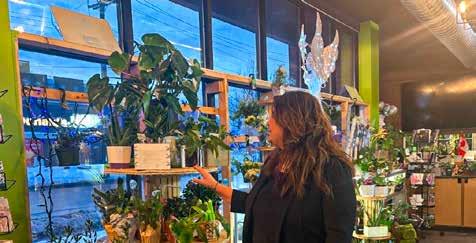
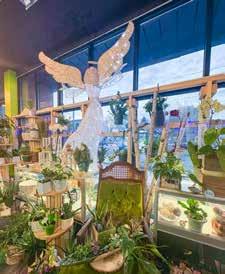
Sandy’s Flowers & More has opened its doors in the Glebe, offering beautiful floral arrangements and bouquets. The flower shop is located at 675 Bronson Avenue, having recently relocated after the closure of Westgate Mall.
Tara Mahmud, owner of Sandy’s Flowers & More, built her business from the ground up, driven by her passion for flowers from a young age.
“I love nature, my mom had a big garden,” she said. “My grandfather had a big garden in the mountains where we grew up. My mom was always gardening.”
Mahmud came to Canada in December 2000 as a Kurdish refugee from Iraq, sponsored by a church group. The floral shop is named after her host mother, Sandy. When she arrived in Canada with her son, Mahmud was alone and unsure of how she was going to survive in the country without knowing anybody or the language.
Her host family is the reason she was able to build a life here and work towards her dream of owning her own floral shop.
“Sandy, she never gave up on me,” said Mahmud. “I was sick, she was there. I was alone, she was there. I was sad, she was there.
“I never say friend, she’s my Canadian mom. They are my Canadian family.
Because of them I stayed here. Because of that family, only that family.”
As a single mother and a refugee, Mahmud overcame many challenges in the process of opening her store. Her dreams were once shattered after a business deal fell through, which forced her to start from square one. Now, she is the proud owner of her floral shop and brings many people joy with her flower arrangements.
“I feel very happy, very happy because in life, you go through a lot. I had a very stressful life, but if I just focused on that stressful time, I could never be me today.”
After the closure of her location in Westgate Mall, Mahmud is excited to grow her business in its new location and is glad her old customers are coming back.
“I just have to move forward, and I’m sure I’m going to make this business bigger, 100 per cent,” Mahmud said. “When you’re honest with customers,
why wouldn’t I be successful?”
Roses, lilies and peonies are just some of flowers offered for purchase at the store. Delivery services are available, and customers can place orders over the phone, online or in store. Prices for floral arrangements and bouquets range from $40 to $500-plus. However, Mahmud is dedicated to working with each person’s budget to ensure they have an arrangement they can afford and enjoy.
She has already begun offering a
wide variety of gift products like candles, napkins, plush toys, skincare products and more, focusing on Canadian and local brands.
Mahmud notes that she loves seeing the joy on people’s faces when they receive their floral arrangements.
“I love creating floral designs because number one, I meet beautiful people and number two, it’s always fun when people come and say, ‘Oh it’s my wedding, it’s my anniversary, it’s my date.’ I just love to make them with my heart to make the customer happy.
“Every time I make flowers and anything for the customers, they are very happy. And when I see that, it makes me enjoy it more. When I see the smile of the customer.”
Mahmud has built lasting relationships with her customers, earning their trust to make good quality bouquets and arrangements for every occasion.
“I love all of them. Especially one guy who buys flowers for his girlfriend. It’s just so cute, he comes back all the time and it’s so nice. He keeps telling me, ‘I know you’ll make it beautiful, just make something, I trust you’,” Mahmud said.
For Mahmud, flowers are important because they are a way to uplift spirits and make people feel special.
“It’s good for your mental [health], it’s good for your home. It’s good for everything. Everybody needs flowers, some colour in their home. Especially when it’s something grown in the earth. That makes me so happy. Not something man-made.”
Jessica Jagodics is a second-year journalism student at Carleton University and a reporter for The Charlatan

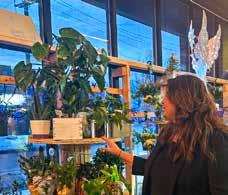
Florist Tara Mahmud recently opened Sandy’s Flowers & More on Bronson Avenue in the Glebe, relocating from Westgate when the mall closed.
Ottawa Centre Refugee Action – 10 years on
By Tanya Lary and Pat Wilson
In the fall of 2015, the Glebe community began to mobilize to support refugees, motivated by the Syrian refugee crisis and heartbreaking photos of a little boy who had drowned while his family was trying to reach asylum in Greece.
There was huge community interest. The Ottawa Centre Refugee Action (OCRA) was created, and it set up community meetings, established a website and worked with First United Church and Jewish Family Services. It started to receive donations and to organize support groups to help the families as they arrived. OCRA is entirely volunteer run. All donations are used to support refugee families; OCRA does not use any donated funds for administrative or internal purposes.
By late November of 2015, $100,000 had been raised and dozens of people had volunteered. The first family arrived just before Christmas, part of the wave of Syrian refugees that the newly elected Trudeau government had promised to bring in. By the end of 2016, 12 families, comprising 37 people, had arrived, coming from Syria, Iraq, Colombia, Ghana and the Central African Republic. Glebe residents were a huge part of this effort, providing housing and direct support. Many of these friendships continue today. In the first two years, 475 people provided financial support or had volunteered to help families navigate the complexities of arrival – finding and furnishing apartments, registering for school, learning English and accessing badly needed medical and dental services.
In 2018, the primary focus changed to bringing family members of those refugees already settled by OCRA. These were all refugees living in vulnerable circumstances in Lebanon, Turkey, Jordan and Ethiopia. The first families settled by OCRA have played a key role in supporting their family members, but OCRA volunteers have also provided crucial help.
Since 2022, OCRA has worked to sponsor refugees from Afghanistan, with a focus on Afghan women who have fled persecution by the Taliban government. Pakistan has been a
long-term host to many Afghan refugees but has started to send refugee claimants back, so there is considerable urgency to resettle these women and their families.
Highlights include:
- the first Canadian baby born to a Syrian family is now nine years old.
- the establishment of Yasmin Catering by an OCRA arrival and a Canadian volunteer, bringing together a group of Syrian women.
In addition, a group of Glebe Collegiate students, many of them former
refugees, raised funds to bring in an Afghan woman (the best friend of one of the students) and her family. They had fled to Iran and were fearful of being sent back to Afghanistan. The two friends are now reunited after OCRA succeeded in getting the Canadian government to process Afghan refugees living in Iran for resettlement in Canada.
In 2023, 34 Afghans were settled by OCRA through the federal government’s Operation Afghan Safety Program.
A total of 125 people have been sponsored and resettled by OCRA since 2015.
There is an amazing group of settlement volunteers and donors in the Glebe and elsewhere who have supported our newcomers. Thank you all!
Moving Forward
OCRA is 10 years strong, with an enduring network of volunteers, now joined by former refugees who play an important role in settling new arrivals. Please consider donating to OCRA in 2026 to support our efforts to fund the rescue and resettlement of Afghan women. Here is the link to OCRA’s website with donation instructions: ottawacentrerefugeeaction.ca/ donate2/
Tanya Lary is an OCRA co-founder and has been its treasurer since 2015. Pat Wilson has been an OCRA volunteer since January 2016. She retired as a lawyer in 2017and has helped bring to Ottawa more than 25 refugees and families from Syria, Eritrea and Afghanistan. She was recognized in 2025 with the King Charles Coronation medal.

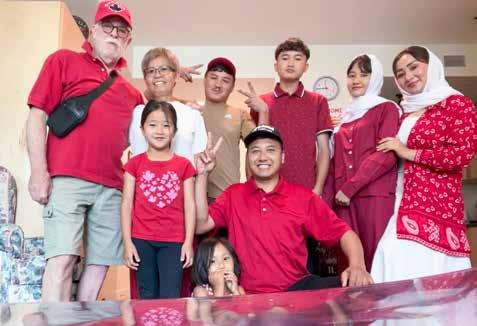
The Noori family, with OCRA volunteers, on Canada Day 2025. Pictured are Shukria (far right), who was held captive by the Taliban for over a year before escaping and coming to Canada in July 2024, her husband Dawood (kneeling) and children Asra and Kawsar, who are thriving in school in Centretown. The three older young people (standing) are Najiba, who was arrested for attending an underground school for girls in Kabul before escaping with her brother Najib and cousin Asad and coming to Canada in June 2025. Also shown are OCRA volunteers since 2018, Joe and Supattana (far left).
Grace Huntley is the 2025 recipient of the Anne Donaldson Memorial Scholarship for Community Journalism established by the Glebe Report board of directors in 1997 and given annually to a Carleton Journalism student who shows academic excellence and commitment to the urban community.
The Path to journalism
By Grace Huntley
When I was a kid, both my parents’ consumed news in the old-fashioned way, from physical newspapers and cable TV. Despite watching TV news most days with my parents and reading the news articles my mom would constantly cut out for me, as a preteen, I didn’t think much about where the news came from. It seems obvious, but I didn’t pay much attention to the by-lines or the people conducting interviews. To me, the news just magically appeared in my living room.
Somewhere between my fourth re-watch of Gilmore Girls, starting to see journalists on my social media feed and seeing Hildy Johnson talk fast in His Girl Friday, I realized that there were people behind the articles on my bedside table and that the people on the TV newscast were not just talking heads. During high school, as I became more interested in social issues and started tuning in without my parents’ prompting, I thought maybe I’d like to be the person holding the microphone, asking the hard questions and crafting the stories. So, I applied to Carleton University’s journalism school with no interest in going anywhere else.
From the start, my passion for journalism has been driven by three desires: to hold powerful people accountable, to tell important stories and to amplify the voices of those who are not normally given a microphone. My journalistic interests include accessibility,
social justice, environmental sustainability, urban planning and municipal politics.
I’m passionate about in-depth and magazine writing, uncovering the truth and pulling out the colourful details to weave together complex stories. In my second year of university, I decided to add geography as a second major after a few first-year classes sparked my interest in spatial politics, environmental justice and urban design. I love digging deep into the why of stories and unravelling the causes of social disparities like unequal access to transportation, housing and healthcare. This is why I like small community papers like the Glebe Report – I love hyper-local stories where each bench, sidewalk, school, community group and bus stop has a unique and important story to tell.
At Carleton, I’ve enjoyed contributing to the student paper, The Charlatan, as a volunteer journalist and as director of community engagement on the board of directors. This is where my passion for community-based reporting was put to work. Some of my favourite stories have included arts events like the annual Gender and Sexuality Resource’s Centre’s art exhibit, the Versus vs. Apartheid poetry event and in-depth look at the accessibility of Carleton’s washrooms.
Last year, I had the opportunity to take a reporting in Indigenous communities’ class, where we learned about decolonizing journalism and

collectively produced a website with stories about environmental issues concerning Indigenous communities near Ottawa. For this class, I worked with three other students to produce a long-form story that was ultimately published in Canadian Geographic about the Isaruit Arts Centre, where Inuit of Ottawa gather for community meals that include country food, such as seal, arctic char and caribou.
In the latter years of my degree, despite my passion for journalism and the incredible opportunities I’ve had while at Carleton, I found myself becoming disillusioned with the current state of the journalism industry. Amongst mainstream news outlets, the maintenance of the status quo and the sidelining of marginalized voices is standard practice. Journalists who embody integrity, grit and commitment to the truth while pursuing independent journalism motivate my work. Pacinthe Mattar, especially, has inspired me. Her 2020 article for The Walrus, “Objectivity is a Privilege
Afforded to White Journalists,” has become popular amongst journalists and students because of how eloquently it put into words the experience of racialized journalists and described the reality that white journalists are seen as ‘neutral’ and ‘objective’ while racialized journalists are disproportionately scrutinized and their stories sidelined. Mattar inspires me because she continues to talk about what many others are too afraid to speak or write about and does not give up on the pursuit of the truth despite challenges from the hegemonic journalism industry. I hope to bring these attitudes of perseverance and integrity to my future as a journalist.
Grace Huntley graduated from Carleton University this winter with a combined Honours Bachelor of Journalism and Geography degree. Currently, she is on a six-month travel break and plans to pursue a career as a long-form journalist or communications specialist.






Study:
Principal Investigator: Dr. Stuart Fogel

The uOttawa Sleep Laboratory is looking for adults to participate in a research study investigating the relationship between sleep and memory.
To be included, participants must be:
- 60+ years of age
- Right-handed
- Native English speakers
- No psychiatric disorders (past or present)
- Healthy adults, those with memory complaints, or those with mild cognitive impairment.
Grace Huntley is the 2025 recipient of the Anne Donaldson Memorial Scholarship for Community Journalism established by the Glebe Report board of directors.
Taste in the Glebe a full-bodied success!
At GNAG, our work is shaped by the people who walk through our doors and the neighbourhood we serve. Over the past several years, we’ve experienced moments of growth, reflection and learning, adapting thoughtfully to economic shifts, changing community needs and new opportunities to connect. Through it all, our focus has remained the same – creating welcoming spaces and meaningful programs that strengthen our community.
As we look ahead to summer, that commitment continues. We’re excited to introduce new camp opportunities while maintaining the high quality our programs are known for. Fees for GNAG-run camps remain the same as last year, with adjustments only where third-party providers have updated their rates. Financial assistance is available to all Ottawa residents, ensuring access for families across the city.
Our goal is simple: to offer exceptional programs that bring people together and help our neighbourhood thrive. We look forward to another summer filled with laughter, connection and a community that truly comes alive.
Trivia in the Glebe
Pop quiz: What do the Glebe, great company and friendly competition have in common? GNAG Trivia Night!
This popular community event promises a lively crowd, great prizes and entertaining hosts, making it a night not to be missed. Wine and beer will be available for purchase, and guests can pre-order delicious charcuterie boards to enjoy throughout the evening.

Sarah Routliffe
Trivia Night is relaxed, social and open to anyone in the community who wants to gather a team and spend the evening debating answers and having fun. As always, proceeds support GNAG’s Community Development Fund, which helps sustain vital programs, including Financial Assistance.
Trivia Night at GNAG takes place on February 27 with doors opening at 7 p.m., and trivia officially getting underway at 7:30 p.m. Dress to outsmart the competition, and arrive early to grab a drink and get settled.
Taste in the Glebe: A Delicious Success
Taste in the Glebe brought together talented local chefs and beverage partners for an unforgettable evening of small plates and refreshments on January 28. The incredible outpouring of community support made this one of GNAG’s most successful fundraisers of the year.
Proceeds from the event go directly to GNAG’s Community Development Fund, supporting programs such as the Integration Program, Financial Assistance, the Community Outreach Subsidy and other community initiatives.
We extend heartfelt thanks to Sara Adam and Dominique Laframboise of Sezlik.com (Luxury Realty) for their generous sponsorship, which covered venue rentals and additional equipment needed to meet public health standards. Their support ensured the event ran smoothly and successfully.
Thank you as well to the Lyne and Dominique Team at Engel & Völkers for sponsoring the photo booth, adding a fun and memorable element
JAMES McCULLOCH LAWYER IN THE GLEBE
James provides legal services to Glebe residents, offers home visits and welcomes new clients.
613 565-5297 mccullochlawyer@rogers.com

to the evening. We are also grateful to the Glebe BIA for their generous donation of Taste in the Glebe tote bags, a thoughtful and stylish addition for guests.
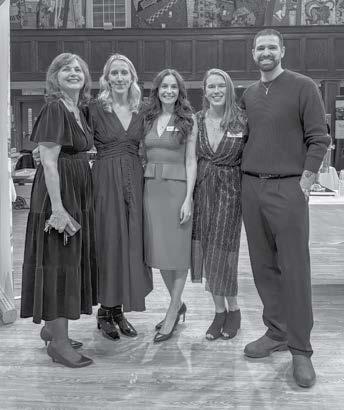
A sincere thank you goes to every restaurant, beverage company, volunteer and community member who attended and supported the event. Special recognition goes to event lead Jordan Pizzuti, whose enthusiasm, exceptional lineup of restaurants and standout beverage selection elevated the evening. We also extend our heartfelt appreciation to the 2026 Taste in the Glebe Committee – Jordan Pizzuti,
Summer Camp Registration: Reminder
Summer Camp registration opened on February 3. If your preferred camp is currently full, we encourage you to join the waitlist; spots often open up as families finalize summer plans. And if you secured your top choices, we can’t wait to spend the summer with your child.
Sarah Routliffe, Clare Davidson Rogers, Lauren Kirk and Elly Graff. From all of us at GNAG, thank you for supporting our mission and helping our community shine.
Taste in the Glebe 2026 Committee: Clare Davidson Rogers, Elly Graff, Sarah Routliffe, Lauren Kirk and Jordan Pizzuti.
Affordable housing, traffic, buses, the ‘Mutchmor’ rink and the inevitable Lansdowne
By June Creelman, GCA vice president
There is a bit of good news for those seeking more affordable housing in the Glebe. The Centretown Citizens Ottawa Corporation (CCOC) is planning to build a 96-unit building at the corner of Bank and Chamberlain. There will be one, two and three-bedroom apartments for people with moderate and low incomes in a mid-rise building with commercial space at street level. This new building will replace the City-owned parking lot and the Reliable Parts building, which has been sold.
After years of advocating for more affordable housing in our neighbourhood, the GCA is particularly pleased to have CCOC as the housing provider. CCOC has 40 years of experience in providing affordable housing in central Ottawa and is known for quality projects. Sarah Button, the organization’s executive director, told the GCA board at its January meeting that there are still some details to work out, but they hope to break ground by the end of 2026. CCOC will launch a community bonds fundraising campaign for anyone who wants to invest in this housing initiative. Stay tuned for more information on this exciting project.
Meanwhile, further west on Chamberlain, the intersection with Bronson remains a construction zone. The
Bronson exit off the eastbound 417 is still closed, and traffic lights have been installed but not activated. It turns out that the Ontario Ministry of Transportation has delayed the realignment of the Bronson exit with Chamberlain until 2027. While this is a setback, the GCA hopes that this provides an opportunity to expand and improve Glebe Memorial Park. The GCA’s Parks Committee will be working with Councillor Shawn Menard’s office and the City to push this forward.
In other park news, the new boarded rink at Sylvia Holden Park is proving popular. The cold weather has made for excellent ice, and the team of volunteers who are operating the rink are doing a great job. This is a pilot year for this rink location, after Mutchmor Public School declined to let it remain in its historic home between Third and Fourth avenues. There will be an evaluation after this year to see if the Sylvia Holden location becomes permanent.
Next door to Sylvia Holden Park, the destruction of nearly half of the green space at Lansdowne Park is now well underway. The signature sculpture, “Moving Surfaces,” has been dismantled, and the toboggan hill is being excavated to make way for a new event centre. The toxic soil that had been buried in the hill is being trucked away from the site, and you’ll no doubt have seen increased truck traffic on Bank Street, Wilton Crescent and Queen Elizabeth Place. So far, few problems have been reported, but we are monitoring closely and keeping in regular contact with City officials. This excavation work will continue into March, and the building of the event centre will continue until 2028.
The increased truck traffic on Bank
Street coincides with a decrease in bus service due to a city-wide bus system crisis. The frequent cancellation of buses 6 and 7 has been extremely problematic for Glebe residents who rely on these routes more than any other. The GCA supports Councillor Menard’s efforts to get bus service levels restored without delay. The GCA’s mission is to advocate for a livable, sustainable, diverse urban neighbourhood. Please join us at our next board meeting on Tuesday, February 24 at 7 p.m. Visit glebeca.ca for details.






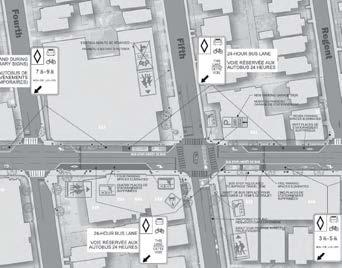
Bank Street improvements coming to Capital Ward
Bank Street in the Glebe Active Transportation and Transit Priority Feasibility Study
This past fall, City staff presented recommendations for a number of improvements for Bank Street in the Glebe. Importantly, staff have recommended implementing peak period bus-only lanes in the curb-side lanes – northbound in the morning, and southbound in the evening – as well as permanent, 24/7, bus/bike-only lanes on Bank northbound between Aylmer and the bridge and between Regent and Fifth Avenue and southbound between Fourth and Fifth and between Holmwood and Wilton.
The plan would also be adjusted for larger events at Lansdowne Park with bus only curbside lanes used to help move people.
In addition, staff recommend extending the northbound separated bike lane on the Bank Street bridge to Exhibition Way, potentially adding new bike lanes on streets like Percy, Lyon and O’Connor and implementing crosswalk improvements for pedestrians on Bank Street.
While this project will not fundamentally change the design of the roadway with permanent infrastructure changes, staff are proposing significant changes to the street’s usage to help move more people more safely and efficiently.
These suggested changes would represent an important shift in transportation priority along Bank Street while still preserving the many uses of the street which create its vibrancy and desirability as a destination.
At the same time, this plan would

Shawn Menard
Councillor, Capital Ward N 613-580-2487 www.shawnmenard.ca
target when the street is most congested while maintaining some high-demand parking spaces along Bank Street for visitors to small businesses, and it would also ensure that deliveries to businesses can still be made without forcing more truck traffic onto the adjacent neighbourhood streets.
This plan also allows for flexibility, as the city could make further adjustments to bus lanes, car lanes, parking and pedestrian and bicycling facilities in the future, once we see the outcomes of this plan .
Personally, I want to thank everyone for their input thus far and their advocacy and care invested in this project. It’s through years of work, collaboration and consideration that staff arrived at the re-prioritization of transportation along Bank Street. If you have further feedback for our office prior to the expected committee date in March to consider the recommendations, I would welcome receiving it.
Bank & Sunnyside Intersection Update
Last year, we held meetings with city staff, the Old Ottawa South Community Association and local residents about the Bank and Sunnyside intersection. This is a highly used intersection with significant numbers of pedestrians, motorists, buses and bicyclists. Hopewell Avenue Public School sits at this intersection, and both Bank and Sunnyside are important routes for the neighbourhood.
With all this in mind, staff have come up with improved designs for the intersection:
• Shifting the traffic pole at the northwest corner so it is in a better position for pedestrians crossing Bank Street
• Realigning the north, east and west crosswalks to move pedestrians further away from traffic, create shorter crossings for pedestrians and improve sidewalk space for pedestrians waiting to cross the street
• Installing new tactile walking surface indicators to provide greater accessibility for residents with vision impairments
• Improving light timing so that some of the backups occurring on Sunnyside are mitigated
We expect these draft improvements to be implemented in the summer. If you have any feedback, we would be happy to hear from you.
Transportation staff are also working with OC Transpo on the southwest corner to provide better safety and proper room for buses making a righthand turn from Sunnyside onto Bank; that will include looking at the type of buses allowed to operate on route 48.
Finally, at our request, city staff have removed the no-left-turn sign (often covered with a garbage bag) facing southbound traffic on Bank Street. In the past, the city has uncovered it to ban left turns as part of the transportation management plan for some events at Lansdowne.
We know this sign has caused confusion, and we are glad that staff have agreed to permanently remove it, ensuring that residents can turn left at this intersection.
My team and I would like to thank City staff for all their work on this issue, and the residents who engaged with our office and with staff.
Merrill Haney, Ph.D. (Counselling & Mediation)
“You are your dreams...limited only by your fears.”
Individual, Couple and Family Counselling • Comprehensive Family Mediation (with or without lawyers) • Hypnotherapy • Life Coaching
St. at the canal email: richard@ottawacounselling.com 234-5678 (by appointment) www.ottawacounselling.com



Crisis response program expands to the Glebe Annex
By Ryan Hampel
Ottawa’s Alternate Neighbourhood Crisis Response – better known by its acronym ANCHOR – has broadened the area it serves to include the Glebe Annex.
The expansion this fall followed sustained advocacy last year from the Glebe Annex Community Association (GACA) and Glebe Annex residents to make the mobile, non-police crisis response available to the community. The City’s 2026 budget set aside funding to accelerate ANCHOR’s rollout through the hiring of additional staff and the expansion of dispatch capacity and outreach.
For many Glebe Annex residents, this expansion responds to a real and growing challenge – how to respond compassionately and effectively when someone is clearly in distress, but police involvement feels unnecessary or inappropriate. Until now, residents often faced a stark choice between calling 911 or doing nothing. ANCHOR fills that gap by offering a practical, humane option that prioritizes care, de-escalation and connection to services, while also supporting neighbourhood safety and well-being.
What ANCHOR is (and what it isn’t)
ANCHOR is a non-emergency, community-based mental-health and substance-use crisis response designed to offer a skilled and compassionate alternative to police. The program operates through 211, which triages and diverts calls to mobile crisis response workers who respond in teams of two, either on foot or by vehicle. These workers are trained in mental-health and substance-use crisis response. Services provided on scene include emotional support, well-being checks and de-escalation. ANCHOR also connects people to follow-up care and social supports. The program is accessible 24 hours a
day, seven days a week, 365 days a year.
ANCHOR is not intended to respond where threats of violence or weapons are present. In those cases, 911 remains the appropriate call. While ANCHOR is independent of Ottawa Police Services, there may be situations where ANCHOR services intersect with police, which may be determined when calls are triaged.
Early results
In the first year of the ANCHOR program, which launched as a pilot in August 2024, the service responded to over 4,400 calls. Of these, 92 per cent were addressed without the need for any police intervention. These results are significant because resolutions without police involvement reduces pressure on emergency services and allows police to focus on situations where their presence is truly required.
What residents can expect going forward
With the ANCHOR expansion, the program’s boundary now extends from the Ottawa River in the north, Island Park Drive in the west, Carling Avenue to Bronson Avenue and then Highway 417 in the south, and the Rideau Canal in the east. While ANCHOR does not include the Glebe, other neighbourhoods could be considered for expansion in the future.
Residents of the Glebe Annex are encouraged to call 211 when they encounter someone who appears distressed, confused or unwell but not violent or threatening. This could include people yelling, nodding off on the sidewalk or acting confused or disoriented. Residents should continue to call 911 for cases involving urgent situations, medical emergencies or suspected criminal activity. If a situation feels ambiguous, 211 dispatchers are trained to assess risk and determine the most appropriate response, giving residents confidence that they are making the right call.
A key focus of the program is strong collaboration with existing com munity health and social service pro viders, including the John Howard Society (JHS). ANCHOR facilitates this

either during the crisis response itself or through post-crisis follow-up. In many cases, a follow-up worker will check in a few days later and incorporate coordination with the individual’s current service providers, such as JHS. This collaborative approach helps avoid fragmented or duplicative
As ANCHOR begins operating in the Glebe Annex, there will be a learning period for both residents and service providers. GACA will continue to monitor the program’s use and effectiveness, and residents are encouraged to share feedback and ask questions. With thoughtful use and continued collab -




The Glebe according to Zeus

30 Years Ago in the
Glebe Report

by Ian McKercher
Zeus releases plan for Glebe domination!
By Zeus, Supreme Self-Appointed Overlord of the Glebe
An important message from your Leader, me: Pigizens of the Glebe Neighbourhood Authority (GNA), rejoice! For today, I unveil my master plan to govern this fine patch of Ottawa asphalt like a true statespig – because if Rump can run Venezuela, surely I can run Bank Street.
First decree: Operation R.A.S.T.A. (Rodents Against Serious Talk and Annoyance). No more serious talking from bipeds! Guinea pigs and other rodents prefer compliments, gossip or descriptions of organic vegetables. Violators will be deported by the Ministry of Indecent Crimes and Evil (MICE) to Hintonburg!
Second decree: The Ministry of Sidewalk Clearance (MISC), led by duly appointed Minister Floof, will enforce strict bylaws whereby rodent walkways shall be fully cleared first, before roads. “It is imperative that rodents can reach grocery stores, favourite cafés and other select services!” said Floof whilst sipping a warm parsleyccino from his new office located at Happy Goat on Bank Street.
Budget update: The Department of Allocations, Whims and Grabs (DAWG) has allocated $2.4 billion GBs (Glebe Bucks™) to canal defense. This is required for neighbourhood building and ensures that the Rodent Canal (RC) is protected and guarded, in particular from canine invasions from Old Ottawa South.
Foreign policy: Speaking of Old Ottawa South, I’ve decided to annex it. Their fresh vegetables are superior in summer, and they hold a strategic RC defence position. I should get the Nobel Peace Prize for this.
In conclusion, this is just the beginning. If I can govern the Glebe, I can govern the globe. And that’s what I plan to do.
THANK YOU FOR YOUR ATTENTION TO THIS MATTER!
Sincerely,
Zeus, CEO, COO, POO of GiddyPigs.com, Czar of the Glebe, close personal friend of Rump
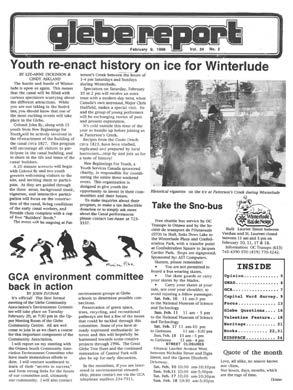
ENVIRONMENT COMMITTEE BEGINS
The first formal meeting of the Glebe Community Association’s Environment Committee was to take place February 20 at the Glebe Community Centre. All were welcome to help chart a course for this important component of the Community Association.
John Zvonar would report on his meeting with the Ottawa South Community Association Environment Committee which had made tremendous efforts to date. He would also contact environment groups at Glebe schools to determine possible connections. Preservation of green space, trees, recycling and recreational pathways were some of the issues that could be tackled through this committee.
GCI PARENTS’ COUNCIL ESTABLISHED
The new Glebe Collegiate Institute School Council met for the first time on January 18. School Councils were new in Ontario, being mandated by the provincial government to give parents a stronger voice in how schools were run and to strengthen partnerships with the community.
The School Council would be composed of elected representatives of parents, students, teaching staff and non-teaching staff, with the




principal as ex-official member.
The advisory function of the former Parent Advisory Committee was to be passed on to the new School Council.
GCC HERITAGE DESIGNATION
Glebe Neighbourhood Activities Group (GNAG) chair Jennie Aliman was spearheading a request to the City of Ottawa that the Glebe Community Centre be granted a heritage designation to ensure that the building’s tremendous historical significance would be preserved and protected in the future.
WEIGHT TRAINING AT GLEBE CENTRE
Fitness trainer Stephanie Barrett had begun a program of weight training for residents at the Glebe Centre. Developed at Carleton University, the program aimed at increasing muscle mass and strength to help seniors stay fit and independent.
SPACIOUS APARTMENT FOR RENT
Near canal. Large two bedroom. Living room with fireplace. Separate dining room. Hardwood floors. Renovated kitchen. Balcony. Heat included. $1167 monthly.
This retrospective is filed bi-monthly by Ian McKercher of the Glebe Historical Society. The society welcomes the donation or loan (for copying) of any item documenting Glebe history (photographs, maps, surveys, news articles, posters, programs, memorabilia, etc.). Contact Ian at 613-235-4863 or ian.s.mckercher@gmail.com. Note: All back issues of the Glebe Report to June 1973 can be viewed on the Glebe Report website at www.glebereport.ca PAST ISSUES menu.

The new Civic Hospital will affect your health in more ways than one
By Cecile Wilson
[Atmospheric CO2 at Mauna Loa, Hawaii on 18th January 2026: 428.29]
The healthcare field is a significant source of greenhouse gas (GHG) emissions and airborne pollutants, contributing about 4.6 per cent of the world’s GHG emissions. Medical professionals realize the danger to human health that pollution and severe weather events can pose – increases in lung and cardiovascular problems, dementia, asthma, cancers and heat stroke, all of which increase human suffering and elevate costs for taxpayers and for home insurance.
That’s why it’s noteworthy that in 2023, The Ottawa Hospital (TOH) announced a “high-efficiency” Central Utility Plant (CUP) for the new Civic Hospital that will use “innovative technology to lower TOH’s overall carbon footprint.” It was also stated that the CUP would eventually become the foundation of Hydro Ottawa’s “new district energy network, improving access to clean energy in our community.”

It sounds good, but exactly what does this mean?
What is ‘sustainable’?
Hospitals’ utility needs include electrical power, heating, cooling and domestic hot water. At CHEO, for example, these needs are met by a fossil gas (a.k.a. “natural” gas) plant that is connected to the electrical grid. The gas plant supplies the hospital with heat captured as a by-product of electricity generation, steam. The electricity is sent to both the hospital and the grid.
In 2009, TransAlta (one of the plant owners) installed a gas turbine that lowered the emissions intensity of the plant by six per cent. Technically, this increased the gas plant’s efficiency, but it still added GHGs and pollutants to the air. To protect our health, we need to remove GHGs and pollutants.


While the final design of the CUP was due for approval in 2024, details of its makeup are not easily publicly available. People I spoke with expect it will be gas-fired, but they suggested a range of alternatives for heating and cooling sources.
Wastewater Energy Transfer
Wastewater Energy Transfer or WET systems extract heat from the wastewater in the sewer line and use that heat to warm buildings. The temperature of wastewater varies between five and 20 degrees – warmer than the outside temperature in the winter and cooler than the average outside temperature in the summer – so it can be used for both heating and cooling purposes. This largely avoids the need to burn fossil fuels to generate heat in the winter and saves both water and electricity in the summer.
At Toronto Western Hospital, a WET system installed by Noventa supplies 90 per cent of the hospital’s heating and cooling needs and has reduced its GHG emissions by about 8,400 metric tonnes per year. A capstone project by five senior environmental engineering students, under the supervision of Professor Amir Hakami, found that WET could provide 49 per cent of the hospital’s heating needs and 123% of its cooling needs without fossil fuels. The students’ findings received a favourable response from the Civic Hospital’s project engineer.
In Ottawa, a WET system due to be completed this year will heat and cool the two Odenak project residential towers a kilometer away from the new Civic. The towers are part of the Dream LeBreton project.
Exclusive Winter Savings Await
Open-loop Geothermal
In Corner Brook, Newfoundland, the 600,000 square foot Western Memorial Regional Hospital is heated and cooled by the largest geothermal system in Canada. Consisting of about half a million linear feet of piping 600 feet deep, the geothermal system pumps an antifreeze and water solution through the pipes and avoids the need for fossil fuels. It also removes the need for cooling towers, reducing the noise on site.
Closed-loop Geothermal
Mike Fletcher, a former City of Ottawa project manager turned consultant, offered closed-loop geothermal as another option. An open-loop system requires a water source, such as a well, groundwater or even a surface lake. The water is pumped from the water source into a heat pump system, which transmits the heat to the building in the winter and extracts the heat from the building in the summer and puts it into the water source. The advantage of open-loop geothermal energy is that it is very efficient and does not require a lot of piping. The closed-loop method could also serve as the basis for a district energy system.
Connection to the electrical grid
Perhaps the most obvious alternative for cleaner energy is to connect the CUP to the electrical grid. By law, the utility plant would still require emergency generators which typically run on diesel or propane. Fletcher pointed out that renewable diesel made from vegetable oils, used cooking oils and animal fats is chemically identical to petroleum diesel but yields 90% fewer emissions.
The Cowichan District Hospital due to open next year will be all-electric, the first fossil-fuel-free hospital in B.C. and the first in Canada to achieve Zero Carbon Building – Design™ certification from the Canada Green Building Council. One of the partners in that hospital build is Ellis-Don.
The proof is in the pudding
In the coming months I hope to learn more about the Civic Hospital’s specific goals for “improving planetary health” and how it will “support the health of our community.” The money saved by selecting fossil-free utility systems and avoiding GHG- and pollution-provoked illnesses could be diverted into patient care. Our community health depends on it. Stay tuned!
Cecile Wilson lives in the Glebe and is active in the CAFES Environment Committee and the Climate Misinformation Project, as well as other climate-based organizations in the city.


Plans for a new Civic Hospital campus at Dow’s Lake include a high-efficiency central utility plant that is to use new technologies to lower the hospital’s overall carbon footprint. PHOTO: ENGAGE.OTTAWA.CA
Evenings of learning and connection at Abbotsford
By David O’Neill
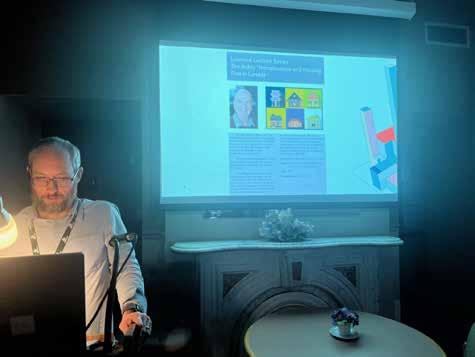
The Glebe Centre Community Programs at Abbotsford are excited to expand evening programming, offering engaging opportunities for learning, discussion and connection for older adults in the Glebe and surrounding communities. Abbotsford is pleased to host a monthly lecture series and in-depth courses led by respected academics and subject-matter experts.
Our monthly lecture series, The Learned Lecture Series, brings thought-provoking talks to the community on a wide range of topics, encouraging curiosity, conversation and lifelong learning in a welcoming, accessible setting. These evening lectures are designed for those who enjoy learning for the joy of it – without exams, pressure, or prerequisites, just great ideas and lively discussion. Coffee and treats are provided by Brian Lonsdale of the Lonsdale Financial Group.
In addition to the lecture series, the Glebe Centre Community Programs at Abbotsford are offering a new six-week course beginning February 17, titled Getting Off Fossil Fuels – The Role of Renewable Energy, delivered by Dr. David Holes. This course will explore the transition away from fossil fuels, the role renewable energy can play in that shift and the broader environmental, economic and social implications. The course is ideal for anyone interested in climate issues, sustainability or understanding the energy systems shaping our future.
These programs are made possible through a partnership with Friends
of Lifelong Learning in Ottawa-Carleton. Last June, Carleton University made the decision to close its lifelong learning program that had offered university-level lectures and courses to older adults in Ottawa-Carleton for 25 years. In response, a group of professors and learners came together to explore whether the program could be reinstated. Calling themselves Friends of Lifelong Learning in Ottawa-Carleton (FLLLOC), the group surveyed learners and instructors to better understand what older adults wanted to learn and which instructors were available to teach.
FLLLOC also developed and submitted a business plan to Carleton University that lowered administrative costs and maximized learner engagement by using volunteer resources. The group has met with Carleton’s provost and is hopeful that a decision about whether the university will be able to work with them to relaunch the program will be forthcoming early in the new year. In the interim, FLLLOC has been delighted to partner with Abbotsford through the Glebe Centre Community Programs to deliver two six-week courses as well as the monthly learned lecture series.
The Glebe Centre Community Programs at Abbotsford are proud to support lifelong learning and to provide space for ideas, dialogue and community connection to flourish, especially in the evening hours, when many people are looking for meaningful ways to stay engaged.
For more information or to register for upcoming lectures or the six-week course, please call 613-230-5730.
The Glebe Centre Community Programs and Services at Abbotsford are part of a registered charity, The Glebe Centre Inc., which includes a 254-bed long term care home. Find out more about our services and programming by dropping by 950 Bank Street (the old stone house) Monday to Friday, 8:30 a.m. to 4:30 p.m., phoning 613-230-5730 or by checking out all The Glebe Centre facilities and seniors’ services on our website at www.glebecentre.ca.
David O’Neill is manager of community programs and services at Abbotsford House.
These evening lectures are designed for those who enjoy learning for the joy of it



• RANDALL’S KNOWLEDGEABLE SPECIALISTS can guide you on style, fabric and colour. Plus Randall’s takes care of measuring, installation and guarantees the fit. Easy peasy!
• FLEXIBLE VIEWS, open from either the top or bottom to control how much light enters the room without sacrificing privacy.
• MAXIMIZE ENERGY EFFICIENCY by keeping the upper half closed in the summer to keep your room cool, and open in the winter to allow the sun to help warm up your space.





David O’Neill sets up for an evening of learning at Abbotsford, one of a monthly series of lectures led by subject-matter experts. PHOTO: PAT GOYECHE
Complex kids? Try to prepare, teach, and motivate!
By Jenny Demark
Do you know a parent who is struggling to manage the day-to-day challenges of raising their children? Is your own son or daughter giving you a run for your money? Are you feeling overwhelmed with kids who have developmental, behavioural or emotional difficulties? It is an understatement that parenting is not easy. In fact, it is one of the most difficult jobs for which we are never fully ready. Add to that the confusion that arises from well-meaning but often misguided online parenting “experts” and it can be really difficult to know what to do in any given moment.
But do not despair! There is an evidence-based framework that uses three fundamental ideas: Prepare, Teach and Motivate to address almost any parenting situation.
The first parenting fundamental is Prepare. Prepare yourself and prepare your child. Plan ahead. Pick the right battles. Set the stage for success. Validate your children’s perspectives, opinions and feelings without necessarily agreeing or giving in.
One of the single best prepare strategies is to spend quality time. Quality time is a designated period with your child doing something that they enjoy. It should happen on a regular basis. Your child is in the lead and in control. Quality time is unconditional and non-contingent, meaning that it happens because it happens. It does not get taken away because you and/
missing skills. Most parents already know how to teach children the day-to-day things, such as tying their shoes or making their beds, but they can feel stumped when faced with more challenging situations such as children who act defiantly, have excessive tantrums or struggle to fall asleep. Cooperation, emotion regulation and sleep hygiene are actually skills and like all skills, they can be taught.

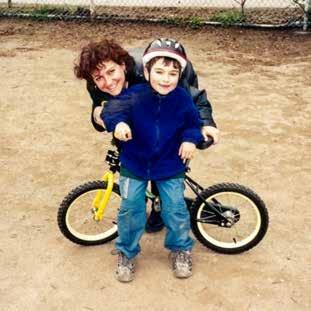
on a bike, they figure it out, and they ride. But most kids require preparation, a lot of teaching and a lot of practice before they have mastered the skill – and even still, they may wipe out on occasion.
When we teach children how to ride bikes, we prepare them for success by making it easier – we may use a balance bike or training wheels to start – and we ensure that they wear their helmets. We teach them with specific instructions on what to do with their eyes, their hands, their feet. We model and practise how to steer and how to brake. Then, we motivate them as they practise putting it all together. We run alongside them, motivating, encouraging and cheering them on as they pedal with greater skill and confidence. And when they fall off (which they all do at some point), we are caring and supportive. We don’t get angry with our kids when they fall – we realize they are doing the best they can while they are still learning. When they are successful, we celebrate enthusiastically.
These same Prepare, Teach and Motivate principles, which seem quite obvious in the bike-riding example, can be applied to common struggles faced by today’s parents. Some of the key skills for children to learn include cooperation with adult requests, being able to tolerate when they are told no (yes, children should be told no!), getting out the door in the morning, managing screen time, emotion regulation and healthy sleep habits.
Finally, the third fundamental is Motivate. Motivation can be used to improve skills and decrease unwanted behaviours. Research has consistently demonstrated that the use of rewards, rather than punishments, is the most effective way to motivate
As an illustration, here is how to prepare, teach and motivate strategies can be applied to teaching a child how to ride a bike. Some kids are naturals – they get
Children who have a good foundation of these skills will grow to be resilient, likeable and confident. And isn’t that what we all want for our kids?
Jenny Demark, Ph.D., C.Psych. is a psychologist who lives in the Glebe and works nearby. She is one of the authors of Complex Kids, Simple Solutions: How to raise resilient, confident, likeable kids. The book, released last November, is available through all online retailers and local booksellers.

PHOTO: JOCK SMITH
Unplugged Glebe: It takes a village to delay a smartphone
by Robyn Aaron
I’ll start with a confession: I am writing this on a screen. Probably while resisting the urge to check my messages. Like many parents, I’m not anti-technology – I’m just increasingly aware that it’s quietly taking over more of our kids’ childhoods than any of us really intended.
In a world where smartphones and social media are everywhere, setting boundaries around technology can feel overwhelming. But here in the Glebe, many families are deciding to try something different: restoring a playbased, rather than phone-based, childhood, by delaying the introduction of smartphones.
I’m inviting parents and guardians to sign the Unplugged Canada pledge to voluntarily pledge to delay smartphones until at least age 14. By signing the pledge, Glebe families can join a supportive community of parents and caregivers who are all trying to hold the line together – reducing peer pressure, creating shared expectations and building circles of friendship where kids can focus on being kids (mud, bikes, games, boredom and all).
You can sign the pledge at unpluggedcanada.com. Unplugged Canada’s mission is to educate parents and caregivers about the risks of early smartphone use and to inspire a collective commitment to restore play-based childhood. Signing the pledge can help kick-start conversations at home and with other parents. “But won’t my child be the only one without a smartphone/TikTok/Snapchat?” This is the question many of us worry about quietly at night. The good news? Progress is already underway.
Mutchmor currently has the highest number of pledges in Canada to delay smartphones. Last year, the Mutchmor School Council unanimously endorsed the Smartphone Free Childhood Initiative (the global name for the Unplugged movement). First Avenue Public School and Glebe Montessori already have pledges signed, and Corpus Christi’s School Council has hosted a presentation on Unplugged. You may have spotted Unplugged Canada flyers at Shoe + Shoe, Hokum, Il Negozio Nicastro, Glebe Tailoring, Bridgehead, Knifewear, Little Victories or the Glebe Community Centre. In other words: This is becoming a thing – and not just a “that one family” thing. By deciding together that delaying smartphones is worthwhile, we can help create new, more realistic norms around device use. Norms that actually match our values as a community.
Why does delaying smartphones matter?
Children and youth themselves are telling us that divided attention, distraction and social media are affecting their well-being. UNICEF Canada’s U-Report shows that many kids spend more than three hours a day on social media, with some estimates climbing to seven hours or more. To put that in perspective: just two hours a day adds up to an entire month of screen time over a year. One whole month. On a phone. CHEO has also released research highlighting the mental-health impacts of problematic screen use. And it’s not
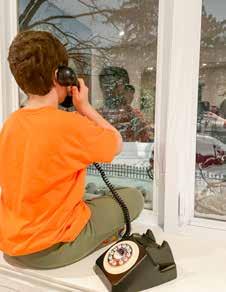
families,
just about what smartphones expose kids to (harmful content, cyberbullying, addictive algorithms) but also what they quietly replace: the capacity to develop vital executive function skills, like frustration, tolerance and the ability to be bored, device-free meals, healthy sleep habits, unstructured play and the chance to build resilience. After all, kids’ brains don’t finish developing until around age 25. It can be hard enough for an adult brain to resist scrolling and checking notifications, let alone a brain without fully developed impulse control.
But honestly, most of us don’t need experts to tell us something feels off. Despite the promise of “connection,” smartphones often lead to disconnection. Kids spend time comparing themselves to others online at exactly the age when they’re trying to figure out who they are. Notifications interrupt play, homework, conversations and sleep. I think many of us sense intuitively that we want something different for our kids.
What else can we do as parents and caregivers?
None of us is doing this perfectly, but small changes matter:
Model healthy screen habits – yes, this includes parents.
Consider alternative tech if your child needs to stay in touch, like a basic talkand-text phone, a landline or a landline-alternative like the Tin Can phone.
If your older child already has a smartphone, consider switching to a Pinwheel phone. It looks like a smartphone but is designed with child safety in mind and no internet access.
Make a family rule that devices stay out of bedrooms and off the table at meals (again: parents included).
Let kids be bored! Try putting phones away while waiting at restaurants, on the bus or at appointments.
Sign the Unplugged Canada pledge to delay smartphones until at least age 14, so we can build a shared community norm.
Finally, if you’re interested in becoming a School Champion for your child’s school, if you are are a parent or guardian who would like to join the Unplugged Ottawa WhatsApp group or if you run a local business and would like to display an Unplugged Canada poster in your window, you can contact me at robynaaronm@gmail.com.
If you’d like to learn more or sign the pledge, visit www.unpluggedcanada.com.
Robyn Aaron, MSW, RSW, is an Unplugged Canada champion for Mutchmor Public School.

At Villagia In The Glebe, you can embrace winter without the worries of icy sidewalks or endless shovelling. Our welcoming community in the heart of Ottawa makes it easy to stay active and enjoy all that the Glebe has to offer.
Enjoy chef-prepared meals every day, with menus designed to suit your tastes and dietary needs. Whether it’s breakfast with friends or a quiet dinner, dining is always a pleasure.
And with our caring team close at hand, you’ll have the comfort of knowing support is there whenever you need it.
Some Glebe
working with Unplugged Canada, are banding together to collectively delay their children’s use of smartphones until at least age 14, in view of the risks of smartphones for children’s development.
Babies of the Glebe 2025




Clara Maria October 2025
Parents: Lisa Butzenlechner & Stefanos Efstathiou
Elisabeth Lønnum Huard September 2025
Parents: Line Lønnum & Ryan Huard
Elliot Le-Thurston February 2025
Parents: Mimi & Quinn Le-Thurston
George Moss Abugov October 2025. Parents: Marina Cremonese & Zach Abugov
Evylyn Reid Demarsh December 2025
Parents: Lauren Reid & Alex Demarsh, siblings Nathan & Roslyn
Finn Elliott Butler October 2025 Parents: Alanna J Brown & Andrew Butler
Grace Somers Achtell Charie October 2025
Parents: Kate Achtell & Kelsey Charie
Lilah Story July 2025 Parents: Jodi Stinson & Turner Story
Louise Murphy-Garneau September 2025 Parents: Georgina Murphy & André Garneau





February

Alice Esmé Paveck Gall February 2025
Parents: Hannah Paveck & Nick Gall
Oliver George Skok January 2025 Parents: Kealey Dixon & Ilya Skok
Lucie Julien-Lefebvre
July 2025
Parents: Noémie Julien & Nathan Lefebvre
Lydia (left) and Jacob (right) Kenny October 2025
Parents: Shannon Donnelly & James Kenny
Meredith Thomson Brynen
September 2025
Parents: Bronwyn Thomson & David Brynen
Miles Upton November 2025
Parents: Leigh Gardner & Brian Upton
Oliver Rowe Niedra
2025
Parents: Thalia & Daniel Niedra
Safiya Hafez Charette August 2025
Parents: Mona Hafez & Yves Charette
Anna Gross February 2025 Parents: Geoff & Sarah Gross
Strawberry-rhubarb muffins in celebration of volunteers
By Marisa Romano
Patrick Farley is a regular volunteer. In the past, he has donated his time and talents to a soup kitchen, Habitat for Humanity and a hockey team, but in the past three years or so, he has joined the crew of volunteer carriers who regularly deliver the Glebe Report to our doors.
Farley walks his route with Myriam and Eloise, his two girls, and Pepper, their dog. A few years earlier, Farley started delivering the paper for his neighbours on occasion and when they moved to another neighbourhood, he took over their route, an enjoyable experience and an opportunity to show his girls the importance of being involved in the community. The girls enjoy it too, especially when they can scooter along the way. Myriam has a favourite house –she is the one who brings the paper to the door there – but there are other special places worth checking on the way, like a miniature fairy table sitting in the front yard of one of the last houses on their itinerary.
The United Nations General Assembly has proclaimed 2026 the International Year of Volunteers for Sustainable Development (IVY). Launched last November, this year-long celebration is in recognition of all volunteers who contribute – formally and informally, locally and globally – towards positive changes in our communities, and in appreciation for all that has been achieved by so many helping hands.
Statistics Canada’s latest Giving, Volunteering and Participating survey, published last year by Volunteer Canada, reports that almost six out of ten Canadians 15 years and older have volunteered at some point in their life, and many of them do it on a regular basis. Beneficiaries of this bounty are organizations dealing with social services, sport, religion
or education, but people are also helped by volunteer helpers with housework, home maintenance, shopping or rides to stores and appointments. Despite reporting a small decline in participation in post-COVID years, these statistics still put Canada among the countries with the highest number of volunteers, a good reason for joining the celebration of this special year.
The publication and distribution of the Glebe Report is possible thanks to volunteers like Patrick and the financial support of about 100 advertisers. Established in 1973, the Glebe Report keeps us connected, aware, informed and organized when it is time to act in defense of our community. Under the guidance of a volunteer board, the production team of about 22 people works with articles and photos sent by volunteer contributors (about 40 or so for each issue), coordinates advertising and organizes the 200 volunteer carriers for the distribution of 7,500 paper copies to our homes and 53 businesses in the Glebe and Old Ottawa South and keeps the website updated. It is an impressive number of people volunteering a remarkable number of hours for a little paper that helps our community thrive – something worth noting and celebrating.
This is only a small example of the essential role that volunteers play in building supportive communities. This year, we will meet other local volunteers who contribute to the wellbeing of our society. They will share their favourite recipes in celebration of community participation and the work of volunteers worldwide, a feast for our tables and an invitation to all to join the volunteer movement.
Marisa Romano is an active volunteer in the Glebe and elsewhere and a lover of good food.


Strawberry-rhubarb muffins
This is one of the Farley’s favourite recipes; a lip-smacking addition to any lunch box and a pleasing companion to any good cup of coffee or tea. Not too sweet and very moist!
Ingredients:
1 ¼ cup all-purpose flour
1 ½ tsp baking powder
1 tsp salt
¼ cup white sugar
¼ cup brown sugar
1 cup rhubarb, cubed
½ cup strawberries cut the same size of rhubarb cubes
1 large egg
½ cup milk
¼ cup cooking oil
1 tsp almond extract
white or icing sugar for topping
Method:
Mix flour, baking powder, salt and sugars into a large bowl. In another bowl, beat the egg; add milk, oil and almond extract.
Pour egg mixture over dry ingredients and stir to moisten.
Fold in rhubarb and strawberries.
Fill muffin cups and bake at 375 F for 20 minutes.
Dip muffin tops in sugar while hot or sprinkle the tops with sugar before baking.
Although strawberries and rhubarb are a favourite, peaches or other fruit in season are just as delicious.
Teskey - Cartwright - Keeley


Strawberry-rhubarb muffins fuel delivery of the Glebe Report by volunteer carriers. These were made with peaches – just as good! PHOTO: MARISA ROMANO
GLEBE- This redone and redesigned modernist residence captured the essence of refined urban living.
Luxury Condo: Offering endless vistas of the Canal, this outstanding suite offered a hassle free lifestyle while never giving up space or quality.
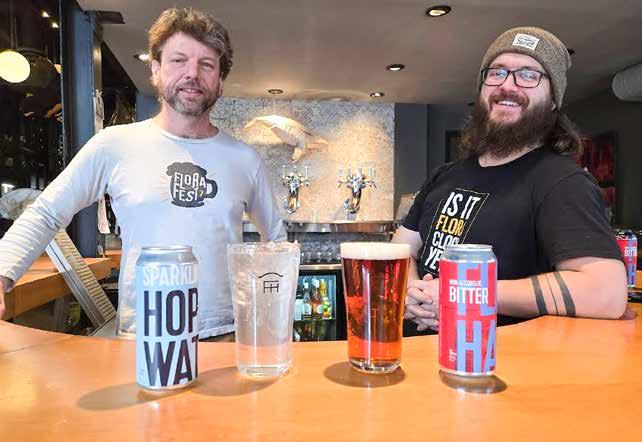
Alcohol-free has never tasted so good
By David Longbottom
As February flows by, already well into this new year, it strikes me that we have become ever more obsessed with making (and inevitably breaking) resolutions.
Perhaps it’s the proliferation of sensors and personal fitness apps and trackers that we wear? Perhaps it’s the tendency to report our every move and achievement on the various social media channels? Perhaps it’s the catchy names that society now invariably attaches to the next meme-worthy “challenge”?
In any case, the challenge most in focus recently as media channel after media channel churn out their fluffy content was Dry January (or for those looking for a slightly shorter commitment, Dry February). For those not yet familiar with this trend, it is a personal challenge undertaken by some committed souls to stop drinking alcohol for a month. Some make it through, others do not. Some spend the month just thinking about enjoying a drink again. Maybe next year.
No matter your opinion or perspective on it all,

such is the popularity of the trend that an undeniably good thing has happened. Beer makers and cocktail mixers across our fine city have risen to the challenge enthusiastically and produced many delicious alcohol-free drink options to enjoy. For those who like to enjoy their socializing booze-free during a “dry” month or at any other time of the year, these no-alcohol (NA) choices are a boon.
The NA sector used to be served only by lacklustre alcohol-free wines, which were more glorified fruit juice than anything worthy of association with the beautiful grape. Now the sector is awash in glorious options.
One only has to look down the drinks list in any of our fine establishments in and around the neighbourhood to find gorgeously crafted cocktails, fresh locally brewed alcohol-free beers, and low- or no-alcohol wines a plenty. Whether this is a trend or a permanent market shift remains to be seen, but meanwhile drinkers and diners can enjoy what all customers truly want – choice.
Try local NA beers from great breweries such as Stray Dog (Burden of Proof Pale Ale and IPA), Bicycle Craft (Fresh NA) and our own Flora Hall (English NA Bitter and refreshing Sparkling Hop Water). These beers are free of alcohol yet full of flavour. They are also available in a variety of beer styles, from IPAs to Bitters.
Or head to a local resto for their signature mocktails such as The Gigi at Cantina Gia in the Glebe (America aperitif, grapefruit, lemon and club soda). Or try the Pump Punch at nearby Lieutenant’s Pump on Elgin Street (ruby red grapefruit juice, lime juice, strawberry syrup, grapefruit San Pellegrino). Or head over to Cocotte Bistro on Metcalfe Street for a “Driving Cocktail,” such as the Papillon, with butterfly pea flower, lemon juice and soda. We are truly spoilt for choice these days when it comes to alcohol-free drink options.
All the best in 2026 to you all, whatever path you may choose – dry, damp or full wet.
Dave Longbottom is the founder of Flora Hall Brewing and can be seen around town observing and enjoying, but never judging, the drinking habits of others.















Myles and Nate at Flora Hall Brewing help to make popular non-alcoholic options, including Sparkling Hop Water and alcohol-free English Bitter. Many local bars and restaurants have expanded their non-alcoholic drinks.
thriller & mystery review

By Sylvie Chartrand



Here are summaries of some of the books I have read so far this year, in order of when I read them, not by favourites. I mostly like mystery novels but hopefully you can find something that appeals to you in the book reviews below.
The Cage by Bonnie Kistler (2022)
Bonnie Kistler is a former Philadelphia trial lawyer. She and her husband now live in Florida and the mountains of western North Carolina. They have two daughters.
Two women working late on a Sunday night happen to leave the office at the same time and get on the same elevator, but only one of them makes it out alive. Shay Lambert, a lawyer, is arrested for the murder of Lucy Carter-Jones, the human resources director of the company. Shay told the policemen that Lucy committed suicide, but how is she going to prove it?
Blood Sugar by Sascha Rothchild (2022)
Sascha Rothchild is an Emmy-nominated screenwriter who has written and produced lauded shows such as GLOW, The Bold Type, The Baby-Sitters Club and The Carrie Diaries. Blood Sugar is her debut novel.
Ruby Simon is a likeable killer. She’s a therapist who cares about her patients and loves animals. She married the man of her dreams, Jason, who died in his sleep from diabetes complications, but the police think she is guilty of killing him. Is it a coincidence that three other people died while she was in their vicinity? The homicide detective doesn’t think so. Can they prove that she killed all four?
The Blood Tide by Neil Lancaster (2022)
Neil Lancaster is the No.1 digital bestselling author of both the Tom Novak and Max Craigie series. He served as a military policeman and worked for the Metropolitan Police in London as a
Sylvie Chartrand is a public service assistant at the Sunnyside branch of the Ottawa Public Library. Sylvie’s

detective. He now lives in the Scottish Highlands, writes crime and thriller novels and works as a broadcaster and commentator on true crime documentaries. He is a key expert on two Sky crime TV series, Meet, Marry, Murder and Made for Murder
The Blood Tide is the second book from the DS Max Craigie Book series.
PC Hamish Beattie answered the call about a man standing on a bridge about to jump. Hamish tried to talk him out of jumping, but Jimmy saw no other way out and jumped, but before he did, he said something about police corruption. Hamish took copious notes and contacted DS Max Craigie, someone he trusts, to look into it. Max, Janie and Ross are on the case.
The It Girl by Ruth Ware (2022)
Ruth Ware is an international number-one bestseller. Her thrillers In a Dark, Dark Wood, The Woman in Cabin 10, The Lying Game, The Death of Mrs Westaway, The Turn of the Key and One by One have appeared on bestseller lists around the world, including the Sunday Times and New York Times. Her books have been optioned for both film and TV, and she is published in more than 40 languages. Ruth lives near Brighton (UK) with her family.
The It Girl is another page-turner. Hannah rooms with April at Oxford University. Hannah is fascinated by April, who seems to have it all, beauty, money and brains, but April can also be cruel. They form a tight bond with Will, Hugh, Ryan and Emily in the first term but by the end of the year, April was dead. Ten years later, Hannah finds out that John Neville, who was arrested for killing April, has died in prison. A journalist approaches Hannah with evidence that has Hannah questioning everything. Did her testimony send an innocent man to prison?
These books and so many more are available at the Ottawa Public Library!

WHAT YOUR NEIGHBOURS ARE READING
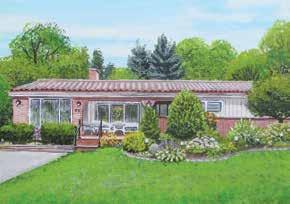



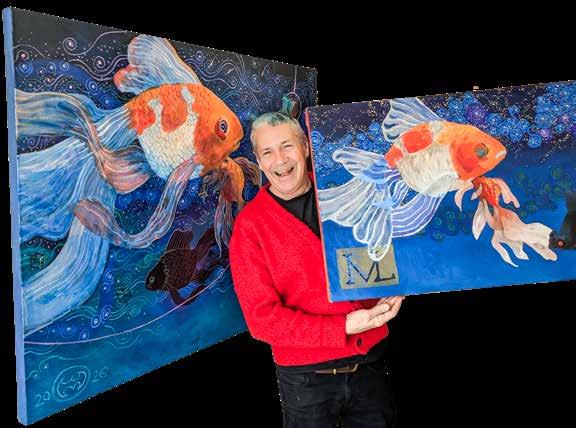
Exuberance of youth, or wisdom of age? Ask the goldfish.
By Bhat Boy
The beauty of good art is that it ages well. The Mona Lisa can smile at you across the centuries, and you wonder what she thinks. Elizabeth Taylor can still dazzle you on a screen, even though she has been dead for 15 years. These things never age.
My paintings never get old either. It did not strike me until I started becoming old myself –the power of the painting’s youth.
In September 1993, a young artist named Ian Van Lock had his first art show at A Source of Art Gallery in Fifth Avenue Court. Most of the paintings featured goldfish in space, some mixed with floating chinaware. There was a great deal of night sky. The paintings varied in price from $75 to $600. Merideth Olson, assistant editor at the Glebe Report at the time, bought a 2’ x 3’ painting for $250. It was entitled ‘Little Pisces.’ In the lower left corner, it had a stylized IVL for Ian Van Lock. This was, of course, me, Bhat Boy, before I had christened myself a superhero and became infamous.
Thirty years later, Merideth Olson was preparing to downsize from her big home on Fourth Avenue and very kindly regifted the painting to me. I was happy to have it back, and I hung it at home where I had time to think about it. It was painted in a simpler time, in the colours of my youth. Things about it would nag at me, things that were wrong, that I thought I should have painted differently. Was it because I didn’t know any better, or was that just youth? Is youth made of our mistakes, or are our mistakes what youth is made of?
One day recently I was taken with the sudden


urge to recreate this painting from my youth, but with wisdom! As wisdom has it, I had everything there in my studio that I needed to start painting that very instant. Without even thinking about it, I picked up my paintbrush and began. I instantly remembered the youth and spontaneity. There is a wildness of anticipating something but not knowing quite what it is. Creating the painting is muscle memory but also tinted with my experience, my learned shortcuts. The painting this time is bigger, brighter. With age, I have earned the luxury of being able to paint something just because it feels like fun, not because I have the need to sell it. This is a different kind of freedom that age has brought me, as my glamourous-sounding, spontaneous youth was also a very poor time. A time of anxiously biting my nails from sale to sale. All these years later, I wake up every day and know that my paintings all over the world are living their own lives with their own families and their own secrets. Each one as young as it ever was. Each one advertising Bhat Boy.
If you would like to see them, the two goldfish paintings, one by Ian Van Lock in 1993 and one by Bhat Boy in 2026, will be on display together at Happy Goat in the Glebe for the month of February.
Do you or someone in your family have an Ian Van Lock goldfish painting? If so, I would love you to send me a picture and tell me any personal stories you have about the painting. Get in touch at boybhat@gmail.com.
Bhat Boy is a notable Glebe artist and art teacher whose works grace many local landmarks.

Founded in 2013 and presented without interruption ever since, Doors Open for Music at Southminster (DOMS) offers free 45-minute concerts every Wednesday at 12 noon, September through June, at Southminster United Church, 15 Aylmer Avenue. Concerts are live in person and livestreamed on YouTube. The series is sustained by freewill offerings.
Accessibility
The church is wheelchair accessible and on OC Transpo routes 6 and 7. Seniors (65+) ride free on Wednesdays on OC Transpo buses and O-Train service.
Refreshments
A special thank you to Colonel By Retirement Home for welcoming DOMS concert attendees each week with complimentary coffee and cookies!
DOMS Winter 2026 Lineup
February 11 – Ae Fond Kiss
Celtic harp duo Harpistry – Lucile Hildesheim and Susan Toman – performs Irish and Scottish music spanning centuries to warm the heart.
February 18 – Swingin' with Cupid
The Mike Manny Trio – Mike Manny (piano), Normand Glaude (bass) and Jaime Holmes (drums) – plays classic jazz love songs.
February 25 – Hopewell Showcase
A February tradition: students from Hopewell Elementary School, directed by Marya Woyiwada, share their musical talents with the community.
March 4 – Liebeslieder
Soprano Kathleen Radke, mezzo-soprano Danielle Vaillancourt, tenor Grayson Nesbitt and bass Jean-Sébastien Kennedy join a four-hand piano duo to perform Brahms’ Liebeslieder, Opp. 52 and 65.
March 11 – Trio for Peace
Andrew Paul MacDonald (archtop guitar), Wilhelm Magner (viola) and Carmen Picard (piano) play Schumann’s Märchenerzählungen trio and world premieres by MacDonald and Ottawa’s own John Armstrong.
March 18 – Fantasies and Sonatas
Acclaimed classical pianist Roman Timofeev performs Mozart’s Sonatas in C (K. 309) and C minor (K. 457), and Fantasia in C minor (K. 475).
March 25 – A Serious Life
The Canto Sentimento String Quartet – violinists Adam Nelson and Lucas Olsen, violist Olivier Philippe-August and cellist Gabriela Ruiz – performs Beethoven’s Op. 95 and Philip Glass’s Mishima: A Life in Four Chapters.


March 8-14, 2026 Unique items and experiences (local and out of
With the benefit of 30 years’ experience, Bhat Boy has recreated his “Little Pisces” painting of a goldfish originally painted as Ian Van Lock in 1993. Both can be viewed together at Happy Goat in the Glebe in February.
Hold True: public art in Ottawa today
Review by Maureen Korp
The City’s exhibition Hold True presents works by 41 artists, recently acquired as purchases or site-specific commissions through the City’s Public Art Program. In 1983 Marion Dewar, Ottawa’s mayor (1978-85), gathered a committee of seven (this writer was one of the seven) to draft the City’s Arts Policy, a new initiative: public art, art with no admission charge, for all to see.
Hold True is art of time and place, Ottawa today. Ottawa’s multilayered worlds are well introduced by three short videos. In “nipēhtēnān kiteh, We Can Hear Your Heartbeat,” 2023, Red Pheasant Cree Nation artist Meryl McMaster presents the tale of a woman walking along a railway track. Hers is a story of healing. As she walks the trail, we hear her words: “I hear the land, you are my teacher.”
Penny McCann’s short video, “Buses don’t stop here anymore,” 2024, documents a horrific tale of urban destruction. In its close-ups, we see sharp metal teeth tearing into the façade of Ottawa’s Greyhound Bus Terminal on Catherine Street. What became of the stories from there—reunions, farewells, lost luggage?
Pixie Cram might answer that question. In her short video, “Witch Woman,” 2022, nature prevails regardless. Birds chirp at gravesides.
Remember the destructive 2018 tornado. its fierce winds roaring through Ottawa? Jennifer Anne Kelly’s “Study for Re-Wilding,” 2024, fills one display case in the exhibition with an array of colourful butterfly cut-outs. Its happy
butterflies were the artist’s preliminary models for “Re-Wilding,” 2025, a sitespecific sculpture formed of salvaged materials. “Re-Wilding” is aloft inside the Trend-Arlington Pavilion, a new building on Nepean’s Bellman Drive.
Work commissioned by the City’s Public Arts Program is always sitespecific, designed in size, material and concept for a specific location, there and only there. “Signal Pine,” 2023, a sculpture by Amy Thompson, is a good example of site-specificity.
“Signal Pine” stands tall in Laroche Park. Pine trees once stood there, too, before the area became an industrialized quarter known as Mechanicsville.
“Signal Pine” is a tall stalk with wings of yellow, green and black. More stories to be told. It is encircled by four big, old stones topped with metal cutouts.
If you’ve ever made a run for Line 2, the O-Train’s Trillium Line, running, walking, skipping or however you entered the Corso Italia, South Keys or Limebank stations, you, too, became part of an art installation, one entitled “Ternary Motion,” 2023, by the Jason Bruges Studio. In those three stations, overhead lights are sensitized to respond to motion, shifting line and colour, as trains and people move about below. All going around in circles, yes, some days are like that.
“Friel Tower,” 2024, Jane Spencer’s black-and-white photograph is an eyeopener. Spencer photographed the narrow exterior wall of 201 Friel Street, a tall Sandy Hill apartment building designed by Craig & Kohler Architects. Spencer’s photograph is of a careful, balanced composition—built squares




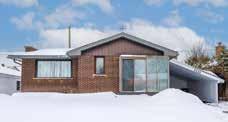

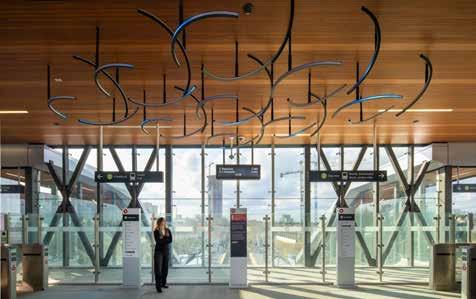
interleaved with rectangles of tatami proportions. At street level, this balance is unseen.
What might be the story behind James Hewitt’s little painting entitled, “The Giant,” 2024? Is the big guy scared of the little guy? Do you recognize the story possibilities in Linh VH Nguyen’s composition, “will we?” 2023? Will the flowers really dance? Who leads?
With Mark Garland’s large, mixedmedia tapestry, “The Time is Past,” 2024, we can amuse ourselves sleuthing its secrets: the big eye above, pink one below, all the people, animals, names hidden away in its design.
Remember the swans a’swimming in Dow’s Lake? Sadly, they are gone.
Today, we do have Ramona Ramlochand’s “White Swan,” 2024, a golden light in the shadow. The swan is afloat on blue waters, motion created by its cut paper overlay.
Sarah Patterson, Public Art Program registrar, estimates the City’s collection
to be approximately 3,500 purchased or donated artworks by more than 900 artists, all this in addition to the City’s 177 commissioned site-specific artworks. Much of the collection is visible somewhere in this sprawl of a city. Good luck, however, locating the work of any particular artist by name or location. The City’s public art website (ottawa. ca/en/arts-heritage-and-events/public-art-and-city-ottawa-art-collection/ city-ottawa-art-collection/artists) does not provide catalogue listings for most artists or neighbourhoods.
Nonetheless, keep looking. Art is everywhere, and it is all yours. You live here. Come see the recent public art acquisitions now on view in the ongoing exhibition Hold True at the City Hall Art Gallery.
Maureen Korp is a writer, historian and scholar. Her most recent book, THERE and HERE, a small collection of poetry, is available in bookstores.

CONTINUING EXHIBITION
Hold True: 2025 Additions to the City of Ottawa Art Collection
Continuing until March 29
City Hall Art Gallery
Ottawa City Hall
110 Laurier Ave. W.
Open daily: 9am to 5pm
FREE
Wheelchair Accessible
Linh VH Nguyen’s composition, “will we?”
“Ternary Motion” by Jason Bruges Studio at Trillium Line’s Corso Italia station PHOTO: JAMES MEDCRAFT

Something Rotten! brings Tudor times to life this April
By Clare Davidson Rogers
GNAG will be producing the amazingly popular Something Rotten! this April. This frolic of a musical brings the audience back to Tudor times, wrapped in modern wit, show-stopping dance numbers and hilarious lines. If you’re unfamiliar with this breakaway hit, it’s the story of the Bottom brothers and their efforts to outshine the celebrity playwright of the moment, the beloved bard Shakespeare.
But what was life like in Tudor times, and how does that translate to Something Rotten!
Life in Tudor England: Not for the Faint of Heart
Tudor England (1485–1603), considered the start of the English Renaissance, was a messy, loud, irreverent and simultaneously rigorously regulated time. Poverty was everywhere, alongside unbelievable luxury. London was growing rapidly, but city services were non-existent. There was no sanitation, and the contents of slops and chamber pots were tossed into the street regardless of who was passing below.
People worked from dawn to dusk and spent their hard-earned pennies on the cheapest and most entertaining distractions they could find. The Globe theatre in London was the center of that entertainment. The wealthy and the poor attended alongside each other with the “groundlings,” those who attended in the central open pit, bringing a boisterous character to the audience. They would laugh, heckle, boo and cry openly during the plays. Something Rotten! embraces this social complexity, featuring innkeepers, sooth-sayers, money lenders, guild members and more!
Fun Fact: Women were not allowed to act in Tudor times, so female roles were played by men and boys. Those gender switching roles brought a lot of fun to Shakespeare’s plays.

The Rock Star of His Time: William Shakespeare
By the late 1590s, William Shakespeare was one of the most popular playwrights of his time. He was the Cohen Brothers and Steven Spielberg all wrapped up in one, filling his plays with bawdy jokes, tender love stories, power struggles and dramatic deaths, all the while making subtle political commentary that was not lost on any level of his audience. The protagonists in Something Rotten! Nick and Nigel Bottom, battling the odds, attempt to outshine that most eminent superstar of the day.
Fun Fact: Shakespeare wrote specific parts for his actors, relying not only on his magical script but also on their strengths to create a character. It begs the thought – what would those plays be like if there had been other actors in the wings?

David Arnold will play Shakespeare in GNAG’s April musical Something Rotten!
Costumes and Creative Constraints
In Tudor times, the Sumptuary Laws dictated what clothing, food and even furniture could be used by each social rank of society, which kept everyone in their place. Luckily the theatre was exempt from those laws, but the cost of costumes was prohibitive so theatres often borrowed or used donated or second-hand clothing.
Despite those constraints, theatre thrived in Tudor times because of its clever language and inventive take on tradition. In Something Rotten!, Nick and Nigel do their best to make something new – a full-blown musical – out of something old, combining modern sentiment and Renaissance traditions.
Fun Facts: (or maybe not so fun) Unbeknownst to the players, wearing foundation make-up was a healthrisk as it was lead based. Theatres used thunder sheets, trapdoors and real smoke to create special effects for their plays.
Why Tudor Times Still Matter
Theatre in Tudor times and Something Rotten! follow the timeless stories of love, power, revenge, jealousy and ambition while subtly poking fun at the current political situation. Something Rotten! lovingly mocks the pressure to follow trends all wrapped up in a celebration of originality, which sounds a lot like what we see in our social feeds at the moment.
Something Rotten! is a wonderful combination – an alchemy as it were – of fun historical facts and modern humour. Unlike the alchemy of Renaissance times, when people thought gold and silver could be created by mixing the

perfect ingredients, our alchemy is the combination of community, creativity and occasionally chaos.
Whether you love musical theatre, are a Shakespeare fan, or are just looking to support your neighbour, we encourage you to join us for an evening full of fun at Something Rotten!
Tickets go on sale March 2 on our website at GNAG.ca.
Show Dates: April 14 -19 at 7 p.m. April 18 & 19 at 2 p.m.
Questions about volunteering as an usher or helping in some other way should be made to clare@gnag.ca
Clare Davidson Rogers is a long-time GNAG staffer, once-upon-a-time actor and all-around theatre lover.


Jean-François Harbour, Beatrice Harbour, Josephine Harbour and Helena Forbes are members of the cast of the musical Something Rotten! PHOTOS: CAROL MARTIN

Yasir Naqvi MP, Ottawa Centre
N 613-946-8682
The World is changing: the path forward for Canada
As I sat down to write this month’s column, I initially had planned to share my thoughts on the first quarter of the 21st century and what it has meant for Canada – end of Cold War, proliferation of democracy, prosperity through globalization, the internet revolution, multilateralism and sustainable development goals. However, 2026 has started with a bang, perhaps marking the beginning of a major shift away from the gains made and norms set since the end of the Second World War. As such, I am compelled to reflect on what lies ahead, steps Canada must take to carve its place in the changing world and the impact on the lives of every-day Canadians.
and capture of Nicolás Maduro, albeit illegal under international law, makes it clear that words have meaning.
Is Greenland next? It’s no longer a rhetorical question but a real one. (At the time I am writing this column, Greenland is still a self-governing, autonomous territory within the Kingdom of Denmark.)
E yasir.naqvi@parl.gc.ca Catherine
All this has a profound impact on Canada, on our political and economic sovereignty. We may be vulnerable, but we cannot capitulate. Our task is to fortify Canada and set it up for success in the changing world. In my view, the following are key steps we must take to secure Canada and build prosperity for Canadians:
Protect our independence. That is why investments in our defence are paramount. Most importantly, we need to secure the Arctic. If the U.S. is successful in controlling Greenland, we are in a more perilous place. As such, not only do we have to stand with Greenland and Denmark (as we have done with Ukraine), but we must also be able to defend Canada’s North to assert our sovereignty.
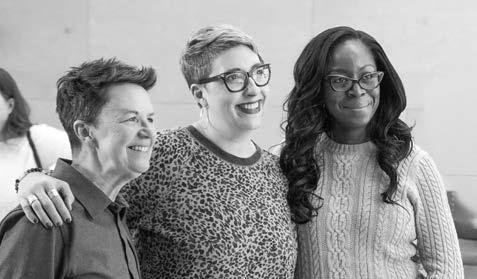
Queen’s Park Closure, New Dawn Clinic, Auditor General’s Report and more. . .

McKenney
N 613-722-6414
E CMcKenney-CO@ndp.on.ca
There is to be no doubt the world is changing. Some are calling it a period of transition, others refer to it as a hinge moment, while Prime Minister Mark Carney describes it as a rupture. No matter what you call it, it is a profound deviation from what we are accustomed to –happening in real-time in front of our eyes.
The biggest change for Canada is our relationship with the United States. Our long-time friend, ally and economic partner has morphed into an adversary. President Donald Trump has waged (what I call a phony) trade war with us. He has chosen to attack Canadian jobs with unjustified tariffs on key industries (like auto, steel, aluminum and lumber). But worse and inexcusable is his threat to Canadian independence. Let’s take him seriously when he repeatedly muses that Canada should be the 51st state. (I want to be absolutely clear – that cannot happen. Jamais.)
This threat becomes even more real when evaluated through the lens of the recently released U.S. National Security Strategy. In it, the Trump administration not only reaffirms the “America First” approach but also asserts control over the Western Hemisphere (the so- called “Donroe Doctrine”). The January 3 attack on Venezuela
Build our economy. For far too long, our economic axis has been northsouth. That is not viable anymore. We have to reorient our economy on an east-west axis. In other words, build one Canadian economy, as opposed to 13. This means breaking down internal trade barriers so that goods and services can move freely within our borders. It also requires building major, nation-building infrastructure projects across the country. Lastly, we must buy Canadian and shop locally.
Diversify our trade. We have always been a trading nation. But we cannot only sell to the Americans. Canada must build strategic partnerships with other countries around the world. These relationships have to be grounded in our values but rooted in the practical imperative to create good paying jobs for Canadians. So, we must engage with Europeans, China, India, the Middle East, Southeast Asia and Latin America – but we must do it with eyes-wide open and appropriate guardrails to protect Canadian interests.
Unify our country. We cannot take Canadian unity for granted. Referenda in Quebec and Alberta will kneecap Canada. We are sought after because of our stability, democracy and respect for rule of law. If we get bogged down in debates on national unity, we exacerbate our vulnerability. As such, we must remain understanding of all regions and Canadians.
Having said all this, I remain hopeful and confident about Canada. Our strength is our people. We are a pluralistic society, benefitting from Indigenous
peoples’ wisdom and rich cultural diversity from around the world. Our collective experience teaches us how to cope with adversity, fight despair and build successful lives. We have done it before, and together we will do it again. The future belongs to Canada.

The Ontario Legislature rose just before Christmas for the winter break after a short but action-packed session that saw a government focused on ramming through major legislation with little to no consultation or debate. Despite this, I am proud of the Official Opposition’s work to hold the government to account on the issues that matter most to you. Whether it be Doug Ford’s attack on renters, education, cost-ofliving or healthcare, we were fighting back hard every single day. This work will continue in the new year, both in Ottawa Centre and across Ontario.
Unfortunately, the government has chosen not to return to Queen’s Park until March 23, over a month later than scheduled. This means we will lose four weeks of question periods, debates and chances for public participation. This is after they cut 12 sitting weeks from the legislative calendar in 2025.
Shortly before MPPs were sent home for the winter break, the Auditor General released her scathing annual report – it’s no wonder Doug Ford is shutting down Queen’s Park and hiding from accountability. Some of the biggest hits include:
• The Ford government is spending more tax dollars on advertising than any government in history.
• 2.5 million Ontarians don’t have access to primary care right now, and Doug Ford has no plan to train, retain and hire more doctors.
• Patients are being upsold, overcharged and made to pay out of pocket for health care.
• Supply Ontario wrote off $1.4 million worth of inventory and continues to pay hundreds of millions of dollars for PPE that they cannot use.
• Ministries are bypassing legally required public consultations, as mandated by the Environmental
ted r. lupinski
Chartered Professional Accountant • Comptable Professionnel Agréé
Bill of Rights, even passing laws before consultation periods close.
This is a government that has no qualms about wasting our hardearned money to benefit their wealthy and well-connected friends. Especially today, with new home starts at a record low and affordable housing unattainable for so many in our community, we can’t afford a government of waste. At the Ontario Finance Committee’s pre-budget consultations in January, I challenged and, when the legislature resumes in March, I will continue to challenge the priorities of this government in light of this damning new report.
Another important issue about which many neighbours have reached out to our office: Chinatown’s New Dawn Clinic. On December 8, Somerset Ward Councillor Ariel Troster and I filed a formal complaint with the College of Physicians and Surgeons of Ontario regarding the operations of the New Dawn Clinic. Residents and local business owners have reported troubling and persistent impacts associated with this clinic’s prescribing practices, including ongoing drug diversion, incidents of violence targetting patients and unsafe conditions in the surrounding neighbourhood that pose risks to both patient well-being and public safety.
When properly administered, evidence-based, safer-supply initiatives save lives – but the lack of clinical oversight at New Dawn undermines these initiatives and places our community at risk. That’s why Councillor Troster and I are urging the CPSO to immediately take action, investigate New Dawn and review all its clinical operations. Keep an eye out for updates on that issue in the coming weeks.
Finally, I would like to thank community members who were able to join me for my annual New Year’s levee on January 11. It was lovely to connect with
so many of you and take a moment to celebrate some of the incredible organizations in our city that work every day to support some of our most marginalized neighbours.
As always, I encourage you to send me a message at CMcKenney-CO@ndp. on.ca or visit my community office (353 Waverley St. W) if my team and I can support you in any way.
MPP Catherine McKenney, Somerset Ward Councillor Ariel Troster, and Somerset West Community Health Centre CEO Suzanne Obiorah at McKenney’s New Year’s levee.
Peripheral Artery Disease
By Sue Reive
We’ve all heard the expression “aging is not for sissies.” With increasing age, many people feel aches and pains, particularly in their legs, especially with walking or climbing stairs. One condition that causes leg pain with walking is Peripheral Artery Disease (PAD).
I would like to share a case study to highlight the signs and symptoms of PAD. During the pandemic, an elderly gentleman in his late 60s was referred to me with a diagnosis of calf muscle strain. He complained of pain in his right calf muscle that started at 300 metres of walking. If he stopped walking, the pain subsided. He reported no trauma, and the pain was a gradual onset over a few months. He had just completed eight sessions of physiotherapy with another physiotherapist, and there was no change in his symptoms. He reported no swelling or bruising or night pain. He reported no heart problems, diabetes or cholesterol issues on his medical history.
As I took the subjective history, I was thinking of the causes of calf pain and that my objective examination would hopefully reveal the cause of this patient’s problem. My first thought was that with a calf muscle strain, there is usually known trauma or an incident
where you remember straining the muscle. As well, the pain would not start at 300 meters of walking, it would occur on every step. The 300 meters is a significant symptom – it made me immediately suspect a vascular cause of calf pain. If there is not enough blood flowing to the calf muscles due to narrowed arteries (due to PAD), then pain will arise due to ischemia (lack of blood). Stopping walking and resting reduces the demand for blood, and therefore the pain subsides.
On the objective examination, I had the patient walk. There was no limping and no pain. Usually with a calf muscle strain, there would be both. I had the patient go up and down on his toes multiple times; again, no pain or obvious weakness, which confirmed to me this was not a muscle strain. To reproduce the pain, I had the patient walk further, up and down the corridor, and then perform the heel raises until the calf pain started. I then checked the pulses in his right foot and couldn’t feel any. His right foot was considerably colder than the left foot, and its skin was thin, shiny and very white.
I then looked at range of motion of the lower limb and back, neurological status and resisted muscle testing –all were negative. My conclusion was that the right calf pain experienced with walking was caused by PAD. I explained my findings and thoughts to the patient and wrote a note to his doctor suggesting the patient have a doppler ultrasound to visualize the blood flow in the leg. Turns out I was correct – the patient had an arterial

blockage and had to have vascular surgery.
To recap, PAD causes narrowing of the arteries, usually due to fatty plaques, which decreases blood flow to the limbs, most often the legs. The lack of blood (ischemia) causes pain in the muscle (claudication) when exercising. In severe cases, there may be pain even at rest. Objective signs include coldness in the affected limb, cramping, numbness or weakness and reduced or diminished pulses. The skin may be thin, shiny and discoloured in the affected limb. Risk factors of PAD
include smoking, a sedentary lifestyle, diabetes, high cholesterol or high blood pressure and being 65 or older. The diagnosis of PAD includes blood work, checking pulses and imaging. Treatment includes lifestyle changes (diet, exercise and stop smoking) and controlling blood pressure and cholesterol. To improve blood flow, blood thinners may be prescribed, and vascular surgery could be required.
Sue Reive is a physiotherapist at Ottawa Physiotherapy and Sport Clinics - Glebe.
Negotiating the winter blues and chills with supplements and potions
By Renu Pillay
If you stepped outside onto Bank Street in the last 10 days of January, you knew we were in the heart of an Ottawa winter. The lack of sunlight and those constant sub-zero temperatures with wind chill in the minus 30s can really start to sap your energy.
Whether you’re dealing with the winter blues or just trying to stay resilient against the seasonal chills, it helps to look at how certain supplements can support your system until the spring thaw arrives.
The Mid-Winter Biological Shift
Living in Ottawa means our bodies have been functioning on minimal sunlight for months now. This isn’t just a matter of feeling tired; it’s a biological response to our environment. Because the sun sits so low on the horizon during these months, our skin can’t produce Vitamin D naturally, regardless of how much time we spend outside.
The Winter Pathway
Low UVB Exposure: Natural Vitamin D stores usually hit their lowest point in January and February.
The Serotonin Connection: Research suggests Vitamin D plays a role in regulating serotonin, our feel-good brain chemical. When levels dip, we often feel that familiar seasonal lethargy.
Immune Readiness: Vitamin D acts as a signal for our immune cells. Without it, our body’s surveillance system isn’t as sharp when seasonal bugs are circulating.
Helpful ‘Potions’ for your Winter Toolkit
Beyond the basics, there are several
SupplementThe GoalWhy We Use It
Vitamin D3Nutrient SupportBridges the “sunshine gap” to support mood and immunity.
Zinc Immune SupportHelps maintain the function of your natural defenses.
QuercetinAbsorption AidAssists in the cellular uptake of minerals like zinc.
NAC AntioxidantSupports lung health and antioxidant production.
ElderberryWellness High-antioxidant support for the “chill” season.
MagnesiumRelaxationSupports better sleep and muscle ease on cold nights.
Omega-3sBrain HealthEssential fats that support cognitive function.
ProbioticsGut HealthSupports the 70% of your immune system located in your gut.
SaffronMood SupportHelps maintain emotional balance during dark months.
evidence-based options that I often discuss with customers looking to support their well-being:
Vitamin D3: Since we’re at the “bottom of the tank” right now, supplementing is a primary way to support immune signalling and bone health.
Zinc & Quercetin: Think of these as a team. Zinc supports immune cell development, while Quercetin (a plant pigment) acts as a key to help that zinc get into your cells.
Elderberry: This isn’t just an old-fashioned remedy; modern studies show it’s packed with antioxidants that support the body during the peak of cold season.
NAC (N-Acetyl L-Cysteine): This amino acid supports glutathione, your body’s master antioxidant. It’s
frequently used by those looking to maintain respiratory comfort during the dry, cold months.
Adaptogens (like Ashwagandha): Winter is a physical stressor. These botanicals are studied for their ability to help the body stay balanced when we’re feeling “burnt out” by the cold.
Saffron Extract: Some of the most interesting recent research involves saffron’s ability to support a positive mood and emotional outlook during long periods of darkness.
Building a Foundation Beyond the Bottle
While these targeted supplements provide a significant advantage, they work best when integrated into a lifestyle that respects the demands of the
Canadian climate. In the Glebe, this means prioritizing sleep hygiene to manage the early darkness and staying hydrated despite the lack of heat. Consider incorporating a lightbox to mimic morning sun and remember that movement – even a short walk – is vital for lymphatic drainage and circulation. By combining these daily rituals with the right nutritional support, we don’t just endure the Ottawa freeze, we maintain the vitality necessary to enjoy it until the first tulips of May finally emerge.
Winter Wellness Support Summary: A Quick Note on Safety
While it’s tempting to try everything on the shelf, “natural” doesn’t always mean “safe for everyone.” Many supplements can interact with medications for blood pressure, cholesterol or mood. It is always best to have a quick chat with your pharmacist to make sure your winter plan is tailored specifically to you and won’t interfere with anything else you’re taking.
Stay warm, keep moving, and remember – we are halfway through, and the days are slowly but surely getting longer!
Renu Pillay is the pharmacist at Whole Health Compounding Pharmacy Glebe.
Preventing falls in the winter: Why your brain-body connection matters
By Sadie Laronde
Do you find each step out the door this time of year a challenge? The icy sidewalks, uneven terrain and slippery steps are a total drain on our limited winter energy! Living in Canada, we are hardy from our robust winters, but is there anything else we can do to make winter life a bit easier?
Winter falls are becoming more common, especially among older adults. From 2005 to 2013, reported falls increased by 45 per cent and 70 per cent of these falls resulted in a hospital visit. While it makes sense to focus on external solutions like better boots, ice cleats or avoiding harsh conditions, more reliable prevention actually happens inside the body.
Balance Is a Brain-Based Skill
Balance is not just about strong muscles; it is a complex neurological process. The brain relies on constant feedback from the body to understand where you are in space and how to move accordingly. This communication happens through the nervous system, integrating information from your muscles, joints, fascia, nerves and spinal cord. A part of the brain called the cerebellum is an important area responsible for coordinating your body’s movement.
Three key systems help keep us upright:
• Vision – what we see around us
• Vestibular system – the inner ear’s sense of motion and orientation
• Proprioception – sensory input from joints and muscles that tells the cerebellum where the body is in space and that is coordinated in the brain.
Winter conditions disrupt all three of these systems; low light, slippery surfaces and stiffer joints reduce the quality of information reaching the brain, increasing your fall risk.
‘Use It or Lose It:’ Why Movement Matters
One of the most important principles in fall prevention is simple: use it or lose it. When movement decreases, which often happens in winter, coordination and balance can decline. The
cerebellum thrives on having variety in movements and sensations.
Simple movements of the body can activate your cerebellum and get the nerves firing. Before trying these movements, check in with your balance first! Balance on one leg while holding the wall or a chair and notice if it’s challenging or if you wobble.
Try one of the following exercises and then retest it!
Firm taps down both legs, then both arms for 30 seconds.
Gently rotate your joints in both directions 10 times: starting at your ankles, then knees, hips, shoulders, wrists and even fingers.
Tongue circles: bring the tip of your tongue to the top of your teeth inside your mouth and bring it all the way around in one direction 10 times, then do the same in the other direction.
These exercises are designed to stimulate the nervous system to help improve your brain-body connection.
How Chiropractic Care Enhances Balance
From a chiropractic perspective, balance is deeply connected to body awareness. When joints are restricted or spinal movement is limited, the brain receives distorted or reduced sensory input. This can affect coordination, reaction time and postural stability.
Chiropractic adjustments are designed to improve joint motion and nervous system communication, helping the brain better understand where the body is in space. Research has shown that chiropractic care improves this brain-body connection and is effective in improving step-time reaction in older adults.
When the nervous system functions more clearly, movements become more confident and efficient, a key factor in preventing harmful accidents.
The Real Reason: Independence and Longevity
Preventing falls isn’t just about avoiding injury this winter. It’s about maintaining independence, confidence and longevity. Being certain in your
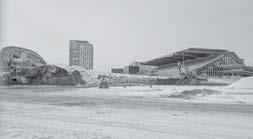
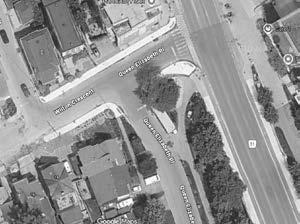
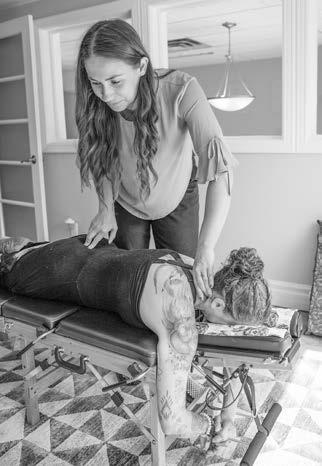
movements allows you to stay active, engaged and connected to your community, all months of the year.
Winter can be a powerful opportunity to slow down, tune in and care for your nervous system intentionally. Supporting balance through movement, body awareness and even chiropractic care helps ensure your body remains resilient.
Sadie Laronde is a holistic Indigenous chiropractor at the newly opened The Effect Healing Collective at 151 D Second Avenue.
Lansdowne 2.0 underway
By John Dance
It took little time for the City to start construction of the new event centre at Lansdowne Park. Shortly after City Council gave the final approval, fencing and hoarding was erected around the Great Lawn and the toboggan hill was closed. Trees were removed in areas required for construction. The City says removed city-owned trees will be replaced on a one-for-one ratio and the NCC trees will be replaced on a two-for-one ratio. Excavated demolition and construction material is being trucked via a temporary roadway that goes under the Bank Street canal bridge then leads to Queen Elizabeth Place, a short street that connects Queen Elizabeth Driveway via Wilton Crescent to Bank Street. The phase of construction
dealing with the removal of the toboggan hill will continue into March.
The City erected notice boards requesting QED motorists to avoid using Queen Elizabeth Way and instead use Fifth Avenue or one of the exits west of Bank Street. This had not been discussed with Glebe or Old Ottawa South residents who noted that diverted traffic would result in longer drives and dumping more traffic on already busy streets. With the support of Councillor Shawn Menard, the City reversed course and the notice boards were removed.
John Dance is an Old Ottawa East resident who keeps in close touch with municipal affairs and frequently updates readers of the Glebe Report and The Mainstreeter

Maintaining balance requires strong muscles, but also depends on complex neurological processes connecting body and brain. Chiropractic care has been shown to improve the brain-body connection.
Photo: Jill Anholt’s sculpture “Moving Surfaces” has been dismantled and the berm on which it stood, used in winter as a toboggan hill, is being removed. PHOTO: JEANETTE RIVE
February Crossword
By Ellyn Duke Watson & Cooper Love
Across
1 Credit card company (4)
4 Small cluster of grass or hair (4)
6 Overly sentimental or trite (5)
7 Snowman in Frozen (4)
9 Used by 25-Across (5)
11 Shrub native to Canada with red berries (5)
13 Stringed instrument for angels (4)
15 Cattle farm (5)
17 Where Shrek lives (5)
18 What one might give to a lover on the day of 19-Across (9)
19 Patron saint of lovers (2,9)
21 Tastelessly showy (5)
22 Get hitched (3)
23 Expression for brain (6)
25 Roman god, often depicted as a winged infant (5)
29 Oral knowledge passed down through generations, often mystical in nature (4)
30 Plant store on Bank St (11)
34 Precious gem (5)
36 Motorhome, abbr. (2)
37 Sleeveless garment, often used in transition weather (4)
38 Pride and Prejudice author (6)
39 Tiny garden pest insect (5)
Down
2 À la carte (4)
3 Kiss and a hug (2)
5 Rocky peak (3)
6 Group of singers (5)
8 Number of chambers in the human heart (4)
9 Greek goddess of beauty (9)
10 Anonymous romantic sender (6,7)
11 Stitch fabric (3)
12 Bubbly wine from a specific region in France (9)
14 Type of nut often used for pies and tarts (5)
16 What one might give to a lover on the day of 19-Across (4)
17 Official street name of the Prime Minister of Canada (6)
20 Juliet’s family name (7)
24 Second half of Taco Bell’s slogan (3)
26 Comic book punch sound (3)
27 Dig deeply into (5)
28 Second planet from the sun (5)
31 Deep affection (4)
32 Like a ___ to a flame (4)
33 Scatterbrained person (4)
35 Genetic material (3)
Crossword answers: Page 32
Redevelopment of Bronson Avenue
By Barbara Popel
Unfortunately, there has not been much progress on the Bronson Redevelopment Project since I last wrote about it 14 months ago in the December 2024 issue of the Glebe Report.
The plan to redevelop Bronson from the Queensway to the Canal is still on the City’s list of projects, and the same senior engineer, Roxanne Tubb, is still listed as the project leader. But there’s no money in this year’s budget or next year’s budget projection for the project. Consequently, the best guess from Councillor Shawn Menard’s office is that the redevelopment of Bronson won’t happen for at least two years.
But one bit of good news – thanks to Menard’s proactive intervention last September, when Bronson is finally redeveloped, the overhead hydro wires may be buried! Here’s what happened.
Hydro Ottawa had a “critical pole replacement project” for poles on Bronson between Findlay Avenue and Holmwood Avenue that were deemed to be at the end of their service life and posed a safety hazard. When Hydro Ottawa informed Menard of this project, he replied that it only made sense to bury the wires and since Bronson is set for a lot of renewal work, it made sense to do all that work at once and not dig up the street twice. Hydro Ottawa said it “would be happy to coordinate with the City of Ottawa project managers to explore an underground approach for burying Hydro Ottawa infrastructure.”
I asked Jon McLeod, an aide to Menard, if, as happened when Bank Street in the Glebe was being redeveloped, the cost of burying wires would be paid by property owners on the street. He replied that the new policy for wire burial is that the City and Hydro Ottawa split the cost. So it’s possible that the wires
might be buried when Bronson is redeveloped, with no direct cost to property owners.
In early 2024, Menard formally requested several of the immediate safety-related changes that the Bronson Team had proposed. He asked the City to install an automated speed enforcement system (ASES, better known as “photo radar”) near Senator Eugene Forsey Park and to install a permanent red light camera at the Fifth/Madawaska/Bronson intersection. Neither of his requests has been approved. Given the fate of photo radar in Ontario courtesy of Premier Doug Ford, that won’t be happening; the red-light camera is apparently still under consideration, but they are in much demand across the city, and staff decisions about where they go are based only on traffic violations and accident reports.
Last spring, I noticed there are no “Children Playing” signs on either side of Bronson near Senator Eugene Forsey Park. I asked Menard’s office to request they be installed, and there is hope that will happen this year.
I’ll close with kudos to some folks. Shawn Menard and Jon McLeod have been actively supportive of the Bronson Team since we set it up in January 2023 –thank you!
As I look back on all the work the Bronson Team has done since then, I’m so proud. They’ve had so many good ideas! It’s great having representation from the three community associations in the Glebe, Dow’s Lake and the Glebe Annex. If you’d like to join the team, please contact me through the Glebe Report or your community association.
Barb Popel is the team leader of the Bronson Team. She has lived in the Glebe since 1991.

improvements when the City’s Bronson Avenue Redevelopment Project commences.
The Bronson Team of residents of three communities (Glebe, Glebe Annex and Dow’s Lake) is advocating for Bronson Avenue safety
PHOTO: BARB POPEL
Beginnings
The word “start” means “to begin,” yes, but it also means to startle, to jump, perhaps to be frightened. We live many beginnings – a new love blossoms, a child is born, we move to a new city, we retire. Morning is a kind of reset button, when all things are possible. Spring brings renewal in nature and the joy of life beginning again.
We asked poets to send us their thoughts and feelings in poetic form on the theme of “beginnings.” Here is a selection of their poems.
The Glebe Report’s Poetry Quarter is curated by Deborah-Anne Tunney, poet and short story writer.
POETRY QUARTER
I Want to Begin
I want to begin with that morning waking up and thinking I could walk to his house across the fields.
I want to begin with being fourteen again with a heart that reached to my fingertips to my nose to my feet. I want to begin with something that woke me before dawn and my friend lay asleep beside me.
I want to begin with the sweet air of her grandmother’s house, and the quiet that was on everything, even the dishes. I want to begin with the screen door closing behind me like a steel whisper and the morning breathing in the trees.
I want to begin with what called me, as I stepped from the road to the fields and dryness snapped beneath my shoes. I want to begin with the sound of the first birds beginning to moisten the morning of that dark sky.
I want to begin with my heart that folded to an arrow, even though I’d never been that way before.
Michelle Desbarats
LOVE SPROUTS
The trumpet-major of my heart draws near, In haughty splendor, flushed with rising light; He bursts upon my sight with sudden might— The spark that stirs his spring is vibrant and clear.
From hollow depths where nothing once was there, Love sprouts—first fragile life in silent night; He hears the calling voice, yet soft and slight— A desert’s ardent breath, untouched, sincere.
No true emotion ever marked his face; No whispered signs of passion crossed his day, No hidden joys, no tears in secret trace.
Watch now, his breast swells sweet with soft dismay— The arrow strikes with tender, fatal grace; The end has begun: Love approaches in its sway.
Marie-France Richards
beginnings with or without measure. . . then again, regardless, somewhere, beginnings, all anew again
Maureen Korp
Startled
What a huge snowflake she thinks as she moves toward the window, discovers instead, a shower of feathers. Thoughts race as she remembers the Cooper’s Hawk perched, unmoving, high in her neighbor’s giant fir, the pigeons who swirled below. She tries not to put the pieces together. Tells herself it could have been a close call. Chooses not to venture outside and investigate; prefers her fantasy ending to a more probable reality.
Ronnie R. Brown
Cat Poem
Someplace he hasn’t been to before, a nether world, it seems-Tiresias-eye as he looks back at me feline no less, bending forward-but straight-backed.
How I expected him to be-my cat a wise old man, and what’s going through his mind I will never know seeing him from another place before the moon’s light appears.
A far country I will indeed claim for him sometime before Homo-this or-that Einstein’s dark matter with non-being, the cat coming closer to me... like from long ago.
Cyril Dabydeen

She Could Not Wait To Begin!
I’m four. Daddy says I’m too young to go to school. “Wait till you’re six!” Two more years for that fix! On a joy ride in Uncle Heng’s lorry he pointed to schools on our way home. My keen mind mapped the closest one before he turned homeward to where we lived in Fish-Eye Bay. When Mum and Dad went to work next day I slipped on my sunhat, socks, shoes, and gloves like Mummy does and look as presentable. I filled her shopping bag full of books: my Rupert 1941 and 2 Annuals, Enid Blyton’s Bedtime stories, as well, Wynken, Blynken, and Nod. With all my offerings I set off walking the map my mind had traced, skipping potholes, brushing tall grasses. called Lalling, till I neared the big road’s rushing traffic. yet school was still far away. Late afternoon, sirens nearing. Suddenly, police cars, Uncle’s motorbike, appeared. “We’ve found her! She’s safe!” They shouted. “Come! little girl, home is where you’re going!” “No! No! I’m nearly there! See?” I pointed to the distant shadow. Uncle lifted me on his bike tank as I howled and struggled to no avail. I clutched my books. A beginning failed!
Betty Warrington-Kearsley
IN THE BEGINNING…
A fish swimming in a bowl; the flutter of a hummingbird—that first quickening that finally convinced her when even the test (or, actually, tests). the sonograms, the doctor’s assurances could not. The sign that, at long last, she was going to be a mother, that life was growing inside her and a new, wonderful adventure was about to begin.
Ronnie R. Brown
APRIL, COME SHE WILL…
Five pink tulips in a pot, beginning to open up, defying the freezing rain & snow on the other side of The kitchen window; showing Mother Nature what she should Be offering, instead of this cruel April fool joke.
Ronnie R. Brown

Khartoum Boys
Three young men-boys really, immigrants you see, and what do they usually eat or won’t eat? I ask.
A flat bread to begin with being unholy Muslims, the Mahdi long in them-now unknown.
Pride with history only, close to their parents-about once having eaten a camel roasted over a slow fire in Sudan
in a desert long ago; but now it`s cold weather in Ottawa, a true northern place-let it be known.
No other image will do adapting to a new place, or sense of who they are, the past in them— in another country
Cyril Dabydeen
Beginning - skating season
Bobskates and mittens
Those red skating cages, Shaky first-timers, Skaters all ages.
The turn on a dime-ers, The pros and the slows, On our Rideau Skateway Anything goes.
Canal skating season Should now begin, But as often happens, The ice is too thin.
Louise Rachlis
back seat refrain. . .
don’t ask me again where are we going, please. when we get there, you’ll know, my child, you’ll know we’re there please. is that clear? are we there yet, mama?
Maureen Korp
SOMETHING IN THE AIR
The rumble of distant thunder—eyes Closed, she tries to will the storm her way; longs for the flash of lightening, the plop, plop of fat raindrops hitting the cottage roof; the breezes that will cool her sweat-soaked skin if/when the sky opens up and the fun really begins.
Ronnie R.
Brown
MIGRATION
A blizzard of snow geese fill the fall sky, begin their trip toward warm.
Ronnie R. Brown

FASHION REBORN
A stiletto crowns my head, My hat, my own, my world ahead. Old steps awaken on my skin, Heels of yesterday, tomorrow’s spin.
Amber air, loose hair, fragrance streams, Emerald waves, and sparkling dreams. Black heels glide where shadows play, Where Spring drifts among lilies of the valley.
Styles return, they twist, they gleam, Creation pulses, bold, supreme. Dance, my heels, on floors of light, Fashion reborn, awake, in flight.
Marie-France Richards
In the elevator
In the elevator listening to the others, winter, it’s cold who likes winter?
It’s so cold.
Can’t go anywhere. kvetch, kvetch It’s cold, when’s it going to end? who likes winter?
“I do.” who is that?
“me, Ms. Snowflake. I melt with your compliments.
Maureen
Korp

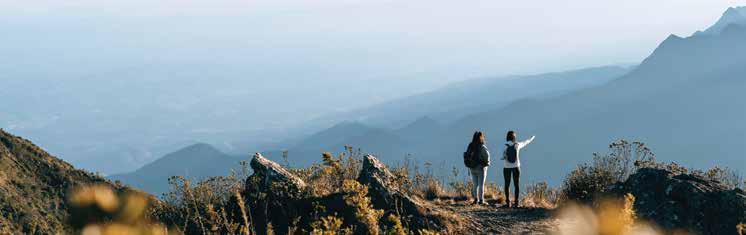

to be
to be. . . that’s the truth, isn’t it? to be. . . all that, and more. . . one day. . . Hey!
The light’s a’changing ! Get a move on, kid! Yes sir
that’s the truth, isn’t it?
Art, to be. . .will it be on the test tomorrow?
Maureen Korp
Bernsie’s backyard was quite a scene
Overrun by squirrels lean and mean She chased them all day Till they carried her away
To make her their new squirrel queen
Tom Roberts
POETRY QUARTER
Call for submissions for May 2026
All the colours of the spectrum
Colour dictates what we perceive and feel. It is the lens we use to explore and understand our world. We perceive a warning in the scarlet of a berry, feel peace in the emerald of a forest canopy or wonder at the light of a stardrenched sky. Whether you write about the blue of grief, a golden moment or the infrared of things unseen, we want to read your poems about colour, the silent animator of our environment. We are looking for poetry that reflects the complexity of the human experience of colour – poems that bleed, poems that glow or poems that speak volumes on the absence of colour.
As usual, poems should be:
• Original and unpublished in any medium (no poems submitted elsewhere, please);
• No more than 30 lines each;
• On any aspect of the theme within the bounds of public discourse; and


• Submitted on or before Monday, April 20, 2026.
Poets in the National Capital Region of all ages welcome (school-age poets, please indicate your grade and school). Please send your entries (up to five poems that meet the criteria) to editor@glebereport.ca. Remember to send us your contact information and your grade and school if you are in school.
Deadline: Monday, April 20, 2026
Cover-Up is a film for our times
(US, 2025)
Directors: Laura Poitras and Mark Obenhaus
Review by Tony Wohlfarth
Laura Poitras is one of the most important documentary filmmakers in the world. In 2015, she won an Academy Award in the category of best documentary feature for Citizenfour about the whistleblower Edward Snowden. In 2023, her film All the Beauty and the Bloodshed, which was nominated for a best film Oscar, exposed the misuse of Oxycontin.
Her latest film is co-directed with Mark Obenhaus. Cover-Up is an insightful portrait of Seymour Hersh, a renowned investigative reporter. Sy, as he is best known, broke the story of the My Lai massacre, winning him a Pulitzer Prize in 1970. He went on to cover the Watergate scandal, CIA espionage and the Abu Ghraib Iraqi prison torture scandal. Hersh was an investigative reporter for The New York Times for eight years, and he also freelances for The New Yorker. Hersh, now 88, is sill working.
The film captures Sy’s early life growing up in Chicago with his Jewish immigrant family. His father was a Holocaust survivor. Cover-Up also provides a moving tribute to his partner Elizabeth Sarah Klein. Elizabeth is a psychoanalyst, and Sy pays tribute to her during the film. They have three children.
Two decades ago in 2005, Poitras asked Hersh to agree to sit to be interviewed for a documentary. He declined in order to protect his sources. It took another 20 years for Poitras to convince Hersh to agree to participate.
In 2018, Hersh published an autobiography, Reporter: A Memoir. I borrowed it from the Ottawa Public Library as an audio book. Well worth listening to. I also recommend this 19-minute interview with the
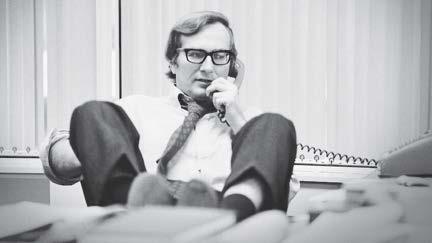
Obenhaus and Yoni Golijov.
In Cover-Up, Sy is interviewed amidst an impressive collection of stunning archival footage of world events affected by his work. He is also surrounded by the tools of his trade – piles of yellow notepads of his interviews with sources. In all, the producers accessed 60,000 archival assets in making this film. Producer Olivia Streisand led the archival work for the film.
Cover-Up is an important and timely account of the importance of a free press. The CBC’s Hana Gartner is featured and is one of his contemporaries. Poignantly, it ends with a statement from Hersh: “We can’t have a country that does that.”
Cover Up had its world premiere at the Venice Film Festival, where it received a six-minute standing ovation. It was short-listed for a 2026 Academy Award nomination. The film screens with subtitles.
Running time: 1 hour 58 mins
Streaming on Netflix Canada
Tony Wohlfarth is a Glebe-based freelance entertainment writer.









film’s production team available via YouTube: COVER-UP: A Conversation with Laura Poitras, Mark

News from Glebe Collegiate Institute
Sports Performance and Management program launches at Glebe
By the Glebe Collegiate Student Services Team
Beginning in Semester 2 of 2026, Glebe Collegiate Institute will proudly offer a new Specialist High Skills Major (SHSM) in Sports Performance and Management, designed for students who are passionate about athletics, health, business and leadership. This exciting addition provides students with the chance to explore the growing sports industry while earning valuable certifications, gaining hands-on experience and preparing for postsecondary success.
This SHSM program allows students to focus their studies on fitness, coaching, event management and sport-related business, all while fulfilling their Ontario Secondary School Diploma requirements. Participants will have opportunities to earn industry recognized certifications such as First Aid, CPR and sports administration, and they will take part in workshops, field trips and real-world experiences that take learning beyond the classroom.
Whether a student dreams of becoming a doctor, physiotherapist, coach, athletic director or sports marketer, the Sports Performance and Management SHSM offers a dynamic pathway to explore these careers. By combining academic courses with experiential learning, students will develop the leadership, communication and organizational skills that are key to thriving in any professional environment.
Parents and guardians are encouraged to explore this opportunity with their children and discover how the SHSM can help them turn a love of sport into a successful and fulfilling career path. Glebe is proud to empower
students to pursue their passions and prepare for life after high school both on and off the field. For more information, please check out the Glebe Collegiate website under the Experiential Learning Pathways section or click on the QR code.

Glebe also has a non-profit SHSM for students interested in community leadership. This year, one of the nonprofit SHSM students was nominated for the Terry Fox Humanitarian Scholarship as well as a TD Scholarship. We love providing opportunities at Glebe that help students access these opportunities.
The Glebe Collegiate Student Services Team is comprised of Sheri Buffet, Jessica Chelsea, Nadia Choudhry, Nancy Fraser, James Hum, Paula Leitch-Blais, Dr. Gaylene McCutcheon, Ashley P Nelson, Tania Rolland, Jamin Schuster and Houng Thai. Its objective is to help students lead a successful academic experience and guide them through selection of courses.

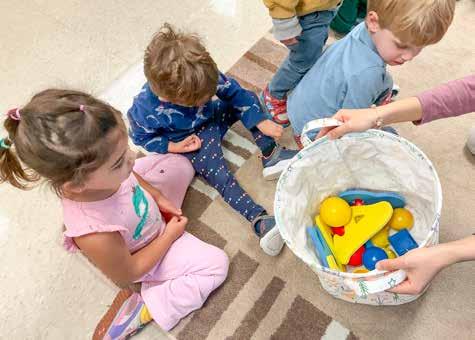
Toddlers and preschoolers embrace winter!
By Tamara Glavinovic
This new year brings both a fresh start and a fresh burst of energy to the parents, teachers and children at the Glebe Co-operative Nursery School. After several weeks of holiday time filled with family traditions, cozy mornings and unhurried days at home, both toddler and preschool classrooms reopened their doors, and the children returned with enthusiasm. The teachers, too, came back after a well-earned rest, ready to embrace the joyful chaos and small triumphs that define the winter term at GCNS.
From the first day back, the toddlers and preschoolers have leapt into the wintery playground with a level of excitement that many adults can only admire. To them, the snow is not an inconvenience or a barrier but an invitation – a landscape waiting to be explored, shaped, climbed and transformed. As soon as mittens are secured and zippers pulled up to noses, the children enter the outdoors as if greeting an old friend.
The toddlers tumble into the snowbanks with wonder, some still mastering the art of staying upright in bulky snowsuits. They work with determination, using shovels and buckets to build small forts, scoop up “snow soup” or simply move snow from one place to another, a task that seems endlessly entertaining to the under-three crowd. Their teamwork is unmistakable: one toddler holds a bucket steady while another fills it; a third pats down the top with serious concentration, as though constructing a monument of great importance.
The preschoolers, meanwhile, approach the snowy world with their own blend of curiosity and confidence. Armed with an assortment of playground tools, they excavate tunnels, carve winding paths, invent elaborate snowy “construction sites” and debate the best architectural strategies for keeping their snow structures upright in the wind. Watching them collaborate –sometimes negotiating, sometimes disagreeing, but always moving forward – is a reminder of how naturally children learn from one another. Their creativity seems to grow in direct proportion to the height of the snowbanks, and their ability to transform the yard is impressive enough to inspire even the most winter-weary adult.
This term also saw the launch of a
wonderful new community tradition: the first GCNS toy and clothing swap. Organized by our fantastic volunteer parents, the swap invited each child to bring in a few gently used items and choose some new-to-them treasures to take home. The atmosphere was warm and lively, with families chatting and many parents reflecting on how quickly their little ones grow. The inaugural swap not only helped families refresh their shelves and closets in a sustainable way, it also deepened the connections that make our co-op special. We expect it will become an annual event, one that brings joy to children and strengthens our sense of community.
The preschoolers had an especially exciting activity coming at the end of January. One of our preschoolers’ set of parents – one of whom happens to be a chef – led the class in a hands-on cooking workshop. With child-friendly tools, colourful ingredients and plenty of opportunities to stir, mix, pour and taste, this workshop offered a delightful blend of sensory exploration, skill building and delicious fun.
Our monthly French activities have also continued, thanks to the fantastic educators from the Alliance Française. This month’s focus was on colours –bleu, jaune et rouge – which the children practised not only by repeating the words but also by singing, dancing and playing interactive games.
Finally, we are pleased to share that an open house will be held in March, offering interested families the chance to see our classrooms in action and to get a feel for the warmth and collaborative spirit that define our community. While the exact date is still to be confirmed, updates will be posted on our website (https://glebepreschool.com). We warmly encourage prospective families to visit and see firsthand why GCNS remains a cherished place for children to learn, grow and play together.
Tamara Glavinovic is responsible for communications for the Glebe Co-op Nursery School.
Preschoolers at Glebe Coop Nursery School learn French with educators from Alliance Française.
The former “Mutchmor” rink is now located, on a pilot basis, at Sylvia Holden Park. The rink waited patiently on January 29 for skaters and hockey sticks to show up. PHOTO: EMMA FAZAKAS

This space is a free community bulletin board for Glebe residents. Send your GRAPEVINE message and your name, email address, street address and phone number to grapevine@glebereport.ca. Messages without complete information will not be accepted. FOR SALE items must be less than $1,000. While the Glebe Report strives to keep our
we advise readers to exercise due caution and best judgment when responding to the notices.
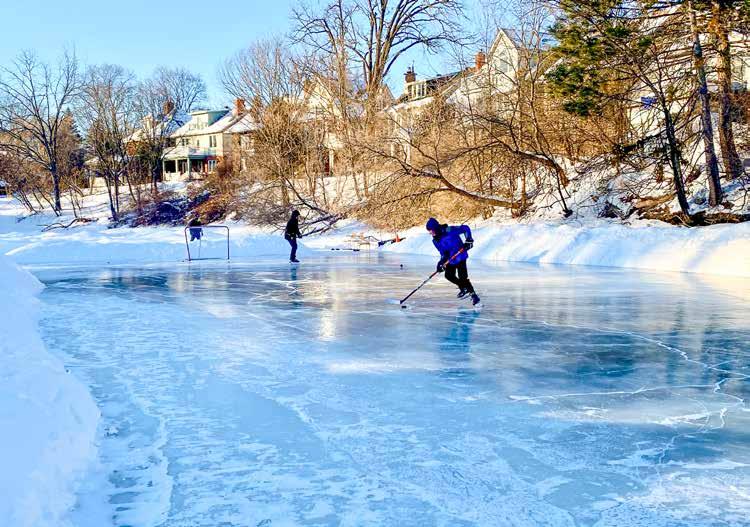
COMMUNITY CONNECTIONS
ABBOTSFORD LEARN & EXPLORE SPEAKER’S SERIES, tea/coffee and treats for sale courtesy of your Members Council. FREE Lecture: must register in advance for a seat or zoom link. 950 Bank Street 230-5730 FEB 11: Wanting Zhao, CFP, PFP, Senior Financial Planner, Personal and Business Banking, Ontario East Region, CIBC will be presenting on wills and estate planning from a financial planning perspective. Do you have a will? When did you last update it and what should you consider? Let’s talk; bring pen and paper. This will be held LIVE FEB 18: Richard Knapton is an avid birder and researcher. He has taught biology and ornithology courses at three universities and leads birding tours. He will be presenting Winter Birds of Ottawa. Let’s embrace winter; listen and look with informed ears and eyes. This will be held LIVE. FEB 25: Laurence Wall spent 44 years working for CBC Radio at four different stations around the country. Included in that were 28 years as a radio news presenter for CBC Ottawa. He will share the role of the CBC in Canada’s history when presenting: Twentieth Century Canadian History through the Magic of Radio. This will be held LIVE. MAR 4: Ron Lavoie developed a passion for photography after a successful career helping immigrants learn English. His photographic practice includes architecture, the built environment, and landscapes. During the pandemic, he moved to Belleville and completed a two-year program in Photojournalism. Ron will present Japan Style, focusing on architecture and design in Japan. It will be held LIVE and on ZOOM simultaneously.
GLEBE PHYSIO IQ ICE CARVING & HOT CHOC-
OLATE Join us in The Glebe at Physiotherapy iQ to enjoy Hot Cocoa & live Ice Carving by a talented local artist who will bring to life a stunning creation on Sat. Feb. 7, 12 p.m.-4 p.m. This is a cozy winter celebration to bring the community together. Warm up with hot cocoa, enjoy a festive atmosphere and experience the magic of the winter season with friends and neighbours.
BEANDIGEN BEADING WORKSHOP Stop in at Beandigen, an Anishinaabe owned and operated café in the Glebe, to participate in its third annual beading workshop led by resident beader, jayde. jayde will lead you in the creation of a snowflake pin, to celebrate the winter season, on Sat. Feb. 7, 1 p.m.-4 p.m. and Sun. Feb. 8, 1 p.m.-4 p.m. This is a free event and
open to all-ages, however, spots are limited, and registration is required. Please register all attendees individually online through the Glebe BIA website intheglebe.ca.
THIRTEEN STRINGS ORCHESTRA Join composer-conductor-performer Dinuk Wijeratne for his highly anticipated debut with chamber orchestra Thirteen Strings at the Carleton Dominion-Chalmers Centre on Fri. Feb. 13th at 7:30 p.m., an evening that promises to transport audiences across continents and cultures. Shawn Mativetsky, Canada’s leading ambassador of the tabla, joins as special guest. Two of Thirteen Strings own musicians, bassist John Geggie and violist David Marks, will compose the two-minute Fanfare as part of the evening’s program. Visit www.thirteenstrings.ca for tickets and more information.
ABERDEEN PAVILLION MARKET Ottawa’s ultimate destination for one-of-a-kind items, vintage treasures and artisan goods is back for another season, returning to Aberdeen Pavilion in Lansdowne Park on Sat. Feb. 14 & 28, 10 a.m.-4 p.m. Celebrated for its diverse product offerings, the marketplace is a chance for visitors to shop local, support small businesses and discover unique wares of 150 handpicked artisans and vendors in the warmth of the historic building. Admission is always free.
PROBUS OTTAWA PROBUS Ottawa is welcoming new members from the Glebe and environs. Join your fellow retirees, near retirees and want-to-be retirees for interesting speakers and discussions, not to mention relaxed socializing. See our website: www.probusoav.ca for more detailed information about the club and its activities as well as contact points and membership information. We will be meeting on Wed. Feb. 25 at 10 am at Gloucester Presbyterian Church, 91 Pike Street, Ottawa for a presentation by Dr. Bill Dalziel, the retired chief of geriatric medicine at The Ottawa Hospital and University of Ottawa and the retired chief of the Ottawa Regional Geriatric Program. He will be speaking about the aging brain and dementia: prevention/assessment/diagnosis and treatment.
ORDER OF CANADA Glebe resident Della Wilkinson appointed to the Order of Canada for decades of work advancing justice. As a scientist with the Royal Canadian Mounted Police, Della’s research focused on one of forensic science’s toughest challenges: recovering
Grapevine
and
WHERE TO FIND THE Glebe Report

reliable evidence like fingerprints from difficult surfaces. Della also serves on the Glebe Community Association’s board of directors as the Environment Chair. Congratulations Della! GROUPE FACEBOOK FRANCOPHONE Francophones d’origine et d’adoption du Glebe/ Vieil Ottawa Est et Sud (www.facebook.com/ groups/428659222041312). Ce groupe souhaite servir de pont entre les francophones d’origine et d’adoption de nos trois quartiers via des rencontres planifiées ou spontanées organisées par les membres, afin de garder notre langue vivante et présente à Ottawa. Alors si vous êtes francophone et vivez dans le Glebe, OOE ou OOS, si vous souhaitez rencontrer d’autres francophones, organiser/participer à des activités en français, ou être tenu au courant et discuter d’enjeux importants pour les francophones, c’est le groupe qu’il vous faut. Nous avons un club-ciné, un club de lecture, un clubthéâtre et nous organisons des soupers et des 5 à 7 occasionnels. Nous avons également à votre disposition un répertoire sur les commerces et professionnels qui offrent des services en français dans nos quartiers. Nous comptons sur votre participation pour faire rayonner le français dans nos quartiers.
LOST & FOUND
FOUND WOMAN’S GOLD WEDDING BAND: I found a gold wedding band last winter on Bank St. If you lost your wedding band, text Pamela, 613-232-7670.
SERVICES
HOUSESITTING I am a local young lady whose family have lived in the Glebe for approximately 80 years. I have experience housesitting/ living-in and caring for homes while families have travelled to another residence in Canada or abroad, short or long term. I have experience in supervising renovations, gardening, shovelling snow, packing/moving a home, organizing, watering plants, collecting mail, etc. I enjoy homemaking and keeping my surroundings meticulous and tidy. I study the Word of God/ BIBLE remotely at home and live my life on a mission to love and care for others in the name of the Lord Jesus. I have volunteered my time housesitting in many family homes for approx. 7 years in the Glebe and have excellent references in the neighbourhood. Please call if you have any questions. Sarah, 613-682-0802, mayyouhope@gmail.com.
Douvris Martial Arts
Ernesto’s Barber Shop Escape Clothing
Feleena’s Mexican Café
Fourth Avenue Wine Bar
Glebe Central Pub
Glebe Collegiate Institute
Glebe Community Centre
Glebe Meat Market
Glebe Physiotherapy
Glebe Tailoring
Goldart Jewellery Studio
Happy Goat Coffee
Hillary's Cleaners
Hogan’s Food Store
Ichiban Bakery
Irene’s Pub
Isabella Pizza
Kettleman’s Kunstadt Sports Lansdowne Dental
LCBO Lansdowne
Little Victories Coffee Loblaws
Marble Slab Creamery
Mayfair Theatre Metro Glebe
Nicastro
Oat Couture
Octopus Books
Olga’s Quickie
RBC/Royal Bank Subway
Sultan Ahmet Sunset Grill
The Flag Shop Ottawa The Ten Spot
Thr33's Company Snack Bar
TD Bank Lansdowne
TD Bank Pretoria
The Works
Von’s Bistro
Wall Space Gallery
Whole Health Pharmacy Wild Oat
3 Brothers Shawarma and Poutine
Skating on Brown’s Inlet in -31 weather PHOTO: ROGER SMITH

Booking
Renovations,














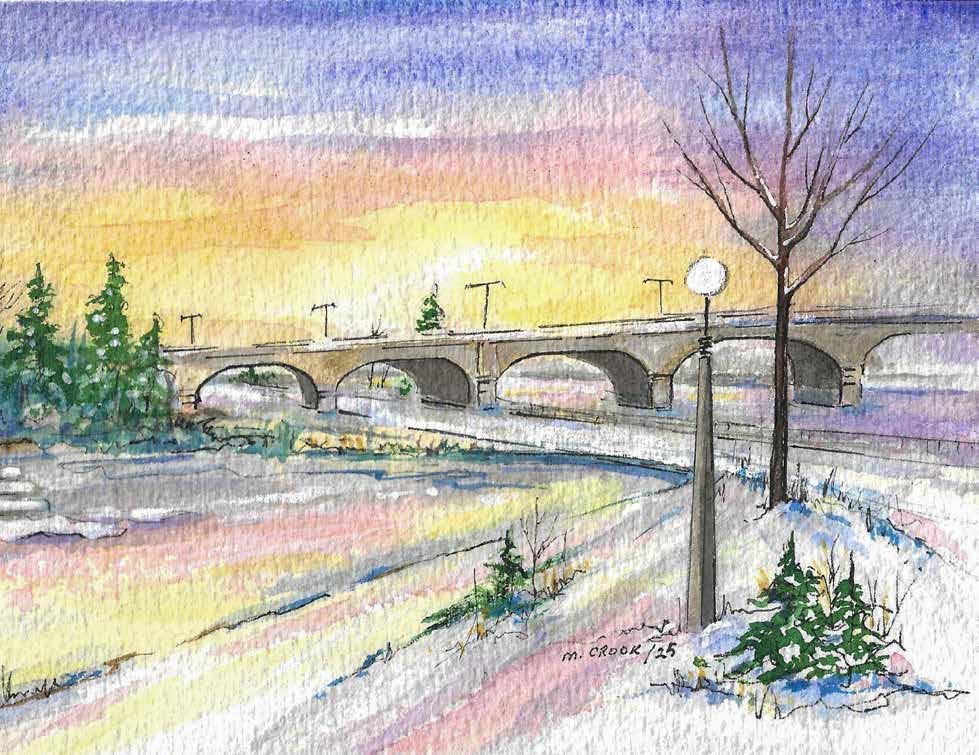

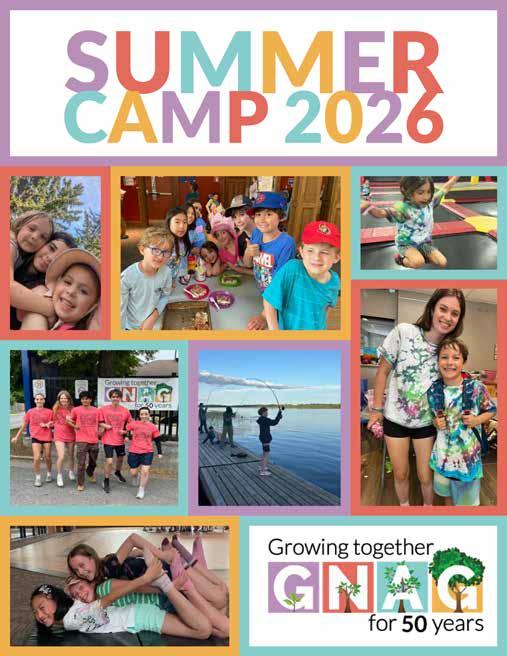





Bank Street Bridge Looking East, by Mary Crook.