DELICATE MATTER(S) by David Schnuckel It’s a difficult idea I’m still working out, but perhaps some of the most necessary advancements to the field of contemporary glass are developed by artists coming to the medium through less obvious points of entry. Artists who come to glass without formal training in it. Artists who hadn’t earned degrees in it. Artists who come to glass with an external expertise in other non-glass fields of interest and translate those knowns into a substance unknown. Artists who illustrate a virtuosity with glass as a matter of thinking with material as opposed to simply wanting to make eyecandy out of it. Enter Charisse Pearlina Weston, an artist and writer whose diverse creative practice approaches glass not as a thing to worship, but a podium of artmaking to mourn, commemorate, and speak of the complexities defining the Black lived experience. As an accomplished essayist and poet, Weston’s work integrates a material awareness and sensibility with glass that parallels the way she observes and engages words, culminating in objects and installations that are driven by (and curious of) the interconnectedness of contradiction. Language, linguistics, poetry, fiction, and the autobiographical account all come together - both literally and figuratively - in work that critically engages issues of racial strain and struggle as conceptually layered, ambiguously disclosed narratives. The visual language that she employs is one-part monument, one-part object collage; a spatial approach to an abstracted—yet story-laden—sculpture built on arrangements of seemingly disparate components. These symbolic ingredients are sometimes too vague to speak for themselves; but, when together, they form an emblematic voice that harmonizes around her conceptual center points in each work. Various inclusions of masonry, transparent papers and films, photography, text, and flat glass are all visual notes that lend to the flavor and aroma of a solemn, contemplative body of work as GASNEWS
SUMMER 2020
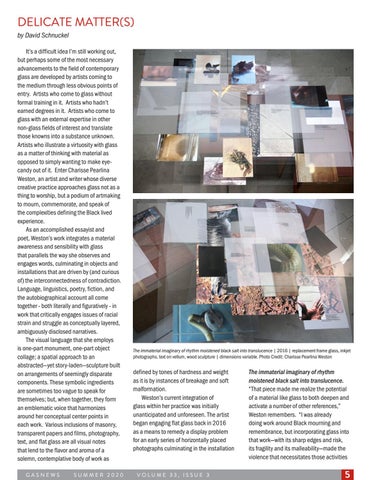
The immaterial imaginary of rhythm moistened black salt into translucence | 2016 | replacement frame glass, inkjet photographs, text on vellum, wood sculpture | dimensions variable. Photo Credit: Charisse Pearlina Weston
defined by tones of hardness and weight as it is by instances of breakage and soft malformation. Weston’s current integration of glass within her practice was initially unanticipated and unforeseen. The artist began engaging flat glass back in 2016 as a means to remedy a display problem for an early series of horizontally placed photographs culminating in the installation
VOLUME 33, ISSUE 3
The immaterial imaginary of rhythm moistened black salt into translucence. “That piece made me realize the potential of a material like glass to both deepen and activate a number of other references,” Weston remembers. “I was already doing work around Black mourning and remembrance, but incorporating glass into that work—with its sharp edges and risk, its fragility and its malleability—made the violence that necessitates those activities
5