RMDs on PTH 6: Manitoba government changes how it grants permits for truck use of PTH 6 highway.
Page 20
High Wheeler: B.C. Ghost Town home to vehicle it says is ‘beginning of International Trucks.’
Page 11
Page 10
Western Canada’s Trucking Newspaper Since 1989
September 2016 Volume 27, Issue 9
DD5: Daimler’s four-cylinder engine packs a lot of punch in segment dominated by sixcylinder offerings.
truckwest.ca
RETAIL A DV E R T I SIN G PAGES 29 -3
8
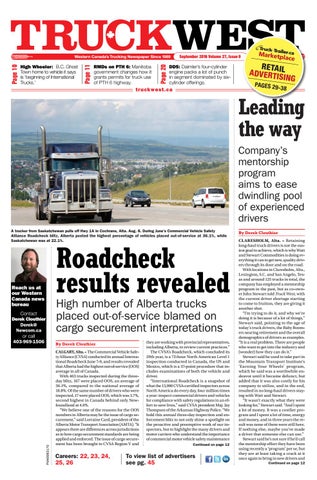
Leading the way Company’s mentorship program aims to ease dwindling pool of experienced drivers A trucker from Saskatchewan pulls off Hwy 1A in Cochrane, Alta. Aug. 8. During June’s Commercial Vehicle Safety Alliance Roadcheck blitz, Alberta posted the highest percentage of vehicles placed out-of-service at 36.1%, while Saskatchewan was at 22.1%.
Roadcheck results revealed
Reach us at our Western Canada news bureau
High number of Alberta trucks placed out-of-service blamed on cargo securement interpretations
Contact Derek Clouthier Derek@ Newcom.ca or call 403-969-1506
PM40063170
By Derek Clouthier
pg 01, 12 tw sept v3.indd 1
CALGARY, Alta. – The Commercial Vehicle Safety Alliance (CVSA) conducted its annual International Roadcheck June 7-9, and results revealed that Alberta had the highest out-of-service (OOS) average in all of Canada. With 463 trucks inspected during the threeday blitz, 167 were placed OOS, an average of 36.1%, compared to the national average of 18.8%. Of the same number of drivers who were inspected, 17 were placed OOS, which was 3.7%, second highest in Canada behind only Newfoundland at 4.6%. “We believe one of the reasons for the OOS numbers in Alberta may be the issue of cargo securement,” said Lorraine Card, president of the Alberta Motor Transport Association (AMTA). “It appears there are differences across jurisdictions as to how cargo securement standards are being applied and enforced. The issue of cargo securement has been brought to CVSA Region V and
Careers: 22, 23, 24, 25, 26
they are working with provincial representatives, including Alberta, to review current practices.” The CVSA’s Roadcheck, which concluded its 29th year, is a 72-hour North American Level 1 inspection conducted in Canada, the US and Mexico, which is a 37-point procedure that includes examinations of both the vehicle and driver. “International Roadcheck is a snapshot of what the 13,000 CVSA-certified inspectors across North America do every day, four million times a year: inspect commercial drivers and vehicles for compliance with safety regulations in an effort to save lives,” said CVSA president Maj. Jay Thompson of the Arkansas Highway Police. “We hold this annual three-day inspection and enforcement blitz to not only shine a spotlight on the proactive and preemptive work of our inspectors, but to highlight the many drivers and motor carriers who understand the importance of commercial motor vehicle safety maintenance Continued on page 12
To view list of advertisers see pg. 45
By Derek Clouthier CLARESHOLM, Alta. – Retaining long-haul truck drivers is not the easiest goal to achieve, which is why Watt and Stewart Commodities is doing everything it can to get new, quality drivers through its door and on the road. With locations in Claresholm, Alta., Lexington, S.C. and San Angelo, Texas and around 125 trucks in total, the company has employed a mentorship program in the past, but as co-owner John Stewart told Truck West, with the current driver shortage starting to come to fruition, they are giving it another shot. “I’m trying to do it, and why we’re doing it is because of a lot of things,” Stewart said, pointing to the age of today’s truck drivers, the Baby Boomers nearing retirement and the overall demographics of drivers as examples. “It is a real problem. There are people who want to get into the industry and (wonder) how they can do it.” Stewart said he used to take part in the Mountain Transport Institute’s ‘Earning Your Wheels’ program, which he said was a worthwhile endeavor until it became defunct, but added that it was also costly for his company to utilize, and in the end, resulted in no long-haul drivers staying with Watt and Stewart. “It wasn’t exactly what they were looking for,” Stewart said. “And I spent a lot of money. It was a costlier program and I spent a lot of time, energy and money, and in three years the result was none of them were still here. If nothing else, maybe you’ve made a driver that someone else can use.” Stewart said he’s not sure if he’d call the mentorship effort they have been using recently a ‘program’ per se, but they are at least taking a crack at it once again to bring in new drivers and Continued on page 12
2016-08-11 9:49 AM
TRUCK WEST SEPTEMBER 2016
3
INSIDE THIS ISSUE
46
The Last Word Wildwood Transport is not so sure a driver shortage really exists.
5 Editorial Editor Derek Clouthier addresses feedback from last month’s column and editorial director Lou Smyrlis says it’s easy to boost your step count.
6, 7 Alberta
Hwy. 63/881 safety; Ritchie Bros. breaks records; and Mullen Group preps for 2017.
42
10 British Columbia
A 1909 International High Wheeler in B.C. Ghost Town said to be the ‘beginning of International Trucks.’
11 Manitoba
Provincial government changes the way trips are allotted to trucking companies using PTH 6.
Mark Dalton in... Goober for hire
14 Cross-border Inventory-to-sales ratio remains high in US, and for-hire truck tonnage drops 1.5% in June, but 2.1% stronger than last year.
Making up your mind when to replace your old truck with a new one can a tough decision.
Trucks servicing Port of Vancouver must adhere to environmental law; Trailcon expands; truck parking coming to Delta, B.C.
26 A l Goodhall Though it may be hard to find, a middle ground must be uncovered in the debate over ELDs.
17 Rebecka Freels Communicate properly in the workplace and avoid information overload.
27 Bonnie Learn How can we get past the ongoing concerns surrounding distracted driving?
18 Sandy Johnson Understanding URS and ELDs so they are a help, not a hindrance.
19 Equipment
Mercedes-Benz Vans offers more in its Sprinter series.
20, 21 Equipment Daimler announces the DD5 in the medium-duty engine; Cummins’ new X15 engine series provides both performance and fuel economy.
13 Business Panel discusses the relationship between brokers and carriers, including the effect of ELDs and payment terms.
25 Mark Lee
16 British Columbia
23 Equipment
28 M arketplace Feature How to make quality purchase decisions and best maintain your tanker trailer.
41 Letters to the editor 43 H uman Resources Trucking HR Canada wants your workplace to be the best in Canada.
44 N ewland Transport An illustrated trucking adventure continues.
Shell decides to bring its new CK-4 and FA-4 engine oils to the market early.
45 F leet News M-O opens Vancouver terminal; Bison welcomes two new executives.
24 S cott Taylor GST/HST should be a relatively easy tax to file, in theory, but there are various rates and rules.
45 Ad Index
September 2016 Volume 27, Issue 9
ISSN 0700-5016 (Print) ISSN 1923-3531 (Online) Truck West is published monthly by
Newcom Business Media Inc.
CHAIRMAN & FOUNDER: Jim Glionna PRESIDENT: Joe Glionna PRODUCTION: Beverley Richards, Carolyn Brimer CIRCULATION MANAGER: Pat Glionna
Sales inquiries Delon Rashid
Joe Glionna PRESIDENT 416-614-5805 joe@newcom.ca
Lou Smyrlis
PUBLISHER & EDITORIAL DIRECTOR 416-510-6881 lou@newcom.ca
Kathy Koras
Tony Hohenadel
Sonia Straface
Julia Kuzeljevich CONTRIBUTING EDITOR 416-510-6880 julia@newcom.ca
Dan Robinson DIRECTOR DIGITAL MARKETING 416-510-5123 dan@newcom.ca
Denis Arsenault
Doug Copeland
ASSOCIATE PUBLISHER 416-510-6892 kathy@newcom.ca
PUBLISHER truckandtrailer.ca 416-614-5800 tony@newcom.ca
EDITORIAL
Sales & Marketing Consultant – Western Canada
403-713-1054 delon@newcom.ca
Subscription inquiries Lilianna Kantor Phone: 416-614-5815 Fax: 416-614-8861 Email: lily@newcom.ca RETURN UNDELIVERABLE CANADIAN ADDRESSES TO: CIRCULATION DEPARTMENT, TRUCK NEWS 451 ATTWELL DR., TORONTO, ON M9W 5C4 PUBLICATIONS MAIL AGREEMENT NO. 40063170 CUSTOMER NO. 4006214
Derek Clouthier EDITOR 403-969-1506 derek@newcom.ca
James Menzies EXECUTIVE EDITOR 416-510-6896 james@newcom.ca
ASSISTANT EDITOR 416-510-6890 sonia@newcom.ca
Brad Ling
VIDEO PRODUCTION 416-442-5600 ext. 3620
ACCOUNT MANAGERS
TRUCK WEST is a proud member of the following trucking associations: ALTA. MOTOR TRANSPORT ASSN.
SASK. TRUCKING ASSN. MAN. TRUCKING ASSN.
B.C. TRUCKING ASSN.
Delon Rashid
SALES & MARKETING CONSULTANT – WESTERN CANADA 403-713-1054 delon@newcom.ca
Nickisha Rashid REGIONAL ACCOUNTS MANAGER 416-614-5824 nickisha@newcom.ca
Heather Donnelly NATIONAL ACCOUNTS MANAGER 416-614-5804 heather@newcom.ca
QUEBEC ACCOUNTS MANAGER 514-938-0639 ext. 2 denis@newcom.ca
REGIONAL ACCOUNTS MANAGER 905-715-9511 doug@newcom.ca
Paul Beelien
REGIONAL ACCOUNTS MANAGER 416-614-5806 paul@newcom.ca
We acknowledge the financial support of the Government of Canada through the Canada Periodical Fund of the Department of Canadian Heritage.
pg 03 tw sept v3.indd 3
2016-08-11 12:19 PM
4
INSIDE THE NUMBERS
PRIVATE DECISIONS
HAVE PURCHASED USED TRUCK IN PAST
YES
Why Western Canadian private carriers purchase used trucks and what they look for
NO
74%
W
estern Canada private fleets – the vast majority of which have fewer than
26%
25 vehicles – consider buying used a viable option when it comes to
equipment renewal. Almost three quarters have purchased used trucks in the past, according to our annual Equipment Buying Trends Survey. Availability of parts, estimated maintenance costs and the truck’s age/mileage are the most important considerations when buying used.
SIZE OF HD VEHICLE FLEET 1 to 4
TOP 10 CONSIDERATIONS IN PURCHASING USED TRUCKS (SCALE OF 1 TO 5)
Brand
100 to 499
13%
3.63
4%
5 to 9 vehicles
Age of truck/mileage
39%
4.31 GVW/payload capacity
13%
25 to 99
4.18
Horsepower
4.00 Type of transmission
4.12
TYPE OF TRANSMISSION PREFERRED
Availability or preferred engine brand
3.67 History of truck
26% of respondents
10 to 24
Automatic
4.19
32% of respondents
Estimated maintenance costs
0% Manual 10 speed
4.35 Availability of parts
16%
4.41
Manual 13 speed
Knowledge level of dealer representative
3.25
53% Manual 18 speed
TYPE OF OPERATION
21% Long haul (600 km+)
Regional
Construction
Other
33%
8%
21%
4%
14%
Urban/local
Forestry
NEITHER RAIN, NOR SNOW NOR 23 HOURS OF DARKNESS NOR THE FAILED MISSIONS OF TRUCKERS’ PAST NOR ACTS OF GOD. . . SHALL STAY ME AND THESE CHAINED-UP WHEELS FROM REACHING THE FINAL OUTPOSTS OF THIS VAST FRONTIER ®
Lisa Kelly on History Network’s Ice Road Truckers
®
Delo user since 2005 ®
UNCOMMON JOBS REQUIRE UNCOMMON TOUGHNESS
© 2016 Chevron Canada Limited. All rights reserved. All trademarks are the property of Chevron Intellectual Property LLC.
Chevron Global Lubricants West.indd 4
2016-08-08 7:32 PM
EDITORIAL
TRUCK WEST SEPTEMBER 2016
5
Have we figu ed out how to attract a new crop of drivers? The feedback I received on my column last month, ‘How would an outsider view truck driving when choosing a career?’ was both great, in the number of you who contacted me (you’ll even see some letters in this issue addressing the matter) and concerning, with the apparent absence of enthusiasm in choosing driving as a career and a lack of confidence that a new generation will want to get behind the wheel. It seems there are two schools of thought behind what many believe will be a troublesome driver shortage in the imminent future. The first is that truck driving is not what it used to be. It no longer provides people with the feeling of independence it once did, and the main culprit for that ‘loss of personal freedom’ is the implementation of new technologies, specifically electronic logging devices (ELDs), used to better monitor and keep track of what drivers are doing, where they are doing it, how they are doing it, how often they are doing it…pretty much what some feel is an eye over the their shoulder watching their every move. Like I wrote in last month’s column, one of the biggest reasons people get into a truck as a career choice is the freedom that brings with it. Not sitting in an office with someone looking over your shoul-
Derek’s deliberation Derek Clouthier der analyzing your performance. If that feeling becomes devoid with the use of monitoring devices like ELDs, then a big part of what used to make driving attractive is lost. Engine technology was another advancement I heard some gripes over. Costly and more frequent repairs were the main concern, which does a driver’s pocketbook no favors. Bringing me to the issue of salary, something many in the industry have told me since I started with Truck West magazine is far too low to attract new employees given the nature of the job. Constantly being away from your family and friends is not the most attractive feature of being on the road, and if truck drivers are not being paid handsomely, what is drawing them to the industry? The second school of thought surfaced when I was writing the Last Word feature this month. The owner of the company I interviewed addressed the notion of a driver shortage and raised a good point: the best way to attract new drivers is to
make getting the job more difficult though more vigorous training, which would help weed out those who simply choose to drive as a ‘last resort’, drive up wages and in turn attract more people to the industry. New technology is not going anywhere, and for good reason. Though I can understand the frustrations some current drivers feel when it comes to ELDs and the invasiveness that accompanies them, the devices provide far too many benefits from a business standpoint. Same goes for new engine technologies. Making trucks more fuel efficient and employing the use of telematics to solve issues before they happen is a big money-saver in the long run. Every vehicle on the road is more advanced now than ever before, so don’t expect engine technology to regress back to 1976 anytime soon. But despite that fact that most of the feedback I received told me why you wouldn’t want to choose truck driving as a career, it was also able to decipher how the industry could get more young people interested in driving. Technology and young people go hand-in-hand, so for many Millennials
A journey of 1,000 miles begins with a single step A few issues ago, I wrote about breaking the stereotype of the obese and unhealthy trucker. I said it’s time to throw out the excuses and take charge of creating a healthier you. Since then, I’ve had the pleasure of participating in the first two legs of the Healthy Fleet Challenge, put on once again by Healthy Trucker in partnership with the American Trucking Associations (ATA), NAL Insurance and Truck News. The goal is to get our industry more physically active in the simplest, most inexpensive way there is: walking. To make it more fun, the challenge includes a competitive spirit. Participants’ daily steps are measured through wearable technology and an online leaderboard shows their step count. That makes it a lot of fun whether you are try-
pg 05 tw sept v3.indd 5
The view with Lou Lou Smyrlis ing to push your company team totals past the rival company’s team or, like me this time, if you set your sights on competing for the best individual results. You can read our report on the latest challenge on page 15. In addition to the team and individual standings, we profiled several participants who really brought their A game and you can pick up some good tips from them. I know I did. Take for example Rajdeep Singh, a safety and compliance manager with Challenger Motor Freight. He finished
third overall, averaging 28,101 steps per day. His advice: Get up early in the morning and go for a brisk walk. And here’s another piece of advice that I love: Instead of e-mailing people in his office, to increase his step total, Singh actually walks to their office and speaks to them. Imagine that. Sherry Rodrigues, who does payroll/ invoicing for Elgin Motor Freight, has made accumulating more steps part of her lifestyle. When she goes to the grocery store, she will walk up and down each aisle even if she doesn’t have to. Think that’s silly or extreme? Consider that the human body is not made to sit anywhere near as much as we do. Isn’t it smart then to think up little ways to get as much walking in as possible? I also love the advice from Chris Illes,
who may not want to sit in a cubical for a living, all they really need is to be offered a good wage and feel challenged, and the industry will have what it needs – quality professionals behind the wheel. As always, please write a letter and tell me what you think. Derek Clouthier can be reached by phone at (403) 969-1506 or by e-mail at derek@newcom.ca. You can also follow him on Twitter at @DerekClouthier.
operations manager at Stream Logistics. Illes finished second overall, averaging 33,402 daily steps. Like Singh, Illes gets up early to go for a walk and also gets some walking in at lunch. And when he goes home, he walks with his family. How beautiful is that? For those of us in central Canada this was a particularly tough challenge because of the high summer temperatures. But every morning when I checked the leaderboard I was inspired to see industry leaders like Dan Einwechter and Eugene Moser from Challenger and ATA president Bill Graves leading by example and churning up those steps. The final leg for the Healthy Fleet Challenge starts Sept. 1. Join us. Lou Smyrlis can be reached by phone at (416) 510-6881 or by e-mail at lou@newcom.ca. You can also follow him on Twitter at @LouSmyrlis.
2016-08-10 5:14 PM
6
ALBERTA
AMTA focuses on Hwy. 63/881 safety
TruckNews_TruckWest CAN_W16.pdf
1
8/2/16
3:25 PM
Meet oil’s new best friend. Let’s be clear. Howes Oil Enhancer makes your motor oil perform better – period. Beyond extending the life of your oil, it also reduces friction and protects internal engine components better than any other additive, saving you money and costly down time. Howes Oil Enhancer is a key part of your vehicle’s regular maintenance program and delivers the outstanding performance you can always expect from Howes.
C
M
Y
CM
MY
CY
EDMONTON, Alta. – The Alberta Motor Transport Association (AMTA) has united with the Coalition for a Safer 63 and 881 in an effort to deliver road safety messages to help reduce traffic related incidents along busy provincial Highway 63 and 881. A series of up to four road safety billboards will be erected along Highway 63 near the community of Boyle, Alta. between June and December. Highway 63 stretches 443 kms connecting the province’s oil sands region with trade routes to the south and is the only all-weather road in and out of Fort McMurray, Alta. “AMTA is committed to making the roads safer for all road users and a key element of that is raising awareness of how to safely share the road with commercial vehicles,” said AMTA president Lorraine Card. “Both AMTA and the Coalition for a Safer 63 and 881 share a common goal with this billboard campaign, we want to reach road users who are traveling to and from Fort McMurray and encourage safe driving behaviors so everyone arrives home safely.” Formed in 2010, the Coalition for a Safer 63 and 881 aims to change the driving habits of those who utilize both highway systems. “The Coalition for a Safer 63 and 881 proud of our partnership with AMTA. Both organizations share a similar vision and mandate, like AMTA, the Coalition is committed to making highway 63 and 881 safer through education and advocacy,” said the coalition’s executive director, Debbie Hammond. “The billboard campaign is a great partnership that strengthens our voice as safety advocates. We believe by providing the educational resources and safe driving tips, drivers can make safer choices behind the wheel and arrive to their destination.” The AMTA said several industryleading partners are part of the Coalition for a Safer 63 and 881. According to the coalition’s website, there have been 153 fatal collisions on Highway 63 and 881 between 2003 and 2015, with a total of 190 victims.
CMY
K
Ritchie Bros. auction breaks records
From the trusted maker of Diesel Treat and Meaner Power Kleaner.
pg 06-07 tw sept v3.indd 6
1-800 GET HOWES (438-4693) • www.howeslube.com
LETHBRIDGE, Alta. – Records were broken in Lethbridge last month, as Ritchie Bros. sold more than $24 million worth of equipment in two days. Traditionally the company’s Southern Alberta site has focused on agriculture auctions, but this sale featured more construction and transportation assets than ever before, resulting in more choice and bigger crowds on auction day. In addition, 67% of equipment was sold to online buyers. The auction took place July 2122 and Ritchie Bros. sold more than 1,600 pieces of equipment. More than 3,250 people from 32 countries registered to bid.
2016-08-11 10:00 AM
TRUCK WEST SEPTEMBER 2016
7
Mullen Group to start preparing for commodity price recovery OKOTOKS, Alta. – The time has come to start preparing for a recovery in the oil and gas segment and to position Mullen Group for growth. That was a message from Mullen Group CEO Murray Mullen to analysts during a conference call after posting Q2 results in late July. Mullen said the company intentionally gave up market share in the oil and gas segment rather than chase rates. However, three factors have caused him to change his view and declare the company is ready to start winning back market share and staffing up. He feels by downsizing the company when commodity prices crashed, Mullen was able to right-size and get its cost structure in line with demand. Also, he believes competitors in the oilfield services segment are financially strained and “in trouble” and he also feels, “sometime over the course of the next 12-18 months” that demand for oilfield services will improve. “This is the time for Mullen to start to position for some time in late 2017 and we will be more aggressive in the market and will start to regain some market share,” Mullen said. “These initiatives mean our margins will decline in the short term but we will get them back, it’s just a matter of time.” Waiting until demand improves in 2017 would be too late, Mullen said, adding the time is right because heightened demand coupled with bankruptcies in the segment will put upward pressure on rates. “This is the time to start getting market share because as demand picks up, pricing will pick up,” Mullen said. He also said Mullen Group will continue to invest in its regional LTL business. But that doesn’t mean all is rosy. Mullen gave a candid assessment of the Canadian economy as it “muddles along” and the Alberta economy, which he said is in a “nasty recession.” “Really, there are two economies out there today,” he said, noting the public sector economy is not struggling to the same extent as the private sector economy. Mullen has let go more than 1,500 people since oil prices tanked. And Mullen still doesn’t see current oil prices supporting much in the way of capital investments in the oilsands. “I have an innate desire to give everybody the all-clear signal,” Mullen said. “However, it appears to me the storm clouds remain well entrenched.” He said the next few quarters will be challenging. LNG development, Mullen said, seems to be on hold or “dead in the water.” Still, Mullen said he’s impressed with the Q2 financial results the company achieved in a challenging environment and he’s now positioning the company to grow. “If your company is well positioned, this is the time to be opportunistic, which is exactly what our strategy will be here at Mullen Group,” he said. “It is our view that this is the time to position for the next business cycle.” Mullen Group’s total revenue came in at $247 million, down 13.3% from last year’s Q2. The oilfield services segment saw revenue drop by $31.7 mil-
pg 06-07 tw sept v3.indd 7
lion while trucking/logistics saw a decline of $4.8 million. However, Mullen delivered earnings of 14 cents a share, well above analysts’ expectations. “MTL reported a solid beat in Q2 with EBITDA of $47 million,” Scotiabank wrote in a note to investors. “The major reason was solid expense control which led to better-than-expected margins in both segments. In our view, this was a strong showing considering that the macro-environment remains weak.” Mullen’s lower trucking revenue was attributed to lower fuel surcharges and slowing demand in Alberta. Net income totaled $13.7 million, a 1,422.2% increase over last year when Mullen posted a profit of $0.9 million, or one cent per share.
TRAILER
R E N TA L | L E A S I N G | S A L E S | S T O R AG E | PA R T S | S E R V I C E
Safe, dependable & professional Make Trailer Wizards your first call.
25+ locations across Canada
25,000+ diverse rental & lease trailers
50+ years of expertise
Giving you convenient, coast-to-coast coverage
Delivering the trailer you need, when you need it
Providing you award winning trailer solutions
1 855 327 9757 | trailerwizards.com
2016-08-11 10:00 AM
ON OCTOBER 13th 2016, PLEASE PLAN ON JOINING CANADA’S TOP TRANSPORTATION EXECUTIVES FOR A DAY OF EDUCATION & NETWORKING. We have created an agenda that truly addresses the many challenges facing both Shipper and Carrier executives.
KEYNOTE SPEAKER
2016 SUMMIT AGENDA THE ECONOMY IN 2017: What Trends Will Impact your Business? KEYNOTE PRESENTATION: Changing the Way We Think about Vehicle Technology Keynote sponsored by Navistar
THE VIEW FROM THE TOP: The Transportation Executive’s Perspective on the Major Trends Driving Transportation in 2017 and Beyond
Ian Wright
Founder & CEO, Wrightspeed Co-Founder, Tesla
SHIPPER-CARRIER ROUNDTABLE EMERGING FREIGHT TRANSPORTATION SERVICES THRIVING IN CHALLENGING ECONOMIC TIMES Jonathan Wahba
CREATING THE SUPPLY CHAIN OF TOMORROW
Chief Operating Office , Kriska Transportation Group
LEADERSHIP AND MENTORING IN THE TRANSPORTATION INDUSTRY
Valerie McSween
Ian Evans
Vice President, Eastern Region, Mactrans Logistics Inc.
Ian Evans & Associates
Wendell Erb
Michelle Arseneau
REACHING NEW HEIGHTS IN YOUR LIFE AND CAREER For more information and to register, please visit
www.SurfaceTransportationSummit.com
Grant Naslund
Director, Eastern Operations, Bison Transport
President & CEO, The Erb Group of Companies
Managing Partner, GX Transportation
BROUGHT TO YOU BY:
NEW VENUE
INTERNATIONAL CENTRE 6900 Airport Road, Mississauga, ON
Summit Spread Tab.indd 2
REGISTRATION: 7:00 am PRESENTATIONS: 8:20 am sharp
2016-08-04 10:57 AM
ns
s& es
seneau
artner, tation
SURFACE TRANSPORTATION
ummit
2016
REGISTER
NOW Qualify for the
Early Bird Rate
OUR 2016 TEAM OF PRESENTERS...
Adrian Pavone
President, Cardinal Couriers Limited
Steve Sashihara CEO, Princeton Consultants Inc.
Craig Fuller
CEO, Transportation Futures Exchange
Rolly Uloth
Jennifer Lee
President, The Rosedale Group
Partner and National Retail and Omnichannel Leader, Deloitte Canada
Angela Splinter
John Larkin
CEO, Canadian Trucking Managing Director/Head, Transportation Capital Human Resources Markets Research, Stifel Council Financial Corp.
Peter Aumonier
Senior Vice President, Northbridge Insurance
Carolina M. Billings President & Managing Partner, NLI Label
Michael Leblanc
Senior Vice President, Retail Council of Canada
Valerie Normand
Director of Ecommerce Solutions Integration, Canada Post
Carlos Gomes
Senior Economist, Scotiabank
GOLD SPONSOR
PLATINUM SPONSOR
Paul Kudla
Mark Dienesch
Martin Abadi
Darrell Benvenuto
Paul Kretz
Regional Vice President Senior Vice President Canada/Volvo Trucks Sales and Marketing North America VersaCold Logistics Services
Barrister & Solicitor, Fernandes Hearn LLP
Trevor Kurtz
General Manager, Brian Kurtz Trucking Ltd.
CEO and Founder, NCX
Heidi M. Syer
Division Freight Manager, Canada, PepsiCo Foods Inc
VP, Logistics, Indigo Books & Music
Michael Bourque
President & CEO, Railway Association of Canada (RAC)
Walter Spracklin
Equity Research Analyst – Transportation Sector, RBC Capital Markets
SILVER SPONSORS
ASSOCIATION PARTNERS NLI GROUP.ca
FROM CONCEPT TO EXECUTION
Summit Spread Tab.indd 3
2016-08-04 10:58 AM
10
BRITISH COLUMBIA
Going way back A piece of trucking history sits in B.C. Ghost Town By Derek Clouthier 3 VALLEY GAP, B.C. – If you were to pull off Highway 1 just west of Revelstoke and east of Sicamous, B.C. at a place called 3 Valley Gap and checked out the location’s Ghost Town, you’d find what appears to be a hidden gem in the trucking industry. Included in the Ghost Town is a collection of historical vehicles, ranging from non-motorized buggies, to the famous Model T Ford, and even a ’57 Chevy. But also found in the impressive assortment is a 1909 International High Wheeler, Model A Autobuggy, which, if the sign describing the vehicle is correct, marked the beginning of International Trucks. George Bell, the owner of 3 Valley Gap, said his father purchased the High Wheeler in 1993 from the B.C. Museum of Transportation, Science and Industry, which was located in
New Westminster and closed that same year. “They had about 200 cars on the auction block,” Bell said. “It was one of those vehicles that was basically just a museum piece. “It wasn’t something that you’d want to bomb around in with your wife and kids.” Bell’s father told him there were about 2,000 buyers at the auction, there to snap up what the museum was auctioning off, many of whom were from south of the border. Bell’s father passed away in 2007. In addition to claiming the High Wheeler was the ‘beginning of International Trucks,’ the sign also says the vehicle boasts a 74-inch wheelbase and ran on two cylinders. It was designed as a farm truck but was used as a passenger vehicle before it was converted into a truck to carry goods. “It’s basically a transformation from a buggy to a car,” Bell said. “We’ve had it running here and I rode in it. It’s air-cooled, there’s no radiator, it’s chain drive and about (14) horsepower.” George said the paperwork he has on the High Wheeler indicates the vehicle was resorted in 1986 by a group of students from the British Columbia Institute of Technology. Truck West contacted the B.C. Museums Association, which had no remaining information on the Museum of Transportation, Science and Industry or on the 1909 High Wheeler.
A 1909 International High Wheeler Model A Autobuggy can be found in 3 Valley Gap, B.C., with a sign that reads, “beginning of International Trucks.”
THIS MONTH’S CROSSWORD PUZZLE TW-159 Sept. 2016 © 2016 M. Jackson
Answers on pag 43
Across
Down
1 Mississauga-based, 13 terminal carrier (8,5) 8 City with 407 ETR hwy. 9 GMC’s ’69 Crackerbox replacement, ____ 95 10 Major ’67 Montreal event 11 Cab top noisemakers (3,5) 13 Cummins or Detroit engine 15 Moving under Customs control, cargo-wise (2,4) 18 Ice cream topped diner dish (5,3) 19 “Big Yellow Taxi” singer Mitchell 22 CARGONET focus 23 Rejuvenate a classic truck 24 Toll booths, informally (4,9)
1 2 3 4 5 6 7 12 14 16 17 18 20 21
pg 10-11 tw sept v3.indd 10
Tire with new lease on life Cargo restraint device Cab panel damage, perhaps Bird image Canadian coin Tractor to trailer air connector (4,4) Car plant province Vital winter vehicles Radar ____, a.k.a bird dog Vitran ____, Concord, ON-based carrier Carrier’s ambassadors, you might say Heavy highway hauler (3,3) Above-cab van body portion Emissions-affected atmosphere layer Fixer-upper truck ad words (2,2)
2016-08-10 5:15 PM
MANITOBA
TRUCK WEST SEPTEMBER 2016
11
Manitoba government changes trip allotment for province’s PTH 6 By Derek Clouthier WINNIPEG, Man. – The Manitoba Trucking Association (MTA) is applauding an agreement it reached with the provincial government on changes in how the amount of trips are allotted to trucking companies traveling on Provincial Truck Highway 6 (PTH 6). Initiated by the MTA’s board of directors, Manitoba Infrastructure announced that the number of daily trips for Rocky Mountain doubles (RMD), a combination double vehicle that has a slightly shorter configuration than a traditional combination double, would be reduced from 10 round trips to four single trips per day, with companies able to request additional trips when needed. MTA executive director Terry Shaw explained that although PTH 6 is the main connector between southern and northern Manitoba, due to a variety of factors they can be difficult to maintain. “Costs of servicing the northern
Report says Manitoba to soon face dire driver shortage WINNIPEG, Man. – The Manitoba Trucking Association (MTA) says its province will face a dire labor shortage with a shortfall of 10,000 drivers by 2026, and government must step up to fund training and help fill the gaps. The MTA said the projection comes from the Asia Pacific Gateway Skills Table’s ‘Labour Market Information Project’, which indicates that more than 177,375 jobs will need to be filled in four transportation sectors across Canada’s four western provinces in the next decade, with Manitoba facing the most difficult hiring conditions of all provinces due of workers migrating to other areas of the country. “We need more than one new job a day, seven days a week, every week of the year for the next decade and we just aren’t doing what we need as a province to support the demand,” said Terry Shaw, executive director of the MTA. “We need to be recognized as a trade and have funding in place that matches the designation.” Because commercial driving is designated a certified occupation and not a skilled trade, prospective drivers cannot receive provincial funding for training and must fork over around $8,600 out of pocket for their education. “The workers our industry attracts don’t typically have $10,000 lying around in RRSPs or other savings,” Shaw said. “There was a shortage in other industries and the levels of government responded accordingly. We now need the same treatment to ensure goods that Canadians depend on can keep moving from coast to coast and beyond.”
pg 10-11 tw sept v3.indd 11
parts of our provinces, specifically Northern Manitoba, gets very high,” Shaw said. “PTH 6, because it is a northern connector, it’s not interstate quality…it’s a single lane each way, some of the shoulders need work and some of the lines need repainting, so the government kind of balked at increasing traffic with the Rocky
ogy,” he said. “So hauling two trailers with one truck as opposed to one trailer with one truck is a huge gain in terms of greenhouse (reductions) and economic efficiencies.” The MTA relayed to the government that there was an opportunity for the trucking industry and the province’s northern communities on the environmental front when it came to expanding the longcombination vehicle network in Manitoba, and PTH 6 was an obvious emphasis. “People were using Rocky Mountain doubles on PTH 6 but they were limited to how many they could run every day,” Shaw said. “We had some members who were hauling t hree or four Rocky Mountain doubles daily and the rest of their trips on PTH 6 would be single-tractor, single-trailer combination, and they were saying instead of running six individual trips, I could run three Rocky Mountain double trips. That just inherently increases our economic efficiency, it makes us more competitive in northern Manitoba and it is better for the environment.”
‘Hauling two trailers with one truck…is a huge gain in terms of GHG (reductions).’ Terry Shaw, MTA Mountain double combinations.” Shaw said part of the discussion the MTA’s board had with the government focused on the environment. “Everyone was saying one of the best ways to become environmentally efficient is to become fuel efficient, and a great way to become fuel efficient in our industry is efficiency combinations and efficiency technol-
The MTA worked with the government to see how they could get more Rocky Mountain double trips into northern Manitoba. There was a cap of 50 trips per day on PTH 6, but some companies were maxing out at 10 trips per day, but could have used a few more. Shaw said with the government wanting to limit the trips on PTH 6 and the industry wanting the opposite, it was an opportunity for the two parties to work together to find middle ground. The eventual agreement saw the number of trips reduced per permit, and companies requiring more than 10 trips could now buy permits from businesses that did not use their entire allotment, allowing them additional trips on PTH 6. “It was a real nice win on a whole bunch of fronts and it was a great example of the partnership we have with the government and how we can all communicate opportunities back and forth and ultimately sign off on something that works for everybody,” Shaw said. “While it’s not ideal, it gave those companies that had more than 10 trips a day the ability to use more than 10 trips a day with Rocky Mountain doubles, and those that only used four trips a day didn’t have to buy a 10-trip permit, they could buy a six-trip permit and leave four trips for somebody that could use it.”
The best tank leasing experience... just a phone call away Kevin Quick VP, Business Development, Western Canada kquick@transcourt.com
1 888 407 3830 · transcourt.com
Expansive, highest quality fleet · Personalized service Customized solutions · Excellent value · Coast-to-coast
2016-08-10 5:16 PM
12
COVER STORIES
TRUCK WEST SEPTEMBER 2016
Struggling to hire Canadian drivers Continued from page 1
get them trained. The first step is the interview, which is when Stewart said he looks to see if the applicant’s goals are in line and match what Watt and Stewart is doing as a company. “If they want to do short haul and don’t ever want to leave the province, then the interview is over,” Stewart said. “If they want to do long haul or regional work, then yes, we can get over that hurdle, and then we find out a little bit about them.” The company’s mentorship program begins with some short-haul runs, normally within around a 100-km radius of the Claresholm location for one to two months. Prospective drivers then work with other drivers packing loads in the yard for around the same amount of time before they are put on the road to start doing some long-haul trips down to South Carolina. “It’s not really a tried-and-true system,” Stewart said, adding that a young driver was just put through this regiment not long ago. “It’s worked once and I’ve got a second young guy here who comes from a trucking background…he loves trucks, and I said okay.” Stewart said one of the problems with mentoring new drivers is that once they complete his program and end up going elsewhere, they are only trained to haul the specific products Watt and Stewart move, and whatever company they transition to would then have to provide training if they haul dissimilar freight. “I can teach them flatbed work, I can teach them oversized hauling and I can teach them how to drive, which they could then dovetail to another company and learn whatever skill they need,” Stewart said. Finding Canadian drivers has also long been an issue for Watt and Stewart. “We’ve tried, like everybody else, millions of ways to keep drivers and to find drivers,” he said. “I’m struggling right now to hire Canadian drivers because they either can’t or don’t want to cross the border or don’t want to do long-haul.” Stewart said at one point, his company was made up of about 60% immigrant drivers from all over Europe, but with regulatory changes making it more difficult to bring people in from overseas, that number has dropped.
“The whole program was working really well about six to seven years ago…it was logical, it made sense and it didn’t have all this bureaucracy,” Stewart said of the federal government’s Temporary Foreign Worker Program. The website www.britishexpats.com even has a posting from January 2013 of Watt and Stewart looking for 20 new employees to begin work immediately. Right now, Watt and Stewart is in need of seven new drivers, and Stewart is in the process of applying for another foreign worker permit, as he said he knows people in Europe who would gladly come work for his company. But ‘need’ can change quickly in the trucking industry. “I was full three weeks ago, but that’s what this industry does to you,” said Stewart. “(Drivers) are very transient. Recruiting, retention, pay scales…it all has to work. And you can do all the things you think are right and they can still walk away.” He added that the government often looks at the pool of potential drivers too simplistically, believing that someone with a Class 1 licence can just get behind the wheel of a truck. “Well, I say, first are they trained and are they even in the industry?” Stewart questioned. “In our office alone, we have five or six people with a Class 1 (licence) but they don’t actively work as a truck driver every day.” But Watt and Stewart are ‘spreading their wings’ in the company’s efforts to bring in new talent. So far, Stewart said he has mostly just got information out about his company’s mentorship program by word of mouth, and has not advertised in an effort to avoid receiving too many applications all at one time, particularly from drivers with no experience at all. The company’s objective with the mentorship program is to train about three or four new drivers per year. “The whole goal is to get them out on the road and become long haul drivers,” Stewart said, “and to retain them as long haul drivers, but that’s easier said than done.” The lifestyle of long-haul truck driver is unique, and there are a myriad of things that can happen to a person that can change how they perceive the job, including marriage, health issues and unforeseen family matters. “People are people first,” said Stewart, “and truck drivers second.”
Roadcheck 2016 Canadian results Jurisdiction
# Trucks Inspected
# Trucks OOS
#Drivers OOS
% Trucks OOS
BC
724
139
14
19.2
AB
463
167
17
36.1
SK
615
136
21
22.1
MB
290
63
4
21.7
ON
3397
530
46
15.6
QC
1486
277
25
18.6
NB
241
28
3
11.6
PE
32
5
1
15.6
NS
255
53
5
20.8
NL
282
62
13
22.0
YT
56
7
0
12.5
NT
46
13
0
28.3
Cdn Total
7887
1480
149
18.8
Alberta has highest OOS rate Continued from page 1
and safe driver behavior and practices on our roadways.” Drivers must produce their license, endorsements and hours of service documentation. Inspectors also check for seatbelt use and any apparent impairment. The vehicle (the inspection includes commercial trucks and busses) has its brake, exhaust and fuel systems, coupling devices, frames, driveline/ driveshaft, lights, steering, suspension, tires, van and open-top trailer bodies, wheels, rims, hubs, windshield wipers and cargo securement inspected. Forty-six percent of the trucks placed OOS was due to brake system defects and brake adjustment issues, which CVSA said continues to be a concern. Logbook, driver qualifications or paperwork problems were the result of just 2% of drivers being placed OOS. Roadcheck’s special emphasis for 2016 was tire safety. Canada’s 18.8% OOS average was identical to last year’s results. US results are expected to be released this September. In Canada, a total of 1,480 trucks were placed OOS of the 7,887 inspected. Ontario had the highest number of trucks inspected, at 3,397 with 530 placed OOS, or 15.6%. New Brunswick had the lowest number of trucks placed OOS, at 11.6%, or 28 of 241 trucks inspected,
well below the national average and less than one third of Alberta’s percentage. Card said safety is a top priority for the AMTA, and through discussions with carrier members and drivers, the association has developed a committee with the province’s Commercial Vehicle Enforcement (CVE) to review matters around cargo securement. The AMTA is currently working with the CVSA Region V’s Education Quality Assurance Team as part of this effort, and the committee’s findings will be presented during the CVSA’s convention in Little Rock, Ark. in September. “By working on issues jointly with industry and enforcement, we can have open discussions regarding industry best practices and opportunities for improvement,” said Card. The AMTA meets with CVE and member carriers to review industry concerns surrounding road safety. Card said CVE also attends AMTA safety conferences to provide road safety education to attendees. “By providing workshops, conferences and training programs – including a truck driving simulator – we aim to educate drivers and the motoring public on best practices for sharing Alberta public highways,” Card said. “We will continue to work together to improve the overall OOS rate in Alberta.”
25 Annual Educational Conference th
September 30, 2016 - 8:30am - 4:30pm
Registration cost: $150.00 (incl. HST) Early Bird Draw (Register before July 31st for a chance to win $100 Gift Card) TThe he 22016 016 AAnnual nnual Educational Educational Conference Conference w will ill cconsist onsist ooff a oone-day ne-day fformat ormat aalong long w with ith aanother nother ooutstanding utstanding aagenda genda ooff session topics of key interest to the Transportation industry. FFor or more information information, pleas please se vvisit isit fleeetsafetycouncil.com etsafetycouncil com oorr ffollow ollow uuss oonn TTwitter@FleetSafetyConf witter@FleetSafettyCConff orr ccontact onttactt IIHSA HSA att 1-800-263-5024 ext. 7944 Centre for Health & Safety Innovation (CHSI), Mississauga Ontario
pg 01, 12 tw sept v3.indd 12
2016-08-11 9:49 AM
CANADA
TRUCK WEST SEPTEMBER 2016
13
TransCore panel examines broker-carrier relationship Panelists explore payment terms, the potential effect of ELDs and whether there’s a future for small brokers
SMa
ll
f
e f f I C I e n C y aW
Sept epI: DrIver turnover
ll
aWa r D
What IS yourS?
SMa
SMall fleet effICIenCy
016
f
Castrol Canada understands that key performance measures are vital to improving profit for your small to mid-size fleet. That is why we have now partnered with InGauge to bring you tools to measure EPI (Essential Performance Indicators) monthly to benchmark your fleet’s performance.
et
D2
for the fIrSt ever CaStrol SMall fleet effICIenCy aWarD
le
ar
Win grand prize of up to $15,000*
016
Panelists agreed electronic funds transfer is preferable over payment by check, but said there are still many small brokers who insist on paying the old-fashioned way. “Sending a check is one of the payment delay tactics people still use,” Arseneau said, noting her company now handles 95% of all payments electronically. Check payments add an administrative burden to the transaction and also slow payment times, panelists agreed. Arseneau said there are benefits to paying invoices promptly. “Anytime anyone can pay us in less than 30 days, there’s an opportunity
Canadian spot market load volumes have been increasing month to month and are almost back to 2015 levels. Claudia Milicevic, general manager, TransCore Link Logistics, provided customers attending the company’s annual golf tournament July 13, an overview of spot market freight volumes and trends. She said this June, there were an average of about 17,000 loads posted to the Loadlink load board each day, down from about 18,000 in June of last year and a peak of 22,000 per day in 2014. This year’s load postings have been similar to 2013. However, trucks are also being posted in greater numbers, especially in Western Canada, where fleets and owner-operators who traditionally served the oilpatch are now looking elsewhere for freight to haul. “Western Canada is our fastest growing region and has been for the last couple years,” said Milicevic. The truck-to-load ratio sits at about 3.11 today, down from 3.74 in the fourth quarter of 2015 and 4.28 during the depths of the recession in 2009. But earlier last year, there were just 2.5 trucks posted per load and in 2014, when the most recent capacity crunch was felt, there were as few as 1.28 trucks per load. Milicevic offered customers tips on how to get the most out of a load board, including focusing in on underserved lanes. She said lanes such as Ontario-Texas receive the most demand, with a truck-to-load ratio of about 10:1. Ontario-Ohio, on the other hand, is a balanced lane with more opportunities for fleets and owner-operators. “Always look for the balanced lanes,” she suggested. “If you are running Texas, you may want to consider other alternatives to reduce any empty miles you have.”
D2
McCarron asked panelists how the relationship between freight brokers and carriers has evolved. Panelists agreed brokers continue to get a bad rap because of the sketchy ones, while many quality brokers exist. Arseneau said the good brokers will provide all the infor-
How will you be paying?
Spot market volumes steady, but capacity flooded with western trucks
ar
The carrier-broker relationship
There was a lively discussion about the future of small freight brokers and their ability to compete. “I don’t believe there will be a future (for small brokers),” Cascagnette declared, noting it will be increasingly difficult for small brokers to deal with dragged out payment terms from customers. Saunders said small brokers will have to provide exceptional service to survive. “ You’re not going to win on IT and you may not win on the breadth of services offered but you can win on customer service,” he said. Cascagnette’s advice for small players is to develop a niche and become the best at serving it. He said Highlight was launched to become the top carrier serving the eastern seaboard and it spent its first five years focused on that one lane before expanding elsewhere. “Pick an area and service it,” he said.
e f f I C I e n C y aW
To start, panelists offered a tepid overview of the economy and trucking conditions in general. Arseneau said business at GX Transport has been “pretty steady” but she said customers seem unsure of what is in store in the future and are being conservative with their growth. “People are doing their best to hold onto what they have,” she said. Saunders said Polaris, despite the slowness of the overall economy, has been investing heavily in IT infrastructure so it’s able to “right-size” quickly when necessary. Cascagnette, on the other hand, said Highlight Motor Freight has been growing rapidly and its biggest challenge is finding qualified drivers. “We still have a driver shortage,” he said. “Every year, we’re adding vehicles. In the last three years, we’ve added 120.”
The future of the small broker
‘Pick an area and service it.’
et
The state of business
mation you need up-front to deliver the load correctly, whereas the bad broker will leave out details, “play games on payments and bastardize the whole process.” She said it’s also becoming more difficult to reach decision-makers. It used to be a matter of getting past the receptionist, but now, “there is no receptionist,” she said.
to drive up rates. “It’s going to eliminate a lot of smaller players that don’t have the cash flow available to upgrade their trucks and install these systems and maintain them,” Cascagnette predicted. Arseneau added considerable internal resources are required as well to implement the Bob Cascagnette, Highlight devices. “You need to have the expertise and bandages have noted they are taking adwidth within the company to follow that vantage of the opportunity to expedite project through,” she said. “It’s expenpayments to attract more carriers to sive and will consume a lot of resources move freight for them. for companies that aren’t there now.” Cascagnette pointed out the stanThe effect of ELDs dard will also force new operational Panelists agreed the looming electronic realities onto the shipping community. logging device (ELD) mandate in the US “It’s going to turn a few of these and, eventually in Canada as well, will overnight lanes into two-day lanes,” reduce capacity and has the potential he noted.
le
WOODBRIDGE, Ont. – Bringing together a large room full of freight brokers and carriers is always sure to create a lively dialogue, and that was exactly the case at the TransCore Link Logistics annual meeting and golf tournament held July 13. Asking Mike McCarron of Left Lane Associates to moderate the discussion ensures a little extra liveliness. He asked four members of the carrier and freight brokerage communities to explore the current state of affairs, the broker-carrier relationship and the future of the small broker, among other topics. Panelists included: Mike Fontaine, general manager of C.H. Robinson’s Toronto office; Bob Cascagnette, vicepresident of sales for Highlight Motor Freight; Michelle Arseneau, GX Transportation; and Jon Saunders, vice-president of finance with Polaris Transportation Group.
to do some type of rebate program or it will factor into their rates,” she said. The panelists who operate broker-
To CAlCulATe:
# of Drivers Departed During Month ÷ [# of Drivers End of Month + # of Drivers Beginning of Month] ÷ 2 x 12 x 100
In December 2016, we will announce the award winner to the carrier that shows the greatest improvement across all measures. Look out each month for a new measure.
Driver Turnover (ANNUALIZED)
To win, submit your ePI for each month at www.castroldiesel.com or call 1-888-CASTRol. * Amount for 3 months’ supply of free engine oil and 6 months of used oil analysis based on a fleet of 20 power units.
Field TesTed. FleeT TrusTed.
4 COLOUR PROCESS
9.4%
Poor
Average
Performance
Performance
Top
Performance
Lower Your Cost Per Mile with Castrol Hypuron Advanced Formula 10W-30.
TM
P R I N T S P E C I F I C AT I O N S pg 13 tw sept v3.indd 13
42.82% 76.23%
Driver Turnover (Annualized): Driver Turnover is a very important personnel-based metric in today’s challenging recruiting and retention environment. This EPI measures the percentage of turnover per year. To win your driver turnover should be lower than 42.82%.
BLACK & WHITE
BLEED SIZE TRIM SIZE
10.125” x 3.625”
AGENCY APPROVAL
K. Arnott
2016-08-11 10:28 AM
14
CROSS-BORDER
TRUCK WEST SEPTEMBER 2016
Trucking stuck in neutral as inventory-to-sales ratio remains high BLOOMINGTON, Ind. – High inventories and loosening capacity are making it difficult for transportation companies to raise rates. Jonathan Starks, chief operating officer of FTR, explained during a recent State of Freight webinar that inventory cycles are one of the variables making it a challenging environment for carriers. The inventory-to-sales ratio is elevated – especially at the wholesale level – resulting in little freight growth. “We saw the biggest jump (in inventory-to-sales ratio) at the wholesale level. They’re holding onto a substantial amount of inventory, which has to be worked out and it’s having ripple effects all the way through, specifically within manufacturing,” Starks explained. “If a wholesaler has it, you don’t need to manufacture it.” Starks predicted it would take six to
nine months for inventory levels to be reduced to the point where they’ll start driving freight growth. “This will be a drag on transportation as we move through, at least to the end of this year,” he said. FTR also tracks capacity utilization – the availability of a truck and driver – and has seen it drop to about 95% from close to 100%. However, when factoring in idle equipment, the number drops to about 85%. “There is a fair amount of idle equipment out there,” Starks said. That brought Starks to the question everyone wants to know: Is it possible to generate freight growth in such a sluggish economy? The bad news is, industrial production has been flat for a year-and-a-half, Starks pointed out. The good news is, it isn’t shrinking, which is usually a precursor to Desi Sept 2015.pdf
1
2015-09-15
3:41 PM
a recession. “This is a completely different environment than we’re used to,” he said. “We’re not used to a completely stagnant manufacturing environment.” Businesses are ordering less product, which Starks said “is not tremendously encouraging.” “I don’t see businesses in the shortterm being the stimulus for freight growth and I think that’s a little bit of a problem,” Starks warned. However, the US consumer continues to buy stuff. “The retail market continues to trend higher,” he said. “Over the last several months, we have seen noticeable growth within that retail market; that is a very positive sign. The disconnect between what is happening in the business environment and consumer side is very noticeable.” While it’s a slow period for trucking,
Starks said shippers aren’t necessarily entirely in the driver’s seat when it comes to rates. He said these are fairly neutral conditions for shippers and carriers when it comes to rate negotiations, however, he added smart shippers are locking in rates now knowing that some productivity-choking regulations for trucking are on the horizon and capacity will once again tighten. “We have seen where rates have fallen off relatively dramatically as we moved into the first part of 2016 but they seem to be stabilizing,” Starks said. He indicated anecdotally he’s hearing shippers are pushing back hard on rates. “They have to be careful,” he cautioned. “What goes around comes around and if you push too hard, as things start to return, the carrier pushes back.”
US truck tonnage declined in June WASHINGTON, D.C. – US for-hire truck tonnage dropped 1.5% in June, but was 2.1% stronger year-over-year, according to the latest data from the American Trucking Associations (ATA). The decrease followed a revised 2.9% gain in May. Year-to-date, tonnage is up 3.7% compared to the same period in 2015, the ATA reports. “The see-saw pattern continued again in June with tonnage falling after a good rise in May,” said ATA chief economist Bob Costello. “On a monthto-month basis, tonnage has been down in three of the last four months, totaling 4.7% since February. Looking ahead, I expect the freight environment will remain choppy. The good news for trucking is we are the most diverse mode of all freight transportation sectors between industrial and consumer freight. We are currently benefiting from the consumer side while being hurt on the industrial side. And of course, we still have the inventory glut that is weighing down tonnage.”
US trailer orders decrease BLOOMINGTON, Ind. – Trailer net orders fell 10% in June to 11,900 units, according to the latest figures from FTR. Orders were 56% off last June’s pace, marking the weakest June since 2009. Elevated dry van cancellations were also noted. Orders have totaled 271,000 units over the past 12 months, FTR reports, with backlogs falling to their lowest level since September 2014. “Trailer orders were down in June due to cancellations in the dry van segment,” said Don Ake, FTR’s vice-president of commercial vehicles. “It appears that Q4 backlog has begun to soften because of moderating freight demand, with fleets re-evaluating their second half requirements...Backlogs fell 15,000 units, likely a record drop for one month.”
pg 14 tw sept v3.indd 14
2016-08-11 10:29 AM
Winners of the second leg of the Healthy Fleet Challenge revealed The second leg of the Healthy Fleet walking challenge of 2016 is over and was it ever a hot and sweaty one, thanks to a warm July. The challenge was created by Healthy Trucker (and is in partnership with the American Trucking Associations and Truck West) with the goal of getting the industry more active. The challenge measures competitors’ daily steps and uses an online leaderboard to help drive competitors to the top. In total, all participants walked a total of 176,208,408 steps for the month of July. All of those steps add up to more than 88,000 miles walked and 8 million calories burned. The competition takes a break in the month of August, but resumes on September 1 until September 30. Now for the July winners….
Top 5 with 10 team members or more: 1. Challenger – averaged 14,512 steps per day – 23 team members 2. BLM Transportation Group – averaged 9,253 steps per day – 13 team members 3. SLH – averaged 9,155 per day – 14 team members 4. ABF Freight – averaged 8,962 steps per day – 18 team members 5. Quik X – averaged 8,590 steps per day – 16 team members
Top 5 with 3 team members or more: 1. Stream Logistics– averaged 22,176 steps per day – 3 team members 2. Challenger – averaged 14,512 steps per day – 23 team members 3. Dalton Timmis – averaged 11,721 steps per day – 4 team members 4. Coastal Pacific Xpress – averaged 11,282 steps per day – 4 team members 5. Transam Carriers – averaged 11,272 steps per day – 6 team members
Top 5 participants: 1. Paul Bomben – TST Overland Express – averaged 35,963 steps per day 2. Chris Illes – Stream Logistics – averaged 33,402 steps per day 3. Rajdeep Singh – Challenger – averaged 28,101 steps per day 4. Mary Wilson – Northbridge – averaged 28,057 steps per day 5. Lou Smyrlis – Newcom Business Media – averaged 27,193 steps per day
You can view the leaderboard, that gets updated in real time at www.healthyfleet.com.
Sponsors:
Healthy Trucker reminds those interested that they can join the challenge at any time by e-mailing info@healthyfleet.com.
HEALTHY CHALLENGE West.indd 1
Supporting Partner
Walking Challenge Participants This month, Truck West has decided to zoom in on some of the individuals who make the overall step count inflate – those participants who always seem to be at the top of the individual leaderboard every month. Meet three of the top steppers and learn how they manage to go above and beyond the recommended 10,000 steps per day.
Rajdeep Singh
Sherry Rodrigues
Chris Illes
Rajdeep Singh – Safety and Compliance Manager, Challenger Rajdeep Singh doesn’t get much sleep. He averages five hours per night, but he doesn’t need more than that, he says. Singh is the safety and compliance manager at Challenger by day and a personal trainer by night, so when he joined Challenger and found out they were part of the Healthy Fleet competition, he was excited to join. Today, Singh is Challenger’s best individual participant who in total for the month of July, has logged 871,132 steps. That’s an average of more than 28,101 steps per day for the month of July. Singh says because of his interest in health and wellness he’s always been an active person so the Challenge has just forced him to be aware of his steps more than usual. To get this many steps consistently, Singh says he wakes up early in the morning to go for a brisk 45-minute walk before heading to work. At work, he says he tried his best to take advantage of Challenger’s large facility. “So instead of emailing someone, I’ll walk right up to them now,” he said. “We all also like to go to the parking lot on our breaks and walk around to get steps in.” At lunch, Singh says there is sometimes a market around the office to walk to and grab a bite to eat, but when he is forced to eat in the staff cafeteria, he admits to walking and eating. “Anything to get in those extra steps,” he said, laughing. Every day, after work, he says he spends close to 3 hours at the gym, helping others learn the ropes. Each night, he says he gets home around 9 p.m. and before bed will make sure to go for another hour walk. “It really is such a great, friendly competition,” he said of the Challenge. Sherry Rodrigues – Payroll/Invoicing, Elgin Motor Freight The biggest difference Sherry Rodrigues has noticed since joining the Healthy Fleet Challenge is how much stronger she’s felt. “It was the strangest process,” she said of her time after first joining the Challenge two years ago. “I didn’t realize I could feel so different just from walking more. I felt leaner and I felt more driven.” This month, Rodrigues has walked an average of 16,868 steps. She does payroll and invoicing for Elgin Motor Freight and is one of their top participants. “I’m such a competitive person when it comes to pushing myself,” she said. “So when I heard about the challenge I was really excited to join. I’ve always been active, whether it was yoga or pilates. And I love being outdoors. Most of my Saturdays are spent outside working on my garden.” To get her step count at a steady 20,000 per day, Rodrigues says she adopted small habits that help her accumulate more steps and has made it a part of her lifestyle. For example, she said, sometimes when she goes to the grocery store, she’ll walk up and down each aisle even if she doesn’t have to shop in that aisle. “Or even if I want to watch TV after dinner, I tell myself I have to walk on the treadmill while I watch,” she said. At work, she uses her breaks and lunch time to walk around and after work, she’ll walk with her neighbor and her neighbor’s dog. She said the competition is fun and makes her feel good about herself and every milestone she’s hit. “I remember when I hit 30,000 steps in one day. I was ecstatic,” she said. “I must have walked five hours that day. I love the challenge this competition gives me.” Chris Illes – Operations Manager, Stream Logistics Chris Illes blames the Healthy Fleet Walking Challenge for wearing out his treadmill in July. Whether or not his treadmill broke because overuse is to be determined. Despite this, Illes was ranked second overall in the Healthy Fleet Challenge this month. According to Chris, he’s always been active, but thanks to the Healthy Fleet Challenge, he’s taken his cardiovascular activity one step further. Illes is the operations manager at Stream Logistics who, in the month of July, logged an average of 33,402 steps – which is not an easy feat for anyone who’s done the challenge and knows that getting more than 10,000 steps while working an office job is difficult. “Having a job like mine means that 100% of the steps I take are recreational,” he said. “I don’t work in a warehouse or have a job where I spend all day on my feet.” So how does he manage to walk that much on a daily basis? “I get up an hour and half earlier than I normally would and I walk for 90 minutes in the morning,” he said. “During the day I walk once in the morning and once in the afternoon for 20-25 minutes on the property here (at Stream Logistics) and I walk on my lunch.” At night, he walks with his family. To sustain all of this walking, Illes stressed that eating habits need to be adjusted for those thinking of trying to match his step count. “In February, when I first started going hard in the competition, I hit a wall because I wasn’t taking in enough calories,” he said. “So what I found helped was taking in more calories, and I started to eat a lot more snacks throughout the day, especially peanuts. I also make sure to drink a lot of water and Gatorade. You have to make sure you have enough in the tank to achieve that step count.”
2016-08-08 11:52 AM
16
BRITISH COLUMBIA
Construction begins on Delta parking facility
Trailcon expands in Western Canada VANCOUVER, B.C. – Trailcon Leasing has acquired Stewart Trailers, a welding, mobile service and trailer repair facility in the Greater Vancouver area. The move strengthens Trailcon’s presence in Western Canada, and continues its expansion in the area after the purchase of Hubs Trailer Service in Calgary, Alta. “Our mission was to fully integrate Hubs into the Trailcon business model while retaining all the Hubs customers and employees,” said Trailcon president Alan Boughton. “Once we accomplished this, we proceeded with a new acquisition that fit well with Trailcon’s longterm progression. As a friend once said to me, ‘You can do it fast or you can do it right.’ Trailcon believes in always doing it right and the time was right for the Stewart Trailers acquisition.” Brian Jones, who was hired as Trailcon’s branch manager in Vancouver last year, was tasked with finding the right business and facility for the company’s expansion. “Stewart Trailers gives us a topnotch facility on a popular trucking route in the Lower Mainland and the opportunity to serve a solid group of customers established by the great people at Stewart over the past 56 years,” Jones said. The new facility is located on the South Fraser Perimeter Road, north of the Trans-Canada Highway on Hwy. 17. “Trailcon has been escalating our dedicated full-service lease fleet in British Columbia for several years now,” said Trailcon vice-president of sales and marketing, Mike Krell. “With our Stewart Trailers acquisition, we will be in an even better position to offer a full range of services to our customers locally and nationwide.”
As of Aug. 1, trucks servicing the Port of Vancouver must obey new environmental regulations in an effort to reduce emissions.
New environmental standards in effect for B.C. port trucks VANCOUVER, B.C. – The Vancouver Fraser Port Authority said environmental requirements for container trucks serving the Port of Vancouver will have an immediate impact on air quality and public health in B.C.’s Lower Mainland. Starting Aug. 1, the roughly 1,750 trucks registered in the authority’s truck licensing system are required to have either a diesel oxidation catalyst or diesel particulate filter installed on vehicles with 2006 model engines or older, or access to port facilities will be denied. So far, around 100 trucks have been refused access to the port. Trucking companies and independent owner-operators must provide verification of their truck engine age or proof that the retrofits have been installed on older models. “The Vancouver Fraser Port Authority has a number of programs to reduce
emissions and improve regional air quality,” said Peter Xotta, vice-president, planning and operations at the Vancouver Fraser Port Authority. “Modernizing the port’s truck fleet is just one way we are contributing to efforts that address climate change and protect the health of local citizens.” The port authority said trucks with engines built since 2007 with diesel particulate filters produce 90% less diesel particulate matter than older engines, while those built in 2010 onwards are known to produce 20 times less nitrogen oxide. In 2008, the Port of Vancouver was the first port in Canada to implement such environmental requirements on container trucks, which was part of the provincial and federal governments 14-point Joint Action Plan in 2014 to create what the authority called a more stable trucking industry.
DELTA, B.C. – The British Columbia government has broken ground on a new truck parking facility in Delta, B.C., aimed at benefiting commercial drivers traveling to or working in the Lower Mainland. Expected to open this fall and have room for up to 40 trucks, the new parking facility will be located on Nordel Way at Hwy. 91, across from the Nordel commercial vehicle inspection facility in Delta. “Parking facilities for commercial trucks are a much-needed addition to our transportation infrastructure,” said B.C.’s transportation and infrastructure minister Todd Stone. “This new parking facility will help support those working in our trucking industry by providing a safe place to park overnight, with amenities like washrooms and convenient access to major highways.” The $2.8-million parking facility will also feature lighting, bathrooms, garbage cans and a sanitation dump. “Trucking is essential to our economy, with more than $3 billion in goods trucked between our gateway ports and the rest of Canada each year,” said Delta North MLA Scott Hamilton. “This truck parking facility supports the industry by offering a safe, convenient place to park.” The Nordel Way parking facility is the first of at least two new truck parking locations to be constructed as part of the province’s 10-year transportation plan. The B.C. government also amended regulation to increase the allowable length of boat tails, which are rearmounted trailer panels that reduce aerodynamic drag and improve fuel efficiencies. Regulations were also changed to increase the allowable length of Btrain commercial vehicles. “This new parking facility will be welcomed by the trucking industry and we look forward to future additions to parking infrastructure around the province,” said B.C. Trucking Association president Louise Yako. “Also of importance to our members are government’s regulatory changes, which will allow them to use more fuel-efficient tractors and maximum-length aerodynamic devices on trailers. These will not only save operators money on fuel, but also help our industry reduce greenhouse gas emissions.”
LIFT YOUR BUSINESS TO A NEW LEVEL!
WE’RE HERE WHEN YOU’RE READY TO TALK. 1.888.744.3810
www.premiertruckbody.com
pg 16 tw sept v3.indd 16
• info@premiertruckbody.com
2016-08-11 10:05 AM
OPINION
TRUCK WEST SEPTEMBER 2016
How to communicate in the information overload workplace nformation overload is a huge problem in today’s workplace. It’s not uncommon for office workers to begin their day faced with dozens of new email messages. Supervisors and managers have the additional burden of needing to review equipment spec sheets, read operational updates from staff and have industry magazines and association newsletters to go over. Employees who earn their living behind the wheel are not immune either. In today’s highly regulated environment, professional drivers have documentation to review, forms to complete and must stay on top of frequently changing regulations. The risk with overload environments is that important messages will be overlooked or ignored; not on purpose, but simply lost in a seemingly overwhelming deluge of information. Even more alarming is how many workers admit to deleting information they receive because they feel they don’t have time to read it. A report prepared for the International Association of Business Communicators, Preparing Messages for Information Overload Environments, provides insight into how to increase the chances of your message being heard, understood and remembered.
sentation, haul out a flip chart or white board to lead the discussion. Changing things up will help your message get noticed. Standardized structure for messages: You can speed up the time it takes for people to make sense of a letter, memo, report or e-mail by sticking to a standard framework for all messages crafted by your organization. Many Fortune 500 companies swear by this approach, and one multi-national company highly regarded for its analytical approach to communication, requires employees to use this five-step structure: 1. Idea: one-sentence description of the main message. (Think newspaper headline here). 2. Background: short snapshot of the background about the information that is about to be presented. 3. How it works: details such as what, who, when and where. 4. Key benefits: in this area the author
Communicating strategically Rebecka Freels More ways to tackle information overload
Element of surprise: To get an e-mail noticed, inject something unexpected into the subject line. Ask a question, or write something unexpected (but related to the topic). This is an effective marketing technique, and also works for internal communication as long as it is not overused and is appropriate for the situation at hand. For a meeting, instead of rolling out the predictable PowerPoint pre-
17
provides the motivation for what is being proposed; ‘the sell’, so to speak. 5. Next steps: what needs to be done by when and by whom to achieve the benefits outlined in step 4. Lastly, it is very wise to also have a rule about the length of any written piece of communication, say a two page maximum length. Everyone is pressed for time these days. Helping your readers navigate and process the information you send them will not only be appreciated, it will also significantly increase the likelihood that your ideas will be heard across the clutter. Rebecka Freels, former CTA and OTA communications director, operates a Calgary-based marketing, communications and events practice with clients in the transport industry. Reach her at Rebecka@beyondwordscommunications.com.
Unreserved public equipment auctions Fast, flexible financing available – up to 100%, $0 down
Use a strategy tube map
Senior management teams invest great time and effort devising an organizational strategy that sets out yearly goals and targets for their trucking operation. Savvy trucking leaders know the benefit of employees who are invested in the organization’s business strategy. A well-communicated business strategy creates enthusiasm, provides a sense of purpose and keeps everyone on staff pulling in the same direction. But all too often in today’s busy workplace, even though effort is made to make employees across the organization aware of the company’s big plan, the effort falls flat. Try this: The next time you bring staff together to share details of the company’s business strategy, why not unveil something a bit more exciting: a strategy tube map. The tube map gets its inspiration from the brilliant design introduced in the 1930s to illustrate the underground transit system in London, England. The tube map helps transit users visualize where they are and where they want to go. It’s not actually a map at all, but a diagram. When used in a corporate strategy application, the diagram shows key milestones and final goals. Each strategy line is an arm of the diagram. The strategy tube map is best displayed as a large-scale poster and, after the big reveal, hung in places where employees gather (staff room, driver’s lounge, terminals). This communication tool is a clear and refreshing way to depict the organization’s big plan. Even better is because this is a new and unexpected way of sharing information, it is more likely to capture employees’ attention and spark conversation.
pg 17 tw sept v3.indd 17
2012 Kenworth W900
2015 Peterbilt 389
2015 Volvo VNL
2014 & 2013 Stellar 47 Ton 16 Wheel Booster
2014 Stellar 65 Ton 24 Wheel
2014 & 2013 Stellar 53 Ft x 10 Ft 6 In. 75 Ton 24 Wheel
Edmonton, AB Equipment includes
Truck tractors, flatbed trucks, dump trucks, bed trucks, winch tractors, lowboys, jeeps, vacuum trucks & much more
On-site inspection hours Mon–Fri, 8 am–5 pm
September 7–9 (Wed–Fri) 8 am Bid in person or online
▸ No minimum bids or reserve prices ▸ Test and inspect on-site ▸ Open to the public, free registration
Financing & leasing available
Location
1500 Sparrow Dr, Nisku AB
More items added daily Call about selling: 780.955.2486
Up to 100% financing, with no money down.
See complete listings at rbauction.com/Edmonton Auction Company License #303043
2016-08-10 5:18 PM
18
COMPLIANCE
Keep ELDs, URS out of your blind spot
M
aybe this isn’t news if you own a new vehicle, but I was surprised by all the bells and whistles on a car I recently rented. Let me tell you, it could do everything from warning me I was too close to the center line to saying there was a car was in my blind spot. It could even park itself! It took me an entire two weeks and 2,500 km of driving to figure out most of these options, even with the manual. I thought at one point a hand might
Permits & Licensing Sandy Johnson reach out and pat my forehead dry on the warm days. For people like me who drive old cars without new technology, having to suddenly confront changes in the way I drive was pretty jarring. On one hand, I felt like my car genuinely wanted to help me get safely from A to B. On the other,
there were times when I was confused as hell. And a little frustrated. When I first started driving the rental car, it was fun to discover what it could do, or really, what it could do for me. But after a while, I turned off the lane cross-over alert. The blind-spot indicator was a distraction at times. Then I went to change lanes and the little light blinked that I was about to drift into the car beside me. Maybe it’s a useful feature after all! Changing lanes
New technology, new procedures, new rules – it’s easy to feel like they get in the way of how we’ve always gotten the job done. But as time goes on, we start to see the value in a new approach. Anyone in fleet tax management is dealing with two issues that will upend the way we’ve always done business: Unified Registration System (URS) and electronic logging devices (ELDs). With its many delays, the URS has hit
the industry like a slow drip, but it will become a tsunami when the final implementation becomes a reality. The same is true of ELDs. Even the crustiest of operators are succumbing to the convenience of the smartphone and logging apps. As fleet tax pros, we can plan and prepare and think we have all the bases covered, but until these two changes are fully implemented, none of us truly knows how they’ll affect us—including any unintended benefits or problems they’ll present. And what does it all mean to the average trucker? Are private carriers paying attention? In anticipation of URS and ELDs coming into full force, here are a few ideas help you keep up with the onslaught of changes in the lane next to you. ELDs
The worst kept secret in transportation is the fudging of hours-of-service logs. It’s been an accepted practice for 50-plus years. Not anymore. Many fleets aren’t waiting for ELDs to be forced upon them. They switched on their own, and I’m hearing good things: when used properly, fleets can manage their operation better and drivers can actually gain time in their cycles. Who knew?
DON'T LET
WINTER STOP YOU
Drivers can eliminate paperwork and run by the book, while fleets save time and money through automation. ELDs can put drivers and dispatchers on the same page when it comes to planning. For instance, they can both see why it makes sense to send the driver to the shipper the night before so his waiting time can be done off-duty. Now’s the time to look around and test out various programs. There are a lot available (some for free) that comply with the latest rules and regulations. Shop to your heart’s content and find a program that fits you rather than you fitting it. URS
CRITICAL HEATING FROM EBERSPAECHER Don’t let winter conditions keep you off the road. Trust Eberspaecher Climate Control Systems to keep your engine running smoothly. Eberspaecher’s Hydronic D5 heater offers engine and supplemental cabin preheating so you can combat winter temperatures with ease. With a Hydronic D5 on board, you can expect fuel savings of 0.84 gal* on every start, reduce engine wear and emissions, and eliminate slow or non-starts in the field Learn more about Eberspaecher online at www.eberspaecher-na.com or call 1-800-387-4800 *Based on field test data – Fairbanks Alaska, February 2013
If you are an existing carrier of any kind (for-hire or private), register for an account on the Federal Motor Carrier Safety Administration (FMCSA) portal: https://portal.fmcsa.dot.gov/URSRegistrationWizard. But if you’re a private carrier, you really have some work to do. Contact your insurance agent and have them file the appropriate documents with the FMCSA. You will also have to file a BOC-3 form. If you aren’t sure how, find an expert who will guide you in the right direction. We’re all used to being in the driver’s seat and we all know the rules of the road. We know how to park our own car and hopefully can stay out of someone else’s lane without being warned. But we’re about to confront some new bells and whistles in our business and sometimes it’s going to be frustrating. Objects in the mirror may be closer than they seem, but you still have time to make changes on your own terms. Make good use of it. Sandy Johnson has been managing IFTA, IRP and other fleet taxes for more than 25 years. She operates FleetTaxPro. com, which provides vehicle tax and licence compliance services for trucking operations from single vehicles to large fleets. She can be reached at 1-877-8608025 or www.FleetTaxPro.com.
pg 18 tw sept v3.indd 18
2016-08-11 10:36 AM
CARGO VANS
TRUCK WEST SEPTEMBER 2016
19
Mercedes-Benz Worker lineup expanded Vocational upfit options also offered for Metris and Sprinter vans By Derek Clouthier CHARLESTON, S.C. – Mercedes-Benz Vans USA unveiled the addition of the Metris van to the company’s Worker lineup during a press event in Charleston, S.C. July 26. The new Metris Worker will be offered both as a cargo and passenger van, which the company says are ‘right sized’ to be able to fit into a standard sized garage, while providing nearly twice the cargo space and payload capacity as traditional small vans. “With a starting price of US$25,995, the Metris Worker Cargo offers tremendous value for small businesses and fleets alike, in addition to providing superior cargo volume, payload capacities and high levels of safety,” said Bernie Glaser, head of the MercedesBenz USA Vans division. The Metris Worker boasts a towing rating of 5,000 lbs., a payload capacity over 2,500 lbs. and service intervals of up to 15,000 miles. With a turbocharged 2.0-liter fourcylinder engine, 208 hp and 258 lb.-ft. of torque, the Metris Worker offers the same engine, transmission and capacities as the traditional Metris. The Cargo model comes with 186 cubic feet of cargo volume inside, 180-degree rear doors and a metal cargo floor, which can be customized with an optional factory wood floor or several other flooring varieties. It is also offered exclusively in white providing easy customization with decals or paint. The Cargo is intended for those in fields such as plumbing and general contracting. Each Metris Worker model comes with a variety of optional packages, with the cargo van offering a convenience package for $1,999 that includes a rearview camera, heated, electrically adjusted exterior mirrors, LED lights in the rear cargo area, cruise control, rain sensor wipers and a first aid kit. For $3,999, the Utility package adds blind
Mercedes-Benz Vans unveiled the new Metris Worker van at an event in North Charleston, S.C. on July 26.
spot assist, heated washers and wipers on the rear window, roof rails, interior rear view mirror, cargo straps and D-rings, wood floor in cargo area and waist-level cargo area paneling. Along with Daimler Vans USA, Mercedes-Benz USA announced the expansion of its Sprinter Worker lineup to include additional chassis, engine and body configurations beginning later this year. “The response since we introduced the Sprinter Worker earlier this year at the Chicago Auto Show has exceeded our expectations,” said Glaser. “We received such terrific feedback from our dealers and customers that we have added several optional features to the Worker lineup.” A new high-roof cargo van model with a 170-inch wheelbase will now be offered. The model will boast up to 486.5 cubic feet of cargo space and an interior standing height of close to 6.5 feet. The Sprinter Worker Cargo van lineup will also offer a 3.0-liter V6 BlueTec turbo diesel engine. The standard 2.1-liter, four-cylinder diesel engine (161 hp and 266 lb.-ft. of torque) is paired with the 7G-Tronic seven-speed transmission, which the company says helps achieve the best possible fuel efficiency, with over 23 mpg, all while providing a towing capacity of 5,000 lbs and a maximum payload of 3,512 lbs).
Mercedes-Benz Vans broke ground on what will be a new Sprinter van assembly plant in North Charleston, S.C. on July 27.
Some of the standard equipment highlights for the Sprinter include a cabin partition preparation, six standard airbags and Crosswind Assist Load-Adaptive Traction Control. The Sprinter Worker comes in both the Cargo and Passenger models, with the Cargo offering three packages – convenience, utility and overtime. Mercedes-Benz USA is also offering a turnkey vocational upfit solution for both its Metris and Sprinter Van series. The company has teamed with SmartLiner, Auto Truck and Knapheide to provide customers with the dealer-orderable upfit options called MasterSolutions. The service is able to endow any van with a variety of customized details, including shelves, racks, cab chassis bodies and refrigeration units. “You’re the expert in your trade, and your van is the tool to get the job done.
MasterSolutions allows you to configure your van directly via your Mercedes-Benz Vans dealer and get you exactly the van you need right when you need it – so you can concentrate on finishing the job,” said Glaser. Mercedes-Benz Vans USA also broke the ground of its new Sprinter plant in North Charleston, S.C. July 27, marking the beginning of the company’s efforts to construct its popular van model on American soil. An extension of its current facility, construction is to commence immediately, with the goal of having the first Sprinter van built in the US come off the assembly line by the end of the decade. “Today we are here to break the ground for a new plant so that we finally have the opportunity to build the Sprinter from scratch here in the US in this new production facility,” said Michael Balke, incoming CEO/director of production for Mercedes-Benz Vans USA. Unlike for its Canadian deliveries, where Sprinter vans arrive fully intact, for years, Mercedes-Benz Vans has been building the Sprinter in Germany, where they then must be disassembled prior to being shipped to the US due to the current high import tariffs. Once they arrive at US ports, like Charleston, they are re-assembled and put on the market, which Mercedes-Benz said is a time-consuming process. The new production plant in Charleston will enable the company to more economically meet growing demand for its Sprinter van and reduce delivery time to customers. Balke, who currently works out of Germany, will be relocating to Charleston to lead the production team at the new plant. “I’m confident that with our global teams, 10 years of experience and the guidance of our production team in Germany, this new Sprinter plant will be a strong success for everybody involved and for our global footprint,” Balke said. Once the extension is completed, the Charleston facility will cover approximately 1.1 million square feet, in addition to a 2.8 million square foot marshaling yard for finished vehicles.
NEED PARTS, REPAIR AND TESTING SERVICES AND MORE? VISIT ONE OF OUR SERVICE CENTRES NEAR YOU! WEYBURN AREA 216-20TH AVENUE S.E., P.O BOX 964 WEYBURN, SASKATCHEWAN, S4H 2L2 JESSIE FORSYTH 306 861-9981
SERVICING YOU IN THE WEST! MEET OUR SALES REPRESENTATIVES:
pg 19 tw sept v3.indd 19
202 MELVILLE STREET SASKATOON, SASKATCHEWAN, S4H 2L2 PAUL BACIK 306 381-8265
EDMONTON AREA
Chris Campbell
Manitoba, Southern Saskatchewan & North of Ontario:
Southern Alberta & British Columbia:
Ph: 1-306-931-9777 Cell: 1-639-471-8265 campbellc@tremcar.com
Gilles Rondeau
Ken Smelski
Ph: 204-270-0140 rondeaug@tremcar.com
Northern Saskatchewan & Northern Alberta:
SASKATOON AREA
Cell: 403-463-4444 smelskik@tremcar.com
1750 AURUM PARK EDMONTON, ALBERTA ROSS LONGSON 780 283-5903
WE PROVIDE LEASING AND WELCOME TRADES
2016-08-11 10:37 AM
20
EQUIPMENT
Daimler enters medium-duty engine segment with DD5 By James Menzies YOUNTVILLE, Calif. – Daimler Trucks North America (DTNA) recently announced the availability of its new Detroit DD5 engine in the Freightliner M2 106 medium-duty truck, which the company says will bring the benefits of integrated powertrains to the segment. Richard Howard, senior vice-president of sales and marketing, told journalists July 28 that the new engine launch was inspired by customer demand. “We have full integration in the Class 8 market and all the benefits that has brought to our customers. Customers were asking for choice in the medium-duty market,” Howard explained. “We are mainly customer-driven in terms of bringing something to the market that isn’t a me-too product.” Daimler has benefited from the move towards vertically integrated powertrains in the heavy-duty segment, where it now has Detroit engines installed in more than 90% of the trucks it builds. It has also seen a faster than
expected uptake of its DT12 automated manual transmission, which is now ordered in about 70% of its trucks. But developing the DD5 for the North American market was no small task. Daimler has invested US$375 million into configuring its Detroit plant to bring production to North America and it took a significant amount of work to adapt the base engine – available in Europe for three years – for North American duty cycles. “It’s a big commitment to bring an engine into this market,” said Kary Schaefer, general manager, marketing and strategy with DTNA. “We took the commitment very seriously and we took a cautious approach to the market.” Initially, the DD5 will be offered only in the M2 106 and in certain pickup and delivery applications, with production commencing in October. Power ratings will include 210 hp/575 lb.-ft. of torque and 230 hp/660 lb.-ft. Schaefer said the engine has undergone more than three million miles of testing and the company is confident it will bring a 3% fuel economy improvement compared to cur-
rent engine offerings, even taking into account enhancements the competition is likely to be developing. The DD5 is a four-cylinder design, but Schaefer emphasized the engine is capable and robust. Detroit is touting a B10 life of 400,000 miles, meaning only 10% of engines built will need significant work by the 400,000 mile mark. “As a testament to our confidence in the DD5, I am excited to announce we are backing it with a three-year/250,000mile engine and aftertreatment system warranty,” said Schaefer. She explained the four-cylinder design reduces parts complexity and provides sufficient performance and power, while also allowing easier access to the rear of the engine. The company is also extending service intervals. Engine oil and filter changes don’t have to be done until the 45,000-mile mark. Diesel particulate filters (DPFs) can go 200,000 miles between cleanings and the diesel exhaust fluid (DEF) filter only needs to be replaced every 300,000 miles or three years. “These are the longest service inter-
vals for a comparably spec’d engine,” Schaefer said. The crankcase is designed from cast iron eliminating the need for cylinder liners. Ribbing gives the crankcase extra stiffness and helps reduce weight. A dual stage turbo allows better airflow than a variable geometry turbo, Schaefer explained, and is simpler in design. Also new is variable camshaft phasing, which Schaefer said produces higher exhaust temperatures to enable more efficient exhaust aftertreatment. “The aftertreatment performs better when temperatures are hot,” she noted. The two stage engine brake can provide 180 and 220 braking horsepower, which Schaefer noted is nearly 50% better than that offered by competitive engines. The DD5 is already compliant with Phase 2 of the EPA/NHTSA greenhouse gas emissions regulations. In 2018, production of the engine will shift from Germany to the US. At that time, DTNA will expand the applications in which the engine is approved for. It will also bring to market a DD8 engine in 2018.
DD5 a sprightly four-cylinder engine during highway evaluation By James Menzies YOUNTVILLE, Calif. – There will be skeptics. Detroit knows there will be skeptics. But the company’s bold move to challenge existing six-cylinder midrange engines with a four-cylinder offering will deliver not only equal performance, but also benefits in terms of durability, serviceability and total cost of operation, the company contends. And after an hour behind the wheel of a Freightliner M2 106 powered by Detroit’s new DD5 engine, I have to say the engineers who designed this engine have coaxed a surprising amount of power and performance out of the four-cylinder design. Like many Daimler products, this engine was born in Europe three years ago but then extensively reconfigured for North American duty cycles. The company is taking a conservative approach to this market, initially offering the DD5 only in the Freightliner M2 106 and in certain stop-and-go applications. It will expand applications and power ratings – and will offer a larger DD8 – in 2018. By introducing a mid-range engine to the North American market, Daimler feels it will bring the benefits of vertical integration enjoyed in the Class 8 segment – where more than 90% of its trucks are sold with Detroit engines – to the medium-duty market. Customers can now pair a Detroit engine along with Detroit axles. There’s no talk yet of a Detroit transmission for this segment but it seems a logical next step. The trucks made available for first drives contained Allison’s 2500 RDS transmission. They also featured Detroit 10k front axles and 17.5k rear axles with a 5.71 rear axle ratio. Some were empty while one was loaded to 24,000 lbs. They were Class 6 trucks with 20-ft. dry van bodies. The DD5 was rated at 230 hp and 660 lb.-ft. of torque. On the road, the DD5 demonstrated snappy throttle response and little
pg 20-21 tw sept v3.indd 20
The DD5 gets Detroit into the medium-duty engine segment where it will be pushing the benefits of integration.
noise. Plastic bits can be found in key places on the engine to reduce noise. There was also considerable attention given to how the engine is mounted into the chassis, which reduces vibration inside the cab. The DD5 has some unique attributes. It’s the first engine in the diesel engine space to use variable camshaft phasing (VCP), a feature that’s been borrowed from the passenger car segment and used by Detroit for the first time in a diesel engine. This will contribute to more efficient aftertreatment, according to Chris Moran, program manager, who explained how it works in an interview with Truck West. “With the new emissions systems, since we’ve gone to DPFs and SCR technology, some of the challenges, especial-
ly in P&D trucks, are when they’re empty or lightly loaded and you’re stop-and-go, it’s important to keep the aftertreatment system efficient in terms of burning off soot and NOx control,” Moran said. “One of the key things that VCP allows is, we’re able to open the exhaust valves sooner in the combustion process than we normally would, when you have more heat, so in effect you’re putting more heat into the aftertreatment system, which allows us to manage it more efficiently.” This has enabled Detroit to extend DPF cleaning intervals to 200,000 miles or 321,000 kms, depending, of course, on duty cycle. Detroit is also including the aftertreatment system in its engine warranty. The ability to compete with a sixcylinder engine and to get comparable power and torque out of four cylinders,
came down largely to Detroit’s ability to manage the combustion process. It opted for a dual stage turbo rather than a variable geometry turbo to help with air management and in favor of simplicity. Moran said the goal for engineers was to deliver equal performance to existing six-cylinder products, but greater fuel economy – 3% or more, Detroit claims – and improved durability. It is also promising longer service intervals: 45,000 miles/73,000 kms between oil and filter changes in short-haul applications. This, too, will drive down operating costs. Detroit is touting a B10 life of 400,000 miles, demonstrating some swagger over the longevity of the engine. “A lot of care has gone into making sure this engine is going to last,” Moran said.
2016-08-11 10:38 AM
21
TRUCK WEST SEPTEMBER 2016
Cummins unveils new engine series New X15 to provide stronger fuel economy and performance By James Menzies DUBLIN, Ohio – Cummins has taken the wraps off an all-new heavy-duty engine series it feels will cement the 15-liter’s spot in the market by bringing additional efficiency and stronger performance. Gone is the ‘IS’ from the name. The new 2017 engines are branded the X15 while an X12 will come online in 2018. The X15 is available in two versions: Performance and Efficiency. The Efficiency series is dialed in for maximum fuel economy, while the Performance model is designed for more rigorous applications where additional torque and power are needed. “The big bore engine is here to stay,” declared Lori Thompson, vice-president of marketing with Cummins, when unveiling the engines to the trade press July 22. The engines were made available for test drives at the Transportation Research Center near Columbus, Ohio. The X15, in a direct comparison to a current generation and identically spec’d ISX15, showed markedly better throttle response and engine braking. Cummins officials said they optimized the software calibrations and air management systems for greater thermal efficiency and to improve performance and reduce fuel consumption. “Thermal efficiency is really how we
extract the power from the fuel,” explained vice-president of engineering, Jim Fier. “There are many changes on this product on how we do that; how it breathes. Different valve timings, different ways to alter the injection process. Compression ratio. There are a lot of things we adjusted in order to extract more power from the fuel.” Cummins said customers would see about a 3% fuel economy improvement versus the current ISX15. Comparing the X15 to a 2012 ISX15 yields an even more impressive 20% fuel economy improvement, Fier pointed out, making a compelling case for replacing older trucks. A four-hour run on the 7.5mile oval track at the Transportation Research Center yielded fuel economy of close to 10 mpg with a loaded trailer. Cummins is also extending service intervals and promising reliability won’t be compromised. “Every enhancement was made with dependability in mind,” Fier said, adding the engine underwent the most extensive field trial program in Cummins history, accumulating some nine million miles. Diesel particulate filter (DPF) cleaning intervals have been pushed out to 800,000 miles and oil drain intervals are now 50,000 miles on trucks that average 6.5 mpg or better. Further, Cummins is offering a new oil analysis program called Oil Guard, which will help
customers extend drain intervals to as much as 80,000 miles in duty cycles that will allow it. The new program provides an opportunity to customize drain intervals by specific application rather than applying broad recommendations across the segment. Also new is a one-piece aftertreatment system that Cummins said reduces space requirements by 60% and weight by 40%. The system combines the diesel oxidation catalyst, DPF and selective catalytic reduction system in one canister. The power ratings are as follows: The X15 Performance can be spec’d with 485-605 hp and up to 2,050 lb.-ft. of torque. The X15 Efficiency can produce 400-500 hp and torque of up to 1,850 lb.-ft; the X12 can be had with 350-475 hp. Thompson said the X12 offers the highest power-to-weight ratio in the industry and is at least 150 lbs lighter than competitive engines. The engines are also built with connectivity in mind. All X15 and X12 engines will be capable of receiving overthe-air engine calibration updates. This means fleets can update engine software without taking the truck into a dealership and can even remotely program the engine for a different duty cycle. This will be done through approved telematics platforms. The fleet manager sends the update to the truck from his or her computer and the driver is then prompted to approve and finalize the calibration update. A backup is created in case there are any issues with the update. Amy Boerger, vice-president of sales
with Cummins, said the company now has 45,000 trucks equipped with its Connected Diagnostics remote diagnostics platform. Connected Calibrations with over-the-air programming is the next step in connectivity for Cummins. “That’s uptime for them,” Boerger said. “They no longer have to bring the truck into a shop to get a calibration update.” Also demonstrated at the event was an X15 Efficiency model with SmartCoast and ADEPT features, as well as predictive cruise control. GPS-enabled predictive cruise looks ahead of the truck by two miles and adjusts acceleration accordingly to maximize the time spent coasting. Fier said it effectively makes every driver a fuel economy expert. SmartCoast lets the truck run at idle on slight downhill grades. A lap around the track saw the truck coasting about a third of the way around, with very subtle changes in terrain. Cummins says an LTL fleet has been testing SmartCoast and operates in coast mode burning minimal fuel 18% of the time. With the introduction of the X15, Cummins says it will meet and exceed its obligations to enhance fuel economy as part of the next phase of EPA/NHTSA regulations aimed at reducing greenhouse gas emissions. The X15 enters limited production in the fourth quarter, with full production ramping up in January. Cummins anticipates building about 1,400 such engines during the pre-production phase, about triple the usual volumes for the phase. The X12 will hit the market in 2018.
Cummins recently demonstrated its new X15 engine series in a variety of trucks. Throttle response and engine braking was noticeably improved.
pg 20-21 tw sept v3.indd 21
2016-08-11 10:39 AM
1.800.334.5142 | recruiting@challenger.com APPLY ONLINE: www.challenger.com/careers/drivers
Challenger Motor Freight.indd 1
2016-08-02 10:17 AM
EQUIPMENT
TRUCK WEST SEPTEMBER 2016
23
Shell bringing new engine oils to market early By James Menzies WASHINGTON, D.C. – Faced with the challenge of having to formulate its oils to a new specification, Shell took the opportunity to completely redesign its portfolio with even tougher future standards in mind. Shell recently invited journalists to Washington, D.C., where the new CK-4/ FA-4 standards were born. Originally known as PC-11 (proposed category), the launch date for the new category is Dec. 1. The standard was driven by government mandates calling for cleaner engines that produce less CO2 and achieve greater fuel economy. Engines designed to meet the impending greenhouse gas (GHG) standards will likely run hotter and manufacturers turned to oil suppliers to develop a better quality engine oil. The result of that will be the introduction of CK-4 and FA-4 engine oils, which will hit the market in earnest in December. Shell is ready now. It will be rolling out its CK-4 oils this month, though they can’t be labeled as such until Dec. 1. Customers will see improvements, especially in terms of oxidation stability, aeration control and shear stability. It also announced a new Rotella T5 Ultra 10W-30 FA-4 oil that will hit the market in December, giving fleets even greater fuel economy thanks to the lower high temperature high shear (HTHS) properties. Meeting the standard early should not be mistaken for crossing any sort of finish line, noted Chris Guerrero, global HDEO brand manager, Shell Rotella. “The fact of the matter is, this is simply where the next chapter begins for Shell Rotella,” he said, adding the launch marks one of the more comprehensive and ambitious product overhauls in the company’s history. Interestingly, Shell has come to discover even its current CJ-4 engine oils were strong enough to meet the new, more stringent CK-4 specification. However, Guerrero said a decision was made internally several years ago to exceed what’s required and to look for ways to greatly improve its existing Rotella oils. The new CK-4 and FA-4 products were about five years in development, he noted. “It’s a proud day for us,” added Dr. Richard Tucker, general manager, technology, B2B Lubricants. “This is a culmination of a huge amount of effort.” Shell has conducted more than 40 million miles of real world testing in developing its new oils. Engine teardowns have proven there is no compromise in terms of engine protection. The CK-4 products will be a straight replacement to today’s CJ-4 category oils and can be used in older engines. Oil companies are still waiting to find out to what extent, if any, engine manufacturers will allow FA-4 in older engines or promote it in new ones. “Having OEMs mandate the use of FA-4 would be a big help in terms of the acceptance of that product,” said Matt Urbanak, HDEO technology manager with Shell. Even without engine manufactures pushing the adoption of FA-4, Dan Arcy, global OEM technical manager, said a business case can be made for using it
pg 23 tw sept v3.indd 23
based on the fuel savings. While Shell has yet to release any hard fuel economy data, Arcy said customers should see their fuel bills reduced by about 0.5% if running a 10W-30 FA-4 oil rather than a CK-4 of the same viscosity grade. Arcy said a fleet would see about a 2% improvement if it goes from a 15W-40 CK-4 oil to a 10W-30 FA-4. But without the OEM push, Shell acknowledges the upgrade to FA-4 may be slow out of the gate and so it has decided to initially meet this market’s needs with a single viscosity grade. “We are prepared to add more viscosity grades to that when we feel there’s a market for it,” Arcy told Truck West in an interview. “Right now, based on our discussions with OEMs, we’re not 100% positive all of them are going to go to FA-4 oils and in our discussions with fleet customers, not all of them are going to go to FA-4 or will be capable of going to FA-4. So after discussions with both OEMs and our customers, we decided that coming out with a 10W-30 in December would be an appropriate product to have to meet those requirements at this time. But if the market requires a 5W-30 FA-4, we’ll have that available.” To prevent confusion and misfills, Shell’s FA-4 packaging is unique and easy to identify, thanks to a red cap, clear labeling and the use of Ultra branding.
If FA-4 is put into older engines, the results won’t be catastrophic. Urbanak noted Shell has been testing its FA-4 prototypes in legacy engines without any problems. The only side effects might be low oil pressure at idle or the triggering of engine fault codes. With two engine categories in the market, fleets will have to be mindful of
new category oils. It continues to update its WhatIsPC11.com website with information about the new products. As part of its portfolio overhaul, Shell is also introducing its first full synthetic Rotella T6 5W-30 multi-vehicle oil. It meets the CK-4 specification and can be used in both diesel and gasoline engines. The company is also enhancing the packaging of its products to make one-gallon jugs easier to handle and store and is adopting easier-toread labels. But even with its product line completely overhauled and the early meeting of the new specification, Urbanak emphasized Shell won’t be resting. “This is not the finish line,” he said. “Our technological development doesn’t end with the launch of these new products. There will be a significant effort next year around benchmarking our products. We have a helluva lot of engine testing ongoing today and that engine testing will continue as we get access to these newer model year engines.” What’s next? Urbanak said the company is already testing even lower viscosity engine oils to see how much further it can go.
‘This is a culmination of a huge amount of effort.’ Dr. Richard Tucker, Shell what they’re buying and putting in their trucks. Shell also pointed out the HTHS properties have a greater influence on fuel economy than viscosity alone. For example, in recent tests, a 10W-30 oil with a lower HTHS number achieved better fuel mileage than a 5W-30 with a higher HTHS number. Similarly, a FA-4 10W-30 is likely to be more fuel-efficient than even a CK-4 5W-20. Shell is actively doing its part to eliminate all the confusion that seems destined to hang over the roll-out of the
get on the road to a great career Siemens Transportation Group Inc.
Hiring Company Drivers and Owner Operators for our Domestic and U.S. Fleet U.S. Fleet drivers must be willing and able to cross border Ask about our Lease to Own and Driver Training Programs Join a company with heritage, credibility and exceptional values Contact us at driver.recruitment@edgetransport.com or 1.888.878.9585
2016-08-10 5:19 PM
24
TAX TALK
Easy as GST/HST; except by check
I
n theory, GST/HST should be a simple tax to file. You write down how much you paid on business expenses and the amount will be fully refunded to you. What’s hard is that there are so many different rates and rules. With New Brunswick and Newfoundland having changed their GST/ HST rates effective July 1; there are now four different rates in this country. Alberta, British Columbia, Manitoba, Quebec and Saskatchewan are at 5%; Ontario is at 13%; PEI is at 14%;
Tax Talk Scott Taylor and New Brunswick, Newfoundland and Nova Scotia are at 15%. Those provinces charging 5% might look cheap, but they’re not. All except Alberta have a provincial sales tax in addition to the GST/HST, and you don’t get it back as a credit. So if you get your truck repaired in
B.C. for $100, the total including PST and GST/HST would be $112. You can claim only the GST/HST portion – $5 – meaning your net cost for the repair would be $107. If you spent that same $100 in Ontario, where there is no PST on repairs, you’d be charged $113 including GST/ HST but you’d get to claim $13 back. Your net cost for the repair would be $100. Because sales tax rates and rules vary from province to province, you’d better pay attention to your receipts when you make your claim. If you live in the east and assume 15% HST on all of your receipts but also buy things in Ontario and Quebec, then you’re claiming back too much HST. ‘Place of supply’
If you have to charge GST/HST when you send an invoice, fortunately there is no change to the ‘place of supply’ rule for freight transportation servic-
At Hyndman, we reward hard work. In addition to our comprehensive pay, company paid benefits starting on Day 1, and 2 pay days per week, Hyndman offers many outstanding bonus opportunities. Join our success today and let us reward your hard work!
» CLEAN INSPECTION BONUS » PRODUCTIVITY INCREASE BONUS » DRIVER REFERRAL BONUS » SAFETY BONUS » QUARTERLY MILEAGE BONUS » $2,000 TEAM SIGN-ON BONUS
(800) 499-4997 | DRIVEHYNDMAN.CA
pg 24-25 tw sept v3.indd 24
es. The tax rate is based on the destination of the load. Say a manufacturer in Manitoba hires you to transport products to a wholesaler in Ontario. Because the destination of the freight is in Ontario, HST will apply to the freight transportation service at Ontario’s rate of 13%. If you have destinations in more than one province, the service of transporting the goods destined for each province is considered to be a separate supply. That means you must charge GST or HST for each part of the delivery at the appropriate rate. It’s complicated, but those of you doing this already are accustomed to it. Nothing has changed. You just need to double-check that you are using the correct rates shown above. Electronic payments
Mandatory electronic filing of GST/ HST returns using CRA’s NETFILE service has been with us since late 2010. Now it seems electronic payments are also mandatory. Well, electronic payments aren’t required, but CRA makes paying by check very difficult. There’s no doubt how CRA prefers to be paid. CRA says it wants you to make payments electronically in order to cut down on the use of paper. Under this philosophy, CRA has also stopped mailing out statements of account after you make payments – you’re expected to go online to see if you owe money. The trouble is, paper statements of account always included payment stubs that you could use when you paid by check. So now you don’t have payment stubs and have to go online to get one. Here’s the catch: banks are only allowed to take payment forms that are pre-printed with your name on them. You can’t just download a blank form from the CRA website. You must go to your ‘My Account’ page and order forms that are specific to you. To make matters worse, CRA only sends payment forms by mail and the envelope includes only one form. That’s right, one. And you’re not allowed to use photocopied forms at the bank, either. So if you plan to make multiple check payments against your debt, you must order an official payment form from CRA each time. The other bad part in all this is that less mail from CRA means it’s easier to forget about making payments on time. The only reminder you can count on is a threatening letter after you haven’t made a payment in a while. CRA is mailing less for all types of accounts, GST/HST included. The latest statistics show that 84% of all income tax returns were electronically filed in 2016. No wonder Canada Post numbers regarding mail handling are dwindling. Leaving more trees standing is a great thing. But when it comes to GST/HST and other tax filings, plan to change your routines and become more ‘electronic’ to stay on top of your accounts. Scott Taylor is vice-president of TFS Group, providing accounting, bookkeeping, tax return preparation, and other business services for owner-operators. Learn more at www.tfsgroup.com or call 1-800-4615970.
2016-08-10 5:20 PM
OPINION
TRUCK WEST SEPTEMBER 2016
Pondering truck replacement cycles his past month has been, shall we say, interesting. To start with, it’s the time when a lot of our customers have their annual shutdowns, so freight is a little slower than usual and things have been quiet lately as it is. My driver also took a two-week vacation, so I had a truck parked, further reducing revenue. Although it was coincidental, it was actually a good time to park a truck; a two-week vacation at a really busy time would have a much greater impact on my income. I could have put a casual driver on the truck, but I’m not a big fan of that. Unless it’s somebody I know and trust, I don’t want them in my trucks. The potential for damage and destruction is far too great. Now, I’m sure there are guys out there who only want to go to work here and there, but it’s not as simple as finding one of those guys. They have to be certified to drive at my carrier. If not, they need to do a week’s orientation. Sure, I could put somebody through that and pay them for their time, but then that pay would have to be set against the revenue they earn, and with only two trucks there wouldn’t be enough of a benefit to go through the process. It’s far easier to park the truck and not worry about it for two weeks. Having a truck sitting for two weeks also gives me the opportunity to give it a good going over. Things like an alignment and tire rotation can be done. In this case, I also swapped out the steer tires for two new ones. They were getting close to needing changing and although there were a couple of months left on them, it made sense to do them while the truck was gathering dust in the yard. I now wish I had left it a few more weeks, as on my driver’s return to the yard after his first trip back from vacation he ran over a bolt seal that somebody had thrown onto the floor after sweeping out a trailer in the yard. The previous set of tires had done 250,000 kms – the new one managed 2,500 kms. I could’ve repaired it, but I won’t do that on a steer tire, so I sold it to the tire company for just over half of what I paid for it the week before. I would love to find out who left the bolt seal lying on the ground. I never drop anything and always pick up anything that could possibly puncture a tire if I see it. I don’t want the karma of getting a flat myself. The rest of the month went pretty well. I didn’t pull any turnpikes, which meant my revenue dropped, but I had a fantastic month in terms of miles, so the money in the bank will be the same. I just had to work harder to achieve it. I consider myself very fortunate in that respect. As I said, things are slow all over. Reading the tales on social media of sitting for days waiting for a dispatch was a world away from my experience. The only time I didn’t have a load offer before I had completed my previous run only lasted four hours before I got the welcome beep-beep from the satellite and I was short on hours that day
pg 24-25 tw sept v3.indd 25
You say tomato I say tomahto Mark Lee anyway, so I lost no time at all. Speaking to my friends, the situation with them is all over the board. Some have never been so busy, some have not noticed any difference and some are experiencing slow times. Two of them have ordered new trucks as they have worn out their old ones. Well, not quite worn
them out, but they’ve gotten to the point where another year will see some big expenses – new drive tires, emissions system clean-outs and parts replacements and a whole bunch of other stuff – that will take a good five-figure sum from their back pockets to satisfy. The decision makes a lot of sense to them and it got my cogs spinning, too. Now is a good time to be selling a threeyear-old truck with around 600,000 kms on it. The disparity between the dollars has a big influence on that, however the flip side is that a new truck is considerably more expensive than it was when the first trucks were new. In reality, that means that although the prices themselves are higher, the price difference between a three-year-old truck and a new one remains the same, so it won’t make any real difference now. I’m not ready to make any decisions right now. My trucks are only just over two years old and that’s
25
a good thing. For one, I have absolutely no idea what I’m going to do next. I like the idea of a three-year replacement cycle in some respects, but I also like the idea of running a truck that, although older and a bit baggy, is bought and paid for. I’ve done both in the past and not regretted either decision, but the trucks today are so complicated that there’s the worry that a catastrophic failure of the emissions control system could mean a massive repair bill. One thing’s for sure, my two friends have given me much food for thought and many sleepless nights are sure to come as I decide which direction I want to take my business. A fourth generation trucker and trucking journalist, Mark Lee uses his 25 years of transcontinental trucking in Europe, Asia, North Africa and now North America to provide an alternative view of life on the road.
CELEBRATING TRUCKING IN CANADA
We know Professional Drivers often miss out on time with family and friends when they’re on the road. We also know that without them, we’d be without many of our every day essentials. So, we want to say THANK YOU, not just during National Trucking Week, but all year long, because we recognize your efforts!
September 4 - 10, 2016
1.800.462.4766 | drive@bisontransport.com | bisondriving.com Bison Transport is committed to Employment Equity & Diversity
2016-08-10 5:20 PM
26
OPINION
Why drivers need to keep an open mind
F
or some, social media is like chocolate cake, you just can’t get enough. Algorithms tailor our social media newsfeeds to surround us with the sweet taste of our own ideas and beliefs. But that sweet fatty diet is poison to us in the long run. Our bodies need variation in our diet with a focus on healthy foods to stay healthy over the long term. We need to apply those same rules to our media diet. By consuming only the sweet memes and the tasty clickbait, we poison our
Over the Road Al Goodhall mental environment that in turn affects our ability to think clearly and objectively about the issues that are important to us. The debate raging around electronic logging devices (ELDs) is a case in point. On one side, we have the opinion that ELDs are an invasion of our personal
rights and freedoms and should not be mandated. On the other side, the argument is made that road safety hinges on all trucks having these devices in place, thereby leveling the playing field by making sure that everyone is playing by the same rules. There does not seem to be any middle ground in this debate, yet most drivers fall between these two extremes. All drivers must keep a daily log of their activities, there is no debate over that point. Large corporate carriers insist on increasing their technological presence in the cab using invasive technologies and independent drivers insist on maintaining paper logs that can easily skirt the letter of the law. Both sides pay lip service to the core issues of public safety and driver safety by building an echo chamber for their cause through social media. This is not an issue that has only two sides.
T
EC H
IT
W S
U
• Great Lanes to Midwestern USA and Texas
N
• Competitive Rates Plus Benefit
N
Join one of Canada’s premier transportation companies today and get the pay and miles you deserve!
O C
Your life Your lane
CAN/USA
COMPANY TEAM DRIVERS • Assigned Late Model Peterbilt Tractors
Let TransX help drive your success! To apply, visit drivetransx.ca or call 1-877-787-2679 for more info.
pg 26 tw sept v3.indd 26
In today’s connected world, drivers need the data that technology provides to protect their rights and their safety more than ever. They do not need legislation to ram it down their throats. Drivers need education and training. The legislation should be focused on protecting a driver’s privacy, not solely on a corporation’s right to impose practices that benefit their bottom line. There is a middle road and it is about ethics and morality, not about the law. For six years, I have been using an ELD. It has brought benefits to both the company I work for and for myself. It has not hampered my ability to earn a living. I run just under 3,000 miles every week (five days) in both Canada and the US. The company has been able to use the data it captures to provide an incentive program that has not only increased profits for the company but has provided additional income for the majority of its drivers. We are one of the few companies our size that maintains the highest CVOR rating available for the past three years running and has also been voted one of the Top 10 companies to work for in Canada by its drivers, also for three years running. Is this because an ELD law has been mandated? Of course not. It is because of the honesty and integrity the owners bring to the table. Drivers are partners in the business, not tools of the trade. Technology has been and continues to be incorporated in a way that is beneficial to all. Are there growing pains? Yes. Could these gains have been made operating in a digital world with paper logs and no technology to capture the data that guides that ethical decision making? Of course not. I agree wholeheartedly that as drivers, we need to band together to speak out against the imposition of technology that focuses solely on the financial return to the corporate investor at the expense of the health and wellbeing of the individual driver. I do not support legislating ELDs across the board. The small independent trucker has increasing access to technology to compete in today’s market just as any other small businessperson does. Government should be making sure that access remains open and is expanded to entrepreneurs by not imposing costly fixes that benefit only the large corporations. If independent truckers want to continue to operate with analog systems like paper logs in the digital world that we live in, then let them. In another decade this business practice will dry up as so many manual systems have. They will not be cost-effective and will not provide the information needed to compete in the modern marketplace. We need an educated well-informed driver pool to make sure this industry remains healthy, not just for the driver but for the companies we work for and contract our services to. Drivers need to diversify their sources of information and refrain from making decisions based on Internet memes, sound bites and headlines. Open your mind, research opposing opinions, engage in friendly debate and ask why, why, why? The health of our industry depends on it. Al Goodhall has been a professional longhaul driver since 1998. He shares his experiences via his ‘Over the Road’ blog at http://truckingacrosscanada.blogspot. com. You can also follow him on Twitter at @Al_Goodhall.
2016-08-10 5:22 PM
SAFETY
What will it take to end distracted driving? istracted driving is certainly not a new topic. There are numerous articles, videos and public service announcements with the core message that distracted drivers substantially increase the risk of being involved in a collision. The evening news reflects the grim tasks that emergency services personnel are faced with each time they investigate a fatal collision scene. Words such as ‘senseless’ and ‘completely preventable’ are common terms in the post-incident dialogue. However, statistics are not drastically improving, even with the legislative changes that have been implemented across the country. So what will it take to create a change in attitude and behavior? It is time to rethink the approach and put ourselves and those who we love first. Whether you’re driving for a living, driving to commute for work or driving for pleasure, each time we take to the road we need to think of the driving task as an important task with the opportunity to achieve excellence. By understanding the responsibilities
27
TRUCK WEST SEPTEMBER 2016
Ask the Expert Bonnie Learn of a driver, you are taking the first step in achieving accountability for your own driving behavior. Consider for a moment what we do each day while driving and take a meaningful look at your own on-road performance. Did you call someone? Did you drink a coffee or eat a sandwich? Were you changing the radio station or focusing on a GPS map? Did you miss an exit because your thoughts were elsewhere? If so, you were distracted! Over the last 20 years, there have been countless changes to the traffic infrastructure, volume, road quality along with the technology within our vehicles. These changes require us to constantly adapt and adjust our skills and attention in order to safely navigate. Unfortunately, drivers lose focus every day as a result of these internal and external distractions, which are
not properly managed and inhibit our ability to drive safely. If you were to complete a survey describing the type of driver that you are, how would you rate yourself? To test your own driving skills, consider performing a self-commentary while driving. This process requires you to verbally explain the details of your drive. This technique will increase your awareness skills and the time you have to respond and react to potential hazards. This powerful practice will improve basic driving abilities and ensure that focus is always placed on the task of driving. Performing the commentary while you drive will help identify behaviors that are distracting to yourself and others. It is only when we become aware of own skills or poor driving habits that we have an opportunity to make changes and develop processes for improvement. One effective process to consider is creating a tool kit of deliberate practices to assist with managing distracting situations. Such practices could include pre-planning your route to consider weather, traffic and road conditions as well managing your time to allow for any unexpected changes and avoid being rushed. Understanding how personal wellness or fatigue can affect your ability to remain focused could also be helpful. Another practice to include is considering the most responsible way to manage your electronic communica-
tion by using an automated reply setting to notify others when you’re driving or turning the device off until you arrive at you destination. These deliberate pre-planned decisions will support your ability to manage distracting situations with confidence. Somewhere along the way, we have forgotten that driving is a full-time job that requires all of our focus. We need to look at our skills and work at becoming better and more aware drivers. Learning to test our skills with a commentary and creating a safety tool kit we can better prepare ourselves for the many distractions while increasing our skills and awareness level. Tomorrow before you drive, take a look at yourself as you adjust your mirrors, be reminded of how valuable you are to your family and friends. Lead by example and be willing to consider a change in behavior that may well save your life. This month’s expert is Bonnie Learn. Bonnie is a risk services specialist and has served the trucking industry for more than 23 years providing loss control and risk management services to the trucking industry. Northbridge Insurance is a leading Canadian commercial insurer built on the strength of four companies with a longstanding history in the marketplace and has been serving the trucking industry for more than 60 years. You can visit them at www.nbins.com.
THANK YOU CARRIERS
for helping us deliver change in Fort McMurray “On behalf of Canadian Red Cross, I want to thank Trucks For Change Network and the Canadian trucking industry for their support towards the Alberta Fires Response. With the support of our partners, we are able to assist the thousands of Canadians impacted by this disaster.” Susan Larkin, Senior Director, Philanthropy, Canadian Red Cross
Working with the Canadian Red Cross, our member carriers donated their services to deliver relief and recovery to thousands of Canadians impacted by the devastating fires this spring
Trucks For Change Network is a non-profit roup of leading highway carriers supporting communities. Together our members have helped charities across Canada deliver millions of pounds of donated food and materials to those in need. Please visit www.trucksforchange.org Please Visit: In support of redcross.ca/AlbertaFiresInfo
T4C Fort M ad_aug16_Twest.indd 1
pg 27 tw sept v3.indd 27
Proudly supported by:
8/10/16 4:15 PM
2016-08-12 9:26 AM
Purchasing and maintaining
tanker trailers There are so many different types and models of tankers used to haul a variety of products across Canada – crude oil, refined petroleum, chemicals, dry bulk, farm equipment, hot products, jet fuel – but despite their durable appearance, these cylindrically-shaped trailers still require some tender love and care. “A quality continuous preventive maintenance program shows in the longevity and the presentation of the equipment,” said Allan Paaren, vice-president of sales for Ontario for Tremcar, a manufacturer of tankers for the North American market. “Dealing with dangerous goods, food products and bulk commodities in general is serious business.” Darren Williams, Tremcar’s vicepresident of sales for Western Canada, said how a tanker is maintained can depend on what you’re hauling. “For petroleum, normal maintenance is all they need to do,” Williams said. “For crude oil, they should never leave a trailer parked for an extended period because there are harmful agents such as H2S (hydrogen sulfide) that is in the oil that can harm the liner or bare aluminum.” Bruce Daccord, president of Transcourt Tank Leasing, said one of the most vital maintenance tips that often gets overlooked as soon as someone purchases a tanker is keeping it clean. “A clean trailer allows you to more easily spot trailer problems,” he said. “As a North American provider, we see the effects of severe winter and off-road situations that the oil and gas industries take our equipment into.” Daccord said the combination of severe weather and the use of de-icing chemicals that attack electrical connections and metal parts, mean keeping a tanker trailer clean is not only a challenge, but also a growing concern.
pg 28 tw sept v3.indd 28
“We have a saying that, ‘Nobody washes the rental car,’” Daccord said, “but it is typically the lowest cost in overall maintenance, but in some situations yields the biggest savings.” Derek Lane, f leet manager for Western Canada with Bess Tank Lines, said when it comes to transferring product, keeping pumps and valves clean, lubricated and serviced is key. “A pretty steady regiment when it comes to washing as well,” Lane said. “A lot of the internal barrels, there are a lot of products out there that will corrode and pit them and people don’t realize that all the time and then you go look in a barrel and it’s all corroded and pitted.” Image may not be everything, but it is something. “The exterior, especially when you get into stainless tankers, keeping them clean really keeps up the image and really helps the wear and tear down on the exterior skin,” Lane said. Lane said the difference between a tanker purchased 20 years ago and one bought today are 10-fold when it comes to ease of maintenance. “The different materials that are used and today’s technology makes a world of difference when it comes to strategic welds, precision cutting and measuring and right down to the little things, like replacement parts, which are a lot more available and standardized now,” Lane explained. Lane said gaskets are one of the primary areas people must pay attention to when it comes to maintaining a tanker. “When you look at manhole gaskets, internal and external valve gaskets, they have to be pulled and properly cleaned and then reinstalled,” he said. “We’ve seen it on some customer trailers where there’s gunk and residue built up in those gaskets and you’re only asking for problems; it can cause cross-contamination,
leaks…nothing is more frustrating than those two items.” Lane said gaskets should be cleaned whenever you’re switching products or on a semi-annual basis if hauling the same product throughout the year. Buying decisions
In addition to properly maintaining your trailer, choosing the right tanker to purchase or lease for the type of work and product you want to haul is a fundamental first step. Daccord said one common feature of tanker trailers potential buyers should pay close attention to is versatility. “The work that you have in mind for your trailer changes frequently,” he said. “The more flexibility you have, the better your chances of finding and keeping work for that trailer.” Daccord pointed to pressure unload lines as an example; you may not need one today, but including provisions for one at the time of purchase gives you the option of adding one at a later date. Eyeing future technologies is another aspect to consider when purchasing a tanker. “You don’t need to be a guinea pig with new technologies (unless you want to),” said Daccord, “but you also don’t want to be left with a devalued fleet if you keep spec’ing equipment the same way even though the industry has clearly started moving in a new direction.” And, believe it or not, size does matter. “A lot of people either underestimate or overestimate their needs,” said Lane. “And they end up buying equipment that can be a lot smaller or a lot larger than what they in fact need.” The same goes for product transfer systems. “For certain products they have to
make sure their applications are correct,” Lane said. Williams said people must take the tanker’s warranty into consideration when purchasing, including who is going to service the trailer and at what cost, while Paaren stressed the importance of quality and the manufacturer’s ability and experience to match the equipment with the customer’s needs. Sharing as much information about your specific needs with the supplier is also key, according to Daccord. “Let them know what you’re hauling, how heav y, how far, how is it loaded and unloaded, in which geographic jurisdictions and on what kinds of roads,” he said, adding that Transcourt is able to provide a better solution if all this information is divulged. “Customers should look for a customized solution, not just a stock unit that happens to be available. If you’re not comfortable sharing this information with your supplier, find a new one.” Daccord also said potential buyers must consider all the costs of operating a tanker, and not solely the purchase or lease price. “That old vintage trailer might look like a bargain,” he said, “but after you’ve run it for a few months and bring it to the shop, you might be in for a nasty surprise. We suggest going with the newest trailer you can afford within your budget – you’ll be glad you did.” Williams agreed that buying or leasing based on price only is a common mistake people make when in the market for a tanker, as did Paaren, who added that reviewing the specifications, alternatives and features of the trailer is important. “The equipment is a long-term investment and deserves careful consideration to make the best decisions at the time of purchase,” Paaren said. “Those decisions will be with the owner for many years to come.” At present, Tremcar is seeing chemical tankers in high demand in Ontario, while petroleum and crude trailers continue to be asked for in Western Canada. Transcourt leases tankers across North America, and depending on where you look, seasonal trailers, such as hot products (asphalt), dry bulk, aggregates and petroleum are currently in high demand. The need for chemical and food grade stainless steel trailers has also remained steady for the company, and it is seeing increasing demand for compressed gas tankers, while crude and condensate hauling has remained soft. “Utilizing leasing as part of your overall trailer procurement program allows for greater flexibility to meet seasonal, peak volume and economic changes impacting your capacity requirements,” said Daccord. Tremcar said it has diversified its services to offer better leasing options, which includes the opportunity to test the product before committing to buying. “Tremcar West, located in Edmonton, has also developed a new line of stationary storage tanks called Steelcraft,” said Melanie Dufresne, president assistant and marketing and communications for Tremcar. “The service center offers stationary utility tanks, waste tanks and (Transport Canada) approved portable storage tanks for pickup trucks.”
2016-08-10 5:23 PM
TW Marketplace September Pages 2016-08-10 11:23 AM Page 39
September 2016
“Since 1991”
www.freightliner.mb.ca Flexible Down Payment Program
As
2016 Cascadia Low As $2,750/month
O.A.C.
Call For Details!
We Wan Your Tr t ade
Excellent Selection
50 Units Left!
Limited Time Offer, Dealer Payment Top-Up Up to $3,500
Additional Discounts Up to $4,000 on In Stock Units
Added To Your Down Payment In Stock Trucks Only ... Call for Details
QUALITY RECONDITIONED TRUCKS (2) CXU613 MACK 2008 DUMP TRUCKS MACK ENGINE; 485 HORSEPOWER, 18 SPD AUTO TRANSMISSION; 12/46 AXLE(S), NEW 16 FT BOX, CHOICE OF 2. -231385
2012 FREIGHTLINER CORONADO HIGHWAY TRACTOR 70" MIDROOF SLEEPER, CUMMINS ENGINE; ISX, 525 HORSEPOWER, 18 SPD TRANSMISSION; 13/46 AXLE(S) -157591
HARVEST QUICKLY APPROACHING ... GREAT SELECTION NEW TANDEM GRAIN TRUCKS BOXED AND READY. -193058
2013 FREIGHTLINER CORONADO HIGHWAY TRACTOR
2010 VOLVO 780 HIGHWAY TRACTOR 70" SLEEPER, D13, 13 SPD TRANSMISSION; 12/40 AXLE(S)
70" SLEEPER, DD 15 , 13 SPD TRANSMISSION; 13/46 AXLE(S). -231387
-157592
PETERBILT 386 DAYCAB TRACTOR
(2) 2014 FREIGHTLINER M2 TANK TRUCKS
CATERPILLAR ENGINE; C15, 13 SPD TRANSMISSION; 12/40 AXLE(S).
250 HORSEPOWER, ALLISON AUTO TRANSMISSION; 12 - 21,000 AXLE(S), HYDRAULIC BRAKES, POTABLE WATER TANK, CHOICE OF TWO 40 KMS. -193060
-231386
NEED GREAT USED TRUCKS FOR YOUR CONTRACT? ... WITH FLEXIBLE PAYMENT TERMS? .... PLEASE CALL TODAY!! Winnipeg /Head Office
Winnipeg East
Brandon
• Sales • Service •Parts
888-584-9129
204-661-3000
888-617-3209
All Locations
380 Transport Road., Winnipeg, MB., R2C 2Z2
1731 Middleton Avenue, Brandon MB R7C 1A7
1-877-627-0560
2058 Logan Avenue, Winnipeg MB R2R 0H9
29
TW Marketplace September Pages 2016-08-10 11:23 AM Page 40
30
September 2016
Selling some iron? You’ve got options! &
TW Marketplace September Pages 2016-08-10 11:23 AM Page 41
September 2016
31
TW Marketplace September Pages 2016-08-10 11:23 AM Page 42
32
September 2016
IN STOCK INVENTORY 2017 MACK CHU613 DAYCAB TRACTOR MACK ENGINE; MP8, 505 HORSEPOWER, 18 SPD TRANSMISSION; 14,600 FA 46,000 RA AXLE(S), 3.73 RATIO, AL461 SUSPENSION; 213" WHEELBASE, BLACK RED PEARL IN COLOR, RAWHIDE PACKAGE, GRAND TOURING INTERIOR, STK#25909. -164834
2017 CHU613 48” FT MP8-505C+ Eng., mDRIVE, 12000 lb F/A, 46000 lb R/A, 237” W/B, Stk: 020099 -231390
2016 GU813 HD Chassis MP8-505C Eng., 3.91 Ratio, 213” W/B, 20000 lb F/A, 46000 lb R/A, Stk: 017910 -194355
2017 MACK CHU613 HEAVY-HAUL DAYCAB MACK ENGINE; MP8, 505 HORSEPOWER, 18 SPD TRANSMISSION; 12,000 FA 46,000 RA AXLE(S), 3.58 RATIO, AL461 SUSPENSION; 213" WHEELBASE, WHITE IN COLOR, RAWHIDE PACKAGE, GRAND TOURING INTERIOR, STK#25910. -164831
B
2017 MACK CXU613 DAYCAB TRACTOR MACK ENGINE; MP8, 445 HORSEPOWER, 18 SPD TRANSMISSION; 12,000 FA 40,000 RA AXLE(S), 3.55 RATIO, AL461 SUSPENSION; 203" WHEELBASE, WHITE IN COLOR, STK#81169. -164832
(2) 2017 MACK CXU613 HIGHWAY TRACTORS 70" MR SLEEPER, MACK ENGINE; MP8 , 505 HORSEPOWER, 18 SPD TRANSMISSION; 13,200 FA 46,000 RA AXLE(S), 3.73 RATIO, AL461 SUSPENSION; 203" WHEELBASE, WHITE IN COLOR, STK#80284. -164835
2016 CHU613 Tandem Grain MP8-415C Eng., 14600 lb F/A, 40000 lb R/A, 249” W/B, 20’ NeuStar grain box, Stk: 015998 -194356
2016 GU713 Tandem Mixer MP7-365C Eng., 6 Sp., 20000 lb F/A, 46000 lb R/A, 7m³ London Machinery mixer, Stk: 015655 -194357 2017 MACK CXU613 HIGHWAY TRACTOR 60" MR SLEEPER, MACK ENGINE; MP8, 505 HORSEPOWER, 12 SPD TRANSMISSION; 12/40 AXLE(S), 3.58 RATIO, MAXLITE SUSPENSION; 227" WHEELBASE, RED IN COLOR, STK#76615. -116355
2017 CXU613 Gravel Truck MP7-345C Eng., mDrive, 14600 lb F/A, 40000 lb R/A, 16’ NeuStar gravel box, Stk: 018915 -194358
2017 CHU613 Daycab MP8-505C+ Eng., mDRIVE, 14600 lb F/A, 46000 lb R/A, 213” W/B, Stk: 018918 -231389
2016 MACK CHU613 HIGHWAY TRACTOR 70" MR SLEEPER, MACK ENG; MP8, 18 SPD TRANS; 505 HP, 12/40 AXLE(S), MAXLITE SUSP; 243" WHEELBASE, WHITE IN COLOR, INTERIOR: GRAND TOURING PACKAGE, 22.5 TIRES, STK#25063. -102521
(2) 2017 MACK CXU613 DAYCAB TRACTORS MACK ENGINE; MP8, 505 HORSEPOWER, 18 SPD TRANSMISSION; 13,200 FA 46,000 RA AXLE(S), 3.73 RATIO, AL461 SUSPENSION; 203" WHEELBASE, WHITE IN COLOR, STK#80285. -164837
2017 CXU613 Daycab MP7-395C Eng., mDRIVE, 12000 lb F/A, 40000 lb R/A, 197” W/B, Stk: 018916 -231391
2015 CHU614 60” Rawhide MP8-505C+ Eng., mDRIVE, 14600 lb F/A, 48000 lb R/A, 269” W/B, Stk: 014676 -231388
2016 MACK CXU613 DAYCAB TRACTOR MACK ENG; MP8, 13 SPD TRANS; 405E HP, 12/40 AXLE(S), MAXLITE SUSP; 197" WHEELBASE, WHITE IN , STK#77870. -102532
2016 MACK CXU613 STRAIGHT TRUCK (CAB AND CHASSIS) MACK ENG; MP8, 6 SPD TRANS; 445 HP, 14.6/40 AXLE(S), 4.11 RATIO, AL461 SUSP; 203" WHEELBASE, WHITE IN COLOR, SPEC'D FOR 15-16' BOX OR DECK, STK#53628. -111803
WEEKLY/MONTHLY RENTAL CHU613 48” MDRIVE -
Mack Manitoba Ltd. 1-888-535-1792 MACK SALES & SERVICE OF MANITOBA LTD.
Winnipeg
Brandon
385 Eagle Drive, Grp 200 R7C 1A9
1874 1st Street Nor th, R7C-1A9
Phone: 204-772-0316
Phone: 204-727-2549
www.mackmanitoba.com
* PLUS LICENSE, REGISTRATION AND TAXES
TW Marketplace September Pages 2016-08-10 11:23 AM Page 43
September 2016 September 2016
33
2016 MACK CXU613 PINNACLE HEAVY-HAUL TRACTOR 70" DELUXE MIDRISE SLEEPER, MP8 - 505C+ / 1850 FT LBS., 12 SPD. M-DRIVE TRANS; 46,000 MERITOR REARS AXLE(S), DOUBLE LOCKERS, ALL POWER GROUPS, BLUETOOTH, SIRIUS, FRIDGE, IN STOCK AT A PRICE THAT CAN'T BE DUPLICATED! -98663
00 RL 4
2013 MACK CXU613 HIGHWAY TRACTOR MACK ENG; MP8-445C, 445C HP, mDRIVE TRANS; FRONT 12,000LB / REAR: EATON D40-170P AXLE(S), 209" WHEELBASE, STK# 90074. -234931
2016 MACK GU714 MIXER TRUCK MACK ENG; MP7, 405 HP, 6 SPD TRANS; 20000LB AXLE(S), STK# 50256. -115191
2017 MACK CXU613 56” FLAT-TOP SLEEPER MP8-505HP , MACK 12 SPEED M-DRIVE, MERITOR 46,000 REARS, DOUBLE LOCKERS, ALCOA HP10 DURABRIGHT WHEELS, 218” WHEELBASE, ALL POWER GROUPS, BLUETOOTH, SIRIUS RADIO, FULL CHASSIS FAIRINGS, CALL FOR DETAILS! -116395
0
2015 MACK TITAN HEAVY-HAUL DAYCAB MP10, 555 HP, 18 SPD TRANS; 18/46 AXLE(S), AIR RIDE SUSP; STK#50180. -101656
2016 MACK GU533 DUMP TRUCK CUMMINS ENGINE; CUMMINS ISL-D, 345 HORSEPOWER, 16,500 LB - 40,000 LB AXLE(S), AIR SUSPENSION; ALCOA LEVEL ONE ALUMINUM" WHEELBASE, WHITE IN COLOR, STOCK #50265. 101987
2016 MACK CHU613 RAWHIDE WITH 70” MID-RISE SLEEPER
D ;
2015 MACK GU713 OTHER TRUCKS NONE SLEEPER, MACK ENGINE; MP8 - 1760, 505 HORSEPOWER, 18 SPD TRANSMISSION; 16,500LBS - 44,000LBS AXLE(S), AIR SUSPENSION, STK# 50160. -101964
2015 MACK GU714 TANK TRUCK MACK ENG; MP8, 425 HP, 18 SPD TRANS; 20/50 AXLE(S), AIR RIDE SUSP; TRUCK HAS AN ADVANCE ENGINEERING PRODUCTS 22,500 LITRE/ONE COMPARTMENT DIVIDED INTO TWO SECTIONS ALUMINUM TC407 CHASSIS MOUNTED TANK, ONLY ONE UNIT AVAILABLE WITH SPECIAL OFFER PRICING, SUBJECT TO PRIOR SALE. STOCK #50039. -101662 PRICE REDUCED FROM $168,000 TO $156,000.
MP8-505HP , MACK 12 SPEED MDRIVE, MERITOR 46,000 REARS, DOUBLE LOCKERS, ALCOA HP10 DURABRIGHT WHEELS, 243” WHEELBASE, ALL POWER GROUPS, BLUETOOTH, SIRIUS RADIO, CALL FOR DETAILS! OLD INVENTORY OLD EXCHANGE BEST YET….. OLD PRICING. -116396
2106 MACK GU814 TRI-DRIVE CAB / CHASSIS MP8-505HP, FULLER RTLO18918B, 20,000 FRONT AXLE, MERITOR REARS, TRIPLE LOCKERS, 69,000 PRIMAX AIR-RIDE, SINGLE HD FRAME RAILS, DELUXE CAB INTERIOR, 260” WHEELBASE. -116397
A
2016 MACK CHU613 RAWHIDE HEAVY-HAUL TRACTOR 70" MIDRISE SLEEPER, MP8-505C, 505 HORSEPOWER, 14.6/46 AXLE(S), AIRLINER SUSPENSION; BLACK IN COLOR, LEASE TO OWN! CALL FOR DETAILS! STOCK #50304. -
2016 MACK GU713 STRAIGHT TRUCK (CAB AND CHASSIS) MACK ENG; MP8 1760, 505 HP, 18 SPD TRANS; 16,500 LBS 44,000LBS AXLE(S), AIR SUSP, STK# 50283. -101988
101643
2015 MACK CXU613 DAYCAB TRACTOR MP8, 415 HORSEPOWER, 40,000 LBS REARS & 12,000 FRONT AXLE(S), DELUXE CAB, 180" WHEELBASE, ALL POWER GROUPS. -92557
2016 MACK CXU613 DAYCAB TRACTOR MP7-1560FT-LB TORQUE, 12 SPD M-DRIVE TRANSMISSION; 395 HORSEPOWER, WHITE IN COLOR, 17 KMS, STOCK #50292. -101989
Doug Holmes
2017 MACK CXU613 HIGHWAY TRACTOR 70" MACK HI-RISE SLEEPE, MACK ENG; 445 HP, TMD12AO MDRIVE 12 SP-MACK TRANS, F 12000LB / R 40000LB AXLE(S), 227" WHEELBASE, STK# 50359. -116584
Stuart Rude
Jon Whalley
5555 - 80 Ave SE, Calgary, AB T2C 4S6
403-279-3000 TransWesternTruck.com
Mack Sales & Service of Nanaimo Ltd. 2213 McCullough Rd. Nanaimo B.C. V9S 4M7
Toll Free 1-866-758-0185 Contact: Brian Burgoyne cell 250-616-1233 or Richard Mayer cell 250-616-1241
Victoria Branch Office 6792 Kirkpatrick Cres. Saanichton B.C. V8M 1Z9
Ph: 778-426-0185 Contact: Dan Sarauer cell 778-677-0185
TW Marketplace September Pages 2016-08-10 11:23 AM Page 44
34
September 2016
Sales, Service & Parts
1-877-620-0223 15210 Yellowhead Trail, Edmonton, Alber ta T5V 1A1
No Big Words or Fancy Promises!
(780) 447-1970 Edmonton Henry Schmidt - 780-918-9978 Tom Procinsky - 780-446-8810 Calgary Dave Hull - 403-801-5642
25 years in business, thousands of satisfied customers.
• Full Service Repair Facility • 24/7 Mobile Repair Service • CVIPs (Trucks & Trailers) • Large Parts Inventory • Fleet Maintenance
Manitoba Dave Hull - 204-230-5749
British Columbia 604-360-9051 Gary Giesbrecht - 604-309-7886
Saskatchewan Ron Gurski - 306-230-6688
2007 INTERNATIONAL 9200I DAYCAB TRACTOR
NEW HYUNDAI DRY VANS AND REEFERS -198645
$31,995
CUMMINS ENG; ISX, 10 SPD TRANS; 400 HP, 12 & 40 AXLE(S), 3.90 RATIO, AIR SUSP; 168" WHEELBASE, WHITE IN COLOR, CLEAN TRUCK. AUTO GREASERS. SOLD WITH SAFETY AND ETEST. 718,365 KMS. -102482
NEW 2017 REITNOUER ALUMINUM DECKS
2007 INTERNATIONAL 9200I DAYCAB TRACTOR
VARIOUS MODELS IN STOCK.
CUMMINS ENG; ISM, 10 SPD TRANS; 370 HP, 12 & 40 AXLE(S), 3.90 RATIO, AIR SUSP; 167" WHEELBASE, WHITE IN COLOR, CLEAN PREEMISSIONS DAYCAB. CUMMINS! NEW ANNUAL INSPECTION. COMPLETE SERVICE. VERY CLEAN. 819,136 KMS. -98582
5
,99 $28
-116402
TOLL FREE: 1-800-661-5960 Visit us at www.kingpintrailers.ca
2007 INTERNATIONAL 9200I DAYCAB TRACTOR CUMMINS ENG; ISM, 10 SPD TRANS; 370 HP, 12 & 40 AXLE(S), 3.90 RATIO, AIR SUSP; 167" WHEELBASE, WHITE IN COLOR, LOW LOW KMS. PRE EMISSIONS CUMMINS. LIKE NEW. NEW ANNUAL INSPECTION, NEW TIRES, NEW FRAME PAINT. EXTRA CLEAN TRUCK. 276,526 KMS. -112270
$39,995
SURFACE SURFA SURF ACE ACE TTRANSPORTATION TRANSPOR RANSPORTTA RANSPORT ATION AT T ION 2016
DWIDE WORL RY E IV L E D
CALL John 1-877-620-0223
20 Y IN BU EARS SINE SS
John Kennedy: johnjr@baytruck.com FAX: 905-670-6673 NEW ADDRESS
7895 Tranmere, Unit #1, Mississauga, ON L5S 1V9
FINANCING AVAILABLE www.baytruck.com
Wee Deliv Deliver W er Change “Each year “Each ear,, Habitat F For or Humanity Humanity Canada Canada helps over 200 hardw hardw dwork orking Canadian Canadian families rrealiz ealizee the dream ealiz dream of affor ffordable dable homeownership while pro providing a safe and decent place for their children children to gro grow. Trucks F For or Change Network member carriers havee helped make this happen by hav by significantly reducing our logistics costs and expanding our resour resour esourcce capacit apacityy at our over 90 Habitat for Humanity Humanity ReStor ores es in Canada Canada”. Rob Voisin, Vice President, ReStore and Product Support, Habitat For Humanity Canada
* Taxes & fees not included in advertised price
Thank you to these generous industry sponsors
ummit
S OCTOBER 13, 2016
Please plan on joining the Country’s Top Top Transportation & Shipping Executives for a day Transportation of Education & Networking
Trucks T rucks For Change Netw Network ork is a registered non-profit organiza endorsed by these leading industry associa
Join Us Today! 905.844.8658 • trucksforchange.org
OCTOBER 2016
13 NEW LLOCATION NEW OCA CATTION International Centre
TW Marketplace September Pages 2016-08-10 11:23 AM Page 45
September 2016
35
Your #1 Choice for Flexible Financing Options Using Airtabs™ will add stability to your tractor and/or trailer… ... improve tractor and trailer handling in crosswinds and improve your mirror visibility in wet conditions. Technical information www.airtab.com To purchase 970-663-9075 or www.buyairtab.com
ut O k c e h C w Our Nee! We b s i t
Canada’s Largest On-Line Source for Heavy Trucks and Trailers!
Follow us /
WE MOVE IRON
Choose the vehicle that’s right for Your Business and let Riordan customize a Lease to Own Program
• Trucks • Trailers
• Equipment • New or Used
RIORDAN LEASING INC 1-800-572-0562 or (519) 579-8193 1158 King St. E., Kitchener, ON N2G 2N4
TW Marketplace September Pages 2016-08-10 11:23 AM Page 46
36
September 2016
CANADA’S #1 DISTRIBUTOR OF ONE-PIECE PLASTIC LINERS www.canadianloadshare.com 16’ WID THS NOW AVAILA BLE
Loadshare® Air Helper Springs for Trucks & Trailers Maximizes weight transfer directly from chassis to front axle. (up to 8,000 lbs.)
LER /INSTAL DEALER S IE IR INQU ME WELCO
“CUSTOMIZED TO SUIT YOUR NEEDS” • UP TO 16’ WIDTHS • VARIOUS LENGTHS & THICKNESSES • TRIED & TESTED with GRAIN & GRAVEL
ADDITIONAL BENEFITS • maintain proper ride height • increase vehicle stability • improve handling and steering • reduce leaf spring wear and drive train maintenance
ORDER YOUR “FACTORY WELDED” UHMW DUMP LINER KIT TODAY! INSTALLATIONS AVAILABLE!
• maintains correct steering geometry • improve ride quality in both conventional and cabover trucks • adjust to varying load requirements or road conditions with the help of convenient in-cab controls
I D E A L A P P L I C AT I O N S I N C L U D E
For Western Canada Sales and Installations Call Your Local Fort Garry Location or Call Bruce Smith @ 519-977-4614
• refuse compactors • snowplows/wing plows • utility trucks • buses
• concrete mixers • dump trucks
• lift axle equipped trucks • highway tractors
for more information contact:
“GREASE FREE” 5TH WHEEL SLIP PLATES
r ributo “Dist ies ir u q In me” Welco
ASK FOR BRUCE SMITH
ONLY
CALL
$
135.00 EA
CASH & CARRY
Canadian Loadshare® 79 Bessemer Road, Unit 15, London, Ontario, Canada N6E 1P9
Tel: (519) 649-7420 Fax: (519) 649-7421
(519) 977-4614
USA Inquiries - www.fsip.com
New And Used Trailer Sales & Leasing
Trailer & Truck Parts & Service
WE’VE GOT WHAT YOU’RE LOOKING FOR AT WWW.FLEETSTOPTRAILERS.COM USED & W Y NE R NTO INVE OCK! 1-866-599-3533 IN ST
REFRIGERATED TRAILERS
FLATBED TRAILERS
SPECIALIZED TRAILERS
DRY VANS CALGARY
8010 - 44th. ST SE CALGARY, AB T2C 4L2
EDMONTON
17303 - 114th AVE. AND 3904 - 78 AVE. EDMONTON, AB
SURREY
17276 - 104A AVE. SURREY, BC V4N 5M3
Looking to buy a truck or trailer online? info@truckandtrailer.ca www.truckandtrailer.ca
END DUMP
BELLY DUMP
WINNIPEG
1650 OAK POINT HWY. PO BOX 18 WINNIPEG, MB R3C 2E6
B-TRAIN FLATBEDS GRANDE PRAIRIE 8401 - 99TH ST CLAIRMONT, AB T0H 0W0
DROP DECK TRAILERS LETHBRIDGE
KAMLOOPS
4005 - 9TH AVE N. 575 ATHABASCA ST. KAMLOOPS, BC LETHBRIDGE, AB V2H 1C5 T1H 6H6
LOOK NO FURTHER Follow us
Canada’s Largest On-Line Source for Heavy Trucks and Trailers!
)
TW Marketplace September Pages 2016-08-10 11:23 AM Page 47
September 2016
37
1-888-995-2459 ,999
$13
00
,6 $46
2008 FREIGHTLINER COLUMBIA 120 HIGHWAY TRACTOR
2006 MACK CV700 STRAIGHT TRUCK W/FLAT DECK
2008 FORD F550 STRAIGHT TRUCK W/VAN
70" CONDO SLEEPER, CATERPILLAR ENGINE; C15, 435 HORSEPOWER, 13 SPD TRANSMISSION; AIR RIDE SUSPENSION; 230" WHEELBASE, 3.58 RATIO, LOCKERS, 613 KMS’ (ORIGINAL), STK #420146. - 116020
W/FLAT DECK, MACK ENG; 460 HP, 18 SPD TRANS; TRI AXLE(S), AIR RIDE SUSP; 265" WHEELBASE, 24', 314,548 KMS, STK #378160. -227788
GAS ENG; 6.4L, 325 HP, 15 SPD TRANS; LEAF SPRINGS SUSP; 201" WHEELBASE, 266,751 KMS, STK#421913, -115906
SURREY
CALGARY
,344
CALGARY
,000
,000
$33
$45
$81
2008 HINO 338 STRAIGHT TRUCK (CAB AND CHASSIS)
2013 KENWORTH T800 HEAVY-HAUL TRACTOR
2009 FREIGHTLINER M2-106 STRAIGHT TRUCK W/VAN
HINO ENGINE; J08E-TA 220/2500, 220 HORSEPOWER, 5 SPD TRANSMISSION; LEAF SPRINGS SUSPENSION; 235" WHEELBASE, RED IN COLOR, 250,214 KMS, STK#463917 -115899
CUMMINS ENG; ISX, 600 HP, 18 SPD TRANS; 14 & 46 W/ 4 WAY LOCKS (WIDE TRACK) AXLE(S), 3.91 RATIO, 807,000 KMS, STK#489879. -231377
ALLISON AUTO. TRANS; 24’ BOX, 33,000# GVW, AIR BRAKES, ALUMINUM GATE, 150,000 KMS, STK#611207. -231378
CALGARY
SURREY
SURREY
,296
1 201 3 1 - 20
$48
$66
,203
2011 FREIGHTLINER CASCADIA 125 HIGHWAY TRACTOR
2012 PETERBILT 386 HIGHWAY TRACTOR
72" CONDO SLEEPER, DETROIT ENGINE; DD15'10 14.8 505/180, 505 HORSEPOWER, 13 SPD TRANSMISSION; AIR RIDE SUSPENSION; 228" WHEELBASE, RED IN COLOR, 882,222 KMS, STK #420129. -116989
PACCAR ENGINE; MX10, 485 HORSEPOWER, 18 SPD TRANSMISSION; 12/40 AXLE(S), 240" WHEELBASE, LOCKING DIFFS, 3.55 RATIO, STK #604743. -151745
CALGARY
CALGARY
NEW EXTENDED WARRANTY COVERAGE AVAILABLE
OCK
T OVERS
2008 FREIGHTLINER COLUMBIA 120 HIGHWAY TRACTOR DETROIT ENGINE; 14L'07 455/1800, 455 HORSEPOWER, 13 SPD TRANSMISSION; TANDEM AXLE(S), 182" WHEELBASE, 3.9 RATIO, STK #398821. -156182
CALGARY $61
,999
99
$34,9
Financing Available
Engine,Trans, Diff. Turbo, Inj, DPF, EGR and more!
2010 FREIGHTLINER COLUMBIA HIGHWAY TRACTOR
2012 FREIGHTLINER CASCADIA 125 DAYCAB TRACTOR
Up to 24 months/400,000 km’s
DETROIT ENGINE; 14L, 455 HORSEPOWER, 13 SPD TRANSMISSION; 12 & 40 AXLE(S), 3.73 RATIO, 815,000 KMS. -231379
DETROIT ENG; DD15, 560 HP, AUTOMATIC TRANS; 3.91 RATIO, AIR RIDE SUSP; 220" WHEELBASE, 468,618 KMS, STK #472987 -227789
SURREY
CALGARY
ALBERTA
BRITISH COLUMBIA
CALGARY
SURREY
4535 8A Street NE
9616 188 Street (Darryl Wood)
TW Marketplace September Pages 2016-08-10 11:23 AM Page 48
38
September 2016
Kenworth Dealer Serving the Canadian Prairies & Beyond 2016 KENWORTH T800 HIGHWAY TRACTOR 38" AEROCAB FLATTOP SLEEPER, PACCAR ENG; MX-13, 500 HP, 18 SPD TRANS; 14.6K/46K AXLE(S), 4.10 RATIO, AG460 SUSP; 220" WHEELBASE, DUAL AMBER REVOLVING BEACONS, DUAL EXHAUST S.O.C., DUAL AIR BREATHERS. -120361
2016 KENWORTH T880 MIXER TRUCK PACCAR ENGINE; MX13, AUTOMATIC TRANSMISSION; 455 HORSEPOWER, 20K/69K AXLE(S), PRIMAAX SUSPENSION; 244" WHEELBASE, NEW SCHWING 10.5 YARD MIXER -96832
2017 KENWORTH T880 HIGHWAY TRACTOR 40" INTEGRAL LOW-ROOF FLATTOP SLEEPER, PACCAR ENGINE; MX-13, 500 HORSEPOWER, 13,2K/40K AXLE(S), 3.55 RATIO, AG400L SUSPENSION; 220" WHEELBASE, WHITE IN COLOR. -124481
2016 KENWORTH W900B HIGHWAY TRACTOR CUMMINS ENG; ISX15, 550 HP, 18 SPD TRANS; 13.2K/40K AXLE(S), 4.10 RATIO, AG400 SUSP; 220" WHEELBASE, DUAL EXHAUST, DUAL BREATHERS, 11R24.4 TIRES, ALUMINIUM WHEELS, BLACK DIAMOND INTERIOR. FINANCING AVAILBLE O.A.C. -181148
2015 KENWORTH C500 CRANE TRUCK 42" MOD SLEEPER, CUMMINS ENGINE; ISX, 550 HORSEPOWER, 18 SPD TRANSMISSION; 315" WHEELBASE, MANITEX CRANE, TWIN FRONT AXLE, TRI REAR AXLE. 973998. ACTUAL TRUCK MAY DIFFER SLIGHTLY FROM PHOTO. -91878
HARVEST TIME GRAIN BOX TRUCKS MANUAL & AUTO TRANSMISSIONS ARRIVING SHORTLY 2012 KENWORTH T800 GRAIN TRUCK PACCAR ENG; MX 13, 455HP, VARIOUS SPECS AVAILABLE. NOT AS PICTURED.. -191622
PRE-OWNED TRUCKS! 2014 KENWORTH T800 HEAVY-HAUL TRACTOR 38" ACFT SLEEPER, PACCAR ENGINE; MX13, 500 HORSEPOWER, 18 SPD TRANSMISSION; 14.6K/46K AXLE(S), 4.10 RATIO, AG460 SUSPENSION; 219" WHEELBASE, BEIGE IN COLOR, 866,700 KMS. -112146
2011 KENWORTH T700 HIGHWAY TRACTOR 75 ACAD SLEEPER, CUMMINS ENGINE; ISX15, 450 HORSEPOWER, 13 SPD TRANSMISSION; 13.2K/40K AXLE(S), 3.55 RATIO, AG400L SUSPENSION; 226" WHEELBASE, BLUE IN COLOR, FLEET MAINTAINED HIGHWAY TRUCK. VERY NICE CONDITION. BOOK A TEST DRIVE TODAY. 956,640 KMS. -115417
2012 KENWORTH T660 HIGHWAY TRACTOR 72 ACAD SLEEPER, PACCAR ENGINE; MX13, 485 HORSEPOWER, 18 SPD TRANSMISSION; 13200/SUPER 40000 AXLE(S), 4.10 RATIO, AG460 SUSPENSION; 228" WHEELBASE, WHITE IN COLOR, RECENT OFF-LEASE. 888,590 KMS. -114898
2013 PETERBILT 388 HIGHWAY TRACTOR 63 ULTRA SLEEPER, PACCAR ENGINE; MX13, 455 HORSEPOWER, 18 SPD TRANSMISSION; 12K/40K AXLE(S), 3.55 RATIO, PB LOW AIR SUSPENSION; 244" WHEELBASE, TAN IN COLOR, RECENT TRADE IN. 785,000 KMS. -111809
BRANDON
ESTEVAN
WINNIPEG
REGINA
1240 Highland Ave.
89 Escana St.
357 Oak Point Hwy
520 Park Street
1-888-979-5692
1-866-332-2121
1-888-979-0957
1-888-979-0394
Dave Mantei - New/Used Sales Cory Nakonechny - New/Used Trailers & Used Truck Sales Todd Border - Bus. Mgr.
TRUCK PARTS & SERVICE CENTER
Jim Bednar, Andy Willerton, Richard Prokopich - Sales Bryan Johnson – New Truck Mgr. (MB) Todd Border – Bus. Mgr.
Lenny Janz - New/Used Sales
SASKATOON SWIFT CURRENT 2410 Northridge Drive
175 Industrial Dr.
1-888-979-2615
1-888-297-8191
Bob Wirtz, Lenny Janz, Chad Kemp, Guy Tatlow, Erin Found - Sales Vince Boechler - Sales Gordon Wood - Bus. Mgr. Gordon Wood - Bus. Mgr. Bert Downton - Regional Used Truck Mgr (SK & MB)
WWW.CUSTOMTRUCK.CA
Erin Found - Sales Gordon Wood - Bus. Mgr.
Buy, Sell, Prosper Thousands of trucks, thousands of trailers. Whether you’re buying or selling, you need to use Truck and Trailer. You don’t have to take our word for it, ask our customers why they keep coming back.
truckandtrailer.ca 1-877-682-7469
TruckandTrailer ad promo.indd 5
Canada’s #1 Source for Heavy Trucks and Trailers
2016-06-07 3:27 PM
WE DELIVER
MORE BLOGS
MORE VIDEOS
MORE NEWS
truck news.com
Discover what more than 500,000 visitors did last year
STAY UP TO DATE ON INDUSTRY NEWS, TRENDS AND EQUIPMENT RELEASES Visit the industry's most popular website
TN.com tab.indd 1
2016-07-07 3:52 PM
TRUCK WEST SEPTEMBER 2016
41
New drivers will have to contend with ELDs Dear editor: A couple of ‘where you went wrong’ spots in your August column, ‘How would an outsider view truck driving when choosing a career?’ Electronic logging devices (ELDs) do kind of look over your shoulder, and also consider some companies are now putting not only forward-facing cameras on the dash, they’re also pointed at the driver. So keep both hands on the wheel and make sure you scan instruments and mirrors every 14 seconds or whatever the company may demand. ELDs mess up your delivery times if you spend time in a Camaraderie state unless you have some mandatory off-duty time available. But anyone doing that is not managing their day correctly. Undoubtedly, somewhere in the day an unplanned wait time crops up, and that’s unfortunate considering most of us get paid only
DESIREE OLDWOMAN Missing Since: August 27, 2011
when the wheels turn. My job is hauling fuel. We have 24/7 loading and unloading available to us if nothing is in our way, like electrical storms, line-ups, product shortages, etc. Therefore, ELDs for us fuel haulers doesn’t seem to be a huge issue thanks to the 24/7 availability where I work. New drivers coming into the workforce should probably be single and not consider raising a family. More than likely you’ll be divorced and end up with half your pay gone. Remember a couple of years ago when we went from 120 hours of work in two weeks to 140 hours in two weeks? Most trucking companies are using that to their advantage considering the lack of new drivers willing to work for the low pay. It is what it is.
Date of Birth: December 5, 1990 Missing From: Siksika First Nation, AB, Canada Height: 5’4” Weight: 165 lbs Eye Colour: Brown Hair Colour: Dark Brown
IF YOU HAVE ANY INFORMATION ABOUT THIS MISSING PERSON,
PLEASE VISIT OUR WEBSITE
OR CALL US TOLL-FREE
missingkids.ca
1-866-KID-TIPS (1-866-543-8477)
OR CONTACT YOUR LOCAL POLICE DEPARTMENT. ALL CALLS CONFIDENTIAL. missingkids.ca is a program of and trade-mark of
John deJong
Regulations can be a lot to deal with Dear editor: I read your column in the August issue of Truck West and thought I’d send you a couple of points you missed. While there are pros to the job of driving a truck, unfortunately there are more cons. The rules and regulations are overwhelming. Just when you feel you have them figured, they change. For example, hours-of-service, and I won’t even go into the electronic logs. The lifestyle is definitely a big adjustment to make. Being away from home is hard enough on someone new coming into the job, add to that the cost of eating out, the pressures of loading and making delivery on time, dealing with traffic that gets worse every year and occasionally being forced to reset your log in some place like Winkler, Man. for 36 hours. Add to that having to shower in someone else’s short and curlies because the truck stop you managed to get to and find a place to park before 4 p.m. can’t be bothered to clean them. I have been driving for more than 20 years, both as a company driver and now an owner-operator, with several large, well-known companies. I have four children, none of whom have any interest in getting into trucking, as they have seen the toll it takes on a family. My biggest complaint is the pollution controls that manufacturers are required to put on their engines by governments. I purchased a 2011 truck and almost went broke with the problems I had with it. For the first two years, it spent a combined total of five months in the shop. Five months of lost revenue had me with one foot in the bankruptcy grave and the other on a banana peel. The hardship it put my family through was like nothing else we have ever had to deal with. There’s an old saying amongst truckers, you may have heard: “You log 60, you work 100 and you get paid for 40.” That in a nutshell is what trucking is all about. John Roffel
Western Canada’s Trucking Newspaper Since 1989
•
www.trucknews.com
SUBSCRIBE NOW!
READING SOMEONE ELSE’S COPY?
MOVING? REQUALIFY?
Call (416) 442 5600 ext. 3553
Have your own!
Company ______________________________________________________________________________________________ Name ______________________________________________ Title ______________________________________________ Address _______________________________________________________________________________________________ City ________________________________________ Province ________________________ Postal Code ____________ Phone: (
) ____________ Ext. ______ Fax: (
CHANGE OF ADDRESS ONLY
) ____________ Email _____________________________________
1
1
4 Serial # from code line on mailing label
Canada 1 Year 2 Years Single Copy
USA
$43.95 $109.95 (+ applicable taxes)
Foreign
$109.95
$66.95 (+ applicable taxes)
$8.00
$10.00
$10.00
Signature Date
❏ NO
Visa Mastercard Amex Expiry Date: ______________________________________ Signature:_______________________ Date: ____________
PLEASE ANSWER THE FOLLOWING QUESTIONS 1) How many vehicles are based at or controlled from this location? Please indicate quantities by type: ___ No. of Straight Trucks ___ No. of Trailers ___ No. of Buses ___ No. of Truck-Tractors ___ No. of Off-Road Vehicles 2) Does this location operate, control or administer one or more vehicles in any of the following Gross Vehicle Weight (GVW) categories? Please check YES or NO: 8,846-11,793 kg. (19,501-26,000 lbs.) ❏ YES ❏ NO Under 4,536 kg. (10,000 lbs.) ❏ YES ❏ NO 14,969 kg. & over (33,001 lbs. & over) ❏ YES ❏ NO 4,536-8,845 kg. (10,000-19,500 lbs.) ❏ YES ❏ NO 11,794-14,968 kg. (26,001-33,000 lbs.) ❏ YES ❏ NO 3) This location operates, controls or administers: Diesel powered vehicles ❏ YES ❏ NO Refrigerated vehicles ❏ YES ❏ NO 4) Do you operate maintenance facilities at this location?
❏ YES
Cheque Enclosed
No: _____________________________________________
Quebec Residents Add 7.5% QST; AB, MB, PE, SK, QC & Territories Add 5% GST; BC, NF, NB & ON Add 13% HST; NS 15%.
DO YOU WISH TO RECEIVE OR CONTINUE TO RECEIVE TRUCk WEST
Charge Card
❏ YES ❏ NO
Pickups or Utility Vans ❏ YES ❏ NO
Propane powered vehicles ❏ YES ❏ NO
IF YES, do you employ mechanics?........ ❏ YES ❏ NO
5) Indicate your PRIMARY type of business by checking ONLY ONE of the following: a) ❏ For Hire/Contract Trucking (hauling for others) e) ❏ Government (Fed., Prov., Local) b) ❏ Lease/Rental f) ❏ Public Utility (electric, gas, telephone) c) ❏ Food Production / Distribution / Beverages g) ❏ Construction / Mining / Sand & Gravel d) ❏ Farming h) ❏ Petroleum / Dry Bulk / Chemicals / Tank
i) j i) jii) k)
❏ ❏ ❏ ❏
Manufacturing / Processing Retail Wholesale Logging / Lumber
b) ❏ Bus Transportation m) ❏ Other (Please specify)
6) Are you involved in the purchase of equipment or replacement parts? ❏ YES ❏ NO 7) Are you responsible either directly or indirectly for equipment maintenance? ❏ YES ❏ NO
Send payment to: Truck West, 80 Valleybrook Drive, Toronto, Ontario M3B 2S9 Today
FICTION MARK DALTON: OWNER/OPERATOR
THE STORY SO FAR Mark finds himself stuck in downtown Toronto traffic as the city’s taxi drivers protest the start of Goober, the ridesharing service that is cutting into their business. After an hour, Mark is so upset about his wasted time that he decides to sign up for Goober and make some extra money on his next trip west. Mark’s first ride is terrific - a young musician traveling the country and celebrating Canada. The second however is a strange moonchild who Mark believes is possibly from another planet. He hurries so much to get her to her destination and off his truck, he winds up with a speeding ticket… •
“You want some help?” “Why? You think I can’t do it? You think cause I’m old I can’t climb into trucks anymore.” Mark thought about it, then decided he had no reason to lie to the man. “Yes,” he said. “That’s exactly what I think.” Suddenly the door popped open and the old man was getting into the truck. “Well I can still climb into trucks.” “I see.” “And you know what else I can do?” “No, what?” “Make love to a woman half my age!” he said. “That’s where you’re taking me…to see my girlfriend.” Mark was shocked, but didn’t let on. “How old is she?”
Goober for hire
After dropping off Lucy Moonbeam on the eastern edge of Winnipeg, Mark had a few hours to kill before turning in for the night. His next fare was going from Winnipeg to Calgary in the morning, but in the meantime, there was a chance he could pick up a fare going across town. Mark logged into the Goober website and put himself on duty. In less than the time it took him to order and eat dinner, he had a fare going in the right direction. The rider wanted to be picked up in the eastern Winnipeg suburb of Transcona and travel west to Headingley, a rural suburb on the city’s western edge. It was all perfect for Mark’s needs. The street he was to pick up the fare was not suited for big rigs, so Mark drove slowly down the narrow street, hoping a jump in house numbers would move him along before anyone complained about a noisy truck rumbling down a normally quite residential roadway. When he reached the house, Number 99, he resisted the temptation to give a blast on his air horn. Instead, he placed Mother Load in park and climbed down to knock on the door. Before Mark was halfway up the drive, the door opened and an elderly white-haired man in a golf shirt, cardigan and slacks appeared on the front porch. “Who are you?” the man said in a voice that sounded like it had been scaring kids off his front lawn for years. “My name’s Mark.” “Mark? Mark who?” “Do you know Bud?” “What?” “Never mind. I’m Mark, your Goober driver.” “Goober? In that?” He pointed at Mother Load as if the truck was on fire. “Yeah. I’m supposed to take you to Headingley.” “I wasn’t expecting a Peterbilt for a ride across town.” “I’m going that way anyway” Mark said. “Besides, it’s got a comfy seat, it’s clean and you can listen to any satellite radio station you like.” He stood on his porch for a few moments longer, then said, “I’ll get my bag,” and disappeared into the house. Mark went back to Mother Load, got in and put his truck in gear. The old man was at the passenger door a short while later. “It’s open,” Mark said. “I know. I’m still trying to climb up inside.”
“She’s 42. I’m 75. That’s not quite half, but it’s darn near close.” Mark got Mother Load rolling, still wondering if this guy was a crazy old man or a dirty old man. “So how’d you meet her,” he asked. “She your caregiver?” “Ha, ha. Very funny,” the old-timer said. “It just so happens I met her on Binder if you really want to know.” “I’ve heard of that, it’s a dating, match-making site.” “That’s it. You ever tried it?” Mark felt almost ashamed that he hadn’t. He had signed up on Facebook and Instagram, but he’d avoided online dating for years. “No, I haven’t.” “Maybe you should.” “I’m not looking for a relationship,” Mark said. “Neither am I, sonny,” he said with a smile. “Way I see it, they’re lonely. I’m lonely. Together we’re not so lonely anymore.” As they neared the road in Headingley where Mark would be dropping his fare off, Mark asked. “You need a ride back in the morning?” “Morning? She wants me to stay for the week.” As they pulled up in front of the house, a middle-aged
woman came out the front door. She looked nice, like an elementary school teacher. And she was obviously excited to see him arrive judging by the way she hurried down the walk. “Thanks for the lift, sonny,” he said, climbing down from the truck. • Mark spent the night at the Husky Travel Center in Headingley, conveniently located on the Trans-Canada. Before he was even awake, there was a knock on the cab door. “You a Goober driver?” said the voice. “Yeah,” Mark said, glancing at his watch. “You’re not supposed to be here til 9 a.m.” “It’s 9:30, sir.” Mark checked the clock on Mother Load’s dash and realized he was late. “Hold on, I’ll be right there.” Without another second lost, Mark scrambled out of bed and set about changing his clothes. And all the while he was shaking his head. Normally, if he’d slept in or needed more sleep, he would just sleep more and get up when he was ready. Now, as a Goober driver, he was on someone’s else’s schedule and had to be ready when they were. “You want a coffee?” Mark said as he climbed out of the truck. “No thanks,” the man said. He was a boy really, under 20, but looking strong and tough, with well defined muscles and more than a few scars across his face. “I had a coffee while I was waiting for you.” Mark noticed the man’s luggage consisted of a hockey bag and four sticks and pulled out some straps from an outside compartment. “Tie up your stuff on the back of the rig. I’ll be back.” When he got back from the restaurant, the kid was waiting for him. Mark handed him a coffee. “It’s on me.” Inside the truck and on the highway, Mark asked. “So you’re a hockey player from Winnipeg?” “Toronto, actually. I hitched a ride into Winnipeg and was going to thumb it the rest of the way to Calgary, but then I saw your thing on Goober.” “You’re going all the way to Calgary to play hockey? Aren’t there plenty of teams in Ontario.” “Lots,” he said. “But they all know me…know that I’ve got a temper and I liked to drink. The manager in Calgary said I could try out for the team. It’s a chance for a fresh start, so I’m taking it.” As the miles fell under Mother Load’s tires, Mark and his rider talked about hockey…the entire way. In Calgary, Mark drove to the arena to drop him off. He wished him luck and gave the young man his card. “Sorry I don’t have a card to give you,” he said, “but if you’re ever in town and we’re playing, I’ll make sure there’s a ticket for you. “I’d like that,” Mark said. Alone in Mother Load, Mark left the truck idling while he contemplated his Goober experience so far. If he forgot all about Lucy Moonbeam, he’d brought a Canadian troubadour to Winnipeg, united old and young lovers in Headingley, and he’d delivered a young hockey hopeful to a fresh chance in Calgary. He couldn’t wait to see what the future had in store.
Illustration by Glenn McEvoy
By Edo van Belkom
PART 3
42
THE SINGLE BEST WAY TO IMPROVE YOUR BOTTOM LINE
pg 42 tw sept v3.indd 42
2016-08-11 10:53 AM
HUMAN RESOURCES
TRUCK WEST SEPTEMBER 2016
43
Trucking companies improving human resources practices By Sonia Straface Think your workplace is the best in Canada? Prove it. That’s what CEO Angela Splinter and the staff at Trucking HR Canada have to say to fleet managers across the country who believe they provide their employees with an outstanding work environment. In 2014, Trucking HR Canada launched the Top Fleet Employers program as a way of addressing the driver shortage and recognizing those fleets within the industry that are taking human resources to the next level. “We wanted to highlight the positive aspects of the industry while improving the image of the industry and promoting it as a great place to work,” Splinter explained. “And that grew into something bigger and followed our mandate of wanting to share best practices with the industry.” The program is open to any and all fleets. Whether your fleet is for-hire or private, is comprised of six trucks or 600, you can apply. There is no limit to the number of fleets that can be honored. In its inaugural year, Trucking HR Canada recognized 10 fleets that met the standard. In its sophomore year, it more than doubled that, recognizing 22 fleets. And in 2016, its third year running, Trucking HR Canada recognized 39 fleets across the country that met its standard for best HR practices. And though it may seem like a lot of winners, that’s the point of the program, according to Splinter, who is adamant the Top Fleet Employers program is not a competition with winners and losers. “We didn’t want to make it a competition-based program,” she said. “It’s a program where either you meet the standard or you don’t. We wanted it to be achievable so everyone could recognize how many positive work environments exist in the trucking industry. We have small and medium fleets that are floored when they’re told they met the standard because they didn’t think they could do that. But small- and mediumsized fleets are doing great things and we want to highlight them.” To be considered as a Top Fleet Employer, fleets have to apply online and provide information on a variety of topics, including employee compensation, wait policies for drivers, employee recognition, employee engagement, wellness,
pg 43 tw sept v3.indd 43
professional development, recruitment and retention strategies. From there, Trucking HR Canada reviews the submissions and follows up the online application with phone interviews in which fleets are asked to provide hard copies of different policies they have in place to verify the programs they offer are legitimate. “You can tell us in an online application how wonderful you are, but we need to confirm all of these things and ensure how up to date these policies are,” Splinter said. “I can give you one example of a fleet we had that completed the online application process and they realized they hadn’t updated their policies in 10 years. At that point, they were no longer in the running, because we had to tell them their policies were out of date.” Splinter also said Trucking HR Canada surveys employees in the fleets that are considered for the program. “We survey a percentage of all employees,” she said. “It’s not just drivers. We talk to administrative staff, managers, safety personnel, etc. We get all of their feedback and that is very telling. They give a whole other level of depth to the application because you really get a sense of an organization’s culture through the employee survey.” The program not only boosts morale for small- and medium-sized fleets that aren’t always in the trucking press for their outstanding work but it has created a wave of trucking companies that are dedicated to making their workplaces better. Splinter said that since its first year, she has noticed a number of trends that have now become a norm in the industry. “We’ve seen increases in compensation. We see more fleets that are looking at total compensation,” Splinter said. “There’s also an increase in the number of employers who offer some combination of pay – pay by the kilometer and pay by the hour. Out of the 39 fleets recognized this year, 85% offered some sort of combination pay.” As well, Splinter said that 100% of the fleets recognized this year offered benefits. “We’ve also seen an increase in fleets who are offering retirement savings. Last year, 70% of the for-hire fleets were offering retirement savings. This year it was 100%,” she said. In addition, all of the fleets recognized this year also have some sort of formal
orientation or on-boarding for new hires. “On a higher level, some trends we’re seeing and one that I like to highlight is workplace culture,” Splinter said. “We see it through the employee surveys in particular. I can’t help but think that it’s unique to trucking, but we are seeing more fleets having that strong sense of family in their fleet.” Standout fleets according to Splinter include Steed Standard Transport based in Stratford, Ont. and Sutco Transportation Specialists, which is headquartered in Salmo, B.C. “Seventeen per cent of (Steed’s) drivers are under the age of 35,” Splinter said. “That statistic blew us away.” To achieve this, Ken Wilson, the safety and compliance supervisor at Steed said, “We pride ourselves on our equipment, low CVOR and our shop. The guys in our shop really keep on top of things and our drivers love operating the trucks we have.” Wilson added Steed ensures its drivers are paid competitive salaries and are respected. Splinter added that in B.C., Sutco impressed the Top Fleet Employers organizers with its unique job ads. “What we’re trying to push with the industry is having truck driving recognized as a skilled trade,” Splinter said. “And what the government looks at are the job ads. And in trucking, job ads today, they all read ‘no education required’ and that’s not helping us. Sutco is one of the only fleets that have really effective job ads and they are highlighting the ed-
ucation and skills requirements needed for jobs within trucking.” Doug Sutherland, general manager of Sutco, said the changes to its job ads were deliberate and were meant to enhance the image of the industry. “We think the ads we put out there are very important in setting the tone of the industry,” he said. “ We think the industry as a whole needs to have ads that properly reflect what we’re looking for in our industry. It’s not just that we take anyone and that’s what a lot of fleets are putting out there. We’ve added language to our ads that Trucking HR Canada suggested and I think major players in the industry will start to have the same sort of language in their ads in the future.” Sutco’s human resources manager, Nathan L’Heureux, added the company has also rolled out a new report card system for drivers that rewards them for their quality of work. “We were also one of the first in Canada to offer the Canadian Trucking Alliance (CTA) Pension Plan,” he said. “And our drivers really appreciate that.” The company also has an enviable benefits plan for its employees. “And when you tie that all in, with the pension plan, the report card bonus system, it’s all about having the proper things in place for (employees) to be successful,” said Sutherland. “HR is the future. Trucking isn’t what it used to be. HR is one of the most important aspects of a successful company.”
This month’s
CROSSWORD SOLUTION is brought to you by
2016-08-10 5:26 PM
44
FICTION
V By Edo Van Belkom
“C’
mon, man...” his cousin says. “Hopefully my daughter only gets engaged once in her life. It’s a cause for celebration.”
Vic again refuses. “I’d love to have a drink or two, but I don’t want to take any chances. If anything happened while I’m driving, I could lose my license, damage my truck... or God forbid, get someone killed.”
ic is attending a family gathering celebrating the engagement of his niece.
At the party, there is plenty of food and drink. Vic is offered a drink countless times by his cousin, but he refuses each time saying, he has to work late tonight..
“Are you sure that’s a good idea?”
“No problem. I’ve done it hundreds of times.”
“Well, I’m not driving until tomorrow morning, so I’ll have one for you.”
POLICE
Illustration by Glenn McEvoy
THE NEXT DAY
O.P.P.
MAR781
V
ic gets a phone call while he’s driving his truck. His wife is on the other end and she’s frantic. She’s been talking to the wife of Vic’s cousin and she says she hasn’t been able to get in touch with him all day. Vic tries to call his cousin, but he’s not answering and the man’s voicemail is full.
W
hen Vic gets home from work that night, his wife meets him at the door.
At that moment Vic’s cell phone rings.
“He was in an accident,” she says. “Was anyone hurt?” “No, thank goodness,” his wife says. “But they say there is a lot of damage.” “To his truck?” “To everything.”
“I
s this Vic...” the officer says. “This is Constable Stans of the OPP. I have someone here who says he’s your cousin. He says you might be willing to bail him out of jail in the morning.” Vic says, “Okay... I’ll be there.”
Dependability. We’ve made it affordable since 1892. No matter where you’ve travelled, Uniroyal tires have been there. Families have trusted Uniroyal value for more than 120 years, and now we’re bringing that same value to the trucking industry. Truckers deserve a tire that works as hard as they do, at an affordable price. That’s why we introduced a line of Uniroyal commercial truck tires. ®
Visit uniroyaltrucktires.com to learn more. © 2016 MNA(C)I. All rights reserved. (C14032)
pg 44 tw sept v3.indd 36
2016-08-10 5:28 PM
FLEET NEWS
TRUCK WEST SEPTEMBER 2016
1
# Join Canada’s
45
M-O to open Vancouver terminal VANCOUVER, B.C. – Maritime-Ontario Freight Lines will open its new terminal in Surrey, B.C.’s Pacific Link Business Park this August. The location allows for easy access to the South Fraser Perimeter Road, which links the Deltaport Terminal to the west and Trans-Canada Highway to the east. It is also near the Canadian National and Canadian Pacific railways and several points in the city of Vancouver. The new facility sits on 16.42 acres and boasts 8,600 square feet of office and warehouse space, with 78 truck level doors and one grade door ramp. The new B.C. location follows Maritime-Ontario’s investment into its IT platform in 2014, $18.5 million Moncton, N.B. facility in 2015 and most recently the announced purchase of 250 domestic intermodal refrigerated and heated logistic equipped containers, which will come online later this year.
Job Board in Trucking
Bison Transport makes two executive appointments WINNIPEG, Man. – Bison Transport has named two new members to its senior executive team. Trevor Fridfinnson has been appointed COO and Mike Ludwick has been appointed CAO. Fridfinnson has more than 23 years of experience with the company and has played a critical role in the growth and development of the business, Bison said. Most recently, he served as senior vice-president. Ludwick has more than 20 years of service with Bison and has been invaluable in the development of the business’s key operating and admin-
istrative systems and infrastructure, as well as leading management and executive forums, according to a release. “Bison’s senior executive team is responsible for the overall performance of the Bison Group of Companies, providing direction and oversight for Bison Transport and our subsidiaries,” said Rob Penner, president. “We are pleased to appoint new talent and insight to our senior executive team and welcome the continued development and growth Fridfinnson and Ludwick will bring to Bison Transport.”
LIST OF ADVERTISERS Airtab LLC ............................... 35
Nanaimo Mack .......................... 33
Canadian Loadshare .................... 36
Ocean Trailer ............................ 31
Custom Truck Sales .................... 38
Redhead Equipment .................... 32
Fleetstop Trailers ....................... 36
Riordan Leasing ......................... 35
Freightliner Manitoba ................... 29
Ryder ..................................... 37
Gear Centre.............................. 30
Scott Builders Inc. ...................... 30
Island Leasing Inc. ...................... 34
The Minimizer ........................... 35
Kingpin Trailers.......................... 34
Transwestern Truck Centre ............ 33
Mack Sales & Service of Manitoba ... 32
Truck Liner 2000........................ 36
Accutrac Capital Solutions 7
Fleet Safety Council 12
BF Goodrich 46
Healthy Trucker (a division of NAL Insurance) 15
Bison Transport 25
TransX Group of Companies 26
FIND US
VISIT DRIVERLINK.COM TO COMPLETE YOUR FREE JOB SEEKER PROFILE.
Tremcar West 19
Email or fax form to: findjobs@driverlink.com • (905) 795-0539
Howes 6
Truck and Trailer 39
Castrol/Wakefield Canada 13
Hyndman/A Celedon Company 24
Truck News.com 40
First Name:
Challenger Motor Freight 22
Mack Trucks Canada 47
Truck News–Driverlink 45
Last Name:
Michelin 2,42
Trucker Radio 43
Address:
Chevron Global Lubricants 4 Child Find-Missing Kids 41
Premier Truck Body Ltd 16
CITT 6
Ritchie Bros Auctioneers 17
Crossword Puzzle & Solution 10,43
Shift Products 16
Trucking Safety Council B.C. 22
Eberspaecher 18
Surface Transportation Summit 5,8,9
Uniroyal – Newland Transport 44
Edge Transportation 23
Trailer Wizards 7
Volvo 48
First Truck Centre 14
Transcourt Tank Leasing 11
Careers 22,23,24,25,26
pg 45 tw sept v3.indd 45
Trucks For Change 27 Truck West Subscription 41
Prov/State:
Postal/Zip:
Email: Phone: Signature: By completing this form you agree to receive emails from TransCore Link Logistics
CAREERS
www.trucknews.com
2016-08-11 12:14 PM
46
THE LAST WORD
TRUCK WEST SEPTEMBER 2016
Who ever said getting a job as a truck driver should be easy? By Derek Clouthier OAK BLUFF, Man. – “In my mind there is only one solution to moving trucking away from a ‘last resort’ career choice. As an industry, we need to make it difficult to become a driver.” Ryan Mitchell, president of Manitoba trucking company Wildwood Transport, is not buying the notion that a driver shortage is having a negative impact on the industry. Instead, he believes there are other factors contributing to why more people are not getting behind the wheel. “I think as an industry we have an image problem and a lack of specialized training to develop expertise within the many niches of trucking,” Mitchell said. “Every year there’s a certain amount of product that needs to move, and despite this apparent driver shortage, somehow it gets moved.” Mitchell and his brother Kevin have been running Wildwood Transport since they purchased the company from their father in 2013. Launched in 1989 as a compliment to their father’s wholesale lumber business, which started seven years earlier, Wildwood began focusing exclusively on trucking in 1999, leaving the forestry business behind altogether. Ryan said his father was struggling to get the services he needed for his lumber business, and began hauling his own freight out of necessity. “Our business has grown from a few trucks hauling lumber, to a sophisticated open deck operation with an expertise in hauling specialized heavy equipment for the farming, construction and mining industries,” Ryan explained. “Although the business will always change as it grows and matures, we have always been committed to building a team of people that want to execute their work at a level that is of the highest quality possible.” As for the ‘driver shortage,’ Ryan said he feels that ‘basic economic forces will always ensure that there is never any shortage of drivers available to move freight, and questions that if there really was a need for more drivers, then why have wages not increased to lure them in? “I’m not talking about rate per mile,” he said, “I’m talking about the actual
PROVEN HERE.
dollars you put in your pocket on an annual basis. More and more experienced drivers are supposedly leaving the industry each year, so why have wages not gone up?” Ryan said the industry shoots itself in the foot by not allowing the shortage to reduce capacity and drive up wages, and instead, makes it as easy as possible for people to get their licence and become truck drivers. “This fills the gap in the labor pool and ensures that there is no shortage and there is no wage increase,” Ryan said. “Unfortunately, what it also does is cause an image problem for the industry, because by making it overly easy to get into this career, we end up with people who choose our industry as a last resort.” Ryan said those who are not willing to put in the time, effort and money toward another vocation, such as plumbing, electrician, mechanic or construction worker, often find themselves choosing trucking as a career. “Hop in a truck, pass a basic road test and you’ve got your Class 1 licence… that’s all it takes,” Ryan said. “People think that this is a good solution to our ‘driver shortage,’ but it completely damages our ability as an industry to attract and retain highly sought after, top quality professionals for one reason only – it doesn’t pay enough money!” Clearly passionate about the industry and the drivers who make up such a significant portion of the transportation sector – so much so that he apologized for speaking at such length about his feelings around the ‘driver shortage’ – Ryan said it is not uncommon for Wildwood to turn away between 40 and 50 applications in a week from those with Class 1 licences. “There is certainly not a shortage of people with Class 1 licences,” he said. “Unfortunately, there’s a shortage of skilled, trained people, with the experience that will allow them to succeed in our specialized niche.” During the past few years, Wildwood has had its ups and downs. Ryan said it has been a challenging time for the open deck industry in Canada due to the slowdown in the commodities sectors and the impact on cross-border shipping. “I don’t believe there is ever any easy
In an effort to maintain the highest quality of staff possible, Kevin (left) and Ryan Mitchell say they are very selective when it comes to who they hire.
formula that allows you to magically emerge from a downturn unscathed,” Ryan said. “It takes a lot of hard work, with a focus on keeping your core drivers and owner-operators busy. We certainly are not looking to grow our driver base if it would impact the success of our existing people.” Part of Wildwood’s success has come from the fact that Ryan and Kevin have successfully implemented a proper business strategy to move the company forward. “We’re just in the early stages of communicating and implementing this plan,” Ryan said, “but it’s nice to have some clarity, and be able to make decisions as a group with a consistent understanding of our core principles, and long-term objectives.” Ryan is also proud of his staff, particularly how many of them give their time to support various initiatives in the community of Oak Bluff, Man., including one of the company’s owner-operators, Gary Peltier, who puts on a trail and motorcycle ride for the Make-A-Wish Foundation every year, bringing in thousands of dollars to help a child in need. Wildwood also sends a group to the Winnipeg Ronald McDonald house once or twice a year to cook a meal for those staying at the facility. “I find that people in the trucking industry are so hard working and so generous with their time, always willing to help someone out,” said Ryan, “which is pretty amazing since it’s a job where you’re already limited in the amount of time you’re able to spend at home with your own family.” Ryan and Kevin have also found themselves giving up some of their own time when it comes to company barbecues, something the pair seems to have
HERE.
brought on themselves. “Kevin and I love to cook, and are particularly proud of our homemade burgers, so a few years ago, we decide to hand-make some burgers for a staff barbecue,” Ryan said. “I think there would be a revolt if we decided to purchase store-bought burgers now, so we’re usually up late the night before our barbecues making (more than) 100 burger patties.” Looking to the future, Ryan hopes things for Wildwood look pretty much the same as they do now, as they specialize in open deck transport and have a very specific geographical focus. They intend to continue investing significantly in technology, remaining close with their customers and maintain a team of ‘unmatched technical experts in hauling open deck cargo.’ “It’s important to understand the fact that we’re not in an industry that invents new social media platforms or designs fancy electric cars,” Ryan said. “We are in the business of understanding what our customer wants and delivering that exact experience with accuracy and consistency.” But Ryan knows it’s not easy to maintain the level of staff he hopes to have at Wildwood. “It becomes more difficult every year to keep our quality level high, as there are less and less skilled operators who want to work the way you need to work in a specialized deck operation,” he said. “I am proud to say that we continue to be very selective on who we hire. We simply refuse to perpetuate the (driver shortage) problem. I just think ‘driver shortage’ has become this blanket term that’s easy to put on a news headline, but without digging deeper, I think it is a concept that is highly misunderstood.”
AND HERE.
Take control today at BFGoodrichTruckTires.com
pg 46 tw sept v3.indd 38
2016-08-10 5:29 PM
Designer: Paulina Paulino
Live: W=9 by H=14.75 In
Date Modified: August 9, 2016 2:35 PM
Date Released: August 9, 2016
The Office of Experience – 233 N. Michigan Avenue, Suite 1710 – Chicago, IL
COMBUSTION CHAMBER BURN PATTERNS
Standard Piston Combustion Efficiency
Mack® Wave Piston Combustion Efficiency
Welcome to the next evolution in piston design. Mack’s innovative wave piston delivers 2% improvement in fuel economy and 90% reduction in soot. By adding waves to the piston bowl, the engine can utilize more available oxygen in the combustion chamber for a more complete burn than standard piston designs. It’s a small change with major results, and it’s just one example of the innovative thinking you’ll find in the advanced 2017 Mack MP® engine series. Never stop improving. MackTrucks.com
OX-Mack GHG Wave Piston Ad - TNTW.indd 1 Mack Canada.indd 1
8/9/16 2:38 PM 2016-08-09 3:46 PM
Ready. Set. slow.
Introducing the new I-Shift with Crawler Gears from Volvo Trucks. It allows drivers to travel at speeds as slow as 0.6 miles per hour and maintain a precise, controlled roll. It’s an ideal automated transmission for applications like pouring curbs or laying asphalt, where low speeds are crucial to doing the job right. See the new standard in powertrains: DoWork.VolvoTrucks.ca
I-shift with crawler gears Volvo.indd 48
Volvo Trucks. Driving Progress
16-04-26 11:39 AM