July 2015 Volume 26, Issue 7
O/Os vs drivers: Bill Cameron weighs the pros and cons of hiring owner/ops vs. company drivers.
Page 24
Tax tips: Think you can write off all expenses related to your car or pickup? Think again, Scott Taylor warns.
Page 19
AMTA recap: Complete coverage of the AMTA’s recent management conference in Lake Louise.
Page 18
Page 8
Western Canada’s Trucking Newspaper Since 1989
A look at the future: Volvo provided insight into what the future of freight transportation may look like.
trucknews.com
AMTA brings virtual reality to driver training By Jim Bray
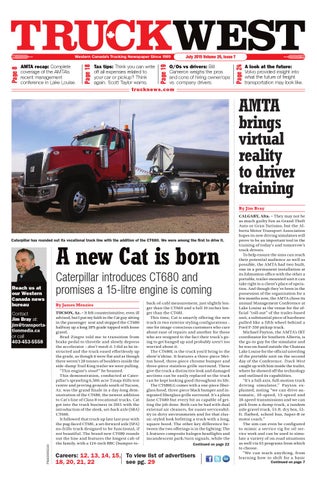
Caterpillar has rounded out its vocational truck line with the addition of the CT680. We were among the first to drive it.
A new Cat is born
Caterpillar introduces CT680 and promises a 15-litre engine is coming
Reach us at our Western Canada news bureau
By James Menzies
PM40069240
Contact Jim Bray at: jim@transportationmedia.ca or call 403-453-5558
pg 01, 07, 22-23 tw july v3.indd 1
TUCSON, Az. – It felt counterintuitive, even ill advised, but I put my faith in the Cat guy sitting in the passenger seat and stopped the CT680 halfway up a long 18% grade topped with loose gravel. Brad Zingre told me to transition from brake pedal to throttle and slowly depress the accelerator – don’t mash it. I did as he instructed and the truck eased effortlessly up the grade, as though it were flat and as though there weren’t 28 tonnes of boulders inside the side-dump Trail King trailer we were pulling. “This engine’s stout!” he beamed. This demonstration, conducted at Caterpillar’s sprawling 6,500-acre Tinaja Hills test centre and proving grounds south of Tucson, Az. was the grand finale in a day-long demonstration of the CT680, the newest addition to Cat’s line of Class 8 vocational trucks. Cat got into the truck business in 2011 with the introduction of the sleek, set-back axle (SBA) CT660. It followed that truck up late last year with the pug-faced CT681, a set-forward axle (SFA) no-frills truck designed to be functional, if not beautiful. The brand new CT680 rounds out the line and features the longest cab of the family, with a 124-inch BBC (bumper-to-
back-of-cab) measurement, just slightly longer than the CT660 and a full 10 inches longer than the CT681. This time, Cat is smartly offering the new truck in two exterior styling configurations – one for image-conscious customers who care about ease of repairs and another for those who are resigned to the fact their truck’s going to get banged up and probably aren’t too worried about it. The CT680L is the truck you’d bring to the show’n’shine. It features a three-piece Metton hood, three-piece chrome bumper and three-piece stainless grille surround. These give the truck a distinctive look and damaged sections can be easily replaced so the truck can be kept looking good throughout its life. The CT680LG comes with a one-piece fiberglass hood, three-piece black bumper and integrated fiberglass grille surround. It’s a plain Jane CT680 but every bit as capable of getting the job done. Both can be had with dual external air cleaners, for easier serviceability in dirty environments and for that classic-styled look befitting a truck with a long, square hood. The other key difference between the two offerings is in the lighting: The L features composite halogen headlights and incandescent park/turn signals, while the Continued on page 22
Careers: 12, 13, 14, 15, To view list of advertisers see pg. 29 18, 20, 21, 22
CALGARY, Alta. – They may not be as much guilty fun as Grand Theft Auto or Gran Turismo, but the Alberta Motor Transport Association hopes its new driving simulators will prove to be an important tool in the training of today’s and tomorrow’s truck drivers. To help ensure the sims can reach their potential audience as well as possible, the AMTA had two built, one in a permanent installation at its Edmonton office with the other a portable, trailer-mounted unit it can take right to a client’s place of operation. And though they’ve been in the possession of the organization for a few months now, the AMTA chose its annual Management Conference at Lake Louise as the venue for the official “roll-out” of the trailer-based unit, a substantial piece of hardware pulled like a fifth wheel behind a Ford F-350 pickup truck. Michael Payton, the AMTA’s IRT coordinator for Southern Alberta, is the go-to guy for the simulator and he was on-hand outside the Chateau Lake Louise for the official unveiling of the portable unit on the second day of the Conference. Truck West caught up with him inside the trailer, where he showed off the technology and outlined its capabilities. “It’s a full-axis, full-motion truck driving simulator,” Pay ton explained, noting “we can drive automatic, 10-speed, 13-speed and 18-speed transmissions and we can pick from a dump truck, a tandem axle gravel truck, 53-ft. dry box, 53ft. flatbed, school bus, Super-B or motor coach.” The sim can even be configured to mimic a service rig for oil service work and can be used to simulate a variety of on-road situations as well via 65 programs from which to choose. “We can teach anything, from learning how to shift for a basic Continued on page 7
15-06-10 2:58 PM
MAKE LESS WORK OUT OF WORK.
People think truck drivers simply drive, but we know better. Standing between you and Job Well Done are all sorts of distractions. We introduced I-Shift so shifting isn’t one of them. It can help you stay focused, productive and safe – true goals of every professional driver. This is why I-Shift is standard on every new Volvo truck. Learn more at volvotrucks.ca.
VNX Volvo West.indd 1
Volvo Trucks. Driving Progress
15-03-06 9:34 AM
TRUCK WEST jUly 2015
ISSN 0700-5016 (Print) ISSN 1923-3531 (Online)
Truck West, is published monthly, 12 times a year, by Newcom Business Media Inc.
Production: Carolyn Brimer, Beverley Richards Circulation Manager: Mary Garufi President: Jim Glionna Vice President: Joe Glionna
Advertising Sales
Inquiries: Kathy Penner (416) 510-6892
Lou Smyrlis
Kathy Penner
PuBl ISHer , eDITOr Ia l D Ire CTOr
aSSOCIaTe Pu Bl ISHer
lou@TransportationMedia.ca
kpenner@trucknews.com
(416) 510-6881
(416) 510-6892
Don Besler
Brenda Grant
NaTIONa l aCCOu NT Sa le S Ma NaGer
NaTIONa l aCCOu NT Sa le S Ma NaGer
(416) 494-3333
brendacgrant@bell.net
(416) 699-6966
donbesleris@rogers.com
Doug Copeland
r eGIONal aCCOuNT MaNaGer
(905) 715-9511
dcopeland@trucknews.com
Editorial
Inquiries: James Menzies (416) 510-6896
James Menzies
Sonia Straface
(416) 510-6896
(416) 510-6890
exe Cu TIVe eDITOr
jmenzies@trucknews.com
a SSISTa NT eDITOr
sstraface@ TransportationMedia.ca
3
This event merits more support Editorial Comment James Menzies As you’ll see on TruckNews.com, I spent May 30 covering the Toronto Regional Truck Driving Championships. At the event, nearly 50 of the Greater Toronto Area’s most skilled drivers competed head-to-head in a variety of competitions, the highlight being an obstacle course that mimics some of the most challenging driving scenarios a pro driver will ever encounter. These events – some call them Roadeos – are held across Canada and culminate with the National Championships, which will be held this fall in Regina, Sask. I believe these championships are the greatest showcase our industry has for the skills and professionalism exhibited by our drivers. Which begs the question, why do so few fleets participate? Sure, there were about 50 drivers at the Toronto Regionals, but most of them drove for just a handful of fleets. Those who like the championships, like them a lot. Speedy Transport had eight drivers entered and company CEO Jared Martin was there to root them on. Likewise, Fortigo Freight was well represented and president Elias Demangos was on-hand to support them. Con-Way, YRC, FedEx…these guys get it. Most of these drivers arrived in company attire and the level of camaraderie on display is unmatched at any other industry function I’ve attended.
Pr ide i n t he profession is front and centre at the championships. They’re open to t he public and free to attend. For f leets, it’s also a great form of inexpensive remedial training. D r i ver s spend t i m e p r e p a ring for the competition and are forced to complete a w ritten test and also a pre-trip inspect ion under t he watchful eye of an MTO enforcement officer. So why a ren’t a l l f leets encouraging their drivers to participate? The Toronto Regionals used to attract about 100 drivers just a few short years ago, so participation is clearly waning. Yes, some fleets prefer to host their own, in-house competitions and awards programs – which is fine – but considering the work the volunteers put into hosting the Regionals and Provincials across the country, why not leverage that to supplement your own internal initiatives. For an industry that cries bloody murder about its drivers not being recognized as the professionals they are, why is it so few fleets show up to support the best showcase of this professionalism that exists? I just don’t get it.
That’s not to say the Toronto Regionals were a bust – far from it. The level of competition was top-notch and a strong team of local winners will go on to represent the area in the Provincials and hopefully from there, the Nationals. Still, it’s a shame there aren’t more fleets that see the value in taking part in this event, which some have described as the Olympics of trucking. This is an event that merits more support than it receives. James Menzies can be reached by phone at (416) 510-6896 or by e-mail at jmenzies@trucknews.com. You can also follow him on Twitter at @JamesMenzies.
See you at the Summit in October Julia Kuzeljevich
CONTr IBu TING eDITOr
(416) 510-6880
julia@TransportationMedia.ca
TRUCK WEST is a proud member of the following trucking associations: ALTA. MOTOR TRANSPORT ASSN.
SASK. TRUCKING ASSN. MAN. TRUCKING ASSN.
B.C. TRUCKING ASSN.
Subscription inquiries
Anita Singh (416) 442-5600 (Ext. 3553) From time to time, we make our subscription list available to select companies and organizations whose product or services may interest you. If you do not wish your contact information to be made available, please contact our privacy officer via one of the following methods:
Phone: 1-800-668-2374 Fax: (416) 442-2191 E-mail: vmoore@annexnewcom.ca
Mail: Privacy Officer, 80 Valleybrook Drive, Toronto, ON M3B 2S9 RETURN UNDELIVERABLE CANADIAN ADDRESSES TO: CIRCULATION DEPARTMENT, TRUCK NEWS, 80 VALLEYBROOK DRIVE, TORONTO, ON M3B 2S9 PUBLICATIONS MAIL AGREEMENT NO. 40069240
We acknowledge the financial support of the Government of Canada through the Canada Periodical Fund of the Department of Canadian Heritage.
pg 3 tw july v3.indd 3
For several years now we, along with our sister publication Canadian Shipper and Dan Goodwill and Associates, have taken a proactive approach to improving shipper-carrier relations, by bringing the buyers and providers of surface transportation services under the same roof with the Surface Transportation Summit to discuss and debate key industry issues. This year is no different and we are proud to open registration for what we think is the best line-up of topics and speakers we have yet put together. This year’s Surface Transportation Summit takes place once again at the Mississauga Convention Centre on Oct. 14. Visit www.surfacetransportationsummit.com to register. We are particularly excited that the Freight Management Association of Canada has jumped on board this year as a partner, helping us attract even more of your shipper customers and potential customers to the Summit. Another new wrinkle this year is the Business Matching program. Those participating in the Business Matching session will be able to pre-select in advance of the conference the companies with whom they wish to meet for private one-on-one 20-minute discussions, allowing both
The view with Lou Lou Smyrlis
parties to discuss business opportunities in depth. The Economic Outlook, which starts the Summit, should be particularly interesting this year. The economic recovery stumbled in 2015 as a 50% drop in the price of oil had a dramatic impact on Canada’s energy sector but made for cheaper energy pricing for manufacturing. Meanwhile the significant drop in the value of the Canadian currency (and other currencies) compared to the US dollar is having an impact on northsouth traffic flows. How will these forces play out over the next 12 months? One of Canada’s leading economists will provide an economic overview of 2015 and share his insights on where the economy is headed in 2016. He will be joined by a leading equity analyst who follows the transportation sector and will offer his perspective on how the economy will affect truck and rail carriers specifically. And I will also be interviewing carrier executives for their
thoughts on the coming year and how they will be shaping their business strategy accordingly. Another favourite session back thisyear is The View from the Top, with rail, trucking, 3PL and OEM executives sharing where they plan to take their organizations in 2016. This will be followed with the largest Shipper-Carrier Roundtable we have put together. I’m moderating this session, featuring no less than seven key industry executives representing major carriers, shippers and 3PLs and we will leave no major subject untouched. You may want to sit up close, there could be some fireworks with this one. The afternoon will include sessions on carrier benchmarking, shipper and carrier scorecards, best practices in buying a transportation company and outsourcing. We close with an impactful session on the future of retail distribution in Canada. As mentioned it’s an agenda that we are very proud of. I hope to see you there come Oct. 14. Lou Smyrlis can be reached by phone at (416) 510-6881 or by e-mail at lou@Transportation Media.ca. You can also follow him on Twitter at @LouSmyrlis.
15-06-11 10:47 AM
CHOOSE MICHELIN X ONE TIRES FOR INCREASED FUEL EFFICIENCY, PAYLOADS AND UPTIME. ®
®
Switching to MICHELIN ® X One ® wide base single tires can save you up to 10% in fuel 1 and 1,410 pounds in payload. That’s why more than two million X One tires have worked hard for customers across North America. As the pioneer in wide base single tire technology, Michelin has introduced tires and retreads to fit every application. Our innovation continues with the SmartWay ® verified MICHELIN ® X One ® Line TM Energy D and MICHELIN ® X One ® Line TM Energy T— the most fuel-efficient tire combination in the industry. To learn more, visit michelintruck.com. 1 Based on industry standard rolling resistance testing of comparable tires and retreads. Actual results may vary, and may be impacted by many factors, to include road conditions, weather and environment, driver performance, etc. © 2015 MNA(C)I. All Rights Reserved. The “Michelin Man” is a registered trademark licensed by Michelin North America, Inc. (C13161 - 05/15)
Michelin West.indd 1
15-06-01 3:55 PM
cross-border
US to require ESC on all heavy trucks WASHINGTON, D.C. – The National Highway Traffic Safety Administration (NHTSA) announced June 3 it will require heavy trucks to be equipped with electronic stability systems, beginning in August 2017. The agency says the mandate will save up to 49 lives and prevent up to 1,759 crashes each year, producing a net economic benefit of more than US$300 million annually. The mandate will require the use of full electronic stability control (ESC). “ESC is a remarkable safety success story, a technology innovation that is already saving lives in passenger cars and light trucks,” US Transportation Secretary Anthony Foxx said. “Requiring ESC on heavy trucks and large buses will bring that safety innovation to the largest vehicles on our highways, increasing safety for drivers and passengers of these vehicles and for all road users.” The final rule calls for the use of ESC on heavy trucks exceeding 26,000 lbs in gross weight. It will take effect for most heavy trucks two years from publication, or in August 2017. The US trucking industry welcomed the new mandate. “Ensuring the safety of America’s highways has always been ATA’s highest calling,” said ATA president and CEO Bill Graves. “And we’ve long known the positive role technology can play in making our vehicles and our roads safer. Today’s announcement by NHTSA will reduce crashes on our highways and make our industry safer.” “Last month, NHTSA reported to Congress that truck rollover and passenger ejection were the greatest threats to truck driver safety,” added ATA executive vice-president Dave Osiecki. “We can save lives by preventing rollovers with electronic stability control technology, and that’s a positive for our industry. Many fleets have already begun voluntarily utilizing this technology and this new requirement will only speed that process.” Also voicing approval for the mandate was Bendix, which manufacturers electronic stability systems and has long advocated for a full-stability, rather than roll-only stability, requirement. Full electronic stability can help prevent a wider range of crashes. “At Bendix, we always prefer to let the market be the catalyst to drive safety technology adoption. We believe ESC stands alone in terms of safety, performance and value. And we have also seen a market acceptance of this technology – over RSC – at a rate of three to one,” said Fred Andersky, Bendix director of government and industry affairs. “This technology is another positive step on the part of our industry toward helping to further improve highway safety.”
pg 05 tw july v3.indd 7
Quality occupational health & safety support for the trucking industry. Occupational Health and Safety Services Training and Education Tools and Resources Advice and Program Support
TOLL FREE: 1-877-414-8001
The Certificate of Recognition We provide COR to the BC trucking industry.
Check out our services and programs at:
www.safetydriven.ca
15-06-11 11:28 AM
6
british columbia
B.C. trucking strategy gets thumbs up from industry group By Jim Bray LANGLEY, B.C. – A 10-year transportation plan for Canada’s westernmost province is being greeted as good news by the British Columbia Trucking Association. The document, B.C. on the Move: A 10-Year Transportation Plan, was released by the province in mid-March and outlines a number of priorities and commitments to construction and maintenance of the province’s road infrastructure. The strategy was an initiative of the Ministry of Transport and Infrastructure, but BCTA president and CEO Louise Yako noted that it wasn’t created in a vacuum. “They consulted for several months over the fall, and we were part of that process,” she said. “In fact, ministry staff came to meet with and discuss the concept and talk about priorities with our board last fall and many of the components of the trucking strategy involve priorities identified by BCTA.” Yako said this was the first time the province has put together any strategy that’s specific to trucking, let alone a 10-year plan. “We’re very pleased,” she said. Yako pointed to a couple of reasons she thought might have been behind the province’s decision to create the plan. “This government recognizes the value of transportation to the B.C. economy and in particular they recognize the value of trucking to the transportation network,” she said, “and they see that as a competitive advantage for our province. They’re really putting their money where their mouth is on this and coming up with something concrete that we can hold them to account for and the people of the province can point to as being a commitment that’s made by this government.” While the plan may outline strategies for a decade out, that doesn’t mean the money is being committed that far ahead. In fact, it only promises at least three years of funding and also requires federal money to complete some of the plans. Yako doesn’t think that’ll be a problem, however. “It’s based on the three-year funding cycle that the provincial govern-
pg 06 tw july v3.indd 6
ment is always involved in, so there’s no new money from the provincial perspective,” she said, “but what it does do is provide very concrete and specific focus on the things in the strategy.” As for the requirement for cash from other sources, “one of the successful components of achieving federal matching funding in the past has been to be able to show that the provincial government is committed to specific projects and they’ve done the planning and the background work necessary to show that they’re shovel-ready. I think (that’s what) the provincial government is hoping to show.” Among the points the plan pushes are upgrading and replacement of bridges and overpasses to accommodate the increasingly hefty loads industry needs to move. It also pledges to build at least two new truck parking areas in the Lower Mainland and 20 new inspection pull-outs across the province, as well as the four-laning of Hwy. 1 between Kamloops and Golden (an area that can be challenging for trucks and cars alike), completion of the Hwy. 97/Cariboo Connector updates and moving forward on the George Massey Tunnel Replacement Project. It also promises to four-lane Hwys. 97 and 2 in the Northeast part of the province and upgrade Hw y. 3 via more four-lane segments or passing lanes. The province also committed to streamlining the permitting process, which in some cases means reducing the number of permits required, to support the office of the Independent Container Trucking Commissioner and to review the province’s pilot-car requirements. Not all of the BCTA’s recommendations made the cut. The association had lobbied for the six-laning of Hwy. 1 from Hope to Langley, for example, whereas the strategy merely pledged to initiate a design phase for such a segment between Langley and Abbotsford, at the least. Also not on the province’s agenda right now is a strategy for super-single tires and for making electronic logging devices mandatory to help reduce driver fatigue and ensure compliance with hours-of-service
rules. “The government’s been pretty clear that they’re not interested in moving in those directions,” Yako said, noting however that the federal Transport Minister has been “very vocal about her support for ELDs so we’re hoping that that support will sway the provincial minister.” As for super singles, Yako said “it’s always been explained to us that the province’s desire not to pursue that at this point is really a cost issue for them and so if we can effectively make the point that super singles, while they may cause some additional damage, the improvements in the technology have been such that the damage is really quite minimal now – particularly if you compare it to things like dual tires that have not been fully inflated.” She promised that the BCTA is continuing the discussion and raises it with the ministry periodically. “We’ve had no indication from them that they’re willing to change their mind at this point,” she said, “but we are pretty committed. We know that our members want that change and certainly we’re seeing other provinces make that change – Manitoba most recently – and so we’re going to keep asking for it until we get it.” Another area in which the BCTA would like to see movement is expanding the province’s LCV routes so Rocky Mountain Doubles will be able to connect Kamloops with the Alberta border. Yako thinks there may be some hope here, however. “I think if you look closely at the strategy, they have committed to recognizing the value of supporting the use of vehicles that are more efficient and productive and so that’s certainly something that we expect will be part of the outcome of the strategy.” Even though the province didn’t embrace all of the BCTA’s suggestions, Yako doesn’t think they’ll have to wait another 10 years for the province to look at additional issues. “I don’t think the plan precludes other things being done or added to the ministry’s work plan,” she said. Part of the plan commits the government to “work with industry” and, while that may be rather vague, Yako doesn’t see a problem. “We have a very good working relationship with
the Ministry of Transportation,” she said. “I think we all agree on the priorities because a lot of our priorities are reflected in that document and they’re very good at listening, especially over the last few years; we’ve had an extremely cordial and I think effective working relationship.” The plan also pledges to explore “partnership opportunities” with the private sector to identify locations to construct new truck stops and facilities, and Yako says the BCTA is there already. “We’ve developed a very comprehensive rest area plan,” she said. “We’ve done the research and developed a briefing note that summarizes the research in terms of best practices for siting rest areas. And we’ve gotten very general rules of thumb that we think need to be followed based on that research.” She said the next step, on which they’re working with the Trucking Safety Council of B.C. and the province’s government insurance company (ICBC), is to conduct a survey of professional drivers “to get their views in terms of where the exact locations or the ideal locations for additional rest areas should be, as well as asking them about preferred amenities at those rest areas.” She said that will happen this year. While the plan consists mainly of broad brush strokes, Yako said “we’re interested in the details, and that’s why we’ve asked for and they have agreed to a meeting where we’ll get some of those details and also talk about how it is we can work together more effectively to ensure implementation of the plan in a way that industry would like it to roll out.” She reiterated that the BCTA is grateful to the Ministry for acknowledging the importance of the trucking industry and identifying specific projects and priorities important to the trucking industry. “We have a good working relationship with them,” she said. “We all want the same things and this is just a roadmap on how we get something done.” For more information, you can check out a copy of the 60-page “BC on the Move: a 10-Year Transportation Plan” document the B.C. government posted on its Web site at http:// bit.do/bconthemove.
15-06-10 3:00 PM
alberta
TRUCK WEST JUly 2015
7
Alberta fleets now have cost-effective training simulator available Continued from page 1
driver to (driving techniques to maximize) fuel economy,” Payton said. “We can teach rollover protection, we can teach advanced driving techniques, how to properly navigate left and right turns.” Payton admitted that he learned how to shift thanks to the simulator. “I went out and drove a tractor-trailer in the city of Calgary and successfully drove an 18-speed transmission after learning off this thing,” he said. The technology comes courtesy of Virage Simulations of Montreal, who Payton said built the simulator itself and then had it installed into the trailer before delivering it to the AMTA. Besides the simulator itself, which includes a panoramic setup of three large LCD video screens meant to give the student driver a realistic view in front and beside, the trailer also contains a debrief station. Located only a few feet away from the actual simulator, its monitor (mounted on the wall next to the table) mirrors the sim’s data. “We can have students sit (at the table) while we have a driver (in the seat),” Payton said, “and since they’re not together the students can watch (the driver) and they’re not bothering the driver (during the exercise).” Payton said he can teach four people at one time comfortably, rotating through them as they each get some seat time. Sessions are generally about 10 minutes, though Payton noted that “20 minutes is the absolute maximum length.” At the other end of the trailer, behind a Wizard of Oz-like curtain, are the brains of the simulator. “There’s five computers that run it,” Payton said, “one master and four slaves and the four slaves do different functions. One runs the video, one runs the motion, one runs the scenarios and the other does the control panels.” The result is a high-resolution audio and video extravaganza that provides a safe – and quite fun – way to learn real-world driving skills in realistic scenarios. “It’s as close to real as possible,” Payton said. “It’s 2D, not 3D but once you get used to driving in the 2D world, it’s very realistic.” Pricing for fleets is very realistic as well. “There’s a movement fee if we leave the city of Calgary,” Payton said, “but if you’re a regular paid (AMTA) member it’s $30 an hour, with me included. There are businesses in Calgary now that are charging close to $200 an hour with an instructor (for such simulations).” The fixed simulator in Edmonton uses the same technology, and the rates are the same (sans “carrying charges”). If the simulators’ early reception is any indication, they could turn out to be a very popular tool. Payton said it has already been quite in demand despite its lower profile before the Lake
Louise coming out party. “I was out three times this week, training,” he said, “and we’ve been out doing a bunch of demonstrations for different people who wanted to see it.” Payton said they’ve been hired by “a couple of different companies” so far to do short training sessions, and the reaction has been “absolutely amazing. Skeptical people, truck drivers who’ve been driving for 25, 30 years will come in and think it isn’t real enough, but once they get into it, their tone changes completely and they think it’s a great training tool.”
Spec Your Trailer With the DEFENDER Harness and LED Lighting System. Stay lit and stay on the road with the only harness and LED lighting system guaranteed* for 10 years against corrosion. With heavy-duty terminals, integrated moisture barrier, advanced silicone seals, modular design, and a patented hard-shell J560 connector — DEFENDER stops corrosion before it starts. When you need to deliver, drive with DEFENDER. ®
816-765-2000 • www.pmlights.com
Scan for DEFENDER ® Demo Video
*See dealer for details.
2015 Defender TN/TW.indd 1
pg 01, 07, 22-23 tw july v3.indd 7
Exclusive advances in modular harness technology make DEFENDER ® virtually impervious to moisture and corrosion.
6/4/15 10:29 PM
15-06-10 2:34 PM
8
alberta
Trucking is just okay now, but could be better long-term: Bradley By Jim Bray LAKE LOUISE, Alta. – “Welcome to Ontario!” With those cheery words, inspired by polls predicting an NDP victory in the following week’s Alberta provincial election, Canadian Trucking Alliance president and CEO David Bradley began his wide-ranging address to the Alberta Motor Transport Association’s annual Management Conference at the Fairmont Chateau Lake Louise in early May. “This job has cured me of partisan politics,” he said, adding “a pox on all their houses as far as I’m concerned.” Bradley’s address stressed the importance of Alberta to the rest of the country and he had positive words for the AMTA as representative of the industry there. “Canada is a strange federation that works in an odd sort of way at times,
and CTA is as well. And just as Canada needs a strong Alberta, to do what we do, CTA needs strong provincial associations, and particularly a strong AMTA,” Bradley said. He emphasised that the CTA and all the provincial associations need to be moving “in lock step together” to be effective and he praised AMTA president and CEO Richard Warnock for bringing his experience and common sense to the table. “It’s really helped us an awful lot,” he said, adding that he looks forward to working with executive director Lorraine Card as well. Bradley then outlined some of the CTA’s recent accomplishments, tying them into the Alberta situation, noting that one of the things the industry has been pushing for the past 10 years or so is a universal electronic logging device mandate.
“It’s the way the world is going,” he said. “There’s an app for virtually everything else, so it doesn’t make sense in this day and age to need paper logbooks. But it’s been a bigger challenge than we thought trying to get the political buy-in.” He said part of the reason for the lack of political action is that the industry itself has done a phenomenal job of improving its safety performance, and noted that “just in March, finally, the federal Minister of Transport announced that the government was committed to introducing a universal ELD mandate.” The next step would be to get provincial buy-in, he said. Addressing the driver shortage, Bradley said that most of the problem is the carriers’ responsibility because “They’re the only ones that have the power to actually deal with it.”
INFINITE
POSSIBILITIES
FW35 – THE MOST VERSATILE AND PROVEN FIFTH WHEEL ON EARTH Durable cast steel FW35 Series fifth wheels offer fleets more features and options for more applications than any other fifth wheel in the industry. • Approved for moderate, standard and heavy-duty • FW31 NoLube™—the world’s only completely grease-free fifth wheel • Convenient and safe in-cab air release • Twin lock design—proven and trusted by fleets for over 60 years • Industry’s only Performance Guarantee of 6 years/600,000 miles
FW31 NoLube™
Why would you spec any other fifth wheel?
www.safholland.ca 519-537-3494 Specify for Peak Performance
pg 8-9 tw july v3.indd 8
In-Cab Air Release
© 2015 SAF-HOLLAND, Inc. All rights reserved.
Groups like the CTA and Trucking HR Canada, he said, can try to help but “We don’t hire, we don’t fire, we don’t go to the market to get rates; it really falls to the people who are hiring and doing the recruiting and retention.” He reiterated that the occupation really needs to be deemed a skilled one, or at least “closer to a trade.” “Whether that means a Red Seal-type of situation (or not), evolution is suggesting that’s the direction we’re going to head in and if we have the occupation recognized for what it really is, then that should help us in terms of access to funding for training, it should help us in terms of attracting younger people who are looking to the trades. But (trucking) isn’t in the game because we don’t have that piece of paper. The occupation has to reflect the attributes of other skilled occupations.” Bradley also decried the lack of a national perspective on greenhouse gases. “Our federal government’s position… is ‘We’ll just do whatever the American do, no more, no less.’ They put virtually no effort in at the bureaucratic level to actually analyze things and figure out if there’s a Canadian perspective on any of this, so the rules get developed by Congress, with US politics at play.” He said that has worked adequately in the past, but “the federal role ends at the retail sale of the truck,” which he said leads to engine tampering and means “federal regulation means absolutely nothing at this point.” He also noted that upcoming standards out of the US will mean the Canadian government’s laissez faire attitude won’t work. “They (the Americans) are going to be looking at it from the perspective of an 80,000-lb tandem-tandem, not B-Trains, not all the various configurations we have in Canada or at the weights we have.” Addressing the issue of transporting dangerous goods, Bradley noted it’s a huge concern for the trucking industry. “We tried to make the case (to the federal government) that when you look at things in their totality, a Lac Megantic would not occur in a trucking situation,” he said, adding that the existing regulations for the most part are “pretty darn effective.” Bradley wrapped up his address by telling delegates he thinks the trucking industry overall is currently “Okay. Things aren’t great, but they’re not bad.” He blamed part of the problem on the driver shortage and said that it looks like the US recovery, while modest, is real and “we’re seeing (a north-south) balance returning and that’s helping.” When asked about industry consolidation, he said “Just about every trucking company in Canada is for sale, it’s just whether you can get the price you think it’s worth,” though he also noted he doesn’t think the family-owned trucking company is an endangered species. “I think we’re a long way from that,” he said, “but I do think there’s a natural progression that industries go through in terms of consolidating and we’ll probably see more of that in the next few years.” His bottom line was that, despite its many issues, he’s still bullish on the industry and its future. “As long as people have to eat and as long as the people who produce anything need (their things delivered) it’s going to be moved by truck and that’s really good to know.”
15-06-10 3:02 PM
TRUCK WEST jUly 2015
9
Trucking HR previews national occupational standards By Jim Bray LAKE LOUISE, Alta. – You could say there was a bit of a school of hard “NOC’s” at the Alberta Motor Transport Association’s annual Management Conference at the Fairmont Chateau Lake Louise over the May 1 weekend. That’s thanks to Trucking HR Canada’s CEO, Angela Splinter, who was on-hand to outline to delegates the latest updates on her organization’s quest to help combat the industry’s personnel shortage. NOC, the National Occupational Classification system, is the nationallyaccepted reference on occupations in Canada. Splinter’s lunchtime address outlined how the system classifies over 40,000 different occupations, pigeonholing them into what she called “occupational groupings” while assigning them skill levels ranging from A to D – with A being the highest. “The NOC code system also provides the government with a means of collecting statistics,” Splinter said, “and informs policies like the Foreign Worker Program and how training dollars get allocated.” Splinter noted the truck driver designation sits at skill level C, or unskilled, which, “excludes us from apprenticeship-like funding – dollars allocated to training – and excludes us from bringing in internationally trained drivers through a more permanent immigration system.” To hopefully help address the situation, Splinter’s organization has come up with a National Occupational Standard (NOS), previewed at the AMTA event and announced publicly the Monday following. The NOS attempts to give clear definitions to the actual jobs of commercial drivers, a diverse bunch of people who guide the wheels of a diverse bunch of equipment through a diverse bunch of environments on a diverse number of tasks. “The (accepted) grouping of truck driver has us lumped in with what could be conceived of as ‘every driver known to Man’ – for example, long-haul driver, short-haul driver, tow truck driver, dump truck driver, moving van driver are all lumped in the same,” Splinter said. “Our concern is that when they do statistical analysis of the occupation, the data isn’t necessarily as accurate as it could be.” The NOS document “has us clearly identifying the knowledge, skills and abilities that Canada’s commercial vehicle operators or truck drivers need to perform their jobs,” Splinter said, noting that work on it started a year ago with the establishment of a national working group that included experienced drivers and driver trainers, including the AMTA’s Brian Bell and Grimshaw Trucking’s Jane Douziech from Alberta. “The (NOS) we’ve developed for drivers has gone into a level of detail that we’ve never done before in defining the driver occupation,” she said, noting that “the first step we did was take an inventory of everything that exists across the country with regards to defining the occupation, including work you’ve done in Alberta on minimum driving standards.” Once the first draft of the document was finished, Splinter said, they took it across the country for feedback. We had sessions in each region, and…we reviewed every task in this standard, line
pg 8-9 tw july v3.indd 9
by line because we wanted to make sure we had it right and…that we had a truly national occupational standard.” Topics of discussion included such things as the difference between urban and rural, and what constitutes adverse weather conditions. “In Ontario, in Toronto, a couple of inches of snow shuts everything down,” Splinter said, “but the western folks approached the topic by saying if they didn’t drive in adverse weather conditions they’d never drive!” There was some more serious discussion, too. “They were very technical, in focusing on what it is that a driver does,” Splinter said, “and every session had consensus at the end of it in terms of what we’re doing and what we’re defining.” Splinter said the result is “We have a NOS that can better inform training programs and ensure that these training
TRAILER
programs meet industry needs. It will support certification programs which identify drivers who have the required knowledge, skills and abilities.” While admitting that the NOS is ultimately just a supporting document along the path to mandatory training, she said “It will (help) by aligning the training programs to the National Occupational Standard.” Trucking HR Canada wants the NOS to provide the foundation for consistent and quality training with schools using the standard to ensure their curricula prepare students better for a career behind the wheel. “We approached this task with that end goal in mind,” Splinter said, “meaning we described the knowledge in a way that can be measured in a written test. The work tasks include supporting steps – it has a definite beginning and a definite end and it’s either
observable or measureable.” Splinter said it’s hoped the NOS will help with the recruitment and retention of drivers. She said the NOS should help by helping dispel the myth that anyone can be a truck driver. “It is not just true that anyone that can be a commercial vehicle operator,” she said, “and the NOS outlines why. So at the end of the day we have taken a successful first step forward in increasing the skill recognition for drivers.” As for the NOC code itself, “it needs to be changed too, to better reflect the skill level of drivers,” Splinter said. “There is a long road ahead in trying to get the skill occupation within the NOC code changed, but the NOS certainly gives us a first step at least.” The NOS document is available for free download from the organization’s Web site at truckingHR.com.
R E N TA L | L E A S I N G | S A L E S | S T O R AG E | PA R T S | S E R V I C E
Canada’s One-Stop Trailer Shop named one of
Canada’s Best Managed Companies Trailer Wizards has been delivering dependable, professional service nationwide for over 50 years and is now one of Canada’s Best Managed Companies. Put our award-winning trailer expertise to work for you. Contact us today.
1 855 327 9757 | trailerwizards.com
15-06-10 3:02 PM
10
alberta
TRUCK WEST jUly 2015
AMTA conference shifts gears in afternoon business session By Jim Bray LAKE LOUISE, Alta. – Today’s hightech automated transmissions for the trucking industry are not only pushing the state-of-the-art forward, they’re also useful as recruiting and retention tools that could help a company combat its driver shortage. That was the uptake from the afternoon business session of the Alberta Motor Transport Association’s annual Management Conference, which saw a panel of industry experts outline the latest and greatest in transmissions as well as face some pointed questions from the audience on hand. The quartet on the panel consisted of Chris Stadler (Volvo Trucks), Aaron Scates (Daimler Trucks North America), Michael Marcoux (Allison Transmission) and Shane Groner (Eaton). Each brought a unique perspective to the discussion, focusing on recent and future transmission developments. Not surprisingly, one of the main drivers of today’s automatics is fuel economy. Daimler’s Scates noted that today’s trannies aren’t like your father’s. “I can remember back when a manual transmission got better fuel economy than an automatic, at least on the car side,” he said, “but that really changed with the adoption and
integration of software, which has a lot to do with smoothing out driver behaviours and habits.” He said today’s automated manuals and automatics now seem to get better fuel efficiency on the truck side than manuals, though he also noted that “I don’t think AMTs or automatics are right for every application or for every fleet.” The panelists were asked to outline the main benefit for the industry their transmissions offered, and
“With some older drivers, who have that ‘If you ain’t shifting you ain’t driving’ kind of mentality, when you get them into (a truck with automation) for a few weeks, let them whine and complain a little bit, and then try to take the truck away again, their response changes.” Shane Groner, Eaton Eaton’s Groner led off by saying “total cost of ownership,” a comment echoed by the other panelists. He also mentioned Eaton’s Roadranger support network, parts availability and the transmissions’ integration with various engines and that
THIS MONTH’S CROSSWORD PUZZLE TW-145 July 2015 © M. Jackson
Answers on page 23
Across 1 Scale-equipped highway checkpoints (5,8) 8 Trucking-company office department 9 Conical traffic diverter 10 “Keep the rubber ____ down” 11 Winter-road description, often 13 Extra-cost new-truck item 15 PTO-driven add-on hydraulic system (3,3) 18 Hypoid lubricants (4,4) 19 Boston, MA, a.k.a. ____ Town 22 Van-body portion above cab 23 Battery’s ____ capacity specification 24 Pre-trip inspection items (4,9)
pg 10 tw july v3.indd 10
noted today’s transmissions offer “high levels of, fuel efficiency” and hinted that the growth in automated transmissions is skyrocketing. Allison’s Marcoux pointed out that one of the things his transmissions bring to the table is the “driver retention factor. The industry’s changing such that to recruit and keep qualified drivers becomes more difficult today than it was 10 years ago,” he said. He added “Ergonomics has a big
Down 1 2 3 4 5 6 7 12 14 16 17 18 20 21
Engine- and cab-heater brand Broke a truck-stop rule, perhaps Paint-damaging precipitation Dashboard switch type Truck’s maximum velocity (3,5) Diesel-engine incontinence (3,4) Canadian Tire money guy, ____ McTire Smokey on a Harley Big-rig power unit Double-axle setups Halifax-based ____ Road Transport New Hamburg, ON-based carrier Driver ____ accident cause Fixer-upper truck-ad words (2,2)
part to play as well in terms of your safety factors, such as keeping your hands on the wheel and of course when you get into automatic transmissions versus manuals, you also get into some maintenance issues that you can get from untrained drivers who drive manuals in terms of maybe missing or skipping a gear.” Marcoux said automatics can take the driver out of the equation when it comes to protecting the truck’s driveline. He also noted that Allison’s fully automatic transmission uses a series of stationary clutches combined with driving clutches relative to the inputs as well as the torque converter, which he said is a main differentiator for his company’s product. “We offer ultimate ratio steps that differ from our competition as well,” he said. Scates outlined his company’s DT12, a fully-automated 12-speed manual transmission with highspeed, computer-controlled shifting and clutch actuators that choose the right shift pattern and clutch engagement for optimal fuel economy and driving conditions. Volvo’s Stadler noted that his company has been offering the I-Shift 12-speed automated manual since 2002 in Europe, and in the US since 2007 and noted that “our volume in the market today is about 400,000 automated manual transmissions” so far and “if you look at the demand in Europe, it’s pretty much predominantly automated manual transmissions and it’s growing very fast here.” He said that nearly 90% of the company’s Canadian sales sport the transmissions. “We see the trend going toward automation and it’s more around efficiencies for the customer.” He said fuel efficiency is up to 3% better with the transmission, compared to its manual. “The transmission is basically the brain telling the engine what to do,” he said, noting that “it’s going to help the driver be more efficient in oper-
ations,” allowing the driver to focus more on the road and be less fatigued than with a manual transmission. One possible issue surrounding the move to automatics is how well drivers will accept them. According to the panelists, however, it’s not as much of an issue as one might think. “Behaviours are changing,” said Groner, noting that young drivers – many of whom may never have driven a manual – don’t seem to have an issue with automatics and even some of the curmudgeons are coming around. “With some older drivers, who have that ‘If you ain’t shifting you ain’t driving’ kind of mentalit y, when you get them into (a truck with automation) for a few weeks, let them whine and complain a little bit, and then try to take the truck away again, their response changes.” Groner also noted that with automated transmissions, fleets are seeing less brake and tire wear, as well as reduced clutch replacement and U-joint failures. Stadler said today’s transmissions can be a recruiting and retention tool because the drivers “aren’t as worn down at the end of the day and don’t have to worry about burning out clutches” as well as the transmissions saving companies money in maintenance by controlling the drivers’ behaviours to prevent abuse or misuse of the vehicle. They can also save training costs. “We can see up to 20% in savings (with automatics),” he said, noting that it’s like taking a week out of the training process. Making trucks less of a chore to drive could also help with recruiting women into drivers’ seats and help bring in people of smaller stature who may have had trouble operating a manually-equipped truck. Allison’s Marcoux told of a female owner/operator in Indianapolis with a f leet of pink dump trucks that are all automatic. “They’re all female drivers,” he said. One area in which the automated transmissions don’t seem suitable, at least yet, is garbage collection or, according to Daimler’s Scates, “anywhere with a lot of starts and stops.” Scates also noted the concept of ‘downspeeding’ and said his company is working on enabling even faster ratios. “The objective is to downspeed the engine to reduce the cruise rpms as much as possible to improve fuel economy,” he said. On the horizon is the type of seven-speed dual clutch transmissions now wriggling their way into high end sports cars such as Porsches, as well as remote diagnostics features and “virtual technicians” that can e-mail fault information back to headquarters. However you slice it, it appears the manual transmission may be as much of an endangered species in the trucking industry as it is in the passenger car market, and if these transmission experts are to be believed, the move to shiftless drivers is a good thing for everyone involved.
15-06-10 3:14 PM
22
ND ANNUAL OWNER/OPERATOR AWARD
Truck News & Truck West are proud to honour Canada ’s top Owner/Operator every year.
W
e know Owner/Operators are at the heart of the
trucking industry, investing both personally and financially in their businesses. We’re proud to take this opportunity to recognize the best among them. If you know an Owner/Operator who exemplifies professionalism while also demonstrating a clean driving record, a commitment to safety and a track record of community involvement, nominate them for this prestigious award by completing the application form.
In addition to a ring fit for a champion,
In addition to a ring fit for a champion, 2015’s honouree will also receive 2012’s honouree will also receive $3,000 CASH and a VACATION FOR TWO up to $2,500!
$6,000 CASH!
Nominations Nominations must mustbe bereceived receivedby byJune July 13, 31, 2012 2015 CO-FOUNDING SPONSORS OF THIS AWARD...
THE OWNER/OPERATOR SHOULDbe… BE... The Owner/Operator OF of THE the YEAR Year should Name: Address: Town/City:
Prov:
Home phone:
Bus. phone:
Postal code:
Email: Number of years in trucking/commodity hauled: Primary truck and engine: Number of vehicles: Contracted to (if applicable): How do youismaximize My choice based on:fuel efficiency?: My choice is based on: n Safe driving record n Industry/community involvement Safe driving record ❍ Industry/community involvement ❍
n Heroism Heroism ❍
n Going “Green” Initiatives Going "Green" Initiatives ❍
Explain:
OWNER/OPERATOR AWARD
(Include additional information on separate paper if insufficient space)
Nominated by:
Phone:
Mail completed forms to “AWARD” Truck News/Truck West, Attn: Kathy Penner 80 Valleybook Drive, Toronto, OntarioOntario M3B 2S9M3C 4J2 12 Concorde Place, Suite 800, Toronto, FORM MUST BE FILLED IN COMPLETELY AND NOMINEE MUST HAVE CLEAN DRIVER'S ABSTRACT
OO of the Year Award 2015.indd 1
15-05-11 2:21 PM
ENJOY THE DRIVE WE’LL TAKE CARE OF THE REST • New pay packages • Beneets starting day 1 • Pay rate to match experience • Tuition reimbursement for qualieed Trainees • Paid orientation New O/O Pay Open Board $1.13 Dedicated $1.12 East Coast Premium $0.04cpm Between: (ON, PQ, NB, NS) and (NY, PA, NJ, RI, MD, DE, DC, MA, ME, VT, NH, CT) *Introducing: Select Mid-West Premium $0.04cpm Between: (ON, PQ, NB, NS) and (Ohio, Michigan, Indiana)
Rajdeep Singh is a Recruiter with Challenger Motor Freight Inc. He has eight years of driver recruiting, and safety & compliance experience in the transportation industry. His friendly nature and advanced proociency in English, Hindi & Punjabi makes him easily approachable and he has been working closely with many communities throughout his professional career. His experience within the industry has allowed him to understand the needs and concerns that drivers face. Raj is always willing to go that extra mile in making sure that both the driver and the company is a good match for each other. Raj is very excited to have joined Challenger Motor Freight Inc. and is currently looking to hire qualioed OTR drivers and owner operators. Challenger is one of Canada’s 50 Best Managed Companies and is welcoming all transportation personnel to join their amazing team. You can ond out more mo about the new driving opportunities by contacting Raj at 416-735-4386 or rajdeeps@challenger.com. You can also apply online at www.challenger.com
T 1.800.334.5142 | F 1.888.876.0870 | recruiting@challenger.com | www.challenger.com
Challenger Motor Freight.indd 5
15-06-08 9:28 AM
Canada
TRUCK WEST jUly 2015
Researchers seeking fleets to participate in sleep apnea study By Sonia Straface TORONTO, Ont. – A new sleep apnea study in the Canadian trucking industry is underway and researchers are hopeful it will answer a lot of questions concerning the safety of our roads and drivers’ health. The study – pioneered by the Toronto Rehabilitation Institute, together with BresoTec Inc. – is aims to resolve the problem with research surrounding sleep apnea from a Canadian standpoint. According to scientists and researchers behind the study, there is currently no reliable research providing evidence on the severity of sleep apnea in the trucking industry here in Canada. To solve this issue, they proposed a study for which they need 1,000 truck driver participants to analyze the impact sleep apnea has on both the road and trucker health. “It’s really important to get a handle on how significant the problem is,” said Dr. Geoff Fernie, research director at the Toronto Rehabilitation Institute. “Some of the (US) reports we were reading were really quite frightening. We weren’t sure if the same applied to Canadian longhaul truck drivers as it does in the United States. And so (with the study) we want to find out within the industry how common it is, and see what affect it has on road accidents.” Sleep apnea and trucking are no strangers. The two actually go hand-inhand, because of the lifestyle and demographics of the trucking industry. “Because we’re aware of the problem with road accidents, we became very aware that truckers were perhaps particularly at risk for sleep apnea,” added Fernie. “There are reports in the literature, particularly in the United States, that a very high proportion of truckers have sleep apnea and that’s a worry to us.” Fernie said it is estimated that “roughly one in 10 people have sleep apnea, but only one in 10 of those one in 10 real-
unteers to be a part of the study, and has its eyes set on fleet managers and owners who would be willing to volunteer his/ her fleet for the study. “We are actively looking for participants for the study, and we’ve talked to CTA and they are very willing to help,” said Dr. Xavier Cheng, strategic partnerships officer at Toronto Rehabilitation Institute. “The key issue here is we want a homogenous population of truck drivers. We don’t want individual volunteers coming up because they feel like they have sleep apnea because they will bias the study, and we also don’t want truck drivers volunteering who know they don’t have sleep apnea coming up because they too will bias the study. Essentially we would like to test a whole fleet of truck drivers.” Cheng added that the way drivers will be tested for the study won’t be in a sleep laboratory overnight. Instead, drivers will use a device they can take with them
ly knows that they have it. That means 90% haven’t been diagnosed and that’s a problem because if you have sleep apnea and you’re not diagnosed, therefore not treated, you have four times the chance of having a heart failure or stroke and we’re not quite sure but somewhere around three or four times more likely to cause a road accident as well.” Dr. Hisham Alshaer, a scientist at the Toronto Rehabilitation Institute, added the study will try to find the correlation between sleep apnea and road accidents. “We also want to find out if those who have obstructive sleep apnea had some kind of car accident trigger in the past, so we want to find the link between obstructive sleep apnea and the record of vehicle accidents,” he said. The Institute is currently seeking vol-
13
at home or on the road. “With the nature of the device we can test the whole fleet at once,” he said. “There will be no down time for the truck drivers. It’s a very convenient process.” “We want to assure drivers that the study really is in their interest,” added Fernie. “Because if they do have sleep apnea, it’s a good idea to know it and to treat it.” There is no firm date yet on when the study is to officially begin because it is still in the fundraising stage, but the institute hopes it can kick off in the fall. “We’ve now raised $800,000 of the $1.2 million we need to run the study,” said Fernie. “And now that we’ve raised this much we are confidently going ahead and planning to start the study, if possible, in September.” Fleets interested in joining the study should contact Dr. Xavier Cheng at xinran.cheng@uhn.ca for more information. You can also follow @BresoTec on Twitter to learn more.
OWNER OPERATORS NEW TEAM RATES CANADA ONLY TEAMS $1.18 USA TEAMS $1.20 Find out about your lanes today!
Start up Costs No Slow Down
We Have Miles!
APPLY NOW AND START YOUR SUCCESS
G R O U P O F C O M PA N I E S
Ask us about our new leasing program
www.drivetransx.ca pg 13 tw july v3.indd 9
1.877.787.2679 15-06-11 11:29 AM
We Make Lease Purchase Look Good
Take advantage of all the benefits a leading international carrier can offer you. Choose from many fleet options to fit your lifestyle and enjoy our world-class leasing program: • $0 Down • If You Qualify for Hyndman, You Qualify to Lease • Per-Mile or Fixed Weekly Payment Options
800-499-4997 DriveHyndman.com Celebrated Past. Exciting Future.
Hyndman.indd 1
15-04-10 9:52 AM
compliance
TRUCK WEST JUly 2015
IRP: Light vehicles, heavy-duty benefits s many a kid will attest, how old you are can change depending on the situation. My brother used to lament the fact that when our parents needed him to something responsible it was because he was “almost 13” but when there was something they didn’t want him to do it was because he was “only 12.” When it comes to taxes and licensing, light-duty trucks fall into a similar grey area. Are they commercial vehicles that need to follow the rules that big rigs do? Or are they just like any other F-350 running up and down the highway? Well, it depends on the situation.
Permits & Licensing Sandy Johnson porary-use provisions, you can use IRP to apportion and pay sales tax on your light-duty truck, saving yourself the accounting work and potential exposure of non-compliance. Big savings?
The benefits can be substantial.
Say you buy a pickup truck for $50,000 and a trailer for $15,000 and plan to run regularly in B.C., Saskatchewan, and Manitoba. Under the temporary use formula you could pay as much as $4,300 per year in PST. Under IRP, you’d pay roughly $500 for your plate - including sales tax - and be licensed to run virtually anywhere in North America without a trip permit. Licensing under IRP and paying prorate vehicle tax also exempts you from paying PST on your trailer as well as any parts and repairs. If there is a downside, it’s that if you have to keep distance records by jurisdiction. However, you have to keep those records for insurance purposes anyway. A GPS device installed in your vehicle can take that pain away and produce the distance-by-jurisdiction reports you need. If you think you can fly under the “weight threshold” radar and avoid
15
paying sales tax on a light-duty vehicle, think again. Should the sales tax collectors catch up to you, be prepared to cut a heavy-duty cheque. Finally, don’t confuse IRP and IFTA weight thresholds with National Safety Code weight thresholds for logbooks, safety, and maintenance. Once you run a mile outside your home jurisdiction, you’re a federal carrier and fall under those rules for vehicles registered for 4,501 kg and greater. You may be a hotshot, but you’re a commercial vehicle operator just like the big kids. Sandy Johnson is the founder and managing director at North Star Fleet Solutions in Calgary. The company provides vehicle tax and license compliance services for trucking operations ranging from single vehicles to large fleets. She can be reached at 877-860-8025 or northstarfleet.com. To learn more visit FleetTaxPro.com.
Hot topic
Lately I’ve had a number of inquiries from guys using commercial-grade pickups in hotshot and other specialized services. They’re running freight all over Western Canada in light-duty trucks and want to know if IFTA and IRP apply to them. Well, a two-axle pickup truck with a trailer is definitely below the 11,797-kg weight threshold for IFTA compliance, so no worries there. This setup is also under the 11,794kg weight threshold for IRP but the program allows you to license lighterweight vehicles by choice. Should you do it? What’s IRP?
The International Registration Plan is an agreement among 10 Canadian jurisdictions and 48 states (plus Washington, D.C.) that allows you to license a vehicle to operate in those jurisdictions for one fee paid to your home jurisdiction. On your behalf, your base jurisdiction collects and pays out what you owe to all the other IRP member jurisdictions based on your percentage of travel. Medium and heavy-duty trucks that operate in two or more IRP-member jurisdictions must register under IRP. While you may not be required to register your trailer-hauling dually, it may be worth it. That’s because IRP is also used to administer other taxes like provincial sales tax, ad valorem tax, and third structure tax. Paying PST
Paying prorated vehicle tax through IRP is a potential advantage compared to paying tax conventionally, especially if you travel in Manitoba, Saskatchewan, or British Columbia. Each of these provinces collects PST on the depreciated value of vehicles and equipment (“goods”) that come into the province for “temporary use.” Saskatchewan charges 5% PST on out-ofprovince vehicles that operate there for one or more days in a 12-month period. B.C. charges 7% PST after five days of use. Manitoba’s temporary use formula has no minimum time and is simply based on the number of days the vehicle is in the province. Instead of fussing around with tem-
pg 15 tw july v3.indd 15
Hiring Owner Operators Opportunities include: - Short lane US (Operating in the Pacific NW) - Long haul US (Reefer & Dry Van) - Canada only lanes
1.800.462.4766 | drive@bisontransport.com | bisondriving.com Bison Transport is committed to Employment Equity and Diversity
15-06-10 10:13 AM
16
opinion
Automation has its limits
I
s automation levelling the playing field between drivers when it comes to performance? The notion that advanced engines and automated drivetrains can nullify a driver’s lack of experience or poor driving habits seems to be gaining some traction in safety and operations departments. My experience shows that this simply is not true. Sure, you will bump up the average mileage when switching from a stick to an automated transmission, but when you compare a driver’s performance to the fleet average on equipment with identical specifications, you will still have drivers performing well above or below that average and at every point in between. This speaks directly to the level of skill and experience within the driver pool as well as the amount of time and money that is being invested in educating and training drivers. Has the adoption of automated transmissions and other in-cab technologies affected how drivers are valued? I think it has, and not for the better. There is no doubt that technology is shifting standards and expectations within the trucking industry, but my fear is that we are moving towards an increasing dependence on monitoring a driver’s performance rather than enhancing it. The latest technology should not cage a driver’s ambition and cap their performance, it should help them tap into their full potential. Let’s take the truck with an automated transmission, limit its speed via the onboard software, and then add two cameras, one facing forward and one facing the driver. Let’s not forget the truck is equipped with satellite tracking and an electronic log. At this point, if you are an experienced driver, ask yourself a few questions: How many hours of training time have I received on this piece of equipment? Have I received training instilling me with confidence that my performance and safety will be enhanced? All of my actions are now being monitored, when and how is that information to be used? Do I trust my employer? Have any concerns over privacy been addressed? What is my employer’s goal in adopting this technology? I’ve been an advocate of adopting new technology, but not at any cost. There are some real advantages and disadvantages to the truck I’ve described above. Automated transmissions are a real boon to the driver. They’re far more fuel-efficient (in the summer months I consistently post between 8 and 9.5 US mpg) and as far as improving driver safety goes, they are simply excellent. The ability to avoid hazards is greatly enhanced when all you have to do is steer and brake while the transmission rapidly downshifts for you while applying the engine brake at the same time. Add disc brakes along with stability control and the reduction in stopping distance combined with rollover prevention is impressive. Speed limiters have resulted in a lack
pg 16-17 tw july v3.indd 16
Over the Road Al Goodhall of training when it comes to defensive driving and improving fuel efficiency. This is ironic, since most companies instituted the use of speed limiters to save money. The attitude seems to be that since we have speed limiters installed, the fuel efficiency factor is being fulfilled. But what’s happening is that
inexperienced and poorly trained drivers are simply running at the governed speed in every imaginable situation. The result is packs of trucks running down the road at the same speed jockeying for position. So I’m not at all surprised at the number of multi-vehicle truck accidents that have occurred over the past couple of winters throughout North America as a result. I can understand in today’s litigious society the need for trucks to be equipped with forwardfacing cameras, but that’s where I draw the line. Driver-facing cameras don’t do anything to prevent fatigue. Driver fatigue stems from many factors and that is a topic that deserves its own column. I’ve been privy to discussions between people that feel driver-facing cameras are the only way to clamp down on cell phone use and distracted driving. I disagree with this position and feel it is a cop-out on taking the time to build strong trust-based relationships be-
tween drivers and management. That brings me back to my opening statement about how drivers are valued and their relationship between the safety/HR/training department. Drivers on a whole are feeling as though they are operating under a microscope these days. This may not be the intention of a company’s management team but it is often the perception that drivers operate under. This needs to change. This is the challenge safety and HR departments face in the immediate future if they hope to resolve issues of recruitment, retention, and productivity. Most drivers I have talked to are all in. All we need is an invitation. Al Goodhall has been a professional longhaul driver since 1998. He shares his experiences via his ‘Over the Road’ blog at http://truckingacrosscanada.blogspot. com. You can also follow him on Twitter at @Al_Goodhall.
ON OCTOBER 14th 2015, PLEASE PLAN ON JOINING CANADA’S TOP TRANSPORTATION EXECUTIVES FOR A DAY OF EDUCATION & NETWORKING. We have created an agenda that truly addresses the many challenges facing both Shipper and Carrier executives.
2015 SUMMIT AGENDA THE ECONOMY IN 2016: Leading economic experts provide their projections for the coming year & industry executives outline their strategic response. THE VIEW FROM THE TOP: The transportation executive’s perspective on the major trends driving transportation in 2016 and beyond. SHIPPER-CARRIER ROUNDTABLE: How should shippers and carriers react to the challenges shaping the transportation industry? Leading shippers and carriers participate in a frank and open discussion. THE FUTURE OF RETAIL DISTRIBUTION IN CANADA: E-commerce, omnichannel distribution, smart apps, same-day delivery are all profoundly changing the way retailers do business and impacting every facet of logistics and transportation. How should transportation professionals adapt? CARRIER BENCHMARKING: Do you know how your company stacks up against the competition on key variables such as cost per mile & revenue per mile? How to find out without breaking competition laws.
Douglas Nix
Anne McKee
Vice Chairman Corporate Finance Associates
Executive Vice President Trailer Wizards Ltd.
Ginnie Venslovaitis
Jason Dubois
Director, Transportation Operations Hudson’s Bay
President Len Dubois Trucking Inc.
Car
Sen S
R
Co-Fou S
BEST PRACTICES IN MERGERS & ACQUISITIONS: Hear from the experts on the best way to go about buying a trucking company, freight broker or full service logistics provider. SHIPPER & CARRIER SCORECARDS: Straight talk on the metrics and measurement tools used to see how shipper and carrier goals and expectations align with each other. IS OUTSOURCING TO A 3PL THE RIGHT STRATEGY FOR YOUR BUSINESS?: Learn what the latest research reveals about 3PL utilization and effectiveness and hear first hand from a major shipper who embarked on an exploration and evaluation of 3PL services.
Registration: 7:30 am Presentations: 8:20 am sharp
Brian Ware
VP, Marketing and Business Development Lakeside Logistics
Douglas Davis
Co-Founder & Partner StakUp Inc.
#sts15
MISSISSAUGA CONVENTION CENTRE 75 Derry Road West, Mississauga, ON
For more information and to register, please visit www.SurfaceTransportationSummit.com
15-06-10 10:14 AM
Ale
Logis Loew
Kee
President rds Ltd.
bois
nt cking Inc.
Davis
Partner nc.
TRUCK WEST jUly 2015
Dealing with the unexpected y trials and tribulations as an owner/ operator have continued. When I took my truck to the dealer for its annual service and general check-up, an oil leak was discovered that involved removing the transmission and a lot of general messing around. The result was that I lost my truck for over a week. Two weekends were lost and that impacted my revenue dramatically as I generally leave on a Sunday afternoon, so I lost another trip. But that’s trucking.
removed it myself, but I never knew so I never did. Whoever did move my stuff obviously wasn’t too happy about having to do it either, as some damage occurred. I pointed this out to the service representative and he took pictures and said all the right things to try and keep me from going over the cam. The best was yet to come though. After returning home with my bobtail I sent an availability message in to the office and they dispatched me on a load the next day. When pulling away I noticed a slight vibration, which continued to get worse as the day went on. It was more noticeable when in eighth gear as that’s the point when the truck starts getting down the road. I inspected everything obvious and could find nothing loose, so I called the dealer. They said to bring it back in and they would take a look, so I set off on my way again. At highway speed it was fine, but as soon as I stopped and started off again
You say tomato I say tomahto Mark Lee I got my truck back and to be honest I was not impressed with the condition that it was in. In order to get to the rear of the engine the doghouse had to be removed from the inside of the cab. In the process of doing this, some of my stuff had to be removed. Had I known this was part of the process I would’ve
SURFACE TRANSPORTATION
ummit
2015
Introducing the 2015 team of presenters...
Senior Economist Scotiabank
Co-Founder & President, StakUp Inc.
Chris Henry
Dan Einwechter
Ray Haight
Kelli Saunders
Kimberly Wildenmann
Carlos Gomes
Co-Founder & Partner StakUp Inc.
Alex Boxhorn
Logistics Manager Loewen Windows
President Morai Logistics Inc.
Joe Lombardo
CEO Challenger Group of Companies
Traffic Coordinator Lantic Inc.
Serge Carestia
TRANSPORTATIONMEDIA Vice President Director, Transportation Supply Chain and Terminal Operations The Home Depot Canada Purolator TRUCK NEWS
PRODUCED BY
Truck News . Truck West . Fleet Executive . Canadian Shipper . TMTV . Surface Transportation Summit
Bret Walters
General Manager Operations Chalifour Canada
Mark Bylsma
President Spring Creek Carriers Inc.
Silvy Wright
President & CEO Northbridge Financial Corporation
Dave Zavitz
Robert Wiebe
Doug Munro
Senior Vice President, Sales & Marketing Canada Cartage
Senior Vice President Supply Chain Loblaw Companies Limited
President / Owner Maritime-Ontario Freight Lines Limited
Mark Lerner
Mike McCarron
John Ferguson
Assistant Vice President Intermodal Sales CN Rail
Steven J Brown
Partner, National Consumer & Industrial Products Industry Leader, Deloitte
MOTORTRUCK
President, Left Lane Associates
Wesley Armour
President & CEO Armour Transportation Systems
President & CEO SCI
Roger Poirier
Managing Director Investment Banking Cormark Securities
17
the vibration came, so much so that it became a shake and there was no way I was going to continue like this. So I pulled into a truck stop and put on my coveralls. Now I’m not the most streamlined chap, so sliding under the truck is not something I do for fun, but there was something wrong in my driveline and I needed to figure out what before I drove another mile. It wasn’t long before I discovered my problem. The hanger bearing was about to come away from its mounting on the cross-member. I called the dealer and told them the problem and they referred me to the call-out service, so I called them. The only way to deal with the problem was to send out a tow truck and bring my truck to the nearest dealership, they told me. Oh well, if that’s what it takes, then it is what it is…except they wanted to know how I was going to pay. I told them I wasn’t paying a cent – it was down to the incompetence of the dealer and it was on them. They disagreed as there was no indication on the job order that the hanger bearing had been removed. However they did say that if it was proven that it was due to their mistake, I would be fully reimbursed for any expenses. Now that’s all fine and dandy, but it wasn’t what I had planned, as you can imagine. I also had the inconvenience of a hot load that needed delivering and had to call in to dispatch for them to send out another truck to grab my trailer and take it to the customer. This was my priority, so once I did that I had time to ponder the situation. Did I really need towing for what was a simple nut-tightening exercise? My thoughts were, no I didn’t. All I needed was another pair of bolts to replace the ones that had worked loose. Luckily there was a garage on site, the guy inside gave me exactly what I needed and with the help of a ratchet strap to hold the very heavy driveshaft in place, I replaced the bolts. I must confess I didn’t think of the ratchet strap method. I had run out of curse words and retired to my cab after unsuccessfully trying to hold the driveshaft up with my raised knee and putting the bolts through the holes whilst lying under the truck. Fortunately a friend phoned me and came up with the ratchet strap idea. It then took me all of five minutes to get back on the road. I called the shop manager at my carrier and explained what had happened and what I had done to remedy the problem and he said it would be okay to run back home. The first leg would be bobtail anyway as my trailer had been picked up by another truck. And that is what I did. I ran it straight back to the dealer and handed the truck over to them to put right. I have to say the manner in which they dealt with my issue was very much to my satisfaction. The technician that neglected to tighten the bolts, also happened to be the one that messed up my cab and he was disciplined. I am led to believe that he no longer works at the dealership as they take this kind of thing very seriously and to be honest I was very lucky; the consequences of a driveshaft coming apart and digging into the road could be deadly.
TRANSPORTATIONMEDIA
RESEARCH
TMTV TRUCK NEWS.com
pg 16-17 tw july v3.indd 17
2015 SUMMIT SPONSORS
A fourth generation trucker and trucking journalist, Mark Lee uses his 25 years of transcontinental trucking in Europe, Asia, North Africa and now North America to provide an alternative view of life on the road.
15-06-10 10:14 AM
18
tax talk
Deducting expenses for cars and pickups
L
ast month I gave a short presentation at a carrier’s driver meeting. At the end, I always encourage attendees to ask any questions they have about what “other guys” are doing or talking about. To be honest, I learn a lot this way. Of all the topics we covered, we spent the most time talking about service vehicles – a car or truck used for business – and specifically the expenses you can deduct. One of the great myths of being self-
Tax Talk
sists he can fully write off his new F-150 as long as he runs the odd business errand. None of it’s true. In fact, a tax auditor doesn’t care what type of vehicle you have or how you finance it. He only wants to see that your vehicle-related expenses were incurred to earn business income and that you have documents to support your claims. Deductible expenses
Scott Taylor employed is that if you lease a service vehicle you can deduct 100% of the payment and related expenses as business. Others will say that the type of vehicle – ie., pickup truck vs. a car – affects the amount or percentage of your allowable deduction. And there’s always one guy who in-
CRA is clear about the type of vehicle expenses you can deduct. These include: licence and registration fees; fuel costs; insurance; interest on money borrowed to buy the vehicle; maintenance and repairs; and your lease payment or capital cost allowance (CCA or depreciation). If your vehicle is categorized as a “passenger vehicle,” your claim for your financing expense (ie., lease payments or CCA and interest costs) has lim-
Owner Operators: Consistent miles Company Highway Drivers: $1100 take home per week on average.
Friendly drivers we love you
its. Lease payments can’t exceed $800 per month. If you purchased the vehicle, the cost can’t be more than $30,000. If it costs more, you can only add $30,000 plus the appropriate taxes (PST, GST, or HST) onto your CCA schedule. The other cost of purchasing – interest on your loan – is limited to $10 per day. So if you own the vehicle for the entire year, $3,650 is the maximum claim. If you own it for less, you must prorate the interest expense claim for the appropriate number of days. Keeping records
To support your vehicle expense claim, you must keep a record showing the total kilometres you drive in a year (ie. your odometer readings on Jan. 1 and Dec. 31). Then, each time you use the vehicle for business, list the date, destination, purpose, and the number of kilometres you drive. You need these figures in order to determine the percentage of business use to be applied against your overall vehicle expenses (divide your business-use kilometres by your total kilometres for the year, giving you anywhere from 1% to 100%). If you can’t produce a journal or log detailing the business use of the vehicle and validating that percentage figure, CRA can deny or reduce your claim. If you use more than one vehicle for your business, keep a separate record that shows the total and business kilometres you drive in each. Calculate and deduct the cost to run and maintain each vehicle separately based on its own business use. Is it business?
There are all kinds of business reasons to use your vehicle, from a revenue-producing courier delivery to a trip that involves banking, a run to the parts store, or a meeting with your carrier. What’s not valid is the drive from home to your truck. This is considered commuting – a personal trip. I’ve argued this with CRA numerous times, using the logic that since the business office is in the home, then driving from the “office” to a work site is business travel. I don’t think I’m wrong but I haven’t found an auditor yet who has bought the argument. Check the facts
“When you drive for Rosedale, you’re not a number. You might get a funny nickname but that’s what friends are for.” Romeo C., Rosedale Driver 6-years
Join the family. Drive the business. rosedale.ca/drivers 1.855.721.3962 | F1.844.314.5953
T
pg 18-19 tw july v3.indd 18
When it comes to service vehicle expenses, don’t be steered into the ditch by what you hear at the truck stop or in the driver’s lounge. Talk to an accountant or someone qualified to give tax advice. CRA’s guide, T4002 Business and Professional Income, is a great reference on motor vehicle expenses (look for it online at www.cra-arc.gc.ca). Note how many times it mentions supporting claims with a detailed record. If you use a vehicle for business and personal use, it’s vital that you know what’s deductible and how to keep valid records because I doubt there’s ever been a small business audit that did not review these expenses. Scott Taylor is vice-president of TFS Group, providing accounting, bookkeeping, tax return preparation, and other business services for owner/operators. Learn more at www.tfsgroup.com or call 800461-5970.
15-06-10 10:16 AM
opinion
Company drivers vs owner/operators any large carriers offer positions for both owner/operators and company drivers. Any method of getting a moving truck hooked to a trailer is generally utilized. Smaller companies, for some reason, usually stick with one or the other. If they hire both owner/ operators and company drivers, they usually have a solid preference one way or the other, as can be seen by the vehicle numbers. This column is meant to present pros and cons of each choice. For the record, our own company’s original business plan didn’t include company-owned power units and drivers. Most of the times we’ve strayed from this plan, I’ve been generally disappointed with the results. If you knew the kind of impatient perfectionist I am, you’d see why I lean towards owner/operators. It’s much easier to grow a company with owner/operators. Every expansion requires operating capital, and another trailer. With owner/operators, your outlay is much less, because you didn’t need to also buy another truck. The flip side to this is your share of the revenue is smaller. An owner is usually fussier about vehicle appearance and maintenance (although I’ve seen exceptions to this rule), than a company driver. Appearance and obvious pride of ownership is a visible trait, one that improves the image of your own company. As the driver pool gets shallower, we’ve seen the work ethic of anyone in any industry to be decreasing. An owner/operator often provides a more solid and predictable work pattern. This may either be from years of business experience, or the fact that an owner/op may often be older than a typically available company driver. As they have a financial investment at stake, they’re usually more apt to connect sensible, reliable work with financial success. They may also have a little better concept of time management, again, from seeing the financial benefit. If the owner/operator hasn’t properly learned fuel economy skills, it comes out of his pocket, not yours. Some of the downfalls to owner/operators are that some will get a little power hungry, and may think they can refuse certain loads, since they also have money invested. This attitude doesn’t fit with a company that has limited equipment. We’ve also had a recurring issue with long-time owner/operators buying impractical trucks, because after years in the business, they rightly feel that they deserve a nice ride. But a big bunk, big engine, and a lot of accessories make for an often unworkable TARE weight. With company-owned trucks, more of the revenue stays with you, although your financial investment was higher. If you’re a former owner/operator that’s still driving, you have obvious pride in your equipment. Unnecessary damage can be infuriating. Your standards for interior cleanliness may be ignored. (My pet peeve was a previously immaculate
Small Fleet, Big Attitude Bill Cameron interior reeking of smoke). Some company owners prefer running their trucks, because if a driver leaves, after the usual due diligence, you can send the truck right back out. Unlike hiring a new owner/operator, a safety check, permits, licensing, etc., is already in place. On the other hand, how
easy is it to find another good, qualified, safe driver? You have more control over company trucks. Paint colour, anti-idling systems, fuelling locations, are largely your decisions. A hired driver is less apt to attempt to refuse a dispatched load. Personal interpretations of labour laws may empower some drivers in such a way that they may not be as productive or disciplined in time management, translating to less revenue. I’ve seen it require five company trucks to produce the same work as four good owner/operators. Key word: ‘good.’ We’ve often found that no matter what type of equipment you own, it seems every driver you interview wants something else. If your equipment is clean, well equipped and well maintained, with competitive remuneration, this can be terribly frustrating. Company drivers may often need to have routing specified. We’ve seen some drive extra mileage just to use roads they
prefer, or strictly interstate routing. This consumes extra fuel, which you’re paying for, and often causes unjustified hard feelings if the driver’s paid mileage is drastically different than the odometer. Owner/operators are often guilty of the same offence; but in that case it doesn’t cost you anything except trailer wear and tear. Company trucks, obviously, rigidly adhere to your own maintenance expectations. Unless your owner/operators are as diligent as you are, this situation can cause strife, especially when their actions, or inactions, sully your safety record or reputation. I’ve admitted where my preference on this issue lies, but it’s an apples to oranges comparison. Do you prefer red or orange? Bill Cameron and his wife Nancy own and operate Parks Transportation, a flatdeck trucking company. Bill can be reached at williamcameron.bc@ gmail.com.
Stay up to date on
industry news, trends and equipment releases Visit the industry's most popular website
truck news.com
Discover what more than 500,000 visitors did last year
WE DELIVER
MORE BLOGS
MORE VIDEOS
MORE NEWS TN.com tab.indd 1
pg 18-19 tw july v3.indd 19
19
TRUCK WEST jUly 2015
14-08-06 10:50 AM
15-06-10 10:16 AM
ONE CARRIER. ONE FAMILY. We are Hyndman, the new face of Celadon in Canada. The name might have changed, but the unbeatable driver support, exceptional customer service and friendly staff certainly haven’t. Join our growing family today!
800-499-4997 DriveHyndman.com Celebrated Past. Exciting Future.
Hyndman.indd 1
15-04-10 9:24 AM
safety
TRUCK WEST jUly 2015
Cost cuts are not always the answer rucking will always be a competitive industry. The difference between a profit and loss is often dictated by the pennies shaved from a cost per kilometre. The final figure on a quote can mean the difference between securing freight for a backhaul and moving an empty trailer. It’s why fleet managers focus so much of their time on cost controls. But there is always a danger that cuts will carve too deep. Hasty decisions to slash rates often sacrifice the margins needed to make future investments, secure profits, or even cover ongoing operational demands. Delayed investments can be equally damaging. The road-weary trucks that do not carry monthly payments, for example, might be responsible for rising maintenance demands and unplanned downtime. They may burn more fuel than their newer counterparts, or have been over-spec’d to meet the needs of customers who no longer exist. The money not invested in something as simple as a bunk heater? That can lead to increased idling and higher fuel bills. The aging equipment can play a role
Ask the Expert Matt Graveline in recruiting and retention efforts as well. Every driver wants to take pride in their ride. Some of the most damaging cost controls of all are made on the backs of drivers. Lower per-kilometre or hourly rates offer short-term savings but usually encourage the best employees to explore other career opportunities. Fleets that are able to find new candidates despite this fact are often blind to the underlying costs of high turnover. There is no escaping the fact that new drivers need to be recruited, evaluated and prepared for the job. Each step carries a cost. Revenue opportunities can certainly be lost if a truck needs to be parked against a fence until the recruiting process is completed. Even existing customers may begin to look for another carrier if they grow tired of the everchanging personnel and the learning curves that come with them. Fleet managers who rush to fill an empty driver’s seat have also been known to sacrifice
HIRING THE BEST! Class 1 Owner Operators Needed
traditional hiring criteria. This leads to a higher risk of everything from customer complaints to collisions. The damaging cost controls are not always limited to pay packages alone. The managers who see benefits plans and wellness programs as nothing more than a cost may overlook the underlying values. These are the types of initiatives which show existing employees that they are seen as more than a number, and help them to return to work more quickly after an illness or injury. The most effective programs also evolve to reflect the fleet’s demographic makeup. Drivers with young families, for example, might be drawn to the promise of life insurance and dental coverage, while older drivers might prize enhanced drug plans to cover maintenance medications. Wellness programs can help to control medical costs and enhance a sense of teamwork at the same time. Investments like these are becoming more important with every passing year. We know the challenge of recruiting and retaining drivers is going to get worse. The Conference Board of Canada reports that for-hire truck fleets will need as many as 33,000 new truck drivers as early as 2020. To compound matters, fleets are facing new competition for the available labour pool. Other industries are facing labour shortages of their own, and will do everything they can to recruit people who might otherwise have been sitting in a driver’s seat. Given the need for ongoing investments, it’s important to think
21
twice before slashing rates or surcharges in the race for business. Surcharges, for example, help fleets to buffer themselves from factors beyond their control, such as a sudden jump in fuel prices or unexpected delays. It may be reasonable to include two hours of loading time in a quote, but someone will need to pay for additional delays at a loading dock. I’m not naïve. I know that customers are not going to accept higher costs without question. But rates can be justified by describing the benefits customers will enjoy. A commitment to using newer equipment can translate into promises of increased reliability. Investments in telematics might ensure tighter controls on reefer temperatures and fewer freight losses. The promise of paying drivers competitive wages and additional benefits reinforce a commitment to safety and customer service. Reasonable customers will recognize valuable investments when they see them. Let your competitors try to compete by slashing rates. This month’s expert is Matt Graveline, risk services specialist with Northbridge Insurance. Matt has more than 20 years’ experience in the trucking industry as both a long haul driver and an owner/operator. Northbridge Insurance is a leading Canadian commercial insurer built on the strength of four companies with a long standing history in the marketplace and has been serving the trucking industry for more than 60 years. You can visit them at www.nbins.com.
join us down the road to success Siemens Transportation Group Inc.
Hiring the Best!
for USA and Canadian Lanes
Become a part of our team today!
Currently Hiring Company Drivers and Owner Operators for our Domestic Fleet Mountain Driving experience required Inquire about our Lease to Own Program Join a company with heritage, credibility and exceptional values
Call Recruiting at
Contact us at: driver.recruitment@hwtransport.com or 1.888.878.9585
604-527-1000 www.motrux.com
pg 21 tw july v3.indd 21
15-06-10 3:15 PM
22
Guess who found a new job?
TRANSPORTATIONMEDIA
www.truckops.ca is brought to you by:
Truck News, Truck West, Fleet Executive, Canadian Shipper,TMTV, Surface Transportation Summit.
TRUCK NEWS
Getting a new job is life-affirming!
Are you stuck in a job, and looking for something new? Well, you too can find a job in 2014 on www.truckops.ca, a job website for transportation and supply chain professionals.
MOTORTRUCK
NOVEMBER DECEMBER 2013
CANADA’S BUSINESS MAGAZINE FOR FLEET OWNERS
Job Postings Are Free!
www.truckops.ca, www.transportplanet.com and www.hirelogistics.ca
MOTORTRUCK
TRANSPORTATION RESEARCH
Now Hiring! Singles to Run Canada / U.S. Lanes
Fuel surcharge and cap adjusted monthly Paid customer pick-ups and deliveries Our singles average 2,827 miles/week Centralized Dispatch (Integrated National Operations Centre, iNOC) Required experience is now 18 months
Call Us Today! ay! 1.855.872.7602 www.dayross.ca Recruiting@dayandrossinc.ca
*Loaded or empty. Rate includes fuel surcharge for June 2015, adjusted monthly based on market conditions
pg 01, 07, 22-23 tw july v3.indd 22
Driving Cat’s new CT680 in the Arizona desert Continued from page 1
Your ad will appear simultaneously on three jobs websites:
Current U.S. mileage rate $1.55*
test drive
LG comes with sealed-beam halogen headlights and LED park/turn lights. Naturally, Caterpillar chose to make the sexier CT680L available for rides and drives in mid-May. I was awfully happy to get one in Viper Red, because what could be more appropriate for a drive in the Arizona desert? For the on-road portion of the drive we hooked on to a side-dump trailer loaded up with 28 tonnes (about 62,000 lbs) of boulders. The ‘stout’ engine under the hood was Cat’s CT 13 rated at 475 hp and 1,700 lb.-ft. of torque. It’s well known this engine is a Navistar N-13, re-programmed and re-rated by Cat for vocational applications. It’s available in three power ratings: 410 hp/1,450 lb.-ft.; 430 hp/1,550 lb.-ft.; and 475 hp/1,700 lb.-ft. Cat officials revealed at the CT680 launch that a 15-litre is coming later this year. Both the CT660 and CT680 were designed to accommodate it and Cat’s CX31 automatic transmission, rated at 1,850 lb.-ft. of torque, can too. While they were tight-lipped about who their engine partner will be, there’s really only one possibility and the bigger question would be: will it be painted red or yellow? We’ll have to wait to find out, but the 15-litre engine will be a welcomed addition, especially here in Canada. Even before climbing inside the CT680, it’s clear Caterpillar engineers have had their way with this truck and where appropriate, they haven’t been shy about straying from industry norms. The hood opens differently. Instead of mounting a grab handle to the front of the hood and requiring drivers to plant their foot on the bumper and heave it open, they’ve placed two handholds along the side, allowing for easier lifting. The exterior grab handles are textured for a better grip when climbing into the truck, though the external air cleaners on the one I drove seemed to limit the door opening. Even so, climbing in was no problem. The interior of the cab is where Cat really went to town with this truck and evidence of this can be seen everywhere. Round vents are said to deliver more efficient heating and cooling and on my drive in the Arizona desert, the A/C kept the cab comfortably chilled. The gauge cluster has been carefully arranged to ensure the most important gauges are always visible through the steering wheel. This includes consolidating the speedometer and tach so that both road and engine speed can be determined with one, quick glance. Extra wide rocker switches snap authoritatively into position, making them easier to activate with gloves on. “They’re nice and wide and you get a nice tactile feel with those switches, so you can tell you’ve engaged that
15-06-10 2:35 PM
TRUCK WEST jUly 2015
switch and you can keep your eyes on the road,” Zingre explained. They’ve also been logically placed on the centre stack, with the most frequently used of those switches located closest to the driver. And the centre stack itself is angled towards the driver, providing a cockpit feel with everything within easy reach. The CT680 I drove featured a onepiece windshield but if you’re worried about chips and cracks, a two-piece is available. A long, flattish hood extends in front of that windshield but all-around visibility isn’t bad. The cowl-mounted sideview mirrors have been positioned far enough back to afford a good left-right view at intersections and also excellent visibility of the space around the truck and trailer. Those mirrors are heated and also feature an integrated turn signal. One small detail I didn’t like is that the signal light stalk was a bit of a reach from the steering wheel; you pretty much have to take your hand off the steering wheel to activate the turn signals, rather than f licking them on with one finger while keeping both hands on the wheel. The CT680 was comfortable to drive. It seemed everything was just right in terms of driver comfort – the positioning of the elbow rests, the angle of the dead pedal, etc. The seat was comfortable and the ride was smooth. The interior has an automotivetype feel to it, with soft-touch materials that look and feel nice but are also easy to wipe clean. The standard leather-wrapped steering wheel is just one example of this, but other examples can be seen throughout the cab. Even the flooring has extra matting to provide better insulation from ambient sound and teamperatures. The CT 13 is a quiet engine and combined with the well-insulated cab, this is a nice, quiet truck to operate. As for drivability, I really enjoyed the CX31 transmission produced by Cat itself. It’s a six-speed torque converter-style automatic transmission that communicates well with the CT 13 engine and provides seamless powershifting. Cat claims this transmission boasts the industry’s best power-to-weight ratio. The shift console is located fairly far back on the driver’s seat, so that you have to turn your head a full 90 degrees from the road if you want to confirm what gear you’re in, but
23
A pair of Caterpillar CT680s on display at Cat’s Tinaja Hills demonstration centre and proving grounds.
there’s little need to fret about gear selection with this transmission; it’s on the mark, all the time. About 50% of Cat trucks are being ordered with the CX31, but Eaton automated and manual transmissions are also available as options. The engine, with its graphite iron block, weighs up to 200 lbs less than other 13Ls on the market and coupled with the aluminum alloy cab provides a total weight savings of 400-600 lbs. That can be converted straight into revenue-generating payload. The Jake brake on this truck was incredible – and incredibly quiet, at least from inside the well-insulated cab. The route we drove was fairly hilly and we were heavily loaded but I seldom required the maximum engine brake setting. Off-road, it kept the truck reined in down an 11% grade, no problem. The ride quality was also exceptional. Cat guys attribute this to the parabolic taper leaf spring suspension that’s standard on this truck and now an option on the CT660. Any lingering perceptions that this is an International truck with a Cat logo on the grille are grievously inaccurate. Yes, Navistar provided the donor chassis upon which the CT-series trucks were built but it’s a true, gen-
Handholds on the side of the hood allow it to be lifted more easily.
uine Caterpillar piece of equipment. As such, it can be serviced through Cat’s network of 400 dealers in the US and Canada. Back at Tinaja Hills is where Zingre saved the best for last – a demonstration of the CT 13’s pulling power. As already mentioned, the engine easily passed this test. Zingre, who comes from a trucking family where horsepower was always king, said many customers are surprised by the power put out by this 13-litre engine. The truck I drove was rated to 120,000 lbs GCW.
However, he also acknowledged there’s a time and place for 15-litre power and that is especially true in Canada. The new CT680 rounds out Cat’s vocational truck line and gives it more complete coverage of the segment. Offering it in two exterior stylings also gives this model broader appeal to what is a diverse customer mix. Add to that a proven 15-litre engine and it seems Cat is poised to become a bigger player in the vocational truck segment.
This month’s
CROSSWORD SOLUTION is brought to you by
pg 01, 07, 22-23 tw july v3.indd 23
15-06-10 2:35 PM
24
equipment
Volvo outlines how connectivity will reshape trucking By Lou Smyrlis NEWPORT, R.I. – Vehicle connectivity innovations will soon change the face of the trucking industry, reshaping everything from maintenance practices to driver productivity, according to Goran Nyberg, president of Volvo Trucks North America. Nyberg was one of several Volvo C-Suite executives gathered in Newport, home of a leg of the Volvo Ocean Race, to share their vision of the industry’s future. Data connectivity with trucks was established back in 1990 and since then there has been a steady evolution of connectivity in the business world, but Nyberg feels trucking has fallen a bit behind other industries in keeping up with connectivity. By 2008 the number of things connected
to the Internet exceeded the number of people on the planet – 6.6 billion. By 2020 it’s predicted the number
“Remote diagnostics is something we are putting a lot of focus on. We believe it will be one of the gamechangers in the industry.” Goran Nyberg, Volvo Trucks North America of things connected to the Internet could rise to 30 billion. So why shouldn’t there be greater
VOLUME 5
STRAIGHT TALK SMART STRATEGIES Your guide to the most effective fuel saving strategies • Canadian fleets taking the intelligent approach to fuel savings. What can you learn from them?
STRAIGHT TALK SMARETGIES STRAT VOLUME 5
ective
eff to the most Your guide practices fuel saving
• Bolt-on technologies that really do save fuel • Buying a SmartWay approved tire. They’re not all created equal
Download your FREE copies in the Knowledge Centres section of
www.trucknews.com Produced by the editors of Truck News, Truck West & Fleet Executive In partnership with Michelin North America (Canada) Inc.
pg 24 tw july v1.indd 24
connectivity with truck equipment? There will certainly be great demand for it from new people entering the
rs of by the edito Produced t s, Truck Wes Truck New utive & Fleet Exec elin hip with Mich In partners Inc. rica (Canada) North Ame
industry, according to Nyberg. “People under 25 have never lived one day without the Internet and connectivity. Their expectations are different (from previous generations). In a few years they will be in management positions and they will have different expectations when it comes to connectivity. We need to think differently,” Nyberg told Volvo customers and business media gathered for the event. Volvo is already starting to employ the “different thinking” Nyberg called for with its focus on platooning vehicle technology. Such technology, where trucks can communicate with each other and team up to follow a lead vehicle, is technology that is possible today because it can be applied to existing vehicles and infrastructure, provided the regulations that would allow its use on North American highways was available, said Susan Alt, senior vice-president of public affairs for Volvo Group North America. Vehicles operating in platoon mode are able to greatly reduce the following distance between them than is currently acceptable thanks to the on-board sensors. By tightening up the following distance, significant drafting advantages are created which improves fuel economy. Alt said Volvo is working with the state of California on a bill that would allow platooning of three- to fourtruck combinations. “We are doing it state by state and hoping NHTSA will jump in federally,” Alt said. “The technology is available but your average soccer mom is not going to be ready for it (on our roads). I see this as something starting small and growing. I see starting with two-truck platooning.” Two-truck platooning provides advantages over running B-trains because the two tractor combinations are not tied to each other and don’t even need to be from the same company to enjoy the advantages of better fuel efficiency while travelling the continent’s highways, pointed out Jeff Cotner, Volvo’s chief designer. Another advantage would be that the drivers in the following vehicles would get a chance to rest since their vehicles would simply be following the motions of the driver in the lead vehicle. And eventually the following vehicles could be driverless, according to Nyberg. “If we can have road trains in the
future with the following vehicles running driverless, it will improve the driver shortage,” Nyberg said. Predictive shifting is another area where connectivity can change the face of trucking, improving safety and productivity. For example, as the truck approaches a hill, preprogrammed information on the terrain allows the truck to handle the climb and descent in the most efficient manner. As the truck comes into the hill it is automatically sped up to delay downshifting, then the truck’s momentum and stored energy is employed on the downhill portion to accelerate and get better roll off. Ma intena nce is a not her key area to be affected by advances in connectivity. “Remote diagnostics is something we are putting a lot of focus on. We believe it will be one of the gamechangers in the industry,” Nyberg said. “We need to change the mindset. It’s not acceptable to have an unplanned stop. That’s a vision that we need to strive towards.” Remote diagnostics capabilities lead to a 70% reduction in diagnostic time and a 22% reduction in repair time, Nyberg said. Volvo has now included its I-Shift automated transmission to the list of components that can be dealt with through remote diagnostics, and Nyberg adds “our ambition is to include the entire truck.” There are 15 different ECUs on a Class 8 truck, all of them collecting vast amounts of data. If all that data could be brought together maintenance could become much more predictive. For example, the truck itself could become smart enough to alert the maintenance department of a pending alternator failure so that replacement of the alternator can be included on the next preventive maintenance check. “The wireless workshop is coming. Vehicles will self-evaluate and will be repaired remotely via wireless updates,” was the prediction from Rich Ferguson, senior vice-president, aftermarket and soft products. But the massive amounts of data harvested should not mean a huge dump of data on truck owners. The focus should be on providing solutions, not reporting problems with fault codes. “W hen we started the journey into remote diagnostics in 2012, we quickly understood that customers didn’t want data overload. They want solutions. The just want to know when they will get their truck back,” Nyberg said. Volvo is also using connective technology to ensure it is meeting its own standards on repair times and getting a handle on how quickly repairs are made under real-world conditions. It tracks turnaround times for repairs by operating geofencing around all its dealers, tracking when a vehicle enters the dealership for repairs and when it leaves. Nyberg also sees this massive collection of data applied to determining which components fail and when, having an impact on future component design.
15-06-12 10:41 AM
inside the numbers
TRUCK WEST jUly 2015
25
What do shippers want? There are many Things a shipper can Take inTo consideraTion in evaluaTing carriers. our annual shipper’s choice survey asks shippers To raTe The imporTance of 8 key performance indicaTors and Then To raTe The performance of Their Top Tl and lTl carriers. While on-Time performance is paramounT, compeTiTive pricing and cusTomer service are also considered criTical by shippers. Importance of key perfomance IndIcators to buyers of transportatIon servIces (scale of 1 To 5)
On-time performance
Quality of equipment & operations
Information technology
Competitive pricing
Customer service
Leadership in problem solving
Ability to provide value-added services
Sustainable Transportation Practices
4.767
4.358
4.098
4.700
4.692
4.416
3.658
4.078
4.842
4.508
4.163
4.737
4.655
4.429
3.936
4.188
LtL
tL
performance of LtL and tL provIders (scale of 1 To 25)
20.44
18.50
16.36
19.87
19.89
17.78
14.57
16.57
21.31
19.63
16.64
20.29
20.41
18.50
16.04
17.37
LtL
tL
response by sector
Other
23%
annuaL expendItures on suppLy chaIn
Less than $100,000
$100,001 500,000
$500,001 1 milliom
$1 milliom 5 milliom
$5 milliom 10 milliom
$10 milliom - 20 milliom
More than $20 milliom
13%
25%
12%
21%
10%
7%
13%
Manufacturing
42%
Freight forwarding
6%
annuaL expendItures on truck transport
Third-party logistics
17%
11%
Retail
12%
Less than $10,000
$10,001 50,000
$50,001 100,000
$100,001 - 500,000
3%
11%
11%
27%
$- 500,001 - $1 milliom - $5 milliom More than 1 milliom 5 milliom - 10 milliom $10 milliom
11%
18%
6%
12%
TransporTaTionMEDia
research
pg 25 tw July.indd 25
15-06-11 9:58 AM
fiction Mark Dalton: owner/operator
TRUCK WEST jUly 2015
THE STORY SO FAR Mark gets a regular route from Edmonton to Yellowknife, transporting supplies for the winter ice roads. Halfway through his first trip he gets sleepy and nearly drives off the road. When he takes a break and gets out of his truck, he’s swarmed by insects. After jumping back into his truck, he is fighting off the bugs all the way to High Level. • After a fitful night’s sleep in High Level, in which he was continuously pestered by the intermittent buzzing of mosquitoes in his ears, Mark was back on the road to Yellowknife. In the first three hours of his drive he dispatched 12 of the bloodsuckers, either in the palm of his hand or against his dashboard. Every time he squashed one of the tiny bloodsuckers, he breathed a sigh of relief believing that that one had been the last of them. But, sure enough, minutes later, another one would take its place keeping Mark attentive and getting him to Yellowknife without ever once dozing off or driving onto the shoulder. When he reached the company yard in Yellowknife, Mark was more than ready for a long night’s sleep. He’d dispatched the last mosquito about an hour past Fort Providence and there was a nice secluded corner of the yard where a half dozen other drivers had parked for the night. He should have really ventured into town and indulged in a hotel room, but that would take time and effort and put off the rest he so desperately needed, so as soon as he’d checked in with the yard boss, Mark snuck into a out-of-the-way spot at the edge of the lot and crawled into his bunk. Sleep came almost instantly, followed by…a woman he’d met in the grocery store who’d said her name was Rachel…who was wondering if Mark could help her with something back at her house…and he could… and when they arrived there didn’t seem to be any problem that Mark could see…except for her husband angrily pounding on the door and wanting to get in… “Dalton!” he said. “Dalton, I know you’re in there.” Mark’s head jerked up off the pillow. “Huh? What?” “You got to be in there, Mark,” a voice said outside the truck. “I’ve come too far for it not to be you.” “Who’s there?” Mark said. “Hah! I knew you were in there. It’s me, Johnny.” “Who?” Mark wasn’t playing a game, he really didn’t recognize the name. “Me, Johnny Jones. You helped me a few years ago when I was driving for J.J. and G. and was delivering Just-in-Time loads of auto parts to GM in Oshawa. You made sure I didn’t get ripped off.” Mark remembered the guy, but barely. “Things turned out alright, then?” “Yeah. They sure did. I own four trucks now...got a bunch of drivers working for me. Life’s good, and it’s all because of you.” “You’re welcome.” Mark let his head fall onto the pillow. A few moments of silence, then, “Aren’t you com-
Miles to go before I sleep ing out to see me?” Mark realized he was being a little rude, but he was just so tired and he needed to rest. “Sorry, friend. I’m really tired and I’ve gotta get some rest.” “No way. It’s fate that our paths crossed way out here. I’ve always wanted to thank you and this is my chance. I want to take you out for dinner, maybe a drink or two and a few laughs.” “Like I said, I…” “I’m going to keep asking you till you open this door and come into town with me.” “Sorry, but…“ “I mean it. You can sleep when you’re dead, I want to show you a good time.” The irony of what the man said wasn’t lost on Mark. Of course there would be plenty of time to sleep after death, especially when a lack of sleep while living might actually have something to do with bringing on that very state of death. It was also obvious that this guy wasn’t going to allow him to sleep no matter what he said, so he might as well go out, enjoy a free dinner and have a few laughs. He almost laughed under his breath when the thought popped into his head…What’s the worst that could happen? • Mark couldn’t remember what time he got back to Mother Load. After he’d had a plate of char and other fish from Great Slave Lake at the Bullocks Bis-
tro, they’d gone to a small pub on Yellowknife’s main drag. After closing the place down a cab dropped him off at Mother Load and then it was morning and another man was knocking on his door. “You in there?” “Yeah,” Mark said, his head sore. “Your load’s ready. It needs to be out of the yard in half an hour.” Mark managed an “Uh-huh,” and the man went away. Then, 20 minutes later Mark was connecting Mother Load to a flatbed that had two other flatbed trailers piled up on top of it. They were all older trailers scheduled for overhauls that would extend their life on the Mackenzie Highway and the ice roads later in the year. And because the work on the trailers would be extensive the shop time for their repairs was already scheduled, meaning there was a hard deadline for their arrival in Edmonton. ‘Perfect,’ Mark thought aloud. While his logbook showed that he’d had more than the required amount of off-duty hours, less than half of those hours had been spent resting. And now, even though he was out of the yard and on-duty, he still had to take care of little things like a food, fuel and a bathroom break before he could begin to put any meaningful number of kilometres behind him. Within no time he could feel he was driving tired and seriously wondered if he’d be able to make it to High Level without going off the road. He put another audiobook on, an Outlander book by James Axler that would have lots of gunfire and sex to keep him awake and alert, but after a couple of hours he was having trouble following the storyline. He stopped at the roadside and poured himself a cup of coffee from his Thermos and was able to carry on for close to another hour before it was obvious that he needed to rest. And so he found a safe spot to pull over and reclined his seat back for a quick 15-minute nap. He was awakened two hours later by the airhorn of a passing rig. Two hours, Mark thought staring as his watch. It had felt like two minutes. Regardless, Mark was happy to have had the rest and got back onto the highway feeling refreshed and energized. It was a feeling that didn’t last. Mark was expecting his cell phone to ring at any moment and hear Bud yelling in his ear, “You’re late, Dalton. How can you do this to me?” But thankfully, Mark’s cell phone wouldn’t get any reception until he was closer to Edmonton…tomorrow. – Mark Dalton returns next month in Part 3 of Miles to go before I sleep.
Illustration by Glenn McEvoy
By Edo Van Belkom
Part 2
26
BROUGHT TO YOU BY MICHELIN® X® LINETM ENERGY T TIRE MICHELIN’S UNCOMPROMISING HIGHWAY TRAILER TIRE
pg 26 tw july v3.indd 34
15-06-10 3:34 PM
equipment
TRUCK WEST JUly 2015
27
SAF-Holland introduces integrated mechanical trailer suspension By James Menzies MUSKEGON, Mich. – With more fleets spec’ing mechanical trailer suspensions, SAF-Holland has come out with a new system it says will reduce weight and maintenance costs and simplify OEM installation. The ULX40 UltraLite is offered as a complete system, something only SAF-Holland can offer as the industry’s only supplier of both axles and mechanical suspensions, according to the company. This systems approach follows a trend seen some time ago with air suspension systems. The ULX40 uses composite springs designed to last four times longer than steel springs, and the company claims they also provide ride performance comparable to air ride. Mechanical suspensions are said to save a fleet about $650 in maintenance costs over a 10-year period. There are fewer parts to worry about, as they don’t require shock absorbers, air springs, height control valves or dock lock devices. “This new spring-ride suspension product will change the way fleets look at mechanical suspensions,” said Jeff Talaga, executive vice-president, trailer systems. “It’s an engineered all-in-one system that is lighter weight, offers a lower total cost of ownership, and the industry’s first 10-year suspension and axle system warranty. It will be spec’d by onhighway fleets in the van industry who are looking for a versatile option to help reduce costs for hauling requirements.” Trailer OEMs will also like the ULX40, since it simplifies installation and supply chain management, said Bill Rector, director of sales and marketing, trailer systems business unit with SAF-Holland. The ULX40 is up to 125 lbs lighter than other mechanical trailer suspensions, the company claims. Weight savings can be attributed to the composite springs, which are 80 lbs lighter than steel, as well as a lighter-weight 5.75-inch diameter axle. Talaga said more dry van fleets are favouring mechanical trailer suspensions, due to the maintenance savings and an improved ride performance that now comes close to matching that offered by air ride suspensions. Today, about half of new dry van trailers are being spec’d with mechanical suspensions. “The large f leets are look ing at moving away from air ride to mechanical suspensions,” Talaga explained. One such fleet is Schneider, which published a white paper that concluded ride hasn’t been significantly compromised by moving to mechanical trailer suspensions. This trend suits SAF-Holland well. “We are the market share leader in mechanical suspensions,” Talaga pointed out. Until now, there has been no fully unitized mechanical trailer suspension available in the industry. “We are the only ones who can do that today,” Talaga said.
pg 27 tw july v3.indd 27
TROY COOK Missing Since: June 12, 1998 Date of Birth: July 16, 1978 Missing From: Truro, Nova Scotia
“The end user no longer has to worry about chasing down this supplier for this piece of axle, spring or suspension. It comes from us, one warranty.” The 10-year warranty is an industry first, SAF-Holland claims. Doug Dorn, vice-president, fleet and end user development, said the latest offering from SAF-Holland rounds out its suspension offerings. “What I’m most excited about from a fleet perspective is, I now have the ability to speak to any fleet customer in the US and Canada – I’ve got it all,” he said. “If they’re an air ride fleet, I’ve got it in the CBX40. If they’re mechanical, I’ve got it in the ULX40.” The ULX40 can be ordered with disc or drum brakes.
Height: 5’7” Weight: 120 lbs. Eye Colour: Brown Hair Colour: Black
IF YOU HAVE ANY INFORMATION ABOUT THIS MISSING PERSON,
PLEASE VISIT OUR WEBSITE
OR CALL US TOLL-FREE
missingkids.ca
1-866-KID-TIPS (1-866-543-8477)
OR CONTACT YOUR LOCAL POLICE DEPARTMENT. ALL CALLS CONFIDENTIAL. missingkids.ca is a program of and trade-mark of
Western Canada’s Trucking Newspaper Since 1989
•
www.trucknews.com
SUBSCRIBE NOW!
READING SOMEONE ELSE’S COPY?
MOVING? REQUALIFY?
Call (416) 442 5600 ext. 3553
Have your own!
Company ______________________________________________________________________________________________ Name ______________________________________________ Title ______________________________________________ Address _______________________________________________________________________________________________ City ________________________________________ Province ________________________ Postal Code ____________ Phone: (
) ____________ Ext. ______ Fax: (
CHANGE OF ADDRESS ONLY
) ____________ Email _____________________________________
1
1
4 Serial # from code line on mailing label
Canada 1 Year 2 Years Single Copy
USA
$43.95 $109.95 (+ applicable taxes)
Foreign
$109.95
$66.95 (+ applicable taxes)
$8.00
$10.00
$10.00
Signature Date
❏ NO
Visa Mastercard Amex Expiry Date: ______________________________________ Signature:_______________________ Date: ____________
PLEASE ANSWER THE FOLLOWING QUESTIONS 1) How many vehicles are based at or controlled from this location? Please indicate quantities by type: ___ No. of Straight Trucks ___ No. of Trailers ___ No. of Buses ___ No. of Truck-Tractors ___ No. of Off-Road Vehicles 2) Does this location operate, control or administer one or more vehicles in any of the following Gross Vehicle Weight (GVW) categories? Please check YES or NO: 8,846-11,793 kg. (19,501-26,000 lbs.) ❏ YES ❏ NO Under 4,536 kg. (10,000 lbs.) ❏ YES ❏ NO 14,969 kg. & over (33,001 lbs. & over) ❏ YES ❏ NO 4,536-8,845 kg. (10,000-19,500 lbs.) ❏ YES ❏ NO 11,794-14,968 kg. (26,001-33,000 lbs.) ❏ YES ❏ NO 3) This location operates, controls or administers: Diesel powered vehicles ❏ YES ❏ NO Refrigerated vehicles ❏ YES ❏ NO 4) Do you operate maintenance facilities at this location?
❏ YES
Cheque Enclosed
No: _____________________________________________
Quebec Residents Add 7.5% QST; AB, MB, PE, SK, QC & Territories Add 5% GST; BC, NF, NB & ON Add 13% HST; NS 15%.
DO YOU WISH TO RECEIVE OR CONTINUE TO RECEIVE TRUCk WEST
Charge Card
❏ YES ❏ NO
Pickups or Utility Vans ❏ YES ❏ NO
Propane powered vehicles ❏ YES ❏ NO
IF YES, do you employ mechanics?........ ❏ YES ❏ NO
5) Indicate your PRIMARY type of business by checking ONLY ONE of the following: a) ❏ For Hire/Contract Trucking (hauling for others) e) ❏ Government (Fed., Prov., Local) b) ❏ Lease/Rental f) ❏ Public Utility (electric, gas, telephone) c) ❏ Food Production / Distribution / Beverages g) ❏ Construction / Mining / Sand & Gravel d) ❏ Farming h) ❏ Petroleum / Dry Bulk / Chemicals / Tank
i) j i) jii) k)
❏ ❏ ❏ ❏
Manufacturing / Processing Retail Wholesale Logging / Lumber
b) ❏ Bus Transportation m) ❏ Other (Please specify)
6) Are you involved in the purchase of equipment or replacement parts? ❏ YES ❏ NO 7) Are you responsible either directly or indirectly for equipment maintenance? ❏ YES ❏ NO
Send payment to: Truck West, 80 Valleybrook Drive, Toronto, Ontario M3B 2S9 Today
15-06-10 12:54 PM
28
fiction
By Edo Van Belkom
V
ic signs a deal to haul container loads from the rail yard in Vaughan, Ontario. Bud’s promise of a higher pay rate seems to be coming true as he’s set to earn $.35 per mile with this new job.
H
e arrives in Vaughan to pick up his first container. He’s overwhelmed by the chaos of the place and doesn’t know where to go or what to do. He asks a fellow driver for help and is given instruction that confuse him. So he goes to the spot where he thinks he should go...
and he waits.
And waits.
All the while trucks are moving in and out. Finally, he sees the driver who gave him the instructions driving out of the yard with a load. He flags him down and asks him,
“What’s going on?.”
H
Illustration by Glenn McEvoy
e gets in line now, pushes his way in and gets a load that’s destined for North Bay. It’s a lot of miles but after waiting so long, it’s now rush hour on a Friday afternoon and the traffic heading north is bad. No wonder this load was available to him. Eventually, the traffic breaks and Vic gets moving. However, by the time he gets to North Bay the shop is closed and he has to wait overnight to make the delivery. The next morning, the shop opens up and Vic is able to deliver his load.
The driver tells Vic that lesson number one in the container business is every man for himself, then he drives off leaving Vic standing alone and feeling stupid.
“They charge me for that?”
“And more.”
Vic is surprised by the hidden costs and gets discouraged.
H
e returns his empty container to the yard. While waiting in line for his next load he steps out of his truck for some fresh air and calculates what he makes. Mileage, minus fuel, meals, traffic, down time... Other drivers remind him about chassis and container rentals for being late with the empty trailer.
“How am I ever going to make money at this job?.”
Dependability.
We’ve made it affordable since 1892.
And now, we bring that same value to the trucking industry. The Uniroyal® LS24TM gives you what you want in a long- haul steer/all-position tire. It comes with sacrificial rib design and micro-siping that combat irregular wear. For a long- lasting steer/all- position regional tire, choose the Uniroyal® RS20TM. Both are SmartWay ® verified.
© 2015 MNA(C)I. All rights reserved. (C13161 - 05/15)
uniroyaltrucktires.com pg 28 tw july R1.indd 60
15-06-11 12:18 PM
equipment
TRUCK WEST jUly 2015
29
PacLease honours two Canadian dealers EDMONTON, Alta. – PacLease Edmonton Kenworth has been named one of the top North American PacLease dealers, recognized with a Standard of Excellence award. It was one of two North American dealers to be recognized with such an award, the other being Rush Truck Leasing – Houston. “PacLease is committed to exceeding customer expectations. We are pleased to recognize two franchises this year that have exceeded expectations by showing commitment throughout their enterprise while providing outstanding service and performance to their customers,” said Neil Vonnahme, president of PacLease. Also winning a regional award for Canada was Camions Excellence PacLease, a Peterbilt dealer in Saint Julie, Que. They were among the top-performing PacLease franchises in North America in 2014.
ES I N A P MPANIES O C T S BEEST COM E H R T D THE B ORK FO FIIN FOR K F ND TO W R O TO W
OBAC members to get deal on Western Star 5700XE OTTAWA, Ont. – The Owner-Operator’s Business Association of Canada (OBAC) has added the Western Star 5700XE to its “Any Way You Like It” rebate program. Eligible members will get $1,200 back on a day-cab or sleeper model 5700XE. The rebate can be applied to the purchase price of the truck, dealer parts/ service credit, or cash back through the dealer. The 5700XE has aerodynamics to rival the best, according to the company. It is the second most aerodynamic truck in the Daimler Trucks North America lineup, next to the Freightliner Cascadia. Here are the rebate details: Valid for any new Western Star 4900
or 5700XE model truck or tractor – new orders or from dealer stock (gliders not eligible); Offer valid for any new truck purchase regardless of truck model year; Current OBAC members qualify for rebates based on truck configuration: $1,200 rebate for 5700XE day-cab or sleeper; $1,500 rebate for 4900 model day-cab; $2,000 rebate for 4900 model sleeper cabs; Truck must be delivered by December 31, 2015. To be qualified for the program, one must be an active OBAC member and must present the dealer with a their current membership card at time of purchase. For more information, visit www. obac.ca.
North America’s best resource for trucking jobs North America’s best resource for trucking jobs
SIGN SIGN UP UP FOR FOR FREE FREE TODAY TODAY www.driverlink.com www.driverlink.com
| |
support@driverlink.com support@driverlink.com
TO REGISTER TO REGISTER COMPLETE AND FAX TO 905-795-0539 We will enter your informationAND on Driverlink whereTO companies and recruiters search for drivers. COMPLETE FAX 905-795-0539 We will enter your information on Driverlink where companies and recruiters search for drivers.
List of advertisers Accutrac Capital Solutions 7
Hyndman/A Celadon Company 14,20
BF Goodrich 28,30
Michelin 4,26
Bison Transport 15
Motrux 21
Canada Cartage 13
Ocean Trailers 5
Careers 12,13,14,15,18, 20,21,22
Owner Operator Of The Year Award 11
Challenger Motor Freight 12
Peterson Manufacturing 7
Child FindMissing Kids 27
SAF Holland 8
Crossword Puzzle & Solution 10,23
Saskatchewan Government Insurance 32
David Benajatchek – Authorenticity 23
Shell Canada Products Ltd. 31
Day & Ross 22
2015 Surface Transportation Summit 16,17
HWT/Siemens Transportation Group 21
pg 29 tw july v3.indd 29
The Rosedale Group 18 Trailer Wizards 9 TransX Group of Companies 13 Truck West– DriverLink 29 Truck West– Subscription 27 Truck West– Truck Ops 22 Trucker Radio 6 Trucking Safety Council B.C. 5 Uniroyal 28 Volvo 2
First Name First Name Address Address Prov/State Prov/State Home Tel Home Tel
Last Name Last Name City City Email (THIS WILL BE YOUR USERNAME ACCOUNT) Email (THIS WILL BE YOUR USERNAME ACCOUNT) Cell Cell Cell Email Other Cell Email Other
Postal/Zip Postal/Zip
BEST WAY TO CONTACT ME: BEST WAY TO CONTACT ME: Owner Operator Owner Operator Lease Purchase Lease Purchase
Home Tel
Home Tel WORK PREFERENCES: WORK PREFERENCES:
Local Local Moving Moving
Hwy Team Hwy Team Driver Trainer Driver Trainer
Hwy Single/Company Driver Hwy Single/Company Driver Other Other
/yrs TOTAL TRUCK DRIVING EXPERIENCE /yrs TOTAL TRUCK DRIVING EXPERIENCE Manufacturer Year/Model OWNER OPERATOR? Manufacturer OWNER OPERATOR? North America Year/Model Canada only PREFERRED DRIVING REGION: North America Canada only PREFERRED DRIVING REGION: WORK EXPERIENCE: WORK EXPERIENCE: Last Employer Last Employer Start/End Date Start/End Date Contact Person Contact Person
City City
CERTIFICATION / TRAINING: CERTIFICATION / TRAINING: Name of School Name of School Name of Course Completed Name of Course Completed City City
Tel Tel Can you lift 50lbs? Yes Can you lift 50lbs? Yes
Prov/State Prov/State
Engine/Size Engine/Size
Prov/State Prov/State No No
Start/End Date Start/End Date
Doubles/Triples Doubles/Triples Air Brake Adjustment Air Brake Adjustment Over-Size Loads Over-Size Hazmat Loads Hazmat Air Brake (Drive) Air Brake (Drive) Tankers Tankers
I am able and willing to cross the Canada/U.S. border to haul loads. Yes No I am able willing(for to cross the Canada/U.S. border to haul loads. FASTand approved expedited border crossing). Yes No IWould am FAST expedited borderagencies? crossing). youapproved like to be(for contacted by driver Yes No Would you like toever be contacted by driver agencies? Has your license been suspended? Yes No Has your license ever been suspended? Yes No By filling out and signing this application, I agree to abide by Driverlink’s terms and conditions and consent to the use of personal according to the Driverlink By filling information out and signing this application, I agreeprivacy to abidepolicy. by Driverlink’s terms and conditions and consent to the use of personal information according to the Driverlink privacy policy. Signature: Date: Signature: Date: Driverlink is proud to protect the privacy of your personal information as required under federal privacy laws. If you would like to see a copy of ourisprivacy please go to www.driverlink.com/privacy.asp. If youunder would like aprivacy printedlaws. copy Ifofyou our would privacylike policy, please Driverlink proud topolicy, protect the privacy of your personal information as required federal to see a call 1-800-263-6149 and we be happy to mail one to you. copyusofatour privacy policy, please gowill to www.driverlink.com/privacy.asp. If you would like a printed copy of our privacy policy, please call us at 1-800-263-6149 and we will be happy to mail one to you.
CAREERS CAREERS
www.trucknews.com www.trucknews.com
15-06-11 11:52 AM
30
the last word
Brought to you by BF GOODRICH
TRUCK WEST jUly 2015
Turk Enterprises offers food for thought for reefer companies By Jim Bray ST. ANDREWS, Man. – Turk Enterprises started with a single truck and driver, but since those early days in 1988 owner/president Dave Tyrchniewicz has built his company to a fleet of about 60 trucks and some 80 employees. And like Frank Sinatra, he did it his way. “I was a truck driver and just decided if one (truck is) working good why don’t we try a few more?” he told Truck West in a recent interview. “So I went to two, to five, 10, and it just kind of grew from there.” Tyrchniewicz came by the trucking bug honestly, thanks to his uncle. “He had a couple trucks and he taught me how to drive and I decided it was a good thing for a young guy who wanted to travel the country and see what’s out there,” he said. So he started his company in Winnipeg, then pulled up stakes for greener pastures in St. Andrews, a short distance north of Winnipeg, 14 years ago. “We just built a new facility here last year,” he said, “moved in in September and we’re full steam ahead.” Turk Enterprises bills itself as “perishable specialists.” According to Tyrchniewicz, “we are 95% specialized in the movement of perishable goods and whatever that takes to get it done.” Turk works predominantly in western Canada as well as the Midwest and Southwest US. “We always seemed to have specialized in hauling meat out of Manitoba and mostly produce coming back into Manitoba,” he said. He added his biggest challenge these days is “Keeping the rates up where they need to be and educating the customers of the difference between someone who specializes in perishables and somebody who merely owns a reefer trailer.” He does that by focusing on service and hiring knowledgeable professional transport operators. “We don’t like to refer to them as truck drivers because they’re much, much more than that,” he said. “They’re professional transport operators with a background in perishables.” The driver shortage has meant the company now does a lot more training
PROVEN HERE.
in-house, though Turk doesn’t have a specific training department. “Everybody in our office and in our facilities are experienced and we try to pass along that knowledge to the professional operators and educate them on everything we do at Turk Enterprises,” Tyrchniewicz said. One way Turk Enterprises differentiates itself from the competition is by having top-notch equipment. “We have top of the line, brand new equipment, we’re replacing every year and never older than four years old,” he said. “We spec’ our equipment a little differently, we have thicker walls in our trailers and we always buy the high-output reefers – everything about providing the proper service our customer needs so that your bag of cherries looks identical when we deliver it in Winnipeg is it did when we picked it up in B.C.” It seems to work. Tyrchniewicz noted that Maple Leaf Foods awarded the carrier a 100% scorecard in one quarter, and “a few years back we were Transport Company of the Year for Safeway – out of close to 1,100 carriers North America-wide.
Dave Tyrchniewicz (above), owner/president, Turk Enterprises, doesn’t like to refer to his employees as drivers, because “they’re much, much more than that.”
“I think that’s why we excel at it because we recognize the difference.” Stuff happens sometimes, of course, and Tyrchniewicz said if a unit gets delayed for whatever reason, Turk ensures the lines of communication with the client stay open – and honest. “If you never lie to your customer then they will believe you when you tell them that you have a breakdown,” he said. Tyrchniewicz also keeps Turk En-
“It’s just critical that when we deliver something that nobody’s ever going to get sick...because of something we did to that food in the trailer.” Dave Tyrchniewicz, owner, Turk Enterprises
It’s always about service in everything we do, from dispatch to mechanics to transport operators – service, getting the customer what they need when they need it, on time, on temperature and in the proper condition.” Tyrchniewicz said one of the biggest challenges in pulling off such service levels is getting the drivers to realize that they’re responsible for what’s in the trailer. “You need to treat a perishable product much differently than you need to treat a box of frozen potatoes,” he said.
terprises focused on safety. “We want everybody to be safe,” he said. “We try to buy the safest equipment, including roll stability, proper tires.” The company also ensures the entire fleet has disc brakes. “It’s probably one of the biggest safety improvements we’ve made.” Tyrchniewicz thinks the biggest issue facing the industry over the next few years will be driver retention, and noted that the drivers entering the biz today are a lot different from when he started. “It’s a different ball of wax now,” he
HERE.
said, “and I think one of our biggest things is teaching the general public that this is a skilled profession and not just a job of last resort. That’s why we need to make it a designated Red Seal trade, a profession to be proud of. It’s a great industry and we to spread that word. And quite honestly, the country needs us.” Drumming up new business is done mostly by increasing the work Turk does with its existing customers. “Most people realize we’re professional and a lot of our existing customers just want more and more equipment from us,” Tyrchniewicz said. “We haul for some of the biggest players in the food industry…and they’re just asking for more and more.” It undoubtedly doesn’t hurt that Turk is HACCP (Hazard Analysis and Critical Control Points) approved. “We follow strict food safety guidelines and policies and it’s one of the things that sets us apart. There’s not that many carriers in Canada that are HACCP approved,” Tyrchniewicz said. “It dawned on me that we load food in a HACCP-approved facility and we deliver to a HACCP-approved facility, so we felt it important to join HACCP. It proves our dedication to food safety.” And that plays right into the company’s slogan: ‘Food safety in motion.’ “It’s just critical that when we deliver something that nobody’s ever going to get sick, hurt or die because of something we did to that food in the trailer,” Tyrchniewicz said. “That’s just not the proper way to operate.”
AND HERE.
Take control today at BFGoodrichTruckTires.com
pg 30 tw july v3.indd 30
15-06-10 3:58 PM
YOU NEVER FAIL TO DELIVER. NEITHER SHOULD YOUR ENGINE OIL. No matter the weather or how far the haul, you do what it takes to get the job done. Just like Shell Rotella T Triple Protection. Its triple action gives you extra performance to protect against wear, deposits and emissions. Plus it’s engineered to continuously adapt to your engine’s needs, leaving no doubt your engine is up to the job, whatever that may be. www.shell.ca/rotella ®
®
THE ENGINE OIL THAT WORKS AS HARD AS YOU.
1110983_A121_HW_NeverFail_truckNEWS_10_875x16_5.indd 1 Shell Canada Products Ltd.indd 1
6/5/15 1:57 PM 15-06-08 9:34 AM
Accidentally Contaminated?
Unless you’ve insured with Cargo Secure If you happen to mix a load like grain, fertilizer, fuel or any other commodity that is damaged by accidental contamination, you could be covered for up to $250,000. Accidents happen. That’s what insurance is for. Contact your Broker for more information. Unload the fine print and load up with coverage.
sgicanada.ca
SGI.indd 5
15-06-05 9:57 AM