with questions: office@wisdomhomeschooling.com with contributions to the WISDOM Magazine: magazine@wisdomhomeschooling.com
Publisher:
WISDOM Home Schooling
Content/Editor /Desktop:
TobyLauren Burgess, Rebecca Bekolay
Desktop / Design:
Naomi Doyle
www.wisdomhomeschooling.com
Data Manager
Janelle Mailhot
SIS Data Assistant
Hope Bekolay
SIS Data Clerk
Tiana Dieser
Vincent Laszlo
Events Director
Marlane Noster
Events Coordinator
Kyra Tinant
Socratic Dialogue
Online Program Manager
Nicole Noster
Mediated Learning Director
Thérèse McDonald
Mediated Learning Advisor
Kristina Hankyle
High School Advisor
Christian Bekolay
High School Credit Advisor
Peter Weidman
High School Subject Specialists
Pierre-Andre Beaudoin (Chemistry)
Rhonda Caluttung (English & Social Studies)
Lydie Delli Santi (French, Spanish)
James Rauch (Latin)
Peter Weidman (Math, Sciences)
Georg & Gayle Beinert
Menno & Margaret Knelsen
Central
Darrel & Kristine Buchholtz
Vince & Theresa Holden
Michael & Victoria Hutchinson
Sheldon & Sharon Kok
Cory & Sierra Rotchford
Peter & Kathleen Wing
South
Neil & Julie Aragon
Joe & Diane Pollock
Kris & Amanda Watson
Content: WISDOM publishes articles by many Individual authors. The opinions of the writers are not necessarily those of WISDOM. We reserve the right to decline any submission, and to edit those submissions we accept for accuracy, clarity & length.
Photography: The people appearing in photos throughout this publication do not endorse any specific product, service, cause, association or endeavour. Images and photos are for illustrative purposes only.
Schooling is a registered trade name of The Gilbertine Institute.
Gilbertine Academy, Calgary, is an independent school operated by The Gilbertine Institute.
•
•
•
•
•
•
Cover: submitted by Rachel Carlson
submitted by Chelsie Linteris
About How We Are Unique
WISDOM Home Schooling
WISDOM’s Vision
WISDOM believes that children’s parents are their most effective educators, when given freedom to teach according to the dictates of an informed faith, conscience, and values; and offered the support structure necessary to achieve their goals. WISDOM helps parents attain their vision for each unique child.
Support
• WISDOM provides year-round support to the extent that each family requires, with a minimum of two facilitator visits per year and full-time phone and email support. Specialized help in various subject areas is available through your facilitator and other resources.
• Our magazine provides encouragement, news, and advice for home schooling parents and is sent to your home six times per year.
• The WISDOM website provides resources, information and support.
• We offer annual family camps and workshops in response to the interests of our families.
• Our Mediated Learning Program offers Dynamic Assessment for all learners, including special needs or gifted learners, and a series of parent training workshops in central locations and online.
• Annual BBQs, Spring Socials and other events provide excellent opportunities to meet like-minded families.
Administration
Our Facilitators are home schooling parents and/or graduates as well as Alberta certificated teachers; they have personally experienced many of the same successes and challenges you face in your family. The office staff includes home schooled graduates and home schooling parents (and some who are both). Home schooling parents represent you on The Gilbertine Institute Board of Directors. Parents from across Alberta serve on the WISDOM Parent Advisory Council to help and are available to answer your questions. All members of the WISDOM Team have a personal commitment to and first-hand knowledge of home education.
High School
Students may choose from many completion options including:
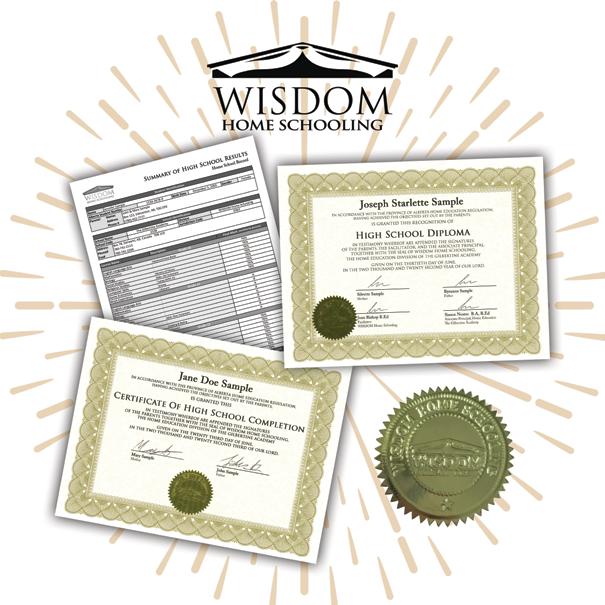
• WISDOM Diploma
• WISDOM High School Certificate
• Parent Verified Transcript of Courses and Marks
• Alberta High School Diploma
• Alberta Education Transcript of Courses and Marks
• Apprenticeship programs
• Entrance exams and personal portfolio for post-secondary access
• SAT, CLT, and other completion exams
• WISDOM online courses in Socratic Dialogue utilizing the Great Books: Philosophy, Mathematics, Latin, Writing, Natural Science, Politics, Literature, and more.
• Students can access specialist help for English, Math, Sciences, Social Studies, Latin, French and Spanish.
See the WISDOM High School Information Handbook for more detailed information on high school options.
Isithere, determined to attempt gathering my thoughts and personal assessments for the ending of this academic year and the planning of the upcoming one, but boy, do I ever feel flat right now. One thing I have learned over the years though, is to get at it, whether I feel up to it or not.
No, this year I haven’t had any babies (as my neighbour close by has), no, there haven’t been surgeries (that is my friend down south - recuperating amidst eight children 12 and under), I haven’t had any major trauma in my life (my neighbour towards Edmonton certainly has); but why have I not achieved all that I had hoped for?
Each year, at this point of self- examination I am tempted to despair, because what I see before me now does not reflect my earlier anticipations. Then comes the big question, “For whom is this reality check?” Ah, yes, okay, it’s for my children, not the government, not the neighbours; now then, how does it coincide personally with each child of mine?”
My children are the primary beneficiaries of the education program I set up each year. I hope to draw them beyond their limitations and concerns to new advancements beyond their imaginings. Was I successful this year? or perhaps more to the point - was the year a successful one in terms of learning experiences?
My eldest still at home would likely agree that he didn’t get it all ‘done’. Yet when we look at his accomplishments and his desired goals - I wonder if he realizes that there are only 24 hours in a day! My daughter learned a very valuable lesson this year - she needs to be more accountable with her time if she wishes to realize
Notes to myself
By Marlane Noster
her goals. The next daughter would be correct in saying, “I directed my own studies this year.”
The two youngest would be accurate in saying, “We did a lot this year!” and remember (repeat, remember) that I have been thrilled by some unexpected bonuses.
Technically, they could all have been chained to their desks longer, but then we may have lost those exciting moments when the miniature pony wandered into the yard, or a formation of F-18’s flew over and we had a great discussion about our National Defense; or the day we began reading about dyslexia and learning to teach to that giftedness.
By stepping back and looking at the year objectively, the achievements begin to look appealing, almost like I am looking at someone else’s family - I am so glad I began making this list! I recognize character development, personalities blossoming, development and showcasing of their individual talents, excellence in some of their academics, and growth in faith. It is time to let go of the nagging concern regarding the perfection that the government and the public seem to expect from my children. Sure, they didn’t excel in some areas, but look again at the list of accomplishments and achievements. Is this not what assessment is all about; becoming aware of the strengths and weaknesses of my program and of my students? It helps me to plan more precisely for next year.
Planning precisely; now, here is my stumbling block, realizing that I must plan precisely then be humble enough to recognize that I do not control the movements of the earth, the illnesses, the interruptions from the most
horrid to the most illustrious. Here is where I must smile and say to myself, “Lord you must have a plan here... Lord?”
I do recall a dream a while ago, still echoing in my mind. I was responding to someone in my dream with this thought: “I am working hard at maintaining a balance between the fantastic, the urgent and the mundane.” I suppose that could be the statement of the year for most home schooling parents. So how do I make that balance a responsible one?
What is it, ultimately, that I want for my children? Certainly I need to think of the cornerstone, I want each of my children to know, love and serve the Lord, and in order to achieve that I need to develop their willingness, ability and skills. I want them to develop a relationship among themselves, with God and with others. I want them to be aware of the current world and of history. I want them aware of their responsibility. (The attitude of ‘what can I do for the world’ as opposed to, ‘what can this world do for me?’) For each child and at the various stages of their growth I need to be aware of how I can draw them or lead them along the road of learning. I want to train my children to respond to each moment and in every situation with charity and understanding. When I am honest with myself I see that I still have a lot of work to do on myself, and that the training of my children will be a long, adventuresome journey.
Assessment? Absolutely necessary. Precise planning? A must. Attitude? Joyful (I can do it), humble, at attention, at ease.... Am I going to be able to? Yes, by Grace.
Marlane Noster is the co-founder of WISDOM.
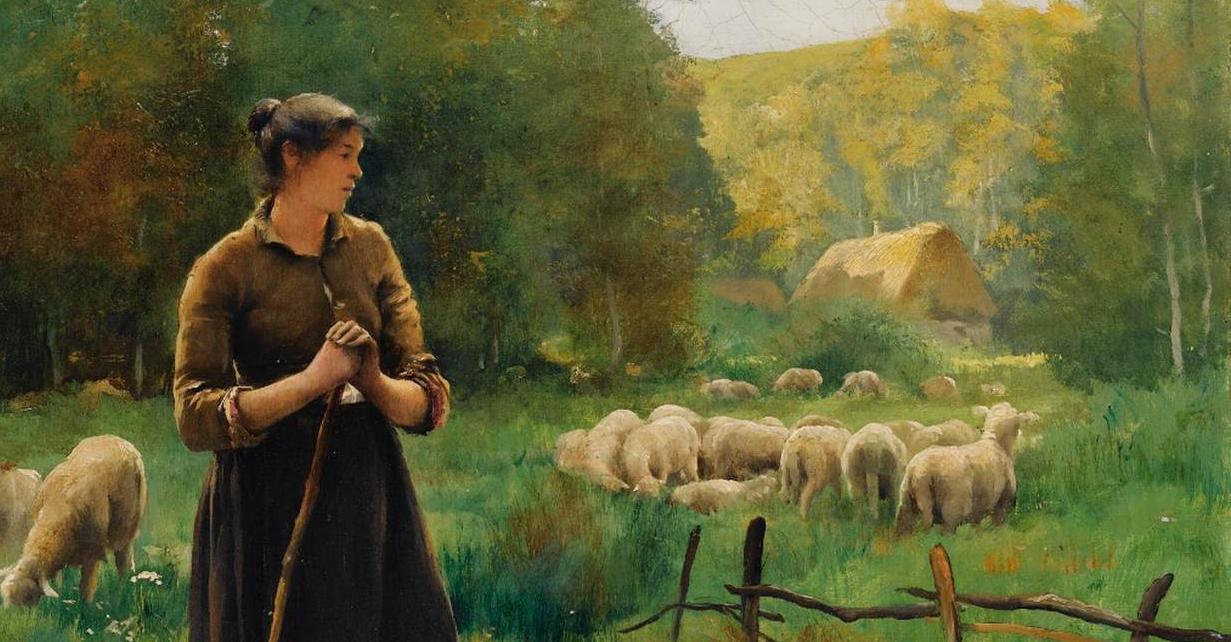
Image: The Young Shepherdess By Julien Dupré
How Children Learn Stages
How do I choose curriculum?
Curriculum resources are useful and make our job much easier, but remember they are a means to an end, not an end in themselves.
Don’t rush out and buy books. Before you buy any resources take a look at what stage of learning your child is in. Human beings are designed to learn in different ways at different stages in their lives. As a home schooling parent, this is the most important thing you need to consider for, if you try to teach your child according to the needs of one stage while he is in another, your success will be limited. Both you and your child will be frustrated.
Your child’s learning happens in three stages:
Stage 1: Basics
(age 5-11)
At this stage, your children are designed to memorize.
It is the time to expose them to as much memorization as possible: numbers, timestables, letters of the alphabet, phonics and spelling patterns, poems, songs, scripture....
Read to your children every day, and talk to them. They will remember virtually everything you say. Encourage them to read all they can
By Ken Noster
and discuss the things they are learning.
Language Arts - learn through Speaking, Listening, Reading, Writing, Discussion.
Reading is assisted by learning phonics rules. Ultimately, the best readers are children who have been read to regularly, not necessarily those who have learned to read themselves at an early age. Be sure to include literary fantasy, a foundation for developing logical thought.
Writing - Begin by tracing letters to develop handwriting. Later, copy text (from classical works, the Bible, poetry....). Write letters, a journal, poems, stories.... At this age spelling patterns (rules) are more easily memorized. Work on relevant words from the children’s written material. Natural Speller is a good
resource. Punctuation, capitals, and grammar can be taught when the student is writing.
Vocabulary is best taught by means of good Literature. Keep reading to them, always above their own reading level. If you think you need resources, you might consider Wordly Wise, First Language Lessons for the Well Trained Mind, English from the Roots Up
Math is logical, fun, and practical. If children are not enjoying it, maybe the approach needs to be changed. Start with hands-on: measuring foods; counting buttons, then money and minutes on a clock; pizza & other fractions; musical timing.
Select resources that serve your child; don’t try to apply your child to a resource.
A favourite of home schooled families, MathU-See teaches concepts before functions, and helps children truly understand Math.
Stage 2: Logic
(age 12-14)
Almost suddenly, memorization becomes less appealing, and the child is not interested in seatwork. Now discussion & analysis should become the heart of the curriculum. If students do nothing else, it is important that they read good material and discuss it, preferably with their parents. The parents need not read all the material that the students do but must be available to listen to each child’s impressions and thoughts and offer their own perspectivean adult perspective.
Content should include study of historical and literary heroes and saints and consideration as to why they are heroes and saints. Main reading should be in the areas of history, classical literature, scripture, and should include fiction, science, and math concepts or theories. Discussion should accompany most of what is read.
This is a good time to study the basics of Public Speaking and Debate. Students need to develop an understanding of what is logical and what is illogical. They need to recognize how emotion may enter into a discussion or
Stages of Learning
debate and cause deviation from logic.
Remember, at this stage students need to develop their ability to think.
Stage 3: Communication
(age 15-18)
Students now employ the skills developed in the two previous stages.
Writing becomes the heart of the curriculum. Students should spend most of their time reading, analyzing, researching, and writing.
Because the curriculum revolves around the need to express oneself, students begin to realize that they always need to know more. Gradually, they develop an interest in acquiring information, and they find new enjoyment in the poetic, beginning to employ effective and persuasive language.
Have students take notes when they read or listen so they have facts they can refer to in their writing. Encourage them to look at Science, Literature, and news items with an eye for comment and criticism; and have them write essays and articles in all subject areas.
They should write a number of essays throughout the year, write letters to editors or politicians, and explore creative writing such as poetry and song. They should study and participate in Debate and find opportunities to speak in public.
note: When studying subjects such as Math, History and Sciences, don’t be tempted to teach these by rote memorization. At this stage, students will learn best by striving to truly understand the subject and be capable of expressing what they have discovered.
At the end of this 3-stage approach to learning, students will be well-prepared for post-secondary training and adult life.
Kenneth Noster is a WISDOM Founder. He and his wife Marlane home educated their 6 children through high school.
left photo submitted by Chantal Elizabeth Photography above submitted by the Knoch Family.
Questions & Answers About Home Schooling
Here are some frequently asked questions. If you have further questions after reading through these, don’t hesitate to call the WISDOM Office at 780-741-2113.
What is Home Schooling?
What is Traditional Home Schooling?
(And what are the different types of home schooling that are out there today?)
With parenthood comes the responsibility of educating our children. We begin teaching from the very first day, helping our children to find security in us; and then throughout their early years teaching them to walk, speak, feed themselves, toilet train, along with the myriad of life skills a young child comes to know, ultimately finding security in God. Reading, writing, numbers, science, and social studies are no harder to teach, and up until the last century, the home was the environment where these skills were taught. Schools as we know them were established primarily out of charity toward the children of illiterate parents. The methods employed in teaching children at home differ substantially from those required in a classroom and generally tend to be more informal and open-ended. Rather than organizing their time around managing a classroom, home schoolers focus upon individual student strengths and weaknesses and organize each day around making the most of the learning opportunities at hand. Home schooling is not merely school at home; it is a way of life.
The term used by Alberta of Education to describe traditional home schooling is “Home Education.” Parents who “home educate” retain full authority to plan and provide schooling to their children. Parents have the right to teach according to their faith, goals, and time-lines; free to follow their vision rather than the vision of someone outside of their home.
In a “Shared Responsibility” program, the parents teach part of the program, and a school teaches the remainder. Online schooling is considered a schooldelivered program, with the school taking responsibility for the content, scheduling, and evaluation. Fully school-delivered programs generate full funding for the school authority, and the parents have little or no input into what is being taught.
WISDOM has seen the success that results from full parental control of home schooling and affirms the parents’ right to teach their own children. Unfortunately, parents often lose confidence in their own abilities once they have deferred to a school to provide schooling for their children. Many students in school delivered programs find themselves back in school within a few years. This contributes to WISDOM’s decision to offer only Traditional home schooling; properly speaking: only “Home Education.” We will work with you to meet your goals and fulfill your regulatory responsibility. We will assist you with program choices and other important education decisions, but we maintain that you are the primary educator, and you call the shots for your children.
Why do families home school?
Are parents qualified to teach their children?
Parents make the decision not to delegate the education of their children to others but rather commit the time and energy themselves. Families have a variety of reasons for home schooling. WISDOM’s founders began because they wanted to integrate their children’s spiritual development with their education, realizing that if their prayer life and the study of faith was not in order, education became fruitless. Many parents who begin to home school for purely academic reasons, soon find themselves growing in their faith. Relational problems that are less visible to parents when their children are away all day become far more evident when the family lives in close proximity day in and day out. Thus, parents more effectively identify and deal with hitherto obscured issues. Although family life seems more demanding in the short term, home education leads to strong relationships and renewed capacity for learning. Approaches to academics vary, but most home schooling families tend to emphasize a good, wholesome life, growing in respect for one another.
• There is opportunity to centre the daily schedule around prayer/ meditation and scripture study, rather than these becoming relegated to “when there’s time”.
• Each student’s curriculum can be custom designed.
• Parents may conscientiously choose social activities.
• Parents can build in time to think, plan, explore, question; all within a safe environment.
• Schooling can be scheduled around the father’s work, family responsibilities, etc.
• Schooling can be designed to fit the learning and teaching styles of the family, some structured, some flexible, all unique to some degree.
• Communication between family members is enhanced.
• Tutorial-style education helps each child achieve his or her full potential.
An important difference between you and a classroom teacher is the love you have for your child and the fact that your educational commitment is not one academic year, but a lifetime. These two points give you a distinct advantage, though it sometimes takes a bit of adjustment before you can make the most of this advantage. Confidence grows with experience, but a cooperative school authority can shorten the time it takes to gain your feet. Research has proven that the academic achievement of parents has no bearing upon the success achieved by their home schooled children. If you can read and write, you can teach your children as effectively as can the parent with a PhD in Education. Research demonstrates that a child’s academic potential is governed by factors other than the educational level of the parents. A loving parent is the nurturing ingredient that will bring a child to full potential.
Dr. Brian Ray, president of the National Home Education Research Institute, has conducted numerous studies on the effectiveness of home schooling, demonstrating that the average home school student’s academic achievement is very high. Dr. Ray says, “The tutorial method has always been the superior method for education of children. Home schooling epitomizes this method, providing the essentials for success--a close relationship between the student and teacher, motivation, flexibility, and individualization.”
Is home schooling legal?
Several resources are available to give you the preparation and training you need:
• The Successful Homeschool Family Handbook, Home Grown Kids, and Better Late Than Early, by Raymond and Dorothy Moore
• The Three R’s by Ruth Beechick
• How to Home School by Gayle Graham
• Educating the Whole Hearted Child by Clay & Sally Clarkson
• Speak to at least one veteran home schooler (try the WISDOM Parent Advisory Council, if you don’t know anyone who home schools).
• Home school conventions, workshops, and curriculum fairs provide practical instruction in teaching techniques unique to home instruction.
• Support groups can greatly encourage and help you through the exchange of ideas. (From the Head of School: “Personally, in the early years, I derived my greatest benefit by having other adults whose judgement I trusted, experience the progress my children were making. Their perspective was extremely valuable at times when I was too close to perceive how much my children had actually improved.”)
Each province and state sets its own laws governing home education. In Alberta, if parents intend to home educate, they must notify their own school district, or a willing non-resident school board, or a private school.
WISDOM Home Schooling is a registered trade name of The Gilbertine Institute, which supervises and supports home education programs. The society board, campus, home education administration and staff are wholly supportive of home education, and are operated by professionals who are home schooling parents and graduates. WISDOM complies with the regulations of the Education Act while helping to make home schooling easier and more effective for parents. A certain degree of accountability can serve to keep us organized, but because bureaucracy can be frustrating and even discouraging, we recommend caution be exercised in choosing an administration. Because school boards are designed to operate institutions, they can easily become dogmatic in their administration of home education. It is important to look for a board or private school that has understanding and experienced staff who can look at your family from a personal perspective.
A few traditional boards in Alberta make a point of hiring home educating facilitators and/or staff. WISDOM makes it our policy. All of our facilitators, managers, and full time office staff are home educating parents and/or graduates.
Legislation is continually being reviewed in each province, making it important for you to work with home school organizations, especially the Alberta Home Education Association and AHA to aid the passage of favourable legislation. Constitutional rights to liberty and privacy and the free exercise of religion under the Canadian Charter of Rights and Freedoms guarantee parental rights to educate their children according to their convictions. However, school boards have ruled inconsistently in applying these rights to home education. Parents are encouraged to comply with the law as far as their conscience will allow and then, if necessary, seek an acceptable alternative. WISDOM helps families comply with the law without compromising integrity as parents and educators. It is important to
How much time does it take?
obtain a copy of the Alberta Home Education Regulation. Many problems can be avoided by being accurately informed and by using tact and respect in dealing with authorities or individuals who don’t understand home education. Consider joining the Home School Legal Defence Association of Canada. They are an excellent ally in the effort to maintain parental rights.
Although teaching your own children does require a time commitment, it isn’t as demanding as you might expect. You can achieve a great deal more in far less time than required in an institutional setting. The time required will depend upon the approach you take and the resources you use, but you will likely begin with a half to one hour, per day, for the early grades, three hours by junior high, and older children, mostly working independently, will spend six or seven hours through high school. Mature students usually study music, perhaps work part-time, often read more than average and spend time preparing for post-secondary work or study. If you are taking more time than seems necessary, you have most likely imported “school” into your home. Due to the number of students in a classroom, schools attempt to teach by the use of packaged tasks or “curriculum.” Fortunately, children learn more and faster if they are allowed to function in the practical world rather than just studying about it in a textbook. Above all, a balance of practical activity and good reading material forms the heart of an effective education.
How can we teach several children at once?
Science, history, religion and literature can be taught to various levels at once, demanding more complex thinking, more lucid expression, and more effective writing of the older children and less of their younger siblings. Older and younger children can gain much by working together for the good of all. Children who are close in age can do all their work together. Try doing a circuit with your children, giving each the individual help needed to assist the child to work independently.
What about socialization?
Once you have home schooled a year or two you will look back at this question and say, “what was all the fuss about socialization?” Because most children in western culture spend most of their time among same-age peers, we have come to assume that this is normal. Have you ever wondered why God put children in families where nobody (unless you are a twin) is your age? The best environment within which to grow socially is a multi-age group. There is significant benefit to maturing in an environment where you must interact daily with those older and younger than you; responsible for the good of each other and learning from others at the same time. (This includes the parents.) Healthy relationships are best taught, demonstrated, and reinforced at home and in service to others as family outreach. As you get to know other home schoolers you will be impressed at the responsibility these children bring to their relationships. Their well-mannered confidence is a tribute to the environment their parents create. One of the greatest dangers to our children is peer dependency. “Do not be deceived: Bad company corrupts good morals” (1 Cor. 15:33). It is only after years of careful formation that our children can be a testimony to others without being influenced by them. The home is the environment for this careful formation. A recent US study has verified that the self-concept of home schooled children is significantly more positive than average. These young people know who they are.
What about my child’s special interests?
Can Home Schoolers get a high school diploma and attend university or college?
A wealth of experiences outside the home can supplement and enrich home education. Field trips organized by your family or in cooperation with one or more other families offer excellent opportunities to share fellowship and learning. The classroom of the world around you is the one that can teach you the most. Books are an excellent means of learning about those things the student can’t access personally but, where possible, home schooling parents can immerse their children in the practical aspects of life, from pond life, to museums, to doing laundry and dishes. Other interests such as musical training and amateur sports tend to fit well in a home education schedule.
In the USA, more than 200 institutions welcome home-educated students, not based upon official academic records, but rather upon individual merit. They are assisted by the track record established by previous home schooled students, who tend to be mature and capable of thinking for themselves, proving to be independent workers who set their own goals and schedules. The Universities of Harvard and Yale encourage home schoolers to apply and offer admission based upon an entrance exam.
In Alberta, home schooled students may earn high school credits and graduate with an Alberta Education Diploma. Conversely, they can set their own criteria for graduation and a WISDOM Diploma. There are different entrance requirements for various post-secondary institutions, but all are attainable through home schooling. All universities and colleges (even the ones who have no policy for home schoolers) have a “special admissions” option that looks at the individual merit of an applicant and can admit anyone who can demonstrate ability. For some situations the SAT can be used for college or university entrance. Read: Homeschooling for Excellence by David and Micki Colfax. The parents did not attempt to follow a typical school curriculum, and their 3 oldest sons entered Harvard. The children enjoyed a blend of wilderness subsistence farming and good books. Also be sure to ask the WISDOM Office for a copy of our High School Information Handbook.
What materials are available?
Many common textbooks are available from curriculum publishers and from other sources, offering depth and a logical order of topics. Work texts combine textbook information with exercises in consumable write-in books. Unit Studies allow a parent to integrate the teaching of values, skills, Science, Language, and Social Studies... by following specific themes. Using a Classical Approach, children progress from memory and skills to advanced reasoning and expressive use of language. When applying the Principle Approach teachers and students keep notebooks containing Bible perspectives and principles, personal applications, and other specific information on the subject. Whatever the approach, don’t forget the extreme value of good reading material & real life experiences. Once a student has learned the basics of language and numbers, abundant learning comes through reading good literature and engaging in good discussions. Remember to use those normal everyday activities like laundry, chores, music, and dishes to teach skills and character development; and great books combined with probing discussion to teach thinking.
What methods should I use?
What about neuro-diverse children with special learning needs?
Your first year will require a calculated guess. Many parents choose to simply use what their home schooling friends are using. You will not be in a terrific position to make curriculum choices until you have actually worked with each child to discover learning style, strengths, and weaknesses, interests, and abilities. You will also discover your own teaching style, the demands upon your time, priorities, etc. Whenever possible, you will take time in your first year to talk to other home schoolers and look at resources. By the time you begin your second year, you will be more confident to make many of your schooling decisions. Don’t forget to keep researching different methods of education.
Neuro-diverse (ADHD, dyslexic, Asperger or Autism-spectrum, anxiety, Tourette’s syndrome, and gifted) children are particularly well-served by home schooling by working at their own pace with material that is suited to their individual needs. Learning is best served in an environment where the student has a strong relationship with the teacher, and nowhere can this be achieved as effectively as within the context of the family. Consistency and discipline are the key strengths in special needs home education. Dr. Brian Ray, president of the National Home Education Research Institute, affirms, “Research comparing home educated to public school learning disabled students found higher rates of academic engaged time, and greater academic gains were made by the home educated. ... parents, even without special education training, provided powerful instructional environments at home....” WISDOM offers parent training for teaching neuro-diverse students.
How does WISDOM receive, divide - and use - educational funding grants?
Our school authority receives funding in allotments of 10% per month from September through June. The home education grant is $1802 per student and $901 per enrolled kindergarten student (subject to change). The parents may fund learning resources by using up to 50% of this grant ($901 per student and $450.50 per kindergarten student at the time of printing). WISDOM makes half of the student portion of the grant available in September/October, and the second half available beginning in January/February. The other half of the total grant covers facilitator salary and all administrative costs of the home education program, including supplementing WISDOM events and programs.
What are some difficulties we might face when home schooling our children?
Here are some possible difficulties:
• Lack of Confidence: Like many things, until you actually do it, home schooling may seem daunting. Once you begin to take ownership and step out in faith, this will no longer seem as big a task.
• Fear of Being Unable to Work with Your Own Children: If you do not have your children’s respect you will have trouble getting their cooperation. Gaining their respect through proper discipline, training, and example should be the parents’ top priority, whether or not they are home schooling; but home schooling can provide the incentive and the best setting to accomplish this. In order to teach your children, you must have authority over them.
How do we get started home schooling?
• Inadequate Time and Energy: Teaching at home requires an investment of time and energy, especially by mothers. Self-discipline and good organization will help ensure a well-run household. Daily prayer, good planning, a daily schedule, and a chore list can keep school and housework organized. Children can be a great help when trained to assist with the cooking, laundry, and household chores; and older children make excellent teacher assistants, helping their siblings.
• Lack of Commitment: Families who are home schooling only for convenience or because it is popular may soon drop out, unless they develop the conviction that home schooling is best for their family and is God’s will for them.
• Social Pressure: Pressure from well-meaning friends or relatives can be a real deterrent. Make a well-informed decision and then stand on your convictions. Sometimes, after watching you from a distance, family and friends will become attracted to the difference they see in your children; sometimes they won’t. Don’t get hung-up on convincing them; rather continue to focus upon your job. Beware of the social pressure of wanting to be like other people in your home school support group. Priorities and activities that provide success in one home, may spell disaster in another. It is very easy to get to the point of over-doing field trips, lessons, and get-togethers.
• Financial Investment: Remember, in many early American schools, there were few books available, and the education students received surpassed that of today. The misconception that home schooling is expensive has been driven by: 1) Parents who search outside of themselves and their home for the “perfect curriculum”, and 2) Government Funding. The more money school boards promise, the more parents think they need this money to home school. They buy an oversupply of curricula to which they quickly become slaves. As an example, The 3 R’s by Ruth Beechick is the only book you really need for grades one to three. Don’t over-buy. Use funding less for curriculum, and mostly to build up a good library.
Pray, and agree together as parents on your decision to home school. Then, together, set long term goals for your children, writing down what you ultimately want for them. Once you have done this, you will have accomplished the most important foundational task for your home school. Then you can work backward from these goals to decide how to structure your time and tasks right now. Above all, start simply, and avoid trying to create a typical school in your home. This isn’t “school at home.” This is working toward providing the best possible education for your child.
Please give the WISDOM Office a call at 780-741-2113 with any further questions, or for more detailed answers to the questions above.
For additional input, call one or more of the Parent Advisory Council members or a WISDOM facilitator near you. Contact information for our members may be found in the front inside cover of this publication. Bios of our team are available online.
How to Begin HOME Schooling
By Christie Lietz
Welcome to home schooling with WISDOM. Now, where do you start?
There are about as many approaches to home schooling as there are families, but let that free rather than intimidate you; versatility is one of the great beauties of this approach to the formation and education of our children. Use this freedom prayerfully, carefully, to come up with a united “vision statement” of what you want to achieve in preparing your young ones for adulthood. What values and abilities will characterize your family in order for you to feel satisfied with a job well done? Write these goals down, and put them somewhere you can see them often. Don’t be afraid to explore the many options and approaches to find the match for your particular learners. Take a deep breath and encourage yourself as you...
Think long-term. You have time. You really do have more time with them now; perhaps a decade or two of it. You will all learn an amazing amount in that time. It’s okay to “lag behind” in some areas and forge ahead in others; it will all work out over the long haul. Children are learners, and they will pull you and their younger siblings along on the journey, provided their love of learning and their relationship with you is not harmed by driving them or by comparing them.
Realize and trust that the opportunity to learn one-onone or in a small group with a trusted and beloved adult is the optimum situation for effective learning.
Take advantage of the freedom to do “off-season” camping
Getting Started
and travelling. Avoid rush hour and skip the crowds at popular activities and venues.
Believe your children are absorbing and discovering a great deal simply from participating in life with their parents and siblings. By way of comparison, children on an abundant diet of natural, organic, healthy foods will thrive without need for supplements taken in capsule form, while a child who loses access to natural food will need supplementation. Similarly, the home is a rich, wholesome learning environment where so much of great value can be “caught.” Children internalize what they hear and see frequently. They will faithfully mirror our attitudes and beliefs. We need to be communicating an attitude of thankfulness to
have them with us, a sense of privilege to be able to learn together, reverence for God as the Giver of all good gifts, and an active appreciation for each family member with their different gifts.
At the beginning of this year, I grabbed up a glossy, hard cover book at a book fair entitled, 365 experiments - Fun, Interesting etc I thought, “Great, I’ll use that with my younger children; I haven’t done much formal science yet, and it’s about time.” I didn’t know whether to be amused, disappointed, or thrilled when I finally cracked the book open: My children had learned every one of the 365 concepts just by playing in the bath, noting what happened in the dishpan, helping in the kitchen, or playing outside and with construction toys like K-Nex. Not only had they already accomplished everything in the
text, but they had also learned a great deal that they would never have been exposed to in the classroom.
There is so much opportunity for hands-on learning in the home. As much as possible, involve your children in learning with you; discuss values, make choices, weigh decisions. Teach them how to keep a budget, shop wisely, build and repair, clean and maintain, live faithfully, keep their word, work cheerfully, keep a confidence, practice hospitality, cook nutritiously, give generously, serve others, celebrate and honour, give thanks, stop and help.
Add to that a bunch of excellent books1, some educational games and construction toys, some stuff to make things with, music, a patch of outdoors, maybe some sports equipment, some pets or animals, a dress up box, and you’re pretty much set for younger students. If you’re bringing your children home for high school, you will want to work with them and your facilitator to make sure you’re covering all the bases which are important.
In your record-keeping, jot down all the activities you are involved in as a family; not just swimming and soccer and math, but also the things they can learn only because they’re at home, like how to bath an infant, how to find the best value at the supermarket, how to do an oil change on the
family vehicle, how to prepare a “company supper” or grow and process a garden.
Many families would refer to launching into home education as a “journey.” Remember the first time you headed off on a long trip? Did you haul along your luggage limit even though you could barely carry it? The more a person travels, however, the clearer they become as to which items are truly necessary, and the lighter and more stream-lined their luggage becomes.
So, what is some of the “baggage” most of us bring into home schooling?
• Trying to “do school”except you’re at home.
• Trying to keep your children up to “grade level” in all their “subjects.”
• A lot of curriculum.
• Testing to reassure you your kids are “passing muster.”
• Needing to “keep up appearances” to assure neighbours, relatives, nonhome schooling friends and ourselves that we’ve “got it all together” and can do this.
• Some envy of the home schooling mom who has a whole sunny room full of study areas, book cases and visuals, as well as a husband
1. “Books Children Love” by Elizabeth Wilson is a great resource, as is Sonlight Curriculum’s reading list, the DK Eyewitness books and Kingfisher encyclopedias. Charlotte Mason, (“The Charlotte Mason companion”), the Raymond & Dorothy Moore (“Homestyle Teaching” and others) and Ruth Beechick are all wonderful, simple, practical resources, and a great starting place for the beginning Teacher. There are TONS more, of course.
who teaches the kids math and science.
• Some intimidation caused by all those contradictory philosophies and the plethora of curriculum and activity choices.
• Copying what is working for the first few other home school families you meet.
Okay, and what would some veteran “travellers” say about what’s essential?
Pray. Lots; together as husband and wife. Ask for wisdom. Let God mastermind and provide according to His intimate knowledge of each child’s make-up and needs and future. Ask God to work in the heart of each member of the family. Respect and honour and support and communicate with each other as parents. Daddy is the Principal and, ideally, also teaching something as well.
Ease into it. It will take some time and research and experimentation to find the resources, the rhythm, and the activity level which best suits your family.
Work with WISDOM to ensure that you and your facilitator are a good team, and that your questions and concerns are being adequately addressed.
Ask God for, and search out, other families with similar interests and values who can be companions with you and your children on the journey.
Learn all you can about Temperaments, Learning Styles and Mediated Learning. Mediated Learning is the approach that all great teachers instinctively
use; WISDOM breaks it down into its key elements and presents it so we can all use it.
Success is a powerful motivator. So is curiosity, and the joy of “aha!” moments. The more we can learn to ask the right questions, model interest and curiosity, and guide our children to find their own answers, the less we’ll have to push and prod, and the happier everyone will be. This holds true even for their weakest subjects.
As you continue on this journey, take time to get refreshed and inspired. This includes many possibilities, but here are a few:
• Practice Sabbath (“The Rest of God” by Mark Buchanan is a good resource), or “Quiet Time” (30-60 minutes a day where the children are expected to amuse themselves quietly, or have their own devotions- this can be worked up to gradually).
• Consider “Mommy Culture” (keeping up with some of the hobbies or pursuits you enjoyed in your “previous life”).
• Cut your family some slack and “go with the flow” as much as possible when the demands of life are heavy or energy is low, or the weather is beautiful, or out of town guests are arriving. Take time to celebrate. Take time to make an occasion of special people and accomplishments.
• “Unplug” as much as possible. There are huge dividends to this practice of simplicity. It is very refreshing to be with people who know how to be “present” to those around them, and how to be still and notice everyday miracles and lessons and opportunities.
Join their ranks.
• Give your children the gift of some unprogrammed, minimally supervised free play or “down” time. This is actually extremely important to their formation, and your sanity. Research it if you don’t believe me. This will also naturally include some training in how to look out for one another, an essential skill.
• Take “PD” days to attend conferences, seminars, read books, enjoy some solitude, visit with a veteran home schooler, date your spouse, prayerfully set down goals, plans and vision etc.
• A helpful “litmus test” as to whether the material you are using is developmentally and learning style appropriate is whether or not they are enjoying using it.
• If you have multiple students, it is helpful to have curriculum or materials so they can all self-study in areas which need frequent drill or repetition, such as math facts, spelling, grammar, typing, handwriting, music practice etc. That way, you can be free to focus on activities needing your input and supervision with one child or group while the others are still constructively occupied. It is also very helpful to arrange things so that the older or more advanced children pass on their skills and knowledge to the younger ones. Most or all of the family together can enjoy phys ed, art, science, history/geography, the “Read Aloud book”, games, building, cooking, gardening and so many other activities.
“Attitude is Everything.” “Character First.” “Gain their
hearts, and the rest will follow.” So much is involved in these aspirations, but they need to somehow be kept smack in the centre, starting with “fixing our eyes on Jesus, the author and perfecter of our faith.” He can teach us, moment by moment, encounter by encounter, how to turn our children’s eyes to the “Wisdom that comes from heaven, (which) is first of all pure, then peace-loving, considerate, submissive, full of mercy and good fruit, impartial and sincere.” It is the opposite of a worldly mindset, which is controlled by bitter envy and selfish ambition and leads to “disorder and every evil practice.”
( James 3:13-18)
Sometimes we need to discipline ourselves, when attitude or behavioural issues arise, to stop what we are busy with teaching or doing and appeal to the Truth, the example of Christ our hero, and the best in our children. Other times, the child who is being resistant or disruptive needs to be given some choices: to continue their behaviour and accept the consequences, to cooperate, or to think about it for a moment and then decide. Occasionally it would be appropriate to put the onus on them to come up with a positive alternative to the assignment or
Getting Started
situation. It is very important that we help our children to feel that we are on their side, even when we are correcting them, requiring
something difficult of them, or asking for excellence.
God bless as you proceed to teach your children with WISDOM.
Some books that many home schoolers have found helpful:
• The Three R’s (Ruth Beechick)
• Home Schooling for Life (Dr. Dale Simpson)
• How to Home School: A Practical Approach (Gayle Graham)
• Beyond Survival: A Guide to Abundant Life Homeschooling (Diana Waring)
• A Charlotte Mason Education - A How to Manual (Catherine Levison)
• Dumbing Us Down (John Taylor Gatto)
• The Well Trained Mind (Jessie Wise & Susan Wise Bauer)
• Designing Your Own Classical Curriculum (Laura Berquist, 1998)
• Educating the Whole Hearted Child (Clay and Sally Clarkson, 1996)
• Catholic Education: Homeward Bound (Kimberly Hahn and Mary Hasson, 1996)
• Catholic Home Schooling, A Handbook for Parents (Mary Kay Clark, 1993)
• The Teenage Liberation Handbook: How to Quit School and Get a Real Life Education (Grace Llewellyn, 1991)
• Learning All the Time (John Holt, 1989)
• For the Children’ s Sake (Susan Schaeffer Macaulay, 1984)
• Better Late Than Early (Raymond and Dorothy Moore, 1975)
• How Children Learn (John Holt, 1967)
• The Original Home Schooling Series, 6 volumes (Charlotte Mason, ca. 1900)
Photos submitted by the Lietz Family
Socialization
Socialization: “the process by which a human being, beginning at infancy, acquires the habits, beliefs, and accumulated knowledge of his society through his education and training for adult status.” (Webster’s Dictionary)
The critical elements in this definition are habits, beliefs, and accumulated knowledge. Let’s look at these and a few other realities of socialization.
Habits
It is unlikely that any responsible citizen would want children to acquire any and all habits. There are many habits our society would consider ills: habits that hamper personal development and negatively affect the quality of life for individuals and those around them. Positive socialization should promote formation of good habits: work habits, manners, sportsmanship, caution, respect.... Beliefs
Many beliefs are held generally by our culture, regardless of race or creed. Justice, equality, and a code of human rights are impressed upon our children at an early age by the way we live and by the ways in which we discipline them.
Some parents choose to raise their children without a spiritual belief system, allowing them to “make their own decisions” when they grow up. Most are aware that “no belief” simply means undirected belief, often with serious consequences. Every child will believe in something; responsible parents will develop and share their own beliefs, assuring that their children face life with a firm footing.
Accumulated Knowledge
We must consider what knowledge we wish our children to have. Is it important to the development of their character that they be familiar with every popular television program or film? Will they be better equipped to enter the work force if they know all the reality stars or rock stars and the top ten listings on the charts? We don’t have to hide our children from the world, but life is short, especially childhood, and their time is best spent learning valuable skills, learning manners, and developing character. Even though they think it’s taking forever to grow up, their time is limited; the question is, “For what will you have them use their time, and what will you eliminate from their life in order to make time for the priorities?” Some parents simply throw their children into a group of people their own age and hope they’ll learn something of lasting
SOCIALIZATION of home educated Children
By Ken Noster
value.
What is the “Real World?”
Some people say, “My child need to live in the ‘real world’ in order to learn to deal with life.” This statement presumes family life is not the real world. Ironically, just the opposite is true, for the family is a microcosm of the nation. Being the primary element of society, it is what drives and governs that society. For example, if families have strong moral codes, the nation will have a strong moral code; if families focus upon selfless service to others, the nation will focus on service; if families are violent, the nation will be violent. Our nation today is confused because many of our families are confused. If you wish to have your children grow up in the real world, have them actively engage in family life.
With the above statement, most people mean they want their children to be able to deal with the tough situations that will come up in life by not shielding them from those situations now. Frankly, there is a reason children spend the first 18 years of their lives under the wing of their parents. During this period they are developing, and like a young plant they can easily be harmed. The mind and heart of a child cannot take the constant abuse that is difficult
even for an adult to handle, abuse that the world continually dishes out. The experiences of a child have overwhelming consequences for their whole life. If you were to counsel troubled 40 and 50 year old adults you would find that virtually all of their problems stem from experiences they had as children. Do not underestimate the effects the “real world” is having upon children. Just as a young plant does best if started in a greenhouse, then set outside for short periods of time, but drawn back into the protection of the greenhouse; a home schooled child does best given the security of a loving home from which the world may be entered into for short periods. In this way the peer group is not given power; the child can live quite well without it, apart from it.
Incidentally, living in the “real world” can mean any number of things. Is the real world most present in the slums of New York, or in the war-torn Middle East, or in the streets of Calcutta? Just as parents would not choose such environments for the fragile years of childhood, there are many other environments, some as near as their personal device, that threaten to expose children to realities with lifelong negative consequences..
What is the purpose of socialization?
To become socialized is to become capable of relating to other people by virtue of manners, attitude, and action. Fear of rejection by one’s peers is a sign of dependency, not socialization. Selectivity or avoiding interaction with undesirables is elitism, not socialization. Involvement in questionable peer- driven activities is a sign of capitulation, not socialization.
The successfully socialized individual is one who can be open to all people without being manipulated by them. The successfully socialized individual is one who has the confidence to stand for what is right in spite of rejection; to bear burdens or difficulties with hope.
Institutional/peer vs. Family socialization If socialization involves acquiring habits, we must be very concerned about the degree to which peer groups foster conformity, while healthy development requires an environment where individuals are truly free to make their own choices. Even parents, in the end, can’t dictate conformity; their greatest strength lies in their ability to inspire. It is very important that our children experience people who demonstrate desirable habits. If they are immersed in a world of good habits, they will reflect this world. If most of their time is spent with people with poor habits, they will be likewise affected. With habits or any other aspect of socialization, we
must be cautious about who spends time with our children.
It is only within recent history that our culture began to segregate children into groups by age. When my father went to school, he was constantly amidst children aged 6 to 16. There was more opportunity to emulate older children and feel responsible for younger ones. Where for centuries the family (the classic cross-age unit) has been the primary mode of socialization, the twentieth century has convinced our society that a student needs a same-age peer group to be properly socialized.
Learning to socialize within the context of the family demands that each member become a giver. Nowhere is this more evident than with parents. They start out as relatively selfish individuals, but by the time they have changed and fed babies in the middle of the night, cleaned up after and cared for the sick, had most of their prized possessions lost or broken, and suffered with every suffering of their children, they have grown in humility, generosity, and love. A child grows likewise, refined by a balance of giving and receiving unconditional love. Quite contrary to the message of our culture is the prayer of St. Francis: “... For it is in giving that we receive, it is in pardoning that we are pardoned...”
Simply living together and learning responsibility within the context of the family will teach abundant character lessons that peer groups could never teach. Consider; who will teach respect for parents and other adults? Who will teach the importance of service to others without personal gain? Who will teach the value of human life and the importance of protecting the very young and the very old? This socialization will not come from the typical peer group. The negative competition associated with being part of a peer group serves to develop individuals who have successfully learned to look after themselves.
Influences upon our children
It would be nice to think that good teachers could make the difference in institutional socialization, but the following chart reveals that even the best teachers don’t have nearly the same influence as peers and the media.
Great change, unprecedented change, has occurred within the past 70 years. A 1960 study reflected the way things had always been, not just for a hundred years or a thousand years, but always. Parents have always provided the primary influence upon their children. Other influences, such as the state-imposed influence of Revolutionary Russia or Nazi Germany, have come and gone; but parents have remained
(quite naturally) the greatest influence in the lives of their children.
A 1980 study, for the first time in history, demonstrated that parents were no longer the source of greatest influence upon their children. The peer group had taken over that position. This means that since the 1970’s, the average North American child has been principally socialized by his peers. In 1995, a similar study indicated that parents had by then fallen into 3rd place, eclipsed by both peers and the media. No recent study has been added, but it is pretty obvious that 21st century parents have not regained their influence.
How can parents reclaim the necessary influence upon their children to socialize them well? Much of the answer can be found in one word: TIME. The lion’s share of a typical child’s time is spent with same-age peers. Even after school and on weekends, parents allow their busy lives to take them away from their children and allow peers to dominate what should be family time.
The media is every bit as pervasive as peers and perhaps even more powerful. Families who could once turn off the television and be selective about movies and music, now find it difficult to avoid the barrage of media that envelops us.
Because of the power of peers and the media, the only way for parents to regain the position of primary influence upon their children would be to spend a great deal of time with them. Parents with children in school would have to eliminate most individual activities and spend a great deal of their “after school” and weekend time together as a family in order to attempt to overcome the immense pressure dealt to their children by peers and the media.
When people who are critical of home schooling demand: “What about socialization,” they are addressing the most important reason to take their children out of school. First of all, they would be in a position to have their children less influenced by peers and the media, and secondly, they would increase the quantity and quality of their family time, making it eminently easier for the parents to retain their role as the greatest influence in their children’s lives.
Home schooling is not the only way to socialize your children well, but it is certainly the easiest and most natural way to do so. With due attention to the essentials of family life, the home is proving itself to be the best school of socialization.
Photo submitted by Paula McLaughlin
JUMPING HURDLES Distractions
By Ken Noster
Distractionis constantly with us. Sometimes distractions (also called diversions) can be positive means of drawing us away from pain or elevating our thoughts as a beautiful symphony or touching drama can do. More frequently, distractions are not positive at all. They steal our time and they frustrate our purposes. Often we seem powerless to stop them, for they can creep into our lives unnoticed.
Our recourse must be to develop eyes that can see distractions for what they are, good or bad, and develop hearts that are heroic enough to embrace or dispel them. While still an adolescent,
frustrated by multitudinous demands for my attention, I learned to fight distractions by avoiding them. Working on the family farm, I would miss meals and arrive home late at night in order to get a job done. A few years later, I became adept at ensconcing myself between library shelves or in nooks and crannies around the university. In my early 20’s I was able to keep on task by staying in my room, or going to the school where I taught very early in the morning, long before anyone else would think of arriving, guaranteeing myself quiet hours each day to get my work done.
Then I got married, somewhat of a distraction, and I found it more difficult to be efficient in my work and daily regimen. There was always someone else to consider, and she didn’t always have the same zeal for my agenda as I did. However, for the most part, Marlane fell in line, and was just as bad as I when it came to lowering her head and ploughing forward on a task. It’s no wonder the Lord didn’t give us children in those first few years; we never paused long enough to make a home for them.
Just before I turned 30, our first child was born, and then I began to learn the meaning of the
word distraction. Now, for the first time in my life, I could no longer escape it, and that was a good thing. Marlane was quick to revert to her gift for making the most of the moment, but it took me most of the next 10 years to catch on. Thank God I began to have people in my life who could begin to break me from my taskoriented single- mindedness. I had convinced myself that the job at hand (whatever it was) required my full attention, and anything that might get in the way was to be avoided. A robot is impossible to distract. It is programmed to perform a task, and nothing else matters. There also isn’t anything
very warm about a robot. My first baby began to show me that. Marlane reinforced it, and our subsequent babies drove the point home. I began to recognize the value of distractions: the immediate needs of a child that put our “important” work in perspective; a nice dinner that demands that a job be left unfinished. Though painful in the moment, these are the God-given distractions that began to turn me from a robot into a human being.
Accepting that some distractions are the Lord’s way of getting our attention, we must also acknowledge that some distractions are just the opposite: they get in the way of God’s design for us. We all have them. They may be the “drop-ins” who presume to demand our time without consideration; they may be our “undisciplined” children who have not learned rules of propriety or self- discipline; or they may be “patterns” we have built into our lives that are no longer appropriate.
The “drop-in” comes in many packages, but one version is the person who knows that the home schooling mom is at home all day (not at work like everyone else), so presumes to phone or drop in at any time in the day. The “drop-in” can also appear as the “drop-it”, presuming that you can simply drop what you are presently doing to be of help on demand. In situations like this, the flexibility of home schooling can be its own worst enemy. We can usually see ourselves clear to assist the person in need, and lest we appear uncharitable, we often sacrifice the schooling schedule of our children. The “drop-in/ drop-it” requires clear boundaries, including times when mom is free to talk and times when she simply is not. Short of a veritable emergency, it is necessary to remain firm in your schedule. Of course, it is possible that friends,
neighbours, even extended family may consider such a mother to be uncharitable, but there is more to doing right than having people approve. “Blessed are you when men revile you....” (Matt 5:11)
The “undisciplined” child is probably the source of the most common distractions, including sibling rivalry, poor manners, selfish pursuits, and disobedience, producing the need for parents to repeat themselves (perhaps the crowning of distractions). Though difficult at the time, it is worth it to a parent to be distracted early in the child’s life in order to avoid it in abundance later. This means taking the time and effort to keep children accountable when young, in order to more easily keep them responsible when older. But don’t give up if they are already older. In dealing with the older child who lacks discipline, just as with the young, it is better for a parent to invest time now in order to avoid a multitude of distractions later. Following up, requiring accountability, and providing clear, consistent consequences to a child’s actions (or lack thereof) are the best ways of producing discipline in children.
The “drop ins” and “undisciplined” are external to ourselves, so in some ways they are easier to deal with. “Patterns” are personal, and as such are often hard to distinguish and difficult to change. A simple example of a distracting pattern could be listening to the 6 o’clock news. For a single man, such a pattern can be useful, or at least inoffensive, but for a husband and father, it could easily distract from fruitful family life. The list of examples of personal distractions is endless: television, snacks, email, internet, social networking. The more obvious ones are common, but we each have our favorite distractions that are easier to fall into than the task at hand; ways of avoiding responsibilities which we would be better off to tackle.
To begin getting a handle on these personal distractions, it is best to take note of what we tend to do when a difficult or disagreeable task lies before us. Do we head to the fridge, or pull out a cigarette, or phone somebody, or put on the TV, or check facebook? Do we stand and stare out the window, hoping a distraction will come along? Do we fantasize? Do we get busy with minor details that are really far less important than the disagreeable task lying before us? Whatever the details, the affliction is universal, and the solution is accessible. We need to recognize our patterns for what they are and purposefully avoid them each time they arise.
After addressing all the distractions that daily plague us, we need to look in one more place. Braced against the obvious distractions, we can be controlled by the ones that appear as goods; in fact are goods. What was once a distraction can become a priority, and what was priority a distraction. Our office provides good examples of this. Here is a hypothetical situation: I am in the midst of helping student X get into university. I am expecting the student to fax documentation to me at any time, and the head Registrar (normally difficult to contact) will be returning my phone call momentarily. Then, I receive a call from Social Services, indicating that they have received complaints about the educational program and social life of student Y, and are about to go into the home to investigate. Suddenly, my work is changed. What was a priority a minute ago is now a distraction, especially if the Registrar phones while I am talking to family Y, or student X ties up my fax machine with a 30 page document while I am waiting for Social Services to fax me their query.
The point of this example is to illustrate that duties and
distractions can be a moving target, usually obvious only when compared with one another. Something becomes a distraction when it draws our attention away from something more important. Therefore, the real challenge is discernment; determining what is the greater priority and what is lesser. We can easily fail by determining to finish what we are doing before moving to something else. We can also fail by succumbing to the tyranny of the imminent, and switching over to a task that appears important in itself, but when weighed carefully, should not supersede our original course of action.
Although we are sure to fail in most areas of our lives, happily, there are some absolutes about family life that make it easier to make decisions. Our first priority is to our spouse, the second priority is our children. Then comes the rest of the world, even the greatest of causes. If our relationship with our spouse is strained, chances are we are allowing distractions to take valuable time and energy we should be spending on our beloved one. If our relationships with our children are rough, we can likely find that our work or the world has distracted us from the supper table, or daily prayer, or leisure together. The rest of the world, even the greatest of causes and even the most positive of diversions are no more than distractions if they steal what absolutely belongs to our spouse or children. This doesn’t mean we can neglect our work and our community, but it does mean that those good things must be handled in a controlled fashion, served when they are priorities, and withdrawn from when they distract from greater goods. The ability to discern the difference can come only by grace and wisdom, the fruits of prayer, honest reflection, and experience.
Photo submitted by Chantal Elizabeth Photography
Mediated Learning
By Thérèse McDonald
Every good teacher is a mediator, and parents are in a position to be the best.
WISDOM provides training and tools directly to parents and offers ongoing long-term support.
Mediated learning is for everyone, because we all can improve our ability to think. If parents are concerned about their child in areas such as reading, numeracy, focus, retaining of information, organization, self-regulation, or memory, the student will show great improvement when ML is incorporated into the educational program.
The mediational parent helps the learner to recognize the thinking processes that go into solving a problem and then consider more efficient ways to arrive at a solution. The parent’s method of
questioning helps the child become aware of the rules and structures that underlie effective problem solving. Meanwhile, the learning of new skills is made easier by identifying other situations in life where the same kinds of problem solving strategies have been used.
Most parents report positive changes in their children.
Mediated Learning training
WISDOM offers parent training in the mediational method, giving you the tools to enhance your child’s education in every area.
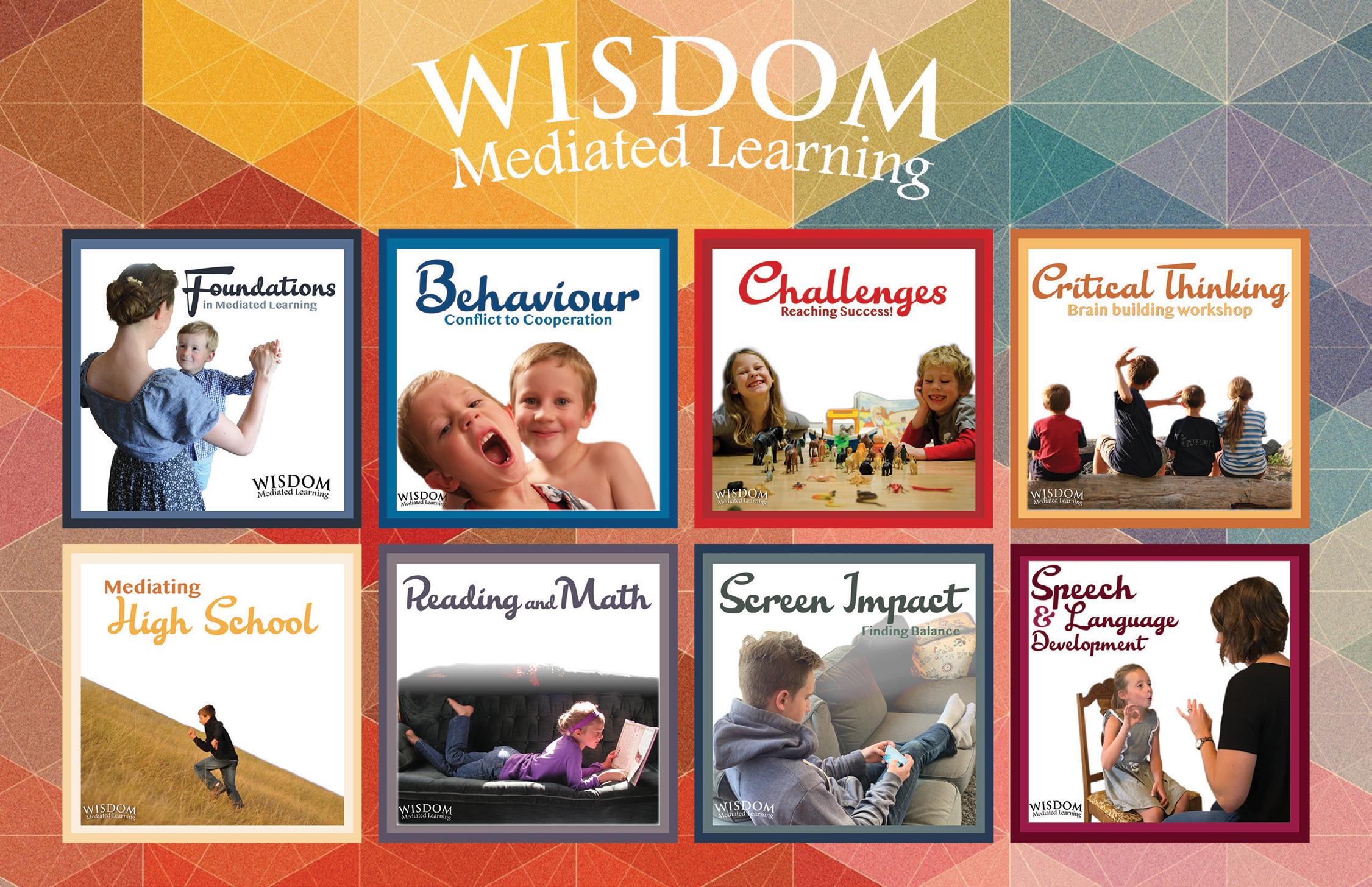
Workshops offered:
• Mediated Learning Foundations
• Behaviour
• Critical Thinking
• Challenges
• Reading & Math
• Mediating High School
• Screen Impact
• Speech & Language Development
For complete descriptions of our workshops, for pricing and additional information, see our website or call the WISDOM office.
Workshops are offered live and as an online course for parents.
dynaMic assessMent
Dynamic assessment reveals how a student learns and what factors are able to produce changes in the student’s learning. It is especially valuable for those who struggle with learning barriers.
Mediated Learning
Whereas typical assessments produce scores comparing students to each other, dynamic assessment compares only pre-test to post-test performance (gain scores). The student is compared only to himself. The most important aspect of Dynamic Assessment is what happens in the intervention phase.
Intervention is goal-directed, fosters connections between previous learning and new learning, and helps the student apply new learning to academic subjects and life experiences. It creates feelings of competence.
With this technique, learning is a shared experience, and intervention implies working to success. Whereas most standard assessments are discontinued after a succession of failures, e.g. wrong answers or nonresponses, in Dynamic Assessment, the criterion for stopping is when a student has achieved success. Consequently, the test is an extremely positive experience, and Dynamic Assessment serves as a catalyst for long-term change. Parents are encouraged to observe the assessment of their child.
After Dynamic Assessment, parents receive a report that illustrates both their child’s cognitive strengths and barriers to learning, and practical ideas to help begin to work through their challenges.
Registration for ML workshops is available online at: wisdomhomeschooling.com
ONLINE COURSES
WISDOM Socratic Dialogue Online Program
Purpose
The WISDOM Socratic Dialogue Online Program was first started in order to help families fully engage in a classical approach to learning. It is natural for youth, ages 13 and up, to be attracted to learning with others in an interactive environment in order to challenge, develop, and refine their own thinking.
Especially with the approach of the high school years and as the time for entering work or post-secondary studies becomes more imminent, students want to assure they are amply prepared. A classical education provides the time-proven foundation that supports all future study and work.
A ClassicalEducation
The WISDOM Socratic Dialogue Online Program offers a classical education. A classical education can refer to using the classics (i.e. the Great Books) in studies but, more importantly, it refers to the time-honored approach to education. The classical approach emphasizes memorization during the ages of 6 to 12 and then the development of the skills of logic and expression thereafter. Developing logic requires discussion (socratic dialogue), which is the method used in all the WISDOM online classes.
Liberal Arts
What is the goal of all education? Great cultures have discovered that the true goal of education is similar to the goal of human life. Whatever skill is learned, from earliest childhood, should have the ultimate purpose of making a person more free, virtuous and happy. All the practical skills we learn do this to a certain extent. By learning to speak, to cook, or to build a house, we are becoming more free. However, as the ancient Greeks discovered, liberty of soul is far more important than liberty of body. A king who rules the world but is enslaved to error or vice is truly not as free as a wise and good man whose body is in chains. As long as a person is enslaved to error or vice he cannot be truly free, virtuous or happy, no matter how much wealth, influence or power he possesses. It is only knowledge of the truth and obedience to it which sets a person free. The goal of true education can never be economic prosperity, or mere leadership ability, or even empty curiosity. The goal of education must be to know the Truth.
Knowing the Truth is not just a matter of collecting information that happens to be factual. Information falls out of the brain
just as easily as it falls in, and often it isn’t truly understood. The most important truths can’t be known unless the mind is prepared to grasp them. What is required for this type of education is training in logical thinking.
A Classical Education, Through WISDOM
WISDOM’s Socratic Dialogue Online Program can be considered a classical program in two ways. The majority of the readings are classics in Literature, Mathematics, Science, Philosophy, and Theology. Students are encouraged to avoid summaries or editorials on these books but to read the books themselves, and to gain all the truth possible from these original texts.
Learning in the online courses is through socratic dialogue, compelling the students to use their gift of reason to develop their ideas, express their interpretations, and challenge each other’s grasp of the truths contained within the text. This method strengthens the student’s memory while refining the use of correct grammar, logical thinking, and persuasive speaking.
The courses or subjects are developed carefully to reflect a classical approach. They help students acquire thinking ability, develop a keener sense of wonder and awe, and recognize the unity that binds together everything they are learning.
WISDOM’s online program aims to allow Christ to direct all of our studies. We do this by praying before each class and trying to conduct our discussions in the most sincere and charitable manner possible. The tutors refrain from speaking to the class as an authority but rather focus on encouraging all
of the students to think, enquire, and express. The interaction is not a book club or survey of comprehension questions but, instead, tutors lead discussion by asking a few key questions that guide the students to think of the “great ideas” and probe deeper questions that evoke great truths: What is heroism? What is beauty? Was the hero just? What is justice…?
The Practical Effects of a Classical Education
Classical education has stood the test of time over 2,500 years because it corresponds to the way the human person develops and learns best. Students who receive a classical education tend to do very well at college or university, mainly because they have developed the art of learning and thinking rather than simply collecting information. They find it easier to categorize and order everything they are learning and recognize which information is important and which is not. They know which questions to ask, and how to pursue questioning until they find the answer. They tend to have a more voracious appetite for learning, because they have experienced learning at its best. In the quest for gaining a fuller grasp of the truth, students become adept at recognizing when something has been proven and when it hasn’t. They embrace a lifetime of fruitful enquiry and right thinking.
Find more on our website or our Online Courses booklet.
You may also call us at 780-741-2113 or email our Socratic Dialogue Online Program Manager, nicole@wisdomhomeschooling.com
Extras Available for WISDOM Families
Updated March, 2026
Programs
All The Right Type Homeschool Version
Our no nonsense approach and learning methodology empower learners of all ages to master touch typing in the most effective and accessible way. All The Right Type was initially designed for school use, but we’ve adapted its features to suit any group or home schooling learning environment. The learning sequenced methodology was designed by keyboarding specialists so all types of learners can advance through the program at their own pace to achieve goals, while parents can monitor proper posture and review learners' lesson results. The ability to be proficient at using a keyboard has never been more important for productivity and success. For home schooling families aiming for success, All The Right Type offers $30 off a 1-year home school subscription.
Contact the office (office@wisdomhomeschooling.com) or check out through the webshop to get your discount code.
Dave Ternier of Country of the Week (countryoftheweek.world) decided to research a new country each week for his daughters. He created a colorful fact filled profile sheet, along with video links, coloring pages, word searches, recipes, music links and more.
He invites WISDOM Families to join in the fun with a discounted offer especially for WISDOM
(countryoftheweek.world/WISDOM). First week is $1 (regular price $5) or a year for $39 (35% off!).
F.O.R.M
The F.O.R.M. Curriculum is a fitness curriculum for teaching students how to build a solid foundation in health.
Functional Fitness
Optimal Nourishment
Rest and Recovery
Multiplied Maintenance
Learn more here (formcurriculum.com/homeschool).
History Plus
History Plus (formerly History Alive) (historyplusonline.com) is available at a discounted rate through the WISDOM webshop, $75 for a one-year subscription. (wisdomhomeschooling.com/resources/shop-online/programs-licenses/history-plus).
IXL
ixL is personalized learning with a comprehensive curriculum for kindergarten to grade 12 in Math and English. Find out more at ca.ixl.com. WISDOM's discounted rate is $23 per license per year, renewing September 1st.
OR
ixL also has personalized learning for Science, Math, and Language Arts (for kindergarten through grade 10). Find out more at ca.ixl.com. WISDOM's discounted rate is $26 per license per year, renewing September 1
Purchase the IXL license above that fits your family the best through the WISDOM web shop (wisdomhomeschooling.com/resources/shop-online).
Minecraft - Education Edition
Learn basic coding concepts, explore infinite worlds, and build everything from the simplest of homes to the grandest of castles with Minecraft - Education Edition. Learn more at education.minecraft.net/en-us
WISDOM's discounted price is $10 per child per year. Purchase your license in the WISDOM web shop (wisdomhomeschooling.com/resources/shop-online).
Enriched Academy
Enriched Academy works with school boards across Canada to provide students with the critical financial and life skills they need to succeed. (Video based lessons, bilingual, lifetime access.)
• Kick Start for Grades 4 to 6 is a financial literacy program designed to meet the needs and interests of students at this age level.
• SmartStart for Grades 7 to 9 is a series of five modules that introduce financial literacy with age appropriate material.
• The High School Program is an interactive tool for teachers and students. It includes 10 video modules covering a wide variety of topics.
Cost: Free! Purchase your license in the WISDOM web shop. (wisdomhomeschooling.com/resources/shop-online).
Family Money School
Finance Course - Find Your Family Money School Fit (wisdomhomeschooling.com/ resources/external/finance-course)
WISDOM Home School contributor Matt Matheson knew that if his wife and he were going to give their kids the financial foundation they need to thrive, he was going to have to do it on his own.
WISDOM has now teamed up with Matt to offer families an exclusive deal on his Family Money School Courses. The courses, which include a parent-directed course for kids under 12 and a self-directed one especially for teens, are designed to help both kids and parents navigate the seemingly complex world of money.
Contact Matt Matheson (familymoneyschool.com/courses/wisdom-promo) with any questions or for more info.
Resources
ASAA
Alberta Schools Athletic Association (asaa) is the governing body that oversees amateur athletics in high schools for the province of Alberta. Through asaa, WISDOM high school students may be eligible to join local high school sports teams.
Email the WISDOM office (office@wisdomhomeschooling.com) to find out more.
Athletes In Action’s Soccer & Basketball Camps
Athletes In Action’s video resources allows you to host some amazing coaches right in your own backyard to mentor and teach your kids soccer and basketball. Once you sign up to host a camp for just your own family or for a group of friends and families, you’ll receive access to 5 days’ worth of coaching via online videos, plus access to an aia staff member that will be available to answer all your questions as you go through the content. (wisdomhomeschooling.com/resources/external/athletes-in-action)
Cost: as little as $5 per student
Facebook
Facebook – WISDOM has a number of private Facebook groups for our families. (When you click join to any of these pages, please answer the verification questions to be added quickly.) Email terry@wisdomhomeschooling.com for more information.
• WISDOM Home Schooling (acebook.com/groups/wisdomhomeschooling).
Main group with the most members and discussion.
• WISDOM Home Schooling – High School & Beyond (facebook.com/groups/ wisdomhighschoolbeyond). Home schooling through high school support and inspiration
• WISDOM Home Schooling Buy/Sell/Swap (facebook.com/groups/wisdombuysell%20%20).
A place where parents can sell, buy or swap new or used curriculum.
Learn Alberta
LearnAlberta.ca (learnalberta.ca) is an Alberta Education resource that is available to WISDOM families. Various education and teaching resources are available on this website.
Email the WISDOM Office (office@wisdomhomeschooling.com) to receive access.
Microsoft 365 / Office 365
Microsoft 365 / Office 365 – Collaborate for free with online (web) versions of Microsoft Word, PowerPoint, Excel, and OneNote. Save documents, spreadsheets, and presentations online. The WISDOM price? Free!
Email Denise (denise@wisdomhomeschooling.com) to sign up for a family account or individual student accounts.
Open Parachute
Mental Health Resources - Open Parachute (wisdomhomeschooling.com/resources/external/mental-health-resources)
Mental health resources are now available to home schoolers! Open Parachute was initially developed for use in schools, but they partnered with aisca and home schooling stakeholders (including WISDOM) to create a format that puts parents totally in the driver's seat for their children. You create an account and choose which modules to have your child work through.
Email the WISDOM Office (office@wisdomhomeschooling.com) for more information.
Pen Pal Club
Pen Pal Club – To join the Club, please have your child send a short letter of introduction (like those posted in the WISDOM Family Magazine) to the WISDOM Office, along with a note giving parental permission. Email Janice (janice@wisdomhomeschooling. com) or mail WISDOM a letter.
Once WISDOM has parental permission, your letter will be printed in the next WISDOM magazine. Any WISDOM student who wants to write to your child will mail the initial letter to the WISDOM Office, and the Office will mail the letter to your child. Once your child receives your letter, then the Pen Pal Exchange is complete, and both students can mail letters back and forth as desired.
Birthday Club
Birthday Club - To join the Birthday Club, email janice@wisdomhomeschooling.com with your child’s name, age, 2 to 3 things they are interested in, and their birth date. We will print them in the magazine just like we do in the Pen Pal Club, but instead of an ongoing pen pal commitment, this gives other kids in the WISDOM home school community a one time chance to send your child a birthday card.
*Please email Janice at least 3 months before your child’s birthday, so that we can get their information printed in the magazine in time.
*Birthday cards will be mailed to the WISDOM Office and then mailed out to the Birthday boy or girl privately.
Prayer List
Prayer List – The WISDOM Office prays for families every weekday around 3:00 pm
If you have a prayer request for your family or home school, please email the WISDOM Office (office@wisdomhomeschooling.com).
Scholastic Letters
Scholastic Letters may be requested by parents who wish to buy directly from Scholastic (scholastic.com/home) book flyers.
Please email the WISDOM Office (office@wisdomhomeschooling.com) for more info.
SOLARO
solaro is a study help and exam prep for grades 3-12 for Alberta. It has all grades and all subjects. WISDOM students can have access to 10 subjects at a time. Cost: $35 per student.
Visit our website (wisdomhomeschooling.com/resources/shop-online/programs-licenses/ solaro-licence) for more information and to order.
Student & Parent / Teacher ID
Student & Parent / Teacher ID – Actively enrolled WISDOM families may download ID cards for your family, with the option of making them photo ID (Printed ID cards are available by request). Step-by-step instructions found on our website (wisdomhomeschooling.com/resources/studentid)
Email Jennifer (jennifer@wisdomhomeschooling.com) for any troubleshooting.
SuccessMaker®
SuccessMaker® (savvas.com/index.cfm?locator=PS2qJ3) is a resource for kindergarten to Grade 8 reading and math. It does it all to make every student more successful. This is “true” adaptive learning for intervention, differentiation, and personalization. Every student interaction adjusts instruction in real time to real learning needs. SuccessMaker® delivers tutorials, practice, challenge, and remediation.
WISDOM price: $75 per student. Order through our WISDOM web shop (wisdomhomeschooling.com/resources/shop-online).
Terry's TLC
Terry’s TLC Newsletter (wisdomhomeschooling.com/library/articles/terrys-tlc) includes a monthly theme with educational links, home school encouragement, a monthly draw, and more. It is emailed monthly from October through June each year.
For more information or to subscribe, email Terry (terry@wisdomhomeschooling.com)
WISDOM Kindergarten Connections
WISDOM Kindergarten Connections is a bimonthly email for any parent with a child in Preschool or Kindergarten. It has home school encouragement and tips, picture book suggestions, hands on learning links, Busy Bag ideas, and more. It is emailed bimonthly during the school year.
For more information or to subscribe, email Terry (terry@wisdomhomeschooling.com).
WISDOM'S eNe WS letter
WISDOM’s eNewsletter goes out to WISDOM Families once a month or more with current information on events, deadlines, or other offerings. Not sure you’re getting them? Check your Spam folder first, and search your email for anything from office@wisdomhomeschooling.com or tobylauren@wisdomhomeschooling.com.
If you are not receiving the emails, email the WISDOM Office (office@wisdomhomeschooling.com) and ask to be added to the eNewsletter list.
WISDOM Events
WISDOM Events are an important part of the WISDOM experience for their families. You can register on the WISDOM website (wisdomhomeschooling.com/events) or email our Events team (events@wisdomhomeschooling.com) for more information.
WISDOM Mail Exchange Events
WISDOM Mail Exchange Events. WISDOM hosts numerous mail exchanges between WISDOM students and parents, most for the cost of a postage stamp. Past exchanges include Happy Mail, Recipe Swap, a Bookmark exchange, and more. It is a great way to make connections between students and families!
Email Terry (terry@wisdomhomeschooling.com) for more information.
Study Prep & Evaluation
The Canadian Test of Basic Skills
The Canadian Test of Basic Skills - Revised (ctbs-r) measures student achievement and growth in general subject areas for Grades 1 through 12. Results offer grade-level average, national percentile, and stanine. You may order it every year or as desired. There is a $10 fee (from funding, or a credit card after April 1 of a school year) on each booklet ordered.
Visit our website (wisdomhomeschooling.com/resources/shop-online/programs-licenses/ctbs) for more information and to order
Contact Peter (peter@wisdomhomeschooling.com) for more information.
The Classic Learning Test
The Classic Learning Test (clt) is a post-secondary entrance exam, created as an alternative to the SAT and available to take from the comfort and safety of your home (parent or remotely proctored tests). Each test contains three sections, assessing Verbal Reasoning, Grammar & Writing, and Quantitative Reasoning. There are 4 types of clts for various grades, including highschool assessment and college entrance exams comparable to sat® and act®. clts are accepted by over 250 colleges & universities in North America, many of whom offer scholarships to these students. For the 20242025 school year, WISDOM families can access the Classic Learning Test (clt) Suite for $10 per test. Visit our website (wisdomhomeschooling.com/events/clt) for more information.
Exam Bank
ExamBank.com (exambank.com) is a resource for Alberta students in all grades. It offers online study resources and practice exams related directly to the Alberta curriculum.
Call or email the WISDOM Office (office@wisdomhomeschooling.com) to receive a username and password.
The Key Study Guide through Castle Rock
The Key Study Guide through Castle Rock (castlerockresearch.com/the-key-studyguide) is an Alberta curriculum-specific resource that helps students prepare for their school tests, final exams, and standardized assessments. The KEY consists of three main components: Unit Review, Unit Test, and Exam Preparation. Each booklet for each subject is available through WISDOM for a discount of $25
Email Christian (christian@wisdomhomeschooling.com) for more information.
Quest A+
Quest A+ (questaplus.alberta.ca) is an online access point for provincial assessment. It has access to field tests, diploma exams, provincial achievement tests and other secure assessments. Any WISDOM parent can access it.
SNAP Workbooks through Castle Rock
SNAP Workbooks through Castle Rock (castlerockresearch.com/snap-student-notesand-problems-workbook) provide complete explanations of curriculum concepts. Examples are designed to take students from guided learning to independent practice. Parents can assign the even-numbered problems for each topic as additional homework as their answers and solutions are not included in the snap Workbook. WISDOM Parents can order each booklet for each subject for a discounted price of $25 each.
Email Christian (christian@wisdomhomeschooling.com) to order or for more information.
WISDOM Resources for Grads
Grad Hoodies - Check the WISDOM web shop (wisdomhomeschooling. com/resources/shop-online) for prices and availability from March through May of the current year.
Grad Signs (wisdomhomeschooling.com/library/grad-signs) Celebrate your graduation by printing and displaying one of the posters below. You might put it in a window, on your lawn, or even in your vehicle. Shout it from the rooftops! Your graduate is special; let's tell everyone!
Grad Tassels Check the WISDOM web shop (wisdomhomeschooling.com/ resources/shop-online) for prices and availability.
Parent Verified Transcript
Parent Verified Transcript (wisdomhomeschooling.com/high-school/transcript-ofhigh-school-marks) is a summary record of marks or grades as verified by the parent (teacher) of a home educated student. It is an official document containing a table of individual courses or programs of study with corresponding marks or grades of the student’s high school year as verified by the parents.
Fill out the Submission Form here: (wisdomhomeschooling.com/high-school/transcript-ofhigh-school-marks).
The WISDOM Diploma
The WISDOM Diploma (wisdomhomeschooling.com/high-school/diploma-andcertificate) is an official document, verified by the facilitator and the Associate Principal of Home Education, complete with the WISDOM seal.
Fill out the Submission Form here (wisdomhomeschooling.com/high-school/diploma-andcertificate).
The WISDOM Certificate of High School Completion
The WISDOM Certificate of High School Completion is an official document, verified by the parent(s) and complete with the WISDOM seal.
Fill out the Submission Form here (wisdomhomeschooling.com/high-school/diploma-and-certificate).
The WISDOM Alumni Association
Welcome to the WISDOM Alumni Association! Join our mailing list (wisdomhomeschooling.com/high-school/alumni) for upcoming information on the official association, potential volunteer opportunities, a proposed alumni newsletter and more.
HOME SCHOOL SUPPLIERS
Updated Spring 2026
DBCS Computer
Computers and peripherals sales and services
www.dbcscomputer.ca
403-980-1213
Airdrie, AB
PlayHockey
Homeschool hockey
403-874-0213
Airdrie, AB
Staples #323 Technology/Stationery Supplies
403-948-8558
Airdrie, AB
Brave Scholar (formerly The Great Canadian Adventure) Canadian social studies, geography, history www.bravescholar.ca
Horse training and riding instruction www.clairetyhorsemanship.ca 587-589-8812
Sherwood Park, AB
Crescendo Music Studios Ltd.
Private & Group music lessons www.crescendomusicstudios.ca
780-570-5699
Sherwood Park, AB
Little Shoots, Deep Roots
Physical books and digital resources to help Christian families disciple their kids, created by a homeschool mom and former children’s ministries director www.littleshootsdeeproots.com
780-803-3682
Sherwood Park, AB
Staples #119
Technology/Stationery Supplies
780-417-7510
Sherwood Park, AB
V-Va Salon Spa
Cosmetology classes www.vvasalonspa.ca
780-416-3730
Sherwood Park, AB
Viro-tek
Computers www.virotek.ca
780-467-7714
Sherwood Park, AB
History Plus!
History Classes, Science Classes www.historyalivecanada.com 403-704-6170
Springbrook, AB
Bitner Music Instruction
Music Instruction
780-499-3043
Spruce Grove, AB
Music Centre Canada
Music Lessons, Instrument sale and repair www.mccsprucegrove.com
780-962-0333
Spruce Grove, AB
Staples #243
Technology/Stationery Supplies
780-960-5760
Spruce Grove, AB
One Bite Technology
Mac & PC Repair, Apple accessories www.onebitetechnology.ca
587-290-0200
St. Albert, AB
Solfeggietto Music Studios
Piano and beginner guitar lessons www.facebook.com/ solfeggiettomusicstudios/ 780-544-0916
St. Albert, AB
Staples #111
Technology/Stationery Supplies
780-418-3650
St. Albert, AB
Amanda Ellis Math Tutoring
Math tutoring (online)
780-645-8128
St. Paul, AB
Lighthouse Ministries
Rod & Staff Curriclum (Curriculum, Learning Aids, Bibles, Books) 403-633-1757
Math and Spelling resources www.mathcanada.ca 250-590-6761
Victoria, BC
Heritage Resources
Curriculum Resources and Curriculum Advice
www.heritageresources.ca
204-745-3094
Carman, MB
Accelerated Christian Education
Canada (ACE)
A.C.E – Paces
www.acecanada.net
204-428-5332
Portage La Prairie, MB
Die Mennonitische Post
German / English Learning Resources www.mcccanada.ca/mennonitische-post 204-326-6790
Steinbach, MB
Tree of Life School & Book Service
Education Recources and Classical Christian Education www.treeoflifeathome.com 506-328-6781
Weston, NB
CMCO Publications
Rod and Staff Curriclum www.cmcopublications.org
807-487-1071
Barwick, ON
The Learning House Curriculum for K-12
www.learninghouse.ca
905-775-0707
Bradford, ON
Living Waters Book & Toy Store books, educational products, games www.lwcb.shop
519-595-7586
Elmira, ON
JOY Center of Learning
Math, English, & Character development www.joycenter.store
519-925-9721
Shelburne, ON
Christian Light Publications (CLP)
Curriculum & academic help
www.clp.org
519-462-2220
Tavistock, ON
Pauline Books & Media
Catholic books for all ages www.paulinestore.ca 416-781-9131
Toronto, ON
National Institute for Learning Development (NILD) Canada Training/Educational Therapy - language based intervention for students with learning difficulties www.nildcanada.org 519-886-8633
Waterloo, ON
Sunrise Marian Distribution Books, Devotionals www.sunrisemarian.com 800-884-1171
With a focus on family life, all of our camps are for parents and children together. Respect, generosity and community are essential elements of WISDOM Camps.
What Do I Do Now?
Now that you’ve read through our information, please give the WISDOM Office a call with any further questions or clarifications. If you are ready to sign up with us, you may access the notification form either through our office, or online at: www.wisdomhomeschooling.com
• Sign up with WISDOM.
• Set your vision for home education, and your vision for this year.
• Begin to put together a plan; how will you meet your goals this year?