



Tiffany Arnold
The Gilbertine Academy Administration
Head of School
Kenneth Noster
Principal, Home Education
Simon Noster
Headmaster, Gilbertine Academy
Yvan Beaudoin
Secretary Treasurer
Vic Wiens
Chief Operating Officer
TobyLauren Burgess
High School Subject Specialists
Pierre-Andre Beaudoin (Chemistry)
Rhonda Caluttung (English & Social Studies)
Lydie Delli Santi (French, Spanish)
James Rauch (Latin)
Peter Weidman (Math, Sciences)
Michele Barter
Pierre-Andre Beaudoin
Madysan Buchholtz
Joan Bishop
Rhonda Caluttung
Lydie Delli Santi
Carrie Friesen
Simon Friesen
Rachelle Godin
Liz Gurnett
Nola Hutchinson
Anella Jantz
Desmond Kilgannon
Randy Kopp
Gordon Loewen
Meghan Lupien
Kyla Mould
Simon Noster
Sue Peachment
Kim Schultz
Dominique Skuban
Christine Stankiewicz
Glenn Spiess
Brian Taje
Paul van den Bosch
Catherine van Kampen
Peter Weidman
(403) 866-7822 (780) 363-3740 (780) 239-0381 (587) 335-2081 (780) 878-5380 (403) 846-0404 (403) 392-9209 (780) 217-4006 (587) 222-1790 (780) 349-1827 (780) 349-1577 (780) 781-2527 (587) 297-1992 (780) 225-6688 (780) 723-5382 (587) 298-7565 (438) 349-2592 (306) 716-6328 (780) 581-8885 (403) 994-1963 (780) 623-2886 (780) 350-8192 (587) 414-7354 (639) 894-0470 (780) 312-4525 (403) 358-4497 (403) 845-2923 (780) 581-1601
For contact information, see wisdomhomeschooling.com > About > The Team

WISDOM Home Schooling is a registered trade name of The Gilbertine Institute.
The Gilbertine Academy, Calgary, is an independent school operated by The Gilbertine Institute.

Phone: (780) 741-2113
Toll Free: (877) 425-8546 with questions: office@wisdomhomeschooling.com
Publisher: WISDOM Home Schooling
Content/Editor /Desktop:
TobyLauren Burgess, Rebecca Bekolay
Desktop / Design:
Naomi Doyle
wisdomhomeschooling.com

Photography:
Unless otherwise credited, photography is courtesy of the Noster, Burgess, Tinant, and Doyle families. The people appearing in photos throughout this publication do not endorse any specific product, service, cause, association or endeavour. Images and photos are for illustrative purposes only.


WISDOM provides abundant options for home schooling through high school, right through to the work force or post-secondary education. Home schooling through high school is an excellent option, even for students who have taken online courses or previously attended a school. WISDOM supports traditional home schooling, where parents exercise their authority to choose and deliver their children’s programs.
Throughout history, cultures have developed “coming of age” traditions for children who were 12 to 14 years of age. After coming of age, youth would enter some form of apprenticeship or, in some cultures, even get married. In the elementary years, education tends to be general and, as a student matures, education becomes more specific to the individual's gifts and calling.
“Coming of age” can be referred to as entering the “age of responsibility.” At the age of 15, students should begin to take greater responsibility for their own educational choices. While high school students may have a limited understanding of what kind of career
they may pursue, usually they have already developed a good understanding of their likes and dislikes, academic strengths and weaknesses and preferred learning styles.
Once a youth reaches the age of 13 or 14 (more or less the end of Grade 8), it is time to begin planning for high school and beyond. Use this Planning Guide, and perhaps the High School Credit guide, if applicable, to begin a family discussion about high school options.
Our Facilitators help parents initiate discussion of high school for the purpose of a well-rounded education and as a preparation for the world of work or post secondary studies. They may direct you to our High School Advisor or our Credit Advisor for more details.
Our classical online courses help students develop competency in thinking and analysis and skills of expression, both verbal and written – the core of an excellent high school education.
For students who wish to obtain Alberta credits for some or all of their high school courses WISDOM has developed a comprehensive course challenge process whereby parents remain the primary educators.
In some cases, where students would prefer direct teacher assistance, they can take online courses from select Alberta schools.
WISDOM students who complete the learning outcomes, as set forth by their parents, can receive a WISDOM Diploma or Certificate of High School Completion, and may request a Parent Verified Transcript of courses and marks.
This diploma may include elements such as:
• entering the world of work
• gaining a trade
• becoming an entrepreneur
• earning an Alberta Education transcript of courses and marks
• earning an Alberta Diploma
• continuing to learn at home until the next step has been discerned
Whatever a student's path through high school to the world beyond, WISDOM supports parents in choosing the approach best suited to their unique child's gifts, goals, and calling.

What will I be good at? What am I designed for?
What do I want? What does God want?
Ask wise adults what they think about your future. Volunteer at work you find interesting.
Do research: read about different careers and see if something jumps out at you. Pray. Study well, prepare broadly, do the things that are in front of you.
Use resources like these:
• WISDOM's Mediated Learning High School Workshop
• ALIS Alberta - alis.alberta.ca
• Kolbe Student Aptitude testkolbe.com/student-aptitude-quiz
• Holland code career test truity.com/test/holland-code-career-test
• 16personalities.com/free-personality-test

• keirsey.com/assessments/products-temperamentcareers/#to-scroll-product
• 123test.com/career-test
• whatcareerisrightforme.com
• myplan.com/assess
• careerexplorer.com
• careerfitter.com
By Ken Noster

home schooling parents tend to be assaulted by concerns:
• How will my child get into university or college?
• How will my child gain the credentials to earn a comfortable salary?
• How can I possibly teach high school?
In this article, I intend to outline some of the ways that a student can “qualify” for post-secondary institutions, but I want to do so with the understanding that there is something greater available.
Today, some employers require that their employees have a provincial high school diploma. A number of college programs list a high school diploma as an
entrance requirement. In itself, a provincial high school diploma doesn’t mean very much. It is possible to receive a diploma with a minimum of skills and with poor attitudes and values. However, what a diploma does indicate is that the student “didn’t quit” school, but had the perseverance to continue through to graduation. The employers and institutions who look for a diploma before
looking any further want to avoid “quitters”. In some cases, it is possible to convince the personnel officer or the registrar that the home schooler is not a “quitter” by virtue of your own evidence, sometimes it is not.
Getting a provincial high school diploma doesn’t require attendance at a school; nor does it require the use of government resources. What it does require, is that the student complete the learner requirements of certain courses in Alberta Education's Programs of Study.
This may be done using resources of the parents’ choosing, and on a schedule set by the family.
The “associate” school board or private school has the job of evaluating the student and registering the credits with AB Education. The minimum
provincial testing requirement is that the student write diploma exams in English and Social Studies.
Sounds simple? Well, it is simple if you were planning on following this type of education anyway. The question is, does this approach furnish the best education for your child?
The ability to attend university is another concern parents face. Interestingly, this is where we are seeing the greatest change. Over the past twenty years, many small to medium-sized universities have fashioned entrance policies for home schooled students. Generally, they require a recommendation from a Facilitator and English 30 or equivalent (proof of literacy). Large universities, such as the U of A, handle entrance on a mass scale and are
reluctant to alter requirements to suit home schoolers. I believe this will change over the next few years as they notice open institutions attracting the home school grads.
Small universities such as Edmonton's Concordia University will accept students by assessing them on an individual basis treated on their own merits. The question is, how can your student spend his/her time most effectively? Is entrance to a big university worth the investment, considering that students may complete a degree in a smaller institution?
It is possible to minimize the size and number of hoops a student needs to jump in order to receive a government transcript, but by listing the minimum requirements, I am not endorsing a minimal education. On the contrary, the high school years are a time for students to move into high gear, using all the skills and resources of their formative years to make best use of their time. The time between childhood and adulthood is
precious; very precious. From the ages of about 16 to 19, young adults are in a position to use and refine their skills of logic and expression. They have developed insight into history, mathematics, literature, science, faith and morals that demand to be expressed; and in the process of expressing them, they learn to think effectively. Poised at the threshold of the world of work and the responsibility of parenting, this is perhaps the last chance to apply abundant time and effort to learning.
There may be a profound difference between learning and earning qualifications. All through life, there will be many opportunities to earn qualifications. This occurs each time you move up the ladder, either at an educational institution or at work. You complete a course, you get a piece of paper, maybe a raise in pay, and you move on. To define learning, it might be best to observe the definition of school. School comes from the Latin word schola which means “leisure devoted to learning.” In his last home school year,
our second born was nineteen years old and still at home reading classics, writing papers, and studying. This was leisure devoted to learning, and the opportunity was soon gone. It is rare that a young adult will ever again have this quantity of time to devote to learning; to discover an interest and immerse himself in it, to read the ancient Greek philosophers, to read excellent literature, to play the piano, to sing.
True learning is far more important than earning credentials. Ironically, those who sacrifice learning for the sake of earning credentials become less qualified than those who simply learn for its own sake. The difference is short term versus long term gain.
In the short term, the student who diligently earns credentials will learn skills, gain employment and appear to be successful. Our culture is overloaded with people who have qualifications without depth, who know nothing of Aristotle or Dostoevsky, or Aquinas, and who have not
come close to their personal potential, because they have never really nurtured their growth in wisdom. These are the people who have presumed that someone else has to teach them in order for them to learn. They fuel the worry of home schooling parents who ask “how can I possibly teach high school?” The best high school years occur when the student takes charge of his/her own education, and accesses the best teachers: the classic literature written by the greatest minds in western culture.
The good news is, once a student has gained a rich basic education, opportunities begin to present themselves. We are called to achieve the best we can, not necessarily the best credentials.
So we need to ask ourselves: "do I want to make the best use of a once-in-a-lifetime opportunity, or do I want to earn credentials?" If both, how can I earn credentials without sacrificing a real education?
Each home education student, who successfully completes the Schedule of Learning Outcomes as defined in the Home Education Regulation, qualifies to receive either a WISDOM Diploma or a Parent Verified Certificate of High School Completion. Each provides recognition of high school completion; the WISDOM Diploma provides official recognition from WISDOM Home Schooling.
1. Student and parent(s) develop portfolio throughout high school and has a completed portfolio available for the facilitator to review at the end of high school.
2. Student and parent(s) complete the WISDOM Diploma Request form (form may be downloaded from the WISDOM website).
3. Parent(s) submit the completed request form for review.
4. The facilitator reviews Diploma request form and may request a final portfolio review.
5. Upon facilitator verification that the Schedule of Learning Outcomes has been achieved, a WISDOM High School Diploma will be awarded and sent to the student/parent(s).
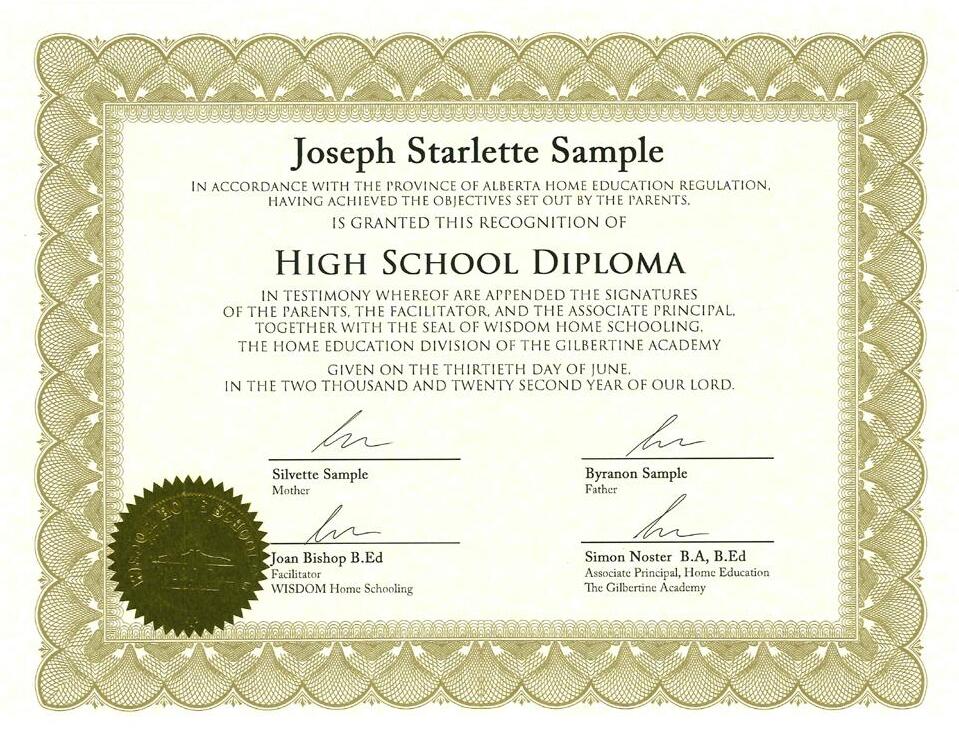
• A well-rounded education, tailored to the individual student, assisting them in finding and preparing for their calling and vocation(s)
• A Classical approach
• Faith and character formation
• Mentorship and Entrepreneurship

1. Student and parent(s) develop portfolio throughout high school and make a completed portfolio available for the facilitator to review at the end of high school.
2. Parent(s) complete the WISDOM Certificate of Completion Request form (Certificate request forms can be downloaded from the WISDOM website).
3. Parent(s) submit the completed request form to highschool@wisdomhomeschooling.com.
4. WISDOM processes the certificate and mails it to the parent(s). Certificates of High School Completion are awarded based upon verification by the parent(s) alone.
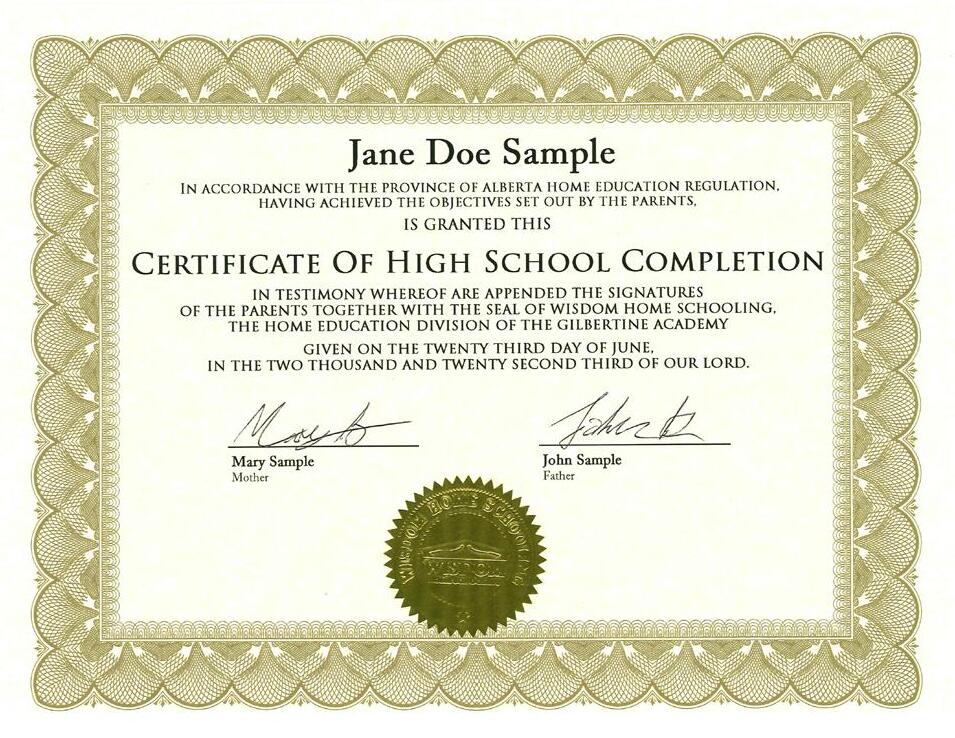
• Indicates completion of High School and readiness to enter the adult world
• Accepted by some post-secondary institutions
• Accepted by many employers
• Insufficient evidence for some institutions
• Insufficient for some employers
Verified Transcript (pvt) is a summary record of marks or grades as determined by the parent (teacher) of a home educated student. It is an official WISDOM document containing a table of individual courses or studies during the student’s high school years with corresponding marks as verified by the parent(s). The transcript can be provided to various post secondary institutions or businesses which require a transcript of marks for admission or employment. A PVT may include Grade 12 results alone or any combination of high school grades. For more information, please visit the WISDOM Website.
1. Parent(s) determine marks or grades for the student’s various individual courses or studies.
2. A record of marks and grades are submitted to the office by one of the following means:
• Send an email with marks to highschool@ wisdomhomeschooling.com or
• Fill out the transcript submission form found on the WISDOM Website and submit by email to highschool@wisdomhomeschooling.com or by mail to the WISDOM office.
3. Facilitators review marks and possibly offer suggestions; WISDOM might also have recommendations as to formatting the PVT
4. WISDOM office processes an official transcript, signed by the Principal, and sends a physical copy to the parent(s).
5. The parent(s) and student may also request that an official transcript be sent to any post-secondary institution or business
• Indicates completion of High School and readiness to enter the adult world
• Provides a specific record of the individual student’s work.
• Accepted by some post-secondary institutions
• Accepted by many employers
• Insufficient evidence for some institutions
• Insufficient for some employers
Parents have the capacity to determine the depth and breadth of their student's learning. There are several methods of determining a mark, including (but not limited to):
• Portfolio of marked student work
• Facilitator feedback
• Parent observation
• Unit tests, practice tests, or final tests
• WISDOM online course feedback
• Teacher/Tutor feedback
• CTBS (Canadian Tests of Basic Skills) results
• CLT (Classical Learning Test) results




Possible approaches:
• Volunteer work leading to employment
• Working with a mentor while completing an academic program at home
• Gaining employment
Benefits:
• Family controls the academic program
• Student makes good use of time, learning on the job
Limitations:
• Student may move into work-force prematurely, losing the advantage of “leisure devoted to learning”
• Student may become tied to work that is not a calling

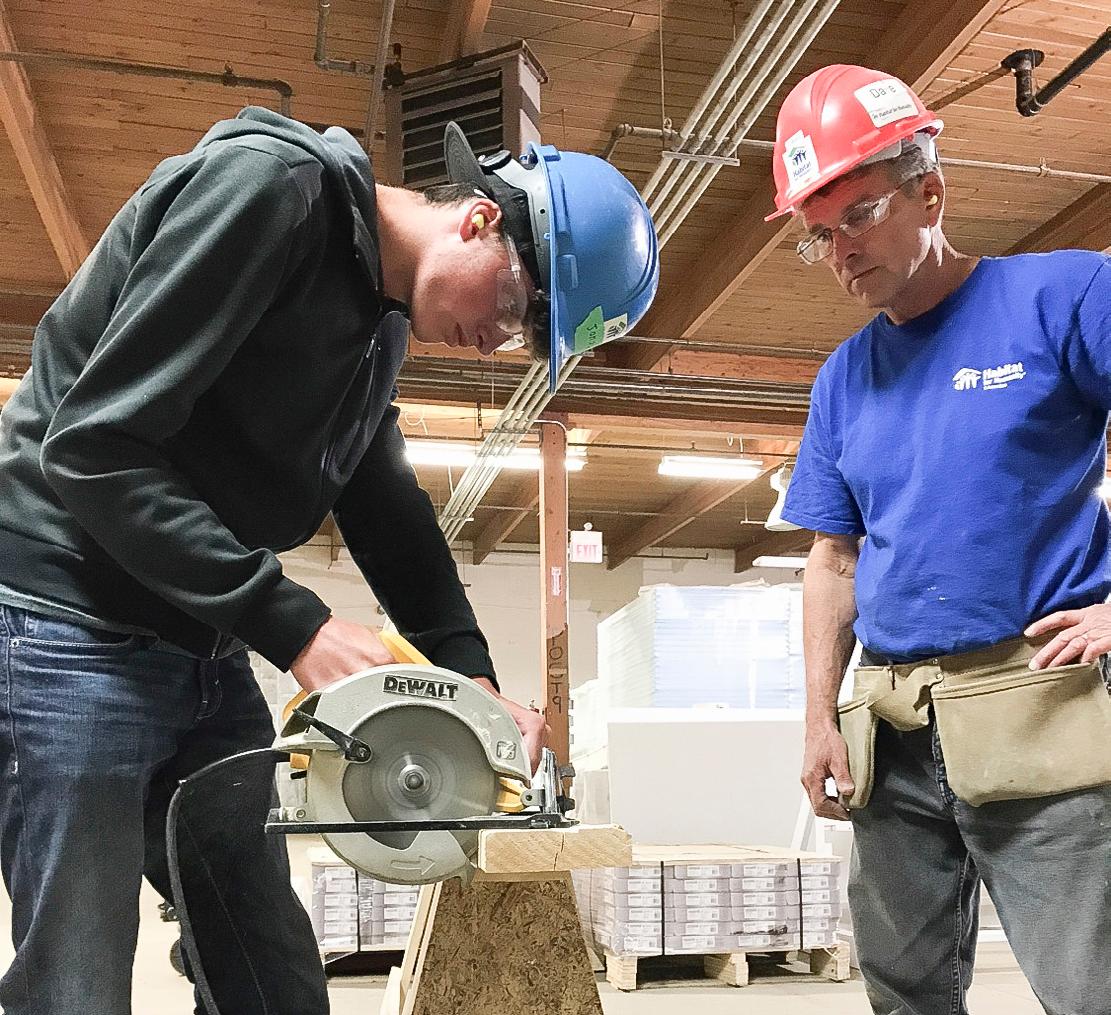
Possible approaches:
• Complete the requirements for Alberta credits at the level required by your trade (eg. automotive service technician requires Grade 10), or
• Write the entrance exam required for the trade you want to study.
• Create a My Trade Secrets account to learn how to prepare for and write an entrance exam: tradesecrets.alberta.ca/mytradesecrets
• Write the entrance exam at your local employment centre
• No charge for writing nor limit to number of times you may write the exam
• Score 70% or higher to qualify for study in your trade
• Find an employer willing to apprentice you
Benefit:
• Begin work in your chosen field any time after age 16
Limitation:
• Beginning a trade before high school completion will leave little time for other education


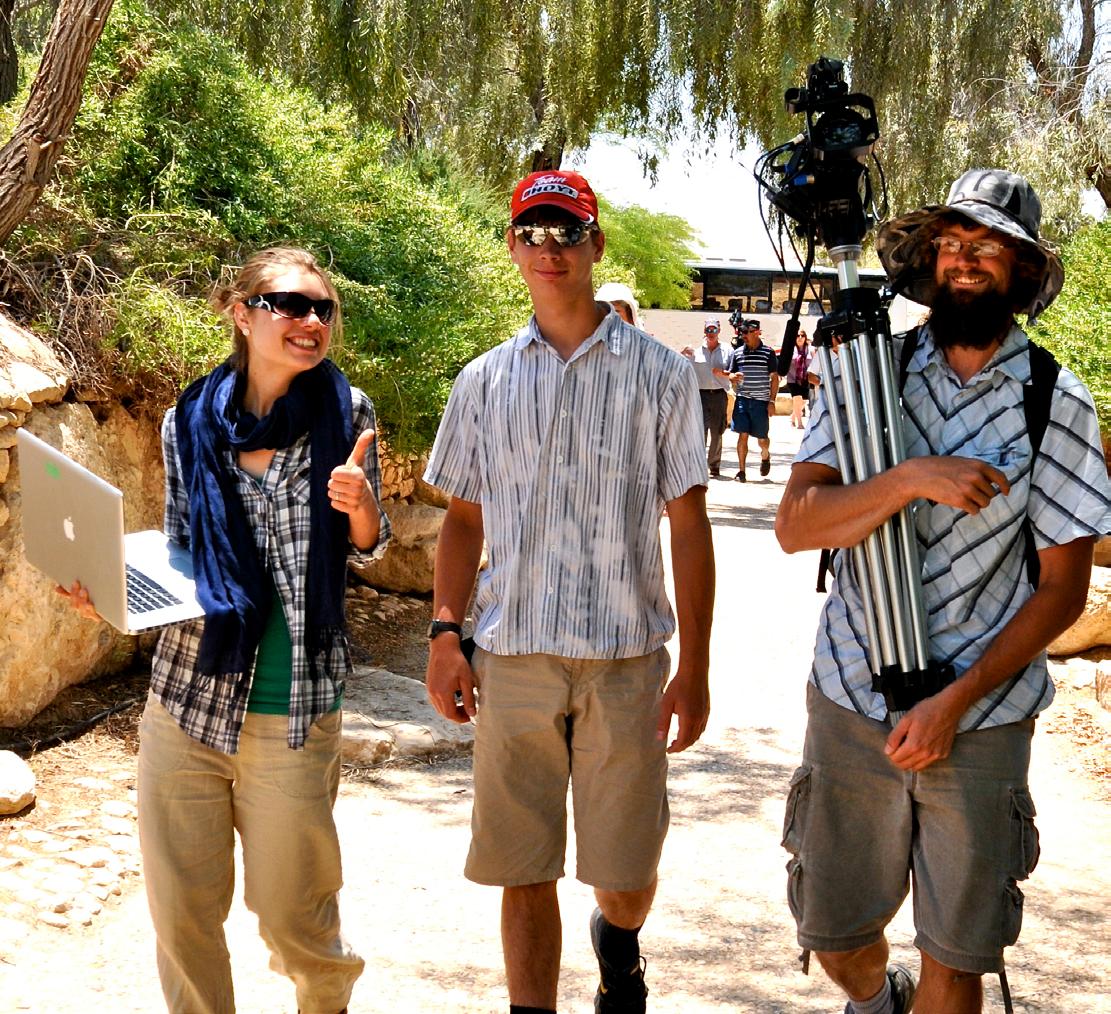
Possible approaches:
• Volunteering to do work that is appealing
• Receiving a rich academic program while gaining skills and perhaps working with a mentor
• Identifying a niche and filling it

A portfolio is a useful way of accessing education or work by providing thorough and accurate evidence of a person’s skills and knowledge.
See more information on page 18 of this handbook.
Benefits:
• Family controls the academic program
• Student builds a business while receiving an education
• A clear calling can stimulate a passion for learning
Limitations:
• Student may focus so much on business as to limit time for a balanced education
Benefits:
• More information than a transcript of marks
• Can be tailored to the work or education the student is seeking
• Can be condensed into an effective resume
• Is an effective supplement to succinct reports like transcripts and certificates
Limitations:
• Some employers and institutions do not accept a portfolio image souce: kabompics.com


Used to enter post-secondary programs that require select course marks.
1. Meet course requirements using your own home school program or Alberta Education materials.
2. Work with the Subject Specialist to achieve the requirements of the course. Evaluation will include a final exam to arrive at the school-based mark for each core course being challenged.
3. WISDOM registers the school-based mark and credits with AB Education.
4. Student writes the Alberta Diploma exam, worth 30% of the final mark.
5. The mark and credits appear on the student’s AB Education transcript.
• Accepted by all universities and many colleges
• Use your own teaching methods and resources
• Receive Alberta credit for skills and knowledge
• Gain credentials
• Some trade or technical schools require an AB Diploma (ironically requiring less rigor but more detail)
• Home school resources often need to be supplemented
• Demonstrating achievement for AB Ed outcomes may leave less time for the student's other passions
Alternative: Student may take up to 10 credits through a distance education provider rather than have the parent deliver the course. See the WISDOM Credit Handbook for details.
1. Speak with your facilitator as soon as possible.
2. Plan your course load so as to complete the following, with a minimum of 100 credits:
• English 30-1 or 30-2 (or Français 30-1 or 30-2)
• Social Studies 30-1 or 30-2
• Mathematics 20-1, 20-2 and Math 24
• Science 20 or 24 or Biology or Chemistry or Physics 20
• Physical Education 10 (at least 3 credits)
• Career and Life Management (at least 3 credits)
• 10 credits from CTS courses or
• Fine Arts, or
• second languages, or
• Phys Ed 20 or 30, or
• the Registered Apprenticeship Program (RAP)
• Knowledge and Employability
• 10 credits in any additional 30-level courses.
3. Participate in course challenge and/or waived prerequisite credits.*
4. Write AB Diploma exams for a minimum of English 30 and Social Studies 30.
If 19 as of September 1, you may choose the Mature Student option of challenging Diploma exams, worth 100% of final mark.
• Access to trade schools and college programs
• You may achieve the diploma while using supplemented home education curriculum
Limitations:
• May not allow direct access to University
• Time spent fulfilling requirements & writing provincial exams
*See the WISDOM Credit Handbook for details.
High School Equivalency Diploma that requires a student to pass 5 educational tests. In Alberta, this new credential has replaced the General Educational Development, or GED®, which is no longer available in Canada as of May 3, 2024 The CAEC provides a high-quality, made-in-Canada education credential that meets industry standards as a replacement for the GED®.
The 5 CAEC tests:
• English Reading or Français Lecture
• English Writing or Français Écriture
• Mathematics
• Social Studies
• Science
In Alberta, like the GED®, the CAEC is for adults who do not have a high school diploma but need an education credential to open new doors to educational or employment opportunities.
Benefits:
• Access to certain employment, trade schools, and college programs
• You may achieve the diploma while using supplemented home education curriculum
Limitations:
• May not allow direct access to University
• Time spent fulfilling requirements & studying for or writing CAEC exams

Featuring passages selected from great works across a variety of disciplines, the CLT suite of assessments provide a highly accurate and rigorous measure of reasoning, aptitude, and academic formation for students from diverse educational backgrounds. The exams are taken online at home in just two to three hours. The CLT also provides colleges and secondary schools with detailed information about student learning trends, to facilitate decisions about admissions, curricula, and instruction.
The CLT may be used in Grade 8 and 10 to measure student progress, and in Grade 12 as a final assessment and college entrance exam accepted by a growing number of post-secondary institutions. Several post-secondary institutions offer scholarships to students who use the CLT. WISDOM families receive a discount on all CLT exams.
Some programs and post-secondary institutions have their own entrance exams for student admission. Talk to the institution of your choice to see if this is an option.
The purpose of the SAT is to measure a high school student's readiness for college, and to provide colleges with one common data point that can be used to compare all applicants. Used primarily for American colleges and universities, it is also accepted at most Canadian institutions.
The ACT is the leading U.S. university admissions test, measuring what students learn in high school to determine academic readiness for university. It may be used for access to American programs, as well as over 200 additional institutions worldwide.
• Access to many colleges and universities
• Potential consideration for specific scholarships
Limitations:
• May not allow direct access to the program you have selected; additional research is required

Basic Employability skills to be Mastered by the end of High School Basic Employability skills to be Mastered by the end of High School
Students can:
• Communicate - listen, speak, write and present
• Manage information - gather, organize, analyze & apply knowledge
• Think critically - problem-solve and make decisions
• Apply numbers - math skills that enable them to make estimates and decide what needs to be measured or calculated, and use formulas
Students have:
• A positive attitude and good behaviour, honesty, integrity and personal ethics
• Responsibility in their personal life and workplace
• The capacity to adapt to change
• The ability to be creative
• A desire for continuous learning
• Awareness of personal strengths & weaknesses
• Ability to set cohesive goals for learning
• Safe work habits, and awareness of health and safety procedures
Students can:
• Work in a team - value and appreciate the diversity within a group
• Take initiative
• Follow well


Classical education is a valuable and growing education option. Parents are wise to incorporate the best of the past while they are preparing their children for a rapidly changing future. A classical education is one of the best ways to prepare for life after school.
The WISDOM Socratic Dialogue Online Program was initiated in order to help families home educate through the high school years. All paths through high school can lend themselves to a classical education.
There are significant differences between the WISDOM Socratic Dialogue Online Program and provincially accredited high school courses. The content of the WISDOM Online Program does not follow the Alberta Programs of Study, but the achievement of strong skills and knowledge from a classical program contributes to achieving some or many of the outcomes.
In the WISDOM Online Program the method of learning is primarily Socratic dialogue.
• Socratic dialogue can best be described as a guided discussion in which the students are active seekers of knowledge and truth through critical inquiry. The tutor opens the class with a question about the reading, and the students delve into a conversation that goes deeply into the text, moving past comprehension of the narrative to understanding its teachings, morals,
issues, and relevance to our current society, culture, and daily life.
• The use of Socratic dialogue means that students will be expected to constantly actively use their minds and language in defending their ideas and challenging one another’s grasp of the books and of the truths contained therein.
• This method strengthens the student’s memory and promotes and enhances the use of critical thinking, logic, and persuasive speaking.
The texts used in the WISDOM Online Program are among the best examples of beautiful and significant literature, philosophy, and history from the past 2 millenia. These texts demonstrate clear, orderly, and compelling thoughts that have effectively shaped the world throughout the centuries.
The Classics wrestle with important fundamental questions of life; questions that every person needs to ask and try to answer as they find meaning and purpose in their personal and professional lives. These answers will drive each person in the actions that continually shape their future and the future of those around them.
Most importantly, students who study the Classics develop a love for truth and a courage to find and spread truth with everyone. In a world of increasing dichotomy and fear, a student of the Classics welcomes discussion with those who do or do not agree with him, and this openness leads to the essential communication that promotes stability in community, society, and government.
Course registration for the Fall term (September-December) opens in May, and for the Spring term (February-May) in October. Go to wisdomhomeschooling.com/courses for more information.


By Vic Wiens
In the past century, students typically identified their career goals and could expect to maintain that career for the next 40 years, retiring with a comfortable company pension. Now, students can expect to change careers up to half a dozen times and work at least part time until age 75. Authors Helen Tupper and Sarah Ellis describe this new Squiggly Career path in a book by that name. Multiple career changes are likely to be the norm for our current high school students. This has significant implications for high school.
Tupper and Ellis describe the five career skills that will allow high school students to succeed in this changing world of squiggly careers. I have added observations below, since Home Education is well suited to preparing high school students for the new world of work. It is worth purchasing the book, reading it, and doing the exercises at the end of each chapter.
Super Strengths
While strengths are those activities we are good at, super strengths are those activities we are (or can become) exceptionally good at. By high school, students begin to get an idea of what they are naturally good at. Becoming exceptional requires developing certain strengths to an exceptional level. Research suggests that successful people spend about 20% of their effort on addressing their weaknesses and 80% of their effort on developing their strengths into super strengths.
The traditional “Grade 9” year is an excellent time for students to begin to identify their natural talents as well as their learned strengths. Learned strengths are things students have become good at through learning, effort, and practice.
Not all strengths lend themselves to careers. Very few people can earn a living playing video games, even when they are exceptionally good at them, though this passion could be converted into a passion for developing video games as a viable career. In other words, high school students need to explore which of their strengths lend themselves to paying careers, even squiggly careers, and then focus 80% of their effort developing those strengths into super strengths. Traditional homeschooling lends itself to such a focus more than campus or online schooling.
Tupper and Ellis define values as “the unique attitudes and beliefs that motivate and drive us.” Workers who are driven from within outperform those who need to be motivated externally. Values are formed over time, with young children absorbing the values of their parents, trying on different traits in the middle years, and then more deliberately choosing them in the high school years. In the same way that students need to choose certain strengths, they also need to choose, from a competing range of options, those values that lend themselves to successful and meaningful adult lives. In the same way that strengths are both discovered and selected, values must also be discovered and selected. Chosen values should always be consistent with religious beliefs.
While some people seem to be born with an air of confidence, most people have to learn confidence. It is important to think of confidence as a skill that can be learned, practiced, and developed. As new jobs emerge and old ones disappear, employees in the future will need to have the confidence to move on to the next opportunity. Some people will portray their confidence more openly while others will display a quiet confidence.
Confidence comes through taking on and mastering challenges, and motivation follows naturally from confidence that is built on success. Research shows that confidence built on success motivates us even more than our values and passions. Of course, success follows from developing skills through learning and practice.
Networking is people helping people. In order to help people, we need to let them know how we can help them. In order for them to help us, we need to let them know what we need. Effective networking requires deliberately getting to know people with whom we can form mutually beneficial relationships both for our current roles and our preferred future roles.
Home education students can learn to network with other students and also with adults who can help them succeed as students. However, they need to be mindful of how they can be of value to these people so that the relationships are mutually beneficial. High school students should also begin to develop relationships with potential employers by finding ways to bring value to these relationships. The majority of employees now find jobs through networking more than through other kinds of job applications. In my view, high school students should already set up a LinkedIn profile and learn how to network online.
In the past, students would ask themselves what job they envisioned doing in five years and then plan towards that job. In our current economic environment, five years from now students may be in entirely new jobs that have yet to be created. Futurists advise students to prepare for at least five different careers in a lifetime. Possibility focus requires us all to constantly scan our environment for possible careers in order to position ourselves for those possibilities by developing the knowledge and skills required for those various possibilities. The same skills may indeed be used for a yet to be created career.
Fortunately, home schooling lends itself to developing these squiggly career skills as well as the basic employability skills. However, such skill development needs to be intentional, and these learning outcomes should find their way into education plans for high school students.
Reid Hoffman and Ben Casnocha make some excellent additional observations in their book, The Start-up of You. They emphasize the need to develop “search literacy” skills. Search literacy is the ability to select the right words for Internet searches. In this digital age, it is more important for people to know how to access information rapidly than to memorize information.
By Thérèse McDonald



Asa modest-income family, we are motivated to lay our hands on as many scholarship, grant, and contest dollars as we can. So far, of my four children, I have two that have graduated on to college, and one who is in the process. As home schoolers, my children and I have had to be proactive in hunting these dollars down. We’ve had good success by taking advantage of opportunities out there.
Money hunting is hard work. One must be prepared to put some time into the pursuit. Time to tune up your communication skills, highlight your talents, and put the spotlight on your achievements!
Do some preparation work by writing down everything you have to offer. Having notes on your activities, volunteer work, training, work experience, skills, past academic work, lists of books you’ve read, courses you have taken, essay samples, test scores, transcript of studies, certificates or awards, groups you belong to, teams, parent associations etc. will help you pre-plot and give focus to potential grant and scholarship applications.
A good primary resource is found at alis. alberta.ca, also known as the Alberta Learning Information Service. There you will find links to both grants and scholarships. Some scholarship descriptions seem to eliminate home schoolers, but I encourage students to apply for scholarships they are even unlikely to win; many scholarship opportunities do not get a single application, so those in charge will often consider someone who falls outside of their parameters. It never hurts to try.
Not all scholarships are advertised. Call post-secondary institutions, companies, and groups and ask them to send to you any information regarding the opportunities they offer. Perhaps Dad’s workplace has sponsorship available, or Grandpa’s veteran group has money to offer. Has anyone in the family served in the military or the police force? Often children or grandchildren are eligible for scholarships or grants, but rarely
do they apply for lack of awareness. Perhaps a parent belongs to a church association that offers help to a member’s child? Take advantage! Polite letters of inquiry to such organizations will open doors.
Schools often look for academic achievement, excellence in sport, or evidence of community involvement or leadership. As a home schooler you may need to prove this more directly with letters of reference or recommendation. WISDOM’s Parent Verified Transcript and Diploma can be secured through the office, as can a letter of reference from your facilitator. Our family has had good success by including these items with scholarship/grant applications.
If you are of a particular ethnic background, cultural associations often have grants or memorial bursaries available. Metis, First Nations, and female gender scholarships are especially in abundance. Fine arts groups are often good sources of help. Do you dance, sing, or perform? Using Internet searches, you’ll find niche scholarships that fit your particular background or activity.
Are you a good writer? There are many contests that offer money prizes. These smaller prizes can add up. Christian magazines, websites, and organizations have annual competitions. Pay attention to deadlines, making yourself a calendar of due dates, so you don’t miss out on opportunities. Look for government contests as well. One of my daughters won three contests in a very short time that totaled $3000.00 in winnings - The Gilbert Magazine (Chesterton), The History Museum in Ottawa (she wrote about trench warfare in WWI), and a smaller article for a Christian magazine.
Don’t discount your location in Alberta. There are grants distributed based on living in the North, in towns with small populations, or offered by local businesses and organizations. Some town councils have bursaries in place to help local young people train in places that demand travel.
If you work part or full time for a large chain or big box store, scholarships are available. If you’ve shown leadership, a sense of responsibility, and good performance, you’ll have a good chance of being awarded funds toward education. Contact Human Resources and ask what is available through your work.
There is big money floating around out there if you plan to work in a particular trade or field of work. Where there is a shortage of employees, many companies offer incentives to come work for them, by paying for school in part or even in full. Apprenticeship opportunities can be a vehicle for free education money.
Low or single income families can also obtain help from schools. A statement of income and work plan will often be sufficient to obtain help from institutions and organizations.
Don’t hesitate to enter talent competitions or county fair showings that also award prizes.
Take the time to communicate with confidence and accuracy when dealing with post-secondary schools and organizations. Many applications ask for an essay (or more than one), or an interview. Some sports scholarships require try-outs or skill tests. Don’t be daunted. This is your chance to shine. In some cases, so few apply, it is a matter of just putting in the effort that will win you funds.
Helpful websites:
scholarshipscanadian.com
alis.alberta.ca
scholarshipscanada.com
studentawards.com
CLTexam.com
Trades – Scholarships: tradesecrets.alberta. ca/financial-assistance/scholarships

by Joyce Sehn
a portfolio?
Portfolios continue to be a very effective method of communicating who you are, and what you can do. Presenting your portfolio in person, and talking about what it contains, adds reinforcement and credibility. This could greatly aid you in getting a job or a seat in the post-secondary institution of your choice. Your portfolio will distinguish you from the many others represented by a stack of applications. Years ago, if a young boy showed an interest in a particular field, he apprenticed with a master, practised until he had acquired great skill, and then produced his own masterpiece. Thus, the goldsmith’s beautiful piece of jewellery,

the sculptor’s statue, and the tailor’s suit demonstrated competence in the chosen field.
Things are not very different in the professional world today. An architect shows a building he has designed, with plans and photos of his work. A furniture designer has photos and scale models of his designs. A violinist will perform, or submit a recording of a performance, and have a list of works studied, and so on. This is still the best way to show what you can do!
In an institutional setting, the focus is on curricula and outcomes, content and knowledge. Economic considerations dictate that simple methods be used for evaluating
students, thus we have standardized tests, multiple choice questions, and letter or number grades. This method is useful in assessing how students compare to each other, but studies have shown it is not the best way to encourage or assess learning.
In a home setting, we have the freedom to focus on real learning and thinking skills, to develop a love for learning, and to become lifelong learners. We can see firsthand what has been learned and the level of understanding achieved. This can be conveyed to others in a variety of ways, including the use of anecdotal notes, samples of work, and the student’s assessment of his or her own learning. This will show what makes them unique - precisely the purpose of a portfolio!
To develop a strong portfolio, it is helpful to answer the following questions:
1. WHO are you?
• What are your strengths and weaknesses?
• What are your likes and dislikes?
• What are your talents, interests and hobbies?
• What experiences do you have? What have you accomplished?
• What have you studied? What have you read?
• What are your distinguishing personality characteristics?
• Where have you lived? Where have you travelled?
2. WHEN and WHY are you preparing a portfolio?
Are you starting a portfolio for a six year old with the goal of preserving memories via photos and a scrapbook approach, or do you need a portfolio in the near future to present to an admissions officer of a college or university? Obviously, these two differing reasons will produce very different-looking results.
Everyone should start a portfolio as soon as possible! The habit of keeping records, saving samples, and filing things in a presentable manner is invaluable. Not only will you have a record for yourself, which you can enjoy

reminiscing over in future years, but you will be ready to produce a portfolio to meet requirements when a need arises. It will evolve over time, changing and improving, depending on the need at the time, and the effort exerted.
Students need to be involved! It will be primarily Mom’s job in the early years, but just as older students must take responsibility for their education, they should take responsibility for preparing their portfolio. This is important enough that it should be included in their program plan at the high school level. The process of preparing and presenting a portfolio, as far as the developing of skill is concerned, is almost as important as the end product.
3. WHAT should be included?
Once you have answered the above questions, you will be much better prepared to proceed. You must then choose what to include. Because no two individuals are the same, no two portfolios will be the same. The list of possibilities is virtually endless, but below are some ideas, in no particular order, from which you may choose (and add your own ideas):
• cover page with name, and a photo of yourself
• table of contents of your portfolio
• a description of your philosophy of education, your family’s vision/goals
• a list of strengths, weaknesses...all the things listed in “Who are you?” above
• lists of extra-curricular-type activities, community and church involvement
• a transcript of marks (given by parents or based on tests or outside evaluations)
• certificates from online courses
• diplomas, completion certificates, music festival awards
• lists of musical pieces studied, performances
• lists of concerts attended, places visited (such as museums, etc.)
• character reference letters, employer
reference letters
• character development analysis checklist
• lists of courses studied, descriptions of courses
• educational goals, program plans
• log of readings
• photos, videos and audio tapes of activities, projects and accomplishments
• samples of photography, design, art work
• a resume (you may use the same one you would use to apply for a job)
• writing samples and work sheets, such as math tests
• tables of contents from curricula studied, test results
• lists of courses/workshops taken (swimming, first aid, baby-sitting, safety, computer)
• goals for future education and career plans
4. WHAT does a portfolio look like?
Generally, people use a binder or folder of some sort. If it needs to accommodate bigger things, such as original artwork for example, it could be quite large, but usually 8 1/2 by 11 size pages are sufficient. A three-ring binder simplifies arranging and rearranging pages to meet various needs. Non-glare plastic sleeves enable the insertion of pages without punching holes in original documents. A power point presentation could also be used, but the downside of this is availability of equipment.
Decide on a simple method of compiling things. Just putting everything in a box may mean you’ll never get back to it, or that you’ll be overwhelmed with the task of organizing it when you eventually get to it, but it is a start. Slipping things into an album on a regular basis will keep things organized chronologically. Scanning documents, photos and projects is another option. When you need to present your portfolio, you can then choose and use relevant items.
A personal example:
Each of our youngest girls has two portfolios.
The first is a photo-album type, which covers the early years of their home education. Pictures and certificates are quite prominent. Its main components include:
• photos of activities
• samples of penmanship
• art work (or photos of art work)
• reading lists
• lists of what was studied during this time (arranged by subject)
The second portfolio is a more serious-looking one, which covers the high school years. It includes:
• a description of a classical education and our philosophy of education
• lists of what was studied arranged by subject, including names of books and texts used
• samples of writing
• a list of books read
• descriptions of online courses and completion certificates
• a parent-generated transcript
• a WISDOM certificate recognizing High School Completion (which states that the student has completed the objectives set by the parents)
Much of the process of preparing these portfolios was enjoyable, but there were struggles, too. Deciding what to include, what format to use, and the order in which to present things, was not easy. But, the effort was well worth it! We have a great record of those precious years, and both girls gained admission to a university/ college without any Alberta courses or credits, simply by presenting their portfolios.














Entrance requirements for non-university colleges vary dramatically. They range from no requirements whatsoever, to entrance exams, academic upgrades, grade 11 transcript, or a high school diploma. Some college programs require special preparation in specific courses. The only way to approach college
There are many ways to go from home school to university. Do thorough research to choose your route.
Conventional Method
WISDOM Element #5, #6, #7 or #8 (p.12 & 13)
University Transfer
Eg: Athabasca University, an online university, will admit students 16 or older with no paper trail. You may complete your degree at Athabasca or transfer to other colleges or universities, space permitting.
Parent Verified Completion
Concordia University in Edmonton, and others, accept home schooled students based upon a WISDOM certificate recognizing High School Completion and a Parent Verified transcript of marks.
Portfolio
Some universities accept home schooled students based on a portfolio and an interview.
Portfolio & Evidence of Literacy
Some universities accept home schooled students with English 30 or equivalent and an interview. (A portfolio is useful.) Earn a degree or transfer to other universities where space permits.
is to go and speak to the administrators of the program you are considering, well in advance of finishing high school at home. In this way you can tailor your high school program to provide entrance qualifications.
Testing
Students may gain admission to some universities by writing the SAT or the institution’s placement tests. Eg: Trinity Western University in BC takes home schooled student based upon the results of the CLT, SAT, ACT, or CAEL.
Mature Status
Universities and colleges accept adult students without a paper trail. The age for mature status is set by the institution, generally anywhere from age 19 to 24
Classic Learning Test
The Classic Learning Test (CLT) is a post-secondary entrance exam, created as an alternative to the SAT and recognized by many post-secondary institutions across the United States, and a growing number in Canada. Eg: Prairie College in Three Hills and Ambrose University in AB, Catholic Pacific College or Trinity Western University in BC, Our Lady Seat of Wisdom College, in ON, Catholic Institute of Technology in Rome, Italy, and many Colleges and University across the US, are institutions that use CLT to meet admission requirements. Some universities are also willing to review CLT results on a case-by-case basis.
Some universities and colleges partner with WISDOM to admit students based on completion of WISDOM Socratic Dialogue courses. Eg: University of Alberta: Augustana Campus in Camrose, AB accepts students based on completion of certain WISDOM Socratic courses. If a University or College does not currently have a partnership, you can ask them to contact us to discuss a new partnership between WISDOM and their institution.
Although it is not necessary for homeschooled students to follow the Alberta Programs of Study outcomes in order to graduate, WISDOM respects parents as the primary educators of their children and recognizes that some families choose to pursue credits for reasons specific to their needs and goals. WISDOM students enrolled in a senior high school program may pursue Alberta Education courses for credits and marks in accordance with Section 6 of the Alberta Home Education Regulation. When credits are the path families choose, WISDOM provides support and guidance to help students be as successful as possible in fulfilling Alberta Education’s requirements. WISDOM students gain credits primarily through a Course Challenge process, but also have the option to gain some credits through some alternative methods.
Many learning options are available when a student has clear plans for the time after high school. A student who is unsure of what to pursue after high school may wish to be “ready for anything” by earning Alberta Credits or an Alberta Diploma, but fulfilling provincial requirements reduces program flexibility. On the other hand, greater flexibility, well spent, typically results in a superior learning experience. Discernment and good planning are are crucial steps to opening up the widest variety of opportunities for high school and beyond.
Four ways to receive high school credits:
• Course Challenge
• Course Waiver
• Mature Diploma Exam Challenge
• Externally Delivered Courses through other Schools
Pursue a rich home education experience, and achieve the CAEC equivalency diploma, and/or gain transferrable University credit.

Pursue a rich home education experience and selective AB courses to achieve necessary post-secondary admission requirements.
Align home education to the AB Program of Studies and obtain 100+ credits in a variety of specific and optional courses.


To learn more about Alberta credits & marks, please see the WISDOM High School Credit Handbook.




rEbEcca KaiSEr
Focussed on Essentials
“Through the years spent at home I grew in the knowledge of who I was and what I wanted in my life. The open guidance of my parents allowed me to discover life to the point where I felt not only a desire to go and achieve on my own, but also knew the extent of my potential. All in all I am grateful to have had the chance to leave home being capable of making wise choices as I carve out my life through discovery and enrichment.”
tHE KuprowSKi gradS
Pursued entrance to UofA through a transfer from Athabasca University
“A few years of studying in Athabasca University has shown us that with distance education strong independent and selfmotivated work habits are required. Also, research and writing skills are heavily stressed in all courses.
“One year of study this way, with acceptable marks, paves the way into the U of A.”
cryStal popKE (Course Challenge)
“Crystal was a home schooled since Grade 5, and she along with 18 other home schooled children had a wonderful High School graduation ceremony in Calgary.
She was accepted into Biological Sciences at the University of Calgary.
Crystal had already completed German 10, 20 and 30 in Grades 7, 8 and 9. In Grade 10, Crystal took Abeka Biology, challenged Biology 30 and wrote the Diploma Exam.
In Grade 11, after having completed Abeka’s Language Arts-Grammar & Composition and Vocabulary, Spelling & Poetry she challenged English 30 and wrote the Alberta Diploma Exam. In her first semester of Grade 12 she completed Abeka’s Chemistry and Advanced Chemistry books challenged the Alberta course and wrote the Chemistry 30 exam. In her second semester in Grade 12 Crystal took Math 30
and Physics 30 by correspondence from Alberta Distance learning. She had already completed Saxon Advanced Mathematics at home. For the Chemistry, Biology and English courses, our WISDOM facilitator submitted the course marks to Alberta Education. This counted for 50% of Crystal’s final mark; the other 50% came from her diploma exam mark.”
tHE StaplES Family
Graduates pursued different avenues.
natHan
completed his high school work and is presently working with his brother in landscaping in North Carolina. He is interested in aviation, particularly helicopters, with a future goal of mission flying. During the spring he researched the aviation programs of several different schools and the American army. He narrowed the selection to two or three possibilities before making his final choice.
andrEw
worked for two years after completing his high school because he was unsure what direction he wanted to go. He then headed towards youth ministry and part time classes at the Alliance University College in Calgary. Because he was twenty-one he could apply as a mature student.
After high school, spent two years in the Alert program through ATI He received training in firefighting, search and rescue, high angle rescue, scuba diving and emergency medicine, however the exams he took did not give him recognized certification. He then completed his paramedic training at a school in Texas that offered national certification. He worked as a paramedic in North Carolina for over five years, during which time he completed prerequisite courses through a community college and then specific nursing courses to complete an associate degree through Regent University, an online school. His wife is a registered nurse.
brian
“I had always been interested in aviation and had his private pilot license before finishing high school, due to the generosity of a retired missionary pilot who gave him his flight instruction free. The only cost was for rental of a plane through a flying club. We were in West Africa during Brian’s final year of high school. He returned to the United States ahead of us and on his own took the GED, SAT, and ACT tests through a local technical school and high school in North Carolina. Brian then went to one year at a Bible school with a mission aviation program, but was not able to continue because of the financial difficulties the program experienced. After another semester at a different Bible school, and through the loan of a plane from his father-in-law and discounted training because his wife worked for a flight school, he completed several additional ratings and now flies as a First Officer for a regional commercial carrier in the eastern United States. He is also Vice President of a landscape design company in North Carolina. The way was not always easy, but the Lord opened doors many times.
ryan & SEan tHomSEn (Apprenticeship & Mentoring)
“We wanted both of our boys to have a strong work ethic, so as a family we took on the job of cleaning the medical center in our town. We worked alongside each other, showing the boys how to give their best effort. We gave them the opportunity to have a variety of different experiences in the work force. They both had the chance to join their dad at work in the industrial electrical field (oil field). This gave them experience working long, hard hours.
Neither of them showed an interest in this occupation but the experience it gave them was worthwhile.
It took Ryan two years to decide that he wanted to go into apprenticeship as a welder. Sean's interest is in
business and he is currently working in retail. Never has not having an “official” Alberta high school diploma been an obstacle for them.
The feedback we have received from their employers has been fantastic. Comments such as “wish all our employees could be as committed to their work as him,” “he sure knows how to get the job accomplished,” “we know we can trust him to get the job done.” Both boys have learned to give an honest day’s work for their pay. This will serve them well in whatever field of occupation they find themselves.”
a parEnt uSing claSSical Education
“Our son is attending an international classical university that admits only 130 students each year. He had no Alberta high school credits, and this did not affect the university’s decision. I believe he was accepted because he had learned how to think well and how to express his thoughts. It takes a lot of time to fulfill the requirements of a government diploma: some people call it “jumping hoops.” Instead, our son spent a lot of time reading classical material and discussing it with us, his friends, and other students.
The WISDOM online writing courses helped him develop good writing techniques, which complement right thinking. He didn’t study as much Math and Science as he would have liked, but he is doing that now. We think the home is a natural place to learn the basics of language and math and develop a love for good literature and discussion.
The rigour of the WISDOM Online Socratic Dialogue courses provided personal discipline and prompted him to read material he would never have tackled on his own.
Our home also provided an environment where he could learn many life skills and grow in his faith.”

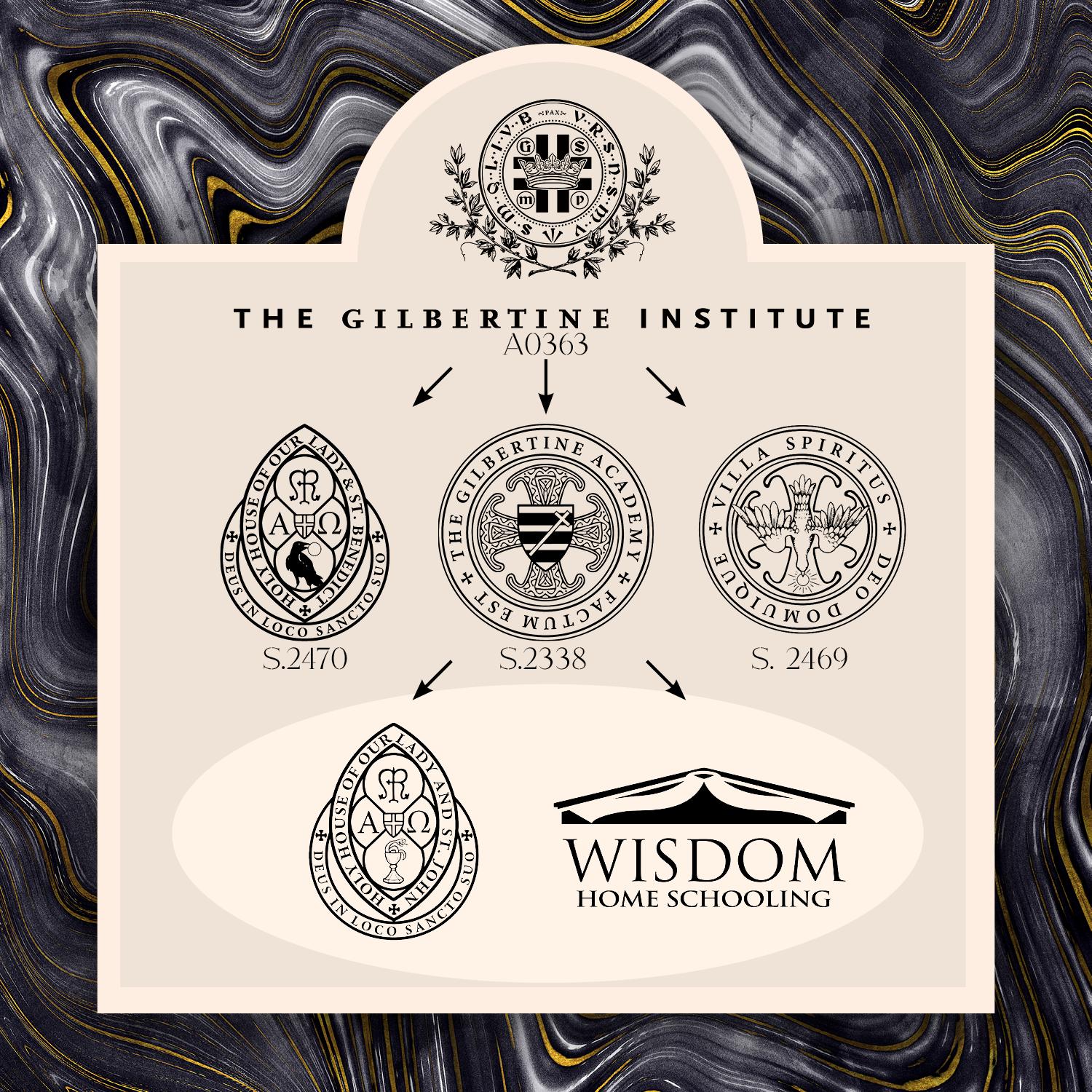
The Gilbertine Institute (A0363) is the society that operates independent school
The Gilbertine Academy (S2338).
WISDOM Home Schooling is the name of The Gilbertine Academy Home Education Administration.