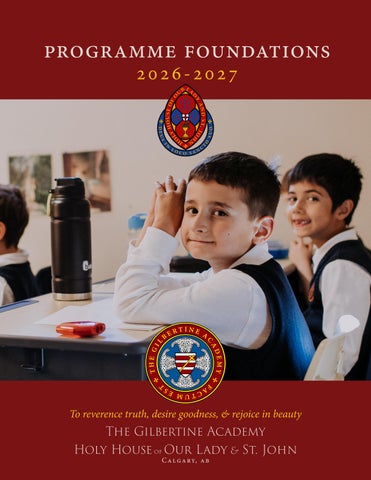
Gilbertine Academy Prospectus

Page 1


THE GILBERTINE ACADEMY

To reverence truth, desire goodness & rejoice in beauty.

e Gilbertine

Academy and Holy House of Our Lady & St. John

Location:

St. John the Evangelist Catholic Church 1423 — 8 Avenue SE, Calgary, AB, Canada, T2G 0N1

In-Person Schedule:

e Gilbertine Academy: full-time High School (gr. 9–12)

Tuesdays to Fridays from 8.00 am to 4.00 pm

Holy House of Our Lady & St. John:

Shared Responsibility Elementary School (gr. 1–8) Tuesdays and ursdays, 8.00 am to 4.00 pm

Remote Learning Schedule:

Grades nine to twelve: Mondays 8.00 am to 4.00 pm

Note: Our shared responsibility programme (Holy House: gr. 1–8) does not currently cover the instruction of Mathematics. Parents are responsible for delivering a complete Maths programme of their own choosing at home, along with any additions that suit the needs of the individual student.

A Catholic Education

THE Gilbertine Academy provides an integrated Catholic education supporting parents as the primary educators of their children. Our programmes of study equip students to grow and thrive in a world that is o en hostile to our Catholic faith. Our young people are not merely educated in this Holy House— we assist in their spiritual, human, and academic formation. Education is so much more than the transfer of knowledge and skills and so we engage the whole person, as a beloved child of God with a supernatural destiny, in the pursuit of truth, beauty and holiness.

Sempringham, and of St. John the Evangelist Catholic Church in the historic Inglewood neighbourhood in Calgary.

...the educational action pursued by the Church through schools cannot be reduced to mere philanthropic work aimed at responding to a social need, but represents an essential part of her identity and mission.

Congregation for Catholic Education

e late Pope Benedict XVI established the Ordinariate of the Chair of Saint Peter as a diocese that preserves and celebrates the English patrimony. e Gilbertine Academy, as an Ordinariate school, is therefore steeped in the British academic tradition and is the only accredited school in the province of Alberta based in a parish Church under the direct authority of the clergy. We are an apostolate of the Companions of St. Gilbert of

Our curriculum revolves around a four-year history cycle where materials presented in one class are reinforced by materials presented in another. We never teachonesubjectatatime— lessons in history beg a discussion of geography, philosophy, and political analysis. e master-works of Catholic art and music engage conversations about history; and every class is a class in religion! We value a classical and interdisciplinary approach to education, emphasize the virtues, integrate knowledge and skills, and provide an academic excellence to give our young people the best opportunity to succeed in this life and in the next. Speci cally, e Gilbertine Academy is structured around the Four Pillars of Catholic Education in the Ordinariate: Sacred Worship, Sacred Wisdom, Sacred Music, and Sacred Art.

Education is integral to the mission of the Church to proclaim the Good News. First and foremost every Catholic educational institution is a place to encounter the living God who in Jesus Christ reveals his transformingloveandtruth. isrelationship elicits a desire to grow in the knowledge and understanding of Christ and his teaching. In this way those who meet him are drawn by the very power of the Gospel to lead a new life characterised by all that is beautiful, good, and true; a life of Christian witness nurtured and strengthened within the community of our Lord’s disciples, the Church.

Structure & Governance

THE Gilbertine Academy (and the Holy House of Our Lady & St. John) is an accredited independent school—grades one through twelve—under the authority of the Ordinariate of the Chair of St. Peter (a Roman Catholic diocese that exists to realise the aims of Pope Benedict XVI’s Apostolic Constitution Anglicanorum coetibus). We are administered by e Gilbertine Institute school authority, which, besides our school here in Calgary, operates Villa Spiritus (a High School at Derwent), Holy House of Our Lady & St. Benedict (an Elementary School in Edmonton), and WISDOM Home Schooling (a province-wide support for home educating families).

Founded in 2018 at St. John the Evangelist Catholic Church in Calgary, with guidance from the Dominican Sisters of Mary, Mother of the Eucharist, our school is under the authority of his Excellency the Most Rev’d

Steven J. Lopes, our Bishop, the Very Rev’d RobertCharles Bengry GSmp, Magister of the Companions of St. Gilbert, and the Rev’d Kenneth Noster, Head of School of e Gilbertine Institute. Mr. Yvan Beaudoin is our Headmaster.

Because of the role of the clergy, and the prayers of our little Gilbertine Community, our school has an intentional monastic rhythm and in uence. Gilbertine spirituality embraces orderliness, industriousness, and balance, with an aim of personal holiness oriented towards the care of the poor in spirit. Students absorb these values through prayer, study, interaction with the clergy, and through the faculty—all of whom are believing and practising Catholics who take an Oath of Fidelity at the beginning of each school year.

Headmaster Mr. Yvan Beaudoin

Our Team

THE clergy, sta and volunteers of e Gilbertine Academy and Holy House are faithful Catholics (most are active members of St. John the Evangelist parish) and all are deeply committed to parent-lead education. All have a variety of educational and academic backgrounds ranging from liberal arts to the sciences. All are committed to supporting parents and educating children in the Catholic classical tradition and, most importantly, in virtue.

All clergy, sta and volunteers at e Gilbertine Academy and Holy House are required to undergo a criminal background check (including a vulnerable

sectorsearch)andachildwelfarecheck,andtocomplete the Safe Environment training programme required by the Ordinariate, Safe Haven—It’s Up to You. e safety and well-being of your children at school is paramount. e rst point of contact at the Academy will likely be our Headmaster, Mr. Yvan Beaudoin. You’ll nd he is approachableandisaclearanddynamiccommunicator. Your rst points of contact at St. John’s will be either Fr. Bengry, our Pastor, or Fr. Beahen, our Parochial Vicar. Our Parish Secretary is Ms. Kristen Morris and Parish Business Manager is Mr. Bob Harrod.

The Gilbertines

THE Companions of St. Gilbert of Sempringham (GSmp), with spiritual roots in the Order of Sempringham founded by St. Gilbert in England in 1131, is an association of the faithful, based in St. John the Evangelist Catholic Church. e Association of a small group of men and women, in Calgary and in Brandon, Manitoba, live out their vocations in an individual and voluntary obedience to a Rule of Life composed in partnership withone’sspiritualdirector,eachconductingthemselves according to the Statutes of the Association.

For God’s sake and for the salvation of your souls, pay more careful attention to divine love than you have up ’till now, by repressing vice, exalting truth & justice, and keeping the rules and traditions of your Order. St. Gilbert

voluntary prayer, presence and service to speci c parishes and neighbourhoods, according to one’s estate in life. Members encourage and empower those with whom they share common locality, experience, or fellowship of interests, to grow in holiness through an apostolate of prayer, presence and service informed by a recovery and celebration of the Anglican Patrimony envisaged in the Apostolic Constitution Anglicanorum coetibus.

Gilbertine Companions are to persist in a unity of spirit and purpose towards worship of God the Holy Trinity, the building up of the Kingdom of God and the salvation of souls under the patronage of St. Gilbert. Not bound as a community by vows, but rather by bonds of a ection, Companions live a life of individual

St. Gilbert himself was a teacher Priest in the twel h century who believed, when the idea was hardly commonplace, that both boys and girls should be educated. e Order was begun when seven of his femalestudentscametohimrequestingarule,habitand enclosure; all of which he furnished. It’s therefore tting that our latter-day Gilbertines have been involved in the founding of schools.

A Unique Opportunity

THE Gilbertine Academy and Holy House are uniquely situated in several ways. e authority of clergy certainly sets us apart, as does our Latin course (we have the only accredited Latin as a second language course in Alberta), but what we cherish most is that we literally go to school with Jesus. He is truly present in the Tabernacle set upon the altar; our school days begin and end in His glorious presence. Our teachers and all sta encourage our young people to embrace a sacramental world-view where we are drawn, hearts and minds, into an ever greater union with the Triune God. rough our academic studies, we learn about the Good, the True, and the Beautiful, but we actually commune in body and soul with Goodness,

Truth and Beauty itself in the Blessed Sacrament. All our studies hinge on the study of the revelation of Jesus Christ, particularly through the Incarnation and His Real Presence in the Eucharist.

...all branches of knowledge are connected together, because the subject matter of knowledge is intimately united in itself as being the acts and work of the Creator.

St. J.H. Newman, The Idea of a University

Another aspect that makes us unique is our e ort towards the practical integration of the home, school,andparish.Restoring the domestic church and the Catholic academic tradition means an investment in

an authentic common life. e goal is for students to discover the in uence and beauty of Catholicism in every aspect of culture and in their own lives, growing in holiness, and drawing ever closer to God.

We believe all of this and more, makes us, along with our sister schools in Edmonton and Derwent, a wholly

unique and rare educational opportunity for children in the province of Alberta and in Canada.

A Shared Responsibility

e Gilbertine Academy and Holy House provides an integrated classical Catholic education, supporting parents as the primary educators. As a Shared Responsibility programme, Holy House for grades one to eight aims to be a home at school that harmonises with schooling at home in mutual support. Our high school programme for grades nine to twelve consists of teacher-directed schooling for all high school classes. Because we are a small school integrated with family and parish life, parents are to be highly involved in the high school education of their children.

Our educational approach extols the theological order of the domestic church—the rst society—and complementsthevocationalmissionofparents“asthose rst responsible for the education of their children”. We do not seek to replace the parental role in education; but rather to bolster and support parents in their e orts as educators of their children. We maintain an atmosphere inwhichourstudentslearnthejoyofintellectualinquiry as an end-in-itself, but also to develop the habits and virtues needed for serious study and personal growth.

Faith Formation

Our course of studies equip students to grow and thrive as disciples of Christ in a complicated and o en hostile world. We assist our students in their spiritual, human, and academic formation in a way that is much more than the simple transfer of knowledge and skills. We work with parents to help form the whole person, as a beloved child of God with a supernatural destiny, in the pursuit of truth, beauty and holiness. e wholesome environment of e Gilbertine Academy and Holy House aims to allow each child to mature academically, spiritually, socially and emotionally, as strong, resilient and engaged Catholics equipped for sainthood.

Modern education, whether public or private (or even Catholic),istooo enthoroughlysecularisedanddenies children the treasure of knowledge and Wisdom from the Western tradition as fashioned for millennia by the Roman Catholic Church. is dichotomy in education

o en leaves children shaped and formed with a secular way of acting and thinking, which is highly fragmented, compartmentalised, and lacks a coherent philosophical foundation. us, for so many young people, the Faith becomes dislodged from the centre of their lives—seen as an ‘extra’ at best—and they are thus made vulnerable to the secular ideologies and whims of the day which are at terrible odds with Catholic morality, understanding, and ultimately at odds with the very foundations of our Western culture.

Becauseofthis,somanyyoungpeopletodaywalkaway from the Church as they become adults. We believe the way forward for a renewal of Catholic Education is to ground our children, from the very start, in ultimate Truth, Beauty, and Goodness. Our programme assists parents in this challenge by providing a nurturing and engaging environment for the formation of their children’smind,body,andsoulintheperennialtradition of the Catholic Faith and Catholic philosophy.

Excellence & Integration

Our curriculum progresses through a four-year history cycle which provides an engaging organisational framework for study, intellectual enquiry and skills building. Materials presented in one class are reinforced by materials presented in another—we never really teach one subject at a time because connexions are always made between historical facts, geography, literature, philosophy, and political analysis. e master-works of Catholic art and music reinforce conversations and content in our other courses and, as we say, every class is a religion class. We value a classical and interdisciplinary approach emphasising the virtues, integrated knowledge, skills, and academic excellence that give our young people the best opportunity to nd joy, contribute to society, and thrive as committed Catholics.

We seek truth from the greatest writers and scientists of the ages and integrate them into our programme in a way that harmonises with the revelation of our Lord and with Catholic Catechesis. As St. Basil the Great wrote to his students in the fourth century AD, “a er the manner of bees must we use these writings, for the bees do not visit all the owers without discrimination… so we, if

wise, shall take from heathen books whatever be ts us and is allied to the truth.”

As St. Basil explains, we are drawn upward toward perfection by seeking wisdom widely, but nding completion in Christ. Jesus nished the Sermon on the Mount by saying “Be ye therefore perfect, even as your Father which is in heaven is perfect,” (Mt. 5.48).

e Greek word for perfect is τέλειος, meaning to be complete;toarriveattheendforwhichwewereintended.

e Gilbertine Academy and Holy House aims at our completeness in Christ with the Four Pillars of classical Catholic Education in the Ordinariate: Sacred Worship, Sacred Wisdom, Sacred Music, and Sacred Art..

The Four Pillars

Our programmes of study are structured around four pillars our Bishop, Steven Lopes, outlines as essential for our identity and mission as an Ordinariate school.

I. Sacred Worship: Sacred Worship: Primacy is given to the daily celebration of the liturgical life of the Church, since the rst education of the soul is conducted not by programmes, but by the Word of God and sacramental grace. e entire day and school year is therefore punctuated by prayer, with the Holy Mass as the ‘most important class of the day’. It is celebrated according to the Ordinariate Form: the Venerable English Mass said ad orientem in sacral English.

II. Sacred Wisdom: Our students are immersed in the excellence of the Catholic Classical Liberal Arts tradition which fosters the intellectual and moral virtues needed for serious study, for living a Christian life of discipleship, and for sharing the Catholic Faith. Academic rigour in the classical liberal arts is essential to the formation of rational, free, and virtuous persons, we therefore ensure a rm grounding in literature, grammar, science, and other core subjects.

III. Sacred Music: Music is an integral part of the patrimony of English Christianity, and is therefore centraltothecurriculumofthe eGilbertineAcademy and Holy House. It provides a point of integration for the other core subjects, but is more than that: our music programmes educate the very soul.

IV. Sacred Art: Usually viewed by other schools as an ‘extra’ or an avenue of self expression, the visual arts are taken seriously at our school. e great treasury of our Catholic faith contained in our sacred arts and architecture can only be accessed through competent visual literacy skills. By learning to draw more carefully, we learn to see more carefully. is is a millennia-old truth forming a part of the education of gentlemen and ladies throughout Christendom and as far away as China. Accordingly, we ensure every student is visually literate and has an appreciation for the arts. at said, sacred art is taught in the Ordinariate not just from the standpoint of appreciation, but in the creation of it. Our programme centres on drawing and painting as important foundational skills.

In the end, education through e Gilbertine Academy and Holy House aspires to do what all good classical Catholic educational initiatives seek to accomplish: assist parents in the handing-on of the faith to their children towards sainthood, while equipping them for the adventure of life.

A person who is a good and true Christian should realise that truth belongs to his Lord, wherever it is found, gathering and acknowledging it even in pagan literature... St. Augustine

The Four Pillars in Action

WE put the Four Pillars of Catholic education in the Ordinariate into action in a way that engages the student spiritually, intellectually, physically and emotionally.

Sacred Worship.

Daily Mass is at the centre of what we do, and more important than any class. Catechesis utilises a four-year classical programme of our Penny Catechism which deepenstheexperienceofourlifeofprayerandworship.

Prayers,chantsandhymnsinLatinandinsacralEnglish punctuate our day along with the recitation of the Daily O ce. Gilbertines seek to pray unceasingly (1 ess 5.16–18) and encourage our young people to do the same by understanding prayer and worship broadly as a life well lived in the love of God and neighbour. Our school has a semi-monastic feel and pattern.

Sacred Wisdom.

Our programme of study is intellectually stimulating, and is divided into the following subjects:

History: Our history programme at e Gilbertine Academy and Holy House provides the framework upon which all other areas of knowledge are hung. We follow a four-year history cycle (Ancient, Medieval, Early Modern, and Modern), which is enhanced and expanded upon through the use of primary sources and timeless great books from each period.

Latin: Our textbook series Libellus Latinus includes Latin dialogues, plays, poetry, proverbs as well as scripture passages and traditional prayers in Latin. is is optional in grade three and four and mandatory for all students in grades ve and up.

Literature & Poetry: Students study a broad range of carefully selected and time-honoured poems, novels, short-stories, fables, lms, and plays which integrate with the historical time-line of the year.

Grammar, Spelling & Composition: Students follow classically-based curriculum to progress in their grammar, spelling, and composition abilities. Wherever possible, the concepts covered in these courses will overlap with other subjects. We teach cursive writing and encourage handsome penmanship.

Science: Using select lessons from the Berean Builder Science Series (Jay Wile), students are introduced to important scientists and their discoveries in each historical era through instruction and a daily science experiment. Careful attention is taken to ensure that all teaching is in alignment with the guidance and principles laid out by the Magisterium for the faithful.

Virtues: Knowledge without virtue isn’t wisdom. Accordingly, we have thoroughly integrated the Disciple of Christ Education in Virtue programme, developed by the Dominican Sisters of Mary, Mother of the Eucharist, into the life of our school and parish. Every month of our four-year classical Catholic cycle emphasizes a virtue based on the cardinal and theological virtues (Catechism 1803–1845), their roots, branches and fruit.

Sacred Music.

e Gilbertine Academy and Holy House holds as vital, one of the oldest academic traditions in Catholicism: the singing school—schola cantorum. e tradition of the schola cantorum took deep root in the British Isles and nds its origins with St. Pope Gregory the Great. We cultivate this ancient tradition, alongside the patrimony of the celebrated English choral tradition, by chanting and singing during the liturgy, learning music theory, and by studying master-works that relate to our fouryear history cycle. Singers use their gi s unto the glory of God at Mass, and at several special events through the year.

Sacred Art.

Sacred Art is a core priority at e Gilbertine Academy and Holy House! We study master-works related to our four-year history cycle but, more than that, we teach higher visual literacy skills that enable our students to access the rich treasury of wisdom and information found in the visual world and most especially in the Catholic Church. Our course of study also gives all our youngpeopletheskillstodrawandtopaintcompetently. It’sourviewthatnoWesterneducationcanbeconsidered complete if a graduate cannot illustrate his journal or paint a lively watercolour whilst on holiday.

In order to communicate the message entrusted to her by Christ, the Church needs art. Art must make perceptible, and as far as possible attractive, the world of the spirit, of the invisible, of God.

St. John Paul ii

Walking with the Saints

HIGH SCHOOL students attending e Gilbertine Academy for the 2025/26 school year will have the opportunity to take part in a North American pilgrimage with high school students from our sister

schools Villa Spiritus and Holy House of Our Lady and St. Benedict in 2026. e trip will include daily Mass, visiting churches, shrines and historic sites consistent with our curriculum.

What was wonderful about childhood is that anything in it was a wonder. It was not merely a world full of miracles; it was a miraculous world.

2025-2026

Year ii: Medieval Period

THE Four Pillars of Catholic Education in the Ordinariate are studied in four historical time periods. Because each subject taught shores up the next, e Gilberine Academy and Holy House ensure a cohesive and thorough learning experience. e grounding in history helps the student understand and interpret his own age in a way that is informed, lively and intelligent. e repeating history cycle is as follows: Year I: Ancient, Year II: Medieval, Year III: Early Modern, and Year IV: Modern. is year we engage students in the Medieval time period with the characteristic integration of academic and social excellence and faithful Catholicity throughout.

Mass & Prayers

As always, the medieval-year curriculum includes the most important class of the day: Daily Mass said according to the Ordinariate Form. Our Gilbertine Priests use the homily as an important opportunity to engage students in the day of the Christian year, in theology, and in the application of our Catholic faith in daily life. e homilies are o en challenging as our clergy encourage our young

people to faithful and robust Christian discipleship—to be Catholics in the world, not of it.

e themes emphasised through the prayers, scripture selections, saints, and psalms align rst with the Church Year, and re ect the catechetical themes of faith and the sacraments. We are blessed to have excellent continuing and new faculty and sta who joyfully promise to be faithful to the Magisterium through their Oath of Fidelity at the beginning of the year.

Catechism:

Following our ancient-year St. Gilbert Catechism with its focus on the Old Testament and salvation history, the medieval-year focus will be on Volume one (of three) of the Penny Catechism. e Apostles’ Creed and the Seven Sacraments focus integrates well with the medieval year programme and is aligned, as always, with utmost faithfulness to the Magisterium.

St. Lucy recipient - Emely Badillo Criado

Schola Cantorum

By teaching vocal technique and sight singing as well as music theory and history, the choral music programme at e Gilbertine Academy and Holy House equips the student to capably sing the Lord’s praises.

e Schola Cantorum of e Gilbertine Academy and Holy House will consist of three choirs: the St. Godric Choir for pre-readers, the St. Aldhelm Choir for treble voices, and the St. Ethelwold Choir for Intermediate and Senior students.

Each choir learns both its own and common repertoire and practises choral skills as appropriate to its level. Choristers will be assigned listening homework which consists of listening to online links of the music they are studying. In addition, St. Aldhelm and St. Ethelwold choristers will have music theory homework and regular theory exams at the end of each of the four terms. Several times per year our school choir leads a service such as one of the Advent Lessons and Carols, and a full Ordinariate sung Mass.

History

e history of the medieval period is the age of faith wherein Holy Mother Church preserved and rebuilt civilisation following the fall of the Roman Empire. is dynamic period encompasses a wide range of geographic territory, gures, events, and ideas. As the faith spreads throughout Europe, the intertwining of spiritual and temporal matters creates a unique tapestry that features popes and monks, emperors and kings, scholars and mystics. Studying the events of the period alongside their spiritual signi cance fosters a deeper understanding of the way the time period a ected the development of Christ’s body on earth and can still o er both a foundation for and a challenge to events, gures, and attitudes present in both religious and secular society today. e Medieval world serves as an epic backdrop for exploring the tensions between growth and stability, temporal and eternal power, and faith and reason, making it a compelling subject for families seeking to enrich their knowledge of both history and faith.

ART STUDIO

Art is a course of study designed to help students become visually literate and to furnish them with skills in drawing and painting. Visual literacy is fundamentally important, not only to access the master works of Western culture and better engage and understand the Catholic visual world, but also to avoid the seduction of the devil who uses visual language to deceive. Students will be given the opportunity to develop the virtues of observation and attention to beauty as skills are developed to represent the world as seen or imagined.

Studio: Students are taught fundamentals such as line, shape, colour, texture, space, form and value and then practice integrating them cohesively. Goals include: 1.) narrowing the focus on drawing only, since drawing forms thebasisofallvisualart, 2.)addressingknowledgeandskill de ciencies while eliminating bad habits, and 3.) building self-discipline in the pursuit of mastery. Studio sessions include sketching sessions, much like coaching sessions, whereby the teacher demonstrates various techniques and concepts. Students apply the lessons at school and at home with regular sketchbook pencil drawing. A major objective will be to bring all the students along the path to mastery, catching up new students, consolidating knowledge and skills, and always pushing just hard enough to keep improving without causing too much frustration. e net will be wide, attempting to inspire the students with a dormant level of interest in art while at the same time supporting the most serious artists to reach new heights. History/ eory: Wherever possible the two domains of Art eory and History are linked in order to drive home the importance (and relevance) of each. e main goals are to develop an historical frame of reference from which to draw inspiration as well as providing students with monthly focal pieces of medieval art to increase their appreciation for the beauty, truth, and goodness of venerable culture in long development. In particular, there will be a medieval-year focus on the Creed and the sacraments of our Catholic Faith in relation to key images of the medieval period.

Literature

e Literature course will be conducted via the Socratic seminarmethod.Studentswilllearnhowtoreadgreattexts well, paying attention to both form and content, as well as the interplay between the two, and to discuss the works in a manner which cultivates not only understanding of the text at hand, but also virtues such as self-control, good judgement, respect, courage. e course will study the greatest literary achievements of the medieval period in both poetry and prose, as well as later works which are heavily in uenced by them, with a special emphasis on texts which re ect and shaped the Church’s growth in England and beyond, including novels, poetry, and plays, alongside historical or theological treatises which show particular literary merit.

The Language Arts

While exploring the beauty and richness of the English language, students will be guided systematically toward mastery of English grammar, spelling, and composition. e highest examples of medieval literary genius will be integrated as appropriate. Note that English Grammar will no longer be o ered online but will be provided in-person.

Science

eultimatecurriculargoalofthescienceclassistoprovide students with scienti c knowledge, principles, procedures, and historical developments. Science will be studied in a way compatible with the teachings of the Catechism. In particular, respect for human dignity in scienti c research, the guiding hand of God in creation and salvation, the responsibility of our ethical dominion over God’s beautiful creation, and the holy obligation to seek truth wherever it is best found. During class, students will continue to bene t from empirical activities, demonstrations, and experiments.

In elementary grades (1-8) a carefully-chosen sequence of lessons will highlight the advancements of the medieval period and the great men and women who made those discoveries. Students will place these discoveries in the context of the advancement of science as a whole.

High school courses will teach the subdisciplines of modern science such as physics, chemistry, biology,

etc. with the speci city and rigor necessary for success on provincial achievement tests, diploma exams, and for university readiness.

Latin

Latin will now be o ered in-person as we continue our commitment as the only school in Alberta that requires all students to study the beauty, truth, and goodness of the o cial language of our Holy Mother, the Church. Medieval year Latin emphasis will be on medieval Latin idioms and developments in language germane to the period, as ecclesiastical Latin was developed into a language capable of expressing complex theological and secular truths with both precision and beauty. Special attention shall be given to the translation of the Ordinary of Mass, the Creed, and some of the venerable prayers of Medieval Christendom such as the Memorare of St. Bernard of Clairvaux, the Tantum Ergo of St. omas Aquinas, and the venerable antiphons of Blessed Hermann of Reichenau, the Salve Regina and Alma Redemptoris Mater.

Physical Education

Physical activity and active participation in sport is an important part of the education of the whole person. Our physical education programme has a strong focus on practising virtues in the context of both individual and team sports, with attention to building up speci c elements of physical skill and good moral habits. As Plato argues, gymnastike builds the cardinal virtue of fortitude. To push ourselves in sport is to work hard and with joy to overcome di culties in pursuit of personal excellence. Fortitude built in athletic training helps us to serve God with humility and self-overcoming. What we learn in the gym strengthens our resolve to take the harder narrower path of choosing to faithfully do what we know is right and noble, rather than yielding to the temptations of immoderate or uncharitable appetites. Each student is encouraged to achieve personal excellence while supporting their team in friendly competition. Students will grow to appreciate the importance of athletic activity, cooperation, leadership, fair play, and teamwork.

Howwe’restructured...

THE Gilbertine Academy is intentionally small and is characterised by a homey but orderly environment. Classrooms are found at St. John the Evangelist Catholic Church, Gilbert House, and at Cross Hall next to the Church. We have a gymnasium and are close to parks and trails. Our students are divided into two Houses (that encourage team work and a spirit of friendly competition) that span the di erent grades. Our Shared Responsibility Division (Holy House) is two-days a week in person activity and instruction for grades one to eight with some remote learning at home options. Our High School Division is four-days a week in person activity and instruction, with one day a week remote learning at home.

Badges worn on clothing became popular (especially in England) in the late Middle Ages as a way of showing an association between individuals. Today this tradition has survived perhaps most notably as a badge on school uniforms. While some schools use a Coat of Arms for this purpose, The Gilbertine Academy follows the more traditional para-heraldic practice.

Our badge brings together three visual elements: the Canterbury Cross, the heraldic arms granted the Gilbertine Priory at Sempringham, and the circle which presents the design and motto in a visually harmonious way. The red and blue school colours subtly remind us of the blood and water which owed from the Lord’s side at His cruci xion, while the gold and silver in the design remind us of the costliness of our Catholic faith.

Perhaps the most prominent component of the badge is the Canterbury Cross set upon a blue eld. Discovered in 1867 during excavations in Canterbury, England, the original Anglo-Saxon broach dates from AD 850. This particular cross reminds us of our obligation to celebrate, protect, and hand-on the patrimonial gifts of the Ordinariate as a treasure to be shared. Of course, every Cross ultimately symbolizes the Christian Faith and reminds us of Christ cruci ed.

The historical arms granted the Gilbertine Priory at Sempringham sits upon the cross and further informs the design. The blazon reads: Barry of six, argent and gules; over all in bend sinister, a pilgrim’s crutch or. The pilgrim’s crutch is sometimes rendered as a long cross and this is the case here as we are a Catholic School and the cross is our hope and deliverance. St. Gilbert was a medieval Priest and teacher who believed both boys and girls should be educated. He, in 1131, founded the only medieval Religious Order indigenous to the English people when seven of his female students asked him for a Rule, habit, and a cloister. The communities would grow to include Nuns, Sisters, Brothers and Priests and ourished until the dissolution of the monasteries in England in the mid 1500s.

The cross and shield are presented upon a circle — a universal symbol with meanings that include unity, wholeness and eternity. We strive for a kind and generous unity of the student body at The Gilbertine Academy towards an integrated education that we hope will lead to eternal life in the presence of God the Holy and Undivided Trinity.

Our motto, rendered in Latin, is that of the Gilbertines “Factum Est”—a message from St. Gilbert himself, made during a vision of him after his death, which means “it is accomplished”. The words also remind us of the Gospel of John, the rst chapter, the fourteenth verse: “Et verbum caro factum est” — “And the Word became Flesh”.

High School

THE Gilbertine Academy seeks to help our teenagers transition to adulthood as ‘apprentice adults’. We therefore have high expectations of our young people as they mature as whole persons. We support families in what is o en a challenging time of life, encouraging our High Schoolers to embrace the Catholic faith for themselvesasthoughtful,virtuous,andfaithfuldisciples of Christ.

Although high school students attend classes on a full-time basis, taught by certi cated teachers, the responsibility and role of the parents as educators must remain. We therefore expect high levels of engagement between parents and their children as they learn at the Academy. Our intentionally small student body helps us better attend to the various needs of our students as they engage with the world around them, growing in independence, but is also useful for better and more regular communication between parents and instructors.

e Gilbertine Academy o ers a rigorous course load, which students can use toward a Province of Alberta High School Diploma. In order to be successful, each student in e Gilbertine Academy will require a high degree of self-motivation and parents who are willing to oversee all parts of their course work.

(Gr.9–12)

At e Gilbertine Institute, students will have the opportunity to study English literature and grammar, as well as an array of topics in Humanities. ey will also be provided with Physical Education, Art, Music, and Religious Studies, with access to all major Mathematics (9, 10 common, 20–1, 20–2, 20–3, 30–1, 30–2, 30–3) and Science streams (9, 10, 14, 20, 24, 30), including Biology 20/30, Chemistry 20/30 and Physics 20/30 on a threeyear rotational cycle.

It is important to note that to qualify for an Alberta Diploma, students will need to nish high school with a minimum of 100 credits. (Our students can nish with more than enough credits for a diploma.) Note that students must complete the CALM high school course (Alberta Education requirement) under the instruction of their parents and must prepare to write the Social Studies 30–2 (or 30–1) Diploma exam to ensure a Province of Alberta High School Diploma. It is important for parents to consult yearly with the Headmaster to ensure all requirements are properly being met for their child.

In person schedule: Tuesday to Friday 8.00 am – 4.00 pm

Remote learning at home: Mondays 8.00 am – 4.00 pm

Elementary School

HOLY HOUSE is the Gilbertine Academy’s Shared Responsibility Programme for Elementary students. Classrooms are intimate, with a homey feel which integrates well with their homeschooling. Instruction takes place on Tuesdays & ursdays. Holy House is divided as follows:

Primary Division: Grade 1 & 2

Classes for Holy House’s youngest students introduce them to the rich liturgical and academic rhythms which characterise e Gilbertine Academy, to foster an awareness of history and a love of literature and learning in general. We support parents in teaching foundational literacy and numeracy skills and students are introduced to basic science, music and art concepts through age-appropriate adaptations of the skills and knowledge being taught in the older grade levels.

Growing in Faith: Primary students attend Morning Prayer, Mass, and Evening Prayer along with the older students, and focus on the same monthly virtue throughout the liturgical year. ey learn stories from the Bible and study the lives of the saints.

Emerging Literacy Skills: Our students read and listen to a variety of classic children’s literature as well as stories related to the historical time period currently being studied. Students work on reading & writing with the use of phonics readers, letter practice, copy-work, and grammar and writing activities. Calendar skills, counting, and other math skills form part of the daily schedule.

Arts, Music & PE: Primary students enjoy weekly art lessons related to the styles and techniques being studied by the older students and also participate in Schola Cantorum, singing and playing time-honoured

(Gr.1–8)

children’s songs, games, and dances while learning the fundamentals of music literacy. Time is also provided for physical activity with daily PE class.

Science, History & Latin: On a weekly basis, Science concepts and experiments integrate with the learning taking place in the older grades. History lessons and foundational geography skills may be related to local, provincial or national history and community understanding or could be taken from texts such as e Story of Civilization and e Story of the World, supplemented with colouring pages and other activities. Latin is introduced using Song School Latin from Classical Academic Press.

Beginner Division: Grade 3 &

4

e Beginner Division provides a transition period for students who are not yet reading and writing with the uency necessary to accomplish the goals of the Junior Division, yet who have the maturity to begin engaging with the same classic literature and historical themes as the older students. Students in this division will build their spelling, printing/cursive, and pre-writing skills through direct instruction, literature studies, and guided narration.

Junior & Intermediate Divisions: Grade 5-8

Students in the Junior (Grades 5–6) and Intermediate (Grades 7–8) divisions are expected to read and write uently so they can explore, discuss, and respond to literature, history, and science texts with a high level of independent engagement. Junior and Intermediate students likewise may share some classes together and separateintosmallergroupsforotherclasses,depending on their experience and skill level in each subject.

The badge used by our younger students (Holy House of Our Lady & St. John) brings together four visual elements: the Marian cypher which represents Mary the Mother of Our Lord, St. John’s chalice for the patron of our parish in Inglewood, the Alpha and Omega representing Christ but also alluding to our classical educational tradition, and nally the arms of St. George, recalling the Anglican patrimony as a treasure to be shared.

The Marian cypher or monogram is located in the top quarter and is composed of the letters ‘M’ and ‘R’ which means “Maria Regina (Queen)”. This design can be traced back to the eleventh century. The three points on each of the ends of the monogram remind us of the Holy Trinity.

Below is the chalice with the snake emerging from it — a symbol of St. John (the patron of our parish of St. John the Evangelist and Jesus’ beloved disciple). It too is an ancient symbol and can be traced back to the thirteenth century. Christians have been persecuted right from the start, but this symbol shows us that we have nothing to fear. It comes from an old legend that tells us about someone who tried to poison St. John. The Evangelist was preserved by a miracle: the poison came out of the chalice in the form of a snake and St. John drank the cup unharmed.

The left and right quarters have within them the Alpha and Omega, the rst and last letters of the Greek alphabet. These are appropriate for any Christian school because it reminds us most of all of the Lord Jesus’ words in Revelation 1:8, “I am Alpha and Omega, the beginning and the ending, saith the Lord, which is, and which was, and which is to come, the Almighty.”

Finally, at the centre, we have a shield with the cross upon it. By this symbol we are reminded that our only protection is Jesus Christ Himself. The style of the shield recalls St. George, who was martyred during the Diocletian persecution of AD 303. He refused to recant his Christian faith and his earthly life was taken from him, though of course not his eternal life. St. George’s cross and shield have become associated with the English Church and the Anglican patrimony which we preserve and celebrate at St. John’s.

There are three other crosses found on the badge that remind us both of the Holy Trinity and of Calvary, where Jesus was cruci ed with the two criminals. We are reminded that Jesus said, “If any man will come after me, let him deny himself, and take up his cross, and follow me” (Matthew 16.24). Each of us, like the two criminals, has a choice to make: do we reject Christ, or do we choose Him as the good criminal did? “Jesus said unto him, Verily I say unto thee, to-day shalt thou be with me in paradise” (Luke 23.43). This is our ultimate hope for all of our students and is really the goal for the education they receive at The Gilbertine Academy: that they would choose to follow Jesus and live with Him forever in joy and felicity.

House Leagues & Awards

HOUSE Leagues are designed to instill in our children a sense of student ownership & responsibility, foster community, and nurture student leaders. At the beginning of the year all students are placed in one of two Houses: St. Becket or St. Edward. Each House has a student Prefect and is presided over by a faculty member. e Houses engage in friendly competition in three categories to win end-of-year championships:

House Champions in Service.

Students maintain simple aspects of the physical environment by completing the “Daily Duties” (sweeping, dusting, kitchen crew, etc.) or other volunteerism, especially at the Church.

House Champions in Athletics.

Students compete in optional but highly-encouraged intramural games.

House Champions in Arts and Academics.

Instructors may award points for exceptional written or artistic work or contributions to class discussion and activities. ey may also award points in this category for outstanding public presentations by students. Additionally, individual students are eligible to win the Magister’s Cup, awarded by the Magister of the Companions of St. Gilbert, upon the recommendation of the Headmaster, for over-all student achievement and excellence. Only one cup is to be awarded annually. Individual students are also eligible to win the Bible and Prayer Book Prize Card of Merit, awarded by the

Magister of the Companions of St. Gilbert upon the recommendation of the Headmaster, to recognise particular devotion to prayer and memorization of Holy Scripture. One prize for girls and one for boys is to be awarded annually.

OneboyeachyearmaybechosenbytheMagisterofthe CompanionsofSt.Gilbertupontherecommendationof the Headmaster, on (or near to) the Feast of St. Nicholas, tobeappointedBoyBishopfortheday.Hewillbevested by the clergy at Evensong during the recitation of the Magni cat. He will make an address and will preside over a celebration with his fellow students a er school.

OnegirleachyearmaybechosenbytheMagisterofthe Companions of St. Gilbert upon the recommendation of the Headmaster, on (or near to) the Feast of St. Lucy, to be crowned with candles during Evensong. She will make an address and will preside over a celebration with her fellow students a er school.

Becket HouseEdward House

Boy Bishop recipient - Ivan Stopic
Fr. Robert-Charles Bengry gsmp

Clergy & Headmaster

e Very Rev’d Robert-Charles Bengry, EV, GSmp is the Magister of the Companions of St. Gilbert of Sempringham, the Pastor of St. John the Evangelist Catholic Church and the Chair of e Gilbertine Institute. Father Bengry was born and raised on the Canadian prairie but has lived and served in British Columbia and Manitoba as well. He earned a Bachelor of Design, Diploma of Christian Studies and Master of Divinity in Vancouver and served a three-point rural parish in the Anglican Diocese of Brandon for seven years. He completed a course of study and formation through the Personal Ordinariate of the Chair of St. Peter and was ordained a Roman Catholic Priest in 2018. Besides his priestly and parish duties, Fr. Bengry tutors Art for high school students at e Gilbertine Academy.

e Rev’d Kenneth Noster serves as the Head of School of e Gilbertine Institute. Convinced that parents are able to have the greatest of formative e ects upon their children and, recognising the many forces at work against family life, Dcn Kenneth Noster has spent three decades supporting home educating parents. He has advocated for parent rights, negotiated home education regulations, and provided direct help to parents through mentorship, articles, presentations, and workshops. He and his wife, Marlane, taught their very diverse six children at home through grade twelve. Dcn Noster was ordained a permanent deacon of the Archdiocese of Edmonton in 2008 and remains active in ministry in spite of a full schedule with our schools. Having worked from 1975 to 1988 as professional actors, Dcn and Marlane provide Drama coaching to our students. As a deacon, Rev’d Noster is on loan to the Ordinariate.

e Rev’d Sean-Patrick Beahen, GSmp is the Parochial Vicar at St. John’s. Father hails from the nation’s capital viaVancouverandmostrecentlyviaBrandon,Manitoba. He earned a Bachelor of Fine Arts in Vancouver and was educated in theology through e School of eology, Sewanee: e University of the South, supplemented

with courses in homiletics, Greek, ethics, Anglican Ethos, and History at the Vancouver School of eology; he also completed a course of study and formation to become a Roman Catholic Priest. Father Beahen was ordained to the transitional diaconate at our Cathedral of Our Lady of Walsingham, Houston TX on the Feast of the Dedication of St. John Lateran Basilica, 2017 and ordained to the Priesthood on the Solemnity of Sts. Peter & Paul, 2018. Fr. Beahen is a Companion of St. Gilbert and serves our school as a Chaplain.

Mr. Yvan Beaudoin is the Headmaster of the Gilbertine Academy. He was born and raised in a small French community in Beaumont, Alberta. A er graduating from high school, he pursued a Bachelor of Education at Faculté St. Jean at the University of Alberta. He began his teaching career with Edmonton Catholic Schools and spent close to ten years in their French immersion programmes both at the elementary and junior high school levels. His desire to return to a small town brought him to St. Paul, Alberta, where he was given the opportunity to teach for St. Paul Education Division at the junior high and high school levels. Soon a er his arrival he became the religious coordinator for their Catholic schools, as well as the catechetical director for the Diocese of St. Paul. Yvan initiated and organized ve mission trips and started a Lifeteen programme for the cathedral parish. He has always been involved in parish life and with his love for coaching sports, in the community at large. His journey nally led him to become principal of a Catholic Francophone school. A er 33 years in Catholic education, Yvan retired in December, 2023, quickly coming out of retirement to join e Gilbertine Academy and Holy House of Our Lady & St. John in March, 2024. Yvan has been married to Aline for forty years, and they have seven children and twenty-six grandchildren. Yvan enjoys spending time at the lake with his kids, grandkids, extended family and friends.

Symptoms of our educational crisis, such as the fragmentation of the disciplines, the separation of faith and reason, the reduction of quality to quantity, and the loss of a sense of ultimate purpose are directly related to a lack of historical awareness on the part of students. An integrated curriculum must teach subjects, and it must teach the right subjects, but it should do so by incorporating each subject, even mathematics and the hard sciences, within the history of ideas, which is the history of our culture. Every subject has a history, a drama, and by imaginatively engaging with these stories we become part of the tradition.

Stratford Caldecott, Beauty for Truth’s Sake

Tuition Fees

OUR annual tuition fees are all-inclusive which means they include all costs associated with class materials such as textbooks and consumable workbooks is does not, however, include other considerations (below).

Annual Tuition per child:

Gr 1–4: 2-day—$1,650*

Gr 5–8: 2-day—$1,650*

Gr 9–12: 4-day + on-line support—$4,250*

Please note that “Tuition per Child” for the Shared Responsibility Programme (Holy House) is in addition to all available Alberta Education funding per student, including Home Education funding. As part of the registration process, parents will sign-over to e Gilbertine Institute their Home Education Parent

Resource Funding. is funding is non-transferable a er September 29th.

*As e Gilbertine Institute is a registered charity, and a signi cant portion of our instructional time is devoted to religiousinstruction,weareabletoissueeachfamilyataxdeductible receipt for the full tuition amount they have paid. Parents qualify for up to a 50% tax refund. Tuition Assistance is available for families who do not bene t from the tax receipt. Note that tax refunds apply to the calendar year tuition was paid, so please select “Option 1 (one instalment of 100% of the total family tuition—1 Sept)” in the Part II documents when registering, if you wish to obtain the full potential rebate amount on your next tax return.

Other Considerations

School Uniform (up to $180 for base items + socks, dress shoes, gym-strip, and gym shoes.)

Basic School Supplies (a list of school supplies will be provided in August.)

Tuition Assistance

e Gilbertine Academy is committed to providing tuition assistance for families who may not bene t from the tax deductible receipt and/or who would nd our tuition fees a barrier to an otherwise successful admission to our programme. Parents who have limited nancial resources but are committed to the spiritual

and academic vision of e Gilbertine Academy and Holy House, should, in con dence, apply for assistance.

Contact: tuitionassistance@gilbertineinstitute.com for a con dential, simple, but formal application. We encourage parents to apply early if they believe they need tuition assistance; ideally before any of the year’s tuition is paid. at said, a family may apply for tuition assistance at any point during the year, should their nancial situation change. Additional assistance is available for active members of our parish, St. John the Evangelist.

Fundraising & Community

TUITION fees comprise only one source of revenue for e Gilbertine Academy and Holy House; therefore,allfamilies(parentsandstudents)areexpected tocontributetofundraisinginitiativeswiththeirsupport and presence. is provides an excellent opportunity to model and practise the virtue of generosity, and to demonstrate to the students the importance of cheerful giving for the good of the community.

Past fundraising initiatives at various campuses have included:

No-drive Bottle Drive

Murder Mystery Banquet

Advent Procession

Family Gaudete Ball

Spring Performance or Spring Tea Plant Sale, Cookie/Chocolate Sale

Soup & Bun Sale

Volunteer expectations: Families are expected to participate in campus fundraising e orts, and to invite a minimum of 6 couples or individuals to school tours throughout the school year.

Next Steps: Discernment

REMEMBER, the decision to enrol your child(ren) with e Gilbertine Academy is a spiritual decision as much as it is temporal or practical. Take time to pray and ask God to reveal His most gracious desire for youandyourfamily.It’simportanttofamiliariseyourself with this Prospectus and our website—especially the Calendar published online—then follow these steps:

1. MakeanappointmenttomeetwiththeHeadmaster, Mr. Yvan Beaudoin. Both children and parents must attend;

2. Make an appointment to visit e Gilbertine Academy and Holy House on a Tuesday or ursday to see it in action;

3. If you are not already members of St. John the Evangelist, attend a Sunday Mass at 10.00 am to

witness our liturgical patrimony;

4. Pray, asking the Lord for clarity; and

5. Fill out an Application Form, and if needed, ll out a Tuition Assistance Form.

Please note, in the case where there is a waiting pool, returning students are taken rst. en, parishioners of St. John the Evangelist are moved to the top for rst consideration. at said, because the education we o er is so unique, even children of parishioners must be a complete t. e decision to enrol must make sense for the family, parish, and the school.

telephone: 403.265.5072

email: o ce@gilbertineacademy.com web: gilbertineacademy.com

Calendar

2025-2026 Academic Calendar

2025-2026 Academic Calendar

Gilbertine

August '25

February '26

October '25April '26

November '25

May '26

December '25June '26

January '26

July '26

O Heavenly Father, whose blessed Son hath said, Su er the little children to come unto me: Prosper with thy blessing all teachers and scholars; and grant that, as the minds of thy children are enlightened with knowledge, so their hearts may be daily drawn by the Holy Ghost to the love of thee and of thy Son, our Saviour Jesus Christ. Amen.

Divine Worship: Daily O ce (ce)

Turn static files into dynamic content formats.

Create a flipbook