Q4

Page 1


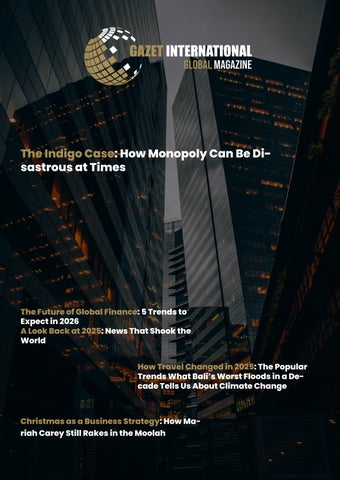
The Indigo Case: How Monopoly Can Be Disastrous at Times

The Future of Global Finance: 5 Trends to Expect in 2026

A Look Back at 2025: News That Shook the World

How Travel Changed in 2025: The Popular Trends What Bali’s Worst Floods in a Decade Tells Us About Climate Change

Christmas as a Business Strategy: How Mariah Carey Still Rakes in the Moolah

Table of contents

Editor’s Note

As we present the final issue of Gazet International for 2025, we also step into a new year filled with renewed ambition and opportunity. The last quarter is a natural moment of reflection, and this edition captures both the key developments that shaped 2025 and the outlook as we begin 2026. The past year brought notable shifts across global markets and business ecosystems. Changing strategies, evolving consumer behaviour, and economic recalibration tested organisations worldwide. In this issue, we curate perspectives that help our readers understand these changes while preparing for the road ahead. Our contributing writer, Titli Ghosh, offers insightful articles examining market structures, cultural influence on business, and future financial trends. I have also contributed an article focusing on the growing importance of recognition and brand enhancement programs as strategic investments for sustainable business growth in 2026. At Gazet International, we strongly believe that recognition plays a vital role in building credibility, trust, and long-term brand value. Over the years, our Business Excellence Awards have been hosted as virtual events, enabling us to connect with a global audience. As we move into the new year, we are excited about the possibility of hosting the awards on a larger, live platform. While the final format will be announced in due course, our commitment to celebrating excellence remains unchanged. We invite our readers and clients to actively participate, nominate their organisations, and be part of this growing platform. This edition features a diverse range of articles spanning business, finance, current affairs, lifestyle, and the environment, reflecting the themes that defined the year. As we begin 2026, we wish our readers continued growth and success—professionally and personally. Embrace the opportunities ahead and let this year be one of meaningful progress.

The Indigo Case: How Monopoly Can Be Disastrous at Times Christmas as a Business Strategy: How Mariah Carey Still Rakes in the Moolah Brand Enhancement Programs: A smart Investment for business Growth in 2026

The Indigo Mess: How Monopoly Can Be Disastrous at Times

It was the first week of December in 2025 when all hell broke loose at major Indian airports. With the festive season just about to begin and people all over India already packing their bags for the annual “holiday season” trips, the airports were expected to be crowded. However, what took everyone by surprise was the fact that airports throughout India resembled scenes straight out of a zombie apocalypse movie. Luggages were strewn about, passengers were screaming and howling, airline staff were being attacked, and many were seen sleeping on the airport floors. And the reason behind this terrible chaos was that IndiGo, the prime domestic airline in India, had canceled more than 1,000 flights within days.

So, what caused this horrible meltdown? And how did the disruption in the operations of one airline cause such a major setback throughout a country as vast as India? Read on to find out how a marked monopoly of the aviation industry in India was behind this disaster.

The Sky Is the Limit: Did IndiGo’s Ambition Go a Bit Too Far?

Back in 2006, IndiGo was set up by Rahul Bhatia of InterGlobe Enterprises and Rakesh Gangwal, former CEO and chairman of the US Airways Group. From its inception, IndiGo appeared to be extremely ambitious. Even before it took off with its first commercial flight, IndiGo placed an order for 100 Airbus A320 aircrafts at the Paris Air Show in 2005. This was a huge gamble by a small aviation startup back then and quite an aggressive stance too.

IndiGo then started its maiden route, the Delhi–Mumbai route, in August 2006. Over the years, IndiGo gradually outshone Indian aviation brands such as Jet Airways and even the national carrier, Air India.

So, how did IndiGo capture the Indian market so easily? It all began with the airline’s low-cost approach. And they achieved this by using just one type of aircrafts: the A320/ A321, with select additional models added later for a handful of routes. This helped the airline cut down on training

costs, the expenses incurred for spare parts, and the cost for maintenance.

Over time, the airline became the poster child of “on-time” arrivals, with its aircrafts and crew taking on multiple rotations every single day. They were admired by the price-sensitive Indian middle class who lapped up its low-cost and efficient services, with the option of choosing meals and other add-ons such as window seats, extra baggage, and priority boarding at additional costs.

Soon, IndiGo capitalized on the spending power of the middle class by increasing the frequency of flights on routes that were high in demand, such as Delhi–Mumbai and Delhi–Bengaluru. Additionally, it continued to add tier-II cities to its roster. And all the while, other major Indian carriers were too focused on branding their airlines as either “affordable” or “premium.”

What About the Other Players?

With IndiGo’s high-flying and aggressive strategies in place, it seemed as if the aviation Gods were all rooting for it too!

Vijay Mallya’s Kingfisher started off with huge promises in 2005. However, owing to a dual-brand strategy (with the Kingfisher brand catering to elite passengers and Kingfisher Red catering to price-sensitive passengers), Mallya’s airline incurred massive losses (amounting to thousands of crores) and wound up operations soon after. By December, 2012, Kingfisher lost its flying license, as Mallya’s bankruptcy saga began.

Jet Airways too failed massively. Unable to keep up with the low-cost options offered by IndiGo and Spicejet, the airline shut shop in 2019. The Maharaja of Indian aviation, Air India, too went through a host of operational inefficiencies under the government. In 2022, the debt-ridden company was finally acquired by the Tata Group but it couldn’t match the vast network that IndiGo had built in India by then.

By August 2025, IndiGo’s market share in the Indian aviation industry was a phenomenal 64.2%, while the Air India Group (including Air India Express and the former Vistara and AirAsia India that merged with the brand) was at 27.3%. Likewise, Spicejet was at 2%, while Akasa Air was at 5.4%. The numbers clearly show how Indigo has monopolized the Indian aviation market through the years.

Was the Chaos Engineered?

But even if it’s the leading player in the aviation industry, how did IndiGo create this unprecedented chaos in December 2025? Apparently, the Association of Indian Pilots wasn’t happy with how most pilots were overworked in the country. In fact, the fatigue that results from flying continuously and with very little breaks in between consecutive flights can result in life-threatening accidents.

So, the association, along with other related bodies, tried their best to bring the Indian Flight Duty Time Limitations (FDTL) on par with the standards set by the International Civil Aviation Organization (ICAO). The Directorate General of Civil Aviation in India (DGCA) held long discussions with airline companies, pilot associations, and various stakeholders.

In May 2024, the DGCA notified all stakeholders about the new FDTL regulations to be implemented in two stages. The first phase was to be completed by July 2025, while the second phase was to be implemented by November 2025.

What this means is that IndiGo and every other operational airline in India had exactly 20 months to be fully compliant with the new regulations specifying reduced flying hours for pilots. While the other players were fine with the new rules, IndiGo, flying high on its monopoly, simply chose not to pay heed to them until the eleventh hour: December 2025, when it suddenly pulled the brakes, causing rampant chaos across airports.

While people missed flights to weddings, examinations, funerals, and other important events, IndiGo simply chose to apologize with lame excuses. The situation became so tense that the government had to ease the regulations. The DGCA has now granted IndiGo an exemption from pilot night duty rules till February 10, 2026. It has also rolled back the provision that prevented aviation companies from counting leaves of pilots and crew as a substitute for weekly rest.

While a government-level inquiry has been ordered to find out the causes behind this chaos, the entire episode draws attention to how detrimental monopoly can be to an industry. We

hope the airline companies and the Indian government keep the interests of the passengers in mind while framing any new regulation in the future.

Christmas as a Business Strategy: How Mariah Carey Still Rakes in the Moolah

It was the year 1994 when US RnB superstar Mariah Carey made the world croon to her holiday hit “All I Want for Christmas Is You.” The track not only got Mariah immense fame but became a cult holiday classic that turned her into a cultural icon. But what remains the most intriguing bit about this entire frenzy surrounding the track is the way it resurfaces every Christmas, tops all major music charts, and rakes in more money for the singer. Let’s look at how Mariah has achieved this incredible feat.

How Does Mariah Still Make Money from a Single Track?

At age 56, there isn’t any musical milestone that Mariah hasn’t achieved. She has not just won 5 Grammy Awards, but also has 10 American Music Awards, 14 Billboard Music Awards, and 19 World Music Awards in her kitty. She was also named one of Time magazine’s 100 most influential people in the world in the year 2008

But the track that made her a global superstar was “All I Want for Christmas Is You.” The track remains the moststreamed Christmas song in the world and brings Mariah around $3-4 million in revenue every single year. By December 2023, the song apparently fetched over $99 million. But how did Mariah become as synonymous to Christmas as Santa? Here are a few ways she earns from the track:

1. Streaming Platforms

Platforms such as Spotify, YouTube, and Apple Music fetch the singer huge money as royalties every year. The track has an average stream count of 1 billion on Spotify every year.

2. Royalties from Downloads and Radio Plays

Even in the age of AI and digitization, Christmas playlists are a favorite for those who wish to gift their loved ones something that has a personal touch. Downloads and direct sales of her track add on to the moolah. Even radio plays fetch the singer huge sums of money every Christmas.

3. Brand Licensing

The holiday season witnesses a surge in Christmas-themed jingles, advertisements, and promotional campaigns. Christmas is also the time when a lot of holiday movies come up. And every time a brand or a film uses the track, the singer earns from it.

Mariah’s Business Strategy: What Creative Professionals and Marketers Can Learn

We have to salute the lady! Mariah is not just a singer with an incredible voice but is also a seasoned business person. When it comes to selling her personal brand, Mariah is at the forefront and has beaten even the best of the best in the music industry! A look at Mariah’s marketing strategy reveals how she made this one track her cash cow. Here’s what marketing and creative professionals the world over can learn from Mariah:

Target an Emotion, Not a Festival

When most brands break their heads over the perfect holiday taglines during Christmas, Mariah targets an emotion. She doesn’t need a festive idea for Christmas. She has made her brand associate with the festival globally. So, when people think of Christmas, they think of Mariah and her track.

Cash In on Your Intellectual Property

With “All I Want for Christmas Is You,” Mariah has built a long-term asset. What’s more? The asset compounds annually, with TV ads, jingles, remixes, radio plays, and online streams. She doesn’t need to renew her brand, as the brand was built long back. Her track isn’t just another forgettable holiday rom-com or a Hallmark movie. Neither is it a Christmas campaign. It’s a business idea that’s utilizing her intellectual property to the fullest and fetching her more than any singer can ask for.

Rely on the Original Version of Your Idea

When marketing experts and ad gurus the world over debate on rehashes and 2.0 versions of their ideas, Mariah doesn’t need to revamp her track. She relates to her fans with her trademark high-pitched voice, the red outfit, the snow, the Christmas tree - the whole feel! Mariah’s track is as OG as it can get, every single year. And surprisingly, people don’t get bored. Her base is incredibly strong, and that never disappoints her.

The “Defrosting” Meme Fest: How Mariah Used It to Her Advantage

“The Defrosting Has Begun”- this was the meme fest that broke the internet a few years back. The memes showed Mariah breaking out of ice, apparently thawing into the Christmas mood! This was a sarcastic commentary on the singer’s annual return to the top of the global music charts with her cult Christmas track.

You would think any global superstar would be offended by such sarcasm. But Mariah, being the seasoned performer that she is, decided to use the memes to her advantage instead. In November 2021, the singer posted an Instagram video that showed her behind three pumpkins showing the words “It’s,” “not,” and “time” carved on them. She then smashed the “not” pumpkin to convey that it was indeed “time” for her to reappear with “All I Want for Christmas Is You.”

In November 2023, she not only acknowledged the jokes surrounding her annual reappearances but went ahead and posted a funny video on the joke. The video in question showed people in Halloween costumes “defrosting” Mariah using hair dryers and the singer starting to perform her iconic Christmas track after being freed. In the 2024 video, Mariah was seen frozen in a block of ice. The video eventually showed her breaking through the ice and announcing, “It’s time.” The 2025 video showed her arguing with an elf before declaring “It’s time” anyway.

The Mariah Magic Turned Music into a LongTerm Business

Mariah Carey’s Christmas cheers may not be the usual manner of acing the music charts, but her game has been immensely profitable for her. The singer has used a wellmade and iconic track to create a lucrative business with little or no long-term effort involved. Mariah can sit back, relax, and still earn millions from her track every year, with a holiday video thrown in to declare “It’s time” for her to “defrost” herself for Christmas. This is a brilliant lesson in marketing and sustaining a business, while retaining its original essence. Nonetheless, we hope to see many more new chart-busting tracks along with the “It’s time” videos from the superstar in the years to come!

Brand Enhancement Programs: A Smart Investment for Business Growth in 2026

In an increasingly crowded global marketplace, visibility alone is no longer enough. Businesses today are expected to stand for something like credibility, consistency, trust, and long-term value. As companies prepare for 2026, brand enhancement programs are emerging not as optional marketing efforts, but as strategic investments that directly influence growth, reputation, and market leadership.

Brand enhancement is no longer about logos or slogans. It is about how a business is perceived across every touchpoint by clients, partners, employees, and the wider industry.

Why Brand Enhancement Matters More Than Ever

Customers and stakeholders are more discerning than ever before. They look beyond pricing and products, choosing to align with brands that demonstrate reliability, recognition, and purpose. A strong brand builds confidence before the first conversation even begins.

In 2026, businesses that invest in structured brand enhancement programs position themselves as credible leaders rather than competitors fighting for attention. Recognition, consistent storytelling, and strategic exposure help organisations stand out without needing to oversell themselves.

From Visibility to Credibility

One of the most powerful outcomes of brand enhancement programs is credibility. Industry recognition, featured stories, awards, and thought leadership platforms help businesses move from being “known” to being “trusted.”

When a brand is recognised by respected industry platforms, it gains validation that advertising alone cannot provide. This external endorsement reassures clients, strengthens negotiation positions, and opens doors to partnerships and expansion opportunities.

Brand Enhancement as a Growth Catalyst

Well-planned brand enhancement programs directly support business growth. They help companies:

• Attract higher-value clients who prioritise credibility

• Strengthen investor and partner confidence

• Improve employee pride, motivation, and retention

• Command stronger positioning in competitive markets

Businesses that invest in their brand narrative often find that opportunities begin to seek them out rather than the other way around.

Recognition Builds Internal Strength

Beyond external perception, brand enhancement has a profound internal impact. Recognition programs and brand features reinforce a culture of excellence. Employees feel valued when their organisation is acknowledged, which leads to stronger engagement and performance.

A recognised brand also becomes a magnet for talent. Professionals prefer to associate with organisations

that are respected, visible, and purpose-driven.

Choosing the Right Brand Enhancement Programs

Not all brand programs deliver the same value. In 2026, businesses must be selective and strategic. The most effective programs are those that align with the company’s vision, values, and long-term goals.

The focus should be on meaningful recognition, credible platforms, and consistent brand storytelling, not short-term publicity. Authenticity matters, and audiences can easily distinguish genuine excellence from surface-level promotion.

Looking Ahead

As markets evolve and competition intensifies, businesses that treat brand enhancement as an investment and not an expense, will hold a clear advantage. Recognition, credibility, and strategic visibility are becoming essential pillars of sustainable growth.

In 2026, successful businesses will be those that understand a simple truth:

A strong brand does not just support growth, it leads it.

The Future of Global Finance: 5 Trends to Expect in 2026

While 2025 witnessed a marked shift in global finance with the growth of fintech, the global finance ecosystem is all set to plunge into a more technology-driven future in 2026. The current global finance environment is all about digital currency, sustainable investments, and artificial intelligence. In this article, we will try to offer a forecast of 5 such marked finance trends that we can expect to see in 2026. So, let’s dive straight in.

Data Overload Will Demand New Strategies

In this era of digitization, finance leaders the world over have access to endless data. However, it is also true that an incredible storehouse of data does not automatically lead to better decisions. In 2026, we expect leaders to be able to convert raw information into clear insights. This will resolve much of the decision complexity associated with the

future of finance.

In fact, Deloitte’s Finance Trends 2026 report, which includes a detailed survey of 1,326 finance leaders from across the globe, has suggested that the future of finance involves a planned fusion of data scientists and accountants in the workforce.

The report says that CFOs across the world plan to include more tech talent in finance. This is in alignment with the growing need to solve real-time reporting issues and invest in forecasting agility. What we can expect is a growing trend of strategic data literacy across global finance teams.

The Reality of AI-Implementation Will Hit the Leaders

According to the same Deloitte survey, 63% of all finance departments that participated in it said they had integrated AI into their finance solutions completely. However, this marked shift toward AI adoption has not necessarily translated into measurable ROI.

What does this mean for CFOs in 2026? They are likely to use more human insight to make use of AI realistically and not trust it blindly.

So, AI-driven hyper-personalization will take over everything from wealth management to credit scoring, leading to customer-friendly solutions such as savings and investments apps. However, humans will still be needed to comprehend consumer sentiments and build AI apps that cater to all categories of clients.

A mid-2025 “Sustainable Reality” report released by the Morgan Stanley Institute for Sustainable Investing stated some interesting facts.

It highlighted how sustainable funds beat traditional funds by a huge margin in the first half of 2025. Let us look at a few figures to comprehend the scenario. By the end of June 2025, assets under management (AUM) in sustainable funds grew to $3.92 trillion, a figure that was 11.5% higher than that in December 2024.

So, sustainable and environmental, social, and governance (ESG) investing is not a fad anymore and is quite mainstream. Investors are increasingly funding companies that

Sustainable Finance Will Become More Rampant

focus on renewable energy and carbon neutrality.

And any marked climate risk is now a financial risk too. If any company desires to attract long-term investors, ESG-compliance is a must.

To make sure sustainable investments are genuine and that there’s no greenwashing involved, governments across the world have laid down strict guidelines on the measurement and reporting of environmental claims.

The year 2026 is set to witness better standardization of such reporting. Once this is in place, organizations that invest in technology with little or no carbon footprint and green bond issuers will have access to more capital. Likewise, industries with high carbon emissions will rethink their sustainability plans.

Blockchain and Digital Currencies Can Slowly

Ease Cross-Border Payments

Blockchain and cryptocurrency have been slowly revolutionizing and transforming global finance. Bitcoin and Ethereum are now significant digital tokens and play a major role in investment portfolios and international payments. And we can only expect crypto- and digital currencies to become more mainstream in 2026.

While blockchain allows for a secure cross-border payment system,digital currencies such as central bank-issued digital currencies (CBDCs) have the potential to decrease transaction costs and reduce fraud. Overall, such payment options increase transparency and make the whole transfer process simpler and faster.

Decentralized Finance (DeFi) Regulations Can Improve Payment Security

And as we speak about blockchain, decentralized finance (DeFi) regulations too need to be spoken about. DeFi makes use of blockchain to help people lend, borrow, and trade without middle-men. So, traditional banks are no longer required in the whole process.

However, strict regulations are required to ensure DeFi transactions aren’t fraudulent. In 2025 itself, the world has witnessed quite a few DeFi regulations being put in place. For instance, some countries now allow legal registration of DeFi platforms.

This implies such companies are recognized as financial service providers and should abide by local laws and protect user funds. Governments across the globe have also implemented tax laws for such transactions.

A lot of DeFi wallets now possess automatic tracking tools. Such platforms are also required to explain all possible risks to their consumers and disclose their fees. This ensures a scam-free environment.

A lot of DeFi councils are now working on common international standards to make such transactions smoother across borders. So, 2026 can expect to see a lot of new DeFi regulations.

Final Thoughts: Finance Will Be Transformed Globally

So, in a way, 2026 is set to see CFOs diversifying their workforce by including more “techies” well-versed in data science and AI. A large number of companies will probably tone down their reliance on AI or merge their AI ecosystems with the human element to improve their ROIs.

Sustainable finance will flourish in a big way, considering the environmental disasters and climate change concerns in the news of late.

Likewise, blockchain and digital currencies will probably see a marked use across the globe, with strict regulations in place. 2026 is going to be interesting for finance globally, and we can’t wait to see what more the year has in store for us!

A Look Back at 2025: News That Shook the World

As 2025 comes to an end, it also reminds us of some earth-shattering news that made us sit up and look! We have tried collating the best and worst news of the year that was not just impactful but also worthy of the hall of fame! Let’s dive straight in.

The Gaza Crisis Worsened

This year witnessed the worst of brutality as the Gaza crisis worsened. The Israel–Hamas conflict caused a humanitarian disaster as widespread famine took over in the region. By the end of 2025, over 1.5 million people were in need of emergency shelter and around 90% of Gaza’s population were displaced. Since the conflict was stirred back in October 2023, over 69,000 people have been killed and more than 170,000 have been left injured. Though a ceasefire was announced in October, with aid reaching Gaza uninterrupted, only time will tell what’s in store for the war-ravaged region.

NASA Astronauts Made It Back to Earth

NASA astronauts Suni Williams and Butch Wilmore had no idea that they were in for a long wait till they could get back home when they embarked on an eight-day space mission back in June 2024. Stranded in the International Space Station due to safety issues, the duo faced multiple postponements to their journey back home. It was not until March 18, 2025 when the duo could eventually return

safely back to Earth. This was an event the whole world was waiting for with bated breath.

An Air India Plane Crash Left Over 270 Dead

Tragedy struck the Indian skies when Air India flight AI 171 that belonged to Boeing Dreamliner 787-8 fleet crashed within seconds after taking off from the Sardar Vallabhbhai Patel International Airport in Ahmedabad. There were no survivors on the flight except one man who escaped miraculously. Of those killed, 241 were on the flight, while the rest were on the ground, many of whom were students of a medical college on which the aircraft crashed. While most blamed the faulty design of the Boeing fleet for the crash, many raised concerns over the pilot’s mental health too. This shocking incident left a huge dent on the Indian aviation’s image.

The Labubu Craze Made Wang Ning a Billionaire

Wang Nin, the CEO of Pop Mart, had no clue that he would become China’s youngest billionaire when he introduced the Labubu blind boxes to the international toy market. Within weeks, the rather ugly-cute doll made waves and became a viral sensation. People queued up for hours to get a Labubu, as Nin raked in huge profits. By June 2025, his net worth jumped to $22.1 billion. His brand, Pop Mart, which initially sold comics and phone accessories, has now shifted its focus to Labubu and its different variants.

ChatGPT Ghibli-fied the World

Early 2025 saw ChatGPT turning the world into a Ghibli universe. This was when they rolled out a feature that could help anybody use their AI platform to transform their pictures into a Ghibli-style illustration. However, this led to widespread criticism of ChatGPT amid allegations of copyright violation too. Ghibli fans were quick to point out the fact that Japanese artist Hayao Miyazaki, the founder of Ghibli Studio, had spent decades creating his masterpieces and himself despised AI.

Justin Trudeau and Katy Perry Announced Their Relationship

If Justin Trudeau’s resignation as the Canadian Prime Minister and the Liberal Party head wasn’t shocking enough, 2025 saw another shocker! In late 2025, Trudeau and US pop star Katy Perry announced they were in a

relationship. The duo visited Japan in December 2025 as part of Perry’s Lifetimes Tour. Perry also shared a number of photos and clips on her Instagram to put a stamp on the relationship.

The Vatican Got Its First American Pope

After Pope Francis passed away at the age of 88 in April 2025, the Vatican cardinals elected American-born Cardinal Robert Prevost as his successor. The new pope took over as Leo XIV. With this, he became the first North American pope and the 267th pope of the Catholic Church. Mention must be made of the fact that Pope Francis was the world’s first Latin American pope.

The First Pig Kidney Was Transplanted into a Human

Back in February 2025, a team of Harvard Medical School physician-scientists did the unthinkable at Massachusetts General Hospital. They achieved a huge medical milestone when they transplanted a pig kidney into a human. The pig kidney was genetically edited to make sure it was compatible with humans and to reduce any chance of an infection. The patient, 62-year-old Richard (Rick) Slayman from Weymouth had to undergo a four-hour surgery to receive the kidney. A patient of chronic kidney disease, he had previously received a human kidney that failed after 5 years. This entire process of pig kidney transplantation raised hopes of solving the issue of shortage of human organs for transplant.

Camogie Players Won the Right to Wear Shorts

In a landmark decision, Ireland’s camogie players legally won the right to wear shorts. For those who aren’t aware, camogie is an Irish stick-and-ball game, also known as the female equivalent of hurling. The rules, traditionally, allowed women players to wear skirts or skorts mandatorily. Following a marked protest by the players, a special congress was called. A new rule was passed with 98% of delegates voting in favor of the right of the female players to choose to wear shorts while playing the game.

Trump Attacked Mass Immigration

The year 2025 saw US President Donald Trump launch a full-blown attack on mass immigration by announcing stricter H-1B visa rules. The H-1B visa has been an easy pass to the American dream for countless students from across the globe, especially from South Asia. However, with Trump making the whole process of getting an H-1B visa

tougher than cracking the Rubik’s Cube, a lot of students and young professionals are considering moving to other countries. By late 2025, the Trump government revoked 85,000 visas, attacking students and professionals that it deemed security risks. He has also announced that the US will now re-examine the green cards issued to 19 countries, including Afghanistan, Iran, Cuba, etc.

The World Hopes for a Better 2026

This is a look back at just some of the news that shook the world in 2025. We hope 2026 will be a year with more news on better environmental awareness, global collaboration on ending war-related humanitarian crises, and scientific breakthroughs on the development of vaccines for AIDS, cancer, and other terminal illnesses.

How Travel Changed in 2025: The Popular Trends

In a world that profits from pace, the travel industry witnessed a major shift toward slowing down in 2025. At a time when our daily lives are being consumed by swiping, scrolling, views, and the algorithm chaos, people are increasingly traveling to escape the grind and to rejuvenate their senses. And 2025 saw travelers choosing personalized, sustainable, and earthy trips that made them forget about boardrooms and cubicles. Here’s our list of the top trends in the travel industry that rocked 2025.

1. Experiential Trips

Across the world, people ditched sightseeing, hurried trips, and photo ops for hands-on experiences. Travel in 2025 was more about personal storytelling through immersive trips. Travel became less about bucket lists and more about participating in the lives of the locals.

So, what does experiential travel involve? It could be a culinary trip that lets you cook with the locals or a cultural immersion through festivals such as the famed Hornbill festival of Nagaland in India. You can learn local crafts such as pottery or weaving, or even participate in local sports.

Likewise, it could simply involve staying in local settlements. For instance, in Argentina, especially in the Patagonian region, travelers can stay in traditional rural villages or farmlands known as estancias. You will not just be welcomed by the farm owners but might actually end up feeding the farm animals or harvesting the yield.

2. Set-Jetting

Back in the early 2000s, New Zealand’s economy saw a massive boost through tourism, all thanks to The Lord of the Rings trilogy. Likewise, Game of Thrones transformed Croatia’s travel economy through its portrayal of Dubrovnik as King’s Landing.

And this is exactly what set-jetting is all about. Also known as film tourism, set-jetting is all about traveling to places that one has come across in movies or series, and 2025 saw a marked rise in this trend.

People now wish to trace their favorite character’s paths by traveling through uncharted territories and unheard-of destinations, just because they saw it in a film or a series. Tuscany, apparently, witnessed a massive surge of 68% in luxury travel bookings in 2025, owing to its depiction in the HBO family drama Succession since 2021. This is exactly how The White Lotus helped tourism peak in Hawaii, Sicily, and Thailand; how Bridgerton helped Bath double its tourism figures; and how Wednesday helped Romania’s Cantacuzino Castle (featured as Nevermore Academy) become a major tourist draw.

3. Digital Detox Trips

The 2025 Hilton Trends Report stated how their survey conducted on 13,000 adults globally produced extremely interesting results. According to them, a quarter of those surveyed admitted to switching off social media on their trips more often. Likewise, a quarter also said they try their best to not respond to calls, mails, and texts while they are on vacation.

This proves how “digital detox” isn’t just an upper-class fad but has permeated into the travel industry too. While, till

now, travelers looked for uninterrupted Wi-Fi and mobile networks at their hotels and resorts, new-age travelers in 2025 have been looking for just the opposite: off-the-grid locations and internet-free stays.

Here’s an example of how travel agencies are utilizing digital detox. A Sardinian travel company has banned technology of any kind, be it laptops, computers, or even cameras, on their trips. Travelers need to keep their phones in a deposit box and can collect them at the end of their vacations. Likewise, lakeside cabins, desert tents, and mountain retreats are increasingly ditching the need for technology.

4. Sustainable Travel

While the threat of green washing persists, as companies increasingly throw around terms such as “sustainability” and “eco-friendly” casually, without actively working for the environment, a lot of travelers genuinely opted for sustainable travel this year.

Sustainable trips are those that offer earthy experiences with little or no carbon footprint. Low-impact travel that makes use of simple solutions such as eco toilets, eco-friendly stays (alpine tents and cottages without AC), renewable energy (hydroelectric power, etc.), and other sustainable ways, were trending in 2025.

A great example of such travel is how Komic, a remote village in India’s Spiti region, hosts travelers in the village headman’s home. One gets a firsthand experience of local life, with homemade food and eco-toilets on offer.

5. Texture Hunting

The year 2025 saw an increase in texture hunting, an integral part of slow travel. So, what exactly is this trend? Texture hunting is the newest travel trend that involves leisurely walks around old neighborhoods to absorb their texture—the old buildings, walls, lamp posts, shops, etc.— and capturing the patterns of these places in journals.

Travelers who enjoy texture hunting document their experiences, but not through photography. They use a kneaded eraser to press onto the textured surfaces, hold it against a stamp pad, and stamp it in a journal or sketchbook.

Perfect texture hunting experiences can be felt in old neighborhoods or heritage cities such as Kolkata, Ahmedabad, Cairo, London, etc. This is an incredible way of traveling while collecting memories but not restricting it to souvenirs such as fridge magnets or run-of-the-mill photos. In an age where digital overload is consuming our lives faster than we think, texture hunting offers a unique tactile expe-

rience that transforms the way we travel.

Final Thoughts: Bucket Lists Are Passé

So, this year saw travelers embrace a whole new set of trends, apart from the usual solo travel and offbeat adventures. Travelers are slowly realizing that age-old rushed trip itineraries are leaving them drained and not refreshed. We’re hoping 2026 will bring in newer trends that wouldn’t upset the ecological order and will help us combat the ill effects of global warming. After all, as they say, there is no planet B.

What Bali’s Worst Floods in a Decade Tell Us About Climate Change and Overtourism

It was back in September 2025 when Bali was ravaged by its worst floods in a decade. Quite a few people died from drowning and electrocution, and the government got busy rescuing the survivors and managing the damage. Hundreds of homes were destroyed and agricultural lands were washed away. Popular tourist spots too were badly affected, while hotels and tourism companies bore huge losses. Some areas saw garbage and debris clogging the drainage systems, worsening the floods.

While torrential rains were said to have triggered the devastating floods across a vast area of the island, a deeper inspection revealed two main causes behind this natural disaster: climate change and overtourism. So, how did Bali end up turning into a climate horror story from being a tourism hotspot? Let’s find out!

The Climate Change Concerns

The fact that Bali’s appeal has been slowly eroding due to climate change is not “breaking news” anymore. A National Research and Innovation Agency (Badan Riset dan Inovasi Nasional, or BRIN) study conducted much before the September floods proved what many had suspected. Apparently, Indonesia is now in a stage of “next level climate change.” What this means is the island nation is more likely to experience longer monsoons in some areas while others face long drought periods.

So, areas such as Bali and Lombok are going through a wetdry season, meaning they are experiencing massive rainfall in the months when they should be dry. Likewise, West Kalimantan is facing heavy rainfall, but East and South Ka-

limantan are facing the possibility of drought in the future.

Apart from erratic rainfall, Indonesia is also facing extreme variations in temperature. So, while areas such as Java and North East Java face extremely high temperatures these days, West Java experiences lower-than-average minimum temperatures.

How Overtourism Caused Bali’s Destruction

While all of the concerns regarding the extreme weather conditions caused by global climate change are justified, there is something else that has made Bali’s situation worse. It’s overtourism and it’s slowly eating into the island’s charm.

Overtourism isn’t a problem that’s specific to Bali. The recent years have seen the locals protesting against the unchecked rise in irresponsible tourism in major tourist destinations such as Santorini (Greece), Venice (Italy), and Barcelona (Spain). However, Bali’s case is a tad bit different. It’s located in an Asian country that’s relatively economically weak when compared to its richer counterparts in Europe.

Tourism is Bali’s bread and butter. And a lot of agricultural land in Bali is continuously being turned into tourist hubs, with hotels, shops, and other buildings popping up. This is what experts have termed peak “environmental degradation.” And it’s affecting Bali’s legendary rice fields and the typical Subak irrigation system that have, till now, saved Bali from devastating floods.

So, how exactly is Subak helpful in the prevention of floods? When farmers implement this system, they distribute water in an even manner, preventing it from gathering in one place. With this system in place, a hectare of rice fields can hold a maximum of 3,000 cubic tons of water. But with Bali’s iconic rice fields vanishing fast, this entire hydrological balance is at risk. And the latest evidence of this was the September deluge.

How Is Bali Fighting Back?

Back in March 2023, the regional government tried curbing overtourism by banning motorbike rentals for tourists temporarily. Apparently, the locals in rural Bali were be-

ing gravely affected by the noise and air pollution caused by rented cars and bikes. But tourists couldn’t be blamed either, as a lot of such remote places in Bali have limited transport options, coupled with poor traffic management.

In November 2025, Bali’s Governor Wayan Koster made an announcement that made locals heave a sigh of relief. He declared the closure of the glass elevator project at Nusa Penida’s Kelingking Beach. The controversial elevator that was being built for quite some time was already becoming quite an eyesore, with multiple tourists themselves complaining about the project spoiling the appeal of the picturesque cliffs of Nusa Penida. The 182-meter glass elevator will apparently be dismantled as the builders weren’t following Bali’s cultural tourism, spatial planning, and sustainability standards.

What More Can Bali Do?

With the growing concerns about Bali’s ecological destruction and its aftermath, climate change experts and environmentalists the world over have suggested that the island must do more to curb its gradual devastation. To begin with, Bali (and the world) needs to cut down on global emissions, meaning phase out the use of fossil fuels such as coal, oil, and natural gas. Bali must switch to renewable sources of energy to curb the severe air and water pollution caused by fossil fuels.

Bali can also focus on building weather-proof infrastructure, such as stronger roads and bridges that will be resil-

ient in case of heavy rains and floods. Bali’s drainage systems too need massive improvement.

Bali’s natural buffers need to be restored and protected. One can’t develop a nation by turning a blind eye to the ecological devastation that new projects can cause. Buffers prevent floods and reduce the impact of natural disasters, and it’s essential that Bali focuses on creating a better balance between development and sustainability to protect its local communities.

Bali can also start developing better and more efficient weather alert systems. This is what has helped countries like Japan avert any massive loss of lives and property when

earthquakes and tsunamis strike. Bali too needs to empower its local population with quick alerts in case of sudden disasters.

The ecological clock of Bali is ticking. And it’s a do-or-die situation now! Bali needs a collaborative effort from its people, its government, global environmentalists, scientists, and the tourism fraternity to curb the damages caused by climate change and overtourism. With the government already pitching in, Bali is perhaps in for better days. We hope Bali returns to its glorious self and continues to be treasured as an exotic global tourism hub with responsible tourism and government intervention when needed.

Turn static files into dynamic content formats.

Create a flipbook
Q4 by Gazet International Global Magazine - Issuu