F
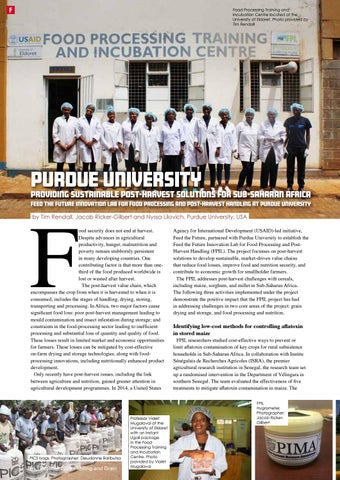
Food Processing Training and Incubation Centre located at the University of Eldoret. Photo provided by Tim Rendall
Purdue University
F
Providing sustainable post-harvest solutions for sub-Saharan Africa
Feed the Future Innovation Lab for Food Processing and Post-Harvest Handling at Purdue University
by Tim Rendall, Jacob Ricker-Gilbert and Nyssa Lilovich, Purdue University, USA
ood security does not end at harvest. Despite advances in agricultural productivity, hunger, malnutrition and poverty remain stubbornly persistent in many developing countries. One contributing factor is that more than onethird of the food produced worldwide is lost or wasted after harvest. The post-harvest value chain, which encompasses the crop from when it is harvested to when it is consumed, includes the stages of handling, drying, storing, transporting and processing. In Africa, two major factors cause significant food loss: poor post-harvest management leading to mould contamination and insect infestation during storage; and constraints in the food-processing sector leading to inefficient processing and substantial loss of quantity and quality of food. These losses result in limited market and economic opportunities for farmers. These losses can be mitigated by cost-effective on-farm drying and storage technologies, along with foodprocessing innovations, including nutritionally enhanced product development. Only recently have post-harvest issues, including the link between agriculture and nutrition, gained greater attention in agricultural development programmes. In 2014, a United States
PICS bags, Photographer: Dieudonne Baributsa
66 | October 2020 - Milling and Grain
Professor Violet Mugalavai of the University of Eldoret with an Instant Ugali package in the Food Processing Training and Incubation Centre. Photo provided by Violet Mugalavai
Agency for International Development (USAID)-led initiative, Feed the Future, partnered with Purdue University to establish the Feed the Future Innovation Lab for Food Processing and PostHarvest Handling (FPIL). The project focusses on post-harvest solutions to develop sustainable, market-driven value chains that reduce food losses, improve food and nutrition security, and contribute to economic growth for smallholder farmers. The FPIL addresses post-harvest challenges with cereals, including maize, sorghum, and millet in Sub-Saharan Africa. The following three activities implemented under the project demonstrate the positive impact that the FPIL project has had in addressing challenges in two core areas of the project: grain drying and storage, and food processing and nutrition.
Identifying low-cost methods for controlling aflatoxin in stored maize
FPIL researchers studied cost-effective ways to prevent or limit aflatoxin contamination of key crops for rural subsistence households in Sub-Saharan Africa. In collaboration with Institu SĂŠnĂŠgalais de Recherches Agricoles (ISRA), the premier agricultural research institution in Senegal, the research team set up a randomised intervention in the Department of VĂŠlingara in southern Senegal. The team evaluated the effectiveness of five treatments to mitigate aflatoxin contamination in maize. The FPIL Hygrometer, Photographer: Jacob RickerGilbert