October 2020
YOUR GLOBAL PARTNER
In this issue:
Improving the understanding of agricultural cycles and practices in Afghanistan • The versatile Satake VTA IN A
I LL
IN G R AI N
SO E M B ER F N ABI M
ND
ST
TRU
S T E D M I LLI N G M A G A
ZI N
• A simple grain inventory management system
O
EB
#1 M
YM
WA S VOTED
• Sensor applications in machinery
See our archive and language editions on your mobile!
• Maintaining hygienic conditions Proud supporter of
R E C E N T P O LL , M
GA
Milling and Grain . Volume 131 . Issue 10 . October 2020
• Why should I care about moisture?
Volume 131 Issue 10
millingandgrain.com
Solid.
Move up with Brock grain handling. Get your grain where it needs to go every time. Brock grain handling equipment is a step up from the standard. Our drag conveyors have solid welded flange connections for extra durability. Our bucket elevators are welded solid on the inside and outside so moisture doesn’t penetrate the trunking. Our distributors have an inverted cone design that prevents grain dust and moisture from building up. This attention to detail translates to long-lasting equipment that keeps your operation moving. Move up at brockgrain.com
+1 812.886.5500
sales@brockgrain.com
Storage | Handling | Conditioning | Structures
COMMERCIAL BINS
• 48 m Diameter Bins (20321-48262 mt) • Peak Load Rating (6804-45360 kg) • Hopper Bins (3.7 m-14.6 m)
COMMERCIAL DRYERS
• Tower Dryers (23-281 t/h) • QuadraTouch ProTM Controls • Balanced Moisture Content
STEEL BUILDINGS
COMMERCIAL SWEEPS
BUCKET ELEVATORS
COMMERCIAL CONVEYORS
• Auger & Paddle sweeps available • Capacity includes 141-281 t/h • Patented Pivot Point • Industrial Grade Pushers
• Low Impact Head Design • Heavy Gauge Trunking • Patented Squaring Plates • Support Towers
• Industrial Strength • Built To Last • Higher Elemental Resistance • Capacity includes (984-1688 t/h) • Dust-tight and waterproof • Patented hip-style weather-tight cover • Catwalks
Sukup Worl d H eadquart ers - S hef f i e ld , Io w a U SA • w w w.su ku p .co m • in fo @su ku p .co m For service in Europe contact:
Sukup Europe A/S Hedensted, Denmark Tel +45 75 68 53 11 • Fax +45 75 68 54 70 info@sukup-eu.com • www.sukup-eu.com
Pneumatic or Mechanical Ship Loaders & Unloaders Port Equipment - Turnkey Projects
Your Solution starts here ! VIGAN Engineering s.a. Rue de l’Industrie, 16 - 1400 Nivelles - Belgium Tél.: +32 67 89 50 41 • Fax : +32 67 89 50 60 • www.vigan.com • info@vigan.com
Engineered To Suit You AGI EMEA is a leader in design and manufacturing of grain storage and handling equipment. Storage, Conveyors, Elevators, Catwalks, Platforms, Temperature Sensing
For more information on AGI’s full catalog of products and solutions contact emea@aggrowth.com or +39 051 798 107
AGGROWTH.COM | @AgGrowthInl
VOLUME 131 ISSUE 10
October 2020
Perendale Publishers Ltd 7 St George’s Terrace St James’ Square, Cheltenham, Glos, GL50 3PT, United Kingdom Tel: +44 1242 267700 Publisher Roger Gilbert rogerg@perendale.co.uk International Marketing Team Darren Parris darrenp@perendale.co.uk Fred Norwood Tel: +1 405 834 2043 fredn@perendale.com Asia Marketing Team Dante Feng Tel: +886 227930286 dantef@perendale.com Latin America Marketing Team Iván Marquetti Tel: +54 2352 427376 ivanm@perendale.com Pablo Porcel pablop@perendale.com Oceania Marketing Team Peter Parker peterp@perendale.co.uk Nigeria Marketing Team Nathan Nwosu Tel: +234 8132 478092 nathann@perendale.com Egyptian Marketing Team Mohamed Baromh Tel: +20 100 358 3839 mohamedb@perendale.com Turkey, Eurasia and Middle East Marketing Team Mehmet Uğur Gürkaynak Tel: +90 537 3646457 mehmetg@perendale.com Managing Editor Vaughn Entwistle vaughne@perendale.co.uk Features Editor Rebecca Sherratt rebeccas@perendale.co.uk International Editors Dr Roberto Luis Bernardi robertob@perendale.com Professor Wenbin Wu wenbinw@perendale.com Mehmet Ugur Gürkaynak mehmetg@perendale.com Design Manager James Taylor jamest@perendale.co.uk Circulation & Events Tuti Tan tutit@perendale.co.uk Development Manager Antoine Tanguy antoinet@perendale.co.uk
52 - Reliable, consistent measurement results: ISSUE HIGHLIGHTS
8
NEWS FEATURES
42 The versatile Satake VTA 46 Why should I care about moisture?
52 Reliable, consistent measurement results
FACES
10-30 56 Our future is digital
58 Lowering feed cost while maintaining laying performance and egg quality 60 Improving the understanding of agricultural
114 People news from the global milling industry
PRODUCT FOCUS
40
CASE STUDY
90
cycles and practices in Afghanistan
STORAGE
66 Purdue University 70 Sensor applications in agricultural machinery
EVENTS
98 Event listings, reviews and previews
72 A simple grain inventory management system 78 Maintaining hygienic conditions 82 Automated palletising
TRAINING
34 Industry training news
COLUMNS millingandgrain.com ISSN No: 2058-5101 ©Copyright 2019 Perendale Publishers Ltd. All rights reserved. No part of this publication may be reproduced in any form or by any means without prior permission of the copyright owner. More information can be found at www.perendale.com Perendale Publishers Ltd also publish ‘The International Milling Directory’ and ‘The Global Miller’ news service Grain & Feed Milling Technology magazine was rebranded to Milling and Grain in 2015
10 The Global Miller 22 Mildred Cookson 28 The Rex Wailes collection
8 GUEST EDITOR Yiannis Christodoulou
92 MARKETS John Buckley
112 INTERVIEW Ed de Souza
COVER IMAGE: Improving the understanding of agricultural cycles and practices in Afghanistan - page 60
Online Milling School presence and future
Yiannis Christodoulou,
What an initiative! What a response! We are extremely pleased that the collaboration between Progressus and Milling and Grain magazine has been proven to be a great success, one that has been very well received and fully embraced by the feed milling industry worldwide.
Through the years, Progressus has made it the company’s mission to deliver quality, unbiased and practical information to the livestock and aquaculture industry through its AgriSchools training workshops, which have been running for over seven years as physical events in Thailand. Necessity many times is the mother of innovation and this is very much true for the situation we are all in right now. At Progressus, and in order to continue our effort of supporting our industry’s needs for people development and upskill, we have partnered with Milling and Grain magazine in order to take these important training modules online under the umbrella of the Online Milling School. This not only allows us to continue to support the needs of the industry and its professionals but, more importantly, has created the means for extending the reach of training programmes from being primarily accessible to the Asian feed milling community to becoming available to the wider world. The proof is in the result. As we are nearing the end of the first delivery of the 12 modules of our Online Milling School, which ran from July 15th to September 30th, 2020, we would
like to thank the companies and professionals that have been part of the programme. Based on the extremely encouraging and positive feedback that keeps coming in from milling professionals from around the world and, specifically, from many European and Asian countries such as the Philippines, Bangladesh and Indonesia, we see and hear that we have been delivering valuable, practical and not easily found information which greatly helps their daily operations and the milling industry overall. Thanks to the support of the feed milling community and the support we received from the early adopters who chose to stand alongside us, and to support us as valuable sponsors, particularly companies such as Yemtar, Amandus Kahl, Agentis Innovations, Premier Tech, Doctor’s Agro-vet Ltd, Biovet and Zoetis, we are in a very strong position and pleased to say that our commitment to the initiative has grown to the next level. We are now working not only on expanding the current online livestock milling training offerings we have in place, but also to build new training tools and modules to further support the development of our industry professionals and the industry as a whole. Some things that are coming up include our on-demand view of the previous sessions we have delivered, re-podcasting of the Livestock Feed Mill series in different time zones that cover the United States and Latin America, and new online schools that will cover aqua feed milling and flour milling. Thank you all for the support. Together we can truly make a difference to the development of our industry. See you during our next sessions! For more information on the topic please visit us at www.onlinemillingschool.com Yiannis Christodoulou, Founder and Managing Director of Athene Consulting Co., Ltd and Progressus
MAIZE
PACKAGING
Improving the understanding of agricultural cycles and practices in Afghanistan
AUTOMATED PALLETISING FOR THE MILLING INDUSTRY
Many people underestimate the benefits of automated palletising.
Since war started at the end of 2001, the economy was severely devasted in Afghanistan, especially for the agriculture sector.
PAGE 60 SCALES
PAGE 82
FOOD
STORAGE
FEED
PROCESS
EGGS
Reliable, consistent measurement results
Lowering feed cost while maintaining laying performance and egg quality
An interview with Martial Wüthrich, Managing Director of Diavite AG, on measuring techniques for rollers
A study published in Poultry Science (Mikulski et al., 2020) shows the positive effect of the probiotic strain Pediococcus acidilactici CNCI-4622 (MA 18/5M)[1] (BACTOCELL) on dietary energy utilisation in laying hens.
PAGE 52
PAGE 58 Annual Subscription Rates Inside UK: UK£100 Outside: US$150/€133 Milling and Grain has a cooperative partnership with COFCOET
More Information www.millingandgrain.com http://gfmt.blogspot.co.uk
Milling
News
MAG TV, our selection of videos on the Milling and Grain website, features various offerings that provide some insight into companies and how they run, as well as the solutions they can provide for customers. Another interesting selection of videos well worth watching include those from bulk handling experts Bruks Siwertell. Unloading animation In this video, a member of the Bruks Siwertell team discusses one of Bruks Siwertell’s unique unloaders. Step by step, the video explores the features present in their unloaders, such as the inlet feeder, a unique innovation on the traditional Archimedes screw. The video explores exactly how unloaders can be tailored to each customer’s specific needs, helping make bulk handling a simple process no matter the situation. myMAG.info/e/962
Loading and conveying terminal, Lithuania This case study explores Bruks Siwertell’s building of one of the most advanced import and export terminals in the Baltic region. This project was established in order to ensure the future growth of Lithuania’s international trade sector. Constructed in Klaipéda, Lithuania, the terminal features the best in conveyors, loading and unloading wagons, trucks and shipping solutions to ensure effective handling of all bulk materials. This video takes viewers through the construction of the terminal, showcasing the variety of innovative solutions provided for the terminal to run as smoothly as possible. myMAG.info/e/963
Siwertell infographic This video serves as a quick, accessible guide to Bruks Siwertell and their offerings for the bulk handling sector. The company specialises in fully enclosed handling systems that are ideal for the processing and transportation of feed, grains and other such agricultural materials. This video explores the companies own unique advantages and what key aspects of their solutions make them a competitor in the sector, ranging from their cost efficiency, large capacity capabilities and lightweight design. myMAG.info/e/964
10 | October 2020 - Milling and Grain
Over the past three months, the Milling and Grain team and Progressus Agrischools have been very proud to host 11 sessions of the Online Milling School, a learning experience catered to members of the feed production sector. The Online Milling School takes attendees through each key process in the feed production chain, ranging from grinding, extrusion, plant construction and quality assurance, to name but a few. The webinar series provides essential information for users to optimise their processing and plant management systems and has been a great success, with attendees joining the webinars from across the globe week after week. Speakers have included experts from Yenar, Amandus Kahl, Bühler and Famsun. On September 30th, the twelfth session of the Online Milling School will take place, specialising in Design and Construction. Although this twelfth session will mark the completion of our first series of webinars, the Online Milling School will continue to provide many more offerings for the milling industry, ranging from new courses, reruns and other opportunities for processing solution companies and feed industry members to get involved. Providing the industry with easily accessible and engaging information in an easily digestible format, the Online Milling School is the perfect opportunity for attendees to enhance their preexisting knowledge in feed production and processing. We aim not to serve as a competitor to other training courses, but as an additional enhancement for those who wish to learn more about the intricacies of feed milling. To find out more and join the Online Milling School’s twelfth session, visit: myMAG.info/e/886
gfmt.blogspot.com
THE FASTEST FLUTING MACHINE EVER MADE RETURN SPEED 105 M/MIN FLUTING SPEED 30 M/MIN Fluting Machine R-F300/1500
ADVANTAGES The fastest fluting process
Return speed 105 m/min. Cycle time -38% Less
Conical rolls possibility
Chamfering
Cutting 0 - 30 m/min
Less machine surface -30%
Stationary roll Moving tool
Return speed 105 m/min Cutting
Lower speed in-and-out fluting
Lifetime tool up/ less break out material
V Speed diagram
Adjustable cutting depth during operation
Single - and multitool
Option Steady rest with digital read-out
Option automatic length compensation of the tool
Fast exchange of tools with VDI toolholder
Option integrated OFT Profilometer Balaguer
GLOBAL SOLE DISTRIBUTOR
www.balaguer-rolls.com Facebook
Youtube
Live visual process control with camera
Option remote access with mobile phone or PC
The software which guarantees the shortest and easiest work preparation
D
Cycling for a cure
SL Systems, a company that specialises in installing control and automation systems, has been installing its unique solutions for feed and grain plants since 1979. During 2020, team leader Paul Colman started cycling and fancied undertaking a cycling-related challenge. The obvious challenge was to cycle from 906 miles from Land’s End to John O’Groats and to do this in nine days, starting August 23rd. However, due to COVID-19 and the lockdown, the trip was cancelled. But as Paul’s scheduled time off work had not been cancelled, he decided to cycle the same distance (and more) over the same number of days but on different routes starting and finishing at home and/or York (the city he grew up in, where he could stay with family.) The first five days were a jaunt of 100 miles each around Nottinghamshire, Lincolnshire and Leicestershire starting and finishing in Bingham, which included an arduous day battling with Storm Francis. The final four days were 100 miles each in Yorkshire, starting and finishing in York. As Paul explained, “On some of the days friends rode all or part of the distance with me, but I also did three days solo […] the solo days were really tough,” Paul added. “I also endured bad weather on most of the days, as it was wet, windy and cold.” In the end, Paul completed 925 miles in nine days on August 31st. Paul says, “After booking the original trip, I decided that I could raise some money for charity at the same time. As
Milling News
I feel that everybody has been, will be or knows somebody that has been affected by cancer, then I should raise money for “Stand up to cancer”. So far, Paul has raised an impressive UK £2,519 and is still collecting donations. For those interested in supporting this noble goal, the link to Paul’s just giving page is myMAG.info/e/950
Milling and Grain - October 2020 | 13
Milling News
From a start-up to a global player, Volkmar Wywiol received lifetime achievement award
O
n 14th September, Hamburg’s First Mayor Peter Tschentscher presented Volkmar Wywiol with the Hamburg Founders Award in recognition of his life’s work. This award, highly coveted in North Germany’s business community, is conferred for exceptional entrepreneurial achievements. It was issued for the nineteenth time by the bank Hamburger Sparkasse and the daily newspaper Hamburger Abendblatt. The founder and managing partner of the Stern-Wywiol Gruppe, based in Hamburg, set up a business of his own in 1980 by taking over the little trading company Sternchemie. With his pioneering mentality, the unceasing urge to turn ideas into action and the ability to inspire his employees with his own enthusiasm, Volkmar Wywiol succeeded in transforming the “one man show” into a dynamic group of companies in the space of only 40 years. The family business is now a major player in the global market for functional ingredients for food and animal nutrition. What is the secret of this entrepreneurial success? Volkmar Wywiol has more than one explanation for it, “Ultimately, numerous factors have to come together at the right moment. But for me, it all revolved on three things: courage, creativity, and the thirst for action. Then there was my curiosity to discover and accomplish something new, again and again.” Since research and development is always essential for
Peter Tschentscher (left) presents Hamburg Founders Award to Volkmar Wywiol (right)
successful production, Wywiol soon decided to invest in a technology centre of his own in Ahrensburg, the Stern-Technology Centre – Futuremaker. This proved to be a milestone in the group’s development. For the present success of the Stern-Wywiol Gruppe is rooted in the diversity of its research, comprehensive advice on applications and an interdisciplinary exchange of information and opinions in the team of over a hundred scientists and technologists.
Skretting launches Feed4Future a carbon neutral feed concept
W
ith food production accounting for around a quarter of the world’s greenhouse gas emissions, carbon footprint reduction is one of the most effective ways that supply chains can address the climate change challenge. Recognising the considerable opportunity to minimise the carbon dioxide emissions generated by the aquaculture feed production process and the fish farming sector, Skretting Italy has launched the new carbon neutral feed concept Feed4Future. This first-to-market offering pairs Skretting’s extensive knowledge of the nutritional requirements of aquaculture species with sustainable, lower impact feed ingredients responsibly sourced from carefully
14 | October 2020 - Milling and Grain
selected suppliers. In utilising Skretting’s groundbreaking MicroBalance technology and incorporating innovative raw materials and high-quality byproducts sourced from the food industry that don’t compete with human consumption, Feed4Future diets have a 10 percent lower carbon footprint than standard diets, with the remaining CO2 emissions compensated for by carbon credits. “With the spotlight on the impacts of food production, Feed4Future can take Italian aquaculture to new levels of sustainability. With 80 percent of fish farms’ carbon footprint related to feed, its application means that together we are taking effective action against one of the most far-reaching issues facing our planet today – climate change,”
said Umberto Luzzana, Marketing Manager, Skretting Italy. For those producers looking to go a significant step further with fully carbon neutral farms, Skretting has developed CarbonBalance, a new programme supporting fish farmers and helping them achieve this ambition. Following an initial assessment of each farm site, Skretting calculates the carbon footprint, identifies measures to reduce it, and then works together with customers to achieve full neutrality. CarbonBalance also provides links to those third-party certification bodies that are already onboard with the programme and will offer support in communicating these actions to the market. Amongst other things, it will explain what makes these fish carbon neutral and the contribution they are making to sustainable food production.
Milling News
DuPont Animal Nutrition announces manufacturing facility in Wuxi, China
I
n late August, DuPont Nutrition and Biosciences announced the opening of a new Animal Nutrition manufacturing facility in Wuxi, China. The new plant operation will provide the local animal production industry with customised solutions according to DuPont’s global quality standards and advanced technology. “This facility will improve the flexibility of our offerings to the Chinese animal nutrition market,” said Aart Mateboer, Business Unit Director, Animal Nutrition. “We look forward to providing our key accounts a more customised offering, as well as a larger range of packaging sizes to better meet our customers’ needs. It provides us enhanced capabilities to launch many new products out of our global R&D pipeline to support the evolving needs of our customers in China”. “We are pleased to add our animal nutrition products to the portfolio we support at our Wuxi facility, and offer world-class quality with very local customisation to our China customers,” said Katariina Rasinmaki, Global Manufacturing & Supply Chain Leader. “We continue to enhance our capability to deliver solutions from our best in class product portfolio to our Asia Pacific customers,” said Vik Prabhu, Regional Director, Health and Biosciences, Asia Pacific. “We recently expanded our capability at our Shanghai Animal Nutrition Applications & Technical Service Laboratory, which is an excellent
16 | October 2020 - Milling and Grain
complement to this new operation. Due to African Swine Fever and COVID-19, our customers have adapted quickly to changing conditions and this facility is designed to provide flexible local response to our most valued customers”. DuPont Animal Nutrition is a market leader in nutritional health solutions with a comprehensive portfolio of feed enzymes, betaine, phytogenics and probiotics. Through the lens of nutribiosis, DuPont invests in science and innovation to help producers improve performance, increase liveability and support welfare in the face of increasing pressure to reduce or remove antibiotics from production systems.
Milling News
Adisseo announces acquisition of FRAmelco Group
A
disseo has recently announced the signature of an agreement to acquire FRAmelco Group, a Dutch feed additive company (meaning FRAnklin Group BV and its wholly owned subsidiaries – hereafter “FRAmelco”). This transaction is part of Adisseo’s strategy to boost specialties growth to become one of the worldwide leaders of specialty feed ingredients in animal nutrition. FRAmelco Group, a family owned multinational group headquartered in The Netherlands, operates three plants located in the Netherlands, Spain and Thailand. The business generates gross sales of approximately EU €30 million-per-year. Most of FRAmelco sales are made of Glycerides (short and medium chain fatty acids) to maintain animal in good health and to improve animal performance and Lysolecithins to improve feed digestibility. Commenting on the acquisition, Jean-Marc Dublanc, CEO of Adisseo, said, “Today we take another step forward in implementing our growth strategy on Specialties. We look forward to welcoming the FRAmelco management and employees with their great knowledge and expertise. The acquisition of FRAmelco is bringing products, solutions and know-hows to better address our customers’ current and future needs. “Together, we will set up an efficient organisation which will allow us to strengthen our global product portfolio’s competitiveness. We will become the leader in short and medium chain fatty acids, a promising technology which fits perfectly with our vision of contributing to healthier animals through nutrition. We will also mutually benefit from respective strengths and global commercial coverage to better serve customers and capture market growth.” Lars Snijders, CEO of FRAmelco added, “We are excited to become part of Adisseo because both companies are driven by the same ambition, to deliver the most innovative and sustainable feed solutions to customers. We are proud of what we have achieved in recent years, bringing solutions and value to our clients through our Glycerides and Lysolecithins technologies. By combining our strengths with those of Adisseo, we can jointly accelerate success.”
Made in Britain, Trusted Worldwide. We are
INS CTOMAT ®
5k
Insect Detector
YOUR GLOBAL PARTNER
Want more industry news?
Discover more www.samplex.co.uk
Get weekly updates from the feed and flour milling industries with our email newsletter!
myMAG.info/e/289 Milling and Grain - October 2020 | 17
Milling News
US Wheat Associates introduces interactive wheat export supply system map
T
he US Wheat Associates (USW) has introduced the first digital map of the US wheat production and supply system as a visual planning tool for its overseas representatives and their customers. The USW Wheat Export Supply System map was built in cooperation with Heartland GIS using funds from the USDA Foreign Agricultural Service Agricultural Trade Promotion programme. “With six distinct wheat classes grown across many states and delivered by many different routes, the US wheat supply chain truly is driven by geography,” said USW Vice President of Overseas Operations Mike Spier. “The map provides a geographical information system that our team of representatives can use to help the world’s wheat buyers literally see where the wheat they are buying is grown and how it can be transported to the export elevator.” “Assisting overseas customers is a very important service that helps add value to US wheat,” said USW
Vice President of Communications Steve Mercer. “This map will be a unique and very useful addition to the trade service our representatives conduct all around the world.” The map includes a selection tool that allows the viewer to identify, in any combination, US wheat production by class, wheat shuttle loading terminals, Class 1 US rail lines and spurs, river terminals, major rivers and export elevator locations. “Working with US Wheat Associates and its state wheat commissions, we used data from multiple sources, including satellite imagery, to identify wheat planted area between 2013 and 2019,” said Todd Tucky, Owner and Senior Consultant of Heartland GIS. “I believe this is the most accurate representation ever developed of where individual wheat classes have been produced in the United States.” The USW Wheat Export Supply System map can be accessed on the USW website at myMAG.info/e/952.
Derecho devastates crops in Iowa
because the winds were prolonged. Reuters reported that the derecho destroyed or seriously damaged more than 57 million bushels of commercial grain storage capacity in Iowa and a similar amount on farms, according to the state’s agriculture department. Reuters also estimated the storm reduced the national yield by 2.5 to 4.5 bushels-peracre. This storm came at the critical time just before harvest. Mid-Iowa Cooperative reported that its location near Toledo suffered 80 percent damage due to the derecho. “We have five million bushels- had five million bushels of storage available here- up until recently,” said Rick Eckerman, the Chief Administrative Officer of Mid-Iowa. The fact that many of the state’s steel bins, needed to store corn from the autumn harvest, were damaged or destroyed means the farm sector may suffer an even bigger hit throughout August as the storage capacity needed to hold the crop has been severely diminished.
A
lmost 40 percent of the corn crop across the state of Iowa was destroyed in mid-August by a land hurricane, known as a derecho, which caused a wind gust of 112mph (180 kph). The derecho, which originated just north of Des Moines, reached the strength of a category three hurricane. Several fatalities were caused by falling trees and two million customers lost power. The path of derecho across the Midwest was nearly 770 miles (1200 km) long and lasted around 14 hours across several states. Winds as high as 100mph also hit eastern Nebraska, Wisconsin and parts of Illinois. Meterologists explained that the extensive damage to power lines, crops and grain storage bins and silos was
18 | October 2020 - Milling and Grain
Milling News
Satake announces Excellent Employee Award
S
atake Corporation has announced recipients for its first global Excellent Employee Award. Winners are Joe Escamilla of Satake USA, Inc for the Grand Prize, Michael Stephen Wain of Satake Europe Ltd and Nitin Gadekar of Satake Australia Pty Ltd for the First Place. “Winners have shown extraordinary effort to further advance our technology and support our valuable customers, thus Grand Prize winner, Joe Escamilla (centre). Photo taken with Max Yoshimasa (right), President & CEO, and Peter Cawthorne (left), VP of Vision Sales, contributing to gaining customers’ trust and Satake USA, Inc confidence towards our group. Our 124year history consists of continuous effort in my career at Satake and look forward to a bright future developing innovative technology and solutions for our within Satake for years to come. I will continue to focus on customers. It is employees like these who encourage and Satake’s goals and hopefully make a positive impact within motivate the whole group to become one team to further continue building the history” says Kazuyuki Kihara, Vice and outside of our company”. Chairperson of the Satake Group. The Satake Excellent Employee Award is established in 2019 and awarded annually to its global employees with The Grand Prize recipient, Joe Escamilla comments, “I would like to thank the entire Satake group for recognising outstanding performance and contribution. The winners are chosen by the management team of all global group the efforts taken in devoting myself to our company’s goals. Receiving the award is an absolute honour and could companies and announced normally in the spring. The publication of the 2019 award was delayed due to the not be achieved without the guidance of my superiors and COVID-19 situation. all my fellow colleagues. I’ve learned so much throughout 杂志广告20200316.pdf 1 20-3-16 下午4:02
September
China
700+
60,000
30,000+
Exhibitors
Exhibition Area
Visitors
M
150+
120+
20+
Y
Media
Delegations
Conferences
C
NEW
NEW
CM
MY
CONCURRENT EVENTS
CY
• VIV International Summit 2020
CMY
K
• The Third Farm and Food Integration Forum
• The Second Global Pig Genetics Summit
• Aquatic China 2020
• International Antibiotic-Free T20 Summit 2020
• International Poultry Innovation Outlook Forum
• VIV Qingdao Dairy Forum • Match-Making
• InnovAction Campaign
• Hosted Buyer Program
• 20th Anniversary Celebration
REGISTER TO VISIT www.vivchina.nl/visit/registration CONTACT US SALES
MARKETING & MEDIA
CONFERENCE & EVENT
BUSINESS DEVELOPMENT
Ms. Sylvia Shan sylvia.shan@vnuexhibitions.com.cn Mob: +86 183 0213 3457
Ms. Kandy Tang kandy.tang@vnuexhibitions.com.cn Mob: +86 135 6416 7785
Ms. Snow Bai snow.bai@vnuexhibitions.com.cn Mob: +86 139 1737 2737
Ms. Isabel Yuan isabel.yuan@vnuexhibitions.com.cn Mob: +86 134 7260 2614 www.vivchina.nl
20 | October 2020 - Milling and Grain
Milling News
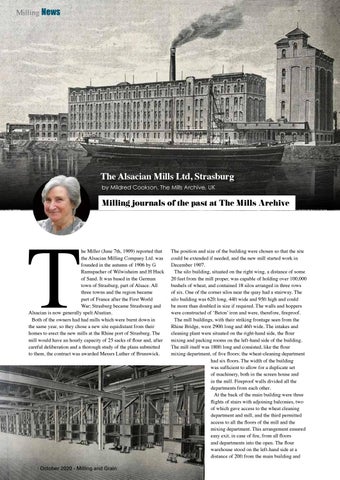
The Alsacian Mills Ltd, Strasburg by Mildred Cookson, The Mills Archive, UK
T
Milling journals of the past at The Mills Archive
he Miller (June 7th, 1909) reported that the Alsacian Milling Company Ltd. was founded in the autumn of 1906 by G Ramspacher of Wilwisheim and H Huck of Sand. It was based in the German town of Strasburg, part of Alsace. All three towns and the region became part of France after the First World War; Strasburg became Strasbourg and Alsacian is now generally spelt Alsatian. Both of the owners had had mills which were burnt down in the same year, so they chose a new site equidistant from their homes to erect the new mills at the Rhine port of Strasburg. The mill would have an hourly capacity of 25 sacks of flour and, after careful deliberation and a thorough study of the plans submitted to them, the contract was awarded Messrs Luther of Brunswick.
22 | October 2020 - Milling and Grain
The position and size of the building were chosen so that the site could be extended if needed, and the new mill started work in December 1907. The silo building, situated on the right wing, a distance of some 20 feet from the mill proper, was capable of holding over 100,000 bushels of wheat, and contained 18 silos arranged in three rows of six. One of the corner silos near the quay had a stairway. The silo building was 62ft long, 44ft wide and 95ft high and could be more than doubled in size if required. The walls and hoppers were constructed of ‘Beton’ iron and were, therefore, fireproof. The mill buildings, with their striking frontage seen from the Rhine Bridge, were 290ft long and 46ft wide. The intakes and cleaning plant were situated on the right-hand side, the flour mixing and packing rooms on the left-hand side of the building. The mill itself was 180ft long and consisted, like the flour mixing department, of five floors; the wheat-cleaning department had six floors. The width of the building was sufficient to allow for a duplicate set of machinery, both in the screen house and in the mill. Fireproof walls divided all the departments from each other. At the back of the main building were three flights of stairs with adjoining balconies, two of which gave access to the wheat cleaning department and mill, and the third permitted access to all the floors of the mill and the mixing department. This arrangement ensured easy exit, in case of fire, from all floors and departments into the open. The flour warehouse stood on the left-hand side at a distance of 20ft from the main building and
was connected to the packing department on the first floor by a light iron bridge. The boiler and engine house, as well as the chimney stack, were situated behind the main building. This building contained, next to the wheat cleaning department, the rope shaft for the reception of the main drives. The walls were built of lime sandstone. The ceilings of this and the offices consisted of T-irons placed at long distances from each other and the floors were covered with threeinch boards. A ship’s elevator, with an hourly capacity of 60 tonnes, and a band conveyor delivered the wheat from the boats to a large automatic self-registering weighing machine in the screen house. From there, wheat travelled by elevator to two large warehouse separators with shaker sieves with a powerful suction to extract dust, coarse and fine impurities. The screen house was fitted with a double milling separator with reciprocating brushes, two large
magnetic separators, one grader for two sizes, two horizontal brushes and cockle and barley cylinders. After the cleaning process, the wheat was then collected in conditioning bins. The break rolls were 60x10 inches in diameter and the smooth rolls 40x10 inches in diameter. There were eight double break roller mills and 22 double smooths of the new Luther diagonal type, set in two rows. The roller mills were protected by patents and were well-built and substantial machines. The grinding rolls were placed diagonally to each other and were fed by a special feeding device, which had one feed roll placed below the other. This lower feed roll delivered the material to the nip of the rolls direct, without the use of back or guide plates. By this means, an accumulation of material behind the rolls and a streaky feed was avoided, and a regular stream and absence of flakes was ensured. There were 23 Luther plansifters, which were so well balanced that there was no vibration. Semolina, middlings and dunst were
WE ARE OTTEVANGER We engineer, manufacture, build and manage your complete project in the cereal processing industry. www.ottevanger.com Milling and Grain - October 2020 | 23
Milling News treated by 10 double “Brilliant” purifiers. The fans, exhausted from the roller mills and plansifters, were connected with the “Luther” suction filter dust collectors, and were provided with automatic shakers. The finished products, such as flour, thirds and large and fine bran, were conveyed to the mixing and packing departments where they were weighed and packed. The flour and bran bins delivered their respective products by means of chutes on to the different floors where they were sacked off. The better class qualities of flour were packed by three automatic packing machines. There was also a large flour warehouse, with sack slide and hoist, used for conveying the sacks from one floor to another as required. A sack conveyor discharged into boats by means of another specially constructed sack slide. The whole installation, including lighting, was worked by a 400-horsepower tandem compound steam engine. There were two Cornwall boilers fitted to superheat the steam to 350°F. From the rope flywheel the ropes drove two lines of shafting in the basement for the rolls. All ropes ran in rope shafts to prevent accidents. Two lines of shafting on the fourth floor drove plansifters, purifiers, elevators and worms, and one line of shafting on the first floor drove the wheat cleaning machinery, ship elevators, and silo elevators.
www.millsarchive.org
Your partner for industrial process automation Our solutions: Design and engineering Build and installation MCC and PLC panels Software engineering PLC/SDADA MES application Batch Explorer Integration to other software packages Turn Key installations incl. training, service & support
Genuine for over 50 years!
Grain Cooling
GRANIFRIGOR™ The most natural way of grain preservation • Protection against insects & fungi • Without chemical treatment • Short amortisation period • Low energy demand • Independent of ambient weather • No respiratory losses
Scan the QR-Code to discover our solutions! www.inteqnion.com
24 | October 2020 - Milling and Grain
FrigorTec GmbH • info@frigortec.com • www.frigortec.com
Milling News
Nutreco announces winners of its Feed and Food Tech Challenge 2020
O
n September 23rd, Nutreco announced the winners of this year’s Nutreco Feed & Food Tech Challenge (NFTC2020). First held in 2017, the event acknowledges the best breakthrough innovations in livestock farming, aquaculture and, for the first time this year, alternative food proteins. In this competition, 15 finalists were selected from over 110 submissions by start-ups from across the globe. On September 22nd, the top three finalists eniferBio, Poultrix and Bond Pet Foods pitched again to the NFTC2020 jury, this time in a hope to win the top spot in the competition. The jury of the event consisted of Nutreco and external experts, including AquaSpark’s Mike Velings, Mathieu Castex of Lallemand Animal Nutrition and David Welch of The Good Food Institute. The winner wins a validation trial worth EU €50,000, the second-place winner will receive €10,000 and third place will receive €5,000. The winner of the NFTC2020 and receiving the scientific validation trial is eniferBio. This startup from Finland works to create a better future using fewer natural resources by revolutionizing an existing single cell protein technology to produce raw materials for aquaculture. In second place is Poultrix from Israel, which provides
a digital solution to help poultry integrators manage its farming operations in a more efficient, sustainable and responsible way. Coming in at third place is Bond Pet Foods. The startup’s breakthrough innovation was applying an innovative marketing and technology approach towards pet food. Alex Obach, Aquaculture NFTC2020 Juror and Skretting Head of R&D commented, “I’d like to congratulate eniferBio on their exciting technology solution and on winning the NFTC2020. Their innovation addresses raw material sustainability, one of the key challenges the aquaculture industry is facing. I look forward to working with them to validate their technology and explore further collaboration.” Nutreco’s Director of Venturing and NFTC2020 head juror Joost Matthijssen commented, “We were impressed by the standard of breakthrough innovations throughout this competition. As the 15 finalists put their best foot forward during the pitch sessions to the jury and Nutreco colleagues around the world, we have added an audience award for the NFTC2020 Best Pitch. This award for the start-up that gave the best pitch in terms of message delivery, presentation style and engagement was decided by Nutreco employees based.” Fumi Ingredients is the winner of the audience award for the NFTC2020 Best Pitch and wins a €5,000 prize. The next edition of the Nutreco Feed & Food Tech Challenge will take place in 2022.
World’s first ‘underground drone’ unveiled by Crover at TechCrunch Disrup
C
rover, the first robotic device able to ‘swim’ through solid granular media such as sand, grains and powders has been unveiled at this year’s TechCrunch Startup Battlefield, “the world’s preeminent startup competition”. Future potential applications of the technology include underground exploration in other planets, the recovery of buried objects, and travelling in desert sand. Lorenzo Conti, Crover’s Founder and Managing Director, said, “During my PhD at the University of Edinburgh, I discovered a novel physical law, which represents the
first feasible method for locomotion in bulk solids, what I like to call the Crover effect!” The first version of the Crove robot is intended to help grain operators monitor the conditions of cereal grains in long-term storage, helping them maintain the quality of their stock and preventing spoilage of the grains, so that more food can reach our table. Edinburgh-based Crover is also the first Scottish company (and the second from the UK) to ever make it into the TechCrunch Startup Battlefield list. Known by fans of the HBO series ‘Silicon Valley’ and by tech enthusiasts globally, TechCrunch Startup Battlefield features 20
Session 12 Design and Construction September 30th 26 | October 2020 - Milling and Grain
carefully selected start-ups from across the world, each presenting on the main stage of the TechCrunch Disrupt annual conference, which is celebrating this year its 10th anniversary. Usually held in San Francisco, for the first time the event is taking place virtually for a global audience of hundreds of thousands of live viewers. The company has a granted UK patent, as well as international patent applications, on what is considered to be the world’s first feasible method for locomotion in bulk solids. Crover has industrial pilots planned to start in October, with two grain co-operatives in the UK, and it aims to offer the product commercially from next summer.
www.onlinemillingschool.com YOUR GLOBAL PARTNER
INTUITIVE AND FAST PROGRAM SETTING
The Rex Wailes Collection
Rex makes front page news
Rex presenting a windmill certificate to John Bryant of Pakenham windmill
by Mildred Cookson, The Mills Archive Trust, UK
When Rex started as the Technical Adviser to the Society for the Protection of Ancient Buildings (SPAB) in 1929, he needed to gather information on the state of British windmills. Concern about their fate had been highlighted in the national press, particularly The Daily Mail, but most of the detailed accounts were published in local newspapers. Not surprisingly, he created a library of press cuttings. These cuttings were carefully selected for their relevance to the state of British mills and were pasted into a series of large scrapbooks, which are now cared for by The Mills Archive. Until the start of Second World War, they show how many mills had been left to decay, while others were maintained by a dedicated volunteer or owner. They underline the impact of the series of surveys and appeals launched with Rex’s help during that decade. On Rex’s visits to mills he is often caught on camera, not his own, but by the local newspaper reporter who was always looking for an unusual story to write up. They could feature Rex presenting a certificate to a miller who has looked after and maintained his mill with great care. One such was John Bryant, whose family had owned Pakenham Windmill in Suffolk since 1885. Rex’s international influence is well-recorded. In Virginia, USA, he is captured in an article in “The Virginia Gazette” on May 5th, 1957, where he oversaw the planning and construction of the Robertson’s windmill at Colonial Williamsburg, based on the UK post mill at Bourn in Cambridgeshire. This mill was chosen as a model as it was one of the oldest in the UK, and closest in design to a mill that could have been built in Virginia when the early settlers arrived. Rex’s pre-war work in Finland continued to be recognised many years later, as evidenced by the 1974 front page coverage by Vasabladet, a Swedish language regional daily newspaper in Ostrobothnia, Finland. Work is still continuing at the Archive on Rex’s collection even during the ‘lockdown’ with Nathanael, our Archivist, working from home on the digital files.
Rex at Colonial Williamsburg, Virginia
Rex on the front page of the Vasabladet, August 23rd , 1974
29TH EDITION COMING SOON internationalmilling.com
28 | October 2020 - Milling and Grain
Milling News
29TH PRINT EDITION
COMING SOON
NOTE TO OUR MEMBERS UPDATE YOUR COMPANY LISTING TODAY TO ENSURE YOU ARE INCLUDED IN THE 2021 EDITION!
internationalmilling.com ONLINE | PRINT | MOBILE
Milling and Grain - October 2020 | 29
Milling News
Evonik launches its own GAA product GuanAMINO®
E
vonik has launched GuanAMINO®, its own guanidinoacetic acid-product (GAA) used to enhance energy metabolism in livestock production.The launch of GuanAMINO® comes almost two years after Evonik’s former supplier terminated its agreement, although Evonik continued to supply its customers until at least the end of 2018. The end of the previous arrangement opened options for Evonik to further develop the use of GAA in animal nutrition and supply the global market with its own GAA product. GuanAMINO® provides farm animals with the natural creatine precursor GAA, which supplies creatine in the best way to animals, improving their performance, ensuring optimal nutrient utilisation and, therefore, return over feed costs. “GuanAMINO® is the best supplemental creatine source due to its outstanding stability in feed processing and high bioavailability to the animal. Adding GuanAMINO® to feed closes the gap in creatine supply, thereby increasing the efficiency and effectiveness of nutrition and optimising production costs of farm animals,” says Dr Torben Madsen,
Head of Product Line Sustainable Healthy Nutrition at Evonik Animal Nutrition. “We are proud to achieve this major milestone on our continuous way to provide our customers the best solutions for their individual needs. With GuanAMINO®, we offer our customers the best creatine source and another performance enhancing solution in our portfolio for sustainable, animal protein free diets,” says Dr Madsen. Creatine is vital for vertebrates as it contributes to ensuring that high energy demanding cells (particularly muscles) are supplied sufficiently. With the addition of GuanAMINO® to animal feed, the feed conversion in livestock production can be improved significantly. In the body, creatine is formed through methylation of GAA, which itself is formed from the amino acids glycine and arginine. However, in fast-growing animals it is estimated that only around two-thirds of the required daily need for creatine is covered by the body’s own synthesis. The rest must be supplied via addition to the feed. GuanAMINO® is granulated, virtually dust free, free flowing and has handling characteristics which make for easy usage in daily operations.
PCE
PELLETING CONSUMABLES EUROPE
YOUR PARTNER IN TOP-QUALITY RING DIES available all major p for press branellet ds
Scan the QR-Code to find your die!
WWW.PCE.EU 30 | October 2020 - Milling and Grain
WE PROVIDE
COMPLETE SOLUTIONS FOR ALL TYPES OF CEREALS Our quality and reliability expands to 90 types of equipment that we produce and supply from Gaziantep to the World.
We Earned Our Name From Our Work..
• Cleaning • Moisturizing • Grinding • Transport • Packaging • Installation • Electricity and Automation Equipment
asggruptr @degirmenmakina @degirmenmakina
4. Organize Sanayi Bölgesi 83404 Sok. No: 6 Şehitkamil / GAZİANTEP - TÜRKİYE Tel: +90 342 357 01 50 (10 hat) info@degirmen.com
www.degirmen.com
www.golfettosangati.com info@golfettosangati.com
Mill
TRAINING Milling and Grain magazine, along with Progressus Agrischools, have set up the Online Milling School and have been running weekly e-learning experiences for the past three months. The series of two-hour sessions discuss various critical aspects of the feed milling operation.
Join us for the final session of the Online Milling School The final course offered as part of the Online Milling School takes place September 30th and will discuss design and construction. Previous courses, which will be re-run at a later date, have discussed topics ranging from storage, pelleting, quality assurance, steam and conditioning and more. “This is a key initiative by both Progressus and Perendale to bring learning and knowledge sharing to the factory floor and to the locations of those who might otherwise not have access to a better understanding of processes,” says Roger Gilbert, Publisher of Milling and Grain Magazine and CEO of Perendale Publishers Ltd. “Each course will be held on a Wednesday live at 14:00
The Science of Wheat & Milling course, hosted by the AgriFood Training Partnership (AFTP), will provide attendees with an indepth exploration of the science behind cereals and milling, and the processes and technology used in practical industrial applications.
AFTP Science of Wheat and Milling Through three days of campus workshops hosted by the University of Reading, UK, and featuring speakers from across academia and industry, attendees will be introduced to the fundamental attributes of wheat and grain, including their physical structures, nutritional content, and the principles of wheat breeding and genetics. With this foundational knowledge, attendees will then explore the milling process and
This training course will focus upon understanding the underlying principles of the milling process and the parameters that can be influenced by either raw materials or the milling system; understanding the challenges of operating staff; and learning which critical control points to check in order to judge whether an operation is running well.
Buhler–KSU Executive Milling Course topics include managing raw materials; cleaning
This course will have an in-depth discussion of various flow sheets and approaches for successful milling. Understanding the influences of both raw materials and the applied milling system will be supplied to optimise production processes.
Buhler–KSU Flowsheet Technology Course topics include the cleaning and conditioning of wheat 34 | October 2020 - Milling and Grain
Bangkok Time (09:00 WET) and repeated in a rebroadcast to reach North and South American students on Fridays at 14:00 CDT. “We hope to provide an CR DO incentive for those in the feed milling sector to begin a lifetime of learning, starting with an online introduction through the Online Milling School. We wish to work with established milling learning centres and will encourage students to go further over time,” he adds. Whether you’re starting out in feed milling, advancing your understanding of milling processes or refreshing your knowledge based on certain aspects of the milling process to meet ongoing operational requirements, the OMS has something to meet that need.
E
ONLINE MILLING SCHOOL
the uses of flour for various applications. After completing the course, attendees will have a wideranging and detailed understanding of the wheat and milling industry, balancing scientific knowledge with a practical appreciation for the technologies and processes used to create products for the consumer. As a result, the course will be beneficial for professionals working in any area relating to wheat and milling, but also to food manufacturers and retailers looking to increase their knowledge of these subjects. The workshop is divided into three days. Participants will hear from experts in each field in the format of lectures, case studies and demonstrations. Each topic is set in the context of applied case studies presented by leading academic and industrial experts in the field Talks are accompanied by debates and interactive activities.
systems (special systems for mycotoxin reduction and top quality flour production); milling systems (descriptions and functions of milling machines, basic flow sheet technologies, basics in starch damage); finished product handling and storage (batch mixing versus continuous mixing systems, basics in flow quality, product safety and quality control); performance evaluation in a flour mill, factors that influence an investment decision and basics in aspiration. No previous experience in milling is required. This course is ideal for mill owners, managers and directors. The course is taking place November 9-13th, 2020.
(advanced flow sheet technology in the cleaning section, systems and designs, practicals in the Hal Ross Mill); in-depth flow sheet technology of the milling process, new approaches in a mill flow sheet to improve extraction, operational reliability and finished product quality of a mill; flour mill operation (different approaches to milling wheat); novelties in the finished product handling section (new machines and measurement equipment for product safety). This course will take place November 16–20th, 2020.
We are now accepting enrolments
for the 2020 flour milling distance learning programme
Mill
TRAINING
I
n response to COVID-19 disrupting much of the events and exhibitions that were due to take place around the world in 2020, many companies have embraced the digital and taken their conferences to online platforms and Milling and Grain magazine is no exception! In June 2020, Milling and Grain magazine, along with Progressus Agrischools, set up the Online Milling School. Serving as a platform for millers to engage with the industry and latest innovations in the sector, we have hosted a total of 12 e-learning experiences, discussing various critical aspects of the feed milling operation. Topics ranged from pelleting processes, storage solutions, conveying and handling through to design and construction of turnkey projects, all with the goal to educate the feed milling sector and provide industry members with the key skills they need to optimise their processes. “This is a key initiative by both Progressus and Perendale to bring learning and knowledge sharing to the factory floor and
36 | October 2020 - Milling and Grain
to the locations of those who might otherwise not have access to a better understanding of processes,” says Roger Gilbert, Publisher of Milling and Grain Magazine and CEO of Perendale Publishers Ltd. “We hope to provide an incentive for those in the feed milling sector to begin a lifetime of learning, starting with an online introduction through the Online Milling School. We wish to work with established milling learning centres and encourage students to go further over time,” he adds. Key features Milling and Grain wanted to ensure we could offer the sector were both accessibility and engagement. Every session of the Online Milling School was re-broadcast, in order to be made accessible to industry members from around the world, and each session also featured a live Q&A session, where attendees could pose their questions to our expert presenters and get the information they desire. Industry members who attend all 12 sessions also receive a Certificate of Attainment in Feed Milling Production Management.
Milling and Grain - October 2020 | 37
Session 1: Grinding and conditioning July 8th, featuring Malcolm Greswell and Finn Norman Jensen, Independent Consultants In the opening session of the Online Milling School, the team were joined by two expert milling consultants with several decades of experience in the milling industry, discussing optimisation of grinding solutions. It is important to understand not only the principles of grinding, but how to set up hammer mills in the most efficient manner. Particular attention was given to machine operational parameters and the management of screens and hammers. The second half of this session focussed upon conditioning, wherein our presenters explored how to manage steam addition for achieving maximum gelatinisation. Session 2: Grinding operations July 15th, featuring Ryan Selis, Yemtar Session two featured Turkish milling experts Yemtar, who discussed the correct set up and maintenance of hammer mills. The air supplied to grinding systems is often neglected, leading to gross inefficiencies in output. The monitoring and maintenance of the air supply systems, therefore, is a critical part of the grinding operation in order to make the most of your feed production line. Session 3: Batching operations July 22nd, featuring Ryan Selis, Yemtar and Jon Ratcliff, Agentis Innovations The importance of mixer uniformity is generally well understood, but often good practice is not always applied. Mr Selis explained what specific factors influence batch uniformity, how it is measured and its potential impact on cross contamination and carryover. In the second half of this session, Mr Ratcliff explored the importance of proper premix preparation and ensuring your additives and ingredients are all correctly managed. Session 4: Steam and conditioning July 29th, featuring Ryan Selis, Yemtar, Olaf Naehrig, Amandus Kahl and Jon Ratcliff, Agentis Innovations In session four, our three expert speakers explored a variety of topics in relation to steam and conditioning. Ryan Selis introduced the session, exploring steam quality and conditioning. Mr Naehrig then explored how to effectively manage feed expansion and optimise the conditioning process. Mr Ratcliff concluded the session, providing insight in regard to thermal pathogen reduction, a process to maintain the hygienic standards of your feed. Session 5: Mixing operations August 5th, featuring Roy Kazen, Ottevanger Milling Engineers and Ryan Selis, Yemtar This session was opened up with a discussion concerning mixer design. The many mixers on the market all feature a variety of unique innovations that provide them with their own advantages and exclusive features. Mr Kazen explores the best mixers on the market and what to look out for when purchasing a mixer. Mr Selis also covers mixing dispersion and homogeneity, discussing the factors that can positively and negatively affect these processes. Session 6: Pelleting August 12th, featuring Ryan Selis, Yemtar, and Olaf Naehrig, Amandus Kahl In our sixth session, Mr Selis was joined by Olaf Naehrig of Amandus Kahl to discuss raw material formations and pellet quality. Mr Selis discussed how formulations are prone to changes due to a variety of factors, including additives, processing
technologies applied as well as the physical and chemical features of the materials. Bulk density, angle of repose and moisture levels must all be monitored to optimise final results. Mr Naehrig also emphasises the importance of proper die and roller measurement, exploring how die speed and configuration, as well as roll gap and machine wear can be optimised to ensure efficient and optimised processing. Session 7: Raw material receiving and storage August 26th, featuring Ryan Selis, Yemtar In this presentation, we explored a typical flow chart for raw material conveying and discussed each stage of receiving, from delivery and weighing, to cleaning and storage in a grain bin or silo. Mr Selis explored typical sampling procedures and recommended that samples of each batch should be kept on record for a minimum of three months, for traceability purposes. Conveyor types and characteristics were also explored, alongside the advantages and disadvantages to different silo types, such as flat-bottom silos and conical-bottom silos. Optimal conditions for raw material storage were explored, as well as solutions to mitigate insect and vermin infestation. Session 8: Other supporting equipment September 2nd, featuring Ryan Selis, Yemtar, Olaf Naehrig, Amandus Kahl and Diego Clivio, PCM Group In session eight our speakers discussed the variety of liquids available for feed applications, ranging from fats, probiotics and enzymes. Managing these liquids is essential to ensure proper distribution and homogeneity. Following this, Mr Naehrig explored coolers and the cooling process. Optimising your cooling process is essential to make the most out of your feed and produce the most polished final product. Livestock feed was also discussed at length, and the role expanders play in producing quality feed for cattle and sheep. Session 9: Quality assurance and control September 9th featuring Ryan Selis and Jon Ratcliff Traceability and quality assurance are essential aspects that must be monitored in feed production, and session nine offered attendees the opportunity to discover the best traceability solutions and methods to ensure feed is responsibly sourced and produced. Quality control was also discussed as well as methods to optimise your quality assurance tests. Session 10: Feed mill management September 16th, featuring Dr Charles Stark, Kansas State University, Ryan Celis, Yemtar and Jon Ratcliff, Agentis Innovations Our tenth session discussed the efficient operation of feed mills and the best methods to ensure both profitability and success. Presenters explored how to set and monitor equipment to ensure maximum efficiency, as well as key performance indicators to monitor for effective mill management. With sustainability becoming a growing concern, the presentation also explored energy efficiency and methods to reduce energy use in mills. Session 11: Digitalisation and Automation September 23rd, featuring Mr Kim Jensen Møller, Famsun and Didier Nyugen, SEA Industry 4.0 is drastically changing how we run feed processing lines, and ever-evolving automation systems are leading to increased efficacy and product quality. In this session, our Online Milling School presenters explore how digitalisation has changed the feed industry, exploring sensors, software and robotics. Milling and Grain - October 2020 | 39
Consumer Physics’ SCiO Cup
PRODUCT FOCUS October 2020 In every edition of Milling and Grain, we take a look at the products that will save you time and money in the milling process.
Consumer Physics recently introduced the SCiO Cup, the world’s fastest, portable, lab-grade forage dry matter analyser. The smartphone-operated device transforms feed analysis by enabling frequent dry matter analysis. The SCiO Cup enables on-farm decision making, ensuring consistent dry matter intake and reduced feed leftovers. In addition, the SCiO Cup can be used on-field for planning silage harvest timing at optimal moisture levels. SCiO Cup supports dry matter analysis of chopped corn silage, legumes silage, grass silage, small grains silage, and mixed silage. Silage calibrations are seamlessly and continuously updated in the cloud to ensure seasonal and regional accuracy. The SCiO Cup also enables users to track past dry matter results and trends across time, per field or feed bunker/ pit. The SCiO Cup is rechargeable, battery operated and can scan more than 1000 samples on a single charge.
www.consumerphysics.com
3500 Series Commercial Sweeps
Henry Simon’s HSPU Purifier
The new Brock 3500 Series Commercial Sweeps give commercial grain elevators and large farm operations another tool to remove grain from storage bins. These sweeps are built to withstand heavy loads of corn and other grains held in large bins up to 156 feet in diameter. 3500 Series Sweeps are an all-electric option that doesn’t require hydraulics. They use an explosion-proof, heavy-duty motor with V-belt drive and electrical collector ring for cordfree operation. Brock’s heavy-duty sweep sections eliminate the need for floor jacks, allowing for zero entry during bin unloading. Brock 3500 Series Sweeps are available in two auger sizes.
The new Henry Simon Purifier (HSPU) brings the advantages of new design and technology together in semolina cleaning and classification processes. The purifier is equipped with Advanced Sensor Technology - state of art sensors that provide a higher level in operational efficiency, reliability and safety. And, as being the first example, the purifier has a touchscreen panel on which the amplitude, frequency, static air pressure etc. can be displayed. The maintenance software also allows for the visualisation of maintenance history, error logs, replacement time of consumables etc.
myMAG.info/e/953 www.brockgrain.com
Port-Mobile Unloader Optimised on many key levels from its stable, lightweight steel structure through to its gentle cargo handling and total operational costs, the Port-Mobile Unloader (PMU) offers full port mobility, excellent efficiency and reduced investment costs. The Siwertell PMU uses heavy-duty rubber tyres and an advanced steering system and is available as a 400 tonnes-per-hour or a 600 tonnes-per-hour unit. It is an ideal solution for operators looking for a port-based system to discharge vessels up to 60,000 deadweight tonnage. One of the advantages when unloading grain with Siwertell screw-conveyor technology is low material degradation. The Siwertell PMU offers similar discharge rates as pneumatic unloaders, but generates less cargo degradation because of its dramatically lower conveying velocity.
myMAG.info/e/954 www.bruks-siwertell.com 40 | October 2020 - Milling and Grain
myMAG.info/e/955 www.henrysimonmilling.com
Gericke TCM Turbo Compact Mixer Gericke’s unique experience in continuous mixing and feeding has resulted in a new family of mixing solutions. With the TCM Turbo Compact Mixer it is possible to continuously, and fully automatically, feed and mix up to four streams with minimum space requirements and high accuracy. The new TCM compact mixer from Gericke is aimed precisely at processes where demanding additives such as colours or flavours are added. Due to the “end-of-line” addition strategy, only a few equipment parts need to be cleaned. This also makes the TCM ideally suited for products that must guarantee zero cross-contamination handling of allergens. The complete disassembly allows easy and quick cleaning. Even the mixing chamber is removable. With small volumes, recipe accuracy is guaranteed even with frequent start-stop operation, which has been confirmed in an extensive series of tests. Despite the compact size, capacities of up to 20,000 litresper-hour can be realised.
www.gerickegroup.com
FOCUS
SPECIAL FOCUS
4B JumboTM CC-S® Low-profile Buckets
The large sized ultra-heavy-duty Jumbo CC-S (JCC-S) elevator bucket line is intended for the most severe agro-industrial uses, such as port and river terminals, ethanol and fertiliser plants, or frac sand and aggregate operations. The super strong Jumbo CC-S® bucket offers greater carrying capacity, along with ultra-durability and wear resistance. It has the thickest front lip, front corners and walls available for longer life. The Jumbo CC-S® is a High-Efficiency™ elevator bucket, and comes in six sizes ranging from 14x8 to 24x8, available both in standard and low profile version. As an extension of the proven and successful heavy duty CC-S® elevator bucket, the Jumbo CC-S® also incorporates the long lasting Iceberg® Edge front wear lip and the unique tapered bottom. Designed for the closest possible vertical spacing (projection +1/2”), the tapered bottom ensures efficient bucket fill and discharge, especially in low-profile configurations. This design allows the buckets to nest inside one another, delivering transport cost savings and storage efficiencies. The Jumbo CC-S® offers a substantial upgrade opportunity for anyone requiring thicker walled elevator buckets. Ray-Carroll County Grain Growers, a 2.8-million-bushel country elevator in Carrollton, Missouri, USA, needed to increase its receiving capacity in order to better accommodate its growing customer base. The challenge was to upgrade the receiving system without shutting down operations. Twenty million bushels of corn are received at this facility every year. 4B Components engineering group analysed the existing elevator legs and designed an improved solution. 4B JumboTM CC-S ® 16x8 low-profile buckets were installed and spaced 7.75 inches apart. The low-profile design allowed Ray-Carroll to install the buckets closer together, resulting in the ability to add 224 additional buckets-per-leg. To handle the increased load of the additional buckets, 18-inch wide 1,000-pounds-per-inch of belt width (PIW) rubber belting was installed, utilising 4B BC belt splice clamps, designed for heavy weight belts. It took two days for the millwright team to install the new buckets on the two legs. By working on one leg at a time, the other remained operational, and the elevator was able to receive grain throughout the process. Before the upgrades, the two legs each ran at 8,500bph capacity. Now, each leg can handle 15,000bph, an increase of approximately 75 percent throughput. Ray-Carroll was very pleased with the solution provided by the 4B engineering team. They increased capacity and, by the installation of the 4B Jumbo TM CC-S ® 16x8 low-profile buckets, they achieved their goal of making it easier and quicker for their customers to deliver grain. Trucks now go scale to scale in under four minutes.
Milling and Grain - October 2020 | 41
F Satake’s VTA
The versatile Satake VTA
T
by Peter Matthew, Director of Cereal Operations, Satake USA, Inc.
he Vertical, Top Feed, Abrasive Rolls (also known as the VTA) was first designed and manufactured in 1993 by the Satake Corporation in Hiroshima, Japan. Originally manufactured for the rice milling industry, the was supplied as part of the world renowned Satake rice milling systems; These systems incorporate the VTA (abrasive milling), VBF (friction milling), and the KB (polishing) machines which, very quickly, became the standard for rice milling across the world, with approximately 5000 VTA units currently in operation. Satake’s rice milling systems are still the preferred choice for rice milling to this day. Using the same machine body, structure, and main drive motor, numerous cereal grains and pulses can be processed through the VTA unit. By simply changing the standard abrasive rolls and/ or screens, the required dehulling/debranning/ splitting actions can be achieved. Cereal grains and pulses currently being processed utilising the Satake VTA include rice, wheat, barley, sorghum, millet, peas, lentils, soybeans, and chickpeas. How can this one machine process such a wide variety of grains and pulses? Let’s take a closer look at the VTA operational benefits on these products: Rice: As mentioned previously, the VTA unit has been utilised for many years, and remains to
42 | October 2020 - Milling and Grain
be, an integral processing machine in the Satake rice milling systems. Using abrasive stones, in combination with specially designed screens, the rice bran is uniformly removed from the grain, with minimal breakage to the rice grain Wheat: In 1996 Satake introduced the VTA to the wheat milling industry as part of the Peritec Wheat Debranning Process. With simple changes to the abrasive stones and screens, efficient bran removal from the wheat kernel is achieved. In this application, the VTA is typically utilised after the 1BK scale in the production process, but prior to the to the 1BK roller mill. This application is suitable for both new mill installations and existing mill ‘upgrades’ with several key changes to the existing mill process flow. Typical benefits gained from debranning wheat prior to the milling process are: • The reduction of harmful elements such as pesticides and vomitoxins • Less bran specks in the finished flour, resulting in a ‘whiter flour’ • Mineral-rich flour (aleurone inclusion) • The use of a lower “falling number” in wheat • Baking quality – Volume, taste, colour, and consistency
F
• Mill capacity increase to existing mill units. • Barley: Again, by simply changing the abrasive rolls and screens, the VTA can accomplish three tasks: • Dehulling: Removal of the outer husk • Barley debranning: The percentage of bran removal is dependent upon finished product requirements. This, typically, is a single pass although a secondary pass is sometimes necessary for higher debranning rates. (the ‘batch- type’ method is sometimes used for this application) • Pearled barley: The pearling of barley requires a high degree of bran removal. This is achieved through using a multi-pass VTA system, employing two or three VTA units or, as previously mentioned, a ‘batch-type’ method. • Sorghum: Utilising a configuration of abrasive stones and screens like that required for wheat processing, the efficient debranning of sorghum is achieved. • Millet: With an identical set-up of abrasive stones and screens to that of sorghum, the debranning of millet is efficiently achieved by the VTA machine. • Peas: The efficient and simultaneous dehulling and splitting of peas utilising the VTA has proven to be a market success for Satake. In this application, the
square silo experts
SCE offers industrial steel buildings that include square silos, mostly used in feed & food processing industries. Those square silos take up less space than round silos and allow you to store 27% more.
Thanks to the specific design, you can
assemble our silos in any production unit.
SILO CONSTRUCTION & ENGINEERING Belgium HQ +32 51 72 31 28 Asia Sales Office +65 8222 90 96 www.sce.be
Milling and Grain - October 2020 | 43
F
configuration of the VTA utilises special diamond-coated abrasive rolls, along with a specifically designed screen. The diamond-coated rolls provide an excellent medium for the removal of the pea hull whilst the internal resistance bar design facilitates the ‘splitting’ effect of the whole pea. In addition to this, the diamond coating provides a long lifespan to the abrasive rolls, whilst the special screen design ensures lasting durability. • Lentils: With an identical set-up of abrasive stones and screens to that of sorghum, the debranning of lentils is efficiently achieved by the VTA machine. • Soybeans: As with peas, the VTA machine efficiently processes soybeans. Dehulling, splitting, and removal of the soybean hull are carried out by the diamond-coated roll and the splitting action is the direct result of the processes varied out by the internal resistance bar. It can also be noted that, in this application, the diamond coating again provides a long lifespan to the abrasive rolls, whilst the special screen design ensures lasting durability. • Chickpeas: Despite the irregular shape of chickpeas, they can again be easily processed by the versatile VTA. Dehulling and splitting actions are both carried out in the VTA chamber. The versatility of the Satake VTA is clearly evident by the many different applications highlighted in this article. Through extensive on-site testing, the participation of Satake test facilities worldwide and the experience and knowledge from decades of grains processing, the versatile VTA from Satake provides the best technical solution for our customers’ needs when it comes to dehulling, splitting and debranning of grains and pulses. For all your cereal grains and pulses processing needs, please contact Satake USA, Inc. or visit our website. www.satake-usa.com
NOTE TO OUR MEMBERS UPDATE YOUR COMPANY LISTING TODAY TO ENSURE YOU ARE INCLUDED IN THE 2021 EDITION! 44 | October 2020 - Milling and Grain
FIND WHAT YOU ARE LOOKING FOR - WITH THE INTERNATIONAL MILLING DIRECTORY ONLINE
internationalmilling.com ONLINE | PRINT | MOBILE
PINGLE.
PROFESSIONAL MANUFACTURER OF GRAIN MACHINERY
★ INTEGRATED MILLING SOLUTION PROVIDER ★ ISO 9001:2015 CERTIFIED
Аdd: Zhengding, Shijiazhuang,Hebei,China Tel: +86-311-88268111 Fax: +86-311-88268777 E-mail:pingle@pingle.cn / www.plflourmill.com
F
Why should I care about moisture?
I
by Alessandro Mario, Technical Sales Engineer, Hydronix, UK magine a world where moisture does not matter, a world where you can harvest when you want, where mycotoxins do not affect stored products, where mills always operate at maximum efficiency, and final products are perfect. It sounds fabulous, but as is well-known in the agricultural, feed, and related industries, moisture is a determining factor in every process. Let us take a few steps back and have a brief overview of all the steps where it is possible to increase profits and efficiency by controlling the moisture.
Harvesting and threshing
Harvesting is the procedure where ripe crops are cut and picked up, to then proceed with the extraction of the grains by another mechanical process called threshing. Depending on the destination of the yield, the crops need harvesting at precise moisture. For example, harvesting and threshing grains when it is too dry (water content below 20%-25%) can lead to loss, waste, and breakage of material. Contrary to this, if crops are too wet, it is possible to get mechanical issues requiring additional adjustment of the harvesting equipment. Wet crops will also limit the weight capacity of the machinery and cause problems with the threshing action. The water content of the yield can be measured inline directly inside the combine harvester to calculate the dry weight, as well as provide additional information about spatial variability in the field. Depending on the location and the weather, the first 48 hours are crucial for the yield, as mycotoxins can contaminate the product before the storage and drying operations. Knowing the moisture during the harvest will also allow the farmer to plan quickly ahead.
Storage and drying
After the previous operations, the crop needs to be stored and preserved accordingly to prevent mycotoxins, spoilage, or heat spots. These often give problems that are directly related to the moisture contents of the grain. Monitoring moisture 46 | October 2020 - Milling and Grain
during storage is fundamental to be able to regulate the storage operations and to react timely to problems. Drying is a common practice to store grains safely, and it is a delicate process to reach the perfect moisture. By missing the target, the crop is still prone to mycotoxins and spoilage. On the other hand, over-drying is not just an expensive waste of energy but can cause damage and breakage to the grain’s skin, making it prone to mycotoxins and insect attacks. Excessive drying can also cause the grains to shrink in size, causing yield loss. The material entering the dryer has variable water content, and this makes it challenging to regulate the amount of time the material needs to be exposed to the heat or to regulate the temperature. In this process, the inline moisture control is used to automate the dryer to save money and improve the quality.
Conditioning
After drying, depending on the material and system requirements, it may be necessary to reintroduce water into the product by conditioning. This process can be done before the grinding mill and before pelleting operations. Depending on the final application, the conditioning can also heat the material to kill germs, to cook ingredients, and to gelatinate starch. In the same way that moisture control enhances the drying phase, it also improves the conditioning process by monitoring the target moisture to react timely to changes in the input material.
Grinding
Grinding is one of the most energy-consuming transformations in many food processes. Through mechanical action, it reduces the size of food materials such as grains, seeds, fruits, and many more to achieve different chemical and microbiological stability. Results vary based on machines and methods used, as well as toughness and moisture of the material processed. The toughness is the ability of a material to resist breakage; therefore, tougher material will need more mechanical energy to be reduced in size. The plasticity or ductility of a material determines the amount of energy absorbed before breaking down, as well as the final size. More plastic or ductile material will need more energy to break, but it will maintain a more regular final
TAKE YOUR PLACE IN POWER UNION
YOU
27-29 MAY 2021
Istanbul Expo Center, Hall 5-6-7 Yesilkรถy - Istanbul / Turkey
9th INTERNATIONAL
Flour, Feed, Corn, Semolina, Rice, Bulghur Milling Machinery & Pulses, Pasta, Biscuit Technologies Exhibiion
www.idmavictam.com
9th Internaaonal Flour, Feed, Corn, Semolina, Rice, Bulghur Milling
Machinery and Pulses, Pasta, Biscuit Technologies Exhibiion
F shape. In contrast, less plastic or ductile material will shatter into finer and irregular shard-like particles. The elasticity of the material is defined by its water content: therefore, by controlling the moisture of the material, it is possible to determine the energy consumption of the process, the final size of the powder particles, and the product yield and loss. For these reasons, the initial moisture of many food materials is the most important element to regulate before the grinding process.
Transport and flowability
After the grinding process, the moisture remains very important as it determines the flowability of the particles as the bonds between water molecules affect the stickiness and caking effect of the powder.
Pelletising
Pelletising is the process of extruding the formulation into cylindric shapes that are more easily consumed by animals. The content of the mix is extremely variable between the various applications and recipes. However, even in this process and after all the other steps, the water content is still an important factor to measure the quality of pellets. Additionally, the pellets may need to be dried for storage.
Control and sensors
In summary, the moisture affects the costs and the quality of the products. Knowing and subsequently controlling the water content of the material in every step of the process is necessary to improve efficiency, to reduce carbon footprint, and to save money.
Table 1. Resistive Capacitive
Low cost, low repeatability, affected by impurities and temperature, limited range Inexpensive, marginally more reliable than resistive, measures water impurities
NIR/Infrared
Contactless, expensive, fragile, affected by dust, colour, temperature, high maintenance costs, measures only surface material
Nuclear
Very expensive, very accurate, requires safety maintenance, requires a highly trained operator, measures large volumes
Microwave
Analogue: High sensitivity to water, affected by salts and impurities, nonlinear calibration Digital: Accurate, high sensitivity to water, not affected by impurities, cost-effective, simple to calibrate
Milling and Grain - October 2020 | 49
F To achieve these results, sampling the material is not enough because the samples may not be representative of the full batch and the speed of the feedback process is not adequate. It is possible to achieve real-time control in the process with inline sensors. As water content is an indirect measurement, this means the value is attainable only by calculating it from another measured characteristic; therefore, it is necessary to keep as constant as possible all other variables such as: • Material composition (mix recipe) • Particles size • Pressure on the sensor • Flow speed For this reason, it is key to calibrate the sensors for each recipe or formulation, only after the system installation. The calibration must be realised by accurate lab tests, calibrating any sensor with another different sensor can cause a sum of errors resulting in incorrect calibrations, defeating the initial objective completely. Independently from the method used in the process, whilst calibrating any sensor, during the lab test it is critical to completely ‘cook’ away the moisture of the sample to reach the dry weight, as this is what will be used to define the moisture reported by the sensor. There are many moisture sensors available on the market, and we can summarise the different technology used in five categories: An essential and often overlooked difference in the technologies is the linearity and stability of their outputs. Resistive, capacitive, and analogue microwave sensors have a nonlinear relationship to the moisture, making them very difficult to calibrate, as they require numerous points to design the curve.
Scan the QR-Code for more information www.almex.nl
EXTRUSION AND EXPANSION TECHNOLOGY YOU CAN TRUST With the Expander AL300 Our expander is unique in its ability to condition feed up to 140 °C in short time (HTST) which results in a better digestibility of the feed.
www.almex.nl 50 | October 2020 - Milling and Grain
Alessandro Mario, Technical Sales Engineer
Nonlinear measurement techniques also give a low accuracy at the wet and dry end of the scale (See Figure 1). Sensors with the digital measurement technique have a linear output, so that signal and water content are directly and proportionally related. This method enables an optimal calibration to be achieved with a few points. In theory, with a linear system, it is possible to achieve calibration with only two points We had a brief journey from harvesting to the final product, and we observed the importance of water content control and automation. It is now possible to define the ideal requirements of this system: • In line with multiple readings-per-second, providing quick feedback for the control to adjust and stay on the target moisture • Robust, made with high-quality materials to withstand tough industry conditions • Linear output stable in time, accurate in every condition and easy to calibrate • Stores multiple calibrations for multiple recipes • Self-contained and easy to integrate into a pre-existing system • Low maintenance and cost-effective • Able to monitor from any device for full connectivity and remote analysis • High-temperature resistance may also be required • Some applications could also require ATEX or IECEx certificates. Thanks to the expert research and development team at Hydronix, you can find all the above characteristics in the XT series of sensors with unique digital microwave technology. Hydronix is driven by the belief that by helping your success, we help to build a more sustainable future for our children and the generations to come. For these reasons, Hydronix, with its 38 years of passion and expertise, provides the best digital microwave moisture sensor technology. Hydronix is present in over 65 countries around the globe, providing a network of expert engineers on the field speaking your language. www.hydronix.com
F
Martial Wüthrich: “The rollDetect roll measuring system developed by us together with Bühler is easy to use and yet works very accurately.”
RELIABLE, CONSISTENT MEASUREMENT RESULTS: An interview with Martial Wüthrich, Managing Director of Diavite AG, on measuring techniques for rollers
You have been producing devices for measuring surface condition for many years. What has changed since then, with regard to the requirements for these special measuring devices?
Are there fundamental differences within the family of probing instruments for measuring surface roughness?
In tactile measurement, we distinguish between two measurement methods. For portable measuring devices, we use mostly skid probes. The runner on the probe forms the reference
Martial Wüthrich: Above all, the evaluation electronics have been improved. Thanks to various features, the measurement results are displayed faster, more accurate and are more user friendly. Graphics to explain the two different stylus used for Of course, the standards have also changed rolls. Diamont stylus for smooth rollers and needle stylus during this time and the scanning of the for corrugated rollers surface had to be adapted accordingly. The roughness of the surface can be measured optically or by touch.
Diavite AG concentrates on the production of tactile measuring instruments. Why?
The costs of the two systems are very different. Although optical measurement does not give better results in everyday life, optical measuring instruments are about three times more expensive than tactile ones. Tactile measuring is simpler, equivalent in terms of results, less susceptible to corrupted data, and also cheaper. It is clear that far more tactile measuring devices are in use than optical systems. 52 | October 2020 - Milling and Grain
F against which the diamond measures. A mechanical filter is, therefore, used. The second measuring method is the version with a free stylus, i.e. the measurement with an external reference. In this case, only a tripod can be used, since the guide in the feed forms the reference for the diamond. With this method it is possible to measure not only the roughness, but also the contour and profile.
Diamont stylus or needle styli? Which version for which application?
For manual measurements, only the diamont stylus comes into question. In the workshop, we try to use diamont styli if possible, since the skid arm is protected with these styli and the stylus is, therefore, less sensitive to incorrect manipulation. Of course, it is also a question of space.
Can the surfaces of all kinds of bodies and materials be measured?
Due to the variety of our probes, a great many surfaces can be measured on a wide variety of materials.
What about smooth and corrugated rollers?
With smooth rollers, we can measure the roughness with a diamont stylus. With corrugated rolls we no longer talk about roughness, here the contour profiles have to be measured. With a needle stylus this measurement is possible with the same device.
Does this mean that such measuring devices can also be used in the milling industry?
Yes, with the rollDetect, which we developed together with the company BĂźhler, both the roughness (RA value) on smooth rolls
and the corrugation profiles can be measured and evaluated with one instrument. With this tactile solution, which only requires replacement of the probe, measurements can be taken quickly and accurately in the machine without removing the rolls. Since the tactile measurement is not influenced by external light influences like the optical measurement, the rolls can be measured, regardless of whether they are exposed to sunlight or standing in a dark room.
Are there special specifications for the surface measurement of rollers?
The special thing about rollers is that the measurement has to be made in the radial direction and not, as is usually the case and easier, in the axial direction. Therefore, the development of rollDetect became necessary. It enables the simple positioning on the roll crosswise to the roll axis and thus results in reliable and constant measuring results.
Do you need specialists for roughness measurement of rolls? Can this also be carried out by laymen?
The measurement itself is easy to carry out, since a clean profile is required above all. The handling requires a little bit of tact, since we measure in the micrometer range (1/1000mm). Since the measurement is automated after the start signal, it can be carried out by anyone. However, in order to use the full potential of the technology and to benefit from the experience and expertise to optimise the roll and process technology, it is recommended to have these measurements carried out by an experienced, skilled specialist or a service technician! www.diavite.com
SPECIALIST IN S Q UA R E S I LO S
www. tsc- silos. com
Milling and Grain - October 2020 | 55
F
Our future is digital
P
An interview about “digital mills” with Philipp Marquart, Production Manager of Grüninger Mühlen, Switzerland
hilipp Marquart grew up close to the headquarters of Grüninger Mühlen, in Flums, in the uplands of St Gallen, Switzerland. Philipp Marquart completed his apprenticeship as a miller at the Grüninger family business before undertaking further training at the Swiss Milling School in St Gallen, followed by attendance at the Master School in Stuttgart, Germany, where he won the “Best International Young Miller” award. In November 2017, Philipp Marquart became Production Manager at Grüninger Mühlen at the age of 20. In addition, he has been an expert examiner at the Swiss Milling School (SMS) in St Gallen since 2018 and an expert examiner for the milling profession, specialising in food (Swiss Certificate of Competence) since 2019.
Philipp Marquart, at 23, you are currently the youngest production manager in the Swiss milling industry. May I ask, do you have sufficient experience for the role?
Philipp Marquart: (Laughs) Yes, actually I do. I’ve been working for six years already in the milling industry and so I already have quite a bit of experience. I have gained important knowledge that I know how to use. Also, I think that in a developing industry, too much routine could be a hindrance.
Especially when it comes to breaking new ground?
Philipp Marquart: Yes, exactly. Here, too, I follow my principle: In order to achieve the possible, the impossible must be tried again and again. I’m open to innovation and want to learn about, and try out, new technologies. It’s important that I don’t have tunnel vision, I want to look out for what else is happening.
What innovations and new products have you come across at the Grüninger mill?
Philipp Marquart: Quite a variety, depending on the area: where automation and monitoring are concerned, there’s a lot happening. Thanks to Bühler’s automation, the Grüninger mills have been running in single-shift operation for ten years already; eight hours actively operated, 16 hours run on automatic. This means there is a quality check around the clock. If any deviations are detected, the system alerts the miller on duty. On the whole, 56 | October 2020 - Milling and Grain
what I found when I joined the company has given me a good starting point for further innovations.
What innovations have you introduced since then?
Philipp Marquart: We have further expanded and modernised our automated quality inspection for flour using NIR technology so that, in future, quality-conscious production can continue to be guaranteed around the clock. We were also the first mill in the world to introduce Bühler’s Mercury Manufacturing Execution System (MES). It enables us to monitor every process and coordinate incoming and outgoing goods, thus ensuring complete traceability. Then, as a pilot partner of Bühler, we equipped five of our 17 grinding and milling passages with new roll sensors. We hope that this will provide us with information about temperature and vibration, and about power consumption related to the entire grinding process. The next step is to work out the implications from this data. Among other things, we would like to compare the two factors, machine wear and yield, and find out at what point a higher yield is more costly than a lower one. Wear and energy consumption are indicators that can be altogether higher, and we therefore have to take them into account.
What conclusions have you already reached?
Philipp Marquart: It’s still a bit too early for that. However, we have already come to some initial conclusions about temperature and vibration dependency. We’re working with the people from Bühler to assess our experiences and we meet with them regularly.
What “digital” projects are you working on next?
Philipp Marquart: We’re currently looking into how to link our laboratory to production. Up to now, the laboratory has been completely separate from the mill. By linking it to production, we would save an entire work step. To put it simply, in future, the Mercury MES control system will automatically find the correct parameters for the correct grinding process based on the laboratory values.
You are committed to digitising Grüninger mills. What do you see as the advantages of this?
Philipp Marquart: The more we digitally link and control our individual processes, the more we can simplify standard
F processes. That will also reduce the number of potential sources of error. The bottom line is that all of this leads to consistent quality and yield, savings in energy consumption and, ultimately, optimised working conditions.
Grüninger Mühlen, is a relatively small player by international comparison. Is digitising the mill worth the financial expense?
Philipp Marquart: Yes, in fact it’s extremely worthwhile. We must not only compare ourselves with other countries, but also proof ourselves on the Swiss market. That means that we work here under “Swiss” conditions with high personnel costs, a very high level of quality and with end consumers who demand a high level of transparency. Digitisation helps us to meet these requirements.
What other possibilities do you see for further digitisation at Grüninger Mühlen?
Philipp Marquart: Our company doesn’t just do production. Individual divisions are still working with different systems. We need to bring all the processes together from intake, the whole production, quality assurance, warehousing up to delivery into smart systems that work with each other and are compatible with the Mercury MES control system. This will simplify our work and lead to continuous improvements.
Will you be able to turn Grüninger Mühlen into a smart mill by 2030?
Philipp Marquart: In a family business like ours, it’s the management that basically decides on the future. From my point of view, we are working towards a smart, autonomous mill.
At 23, Philipp Marquart is the youngest Production Manager of a Swiss mill
In production, staff will be able to concentrate on monitoring processes and ensuring compliance with standards.
What role do humans play in the “smart mill”?
Philipp Marquart: We mustn’t forget that we work with natural products. Not everything can be standardised. We still need our employees’ knowledge and skills. It is they, not the (digital) machine, that have a feel for the subtleties and nuances, and they are the ones that set the standards. www.grueningermuehlen.ch
increase your energy efficiency and have above standard pellet hardness With the MonoRoll HE
Please contact us for a brochure request and for the possibilities within your company.
Scan de QR-Code for more information www.ptn.nl
info@ptn.nl - www.ptn.nl
Milling and Grain - October 2020 | 57
F
Lowering feed cost while maintaining laying performance and egg quality
A
by Lallemand, Canada
study published in Poultry Science (Mikulski et al., 2020) shows the positive effect of the probiotic strain Pediococcus acidilactici CNCI-4622 (MA 18/5M)[1] (BACTOCELL) on dietary energy utilisation in laying hens. The study indicated that the probiotic was able to compensate for the effect of a 100kcal ME/kg of feed energy dilution on laying performance. Authors suggested that the probiotic supplement exerts a positive influence on the dietary energy utilisation, increasing the feed efficiency in laying hens. Energy being a major driver of feed costs in poultry production, these new findings bring egg producers and nutritionists a new tool to manage production costs. The publication concluded that Pediococcus acidilactici CNCM I-4622 supplementation on a reduced-energy diet can be a viable strategy for lowering feed cost while maintaining laying performance and egg quality. The study was conducted at Olzstyn University, Poland, in order to determine the effects of probiotic supplementation in diets with different energy levels for laying hen productive performance. As a model, 100 kcal ME/kg of feed energy density reduction was tested. The experimental diets were formulated to contain respectively 2,550 and 2,650 kcal ME/kg of feed and equal amounts of amino acids and minerals. The trial involved 200 31-week-old Hy Line Brown hens and lasted for 16 weeks. Despite a 100 kcal ME/kg of feed difference, both groups displayed a similar laying rate, equivalent feed conversion rate (FCR) and exported egg mass. The concept of bioequivalence has
58 | October 2020 - Milling and Grain
been applied to evaluate the combined effect of the dietary energy dilution and the supplementation of P. acidilactici CNCM I-4622 on hens’ productive performance. Bioequivalence is defined by EFSA (2018) as follows, “if two products are said to be bioequivalent, it means that they would be expected to be, for all relevant effects, the same.” The bioequivalence concept applied to hens’ performance criteria indicates that hens receiving P. acidilactici CNCM I-4622 with a reduced-energy diet show bioequivalent performance to hens from the standard energy diet without probiotics. In addition, eggs from the probiotic and reduced energy diet group showed similar eggshell thickness than eggs from the control and standard energy diet groups. This suggests that probiotic supplementation is able to compensate for the effects of energy dilution (-100 kcal ME/kg of feed) on laying hen production performance. Eventually, when comparing the effects of probiotics with equivalent diets (same energy levels), it appears that hens fed the probiotic diet repeatedly provide better productive performance than hens without the probiotic (p<0.05). This corroborates previous findings when the probiotic is supplemented on top of the diet and has shown beneficial and consistent effects on both the laying rate and the feed efficiency.
References
Mikulski, D., Jankowski, J., Mikulska, M., Demey, V. 2020. Effects of dietary probiotic (Pediococcus acidilactici) supplementation on productive performance, egg quality, and body composition in laying hens fed diets varying in energy density. Poult. Sci.,99, 2275-2285 www.lallemand.com
M&G_gennaio.pdf
1
11/01/19
F
14:05
C
M
Y
CM
MY
CY
CMY
K
FE E D AN D B IOFU E L
YOU KNOW YOUR PRODUCT. WE KNOW PRODUCTIVIT Y HOW CAN WE HELP FEED YOUR BUSINESS?
At ANDRITZ, our aim is to give every animal feed miller the optimal combina tion of feed quality, safety, and capa city utilization. Whether you’re looking to achieve a unique nutrient blend, lower operating costs, or achieve complete
feed traceability, we have your needs covered from raw material intake to bulk loading of finished feed. Whatever your ambitions, our marketleading solutions and aftermarket services can help you get there. So put our process knowledge
to work, and let’s talk pro ductivity. Find out how our worldclass solutions can feed the future of your business at andritz.com/ft.
ANDRITZ FEED & BIOFUEL A/S ⁄ Europe, Asia, and South America: andritzfb@andritz.com USA and Canada: andritzfb.us@andritz.com ⁄ andritz.com/ft
Milling and Grain - October 2020 | 59
F
Improving the understanding of agricultural cycles and practices in Afghanistan
S
by Ross Burgon, Head of the National SPRINT Business Support Programme, UK
ince war started at the end of 2001, the economy was severely devasted in Afghanistan, especially for the agriculture sector. Maize is the third most important cereal crop in Afghanistan, but the productivity of maize has a declining trend which may be caused by low efficiency of maize farmers nowadays. Maize productivity fluctuated and has been decreasing in past years. In 2017, Afghan maize production was at 0.174 million tonnes, a 44 percent decrease of 0.312 million tonnes in 2016 (FAOSTAT, 2017). The productivity of maize in Afghanistan is substantially lower than that in its neighbouring countries. The low productivity of maize is mainly caused by the lack of knowledge for efficient use of inputs and poor management skills. Given the importance of maize, the
60 | October 2020 - Milling and Grain
increase of maize productivity is very helpful for improving food security in rural areas of Afghanistan. Thus, it is necessary for farmers to use the available resources in the most efficient ways and to achieve a higher productivity in maize production and a better food security.
From ‘Economic Analysis of Smallholder Maize Producers: Empirical Evidence from Helmand, Afghanistan’, published in the Journal of Agricultural Science on February 15th, 2020 Read the study online: myMAG.info/e/916 Unique insights into crop production
Surrey-based Alcis is a geographic information services company that specialises in supporting fragile and conflict-affected states. The company was founded in 2004 to support UK government
F
efforts around crop production in Afghanistan, where through the use of remotely sensed imagery and other geographic data, it has been able to provide unique insights into what was happening on the ground. The company is very active in this country, primarily working alongside agricultural development programmes to gather relevant, accurate and timely data that helps international donors plan and implement effective
interventions, thereby providing the maximum assistance to the beneficiaries. It maps and models crop types, land use, population and a range of other factors, joining them together through the use of their location component to derive contextual understanding. By providing this understanding, using on-line tools and maps, it helps to evaluate performance and ensure that the projects are having the desired effect.
The Easy Way to Control Moisture Digital Moisture Sensors for Grain, Rice and Animal Feed
Hydro-Mix HT
High Temperature
• • • • • •
Hydro-Mix XT
Each sensor is a single, self-contained unit incorporating all functionality
Hydronix Ducting System
Easy to install in drying, ducting, conveying or mixing processes Simple ducting installation using the Hydronix System Hydronix digital measurement technology for precise results Wide moisture measurement range Simple to install, calibrate and maintain
enquiries@hydronix.com
www.hydronix.com
Milling and Grain half page horizontal 190 x 132 plus 3mm bleed.indd 1
Milling and Grain - October 2020 | 6112:43:47 01/10/2018
F Support from SPRINT for Afghanistan project
To enable the analysis of satellite images that will improve the understanding of agricultural cycles and practices in rural Afghanistan, Alcis is collaborating with the University of Surrey on a maize mapping and sustainable water use project in Afghanistan. The University of Surrey is providing geospatial data processing expertise to support the Alcis project. The project will be funded by a grant from the £4.8 million national SPace Research and Innovation Network for Technology (SPRINT) business support programme that provides unprecedented access to university space expertise and facilities. SPRINT helps businesses through the commercial use of space data and technologies. The SPRINT project will develop the methodology for mapping maize crops in Afghanistan in past crop cycles, without the need for ground truth data, using imagery from the European Space Agency’s Sentinel 1 and Sentinel 2 satellites, and knowledge of the nature of maize growth and climate variables. It will also develop a new spatial product, derived from globally available Earth Observation data, that will inform on the climate change impacts on water resources in Afghanistan, the water consumed by changing agricultural practices and the sustainability of this consumption in the context of climate change. Using remotely sensed satellite data, the project will develop signatures for the maize crop based on its phenology and the local meteorological measurements. These signatures will be used to identify this crop at scale across the north of Afghanistan. Following successful trials, the project will then seek to develop this data across the entire country.
Collaboration with the university is key
Tim Buckley, Chief Operating Officer at Alcis said, “Alcis’ clients work in fragile, conflict-affected areas, including rural Afghanistan, where getting good quality data is a major challenge. Our driving force is using cutting-edge technology for community-based applications to change people’s lives for the better. Longer-term, we’re expanding our offerings with other crops in other countries, increasing our footprint geographically, and we believe that this SPRINT project will be a springboard into new markets for us. “The University of Surrey has such a strong reputation for space research, with a rigorous approach to data analysis and a willingness to experiment. The knowledge, information and theory that is the bedrock of academia can be of vital use in real-world applications, particularly in the space sector. Our relationship with Surrey will enable us to accelerate and develop our processes to make them even more efficient.”
University of Surrey brings geospatial data expertise
Belen Marti-Cardona, Associate Professor in Earth Observation and Hydrology at the University of Surrey added, “We have consolidated experience of projects exploring the sustainability of water resources in the context of climate change and expanding farmlands in developing countries. While the Afghan environment poses some new challenges, we share in Alcis’ excitement and their vision to tackle them through data analysis. “We bring expertise in the synergistic combination of different Earth Observation data types and crop phenology to create new information on food production and water resources use. Our big data processing capabilities allow for the regional upscaling of our analysis. Alcis knows how to use this information to inform decision making and have a real-world impact.” www.sprint.ac.uk www.alcis.org Milling and Grain - October 2020 | 63
&
The new Milling Generation is coming
follow us on www.ocrim.com
www.paglierani.com
www.ai-lati.eu aderente a
www.filieraitalia.it
F
Food Processing Training and Incubation Centre located at the University of Eldoret. Photo provided by Tim Rendall
Purdue University
F
Providing sustainable post-harvest solutions for sub-Saharan Africa
Feed the Future Innovation Lab for Food Processing and Post-Harvest Handling at Purdue University
by Tim Rendall, Jacob Ricker-Gilbert and Nyssa Lilovich, Purdue University, USA
ood security does not end at harvest. Despite advances in agricultural productivity, hunger, malnutrition and poverty remain stubbornly persistent in many developing countries. One contributing factor is that more than onethird of the food produced worldwide is lost or wasted after harvest. The post-harvest value chain, which encompasses the crop from when it is harvested to when it is consumed, includes the stages of handling, drying, storing, transporting and processing. In Africa, two major factors cause significant food loss: poor post-harvest management leading to mould contamination and insect infestation during storage; and constraints in the food-processing sector leading to inefficient processing and substantial loss of quantity and quality of food. These losses result in limited market and economic opportunities for farmers. These losses can be mitigated by cost-effective on-farm drying and storage technologies, along with foodprocessing innovations, including nutritionally enhanced product development. Only recently have post-harvest issues, including the link between agriculture and nutrition, gained greater attention in agricultural development programmes. In 2014, a United States
PICS bags, Photographer: Dieudonne Baributsa
66 | October 2020 - Milling and Grain
Professor Violet Mugalavai of the University of Eldoret with an Instant Ugali package in the Food Processing Training and Incubation Centre. Photo provided by Violet Mugalavai
Agency for International Development (USAID)-led initiative, Feed the Future, partnered with Purdue University to establish the Feed the Future Innovation Lab for Food Processing and PostHarvest Handling (FPIL). The project focusses on post-harvest solutions to develop sustainable, market-driven value chains that reduce food losses, improve food and nutrition security, and contribute to economic growth for smallholder farmers. The FPIL addresses post-harvest challenges with cereals, including maize, sorghum, and millet in Sub-Saharan Africa. The following three activities implemented under the project demonstrate the positive impact that the FPIL project has had in addressing challenges in two core areas of the project: grain drying and storage, and food processing and nutrition.
Identifying low-cost methods for controlling aflatoxin in stored maize
FPIL researchers studied cost-effective ways to prevent or limit aflatoxin contamination of key crops for rural subsistence households in Sub-Saharan Africa. In collaboration with Institu SĂŠnĂŠgalais de Recherches Agricoles (ISRA), the premier agricultural research institution in Senegal, the research team set up a randomised intervention in the Department of VĂŠlingara in southern Senegal. The team evaluated the effectiveness of five treatments to mitigate aflatoxin contamination in maize. The FPIL Hygrometer, Photographer: Jacob RickerGilbert
F Table 1. Treatment 1
Treatment 2
Treatment 3
Treatment 4
Treatment 5
No training
Training
Training
Training
Training
• No technologies
• No technologies
• Hygrometer: Low-cost moisture verification tool
• Hygrometer • Plastic sheet
• Hygrometer • Plastic sheet • PICS bag
experimental treatments outlined in Table 1 included a mixture of training and lowcost technologies provided to the farmers. The technologies included: a hygrometer to verify moisture content (developed under FPIL at Purdue); plastic sheeting as an alternative to drying on bare ground; and the Purdue Improved Crop Storage (PICS) bag as a means of preventing insect contamination and limiting any fungus growth in stored maize. Researchers surveyed all households in each treatment group after a cropping season to determine which households implemented recommended practices and to test the aflatoxin levels in their stored maize. The researchers found that only hermetic (airtight) storage bags caused a statistically significant reduction in total aflatoxin levels after three-to-four months of storage, reducing the likelihood that maize had total aflatoxin levels above safe-to-eat thresholds by 30 percent. The results provide practical guidance to lower aflatoxins in staple crops and suggest that strategies to reduce aflatoxins should address issues from harvest to storage comprehensively.
Product development: Instant Ugali
A partnership between the FPIL and the University of Eldoret in Kenya resulted in the establishment the of Food Processing Training and Incubation Centre. The centre is housed on the University of Eldoret’s campus and is fitted with basic food processing equipment and a research laboratory. It provides a space for small scale processing, product research and development, and serves a training facility for local entrepreneurs. Ugali, a type of porridge made from maize, millet or sorghum flour, is a common staple in Kenyan diets. Cooked in boiling water or milk until it becomes a stiff dough, the cereal requires both time and strength to prepare. As a result, some consumers opted for less nutritious but faster choices to feed their families. Instant Ugali is a new food product created by the R&D efforts of the Food Processing Training and Incubation Centre. Instant Ugali uses extrusion technology to develop a one-minute version of the traditional dish. Compared to traditional ugali, the Instant Ugali is faster, more convenient, and provides enhanced nutrition. It has been certified for production by the country’s national certifying body, the Kenya Bureau of Standards.
Entrepreneurial development: Madame Mbacke
Madame Astou Gaye Mbacke first partnered with the FPIL in 2016. This partnership has led to her business, the Touba Darou Salam Cereal Processing Unit, gaining a food extruder, thereby giving the facility the technical capacity to develop instant enriched flours. Today, her instant flours are sold through a network of over 1,000 Senegalese women. The instant flour business offers a source of income, empowerment and independence to women entrepreneurs who partner with Mbacke’s processing unit. In January 2020, FPIL researchers Dr Cheryl O’Brien of San Diego State University and Laura Leavens, graduate student at Purdue University, travelled to Senegal to evaluate the impact of the Touba Darou Salam Cereal Processing Unit on incomes and empowerment of the entrepreneurs. In the study, 98 percent of women survey reported their household incomes increasing as a result of partnering with Mbacke. The FPIL team found the average female retailer sells 50kg of instant flours during a typical sales month, earning the equivalent of half the monthly household income of a typical Senegalese household. Additionally, the participants also reported that instant flour sales increase their household’s ability to improve their dietary diversity, invest in their children’s education, Maize stored and several other key elements. on the ground
Milling and Grain - October 2020 | 67
Don’t let your chickens’ development be arrested.
GuanAMINO® is a creatine source which ensures optimal nutrient utilization and return over feed cost. Furthermore, it spares metabolic energy and works towards an optimized amino acid metabolism. Not sure why you should add GuanAMINO® to your feeds? Contact your Evonik representative for more information. animal-nutrition@evonik.com www.evonik.com/animal-nutrition
Purdue graduate student Laura Leavens in Senegal. Photo provided by Laura Leavens
Mbacke’s business continues to grow these women’s associations. Soon after the extrusion technology was started in Touba, Senegal, government officials expressed interest in the FPIL project. Madame Mbacke has received contracts from the federal office that leads malnutrition programmes to supply instant fortified millet flours mixed with mango, baobab, or other local fruits for nutrition initiatives in the country. These fortified blends provide essential vitamins and minerals to address malnutrition shortfalls present in the Sengalese population. FPIL will continue to support Madame Mbacke and other local entrepreneurs in their efforts to produce high-quality, nutritious, market-competitive products.
Sustainability and scale
FPIL’s first phase contributed to strengthening institutional and human capacities. This training and capacity development is vital to the long-term sustainability of local systems. FPIL fully or partially-funded 27 graduate students for long-term training; 27 project collaborators for short-term training; 13,040 farmers, traders, agricultural extension agents and technicians for training on proper drying and storage practices/technologies; and 271 entrepreneurs, food processors, students and youth for training on processing methods, natural fortification and entrepreneurship. Early indicators show that introducing smallholder farmers in sub-Saharan Africa to affordable drying, moisture testing and storage technologies can increase the availability of high-quality grains and legumes for commodity markets and value-added processing. FPIL’s efforts in food processing and nutrition increase and diversify food processing products and develop markets for cereal and legume products in both rural and urban areas. The goal is to create a sustainable marketdriven model for affordable nutritionally enhanced foods. The result is better market opportunities for farmers and improved quality, safety and nutritional options for consumers. The models can be scaled up with modifications to other Feed the Future countries. Scaling technologies to create sustainable post-harvest value chains that promote resiliency among target populations is a focus in FPIL’s second phase. This will involve training more farmers and traders on best practices and cost-effective technologies for harvesting, drying and storing crops; working with the private sector to establish supply chains for technologies; and researching effectiveness of new innovative technologies. The FPIL will continue to drive the value-chain through food processing, which will help to improve nutrition and increase commercialisation in Sub-Saharan Africa. It is necessary to increase the availability and market share for safe, highquality cereal and legume-based products in rural and urban markets. The team continues to work to develop nutrient-enhanced products using sustainable local commodities to increase access to micronutrient rich foods for at risk populations. A core effort of this work is to establish innovative platforms for the delivery of innovative food products into local markets creating improved market availability and accessibility of nutritious, affordable foods. The Feed the Future Innovation Lab for Food Processing and Post-Harvest Handling plans to have many more success stories to tell. This article was made possible through support provided by Feed the Future Innovation Lab for Food Processing and Postharvest Handling through the US Agency for International Development, under the terms of Contract No. AIDOAA-L-14-00003. The opinions expressed herein are those of the author(s) and do not necessarily reflect the views of the US Agency for International Development. www.purdue.edu Milling and Grain - October 2020 | 69
F
Sensor applications in agricultural machinery
A
by Variohm EuroSensor, UK
s part of the many sensor technologies now widely employed in smart farming, where sophisticated monitoring and control is now universally applied to optimise crop production, mobile agricultural machinery manufacturers are increasingly utilising precision sensors as part of the equipment and systems they produce to till, seed, and harvest crops to further maximise productivity. Variohm EuroSensor, a leading sensor manufacturer and a sensor component distributor, has successfully undertaken a number of applications with UK and European farm machinery manufacturers for position, load, pressure and temperature sensors with almost all of them installed in harsh outdoor environments where large temperature extremes as well as severe shock and vibration conditions exist, and upmost reliability is essential. These various types of sensors serve numerous measurement tasks. Some are configured open loop with the position or load information simply fed to a visual display to allow manual operation of a process. Other automated and autonomous machine tasks involve the sensing component as part of closed loop systems where often multiple functions are synchronised, for instance with vision systems and linear motion positioners or rotary actuators for tasks such as in-row weeding or selective crop harvesting. The high precision angle and linear position sensing technologies offered by Variohm include potentiometric based
70 | October 2020 - Milling and Grain
sensors where there is a physical contact between a conductive plastic track and wiper contact in a housed assembly. As the sensor is extended or rotated, the position information is provided as a linearly proportional voltage measurement. For rotary angle sensing, Variohm offers two Hall Effect technologies where there is no contact between a fixed sensing element and a rotating magnet. Whilst these sensor types do not differ in the actual way the sensing takes place, they can be differentiated by the first ‘non-contacting’ type having an
F
enclosed and housed assembly complete with bearings (so there is a degree of contact involved), and a second type of ‘touchless’ sensor where the sensor and magnet are supplied as separate components and mounted by the customer between the fixed and rotating components. Variohm manufactures a range of Hall Effect angle sensors that are well suited to agricultural applications. Three mechanical design formats with encapsulated sensor electronics form the Euro-XP, XPD and XPK series. The XP and XPD are durable, housed versions featuring optional ‘U’ or ‘Spring’ shaft drives and a D-shaft drive respectively, both with flange mounting and integral bearings. The third version, the Euro XPK, is a two-part ‘puck and magnet’ contactless design. Variohm’s comprehensive range of angle sensors also covers non-contacting sensor technologies with multi-turn capability so that, if attached to ballscrew or leadscrews for instance, they can be calibrated to measure travel length. For linear position measurement based on non-contacting measurement principles, magneto-restrictive technology and variations that offer added reliability are available. As separate two-part rod and sensor components, they are assembled inside hydraulic cylinders (in-cylinder’) for position feedback or mounted alongside multiple cylinders typically for telescopic boom control. They are also available as especially robust housed components where a linear support bearing is used. Clearly, as wear and working life are important aspects for agricultural, and many other mobile machinery applications, the sensors that necessitate contact between sensing elements are possibly less favoured than non-contacting and touchless sensors. Also, in terms of robustness, where the separate sensor and magnets can be epoxypotted and effectively protected from air and liquid ingress, these technologies are perhaps favoured for the most arduous tasks where long life, low maintenance and best reliability can be assured. Also for medium precision linear position sensing, and especially useful for long distance measurement, the cable extension sensor combines a rotary sensor on a cable winding drum and a spring-assisted winch mechanism. As the cable extends from the drum it rotates the shaft driving the internal rotary sensor. The sensor technology used in the cable extension sensor can be potentiometric (sometimes called a string pot sensor) or incremental or absolute encoder. Across this wide choice of position sensor types, accuracy, linearity, repeatability and other factors such as IP rating (up to IP69K), shock and vibration durability can be tuned to the application. The same applies for electrical input levels and electrical output requirements which cover analogue, ratiometric and many choices of digital output including CANopen, SAE J1939, SSI, and many more. Variohm also offers custom modification of electrical and mechanical interfacing to make customer installation as easy as possible. Combined pressure and temperature sensors can usefully be applied to processrelated tasks in crop storage, farm fertilizer dispensing machinery and hydraulic control management. Variohm’s temperature sensors are extensively used by manufacturers of instrumentation systems for measuring ground temperatures and as part of other environmental measurement equipment. www.variohm.com Milling and Grain - October 2020 | 71
F
A SIMPLE GRAIN INVENTORY MANAGEMENT SYSTEM:
Get a solid ROI while keeping your feet planted on the ground
I
by BinMaster, USA t is time to put an end to climbing bins. Knowing the volume and value of what is stored in grain bins is surprisingly simple and inexpensive. Installing a solution that measures grain bin levels automatically and lets you access inventory from your phone or computer can improve inventory accuracy, save time, and keep employees safe from the perils of climbing bins.
Sensors measure sans climbing
Many grain facilities still rely on climbing bins and dropping tape measures to see how much room in left in grain bins. An automated tape measure, also known as a weight and cable or bob, has been one of the most common technologies for grain level measurement for about 25 years. These sensors work by periodically dropping a weighted cable into the bin and when the
Grain storage facility using SmartBob level sensors on all bins
72 | October 2020 - Milling and Grain
weight reaches the grain surface, the cable retracts and measures by counting pulses that are converted into a distance by the electronics. The SmartBob remote is ideally mounted one-sixth from the outer perimeter of the bin to provide the most accurate volume for a centre-fill, centre discharge bin. It is programmed to take measurements at predetermined time intervals, generally ranging from once-an-hour to once-a-day. Measurements can also be taken manually when needed. It is accurate within six millimetres and highly reliable as it always takes the measurement in the same spot, unlike a person who may not drop the tape measure in the same spot consistently. SmartBobs are a very economical sensor with a price range of UK ÂŁ1300-to-1500. They are highly dependable, simple to operate, and have a long service life. Bob systems well more than a decade old are still in service and working reliably harvest after harvest. Bobs and other types of continuous level sensors are relatively simple to install. Most grain storage facilities install the sensors themselves without the need for bringing in an electrician or contractor. There are even new models of sensors that run on battery power, so no wiring is necessary. Installation is as easy as putting a battery in a flashlight. Beyond the bob, there are other types of level sensors used for inventory management of grain. Non-contact radars provide continuous level measurement in very dusty environments. They measure a single point in the bin with very high accuracy and update very quickly. 3DLevelScanners are the best solution for large diameter storage bins or those with multiple filling or emptying points. The scanner can detect irregular grain piling, cone up or down conditions, and sidewall buildup. A 3DLevelScanner is also the only type of level sensor to generate
STORAGE
SmartBobs mounted on multiple bins
SmartBob sensor mounted on roof of grain bin
Below: BinView provides inventory management via a website views on a phone, tablet, or PC
F
SmartBobs installed on grain bins at a farm
a three-dimensional image of the bin’s grain topography.
Connecting sensors to the software
Setting up an inventory management system is relatively simple. It was not that long ago intervention from the IT department or an engineer might be needed. Programming sensors today is a lot like using an app on your cell phone. Some sensors are set up using Bluetooth. Others are set up using onboard programmers such as a BinDisc with push-button controls. Quite often, setting up and monitoring a system is done on a website. Wireless connectivity both simplifies system installation and significantly reduces wiring costs. Equipment such as wireless transceivers and gateways eliminate the need for running long spans of wiring. Daisy-chaining is a wiring scheme often used in grain operations with multiple bins that reduces the need for wiring and requires less equipment. A daisy-chain entails multiple sensors wired together in a ring. This allows a single wireless gateway to send level data for multiple sensors seamlessly to the cloud for processing. This is a commonly recommended configuration for large grain storage facilities such as cooperatives, elevators, or ports. Daisy-chaining allows an entire facility to be connected at a much lower expense than traditional wiring. Antennas and wireless transceivers can also be used to span large distances.
When it Comes to Aquafeed Production Carefully Choose Who You Partner With for Equipment Solutions MAX.
393.31 [9990]
MAX.
391.31 [9939]
15.00 [381]
Ä‚12.00 [305]
MIN.
29.19 [741] F085 SHIMPO
36.91 [937]
31.19 [792]
MIN.
67.28 [1709] 39.00 [991] 101.44 [2577]
30.38 [772] BIN Inlet
DCC Inlet
1.93 [49]
In the aquafeed business, you either 18.00 [457] sink or swim. 1.00 Contact Extru-Tech NPT today at 785-284-2153 or visit us online at www.extru-techinc.com
Extru-Tech Offers Smooth Sailing [6855] 3 _ Purpose Built Aquafeed Equipment Solutions 3 Floating or Sinking Feeds from a _ Single System 3 Advanced Densification _ Technology 199.38 [5064] 3 _ Consistent Sub 1.0mm Feed with No Waste 3 Team of Professional Aquafeed _ 12.56 [319] Equipment Specialists 15.88 [404] 24.59 [625]
03 54
51
06
0
15.00 [381]
256T
108.28 [2750]
P.O. Box 8 1.00 NPT [STEAM] 100 Airport Road Sabetha, KS 66534, USA 57.69 Phone: 785-284-215366.50 [1465] [1689] Fax: 53.25 785-284-3143
2.00 NPT [WATER]
2.00 NPT [STEAM]
3/4 NPT
2.00 NPT 80 NORGREN
0
88.00 [2236]
160
extru-techinc@extru-techinc.com www.extru-techinc.com 48.00
MAXUM SIZE 10
[1219]
ET-302.indd 1
102.13 [2594]
52.19 [1325]
2
278.03 [7062]
End of Head
CYL. Disch.
269.88
What the Competition Offers
3 _ High Maintenance 3 _ Many Promises 3 _ Limited Capacity
19.16 [487]
64.83 [1647]
108.59 [2759]
30.00 [762]
[1353]
Milling and Grain - October 2020 | 73
2/2/18 10:01 AM
284.00 [7214]
GIVE THE RIGHT CHOICE
Zhengzhou Golden Grain Equipment Engineering Co.,Ltd Flour Mill Engineering & Service Integrated Solution Provider
F
The Power of Phytogenics! • Increases feed intake and supports digestibility • Helps to maintain flavor profile across diet changes • Beneficial for all stages of growth and development Fail-safe rotary level indicator alerting to full status
• No negative side effects or withdrawal periods • Increases profitability
Large grain facility in South America using SmartBobs
LoRa or long-range communications can be used for distances up to one mile with an unobstructed line of sight.
Monitor bins on-site or remotely
Measurements from SmartBobs or other types of level sensors are monitored on a computer or phone via an internet connection. BinView® is a web-based application that allows you to set up your bins and monitor levels in real-time. It is compatible with sensors using either a 4-20mA output or Modbus RTU. Its intuitive interface is used to set up bin parameters, such as height, diameter, material, and the bin location for easy identification. A graphical interface displays inventory levels for each bin. High and low-level alerts can be set to automatically send a text or email when bins are nearly full or empty. Measurement data can also be accessed from a push-button console. The C-100 provides walk or drive up access to bin levels when installed at a convenient location. It eliminates the need to go to the control room to check how much space remains in the bin. During harvest, drivers can access bin data to know which bins have space available to unload grain for winter storage. Your facility can optimise storage capacity with a system that knows when bins are full.
digestarom.biomin.net DIGESTAROM is a registered trademark of BIOMIN Holding GmbH (IR-681524). BIOMIN is a registered trademark of Erber Aktiengesellschaft (IR-509692).
Naturally ahead
Milling and Grain - October 2020 | 75
F
Grain storage facility using SmartBobs
Reliable rotaries prevent overfills
Perhaps the most essential, economical, and simple solution for grain storage facilities is the rotary level indicator. The rotary is the workhorse of the point level indicators and is used widely throughout the grain industry. The rotary is used as a high-level indicator to know when to stop filling a bin to prevent overfilling. It is often used to turn an auger off or is wired to a light or horn as an automated alert. It can also alert to low levels when a bin is almost empty when mounted at the bottom or in the cone of a bin. Rotaries are also used together with SmartBobs or other types of continuous level sensors as a redundant point level indicator for added protection against overfilling bins. A rotary can be configured for top or side mounting and with a variety of paddles, including a convenient collapsible paddle that can facilitate
Multiple rotary level indicators mounted on a segmented silo
installing the rotary without entering the bin. For top mounting, the rotary can be extended down into the bin up to two metres to prevent filling to the very top of the bin and potentially damaging a continuous level sensor or other equipment or structure in the bin.
Take the first (or next) step
Installing a grain inventory management system is not expensive or intimidating. Start with the sensor, connect sensors to the system, choose software or console access (or both), and top it with a rotary for added protection. A quick consultation and quote are all that is needed to make grain inventory simpler and safer. www.binmaster.com
FIND WHAT YOU ARE LOOKING FOR WHILE ON THE GO, WITH THE INTERNATIONAL MILLING DIRECTORY MOBILE SITE NOTE TO OUR MEMBERS UPDATE YOUR COMPANY LISTING TODAY TO ENSURE YOU ARE INCLUDED IN THE 2021 EDITION! 76 | October 2020 - Milling and Grain
internationalmilling.com ONLINE | PRINT | MOBILE
4B Designs and Manufactures Components for Bucket Elevators and Conveyors Elevator Buckets
Elevator Bolts
Hazard Monitoring Systems
Belting & Splices
Speed Switches
Conveyor Chain
Belt Misalignment Sensors
With sales and technical support offices in North America, Europe, Asia, Africa, Australia and China along with a worldwide network of distributors, 4B can provide practical solutions for any application no matter the location.
Engineering Solutions Since 1888
Bearing Temperature Sensors
Plug Switches
www.go4b.com/milling
F
T
MAINTAINING HYGIENIC CONDITIONS IN GRAIN SILOS
by Rebecca Sherratt, Features Editor, Milling and Grain he demand for sustainable feed and food production continues to grow as the human population rapidly increases, and as a result of this the correct storage of raw materials and feed becomes only more crucial in the bid to reduce waste. We have discussed before, in Milling and Grain, various methods to correctly store your raw materials, the best solutions to choose and how to implement proper storage systems, but another issue is also the notoriously difficult task of cleaning your silo or grain bin. How exactly is the best way to ensure your solutions and products remain sanitised and hygienic? There are a variety of reasons why it is crucial to correctly empty and sanitise your storage solutions, ranging from the threats of insects, mycotoxins, damp and material build-up.
Combatting the damp: Aeration is key
Clean, dry materials are essential for high quality final products. If your raw materials such as grain, soybeans etc are not dried adequately, damp can spread throughout the silo and cause tremendous damage. Fine particles can restrict airflow through the grain mass and make it difficult to thoroughly dry the raw materials within the silo, as well as regulate temperatures. To minimise risk of particles preventing proper airflow, broken kernels, fines and undesirables should be removed from the bulk materials to increase the quality of the stored product. If silos and bins cannot easily be screened, then professionals recommend removing smaller loads of grain, one section at a time, to check through in stages. Whilst this solution might not be the speediest, it proves to be an effective and thorough solution. Between 14 and 15 percent moisture content is considered the sweet spot when analysing moisture content within raw materials. At this level, the moisture balance prevents the risk of mould growth, but is not too low that farmers may spend a significant sum of their budget keeping their harvest drier than is required. 78 | October 2020 - Milling and Grain
Combatting insect and rodent infestations: Conducting thorough cleans
Insects are potentially one of the biggest issues when dealing with storage solutions. Removing infestations is rarely a simple process, as infected equipment and harvests can transfer over to seemingly clean harvests and other materials. Traces of old grain and other raw materials must be removed from combines, truck beds, augers, grain carts and other products used in the storage process. New grain must, under no circumstances, ever be placed on top of older grain within a silo or grain bin, as this can lead to further infestation. Insects cannot live on extremely dry grain (dry grain being grain with 10% or less moisture content), so there are other benefits to keeping your materials dry. As they are cold-blooded, grain insects become inactive at temperatures any lower than 13°C (55°F). There is also the threat of mice and rats contaminating raw materials and feed, which can be prevented through several different methods. Mice and rats are privy to burrowing underneath silo and bin foundations, so the outside of your storage solution must mitigate this risk. Tall weeds surrounding your silo must be removed and the surroundings of silos must be analysed to ensure water drains away from the bin foundations.
Combatting the risk of mycotoxins and mould: Implement microbial inoculants
The risk of mycotoxins is one that can start before the storage process and needs careful monitoring throughout the entire harvesting production chain. Steps must be taken to prevent fungal growth pre-harvest as well as after ensiling. In a study conducted in 2010 by Dragan R Milicevic, indirect costs concerning quality control measures regarding fungal contamination exceeded $1 billion per annum in the US alone. The threat of mycotoxins in silage relates again to the two previous points mentioned earlier: damp and insect infestation. Unhealthy levels of damp and insects in silage both cause
140 COUNTRIES
BIGGEST STORAGE PROJECTS
35 MILLION M3 BUILT
FLEXIBILITY AND ADAPTIBILITY
New Line of Indoor Silos A Cost-Effective Solution for Indoor Storage
Diameters Ranges from 3m to 12,23 m. Maximum Height of 11,45m.
- YOUR PARTNER FOR STORAGE symaga.com • +34 91 726 43 04 • symaga@symaga.com
F potential for moulds and toxins to grow in silage. Moulds can grow at between 10-40°C (50-104°F) and between pH’s 4-8. Delayed harvesting, damaged packaging or broken silo covers can also cause mould to take form. When first filling your silo with harvested materials, the risk of moulds can be minimised by ensuring to harvest at the recommended dry matter (DM) concentration and silos should be filled as quickly as possible, tightly packed to achieve the recommended density. Most atypical silage moulds, such as Fusarium, Monascus, Rhizopus and Aspergillus cannot flourish in low-oxygen environments and so the real risk areas for contamination within a silo are the top layer of materials and the shoulders of silos, more prone to oxygen infiltration. One particularly effective solution when protecting stored materials at risk within a silo is the use of mould-inhibiting chemical additives or microbial inoculants. The implementation of lactic acid bacteria has been well documented in its role towards reducing fungal growth in silage. Following several in vitro studies, Lactobacillus brevis and Lactobacillus plantarum were proven to reduce ochratoxin content by between 16-35 percent (Piotrowska, 2014). In 2017, Martinez-Tuppia also conducted a study on ensiled high-moisture corn that, through the use of L. brevis, degraded fumonisin B1 into its hydrolysed metabolite. The same effects have been exhibited with Lactobacillus paracasei towards vomitoxin (DON).
Combatting material build-up: Employ professional clean-up teams Eradicating silo build-up is very beneficial, not just from a
hygiene perspective, but also financially. Removing material build-up frees up lost space in your silo, so more space is available for your fresh produce. Before engaging in silo cleaning, first ensure that there is a path for the cleared material to easily leave the silo to be disposed of. The discharge opening in the silo must be clear and a conveyor, truck or other takeaway mechanism must be ready to receive materials. When cleaning the top of a silo, the undercutting technique is commonly implemented. This involves working from the bottom of the accumulation upwards, whereby the waste is pulled out from under its own weight. The standard team when cleaning silos consists of three people, with an entry technician being winched into the chamber. The second member of the team manages the winch whilst the third member records gas readings and is present to assist in case of an emergency. A gas detector must always be used before entering the silo to test the air, as oxygen deficient silos are considered too dangerous to work within. It is recommended to hire a specialist team to clean your silo, who are trained in conducting themselves in confined spaces, familiar with the protocol in case of emergencies and able to use the equipment effectively and responsibly.
A myriad of options
Whilst such a wide variety of issues can seem daunting at first, experienced silo managers will know that once the relevant safety and hygiene protocols are put into place, they are easy to maintain and contribute greatly to maintaining healthy, profitable harvests. Conduct your own research and discover which solutions are the best for you and your solutions.
Increase nutritional value with our innovative split-grinding solution. Optimized feed conversion rate. Improved feed quality. Higher line-capacity.
BO CAR
HY D
RAT
PR O
T EI
N-R
I CH
R AW
T ER MA
IAL
S IAL TER MA W HRA - R IC
E
Split-grinding: Minimum investment. Maximum results. Pre-grinding has a proven advantage over post-grinding when considering the digestive properties of the nutrients, but a pre-grinding set-up requires a high investment. Our newest split-grinding process combines the best of both worlds. So instead of making one grinding batch with all the raw materials, or invest in a pre-grinding set-up, split-grinding enables you to grind separate subbatches of different raw materials, which enhances the nutritional value, increases the quality of the feed, all at a low investment. www.aarsen.com/machines/hammer-mills
Milling and Grain - October 2020 | 81
S
F
M
AUTOMATED PALLETISING FOR THE MILLING INDUSTRY by Granta Automation, UK
any people underestimate the benefits of automated palletising. This article gives you some information on the hidden benefits of this process and what to consider when buying an automated palletising system. Traditionally, palletising of bags and sacks was done by hand. However, this has many drawbacks including production downtime due to staff breaks, and the high risk of repetitive strain injuries occurring. The subsequent implications of staff having to be off work for long periods of time due to repetitive strain injuries and the cost of any resulting claims can quickly add up. Palletising by hand can also limit throughput capacity and become a bottleneck in your production process.
The hidden winner
Most companies can justify automated palletising on labour savings alone, but they are usually surprised by the hidden winner that brings significantly more benefit. The hidden winner is this: simply installing a palletiser typically increases production throughput of the whole production line by a minimum of 140 percent! You may have dedicated workers that are stacking pallets at a good speed, but however dedicated they are there is nearly always production time lost on the following: • Moving pallets out to the storage area • Wrapping pallets • Completing paperwork • Taking breaks • Stopping to communicate • Operators palletising slower than the production line can actually run 82 | October 2020 - Milling and Grain
This may not sound like much time, but when you add it up it is a lot more than most may realise.
Where do I start?
There are many different automated palletising systems available on the market, so we have put together a few key points that you should consider before investing. This will ensure that, when you do make your investment, the solution will be able to meet your current needs as well as being flexible enough to cope with any future changes in your requirements.
Futureproof throughput capacity
What throughput do you need to achieve currently? What throughput are you looking to achieve in the future? Not only do you need to be sure that the system can meet your current throughput requirements, but it is also important to ensure that it has the necessary capacity to enable you to expand your sales and increase your throughput in the future. The last thing you want is to increase your sales only to find your palletiser has become a bottleneck in your production process! Spend time to think about where your business is heading in the future and ensure you invest in a system that will meet your future demands or is easily scalable to meet them.
Stack neatness
Neatly stacked pallets are key to your product reaching its final destination in the best condition. They also make for safer storage, and easier container and lorry loading. With several different methods of automated pallet stacking available, it is important that you choose a method that creates the best stack for your product. There are many factors that affect how your bags will stack best such as how full the bag is, what type of product is in the bag, and how free flowing the material is within the bag. Several systems are available for shaping and flattening bags to ensure that they stack in the neatest possible way. Running a trial
F of your product on a palletising system before you commit to the capital expenditure is a very good way to determine what the best method is for palletising your product neatly.
Ease of use
How easy is the palletising system to use? Can it quickly be reprogrammed to palletise different bag or box sizes? Can your staff reprogramme it themselves? With some conventional palletising systems, it can be very difficult to change the stacking pattern or bag placing positions without support from a specialist programmer. Therefore, it is important to ensure that the system you choose has easy programming software as this will enable your staff to reprogramme the palletiser quickly and easily. This saves you the cost of having to call out an expensive robot programmer to reprogramme the system when you need to change a stack pattern or bag size. It is also important to choose a system that has automatic stack generation software so that you can simply choose which stacking pattern you wish to use without having to spend time planning. Having a system with easy programming software will also ensure that your palletising system is future proof against any changes of product size or pallet type.
Easy to move and re-site
Ensure that the system you choose can be easily moved. As your processes evolve over time, the last thing you want is to end up with a palletiser stuck in the wrong corner! There are modular palletising systems available; which means they can be quickly and easily re-situated and reconfigured to a different layout should the need arise. The modularity of these systems also allows you to adapt the palletising process over time by adding
further processes at a later date such as pallet shrink wrapping, slip sheet feeding, automated pallet feeding, labelling etc.
Try before you buy
For your own peace of mind, make sure you have tried your product on a palletiser before you purchase it. Whilst palletising is a straightforward process, there are many factors that affect how neatly your products stack, and a trial is the best way to establish the best method. There are automation companies that will offer a free trial of your product on their palletiser before you purchase.
Integration with existing production processes
Buying from a company that has experience in machinery integration is key when purchasing a palletising system. A company with this experience will ensure that your palletising process is linked to your production process in the most efficient and effective manner. A reputable automation company will complete a site visit at
Maximize capacity, conditioning, and control. WENGER’S AQUAFLEX XT HIGH CAPACITY EXTRUDER When maximum volume matters, the Wenger AQUAFLEX XT High Capacity Aquafeed Extruder is the choice, processing up to 12,000 kg/hour. Equipped with either our High Shear Conditioner (HSC) or High Intensity Preconditioner (HIP), the AQUAFLEX XT is ideal for aquatic feeds as small as 0.5 mm. Precise control of finished product density delivers either high capacity floating or sinking feeds. Know more about the industry-changing designs and customized options of AQUAFLEX. Email us at info@wenger.com today.
PHONE: 785.284.2133 | EMAIL: INFO@WENGER.COM | WENGER.COM USA
|
BELGIUM
|
TAIWAN
|
BRASIL
|
CHINA
Milling and Grain - October 2020 | 83
F the quoting stage and will be able to offer advice, guidance and 3D CAD drawings showing how best to install the system. Depending on your production layout and throughput speeds, it may well be possible to install one robotic palletising system to palletise product off two or more production lines.
Calculating ROI
Typically, the payback time for an automated palletising system is very quick, as not only do you remove the manual labour element and associated costs, but production can also continue to run throughout break times; thereby enabling you to improve your production speed and throughput capacity. A free robotics and automation resource pack is available for download at www.granta-automation.co.uk/freepack. This pack includes an automation project payback calculator to help you determine your predicted return on investment based on production rates, shift times, HR costs, downtime, etc. Intangible benefits are also something to consider when working out your predicted return on investment as they can have a significant effect on the payback time of your project. An intangible benefits calculator is also included in this pack.
In conclusion
As you can see, when chosen wisely, an automated palletising system will not only provide the immediate benefits of increased reliability and throughput but will also service your future requirements. With changing market demands and the everquickening pace of technology, it is important to ensure that the equipment you choose to invest in is flexible and adaptable enough to cope with these changes without the need for further
significant investment. One of the most adaptable and flexible palletising systems on the market is the Granta GA15 palletising system. It is fast and easy to programme without the need for specialist programming skills. The easy programming software also includes automatic stack generation for an infinite variety of products, pallets and stack configurations. Having input the bag or box size you are palletising the optimum stack pattern is shown along with a variety of other stack patterns. All you have to do is simply select the stack pattern you require using the touch screen. As the Granta GA15 palletising system is a modular system, it can also be simply and quickly reconfigured, should your production requirements change. The modularity of the system also results in short lead times and a quick install time. In summary, here is a quick checklist to use before purchasing an automated palletising system: • Can the system meet current and future throughput capacity requirements? • Will the system stack my products neatly? • Are staff able to programme the system for different bag sizes/ stack patterns? • Can the system be moved/re-sited and reconfigured easily? • Has a trial been run on the system? • Can the system be effectively integrated with our current production processes? • Has the predicted ROI of the system been calculated? If you would like to discuss this guide in more detail or would like further information on the Granta GA15 Palletising system, then please do get in touch. www.granta-automation.co.uk
Tel: +86 13510 372500 Email: gime@vip.126.com
Specialists in:
COLOUR SORTERS RICE MILLING MACHINES CONVEYORS AND ELEVATORS With our world wide sales network and after-sales support, we can guarantee that our customer obtain the best service continuously. Gime Tech Park, Zixu Road 270, Yunmeng City, 432508, Hubei Province, China
www.gimetech.com Milling and Grain - October 2020 | 85
®
Behlen Steel
BUILT TO LAST Behlen Grain Systems... Standing the test of time with competitive prices and Customer Service second to none. COMMERCIAL GRAIN BINS Behlen bins range in size from 2,630 to 1,500,000 bushels. These silos feature a unique trapezoidal wall panel design.
COMMERCIAL HOPPER TANKS Behlen hoppers are designed to ensure strength, ease of assembly, and trouble free operation.
GRAIN STORAGE BUILDINGS Behlen buildings are highly efficient, low cost grain storage structures, allowing you to store grain up to 20’ against sidewalls.
R U O Y H T I W P L E H N E L . S H E N B O I T T U LE L O S E G
A R 520 O 5 . 3 T 5 5 . S 0 0 8 GRAIN ehlengrainsystems.com or Call: Visit: b
®
Industry Profile
Pingle
M
Pioneering advancements in the food industry
illing machinery experts Pingle have always focussed upon pioneering advancements in the food industry, and their innovative solutions showcase their passion for the sector. The company has continued to prosper in the milling sector and have built a solid ground for their iconic business. Pingle are renowned for their maize processing machinery, grain cleaning solutions, flour milling equipment as well as conveying, auxiliary and turnkey solutions. When asked what makes their company so innovative, Pingle explain that the values they hold close have led to a confidence in their excellent products, unbeatable quality and considerate, timely service that they offer their customers. Pingle aim to flourish in their position as world-class solution providers with brilliant enterprises, technologies and scientific innovations. Pingle first came to be in 1991, through the establishment of the Pingle Flour Mill Repair Factory by soon-to-be Chairman Li Jianjun. His repair factory specialised in the transformation and rejuvenation of milling machinery. Four years later the manufacturing company Pingle came forth, established in Zhengding County of Shijiazhuang, China. With a daily output of 100 tonnes, Pingle specialised in the production of small and medium-sized machines. Product export soon followed in 1999, as the company began to make a name for itself. In 2003, Pingle Group was officially founded, and plant 88 | October 2020 - Milling and Grain
expansion soon came underway. The following year, the company also began to grow through the taking over of fellow milling machinery companies such as Luohe Penguin Food Machinery Co Ltd. This led to Pingle becoming the largest manufacturer of flour milling plants in all of China. Four years later, in 2008, Pingle’s export volume reached an impressive US $5 million and their sales network became 28 countries wide. Pingle were now becoming increasingly more recognised in leading countries such as Canada, South Korea, Iran, India and Australia. Environmental sustainability is a hot topic that has been on everyone’s minds in recent years, and the Pingle company is no different. In their development strategies throughout the years, sustainability and the concept of environmentally friendly solutions has always played a large part in growing their business. Pingle is committed to producing machinery that boasts high-efficiency and low-energy output, which still prove to be powerful and impressive solutions. In their production process, Pingle carry out a concept of clean production, wherein they analyse the raw materials used in production, as well as energy use and pollution. Following this, the team take steps to analyse potential methods to enhance their sustainability through the use of non-toxic materials and sustainable resources. With Pingle continuing to compose their success story in the milling world, they will surely continue to boast many achievements in their role as one of the key flour milling companies in the East. www.plflourmill.com
F CASE STUDY
CASE STUDY
Integrated cooling and heating systems for 2 Sisters Storteboom BV, Poland
G
GEA provide cooling and heating solution for poultry processing leaders
EA has supplied integrated cooling and heating systems for the new site of the poultry processing company 2 Sisters Storteboom BV in Komorniki, Poland. 2 Sisters Storteboom and GEA have been working closely together in the planning, configuration and installation of these systems. The aim of the solution is to significantly reduce energy consumption and CO2 emissions, thus protecting the environment and saving costs. With this joint project, the two companies are continuing a partnership that began successfully in 2007 with the opening of the site in Kotowo, also in Poland.
Ingenious cooling system
Chicken products require low temperatures for optimum safety and quality, for example, to prevent the growth of pathogenic bacteria such as Salmonella. The cooling system now installed in Komorniki helps to maintain optimum conditions for processing and storage of chicken products: a temperature of 0-2°C in the production rooms, around 7°C in the auxiliary rooms and -40°C in the spiral freezer and blast freezer.
Ventilation and heating
Poorly maintained building ventilation can increase the spread of some bacteria and viruses. Therefore, a well-designed ventilation 90 | October 2020 - Milling and Grain
system in a chicken processing plant is of utmost importance. GEA has designed a ventilation system for the whole building, tailored to the specific requirements of the different rooms. In addition, GEA’s in-depth analysis of the heating process revealed that it could help 2 Sisters Storteboom to reduce fuel consumption and significantly increase energy efficiency through the installation of GEA heat pump technology. The system recovers waste heat from the cooling system to heat water to 55°C, which is then used to wash the plant.
Low energy consumption and carbon footprint
The integrated configuration of cooling, ventilation and heating systems is highly energy efficient and sustainable. Johan Nap, who is responsible for operations at 2 Sisters Storteboom in Poland, explains, “GEA’s solutions fit very well with 2 Sisters Storteboom’s commitment to environmental protection”. The cooling system uses ammonia as a natural refrigerant, which has zero global warming potential. The compressors and main units are equipped with frequency inverters to ensure the highest efficiency of the whole installation. The heat recovery system replaces the gas-based boiler heating system, thus reducing carbon dioxide emissions. In addition, it saves around EU €60,000-peryear compared to the standard boiler, providing a return of investment in only three years. User friendliness is achieved through the presence of one central control and monitoring system for the complete installation. www.gea.com/refrigeration
GRAINS PRICES IN LATE SUMMER RALLY
by John Buckley
On the plus side of supply, though, these losses should be heavily offset by bigger crops in Australia, Canada and Russia. Australia has had some further dry weather issues, but recent rains have strengthened market confidence in a steep revival from two droughtreduced harvests. The government body Abares forecast 28.9m tonnes and the USDA 28.5m against last year’s mere 15.2m tonnes.
At the time of going to press, the regular update from the US Agriculture Department and the International Grains Council still expect a record global wheat crop. With world consumption showing little growth potential, it points to historically large carryover stocks into the next (2021/22) season too. So why did wheat prices recently embark on a steep, near 20%, late summer rally, from July’s 10-month lows to five-month highs? ‘Sentiment’ seems to be the key factor, the mix of market emotions and intuitions that often over-ride perceived ‘fundamentals’ of supply and demand. Still there have been some supportive signals from the latter direction too. Top of the list has been the constant shrinkage in estimates for this year’s EU crop, recently seen 12% or more lower than last year’s – the loss of about 20 million (m) tonnes of supply after winter sowing difficulties, droughts and other weather challenges lopped area and yields, especially in top supplier France, where latest figures point to a 25% decline in production and as much as 40% in exports. Several east European countries were hard hit too, so the EU’s total contribution to the global export supply will be down sharply in the year ahead (a trend already showing in early season sales and shipments). Traders have also been concerned about drought and frosts slashing a once-promising crop from seventh largest wheat exporter Argentina – though some recent rains there may have rescued it from the worst-case scenarios (minus 50%). Some estimates had ranged down to 18/19m tonnes but the USDA’s latest is 19.5m versus last year’s 19.8m tonnes. This year’s Ukrainian harvest has also been a disappointment, reduced by some analysts to as low as 26m tonnes but the USDA is at 27m versus last year’s record 29.2m tonnes. On the plus side of supply, though, these losses should be heavily offset by bigger crops in Australia, Canada and Russia. Australia has had some further dry weather issues, but recent rains have strengthened market confidence in a steep revival from two drought-reduced harvests. The government body Abares forecast 28.9m tonnes and the USDA 28.5m against last year’s mere 15.2m tonnes. The latest Canadian official crop forecast has, meanwhile, been raised to 35.7m tonnes versus last year’s 32.3m – though the increase is mainly down to a much larger durum/pasta wheat crop rather than milling/bread wheat, the main driving force in the global wheat price. Some Canadian analysts have questioned the accuracy of this estimate based on modelled satellite imagery rather than farmer surveys (due to COVID-19 restrictions) and gathered before some recent adverse weather possibly trimmed yield prospects. Against that, some private estimates have been far higher than the official one in recent weeks, so USDA is still sticking with 36m tonnes. Russia, as so often, is a factor that seems to cut both ways with wheat bulls and bears. On the one hand, its crop is certainly looking much better than last year’s – estimates ranging from the USDA’s 78m to some private analysts at 82.5/83.3m tonnes. If Russia has produced as much as 10m or 12m tonnes more than last year, it should certainly be able to export more than the 37.5m recently forecast by USDA (up by only 3.3m tonnes on the year). But while Russia has got off to brisk start with sales to some of the biggest markets (including supplying 80% of top buyer Egypt’s imports for the season to date), some more bullish noises have been coming out of trade and official circles there. Trade chatter suggests Russian deep-water ports already working to their maximum capacity and that transhipment costs might be going up. Russian fob (before freight) offers also rose steeply in late August/early July – although this could all be designed to lift prices at time when Russia’s earlier-harvested wheat crop is being most heavily sold for export. In (second largest exporter) the US itself, traders report a good quality soft red winter wheat crop and, so far, good grades coming from the higher quality spring wheat harvest (which
92 | October 2020 - Milling and Grain
Futures markets offer only a modest forward premium or ‘carry’ was about 80% done). The North American hard wheats will, as – about 4% for CBOT wheat for delivery this time next year, usual, be needed by European and other importers to top up for their flour quality. Total US wheat output is still seen around 50m maybe nearer 8% more by 2022 – a timespan that (given that the tonnes versus last year’s 52.3m, consumption at 30m (steady) and crops for that season aren’t even planted yet) renders it no more than guesswork. That said, some ‘outside’ investors are said to ending stocks down 3.2m at 25.2m tonnes. be keeping an open mind about commodities per se, as a worthy On the demand side of the market, world consumption is seen hedge against inflation, if the dollar stays weak and prices start increasing by just 3m tonnes this season as lower European to run away when governments try to repay the eye-watering offtake (down 5m) is offset by higher Chinese demand (+4m tonnes) and Indian use (+3.4m). In terms of export/import, where sums spent to rescue the COVID-crashed world economy (which, of course, may affect prices across the board of grain and feed world wheat prices are ‘made,’ trade is actually seen lower by 2m ingredients). tonnes as higher North African needs are outweighed by lower European wheat prices have followed the firmer US trend imports into Turkey. That said, markets need to keep an eye on China. Despite estimates that it holds over half the world’s wheat stocks (150/160m tonnes), a lot of this (if the figure really is that high) is believed to be lower grade grain requiring imports of better qualities to blend into decent flour. Chinese imports rose from 3m-to-5m tonnes last season and are seen increasing to 6m at least for 2020/21. US exporters are already selling more to China – almost 1.5m tonnes shipped so far this season against hardly anything this time last year. They are hopeful the figure will end up far higher as PRC attempts to fulfil its US ag product imports under the ‘phase one’ trade pact signed with President Trump at the turn of this year. US traders are also hopeful that they’ll benefit from this year’s long decline in the value of the US dollar versus a number of other major currencies, making their export prices more competitive to a number of … because that’s what we do, too. On every single potential importers. US export FILIP cleaner, we monitor every detail throughout the sales to date are already running entire manufacturing process. We know that our 9% higher than same time last proven quality will guarantee effective sieve cleaning year, whereas the USDA has been within your plansifters. And that, in turn, will ensure predicting a tiny 1% increase. a high yield from your passages. If it’s sustained, a US export renaissance could certainly lift Efficient. Quality. Cleaning. its futures and physical prices further, spilling strength into world wheat markets. So, could increasing interest from speculative funds and others looking at possibly FILIP GmbH • Müllereibürsten • Anemonenweg 4 • D-33335 Gütersloh ‘undervalued’ wheat prices be Telephone: +49 (0)5241 29330 • Telefax: +49 (0)5241 20321 seen as an opportunity to make SIEVE CLEANERS E-mail: info@filip-gmbh.com • www.filip-gmbh.com a cheap, low risk investment?
Take a closer look!
93 | October 2020 - Milling and Grain
F
with 9% plus gain from the lows they hit in June, when the domestic crop was seen higher than it is now. Some restraint has been demanded by bouts of euro-vs-dollar strength and by the likelihood that weak EU exports will offset its lower crop. Firm maize and soya markets have also offered support to wheat prices on both sides of the Atlantic. Attention will soon be turning to the Northern Hemisphere’s autumn sowing campaign. Will European weather normalise after an excessively wet start last year? They will doubtless want to sow more to make up for the losses above. Will Ukraine get more normal rainfall? Will US farmers, some facing drought conditions, get the rain they badly need as we go to press? And will the southern hemisphere producers continue to escape drought damage? The next few months will be interesting. Other factors to watch • Will a swift arrival of a COVID-19 vaccine slow or reverse the weak dollar trend? • US ending stocks are forecast lowest for some years, still hardly tight but may stir more planting • France had its smallest wheat crop in 25 years. Will it plant to the hedgerows this autumn? • Russia earlier said it might need to use export quotas in second half 2020/21 to protect its domestic consumers – unlikely now as its crop forecasts rise? US maize futures at five-month highs Some of the recently-renewed strength in wheat prices has been down to spillover from the US maize and soybean markets as analysts have marked down weather-affected crops for both these commodities. Drought has been a key issue while a surprise summer storm, hitting one key state, Iowa, especially hard, has also dented previously stellar yield prospects. With some states in more promising condition, the maize crop will probably not be a small one. However, the USDA has been forced to cut its estimate by a further 10m tonnes this month to 378.5m versus last year’s 346m and the previous three-years’ range of 385/364m. The US currently faces mixed export competition in 2020/21. Ukraine’s crop forecasts are in a wide range of 38.5m-to-33m tonnes versus last year’s record 35.9m. Some have suggested its exports, already running 20% under last year’s, will drop to between 26m and 28.5m tonnes from earlier forecasts of 33.5m and last year’s record 30.5m – though that would remain well above the average of years before 2018. Ukraine has been a key source of EU maize imports. Second largest maize supplier Brazil’s exports have been falling in the late summer, but the USDA forecasts its next crop will jump from last year’s 102m-to-110m and some local sources are even higher – so more seems likely to come from this source in 2020/21 season. However, Argentina, with an unchanged crop of 50m and growing domestic demand, will likely export a bit less. Largest maize importer, the EU, continues to take in less than last year, down 30% so far. The USDA forecasts a 22% increase in this trade in the coming season assuming an EU crop of 66.3m tonnes versus EU grain trader body Coceral’s forecast 64.6m tonnes.
US export sales have meanwhile picked up markedly, thanks in large part to a surge in demand from China as it attempts to meet farm trade promises to the US under the ‘phase one’ agreement made between the two countries at the turn of the year. It may also reflect a tightening supply within China. That may sound strange, given that PRC is supposed to be holding over 200m tonnes – about two thirds of the estimated global maize carryover stocks. However, as in the wheat market, the quality of these large inventories is unknown. Traders have also noted that the Chinese government’s regular auctions of these stocks has met strong demand as domestic maize prices have been soaring, contributing to food price inflation. Further large imports could help solve that problem and would obviously go down well with US suppliers. The USDA currently expects China to produce 260m tonnes of corn this year and consume 279m, importing about 7m tonnes. China’s stocks estimated by USDA at some 201m tonnes at the start of this season are expected to drop by about 12m. Factors to watch Dry weather could affect Argentine crop prospects, reducing its exports, but Brazil’s could be 3m-to-5m tonnes above the USDA’s 110m estimate, allowing more. Some improvement has been seen in US production of corn ethanol, normally the outlet for over 40% of the crop but the green fuel has yet to return to this season’s peak level amid COVID-19’s impact on transport use. A higher US consumption forecast of almost 318m tonnes also includes 5.7m more feed/residual use. US seasonal exports are seen leaping 23% to 58m tonnes, potentially bullish for US prices
Milling2020 and-Grain - October 2020 | 95 95 | October Milling and Grain
but possibly over-optimistic? Will relatively cheap corn attract more global import demand as the USDA expects? The CBOT price was heading towards $3/ bu (about $118/tonne) in April of this year, when it was cheapest since August 2016 but has firmed up since. Farm prices are seen around $3.60 in 2020/21, similar to the past two seasons which may be enough to sustain acreage in 2021. Beijing is to release large quantities of rice and wheat for the Chinese feed sector – which may curb its maize import demand. Soya price near 2¼-year highs Soya prices have risen sharply amid declining US crop estimates, a surge in Chinese demand for US beans and the seasonal decline in supplies from Latin America (next crops first quarter 2021 onward). Initially the US expected a surge in plantings and better weather than last year’s washout to raise the current crop by as much as 23m tonnes. Now, after droughts and summer storms, the forecast recovery has been trimmed back to under 21m which with starting stocks more than a third lower than in 2019, suggests are far less slack market than expected a few months back. A big question is to what extent US exports may revive in 2020/21 after two very sub-par years (average 46.3m tonnes versus 58.6m for the previous two). Chinese demand has picked up but remains a hostage to frequently fraught political relations between the two while some other traditional markets have been more lacklustre. The markets will soon be looking to the weather in Brazil, then Argentina to gauge next spring’s Latin American competition. Recently larger estimates have been coming out of chief export rival Brazil where government body Conab has forecast 133.5m tonnes against the USDA estimate of 131m. Argentina’s next crop is forecast 3.8m tonnes higher at 53.5m b ut exports may not expand much amid lower starting stocks and higher domestic crush. USDA’s meal price forecast for the coming season is $347/ tonne – about 5% higher than the past marketing year. Demand for US beans has fallen in Latin America – especially Argentina, where US material was required to backfill crush needs after the South American country’s steep crop decline last season. US crush has been going strong, partly to feed higher meal and oil exports. Processor body NOPA recently reported the highest crush on record for July at some 172.8m tonnes. Brazil has been pricing itself out of much export business recently after its earlier strong sales depleted supplies – another reason why China has been turning more to North America. China is also seen raising its soya crush to a new record 98m tonnes. CBOT bean futures remain at the low end of their recent fiveyear range. Tighter rapeseed prices at two-year highs Canada raising its 2020 rapeseed crop forecast failed to stop the price on the bellwether Winnipeg futures market trading two-year highs this month - over C$5/bushel. The low point of C$4.30’s was reached in May last year. Government body Statistics Canada estimates the crop at 19.4m tonnes, 100,000 less than last 96 | October 2020 - Milling and Grain
year but 900,000 higher than an earlier forecast. Some analysts have questioned its accuracy as COVID-19 restrictions prevented farmer surveys, leading to a switch to satellite modelling while the estimate was made before some weather issues that could trim yields (droughts and frosts). Some private estimates had ranged up to 21m tonnes. Canada’s starting stocks have also turned out sharply lower than expected, further boosting prices. The crop has been in strong demand both domestic and exports as other markets like Europe have filled the gap left by less going to top buyer China. The European market continues to look tight after another poor crop and a disappointing harvest in key EU supplier Ukraine, albeit offset by a better crop forecast for another exporter, Australia. So far this season EU rapeseed imports have been slow, partly due to competition from much cheaper soya and sunflowerseed and their meals which analysts think could continue to cap rapeseed’s upward price potential. The USDA recently estimated the world rapeseed crop at 68.5m tonnes. Ukraine’s crop is down from last year’s 3.5m to 2.5m tonnes, Europe’s similar at 16.8m but there could be an extra 1m tonnes from another exporter, Australia. As usual, rape meal costs will depend heavily on the price of the dominant meal, soya. Finally, sunflower seed output is expected to take a modest dip after several years of growth – dropping 1m tonnes after a fairly steep 1.8m tonne decline in Russia outweighed better Ukrainian output.
See us in Hanover:
EuroTier
Hall 21, Stand E14 February 9 – 12, 2021
HYGIENIC FEED KAHL EXPANDER – FOR FEED AND FOOD SAFETY The most efficient hygienic process for all feed types: Feed hydrothermally treated by means of the expander has particularly good flow properties from silo cells and automatic feeders, is free of pathogenic germs thanks to the thermal treatment and is easily soluble in water. Expanded structurized feed is a good alternative to mealy pig feed, pellets or granulated pellets. KAHL expanders are available in different versions and for all typical capacities in feed plants.
AMANDUS KAHL GmbH & Co. KG Dieselstrasse 5–9 · 21465 Reinbek Germany · +49 (0)40 727 71-0 info@akahl.de · shop.akahl.de · akahl.de
Turner Process Equipment Ltd. Colchester/Great Britain +44 (0)1206 752 017 sales@turnerprocessequipment.co.uk
INDUSTRY EVENTS 2020
1-2 3rd Agrifood International Congress Port Tarragona, Spain www.agrifoodporttarragona.com
2021
1-3 NAMA Annual Meeting 2020 White Sulphur Springs, USA www.namamillers.org 14-16 Vietstock 2020 Ho Chi Minh City, Vietnam www.vietstock.org Postponed from October 14-16, 2020 to 13-15 October, 2021 14-16 Agritechnica Asia 2020 Bangkok, Thailand www.agritechnica-asia.com
2021
9-12 TUSAF 2020 Antalya, Turkey http://tusaf2020.org
2021
January 6-8 16th ICC Cereal and Bread Congress Christchurch, New Zealand www.icbc2020.icc.or.at 26-28 IPPE Atlanta, Georgia USA www.ippexpo.org
☑ = Meet the Milling and Grain team at this event 98 | October 2020 - Milling and Grain
20-23 GEAPS Exchange 2021 Columbus, Ohio, USA www.geapsexchange.com
6-7 3rd Agrifood International Congress Port Tarragona, Spain www.agrifoodporttarragona.com
25-3 Interpack 2020 Düsseldorf, Germany www.interpack.com
19-21 Rice Market and Technology Convention 2021 Panama www.ricemtconvention.com
March
17-18 Solids Dortmund 2020 Dortmund, Germany www.easyfairs.com Postponed from 24-25 June to 17-18 March
4-5 JTIC 2020 France www.jtic.eu
9-11 ☑ Ildex Vietnam 2020 Ho Chi Minh City, Vietnam https://www.ildex-vietnam.com Postponed from 18-20 March to 22-24 July
5-7 FIGAP 2021 Guadalajara, Mexico www.figap.com
26-28 Livestock Philippines 2021 Pasay City, Philippines www.livestockphilippines.com
10-13 Mill Tech Istanbul 2021 Istanbul, Turkey www.milltechistanbul.com
November
December
May
9-12 Eurotier 2021 Hanover, Germany www.eurotier.com
10-12 VIV Asia 2021 Bangkok, Thailand www.vivasia.nl
21-23 FIGAP 2020 Guadakajara, Mexico www.figap.com Postponed from 21-23 October to 24-26 August 2021
2020
2021
10-13 IAOM Eurasia 2021 İstanbul, Turkey www.iaom-eurasia.info
20-22 IAOM MEA Virtual Milling Forum 2020 www.iaom-mea.com
5-7 Livestock Taiwan 2020 Taiwan www.livestocktaiwan.com
February
9-11 AFIA Purchasing and Ingredient Suppliers Conference 2021 Orlando, Florida, USA www.afia.org
The third edition of AgriTechnica Asia is once again ready to be the agricultural exhibition that covers all of Asia, by focussing on Asia’s largest agricultural buyers from across the region. AgriTechnica Asia emphasises agricultural engineering solutions that are both relevant and important to the development of agriculture in the Asian markets.
2020
26-30 Agrishow Brazil Ribeirão Preto, Brazil www.agrishow.com.br
27-28 Paris Grain Day 2021 Paris, France www.parisgrainday.com
October
27-29 Agritechnica Asia 2021 Bangkok, Thailand www.agritechnica-asia.com 2021
23-25 Indo Livestock 2020 Jakarta, Indonesia www.indolivestock.com
18-20 IDMA and VICTAM EMEA 2021 Istanbul, Turkey www.idmavictam.com 2021
June
April
TBA Cereals 2021 Lincolnshire, UK www.cerealsevent.co.uk
11-13 PIX AMC Gold Coast, Australia www.pixamc.com.au
10-12 VIV Turkey 2021 Istanbul, Turkey www.vivturkey.com
The 2021 Poultry Information Exchange (PIX) and Australasian Milling Conference (AMC), PIX AMC 2021 will be held at the Gold Coast Convention and Exhibition Centre. The conference will provide a comprehensive programme with the latest in innovation and information, featuring knowledgeable industry experts from both Australia and overseas. The programme will cover a variety of topics such as chicken meat, egg production, free range and organic farming, flour milling and feed milling for all livestock species, including beef, dairy, pigs and others. There will be topics of interest for each and every delegate. 13-16 125th Anniversary IAOM Conference and Expo Little rock, Arkansas, USA www.iaom.info/annualmeeting/
2021
July 21-23 Lanka Livestock 2021 Colombo, Sri Lanka www.lankalivestock.com
2021
August 24-26 Livestock Malaysia 2021 Malacca, Malaysia www.livestockmalaysia.com 26-28 Hanoi Livestock 2021 Hanoi, Vietnam www.hanoilivestock.com
THE BUSINESS NETWORK LINKING PROFESSIONALS FROM FEED TO FOOD VIV WORLDWIDE FULL EVENTS CALENDAR 2020-2022 VIV QINGDAO 2020
Qingdao China, September 17-19
POULTRY AFRICA 2020
Nairobi, October 14-15
VIV ASIA 2021
Bangkok, March 10-12
VIV MEA 2021
Abu Dhabi, November 22-24
VICTAM AND ANIMAL HEALTH AND NUTRITION ASIA 2022 BY VICTAM & VIV
VIV EUROPE 2022
Bangkok, January 18-20 Utrecht, Amsterdam
30 min, May 31- June 2
PARTNER EVENTS SUPPORTED BY VIV WORLDWIDE Moscow, October
MEAT & POULTRY INDUSTRY RUSSIA 2020 ILDEX VIETNAM 2020
Ho Chi Minh, December 9-11 Istanbul, June 10-12
VIV TURKEY 2021 ILDEX INDONESIA 2021
Jakarta, September 15-17
STAY SAFE & MEET ON VIV ONLINE 24/7, UNTIL WE SHAKE HANDS AGAIN!
WWW.VIV.NET
Online 24/7 knowledge networking from feed to food
TOGETHER
WE CAN...
LEARN
IPPE is one of those important events where one can obtain so much information. I learn something new every time I attend IPPE! -IPPE Attendee
JAN. 26 - 28, 2021 ATLANTA, GA USA
Join us for the 2021 IPPE and learn from the 160+ hours of exceptional educational programs focused on food safety, plant operations, sustainability and more. Register at www.ippexpo.org
EVENT ROUND UP Livestock Taiwan Expo 2020 welcomes livestock communities via live and online exhibition Informa Markets have announced that the fourth edition of Livestock Taiwan Expo and Forum will launch as scheduled from November 5-7th, 2020, at Hall 1, Taipei Nangang Exhibition Centre. This year, the organiser has introduced four innovative initiatives: the introduction of Informa AllSecure Standard, the firstever Livestock Taiwan online exhibition, digital product showroom and online business matchmaking system. The aim is to keep all-important livestock industries connected with the cutting-edge Above: Informa Markets Taiwan Brand will introduce four innovative initiatives: The launching of Informa technologies and assisting industry players to collaborate, sharing best practices and AllSecure Standard, online exhibition, digital product adopting cost-effective methods in growing their businesses face-to-face and digitally. showroom and online matchmaking system This year, around 300 exhibitors will join both live and online exhibitions, and over Below: During the live exhibition, there will be 30,000 professional visitors are expected to be welcomed to the show. a biosecurity tunnel and the show will be run in Ms Sabine Liu, General Manager of Informa Markets Taiwan Branch, accordance with “Informa AllSecure” Standard. All participants will be reminded to wash and disinfect commented, “Livestock Taiwan Expo and Forum is one of the leading their hands regularly, put on masks and keep social international livestock exhibitions run by Informa Markets. Every year, our show distancing etc attracts many professional buyers from different countries, such as the United Arab Emirates, Turkey, Malaysia, Vietnam and the Philippines etc. It is the best business platform for Taiwan companies to do business and connect with overseas markets. This year, due to the outbreak of COVID-19 and travel restriction, we have launched the first-ever online exhibition, digital product showroom and online matchmaking system which can facilitate the online trading and provide the flexibility for our international buyers and exhibitors.” Informa Markets Taiwan Branch has launched the digital product showroom that visitors can browse the online product category and plan for the meetings before the show. Ms Liu stated that the live event will be run in accordance with Informa Markets AllSecure Standard, which is a set of practical measures to enhance the health & safety standards at our events after COVID-19. “For our event, we will introduce a series of safety measures such as biosecurity tunnel, enhanced broadcasting to remind our participants to wash and disinfect their hands regularly, putting on face masks and keeping the social distancing etc. We are committed to maintain a high level of biosafety and personal hygiene, and foster the development of the livestock industry,” said Ms Liu. Both the live and online Livestock Taiwan Expo and Forum 2020 are high-quality platforms for business to business activities, showcasing cross-sector technologies and products, and providing a one-stop-shop solution for the livestock industry. Over 30 livestock industry-related conferences will be held during the events. The themes include animal nutrition management following the COVID-19 pandemic, agricultural waste recycling and sustainable development, and the strategies and solutions for reducing the sludge. The organisers are providing a platform for the industry to share their experiences and best practices. A three-day live and online exhibition will commence on November 5th, 2020, and it will be held concurrently with “Aquaculture Taiwan” and “Asia Agri-Tech Expo & Forum”.
IDMA and VICTAM EMEA postponed to May 2021
Webinars hosted in August:
• September 2nd,9th,16th,23rd: Sessions 8-11, The Online Milling School - myMAG.info/e/866
• August 17th-September 23rd: AFIA Feed Industry Institute – myMAG.info/e/920 • September 17th: Hygienic flour processing, Bühler myMAG.info/e/944
• September 17-19th: VIV Qingdao Online - myMAG. info/e/943 • September 24th: Stone milling: Timeless technology, Alapala - myMAG.info/e/913
Upcoming webinars in September:
• September 30th: Session 12, The Online Milling School myMAG.info/e/866 102 | October 2020 - Milling and Grain
Due to the continuing worldwide COVID-19 crisis, the management teams from the Parantez Group and the VICTAM Corporation have decided to re-schedule IDMA and VICTAM EMEA from March to May 2021 at the Istanbul Expo Center in Istanbul, Turkey. According to the World Health Organisation (WHO), as of September 2020, there are 176 potential vaccines currently being developed in several countries worldwide. With the effect of the vaccine in the coming year, we foresee that the pandemic will ease, travel bans will end and flights will be much easier. Postponing the event to May 27-29th, 2021, will give all stakeholders room to breathe and pay attention to other vital issues. Our mission is to present a strong and value-adding event to the industry with high benefits for all parties involved. Therefore, we believe it is the right decision for the market and we will come back stronger together in 2021.
Elevator & conveyor components 4B Braime +44 113 246 1800 www.go4b.com
To be included into the Market Place, please contact Tuti Tan at tutit@perendale.co.uk
Air products Kaeser Kompressoren +49 9561 6400 www.kaeser.com
Amino acids Evonik Nutrition & Care GmbH +49 618 1596785 www.evonik.com/animal-nutrition
Bagging systems FAWEMA +49 2263 716-0 www.fawema.com Statec Binder +43 3112 38 5800 www.statec-binder.com TMI +34 973 25 70 98 www.tmipal.com
Bakery improvers ERKAYA +90 312 395 2986 www.erkayagida.com.tr Mühlenchemie GmbH & Co KG +49 4102 202 001 www.muehlenchemie.de
Bulk storage NACHI EUROPE GmbH +90 216 688 4457 www.nachi.com
Bulk storage Bentall Rowlands +44 1724 282828 www.bentallrowlands.com Chief +1 308 237 3186 agri.chiefind.com Lambton Conveyor +1 519 627 8228 www.lambtonconveyor.com Silo Construction & Engineering +32 51723128 www.sce.be Silos Cordoba +34 957 325 165 www.siloscordoba.com Sukup +1 641 892 4222 www.sukup.com TSC Silos +31 543 473979 www.tsc-silos.com
Cereal and pulse conditioning Vibrafloor +33 3 85 44 06 78 www.vibrafloor.com
Henry Simon +44 0161 804 2800 www.henrysimonmilling.com
Colour sorters
Lambton Conveyor +1 519 627 8228 www.lambtonconveyor.com
Bühler AG +41 71 955 11 11 www.buhlergroup.com Cimbria Srl +39 0542 361423 www.cimbria.com
Maxi-Lift Inc +1 972 735 8855 www.maxilift.com
Gime Tech Company Limited +86 1351037 2500 www.gimetech.com
Tapco Inc +1 314 739 9191 www.tapcoinc.com
Satake +81 82 420 8560 www.satake-group.com
Yemtar Feed Mill Machines +90 266 733 8550 www.yemtar.com
Computer software Inteqnion +31 543 49 44 66 www.inteqnion.com
Enzymes ERKAYA +90 312 395 2986 www.erkayagida.com.tr
Coolers & driers Chief +1 308 237 3186 agri.chiefind.com
JEFO +1 450 799 2000 www.jefo.com
Consergra s.l +34 938 772207 www.consergra.com FrigorTec GmbH +49 7520 91482-0 www.frigortec.com Geelen Counterflow +31 475 592315 www.geelencounterflow.com Grain technik +91 114608 9500 https://graintechnik.com FAMSUN +86 85828888 www.famsungroup.com Soon Strong Machinery +886 3 9901815 www.soonstrong.com.tw Sukup +1 641 892 4222 www.sukup.com Wenger Manufacturing +1 785-284-2133 www.wenger.com Yemmak +90 266 7338363 www.yemmak.com Yemtar Feed Mill Machines +90 266 733 8550 www.yemtar.com
Elevator buckets 4B Braime +44 113 246 1800 www.go4b.com Maxi-Lift Inc +1 972 735 8855 www.maxilift.com Tapco Inc +1 314 739 9191 www.tapcoinc.com Yemtar Feed Mill Machines +90 266 733 8550 www.yemtar.com
PLP +39 05 23 89 16 29 www.plp-systems.com
Extruders Almex +31 575 572666 www.almex.nl Andritz +45 72 160300 www.andritz.com Extru-Tech Inc. +1 785 284 2153 www.extru-techinc.com Manzoni +55 19 3765 9331 www.manzoni.com.br Wenger Manufacturing +1 785-284-2133 www.wenger.com Yemmak +90 266 7338363 www.yemmak.com Yemtar Feed Mill Machines +90 266 733 8550 www.yemtar.com
Feed nutrition Adisseo + 33 1 46 74 70 00 www.adisseo.com Biomin +43 2782 8030 www.biomin.net Evonik Nutrition & Care GmbH +49 618 1596785 www.evonik.com/animal-nutrition
JEFO +1 450 799 2000 www.jefo.com Nutriad +32 52 40 98 24 www.nutriad.com PHIBRO +1 201 329 7300 www.pahc.com Phileo +33 320 14 80 97 www. phileo-lesaffre.com
Feed milling Dinnissen BV +31 77 467 3555 www.dinnissen.nl FAMSUN +86 85828888 www.famsungroup.com Kay Jay Rolls +91 9878 000 859 www.kjrolls.com Milltech Tel: +90 332 502 13 00 www.milltech.com.tr Ottevanger Milling Engineers +31 79 593 22 21 www.ottevanger.com PLP +39 05 23 89 16 29 www.plp-systems.com Wynveen +31 26 47 90 699 www.wynveen.com Van Aarsen International +31 475 579 444 www.aarsen.com Viteral +90 332 2390 141 www.viteral.com.tr Yemmak +90 266 7338363 www.yemmak.com Zheng Chang +86 2164184200 www.zhengchang.com/eng
Grain handling systems Chief +1 308 237 3186 agri.chiefind.com Cimbria A/S +45 96 17 90 00 www.cimbria.com Lambton Conveyor +1 519 627 8228 www.lambtonconveyor.com
Hammermills Alapala +90 212 465 60 40 www.alapala.com Aybakar AS +90 312 398 0247 www.aybakar.com.tr Bühler AG +41 71 955 11 11 www.buhlergroup.com
Vigan Engineering +32 67 89 50 41 www.vigan.com
Mill design & installation Alapala +90 212 465 60 40 www.alapala.com ASG Group (Değirmen Makine) +90 342 357 01 50 www.degirmen.com
Dinnissen BV +31 77 467 3555 www.dinnissen.nl
Bühler AG +41 71 955 11 11 www.buhlergroup.com
Ottevanger Milling Engineers +31 79 593 22 21 www.ottevanger.com
Genç Degirmen +90 444 0894 www.gencdegirmen.com.tr
Selis +90 222 236 12 33 www.selis.com.tr
Golfetto Sangati +39 0422 476 700 www.golfettosangati.com
Soon Strong Machinery +886 3 9901815 www.soonstrong.com.tw
Henry Simon +44 0161 804 2800 www.henrysimonmilling.com
Viteral +90 332 2390 141 www.viteral.com.tr Van Aarsen International +31 475 579 444 www.aarsen.com Wynveen +31 26 47 90 699 www.wynveen.com Yemmak +90 266 7338363 www.yemmak.com Yemtar Feed Mill Machines +90 266 733 8550 www.yemtar.com Zheng Chang +86 2164184200 www.zhengchang.com/eng
Laboratory equipment Bastak +90 312 395 67 87 www.bastak.com.tr ERKAYA +90 312 395 2986 www.erkayagida.com.tr Gime Tech Company Limited +86 1351037 2500 www.gimetech.com Perten Instruments +46 8 505 80 900 www.perten.com Tekpro +44 1692 403403 www.tekpro.com
Loading/un-loading equipment
Sukup Europe +45 75685311 www.sukup-eu.com
Dinnissen BV +31 77 467 3555 www.dinnissen.nl
Tapco Inc +1 314 739 9191 www.tapcoinc.com
Golfetto Sangati +39 0422 476 700 www.golfettosangati.com
Yemtar Feed Mill Machines +90 266 733 8550 www.yemtar.com
Neuero Industrietechnik +49 5422 95030 www.neuero.de
IMAS - Milleral +90 332 2390141 www.milleral.com Ocrim +39 0372 4011 www.ocrim.com Ottevanger Milling Engineers +31 79 593 22 21 www.ottevanger.com Sangati Berga +85 4008 5000 www.sangatiberga.com.br Satake +81 82 420 8560 www.satake-group.com Selis +90 222 236 12 33 www.selis.com.tr Silo Construction & Engineering +32 51723128 www.sce.be Wynveen +31 26 47 90 699 www.wynveen.com Yemtar Feed Mill Machines +90 266 733 8550 www.yemtar.com Zaccaria +55 19 3404 5700 www.zaccaria.com.br
Moisture measurement Hydronix +44 1483 468900 www.hydronix.com Vibrafloor +33 3 85 44 06 78 www.vibrafloor.com
Mycotoxin management Adisseo + 33 1 46 74 70 00 www.adisseo.com
105 | October 2020 - Milling and Grain
Biomin +43 2782 8030 www.biomin.net
Zheng Chang +86 2164184200 www.zhengchang.com/eng
Inteqnion +31 543 49 44 66 www.inteqnion.com
Packaging
Yemmak +90 266 7338363 www.yemmak.com
Scalling
Fundiciones Balaguer, S.A. +34 965564075 www.balaguer-rolls.com
Sifters
Yemtar Feed Mill Machines +90 266 733 8550 www.yemtar.com
ASG Group (Değirmen Makine) +90 342 357 01 50 www.degirmen.com
Pelleting Technology Netherlands (PTN) +3 73 54 984 72 www.ptn.nl Soon Strong Machinery +886 3 9901815 www.soonstrong.com.tw
Dinnissen BV +31 77 467 3555 www.dinnissen.nl Filip GmbH +49 5241 29330 www.filip-gmbh.com
Roller mills Alapala +90 212 465 60 40 www.alapala.com
Pellet press
ASG Group (Değirmen Makine) +90 342 357 01 50 www.degirmen.com
Statec Binder +43 3112 38 5800 www.statec-binder.com
Yemmak +90 266 7338363 www.yemmak.com
TMI +34 973 25 70 98 www.tmipal.com
NorthWind +1 785 284 0080 www.northwindts.com
Shandong Jintai Rolls Co., Ltd +86 533 3058815 www.jintai-rolls.jssytm.com
Statec Binder +43 3112 38 5800 www.statec-binder.com
Statec Binder +43 3112 38 5800 www.statec-binder.com
Vibrafloor +33 3 85 44 06 78 www.vibrafloor.com
Rolls
FAWEMA +49 22 63 716 0 www.fawema.com
Palletisers
Reclaim system
Ottevanger Milling Engineers +31 79 593 22 21 www.ottevanger.com
Aybakar AS +90 312 398 0247 www.aybakar.com.tr
TMI +34 973 25 70 98 www.tmipal.com
Fundiciones Balaguer, S.A. +34 965564075 www.balaguer-rolls.com
Process control
Neogen Corporation +44 1292 525 600 www.neogen.com
Dinnissen BV +31 77 467 3555 www.dinnissen.nl
Roll fluting
Genç Degirmen +90 444 0894 www.gencdegirmen.com.tr IMAS - Milleral +90 332 2390141 www.milleral.com Henry Simon +44 0161 804 2800 www.henrysimonmilling.com Milltech Tel: +90 332 502 13 00 www.milltech.com.tr
Gazel +90 364 2549630 www.gazelmakina.com Selis +90 222 236 12 33 www.selis.com.tr
Silos Behlen Grain Systems +1 900 553 5520 www.behlengrainsystems.com A/S Cimbria +45 9617 9000 www.cimbria.com CSI +90 322 428 3350 www.cukurovasilo.com
Ocrim +39 0372 4011 www.ocrim.com
Lambton Conveyor +1 519 627 8228 www.lambtonconveyor.com
Viteral +90 332 239 01 41 http://viteral.com.tr
Pelleting Technology Netherlands (PTN) +3 73 54 984 72 www.ptn.nl
MYSILO +90 382 266 2245 www.mysilo.com
Yemtar Feed Mill Machines +90 266 733 8550 www.yemtar.com
Pingle +86 311 88268111 www.plflourmill.com
Obial +90 382 2662120 www.obial.com.tr
Selis +90 222 236 12 33 www.selis.com.tr
Silo Construction & Engineering +32 51723128 www.sce.be
Soon Strong Machinery +886 3 9901815 www.soonstrong.com.tw
Silos Cordoba +34 957 325 165 www.siloscordoba.com
Yemtar Feed Mill Machines +90 266 733 8550 www.yemtar.com
Soon Strong Machinery +886 3 9901815 www.soonstrong.com.tw
Yemmak +90 266 7338363 www.yemmak.com
Plant Yemtar Feed Mill Machines +90 266 733 8550 www.yemtar.com
106 | October 2020 - Milling and Grain
Sukup +1 641 892 4222 www.sukup.com
Symaga +34 91 726 43 04 www.symaga.com
Tanis +90342337222 www.tanis.com.tr
Top Silo Constructions (TSC) +31 543 473 979 www.tsc-silos.com
Temperature monitoring Inteqnion +31 543 49 44 66 www.inteqnion.com
Training Bühler AG +41 71 955 11 11 www.buhlergroup.com IAOM +1 913 338 3377 www.iaom.info IFF +495307 92220 www.iff-braunschweig.de Kansas State University +1 785 532 6161 www.grains.k-state.edu nabim +44 2074 932521 www.nabim.org.uk Ocrim +39 0372 4011 www.ocrim.com
28TH PRINT EDITION
OUT NOW! PERENDALE PUBLISHER'S INTERNATIONAL MILLING DIRECTORY 28 IS NOW ON AVAILABLE. With close to 30 years of publication behind it, the International Milling & Grain Directory (better known as the IMD) is a high-visibility, high-prestige directory for your company to appear in if you are selling products or services to millers. The IMD enjoys a global reach of more than 23,400 readers. New for IMD 28 you will find fascinating articles drawn from our sister publication, Milling and Grain. These articles provide real world examples from each different milling specialty, including interviews with leading industry figures, case studies based on visits to flour mills, feed mills and grain storage and handling manufacturers around the world. Contact the team: Tuti Tan tutit@internationalmilling.com Mehmet Ugur Gürkaynak mehmetg@perendale.com
Member news COFCO partner with the International Finance Corporation to develop a traceable and sustainable soybean supply chain in Brazil Satake announce the winners of their Excellent Employee Awards, which include Nitin Gadekar of Satake Australia Pty Ltd, Michael Stephen Wain of Satake Europe Ltd and Joe Escamilla of Satake USA, Inc Vortex Global donate diverters and slide gates to the University of Illinois’ Feed Technology Centre, for the advancement of their animal management, nutrition and production courses Zheng Chang Group complete a turnkey project in Belarus, featuring 35 silos with a total capacity of 12,500 tonnes
The International Milling Directory is free to join. List your company, products and services today at:
internationalmilling.com
Vibrators Vibrafloor +33 3 85 44 06 78 www.vibrafloor.com
internationalmilling.com
Weighing equipment PLP +39 05 23 89 16 29 www.plp-systems.com TMI +34 973 25 70 98 www.tmipal.com Vibrafloor +33 3 85 44 06 78 www.vibrafloor.com
Yeast products Leiber GmbH +49 5461 93030 www.leibergmbh.de Phileo +33 320 14 80 97 www. phileo-lesaffre.com
Milling and Grain - October 2020 | 107
PROFILE
Fawema: 1920-2020 - Celebrating 100 years of excellence by Mark Edward Wild, Sales Manager, Fawema, UK
A 100-year timeline of Fawema
Up until 1935 through to 1945, the company manufactured various things for a number of industries including parts for locomotives and machine parts for the mining industry. Then, in 1949, the engineer, Julius Schwirten built the first dosing machine for Fawema. This was followed in 1950 by Fawema presenting their AGMA packaging machines. From 1953 through to 1954, Edeka (a large supermarket chain in Hamburg, Germany) ordered 250 dosing machines. The Albrecht brothers (founders of Aldi) also placed an order for dosing machines for nearly 100 sites. By 1972, The FA 10 and FA 20 machines were launched onto the market. Throughout the 1970s, the company underwent a period of growth with 24 representatives located around the world. These were established in all western European countries, as well as in North and South America, Algeria, Australia, Japan and South Africa.
1970s-1990s
The introduction of the FA 310 heralded a breakthrough by Fawema as a manufacturer of packaging machines and the company soon ceased the manufacture of locomotive parts, to focus exclusively on the production of packaging machines. By 1984, Exports accounted for 80 percent of Fawema’s production. By 1995, the company’s 75th anniversary, Fawema inaugurated a new production and assembly hall. In 1998, The Munich based company MAX Holding AG took over Fawema.
The 2000s
Acquisition of the company Vision Schlauchbeutelmaschinen for the integration of new models into the FA range took place in 2004. In 2006 Fawema was acquired by Mr Peter Steindl,
108 | October 2020 - Milling and Grain
a graduate in business and engineering, within a management buyout of the MAX Automation GmbH. In 2011, the latest Fawema servo-driven packaging line FA 217 was brought to the market and the following year saw the new production hall established, introducing state-of-the-art high bay storage facilities. In 2016 “Fawema Kenya” was established to serve as a base for the whole of the East African market. With company offices, spare parts warehouse facilities and staffed by trained field engineers, it allowed Fawema to cement its already strong position in the East African market. In June 2018 “HQ Equita” acquired Fawema and its sister company HDG, founding the “The Packaging Group” and finally in late 2019, a third German company “Wolf” joined the group to make it one of the strongest suppliers of packing equipment in the world.
2020 and beyond: Fawema today
Traditionally, Fawema has always been a company that designs and manufactures packing machines which work primarily with paper packaging materials. This means Fawema solutions work with either ready-made paper bags or paper rollstock. They also manufacture machines that work with plastic packaging material. The majority of Fawema equipment is targeted toward the consumer-size market (between 500g-to-5kg) but they also make machinery for packing flour into bigger sizes of between 10kg-to-25kg. The filling is all ‘open-mouth’. Fawema do not manufacture valve sack fillers, for example. If you were to buy a paper bag of 1kg flour at a supermarket in Germany, Switzerland, United Kingdom, South Africa, Kenya, Australia, the United States, Canada or Saudi Arabia then there is a high probability
that it will have been packed on a Fawema machine.
The mill master
Fawema’s single biggest sector is the flour milling sector and it´s true to say that the majority of their machine sales are for equipment to pack wheat flour, maize flour, cake flour, muffin and scone mixes. They also sell a lot of equipment to pack sugar, extruded dry pet foods, tea, dry building products such as grouts and mortar, cacao powder, rice, spices, oat flakes, salt, chocolates and sweets, lentils and pulses. They do not manufacture palletisers or pallet stretch wrappers.
Keeping pace with change
The packaging industry is in a constant cycle of evolution driven by a number of factors: government legislation is particularly strong in developing markets such as Africa and Asia. The plastic packaging ban in Rwanda and Kenya has generally been considered as a great environmental success and the same legislation is being implemented by other countries not just in Africa, but in Asia too. In more established markets such as Europe and North America, the exceptionally high competition between retailers and the ever-increasing demand from consumers for innovative packaging means that food suppliers are reliant on their packing machine suppliers to come up with new ways to improve productivity, reduce overall production costs, and ensure maximum safety and hygiene with each piece of equipment.
Global reach
There are 195 countries in the world and Fawema equipment is installed in 131 of them. In normal circumstances, Fawema engineers are dispatched to install and commission new machines, wherever that might be in the world. Fawema has offices with engineering staff in Europe, Africa, Middle East and Asia. Due to the COVID-19 pandemic, the freedom to travel has been severely curtailed and this initially presented Fawema with a headache. However, thanks to some quick-thinking by Fawema’s Technical Support Team in Germany, the company devised an ‘online start up programme’, which means that an engineer can now guide a customer, via video link, through all the necessary steps to successfully install and commission a new machine. The first installations have been carried out and have been a great success.
A dust-free solution
Together with strategic partners, Fawema is now able to offer a “dust-free” flour filling solution. On a traditional retail paper bag of flour, the closure is done by making a fold in the top of the bag, applying hot glue and then making a final foldover to close the bag flat. This method is fine but if the adjustment of the machine is not set correctly, there can be a risk that a very small amount of flour dust can be released from the bag and, of course, this can be prone to build-up on supermarket shelves. With Fawema’s innovative new dust-free option, this is no longer an issue. It´s a simple but effective appliance both on the machine as well as on the packaging material.
The next 100 years for Fawema
Thanks to their long-standing history of working with paper packaging material, Fawema has always been considered a “green” company. Today, they are part of a three-way group under the TPG umbrella. The other two partners, HDG Packaging and Wolf are far more involved with plastic packaging, and they also lead the way in technology and innovation in their respective fields. One example of this is the way that they work now with fully biodegradable and recyclable plastic packaging materials. Plastic packaging materials will not disappear so the challenge now and in the future is to develop more environmentally-friendly plastics and to design packaging machines that can work with these new materials, to ensure that they serve the needs for packaging in the 21st century. https://fawema.com
Milling and Grain - October 2020 | 109
myMAG PRODUCTS AND SERVICES FEATURED IN THIS ISSUE
What is The Market Place The Market Place is a collaboration between Milling and Grain magazine and our sister titles, The International Milling Directory and The Global Miller. The Market Place aims to connect the print and the digital world, bringing more content that will be of interest, as well as direct links to the content that you want to see. Throughout this edition of the magazine you will find QR codes and myMAG links that can link to various content from all three publications. MAG TV MAG TV is Milling and Grain magazine’s video channel. Featuring content about new products, interviews with industry professionals, industry event content and much more
P
Advertised products in this issue
77
4B Braime Elevator Components Ltd
myMAG.info/e/192
mymag.info/e/37
myMAG links myMAG links are shortened hyperlinks that will take you directly to content when typed into a browser
PROFILE
62
Imas
myMAG.info/e/119
51
Jiangsu ZhengChang Cereal Oil and Feed Machinery Co.,Ltd
myMAG.info/e/189
6
AGI
myMAG.info/e/195
50
Almex
myMAG.info/e/570
12
Altinbilek Makina Sanayi
myMAG.info/e/281
29
myMAG.info/e/932
97
Amandus Kahl (Germany)
myMAG.info/e/257
Koyuncu Sanayi Fircalari Tekstil Plastik San. Tic.Ltd.Sti.
59
Andritz (Denmark)
myMAG.info/e/100
54
Lambton Conveyor Ltd
myMAG.info/e/123
67, 69, 71 Bastak Gida Makine Medikal
myMAG.info/e/102
86
Behlen Mfg Co
myMAG.info/e/104
75
Biomin Holding GmbH (Austria)
myMAG.info/e/256
35
Nabim
myMAG.info/e/306
63
NorthWind Technical Service
myMAG.info/e/782
19
Obial /ALTUNTAS HAVALANDIRMA TURIZM SAN TIC A.S.
myMAG.info/e/128
3
Brock Grain Systems
myMAG.info/e/261
64
Ocrim
myMAG.info/e/129
116
Buhler (Switzerland)
myMAG.info/e/90
32
Pavan Group
myMAG.info/e/267
47
Cimbria (Denmark)
myMAG.info/e/592
27
myMAG.info/e/592
45
Pingle Group - Hebei Pingle Flour Machinery Group Co. Ltd.
myMAG.info/e/258
Cimbria (Italy) COFCOET (Xi'an) International Engineering Co., Ltd
myMAG.info/e/140
myMAG.info/e/183
59
PLP Liquid Systems srl
110
57
PTN
myMAG.info/e/133 myMAG.info/e/304
30
Consergra
myMAG.info/e/197
2
Satake (Japan)
53
CSI
myMAG.info/e/112
43
SCE
myMAG.info/e/263
38
Selis Makina Endustri VE TICARET LTD. STI.
myMAG.info/e/148
31
Degirmencioglu Makina San. Tic. Ltd. Sti
myMAG.info/e/621
37
Dinnissen
myMAG.info/e/316
49
Shandong Jintai Rolls Co.,Ltd
myMAG.info/e/8511
103
Silos Cordoba
myMAG.info/e/151
94
Erkaya Laboratory Instruments Co
myMAG.info/e/173
68
Evonik Degussa (Germany)
myMAG.info/e/113
4
Sukup Manufacturing
myMAG.info/e/156
Symaga (Spain)
myMAG.info/e/153
73
Extru-Tech Inc
myMAG.info/e/7388
79
25
FAMSUN
myMAG.info/e/121
55
TSC
myMAG.info/e/238
9
Tapco
myMAG.info/e/159
115
FAMSUN
myMAG.info/e/121
93
FILIP GmbH
myMAG.info/e/114
17
TekPro
myMAG.info/e/309
The Essmueller
myMAG.info/e/161
24
FrigorTec
myMAG.info/e/7288
84
11
Fundiciones Balaguer
myMAG.info/e/305
81
Van Aarsen International B.V.
myMAG.info/e/162
91
Gazel Degirmen Makinalari San. TIC. LTD. STI.
myMAG.info/e/182
5
Vigan Engineering
myMAG.info/e/166
37
Grain Technik Pvt Ltd
myMAG.info/e/747
83
Wenger (US)
myMAG.info/e/168
85
Gime
myMAG.info/e/680
13
Yemmak
myMAG.info/e/170
18
Guttridge
myMAG.info/e/853
16
Yemtar
myMAG.info/e/8488
80
Henry Simon
myMAG.info/e/608
15
Yenar Döküm A.S.
myMAG.info/e/171
61
Hydronix
myMAG.info/e/3322
74
Zhengzhou Golden Grain Equipment Engineering Co., Ltd
myMAG.info/e/971
Milling and Grain - October 2020 | 111
the interview
Mr Ed de Souza, Extrusion Systems Process Director, Wenger Manufacturing
Ed de Souza graduated with a degree in Agribusiness at Fort Hays University in Kansas, USA in 1995. He also obtained a master’s degree in Business Administration, with a focus on business management at Fundação Getúlio Vargas. Mr de Souza was hired by Wenger Manufacturing Inc in late 1995. Working at Wenger for the past 23 years, he has developed an extensive know-how in food extrusion processing. He has worked in food extrusion research at the Wenger Technical Centre in Sabetha, Kansas, and has knowledge also as a field service technician working with equipment start-ups, process troubleshooting and providing lectures and training.
How did you come to be involved in this industry?
After graduating with a degree in Agribusiness at Fort Hays University in Kansas, USA, I was interviewing with two multinationals in the commodities business, paperwork related to work visas halted these processes. By chance, I went to visit Sabetha, Kansas, the headquarters for Wenger Manufacturing, Inc., with a college friend, before I returned to Brazil, my home country. At a local high school football game, I met with the service manager for South America and the rest is history. I landed in this business by chance and I believe it was meant to be, as I fell in love with extrusion processing right away.
What has been your proudest achievement, whilst working at Wenger? Has the company expanded greatly since you have been part of the team?
In 2000, my US work visa expired, and I had to make the decision to move to a different country. Brazil was, at the time, a great market and at full expansion for pet food and aquatic feeds. Our customers needed local support and parts, so I was proud to help starting Wenger conduct business in Brazil. Firstly, our Brazilian office served as a service office and soon after we moved in manufacturing parts and then equipment, before evolving into a full blown modern manufacturing plant in 2013. It is an honour being a founder of Wenger within Brazil and representing Wenger Manufacturing, Inc. I consider this to be a great achievement in my career and, yes, the company has expanded greatly since I have been part of this proud team at this honourable company and I have so much to be thankful for.
What are the biggest challenges for your industry, and how do Wenger combat and resolve these issues? The extrusion industry faces challenges that are often overlooked. Most extruded aquafeed manufacturers focus too much on cost accounting, and there is a fine life between being cost effective and losing throughput and product quality. If these areas were focused on, as they are key for product improvement and financial gain, then manufacturers could process better products in larger quantities, using a lot less resources:
Raw Materials: Investing a small percentage in formulation cost to provide extrusion friendly ingredients, such as better starch sources and functional proteins, can possibly double the throughput of an extrusion line, using essentially the same fixed assets and fixed cost. Hardware: Reduced capital investment for inferior standard and or inappropriately engineered and configured grinding, extrusion and drying equipment can result in a continued higher processing cost and lower throughput for the life of the equipment, resulting in higher use of resources due to inefficiency. The lack of proper asset maintenance, which is preventive as opposed to corrective, is a major road block for efficiency and output quality on an extrusion line. Proper preventive maintenance is the very essence of asset preservation: it prolongs the life of productive equipment at a minimum cost, as well as preserving the output quality and ensures reliability.
112 | October 2020 - Milling and Grain
Asset maintenance, especially with extrusion cooking equipment, should not be considered as a lump sum that needs to be reduced in the budget of next year, rather it needs to be viewed as crucial key performance indicator and analysed as cost-per-tonne. In most cases, a planned preventive maintenance programme will represent less than two percent of the total production cost but, if neglected, it can result in throughput loss, product quality decline and loss of clientele. The third topic that serves as a challenge for the industry is control of the processing system. When the two prior points are well managed, process personnel need to be able to precisely control the process for ensuring high quality output on an extrusion line. Processing software has the ability to offer user friendly process tools that ensures a smoother extrusion process and the highest quality product, as well as the ability to provide data for managers to assess and carry out corrective decisions. Wenger has developed and continues to improve its processing equipment, namely extruders and dryers, to provide a user friendly and durable state-of-the-art solution, and modern processing tools overcome ingredient variations and other potential hurdles. Through years of know-how and process engineering, Wenger offers a comprehensive and precise process control automation by our one and only Automated Process Control system (APM™). Wenger values what is best for our clients.
You recently took part in the Aqua Feed Extrusion Conference and gave a great presentation concerning operational excellence leadership. How do Wenger incorporate these leadership techniques to ensure your company remain at the peak of the processing industry?
Wenger focus on providing all-inclusive process support, in addition to advanced extrusion equipment and modern processing control tools. One of our most appraised support systems, WEnger CARE™, improves our customer´s operations, generating more quality products with the least resources spent.
Your role at Wenger is heavily involved with extrusion in food processing- for products such as snacks, pasta and cereal – how has extrusion technology for food processing evolved since you first joined this industry twenty years ago? The food extrusion equipment sector has evolved mainly through extrusion technology that is now able to utilise increased amounts of thermal energy, generating new product possibilities in terms of extrudate development. An example of this is our AquaFlex™ system, a dream machine that presents high flexibility and lasting components, maintaining product quality for the longest uptime and offering product changeover with the minimum setup change. New processing tools and advanced automated controls also allow for higher plant efficiency and lesser processing problems by totally controlling the process.
What do you see as a possible challenge that the industry may face over the next five years, and how will your company play a part in prevention or solving it?
The COVID-19 pandemic presents interesting opportunities. I believe we will see an increased consumption of cultivated fish, due to its minimised impact on the environment and increased number of people adopting pets, as well as extruded plant protein derivatives as an alternative nutrition for humans. We are ready with superior technology for the three area we specialise in: State-of-the-art and advanced extrusion equipment for pet food, aquatic feeds and human food.
Has COVID-19 affected business in any way for Wenger? How has the company overcome these challenges?
We have seen challenges, primarily brought about through the limitations on travelling, but, on other hand, we have developed new and improved tools for remote access for client interaction, equipment commissioning and client support.
What makes your company stand out from its competitors? Do you have any projects or plans that we should look out for over the coming year from you and your company?
What we focus on is the customers’ best interests. Our vision is simply to be the best partner our clients can attain. This vision represents our commitment to state-of-theart and advanced extrusion solutions and innovative processes utilised via expert support. We are also very focussed on research and development. We are, just now, renovating and substantially improving our 55-year old extrusion research centre in Sabetha, Kansas, refining it in terms of both size and technology, making sure our customer stands out from the competition, right from day one and use just the minimum of the earth´s
PEOPLE THE INDUSTRY FACES Stefan Scheiber elected to Bühler Group’s Board of Directors
S
tefan Scheiber, CEO of Bühler Group, was elected as a new Member of the Board of Directors of Bühler Holding AG at a general shareholders meeting on August 28th, 2020. Ruth Metzler-Arnold announced she will resign from the Board of Directors of Bühler Group by February 2021.
Mr Scheiber started his career at Bühler in 1986 and has spent more than 30 years with Bühler in different functions. In 1999, he took charge of the Brewing/Malting and Rice business units and, thereafter, assumed overall responsibility for Bühler in Germany. From mid-2005, Mr Scheiber headed the Sales and Services division as a Member of the Executive Board.
In 2014, he integrated the Food Processing and the Grain Processing divisions, creating the Grains & Food business, which he led until 2016. Mr Scheiber was appointed CEO of the Bühler Group on July 1, 2016. He is a Member of the Board of Directors of the Kistler Group and a Member of the Executive Committee of Swissmem.
UKFFPA Committee appoints John Knight as Chair
J
ohn Knight has held numerous positions during his career with the agricultural supply industry. He started his career as a cattle specialist with Jas Wyllie & Sons, of the Cooperative Wholesale Society, based in South-West Scotland.
In his new role, John aims to represent the views and values of the committee members and build on the many advances they have made towards product safety, quality and consistency. He will also drive towards sustainable manufacturing by increasing efficiency and aim to enhance the understanding of suppliers and customers, to promote growth whilst further reducing waste.
Dr Jose Lius Laparra joins Hamlet Protein
D
r Jose Lius Laparra has recently joined Hamlet Protein to support the company’s growth in Latin America. Dr Jose Luis Laparra, a veterinarian and nutritionist, will cover Mexico and Central America. Dr Laparra graduated from the Veterinarian School at the National Autonomous University of Mexico (UNAM) and obtained his master’s degree in Animal Nutrition from the University of Wisconsin-Madison, US.
“The Latin America feed market is developing rapidly, and we see an increasing interest in the solutions the Hamlet Protein can provide. By combining extensive scientific data with practical insights, we can help customers formulate effective diets for young animals without antibiotics and zinc oxide,” concluded Mr Visser.
Marijn Laurensse new Inteqnion Managing Director
I
nteqnion b.v., part of the Triott Group and one of Europe’s leading companies in process control and optimisation for the feed milling and milling industry are proud to announce and welcome Marijn Laurensse as Managing Director of Inteqnion. On October 1st 2020, he took over all daily tasks from René Ottevanger and became responsible for general management and sales at Inteqnion. Wim Perebolte will remain as Technical Director for Inteqnion.
During the coming months René Ottevanger will continue to be involved with Inteqnion in order to arrange a smooth hand-over and to guide Marijn through the current projects. After that, René’s focus will be on technique and innovation on Triott level with still a significant link to Inteqnion.
René notes, “I’m very pleased with this positive progress and convinced that the knowledge, experience and business drive of Marijn will lead to stronger growth and professionalisation of Inteqnion. We look forward to our future cooperation with great optimism.”
Marketing professional Megan Lehman joins Zinpro
Z
inpro Corporation, the industry leader in performance trace mineral nutrition for livestock, poultry, aquaculture and companion animals, today announced that marketing professional Megan Lehman has joined the company.
Ms Lehman joined the company as Global Marketing Manager and will serve on the global advisory teams for swine and aquaculture. She brings more than 13 years of marketing and brand-management experience to the position from previous roles at human health, global animal health and global animal nutrition companies. She earned a bachelor’s degree in Animal Science from Rutgers University in New Jersey and is currently pursuing a master’s degree in Business from Pennsylvania State University.
114 | October 2020 - Milling and Grain
Smart Mill. Join the journey! Smart Mill is Bßhler’s journey to optimize yield, increase product quality, improve traceability, reduce energy consumption and increase overall plant efficiency. We have laid a solid foundation with smart equipment, a comprehensive automation portfolio and the first digital services in operation. Join the journey to pioneer the industry: buhlergroup.com/smartmill
Innovations for a better world.