F
STORAGE
Smart, integrated hub ports need high efficiency unloading equipment
T
by Bruks Siwertell, Sweden
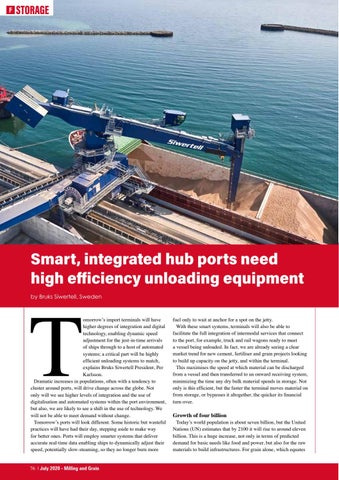
omorrow’s import terminals will have higher degrees of integration and digital technology, enabling dynamic speed adjustment for the just-in-time arrivals of ships through to a host of automated systems; a critical part will be highly efficient unloading systems to match, explains Bruks Siwertell President, Per Karlsson. Dramatic increases in populations, often with a tendency to cluster around ports, will drive change across the globe. Not only will we see higher levels of integration and the use of digitalisation and automated systems within the port environment, but also, we are likely to see a shift in the use of technology. We will not be able to meet demand without change. Tomorrow’s ports will look different. Some historic but wasteful practices will have had their day, stepping aside to make way for better ones. Ports will employ smarter systems that deliver accurate real-time data enabling ships to dynamically adjust their speed, potentially slow-steaming, so they no longer burn more
76 | July 2020 - Milling and Grain
fuel only to wait at anchor for a spot on the jetty. With these smart systems, terminals will also be able to facilitate the full integration of intermodal services that connect to the port, for example, truck and rail wagons ready to meet a vessel being unloaded. In fact, we are already seeing a clear market trend for new cement, fertiliser and grain projects looking to build up capacity on the jetty, and within the terminal. This maximises the speed at which material can be discharged from a vessel and then transferred to an onward receiving system, minimizing the time any dry bulk material spends in storage. Not only is this efficient, but the faster the terminal moves material on from storage, or bypasses it altogether, the quicker its financial turn-over.
Growth of four billion
Today’s world population is about seven billion, but the United Nations (UN) estimates that by 2100 it will rise to around eleven billion. This is a huge increase, not only in terms of predicted demand for basic needs like food and power, but also for the raw materials to build infrastructures. For grain alone, which equates