DRY F
#2 GEELEN COUNTERFLOW
ELECTRIFICATION OF DRYERS FOR PETFOOD AND AQUAFEED:
New technology will reduce energy consumption of the drying process by up to 65 percent by Sander Geelen, Managing Director, Geelen Counterflow, the Netherlands
U
Energy consumption is always a hot topic in the grain and feed business, as the cost of running dryers is often a significant business expense for companies. The new Geelen Counterflow Electric Dryer, with its phenomenally low energy draw won the 2019 Animal Feed and Nutrition Awards for the Environment category
ntil recently, most heat pumps were only capable of boosting temperatures to no more than 80°C. In recent years, however, a new generation of heat pumps has been developed which can achieve temperature boosts to as much as 125°C. This enabled a quantum leap in the thermal efficiency of the
drying process. In 2014, Geelen Counterflow’s R&D team started preparing the standard Geelen Counterflow dryer design for the optional addition of heat pumps and heat exchangers so the required thermal energy can be generated from electricity as well as gas. Most of 2016 was spent testing the new technology at 1:8 pilot scale, connected to an operational 11 mtph. extrusion line in a super-premium petfood plant. Geelen monitored the situation on-site and by remote diagnostics. Many months’ worth of process data were collected and analysed. The Counterflow Recovery Unit with integrated CIP system (Cleaning in Place) went through many iterations, minimising the cleaning frequency for the plant’s maintenance team. During testing in 2016, Geelen found a Coefficient Of Performance
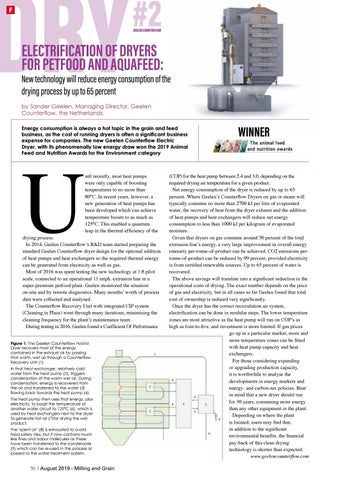
Figure 1: The Geelen Counterflow Hybrid Dryer recovers most of the energy contained in the exhaust air by passing that warm, wet air through a Counterflow Recovery Unit (1). In that heat exchanger, relatively cold water from the heat pump (2), triggers condensation of the warm wet air. During condensation, energy is recovered from the air and transferred to the water (3) flowing back towards the heat pump (4). The heat pump then uses that energy, plus electricity, to boost the temperature of another water circuit to 125°C (6), which is used by heat exchangers next to the dryer to generate hot air (7)for drying the wet product. The ‘spent air’ (8) is exhausted to avoid food safety risks, but it now contains much less fines and odour molecules as these have been transferred to the condensate (9) which can be re-used in the process or passed to the water treatment system.
50 | August 2019 - Milling and Grain
WINNER
(COP) for the heat pump between 2.4 and 3.0, depending on the required drying air temperature for a given product. Net energy consumption of the dryer is reduced by up to 65 percent. Where Geelen’s Counterflow Dryers on gas or steam will typically consume no more than 2700 kJ per litre of evaporated water, the recovery of heat from the dryer exhaust and the addition of heat pumps and heat exchangers will reduce net energy consumption to less than 1000 kJ per kilogram of evaporated moisture. Given that dryers on gas consume around 50 percent of the total extrusion line’s energy, a very large improvement in overall energy intensity per-tonne-of-product can be achieved. CO2 emissions pertonne-of-product can be reduced by 99 percent, provided electricity is from certified renewable sources. Up to 65 percent of water is recovered. The above savings will translate into a significant reduction in the operational costs of drying. The exact number depends on the price of gas and electricity, but in all cases so far Geelen found that total cost of ownership is reduced very significantly. Once the dryer has the correct recirculation air system, electrification can be done in modular steps. The lower temperature zones are most attractive as the heat pump will run on COP’s as high as four-to-five, and investment is more limited. If gas prices go up in a particular market, more and more temperature zones can be fitted with heat pump capacity and heat exchangers. For those considering expanding or upgrading production capacity, it is worthwhile to analyse the developments in energy markets and energy- and carbon-tax policies. Bear in mind that a new dryer should run for 30 years, consuming more energy than any other equipment in the plant. Depending on where the plant is located, users may find that, in addition to the significant environmental benefits, the financial pay-back of this clean drying technology is shorter than expected. www.geelencounterflow.com