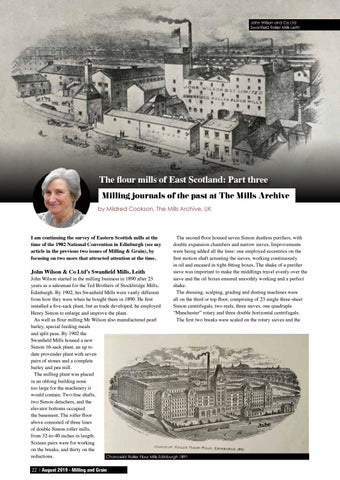
John Wilson and Co Ltd Swanfield Roller Mills Leith
The flour mills of East Scotland: Part three Milling journals of the past at The Mills Archive by Mildred Cookson, The Mills Archive, UK
I am continuing the survey of Eastern Scottish mills at the time of the 1902 National Convention in Edinburgh (see my article in the previous two issues of Milling & Grain), by focusing on two more that attracted attention at the time.
John Wilson & Co Ltd’s Swanfield Mills, Leith
The second floor housed seven Simon dustless purifiers, with double expansion chambers and narrow sieves. Improvements were being added all the time: one employed eccentrics on the first motion shaft actuating the sieves, working continuously in oil and encased in tight-fitting boxes. The shake of a purifier sieve was important to make the middlings travel evenly over the sieve and the oil boxes ensured smoothly working and a perfect shake. The dressing, scalping, grading and dusting machines were all on the third or top floor, comprising of 23 single three-sheet Simon centrifugals, two reels, three sieves, one quadruple “Manchester” rotary and three double horizontal centrifugals. The first two breaks were scaled on the rotary sieves and the
John Wilson started in the milling business in 1890 after 23 years as a salesman for the Ted Brothers of Stockbridge Mills, Edinburgh. By 1902, his Swanfield Mills were vastly different from how they were when he bought them in 1890. He first installed a five-sack plant, but as trade developed, he employed Henry Simon to enlarge and improve the plant. As well as flour milling Mr Wilson also manufactured pearl barley, special feeding meals and split peas. By 1902 the Swanfield Mills housed a new Simon 16-sack plant, an up to date provender plant with seven pairs of stones and a complete barley and pea mill. The milling plant was placed in an oblong building none too large for the machinery it would contain. Two-line shafts, two Simon detachers, and the elevator bottoms occupied the basement. The roller floor above consisted of three lines of double Simon roller mills, from 32-to-40 inches in length. Sixteen pairs were for working on the breaks, and thirty on the reductions. Chancelot Roller Flour Mills Edinburgh 1891 22 | August 2019 - Milling and Grain