STORAGE
F
HEAT TREATMENT TO CONTROL INSECT INFESTATIONS IN THE MILLING INDUSTRY by Raj Hulasare, PhD, P. Eng, Senior Scientist and Product Manager, Thermal Remediation, USA (rhulasare@temp-air.com)
H
eat treatment is an effective environmentally benign pest management tactic to kill all life stages of stored product insects by attaining and maintaining elevated temperatures in the range of 50° to 60°C. Heat treatment is performed in a scientific manner to manage storedproduct insects, without any damage to structure, machinery or storage structure. Heat treatment is highly effective Integrated Pest Management (IPM) tool to control insect infestations in food-feed processing plants, warehouses and storage structures.
History and renewed interest in heat treatments
Heat treatment of mills dates back to the 1900s. Over a century ago (1910s), heat treatment in more than 20 mills in Kansas proved that no stage of insect, even in the most inaccessible places, could withstand heat. Several mills in mid-west US and southern Canada corroborated the practicability and efficiency of heat to control insects. Heat treatment has been performed successfully by major food and grain-processing companies for the past 60 years. The three main drivers for renewed interest in heat treatments are: • Consumer preference for pesticide-free products • Heightened interest in environmentally-friendly technologies or using the “Go Green” approach • Increased tolerance/resistance of insects to chemicals.
A safe, effective, and viable alternative to chemicals
Heat is an effective, nonchemical, nontoxic, nonresidual, and noncorrosive alternative to chemical fumigation. It is an effective and viable eco-friendly approach to control stored product insects without the chemical-associated environmental or health risks to people, animals, or surroundings. With the 1987 Montreal Protocol and the 1998 amended US Clean Air Act, mandates were established to start phasing out the production of methyl bromide due to its connection with depletion of the ozone layer. Except for critical use exemptions, methyl bromide is being phased out of structural fumigations and has been subjected to more restrictions. A silo in India receiving heat treatment
Partial spot treatment
94 | June 2019 - Milling and Grain
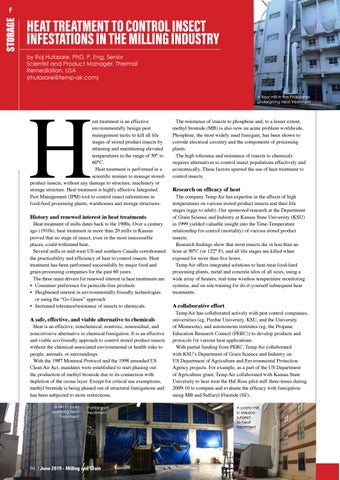
A flour mill in the Philippines undergoing heat treatment
The resistance of insects to phosphine and, to a lesser extent, methyl bromide (MB) is also now an acute problem worldwide. Phosphine, the most widely used fumigant, has been shown to corrode electrical circuitry and the components of processing plants. The high tolerance and resistance of insects to chemicals requires alternatives to control insect populations effectively and economically. These factors spurred the use of heat treatment to control insects.
Research on efficacy of heat
The company Temp Air has expertise in the effects of high temperatures on various stored-product insects and their life stages (eggs to adult). Our sponsored research at the Department of Grain Science and Industry at Kansas State University (KSU) in 1999 yielded valuable insight into the Time-Temperature relationship for control (mortality) of various stored product insects. Research findings show that most insects die in less than an hour at 50°C (or 122° F), and all life stages are killed when exposed for more than five hours. Temp Air offers integrated solutions to heat-treat food-feed processing plants, metal and concrete silos of all sizes, using a wide array of heaters, real-time wireless temperature monitoring systems, and on-site training for do-it-yourself subsequent heat treatments.
A collaborative effort
Temp Air has collaborated actively with pest control companies, universities (eg, Purdue University, KSU, and the University of Minnesota), and autonomous institutes (eg, the Propane Education Research Council (PERC)) to develop products and protocols for various heat applications. With partial funding from PERC, Temp Air collaborated with KSU’s Department of Grain Science and Industry on US Department of Agriculture and Environmental Protection Agency projects. For example, as a part of the US Department of Agriculture grant, Temp Air collaborated with Kansas State University to heat treat the Hal Ross pilot mill three-times during 2009-10 to compare and evaluate the efficacy with fumigation using MB and Sulfuryl Fluoride (SF). A pasta mill in Mexico subject to heat treatment