F
T
Roger Gilbert - publisher of Milling and Grain
heads to Italy to visit one of the oldest, familyowned flour mills on record - anywhere.
Traditional milling
down through the ages Molino Naldoni Flour Mills
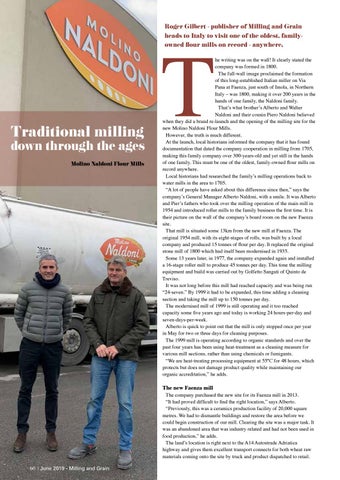
he writing was on the wall! It clearly stated the company was formed in 1800. The full-wall image proclaimed the formation of this long-established Italian miller on Via Pana at Faenza, just south of Imola, in Northern Italy – was 1800, making it over 200 years in the hands of one family, the Naldoni family. That’s what brother’s Alberto and Walter Naldoni and their cousin Piero Naldoni believed when they did a brand re-launch and the opening of the milling site for the new Molino Naldoni Flour Mills. However, the truth is much different. At the launch, local historians informed the company that it has found documentation that dated the company cooperation in milling from 1705, making this family company over 300-years-old and yet still in the hands of one family. This must be one of the oldest, family-owned flour mills on record anywhere. Local historians had researched the family’s milling operations back to water mills in the area to 1705. “A lot of people have asked about this difference since then,” says the company’s General Manager Alberto Naldoni, with a smile. It was Alberto and Pier’s fathers who took over the milling operation of the main mill in 1954 and introduced roller mills to the family business the first time. It is their picture on the wall of the company’s board room on the new Faenza site. That mill is situated some 13km from the new mill at Faenza. The original 1954 mill, with its eight-stages of rolls, was built by a local company and produced 15 tonnes of flour per day. It replaced the original stone mill of 1800 which had itself been modernised in 1935. Some 13 years later, in 1977, the company expanded again and installed a 16-stage roller mill to produce 45 tonnes per day. This time the milling equipment and build was carried out by Golfetto Sangati of Quinto de Treviso. It was not long before this mill had reached capacity and was being run “24-seven.” By 1999 it had to be expanded, this time adding a cleaning section and taking the mill up to 150 tonnes per day. The modernised mill of 1999 is still operating and it too reached capacity some five years ago and today is working 24 hours-per-day and seven-days-per-week. Alberto is quick to point out that the mill is only stopped once per year in May for two or three days for cleaning purposes. The 1999 mill is operating according to organic standards and over the past four years has been using heat-treatment as a cleaning measure for various mill sections, rather than using chemicals or fumigants. “We are heat-treating processing equipment at 55°C for 48 hours, which protects but does not damage product quality while maintaining our organic accreditation,” he adds.
The new Faenza mill
The company purchased the new site for its Faenza mill in 2013. “It had proved difficult to find the right location,” says Alberto. “Previously, this was a ceramics production facility of 20,000 square metres. We had to dismantle buildings and restore the area before we could begin construction of our mill. Clearing the site was a major task. It was an abandoned area that was industry related and had not been used in food production,” he adds. The land’s location is right next to the A14 Autostrade Adriatica highway and gives them excellent transport connects for both wheat raw materials coming onto the site by truck and product dispatched to retail. 60 | June 2019 - Milling and Grain