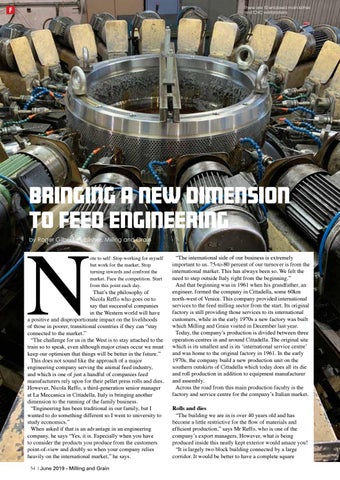
There are 10 enclosed main lathes and CNC workstations
F
Bringing a new dimension to FEED engineering
N
by Roger Gilbert, Publisher, Milling and Grain ote to self: Stop working for myself but work for the market. Stop turning inwards and confront the market. Face the competition. Start from this point each day.
That’s the philosophy of Nicola Reffo who goes on to say that successful companies in the Western world will have a positive and disproportionate impact on the livelihoods of those in poorer, transitional countries if they can “stay connected to the market.” “The challenge for us in the West is to stay attached to the train so to speak, even although major crises occur we must keep our optimism that things will be better in the future.” This does not sound like the approach of a major engineering company serving the animal feed industry, and which is one of just a handful of companies feed manufacturers rely upon for their pellet press rolls and dies. However, Nicola Reffo, a third-generation senior manager at La Meccanica in Cittadella, Italy is bringing another dimension to the running of the family business. “Engineering has been traditional in our family, but I wanted to do something different so I went to university to study economics.” When asked if that is an advantage in an engineering company, he says “Yes, it is. Especially when you have to consider the products you produce from the customers point-of-view and doubly so when your company relies heavily on the international market,” he says. 54 | June 2019 - Milling and Grain
“The international side of our business is extremely important to us. 75-to-80 percent of our turnover is from the international market. This has always been so. We felt the need to step outside Italy right from the beginning.” And that beginning was in 1961 when his grandfather, an engineer, formed the company in Cittadella, some 60km north-west of Venice. This company provided international services to the feed milling sector from the start. Its original factory is still providing those services to its international customers, while in the early 1970s a new factory was built which Milling and Grain visited in December last year. Today, the company’s production is divided between three operation centres in and around Cittadella. The original site which is its smallest and is its ‘international service centre’ and was home to the original factory in 1961. In the early 1970s, the company build a new production unit on the southern outskirts of Cittadella which today does all its die and roll production in addition to equipment manufacturer and assembly. Across the road from this main production faculty is the factory and service centre for the company’s Italian market. Rolls and dies “The building we are in is over 40 years old and has become a little restrictive for the flow of materials and efficient production,” says Mr Reffo, who is one of the company’s export managers. However, what is being produced inside this neatly kept exterior would amaze you! “It is largely two block building connected by a large corridor. It would be better to have a complete square