Milling News
African Swine Fever Conference #2
Chris Jackson
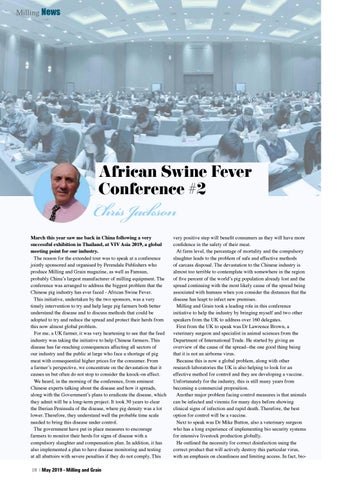
March this year saw me back in China following a very successful exhibition in Thailand, at VIV Asia 2019, a global meeting point for our industry. The reason for the extended tour was to speak at a conference jointly sponsored and organised by Perendale Publishers who produce Milling and Grain magazine, as well as Famsun, probably China’s largest manufacturer of milling equipment. The conference was arranged to address the biggest problem that the Chinese pig industry has ever faced - African Swine Fever. This initiative, undertaken by the two sponsors, was a very timely intervention to try and help large pig farmers both better understand the disease and to discuss methods that could be adopted to try and reduce the spread and protect their herds from this now almost global problem. For me, a UK farmer, it was very heartening to see that the feed industry was taking the initiative to help Chinese farmers. This disease has far-reaching consequences affecting all sectors of our industry and the public at large who face a shortage of pig meat with consequential higher prices for the consumer. From a farmer’s perspective, we concentrate on the devastation that it causes us but often do not stop to consider the knock-on effect. We heard, in the morning of the conference, from eminent Chinese experts talking about the disease and how it spreads, along with the Government’s plans to eradicate the disease, which they admit will be a long-term project. It took 30 years to clear the Iberian Peninsula of the disease, where pig density was a lot lower. Therefore, they understand well the probable time scale needed to bring this disease under control. The government have put in place measures to encourage farmers to monitor their herds for signs of disease with a compulsory slaughter and compensation plan. In addition, it has also implemented a plan to have disease monitoring and testing at all abattoirs with severe penalties if they do not comply. This 18 | May 2019 - Milling and Grain
very positive step will benefit consumers as they will have more confidence in the safety of their meat. At farm level, the percentage of mortality and the compulsory slaughter leads to the problem of safe and effective methods of carcass disposal. The devastation to the Chinese industry is almost too terrible to contemplate with somewhere in the region of five percent of the world’s pig population already lost and the spread continuing with the most likely cause of the spread being associated with humans when you consider the distances that the disease has leapt to infect new premises. Milling and Grain took a leading role in this conference initiative to help the industry by bringing myself and two other speakers from the UK to address over 160 delegates. First from the UK to speak was Dr Lawrence Brown, a veterinary surgeon and specialist in animal sciences from the Department of International Trade. He started by giving an overview of the cause of the spread--the one good thing being that it is not an airborne virus. Because this is now a global problem, along with other research laboratories the UK is also helping to look for an effective method for control and they are developing a vaccine. Unfortunately for the industry, this is still many years from becoming a commercial proposition. Another major problem facing control measures is that animals can be infected and viremic for many days before showing clinical signs of infection and rapid death. Therefore, the best option for control will be a vaccine. Next to speak was Dr Mike Button, also a veterinary surgeon who has a long experience of implementing bio security systems for intensive livestock production globally. He outlined the necessity for correct disinfection using the correct product that will actively destroy this particular virus, with an emphasis on cleanliness and limiting access. In fact, bio-