F
Rice millers
How analysing equipment should be used to increase profit By Yoshito Matsumoto, Manager, China Marketing, Satake Corporation
T
his article explains how rice millers can effectively take advantage of laboratory analysing equipment or apparatus, such as the Milling Meter MM1D, one of the most basic and important pieces of analysing equipment, which will be described in detail later. Satake strongly believes that smart application of analysing equipment can contribute to improving profit in the milling industry. Unfortunately, Satake has seen too many rice mills wherein analysing equipment were routinely operated incorrectly. Some rice milling facilities do not even possess any analysing tools. In these rice mills, milling machine adjustment can only be done with operators’ knowledge and skills acquired from experience. Furthermore, milling datas including incoming raw materials and final products’ conditionss are often not captured quantitatively as well. Satake would like to propose a potentially lucrative procedure, based on collecting pertinent data from analysing equipment, for competitive advantages.
Satake analysing equipment
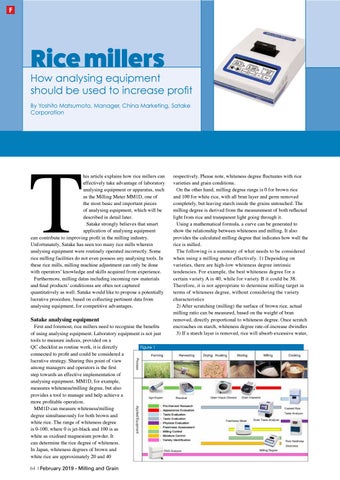
First and foremost, rice millers need to recognise the benefits of using analysing equipment. Laboratory equipment is not just tools to measure indices, provided on a Figure 1 QC checklist as routine work, it is directly connected to profit and could be considered a lucrative strategy. Sharing this point of view among managers and operators is the first step towards an effective implementation of analysing equipment. MM1D, for example, measures whiteness/milling degree, but also provides a tool to manage and help achieve a more profitable operation. MM1D can measure whiteness/milling degree simultaneously for both brown and white rice. The range of whiteness degree is 0-100, where 0 is jet-black and 100 is as white as oxidised magnesium powder. It can determine the rice degree of whiteness. In Japan, whiteness degrees of brown and white rice are approximately 20 and 40 64 | February 2019 - Milling and Grain
respectively. Please note, whiteness degree fluctuates with rice varieties and grain conditions. On the other hand, milling degree range is 0 for brown rice and 100 for white rice, with all bran layer and germ removed completely, but leaving starch inside the grains untouched. The milling degree is derived from the measurement of both reflected light from rice and transparent light going through it. Using a mathematical formula, a curve can be generated to show the relationship between whiteness and milling. It also provides the calculated milling degree that indicates how well the rice is milled. The following is a summary of what needs to be considered when using a milling meter effectively. 1) Depending on varieties, there are high-low whiteness degree intrinsic tendencies. For example, the best whiteness degree for a certain variety A is 40, while for variety B it could be 38. Therefore, it is not appropriate to determine milling target in terms of whiteness degree, without considering the variety characteristics 2) After scratching (milling) the surface of brown rice, actual milling ratio can be measured, based on the weight of bran removed, directly proportional to whiteness degree. Once scratch encroaches on starch, whiteness degree rate-of-increase dwindles 3) If a starch layer is removed, rice will absorb excessive water,