F
TROUBLED CHINA OPTS TO REDUCE PROTEIN IN ANIMAL FEED
O
by Rebecca Sherratt, Production editor, Milling & Grain
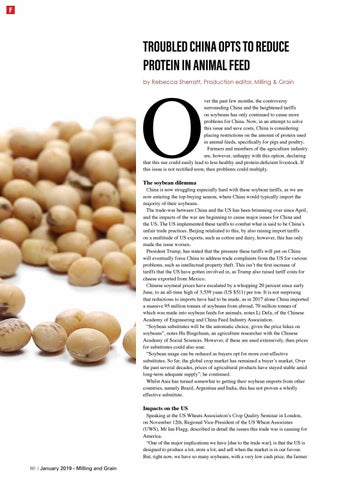
ver the past few months, the controversy surrounding China and the heightened tariffs on soybeans has only continued to cause more problems for China. Now, in an attempt to solve this issue and save costs, China is considering placing restrictions on the amount of protein used in animal feeds, specifically for pigs and poultry. Farmers and members of the agriculture industry are, however, unhappy with this option, declaring that this use could easily lead to less healthy and protein-deficient livestock. If this issue is not rectified soon, then problems could multiply.
The soybean dilemma
China is now struggling especially hard with these soybean tariffs, as we are now entering the top-buying season, where China would typically import the majority of their soybeans. The trade-war between China and the US has been brimming over since April, and the impacts of the war are beginning to cause major issues for China and the US. The US implemented these tariffs to combat what is said to be China’s unfair trade practices. Beijing retaliated to this, by also raising import tariffs on a multitude of US exports, such as cotton and dairy, however, this has only made the issue worsen. President Trump, has stated that the pressure these tariffs will put on China will eventually force China to address trade complaints from the US for various problems, such as intellectual property theft. This isn’t the first increase of tariffs that the US have gotten involved in, as Trump also raised tariff costs for cheese exported from Mexico. Chinese soymeal prices have escalated by a whopping 20 percent since early June, to an all-time high of 3,539 yuan (US $511) per ton. It is not surprising that reductions to imports have had to be made, as in 2017 alone China imported a massive 95 million tonnes of soybeans from abroad, 70 million tonnes of which was made into soybean feeds for animals, notes Li Defa, of the Chinese Academy of Engineering and China Feed Industry Association. “Soybean substitutes will be the automatic choice, given the price hikes on soybeans”, notes Hu Bingchuan, an agriculture researcher with the Chinese Academy of Social Sciences. However, if these are used extensively, then prices for substitutes could also soar. “Soybean usage can be reduced as buyers opt for more cost-effective substitutes. So far, the global crop market has remained a buyer’s market. Over the past several decades, prices of agricultural products have stayed stable amid long-term adequate supply”, he continued. Whilst Asia has turned somewhat to getting their soybean imports from other countries, namely Brazil, Argentina and India, this has not proven a wholly effective substitute.
Impacts on the US
Speaking at the US Wheats Association’s Crop Quality Seminar in London, on November 12th, Regional Vice-President of the US Wheat Associates (UWS), Mr Ian Flagg, described in detail the issues this trade war is causing for America. “One of the major implications we have [due to the trade war], is that the US is designed to produce a lot, store a lot, and sell when the market is in our favour. But, right now, we have so many soybeans, with a very low cash price, the farmer 80 | January 2019 - Milling and Grain