F
A
Optimising feed mill output by Detlef Bunzel, Evonik, Germany
n efficient feed production line is one that has been designed to handle the types and amounts of feed that need to be produced. Optimising the balance between batch size and batch frequency plays a pivotal role. Two critical questions need to be addressed when designing the feed production line - “What is the optimum mixer size for the feed mill?” and “How many batches per hour should be produced?” It is important in every case to find a balance between batch size and batch cycle time. For example, if the aim is to produce 30 tonnes of feed per hour, the production line and equipment could be designed to produce 30 batches of one ton each per hour, 15 batches of two tons each per hour, or 10 batches of three tons each per hour.
Optimum mixer size
Typical mixer sizes in feed mills range from less than one ton to
78 | December 2018 - Milling and Grain
six-eight tons per batch. Most feed ingredients, about 95 percent, are usually added to the mixer as dry bulk. Process steps before and after the weighing and mixing line are virtually continuous and, therefore, the mixer must be able to keep pace with the pellet mills. The capacity of the mixing line is calculated as batch size multiplied by the number of batches per hour. For example, output (ton / hour) = batch size (ton) x number of batches/hours. Each given output can be met by varying the batch size and frequency.
Mix time
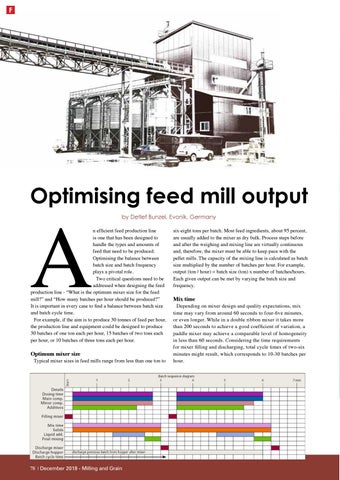
Depending on mixer design and quality expectations, mix time may vary from around 60 seconds to four-five minutes, or even longer. While in a double ribbon mixer it takes more than 200 seconds to achieve a good coefficient of variation, a paddle mixer may achieve a comparable level of homogeneity in less than 60 seconds. Considering the time requirements for mixer filling and discharging, total cycle times of two-six minutes might result, which corresponds to 10-30 batches per hour.