October 2018
YOUR GLOBAL PARTNER
In this issue:
BULK-HANDLING EQUIPMENT FOR GRAIN HANDLING • Ancient grains: Health concerns over cereals and our daily bread • Barley report
Milling and Grain . Volume 129 . Issue 10 . October 2018
• Dry extrusion vs wet extrusion • Remote rodent monitoring • SPACE 2018
Event review Proud supporter of
Volume 129
Issue 10
millingandgrain.com
Trusted. Tested. True.
Commercial CD Dryers Globally recognized for customer service and quality products, our team of experienced Dealers and Staff will assist you in determining the system that will suit your needs.
Custom-designed to your unique needs Efficient, reliable commodity drying throughout the world
Grain Storage
Dryers
Easy to install and maintain
Material Handling Systems
Catwalk and Tower Systems
Lemanco Bulk Storage Systems
Caldwell Grain Conditioning
ÂŽ
phone (308) 237-3186
agri.chiefind.com
@chief.agri
@chief_agri
COMMERCIAL BINS
COMMERCIAL DRYERS
STEEL BUILDINGS
COMMERCIAL SWEEPS
BUCKET ELEVATORS
COMMERCIAL CONVEYORS
• 47.548m Diameter Bins (20320.9-48262.2 mt) • Tower Dryers (22.5-281.2 t/h) • Peak Load Rating (6803.8-45359.2 kg) • QuadraTouch ProTM Controls • Hopper Bins (3.65m-14.6m) • Balanced Moisture Content • Auger & Paddle sweeps available • Capacity includes 140.6-281.2 t/h • Patented Pivot Point • Industrial Grade Pushers
• Low Impact Head Design • Heavy Gauge Trunking • Patented Squaring Plates • Support Towers
• Industrial Strength • Built To Last • Higher Elemental Resistance • Capacity includes (984.3-1687.5 t/h) • Dust-tight and waterproof • Patented hip-style weather-tight cover • Catwalks
Su k u p World Headquarters - S heff ie ld , I o wa USA • www. su ku p . co m • in f o @ su ku p . co m For service in Europe contact:
Sukup Europe A/S Hedensted, Denmark Tel +45 75 68 53 11 • Fax +45 75 68 54 70 info@sukup-eu.com • www.sukup-eu.com
Pneumatic or Mechanical Ship Loaders & Unloaders Port Equipment - Turnkey Projects
1968 2018
1350 machines installed in more than 100 countries! VIGAN Engineering s.a. Rue de l’Industrie, 16 - 1400 Nivelles - Belgium Tél.: +32 67 89 50 41 • Fax : +32 67 89 50 60 • www.vigan.com • info@vigan.com
VOLUME 129 ISSUE 10
October 2018
Perendale Publishers Ltd 7 St George’s Terrace St James’ Square, Cheltenham, Glos, GL50 3PT, United Kingdom Tel: +44 1242 267700 Publisher Roger Gilbert rogerg@perendale.co.uk International Marketing Team Darren Parris Tel: +44 1242 267707 darrenp@perendale.co.uk Martha Cornwell Tel: +1 913 2083770 marthac@perendale.com Fred Norwood Tel: +1 913 6422992 fredn@perendale.com Latin America Marketing Team Iván Marquetti Tel: +54 2352 427376 ivanm@perendale.co.uk New Zealand Marketing Team Peter Parker peterp@perendale.co.uk Nigeria Marketing Team Nathan Nwosu Tel: +234 8132 478092 nathann@perendale.co.uk Production Editor Rebecca Sherratt rebeccas@perendale.co.uk Features Editor Vaughn Entwistle vaughne@perendale.co.uk Matt Holmes matth@perendale.co.uk International Editors Dr Roberto Luis Bernardi robertob@perendale.co.uk Professor Wenbin Wu wenbinw@perendale.com ˘ Mehmet Ugur Gürkaynak mehmetg@perendale.com Design Manager James Taylor jamest@perendale.co.uk Circulation & Events Tuti Tan tutit@perendale.co.uk Development Manager Antoine Tanguy antoinet@perendale.co.uk
©Copyright 2018 Perendale Publishers Ltd. All rights reserved. No part of this publication may be reproduced in any form or by any means without prior permission of the copyright owner. More information can be found at www.perendale.com Perendale Publishers Ltd also publish ‘The International Milling Directory’ and ‘The Global Miller’ news service
Grain & Feed Milling Technology magazine was rebranded to Milling and Grain in 2015
88 - Keeping mills clean ISSUE HIGHLIGHTS NEWS FEATURES
54 Ancient grains: Health concerns over cereals and our daily bread
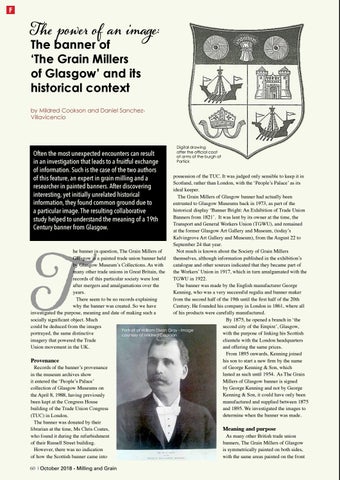
60 The banner of ‘The Grain Millers of Glasgow’ and its historical context
PRODUCT FOCUS
2
CASE STUDY
6-44
70 The Rice Milling Business: Quality and Profit 74 Livestock sector in buoyant mood upon another normal monsoon year
128 People news from the global milling industry
102
76 Data for weaner pigs included in new sid database
78 Dry extrusion vs wet extrusion
STORAGE
82 Rodent monitoring 84 Bulk-handling equipment for grain handling 88 Keeping mills clean
92 Bulk material transport made easy
66 Barley report
FACES
50
EVENTS
104 Event listings, reviews and previews
TRAINING
46 Fundamentals of animal nutrition training begins soon
COLUMNS
14 Mildred Cookson 33 Tuti Tan 34 Sven-Olof Malmqvist
4 GUEST EDITOR Roger Gilbert
COVER IMAGE: Guttridge belt conveyor - See more on page 84
104 MARKETS John Buckley
126 INTERVIEW Christophe Pelletier
ISSUE HIGHLIGHTS #2 SPECIAL SERIES
ANCIENT GRAINS
Health concerns over cereals and our daily bread
How do ancient grains compare with modern grains, and can gluten and wheat lead to obesity and disease? Can we separate the wheat from the chaff in terms of “what is actually true?” In other words, what is based on scientific evidence and what is based on beliefs and assumptions?
PAGE 54
RICE
The Rice Milling Business: Quality and Profit
STORAGE
RODENT MONITORING
Remote rodent monitoring can improve the entire pest management programme
In the June issue, we highlighted an awareness to the fact that the rice milling industry is often a low profit industry and that there are four basic methods to increase business profit for the agricultural sector.
It is no secret that rodents and the diseases they can transmit are a looming menace to any business in the stored grain industry.
PAGE 70
PAGE 82
BULK-HANDLING Bulk-handling equipment for grain handling
It is no secret that rodents and the diseases they can transmit are a looming menace to any business in the stored grain industry.
PAGE 82
BARLEY BARLEY REPROT
We take a look at Barley from South Africa and Japan
PAGE 66
FOOD
STORAGE
FEED
PROCESS
EXTRUSION
PIGS
DRY EXTRUSION vs WET EXTRUSION
INFORMATION FOR WEANER PIGS INCLUDED IN NEW SID DATABASE
To start off, having worked in this industry for over 40 years both dry and wet extrusion has changed as machinery improvements resulted in the evolution of both styles of production.
PAGE 78
INDIA SIFTER Gericke GS Centrifugal sifter
August 2018 saw the initial launch of the new Gericke GS centrifugal sifter. The new range of GS centrifugal sifters is the evolution of a longestablished design principle, highlighting Gericke as an industry leading sifter manufacturer.
PAGE 51
Livestock sector in buoyant mood upon another normal monsoon year
Forecast of yet another normal monsoon year is indeed good news and will help Indian livestock sector in multiple ways”, says B Soundararajan, Chairman of CLFMA of India, the association representing the animal protein industry in India.
PAGE 74
A new standardized ileal digestibility (SID) database for swine feed has been released, that provides SID values of all amino acid for weaners, as well as for grower pigs.
PAGE 76
Rectangular aspirator 1950
The revolutionary technological path that never ends
Rectangular vibrating aspirator 2018
www.ai-lati.eu
www.ocrim.com
The Belt and Road International Animal Husbandry Forum In mid-September I had the privilege of being invited to speak at the VIV China’s ‘Official Forum - The Belt and Road International Animal Husbandry Forum’ that was held in Nanjing, China. This afternoon meeting attracted some 100-plus delegates and hosted 13 presentations covering an extremely wide agenda, but all relating to the development of the Chinese initiative that will link countries along a railway line through to Europe and on sea lanes back to China, taking in some 65 countries in all. It was clear from the focus on ‘animal husbandry’ that agriculture would be a central platform for the meeting. It also turned out that agriculture was considered the single most important common denominator that links all l65 countries. While the VIV China exposition, with its three halls hosting exhibits ranging from ‘Feed-to-Food’ was attracting a large attendance in the expo centre across the way, it was the Nanjing Congress Centre that offered the Forum and a range of industryrelated meetings being co-located with the overall event. Pig and poultry production played an important part in the three days of events, with feed and its related additives, ingredients and machinery products forming a central part in the largest of the three exposition halls. In fact, it was the feed aspect that I wanted to focus on in my presentation on Global Feed Production to the Forum, and which I based on my on-going data collection since stepping down as Secretary General of the International Feed Industry Federation at the end of 2012. I was able to identify those countries that need support in developing their compound feed sectors and that the Belt and Road Initiative was offering a good opportunity for them to achieve this. As many of you will already know, I have suggested that each country should adopt a ‘benchmark’ for its compound feed production. I have even gone so far as to suggest what that ‘benchmark’
might be if a country is to avoid food insecurity issues, particularly in terms of providing populations with sufficient protein from farmed livestock – and including fish production. My figures are based on the Annual Alltech Global Feed Survey plus annual population increases by country year-on-year. It is surprising to find that the metrix I have built consistently shows up a figure of approximately 133.6kg per capita of compound feed production to support a country in combating inadequate supplies of meat proteins in particular. There is no doubt that without understanding or knowing the amounts of processed feed or where their animal feed is derived, there is little hope of addressing food insecurity in those countries that are suffering most. I would even go so far as to suggest that the way animal rations are formulated needs to be more rigorously examined to ensure that we are getting the most from the raw materials being used in terms of protein output from our animals and fish. Why is it some countries use more minerals - and certainly more digestible minerals - and feed additives than others while using similar macro raw materials? Making our food-producing animals as efficient as possible, reducing stress and disease within their number, can only assist us in gaining more protein for human consumption at lower cost. It is already clear from the Alltech Global Survey that lower feed prices can be passed on in lower food costs to the consumer. Of the 65 countries along the Belt and Road corridor, that covers the most populated areas of the world, almost two-third fall below the 133.6kg/capita figure! The Chinese initiative offers those countries - that until now have largely been ignored by global trade due to their location and disadvantages by poor trade routes - to look to the benefits of regular means of importing and exporting goods within and between countries. While the big economies discuss trade sanctions and threaten to disrupt each other’s agricultural trade, as well as most other forms of commodity and goods being traded, I believe it is ‘a light at the end of a very dark tunnel’ for many countries that might now have an opportunity to develop their trading activities and bring about great attention to the production of scientificallyformulated compound feeds - that will go a long way to providing proteins that people want to eat at more affordable prices.
Annual Subscription Rates Inside UK: UK£100 Outside: US$150/€133
ISSN No: 2058-5101
More Information www.millingandgrain.com http://gfmt.blogspot.co.uk
40 YEARS OF TESTED STRENGTH
One Tapco Nylon Elevator Bucket Supports a 9700 Pound* H1 HUMMER Ambient Temperature: 17 °F (-8 °C)
TAPCO’S CC-XD (Xtreme Duty) gray nylon elevator bucket supports a 9700 lb. H1 Hummer vehicle. Testing confirms that it will support over 20,000 lbs., more than two Hummers!
TAPCO’S CC-XD (Xtreme Duty) blue polyethylene bucket will support 9,000+ lbs.
Tapcoinc.com
TAPCO’S CC-HD (Heavy Duty) blue polyethylene bucket will support 5,000+ lbs.
314.739.9191 / St. Louis, Missouri USA No 814
*4399 kg
News
OCT 18
Milling
Eva Tordjman with a Rotosphere at Space
Stolz has launched its new mixer – the rotosphere - at Space in Rennes
T
he rotosphere MRS or MRSV type came from the human food industry and more particularly the chocolate makers who need to clean the machinery for batch changes. It is designed as a vacuum coater and the very first rotosphere was created two years ago. During these 2 years Stolz improved its commercial range doing protocols and industrial tests with the French Technical centre for Feed Industry in France. The rotosphere MRS type is used as a mixer to mix different powders with or without addition of liquids. It perfectly fits for premix and feed industries. The rotosphere MRSV type is used in petfood or fishfeed industries as a vacuum coater. The mixer and coater are designed to obtain high efficiency performances within a short time: variation ratio below 5% and coating up to 25% of liquids It also provides easy cleaning and has a range from 100 litres to 1500 litres capacity. The Standard model is in Stainless steel 304L. Options could be electrical tracing and rock wool insulation with stainless steel insulation plates. Stolz showcased the rotosphere at the Space exhibition in Rennes where thousands of potential customers took time to see the rotosphere and find out how it works. Eve Tordjman, of Stolz, was on hand at the exhibition to answer any questions about the rotosphere. A full report into the Space exhibition in Rennes can be found on page 115. It is the premier livestock show for France and featured many new innovations for the milling and grain industry. 6 | October 2018 - Milling and Grain
With the heatwave long gone, and autumn setting in fullforce, farmers can again return to some normalcy with their crops. This will be a welcome relief to many in the agricultural sector, as the unsure summer months have proven difficult for many. As is discussed later in this issue, in a feature by Matt Holmes, many countries are now basking in the return of normal weather. India, in particular, is welcoming the monsoons that come with the late-summer and autumn season. Rainfall is absolutely crucial to the millions of farmers throughout the world, and India is no exception. Farmers in India have been finding times particularly tough, without their prescribed amount of rainfall. With crop failure almost inevitable, many farmers have been plummeted into irreparable debt with little money left to support their families and businesses. Thankfully, the arrival of monsoon season has saved India once again, and farmers can rest easy that their crops are safe. Turkey is also similarly reporting a successful year for the grain market, as the exchange rate for world grain prices rises in a positive upward trend. The Turkish Grain Board has recently released figures and exchange rates for grain, displaying the varying factors affecting the staple food ingredient. Of course, all this uncertainty regarding grains and crops all boils down to the inevitability of climate change. Despite climate change and global warming being topics that have been discussed or decades, recently over the past few years the effects of this change have soared to dangerous levels, bringing the future of agriculture and the farming industry into question. This summer was one of the hottest yet, and even The Global Miller team felt the effects of the heat, which makes it clear that something isn’t right, considering our main office is based in the dismal UK! In a recent study, by some members of the University of Michigan, analysed fossils have suggested that our fossil fuel emissions will lead to our planet becoming uninhabitable, dead and lifeless. Global warming was also discovered to affect our plants, changing the amount of carbon they will be able to store, alongside affecting our global water supply and the global biodiversity that we all depend on for a thriving ecosystem. Jonathan Overpeck, the dean of the School for Environment and Sustainability at the University of Michigan, states that things will be “a lot harder for us in the future”, unless we make some drastic changes right now. Despite the extensive quantity of research that has taken place with the aim to minimise the impact of global warming, unless we all take major steps to fix these issues, the agriculture industry, alongside the entire world, will only continue to suffer. For the future of farming, and sustainable food for everyone, we must begin to seriously act to slow down and prevent the damage we have done to our planet.
GF
MT
gfmt.blogspot.com
The double sandblasting nozzle achieves a faster sandblasting process while compressing air consumption.
www.balaguer-rolls.com Twitter
18 BR-SM
Youtube
Milling News
Italdesign partners with Henry Simon
L
egendary milling brand Henry Simon has partnered with the Industrial Design Division of Italian company Italdesign, in the creation of various milling machinery. Henry Simon, the milling industry’s pioneer brand, which was re-launched by Satake and Alapala, announced its partnership with Italdesign for all its machine ranges. Their first design revealed was for a innovative new rollermill, a incredible fusion of technology, ergonomics and functionality. The rollermill won the Grapas Innovation Award 2018 with its new sensor technology, high energy efficiency, and striking design. Henry Simon continues to strenghtens its commitment for innovation and design with further projects. The company declares that all the machines produced under the Henry Simon name will be designed by the creative team of Italdesign and equipped with the futures best milling technology. In 2017, Satake Corporation and Alapala announced the rebirth of the Henry Simon brand and range of flour milling equipment. Since its inception in 1878, Henry Simon of Manchester, England, has always been known as an innovator and a driving force that helped create the milling industry that we know today. The new range of equipment captures the original
pioneering spirit and DNA combined with the groundbreaking design and aesthetics resulting from the combined research and development from Japanese and European design hubs. The equipment will be built in the newly completed manufacturing complex that features the very latest robotic cutting, welding, CNC machining and assembly technology. This latest collaboration between Satake and Alapala follows the announcement in July 2015 when the strategic partnership was unveiled to provide the milling industry with a truly global technology partner. The partnership incorporates the sharing of technology and R&D, sales capabilities and human resources for milling clients around the world. Since as early as 1968, Italdesign has been offering development services for the automotive and other various industries. Part of the Volkswagen Group which owns 12 brands such as Audi, Porsche, Bentley, Lamborghini and Ducati, today the company is a turnkey-project service provider and a reliable development partner, able to offer integrated services and assist carmakers in the whole development of future vehicles. The Industrial Design Division of the Company flaunts a wide-ranging and transversal know-how and expertise in various fields, thanks to its thirty-seven years of experience working with both domestic and international companies.
True Falling Number The only validated instruments for the approved methods
• World Standard • Faster, Safer and Easier to Use • 50+ years knowledge and expertise www.perten.com Milling and Grain - October 2018 | 11
Milling News
Binmaster and Stockpile reports team up for an integrated inventory experience
A
single system has now been stablished for storing materials in bins and stockpiles. Stockpile Reports and Binmaster have collaborated to enhance material management for companies that require improved control and reliability of inventory volume and value. The partnership combines the power of robust level sensors with innovative image processing software to optimize and simplify the customer experience across the cement, mining and agricultural industries. Their mission is to provide inventory insights and transparency to production, purchasing, and finance across an entire organization and for individual production sites. Replacing outdated guesswork, inventory write offs, and bad valuations is the intent of the solution. The two companies share a vision of integrating inventory from piles and storage bins into a single dashboard accessed from a desktop, tablet, or mobile device. Driven by three patents that super power Stockpile Reports technology, it is the only pile management solution that can use photos from a cell phone, drone, plane, and fixed mounted camera to precisely measure volume. Dashboards populated with photographs, site statistics, and materials report vital information on the
12 | October 2018 - Milling and Grain
volume, tonnage and condition risks for each pile. This SaaS subscription not only allows users to track pile inventory on a monthly, weekly, or even daily basis—it is the only solution that works from both air and ground cameras. With over 55 years of storage experience, BinMaster sensors fortify operations with advanced technology such as 3D scanners, non-contact-radar and lasers to measure levels and volume of storage. Wireless solutions, digital gateways, convenient consoles, and remote inventory management programs complement a robust continuous and point level sensor selection. “We are often asked if we can measure silos as well and now, the answer is yes, says David Boardman CEO of Stockpile Reports. “Financial and operations staff today demand digitized solutions. Our partnership with BinMaster allows us to provide the integrated solution they need.” “BinMaster welcomes the opportunity to offer customers an even more robust inventory management solution,” stated CEO of Garner Industries, Scott McLain. “Integrating inventory reporting for piles and silos is a unique offering that fits perfectly with our customer-driven organization.”
Mather & Sons, an Edinburgh supplier of oatmeal machinery
In praise of Scotch Oatmeal Milling journals of the past at The Mills Archive by Mildred Cookson, The Mills Archive, UK “The virtues of Scotch oatmeal have been praised by both poet and historian, but most of all by the British public, making it part of their daily food as porridge for breakfast” These words of praise featured in a 1902 issue of “Milling”, the predecessor of this magazine. At that time all the leading hotels in Scotland served oatmeal porridge as a favourite food because “it is easily digested and supplies more strength-giving elements than any other cereal”. It also contained more silica than any other cereal food. In 1902 there were several oat-growing districts in Scotland. Of these, Aberdeenshire grew one-fifth of the whole oat crop because of its soil and its climate. The soil in Aberdeenshire is practically all stony; Aberdeen was also known as the “Granite City” and sometimes the “Silver City by the Sea”. It was the shipping port for the granite blocks which now ornament many of the finest buildings in the country. The climate is perfect for oat growing, with ample moisture during the foliation period, and plenty of sun for maturing and ripening the oats. The days in Aberdeenshire during summer and autumn are also longer than further south. Rolled oats were, as now, very popular and Mr Ling’s Caledonian Oatmeal Mills, Carlisle
14 | October 2018 - Milling and Grain
the “Grampian” Scotch-rolled oats manufactured by the North of Scotland Milling company were apparently unsurpassed both in flavour and economy. Twice a week they could be delivered, like the granite, by steamers from Aberdeen to London. Helpfully, the process of oat milling south of the border, at the Caledonian Oatmeal Mill in Carlisle, was described in an article from “The Miller” December 6, 1886. The mills, owned by Mr Ling, comprised a block of buildings 90 ft long and seven storeys high, facing the street and with a large court behind. The kilns for the oatmeal preparation were in the court, as seen on the illustration. It was an imposing building with a tall handsome chimney about 140 ft high. The machinery occupied one end of the building, the other was used for storage of grain. The mill could store around 3,000 quarters of oats, and, in addition to this, Mr Ling had a large adjoining warehouse to store another 4,000 quarters. There was little need for storage of the finished product as demand was such that it was sent out immediately and Mr Ling had a job to keep up demand. The two kilns were very successful and occupied a position 12 feet from the mill, fulfilling insurance requirements. They were connected to the mill by an iron gangway and partly covered with a glass roof. They were 19 ft square inside and the
Grampian Scotch Oatmeal Advert
The North of Scotland Milling Company’s Mills
kiln floor was 20 ft high from the ground. The furnaces were arched in with ventilators around 5 ft square. In addition to these large kilns, there were two round iron kilns 6 ft in diameter. These had revolving arms and scrapers inside and were used in the preparation of a special type of oatmeal, for which there was a large demand. The kilns were capable of drying over a thousand quarters of oats per week. There were five pairs of millstones which, along with the other machines, were driven by belting with very little vibration. The oats were first cleaned before being sent to the kilns. They passed over a riddle and through a large revolving sizing machine, then though two “Victoria” cockle machines, before being discharged into bins sufficient to fill the kilns. The small and light oats were sold for feeding purposes, only the finest and stoutest being used for making into meal. The oats were conveyed from the mill to the kiln, through iron spouts when dried, and then reconveyed back to the mill to bins. From here the dried oats were
ANDRITZ partnership We will go all the way with you
Your partner for Feed & Biofuel Technologies
ANDRITZ Feed & Biofuel A/S Europe, Asia, and South America: andritz-fb@andritz.com USA and Canada: andritz-fb.us@andritz.com
ANDRITZ offers a broad ran ge of aftermarket services, which includes service, sup port and followups, repairs and spare and wear parts. ANDRITZ is a global leading supplier of technologies, sys tems and services of advanced industrial equipment for the feeding and fueling feed indu stries. We design and manufac ture all key process equipment as well as offer complete plant solutions.
www.andritz.com/ft
Milling and Grain - October 2018 | 15
Milling and Grain supports the aims and objectives of the Mills Archive Trust, based in Reading, England. The history of milling no matter where it has taken place - is being archived by the Trust. For well over 100 years milling technology has been global with many magazines serving or having served our industry from flour and food to feed and oilseed processing and now to fish feeds. A most recent contribution to the Trust’s collection is a complete century of past edition of the now out-of-print ‘NorthWestern Miller’ from the United States. We are proud to present here, front cover illustrations from this valued and longserving publication as a visual reminder of the importance contribution past magazines provided to our industry.
YOUR GLOBAL PARTNER
Art in the Archive We are a charity that saves the world’s milling images and documents and makes them freely available for reference. We have more than two million records. We aim to cover the entire history of milling, from its ancient origins up to the present day. Find out what we have and how you can help us grow.
millsarchive.org The Mills Archive Trust Registered Charity No 1155828
Milling News
The Victoria Cylinder Separating Machine
subjected to another cleaning process by means of screens, three cockle machines and fans to remove all sand, seeds, and other impurities after which they were again transported by elevators to the millstone bins. Two pairs of millstones were used in shelling the oats prior to grinding. The oats were then passed through a conical revolving duster and fanner and then to the second shelling stones. Again, the oats were elevated and cleaned and from there they passed to the grinding bins. There were two pairs of stones for grinding the oatmeal, each having sifters and fans connected to them. Each sifter had appliances by which pinhead oatmeal could be produced, thus giving the means of producing two separate kinds of oatmeal at the same time. The fifth pair of stones were used for making oatmeal flour and connected to dressing machines. The mill could produce over 700 sacks of oatmeal a week, and due to demand was doing just that. There was also means of producing groats on a special groat mill, on the same principle as barley milling. The mill was designed and
Oatmeal Mills, Insch, Aberdeenshire
erected by Messrs Alexander Mather and Sons, Millwrights and Engineers of Edinburgh. As a millstone miller, I am well aware that oatmeal milling done with millstones is a different process to flour milling. The millstones have to be set further apart than that for flour milling. The dressing on the stones is also different and very simple. The art is to get the oats to stand up on end between the stones so as the upper rotating stone clips off the beard. The stones themselves would most probably have been of indigenous rock from rural sites.
Milling and Grain - October 2018 | 17
Milling News
AFIA Applauds Preliminary Trade Agreement with Mexico and US
T
he American Feed Industry Association (AFIA) commends Mexican and US trade officials for accomplishing a preliminary agreement on the renegotiation of the North American Free Trade Agreement (NAFTA). This action brings the United States one step closer toward its goal of passing the tripartite agreement with Canada by the beginning of 2019. Gina Tumbarello, AFIA’s Director of International Policy and Trade, stated the following: “For more than 20 years, the US animal food manufacturing industry has reaped the benefits of trading animal food, feed ingredients and pet food across its northern and southern borders. The North American Free Trade Agreement has not only supported thousands of jobs within the feed and associated industries, it has grown the animal food and feed ingredient export markets in Mexico and Canada to the United States’ largest and second largest, respectively, today. We are encouraged to see the progress US and Mexican trade officials made over several months in resolving their differences and modernizing the agreement and hope that Canada will quickly follow suit so that industries in all three countries can continue to benefit from the largest free trade zone in the world.” Since NAFTA’s implementation, US animal food exports to Canada and Mexico have more than tripled, growing
We Deliver.
from $669 million in 1993 to over $3.1 billion today. Much of this success stems from the tariff-free access the United States enjoys with the two countries, which would likely revert to tariffs under World Trade Organization rules if NAFTA weren’t in effect. AFIA has been working through coalitions to represent the animal food industry’s concerns to Congress. In particular, the association would like to see a renegotiated NAFTA that: preserves the current duty-free market access; addresses modern issues, such as sanitary and phytosanitary issues; implements science-based regulations and regulatory cooperation and coherence; and addresses the United States’ concerns over Canada’s feed registration requirements, which has unfairly disadvantaged the US animal food industry.
Your partner for high quality ring dies
Seedburo Equipment Co. has delivered testing, inspection and grading equipment to the grain, feed and seed industries for over 100 years. We pride ourselves on providing quality, stateof-the-art equipment. What can we deliver for you today?
NTEP UGMA Medidor de Humedad GAC2500-INTL
800-284-5779|312-738-3700|sales@seedburo.com
100_WeDeliver_Seedburo.indd 1
18 | October 2018 - Milling and Grain
29/03/2016 13:48
WWW.PCE.EU
Mercury MES. More than plant automation. Efficient production processes, maximum productivity and top safety are essential for processing grain to high-grade products. To be successful in your industry, you must be able to rely on production plants that offer maximum uptime and optimal performance. Customized automation solutions support your operations and increase your efficiency. The Manufacturing Execution System Mercury MES supports you in controlling and visualizing your processes in a simple and intuitive way. It also enables a seamless exchange of information throughout the systems involved in the production process. Workflows can be optimized thanks to communication between ERP, quality control, maintenance and other systems. Data availability and real-time feedback allow smart decision making, increasing your milling performance and productivity. Mercury is web-based, thus adaptive and accessible on any device. Plus it is the backbone for digital services which increase your profitability through new insights and intelligent algorithms.
Mobility
Mercury MES Manufacturing Execution System Process management Process control and sequence planning including full traceability.
IoT
ERP
Data management
Performance analysis
Production coordination
Central data collection and management.
Consolidates data to calculate key performance indicators.
Real time data exchange between ERP and production.
Staff and resource management
Quality management
Maintenance management
Online process monitoring, statistics and reporting.
Planning of preventive maintenance with ProPlant. Alarm and incident management.
Manage people and production equipment.
Innovations for a better world.
Mercury MES. Transparency translated into eďŹƒciency. Mercury MES enables a seamless exchange of information throughout the systems involved in the production process. Take smart business decisions based on integrated and up-to-date data. Transparency is the key to unlocking greater plant eďŹƒciency and productivity. automation.buhlergroup.com/mercury
Milling News
C
China may soon regret slapping tariffs on US soybeans
hina’s decision to place a 25 percent tariff on imported soybeans from the US, in the ongoing trade war between the two countries, is in danger of causing troubles and complications for China’s own farmers. China is the world’s biggest buyer of soybeans, using them to feed livestock like pigs and chickens. More than a third come from the United States, ones which are now significantly more expensive due to said tariff. “This could be a major issue for China” says Loren Puette, director of Taiwan-based research firm ChinaAg. Chinese importers have started turning to other countries for their soybean supply. Hebei Power Sea Feed Technology last year bought thousands of tons of US soybean meal, an animal feed processed from soybeans, but said it has now switched to shipments from Brazil. “This is what the trade war is,” Xu Limin, a sales manager at the company, told CNN.
While China has alternative sources for soybeans, mainly Brazil, but also Argentina, it can’t buy enough from those countries to replace what it would have imported from the United States. Soybeans are a seasonal business: South American farmers grow and harvest their crops at a different time of year to their US counterparts. Brazil is also struggling to supply enough soybeans to meet demand, it has been revealed. “There simply aren’t enough soybeans in the world to satisfy Chinese demand”, said Michael Magdovitz, a commodities analyst at Rabobank, London. Li Fuqiang, who manages a farm in northern China, told CNN that he was planting more soybeans than usual as he expects local prices to rise and he receives subsidies from the government. But analysts are skeptical that China will be able to grow anywhere near enough soybeans to satisfy local demand, at least anytime soon.
Genuine for over 50 years!
Grain Cooling
GRANIFRIGOR™ The most natural way of grain preservation
S P E C I A L I S T I N S Q U A R E S I LO S
•
Protection against insects & fungi
•
Without chemical treatment
•
Short amortisation period
•
Low energy demand
•
Independent of ambient weather
•
No respiratory losses
www.tsc-silos.com F r i g o r Te c G m b H • i n f o @ f r i g o r t e c . d e • w w w. f r i g o r t e c . c o m
22 | October 2018 - Milling and Grain
Milling News
Trade show for granules, powder & bulk solids technologies In parallel with RECYCLING-TECHNIK Dortmund 2018
Get your free ticket with code:
4079
Joint distribution for new and existing milling projects in the US and Canada
K
ice Industries and Sangati Berga announced the signing of an agreement to form a strategic alliance between the two companies. The agreement includes joint distribution, sales and promotional efforts for new and existing grain milling projects in the United States and Canada. “Bringing together over 100 years of combined experience in the milling industry will bring great value to our customers in the U.S. and Canada,” said Andy Forrester, Director of Sales for Kice Industries. “We are excited to be partnering with a company that has a strong history of executing outstanding projects in the milling industry and one that continues to develop innovative and highly competitive technology.” The agreement will allow both companies to combine their resources to deliver turn-key solutions and industryleading customer support. “We are very excited to enter into this strategic alliance with such a renowned company as Kice Industries, who are known for the high quality of their equipment and excellent customer service”, said Ricardo Pereira, President of Sangati Berga. “We are confident that together, we will offer the US and Canadian markets excellent solutions, combining the highest levels of equipment and services.
Levucell SB receives innovation award Innov’SPACE for its food safety application in broiler
T Messe Dortmund
www.solids-dortmund.com PREMIUM PARTNERS:
24 | October 2018 - Milling and Grain
he probiotic yeast Levucell SB, produced by Lallemand, recently received an innovation award from SPACE, the leading livestock exhibition. Matthieu Baulez, Global Category Manager of Monogastric Feed Additives, commented, “we are thrilled by this recognition, as we truly believe Levucell SB for broiler chickens is a real added value and a totally new approach for the whole poultry production chain, to mitigate salmonella carriage risks, from farm to fork. This is the first time that a feed additive is authorised in the European Union (EU) with a specific food safety function. This means the authorities have acknowledged the benefits of a probiotic feed additive beyond zootechnical performance, on end-product quality, a benefit for the whole food chain up to consumer.” Levucell SB is utilised widely to support better intestinal conditions in livestock, alongside producing a reduced level of salmonella in animals.
Milling News
Peel Ports support ADM Arkady with extensive programme of imports
A
DM Arkady, a global powerhouse animal feed trader, is continuing its extensive programme of animal feed imports with the support of Peel Ports. The programme is being facilitated by Peel Ports’ teams in both the Port of Liverpool and King George V Dock (KGV) in Glasgow, UK, and could see a joint throughput of one million tonnes of animal feed imports per annum. Peel Ports announced a long-term contract with the global supply chain leader earlier this year, which includes significant investment in extensive agri-bulks storage and handling facilities at both KGV and the Port of Liverpool. The port operator has supplied 700,000 sq ft of TASCC and ATEX compliant warehousing facilities across the group which has recently been supplemented with an additional 105,000 sq ft in Scotland due to the success of ADM Arkady in the region, as well as extended port operating hours to create supply chain efficiencies for the customer.
Peel Ports has also invested in a new IT platform, alongside new plant and cargo handling equipment, to ensure the highest standards of compliance. The recent arrival of 21,000 metric tonnes of animal feed to Glasgow marked a significant milestone in the partnership. Graham Atkinson, Managing Director, ADM Arkady, says,“working with Peel Ports, we have been able to enter both the Scottish and northern English market, helping transform ADM’s global supply chain to the benefit of the UK’s agriculture industry. The new ATEX and TASSC accredited facility operated by Peel Ports represents bestin-class and will help us maintain our exceptionally high standards.” Andrew Hemphill, Port Director at Peel Ports Clydeport, said: “We have invested considerably in upgrades to ensure we can provide our customer ADM with marketleading storage and distribution facilities. With these upgrades and the addition of two more facilities in KGV we are able to facilitate large shipments like the most recent from Canada and ensure an effective route to market for ADM’s products. “We look forward to continuing to support ADM Arkady with its extensive programme of animal feed imports.”
Yearly statistics for Turkish wheat prices revealed
T
he Turkish Statistical Institute has released statistics, regarding wheat production and foreign markets. These statistics have measured a decline in the worlds wheat production, by 42 million tonnes in 2018, from 748 million tonnes to 716 million tonnes. In addition, prices of wheat have generally increased by a 30 percent threshold. Currently, there are 850 million tonnes of wheat being processed around the world every day. Despite this imposing figures, wheat production in Turkey has decreased by two percent overall, at an estimated 21 million tonnes of wheat being produced. Turkey consumes 19 million tonnes of wheat per year. The Turkish Statistical Institute also note that they suffer especially harsh losses during the harvesting period, where the recent climactic condtions have caused a drop in exchange rates and losses. The Turkish Grain Board purchased 2.3 million tonnes of wheat during the 2018 harvesting season, whilst total wheat stock has reached 3.5 million tonnes, along with the inventories transferred and carried over from 2017. The current selling prices of wheat in Turkey remain as ₺1,160 per ton of durum wheat, (equivalent to UK £136) and ₺1,100 per ton of bread-specific wheat, (equivalent to UK £129).
26 | October 2018 - Milling and Grain
PINGLE. PROFESSIONAL MANUFACTURER OF GRAIN MACHINERY ★ INTEGRATED MILLING SOLUTION PROVIDER ★ ISO 9001:2015 CERTIFIED
Аdd: Zhengding, Shijiazhuang,Hebei,China Tel: +86-311-88268111 Fax: +86-311-88268777 E-mail:pingle@pingle.cn / www.plflourmill.com
Milling News
Nutriad’s China facility obtains ISO certifications
F
eed Flavor International Co, Ltd (FFI), a subsidiary of multinational feed additives producer Nutriad, is a leading Chinese producer of palatability solutions for animal feed. Operating from a state-ofthe-art facility in Nantong, FFI is consistently investing in quality of people, products, services and processes. Obtaining the ISO9001 and ISO22000 certifications is another step towards the highest level of excellence. The Nantong operation for the independent ISO9001 and ISO22000 audits were assisted by experts from the European headquarters and local staff in Nantong, ensuring the team passed successfully. Nutriad Nantong (FFI) now operates with the highest possible quality standards and systems that ensure full traceability and product integrity. “We take our responsibility in the global food chain very serious. Every ingredient we
use is carefully selected to meet the highest quality standards. Our business is not just a matter of taking orders and dispatching goods. Our business is about developing and building long term partnerships with our customers,” commented Nutriad CEO Erik Visser. “We move with our customers as they develop in response to market changes, anticipating to new trends, developing specialized products and constantly improving service and quality. The ISO certification is another step in our commitment to the Chinese market. We aim to deliver the best to the local customers, as we do all over the world,” concluded Visser. Nutriad delivers products and services to over 80 countries through a network of own sales offices and distributors. Nutriad is supported by five manufacturing facilities and four application laboratories on three continents.
HIGHLY RELIABLE CONVEYING AND DISCHARGING EQUIPMENT. Ottevanger Milling Engineers offers the perfect transport solution for every specific situation and all types of raw materials. All characterized by a very efficient design that results in optimal hygiene, maximum safety and a long and trouble-free service life. Chain Conveyors Ottevanger Milling Engineers Chain Conveyors are the perfect solution for a horizontal way of transporting grains, granulates, pellets, flakes, meals and many other products. The chain conveyors are available in capacities up to conveying over long distances. www.ottevanger.com/conveyors
28 | October 2018 - Milling and Grain
A Triott Company
400 m3/h. These conveyors are exceptionally suitable for
A G A M E - C H A N G I N G S T R AT E G Y I N F O O D S A F E T Y. The Bayer Rodent Monitoring System is a network of high-tech sensors that provides 24/7 monitoring, real-time capture alerts and up-to-the-minute rodent program verification to help you defend your facility and safeguard the public health.
The Bayer Rodent Monitoring System helps: Improve audit readiness and compliance Promote proactive IPM inspection Enable rapid corrective and preventive actions Visit BeyondSmarterBusiness.com for the full story or call 800.331.2867
Control that sets you free
Milling News
European protein plan should focus on how to deliver on improved “protein quality”
T
he European compound feed industry, represented by FEFAC, holds the largest market potential for vegetable protein grown in the EU. In a detailed position paper, made public in the margins of the DG AGRI stakeholder survey on the European Protein Plan, FEFAC raises attention to the “protein quality” dimension of the different protein sources and their use in animal nutrition. FEFAC stresses that different protein sources are needed for different animal nutrition requirements. FEFAC President Nick Major commented, “We notice the strong political interest to reduce the EU protein deficit and the inherent reliance on imports. It should be clear, however, that market demand
from the feed industry for European vegetable protein is based on the nutritional requirements of livestock, i.e. identifying the optimal protein quality in available feed materials and delivering them to food-producing animals. We, therefore, need to ensure that the quality and nutritional composition of the protein is fully considered.” The quality of protein is determined by factors such as amino acid profile, digestibility, protein concentration and presence of anti-nutrients. Animal nutrition science has already enabled the continuous improvement of protein efficiency in livestock farming, for example through phase feeding and the use of synthetic amino acids to more closely match the animal’s requirements. However,
the adoption of new technologies such as innovative plant breeding will be necessary to further boost the inclusion rate of European proteins in feed formulation. President Nick Major continued, “If the EU is serious about reducing the protein deficit, we need to get to a stage where improving protein quality through plant breeding is seen as a key long-term strategic driver for market investments. EU policy development will need to reflect the ambition of wanting to reap the benefits of the most advanced plant breeding technologies, so they can be brought to farm level. As part of seven key recommendations, FEFAC also advises the European Commission to invest in effective tools that can measure the impact of all relevant EU policies on the strategic protein supply of the European feed sector.
www.perryofoakley.co.uk sales@perryofoakley.co.uk +44 (0)1404 890300
Since 1947
The UK’s Most Experienced Manufacturer of Materials Drying & Handling Equipment
Capacities of up to 1000tph available - Heavy duty, galvanised construction - Ranges suitable for grain & bulk materials • Continuous Flow Grain Driers • Belt Driers • Chain & Flight Conveyors
• • • •
Belt & Bucket Elevators Belt Conveyors Aspirator Cleaners Levelling Conveyors
• Augers & Screw Conveyors • Ducting & Valves • Twin Trace Conveyors
Call now to discuss your drying & handling needs! 30 | October 2018 - Milling and Grain
漀渀 琀栀攀 眀愀礀 琀漀 琀栀攀 昀甀琀甀爀攀
刀☀䐀 吀伀倀 ㈀㔀
圀攀 愀爀攀 愀洀漀渀最 琀栀攀 琀漀瀀 ㈀㔀 挀漀洀瀀愀渀椀攀猀 琀栀愀琀 椀渀瘀攀猀琀 洀漀猀琀 椀渀 刀☀䐀 猀琀甀搀椀攀猀 椀渀 吀甀爀欀攀礀⸀ 圀攀 愀爀攀 琀栀攀 猀攀挀琀漀爀 氀攀愀搀攀爀 椀渀 刀☀䐀 椀渀瘀攀猀琀洀攀渀琀猀⸀
眀眀眀⸀洀椀氀氀攀爀愀氀⸀挀漀洀 、䴀䄀币 䴀愀欀椀渀愀 匀愀渀愀礀椀 䄀⸀币⸀ 㐀⸀ 伀爀最愀渀椀稀攀 匀愀渀愀礀椀 䈀氀最攀猀椀 㐀 㜀⸀ 匀欀⸀ 一漀㨀㠀 㐀㈀㌀ 䬀漀渀礀愀ⴀ 吀ﰀ爀欀椀礀攀 倀 㨀 ⬀㤀 ㌀㌀㈀ ㈀㌀㤀 㐀 䘀 㨀 ⬀㤀 ㌀㌀㈀ ㈀㌀㤀 㐀㐀 眀眀眀⸀洀椀氀氀攀爀愀氀⸀挀漀洀 ⴀ 椀渀昀漀䀀洀椀氀氀攀爀愀氀⸀挀漀洀
Milling News
STRONG ENOUGH TO FACE EVERYTHING!
The milling and grain industry globally Welcome to another monthly update about the International Milling and Grain Directory. Our Editorial Team has been distributing copies of our 2018 directory at many of the international shows we’ve attended this year, including GEAPS in Denver, Colorado, USA; VIV Europe in Utrecht, Netherlands; and most recently at SPACE in France. We will be taking copies with us to the IAOM 9th Annual Southeast Asia Region Conference & Expo in Manila, in the Philippines in early October. Our directory goes from strength to strength and only continues to expand. New companies are joining all the time. If you have not already done so, I highly recommend that you join our elite directory list. The milling and grain industry continues to expand globally, and our directory reflects the increasing diversity of the marketplace. The last month has seen a flurry of activity as ten different companies, headquartered in six different countries, joined the directory: • • • • • • • • • •
Casting Rolls Ltd - India HKN Exim Co Ltd – Vietnam FIBC Silvassa - India Techno Masz Bud — Poland Best Complete Machinery Engineering Co Ltd — China Alday Makine — Turkey GEMCO Energy Machinery Co Ltd — China Cox Filter Tech Ltd — China Mungan Flour Mill Machinery Ltd — Turkey Agri Aqua Bd— Bangladesh
Or, alternatively, if you are interested in exploring our directory, for a company that suits your own individual needs, we are available online. Searching for companies in our directory couldn’t be easier, with multiple search tools to help you find the perfect company you are looking for. www.internationalmilling.com
AND GRAIN
@intlmilling facebook.com/internationalmillingdirectory
Leiber® Beta-S – β-glucans for: Improvement of the cellular & humoral defence mechanisms Support of immunological competence in larval & juvenile stages Improvement of feed conversion Visit us: EuroTier | 13.–16. November Hall 20 | Stand B51
leibergmbh.de
Milling and Grain - October 2018 | 33
Milling News
Vortex announces acquisition of Kasa Fab
V
ortex has announced the acquisition of Kasa Fab, a leading custom metal fabrication and manufacturing company. Located at 304 East Avenue B in Salina, Kansas, Kasa Fab was a division of Kasa Companies, which includes Kasa Controls & Automation, IntelliFinishing, and Kasa Anlagen. “This acquisition allows Vortex to expand upon our fabrication capabilities, including lasers, robotic welders, blasting booths, and liquid and powder paint systems, among others,” explained Travis Young, Executive Vice-President at Vortex. “Over the past few years, Vortex has rapidly grown its carbon steel fabrication, which is not always compatible with stainless and aluminium processes. By having two manufacturing sites, we will better serve Vortex’s current customer base, as well as our new customers brought over from Kasa Fab.” “We are happy to be welcoming their employee group into the Vortex family,” commented Jeff Thompson, President & CEO at Vortex. “Both companies have very similar cultures and core competencies. Plus, we are always looking for great people who share our values to join our team.” Vortex will now operate more than 250,000 square feet of manufacturing space and employ more than 400 employees in Salina, Kansas, with this addition. In the transition of ownership, Kasa Fab will operate under the Vortex brand name. Other Kasa Companies were not included in the sale. The acquisition was made effective on September 1, 2018. 34 | October 2018 - Milling and Grain
Drought, drought and more drought by Sven-Olof Malmqvist, M4L Board of Trustees, Owner at Grytåsa In Europe, in particular in Scandinavia, we have had the worst drought since I do not know when? To those who read my last column; I ended up dancing a rain dance and it worked! The rain has finally arrived, just after the harvest of the grain, so we may expect a second cut of grass for the winter fodder, but one cut is lost already. But for the later crops the rain has been a saver. Personally, having an equine farm with 50 heads the lack of roughage and pasture made me have to take extreme measures to secure the winter feed by importing dehydrated bales of alfalfa from France, along with importing hay from Latvia. This has never happened to me before. On the other hand, in the Kerala state in India they got the same amount of rain in 24 hours that we will have in six months in our Eastern part of Sweden. So we need an equalizer sitting on top of the globe, distributing the rainfall fair and square. Unfortunately, it doesn´t work that way! On the news I heard that the seventh hurricane for the season will reach mainland Japan and it seems to be the worst one so far with 45mph winds. So what does this extreme weather tell us? That it is happening everywhere and we better take some precautionary measures so we can handle it in the future and fully appreciate that these kind of extremes can occur everywhere, even up in Northern Europe. We better dig ponds for irrigation, convince the few remaining genetic companies to explore more heat resistance crops to be grown up in the Northern hemisphere and so on. Another drawback based on yield is that the aid to the more needing countries, such as Africa, can be reduced. Therefore, we better try to explore the local and native crops they have in the region and start developing, improving and growing them in a more systematic way so they can provide their own feed and food and be less dependent on outside aid. I can see a collaboration between private enterprises like plant genetics, fertilizer companies, grain millers, feed millers, feed companies and non-governmental organisations like The Food and Agriculture Organisation (FAO), the United Nations (UN), the New Partnership for Africa’s Development (NEPAD) and financial institutes. This will lead to improved production of livestock, poultry and aqua for a growing population. The payback will probably be good in the long run.
Sven Olof is an experienced export manager with a demonstrated history of working in the chemicals industry. He is skilled in marketing management, market planning, business planning, international business and sales management. He is a strong sales professional who graduated from the Swedish University of Agricultural Sciences, Malmoe.
SEFAR NYTALÂŽ. The name you can trust.
F
DA
Headquarters Sefar AG Hinterbissaustrasse 12 9410 Heiden – Switzerland Phone +41 898 57 00 filtration@sefar.com
www.sefar.com
NT
O
LI
A
FO
Since 1830, Sefar is the single-source supplier to millers for all products for sieving, grading, and dust filtration as well as connector sleeves, sieve cleaners and tensioningDequipment. SAFETY
CO MP
Milling News
Genetics and the hidden story of wheat
A
n international research team, in the journal Genome Research, have uncovered the genetic secrets that give wheat its extraordinary ability for local adaptation – opening up a previously untapped resource for producing more resilient wheat. The research team, led by the Earlham Institute in collaboration with HelmholtzZentrum München, University of Liverpool and the John Innes Centre, have revealed epigenetic variations that was previously unknown to current genotyping methods. The new findings link crop evolution and phenotypic change to agricultural conditions - allowing us to protect future yields with a climate resistant armour through new breeding methods - contributing to the success of this global crop, as well as significant implications for the wheat community. The research team found geographical patterns in epigenetic changes between the 100 landraces of wheat studied, which suggests that these changes have arisen due to environmental conditions in those local areas. This is exciting, because it means that breeders have a hidden tool up their sleeves. Currently, it’s all about SNPs - single changes in a DNA sequence that have an effect on disease or environmental resistance, for example. Now, even if the DNA sequence is the same, there might be subtle changes at the epigenetic level that we can use to improve how plants respond to local conditions. Essentially, there are more tools to enable farmers to keep on growing the best possible crop for their local environment. Group Leader Professor Anthony Hall at the Earlham Institute says, “we are very proud of our groundbreaking piece of fundamental work indicating that DNA methylation offers a broad and stable source of variation for wheat breeders. “Our next step is to translate this fundamental work on DNA methylation to a technology that is transformative, relevant and accessible to wheat breeders for the development of new cultivars.” Dr Laura-Jayne Gardiner, Senior Postdoctoral Scientist, added, “what is really neat is, even though we are working with a hugely complex genome which is five times the size of the human genome, we’re able to translate this discovery into a tool for breeders in likely to be just a few years. As a scientist, it’s incredibly exciting that your research could have such an immediate impact.”
36 | October 2018 - Milling and Grain
Milling News
World-first Hands Free Hectare project completes second harvest
H
arper Adams University group, the Hands Free Hectare (HFHa) team, has effectively harvested their second crop using their autonomous combine harvester and achieved unloading on the move for the first time with their ISEKI tractor. The world-first project, run by Harper Adams University and Precision Decisions, returned in November of last year, after receiving funding from the AHDB to grow a crop of winter wheat, with the aim to improve the machinery’s accuracy and so improve field coverage, ultimately leading to a more competitive yield. Drilling misses fell from 2.82 percent in the first year of the project to 0.35 percent this year, helping the team achieve a respectable overall yield of 6.5 tonnes, despite a late drilling and busy schedules. Mechatronics Engineer for Precision Decisions Martin
Abell said, “we’re pleased with our harvest, but our key achievement this year was completing a rolling team. Last year, we tried an unload on the move, but we weren’t able to get out close enough to the Sampo combine because of the accuracy issues we were experiencing with the control systems at the time. “We have continued to make improvements to our system on the tractor, including adding an auto-start so we can start it remotely if required. We enhanced the auto-pilot in time for drilling which led to improved driving accuracy and therefore an increased field coverage. “Thanks to these improvements, this year, we were also able to run the rolling team; unloading grain from the combine into a trailer behind our tractor which was running alongside it, which makes the harvest process far more efficient and quicker to complete. This was
Almex extruders are used for : » Pet Food extrusion » (floating) Aquafeed extrusion » Animal Feed extrusion » Oil seed extraction » Cereal processing extrusion » Compacting » Pre-conditioning prior to other processes
info@almex.nl 38 | October 2018 - Milling and Grain
www.almex.nl
A Triott Company
Extruders and Expanders
Milling News
something we’d talked about doing before the project had even begun; we’d laughed and joked and said it would be the icing on the cake and it was great it worked this year. “We still had a little involvement with the tractor through the remote control, just to ensure it got onto the right line, but once it was there, it drove itself to within a 5cm accuracy. Our combine ran autonomously throughout the cutting, and yet again it completed the headland turns without a problem.” “For the next year we’re putting a cover crop into the hectare, this will protect the land as we use it as a test space while we continue to improve our technology, which
we haven’t been able to do while growing cereal crops in the field. “We’ll also be taking on new and exciting challenges, including working on our tractor so that it can drive itself from the shed to the field. We plan to integrate technology from self-driving cars and will need to get the tractor interacting with its surroundings, including, for example, the gate so that it opens and closes when the tractor enters the hectare.” Kit Franklin, Agricultural engineering lecturer said, “in June we held live demonstrations of the combine harvester at Cereals, which was the first time it had been operated outside of the plot at the university. Although the first demonstration didn’t go to plan the second went incredibly smoothly, but that’s what we’re all about. We want to share the bumps along the road; the warts and all. This is the first time it’s ever been done in the world, so we always knew it wouldn’t be easy. “The successful demonstration was then followed by a rush to get from Cambridge to Bristol for the BBC Food and Farming Awards, where we were extremely pleased to be awarded their Future Food Award. “We’ve also been to Buckingham Palace this year, where the University was awarded its Queen’s Anniversary Prize, and we’ve received the Institution of Agricultural Engineers (IAgrE) Team Achievement Award. “The HFHa has been a life-changing project that we’re all so pleased to have had a part in.”
Milling and Grain - October 2018 | 39
AMINONIR® Advanced – Discover the next generation of NIR Feeling ground down by NIR? Free up your time with AMINONIR® Advanced, the new service that analyzes unground samples – at the point of delivery. Determine raw material and finished feed content in minutes, to optimize your inventory management and feed specification, and control costs. It’s fast, accurate and covers the largest number of feed ingredients used by the industry. Get started now! animal-nutrition@evonik.com www.aminonir.com
INGREDIENT ANALYSIS
Get start ed now !
FINISHED FEED ANALYSIS
ALL PARAMETERS FROM ONE SCAN
BEST NUTRITIONAL MATRIX
Milling News
CLFMA Symposium 2018 focussed on “GenNXT” aspects for Indian Livestock Sector
T
his year’s theme for CLFMA’s annual symposium was ‘GenNXT Wave: People, Technologies and Innovation’ and how this is going to impact the Indian livestock sector. The symposium focused on three areas of expertise: • People – perspectives from next-gen managing the business and entrepreneurs • Technologies – perspectives including application of IoT, Blockchain, digital applications • Innovation – in terms of products, marketing, and supply chain on how these innovations can help improve animal welfare, the environmental sustainability and boost farmers’ incomes. “Every industry needs fresh ideas from outside the system to survive and needs next-gen, young and bright minds with the clear vision and traits such as grit and perseverance to make a positive contribution to the society” says B Soundararajan, Chairman of CLFMA of India. CLFMA analysed how everything in the world has come down to ‘one touch’. The Indian government’s full support is needed to unleash the full potential of innovative livestock technologies. “In the last decade, the world is witnessing how Internet of Things (IoT) and cloud-based technologies are
69es JTIC
6
CONFÉRENCES
transforming animal-agribusiness sector in unimaginable ways. For example, wearable devices on animals provide real-time data to monitor feed intake, stress levels or disease symptoms so that these can be addressed promptly not only to enhance productivity but animal welfare as well. “Similarly, soil sensors help farmers analyse moisture or nutrient levels to cut down unnecessary irrigation or fertilizer application and contribute greatly to cost savings as well as environmental sustainability. These innovations provide us wealth of information to analyse every process deeper for continuous improvement. It is only a matter of time before we see all these are widely used in India” he added. Furthermore, innovations like e-commerce through mobile phones, coupled with analytics positively disrupted retailing in India in the recent years will be discussed. Nowadays, through mobile apps and with just a few clicks, consumers can get their preferred type, preparation, and variety of meat and seafood delivered at their doorsteps at affordable prices year-round without compromising on their two most important needs convenience and quality. The 2018 CLFMA Symposium took place on September 7-8 2018 in Hotel Cicade de Goa, Goa.
JOURNÉES TECHNIQUES DES INDUSTRIES S CÉRÉALIÈRE
PORTE DE LA VILLETTE
Bio : Comment la filière s’organise-t-elle pour répondre à la demande ?
Protéines végétales : Un levier d’innovation pour nos industries céréalières.
Récolte 2018 : Comment travailler et caractériser les blés.
Mélange d’espèces et associations variétales. Risques et opportunités.
Qualité technologique de la récolte d’orges brassicoles.
Vers la transformation de la filière céréalière.
DES SESSIONS DE PRÉSENTATION ET UN ESPACE D’EXPOSITION pour mettre en avant les nouveautés et les travaux de recherche
42 | October 2018 - Milling and Grain
1
135
EXPOSANTS
1300
#JTIC 2018
attendus par jour
www.jtic.eu
VISITEURS
SUPERIOR RELIABILITY THAT HOLDS HECTARES
OF EFFORT AND
YOUR FUTURE Superior offers farm and commercial bins that give you storage volume up to 795,000 bushels (21,500 metric tons).
+1.701.428.3853
SUPERIORBINS.COM
Milling News
O
Global insight and analysis company DTN acquires Purdue ag precision startup
fficials from DTN, a global insight and analysis company, announced that the company has closed its acquisition of ag precision technology company Spensa Technologies Inc., in a strategic move to expand its global agricultural business and mobile presence. Spensa has built a reputation for its eco-friendly, innovative technologies to manage agronomic pests such as insects, weeds and disease. The company was named one of the top 25 innovative ag-tech startups by Forbes in 2017. “Combining the current product offerings with DTN’s Agribusiness and Producer platforms and infrastructure will provide
44 | October 2018 - Milling and Grain
a more comprehensive solution to DTN customers,” said DTN co-CEO Sheryl von Blucher. “Spensa’s agronomic capabilities will further complement DTN’s agriculture industry offerings with differentiated actionable agronomic information and insights. Additionally, the acquisition creates opportunities for DTN to expand the company’s offerings to non-core markets like fruit and tree markets in California.” Spensa technologies gathers highresolution data, models that information to reveal insights and clearly presents findings to help agriculturalists make the most informed decisions possible. The company is based in the Purdue Research Park of West Lafayette, Indiana, and has
strong research relationships with Purdue University, Indiana’s land-grant university renowned as a hub for agriculture. “We have admired DTN as a leader in data innovation and actionable insights for many years and are thrilled to make it an important part of their future,” said Johnny Park, founder and CEO. “We couldn’t have found another company that more closely shares our vision and values and, together, we will be able to feed, protect and fuel the world in ways we would not have been able to by ourselves.” DTN, a Minneapolis-based company with global offices, is a leader in empowering customers with decision-support solutions in agriculture, energy, commodity and financial analytics and weather-sensitive industries. The company is heavily engaged in “internet of things” technology and data-science. “We are delighted with the success this Purdue-borne company is seeing,” said Dan Hasler, chief entrepreneurial officer of the Purdue Research Foundation. “Johnny’s management and team are world class. Combined with Purdue’s ag-based intellectual property, they and so many others like them are unstoppable. We are especially excited to welcome a world-class company like DTN to the Purdue family.” Park was a professor in the Purdue School of Electrical and Computer Engineering before starting Spensa. The company started as a research project at the university and spun out on its own in 2009. The Purdue Research Foundation and Purdue Ventures were early investors. “We have had the backing of so many friends and family over the years to get us to this point, and we are very thankful to everyone who has been a part of the community,” he said. “We also have a long history of support from Purdue University, the Purdue Research Foundation, and the West Lafayette community. They worked with us to build our new office in the park and offer support and guidance along the way. We are pleased to continue to help grow the entrepreneurial ecosystem in Indiana and hope to be able to give back to all those who have helped us and the future start-ups out there.”
Realize the Hidden Value
Optimize high protein diets in the nursery or reduce feed costs for growing pigs. CIBENZA® DP100 is the an intrinsically heat stable protease to help you realize more value from the ingredients in your rations.
Visit www.novusint.com/CIBENZA
® NOVUS and CIBENZA are trademarks of Novus International, Inc., and are registered in the United States and other countries. ©2018 Novus International, Inc. All rights reserved. 4186_Perendale_FY19
Mill
Training Kansas State University’s IGP Institute is offering a course learning what is comprised within the fundamental practice of farm animal nutrition, while discussing topics on anatomy, growth, development and nutrition digestion, absorption and metabolism.
Fundamentals of animal nutrition training begins soon “It is important to understand the basics of animal nutrition in order to work in the animal feed industry,” says Cassandra Jones, Assistant Professor of Animal Sciences and Industry. “Whether you are feeding animals, manufacturing feed, work in sales or marketing, or are responsible for procurement or logistics, understanding the background of animal nutrition helps you understand the purpose and function of the product with which you are dealing,” he adds. This is a self-paced, five-week online training course, including lectures and readings specifically designed for professionals, looking to gain a larger understanding of animal digestive anatomy and nutrition utilisation. The course offers one continuing education credit.
ROLE:
• Working with the sales team from a concept design to a sales order • Carrying out customer site surveys • Produce General arrangement drawings for customer approval. • Produce manufacturing drawings using Autocad for in house and sub-contract manufacture • Working closely with the Production manager • Liaising with the customer and sales throughout the project • Managing a team of site engineers during installation • Producing Method and risk assessments • Ensure Companies Health and safety policy is adhered to • Ensure all works comply with the company’s quality management procedures / system • Manage projects to the Customers’ expectations, on budget and on time. Please apply with a detailed CV to - personnel@ísfyork.com Iain Scott Fabrications Ltd (trading as ISF) The Raylor Centre, James Street, York, YO10 3DW
www.isfyork.com 46 | October 2018 - Milling and Grain
@isf_york.com
SEARCH &
CR
RE
We are looking for a Project Manager to work alongside our existing team within the company. The successful candidate will have experience in mechanical engineering and preferably in the processing industries such as Animal feed, Bio-mass, conveying or bulk handling systems. Candidates must have good communication skills at all levels and be capable of running multiple projects simultaneously; typically up to £250k in value.
ECTION SEL
B
Salary negotiable
E
R OU N
PROJECT MANAGER
N
T
Prior to entering the course, some may ask what nutrients are important in an animal’s diet, and how are nutrients being utilised. These questions and many more will be addressed throughout the course. The date for this online training is set for October 15– November 16, 2018. This course is designed for industry professionals who are interested in fundamentally understanding animals’ nutritional requirements and the digestive systems of production animals. The main training focus is on the elementary principles of farm animal nutrition. This includes the anatomy, nutritional digestion, absorption, metabolism and a general overview of the nutrients necessary for animal growth and development. By the end of this course, participants will know how an animal’s digestive system and nutritional requirements influences the ingredients and makeup of feed.
UIT M E
N OW RE CRUI T I N G
CHIEF OPERATIONS OFFICERS GENERAL MANAGERS CHIEF MILLERS MAINTENANCE ENGINEERS R&D MANAGERS COMMERCIAL MANAGERS QUALITY ASSURANCE MANAGERS PLANT MANAGERS
BOURNE RECRUITMENT
+44(0)161 226 0269
www.bourne recruitment.co.uk
Mill
Training In August the IGP Institute hosted a specialised course for industry professionals to learn about feed manufacturing. Current the United States Department of Agriculture projections
USSEC provides RAPCO feed manufacturing course indicate that over two million bushels of US soybeans will be exported globally and are likely to be used as a feed ingredients for various livestock species. In order for participants to learn more about feed manufacturing, the US Soybean Export Council (USSEC) partnered with the IGP Institute to offer the USSEC Regional Agriculture Production Course (RAPCO) Feed Manufacturing Course held August 21-24, 2018. 30 feed millers from Latin America attended, to learn the proper methods of feed storage, feed safety, pelleting, extrusion processing, feed mill design, quality control and other topics. The feed mill operators were provided with basic level feed manufacturing modules through distance education before arriving on-site. Once at the IGP Institute, the program covered advanced level topics and gave participants the opportunity to learn through hands-on lectures. “We covered receiving the ingredients all the way to how the
Carlos Campabadal, course instructor demonstrates mixing uniformity to participants at the Bioprocessing and Industrial Value Added Products Innovation Center.
Creating a resilient UK Agri-food supply chain Wednesday 14 November 2018 With key changes, including Brexit, occurring within the next year join the only conference dedicated to the UK agri-supply industry as it looks ahead to learn of opportunities for success.
processing affects the nutrition,” says Carlos Campabadal, feed manufacturing specialist and course coordinator. “Other course topics included how to know the different quality of soybeans and soybean meal from origin, and how to store soybean meal in tropical weather locations.” The course participants were able to find a variety of information from each topic that can be applied in their home country. “There are a lot of variables that go into making a good pellet and it has been really difficult for us because a lot of the feed we deliver is bulk feed,” says Juan González, nutritionist at Colanta. “With all the ideas and information we gain, I am going back to Colombia trying to make a better pellet so that when our feed reaches the farm it is in a condition that is very acceptable to the producer and to the co-op.” Along with lectures and presentations, course participants took part in labs at the Kansas State OH Kruse Feed Technology Centre to gain a better understanding of feed manufacturing through demonstrations. “The IGP buildings and the equipment are in excellent condition,” says Mr González. “We have a lot of opportunities here to learn and share that information when we go back home.” The IGP Institute offer a multitude of courses in the areas of grain marketing and risk management, alongside flour milling and grain processing.
Participants listen to Carlos Campabadal, course instructor describe equipment functions at the Kansas State O.H. Kruse Feed Technology Center.
Early Bird Discount book before 21 September 2018
2019
Keynote speakers include: GOVERNMENT MINISTER Defra
GEMMA COOPER Neilsen Marketing
MINETTE BATTERS NFU President
FRASER BLACK Crop Health & Protection
SIR PETER KENDALL Chairman, AHDB
LYNDSAY CHAPMAN Centre for Innovation & Excellence in Livestock
Join us for a day of information and inspiration with industry leaders.
Chaired by Charlotte Smith, BBC Farming Today
Pre-event networking supper 13 November 2018
Book now at www.agribusiness.org.uk
48 | October 2018 - Milling and Grain
Hot Start Conditioner
PRODUCT FOCUS October 2018 In every edition of Milling and Grain, we take a look at the products that will save you time and money in the milling process.
Producing hygienic compound feed with guaranteed quality is becoming increasingly important. In the food chain, compound feed companies are also subject to increasingly stringent requirements in order to be able to guarantee the hygiene and traceability of their feed. Correct conditioning is essential to generate good pellet quality. To ensure that the mash receives the desired thermal treatment at the right temperature, a PTN (Pelleting Technology Netherlands) Hot Start Conditioner (TCS) is highly advisable. The TCS has a closed, insulated and pre-heated mixer body, which heats up the mash with dry, super-heated steam. The main axis can rotate in two directions. The paddles, which are dimensioned and adjustable in height and angle, generate a homogeneous mixture. (image: Hot Start Conditioner in combination with a Almex Expander)
www.ptn.nl
IZMAG flow meter
Self-Cleaning fixed idler conveyor boot assembly
GEA has developed the magnetic inductive flow meter CMAG™. The easy-to-install version of the proven IZMAG™ flow meter delivers highly accurate and reliable measurement data, helping GEA’s customers improve dosing and recipe control, minimise risks and optimise resource utilisation. Its hygienic stainless-steel design and the aseptic flange make it suitable for sensitive processes in the production and processing of beverages, liquid foods and milk, but also for liquid pharmaceutical, chemical and agrochemical products.
Lambton’s Self-cleaning fixed idler conveyor boot assembly improves clean out, by reducing leftover materials left on the conveyor line, therefore reducing the chances of cross contamination between commodities. It also has a reduced length when compared to the standard boot. This shorter length enables it to be used in tighter spaces, reducing the length of the receiving pit and providing additional flexibility in retro-fit applications. The self-cleaning fixed idler conveyor boot assembly can also be mounted directly to the receiving hopper section, for up to an additional one foot in reduction length.
www.gea.com
www.lambtonconveyor.com
Compact filter
Seedburo G3 Bunn
The new compact filter is for direct mounting to bins, drags, legs and other equipment where access or mounting options are limited. This new filter features an integrated fan and cleaning system that is designed for simple installation, operation, and maintenance. It is designed this for various cartridge configurations and lengths to handle a wide range of applications, materials, and air volumes. It has been designed for various cartridge configurations and lengths to handle a wide range of applications, materials, and air volumes.
The G3 Bunn Grinder prepares various types of grain for procedures such as mycotoxin testing. The large capacity hopper stores up to three pounds of corn for the quick and efficient grinding of large sample lots. The adjustable grinding options range from coarse to fine, and the G3 Bunn Grinder can process two pounds of corn per minute. Complete clean-out is easy, with a convenient cleaning lever., whilst the ¾ HP motor powering the heavy-duty precision fine burrs cuts the kernel, rather than simply crushing it. The unit draws nine amps, and therefore requires power from a 15-amp circuit.
www.kice.com
www.seedburro.com
50 | October 2018 - Milling and Grain
FOCUS
SPECIAL FOCUS
Gericke GS Centrifugal sifter
August 2018 saw the initial launch of the new Gericke GS centrifugal sifter. The new range of GS centrifugal sifters is the evolution of a long-established design principle, highlighting Gericke as an industry leading sifter manufacturer. On commencing his position as General Manager at Gericke UK, Colin Arlott assessed the information and feedback from existing centrifugal sifter installations and decided that a new machine with an evolved design was required to meet today’s productivity demands, a machine with sound engineered solutions fit to bear the Gericke logo. The project began in earnest in January 2018 with the analysis of sifting machines in operation around the world, identifying the various design features which have proven successful with operators and maintenance engineers alike, and importantly, identifying features which had not performed as expected within process environments. This analysis provided a focus for evaluation and a direction to redesign Gericke sifters to set a new industry standard. The process of centrifugal sifting remains mostly unchanged from the first machine concepts, whereby a paddle assembly rotating within a static hose is used to create a centrifugal force to push material against the sieve mesh and through pre-determined holes. Whilst the concept is resolute, the demands of modern
processes are ever increasing and the new range of Gericke GS sifters has been specifically designed to remain one-step ahead of these demands. The new range of sifting machine provides time-proven application technology, yet allows for rapid inspection, cleaning, change-over, repeatability, access and maintenance. Operational up-time is maximised with features such as improved 360° in-situ basket inspection and time-frames for removing the basket assembly, replacing the sieve hose and basket insertion have been significantly reduced. Additionally; the orientation and location of the basket within the sifter is accurately repeatable and the basket fixing is simple yet robust leading to a more secure and accurately position basket. All of these features combine to minimise down-time, improve production, increase yield and maximise productivity. Similarly, Gericke have reviewed the methods for construction, fabrication, part procurement, assembly and testing, taking them back first principles, analysing where commonality of parts, standardised fabrications and dynamic construction can be employed. The Gericke UK based manufacturing team have been involved from the ground up to ensure all aspects of the machine are manufactured with best engineering practice, repeatability, minimised set-up, and standardised methodology.
www.gericke.net.en Milling and Grain - October 2018 | 51
#
10
har�on�ou� coe���tence of technology and nature
www.tan s.com.tr
We are proud to be with you in the journey of harvesting seedlings with our technology and advancing mill solutions that have been advancing for 62 years to add blessings to what they give to the earth.
F
Health concerns over cereals and our daily bread By Prof Dr Fred Brouns, Well on Wheat? Consortium
How do ancient grains compare with modern grains, and can gluten and wheat lead to obesity and disease? Can we separate the wheat from the chaff in terms of “what is actually true?” In other words, what is based on scientific evidence and what is based on beliefs and assumptions?
I
n this context, following discussions in the Food and Health working group of the international Health Grain Forum, the universities of Maastricht and Wageningen, in collaboration with the Dutch Bakery Centre (Nederlands Bakkerij Centrum) and Leeds University and Rothamsted Research Institute in the UK, have embarked on a major study entitled Well on Wheat? (WoW?). In addition to donations from the cereals-processing chain, this project is financed by the Dutch government’s Top Sector Agri-food initiative. The question mark after the word ‘Wheat’ is there for a reason. The WoW research primarily focuses on which substances in wheat could cause health problems in some people. Who, when, how and why are key questions in this context. If we know exactly which substances are involved, it may be possible to eliminate them in future using new technologies and targeted seed processing (for details of this project, see the website http:// www.wellonwheat.org).
What should we believe?
Social media and popular books, such as Wheat Belly by William Davis and The Grain Brain by David Perlmutter, suggest that eating cereals, cereal products and bread, particularly wheat, makes many people ill. They claim that it leads to obesity and diabetes and to adverse effects on the brain, and that eating cereals containing gluten leads to ADHD, epilepsy, autism and even Alzheimer’s disease. All very alarming! BUT, is it true? It is also pointed out that we have only been eating cereals for 54 | October 2018 - Milling and Grain
10,000 years and that this is far too short a time to have become “genetically adapted to them”. They suggest also that today’s bread wheat is the result of genetic engineering, suggesting that it now contains many substances that are harmful to health. In this respect, there is widespread misinterpretation of scientific knowledge in this field. The above-mentioned books have therefore given rise to scientific publications in which the many inaccuracies are discussed. This has led to a great deal of confusion over what is true and what is not. Nevertheless, these popular, readily accessible books have led to a trend for more and more people to believe that cereal products, particularly those containing wheat, are bad for their health. In stark contrast to these negative claims about wheat and gluten are the recent recommendations of the World Health Organisation (WHO), the European food watchdog EFSA, the UK’s Scientific Advisory Committee on Nutrition (SACN), the Nordic Countries Health Council, the Health Council of the Netherlands, the Dutch Healthy Eating Hub (het Voedingscentrum) and many other international food authorities. Without exception, they all stress that, as well as plenty of fresh fruit and vegetables, people should also be consuming whole-grain products on a daily basis. Since many whole-grain products contain wheat, rye, barley or spelt, all grains that contain gluten, the question arises as to why these bodies would make such recommendations if these products could make people ill?
How celebrities influence the world
The belief that grains make us ill and that the best thing to do is
F
Figure 1
Figure 2
to stop eating bread is reinforced by claims made by celebrities from the world of show business and sport. For many people, these individuals act as role models, and their claims that they feel better if they don’t eat cereal products have a huge influence on the public. The tennis player Djokovic reported that he had gone glutenfree on the recommendation of his coach. Apparently he was sensitive to gluten. When he won the US Open, he said that he had never had so much energy and that it was because he had gone gluten-free. And, as the world number one, clearly you are always right! He talked about his gluten-free diet on US talk shows, so the news went global. Many people have followed his lead, based on hearsay and belief. “If this gives him so much energy, I must try it myself,” thought countless others in the world of sport. Andy Murray, for example, went gluten-free, and a couple of months later he felt exhausted and literally “couldn’t hit the ball”. That news received virtually no coverage in social media. When Murray started eating normally again and subsequently ousted Djoko from his number 1 position, the score was 1-0 to a normal diet compared with gluten-free. Roger Federer, winner of 20 grand slam titles and, impressively, at 36, on his way to becoming the world number one once again, eats bread on a daily basis! It has recently been announced that world champion Dutch sprinter Dafne Schippers is no longer eating bread because her trainer thinks it is better for her. However, many professional cyclists eat large quantities of cereal products on a daily basis to keep themselves in tiptop condition and to aid their recovery on a day-to-day basis. According to studies conducted during the Tour de France, they couldn’t do without them. In this context, it’s crucial that we understand more clearly what is going on. Particularly since it seems that many people who say that they avoid gluten because it is meant to be good for their health can’t explain what gluten is and where exactly it is found. Examples such as rice, olive oil and even wine are incorrectly named as products that contain gluten. There is also a great deal of uncertainty around ancient and new grains. What are grains and what is ‘ancient’?
History of wheat
Types of wheat have probably existed for millions of years. The oldest forms are diploid (such as modern einkorn) and tetaploid (such as modern emmer and durum wheats), but modern hexaploid bread wheat only originated about 10,000 years ago. These forms originated from genetically related grass species, with the tetraploid and hexaploidy forms having arisen by hybridizations. These ancestors, and therefore also the genomes of the grains that are cultivated today, are extremely old. They all contain gluten protein. The gluten composition and baking qualities are therefore determined by the genetic characteristics of the A, B and D genomes and combinations thereof. In a continuous selection process, farmers selected a handful of wheat varieties that were the most attractive in terms of yield and workload from the available species. Ultimately, some 11,000 years ago, the popular bread wheat that we consume today produced the best result. It was simply a natural variant with an excellent yield (i.e. it was not a genetically modified grain). Bread wheat produces a yield that is two to four times greater than and also has far better baking qualities than other supposed wheat species such as einkorn, emmer and spelt. The rash claim made by many that we have only been eating grains for 10000 years would appear to be incorrect. Archaeological finds, such as microscopic remains in the holes of millstones found in Ohalo near the Sea of Galilee in Israel, and in the dental enamel of Neanderthals living in Belgium, confirm that, as well as plants, tubers and fruit, people were already eating wheat, rye and barley some 50000 years ago. The oldest known bread, a kind of pitta bread, was already being baked by hunter-gatherers who lived at the end of the paleolithic age. This type of bread was easy to dry and store for times when food was scarce. So, the claim by many followers of the Paleo diet that our early ancestors ate no grains at all is untrue. Who knows, people may well have been eating ancient wheat varieties far earlier than that but we simply haven’t found the evidence to prove it - not yet! But absence of proof that they were eating something does not prove that they weren’t.
What are grains and what is gluten?
What is gluten?
Grains belong to the grass family. Amongst others, this includes wheat, rye, barley, oats and spelt, as well as rice, maize and other grains that are less common here, such as millet (which is mainly eaten in India, Africa and China), sorghum (Africa, USA) and teff (Africa), all grains that grow well in areas with low rainfall. Some of these grains contain gluten, others don’t. Quinoa (South America) and chia seeds (South America, Mexico) are in fact not grains at all but are often promoted as gluten-free alternatives. Of all the grains, wheat is the most commonly grown glutencontaining grain.
Gluten is a type of protein that belongs to the prolamins group and is contained in wheat, rye, barley and spelt. It comprises of two components, gliadin and glutenin, which, following the addition of water and salt, form an elastic structure as a result of kneading. It’s a bit like the elastic skin of a balloon. When you blow air into it, the surface expands but the air can’t get out, so the balloon “rises”. If you burst this skin, the balloon goes down. This is similar to kneaded dough in which yeast and bacteria, in a process called fermentation, form gases that can’t escape through the elastic gluten. As a result, the dough rises. If you then prick Milling and Grain - October 2018 | 55
F
Wheat
Barley
the dough with a knife or a fork, it sinks and the gases escape. In fact, gluten is therefore responsible for the good baking qualities of bread, giving it an elastic, aerated structure. Gluten-free grains therefore produce a far smaller and more compact loaf.
Does bread wheat have more gluten?
One question that people often ask is whether it is true that bread wheat contains more gluten than other (older) wheat varieties. The leading European Health Grain Research Consortium has conducted an in depth study into the composition of wheat. In this study, 150 varieties of wheat from seed banks were sown, cultivated and harvested under exactly the same conditions. The results of the analysis indicated that more recent varieties contain less gluten and more starch than older varieties (see figure 1). This dispels the myth that the grains that we eat today contain more gluten than older grains. It is clear, however, that the type and composition of the protein fragments (peptides) vary depending on the genome of the grain. Whether this impacts on the occurrence and severity of health problems is the subject of much international research. It is also clear that the content of other protein components, such as the natural plant protection protein amylase-trypsin inhibitor (ATI), varies according to the type of grain. ATIs inhibit the digestion of starch and protein in harmful predators such as insects, rendering them harmless. ATIs appear to be resistant to exposure to heat (boiling, baking), gastric acid and digestive enzymes in the gut. Consequently, once the grain product has been consumed, ATIs remain largely intact and can cause immune reactions in the gut of people who are sensitive to them. In addition, it appears that ATIs also have a strong allergenic effect and are partly responsible for asthma symptoms in bakers that occur as a result of the inhalation of flour dust. Wheat has a wide range of ATI types (about 20 iso forms), all of which vary in terms of their biological activity, which is why much research has recently been initiated around the potential role of ATIs in wheatand gluten -related health problems.
Are ancient grains more nutritious?
The claim that ancient wheat varieties have a higher nutritional value in terms of fibre, antioxidants (polyphenols), vitamins 56 | October 2018 - Milling and Grain
Rye
Rice
and minerals was investigated in the Health Grain project. The indication was that there are minor differences between them that are not likely to have a significant impact in terms of nutritional value and health. The research also indicated that the annual variation in climate and growing conditions has a greater impact on grain composition than the grain type itself. So, reverting to ancient grains would not be beneficial. And in terms of sustainability, it would be a retrograde step! In this respect, researchers from the University of Hohenheim in Germany studied the yield of “ancient grains” as currently available and grown on experimental plots with the same soil, and climatological conditions. Nitrogen fertilizer load was adapted for each wheat type to help avoid the risk of lodging (Lodging is the bending over of the stems near the ground level in grain crops, which makes them very difficult to harvest and can dramatically reduce yield). The research group irrefutably demonstrated that the yield of ancient wheat types were considerably lower than that of bread wheat. Spelt, Emmer and Einkorn yielded 40-70 percent less (see figure 2).
Intolerance and hypersensitivity
Can wheat lead to intolerance or hypersensitivity reactions? The answer to this question is definitely YES. For example, coeliac disease, a chronic immune reaction to the presence of undigested gluten fragments (peptides), which causes damage to the small intestine. The intestinal villi lose their structure, which results in a “flat” intestinal surface. This leads to a significant decrease in the ability to digest and absorb, which in turn leads to bowel problems, diarrhoea and nutrient deficiency. Coeliac disease only occurs in people with a specific hereditary predisposition. Depending on the country in which data are collected, this occurs in approximately 20-40 percent of the population. Of this group, 2-3 percent will go on to develop the disease. In the total population, this equates to about 1 percent, although the actual percentage may be slightly higher because far from everyone is diagnosed. However, diagnosis is straightforward using specific antibodies that can be detected in the blood. Contrary to what is often suggested in the media, coeliac disease is not an allergy! It is an immune response related disease condition that develops over many months. In an allergy, the symptoms usually develop
F
Maize
Oats
within a few hours of exposure, e.g. asthmatic conditions (generally in combination with physical effort) or skin irritations. About 0.2-0.5 percent of the population are allergic to wheat proteins. This is demonstrated by the formation of IgE antibodies, which can be detected in the blood. Recently, another type of intolerance known as non-coeliac
Millet
gluten sensitivity, or sometimes wheat-sensitive irritable bowel syndrome, has been described. This can give rise to specific bowel problems but also to general malaise, headaches and muscle and joint pain. It is not yet clear which substance or substances in wheat play a key causative role in this. Nor, as yet, is there an effective diagnostic test. Consequently, if a
CUTTING-EDGE TECHNOLOGY WITH INNOVATION PRODUCED IN THE HEART OF LATIN AMERICA BEST COST BENEFIT OF THE MARKET
FAST AND PERSONALIZED SERVICE
WORLD LEADING TECHNOLOGY
PROJECTS TAILORED TO THE NEEDS OF THE CLIENT
Milling and Grain - October 2018 | 57
F person feels that specific health problems may be caused by the consumption of wheat or gluten, it is crucial that they consult a doctor in the first instance in order to exclude the presence of coeliac disease. If the diagnosis is negative, they can then take steps to completely avoid wheat and other gluten-containing grains for a period of between three and six months to establish whether their health problems disappear. It is necessary to do this over a long period of time because significant nocebo effects (the opposite of placebo effects) can occur, and these generally take several months to subside. If their health problems do indeed disappear, they can then double check by eating grains once again for a short period of time. If their health problems come back, it is an indication that they would be better off avoiding wheat and gluten on a lifelong basis. If, however, their health problems don’t come back, they don’t need to do this!
FODMaPs
As well as proteins, indigestible, rapidly fermentable carbohydrates (FODMaPs) such as fructans, which are present in grains, can lead to the formation of gas. This is particularly difficult for people who suffer from irritable bowel syndrome. For these individuals, avoiding FODMaPs can have a beneficial effect on the severity of their condition and the associated sense of wellbeing. However, this does not apply to everyone. The formation of gas through fermentation does not cause illness, allergies or inflammation. In fact, carbohydrate fermentation in the large intestine is a process that generally offers health benefits.
Wholegrain recommendations
So, to get back to the beginning of this story. According to international recommendations, people should be eating more wholegrain products, the majority of which contain wheat and gluten. Wholegrain means the entire grain, e.g. grains of wheat, rye, barley, brown rice and maize kernels. Wholegrain flour means that all the substances present in the intact grain of cereal are also present in the flour. When, way back when, grains were “ground” by hand and millstone, the ultimate result was wholegrain flour. Everything that was in the grain was also in the flour. With modern milling technology, however, this has totally changed. Nowadays, you can separate the various components of the grain during the milling process. This has advantages in that the unsaturated fats in the germ are subject to oxidation (turn rancid), so wholegrain flour has a relatively short shelf life. Refined flour, i.e. flour without the germ and bran (white flour), therefore has a far longer shelf life. By adding fresh germ and bran to the refined white flour at a later stage, a wholegrain composition can still be achieved. Another benefit of this separate milling flour is that a far greater range of products can be produced. One disadvantage is that many tasty products made from white flour, such as white bread and cookies, no longer contain many of the nutrients that are present in high concentrations in the germ and bran. Consequently, white flour is comprised mainly of starch and protein. So, from a health perspective, it is better to choose products made from refined white flour less often, and to opt instead for wholegrain products. Two recent expert meetings on grains, whole grains and carbohydrates (the International Carbohydrate Quality Consortium in Rome and the International Whole Grain Summit in Vienna, at the end of 2017) gave rise to two important press releases. These press releases made the following statements: The consumption of wholegrain products is associated with a significant reduction in the risk of overweight and obesity, type II 58 | October 2018 - Milling and Grain
diabetes, heart and vascular diseases and possibly colon cancer. What’s more, it appears that these effects are even stronger than the long known beneficial effects of fruit and vegetables. For this reason, experts now recommend that the most effective change to our everyday diet is to consume wholegrain foods in combination with plenty of fresh fruit and vegetables.
Summary
Grains are the world’s number ONE food source. Ancient wheat varieties are not demonstrably healthier than bread wheat, albeit some varieties may induce less immune reactivity in laboratory tests, which is reason for further research, nor are they more sustainable. Bread wheat has not been genetically modified; it is the result of a natural cross-fertilisation in the wild. Some people develop health problems as a result of eating wheat and other gluten-containing grains. The role of ATIs, which are always present together with gluten protein, requires further research. It is estimated that a couple of percent of the population suffer from wheat-sensitive irritable bowel syndrome. It is not yet known which substance or substances cause this primarily and as yet there is no effective test and diagnosis. As a result of fermentation, indigestible, rapidly fermentable carbohydrate fibres (FODMaPs) may give rise to the formation of gas, which is particularly difficult for people who suffer from irritable bowel syndrome. People who have been diagnosed as wheat and/or gluten intolerant must avoid wheat and gluten completely. They must choose gluten-free, fibre- rich alternatives such as brown rice, wild rice, oats, buckwheat, quinoa, teff, amaranth, millet, sorghum and maize. Well on Wheat? conducts research into the correlation between wheat types, growing methods, and dough making techniques and the composition of proteins and FODMaPs, and the potential correlation with the occurrence of health problems. The impact on health of consuming whole grains appears to be relatively stronger than the impact of consuming fruit and vegetables. Thus, eating fruit, vegetables and wholegrain products on a daily basis will do the majority of the population good! The majority of the population can eat wheat and gluten without any problems. Bread will therefore remain on the menu, in the future too. Persons with intolerance to grains need special attention. Acknowledgement: I greatly thank the following persons and researchers participating in the project “well on Wheat?” for their inputs. Dr Luud Gilissen, NL, Dr Twan America NL, Dr Peter Shewry UK, Dr Daisy Jonkers, NL, Drs Gonny van Rooij, NL, Mrs Zsuzsan Proos, NL, Dr Friedrich Longin, DL and Ellen Brouns for editorial assistance www.wellonwheat.org
F
The power of an image: The banner of ‘The Grain Millers of Glasgow’ and its historical context
by Mildred Cookson and Daniel SanchezVillavicencio
Often the most unexpected encounters can result in an investigation that leads to a fruitful exchange of information. Such is the case of the two authors of this feature, an expert in grain milling and a researcher in painted banners. After discovering interesting, yet initially unrelated historical information, they found common ground due to a particular image. The resulting collaborative study helped to understand the meaning of a 19th Century banner from Glasgow.
Digital drawing after the official coat of arms of the burgh of Partick
possession of the TUC. It was judged only sensible to keep it in Scotland, rather than London, with the ‘People’s Palace’ as its ideal keeper. The Grain Millers of Glasgow banner had actually been entrusted to Glasgow Museums back in 1973, as part of the historical display ‘Banner Bright: An Exhibition of Trade Union Banners from 1821’. It was lent by its owner at the time, the Transport and General Workers Union (TGWU), and remained at the former Glasgow Art Gallery and Museum, (today’s Kelvingrove Art Gallery and Museum), from the August 22 to September 24 that year. Not much is known about the Society of Grain Millers he banner in question, The Grain Millers of Glasgow is a painted trade union banner held themselves, although information published in the exhibition’s catalogue and other sources indicated that they became part of by Glasgow Museum’s Collections. As with the Workers’ Union in 1917, which in turn amalgamated with the many other trade unions in Great Britain, the TGWU in 1922. records of this particular society were lost The banner was made by the English manufacturer George after mergers and amalgamations over the Kenning, who was a very successful regalia and banner maker years. from the second half of the 19th until the first half of the 20th There seem to be no records explaining Century. He founded his company in London in 1861, where all why the banner was created. So we have of his products were carefully manufactured. investigated the purpose, meaning and date of making such a By 1875, he opened a branch in ‘the socially significant object. Much second city of the Empire’, Glasgow, could be deduced from the images Portrait of William Dixon Gray - Image with the purpose of linking his Scottish portrayed, the same distinctive courtesy of Mildred Cookson clientele with the London headquarters imagery that powered the Trade and offering the same prices. Union movement in the UK. From 1895 onwards, Kenning joined his son to start a new firm by the name Provenance of George Kenning & Son, which Records of the banner’s provenance lasted as such until 1954. As The Grain in the museum archives show Millers of Glasgow banner is signed it entered the ‘People’s Palace’ by George Kenning and not by George collection of Glasgow Museums on Kenning & Son, it could have only been the April 8, 1988, having previously manufactured and supplied between 1875 been kept at the Congress House and 1895. We investigated the images to building of the Trade Union Congress determine when the banner was made. (TUC) in London. The banner was donated by their librarian at the time, Ms Chris Coates, Meaning and purpose who found it during the refurbishment As many other British trade union of their Russell Street building. banners, The Grain Millers of Glasgow However, there was no indication is symmetrically painted on both sides, of how the Scottish banner came into with the same areas painted on the front
T
60 | October 2018 - Milling and Grain
Over 25,000 good reasons to choose Gusti® Plus NUTRIAD PALATABILITY: HELPING NUTRITION HAPPEN Cattle are very sensitive to taste and with over 25,000 taste receptors in their mouth they can detect the slightest change in their feed. This makes formulating diets that fit the nutritional and economic requirements of production whilst maintaining acceptable palatability an ongoing challenge to the ruminant nutritionist. GUSTI® Plus is a tried and tested palatability solution developed using our extensive knowledge and experience of what makes feed attractive to cattle. It provides a uniform taste to feed that will mask unpalatable ingredients and changes in diet formulation to ensure consistent high feed intake. Better acceptance of your feed means healthy productive animals and profitable farmers. It’s all about helping nutrition to happen as nutrition can only begin once feed is eaten.
Interested in how we can make your feed taste great? Visit nutriad.com for more information or to find your local contact. A PA006-06
F corresponding with those on the back. However, the images are often different on each side, and the Glaswegian banner is no exception. The front represents the three periods of milling and how they were powered; on the left there is an octagonal brick-built windmill, typically associated with Scotland, and on the right, a traditional water corn-mill. Both of these would have used millstones for making the flour. In the centre is the latest stage of milling with a steam powered mill, which could still have used millstones before the roller-mills took over towards the end of the 19th Century. The rear of the banner also portrays the history of milling, but in a different manner: contrasting the two ancient millstones with the modern roller-mill. Additionally, these elements relate to a specific area of the City of Glasgow, known as the burgh of Partick at the time. The change in design on the rear side of the banner allowed better positioning of the society’s motto: ‘The Grain Millers of Glasgow’ together with ‘The Golden Grain. God’s Gift. We Grind.’ It is elegantly placed above the three figures of the back. This preferred use of the rear side in this type of banners is seen in other exemplars by Kenning’s companies. A list of members of The Grain Millers of Glasgow was published by The Miller on March 5, 1883, representing the main flour mills in the city at the time: Mr James Marshall of Ibrox Mills; Mr James Snodgrass of Washington Mills; Mr James Glen of Cheapside Mills; Mr John Ure Primrose of Centre Street Mills; Messrs John and Matthew White of the Scotstoun Mills; and Mr David Murdoch of Crown and John Ure & Sons Mills.
THE PROFIT CENTER STORAGE + CONDITIONING + MATERIAL HANDLING + STRUCTURES TURN YOUR OPERATION INTO PROFIT CENTER
®
VISIT GSIAFRICA.CO.ZA 62 | October 2018 - Milling and Grain
124 Ridge Road, Laser Park, Honeydew, Ext 15, Gauteng P O Box 4012, Honeydew, 2040, South Africa Phone: +27 (011) 794 4455 Fax: +27 (011) 794 4515 Email: sales@gsiafrica.co.za Website: www.gsiafrica.co.za
F
The Grain Millers of Glasgow banner (Front) - image © CSG CIC Glasgow Museums Collection
In another article dating November 5, 1883, there is a detailed account of The Grain Millers of Glasgow participating in the ceremony of the laying of the foundation stone of Glasgow City Chambers. The event happened on the October 6 of that year and a trades’ parade was organised as part of the massive celebration, attended by an estimate of 50,000 people. The Millers were part of the Group Four on the official program of the celebration, given to the ‘Miscellaneous Trades’. The society of Grain Millers of Glasgow put on an impressive display of models and decorated trolleys to depict the history of milling through the years, including the latest piece of equipment that would be implemented in the Glaswegian mills as early as 1881: the roller-mill. The prominence of millers at the ceremony would have been aided by the Lord Provost who officiated at the event. He was the Honourable John Ure, the senior owner of two important mills in Glasgow, as well as a member of the Grain Millers society. However, the society lacked a banner of its own, as indicated by the reporter. “While the others had their special emblems [banners], the millers had their models of flour dressing machines, milling stones and other adjuncts connected with their art”. In this way, the millers found a different, yet equally striking tactic to be noticed during the parade.
Made in 1884
By the following year the society would have needed its own banner, to represent them in the massive demonstration supporting the third electoral reform to be approved in 1884: the Franchise Bill. This explains why their banner includes the year 1884 without the wording “instituted” or “established” next to it, as frequently seen in other trade union banners. The Grain Millers of Glasgow were active as early as 1860, as they celebrated their 23rd annual festival on the March 5, 1883.
The Grain Millers of Glasgow banner (Back) image © CSG CIC Glasgow Museums Collection
Therefore, it is fair to say that 1884 indicates that their banner was made then; contrasting with other trade union banners in which the year depicted is usually that of their establishment or institution. The design of The Grain Millers of Glasgow banner could have been influenced by the model of The Scotstoun Mills of Partick. Their device is described in the 1883 article as “the [grain milling] art in its progress from the earliest times down to the most recent roller mill”, which is essentially what is represented in the banner. The Scotstoun Mills were acquired in 1833 by John White, member of the Grain Millers of Glasgow, who erected a new building in 1877 where the previous Waulk Mill stood since 1701. He kept the name of his hometown Scotstoun, until the building had to be rebuilt following an explosion in 1909, renaming it as John White & Sons Mills. In the commemorative catalogue of his renewed business, a photograph from 1897 shows the previous steam mill resembling the one in the banner. Incidentally, both the son and grandson of John White functioned as Provosts of the burgh of Partick. The mills owned by John Ure, alongside the river Kelvin, were known as the Regent Mills in deference to his position. It is evident that the Grain Millers of Glasgow wanted to include references to the burgh of Partick in their banner, as a section of the official coat of arms approved in 1872, got incorporated on the rear. The two millstones are portrayed likewise alongside a central element, only substituting the original wheat sheaf with the latest piece of machinery of their trade: a belt driven roller-mill. Altogether, the banner’s design emphasised the modern approach of the Grain Millers of Glasgow and the role of that particular area of the City in achieving it. Milling and Grain - October 2018 | 63
F The US connection
References:
Finally, the inclusion of that particular roller-mill could have also had an underpinning purpose, as to even state a sense of pride for Scotland. Due to the precise depiction of the object, not only it was possible to locate the exact same device, but also the information about his maker, who surprisingly turned out to be a Scottish-born inventor named William Dixon Gray. Known as the Scottish-American engineer, Gray became in 1876 the chief engineer of the American company Edward P Allis based in Milwaukee, Wisconsin. There he produced his first belt-driven roller mills, around June 1878, for the Kern’s Mill of the equally American company JBA of the same city. Gray travelled to Europe between the autumn of 1878 and the spring of 1879, visiting amongst other places his native Scotland. During his stay in Glasgow, Gray met with none other than the ‘soon to be’ Lord provost of the city: John Ure, and learned about his recently completed mill, the Crown Mills, built in Washington Street in 1865. This encounter established an initial connection between the Americanbased inventor and the Grain Millers of Glasgow, which continued with their attendance at the International Millers’ Convention of 1881, held in Cincinnati, Ohio. Many orders for Gray’s patented belt-driven roller mills were taken at the event, including two by other members of the Grain Millers of Glasgow: Andrew and William Glen of Cheapside Mills. Evidently, John Ure also placed orders for his mills, as by 1883 he “… adopted the same methods of flour making, and by similar machinery, as is used in Minneapolis ….” With that decision, the Grain Millers of Glasgow equalled the quality of the flour coming from the leading American city using local manufacture. Hence, the choice of including in their banner the revolutionary design of Gray, praising his Scottish heritage and the impact of his invention on the developing of the trade in America, Britain and Scotland.
• Glasgow Museums MIMSY Database • Social History Correspondence, Glasgow Museums Resource Centre Archive • Exhibition Catalogue, 1973 • Gorman, J. (1973) Banner Bright, p. 82 • London Post Office Directory, 1861 • The Freemason, 20 July 1901 • Post Office Directory of Glasgow, 19541955 • The Miller, 5 March 1883 • The Miller, 5 November 1883 • The Glasgow Database, GCf381GLA • The Glasgow Database, GC No.23 p.171 • The Miller, 5 November 1883 • The Miller, 5 March 1883 • The Miller, 5 November 1883 • Glasgow City Archives, Town Clerk’s Department • The Miller, 5 March 1883 • The Miller, 5 November 1883 • The Glasgow Database, GC 679 WHI • The Glasgow Database, GC 679 WHI • Glasgow Index of Firms, 1891 • Glasgow Mitchell Library, Reference 477590 • The Northwestern Miller, 6 December 1899 • The Northwestern Miller, 20 December 1899 • Murphy, W. S. (1901) Captains of Industry, p. 218 • The Northwestern Miller, 20 December 1899 • Jones, G. (2001) The Millers, p. 69 • The Miller, 5 November 1883
MYCOFI X
Mycofix®
Absolute protection Powered by science to actively defend against multiple mycotoxins* With 3 combined strategies
ADSORPTION BIOTRANSFORMATION BIOPROTECTION *Authorized by EU Regulation 1060/2013.
mycofix.biomin.net Naturally ahead
Milling and Grain - October 2018 | 65
F
F
BARLEYReport
Grappling with price risks in South Africa’s barley industry
by Shem Oirere, Freelance Journalist
or many decades South Africa has recorded a deficit in its barley production volumes, despite government projections of an increase in area under production by 16.2 percent to 106,150ha. Minimising the barley production deficit in South Africa would require an improvement in the quality of the produce to ensure more sales to the country’s new beer brewing monopoly, Belgian-based multinational beverage and brewing holdings company, Anheuser-Busch InBev (AB InBev). In addition to the unpredictable weather in the primary barleygrowing areas of Northern Cape, Southern Cape and the North West Province, which have recently produced devastated cereal crops with record yield reductions, concerns have also been raised by the country’s grain producers on the likely impact on production of a review of the barley pricing structure by AB InBev. These concerns came to public attention in May 2018, when the local farmers voiced their concerns over the adverse impact of AB InBev’s proposal to review the nine-year-old barley pricing structure that has been tied to the wheat futures, at the Johannesburg Stock Exchange (JSE). Before the merger with SABMiller in South Africa, AB InBev was supplying beer products, such as Corona Extra, Stella Artois, Beck’s Blue and Budweiser brands, largely imported and distributed via DGB (Pty) Ltd (DGB), a global distributor of alcoholic products. A reviewed pricing structure for the 2008 barley crop, according to Pretoria-based Grain SA, a non-profit organisation that champions interests of grain producers of South Africa, would 66 | October 2018 - Milling and Grain
result in farmers earning less than initially projected. The grain farmers’ lobby has sought for the intervention of South Africa’s Competition Commission after AB InBev’s new pricing structure resulted in barley growers being paid 97 percent of the price for top grade wheat (B1) for the 2008 crop, down from the 102 percent of second tier wheat (B2). SABMiller had linked the price of malting barley to the wheat futures price at the South African Futures Exchange (Safex), a futures exchange subsidiary of Johannesburg Stock Exchange Limited, exposing the barley producers to a huge price risk. “We are of the opinion that they (AB InBev) are not sticking to what was agreed at the Tribunal,” said Jannie de Villiers, chief executive of Grain SA told media in South Africa in mid 2018. “AB InBev has refused to engage any further. The Competition Commission is the only avenue we can use. As the biggest buyer of barley, this a competition issue,” he said. Grain SA is invoking a section in the AB InBev/SABMiller agreement under which the former committed, “to source its inputs from local suppliers and comply with the terms and conditions of SABMiller’s existing supply agreements.” In 2016, South Africa, one of the top barley producers in Africa alongside Morocco, Tunisia, Algeria, Egypt. Kenya, Zambia, Zimbabwe and Libya, produced an estimated 354,000 tons of barley although the country’s department of agriculture and forestry says the production was less than the national consumption estimates. “Barley in South Africa is produced only for malting purposes where there is only one buyer - AB InBev and farmers consider it too dangerous to participate in such a market, as they are aware that failure to meet AB InBev quality requirements would mean no or narrow market for their produce,” the department adds in its 2017 ‘Profile of the South African Barley Market Value Chain.”
F
BARLEY Report
U
Japan looks to US for heart-healthy barley
S barley varieties, which have been recently proven to contain highlevels of the dietary fibre betagluten, are becoming more and more interesting to the Japanese grain markets. Japanese delegates recently visited the US Grains Council (USGC) in North Dakota and Idaho to discuss the future growth potential in the niche market. Scientific research has revealed varieties of US barley have properties contributing to healthy hearts. They reduce cholesterol, reduce the glycemic index and lower the risk of heart disease. This makes US barley increasingly attractive to Japanese food producers who use it to make cereal products and snack bars. A team of Japanese food barley end-users, including officials from Japanese companies and local bakery and confectionary makers likely to utilize beta-glucan barley in their products, were among the delegation. They talked with US barley producers and processors who are planning to expand production and other new market players expressing an interest in Japanese markets. The USGC reports, “this trade team saw the willingness of producers and processors to provide high beta-glucan barley,” said Tommy Hamamoto, USGC director in Japan, who accompanied the team. “The team met more market players in food barley than in previous trips and they are more serious about food barley market growth in Japan, indicating the potential to achieve a 100,000 metric ton (4.59 million bushels) market.” Japanese barley trade with the United States has transformed substantially over time. Japan has not imported barley for feed
from the United States for the last three years due to shifts in the US barley industry from open market trade to contract barley production, particularly for malting barley. However, US barley growers now have a dominant supplier role for high beta-glucan food barley, thanks to a decade of work by the US Grains Council (USGC), the US barley industry and Japanese partner organizations. The Council has partnered with Zenbakruen (All Japan Barley Industry Association), the Council of Japan Barley Foods Promotion and the US Department of Agriculture’s (USDA) Foreign Agricultural Service (FAS) to promote the heart health benefits of barley with food snack companies and industry associations through educational seminars, trade teams and reverse missions. Based on these continued efforts, the industry now also independently promotes these products in the Japanese market through cooking programs and demonstrations, food shows and other market promotions. Trade teams like the one in August are an important part of this market development work, says the USGC. Team members visited barley food processors, research facilities and seed breeders to obtain information on newly developed food barley, mainly beta-glucan barley, varieties and those under development. Additional meetings with producers and shippers were also optimistic about supplying food barley to Japan. “Direct communications between buyers and sellers through these trade teams provides the mutual understanding and trust that is key to market promotion,” Hamamoto said. “Without mutual trust, producing high beta-glucan barley under contracts would fall into a chicken-and-egg situation where both sides are not willing to undertake the risk of pursuing this niche market.” Milling and Grain - October 2018 | 69
F
The Rice Milling Business:
I
Quality and Profit
by Yoshito Matsumoto, Manager, China Marketing, Satake Corporation
n the June issue, we highlighted an awareness to the fact that the rice milling industry is often a low profit industry and that there are four basic methods to increase business profit for the agricultural sector. Satake has been promoting a shift to production of higher quality milled rice, which would result in an increment in profit margin by virtue of higher selling price. Other methods are more general but remain inconsistent and imperfect. For example, increasing the operation and production rate has less impact in improving the fundamental cost structure. Similarly, any effort at decreasing variable costs is only a temporary solution, due to an increase in labor cost in developing countries. The only way to pursue fundamental business stability is therefore to embrace a change of business structure.
70 | October 2018 - Milling and Grain
A unique market
The Japanese rice market appears different in its behavior when compared to other markets. One example of this would be that Japanese short grain is well regarded by people who eat short grain rice. Tasty rice has seen an increase in demand by an increasingly discerning consumer, due to a change in their social conditions. However, understanding the differences between the current Japanese market and others means tracing the history of a relatively saturated rice market. It could however give important clues for owners of rice and flour mills in other countries to expand their business. The information described below may prove beneficial for businesses thinking of selling their rice in Japan to understand the Japanese consumer’s demand, especially features exhibited by the Japanese market. Quantity was the top priority for the Japanese market after the Second World War. To compensate for the rice production shortage, consumption of other grains, such as barley, increased. To meet the demand from the industry, Satake developed
F
equipment such as barley processing machines. Also, the Country Elevator (CE) was introduced to the industry during this era for mass rice production. In 1964, Satake completed the first CE built in Japan. From around 1970, the market demand started to shift towards quality and away from quantity as a result of Japanese economic growth. In the beginning, rice product quality simply meant rice possessing a beautiful external appearance. To respond to the milling industry’s request, Satake developed a mist polisher which polished the surface of the white rice grain.
Progress Pellet Mill
The perfect partner for process automation
A Triott Company
Our Solutions:
Specialist in Pelleting Equipment info@ptn.nl - www.ptn.nl
› › › › › ›
Design and engineering Build and installation MCC and PLC panels Software engineering PLC/SDADA MES application Batch Explorer Integration to other software packages Turn Key installations incl. training, service & support
More information? www.inteqnion.com info@inteqnion.com www.inteqnion.com
Milling and Grain - October 2018 | 71
F
Next, the market demand expanded toward the taste of the cooked rice. This led to an increase in rice varieties grown in Japan, along with accompanying facility processing of the many rice varieties with correspondingly smaller quantities of each. It also resulted in higher head rice yields. During this era, Satake developed a range of new equipment, such as the world’s first rice taste analyzer, the optical sorter and smaller batch paddy dryers. For example, with a rapid increase in convenience stores carrying ‘omusubi’ (rice balls), bento boxes and other cooked rice products, this generated an increase in demand from rice cooking facilities and an improvement in cooked rice quality became noticeable, particularly rice breakage during the water soaking process and burnt rice in cooking process. Therefore, the industry, including rice production, processors, and Satake, gained tremendous knowledge - there being a positive effect of technique/technology on rice quality improvement. Triggered by the major rice imports that arose due to rice
crop failure in 1993, safety also became vital in importance to the Japanese rice industry. At this time Satake responded by introducing various inspection equipment but also developed the Universal Transport System for contamination-free rice processing facilities. By the year 2000, the combination of the market demand and the rice industry’s effort to respond to this market gave rise to the establishment of an absolute quality of rice in Japan, both in product safety and tastiness. Japan is therefore a good example of how consumers change in demand directly affected its rice industry and vice versa. It is vitally important for the industry to introduce products that the market demands, and also which the market may potentially demand, in a timely manner. In the next article, we shall explore the importance of how to manage and control rice quality and how it can result in the introduction of profitable products to the market.
When it Comes to Aquafeed Production Carefully Choose Who You Partner With for Equipment Solutions MAX.
393.31 [9990]
MAX.
391.31 [9939]
15.00 [381]
MIN.
29.19 [741] F085 SHIMPO
36.91 [937]
31.19 [792]
MIN.
Ă12.00 [305]
67.28 [1709] 39.00 [991] 101.44 [2577]
30.38 [772] BIN Inlet
DCC Inlet
1.93 [49]
In the aquafeed business, you either 18.00 [457] sink or swim. 1.00 Contact Extru-Tech NPT today at 785-284-2153 or visit us online at www.extru-techinc.com
Extru-Tech Offers Smooth Sailing [6855] 3 Purpose Built Aquafeed Equipment Solutions _ 3 Floating or Sinking Feeds from a _ Single System 3 Advanced Densification _ Technology 199.38 3 Consistent Sub[5064]1.0mm Feed with No Waste _ 3 Team of Professional Aquafeed _ 12.56 [319] Equipment Specialists 15.88 [404] 24.59 [625]
03 54
51
06
0
15.00 [381]
256T
108.28 [2750]
P.O. Box 8 1.00 NPT [STEAM] 100 Airport Road Sabetha, KS 66534, USA 57.69 Phone: 785-284-215366.50 [1465] [1689] Fax: 53.25 785-284-3143
2.00 NPT [WATER]
2.00 NPT [STEAM]
3/4 NPT
2.00 NPT 80 NORGREN
0
88.00 [2236]
160
extru-techinc@extru-techinc.com www.extru-techinc.com 48.00
MAXUM SIZE 10
[1219]
72 | October 2018 - Milling and Grain
ET-302.indd 1
102.13 [2594]
52.19 [1325]
2
278.03 [7062]
End of Head
CYL. Disch.
269.88
What the Competition Offers
3 _ High Maintenance 3 _ Many Promises 3 _ Limited Capacity
19.16 [487]
64.83 [1647]
108.59 [2759]
30.00 [762]
[1353]
2/2/18 10:01 AM
284.00 [7214]
30
th
YEARS
A N N IV E R S A R Y
UNIVERSAL RECLAIM SYSTEM
E L P M I S • T R A M S • E F A S FIND THE PERFECT
ing inciple of undermin Based upon the pr les of bulk materials. residual pi e foot of ating action at th A continuous vibr sive layers of product, es a pile abates succ flowing, until complete e cohesive or fre sidual pile. clearance of the re
SOLUTION BIOMASS
d
Guarantee Total Clearance
Pellets • Wood chips • Sawdust Bagass • Coffee grounds
AGROFOOD
Soybean meal • Sugar • Cereals Oil seeds • Flour
INDUSTRIES
Potash • Fly ash • RDF • Plastics
CONTACT US
30 YEARS
WORLDWIDE EXPERIENCE
ISO 9001 : 2015 AB Certification
VIBRAFLOOR
Z.A. 27 rue de la Tuilerie 71640 Dracy-le-Fort / France Phone: +33 (0)3 85 44 06 78 Fax: +33 (0)3 85 44 06 79 E-mail: vibrafloor@vibrafloor.com
w w w . v i b r a f l o o r. c o m
Powe red by innova tio n
F
LIVESTOCK SECTOR IN BUOYANT MOOD UPON ANOTHER NORMAL MONSOON YEAR
F
by Rebecca Sherratt, production editor, Milling and Grain
"
74 | October 2018 - Milling and Grain
orecast of yet another normal monsoon year is indeed good news and will help Indian livestock sector in multiple ways”, says B Soundararajan, Chairman of CLFMA of India, the association representing the animal protein industry in India. “The news itself boosts the confidence of the industry stakeholders. What we need to be watchful is the spatial and temporal spread of the monsoon across the country during the Kharif season. Indian agriculture still depends on monsoons as half of the cultivable area is fed by seasonal rains. With a 97 percent normal rainfall, we expect production and thereby availability of feed raw materials such as maize will improve which in turn will make them more affordable too,” he continues. Agriculture is a key industry in India, providing almost 58 percent of the county’s total employment through farming industries and sectors, a drastic difference to the UK’s agriculture industry, which only provides 18 percent of our jobs in total. “Livestock sector is the biggest consumer (nearly 70%) of feed grains such as maize, which are primarily Kharif crops. The animal protein sector certainly benefits from year-round availability of sufficient volumes of good quality feed grains. Hence, we need to ensure not only yield is improved but also storage and distribution of harvested crops” said Soundararajan. Whilst normal monsoons keep the cost of food relatively stable in India, at times of droughts prices soar rapidly, making costs of living ominously high and causing difficulties for many people to afford to eat. If monsoons never reach India, food sometimes has to be imported, heightening the costs even further. Crop failures and deficient rainfall are a big reason behind mass farmer suicides in India, as farmers who do not turn a profit quickly fall into debt and find themselves unable to buy food or afford housing. Despite this, monsoons in India are still a fairly reliable occurrence. The monsoon of South Asia is an annual occurrence that usually takes place throughout June – September, usually beginning by hitting Thiruvananthapuram on the West. This monsoon in particular usually has positive agricultural impacts on multiple locations, including Pakistan, Nepal, Sri Lanka and Bangladesh. It has been so crucial to India’s success that the monsoon has even been dubbed the ‘real finance minister of India.’ Soundararajan went on to say, “we lose about 40 percent of our fresh produce as waste - both on and off farm - which deserves critical and urgent action in terms of investments in infrastructure such as warehouses, cold storage facilities, etc. With the ever-growing population, we can’t remain oblivious to the issue. Recent announcements in the budget 2018-19 on the infrastructure funds for livestock and fisheries sector are great initiatives and CLFMA commends the support and focus by the government on the sector.” “We must promote responsible use of water and other inputs to all the stakeholders in the food chain. Be it crop or livestock production, water must be considered a precious resource” he further added. Soundararajan concluded with an emphasis on the importance of storing and utilisinfg water effectively, noting that such safe precautions are as important as when monsoons arrive. “Our future generations will not have the luxury with regard to water as we or our earlier generations had. As a nation dependent on agriculture, it is imperative for us to focus on improving our water use efficiency through new technologies such as micro irrigation and other relevant innovations.”
Leonardo Roller Mill DEVELOPMENT | FUTURE | DESIGN | KNOW-HOW | UNIQUENESS
THE REVOLUTION IS UNSTOPPABLE
#MILLINGREVOLUTION
omasindustries.com
RESEARCH & DEVELOPMENT MADE IN ITALY
INFORMATION FOR WEANER PIGS INCLUDED IN NEW SID DATABASE
A
By Matt Holmes, Features editor, Milling and Grain new standardised ileal digestibility (SID) database for swine feed has been released, that provides SID values of all amino acid for weaners, as well as for grower pigs. The database was released by German-based industrial company Evonik. This new information means that feeds formulated specifically for weaners will no longer need to be based on digestibility data from growers, which should more closely meet requirement and result in enhanced performance, as well
as reduced nitrogen excretion. The annual Evonik Swine SID Compendium provides up-to-date SID coefficients for all essential and non-essential amino acids, for 73 different ingredients used in grower feeds, and 43 ingredients used in feeds for weaner pigs. The data is based on numerous scientific studies and publications compiled over the past year. “Formulating feeds based on the standard ileal digestibility of amino acids is the most effective way to optimise nitrogen utilization, while at the same time minimising its excretion into the environment,” explains Dr Alfred Petri, Senior Vice President Sales Animal Nutrition. “Until now, feeds for weaners have been based on the same SID values as those for growers, even though digestibility of amino acids can be lower in younger pigs. “This new data will mean that feeds can be formulated to meet the specific needs of weaners more closely and, therefore, reduce the risk of supplying too much, or too little, of specific amino acids for optimal health and growth.” Nitrogen release by production animals is directly related to excess crude protein in the diet and the digestibility of amino acids. Concern over the environmental impact of nitrogen has led to increasing scrutiny by governmental agencies. Excess nitrogen in the environment can prove particularly hazardous, impairing our breathing, limit visibility and also alter plant growth, algae in certain ecosystems growing faster than is considered a suitable rate. The problem of excess nitrogen is growing to be a particularly overwhelming problem, especially so in the US. Polluted water, even at low levels, can prove extremely harmful, producing pollutants such as ammonia. Other causes of nitrogen pollution include the excessive use of fossil fuels, fertilisers in gardens, soaps and detergents that contain nitrogen and phosphorous, pet waste and storm water what carries pollutants into local waterways. Massive dead zones of polluted water are now appearing more frequently in the world. Chesapeake Bay, a primary fishing spot for the rare blue crab, has a dead zone what is considered overly polluted, and a similar body of water is also present in the Gulf of Mexico. Over 100,000 miles of rivers and streams, 2.5 million acres of lakes and ponds and over 800 square miles of estuaries in the US have poor water quality due to the effects of nitrogen. The International Nitrogen Management System (INMS), a five-year, US $60 million research project devised by the UN Environment Programme and the Global Environment Facility, has already laid out major steps towards preventing nitrogen pollution worldwide. They stated that we must, as a planet, halve the amount of nitrogen we add into the environment by the mid-twenty-first century, otherwise we will face a toxic epidemic. Dead oceans and lifeless rivers will become a common reality. In the past half-century, we have increased our use of nitrogen more than any other major element we use. Approximately half of the world’s crops are made by the use of fertiliser that uses nitrogen from the air. INMS, alongside working on nitrogen pollution, have also claimed there are three other major biogeochemical issues that may damage our planet irreparable. These changes have been termed ‘planet boundaries’, the other three being climate change, deforestation and biodiversity loss.]
76 | October 2018 - Milling and Grain
cimbria.com
GROWING INTO THE FUTURE TAKING CARE ADDING VALUE SOLUTIONS FOR HANDLING AND STORAGE OF GRAIN AND SEED Cimbria develops and manufactures an entire range of equipment and solutions for seed processing and grain storage. Thorough technical engineering experience and in-depth product knowledge enable us to supply solutions for cleaning, grading and treatment of various seed and grain products. Special focus is kept on effective sorting and cleaning, gentle handling and storage, crop-purity, safe and dust-free operation and low running costs.
CIMBRIA UNIGRAIN A/S Praestejorden 6 | DK-7700 Thisted Phone: +45 96 17 90 00 E-mail: unigrain@cimbria.com
CONVEYING | DRYING | SEED PROCESSING | ELECTRONIC SORTING | STORAGE | TURNKEY | SERVICE
F
DRY EXTRUSION
vs
WET EXTRUSION What is the difference between dry extrusion and wet extrusion? by Joseph P. Kearns, JPKearns Consulting LLC, Harley-dog@hotmail.com
78 | October 2018 - Milling and Grain
T
o start off, having worked in this industry for over 40 years both dry and wet extrusion has changed as machinery improvements resulted in the evolution of both styles of production. Historically dry extrusion was a design for use on farms and the power source was the Power Take Off on a tractor. The idea was to process soybeans mainly to eliminate the trypsin inhibitor and increase oil availability so as the full fat soybeans could be used in “on the farm” feeds with no detrimental effect for the animals fed. It worked perfectly for this application as low production rates matched farmer’s needs. As feed mills became more available and advantageous, the system changed to be more appropriate with electrical motors and surrounding support equipment designed for feed production. These early dry extruders were in the high shear range of operation. High shear was critical for rupturing the oil sacs in the soybeans, so the oil was more readily available for its caloric value in animals, predominately chickens. It just so happened that when operating at high shear the temperature was achieved to eliminate or greatly reduce the trypsin inhibitor in soybeans, which is detrimental for chickens. It is noted and can be seen in the photos that Dry Extrusion has changed over the years. Insta Pro of Iowa, USA is famous for its dry extrusion equipment and two of their extruders are shown, the left without a preconditioner and the right with a preconditioner. The left extruder is designed for ingredient preparation as it has a device at the discharge end of the extruder, which allows for increased pressure development in the extruder barrel but no ability to cut and form an extruded piece. Insta Pro is historically famous for this design and its use in Full Fat Soybean extrusion and ingredient manufacturing. The Insta ProMS3000 shown on the left is designed for processing shaped products such as pet food and fish feed. This model normally includes a 125 HP main drive motor and has an approx. capacity of 600 to 1,500 kg/hr depending on the product produced. In my opinion the addition of a preconditioner has enhanced the ability of these dry extruders over a dry extruder with no option of adding water and or steam as one might desire. The levels that can be potentially added in this size and design of preconditioner would be limiting but I have no doubt the capabilities have been increased. Also, the addition of a die and knife allows for cutting and shaping at
F
the discharge end of the extruder. Moisture level addition for dry extrusion would be somewhere between zero and approximately 10 percent added, and this would be in the extruder moistures of 10 to 20 percent. This statement is based my understanding of the process and the claim for less drying required as well as the appearance of some products. Lower moisture high shear and thus potentially highly expanded feeds.
Wet extrusion technology has also been through tremendous changes and now can be defined as operating an extruder in the 20 percent to well over 50 percent moisture ranges. Historically it was a much lower range of 20 to mid 30 percent moisture, typical ranges for high capacity single screw extruders. Over the years preconditioning developments have greatly changed moisture and steam inputs. Simple single shafted cylinders to Double Diameter Cylinders with differential shaft
Milling and Grain - October 2018 | 79
F
Figure 1
sizes; rotational directions and speeds change possibilities have greatly improved the moisture penetration and inclusion of high moisture ingredients in the extrusion process. Extruder barrels also changed to match the advancements in the conditioning cylinders. The advancements in conditioning cylinders increased the retention time, moisture input and utilisation of the steam based on these developments. Thus, the feed from the cylinder had a higher level of cook resulting in the extruder barrel modifications to increase throughput, as less cook in the barrel was needed. Capacity increases occurred with the elevated moisture levels and it changed the amount of HP needed per ton produced per hour, the result was increase efficiencies. Studies showed that the idea of reducing moisture on these high capacity machines, now up in the 20 metric tonnes per hour range, was actually costly based on all costs associated with the extrusion process. Electrical Energy, extruder wear, cost of drying with steam or gas showed a minor moisture reduction can affect product quality and increase total costs. Figure 1 is a part of a test to justify what moisture to utilise. Too low, 11.1 percent M and the feed is an open cell structure, which can result in excess fines. Too much water, 35.0 percent M, and the feed density increases, and the cook goes down based on
excessive moisture in this case. In the low 20 percent M range the product is showing some deformity in shape while the sweet spot appears to be in the 25 to 28 percent M range. This is the range that yielded the most efficient operation conditions for quality, durability, energy consumption and maximum capacity etc. The ultimate extruder at this time for high moisture use is the Wenger Thermal Twin Screw; it can handle above 50 percent moisture and above 50 percent fresh meat inclusion in the formula. This highly modified and advanced extruder with advanced preconditioning uses steam for cook as opposed to shear in the extruder barrel for frictional development for heat generation. It should be noted the required main drive motor is about one quarter the size for comparable capacities when shear or friction cook is used. In summary Insta-Pro and Wenger were used as examples for this discussion as they have led the industry in extrusion in their designs or style of extruders. There are many designs, models, sizes and a full range of capabilities on a wide variety of extrusion devices. The requirements of purchasers of equipment have different sets of specifications of operation and thus all of these ranges of machines or tools of the trade have a place in the industry. Good luck with your evaluation of the equipment needed for your operation.
Extend your product range with your very own idea of malt flours.
www.schulz-craftmalting.com KASPAR SCHULZ Brauereimaschinenfabrik & Apparatebauanstalt GmbH. Bamberg – Germany
80 | October 2018 - Milling and Grain
F
SILO CONSTRUCTION & ENGINEERING Â
Milling and Grain - October 2018 | 81
STORAGE
F
#2 STORAGE SPECIAL SERIES
RODENT MONITORING
I
Remote rodent monitoring can improve the entire pest management programme By Vaughn Entwistle, Features editor, Milling and Grain t is no secret that rodents and the diseases they can transmit are a looming menace to any business in the stored grain industry. Rodents are also bad for the bottom line: ineffective rodent control in milling and grain storage can directly result in significant product loss and even trigger large-scale recalls. The marketplace needs a solution to not only empower professionals to proactively manage these environments, but also mitigate risk and reduce complexity of compliance with new regulations, including the FDA’s Food Safety Modernization Act in the United States. Effective rodent monitoring programs are essential, but some believe that service providers often become trapped in an endless cycle of routine trap checking that distracts from a holistic focus on inspection and proactive exclusion strategies.
Enter, the RMS
Hearing the needs of customers and the marketplace, Bayer created the Rodent Monitoring System (RMS), which monitors rodent traps 24/7 and reports trap status and capture alerts. The Bayer RMS is the first solution in the Bayer Digital Pest Management platform that unites decades of Bayer professional pest management expertise with the computing power of the Microsoft Azure cloud. The platform is part of the Bayer commitment to bringing 82 | October 2018 - Milling and Grain
innovative solutions to stored grain and food safety professionals. By automating the vast majority of rodent trap inspections, service providers can now shift their time and focus from checking empty traps to proactive integrated pest management strategies, rapid corrective actions and preventive measures. The result: the quality of the entire service is improved helping to support their customer’s food safety program.
Real-time alerts
Contrary to today’s manual service, digital monitoring provides real-time alerts when a rodent is caught enabling professionals to remove the pest immediately, better safeguarding sites. In grain storage and silo settings, the RMS effectively provides aroundthe-clock perimeter pest monitoring, creating an early warning system around key investments. “Our solution can be used as a perimeter monitoring solution where traps are used today,” said Peter Jardine, Head of Marketing for Bayer Digital Pest Management. “We offer a system that enables traps to tell the user about their status, captures, time and date stamps, trend reporting, and more.”
So how exactly does the Bayer Rodent Monitoring System work?
The Bayer RMS uses sensors that allow each trap – often in numerous and otherwise hard-to-access locations – to be monitored 24/7.
F “Our system is designed to retrofit on different types of traps like multi-catch and snap traps,” said Jardine. There are plans to expand the breadth of the RMS, with a new solution for monitoring bait, too. While real-time graphic site plans show the status of all monitored locations, rodent captures trigger an immediate notification to the pest management company and/or facility management via e-mail or text message. Real-time reporting and trending from the system helps illustrate the effectiveness of trap placement schemes and optimize them to improve effectiveness of the rodent control program. That latter point, especially, allows professionals to shift from a reactive to a proactive management strategy. “This allows you to be a better ‘pest detective,’” said Alex Ko, MS, PhD, Bayer Product Development Manager. “Patterns of activity can give you clues as to where pest problems originate.” Bayer RMS users can reduce the amount of paperwork and analog filing. Every RMS user has access to an easily navigated web portal with intuitive dashboard views that identify conditions in the facility, real-time audit records, daily system status messages, inspection and maintenance progress reports, including system performance capture history and trap movements. “We designed our system for use where rodent control is mission critical – with a particular focus on food processing and food touching businesses,” said Jardine. “We believe this is a game-changing strategy for rodent control and food safety.”
The Easy Way to Control Moisture Digital Moisture Sensors for Grain, Rice and Animal Feed
Hydro-Mix HT
• • • • • •
Hydro-Mix XT
Each sensor is a single, self-contained unit incorporating all functionality
Hydronix Ducting System
Easy to install in drying, ducting, conveying or mixing processes Simple ducting installation using the Hydronix System Hydronix digital measurement technology for precise results Wide moisture measurement range Simple to install, calibrate and maintain
enquiries@hydronix.com
www.hydronix.com
Milling and Grain half page horizontal 190 x 132 plus 3mm bleed.indd 1
20/06/2018 10:59:43 Milling and Grain - October 2018 | 83
STORAGE
F
MOVERS AND SHAKERS Bulk-handling equipment for grain handling
V
By Doug Anderson, Marketing Manager, Guttridge Ltd, UK irtually everything that we touch has, at some point in its life cycle, been through bulk handling equipment. Doug Anderson, Marketing Manager at Guttridge Ltd, discusses the various types of conveyors used in grain handling, highlighting the benefits and limitations of each and explains the importance of protecting the material being conveyed.
Conveyer types
There are four main types of conveyor used for the handling of grain - the screw conveyor, the rolling belt conveyor and the chain and flight conveyors. Each type of conveyor has benefits and each has certain limitations. Choice of machinery can often come down to personal preference of the person specifying the system and may often be influenced by experience with certain types of conveyor, be that good or bad. Of course, as technology improves, the characteristics of the machinery changes and evolves which means that specifiers should not make quick decisions on which type of conveyor to use for a certain requirement. It’s important to make careful, educated choices and to fully consider the positives and negatives, benefits and limitations of each type of conveyor when designing a system.
Screw conveyor
Screw conveyors are frequently used in conveying of grain and are a popular choice as they are simple in design (taking inspiration from Archimedes’ screw over 2000 years ago), robust and easy to maintain. Screw conveyors are also relatively low cost and modular in design allowing them to be built to meet bespoke requirements. The screw conveyor also provides accuracy of control to allow the materials being handled to be fed at various rates as required. 84 | October 2018 - Milling and Grain
F Belt conveyor
A rolling belt conveyor carries granular or pelletised material from point to point and is open to all weathers but does come with the option of enclosure panels for dust containment and also to make it weather tight. Materials can be discharged at fixed or variable intermediate positions along the length of the conveyor, via a range of versatile carriage options, such as bucket elevators or tail end hoppers. The belt conveyor can be enhanced by adding the tripper facility, which can be used for situations such as carrying materials into docks. A tripper belt conveyor can move high volumes of material into storage bins very effectively. Moving from one end of a row of silos to the other, they ensure even-fill and eliminate overfill. They are used for high throughput where there is little or no concern over the amount dust created.
Chain and flight conveyors
Offering many of the benefits of the screw conveyor such as simple, robust design, easy maintenance and relative low cost, chain and flight conveyors come with the additional benefit of being able to handle certain materials with which the screw conveyor would struggle. Chain and flight conveyors can handle materials with poor flow characteristics and they can also be tailored to suit friable, abrasive and damp, or sticky materials, perfect for grain that may be damp due to the vagaries of British weather.
Bucket elevator
Bucket elevators are inherently simple in their design and operation. They are robust and heavy duty in nature and are subsequently extremely popular. They handle free-flowing materials easily and can also successfully manage materials with poor flow characteristics. Bucket elevators can be prone to crosscontamination, Guttridge’s’ floating boot design overcomes these issues.
Protecting the materials
One of the main factors in choosing the correct machinery for your operation, once price and physical concerns, such as the layout of the plant, have been considered, is how best to protect the material that is being conveyed. When grain, for example, is moved it can be easily damaged. It’s very important to protect materials such as grain as much as possible, as it moves along the flights throughout the conveying process, so that it is not damaged and thus devalued. It’s also worth mentioning that different varieties of grain can present different problems that require different conveying solutions. Chain conveyors move materials in large quantities en masse and offer the greatest amount of protection for the material. Consequently, the sales of chain conveyors are increasing.
Protecting the machinery
Belt conveyors are used for very specialised market requirements - such as even-fill of silos, or to reduce the creation of dust. Guttridge’s enclosed Kleenbelt conveyors are specifically designed to convey materials without spillage, to contain dust, and reduce machine wear - reducing wastage, minimising the problems relating to dust, as well as increasing life expectancy machinery. It should be noted that even materials that appear to be fairly innocuous, materials such as grain or flour, could damage machinery. Grain can produce large amounts of wear and tear and, under certain circumstances, dust from flour can become explosive. Milling and Grain - October 2018 | 85
STORAGE
F
Another important factor to consider when handling grain is possible high silica content in the husk. As grain grows and absorbs water from the ground sand can be transferred into the husk. Certain areas of Africa, such as Nigeria and Uganda can also produce grain with high silica content due to the growing conditions. A high silica content makes the grain increasingly abrasive to machines, eroding the machine as the material is conveyed from one point to another. This is especially important considering the fact that Africa is the largest exporter of wheat in the world at 11M tonnes per annum. To give that number some context - the UK exports 2.5M tonnes per annum. Different cereal growing locations can generate grain with differing silica content. As grain grows, it can absorb silica from the sandy ground, which is absorbed into the husk. Certain areas have higher silica content in the grain they produce due to the different growing conditions. A high silica content makes the grain increasingly abrasive to the machines, eroding the machine as the material is conveyed from one point to another. This is especially important when considering the design of equipment in certain territories, such as Egypt, which is the world’s largest importer of wheat in the world at about 11 million tonnes per annum. To give that number some context, the UK imports 2.7 million tonnes per annum. 86 | October 2018 - Milling and Grain
Overcoming limitations
In order to overcome the limitations of each type of conveyor and to offer the customer the most effective solution for their requirements 95 percent of the machinery that Guttridge sells is uniquely tailored to suit the specific application. Animal feed plants, for example, often benefit from the use of chain and flight conveyors, as they are gentler in their handling of materials than screw conveyors. When friable products are being moved, where particle degradation is a factor, chain conveyors, or a conveyor that moves materials en-masse, will cause less damage to the product as it will be less likely to break up or shear. In this situation chain and flight conveyors may well be the best, most sensible choice, however, that does not mean that you will not see screw conveyors being used in these circumstances some people simply prefer a certain type of conveyor and despite evidence to the contrary simply insist on using them. The fact of the matter, when it comes to choosing a conveying system, is that personal preference of the person specifying the system weighs heavily in the decision-making process. That said, Guttridge will always work closely with its customers to specify the most operationally effective and cost-efficient system possible.
STORAGE
F
KEEPING MILLS CLEAN Climbing the ropes with Cygnet by Matt Holmes, Features editor, Milling and Grain
K
eeping a mill in clean working order can be a dangerous and highly skilled job. Storage facilities also need to be kept clean and can quickly clog up with residual grain. Cygnet Projects Limited is a Lincolnshire based company which has carved out a niche for itself. With over 30-years of experience, the directors of Cygnet Projects Limited offer specialist rope access services across all industries in keeping with the Industrial Rope Access Trade Association (IRATA) standards. It provides silo cleaning and maintenance services to a number of clients within the milling industry, and has proven to be a reliable business many times over. Their services are necessary to ensure that the mills reach the standards of cleanliness required by their clients, ranging from Tesco, Sainsburys,
88 | October 2018 - Milling and Grain
F
checked before being used. All the equipment is checked on a six-monthly basis to ensure it is safe and fit for purpose. Cygnet adhere to strict IRATA standards to ensure their products are top-quality and completely safe.
Marks and Spencer’s. They operate across the UK and on an international basis providing turnkey solutions to businesses. When operating in the food industry the manufactures have strict targets they have to reach, which includes being audited for how they store raw materials and finished products. Cygnet Projects makes reaching these targets easier to maintain by having technicians on a regular basis dry clean, wet clean and inspect the internal silos providing a certificate of clean & inspection after each visit. Safety is at the forefront of all operations at Cygnet and it can be quite a dangerous occupation, so everything is double
Photographic evidence
Damages found are reported and repaired, providing photographic and video detail of any repairs before and after completion. This helps clients avoid costs for later larger repairs and avoid any risk of contamination to finished products. The Cygnet Projects team are all specialists trained in Confined
EFFICIENT DRYING PERFORMANCE CAN DRIVE PROFITABILITY. Wenger Customized Dryers, Audits and Upgrades Are Designed to Match the Task Customization is key to a dryer meeting specific product needs. And Wenger delivers unsurpassed quality in custom convection drying with options at virtually all major decision points – single or multiple pass and stage, a variety of widths, heat sources, and capacities. Additionally, our dryer audit program provides thorough inspection and re-balancing of your current drying process. Upgrade opportunities for existing systems can be true game-changers. Know more about Wenger dryers as the best choice for a new process or for replacing or enhancing older, less efficient dryers. Email us at info@wenger.com today.
PHONE: 785.284.2133 | EMAIL: INFO@WENGER.COM | WENGER.COM USA
|
BELGIUM
|
TAIWAN
|
BRASIL
|
CHINA
Milling and Grain - October 2018 | 89
STORAGE
F
"Cygnet Projects makes reaching
cleanliness targets easy to maintain by having technicians on a regular basis dry clean, wet clean and inspect the internal silos providing a certificate of clean & inspection after each visit
"
Space Entry & Rescue to the highest level possible, which allows them to enter high risk areas where breathing apparatus are used. All their technicians are also trained in rope access to Industrial Rope Access Trade Association (IRATA) standards. Making entries and rescues in silo’s safe and effective, they help their clients avoid additional unnecessary costs. Using rope access methods Cygnets Technicians abseil into the silo, if it’s a dry clean they will sweep the internal walls of the silo removing any build-up of material. This waste will then either be run out by the mill operators or bagged up and removed from the silo securely. A wet clean is using either a steam cleaner or pressure washer to remove any material left in the silo, this is only done once a dry clean has taken place to minimise the material waste which will be produced. It is then hand dried by the technicians to help with the drying time, so the operator can then refill the silo. All silos are isolated before any technician enters, ensuring that the silo isn’t filled whilst technicians are in it. It also ensures that the augers don’t activate and take in the technician’s ropes causing them to snap.
Water damage
Usually if there is a build-up of material it means there is a fault somewhere, damage to the silo lining or moisture finding its way into the silo. Water ingress causes many problems as it binds most materials together irreversibly. Some of these materials 90 | October 2018 - Milling and Grain
can start to germinate or rot, which both release different gases into the atmosphere within the silo, making it a high-risk entry, requiring specialist breathing apparatus. All technicians wear a personal gas monitor and only enter with escape breathing apparatus. If the monitor alarms blare the technicians don the escape set and climb calmly out of the confined space. Technicians will only enter a silo or a similarly confined space if all the paperwork is present and completed, this includes a planned rescue method to remove them from the confined space if they were to become unconscious or incapacitated. Consideration is always given to suspension syncope when removing a casualty from a suspended rescue, allowing the pooling of toxins in the legs to be gradually released back into the body – doing this too quickly could cause heart failure. Cygnet Projects are much more than just a silo cleaning and maintenance company, providing rope access and confined space services to the likes of Network Rail and Yorkshire Water, alongside a multitude of other companies. Services offered on a monthly basis are: dry cleans, wet cleans, inspections including NDT, dig outs, high level cleaning, high level paint repairs and coatings, fabrication and maintenance. With over 20 years of experience working in the milling industry, why not let Cygnet Projects Limited setup a maintenance programme for you?
STORAGE
F
W
Bulk material transport made easy by Rebecca Sherratt, Production editor, Milling and Grain ith a thirty-year history in providing storage solutions for silos, warehouses, railcards and ships, Vibrafloor SAS have refined their products to suit client specifications and offer a unique and innovative method of moving and emptying bulk materials from storage containers. As the name suggests, Vibrafloor’s unique flexible steel plates utilise vibration to create waves what gently sweep the products towards the outlets for reclaiming. Using this wave method, products become fluidised, and therefore able to be gently swept into troughs and other storage or transport containers. Multiple steel modules cover the floors of silos and ships, ensuring to move every grain of produce, so none is left in the bottom of the storage container. Their automated, low energy consumption technology guarantees an easy, risk-free transport process, with no clean-up needed and high reclaim rates. Vibrafloor’s floor panels appeal to such a diverse range of customers, due to their fluidity in moving any bulk material, ranging from wheat, soybeans, sulphur, woodchips and even sticky materials such as potash. Vibrafloor panels have been used not just in agricultural industries, but also the aquaculture sector, manufacturing and woodwork, alongside industrial and biomass industries. When the Vibrafloor panels vibrate, the area where the biggest bulk of product has built up, (also known as the high-pressure zone), discharges and breaks down; an action Vibrafloor often compare to a controlled ‘avalanche’ of product, with a pressure of 80-220 tonnes per m2. As the product is aired and moved down the storage facility, it is forced to enter the low-pressure zone, where waves develop, and the product can cleanly and thoroughly exit the storage silo, separated, clean and without any wastage left in the silo. With dust-proof panels, Vibrafloor ensures that product is not wasted, nor does any damage occur to the plates via debris. No routine maintenance of panels is needed, as they care for
92 | October 2018 - Milling and Grain
Benefits of Vibrafloor technology: • 100 percent clearance, nothing gets trapped • No major moving or wearing parts • Suffers minimal wear from abrasive products • Low energy use • No routine maintenance • No dust or product degradation • No vibration or stress transfer to structure • Unmanned automatic operation Vibrafloor installations are suitable for a variety of bulk storage facilities: Biomass Silos: Wood-pellets, wood-chip, sawdust, bagasse, husk, Animal Feed Silos: Soy bean meal, canola meal, feed pellets Food and Agricultural Silos: Raw or refined sugar, flour, bran
Cereal Silos: Wheat, barley, malt, maize, soy bean, canola Industrial Silos: Cement, fly-ash, potash,
themselves and fit securely into storage containers, with no room for produce getting trapped or clogging up plate machinery. The 690W motor has been optimised to ensure it effectively moves bulk of up to 70 tonnes per m2, without being so harsh it potentially damages delicate produce. The Vibrafloor panels can also handle temperatures of up to 90 degrees Celsius. Upon request, Vibrafloor panels can also come with aeration ducts integrated into each panel, to maximise airflow and ensure an even more thorough cleaning and emptying of the storage facilities.
Manufacturing
As Vibrafloor expanded to become an international company,
F they soon adapted to accommodate the changes that come with producing such large machinery and shipping it abroad. Initially, Vibrafloor panels were assembled on-site, ‘’which was time consuming, expensive, and difficult to maintain the exacting standards’’, says commercial director, Simon Prince of Vibrafloor. Now, however, ‘’the modules [are] factory produced, pre-assembled modules, which makes installation much easier and quicker, ensuring quality standards can be maintained.’’ Due to the product, silo size and shape varying for each project, Vibrafloor also design their modules specifically for each client’s specifications, to ensure prime operation. Usually the private companies purchasing Vibrafloor panels, assisted by local labourers, install the floor panels on their own projects, however, Vibrafloor also provide start-up assistance to ensure a successful installation.
History
Vibrafloor, originally known as Silexport SAS, is based in Dracy-Le-Fort, in the wine-growing region of Eastern France. The business first patented the modular bulk reclaim system over 30 years ago, with the aim to create a product which reclaims free-flowing bulk materials from the awkward confines of storage vessels and ships, without human intervention or routine maintenance. Over three decades the company has developed and grown at an exponential rate, now having several projects worldwide, such as a 30,000-tonne sugar vessel on the MRS Pioneer, a fly-ash dome in Kujawi, Poland and 14m diameter silos in Elsdorf, Germany, alongside many other worldwide projects.
HIGH EFFICIENCY HAMMER MILLS. The Hammermill GHM is a large, industrial class, rotating hammer mill for grinding raw materials up to 20 mm down to the required particle size. The adjustable, asymmetric shape of the grinding chamber enables a significant increase in impact forces and a smooth flow of product through the grinding chamber. This results in 20 to 30 % higher capacity and less wear on the screens.
A Triott Company
Features » Designed for dual direction of rotation » Electro-pneumatic operated product guide valve » Adjustable breaker plates » Built on heavy base frame with shock absorbers » 6 rows of hammers » Suitable for frequency control
WWW.WYNVEEN.COM Milling and Grain - October 2018 | 93
ÂŽ
ÂŽ
GRAIN SYSTEMS
No matter what configuration you are looking for Behlen can design and engineer the facility you need. We offer some of the largest capacities in the industry which means better installed cost per ton!
For more information go to: behlengrainsystems.com or Call: 800.553.5520
Behlen is the GLOBAL solution for all of your grain storage needs. Our equipment is engineered to the highest standards; you can count on it to stand up to the rigors of today’s tough commercial and industrial applications.
ur o y p e e k o t ow h s w o n k n e l Beh ! t u o s t n e m le e e h t d n a n i grain
INNOVATIVE ROOF SYSTEM Behlen puts steel where it counts for outstanding strength and durability.
UNIQUE WALL SYSTEM Behlen flat-sided wall corrugation provides extra strength and a superior weather seal.
behlengrainsystems.com
EAVE TENSION RING Extra Heavy-Duty Tension Pipe provides superior resistance to wind damage.
800.553.5520 ÂŽ
STORAGE
F
I
Update
expansion at Chile corn facility
nvesting in grain storage facilities means investing in your future. In today’s, ever changing global economy customers aim to make their facilities flexible. Keeping that in mind, our team at Lambton Conveyor Ltd. readily works with you to make your site flexible for all your future extensions or additions without major rework of your already existing site. Lambton has global dealer network in more than 40 countries. Recently, Lambton completed a site expansion in Chile. The plant is in the community of Negrete, province of Bio-Bio, Chile owned by a family company. They developed this project over a period of 5 years to market their 1000+ hectares of corn production. “As we continue to increase corn planting, the plant will continue to expand its capacity, which is likely
Maximizing your grinding efficiency starts with innovative thinking. High capacity feed production. Full grinding flexibility. Healthy business.
The complete grinding solution for high quality, flexible and fast grinding results. The intelligent design of the GD hammer mill with large breaker plates guarantees an extremely effective grinding process which leads to high quality and fast grinding results. This hammer mill combined with an automatic screen exchange system and frequency controlled motor offers full grinding flexibility. By selecting the right screen and adjusting the hammer tip speed, any desired particle size and structure can be produced. The automatic screen exchange positions the screens in just one minute, maximizing the capacity of your hammer mill.
www.aarsen.com/machines/hammer-mills
2018-03-22, GRINDING 190x132mm.indd 96 |Adv. October 2018 - Milling 1and
Grain
22/03/2018 10:03
F in the short term.”, the customer said. Lambton worked with its long-time dealer in Chile on many phases of the facility and provided a complete range of equipment including 25’, 29’, 65’ and 105’ level drags, Round bottom incline drag, 30’ dia LWC-30-8Z4 stiffened bin, 60’ dia 13 ring commercial stiffened bin, 15’ dia LWH-15-3 Standard Hopper Bin, Bucket Elevator and many other accessories. All the equipment provided by Lambton were of the greatest caliber backed up by an excellent technical support from the dealer in Chile. This project promotes Lambton’s reach to the world and shows our dedication to provide the best service no matter the location.
COMPLETE FEED MILLS, PLANTS AND MACHINES Turn key solution — Turn-key feed mills and plants for compound feed, shrimp and fish feed, pet food, premix / concentrate, roughage, straw, green forage. AMANDUS KAHL GmbH & Co. KG Dieselstrasse 5–9 · 21465 Reinbek Hamburg, Germany +49 (0) 40 72 77 10 info@akahl.de · akahl.de
Milling and Grain - October 2018 | 97
STORAGE
F
Update
Silo – a rescue movie filmed in Sukup bins
W
atching a teenager frantically pushing grain away from himself, as he’s sinking deeper into corn, is terrifying even if you know it’s just a scene from a movie. ‘Silo: Edge of the Real World’ is a “meditation on life in a small Midwest farm town when a grain entrapment shocks a community,” says the film maker on silothefilm.com. “Inspired by true events, Silo spans one long day on a small farm in Middle America: a day that begins like any other when a mother wrangles her two teenage sons out of bed and sends them off to a neighbour’s corn farm to lend a hand and learn a trade they will likely inherit. But a combination of carelessness and bad luck lead to an all-too-common tragedy felt by grain farmers across the country.” For those who have lost a family member to grain entrapment, it might be too much to see, Diane Hughes, sales director at Sukup Manufacturing said quietly after watching on a monitor during filming in North Iowa, USA. Inspired by true events, the yet-to-be-named movie depicts 24 hours in a small Midwestern farming community where, due to carelessness and bad luck, a young farmhand gets trapped in a grain bin and rescuers struggle to get him out. It’s a scenario that is repeated too often on family farms, but not one that a lot of people outside know about, said the movie’s New York-based producer, Samuel Goldberg, after a director pitched the idea to him four years ago, screenwriting began. Two years ago when scouting out filming locations, Goldberg learned about Sukup Manufacturing and asked the family-owned company to design bins that could be used for filming. Goldberg met with Steve Sukup, vice98 | October 2018 - Milling and Grain
president and chief financial officer, and his daughter Emily Schmitt, general counsel, to get the project rolling. Sukup Manufacturing designed and built a 42-foot diameter, six-ring bin for filming in a Sukup Steel Buildings-designed hangar at North Iowa Air Service in Mason City, Iowa, about 25 miles from the company’s headquarters in Sheffield, Iowa. The bin roof was fortified to support lighting and other equipment. Four sidewall panels were left out to provide access for a camera boom and other equipment. Flooring was modified to give the effect that there was about 15-foot of grain in the bin. In addition, the set included a partial bin roof for above-the-bin scenes. Sukup Manufacturing also designed a 42 foot diameter 12-ring bin at the main filming site on a farm in Kentucky. The movie is expected to be released next summer. Awareness The opportunity to raise awareness about the importance of safety when handling grain is what interested Sukup family members in helping with the film. In talking with Goldberg, “you could see he was passionate about the topic and the movie,” Sukup said. Throughout the farming community it’s often hard to talk about grain entrapment because so many people have been hurt or killed, he said. Besides focusing on a way of life that most people really don’t know, the movie “will be something that people can really learn from.” Goldberg said he knew nothing about grain entrapment four years ago. The more he learned, the more he became interested in doing a feature film on the topic. The extensive research included interviews with multiple
F grain entrapment experts and meetings with entrapment survivors and with families who have lost members in grain bin accidents, he said. Since 1964, a total of 1156 farm workers have died in confined spaces, including more than 200 teenage boys, according to silothefilm.com, the website for a short documentary that Goldberg and his team produced to market the full-length film. The filmmakers are still seeking a title for the longer film, acknowledging that ‘silo’ was a bit of a misnomer. Grain tanks are called silos in some regions, but are mainly called grain bins throughout the United States. While there will be dramatic effects to carry the story, Goldberg said, the film will be well-grounded in agriculture, depicting the love and promise of farming as well as the danger. “Film is an amazing empathy-producing medium,” said Goldberg, whose previous productions include Mildred & The Dying Parlor (2016), The Heart Machine (2014), and The Last Survivor (2010). “We hope this wakes people up to the dangers of farming,” he said, adding that a portion of the film’s proceeds will be donated to farm-safety causes. Goldberg said the more he learned about the Sukup family, the more he wanted to work with them. “I know the Sukups are very passionate about farm safety and very loyal to the farming community,” Goldberg said. Commemoration A bin sidewall panel commemorating the late Eugene Sukup, founder of Sukup Manufacturing, was signed by every crew member and was presented to the Sukup family at the conclusion of filming in Mason City. Sukup Manufacturing Co. is the world’s largest familyowned and operated grain storage, drying and handling equipment manufacturer. The company is headquartered in Sheffield, Iowa, and covers 1,000,000 sq. ft. of office, manufacturing and warehouse space. The company employs more than 600 people, making it one of the largest employers in North Central Iowa. Three generations of the family are now active in the business. Sukup products are sold throughout the U.S. and Canada, as well as more than 80 foreign countries. The movie is to be released in the summer of 2019.
Take a closer look! … because that’s what we do, too. On every single FILIP cleaner, we monitor every detail throughout the entire manufacturing process. We know that our proven quality will guarantee effective sieve cleaning within your plansifters. And that, in turn, will ensure a high yield from your passages.
Efficient. Quality. Cleaning.
FILIP GmbH • Müllereibürsten • Anemonenweg 4 • D-33335 Gütersloh Telephone: +49 (0)5241 29330 • Telefax: +49 (0)5241 20321 E-mail: info@filip-gmbh.com • www.filip-gmbh.com
SIEVE CLEANERS
Milling and Grain - October 2018 | 99
Industry Profile
Dinnissen process technology
O
Value innovators by nature
n June 20 2018, Milling and Grain had the pleasure of meeting with Dinnissen Process Technology at VIV Europe 2018, stand 08, C010. Speaking to Mr Perry Konings, Commercial Manager at Dinnissen Process Technology based in Sevenum, the Netherlands, a modest but intensely impressive redesign of the company’s brand was discussed. “Finding solutions for every project is part of our DNA,” the company explains. “From tailor made components to machines and total concepts: our extensive experience over 70 years makes us a global player in process technology in the world of food, pet food, feed and chemicals.” “We provide our customers with a variety of solutions. These range from stand-alone machines to turnkey systems. From pre-engineering to project management and from design through to assembly and start-up. Our extensive international network means that we can deliver our solutions all around the world.” Dinnissen was founded in 1948 as a machine specialist for the compound feed industry in Svenum, the Netherlands. Rapid regional growth and developments in the milling sector have continuously challenged Dinnissen to innovate and evolve, resulting in Dinnissen becoming a specialist in handling bulk solids and powders. Today, with over 180 employees, they hold a leading position in the world of powders, particles and granules. They have said that they are proud to be known for their “expertise, quality products and tailor-made solutions.”
100 | October 2018 - Milling and Grain
Pegasus® Mixer
The Pegasus® Mixer, supplied by Dinnissen Process Technology, is an accurate and highly efficient mixer developed to ensure that even the most challenging mixing process can be carried out quickly and effectively. To accomplish this, the Pegasus Mixers use a double-shaft mixing mechanism that rotates in opposite directions. This creates a unique fluidised zone which lies at the core of the entire mixing process.
Pegasus® Vacuum Coater
A great investment for companies looking into producing pelleted and extruded products, the Pegasus® Vacuum Coater creates pellets suitable in accordance with the latest standards and criteria. The machine’s double-shaft paddle suspends ingredients in the air, while the unit simultaneously creates an ultra-vacuum environment with a down level of 50mbar. After spraying and injecting the liquid evenly over each particle, the Pegasus Vacuum Coater presses the particles down, taking only three to four minutes to complete the pelleting process.
Industry Profile When speaking again to Perry Konings, he said there are several new products also in the works; “we have several new innovations such as a complete new configurable hygienic Sample Carousel and a Dinnissen Productivity Platform, which is a fully safe and Integra table-service portal to connect the machines to the cloud for preventive maintenance, data logging and revolutionary webVNC and webHTTP(s) functionality. Furthermore, we have developed a complete new heat-treatment process for flour hygienisation.”
Uniquely tailored to you
Dinnissen pride themselves on quality customer service, placing the client at the centre of the technology they produce. Assembling machinery individually for each client, Dinnissen utilise several methods to ensure that their appliances are ideal for each and every customer: D-Innocentre ®: The In-house Dinnissen Innovation Centre tests new technology at the prototype stage, before placing them into production. The D-Innocentre ® enables engineers to analyse and optimise each aspect of the production cycle, so everything is full tried and tested, prior to the final completion of the product “Our D-Innocenter enables us to perform presales testing to find out the most efficient process technology or developments of new end-products. This ensures the end-result to be even better to what was initially the customers demand,” says Mr Konings. Installation: Dinnissen products are always installed by Dinnissen team experts, ensuring that every client can have their machinery up and running smoothly in minimal time. The Dinnissen team even offer teaching courses, showing customer employees how the various machines work, to ensure that no company is left confused with their flashy new tech After-Sales: Even when sales transactions are complete, the Dinnissen team is always available to contact to carry out inspections and/or routine maintenance. When asked what lies ahead in the future for Dinnissen, Mr Konings states confidently “further organic growth and expansion around the world. Especially in Asia were we recently opened an office. Our masterplan consists furthermore of a new, sustainable and most modern production facility which is being realized in the next years.” As Dinnissen only continue Hotline: +49 69 24788-265 | expo@DLG.org to expand their reach into the www.eurotier.com | facebook.com/eurotier markets of agriculture, feed, pharmaceuticals, pet food, plastics and detergents one can only assume including that their successes will continue to uphold their name as an innovative and reliable processing technology manufacturer. www.dinnissen.nl
The world’s leading trade fair
13 – 16 November 2018 Hanover, Germany
RZ_Anzeige_ET_2018_130x180_EN.indd 1
Milling and Grain - October 201829.06.18 | 101 12:03
F CASE STUDY
CASE STUDY
Installations for the feed industry
C
This year has seen the completion of a major extension to the facility at Fiskå Mølle in Etne that has meant that capacity has been increased throughout all areas of the feed factory
imbria is one of the world’s leading suppliers of high quality bulk handling equipment primarily within grain and seeds, but also within other industries such as animal feed, foodstuff, biomass and a large variety of industrial products. The company holds an in-depth knowledge within the design and construction of projects and special installations for storage and conveying bulk cargos. The vast experience is constantly being put to use in developing new solutions which meet the demands of authorities and users for functionality, quality and environmentally friendly operation. The solutions from Cimbria are always individual solutions developed in close co-operation with the clients. Their needs and demands define the overall parameters and Cimbria make the ends come together in simple, practical and operational solutions based on in-depth experience with the business area.
Mysen Kornsilo and Moelle
Previously, Cimbria commenced a pilot project with Mysen Kornsilo og Moelle, the aim of which was to find a solution for the future expansion of their animal feed production, whilst at the same time ensuring that production could continue uninterrupted during a period of construction and that the first step, which involved new finished goods silos, could be taken. Following further preparatory work and a number of discussions, a solution with two main elements was found. The first part of the solution was a new production line for animal feed, built in a “tower” with the mixer at the top and the cooler at the bottom, such that it was only the ground raw materials that needed to be lifted before the finished pellets were produced. Secondly, a new finished goods silo providing efficient loading of trucks without the trucks having to be moved. The solution in the last-mentioned case is a battery of silos located above a weighbridge on which the trucks stop, while underneath the silos a mobile discharging unit ensures rapid and dust-free loading of the trucks. The new finished goods facility has been built and was 102 | October 2018 - Milling and Grain
commissioned in summer 2017. An important detail for Mysen was to ensure that the pellets were as far as possible dust-free, and as such a screen is mounted on the top of the silo battery. This screen is located facing the future production tower, such that the residue that has been filtered out is returned directly to production. The total capacity of the silo is 940 m3. The unloading conveyors have a capacity of approximately 120 tonnes per hour, and the loading chutes are equipped with powerful extraction in order to prevent dust emission. Following completion of the facility, a new weigher and dosing unit have been installed such that the previous finished goods silos are now used as raw material and weighing silos in the factory, which means that the raw material side has also been upgraded at the same time.
Fiskå Mølle, Etne
This year has seen the completion of a major extension to the facility at Fiskå Mølle in Etne that has meant that capacity has been increased throughout all areas of the feed factory. Starting at the raw product end, six new raw product silos have been installed, equipped with screw conveyors for retrieval/dosing of products down into a new weighing scale that helps to ensure that weighing takes place at a sufficient rate with even more raw products. An extension has also been implemented for microproducts, which are received in large sacks and are dosed into the new weighing scale. Along with the extension that contains the microproducts, space has been allocated for a new control room, behind which a new production tower has been built which is ready for a new production line to be installed while the current plant continues operating. A future upgrade of the capacity of the plant has thus been considered without the plant having to be shut down for an extended period while this takes place. As a simplification of the use of round steel silos, a new higher-lying base has been constructed, under which a conveyor is installed running from the centre of the silo to another conveyor that leads products into the production area. The silo is also equipped with sweep augers, such that emptying of the silo is automated. The final part of the extension consists of more finished product silos that are constructed adjacent to the existing finished product silos. Conditions have been improved for
F
truck drivers when loading their next load of feed for their customers. Finally, the option of putting products into sacks has been established here. Cimbria has been responsible for the entire layout of this extension, having previously carried out a major extension of the facility.
About Cimbria
Cimbria was established in 1947 and is today an international organisation with 900 employees in 30 companies throughout the world. Since 2016, Cimbria has been a part of the AGCO corporation. Cimbria offers storage, equipment and processing plants for the grain and seed industry and transport and conveying equipment for bulk handling. The company has an experienced, highly qualified workforce, its own development and construction department and modern production facilities, which enable it to construct and manufacture all of the solutions in accordance with the individual requirements of each client. www.cimbria.com
Milling and Grain - October 2018 | 103
GRAIN & FEED MARKET REVIEW Wheat prices absorb crop losses - for now
by John Buckley
Russian competition has continued to keep wheat exports from both the US and the EU far behind last year’s levels.
Wheat prices have had plenty of bullish input from the supply side in the past month as crop estimates slid for Russia, Europe, Canada and Australia. Markets have looked much readier to respond with firmer prices, the bellwether Chicago futures, nudging three-year highs at one point in early August. Europe’s own milling wheat market also saw one of its firmest periods for some months, Paris futures reaching their highest levels since 2014 although by mid-September, most of the gains on both sides of the Atlantic had been given back. Russia’s crop shortfalls have remained in the forefront of bullish market factors, constant downward revisions to these from both domestic and foreign analysts encouraging rumours that its government would, before long, apply some form of curb on exports after their hectic start to the 2018/19 season (sales plus a staggering 80% at one point recently). While Russia usually ‘front loads’ its export campaigns, some of that trade frenzy was thought to have reflected exporters and their customers trying to pre-empt any looming duties, quotas or other de facto restrictions that might ensue as crop estimates plummeted to around 67/68m tonnes – as much as 18m below last year’s record harvest. Russian officials have twice denied that any export curbs are on the cards but that hasn’t entirely quelled grain trade doubts about forward sales intentions, if for example this year’s apparently lower quality crop (a wet harvest has apparently reduced the milling/feed ratio) does push up internal bread wheat prices further – the best grades having recently traded at a five-year high. Food price inflation is already a worry in Russia with a weakening of the rouble. On the other hand, while much of the early Russian harvests have shown clear signs of a yield penalty from earlier drought and heatwaves, more recent reports suggest better results from the later Siberian harvest might add 2m or 3m tonnes to recent total crop estimates. If Russian does get around 70m tonnes (the USDA now says as much as 71m), that would still be a reasonable result compared with the average of the past decade. Analysts at consultant Agritel recently estimated Russia could still export about 32.5m tonnes compared with last season’s record 42m, while the US Department of Agriculture is still forecasting 35m. However, some traders have questioned whether the total will much exceed 30m, even 25m tonnes. At the same time, Russia’s Sovecon consultancy estimates the country’s stocks could fall to a six-year low by the close of this season next June while the USDA puts that final figure at 6.9m tonnes. Despite all that, Russia, as usual, continues to hog most of the opportunistic import business, especially to the big buyers like Egypt, shipping a record 4.6m tonnes to all destinations last month and expected to reach at least 4.2m in September. It remains the cheap supplier, export prices recently softening from early-August’s 3½-year highs of around $234.50 to just $215 for the benchmark 12.5 percent protein milling grades.
104 | October 2018 - Milling and Grain
So Russian competition has continued to keep wheat exports from both the US and the EU far behind last year’s levels. In a season during which the US has been predicted by the USDA to raise its exports by 26 percent to 29m tonnes and the EU to at least keep level with last year’s 23.5m, this failure to capitalise on the Russian shortfall has been one of the chief reasons why wheat markets backtracked in latter August and early September. One or two other factors had contributed to the earlier price rises. Canada’s latest official wheat crop estimate came in more than 1m tonnes under market expectations at just 29m tonnes, reflecting drought and heat damage. That compared with the USDA’s September forecast of 31.5m which (up 1.5m tonnes on the year) was expected to allow exports to rise from under 22m to about 24m tonnes. In Europe, meanwhile, the Commission cut its EU soft milling
wheat crop forecast to just 129m tonnes, down 9 percent on the year, reducing its export estimate from 21.3m to 20m tonnes. As the market absorbed these numbers, Argentina announced it was reintroducing grain export taxes as part of its measures to secure IMF backing for an emergency financial package. The new duties will probably not have a big impact on Argentina’s wheat export price in terms of the US dollars, in which grain is mostly traded internationally, because the country’s peso currency is so weak. But the move might affect the timing of Argentine new crop wheat sales when exports get seriously underway in the New Year. Some analysts think that holdups in Argentine sales may benefit French exporters who, over the past season, have faced stronger competition from this supplier’s larger crops and freer export policies, especially in France’s key non-EU market, Algeria.
IMPORT / EXPORT FUMIGATION SERVICES All services can be provided using Aluminum Phosphide, Methyl Bromide, Eco2Fume, or Sulfuryl Fluoride.
Vessel (All Commodities) Ships Barges Warehouse Space Bagged Commodities Container Import Export
Plant Protection and Quarantine [PPQ] Import Cargo / Export Cargo Air Freight Cargo Equipment Cleaning General Pest Control ProFume® Fumigations Precision ULV Fogging Programs Customized Facility Spray Applications Empty Storage Spray Applications
www.centralse.com
For more information on our services, please call +1 (800) 527-8215 central_ad1.indd 1
29/06/2018 15:01
105 | October 2018 - Milling and Grain
However, that remains to be seen. Argentina is still expecting a large 19.5/20m tonne crop that promises a strong export campaign moving into first half 2019. Another firming influence on prices has been a drought in Australia’s eastern states that threatens to cut the country’s 2018/19 crop potential – like Argentina’s harvested around the turn of the year. In contrast, Western Australia, the main exporting state, has had very favourable rains, promising larger than usual yields and exports. However, the eastern regions tend to be where more of the best quality Australian wheat – premium white type - normally grows, so overall, top quality Australian exports are likely to be down in the year ahead. The USDA cut its Australian export forecast by 2m to 14m tonnes in September (versus 15.5m last season and over 22m in 2016/17 when it reaped a record 32.1m tonne crop). The quality factor could be a firming influence for wheat, moving into the second half of the season once Russia and other suppliers have cleared the lion’s share of their better grade wheat into export markets. Ukraine’s wheat crop also seems to be down on quality this year. Some observers suggest milling grades will make up only 45 percent of the harvest and, in some northern regions, as little as 30 percent. So, while Ukraine’s exports in total could be within 1m tonnes or so of last season’s 17.5m, a lot more of that is likely to be feed rather than milling wheat, The second half of the season (Jan/Jun) may therefore be when the US finally starts to reap some of the benefits of rivals’ shortfalls in terms of improved export business. Not only has the US produced a larger crop this year, around 51m tonnes against last year’s 47.4m, but It also expects a large spring wheat component of around 15.9m tonnes – over 50 percent more than it produced during a drought last year. About half of that highergrade wheat at least should be moving into export channels. Going forward, wheat markets have also had to take note of some dry soil issues holding up planting of for autumn-sown 2019 winter wheat crops in Russia and Ukraine, possible other parts of eastern Europe too. Fortunately, the US at least seems to have had some good rains ahead of its autumn planting season with the promise of more to come. Acreage there is forecast higher by some market analysts. Carrying about 30m tonnes of stocks into this season last July, the US looks well-placed to capitalise on any shortfalls arising in other exporting centres. Adequate quality supplies have been reflected in US price premiums on higher protein wheats coming down sharply on export markets into the autumn. Dark Northern Spring 14.5 percent protein wheat recently cost just US $11/tonne more than 13.5 percent against up to US $37 in the early summer, the top grades having fallen by about 26 percent since then. US hard red winter (HRW) wheat, also favoured by US and overseas bread makers was commanding premiums of just US $9/tonne for 12.5 percent protein over ordinary grades versus US $30 in second quarter 2017. About half the US starting stock was HRW and around 17 percent of it hard spring wheat. In Europe too, quality issues may be one of the price drivers going ahead. The key EU quality producer Germany has lost almost a fifth of its wheat crop this year while harvests have also dropped in some of the other higher-grade suppliers, Rumania,
106 | October 2018 - Milling and Grain
Bulgaria and some northern member states. Germany’s plight was underlined by reports it had to import up to 800,000 tonnes of ‘Black Sea’ feed wheat recently. Tight feed wheat supplies in Germany have been out-pricing milling for months past. On the plus side, quality in France, the biggest EU wheat producer in terms of volume, seems to be holding up better but this supplier is not usually able to offer the highest proteins. If EU exports do meet the sort of levels predicted, consumption of wheat within the bloc will decline by about 5.4m tonnes to avoid reducing carryover stocks too far. Going forward • Forecast world import demand for wheat has been slashed by the USDA by 2.5m tonnes to 181.8m versus last year’s 182.65m with less needed by the Middle East/North Africa region but more going into Latin America, sub-Saharan Africa and Southeast Asia. • Things will be a tighter in 2018/19, requiring stock drawdown of some 13m tonnes or about five percent but still leaving a larger than usual carryover. Will US prices in the $5-5.50/ bushel range encourage farmers who have watched the market approach $4 in the past season, to sow more in 2019? That may already be happening the US itself. • Australian stocks are seen halving this season after a droughtreduced crop. • US carryover stocks of wheat are seen finishing this season at
a still-large 25.5m tonnes, enough to supply most of one year’s domestic consumption or exports. • A possible El Nino climate event later in the year could disturb crop weather patterns, usually negative for Australia, maybe more favourably for Argentina. China’s wheat crop seems to be turning out lower than expected and may require larger imports. Last season, it took in 4m tonnes, mainly to boost the quality of its flour grist. Bumper US crop to keep maize costs under control? Rising estimates of US 2018 corn production may continue to keep prices of the grain under control, even if its exports stay relatively high in the season ahead. Corn costs should also be restrained by expected rebounds in South American crops from the past season’s droughts and other weather problems, assuming conditions stay normal over the next six months. Mostly ideal weather has bumped up forecasts for this year’s US maize yields to a new record 181.3 bushels per acre according to the USDA’s latest surveys. Even on this year’s lower sown area that’s expected to produce about 377m tonnes compared to last year’s 371m and 2016’s 385m tonnes. The US is expected to consume about 5 tonnes more and export about 1.5m tonnes less than last season, leaving ending stocks at a reasonably comfortable 45m tonnes. Latest USDA forecasts also suggest Brazil and Argentina combined will produce about 19.5m tonnes more maize this season than last. Some think the Argentine figure might be optimistic as planting is slowed by farmers responding to recent tax hikes on their exports, shifting some into soyabeans instead. Some Brazilian analysts think a similar trend might prevail in Brazil too. The US has been benefitting from the past year’s Latin American and Ukrainian crop shortfalls as well as expansion in world maize trade and, despite the ‘Trump Wall’ factor, sustained strong demand from top customer Mexico. Europe’s own maize crop has been a disappointment for a fourth year running, currently forecast at 60.8m tonnes. It signals another year of huge maize imports by the bloc – at 19.5m tonnes, the largest for 11 years. However, stocks are still seen declining from 9.5m to 5.8m tonnes as consumption edges up by 6m to a new peak of 82.5m tonnes (partly replacing feed wheat). Fortunately for Europe, its key supplier, Ukraine has a better than expected harvest on the way to market – a record 31m tonnes compared with last year’s 24m - which the USDA expects to allow exports to jump by 6.5m to 25m tonnes. Another factor to watch in the months ahead is China, the
YOUR GLOBAL PARTNER
108 | October 2018 - Milling and Grain
second largest (after the USA) producer and consumer of maize. Consumption here is growing each year – from an estimated 202m tonnes in 2014/15 to as much as 251m in the 2018/19 season that started in September. China’s own crop hasn’t grown nearly as fast – by about 10m tonnes over the same period – but the country has for some years been in a surplus position, carrying forward huge stockpiles in its state-controlled strategic reserve (as much as 111m tonnes in 2015/16 – equal to more than half the world maize stock. Supporting and storing huge maize crops has been an expensive business and China has been trying to curb these in recent seasons, whittling down stocks instead. By the close of this season these may be as low as 58m tonnes – hardly tight but, if this trend continues, perhaps eventually leaving China’s market rather more exposed to any future crop/weather issues. World maize stocks peaked at 228m tonnes in 2016/17 and are seen around 157m by the close of 2018/19. China has been by far the largest factor in that decline while the US is also carrying forward less. Is this likely to have much impact on forward prices of maize? Currently the US futures markets have the grain costing about 10 percent more in a year’s time while the USDA has this season’s average farm price rising by about 5.8 percent. However, that’s a whole, as yet unsown, crop away - so only an early pointer. Going forward • US bio-ethanol production – 45 percent of the country’s total corn use - was reported to have made a strong 5.8 percent onyear gain during July. The USDA has demand from the latter sector up 2.4 percent for the season just concluded and by less than 1 percent for the new 2018/19 year that started September 1. Argentina has slapped an effective 10.5 percent tax on its exports, a move that some local analysts say will slash corn profitability and encourage some farmers to ditch the crop in favour of soybeans. • A producer survey by analysts at Farm Futures suggests US maize planted area could bounce-back by 1.7m acres (to 90.8m) next spring – an even bigger crop on the way? Ukraine has also signalled its intention to compete strongly for export business, targeting Europe, now the world’s largest maize importer, and China as key customers. That may also challenge US export plans. Argentina’s Rosario Grain exchange has forecast the coming crop at a record 45/46m tonnes – 12/13m more than this years versus the USDA’s forecast of 41m.
sales@kjrolls.com www.kjrolls.com
Advantages of Our Rolls
• Helps to reduce energy costs
• Shorter downtime of the mill
• Longer roll life
• Better toughness & wear resistance
• Less maintenance costs
Materials
• Roll Grinding & Fluting Machine
• Roll Fluting Machines
• Roll Grinding Machine
• Roll Sand Blasting / Frosting Machine
Kay Jay Chill Rolls Pvt Ltd 27 Industrial Area Phase – II, Panchkula – 134 113, India. Tel: +91 9878 000 859 Fax: +91 172 256 8156 Email: sales@kjrolls.com
MANUFACTURER IN GERMANY
Walzen Irle GmbH www.walzenirle.com MANUFACTURER IN INDIA
Irle Kay Jay Rolls Pvt Ltd www.ikjrolls.com
Industry events OCTOBER
3 - 5/10/18 - World Nutrition Forum South Africa WEB: http://www.worldnutritionforum. info/en/home/ 3 – 5/10/18 - Food Ingredients Asia Indonesia WEB: www.figlobal.com/asia-indonesia 7 – 11/10/18 - IWCSPP Germany WEB: http://iwcspp2018.julius-kuehn.de 10 – 12/10/18 - World Rice Conference Vietnam WEB: https://thericetrader.com 10 – 12/10/18 - 3rd International Congress on Food Technology Turkey WEB: http://intfoodtechno2018.org 17 – 19/10/18 - Vietstock Vietnam WEB: www.vietstock.org/en-us 18 – 21/10/18 - NAMA Annual Meeting USA WEB: http://www.namamillers.org 21 - 23/10/18 - AACC International Annual Meeting UK WEB: www.aaccnet.org 22 – 25/10/18 - IAOM MEA Kenya WEB: www.iaom-mea.com 29 – 30/10/18 - Organic and Non-GMO Forum USA WEB: www.ongforum.com
NOVEMBER 7 – 8/10/18 - JTIC France WEB: www.jtic.eu 7 – 8/10/18 - SOLIDS Dortmund 2018 Germany WEB: www.solids-dortmund.com 7 – 9/10/18 - AFIA Equipment Manufacturers Conference USA WEB: www.cvent.com 13 – 16/11/18 - Eurotier Germany WEB: www.eurotier.com/en/
YOUR GLOBAL PARTNER
AFIA opens registration for Equipment Manufacturers Conference
T
he American Feed Industry Association’s Equipment Manufacturers Conference, hosted by AFIA’s Equipment Manufacturers committee, is now open for registration. The conference, which is held November 7-9, 2018 in San Antonio, Texas, will bring together equipment designers, feed production professionals and manufacturers and installers from across the US. ‘’For more than 20 years this event has brought together leaders in feed equipment manufacturing, offering a unique opportunity for networking and education on issues and trends relevant to their segment of the industry,’’ said AFIA’s director of feed
W
manufacturing and regulatory affairs, Gary Huddleston. ‘’This year, the focus will be on navigating the future and there are a lot of great speakers discussing emerging issues.’’ Programmes running at the conference will include presentations discussing internship and apprenticeship programmes, panel discussions on equipment and an update on policy issues being currently discussed in Washington DC. The three-day event will also begin with an annual golf tournament, which will raise money for the Institute for feed Education and Research’s EMC scholarship fund, a programme devised to encourage students to consider and develop careers in feed and grain.
Women in Agribusiness Summit 2018 omen in Agribusiness will be hosting the seventh annual Women in Agriculture Business Summit on September 24-26, 2018 in Denver, Colorado. Celebrating the female community of agriculturalists, the event offers the chance for females who are passionate about the agricultural business to recruit, meet and connect with like-minded individuals. The Women in Agribusiness Summit is globally recognized for quality speakers and the breadth of industry content covered. Expert panel discussions, along with workshop sessions, help delegates expand sector understanding
W
ILDEX Vietnam 2020 ith the rapid growth of the agriculture and aquaculture industries in Vietnam, IDLEX have announced ILDEX Vietnam 2020, due to run March 18 – 20, 2020. Taking place at the Saigon Exhibition and Convention Centre in Ho Chi Minh City, ILDEX Vietnam is already due to host over 300 companies from over 30 countries ranging from the US, Netherlands, Thailand, Korea and Taiwan. For the past 14 years, the biennial exhibition
110 | October 2018 - Milling and Grain
and develop essential leadership skills; equipping women to advance their careers, companies and the industry. Featured speakers for the event include Dr Jacqueline Applegate, the president of Environmental Science Worldwide and Dr Temple Grandin, a professor of Animal Science at Colorado State University. Over 200 companies are currently confirmed to be attending the event, including Climate, Nutrien, Ketchum and ProAG. Limited places are still available for those wishing to join the business summit and are available on the Women in Agriculture website.
has been proud to be a valuable chance for businesses to explore the market, discover new trends, find new partners and expand networks. The expo provides businesses with all they need to stay on top in the agriculture and milling industry. Over fifty percent of booths for ILDEX Expo are already booked, so companies are recommended to secure a booth soon if they want to showcase their business. ILDEX Vietnam 2020 is also offering early bird prices to companies, individuals and organisations who register before February 28, 2019.
Industry events
2018 WORLD MILL TECH
Turkish milling machinery industry sustains huge growth through 2018-2019
T
he milling machinery sector in Turkey is one of the sectors which has the biggest impact in the Turkish economy through employment and exportation. Turkey is the first country in the world based on export rankings for milling machinery. The companies in Turkey which produce milling equipment export 95 percent of their production abroad. In 2017, the total export amount of sector representatives was $ 1.35 billions with an increase of 35 percent. In 2018 and 2019, the planned exportation amount will be $2 billion US which is an increase of 50 percent. From Europe to Latin America, from South Africa to the Far East there are 160 countries with more than 50,000 factories in total build and established by Turkish milling machinery producers. The main reason for such a development in the Milling Machinery sector in Turkey and the World is the quality of products and service. Also the raw materials including spare parts are generally produced in-house. Since the milling machinery sector has a big role in export economy of Turkey and the world, Turkish manufacturers established a nongovernmental organization, the Milling Machinery Manufacturer Association in 2016. The first aim of the organization is to maintain the first place in export ranking and become a global power by acting together. To accomplish this aim, we are pursuing new technologies, scientific research, and new market and cooperation opportunities. The March, 2018 World Mill Tech (World Milling Machinery Technologies and Side Industry Fair) was hosted by the DESMUD and TUYAP collaboration in Istanbul to build a new business relationship between manufacturers in Turkey and millers from abroad, open new markets and to show new developments in the industry with more than 10.000 paticipants from all over the World. After the success of this large event, The World Milling Technologies Conference and Exhibition will be held on the 22nd-25th of November at Antalya. It aims to bring togther the academicians, suppliers, millers, and representatives of various goverment institutions. The new technologies and developments in milling machinery sector and suppliers will be discussed in the congress. Also there will be a symposium to provide information about important points related to the sector, such as patent, Industry 4.0. 112 | October 2018 - Milling and Grain
䴀椀氀氀椀渀最 䴀愀挀栀椀渀攀爀礀 䴀愀渀甀昀愀挀琀甀爀攀爀 䄀猀猀漀挀椀愀琀椀漀渀
吀䠀䔀 圀伀刀䰀䐀 䴀䤀䰀䰀䤀一䜀 吀䔀䌀䠀一伀䰀伀䜀䤀䔀匀 䌀伀一䘀䔀刀䔀一䌀䔀 ☀ 䔀堀䠀䤀䈀䤀吀䤀伀一 ㈀㈀ⴀ㈀㔀 一漀瘀攀洀戀攀爀 ㈀ 㠀 吀唀刀䬀䔀夀
䈀攀氀攀欀Ⰰ 䄀渀琀愀氀礀愀
眀眀眀⸀眀漀爀氀搀洀椀氀氀琀攀挀栀⸀漀爀最 ⼀搀攀猀洀甀搀 ㈀ 㠀
䀀搀攀猀洀甀搀 ㈀ 㠀
KEYNOTE SPEAKERS DAN BASSE President & Founder, AgResource Co (USA)
IAN ROBERTS Chief Technical Officer, Buhler AG (Switzerland)
Trump Tariffs & Declining World Wheat Export Stocks Offers Dynamic World Grain Market in 2019
Innovating to Feed 9 Billion People in 2050: Providing Adequate Safe, Nutritious and Affordable Food in a Sustainable Manner
Industry events
SPACE 2018: AN EVENT TO REMEMBER
T
by Matt Holmes, Feature editor, Milling and Grain
housands of visitors attended the 32nd annual Space exhibition in Rennes, France, to discover the latest in innovation from the world’s agricultural sector in 11 specially constructed halls. The exhibition took place between September 11 – 14 and attracted more than 50 foreign journalists as well as plenty from France. The event is organised by Anne Marie Quemener who has a long association with Space. Anne Marie succeeded Paul Kerdraon on January 1, 2016 as exhibition manager of Space. Marie says, “we can all be proud of this 32nd edition of Space. Despite a highly competitive context, the whole world is here in Rennes to be inspired by the Breton farming model recognised for its performance and quality. “A great result. I once again express my thanks to the exhibitors who contribute so much to our success by the enormous quality of their stands and their willingness to make Space a major event. The numerous innovations presented allow visitors to get a foretaste of tomorrow’s solutions. “This energy and drive have been reinforced over the four days of the show by its collective nature, the strongest possible Milling and Grain - October 2018 | 115
Industry events demonstration that the different links in the chain of producers, associations, food industry and distributors must work hand in hand to build an ever more competitive agriculture.” “This year we have highlighted innovations in working conditions in our ‘Espace for tomorrow’’” ‘Espace for Tomorrow’ on Wednesday September 12 highlighted some of the farm-led innovations including a range of new inventions which will help farmers better look after their livestock. A robot joined the demonstration to give the exhibition a truly modern feel. A new device which highlighted where a farmer’s body is put under strain while working. By wearing a specially designed piece of kit, a computerised map of the body is displayed on a screen showing where the pressure points are. It can help farm workers to a better posture when bending down to pick up animals. “This choice is in tune with our sector where the well-being of farmers is primordial. The drawing power of the profession finds itself at the heart of our actions also. The satisfactory attendance levels at Space again this year seems to bear this out,” continued Ms Marie. “This platform allows me to thank and pay tribute to the whole Space team for their commitment after working all year to bring about this marvellous showcase of our dynamic and progressive stock raising sector.” This theme continued with a special vaccination pen for vaccinating animals, constructed from removable pen walls around a pit, in which farmers stand. A special metal chute for releasing pigs easily from pens was also showcased.
The Aquafeed Extrusion Short Course
Space 2018 began with a special one-day conference organised by Perendale Publishers about the importance of extrusion. It was attended by over 30 delegates from animal feed producers to Nigerian Tilapia and Catfish farmers. The one day short course was designed specially for aquafeed processing professionals and began with an introduction by International Aquafeed’s Circulation and Events Manager, Tuti Tan. Tuti gave an impassioned speech about the importance of aquaculture and how fish will replace meat as the protein of choice
116 | October 2018 - Milling and Grain
Industry events for the consumer. She introduced world renowned extrusion expert Dr Mian Riaz from Texas A&M University who gave a fascinating insight into extrusion and how it can be low cost yet still effective. He started by explaining about the differences between single and twin screw extrusion before fielding many questions from the delegation about extrusion in developing countries. Tim Hartter, of Corporate Project Service, a division of Wenger, gave a talk about the benefits of proper planning when it comes to building extrusion plant and the importance of separating functions within the plant – so called hygienic zoning. Mr Hartter has over 43 years of experience in the extrusion industry and was lead designer for Wenger’s twin screw extruder. He is certified Hazard Analysis and Critical Control Point (HACCP) and has worked with various agencies and universities to validate the extrusion process as a viable preventive control step for pathogens. Alain Brisset, of Clextral, who sponsored the conference, spoke about twin screw extruders which Clextral specialise in, and the fact that 30 to 40 million tonnes of compound feeds is currently necessary for the fish industry. Arthur vom Hofe of CPM Europe spoke about the benefits of hammermills in the extrusion process. Mr vom Hofe has extensive experience in all aspects of pelleting and specialialises in particle size reduction. Nicola Tallarico of Kemin Europa started the afternoon session with a speech about maintaining the quality of aquafeed and spoke about oxidisation. He pointed out that soya is the most oxidated oil in Europe and gave a fascinating insight into the implications of oxidisation in soya oil as well as the importance of moisture levels in fish feed. The Italian expert who now lives in Belgium also gave a great insight into why Italian coffee is better than French coffee. His view was not shared by Perendale’s French subscriptions manager, Antoine Tanguy. Thomas Ellegaard Mohr of Andritz Feed and Biofuel spoke about extruded aquafeed quality management and the relationship between technology and extruded aqua feed. Per Liden of Perten Instruments told the delegation about improved
SILO CONSTRUCTION & ENGINEERING
Milling and Grain - October 2018 | 119
Industry events ingredient testing when formulating extruded aqua feed. Mr Liden is global product manager at Perten Instruments which is a leading supplier of analytical equipment. He spoke about NIR (Near Infra Red) technology and how it can benefit production efficiency and product quality in the extrusion process. At the end of the one day conference delegates were given a certificate to say they had completed the course.
A brilliant event
Space did not disappoint, with more than 150 stallholders from around Europe and further afield, exhibiting their wares. They all came together for an exciting evening of entertainment and food in Rennes where the guests enjoyed a sumptuous meal and were treated to a magnificent display of dancing talent. The evening also hosted the annual InnovSpace awards which recognise innovative products or services. A total of 39 companies won a coveted InnovSpace award with 30 winning one star and nine companies winning two InnovSpace awards. Among the two star winners were Devrand Ets – Chambres d’agriculture de Bretagne for its cover crops seeder. The Maxi Couv makes it possible to sow cover crops or fodder catch crops directly under the main crop (before harvest) and without tillage. French firm Fournier won two stars for its ‘Well Floor’ which is a floor unit that fosters natural animal behaviour such as scraping and burrowing thanks to the edible material in the tank. For swine it is ideal for the welfare of the animal. L’Allemand Animal Nutrition won two stars for their Levucell SB product. Levucell reduces the incidence of campylobacter and salmonella in swine and poultry. The firm is also entering the aquafeed market with Levucell in the pelleting process. The Innov award was given for Levucell’s contribution to food safety. Neotec-Vision, also from France, won two stars for its stunning checker which assesses the correct stunning of animals before slaughter. Rabaud, of France, won two stars for its Lavicole high pressure washing robot for cleaning poultry houses. Spanish firm Tatoma won two stars for its hydroshift system - a hydraulic control system for augers. Top Elevage, of France, won two stars for its Gold O Racle scraper equipment; Valorex, also of France, won two stars for its Providal which is a feed which allows breeders to review their way of feeding animals and growing plants. German firm Weda won two stars for its PV4 Feeding Valve which is a feeding valve with a transparent cover for dosing liquid feed. The exhibition halls were buzzing with prize winners following the exhibitors’ awards. Phosphates were high the agenda with companies such as Phosfeed and Aliphos displaying their products and feed additives. Mixscience exhibited their natural gut enhancer for swine and aquaculture which is currently being trialled in South America. Phileo with its Lesaffre animal care range was at Space. Its Strategy Director Gildas Joalland said it is developing alternative products with plant based proteins : “We see this as something that can help for the future.” Frank Ruyseveldt of Aliphos was exhibiting phosphate based feeds. Mattieu Boulez, Global Category Manager of Lallemand Animal Nutrition was celebrating a two-star win at the Innov awards for his Levucell SB product. Its Titan product is a feed coated in live yeast. “Lallemand is the only company to protect it against stress during the pelleting process,” he says. A spokesman for Space 2018 said: “The 1,450 exhibitors at Space pulled out all the stops to meet their technical expectations with stands where working material could be seen in action and tested. “The future of production and adaptations to existing animal- rearing models are also at the heart of the Show through the many conferences on animal, and human, welfare.” Space 2019 is set to take place between September 10-13 next year. 120 120 | |October October2018 2018--Milling Millingand andGrain Grain
A one day short course for aquafeed processing professionals
Alapala Smart Automation Systems
Perfect mĹll MANAGEMENT AnywherE With Alapala Smart Automation Systems, you can control your mill remotely and instantly, monitor production results and share them with your team. Value your business with Alapala. Experience the ultimate production experience with mentor of milling Alapala’s leading solutions.
www.alapala.com Alapala
info@alapala.com /alapalagroup
/alapala2013
www.alapalaworld.com
Tornum AB +46 512 29100 www.tornum.com Wenger Manufacturing +1 785-284-2133 www.wenger.com
To be included into the Market Place, please contact Tom Blacker +44 1242 267700 - tomb@perendale.co.uk Silos Cordoba +34 957 325 165 www.siloscordoba.com
Air products Kaeser Kompressoren +49 9561 6400 www.kaeser.com
Sukup +1 641 892 4222 www.sukup.com
Analysis R-Biopharm +44 141 945 2924 www.r-biopharm.com Romer Labs +43 2272 6153310 www.romerlabs.com
Amino acids Evonik Nutrition & Care GmbH +49 618 1596785 www.evonik.com/animal-nutrition
Bühler AG +41 71 955 11 11 www.buhlergroup.com
Satake +81 82 420 8560 www.satake-group.com
Lambton Conveyor +1 519 627 8228 www.lambtonconveyor.com Petkus +49 36921 980 www.petkus.com Silo Construction Engineers +32 51723128 www.sce.be
122 | October 2018 - Milling and Grain
Elevator & Conveyor Components 4B Braime +44 113 246 1800 www.go4b.com J-System info@jsystemllc.com www.jsystemllc.com Lambton Conveyor +1 519 627 8228 www.lambtonconveyor.com
Inteqnion +31 543 49 44 66 www.inteqnion.com
Petkus +49 36921 980 www.petkus.com
Coolers & driers
Sweet Manufacturing Company +1 937 325 1511 www.sweetmfg.com
A-MECS Corp. +822 20512651 www.a-mecs.kr
Denis +33 2 37 97 66 11 www.denis.fr
Croston Engineering +44 1829 741119 www.croston-engineering.co.uk
Yemtar Feed Mill Machines +90 266 733 8550 www.yemtar.com
Adifo NV +32 50 303 211 www.adifo.com
Mühlenchemie GmbH & Co KG +49 4102 202 001 www.muehlenchemie.de
INDUSTRIES UK
VAV +31 71 4023701 www.vav.nl
Computer software
Bakery improvers
Chief Industries UK Ltd +44 1621 868944 www.chief.co.uk
Tapco Inc +1 314 739 9191 www.tapcoinc.com
A-MECS Corp. +822 20512651 www.a-mecs.kr
Imeco +39 0372 496826 www.imeco.org
Bentall Rowlands +44 1724 282828 www.bentallrowlands.com
Sweet Manufacturing Company +1 937 325 1511 www.sweetmfg.com
Colour sorters
Petkus +49 36921 980 www.petkus.com
Bulk storage
STIF +33 2 41 72 16 80 www.stifnet.com
GMP+ International +31703074120 www.gmpplus.org
Cetec Industrie +33 5 53 02 85 00 www.cetec.net
Morillon +33 2 41 56 50 14 www.morillonsystems.com
Elevator buckets
Certification
Fischbein SA +32 2 555 11 70 www.fischbein.com/eastern
Bin dischargers
Yemtar Feed Mill Machines +90 266 733 8550 www.yemtar.com
TSC Silos +31 543 473979 www.tsc-silos.com
Bag closing
TMI +34 973 25 70 98 www.tmipal.com
Yemmak +90 266 7338363 www.yemmak.com
INDUSTRIES UK
Yemtar Feed Mill Machines +90 266 733 8550 www.yemtar.com
Chief Industries UK Ltd +44 1621 868944 www.chief.co.uk
VAV +31 71 4023701 www.vav.nl
Consergra s.l +34 938 772207 www.consergra.com FrigorTec GmbH +49 7520 91482-0 www.frigortec.com
Enzymes AB Vista +44 1672 517 650 www.abvista.com
Geelen Counterflow +31 475 592315 www.geelencounterflow.com Famsun (Muyang) +86 514 87848880 www.muyang.com
JEFO +1 450 799 2000 www.jefo.com
Extruders
Petkus +49 36921 980 www.petkus.com
Almex +31 575 572666 www.almex.nl
Sukup +1 641 892 4222 www.sukup.com
Andritz +45 72 160300 www.andritz.com
Suncue Company Ltd sales@suncue.com www.suncue.com
Extru-Tech Inc. +1 785 284 2153 www.extru-techinc.com
Insta-Pro International +1 515 254 1260 www.insta-pro.com Wenger Manufacturing +1 785-284-2133 www.wenger.com Yemmak +90 266 7338363 www.yemmak.com Yemtar Feed Mill Machines +90 266 733 8550 www.yemtar.com
Feed nutrition
iness, ce is crucial. e in ours.
preservatives and flavouring substances that all share Production returns will follow suit – be it meat, fish,
om for your local contact.
Yemtar Feed Mill Machines +90 266 733 8550 www.yemtar.com
Hammermills Alapala +90 212 465 60 40 www.alapala.com Bühler AG +41 71 955 11 11 www.buhlergroup.com Dinnissen BV +31 77 467 3555 www.dinnissen.nl
Alapala +90 212 465 60 40 www.alapala.com Bühler AG +41 71 955 11 11 www.buhlergroup.com Genç Degirmen +90 444 0894 www.gencdegirmen.com.tr Golfetto Sangati +39 0422 476 700 www.golfettosangati.com IMAS - Milleral +90 332 2390141 www.milleral.com
Biomin +43 2782 8030 www.biomin.net
Ottevanger Milling Engineers +31 79 593 22 21 www.ottevanger.com
Delacon +43 732 6405310 www.delacon.com
Selis +90 222 236 12 33 www.selis.com.tr
DSM +41 61 815 7777 www.dsm.com
Viteral +90 332 2390 141 www.viteral.com.tr
Omas +39 049 9330297 www.omasindustries.com
Evonik Nutrition & Care GmbH +49 618 1596785 www.evonik.com/animal-nutrition
Van Aarsen International +31 475 579 444 www.aarsen.com
Ottevanger Milling Engineers +31 79 593 22 21 www.ottevanger.com
JEFO +1 450 799 2000 www.jefo.com
Wynveen +31 26 47 90 699 www.wynveen.com
Novus +1 314 576 8886 www.novusint.com
Yemmak +90 266 7338363 www.yemmak.com
Nutriad +32 52 40 98 24 www.nutriad.com
Yemtar Feed Mill Machines +90 266 733 8550 www.yemtar.com
Feed milling Kay Jay Rolls +91 9878 000 859 www.kjrolls.com
Zheng Chang +86 2164184200 www.zhengchang.com/eng
Laboratory equipment
Ottevanger Milling Engineers +31 79 593 22 21 www.ottevanger.com
Bastak +90 312 395 67 87 www.bastak.com.tr
Wynveen +31 26 47 90 699 www.wynveen.com
Brabender +49 203 7788 0 www.brabender.com
Van Aarsen International +31 475 579 444 www.aarsen.com
CHOPIN Technologies +33 14 1475045 www.chopin.fr
Viteral +90 332 2390 141 www.viteral.com.tr Yemmak +90 266 7338363 www.yemmak.com
Grain handling systems Cargotec Sweden Bulk Handling +46 42 85802 www.cargotec.com Cimbria A/S +45 96 17 90 00 www.cimbria.com Lambton Conveyor +1 519 627 8228 www.lambtonconveyor.com Petkus +49 36921 980 www.petkus.com Sukup Europe +45 75685311 www.sukup-eu.com Sweet Manufacturing Company +1 937 325 1511 www.sweetmfg.com
Perten Instruments +46 8 505 80 900 www.perten.com Petkus +49 36921 980 www.petkus.com
Level measurement BinMaster Level Controls +1 402 434 9102 www.binmaster.com FineTek Co., Ltd +886 2226 96789 www.fine-tek.com
Loading/un-loading equipment Golfetto Sangati +39 0422 476 700 www.golfettosangati.com Neuero Industrietechnik +49 5422 95030 www.neuero.de Vigan Engineering +32 67 89 50 41 www.vigan.com
Mill design & installation
Ocrim +39 0372 4011 www.ocrim.com
Petkus +49 36921 980 www.petkus.com Satake +81 82 420 8560 www.satake-group.com Selis +90 222 236 12 33 www.selis.com.tr Silo Construction Engineers +32 51723128 www.sce.be Tanis +90342337222 www.tanis.com.tr Wynveen +31 26 47 90 699 www.wynveen.com Yemtar Feed Mill Machines +90 266 733 8550 www.yemtar.com
Moisture Measurement Hydronix +44 1483 468900 www.hydronix.com
NIR systems Next Instruments +612 9771 5444 www.nextinstruments.net
Packaging Cetec Industrie +33 5 53 02 85 00 www.cetec.net Imeco +39 0372 496826 www.imeco.org Mondi Group +43 1 79013 4917 www.mondigroup.com Peter Marsh Group +44 151 9221971 www.petermarsh.co.uk TMI +34 973 25 70 98 www.tmipal.com
123 | October 2018 - Milling and Grain
Yemtar Feed Mill Machines +90 266 733 8550 www.yemtar.com
Palletisers
CSI +90 322 428 3350 www.cukurovasilo.com
Leonhard Breitenbach +49 271 3758 0 www.breitenbach.de
Roller mills A-MECS Corp. +822 20512651 www.a-mecs.kr
Alapala +90 212 465 60 40 www.alapala.com
Cetec Industrie +33 5 53 02 85 00 www.cetec.net
Genç Degirmen +90 444 0894 www.gencdegirmen.com.tr
Imeco +39 0372 496826 www.imeco.org
IMAS - Milleral +90 332 2390141 www.milleral.com
Pelleting Technology Netherlands (PTN) +3 73 54 984 72 www.ptn.nl
Yemtar Feed Mill Machines +90 266 733 8550 www.yemtar.com Yemmak +90 266 7338363 www.yemmak.com
Symaga +34 91 726 43 04 www.symaga.com
Selis +90 222 236 12 33 www.selis.com.tr
Top Silo Constructions (TSC) +31 543 473 979 www.tsc-silos.com
Agromatic +41 55 2562100 www.agromatic.com Dol Sensors +45 721 755 55 www.dol-sensors.com Inteqnion +31 543 49 44 66 www.inteqnion.com Supertech Agroline +45 6481 2000 www.supertechagroline.com
Fundiciones Balaguer, S.A. +34 965564075 www.balaguer-rolls.com Kay Jay Rolls +91 9878 000 859 www.kjrolls.com
Reclaim System Vibrafloor +33 3 85 44 06 78 www.vibrafloor.com
Process control
Safety equipment REMBE GmbH +49 2961 740 50 www.rembe.com
Sifters
Nawrocki Pelleting Technology +48 52 303 40 20 www.granulatory.com/en
Filip GmbH +49 5241 29330 www.filip-gmbh.com
Safe Milling +44 844 583 2134 www.safemilling.co.uk
Petkus +49 36921 980 www.petkus.com
Rolls
124 | October 2018 - Milling and Grain
Temperature monitoring
Roll fluting
Yemtar Feed Mill Machines +90 266 733 8550 www.yemtar.com
Kay Jay Rolls +91 9878 000 859 www.kjrolls.com
Sukup +1 641 892 4222 www.sukup.com
Yemtar Feed Mill Machines +90 266 733 8550 www.yemtar.com
Plant
Fundiciones Balaguer, S.A. +34 965564075 www.balaguer-rolls.com
Silos Cordoba +34 957 325 165 www.siloscordoba.com
Unormak +90 332 2391016 www.unormak.com.tr
Detia Degesch GmbH +49 6201 708 401 www.detia-degesch.de
Entil +90 222 237 57 46 www.entil.com.tr
Silo Construction Engineers +32 51723128 www.sce.be
Petkus +49 36921 980 www.petkus.com
Tanis +90342337222 www.tanis.com.tr
Pest control
Inteqnion +31 543 49 44 66 www.inteqnion.com
Petkus +49 36921 980 www.petkus.com
Pelleting Technology Netherlands (PTN) +3 73 54 984 72 www.ptn.nl
Viteral +90 332 239 01 41 http://viteral.com.tr
DSL Systems Ltd +44 115 9813700 www.dsl-systems.com
Obial +90 382 2662120 www.obial.com.tr
Ocrim +39 0372 4011 www.ocrim.com
Pellet Press
Zheng Chang +86 2164184200 www.zhengchang.com/eng
MYSILO +90 382 266 2245 www.mysilo.com
Kay Jay Rolls +91 9878 000 859 www.kjrolls.com
TMI +34 973 25 70 98 www.tmipal.com
Rentokil Pest Control +44 0800 917 1987 www.rentokil.co.uk
Lambton Conveyor +1 519 627 8228 www.lambtonconveyor.com
Selis +90 222 236 12 33 www.selis.com.tr
Silos Bentall Rowlands +44 1724 282828 www.bentallrowlands.com Chief Industries UK Ltd +44 1621 868944 www.chief.co.uk
Training Bühler AG +41 71 955 11 11 www.buhlergroup.com IAOM +1 913 338 3377 www.iaom.info IFF +495307 92220 www.iff-braunschweig.de Kansas State University +1 785 532 6161 www.grains.k-state.edu nabim +44 2074 932521 www.nabim.org.uk Ocrim +39 0372 4011 www.ocrim.com
Weighing equipment Imeco +39 0372 496826 www.imeco.org TMI +34 973 25 70 98 www.tmipal.com
Yeast products Leiber GmbH +49 5461 93030 www.leibergmbh.de
the interview
Christophe Pelletier, Food Strategist/Consultant BC
Christophe Pelletier is a global food & agriculture strategist and futurist whose consulting company helps organisations anticipate, adapt, and thrive. He is the author of two books: Future Harvests and We Will Reap What We Sow. Both tackle the major issues impacting the future of food and farming. In addition, Pelletier also writes a popular blog: The Food Futurist - www.hfgfoodfuturist.com What kinds of companies consult with you and what services do you offer?
Since I specialise in the future of food and farming, it is not surprising that the majority of my customers are agri-business companies. Some of them are among the largest in the world and some are small and mid-size. I have also provided services to non-profit organisations as well. My services can be divided in four main categories: Futures Scenarios to envision different possibilities and situations by looking at the future from different angles and perspectives. Lots of ‘what if?’ and ‘why not?’ Strategic Foresight, which goes a step further and initiates possible solutions to different scenarios - strategic Foresight is the beginning of action. Speaking Engagements have become my main activity. Audiences range from conferences to in-house groups within my customers’ organisations or with their customers or media as well. Advisory Services on request, depending on specific topics. This category is entirely to the customers to define and shape. There is no standard format.
Can you talk to us about your books?
I published the first book, Future Harvests, in 2010, about a year after I started a blog that I called “The Food Futurist”. The purpose of the blog was just for me to write my views about the topic of feeding a growing population. I started it because I was not really satisfied by what I was reading or hearing about the subject. To my surprise, the blog gained more and more traffic and I decided to expand on the articles I had written and merge it all in a book. Future Harvests is a rather factual book with lots of information. I structured it around six “principles” that I combined into the acronym of SIMPLE, for Sustainability, Innovation, Market orientation, Pragmatism, Leadership and Efficiency. My second book, We Will Reap What We Sow, published in 2012, is a follow-up on Future Harvests. For as much as Future Harvests was focusing on factual and rational information. This book is more of a philosophical nature. The subtitle, “Reflections on Human Nature, Leadership and Feeding a Growing Population”, gives a good indication of the content, but it is not intellectual or pedantic, it is all written in plain English. In the book, I look at the good and less good habits of humans and how they can influence their future. The book explores scenarios and strategies from both the points of views of a likely future and of a desirable future and how to shape things to come.
With the world’s population projected to hit 9.5 billion by 2050, do you think the flour and rice milling industries can meet the likely demand? I do not see why not.
Of course, there will be challenges on the way, with climate and water on top of the list. There also will be solutions. 10 years ago, there were many doomsday thinkers. Since then, the world population has increased by roughly 900 million people, and agricultural commodity prices today are lower than they were by then. This tells me there is hope. That said, it is important to look at which parts of the world are expecting to grow (Africa and Asia) and how they are equipped to deal with population increase. In my opinion,
126 | October 2018 - Milling and Grain
investing heavily in infrastructure, education, and knowledge transfer is of the utmost importance. We need better farmers; we need to be able to transport and store agricultural products; we need to eliminate waste of all sorts—food, water, energy, inputs, etc.—if we want to succeed. Such investments are not minor, and returns will not always be quick, but the alternatives will be much worse. It illustrates my human nature and leadership topic. Money talks and if it did talk ten years ago, it will again. With sky-high agricultural commodity prices, farmers became “hungry” for more and production increased strongly and quickly, resulting now in tough markets for farmers, as supply increased more than demand.
How can we promote diversity in grain farming?
The best way is through attractive profits. As I just said, money talks. Market price is one of the components, but it is not all. Subsidies or any measure to soften the cost part of the equation can work. Market prices are the result of supply and demand. If you want to increase supply and market prices at the same time, you need some serious marketing effort to increase demand. Money enters the value chain only from one end: the end consumer. Then how that money is distributed between the links of the chain is a different story. Consumers need to know about what more choices they have. They need to know what other grains are good for them and why they should buy them. One word sums it up: value. Consumers will buy different sorts of grains if they have value to them.
Should governments be legislating changes in food production, or is it better left to the marketplace/ producers?
Earlier, I mentioned that I hoped for more collaboration and altruism. This is an example of it. Governments should govern. Some do. Some a bit less. Sometimes, governments seem more preoccupied with ongoing campaigning than governing, and that is not good. Opposite to that, businesses should run their businesses, but in a number of occurrences they seem as much preoccupied with being involved in governing. My opinion is that producing better food and, at least as importantly, better nutrition is everybody’s responsibility: governments, businesses, non-profits, producers, consumers, children, parents, teachers, you name it. Why is it important? For a simple reason: a society of unhealthy people will inevitably decline, and the social cost to society is a heavy financial burden that weakens society and its members. A prosperous society that wants a future takes good care of its members.
Do you believe that some leaders are perhaps not focussing on issues threatening the food supply? What can the industry do to combat this? I don’t think that for many it is a deliberate choice. I think that they probably do not even realise what they neglect. A few governments and businesses do indeed choose to do nothing, but they are a minority et we know who they are as they boast about it. Most just take a prudent (probably too prudent) approach and we lose precious time. Then there is the third group of those who are ahead and deliberately choose to change their ways, but unfortunately, they are a minority and do not have enough traction yet.
PEOPLE THE INDUSTRY FACES Chris Van Anne promoted into new role at Diamond V
D Chris Van Anne
iamond V recently welcomed Chris Van Anne back to the company’s Cedar Rapids headquarters as the Director of Knowledge Transfer. In this new role, Mr Van Anne supports the global sales and marketing teams through international sales training and extension of the Life Stage Solutions® programs worldwide.
“Chris comes back to Iowa following six years successfully leading Diamond V’s European operations,” says Mike Johnson, Strategic Marketing and Portfolio Director with Cargill Animal Nutrition. “As Managing Director based in the Netherlands, Chris and his team collaborated with the company’s 15 European Union business partners. They succeeded in doubling Diamond V’s EU business in a few short years.”
Governor Reynolds names Emily Schmitt to the Empower Rural Iowa Initiative
G Emily Schmitt
overnor Kim Reynolds has announced who will serve on the Empower Rural Iowa Initiative. Emily Schmitt, general counsel of Sukup Manufacturing Co, will serve on the Growing Rural Iowa Taskforce, as well as the Initiative’s Executive Committee.
“This is where my grandpa Eugene started the company in 1963 and it is our home,’’ said Schmitt. ‘’I am honored to serve alongside Lt Governor Gregg and others from all around the state to discuss strategies that will grow our communities as vibrant places to work and live.”
Ivy Torres joins US Grains Council as global programs coordinator
O
n August 22, 2018 Ivy Torres joined the US Grains Council (USGC) in the role of global programs coordinator in the organisation’s Washington, DC, headquarters.
Ms Torres will provide administrative support to the global programs team, as well as the Council’s overseas offices, handling details, logistics and follow-up needs associated with USGC programs and consultants.
Ivy Torres
“Ivy brings her own international experience into her new job at the Council, in addition to Portuguese and Spanish language skills,” said Cary Sifferath, USGC senior director of global programs. “She will be a great fit to the global programs team, and we will work hard to bring her up-to-speed with the Council’s busy schedule in the coming weeks and months.”
Jim Stitzlein elected US Grains Council Chairman
D
elegates of the US Grains Council (USGC) elected as chairman Jim Stitzlein, manager of market development for Consolidated Grain and Barge Company.
Mr Stitzlein has over 40 years of experience in the commodity grain handling and export business, including local origination programs, hedging and merchandising, transportation, logistics and facility management, alongside export trading and documentation.
Jim Stitzlein
Mr Stitzlein grew up working on his family farm in Ohio where he was active in the Future Farmers Association. He earned both bachelor’s and master’s degrees in agricultural economics from Ohio State University.
Delacon hires new Regional Sales Manager
D Annelies Diericx
elacon has hired Annelies Diericx as Regional Sales Manager in Northern Europe. Diericx has been working for seven years at Delacon and is an expert for phytogenic feed additives.
“Delacon has a lot of potential for further expansion, therefore it is great to contribute to this growth and be part of it! Phytogenic feed additives are very interesting and I am convinced that phytogenics are the most innovative type of feed additive. As there are thousands of active substances there is still a lot to discover!” said Annelies Diericx.
Christian Jordan appointed new Vice President of Sales and Marketing at Jamesway
C
hristian Jordan has been added to Jamesway Incubator Company’s senior team as Vice President of Sales and Marketing. Mr Jordan is based in the Cambridge, Canada office and will be responsible for managing the global sales efforts.
Annelies Diericx
Mr Jordan has an impressive background in international marketing from years managing feed and agricultural machinery for various companies including incubation, and processing within the poultry sector. “I am excited to continue to be involved in the live production side of the poultry industry,” Mr Jordan said. “I appreciate the work ethics and relationships Jamesway has developed in its long history. I also look forward to working with our excellent sales team to enhance our relationships in the many countries where Jamesway is already active, and to supporting the teams in our emerging markets.” “I am grateful for the opportunity to be a part of the Jamesway organisation,” said Mr Jordan. “I look forward to presenting the high quality equipment, customer service and values that Jamesway offers our customers.”
128 | October 2018 - Milling and Grain
Grain care, our commitment
In Symaga Silos we are passionate about storage and always look forward to the next grain care challenge. Consolidated as one of the main manufacturers of industrial silos, Symaga is currently involved in the biggest storage projects around the world. Our commitment is to offer better, all-technical, global, and tailored services to each project. We account for over 7,000 projects, with more than 28 million m³, in more than 140 countries.
Symaga To Roll Out New Project Department We are improving our technical capacity with a new PROJECT DEPARTMENT, innovating to give tailor-made solutions to every new challenge in grain handling. Our professional team is ready to assist you in your new venture. . New Department made up of Project leaders, focused on - Comprehensive planning with precise timings - Seamless follow-up with a single contact point - Prompt problem-solving
Visit us Visit us
SIMA SIPSA AGROSALON AAPA 08 - 11 Oct., 07 - 10 Oct., 09 - 12 Oct., GRAIN TECH INDIA Valparaiso, Chile Alger, Algeria Moscow, Russia 28 - 30 August, Stand 48 Stand 54 H13 stand B4.55
Bangalore, India Stand: G24
IAOM MEA 22 - 25 Oct., Nairobi, Kenya Stand 45
INDAGRA 31 Oct. - 4 Nov., Bucharest, Romania Stand 131
symaga.com • +34 91 726 43 04 • symaga@symaga.com