August 2018
YOUR GLOBAL PARTNER
In this issue:
FLOUR MILL EXPANSION • NOVA - SIEVING TECHNOLOGY, AT ITS FINEST • Busting the myths about food pasteurisation
Milling and Grain . Volume 129 . Issue 08 . August 2018
• Alternative options for vitamin formulation in livestock rations • How big data will challenge and change the feed industry • Indo Livestock 2018
Event review Proud supporter of
Volume 129
Issue 08
millingandgrain.com
COMMERCIAL BINS
COMMERCIAL DRYERS
STEEL BUILDINGS
COMMERCIAL SWEEPS
BUCKET ELEVATORS
COMMERCIAL CONVEYORS
• 47.548m Diameter Bins (20320.9-48262.2 mt) • Tower Dryers (22.5-281.2 t/h) • Peak Load Rating (6803.8-45359.2 kg) • QuadraTouch ProTM Controls • Hopper Bins (3.65m-14.6m) • Balanced Moisture Content • Auger & Paddle sweeps available • Capacity includes 140.6-281.2 t/h • Patented Pivot Point • Industrial Grade Pushers
• Low Impact Head Design • Heavy Gauge Trunking • Patented Squaring Plates • Support Towers
• Industrial Strength • Built To Last • Higher Elemental Resistance • Capacity includes (984.3-1687.5 t/h) • Dust-tight and waterproof • Patented hip-style weather-tight cover • Catwalks
Su k u p World Headquarters - S heff ie ld , I o wa USA • www. su ku p . co m • in f o @ su ku p . co m For service in Europe contact:
Sukup Europe A/S Hedensted, Denmark Tel +45 75 68 53 11 • Fax +45 75 68 54 70 info@sukup-eu.com • www.sukup-eu.com
Pneumatic or Mechanical Ship Loaders & Unloaders Port Equipment - Turnkey Projects
1968 2018
1350 machines installed in more than 100 countries! VIGAN Engineering s.a. Rue de l’Industrie, 16 - 1400 Nivelles - Belgium Tél.: +32 67 89 50 41 • Fax : +32 67 89 50 60 • www.vigan.com • info@vigan.com
VOLUME 129 ISSUE 08
August 2018
Perendale Publishers Ltd 7 St George’s Terrace St James’ Square, Cheltenham, Glos, GL50 3PT, United Kingdom Tel: +44 1242 267700 Publisher Roger Gilbert rogerg@perendale.co.uk International Marketing Team Darren Parris Tel: +44 1242 267707 darrenp@perendale.co.uk Martha Cornwell Tel: +1 913 2083770 marthac@perendale.com Fred Norwood Tel: +1 913 6422992 fredn@perendale.com Latin America Marketing Team Iván Marquetti Tel: +54 2352 427376 ivanm@perendale.co.uk New Zealand Marketing Team Peter Parker peterp@perendale.co.uk Nigeria Marketing Team Nathan Nwosu Tel: +234 805 7781077 nathann@perendale.co.uk Production Editor Zasha Whiteway-Wilkinson zashaw@perendale.co.uk
12 - Scientists discover earliest known evidence of bread making ISSUE HIGHLIGHTS
Features Editor Vaughn Entwistle vaughne@perendale.co.uk
NEWS
International Editors Dr Roberto Luis Bernardi robertob@perendale.co.uk
54 Nova - sieving technology, at its finest
Professor Wenbin Wu wenbinw@perendale.com ˘ Gürkaynak Mehmet Ugur mehmetg@perendale.com Design Manager James Taylor jamest@perendale.co.uk Circulation & Events Tuti Tan tutit@perendale.co.uk
FEATURES
56 Busting the myths about food pasteurisation 58 Where Service and Software Meet
Development Manager Antoine Tanguy antoinet@perendale.co.uk
FACES
©Copyright 2018 Perendale Publishers Ltd. All rights reserved. No part of this publication may be reproduced in any form or by any means without prior permission of the copyright owner. More information can be found at www.perendale.com Perendale Publishers Ltd also publish ‘The International Milling Directory’ and ‘The Global Miller’ news service
COLUMNS
Grain & Feed Milling Technology magazine was rebranded to Milling and Grain in 2015
2 6-44
62 The golden age of agricultural innovation
66 Alternative options for vitamin formulation in livestock rations
124 People news from the global milling industry
14 Mildred Cookson 18 Christophe Pelletier 33 Tuti Tan 34 Sven-Olof Malmqvist 38 Chris Jackson
PRODUCT FOCUS
52
CASE STUDY
92
68 How big data will challenge and change the feed industry
70 Metal detectors vs. x-ray 76 A whole lotta shakin’ goin’ on
EVENTS
102 Event listings, reviews and previews
4 GUEST EDITOR Roger Gilbert
96 MARKETS John Buckley
STORAGE
80 belt misalignment - A dangerous and common cause of dust explosions 84 Bad practice goes against the grain 86 Significantly reducing dust explosion risks
TRAINING
50 Professionals learn about grain purchasing
122 INTERVIEW President Joko Widodo ‘Jokowi’
COVER IMAGE: For this 600 t/day flour mill, the customer chose the Selis company as their solution partner. The resulting project
is one of the most prominent flour mills in Europe, thanks to its high standard of construction and modern milling equipment. - See more on page 92
ISSUE HIGHLIGHTS FOOD SAFETY Busting the myths about food pasteurisation
Pasteurisation has been established as a key method of destroying pathogenic bacteria in the food and drink industry since its invention in the middle of the 19th century, although the origins of heating wine for preservation go back to China in the 1100s.
WHEAT
DUST EXPLOSIONS
The golden age of agricultural innovation
Belt misalignment - A dangerous and common cause of dust explosions
Celebrating his first year in office, UK Government minister Lord Duncan will visit innovators and scientists leading the way in high-tech developments in agriculture at Scotland’s biggest agricultural event.
In the June edition of Milling and Grain we carried a special feature on the dangers of dust explosions and explored several strategies for reducing the risk of these serious incidents.
PAGE 62
PAGE 80
DISTRIBUTION Bad practice goes against the grain
Tim Doggett, Director at Clugston Distribution, one of the UK’s leading independent logistics companies and part of the Clugston Group, discusses the vital role silos play within the bakery industry and outlines the importance of partnering with a reputable silo evacuation service provider.
PAGE 84
PAGE 56
FOOD
STORAGE
FEED
PROCESS
FEED
VITAMINS
Metal detectors Vs. X-Ray
ALTERNATIVE OPTIONS FOR VITAMIN FORMULATION IN LIVESTOCK RATIONS
Fortress Technology tackles the equipment options in the most widespread food and packaging application scenarios, cuts through the confusion on the pros and pitfalls of metal detectors versus x-ray and highlights the importance of arming yourself with all of the facts to make an informed decision based upon the most prevalent contaminant risks.
PAGE 70
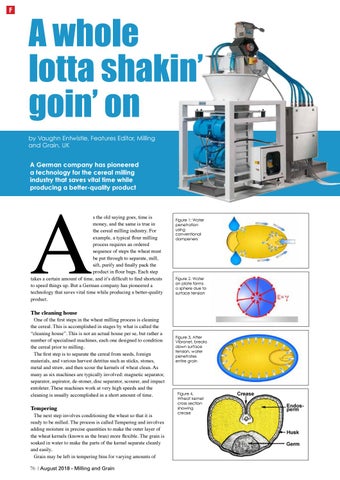
FEED WETTING PROCESS A whole lotta shakin’ goin’ on
A German company has pioneered a technology for the cereal milling industry that saves vital time while producing a better-quality product
PAGE 76
How big data will challenge and change the feed industry
Emerging technologies and the increasing availability of data can have an enormous and positive effect on feed safety, feed quality and animal health. At the same time, the feed producing industry should be wary of a big data overkill.
PAGE 68
With a major fire at the BASF citral plant in Germany causing a global shortage of vitamins A and E, many livestock producers are concerned about availability and the impact on feed prices, however according to Bob Kendal, Alltech UK’s ruminant manager for the north, there are alternative options available.
PAGE 66
Horizontal scourer1950
The revolutionary technological path that never ends
High efficiency peeler 2018
www.ai-lati.eu
www.ocrim.com
Sector recognition at an international level This past month or so has been busy with international events for millers. Close to home we had the UK’s annual Cereals Event attracting UK flour millers, while in Utrecht, The Netherlands, the VNU hosted VIV Europe 2018 for the intensive livestock sectors and further afield our team attended the 13th IndoLivestock 2018 in Jakarta, a poultry, dairy and aquaculture show that is dominated by the feed sector. Last month’s issue we reported, on that must-attend event for flour millers - IPACK-IMA in Milan, Italy. Events like these are valuable in bringing together equipment manufacturers, ingredient and additive suppliers and service providers within the feed and food milling sectors. This is where relationships are formed and consolidated, and where senior people from companies can meet with their existing customers from over a wide area and spend a little time together. Deals of significance are done. Magazines on the other hand assist in laying the ground-work for these engagements and encourage our industry to come together for everyone’s benefit. That’s why Milling and Grain attends and reports on so many events around the world and throughout each year, and especially those with regional and international reach. What we sometimes find when attending these events is the lack of acknowledgement by governments as to the important role our industry sectors play in providing a nation’s food supply. However, that was not the case in Jakarta last month! On the last day of the show the four halls of the city’s Convention Centre were cleared soon after opening time to allow a ‘security sweep’. And just after midday President Joko Widodo ‘Jokowi’ of Indonesia entered the foyer to a rapturous welcome from IndoLivestock. Not only was this immediately the highlight for visitors and those who were in attendance on the last afternoon of the show, but reflected the importance feed milling in particular and livestock production is to this government. Not only did he attend, but he stayed for 90 minutes visiting stands and talking to various local and international companies exhibiting feed and livestock production equipment.
It is clear that this President - and this country - understands the important role feed manufacturing plays in the lives of its citizens - and its direct impact on the food supplies to the peoples in a country that has one of the world’s fastest growing populations. In fact, Indonesia is the fourth most populous country in the world and accounts for 3.5 percent of the world’s total. Indonesia is growing at just under 1.5 percent per year and reached a massive 267 million people this year; it has added 60 million people since the turn of the century. This is good reason for President Joko Widodo ‘Jokowi’ to encourage and support the feed and animal production sectors. He recognises the value of the feed industry in particular and the contribution international companies are making to the successful increase in feed milling capacity and production. In the past 20 years the country has increased its feed production five-fold from approximately five million tonnes in 1998 to 19.6 million tonnes this year. It is important that we connect with country leaders - and not just the usual suspects - when holding exhibitions and conferences. We need to get our messages across in a clear and meaningful way. We need to change the way governments view our industries and the vital role we are playing in gearing up to providing the safe and affordable foodstuffs for an everincreasing world population. Our congratulations go to President Joko Widodo ‘Jokowi’ for showing the way to other world leaders in recognising the importance of our sectors by visiting and engaging with feed and livestock producers!
A welcome return to our pages
It’s a great pleasure to welcome back for a limited time our columnist Christophe Pelletier. (See page 18) For those of you who do not know, Christophe has been a longterm contributor to MAG - on a monthly basis - for some years bringing us insights into the need for change and how to handle challenges facing the food industry. However, this time he’s asking our industry readers to be more responsive and reactive to his thoughts and proposals. We would welcome your comments; which we would consider publishing. In fact, one of our staff’s daughter has used Christophe’s observations in several of her school projects stating “he’s the best columnist” she has read! Great praise indeed. So, put pen to paper or tap the keys and let me know what you think. Roger Gilbert, Publisher, Milling and Grain
Annual Subscription Rates Inside UK: UK£100 Outside: US$150/€133
ISSN No: 2058-5101
More Information www.millingandgrain.com http://gfmt.blogspot.co.uk
40 YEARS OF TESTED STRENGTH
One Tapco Nylon Elevator Bucket Supports a 9700 Pound* H1 HUMMER Ambient Temperature: 17 °F (-8 °C)
TAPCO’S CC-XD (Xtreme Duty) gray nylon elevator bucket supports a 9700 lb. H1 Hummer vehicle. Testing confirms that it will support over 20,000 lbs., more than two Hummers!
TAPCO’S CC-XD (Xtreme Duty) blue polyethylene bucket will support 9,000+ lbs.
Tapcoinc.com
TAPCO’S CC-HD (Heavy Duty) blue polyethylene bucket will support 5,000+ lbs.
314.739.9191 / St. Louis, Missouri USA No 814
*4399 kg
News
AUG 18
Milling
Sukup Manufacturing Co founder passes away aged 89
W
ith great sadness, Sukup Manufacturing Co. have announced that Eugene Sukup, beloved husband, father and grandfather, and the founder of Sukup Manufacturing Co, passed away on Thursday July 12, 2018. Eugene will be remembered by his family and many friends, colleagues, and members of the agriculture community as a leader, innovator, and exceptionally caring and generous person. In 1963, Eugene and wife Mary founded Sukup Manufacturing Co. in a welding shop in Sheffield. Eugene observed that pockets of grain in the bin overheated and spoiled, and he knew he could create a solution to this problem. After his initial attempt with a manual stirring auger failed, he came up with the idea of adding a horizontal auger through the handle of the drill to automate the process. He patented the idea, and the Stirway stirring machine and Sukup Manufacturing Co. were born. Today, Sukup Manufacturing Co holds more than 80 patents and sells its products in more than 85 countries. The company has more than 700 employees and more than 1,000,000 square feet under roof worldwide. Sukup Manufacturing Co. remains the largest familyowned, full-line grain system manufacturer. Eugene served as President of the company for 32 years. His son, Charles, became president in 1995 and his son, Steve, became CFO. Eugene remained chairman of the Board of Directors until his death. 6 | August 2018 - Milling and Grain
Getting bready for change: An archaeological masterpiece, an old face returns and conversations with a President As you may have seen in the news this month, scientists and archaeologists have made a monumental find in the world of food history and the story behind our modern diets. Found in the Black Desert in Jordan, academics from the University of Copenhagen and University College London discovered the earliest known evidence of bread making. The dig site is 14,000 years old and the sample found means that the first evidence of bread has been pushed back by more than 5000 years. You can read more about the bread, which was described to be similar to flatbread and also possibly evidentially of food combinations such as sandwiches, as it was believed the bread was served with deer meat – in the news section of Milling and Grain this month, as well as looking out for a feature length article in the upcoming September edition of the magazine. On a similar note of important history, too a much smaller scale but possibly as interesting – Milling and Grain’s popular columnist Christophe Pelletier has resumed his writings for the magazine this month. The ‘food futurist’ always gives interesting and insightful outlooks into the past of food production and how we can move onwards and upwards into a more sustainable food future. Christophe is looking for some regular feedback on his columns so if you particularly enjoy them or have any thoughts do not hesitate to contact him through the email address given in the piece. Two members of the team are visiting Livestock Taiwan as this column is written. Livestock Taiwan promises to be a one stop shop as an “International and Comprehensive Livestock Technology Expo”. The event has been organised by UBM Asia Ltd., which is owned by UBM plc, listed on the London Stock Exchange and the largest trade show organiser in Asia. It was awarded “Asia’s Most Reliable Trade Show Organiser” in Hong Kong’s Most Valuable Companies Awards 2016. It was also overseen in the organisation by the Council of Agriculture, a government authority for agriculture, forestry, fishery, animal husbandry and food affairs in Taiwan. The council are responsible for guiding and supervising the country’s municipal agriculture offices. For this month’s show reviews, we have two fantastic Expo’s from two different continents! The first is a look back at July’s VIV Europe, with a special technology focus feature which we hope to continue over the coming editions with spectacular products from the global shows we visit. This is followed by a great feature on Indo Livestock 2018, where publisher Roger Gilbert examines the impact of the visit of the Indonesian President has had on the country and the sector alike. This has been covered in extra depth with a first-hand view of Roger’s experience in the Guest Editor this month, and a full write up on the President’s speech can be found in the Interview feature in the latter half of the magazine.
GF
MT
gfmt.blogspot.com
The double sandblasting nozzle achieves a faster sandblasting process while compressing air consumption.
www.balaguer-rolls.com Twitter
18 BR-SM
Youtube
Milling News
AFIA honours two nutrition award winners
T
he American Feed Industry Association honoured two individuals in the animal science field at the American Dairy Science Association annual meeting in Knoxville, Tenn., June 25. Ian J. Lean, Ph.D., of Scibus received the AFIAADSA Nutrition Research Award, and Ronald L. Horst, Ph.D., of Heartland Assays received the AFIA and Federation of Animal Science Societies New Frontiers in Animal Nutrition Award. “These awards recognise leaders who have provided significant contributions in animal science and nutrition,” said Paul Davis, Ph.D., AFIA’s director of quality, animal food safety and education. “Drs Lean and Horst have dedicated their careers to dairy science research, and they are both well-deserving of these awards.” Ryan Ordway of Balchem presented both awards. ADSA Nutrition Research Award Lean is the founder and managing
the United States, Australia, New Zealand, Canada, the United Kingdom, Argentina and South Africa.
director of Scibus, an agricultural research and consulting firm in Australia. Over his career, he has worked as a large animal veterinarian in Australia and a lecturer of clinical nutrition and cattle medicine at the University of California and the University of Sydney. He also served as the senior examiner in cattle medicine and ruminant nutrition for the Australian College of Veterinary Scientists and as president of the Australian Association of Cattle Veterinarians and the cattle chapter of the Australian College of Veterinary Scientists. Lean has authored more than 200 scientific articles, many of which have been published in international peerreviewed journals. He also wrote the textbook “Nutrition of Dairy Cattle.” He has spoken at major conferences in
FASS New Frontiers in Animal Nutrition Award Horst is the cofounder of Heartland Assays and GlycoMyr, two companies that focus on developing products and analytical techniques to identify and alleviate vitamin D and calcium deficiencies. He served as a research scientist for the U.S. Department of Agriculture’s National Animal Disease Center and as a professor in Iowa State University’s Department of Animal Science from 1978 through his retirement in 2006. Horst is most known for his work involving milk fever in dairy cows. This work has crossed from the veterinary field into human medicine, citing multiple collaborative studies detailing vitamin D metabolism abnormalities in several human diseases. Both of these awards are sponsored by AFIA as part of its continuing awards program that dates back to 1948.
True Falling Number The only validated instruments for the approved methods
• World Standard • Faster, Safer and Easier to Use • 50+ years knowledge and expertise www.perten.com Milling and Grain - August 2018 | 11
Milling News
Image courtesy of ©Joe Roe
A
Scientists discover earliest known evidence of bread making
n archaeological dig in the Black Desert in Jordan has revealed the earliest known evidence of bread making. Dr Amaia Arranz-Otaegui, University of Copenhagen, discovered the remains of the bread at the 14,000-year-old dig site and remarked, “it was the last thing she expected to find at the site”. “Bread is a powerful link between our past and present food cultures. It connects us with our prehistoric ancestors,” she said. The discovery team said that the bake Image courtesy of ©Alexis Pantos
12 | August 2018 - Milling and Grain
would have looked like a flatbread and tasted similar to today’s multi-grain varieties. The find is reported to have pushed the first evidence for bread back by more than 5000 years. The use is believed to have been as a wrap for roasted meat, therefore hypothesised as not only the oldest bread – but possibly the oldest sandwich. Professor Dorian Fuller, Professor of Archaeobotany, University College London told BBC News, “This is the earliest evidence we have for what we could really call a cuisine, in that
it’s a mixed food product. They’ve got flatbreads, and they’ve got roasted gazelle and so forth, and that’s something they are then using to make a meal.” Lara González Carretero, expert of prehistoric bread, UCL Institute of Archaeology, examined the 24 crumbs under an electron microscope, she explained, “This would be a bread made of wild wheat and wild barley flour, mixed with water and cooked on a hearth on a fireplace. There’s also the addition of wild tuber flour into it which gives it a slightly nutty, bitter flavour to it.”
The full millstone storey (2nd floor)
City of London Flour Mills, a millstone mill Milling journals of the past at The Mills Archive involved the expensive and laborious construction of a coffer dam to enable the foundations to be laid, requiring them to go down to the London clay level, a depth of 15ft. Two large steam engines As a former “millstone miller� I were used day and night for pumping out the water. The completed am always attracted to the detailed descriptions of the large millstone mills mill opened in October 1852. Then, on the Sunday morning of November 10, 1872, a fire frequently featured in the early years occurred. Despite the Lambeth fire brigade turning out 200 men of The Miller. The September 2, 1878 with 30 engines, five of the upper floors gave way, destroying issue described Mr Hadley’s City of much machinery and stock. Sadly, one of the firemen was London Flour Mills in loving detail. killed when an iron beam fell on him. After the fire the mill was By then The Miller was reporting reconstructed, and the rebuilt mills became the largest and most the sharper competition with other substantially built in the Metropolis. countries that was rapidly developing, along with the greater The external length of the building was 227ft 10in and it was varieties of wheat available. This was necessitating modifications 60ft wide. The external walls in the basement were 4ft 8in in the in machinery and systems of manufacture. The formation of basement above the footings and a more substantial 6ft 9in on a National Association of millers had taken place, and local the river front on a bottom course that was 10ft thick. The mill associations were springing up all over the country proving was seven storeys high and had rolled wrought iron joists 6in beneficial to all millers. deep supported by sockets in cast iron girders which in turn were Mills were up to this time secretive places not allowing anyone inside to avoid their new installations being shown to competitors. supported by hollow cast iron girders. There were 61 columns on the ground floor, 56 on the second, 61 on the third, fourth fifth sixth Gradually this changed and some mills started to show how they were fitted out, allowing publication of some excellent engravings and seventh floors, making a total of 427 in all. The floors were of Rock Hill stone laid on wrought iron joists. of both exterior and interior arrangements. City Flour Mills was The mill was originally built and designed for 64 pairs of stones, one such, which was only too happy to let other millers know of its innovations in the hope that it would encourage others to follow reduced to 63 as a girder intruded on one space. As shown in the illustration of the millstone floor the stones were arranged in suit. groups of eight. Note that to give an uninterrupted view of the Building of the mill was started in 1849 on an old rubbish site on the Thames, alongside Puddle Dock, near Blackfriars Bridge. This driving and millstone floors the centre supporting columns only are
by Mildred Cookson, The Mills Archive, UK
City Flour Mills from Victoria Street
Enlarged view of driving and guide pulley
14 | August 2018 - Milling and Grain
The driving floor (first storey)
there are single silk reels connected with the double ones, so that the produce of four pairs of stones passes through three separate reels, allowing the offals to be treated as described above. The motive power for the mill was originally a Maudsley & Field marine type engine installed in the centre of the building on the ground floor. After the fire, a new set of engines was installed by the Canal Basin Foundry Company of Glasgow. These were compound horizontal condensing engines capable of working up to 500hp. The holdings at the Mills Archive mean that I can only provide geographical and historical snapshots. if you would like to know more please email me at mills@millsarchive.org. Detail of millstone storey
shown, leaving out the side columns which were placed 15ft. apart on the respective floors. The bed stones were supported in iron pans attached to the main girders of the building and were regulated by the usual adjustable screws. With one or two exceptions the stones were 4ft diameter. The spindles toes were carried on independent cast iron columns, screwed to cross girders in the floor. Each of these columns carried a find threaded screw and hand wheel for the purpose of tentering the stones (raising or lowering of them). The millstone cases were made of Memel staves with brass hoops, and with Bovill’s patent combined blast and exhaust applied to each stone. The hopper was made of thin cast brass, octagonal in plan and circular in elevation, fitted with a hinged pane for examining the feed. The wheat was conveyed from the foot of the iron bins above by means of a brass tube. The feed was of the ‘silent’ design worked by a level and screw from below the hopper. The millstone cases along with the exhaust trunks survived the fire of 1872. The diameter of the driving pulley was 6ft and that of the millstone pulley 4ft, the same as the millstone itself. The driving pulley rotated at 80rpm and the millstones 120rpm. At the time this mill was built very few silk dressing machines were in use in England. Originally at City Mills each four pair set of millstones was connected by their meal elevators to a silk dressing machine 34 ft long, arranged longitudinally with the mill on the fifth floor. This total of eight silk reels was subsequently increased by another eight reels of 24 ft. All the reels had hollow perforated shafts for ventilation. The offals from the silk reels passed to a wire dressing machine with a revolving cylinder, one of these being placed at each end of the mill. The offals, after being separated from their finer particles and dust, passed into sifters and were separated into pollards and bran. There were 32 elevators which raised the meal from the millstones to the silk machines which reach to the under side of the top floor. The meal from here was then split into two silk reels contained in one case on the fifth floor. On the floor below these double reels Milling and Grain - August 2018 | 15
Milling and Grain supports the aims and objectives of the Mills Archive Trust, based in Reading, England. The history of milling no matter where it has taken place - is being archived by the Trust. For well over 100 years milling technology has been global with many magazines serving or having served our industry from flour and food to feed and oilseed processing and now to fish feeds. A most recent contribution to the Trust’s collection is a complete century of past edition of the now out-of-print ‘NorthWestern Miller’ from the United States. We are proud to present here, front cover illustrations from this valued and longserving publication as a visual reminder of the importance contribution past magazines provided to our industry.
YOUR GLOBAL PARTNER
Art in the Archive We are a charity that saves the world’s milling images and documents and makes them freely available for reference. We have more than two million records. We aim to cover the entire history of milling, from its ancient origins up to the present day. Find out what we have and how you can help us grow.
millsarchive.org The Mills Archive Trust Registered Charity No 1155828
Milling News
Geelen Counterflow supplies its 10,000th counterflow system
T
he company started in 1980 and quickly decided to specialise exclusively in the counterflow cooler as invented by its founder Pierre Geelen. The efficient counterflow heat exchange between product and ambient air proved to be a winner in the feed industry, with more than 30 percent savings in energy consumption, floor-space and investment cost compared to the incumbent horizontal belt coolers. Over the years the company became the global market leader for coolers in feed, petfood, aquafeed and oilseeds, partially by supplying coolers to nearly all of the major producers of pelletmills and extruders worldwide. Since the late 1980’s the company is also building counterflow dryers for food, petfood and aquafeed, using the same superior efficiency provided
by the counterflow heat exchange principle. The flagship multi-deck batch dryer has become the standard for many of the world’s leading producers of extruded petfood and aquafeed, because of its high hygienic standards and fast change-overs between production runs. Dryers typically consume 40-60 percent of an extrusion line’s total energy consumption, but counterflow dryers consume 20-50 percent less energy than belt dryers. So very significant
Yemmak imaj ilanı (Global Experience)-baskı Milling & Grain EN.pdf
2
13.06.2018
savings are usually possible. The company produces all of its steel and stainless-steel components in-house, using state-of-the-art laser cutting, bending and welding technology. A workforce of 100 in Haelen, the Netherlands designs and builds coolers and dryers for customers worldwide. A Field Service Team of 15 in Europe, Asia and Latin America supports customers with installation, commissioning, training and service.
09:40
Milling and Grain - August 2018 | 17
The Pelletier Column GLAD TO BE HERE AGAIN!
by Christophe Pelletier Time flies by. It has been a bit more than a year since I took a break from my monthly column. It is with pleasure that I resume writing in Milling and Grain, all the more so as I understand that some of you were enquiring about me, which is quite humbling. There could not be any reason to turn down such a friendly request. Yet, my approach is slightly different than before. I would like this to be more than just a monthly column. I would like to interact with you. Let’s get in contact and get acquainted. We have a little value chain between you, the readers the magazine and myself. It is an opportunity to go beyond my column. The feedback I received is that many of you find this column valuable and so does the magazine. Tell me about your work, your hopes and desires, your ideas, as well as perhaps your fears or doubts. I like to make myself easily available. It can happen through my website, email or, my favourite, Skype. With 800 words a month, you can guess that I only scratch the surface. By connecting, there is plenty more available if you wish. This is where value is. This year of reflection has brought me to revisit my original concept that I had started nine years ago on my blog, The Food Futurist. The future of food and farming is quite a broad topic that deals with many dimensions and layers. Most of the focus seems to be on technology and innovation. In my opinion, it is too restrictive. This is why I will try not to follow the herd, as usual. Understand me well, technology and innovation are essential for the future and I follow them closely, but the future will be successful and prosperous only if we develop scenarios and strategies that take into account the bigger picture. By this, I mean that the future of food and agriculture is not just about food and agriculture. It is not just about products, techniques and technologies that are being used or will be used in these two sectors only. To develop a solid vision of the future of food and agriculture, we must first get a solid vision of the world ahead, of how future human societies will be organised, and what their values will be. In the narrative about the future, one hardly ever hears about values, and yet be assured that they will play a critical role, simply because values strongly influence our perception of the world around us and what we care about or not. The future of food and agriculture will depend very much on how humanity will deal –starting now- with environmental issues, with energy, water, urbanism, transportation, work, education and knowledge, demographics, politics, religion, 18 | August 2018 - Milling and Grain
culture and economy, to name a few. The future is about change. A good place to start is to candidly list what must change. Indeed, we must be realistic and admit that humans have a number of bad habits -many of them quite convenient on the short-term, though- that are not sustainable and cannot go on. What must change will have to be replaced, and not just through band-aid solutions. The future is going to be about fixing the causes, not just the symptoms, as we unfortunately have a tendency to prefer to do. Humanity’s attitude towards short-term and long-term goals will also shape our world and societies in such a way that will decide of how and where food will be produced. A key element of how this will happen is money. Where will the money go? What will be subsidised and/or rewarded and what will be discouraged and penalised? What will be the sectors that will attract investors and which ones will lose their appeal? In order to shape a successful future, all of these questions, and many more, need to be answered. Part of this process is analytical and rational, and another part is emotional and philosophical. Unless we want to reduce humans to zombies without thoughts and emotions, the latter is necessary, just as the former is essential to progress. Defining the future needs using both or cerebral hemispheres. It also requires collaboration, and not just within your sector of activity. Collaboration must happen across any boundary that you can imagine. It must be across business sectors, across national borders (beware of building walls!), across the entire value chain, across cultures and across beliefs. In a world where tribalism and polarisation seem to gain ground, effective collaboration is far from being a given. Mutual respect and ability to listen are two qualities needed to succeed because they both alleviate fear of the unknown –which the future is all about- and confidence in overcoming challenges for the better.
Christophe Pelletier is a food and agriculture strategist and futurist from Canada. Working internationally, he has published two books on feeding the world’s growing population: Future Harvests Explores the Future of Food and Farming and We Will Reap What We Sow: Reflections on Human Nature, Leadership and Feeding a Growing Population. He has a very successful blog where you can follow his thoughts at “The Food Futurist: Foresight, Innovation, Philosophy, Critical Thinking and Visionary Leadership for a Prosperous Future of Food and Farming” Email: cpelletier@telus.net Skype: christophefp Web: www.hfgfoodfuturist.com
Milling News
N
Global winners of Alltech Young Scientist programme revealed ow in its 13th year, the Alltech Young Scientist program returned to reward university students for their innovative scientific research. The world’s largest agriscience programme of its kind culminated at ONE18, where eight finalists — four graduate students and four undergraduate students — presented their research to a panel of international judges. The undergraduate winner of US$5,000 and a fully funded Ph.D. program at the university of her choice is Leesa-Joy Flanagan, representing the University of Adelaide in Australia. Her work focused on the effects of different sources of undegradable dietary protein on lamb growth, daily weight gain and voluntary feed intake. The graduate winner of US$10,000 and a fully funded postdoctoral position is Saheed Salami, representing the University of Catania in Italy. His research investigated cardoon meal as a novel feed and its effect on lamb performance, rumen function and meat quality. The newly added Impact Award recognised a project with the potential to make a significant impact on agriculture.
pitched to a global audience of thousands, including international press and potential investors. The unique opportunity for startups is a collaborative project between Alltech and Dogpatch Labs, Ireland’s leading startup hub. From Canada, a program designed to deploy Alltech’s nutrition and ag-tech breakthroughs to farms via nutritionists. “Six of the 10 participants last year were listed as top 100 agri-tech companies in the world,” said Aidan Connolly, chief innovation officer at Alltech. “That is indicative of the companies applying.” Connolly noted that last year’s participants in The Pearse Lyons Accelerator were able to access 28 new markets and generate a total of US$50 million in qualified leads. Tuesday’s keynote lineup included Beth Comstock, who served as vice chair of General Electric and president of integrated media at NBCUniversal. She urged the audience to rediscover the power of imagination without fear of failure. “We can no longer fail to imagine,” she said. “We can no longer fail to fail. What are you going to give yourself permission to try?”
The winner of the US$1,000 prize is Moisés Poli from Universidade Federal de Santa Catarina in Brazil. His research focused on Pacific white shrimp and Nile tilapia integration in a biofloc system under different fish stocking densities. “We reviewed projects representing 86 universities,” said Dr Karl Dawson, vice president and chief scientific officer at Alltech. “These young scientists demonstrate that the future of scientific discovery is bright.” On its closing day, ONE18 highlighted the importance of fostering a culture of innovation and entrepreneurship across all sectors of business and agriculture. Reflecting that spirit, The Pearse Lyons Accelerator returned for the second year, bringing eight startups to the conference’s mainstage. The next generation of ag-tech ideas were
The ONE18 mainstage also welcomed David E. Bell, professor of agriculture and business at Harvard Business School, and Robert Wolcott, clinical professor of innovation and entrepreneurship at the Kellogg School of Management at Northwestern University. The 34th annual conference demonstrated the forwardfocused energy of Alltech as the company continues the mission of its visionary founder, Dr Pearse Lyons, who passed away March 8. “Together we can work toward a planet of plenty,” said Dr Mark Lyons, president of Alltech. “What is your ONE big idea? Share it and make it happen.” ONE: The Alltech Ideas Conference will be back in Lexington, Kentucky, USA, May 19–21, 2019. one.alltech.com
GO MOBILE! YOUR GLOBAL PARTNER
Milling News
Novel research project wins BASIS Paul Singleton Award
A
forward-thinking research project, that has scope to play a part in the fight against blackgrass, has seen Jamie Stotzka win the highly-regarded BASIS ‘Paul Singleton Project of the Year Award’. The consultant bioagronomist was presented with her award at Cereals and explains that her study focused on the effect of microbial inoculants on the growth and development of blackgrass. “From working in the industry, it’s clear that blackgrass is a major issue, costing farms up to UK£134/ ha to control, before accounting for any further crop losses,” says Jamie. “So, I used the project element of my BASIS Certificate in Crop Protection to find out whether the microbial inoculants that I work with in my role at PlantWorks Ltd. could play a key part in an integrated approach to tackle the aggressive weed.” Jamie explains that her research was formed of two sections. “The first was designed to monitor whether arbuscular mycorrhizal fungi (AMF) can help cover crops to outcompete and suppress blackgrass growth. “My second experiment approached
the problem from a different angle, this time using plant growth promoting rhizobacteria (PGPR),” she adds, “I wanted to find out whether PGPR could stimulate the early germination and growth of blackgrass to minimise the threat to winter sown crops. In theory this could mean that the entire population of blackgrass seeds germinate in the autumn, before spraying off to provide a clean seedbed to drill the next crop.” The results of both trials were positive, with the first test that used AMF clearly showing an increase in biomass of the cover crop, with potential to outcompete weeds. The PGPR encouraged an early flush of blackgrass in the autumn, suggesting reduced pressure during the following growing season. She highlights that NIAB has shown a great interest in her work. “I presented my findings to the team,
Eurogerm opens new subsidiary in Colombia
E
urogerm, the leader in ingredients and processing aids for the wheat-flour-bread sector, is today announcing that it has set up its eleventh international subsidiary. Its new unit based in Medellin (Colombia) will enhance the Group’s growth opportunities in the country, which has 40 industrial bakeries and 30 flour mills. The establishment of Eurogerm Colombia will extend Eurogerm’s technical and commercial reach in Latin America, a region where it already has subsidiaries in Mexico, Peru and Brazil. 22 | August 2018 - Milling and Grain
and they’re going to build on my research with PGPR, as my trials provided a good grounding for a potential solution to the blackgrass problem.” Jamie adds that she is delighted with the award, which was judged against 10 other leading BASIS projects, out of 250 submitted. “It’s tremendous that such a novel subject has been recognised for this key industry award, I feel extremely honoured and hope my findings can help farmers in the future.” Stephen Jacob, BASIS CEO, explains that Jamie is a worthy winner and highlights how her project stepped away from the norm with a clear aim to enhance the industry. “As always the standard of projects was exceptional, but Jamie’s high level of detail and strong Integrated Crop Management focus stood out to the judging panel.”
The subsidiary is run by Andrés Builes, a food engineering specialist who has worked with Eurogerm for several years. It will confer a logistical advantage on its customers in Colombia. It will also provide local technical assistance, so they are able to customize their products and services to a high degree, which has been a key success factor for the Group. Benoît Huvet, Eurogerm’s Chief Operating Officer, and Jean-Philippe Girard, its Chairman and Chief Executive Officer, commented, “The opening of this new subsidiary represents a key milestone in the execution of our strategy of international expansion. Our presence in Colombia will help to raise our profile and establish a stronger foothold in the Andean and Caribbean regions. We also remain on the look-out for any international acquisition and development opportunities.”
Milling News
Biomin releases 2018 phytogenic feed additives survey results
B
IOMIN announces the publication of new survey results on the use of phytogenic feed additives (PFAs, or botanicals) in farm animal diets worldwide. The recently published 2018 BIOMIN Phytogenic Feed Additives Survey report, available on the BIOMIN website, reveals insights on the views of more than 700 nutritionists, business owners, veterinarians and consultants located in over 80 countries who are involved in the animal protein industry. Key findings 51 percent of respondents use phytogenic feed additives. 60 percent of respondents report that their PFA use will increase over the next 12 months. The digestibility enhancement and antimicrobial effects of phytogenics continue to rank as the two top reasons for the application of PFAs in animal diets. “We’ve seen an extraordinary response from this initiative,” commented Michael Noonan, Global Product Line Manager Phytogenics at BIOMIN. “The interest in how plant-based substances can contribute to better health and performance of farm animals remains strong among the feed and animal protein industries in all sectors and geographies, as evidenced by the latest findings.” This is the second consecutive year that BIOMIN has commissioned a market research survey of agribusiness professionals in the global protein industry. Though attention on plant-based compounds in animal nutrition has surged, phytogenic feed additives are not new. “Since Digestarom® was first commercialised in 1989, the scientific understanding of precisely-defined PFAs and their effects in animals has expanded exponentially,” stated Mr Noonan.
‘How to feed the world’ offers positive solutions to food insecurity
A
new book of essays by a multidisciplinary team of researchers from Purdue University helps readers understand how decisions made today by farmers, scientists, policymakers, educators and consumers are vital to ensuring global food security in coming decades. The book “How to Feed the World,” is now available from Island Press. It includes 12 chapters examining key challenges and opportunities in the global food system. Topics are population growth, water scarcity, land use, climate change, technology adoption, competing food systems,
24 | August 2018 - Milling and Grain
“The ‘-omics’ technologies have revealed quite a lot in recent years. With advanced next-generation sequencing (NGS) tools, we can now measure the changes in gene expression that result from PFA application,” he observed. A large majority of respondents face stable or rising feed costs while simultaneously looking to reduce the level of antibiotic use in their operations, according to the survey. “Whether your aim is to optimise feed costs, nutrient digestibility of raw materials or to reduce antibiotic use, phytogenic feed additives have a role to play,” explained Mr Noonan. “The key to success is to adopt a 360-degree approach that includes biosecurity, management, nutrition, health and good gut performance.” Plant-based phytogenic feed additives – specifically essential oils, plant extracts, herbs and spices – are known to have a range of biologically active properties that can be applied to modern animal production. These include anti-oxidant, antiinflammatory, anti-microbial and digestion enhancing effects.
international trade, food waste and loss, health, social license to operate, communication and achieving equal access to food. “By 2050, we will have 10 billion mouths to feed in a world profoundly altered by environmental change,” said co-editor Jessica Eise, Ross Fellow in the Brian Lamb School of Communication. “How we meet this challenge will be the difference between food abundance and shortage, environmental preservation or destruction, and even life and death.” Plain-language essays offer practical, positive solutions ranging from precision agriculture and nanotechnology to making healthy choices at the grocery store. “We have the tools and ingenuity needed to achieve global food security,” says Ken Foster, professor of agricultural economics and co-
editor of the book. “But the pursuit of a secure future begins with a clear understanding of the challenges facing our food system today.” In addition to Eise and Foster, other Purdue contributors are Michael Boehlje, Otto Doering, Michael Gunderson, Thomas Hertel, Rhonda Phillips, Gerald Shively, Brigitte Waldorf, Nicole Olynk Widmar and Steven Wu, all from the Department of Agricultural Economics; Laura Bowling, agronomy; Keith Cherkauer, agricultural and biological engineering; Jeff Dukes, Purdue Climate Change Research Center; and Ariana Torres, horticulture and landscape architecture and agricultural economics. To learn more about the book, including ordering information, go to http://islandpress.org/book/how-tofeed-the-world.
eurhythmical collaboration of nature and technology
www.tanis.com.tr
We are proud to be with you in the journey off seed from sowing to the harvest with our developing technology and milling solutions since 62 years in order to add abundance to what soil gives us.
Milling News
S
Bühler acquires vacuum components company in the US
puttering Components Inc. is now a member of the Bühler Group. Sputtering Components Inc. (SCI), a US manufacturer of precision vacuum components, will become a member of the Bühler Group. Bühler is purchasing all shares from the previous owners. Sputtering Components Inc. (SCI) will become a new member of the Bühler Group. SCI is a US provider of components and subassemblies for large-area vacuum coating systems. Post-acquisition, Sputtering Components Inc as a Member of the Bühler Group, will operate as an autonomous unit of the vacuum coating
Remotely adjustable magnet bars for architectural glass coater (source: Sputtering Components Inc.)
business of Bühler Leybold Optics. Antonio Requena, CEO of Bühler Leybold Optics, is pleased about the successful acquisition, “We have intensively worked with SCI for many years. Together, we have gained a leading market position, especially with systems for coating of architectural glass. Therefore, we are proud to know that the team of SCI will in the future be part of Bühler, with all its capabilities, its reputation in the marketplace, and its enthusiasm for high-quality products.” The parties have agreed not to disclose the purchase price. The current management team will continue to run the business with its over 40 employees. The current CEO, Barry Nudelman, will resign from his position and will continue to support the SCI organisation in the transition phase. Andy Britt, currently operating as Vice President of Sales for Bühler Aeroglide, will take over as General Manager effective with the closing date. Sputtering Components Inc will retain its existing location in Owatonna (Minnesota), thus supplementing Bühler’s current North American activities. In conjunction with the coating solutions offered by Bühler Leybold Optics in Alzenau, Germany, Sputtering Components Inc. will in particular strengthen the company’s global sales and service network and its product portfolio, on one hand with process solutions, on the other with new cost-efficient product families. Sputtering Components Inc will continue to cater to both end customers and original equipment manufacturers, offering them top-notch products and services. In this, the company will utilise the existing sales channels as well as the global sales and service network of Bühler.
www.perryofoakley.co.uk sales@perryofoakley.co.uk +44 (0)1404 890300
Since 1947
The UK’s Most Experienced Manufacturer of Materials Drying & Handling Equipment
Capacities of up to 1000tph available - Heavy duty, galvanised construction - Ranges suitable for grain & bulk materials • Continuous Flow Grain Driers • Belt Driers • Chain & Flight Conveyors
• • • •
Belt & Bucket Elevators Belt Conveyors Aspirator Cleaners Levelling Conveyors
• Augers & Screw Conveyors • Ducting & Valves • Twin Trace Conveyors
Call now to discuss your drying & handling needs! 28 | August 2018 - Milling and Grain
Milling News
Roundtable On Responsible Soy announces three new production and supply chain certification models
T
he Round Table on Responsible Soy Association (RTRS) - the internationally recognised organisation promoting the responsible production, trading and use of soy – is to announced the approval of three new production & supply chain certification models during its twelfth General Assembly being in Lille, France. These new models – involving RTRS non-Paraquat and non-GMO credits as well as a new Mass Balance option will be launched between July 2018 and April 2019. The models form part of RTRS’s ongoing ‘commitment to continuous improvement’ that involves offering options to the market that cater for existing demands. The launch of the new models is to be rolled out in a staggered approach in order to provide further tools for the responsible soy market and help facilitate conditions that increase the size and impact of sustainable soy on a global basis. RTRS expects a significant uptake of the new products over the next few years as the market take new steps to achieve further responsible food chain transparency. The new production & supply chain certification models National Mass Balance: This model has been created to add value to the certification of the soy production by incorporating logistical elements, facilitating the physical flow of RTRS soy to the market from within a specific country. The aim of this model is to give better conditions for the soy market wishing to move towards RTRS mass balance. In the National Mass Balance (NMB) model, RTRS-certified operators are allowed to aggregate the mass balance accounting systems of several certified physical sites as one single mass balance accounting system at national level. This NMB system for the Chain of Custody adds to the existing Site Mass Balance (Module A. Mass Balance Chain of Custody) and Segregation (Module B. Segregated Chain of Custody). This product has a significant market potential to scale both supply and demand. RTRS non-GMO credits: This is a model that enables the market to support the responsible production of non-GMO soy through the purchase of RTRS nonGMO credits. This certification allows producers to commercialise RTRS non-GMO credits (1 tonne of nonGMO soy is equivalent to 1 RTRS non-GMO credit). To obtain non-GMO credits the producers must have complied with local current legislation, RTRS Principles and Criteria and all the requirements for non-GMO production on the farm. Moreover, in order to guarantee the non-GMO status of product, an independent third party will be involved as part of the verification process and will conduct semiquantitative real-time tests (PCR) at harvest time in each non-GMO plot of the farms. The association now offers the possibility of non-GMO credits to a market looking to support, but not physically obtain, the non-GMO soy production system. RTRS foresees a market opportunity for German and Swiss markets who support non-GMO in line with their policy. Additionally and not less important,
30 | August 2018 - Milling and Grain
RTRS’s non-GMO module for segregated non-GMO soy has existed since 2011 and RTRS will continue to support it for those who do want to physically uptake non-GMO soy. RTRS believes the combination of non-GMO credits and segregated non-GMO soy will support various forms of non-GMO demand and hence opens up new market opportunities. RTRS non-Paraquat credits: RTRS offers the market the opportunity to purchase non-Paraquat credits during the RTRS phase-out period ending on 1st January 2021; in countries where Paraquat is currently allowed by country legislation in agricultural production all producers are required to implement a program of progressive reduction over time until the deadline is reached. RTRS non-Paraquat credits help farmers to tackle the opportunity of this new market demand. RTRS Regional credits: focusing on market benefits to scale up certification in specific areas In addition to the new production and supply chain certification models above, RTRS is offering the RTRS Regional credits option. This tool will make it easier for the soy market to know from where they are buying RTRS credits allowing greater transparency along the soy chain. RTRS credit buyers will be able to invest by region or country thus supporting local farmers that meet the criteria set out by RTRS. This product has the most significant potential to focus market benefits to foster and scale up certification in selected areas. The three new certification models, along with the new RTRS regional credits tool, will ensure that the RTRS trading platform now is easier to use and more transparent than ever. Marina B. de Engels, President of RTRS says, “RTRS has strived to make these models simple to ensure that it is easy for the market to take positive steps towards soy transparency. It is important that these models are not overly complex or bureaucratic to ensure that we get maximum engagement between our members and the responsible soy market. “As well as relating to issues of soy responsibility each accredited producer has also signed up to a number of other criteria that are key to responsible soy. This includes the support of workers right and the adoption of better water and land management, among others. “We are responding to both the demands of our members and the global market. We hope that by creating these products we will create a larger market with greater access to sustainable soy.” Marcelo Visconti, Executive Director of RTRS, says, “This is the first time since its inception that RTRS has launched new models of supply chain certification, allowing us to add to the sustainability objective of the market. I believe that it’s important that by offering the market these different options we can supply solutions to the individual needs of businesses. In the case of the Mass Balance National model, the objective was to be pragmatic; learning from past experiences that indicated the need to offer new proposals that add value and make market demand viable.”
I
Milling News
An ideal partnership n what is being described as the perfect marriage, industrial sieving machinery manufacturer, Farleygreene and process product and system supplier, Genesis Process Solutions have just announced a partnership which will see Sandbach based Genesis market the Farleygreene range of sieves throughout Wales and large parts of England. Farleygreene has been designing and manufacturing industrial sieving machinery at their UK factory since 1976. Known as the ‘Sieving Partners You Can Trust’, their equipment is renowned for its quality & durability and their bespoke solutions mean that their sieving solutions can be installed into almost any production line. Farleygreene will continue to offer sales & service from their Basingstoke Headquarters for the rest of England as well as having agents in Scotland.
BALANCE IS EVERYTHING!
Leiber brewers’ yeast products for: Improve bioavailability of nutrients & active ingredients Genesis Process Solutions was formed in 2007 and have developed a first-class reputation for system supply and installation. In addition to system supply is a range of market leading products which includes Brabender feeders, Krause flexible silos, BPM pelletisers, Liftvrac conveyors and their own in-house designed Propflow silo discharger. Phil Cameron is the Sales Director of Genesis Process Solutions. “We are absolutely delighted to form this partnership with Farleygreene as their products complement ours so well. We have been working with them for many good years so the transition has been effortless. This partnership really does enable us to offer more to our current customers as well as those from Farleygreene and potential future ones.” “The synergy FG created with Genesis is a natural extension of the recent distribution partnership created in mainland Europe. Phil and his team are now forming an integral part of our UK operation in which a lot of effort is being invested to make it a success on both parts” adds Nick Ashton UK Area Sales Manager for Farleygreene.
Stimulation and support for the body‘s natural defences Binding and inactivation of pollutants & mycotoxins
leibergmbh.de
Milling and Grain - August 2018 | 31
漀渀 琀栀攀 眀愀礀 琀漀 琀栀攀 昀甀琀甀爀攀
刀☀䐀 吀伀倀 ㈀㔀
圀攀 愀爀攀 愀洀漀渀最 琀栀攀 琀漀瀀 ㈀㔀 挀漀洀瀀愀渀椀攀猀 琀栀愀琀 椀渀瘀攀猀琀 洀漀猀琀 椀渀 刀☀䐀 猀琀甀搀椀攀猀 椀渀 吀甀爀欀攀礀⸀ 圀攀 愀爀攀 琀栀攀 猀攀挀琀漀爀 氀攀愀搀攀爀 椀渀 刀☀䐀 椀渀瘀攀猀琀洀攀渀琀猀⸀
眀眀眀⸀洀椀氀氀攀爀愀氀⸀挀漀洀 、䴀䄀币 䴀愀欀椀渀愀 匀愀渀愀礀椀 䄀⸀币⸀ 㐀⸀ 伀爀最愀渀椀稀攀 匀愀渀愀礀椀 䈀氀最攀猀椀 㐀 㜀⸀ 匀欀⸀ 一漀㨀㠀 㐀㈀㌀ 䬀漀渀礀愀ⴀ 吀ﰀ爀欀椀礀攀 倀 㨀 ⬀㤀 ㌀㌀㈀ ㈀㌀㤀 㐀 䘀 㨀 ⬀㤀 ㌀㌀㈀ ㈀㌀㤀 㐀㐀 眀眀眀⸀洀椀氀氀攀爀愀氀⸀挀漀洀 ⴀ 椀渀昀漀䀀洀椀氀氀攀爀愀氀⸀挀漀洀
Milling News
Evonik opens new NIR lab for animal nutrition in Nairobi
L Hot weather – hot companies! The weather in England continues to misbehave. After one of the coldest winters in 50 years, spring was late and wet. That segued into a heatwave of which we are now face a third sweltering week. We at Perendale Publishers had hoped to escape the heat as we journeyed to the Netherlands to attend VIV Europe 2018 last month. Here we met many large and small flour milling machinery manufacturers, food and feed companies, and other suppliers, many of which are listed in our International Milling Directory and some who signed up at the show. Sad to say that, while we found Utrecht and the Netherlands very lovely, the weather managed to be both hot, muggy and overcast-all at the same time (It finally turned to sunny conditions as we were driving back to the ferry terminal at Dunkirk, France). You can read more on this trip in our report in our events section this month. This month we added no fewer than 10 new companies: • ACO Mold co., China - Specialise in plastic injection moulding • Injection Molding Group co., Ltd, China - Plastic injection specialists • Transac Global Ltd., UK - Consulting advisors • Teknik Değirmen, Turkey - Design, manufacture and delivery of turnkey flour and semolina factories • Industrial Metal Powders (I) Pvt Ltd, India - Food grade iron powder suppliers • IBARCODESOLUTIONS Co., LTD, USA • Extruder Shop Limited, UK • Sunrise Food International Inc., Canada - Agritrade • Rappel Limited, UK - Bin leaning services
As always, we actively encourage more memberships! Joining and being a member of the grain and milling industry’s major directory, present for over 27 years continuously at the forefront of technology. Being included in the directory allows you to engage with customers and find new products and markets. Whether you need heavy equipment for your facility or the smallest machinery part, being included in the directory allows you to be found. It is free to join, all we require are a few key details and once our staff approves the entry, you can start to take advantage of its many benefits. Tuti Tan www.internationalmilling.com @intlmilling facebook.com/internationalmillingdirectory
AND GRAIN
ast month, Evonik inaugurated its first laboratory for its animal nutrition business in Nairobi (Kenya). Equipped with stateof-the-art NIR technology, the facility helps feed producers evaluate their raw materials through accurate analysis of a very wide range of nutrients. Furthermore, analysis of poultry feeds is also covered by this unique service. The new Evonik laboratory brings vital technical support to the local and regional feed markets. “We hope to extend the best levels of support to our partners not only in Kenya but in the entire East African region including countries like Tanzania, Uganda, Ethiopia and Rwanda”, said John Owaga, Technical Service Manager for Animal Nutrition in East Africa at Evonik. Animal nutrition has become a more exact science over the past decades. To formulate feed according to a certain specification requires knowledge about the nutrient contents of all relevant raw materials. Since these vary considerably, it is important to analyse the raw materials on an ongoing basis with the latest NIR technology (near-infrared spectroscopy). This ensures high feed quality and keeps feed costs under control. “At Evonik, we see great potential in the East African market coming from the double-digit growth of the poultry industry in recent years”, commented Cuthbert Mamabolo, Regional Business Director for Animal Nutrition at Evonik. Five years ago, Evonik established a direct presence in East Africa with a representative office in Kenya. However, the German speciality chemicals producer was active in this region for decades through external distributors. Today, Evonik caters to the feed industry for poultry, dairy, pigs and fish with key products such as MetAMINO®, Biolys®, Ecobiol®, Mepron® and CreAMINO®. Evonik offers partners unique products and services with great emphasis on technical support that the company tailors to individual customer needs. Hence, opening a laboratory in Kenya is a key strategic decision taken to bring technology closer to the clients and better understand their needs. Milling and Grain - August 2018 | 33
Conference held for West Africa’s flour producers
M The ability to capture the value chain by Sven-Olof Malmqvist, M4L Board of Trustees, Owner at Grytåsa In my last column I wrote about the cycle of producing feed and ultimately food and its constraints and challenges. This month I will address the importance to handle the crops postharvest in a professional way in order to avoid growth of mould and fungi which can lead to mycotoxins. The most common is aflatoxins found in peanuts, maize and in many other commodities, the fungal source is the well-known Aspergillus family, and it can cause cancer in humans and other adverse effects in animals especially chickens, other mycotoxins are fumonisin, ochratoxin, zearalenone and they are all bad news! An international report says that 25 percent of the grain worldwide is contaminated with mycotoxins. It is estimated that 10 percent of the global harvest is lost by fungi and mycotoxins, so it is representing an enormous value and has a great impact on our ability to feed our growing population. The absolutely best way is to prevent this is to dry the crop to the extent that the “water activity” will be kept at a very low level and thereby minimise the growth of fungi and mould. The major problem is to keep that water activity for a longer period and in particular humid and hot conditions. Another element is the nature of the storage bin and if you will have huge variation between night and day temperature. Once you have got occurrence of mycotoxins one must emphasise that there are no universal and reliable methods to erase them completely even though there are commercial toxin binders available in the market. Therefore, it is better to prevent than cure by using inhibitors parallel with good storage practice. Propionic acid for mould inhibition is the most effective and you can mix it with other organic acids like formic to get a better spectrum, their salt can also be used as it is more user friendly but correctly applied and with safety precautions the liquid is more effective. The presence of mycotoxins in grains and feedstuffs is hazardous for human and animal health so we better fight this battle together in order to at least minimise it as much as possible. The best way forward is to increase the awareness and introduce best practice.
Sven Olof is an experienced export manager with a demonstrated history of working in the chemicals industry. He is skilled in marketing management, market planning, business planning, international business and sales management. He is a strong sales professional who graduated from the Swedish University of Agricultural Sciences, Malmoe. 34 | August 2018 - Milling and Grain
ühlenchemie had issued an invitation to a family meeting of the West African milling industry in Ghana in April 2018. The objective of this symposium, the fourth of its kind in Accra, was an intensive transfer of know-how between all the important players in the industry. Over 120 participants from mills, suppliers, governments and NGOs met for two days of networking in Ghana’s capital. The symposium “Understanding Flour” was directed towards mills in the French-speaking states of West Africa. The millers discussed topics of current importance to the flour industry together with manufacturers of laboratory equipment, mill builders, wheat traders and health experts from governments and NGOs. Experts gave further stimulus in the form of information on the latest developments in the use of enzymes in the production of flour and pasta. Like all Mühlenchemie events, the programme in Accra offered plenty of opportunity for discussion between the participants alongside the specialist lectures. “Our aim is to draw the experience of experts and millers together in order to promote an understanding of flour production in every individual. That is the only way we can meet the challenges of constantly changing climatic, economic and market-related conditions,” said Managing Director Lennart Kutschinski at the opening of the symposium. So, for Emenike Okoye, who manages the Mühlenchemie Technology Centre opened in Lagos last year, the event was valuable for another reason, too, “We safeguard the staple food of several hundreds of million people. The West African milling industry is a family that extends across national borders and thrives in spite of competition. This special relationship is something the participants in the symposium were able to experience once again during the two days in Accra.” Mühlenchemie is the international market leader in flour standardisation, flour improvement and flour fortification. The company standardises more than 100 million tonnes of wheat annually. It exports its products to over 120 countries and maintains a close partnership with over 2,000 mills around the globe. At the central Stern-Technology Centre in Ahrensburg, near Hamburg, 80 research scientists and applications technologists work on tailor-made solutions to meet the needs of the milling industry worldwide. In order to transfer this know-how into the customers’ markets, the company has invested several million EUR in enlarging its research and production capacities over the past few years. A team of experts now advises mills on the spot in Mexico, Singapore, Malaysia, India, China, Russia and Turkey and offers individual solutions for achieving optimum flour quality. Last year, in Lagos, the company opened its first Technology Centre in the African continent.
SEFAR NYTALÂŽ. The name you can trust.
F
DA
Headquarters Sefar AG Hinterbissaustrasse 12 9410 Heiden – Switzerland Phone +41 898 57 00 filtration@sefar.com
www.sefar.com
NT
O
LI
A
FO
Since 1830, Sefar is the single-source supplier to millers for all products for sieving, grading, and dust filtration as well as connector sleeves, sieve cleaners and tensioningDequipment. SAFETY
CO MP
Milling News
Tritordeum, the winning ingredient in the Sustainable Food Awards
T
ritordeum is a new Mediterranean cereal with nutritional, agronomical and organoleptic benefits that has won the first prize in the category Sustainable Ingredient in the Sustainable Food Awards 2018 by Ecovia Intelligence. The premier Sustainable Food Awards event has been hosted alongside the Sustainable Foods Summit on the evening June 7, 2018, in Amsterdam. The aim of the awards is to give recognition to companies who are helping build a sustainable food industry – like Agrasys, the startup company which is introducing Tritordeum into the market. With this award, Tritordeum is being recognised as a new ingredient that makes a significant difference in terms of environmental and social impact. “Tritordeum is a project that ensures
36 | August 2018 - Milling and Grain
sustainability in several ways. From the base, it is a project respectful of the natural environment, the people and their surroundings. So it is an honour to be recognised as a sustainable ingredient”, highlighted Verónica Guerra, the Communication and Marketing Manager of Agrasys who collected the prize together with Wiro Nillesen, Tritordeum Value Chain Manager in The Netherlands. What makes it more sustainable? Tritordeum is a Mediterranean cereal – the combination of durum wheat (Triticum durum) and wild barley (Hordeum chilense) – with real benefits for the environment, the consumer and the farmers. As a crop, Tritordeum is more sustainable and has a better ecological footprint. It is a robust cereal, adapted to the inclemency of climate change.
It stands up well to drought and high temperatures. The fact that Tritordeum makes efficient use of water and has good resistance to diseases makes it a more sustainable cereal with reduced environmental impact. Tritordeum is cultivated in the Mediterranean area - Spain, Italy and the South of France, in both conventional and organic production systems. “Nowadays, 70 percent of the production comes from local farmers with the organic certification. The value chain of the Tritordeum has several characteristics that make it a fair and sustainable cereal chain”, assured Ms Guerra. Agrasys works with local farmers under repurchase agreements without fluctuation of prices, supporting local rural economies and following a philosophy of respect for sustainable principles. “Unlike what happens with many other cereals, we respect very much the first link in the chain: the farmer”, explains the entrepreneur. The project has been implemented in each region with local farmers under agreements that ensure stable, fair incomes that are not affected by external market variations. “Moreover, this cereal has a value chain focussed on the control of the seed, grain and flour to ensure full traceability throughout the whole path from growers to processors and then to consumers and it ensures just margins, particularly for our farmers”, added Ms Guerra. Once harvested, the company supervises all steps in the transfer of grain from the field to the nearest mill. After a traditional milling process, the grain becomes quality flour. “So thanks to this controlled process, Tritordeum is a totally traceable cereal”, declared Ms Guerra.
Milling News
SIE win “Star Performer National Award Winner”
S
atake India Engineering Pvt. Ltd. (SIE) proudly reports that on May 31, 2018, it was selected as “Star Performer National Award Winner” for the year 2016-17 in the product group - Miscellaneous special-purpose machinery (including metallurgy, food and textile) and parts” from the Engineering Export Promotion Council (EEPC India) in the Medium Sector Enterprise Category -Food Sector. EEPC India is the premier trade and investment promotion organisation in India actively contributing to the policies of the Indian government and acts as an interface between the engineering industry and government - having a membership base of over 13,000 members. Every year, it organises National & Regional Awards to applaud extra ordinary efforts in exports of Indian made goods, thereby recognising the meritorious performance of Member Exporters. The National Awards is one of EEPC India’s most coveted ceremonies where success is lauded while good effort is commended. In the fiscal year 2016 SIE has made aggressive efforts in promoting turn-key projects for the rice milling industry. EEPC India made a humble effort to recognise its contribution and awarded SIE with the Star Performer Award in special purpose machinery (Medium Sector), for its outstanding performance in promotion of Plant Accessories from India like Bucket Elevators, Chain Conveyors, Control Panels and Automation, Magnets &
Bag Filters etc. for many of its overseas projects. The exports are being made to Neighbouring countries like Bangladesh, Sri Lanka, Pakistan, Ethiopia etc. In the year 2016, SIE has not only won this award but has also outperformed its own Export performance of the last three years and is continuing its efforts to break the record in successive years as well. The fiscal year 2017 is a definite proof of the continuing progress, where our Export performance has increased by 34.88 percent. With such progress percentages, SIE has also successfully supplied and installed a state of art 8TPH rice milling facility as well as executed another project in overseas. SIE’s success is backed up by other group companies such as Satake Asia and Satake Head Office for both sales and engineering. Rajinder Kumar Bajaj, Director of Sales at SIE, says “advice and support have always encouraged us for promoting our local sales in projects. We shall further thrive to make such success in coming years continuously”. www.eepcindia.org
N Y LIA ITA LOG NO H C TE
CONVEYOR & ELEVATOR BELTS STEEL CORD & TEXTILE ISO 9001
21055 Gorla Minore (Italy) Via A. Colombo, 144 Phone +39 0331 36.51.35 www.sig.it Fax +39 0331 36.52.15 E-mail: sig@sig.it
Milling and Grain - August 2018 | 37
Feeling like a nomad by Chris Jackson, Export Manager UK TAG My visits this time have taken me to Indonesia and to Australia visiting my family farms. The contrast in farming could not be more dramatic, coming from what is largely a subsistence farming system, where the Government is keen to try and improve rural incomes. The policies and interest were reinforced by the President, himself touring the agricultural and livestock event that I was in Jakarta to attend along with Perendale. A keen interest was shown in their technical magazines focusing on milling and aquaculture. There is a real thirst for technical information that can help their business become more efficient and by default more profitable. There is a need to encourage the small farmers to move away from growing a small acreage of rice and get them to produce livestock and keep two cows instead of one by growing more grass and less rice. Pig production after chicken production is the usual next logical step as its intensive nature allows for fast reproduction and expansion, however because of religious sensitivities this avenue for income is not widely available. Having said that the demand from neighbouring Singapore for pig meat is largely insatiable. Also, in the southern state of Bali predominantly Hindu and Christian there is a viable industry and large-scale production on Batam Island for meat exports. The majority of the population therefore have to rely on cattle and goat production. Beef is very important and there are large beef-lots relying on imported cattle from Australia to finish. Much more could be produced locally if the dairy farmers could be persuaded to change their breed 38 | August 2018 - Milling and Grain
and use animals that can produce both beef and milk. The added advantage of a shift in breed is that the females will have a much longer working life than the Holstein, freeing up resources from replacement production. Infrastructure is key for industrial development but also crucial for rural communities enabling them to access the city markets, especially for the very perishable vegetable crops. Much can be achieved locally with processing for meat and milk that can be transported long distance in properly chilled, died or frozen. The farming of both fresh and seawater fish also opens up other areas for income. These rely on correct training and a reliable and efficient feed supply. They therefore rely on a modern technological efficient industry to supply them correctly formulated feeds at a price that allows them a sustainable income. Most of the farming with the exception of palm production in Indonesia relies on manpower which must never be ignored by trying to put in machinery to replace labour this will slowly have to come to pass as the age of farmers is increasing and the younger generation does not wish to continue farming. The contrast with Australia is extreme where rice is grown in very large paddies sometimes up to 1000 acres of laser levelled paddies which because of different varieties and growing techniques yield more per acre. The downside to these techniques are that they rely on water being made available for the irrigation and very large horse power machinery which allows production which were not available until relatively recently. Also, in Australia labour for farming is not easily available event though the technicians are being given care of very expensive and technical equipment. @AgrictecExports
Alapala Smart Automation Systems
Perfect mĹll MANAGEMENT AnywherE With Alapala Smart Automation Systems, you can control your mill remotely and instantly, monitor production results and share them with your team. Value your business with Alapala. Experience the ultimate production experience with mentor of milling Alapala’s leading solutions.
www.alapala.com Alapala
info@alapala.com /alapalagroup
/alapala2013
www.alapalaworld.com
Milling News
Presenting results on butyrate research
N
utriad, a pioneer in sodium butyrate applications for the animal feed industry, co-financed a research project on the use of butyrate as feed additive. The multi-year research project was concluded with the Ph.D. thesis of Pierre Moquet on the effects of butyrate in broiler diets, which he successfully defended on June 22, 2018, at Wageningen University (Netherlands). Dr Moquet started his Ph.D.-research in the Wageningen Animal Nutrition Group (WUR) to investigate an important conundrum related to the use of butyrate as an additive in animal feed: on one hand, this molecule has received considerable attention for its potential to improve intestinal health and animal performance, while on the other hand, the mechanisms underlying these effects have been described as very diverse and seemingly less consistent. Together with a fellow Ph.D. student at Ghent University, Dr Moquet set out to explore this topic in the framework of a research project that was co-financed by feed additive producer Nutriad and VLAIO, the Flanders Innovation & Entrepreneurship agency. Dr Tim Goossens, Business Development Manager Digestive Performance at Nutriad, coordinated support for the project. Dr Goossens explained: “Dr Moquet found evidence supporting his hypothesis that at least part of this variation can be attributed to the fact that different products deliver butyrate in distinct parts of the
gastrointestinal tract (GIT). These different release profiles result in specific digestive, microbial and immunological responses.” For example, when butyrate levels were increased solely in the proximal part of the GIT, or specifically in the small intestine, expression of host defense peptides was modulated and the levels of certain antibodies in the blood was increased. However, these treatments also triggered caecal microbial dysbiosis and inflammatory responses. On the contrary, when additives where used to increase butyrate not only in the proximal GIT, but also the hindgut, no signs of gut inflammation were observed, while the apparent digestibility of methionine was improved, as well as the feed conversion ratio. “All in all, the data suggest that butyrate indeed has the potential to elicit important gut health stimulating mechanisms”, Dr Goossens concluded, “but it is not an ‘always beneficial, everywhere’ product. Instead, the importance of precision delivery of this molecule is highlighted once more. This is especially important for butyrate producers if they are to provide practical and smart solutions to animal producers.”
Maximizing your grinding efficiency starts with innovative thinking. High capacity feed production. Full grinding flexibility. Healthy business.
The complete grinding solution for high quality, flexible and fast grinding results. The intelligent design of the GD hammer mill with large breaker plates guarantees an extremely effective grinding process which leads to high quality and fast grinding results. This hammer mill combined with an automatic screen exchange system and frequency controlled motor offers full grinding flexibility. By selecting the right screen and adjusting the hammer tip speed, any desired particle size and structure can be produced. The automatic screen exchange positions the screens in just one minute, maximizing the capacity of your hammer mill.
www.aarsen.com/machines/hammer-mills
2018-03-22, GRINDING 190x132mm.indd 1 40 |Adv. August 2018 - Milling and
Grain
22/03/2018 10:03
Milling News
Traditional herring party
A
t the VIV in Utrecht (Netherlands) multinational feed additives producer Nutriad once more hosted a traditional herring party. A large group of industry professionals and academics joined the Nutriad team to make this traditional event a great success. Every year in June, at the start of the summer, a Dutch tradition creates networking opportunities across the country. Attending a Herring party is as much about meeting interesting people as it is about eating herring and
most would argue the former is paramount. The Dutch have been eating raw herring for hundreds of years and at the VIV Nutriad invited business partners, colleagues and friends to share this tradition. Enjoying local drinks, herring and live music the event was received very positively by the international visitors. “Our guests at the VIV in Utrecht have come to expect a herring party from us. At the end of another long day at the show they like to join friends and partners from the industry at our booth. This is the moment where we focus on personal stories and relationships that create the foundation for sustainable business relations,” stated Nutriad CEO Erik Visser.
COMPLETE FISH FEED PLANTS KAHL fish feed plants are equipped with the latest process technology, the core of which is the extrusion system with the extruder OEE and the process control system ESEP. In the production process, the raw materials undergo the process steps of weighing, fine grinding, mixing, extrusion, drying, vacuum coating, cooling and packaging. AMANDUS KAHL GmbH & Co. KG Dieselstrasse 5–9 · 21465 Reinbek Hamburg, Germany +49 (0) 40 72 77 10 info@akahl.de · akahl.de
Milling and Grain - August 2018 | 41
Milling News
I
Yorkshire animal feeds firm in 3,700-mile pedal-powered charity ride ’Anson Bros Limited, based in Masham, North Yorkshire and one of the UK’s leading, independent, family-owned farm feeds businesses, has continued its longstanding programme of support for local farmers in hardship by leading two legs of a physically demanding nationwide charity bike ride. The Grain and Feed Trade Association (GAFTA) aims to raise £100,000 for the Farming Community Network (FCN), which supports farmers and their families across the UK. A team of eight employees will be led by I’Anson’s managing director Chris I’Anson, fresh from a recent gruelling charity cycle ride, where his team of two rode the length of New Zealand’s two islands in just 19 days. This time, the new group will cycle the 53 miles from Masham to Consett before covering another 100 miles up to BerwickUpon-Tweed. The GAFT Bike Ride left Westminster on 20 June after
42 | August 2018 - Milling and Grain
meeting George Eustice, the Agriculture, Fisheries and Food Minister. The relay will now make its way to the I’Anson factory in Masham via 171 participating feed mills, ports, grain stores and supply trade businesses. The team set off on this latest two wheeled challenge on July 10, 2018 and covered the estimated 153 miles in a single day. The route will lead the I’Anson team first to Apheya Animal Nutrition in Consett, continuing to Berwick-UponTweed where the team will “pass on the baton” to McCreathSimpson-Prentice Ltd. After criss-crossing England, Northern Ireland, Scotland and Wales, the relay will end at the National Farmers’ Union headquarters in Warwickshire, on July 31, 2018. The Farming Community Network helps farmers tackle a range of problems such as financial distress, family disputes and mental health. Its role is increasingly important following a recent National Farmers’ Union report which highlighted a high level of suicide amongst farmers. Staffed by a force of 400 volunteers nationwide, the Farming Community Network encourages people in the farming community to discuss their problems with a friendly, non-judgemental advisor. Each year the charity tackles approximately 2,500 cases, helping 6,000 farmers and dependents resolve their business and personal issues. I’Anson managing director Chris I’Anson, said, “At I’Anson we relish a challenge and we are proud to support farmers across North Yorkshire and the rest of the country. The Farming Community Network volunteers make a positive difference to the lives of thousands of families every year by talking with and advising those who are isolated and in difficulty.” Richard Cooksley, coorganiser of the GAFT ride and with it every step of the way, commented “The supply trade is working together tremendously to raise the profile of the Farming Community Network. Along the way we’ll have some fun but more importantly raise some funding for the FCN. We are indebted to I’Anson for their support and in undertaking such a long and difficult leg.” Donations to the GAFT bike ride can be made on the JustGiving page here: www. justgiving.com/fundraising/ GAFT
Best results from unground samples
AMINONIR® Advanced – Breaking New Ground Optimize your raw material inventory management, feed specification and control feed cost with highest quality and speed. AMINONIR® Advanced delivers reliable nutrition analysis in minimum time – even with unground raw materials. It’s easy to perform, fast to implement, and invaluable for your business performance. It covers the largest number of feed ingredients used by the feed industry. Get started now! animal-nutrition@evonik.com www.aminonir.com
INGREDIENT ANALYSIS
FINISHED FEED ANALYSIS
ALL PARAMETERS FROM ONE SCAN
Get start ed now !
BEST NUTRITIONAL MATRIX
Milling News
Texas and Kansas tours highlight opportunities for Chinese sorghum buyers
T
he US Grains Council (USGC) – in cooperation with the United Sorghum Checkoff Program, the Kansas Grain Sorghum Commission and the Texas Grain Sorghum Association – are hosting top Chinese sorghum importers in the United States to learn more about US sorghum production and strengthen relationships with US sorghum suppliers. The team will learn about sorghum production, buying strategies and develop relationships with US sorghum suppliers at all levels of the value chain as sorghum demand from China rebuilds following trade challenges early in 2018. After trade tensions were heightened between the United States and China earlier in the year – demonstrated by an anti-dumping and countervailing duty investigation brought by the Chinese government regarding sorghum – this team visit is a bright spot that signals relations between the two countries are once again moving in a positive direction. “The Council is pleased to be a part of this important work to maintain communication and strengthen relationships between the US and China,” said Tom Sleight, USGC president and chief executive officer. “Even with a moderate tariff on US sorghum, demand – especially in southern China – continues. It’s just another reason to highlight with these top sorghum importers and end-users how the US can be a competitive supplier with this year’s crop. These importers and feed mill representatives have the opportunity to see the full US sorghum value chain – from crops in the field to elevators and port facilities. Trips like these encourage increased use and purchase of US sorghum between the two countries while satisfying our mission of developing markets, enabling trade and improving lives.” The visit will highlight the entire sorghum value chain for the Chinese buyers in an effort to encourage more US sorghum sales to China. “This is one of many important opportunities created by the Sorghum Checkoff and U.S. Grains Council to foster and maintain valuable market relationships with end users in China,” said Verity Ulibarri, Sorghum Checkoff chairwoman. “This team from China is anxious to meet with US producers and continue learning about our product
E
even with newly implemented tariffs on U.S. sorghum and other goods, and we look forward to providing that handson education experience they expect while demonstrating the quality, condition, logistics and price that continue to drive demand for U.S. sorghum in China.” The 11 team members – whose imports account for more than 50 percent of China’s total U.S. sorghum imports – will first make stops in Texas including a multi-facility grain company, two farming operations, a visit to the Port of Houston and a global merchant for agricultural commodities. “Texas growers are anxious to meet with Chinese endusers slated to be in the U.S. and discuss a number of issues, including ways to improve exporting grain sorghum to China,” said Jay Wilder, Texas Grain Sorghum Association president. “Our producers understand the value of having our international end-users on their farms and businesses and embrace conversations about quality and trade. This is a great opportunity for our producers to not only teach about grain sorghum but also to learn from our key consumers how their businesses function and what attributes make sorghum one of the top exports from Texas to China.” After spending time in Texas, the team will head to Kansas where they will participate in a traders meeting, visit a grain marketing company, travel to an ethanol plant and participate in an outing to several farms, including a large farm enterprise with feed milling and a livestock operation. “At this time, in particular, we must engage buyers around the world,” said Jesse McCurry, executive director for the Kansas Grain Sorghum Commission. “We have a quality product that we want to sell. Kansas sorghum farmers are excited to host our friends and show off our ready supply.” With the support of Market Access Program (MAP) and Foreign Market Development (FMD) program funding from the farm bill and funding from USCP, the Council and the Sorghum Checkoff continue to form and strengthen relationships with sorghum buyers in China. This approach to building bridges and growing markets helps facilitate continued trade with countries around the world. China has become a top customer for US sorghum despite policy concerns in recent months. US sorghum sales to China took off during the 2013-14 marketing year, with a value of US$1 billion since then.
Eurogerm opens new subsidiary in Colombia urogerm, the leader in ingredients and processing aids for the wheat-flourbread sector, is today announcing that it has set up its eleventh international subsidiary. Its new unit based in Medellin (Colombia) will enhance the Group’s growth opportunities in the country, which has 40 industrial bakeries and 30 flour mills. The establishment of Eurogerm Colombia will extend Eurogerm’s technical and commercial reach
44 | August 2018 - Milling and Grain
in Latin America, a region where it already has subsidiaries in Mexico, Peru and Brazil. The subsidiary is run by Andrés Builes, a food engineering specialist who has worked with Eurogerm for several years. It will confer a logistical advantage on its customers in Colombia. It will also provide local technical assistance, so they are able to customize their products and services to a high degree, which has been a key success factor for the Group.
Benoît Huvet, Eurogerm’s Chief Operating Officer, and JeanPhilippe Girard, its Chairman and Chief Executive Officer, commented, “The opening of this new subsidiary represents a key milestone in the execution of our strategy of international expansion. Our presence in Colombia will help to raise our profile and establish a stronger foothold in the Andean and Caribbean regions. We also remain on the look-out for any international acquisition and development opportunities.”
ŽNOVUS and CIBENZA are trademarks of Novus International, Inc., and are registered in the United States and other countries. Š2017 Novus International, Inc. All rights reserved. 3987_Perendale
ÂŽ
ÂŽ
GRAIN SYSTEMS
No matter what configuration you are looking for Behlen can design and engineer the facility you need. We offer some of the largest capacities in the industry which means better installed cost per ton!
For more information go to: behlengrainsystems.com or Call: 800.553.5520
Behlen is the GLOBAL solution for all of your grain storage needs. Our equipment is engineered to the highest standards; you can count on it to stand up to the rigors of today’s tough commercial and industrial applications.
ur o y p e e k o t ow h s w o n k n e l Beh ! t u o s t n e m le e e h t d n a n i grain
INNOVATIVE ROOF SYSTEM Behlen puts steel where it counts for outstanding strength and durability.
UNIQUE WALL SYSTEM Behlen flat-sided wall corrugation provides extra strength and a superior weather seal.
behlengrainsystems.com
EAVE TENSION RING Extra Heavy-Duty Tension Pipe provides superior resistance to wind damage.
800.553.5520 ÂŽ
Mill
Training Last Wednesday, Professor Michael Winter presented the inaugural Nuffield Farming Lecture, promoting the opportunities for UK farmers to improve the health of the nation by adapting to changes in food culture.
Changes in food culture could open new opportunities for farmers The Exeter University academic argued that in order to meet the needs of the modern consumer, agricultural policy must change. “Following the publication of the government’s ‘Health and Harmony’ report, I believe nutritional security needs to be included as a ‘public good’ and should be rewarded with payments in a post-Brexit strategy,” he says. “While many individuals are adopting healthier diets, and more are following trends such as veganism, the population as a whole still doesn’t eat enough fresh produce. “To overcome this, I’d like to see grants paid to encourage farmers to switch to producing nutritious foods such as fruit,
vegetables and legumes. “But there are major barriers to entry for those looking to diversify into horticulture in terms of skills and also infrastructure requirements, such as storage facilities and specialist machinery,” explains Professor Winter. “However, the large trade deficit in UK horticultural produce highlights the need for development in the sector. Grants should be made available to help growers transition into horticultural production.” Professor Winter pointed out the need to facilitate new entrants to the industry, while not forgetting the requirement to upskill current farmers. “The Prince’s Countryside Fund is already doing fantastic work to train dairy and livestock farmers, but this could be rolled out further to help maximise profitability and resilience in more of our smaller farms.” He concluded the lecture by stressing the importance of a joined-up approach from food and farming and health policy makers, to those in related industries, right through to food processors and farmers at the start of the supply chain. “While changes in agricultural policy and farmers themselves can play a huge part in driving change, food choices will always come down to the consumer, so it is imperative clear messages about food, cooking and health continue to be driven by the food industry, and health and consumer groups.”
Extend your product range with your very own idea of malt flours.
www.schulz-craftmalting.com KASPAR SCHULZ Brauereimaschinenfabrik & Apparatebauanstalt GmbH. Bamberg – Germany
48 | August 2018 - Milling and Grain
Mill
Training
Participants gather to learn about oilseeds and grain purchasing tools and resources.
soybeans, soybean oil, or soybean meal,” says Carlos Campabadal, feed manufacturing and grain quality management curriculum manager at the IGP Institute. The topics covered in this the course included US soy in global markets; storage, maintenance tools and resources on US soy and grains; concepts for cash and hedging policies; an inside view of the Grain Transportation Report and other USDA reports; soy from origination to export markets; maritime freights theory; impact of soybean meal based on origin; commodity and ingredient hedging; oilseeds and grain cash market supply alternatives; introduction to technical analysis; US soy sustainability; and As trade conflicts with China stay heated, US soybeans continues commodity and ingredient hedging. to provide technical assist to international markets to continue with In addition to the lectures and speakers the participants visited with the improvement of the industry. The US Soybean Export Council Kenlon Johannes, administrator and CEO, of the Kansas Soybean (USSEC) sponsored the Oilseeds and Grain Purchasing Tools and Commission and Paul O’Trimble, a Kansas Soybean soybean farmer. Resources course was held July 9–13, 2018 at the IGP Institute The participants toured the family farm and saw the equipment used Conference Centre at Kansas State University. to harvest and store soybeans. This training hosted 26 professionals Participants were educated on from 12 different countries including, Feed manufacturing and grain quality management curriculum coordinator Carlos Campabadal explains the value chain of US soybeans Mexico, Guatemala, Costa Rica, El to participants how the combine works to harvest throughout this course. Marvin Salvador, Panama, Peru, Colombia, soybeans. Mateo, purchasing and logistics Singapore, Ecuador, Venezuela, manager at Costa Atlantica, says, Dominican Republic and the United “It has really helped me in the risk States. This course served as a way management side and the day-to-day to educate international buyers on US working with soybean meal.” soybeans and the value they provide. “We are always looking forward to “This course is intended for purchasing providing the technical assistance that directors and commodity traders in is needed for the different regional Latin America to improve all of their markets to improve their purchasing risk management and purchasing skills skills,” says Mr Campabadal. in order to do a better job in buying US
Professionals from across the world learn about grain purchasing
C
M
Y
CM
MY
CY
Flour Milling Training Seven steps to success Safety, Health and Hygiene
● Internationally recognised distance learning programme ● Developed for millers by industry professionals ● Studied every year by hundreds of millers worldwide
Wheat and the Screenroom Mill Processes and Performance Product Handling, Storage and Distribution Flour Power and Automation Flour Milling Management
Enrol students and you will benefit from more knowledgeable and competent millers and colleagues, with consequent improvements in performance.
To enrol or find out more, contact: nabim 21 Arlington Street London SW1A 1RN UK Tel: +44 (0)20 7493 2521 Fax: +44 (0)20 7493 6785 email: info@nabim.org.uk www.nabimtraining.com 50 | August 2018 - Milling and Grain
CMY
K
Heavy duty heat exchanger
PRODUCT FOCUS August 2018 In every edition of Milling and Grain, we take a look at the products that will save you time and money in the milling process.
HRS Heat Exchangers are perfect for highly viscous, almost solid materials such as nut butters. The HRS engineering team have created a heavy-duty version of the R Series, the result is the new HRS RHD Series. It boasts a continuous scraping action to enhance the mixing of viscous products and a unique sealing system which allows for the removal of individual tubes for cleaning or maintenance, but also offers increased strength. As well as expanding the motor size from 4 kW to 7.5 kW and bolstering the gearbox size accordingly, the overall heat exchanger has also been reinforced.
www.hrs-heatexchangers.com
Modbus Scanner Monitor
FPT Industrial N45 engine
BinMaster’s new DPM-300 large display Modbus scanner monitors and displays levels from a variety of BinMaster sensors via a superlarge, superluminous dual-line six-character LED readout housed in a durable enclosure. Multipurpose and easyto-use, the DPM-300 can communicate with any Modbus-enabled sensors, functioning as a Modbus RTU master, slave, or snooper. Additionally, this versatile device includes two independently programmable analogue process input channels for a total monitoring capability of up to 16 process variables.
Whether you farm lentils in or wheat, you know the imporytance of high-performance agricultural equipment. Without a dependable supply of water and equally dependable tractors to tend them, crops lie fallow, profits fall and growing time is lost. The N45 engine is 4-cylinder, 4.5 litre inline engine with four valves per cylinder, a mechanical fuel injection system, and turbocharged aftercooler. It generates up to 126hp (93 kW) @2200rpm and 525Nm of torque @1250rpm. The engine is the muscle behind the GS NEF 60-ne and numerous other FPT Industrial power unit models.
www.binmaster.com
2000 series extruder As Insta-Pro International’s most popular and versatile model, the 2000 extruder can be used independently or paired with an InstaPro oil press to make ExPress products or equipped with steam preconditioners to make feed ingredients or textured proteins. Features: for single or paired use, wall mount control panel or microprocessor control system, optional side-mount volumetric feeder with agitator, cost effective and capacity – 1,300 – 3,840 lbs./hr. Insta-Pro International dry extruders generate heat through friction to accomplish numerous processes including: cooking, expanding, sterilising, stabilising, dehydrating and texturising. The extruders can be either high or medium shear which create various pressures and temperatures resulting in quality nutritional food and feed.
www.insta-pro.com 52 | August 2018 - Milling and Grain
www.fptindustrial.com
Drum tipper with integral flexible screw conveyor TIP-TITE® Drum Tipper with integral flexible screw conveyor allows volumetric feeding of bulk material from drums into downstream processes free of dust. A hydraulic cylinder raises and seats the drum rim against a discharge cone, after which a second hydraulic cylinder tips the drum to an angle of 45, 60 or 90 degrees with a motiondampening feature. At full rotation, a pneumatically-actuated slide gate valve opens and charges the conveyor, which meters the material volumetrically according to infinitely adjustable user controls. The conveyor transports bulk materials from sub-micron powders to large pellets, whilst the gentle rolling action of material prevents the separation of blends.
www.flexicon.co.uk
FOCUS
SPECIAL FOCUS
Dual drive centrifugal sifter
A new model MOB-DD-SS dual-drive CENTRI-SIFTER™ centrifugal sifter from Kason allows independent speed control of the feed screw and helical paddle assembly, allowing each to be adjusted separately according to characteristics of individual materials for maximising feed control into the sifter and for optimum efficiency and capacity, it was announced by Henry Alamzad, president. The speed of the variable feed screw can be entered remotely or by an operator at the control panel to feed material into the horizontal screen cylinder consistently at the desired controlled rate without the need for a separate feeding device, as required for repeatable sifting performance. In the same manner, rotation speed of the helical paddles, which never touch the screen, can be adjusted to accelerate material against and through apertures in the screen cylinder at speeds sufficient to break down agglomerates and achieve desired throughput. On-size particles passing through the screen gravity discharge through a flanged outlet to any downstream process. Oversize particles spiraling through the screen cylinder are ejected through its open end to gravity discharge through a secondary outlet for disposal or reprocessing. The sifter features a cantilevered shaft design, with no bearing on the hinged end cover, allowing internal components to slide off the discharge end of the shaft when the hinged end cover is opened for rapid cleaning, inspection or screen changes with no tools. A fail-safe interlock system with multiple, non-interchangeable keys, prevents inadvertent operation of the electrical system when the hinged end cover, screen access door or feed screw access plate is open. The unit is capable of sifting dry or moist chemical, mineral, food, dairy or pharmaceutical products including those containing soft agglomerates, at rates to 27 tonnes/h. Mounted on a heavy-duty mobile frame, the machine can be rolled between processing lines and wash down stations as needed. It is available constructed with material contact surfaces of 304 or 316 stainless steel, or in all-stainless steel finished to sanitary or industrial standards, with explosion proof electrical systems, including ATEX compliant. Kason offer the world’s broadest range of cantilevered centrifugal sifters, from the XO-B model with capacities throughput rates in excess of 90 tonnes per hour, to the compact GO-8 sifter.
www.kasoneurope.com Milling and Grain - August 2018 | 53
#
08
F
NOVA
SIEVING TECHNOLOGY PARTS, AT ITS FINEST by Giuseppe Cappelletti, Bühler Switzerland
NOVAPRIME is Bühler’s specially developed sieve fabric that is even better matched to the specifications and performance of the various plansifter types. The new Sieve Tensioning Service STS relieves staff of the timeconsuming cleaning and tensioning of the sieve frames.
P
lansifters are an important component of a modern flour mill. With their multiple sieves, they efficiently handle sifting and classifying of semolina and flours. During sifting, the large particles are separated from the finer ones and then sent through an additional grinding pass. The quality of the tensioning and the cleanliness of the sieve have an important influence on the quality of the flours and semolina.
Bühler exclusive
With “NOVAPRIME”, Bühler is now offering a sieve fabric that is even better matched to the specifications and performance of the various plansifter types. Made of polyamide synthetic twine exclusively for Bühler, the new sieve fabric complies with international mesh standards for medicine and food. This also guarantees that the size and mesh uniformity is as precise as possible.
54 | August 2018 - Milling and Grain
It is available in a variety of combinations of mesh width and thread weft as well as in a pre-cut format or on a roll. All new Bühler plansifters are equipped with the sieve fabric, and existing sieve frames can easily be stretched with the mesh.
Skill and dedication
The practice of cleaning and carefully tensioning the frame inserts is very work-intense, time-consuming, arduous and demanding. It takes not only a lot of skill and accuracy, but also a lot of dedication. Reasons enough to turn the tensioning work over to professionals. Bühler’s new STS is a professional tensioning service that meets the highest expectations for sanitation and accuracy. The Bühler Service Stations are all set up with the necessary equipment for the STS tensioning service. And the global network of Service Stations is steadily growing.
Washing machines and climate chambers
The new Sieve Tensioning Service from Bühler meets the highest standards of sanitation and accuracy. The sieve frames are cleaned in a special ‘washing machine’ that washes them and treats them thermally so that no bits of adhesive are left on the frame edges and 99.99 percent of all bacteria is killed. This professional new tensioning is performed by Bühler specialists meticulously by hand. NOVAPRIME is first conditioned in a climatic chamber according to the conditions in a plansifter before being tensioned. Then, following the customer’s detailed specifications, the mesh is tensioned and glued using the special Tensioning Table “NOVATENS”.
Inspections and certificates
The newly tensioned sieve frames are very carefully inspected after they have rested for at least three hours. Most important is measuring the tension. The results are prepared for each sieve in a so-called “TensioReport”. The strict inspection guarantees the quality and reliability of each newly tensioned sieve which is delivered back to the customer by the Service Station. Professional sieve tensioning increases food safety, extends the service life of the sieve and improves the separation, which improves final yield.
F NOVABLUE – Teeth instead of bristles
Secondly to the NOVAPRIME, the new sieve cleaner NOVABLUE from Bühler is an innovative product developed for the plansifter. With a no-bristle comb shape and detectability in the end product, the new sieve cleaner meets high customer expectations and increasing requirements for food safety. Plansifters are an important component of a modern flour mill. Their multiple sieves efficiently handle sifting and sorting semolina and flours. Since the sieve fabrics constantly need cleaning, sieve cleaners are used. Classic sieve cleaners have plastic and/or natural bristles to clean mesh of mesh widths up to 250 µm.
Comb teeth instead of bristles
It is made of a high quality, blue elastomer plastic mixed with homogeneous ferrite particles. Blue is the only color that does not occur in natural food stuff which makes any broken parts immediately visible. The ferrite supplement, which is completely food safe, ensures that the broken-off pieces are easily detectable with metal sensors.
NOVABLUE is suitable for cleaning sieve fabrics with mesh widths of 85 to 250 µm commonly used in plansifters for sifting hard and soft wheat flour and semolina as well as durum wheat products. Existing plansifters can be easily retrofitted with NOVABLUE.
AR
S OF
INNO
VA
TI ON
HAMEX HAMMERMILL ®
For mesh widths of 85 to 250 µm
YE
Detectable for metal detectors
The new sieve cleaner is also resistant to temperatures, fats and enzymes. These properties making it the first sieve cleaner worldwide that meets such high sanitation requirements. It has also been certified for conformity with EC Regulation No.1935/2004 and EC Plastics Regulation No. 10/2011.
70
Bristles can fall out of the holding device which presents a potential risk for contaminants in the flours or grits. In addition, high mechanical stress and age-related brittleness can cause the holder to split. NOVABLUE does not have bristles anymore, making it a perfect solution for millers. The innovative and patented comb shape of the new sieve cleaner is unique on the market and makes it possible to efficiently clean sieve mesh of mesh widths from 85 to 250 µm without bristles.
19
48-2018
Hamex® mills distinguish themselves through the very fine grinding of high-fat products. Dinnissen hammermills are designed from experiences in the field, characterised by high efficiency, stability and durability. Our expertise and experience enable us to find the right solution for every situation! More information
www.dinnissen.nl
Milling and Grain - August 2018 | 55
F
BUSTING THE MYTHS ABOUT FOOD PASTEURISATION by HRS Heat Exchangers, Hertfordshire, UK
Across the world there has been growing concern over the safety of raw flour. Currently there is a massive recall for thousands of pounds of flour and flour products in the USA. This is due to a strain of E.coli named E.coli 0121 contaminating commercial flour products. According to Leslie Smoot, Ph.D., senior advisor in the FDA's office of Food Safety, the grain used to produce flour is "typically not treated to kill bacteria", which means, that any bacteria the grain used for flour has come in contact with in the field or during harvest, may find its way into the flour that is on our store shelves. HRS Heat Exchangers based in the UK, examine in depth food pasteurisation and try to dispel any myths the industry may have about the process, which could prove key in the future of flour milling, where pasteurisation to sterilise bad bacteria is being considered a very real option.
P
asteurisation has been established as a key method of destroying pathogenic bacteria in the food and drink industry since its invention in the middle of the 19th century, although the origins of heating wine for preservation go back to China in the 1100s. However, as food and drink processing becomes more complex and food chains longer, the importance of pasteurisation has increased. At the same time, the technology has also improved, with developments in the equipment used for High Temperature, Short Time (HTST) and Low Temperature, Long Time (LTLT) methods. While simple plate heat exchangers may still be suitable for the pasteurisation of simple fluids such as milk and fruit juices, more textured and viscous products, such as cooking sauces, creams and curds, will require different solutions in order to maintain their quality and texture. Here we dispel eight popular myths about food pasteurisation:-
Myth 1: Pasteurisation is expensive
While the exact costs will vary with each installation, there is no doubt that there is a capital cost to pasteurisation. However, compared with the potential losses due to food spoilage, or worse a food safety incident, these costs are insignificant. In the US, the costs of recalling food products have been shown to average US$10 million*, before accounting for brand damage. Last year alone, 24 recalls due to E. coli, Listeria 56 | August 2018 - Milling and Grain
monocytogenes and Salmonella resulted in the destruction of almost 700,000 pounds of food products. Against these potential costs, the capital cost of a corrugated tube heat exchanger-based pasteurisation system is a sound investment. Alongside the capital costs, the running costs of a pasteurisation unit need to be considered. Heat exchangers and pasteurisation units made by HRS Heat Exchangers are designed to reduce fouling and maintenance, while their wide range of heat recovery options mean that energy costs are kept to a minimum (see below).
Myth 2: Pasteurisation is too complex
Pasteurisation itself is a relatively simple process. It requires that a material is held for a certain time at a certain temperature in order to kill micro-organisms. There is no doubt that pasteurisation adds an additional step in the overall manufacturing process, but if well designed it should not slow down throughput or place additional management burdens on the plant. The use of continuous pasteurisation systems mean that the process is simple and the potential for product damage or change in quality is minimised.
Myth 3: Pasteurisation is only suitable for simple fluid materials
Pasteurisation can be used on a wide variety of liquid and semi-liquid materials. While simple Newtonian fluids will be the easiest to work with and can often be effectively pasteurised with a simple plate heat exchanger, there are solutions for almost any material. HRS’ innovations, such as the use of corrugated tube and scraped surface heat exchangers, means that the company can deal with anything from viscous fluids requiring gentle handling or with low rates of heat transfer, to complex mixtures, such as curd cheese, which could otherwise foul the heat exchanger, reducing thermal efficiency and requiring regular cleaning and maintenance.
Myth 4: Pasteurisation requires a lot of energy
The amount of energy used in food pasteurisation is highly
F variable depending on the process used, the nature of the material being treated, and the heat exchanger used. The bulk of any energy requirement is used to raise the temperature of the foodstuff. Traditional pasteurisation units simply dump this heat afterwards, meaning they are incredibly wasteful and inefficient. Where possible, HRS heat exchangers recapture that heat and use it again, making them up to 70 percent more efficient than some traditional systems.
Myth 5: Pasteurisation equipment is high-maintenance
The use of corrugated tubes, together with integrated cleaningin-process (CIP), minimises the amount of fouling and therefore the amount of cleaning necessary to maintain the efficiency of HRS pasteurisation systems. The careful design of static tubes also helps to keep down production (and therefore purchase) costs.
Myth 6: You cannot pasteurise viscous fluids
Subjecting viscous and non-Newtonian fluids, such as cooking sauces, to shear stress during the manufacturing process can damage the quality and texture of the material, which may preclude the use of certain designs of heat exchanger for pasteurisation. However, by choosing a system such as the HRS Unicus scraped surface heat exchanger, which prevents fouling while maintaining relatively low pressure, such unwanted effects can be overcome.
Myth 7: Pasteurisation is the same as sterilisation
Unlike sterilisation, pasteurisation does not completely eliminate micro-organisms which may be present in the foodstuff. Pasteurisation reduces the microbial load by a significant factor (for example by
5-logs) which in normal circumstances reduces contaminating pathogens to a level at which they do not pose a hazard. Pasteurisation need not be overly onerous or detrimental to the quality of the product. Certainly, with the correct choice of equipment, pasteurisation does not need to have a negative effect on plant throughput or efficiency and a well-designed system incorporating heat regeneration and corrugated tubes should enhance the overall facility, helping to add flexibility to your business.
About HRS Heat Exchangers
Headquartered in the UK, HRS Heat Exchangers Ltd operates at the forefront of thermal technology, offering innovative and effective heat transfer solutions worldwide, across a diverse range of industries. With over 35 years’ experience, we specialise in the design and manufacture of an extensive range of tubular, corrugated and scraped surface heat exchangers. All our products are designed in accordance with the ASME standard. HRS has a network of offices throughout: Spain, USA, Malaysia, Australia and India; with manufacturing plants in the UK, India and Spain. www.hrs-heatexchangers.com
The Easy Way to Control Moisture Digital Moisture Sensors for Grain, Rice and Animal Feed
Hydro-Mix HT
• • • • • •
Hydro-Mix XT
Each sensor is a single, self-contained unit incorporating all functionality Easy to install in drying, ducting, conveying or mixing processes
Hydronix Ducting System
Simple ducting installation using the Hydronix System Hydronix digital measurement technology for precise results Wide moisture measurement range Simple to install, calibrate and maintain
enquiries@hydronix.com
www.hydronix.com
Milling and Grain half page horizontal 190 x 132 plus 3mm bleed.indd 1
Milling and Grain - August 2018 | 57 20/06/2018 10:59:43
F
Where service and software meet
Helping agricultural customers update their management programmes and software tools
I
by F. Byers, President & CEO, AgriSphere, LLC, Illinois, U.S.A.
n 2014, a group of independent professionals working together as a project-based consulting team noticed a trend with the agricultural companies with whom they worked. Many of these companies were distinctly lacking comprehensive management programmes and the right software/technology tools to effectively manage them. Occupational health and safety, preventative maintenance, and food safety and compliance programmes were of key interest and concern to the AgriSphere, LLC team. Documentation, training methods, and administration for these programmes were often out-dated, not standardised, and, in many cases, not uniformly enforced. Further, available software systems and technical solutions designed to manage these programnes, which were more common in other industries and becoming increasingly cost effective, were distinctly lacking from companies within the industry. Enter AgriSphere, LLC – the company was formed at the end of 2014 with a clear mission to “combine world-class subject matter expertise and service with effective, customisable software to allow customers to get the most out of their programmes.” AgriSphere’s two key ingredients are service and software; it is the unique blend of these ingredients based on each client’s individual needs, which makes AgriSphere unique. The founders of AgriSphere knew that these two elements were necessary to ensure that the programmes and consulting they provided had real, lasting value for their customers. The services and software solutions AgriSphere provides to clients work together to help move customers forward. In simple terms, the service suite helps generate the content and planning which then drives the software, making it relevant and useful to client organisations. The software similarly enhances the content by providing long-term management systems as opposed to a one-time report,
58 | August 2018 - Milling and Grain
deliverable, or series of recommendations that often result from consulting engagements. AgriSphere software helps facilitate organisational changes, advancements, and cultural progress, which the consulting services create, highlight, stage, or prepare. Early on, AgriSphere’s founders identified a common complaint among companies in the agriculture industry. Commercially available programmes or software that focused on areas such as occupational health and safety tended to be rigid, fixed, and came in a single format or configuration. Essentially, the industry was tired of a “one size fits all” approach. By taking a dynamic, customised approach, AgriSphere is able to engage with the largest grain companies in the world and small firms and regional cooperatives alike. AgriSphere understands that “one size does not fit all.” Being dynamic means that AgriSphere offers a great deal of flexibility in their products and services. Each client’s needs are different and therefore their management programmes should reflect their specific needs. AgriSphere works with their customers to assess their needs and create solutions. Most solutions combine services, content, and software, but this is not a requirement. Some customers may only need training documentation or live training services, while others simply need assistance with a specific safety program. Conversely, some customers may only have a need for a software platform to help them manage their existing maintenance program. AgriSphere’s ability to package together or separate offerings for clients, as well as the specific topics and content they cover, means that AgriSphere can generate value for virtually all types of businesses in the agriculture industry. Flexibility also means that AgriSphere can engage with agricultural-related firms, such as contractors, fumigation companies, merchandising firms, insurance agencies, equipment manufacturers, etc. AgriSphere actively partners with companies that provide a
F complimentary service to their mutual customers. Working together to solve each issue and provide a turnkey solution for each need further enhances the value of AgriSphere’s services for customers by simplifying, integrating, and managing change. From a product standpoint, AgriSphere’s offerings are designed with the end-users in mind. Data generation for high-level management decisionmaking is key, but so too is ensuring content and software are simple and straightforward. The company strives to ensure that each document and application can be effectively used by all impacted employees, regardless of their position or level of responsibility. Getting programmes out of “three-ring binders” and into the hands of those assigned with implementing tasks each day is a top priority that is only achieved through meaningful touch points for all user types. Besides simplicity, active and engaged support of the programs and software is critical to ensuring a successful adoption. AgriSphere actively engages with their clients throughout the onboarding process and well beyond. This level of engagement helps client organisations fully embrace the program documentation (and its meaning and impact on their organisation) as well as AgriSphere’s software suite. Change management, training, and support for both the program content and the software means that organisations can maximise their value and ensure the solution they’ve acquired from AgriSphere becomes a real and active part of their organisation. AgriSphere strives to assist their client in embracing each unique solution they provide in order to maximise engagement with
personnel in the field. AgriSphere’s programmatic product offerings cover three key management areas of concern for their clients – occupational health and safety, preventative maintenance, and food safety. These programs are a blend of consulting services, content, and topic-specific applications. From these elements, the AgriSphere team designs a custom approach or solution for each customer, again taking into consideration their unique needs and requirements. Basic content/documentation/service elements of each program are as shown in figure 1. Putting the content and documentation of these programs into
Save time, frustration and money. INTRODUCING WENGER’S NEW MODULAR EXTRUSION INTEGRATION (MOXI) Wenger’s plug-and-play solution for extrusion process design and implementation reduces system installation time by up to 60 percent. It literally eliminates the need to design interconnection piping between devices, and reduces the requirement for local contractors – who may be unfamiliar with current extrusion process design standards. With MOXI, there are no floor-mounted extruder components; so the extruder barrel is clear of all system attachments, while providing ready access for maintenance, cleaning and sanitizing. Know more about the extreme benefits and customized options of MOXI. Email us at info@wenger.com today.
Developed and supported by
PHONE: 785.284.2133 | EMAIL: INFO@WENGER.COM | WENGER.COM USA
|
BELGIUM
|
TAIWAN
|
BRASIL
|
CHINA
Milling and Grain - August 2018 | 59
F the hands of location personnel is the job of the AgriSphere Client Portal Enterprise Management Platform. The Client Portal is cloud-based and can work with a wide range of computers and mobile devices. It does not require major hardware investments, although it is primarily designed to be used on mobile tablets. AgriSphere is an authorised Verizon Partner in the U.S., which means they can provide customers with a connectivity solution for the cloud platform in almost every situation.
Agrisphere Client Portal
The Client Portal houses all three programmes and creates a common database between them. The relationship between these programmes is clearly defined and evident. Having a single system to track and manage key data and activities provides advantage to AgriSphere’s customers. As an example, certain cleaning and maintenance activities are a requirement of a food safety program. Prior to performing the maintenance activity, a safety action (such as wearing personal protective equipment or locking-out a piece of equipment) is likely required. Combining these three programmes into one environment creates a seamless workflow for personnel in the field, which facilitates instant information access via tablet devices. A single software solution allows for simpler interfacing, navigation, personnel familiarity, and cost efficiencies (versus multiple software vendors/solutions). Further, the common database creates the opportunity for comparative reporting and analysis between data from each management programme.
Agrisphere Training Centre
To facilitate organised, efficient, and well-documented training, AgriSphere offers clients access to the AgriSphere Training Centre. The Training Centre is an enterprise learning management system (LMS), which uses video-based training courses and customisable quizzes and exams to provide compliant training to all organisation personnel. Video-based training can be augmented and enhanced with optional live, on-site, hands-on training provided by AgriSphere to its customers. The Training Centre can accommodate custom training content and can incorporate previously existing content, video, and other media types. The system is specific to each client and is their “Company University” rather than an “open to the public” internet-based training environment. Reporting of training statistics for individuals, facilities, and the organisation, as well as course/topic analytics and general employee feedback, are all available within the system. The Training Centre can work within the Client Portal or be configured in “stand-alone” mode, which facilitates setting up “training” centres or kiosks/computers within a facility or work area. The Client Portal has many applications that help make managing and implementing a program simple and straightforward. The system comes with a suite of digital forms that help clients move to a “paperless” approach for important things such as inspections, training, and permitting. AgriSphere can develop custom digital forms as an additional service to customers. Audit item management and corrective action tracking are key functions of the system and help clients stay on top of addressing non-compliant or problematic conditions observed by the AgriSphere team or client internal auditors. Other applications are also provided within the system to help meet needs and improve processes. Examples include agGEAR, which creates a database of all company assets from machinery and equipment to ladders and 60 | August 2018 - Milling and Grain
fire extinguishers, and the Lock-Out/Tag-Out (LOTO) Procedure Development Application, which allows facilities to create machine-specific LOTO applications quickly and efficiently. The Client Portal, Training Centre, and associated applications have a sophisticated user/account security structure. The system can be configured for permissions-driven accessibility for personnel; this allows data to be compartmentalised or universally shared between facilities as required by management on a client-by-client basis. Data security and informational back up and redundancy are key elements of the system and are in keeping with industry best practices for handling sensitive information. Configuration, look, feel, interfaces, data collection/storage, and reporting are all elements of the system that can be customised based on clients’ specific needs. Moving beyond the three key management programs and software suite, AgriSphere is a full-service consultancy firm providing a wide range of services. Professional, certified project management is a popular service AgriSphere provides. As a unique value-add, AgriSphere can provide project management and general contracting services for customers responding to safety audit findings where maintenance/construction activities are required. This turnkey, cradle-to-grave service (audit finding to corrective action management) is called the “After the Audit Program” and is available to all clients. Other key consulting and service areas, include: • Professional Networking/Relationship Building or Management • AgriSphere’s consulting team and professional network has well over 100 years of experience in the international agriculture industry. • Operational and Facility Flow Analysis/Engineering and Layout Services • AgriSphere can help your organisation analyse, understand, and justify decisions related to your facilities’ operations, flows, and engineering. • NFPA 70E NEC Electrical Program Development and Electrical Engineering Services • Arc Flash Studies, One-Line Drawings, Labelling and Training can be reviewed, customised or created for your organisation as needed or desired. • Facility Appraisal/Marketing for Sale or Assessing for Acquisition • Leveraging their extensive industry network and experience, AgriSphere can help you appraise, divest, or acquire facilities, equipment, talent, and other organisational assets. • Feasibility Studies/Financial Analysis Whether it is a new greenfield construction project, strategic initiative, or business development activity, AgriSphere can assist by providing proven third-party analyses and recommendations in a multitude of application areas. AgriSphere primarily serves clients in the United States but is expanding internationally through its work with customers that have operations in Central/South America, Europe, and Asia. Multi-language support for most programmes and software applications is available, as required. AgriSphere is actively working on expanding the Client Portal and Training Centre system to accommodate additional programmes, such as logistics, accounting, inventory management, fleet management, and more. AgriSphere stands out as a new, innovative firm with a meaningful take on blending service and technology that just may be the right fit for your organisation. www.agrisphere.com
F
C
The golden age of agricultural innovation by the UK Government, Scotland Office
elebrating his first year in office, UK Government minister Lord Duncan will visit innovators and scientists leading the way in hightech developments in agriculture at Scotland’s biggest agricultural event. UK Government Minister Lord Duncan attended a series of engagements at the Royal Highland Show as he reflects on his first year in office and the importance of scientific innovation in farming and agriculture to help grow this vital sector. Speaking ahead of the show, Lord Duncan said, “Agriculture is part of the lifeblood of the UK. It feeds us, fuels us, pumps in billions of pounds to the UK economy, and supports nearly 400,000 jobs in Scotland alone. Indeed, 80 percent of Scotland’s land mass is involved in agricultural production. “It is also an area which is at the cutting edge of science and technology. Anyone who thinks that farming is tweedy and dusty would be astounded at the level of technology and scientific precision involved in modern day agriculture. “From robotics to genetics and feeding the world the UK is a pioneer in technological innovation. “We know that this work in innovation is key to increasing
62 | August 2018 - Milling and Grain
productivity and sustainability in agriculture and will allow the UK to continue to compete globally, meeting the growing demand for British food around the world. “The UK Government is helping to pioneer Scottish scientists lead the way in tackling problems such as pests and disease. The Department for International Development is funding new cutting-edge research to allow farmers to grow crops that are more nutritious, more resistant to disease and better able to withstand severe floods or drought in Africa. “This is being carried out by scientists at the University of Edinburgh, who are also leading ground-breaking work on devastating diseases which cause huge economic losses for African farmers. “Dfid is also contributing £4m funding to the Centre for Tropical Livestock Genetics and Health, which is based in both Edinburgh and Nairobi and progresses scientific advances in genetics and genomics that help smallholder dairy and poultry farmers in sub-Saharan Africa. “In February, Business Secretary Greg Clark announced £90 million of new funding through the UK Government’s modern Industrial Strategy, to support agricultural technology through Artificial Intelligence, robotics and earth observation to improve supply chain resilience in the agri-food sector. He highlighted how new technology is boosting farmers’ earning power and making agri-businesses more productive and profitable than ever before. “The funding, delivered as part of the new the Industrial Strategy Challenge Fund, will make it easier for food and agribusiness to embrace technology and innovation that will be critical to meeting the increasing food demands of a growing population, fuel rural growth and create high-skilled jobs. “While at the Royal Highland Show I’ll be having a ‘superfood breakfast’ at the James Hutton Institute tent, and hearing about their ground-breaking work in developing science to help feed the world – from right here in Scotland. They are key partners in the developing Tay Cities Deal – which will see the UK Government working in tandem with the Scottish Government and partners to develop projects which will impact the Tay Valley
F and the world. “It’s been one year since I became a UK Government minister, and in that time, I have put championing innovation and agriculture at the heart of my priorities, travelling the length and breadth of Scotland to visit farmers, scientists and stakeholders, and I look forward to seeing even more of the exciting future that agriculture has at the Royal Highland Show.”
Examples of UK Government work in supporting technological and scientific development in agriculture: UK Aid: Super-Crops
In January International Development Secretary Penny Mordaunt announced UK aid research, which is being carried out by international organisation, CGIAR, during a joint visit to the University of Edinburgh with Bill Gates into super-crops. UK scientists are leading new cutting-edge research to allow farmers to grow crops that are more nutritious, more resistant to disease and better able to withstand severe floods or drought in Africa, in addition to developing medicines to protect farmers’ livestock from devastating disease. At the University of Edinburgh, scientists are also leading ground-breaking work on diseases which cause huge economic losses for African farmers, including Animal African Trypanosomiasis (AAT), a disease which kills over three million cattle a year, has been estimated to cost over $4bn a year in total to African economies and can cause sleeping sickness in people. Ms Mordaunt also announced plans to develop the Centre for Tropical Livestock Genetics and Health, which is based in both Edinburgh and Nairobi. DFID will support CGIAR with funding of £90m over three years. CGIAR’ was originally the acronym for the ‘Consultative Group on International Agricultural Research’. In 2008, CGIAR redefined itself as a global partnership. To reflect this transformation and yet retain its roots, ‘CGIAR’ was retained as a name. CGIAR is now a global research partnership for a foodsecure future. The role of CGIAR is to deliver new agricultural technologies to support food and nutrition security and growth. Access to highyielding, drought, heat and disease-resistant crops and livestock underpins the livelihoods and incomes of poor farmers and is essential to combat hunger and reduce the risks of crop failure. Technology developed by CGIAR was at the heart of the green revolution, tripling yields and lifting millions out of poverty and hunger. CGIAR-developed varieties of the 10 main food crops are now grown on over 200 million ha in developing countries. This new funding will support the development and deployment of: crop varieties that are climate resilient, more resistant to heat, drought and flooding; crop varieties that are more nutritious, with elevated levels of essential micronutrients; agronomic practices that boost resilience and reduce the use of costly inputs; new livestock varieties, diagnostics, vaccines and medicines, to reduce the risks faced by livestock farmers. The Centre for Tropical Livestock Genetics and Health (CTLGH) will receive £4 million through funding by DFID. It is a joint venture launched by three partners - the Roslin Institute of the University of Edinburgh, Scotland’s Rural College (SRUC) and CGIAR - International Livestock Research Institute (ILRI), who have created a new, multidisciplinary Centre for Tropical Livestock Genetics and Health, with two main nodes, one in Edinburgh and one in Nairobi. The Centre will mobilise the most recent scientific advances in genetics and genomics that have led to substantial gains in livestock productivity in temperate zones and apply these to improve livestock productivity in tropical environments, for the 64 | August 2018 - Milling and Grain
benefit of smallholder dairy and poultry farmers in sub-Saharan Africa.
Agri-Tech
Global demand for food is projected to grow 60 percent by 2050 - we want Britain, with its scientific know-how and flair for innovation and quality, to be in a superb position to take advantage. Technological innovation is key to compete globally, unlocking the potential of farming by improving productivity and tackling problems such as pests and disease. UK Government investment will help build on the strengths of the UK’s booming agri-food sector, which employs around 4 million people across the UK, and support it by: Bringing together businesses, farmers and academics to take forward priority research projects through new Challenge Platforms; Supporting Innovation Accelerators which will be responsible for exploring the commercial potential of new tech ideas at pace; Demonstrating innovative agri-tech projects and how they will work in practice; Launching a new bilateral research programme that will identify and accelerate shared international priorities and help build export opportunities for pioneering agriculturaltechnologies and innovations overseas. UK farmers, agri-tech companies and research centres are already leading the way in this area, using technology like data, robotics and AI to help create new technologies and herald innovative new approaches, including: The Agricultural Engineering and Precision Innovation (AgriEPI) Centre is bringing together leading organisations in the food supply chain to become a world-leading centre for excellence in engineering and precision agriculture; The mobile app and website CROPROTECT, developed by Rothamsted Research, is helping farmers to protect their crops with farmers and agronomists using it to exchange best practice and tips on smart management of pest, weed and diseases; Ordnance Survey have used their satellites to accurately map 232,342 miles of England’s farmland hedges to create a new digital dataset and use planes with fixed state-of-the-art digital cameras to record thousands of individual photos that can map out farms and entire green landscapes.
F
ALTERNATIVE OPTIONS FOR VITAMIN FORMULATION IN LIVESTOCK RATIONS
W
ith a major fire at the BASF citral plant in Germany causing a global shortage of vitamins A and E, many livestock producers are concerned about availability and the impact on feed prices, however according to Bob Kendal, Alltech UK’s ruminant manager for the north, there are alternative options available. “BASF is by far the world’s largest producer of citral, a key intermediate in the production of vitamins A and E, and following the fire, the market for these key minerals has been squeezed,” says Mr Kendal. “As a result, we have seen significant price volatility for vitamin A and E feed components, which has left livestock producers vulnerable to a hike in feed prices, with some prepared to reduce the specification of rations to offset the increased cost.” With both vitamins A and E playing an integral role in a host of body processes, including immunity, reproduction and feed conversion, Mr Kendal empahises that optimum mineral nutrition must be maintained to avoid long-term impacts on health and productivity. However, he says this doesn’t necessarily mean that the inclusion rate of vitamins A and E cannot be reduced. “When it comes to vitamin E, while there isn’t a direct replacement, there’re ways in which we can formulate diets to maximise the efficiency of the vitamin E that is available, enabling the inclusion rate to be lowered without any negative effects. “This includes partially replacing vitamin E with an organic form of selenium such as Sel-Plex. As a result of complex interactions between the two elements, Sel-Plex selenium can recycle “used” vitamin E, allowing the overall level within rations to be reduced.” Mr Kendal adds that an additional consideration is to totally replace certain inorganic trace minerals within premixes with Bioplex, a unique organic form that research has shown can improve vitamin stability. “In trace mineral premixes, oxidation-reduction reactions are the predominant cause of vitamin instability, and the form of trace mineral will influence its reactivity. Copper and zinc are the most reactive and have the greatest potential for vitamin destruction; however, Bioplex trace minerals have far less potential for reactivity. A switch in mineral form could therefore allow for a reduction in vitamin levels,” he says. Mr Kendal however notes that not all organic trace minerals are the same. “Organic trace minerals must have high bond strength if interactions are to be minimised to an extent that would permit lower inclusion rates of vitamins,” he says. “With BASF not yet resuming production, combined with the ongoing uncertainty in Chinese supply, a rethink of vitamin formulation strategies within livestock rations could prove very worthwhile,” Mr Kendal concludes.
66 | August 2018 - Milling and Grain
Grain care, our commitment
In Symaga Silos we are passionate about storage and always look forward to the next grain care challenge. Consolidated as one of the main manufacturers of industrial silos, Symaga is currently involved in the biggest storage projects around the world. Our commitment is to offer better, all-technical, global, and tailored services to each project. We account for over 7,000 projects, with more than 28 million m³, in more than 140 countries.
Visit us
Symaga To Roll Out New Project Department We are improving our technical capacity with a new PROJECT DEPARTMENT, innovating to give tailor-made solutions to every new challenge in grain handling. Our professional team is ready to assist you in your new venture. . New Department made up of Project leaders, focused on - Comprehensive planning with precise timings - Seamless follow-up with a single contact point - Prompt problem-solving
GRAINTECH
31 Aug. - 02 Sep., Bangalore, India GRAIN TECH INDIA Hall 1, Stand M-24 & 25 28 - 30 August, Bangalore, India Stand: G24
symaga.com • +34 91 726 43 04 • symaga@symaga.com
F
big data
How will challenge and change the feed industry
E
by Naomie Matil, Communications Specialist, GMP+ International, Netherlands
data in the feed industry.
merging technologies and the increasing availability of data can have an enormous and positive effect on feed safety, feed quality and animal health. At the same time, the feed producing industry should be wary of a big data overkill. Leo den Hartog of Nutreco and Johan den Hartog of GMP+ International (not related) about the challenges and opportunities of big
What do programmers, designers and user interface specialists have to do with pig production?
Well, these previously unrelated worlds crossed paths during a hackathon organised by animal nutrition company Nutreco in the Netherlands last year. Participants competed in a 48-hour challenge to come up with apps, websites or other smart devices that would benefit the pig production industry by sharing and integrating data from different stakeholders.
A positive impact
One of the initiators of this hackathon was Professor Dr Leo den Hartog, Director R&D at Trouw Nutrition (a Nutreco company), and a big proponent of exploring the opportunities of new technologies in the feed sector. “Precision Livestock Farming (PLF), feed evaluation, rapid diagnostics, and big data will have a huge impact on animal production in the years and decades ahead. It would be foolish to neglect those developments, or to think they will not affect us. They will.” “And that can both be positive or negative,” adds Johan den Hartog, Managing Director at GMP+ International, owner of the world’s largest feed certification scheme. “If companies keep doing what they are doing, they will definitely miss the boat. In that case, advanced technology can very well have a negative impact. But if you start exploring and using the emerging possibilities in tech, it can be extremely positive for your business: safety-wise, quality-wise and production-wise.” Developments like Precision Livestock Farming enable farmers to use advanced innovations to optimise animal production. Sensors on animals can provide farmers with accurate and realtime information about each animal’s feed and water intake, behavior, psychology, fertility and overall health. They give insight in not just individual animals, but in the entire flock as well. This information ensures that farmers would be able to intervene at an early stage and can result in, for example, a reduced need for antibiotics. For crop producers, smart devices like rapid diagnostics or biochips can give them useful data about crop and soil status. 68 | August 2018 - Milling and Grain
F New insights
One of the great benefits of new technologies in the feed and food producing chains, is that automated data collection gives new insights to both the individual farmer and the entire chain. Information can easily be shared. For example, NIR (near infrared) analysers can detect variation in protein content in soybeans, or lysine levels in wheat samples. “Analysis results of tens of thousands of farmers worldwide, provides the industry with a goldmine of information,” says Leo den Hartog. He is enthusiastic about the Mycomaster, a device that detects the six most commonly encountered mycotoxins. “According to FAO, a quarter of food crops worldwide are contaminated with mycotoxins, yet this is not always visible from the outside. And even if crops have molds, it doesn’t necessarily mean they are contaminated. This device gives farmers a quick answer and advice. And what’s more, a global network of Mycomasters ensures a large database of samples, and thus more precise results on mycotoxin analysis.”
Data ownership
But who owns all that data? Johan den Hartog thinks it’s the individual companies. “But,” he emphasises, “for the best possible results, data should be shared. Although we should be extremely careful in deciding what data that should be.” His stance fits GMP+ International’s approach to feed safety. Sharing knowledge throughout the chain for years has been one of the core components of the company’s worldwide feed safety scheme. Johan den Hartog believes the costs and benefits of emerging technology should be shared as well. “We need a
sector-wide approach.” Nutreco is leading by example. Not only does Nutreco research technologies for more accurate nutritional management to secure feed quality and to improve performance and profitability, it also engages the next generation. Nutreco is inviting innovative start-ups to take part in its annual Feed Tech Challenge. Last year, 44 start-ups with people from 24 different nationalities participated in the two-day event. Several finalists ended up research collaborations and partnerships with Nutreco and the winner got a unique prize: a scientific on-farm validation trial at one of the Nutreco’s research centers.
The risk of data overkill
All parties benefit from promising new technologies: animals live better lives, their performance improves, farmers and other companies along the chain increase their output and profitability, and the final consumer gets quality food. According to Leo den Hartog, companies shouldn’t worry too much about machines fundamentally changing their way of working. Devices support, they don’t replace. “Technology can be used to detect, but when they do, we need people to act.” He does see a risk though in gathering too much data. “Overkill is definitely a risk,” he says. “We must define what information really makes a difference and how we combine data to create useful information. It all starts with the goal. The biggest mistake we can make is randomly gathering all kinds of information and then drawing wrong conclusions.” Johan den Hartog, “In the end, data is just data. What we need is useful information.”
Milling and Grain - August 2018 | 69
F
Food processing inspection technology
METAL DETECTORS Vs X-RAY
Three system comparisons to consider by Fortress Technology, Toronto, Canada Fortress Technology tackles the equipment options in the most widespread food and packaging application scenarios, cuts through the confusion on the pros and pitfalls of metal detectors versus x-ray and highlights the importance of arming yourself with all of the facts to make an informed decision based upon the most prevalent contaminant risks.
I
n some applications, it is obvious which type of inspection technology to opt for, since only one of them can reliably detect the contaminants that pose the risk you are trying to mitigate. However, it’s not always as straightforward. The two technologies will often succeed or fail depending on two different sets of criteria. Success with metal detectors tends to depend on the materials involved (the product, the packaging and the contamination), while x-ray detectors are more likely to be affected by other parameters such as the shape of product and the mode of transport through the unit, in addition to density differentials. Putting this into context, x-ray systems cannot generally be used on free-falling products because of the inconsistent density within the falling product stream. This rules them out of many bagging operations, such as vertical form fill and seal (VFFS) lines. Meanwhile, if stone, glass, high-density plastics or bone poses the biggest risk, a metal detector will obviously be unable to spot them. It is, however, worth noting that even an x-ray system will only be able to deliver reliable protection against these nonmetallic contaminants under certain conditions. This leaves many applications in food and packaging open to interpretation. Faced with making a choice about which technology to invest in, Fortress provides three impartial pointers to help make the decision-making process less of a minefield.
70 | August 2018 - Milling and Grain
Cost comparisons
The upfront financial expense of installing new equipment is naturally a major consideration, yet so can ongoing maintenance costs, which contribute to the total cost of ownership over your equipment’s life span. Metal detectors are typically less expensive up front. What’s more, the price differential between metal detectors and x-ray systems increases incrementally according to the size of the aperture. For smaller units the difference in upfront cost may not be a deal breaker if investing in x-ray, but it may become insurmountable if a physically bigger system is required – for example if checking whole chickens rather than chicken nuggets. Energy consumption contributes to ongoing costs. The difference here depends mainly on whether the x-ray system requires cooling systems, such as fans or air conditioners, which drive up energy consumption. In contrast, metal detectors Image 1: Metal detectors tend to be designed around the application, such as incorporating an incline conveyor in this plant
F are designed to be more robust in extreme environments, e.g. freezers, wet processing plants such as fish packing, and when dry ingredients are prevalent, such as flour in bakeries and food manufacturers that use or pack spices and seasonings. Another factor is the cost of spares and ongoing maintenance. Although much more reliable than their predecessors, generators and sensors still feature on new x-rays and remain consumable items. Spare part prices are typically quite high compared to a metal detector. In addition, support costs, such as paying for an independent Radiation Protection Advisor to conduct the HSE-required yearly safety inspections on x-rays, also need to be considered. With travel expenses, prices for this inspection can range from US$800 to US$1,300 USD per annum. Added up, the cost differences can be substantial. In the worstcase scenario, the total cost of ownership for an x-ray inspection system can be more than 100 times greater than that of a metal detector. In addition, potential safety and liability concerns mean that x-ray systems offer almost no resale value. Of course, other factors may outweigh cost considerations. Before investing, users need to feel confident that an x-ray system will add considerable value in terms of risk reduction as well as versatility for their specific application.
Appraising sensitivity
The sensitivity of both metal detectors and x-ray systems deteriorates as the size of the aperture increases. However, several other factors can impact on the sensitivity of the two technologies quite differently. Metal detectors can identify all types of metal based on magnetic and conductive properties, while an x-ray system depends on density differentials. This means that an x-ray system may struggle
Image 2: Metal detectors are more prevalent on bagging and VFFS lines for inspecting free falling products, such as nuts, chips, confectionery, etc.
When it Comes to Aquafeed Production Carefully Choose Who You Partner With for Equipment Solutions MAX.
393.31 [9990]
MAX.
391.31 [9939]
15.00 [381]
Ä‚12.00 [305]
MIN.
29.19 [741] F085 SHIMPO
36.91 [937]
31.19 [792]
MIN.
67.28 [1709] 39.00 [991] 101.44 [2577]
30.38 [772] BIN Inlet
DCC Inlet
1.93 [49]
In the aquafeed business, you either 18.00 [457] sink or swim. 1.00 Contact Extru-Tech NPT today at 785-284-2153 or visit us online at www.extru-techinc.com
Extru-Tech Offers Smooth Sailing [6855] 3 Purpose Built Aquafeed Equipment Solutions _ 3 Floating or Sinking Feeds from a _ Single System 3 Advanced Densification _ Technology 199.38 3 Consistent Sub[5064]1.0mm Feed with No Waste _ 3 Team of Professional Aquafeed _ 12.56 [319] Equipment Specialists 15.88 [404] 24.59 [625]
03 54
51
06
0
15.00 [381]
256T
108.28 [2750]
P.O. Box 8 1.00 NPT [STEAM] 100 Airport Road Sabetha, KS 66534, USA 57.69 Phone: 785-284-215366.50 [1465] [1689] Fax: 53.25 785-284-3143
2.00 NPT [WATER]
2.00 NPT [STEAM]
3/4 NPT
2.00 NPT 80 NORGREN
0
88.00 [2236]
160
extru-techinc@extru-techinc.com www.extru-techinc.com 48.00
MAXUM SIZE 10
[1219]
ET-302.indd 1
102.13 [2594]
52.19 [1325]
2
278.03 [7062]
End of Head
CYL. Disch.
269.88
What the Competition Offers
3 _ High Maintenance 3 _ Many Promises 3 _ Limited Capacity
19.16 [487]
64.83 [1647]
108.59 [2759]
30.00 [762]
[1353]
Milling and Grain - August 2018 | 71
2/2/18 10:01 AM
284.00 [7214]
F
to detect aluminum, including foil or metallised film. On the other hand, foil packaging can present a challenge for metal detectors, which can only detect magnetic or ferrous metal contamination inside the package, while an x-ray system can detect all metals to some extent. Then there is the ‘orientation effect’ and the ‘product effect’ to consider. The orientation effect occurs if a contaminant is nonspherical, such as a piece of wire, in which case the ability to spot it may depend on the orientation it presents to the detector. In the case of x-rays, the presenting face must be equal to or greater in size than the base resolution of the detector diodes, which is analogous to the pixel resolution in a camera. Metal detectors are certainly not immune to the orientation effect, but they do not have this absolute cut-off.
A so-called product effect may be produced by the product itself or by its packaging. Until recently, anything wet or conductive impacted the performance of metal detectors, especially in the case of stainless steel contaminants. This is because metal detectors work by spotting materials that create a magnetic or electrical disturbance as they pass through an electromagnetic field. Unlike ferrous and non-ferrous metals, stainless steel is usually non-magnetic and a poor electrical conductor. Consequently, a stainless-steel swarf, metal shard or narrow wire hidden in a dry product typically needs to be 50 percent larger than a ferrous sphere to generate a similar signal size. This disparity can rise to 300 percent in wet products, such as ready meals, meat, fish, sauces, preserves and bread, because moisture acts as a conductive and the metal detection signal can be swamped by product effect.
ANDRITZ partnership We will go all the way with you
Your partner for Feed & Biofuel Technologies
ANDRITZ Feed & Biofuel A/S Europe, Asia, and South America: andritz-fb@andritz.com USA and Canada: andritz-fb.us@andritz.com
72 | August 2018 - Milling and Grain
ANDRITZ offers a broad ran ge of aftermarket services, which includes service, sup port and followups, repairs and spare and wear parts. ANDRITZ is a global leading supplier of technologies, sys tems and services of advanced industrial equipment for the feeding and fueling feed indu stries. We design and manufac ture all key process equipment as well as offer complete plant solutions.
www.andritz.com/ft
F Solutions, such as simultaneous multi-frequency, are now available on the market to address this longstanding issue. In the case of an x-ray system, the product density and how uniform it is, will both affect its sensitivity.
Practical matters
Several practical factors also determine the type of system that may better suit a particular application. Among them is the footprint of your facility. Limited space usually favors metal detection, as do applications where the speed of the product through the machine is very fast or very slow. Maintaining a reliable performance over time demands periodic calibration and validation checks on both types of technology. In some cases, the process can halt production several times each shift. Users may therefore want to reduce the frequency, but they need to consider that the longer the interval, the more product may have to be discarded or recalled if a problem with the inspection system is discovered. Although a well-maintained x-ray system presents a minimal hazard, some systems require protective lead curtains to contain the x-rays. These in turn need condition monitoring and must not meet unpackaged product. Care must also be taken that they don’t impede the passage of lightweight products through the system.
Summing up
Some users naturally gravitate towards x-ray systems because they are perceived to be more versatile. It’s true that they have the ability to carry out further product inspection functions that are beyond the scope of metal detectors, such as spotting missing or broken products or checking the fill level. However, users need to be sure that any technical advantage will actually add value, since the pros and cons of metal detection and x-rays often make it difficult to see which technology is the most effective and cost-optimised solution in practice.
Image 3: Protective lead curtains on x-rays must be well maintained and cannot meet unpackaged food
About the company
Fortress Technology Ltd. is a privately-owned Toronto based company. Fortress Technology is the only metal detection manufacturer that, since its inception in 1996, custom manufactures metal detectors to suit its customers’ needs, application and specification while ensuring optimal performance. Dedicated to their Never Obsolete Commitment, new technology is developed to be backwards compatible and accessible without having to purchase an entirely new system. Renowned in the industry for their speed, accuracy and simple operation, Fortress systems are used widely within a range of food industry sectors including bakery, meats, ready meals, dairy, confectionery, fresh foods, and frozen foods. In addition to product manufacture, the company offers a range of before and after sales service and support services including consultation, product testing, training, preventative maintenance plans, spare parts and validation visits. Fortress is a global enterprise providing worldwide coverage from its manufacturing facilities in Canada, the UK, and Brazil.
Image 4: A wedge of cheese is a good example of how density differentials and the shape of product can affect successful detection of contaminants in x-ray.
GO MOBILE!
YOUR GLOBAL PARTNER
WE APP MORE
MYCOMAN速, THE MYCOTOXIN MANAGEMENT APP Nutriad Mycotoxin Management introduces MycoMan速 for the animal feed industry. The app is a perfect tool to manage the negative effect of molds and mycotoxins in practice. Based on analysis of the main mycotoxin levels MycoMan速 shows you directly how serious the impact on the animal is, which Nutriad product is most appropriate, what dosage is needed, and by email you receive a full report of your analysis. This enables you to make the right decision on-the-spot. Download MycoMan速 for free from Apple (IOS) store and Google (Android) Play store.
A MM009-02
F
A whole lotta shakin’ goin’ on by Vaughn Entwistle, Features Editor, Milling and Grain, UK
A German company has pioneered a technology for the cereal milling industry that saves vital time while producing a better-quality product
A
s the old saying goes, time is money, and the same is true in the cereal milling industry. For example, a typical flour milling process requires an ordered sequence of steps the wheat must be put through to separate, mill, sift, purify and finally pack the product in flour bags. Each step takes a certain amount of time, and it’s difficult to find shortcuts to speed things up. But a German company has pioneered a technology that saves vital time while producing a better-quality product.
Figure 1: Water penetration using conventional dampeners
Figure 2. Water on plate forms a sphere due to surface tension
The cleaning house
One of the first steps in the wheat milling process is cleaning the cereal. This is accomplished in stages by what is called the “cleaning house”. This is not an actual house per se, but rather a number of specialised machines, each one designed to condition the cereal prior to milling. The first step is to separate the cereal from seeds, foreign materials, and various harvest detritus such as sticks, stones, metal and straw, and then scour the kernels of wheat clean. As many as six machines are typically involved: magnetic separator, separator, aspirator, de-stoner, disc separator, scourer, and impact entoleter. These machines work at very high speeds and the cleaning is usually accomplished in a short amount of time.
Tempering
The next step involves conditioning the wheat so that it is ready to be milled. The process is called Tempering and involves adding moisture in precise quantities to make the outer layer of the wheat kernels (known as the bran) more flexible. The grain is soaked in water to make the parts of the kernel separate cleanly and easily. Grain may be left in tempering bins for varying amounts of 76 | August 2018 - Milling and Grain
Figure 3, After Vibronet, breaks down surface tension, water penetrates entire grain
Figure 4, Wheat kernel cross section showing crease
F time depending upon its moisture level and type, but the soaking time will typically be 24 hours or more before the water gets into the outer bran layer (see Figure 1). The challenge is to evenly distribute the tempering water over the entire kernel surface. Compared to the rest of the milling cycle—which is usually carried out at great speed by precise machines—the need to temper cereal slows the whole process down to a dawdle. But the time eaten up by tempering causes bigger problems than just slowing down production. The heat in the silo, when combined with water and dirt and mould on the grain, leads to the growth of mycotoxins, and so the longer the grain spends in the silo bin the more the bacteria will grow. Clearly, what is needed is a way of speeding up the tempering process while more effectively wetting the surface of a kernel so that water penetrates evenly.
The Vibronet
Enter the Vibronet, a patented vertical dampener that uses high vibrational energy to accelerate water penetration into the cereal and speed the wetting process.
How it works
Because of surface tension, a drop of water will always try to form a sphere. (See Figure 2) At a microscopic scale, these tiny spheres are much larger than the pores in a cereal kernel and so can only enter the kernel mainly through the germ. By using high vibrational energy, the Vibronet breaks down the surface tension of the microscopic spheres of water, turning the water into a film that covers the entire kernel surface and easily wicks into the tiny capillaries. (See Figure 3) The result is a
much more effective wetting that only requires two to six hours depending upon two to six hours, depending upon grain type, to produce a product with the appropriate water content necessary for milling. Tests conducted by the German Federal Research Institute of Nutrition and Food have shown that the applied intensive vibrational forces can add up to 12 percent water
Roller Mill HE
The perfect partner for process automation
A Triott Company
Our Solutions:
Specialist in Pelleting Equipment info@ptn.nl - www.ptn.nl
› › › › › ›
Design and engineering Build and installation MCC and PLC panels Software engineering PLC/SDADA MES application Batch Explorer Integration to other software packages Turn Key installations incl. training, service & support
More information? www.inteqnion.com info@inteqnion.com www.inteqnion.com
Milling and Grain - August 2018 | 77
F content in one pass. Shorter temper times means that the cereal spends less time in the bin, which leads to a lowered bacterial count in the cereal and in the end product. Speeding up the tempering process also reduces the need for additional temper bins and transport elements, so no new silo bins need to be built—e.g., when increasing mill capacity. What’s more, Vibronet’s vibrational technology is the only method that can bring dampening water into the grain crease, which corresponds to one sixth of the entire kernel surface (see Figure 4). This can result in up to 1.6 percent higher yield and up to 1.6 percent more white flour. The Vibronet system also works on all kinds of cereals and pulses. This more uniform water entry especially helps popcorn producers, and in flaking produces a better flake quality with an enhanced appearance.
Higher production means higher revenues
Reduced temper times mean more time for processing. Employing a Vibronet can lead to increased total yield and yields on white flour, with the potential to increase earnings.
Energy savings
With electricity costs continuing to increase, reducing a mill’s energy consumption significantly impacts the bottom line. The Vibronet is energy efficient and doesn’t need a lot of KW. Compared, to standard dampening systems, the Vibronet consumes less than half the electricity—typically only 0.2kW per tonne and per hour of operation.
A flexible solution
There is a huge range of applications for a Vibronet dampener. It can not only used for milling but also for: • Preparation of cereals and pulses • Preparation of malt for the brewery business • Preparation of seeds • Optimal humidification before flaking • Prior to steaming, cooking, puffing, infrared-micronising Adding water soluble additives, fungicides, insecticides
www.vibronet.com
Almex extruders are used for : » Pet Food extrusion » (floating) Aquafeed extrusion » Animal Feed extrusion » Oil seed extraction » Cereal processing extrusion » Compacting » Pre-conditioning prior to other processes
info@almex.nl 78 | August 2018 - Milling and Grain
www.almex.nl
A Triott Company
Extruders and Expanders
sales@kjrolls.com www.kjrolls.com
Advantages of Our Rolls
• Helps to reduce energy costs
• Shorter downtime of the mill
• Longer roll life
• Better toughness & wear resistance
• Less maintenance costs
Materials
• Roll Grinding & Fluting Machine
• Roll Fluting Machines
• Roll Grinding Machine
• Roll Sand Blasting / Frosting Machine
Kay Jay Chill Rolls Pvt Ltd 27 Industrial Area Phase – II, Panchkula – 134 113, India. Tel: +91 9878 000 859 Fax: +91 172 256 8156 Email: sales@kjrolls.com
MANUFACTURER IN GERMANY
Walzen Irle GmbH www.walzenirle.com MANUFACTURER IN INDIA
Irle Kay Jay Rolls Pvt Ltd www.ikjrolls.com
STORAGE
F
BELT MISALIGNMENT
I
- A dangerous and common cause of dust explosions
by Vaughn Entwistle, Features Editor, Milling and Grain n the June edition of Milling and Grain we carried a special feature on the dangers of dust explosions and explored several strategies for reducing the risk of these serious incidents. So, it was with great interest that at the recent VIV Europe 2018. I discovered a relatively simple and cost-effective piece of technology for potentially preventing dust explosions on conveyors and bucket elevators. Because bucket elevators account for 30-40 percent of all grain handling dust explosions, it’s easy to consider them as ‘dangerous’ installations with a very real potential for the risk of explosion. One of the major culprits in these explosions is belt misalignment. A misaligned belt, rubbing against another part of the conveyer, can quickly generate a great deal of heat and friction, and might even shoot out sparks. When heat/sparks come together with a cloud of highly flammable grain dust, it often results in a powerful explosion. However, research shows that these explosions and the resulting damage can easily be limited with various belt misalignment monitoring systems for horizontal and vertical transport. To alert conveyor/bucket elevator users to belt misalignment, Dutch company Muller Beltex created Rub-Block. A typical RubBlock system employs four temperature sensors—two mounted at either end of a belt system. Unlike competing sytems, Rub-Block
80 | August 2018 - Milling and Grain
detects belt misalignment based on raised temperatures generated by friction. Rub-Block uses a PT100 temperature sensor to report the misalignment of a conveyor belt, elevator belt or HI-roller. The RB200DN can be used for elevators from 12 metres height. The advantage of the Rub-Block is that it emits a continuous standby signal to the PLC. If such a signal is absent, the reason for this must be investigated and, if required, the PT100 sensor must be
replaced. As long as the Rub-Block emits a standby signal, it will also emit an emergency contact signal caused by its temperature rising, as soon as a belt touches it. Off-track belts running into the side of conveyor equipment will cause friction, which may damage the belt, and might also generate heat and fire, leading to a dust explosion. The RB200DN is easy to install. Sensors are fitted on both sides of a conveyor or elevator belt. Once the belt comes off-track and rubs against the brass plate of the Rub-Block, it will create friction and the temperature of the Rub-Block brass plate will increase, triggering an alarm.
and the use of incorrect lubricants. Bearing monitor sensors are able to detect damage at an early stage and prevent downtime and potential dust explosions. The Adjustable PT100 Bearing Temperature sensor with grease nipple (type PT100V3C) and ½ NPT conduit entry has the advantage of being adjustable in terms of probe depth. This way the temperature reading is not just taken from the surface of the casing, but from the bearing ring itself. In practice, this results in temperature differences of 20 percent to 40 percent compared to surface
Bearing temperature sensor
Muller Beltex also makes a range of bearing temperature sensors and many feed mills and milling companies combine these products along with a speed switch to detect slip, thereby eliminating all possible ignition sources on a bucket elevator. The bearing temperature monitor can also detect bearing damage at an early stage. (Like the PT 100 sensor, all sensors used by Muller Beltex are ATEX and CSA approved). 60 percent of early malfunctioning bearings are caused by material fatigue as a consequence of continuous fluctuating pressures on the bearing’s surface
a signal the reason for this
We Deliver.
temperature measurements. This allows users to quickly intervene should they record a sudden temperature increase. The PT100 emits a permanent standby signal. If such is absent, must be
Your partner for high quality ring dies
Seedburo Equipment Co. has delivered testing, inspection and grading equipment to the grain, feed and seed industries for over 100 years. We pride ourselves on providing quality, stateof-the-art equipment. What can we deliver for you today?
NTEP UGMA Medidor de Humedad GAC2500-INTL
800-284-5779|312-738-3700|sales@seedburo.com
100_WeDeliver_Seedburo.indd 1
WWW.PCE.EU
29/03/2016 13:48
Milling and Grain - August 2018 | 81
STORAGE
F
investigated and, if so required, the PT100 sensor must be replaced. As long as the PT100 emits a standby signal, it will also emit an emergency contact signal due by its temperature rising, as soon something will cause friction, which may cause damage to the machine, and may generate heat or even fire. The sensor’s analogue signal can be connected direct to a PLC or, for increased security, to an independent monitoring system such as the GSI48 indicator; also, this analogue signal can be converted by a transmitter to a digital, profibus signal.
Technical information:
PT100 sensor: 4-core cable with a length of 3 metres. Probe (PT100) length 100mm, made of stainless steel. The probe has a diameter of 5mm and the brass house (adapter) has a G1/8 thread, which are used for all kinds of bearing houses. The sensor’s body is made of brass to prevent corrosion. Monel is a nickel copper alloy, which is more resistant to atmospheric conditions, compared to stainless steel. The measurement is performed on the bearing ring, creating an accurate measurement. Maintenance (oil chart) match temperature measurements. ATEX Classification version (Ex-i) III 1/2 D Ex ia IIIC TX Da/Db, II 1/2 G Ex ia IIC T6..T1 Ga/Gb -40°C tot 185°C www.mullerbeltex.com
HIGHLY RELIABLE CONVEYING AND DISCHARGING EQUIPMENT. Ottevanger Milling Engineers offers the perfect transport solution for every specific situation and all types of raw materials. All characterized by a very efficient design that results in optimal hygiene, maximum safety and a long and trouble-free service life. Chain Conveyors Ottevanger Milling Engineers Chain Conveyors are the perfect solution for a horizontal way of transporting grains, granulates, pellets, flakes, meals and many other products. The chain conveyors are available in capacities up to 400 m3/h. These conveyors are exceptionally suitable for conveying over long distances. www.ottevanger.com/conveyors
82 | August 2018 - Milling and Grain
A Triott Company
STORAGE
F
F
Bad practice goes against the grain by Tim Doggett, Director, Clugston Distribution, UK
Tim Doggett, Director at Clugston Distribution, one of the UK’s leading independent logistics companies and part of the Clugston Group, discusses the vital role silos play within the bakery industry and outlines the importance of partnering with a reputable silo evacuation service provider.
I
n any production line or process, the potential for contamination is a serious risk and in the event of such, swift and effective action is vital. This particularly applies to a food grade silo, where immediate action must be undertaken to prevent a contamination further affecting the production line, to remove the product and clean the silo, all of which can result in significant costs and downtime. Therefore, it is vital to have a thorough and effective contingency plan, which includes a bulk powder evacuation service provider who can rapidly and effectively react to minimise the risk to business.
84 | August 2018 - Milling and Grain
Only vacuum tankers operated by an experienced service provider should be used for both planned transfers and emergency situations such as damaged or contaminated silos. The use of a food grade-only silo tanker will maintain the correct hygiene requirements, whatever the reason for the evacuation.
Keep your powder dry: Contamination issues
A variety of reasons can lead to contamination and not just from what goes into the silo. Even issues such as poor design or ventilation can create warm and humid areas that can encourage bacteria to grow which means it is important to ensure regular and effective maintenance regimes. Contamination of a silo or storage area is of the highest concern and a serious risk for many large-scale bakeries and food processors. Once a potential contamination occurs or is identified, the product will have to be evacuated and dealt with correctly, resulting in the possible loss of product and in turn, significant costs or damage to reputation. In addition to the initial setback in business operations, procedures must be undertaken to subsequently clean the silo. Any evacuation service must be provided swiftly, efficiently and be available 24/7 to minimise potential downtime, while at the same time maintaining the highest food hygiene standards.
F Contamination risk within the evacuation process itself is also an important consideration. A silo evacuation service supplier must ensure that the affected product is only ever transferred from a silo into a tanker that is specified to carry the material in question – it must also provide assurances about the company’s regular cleaning routine for its tankers.
Time for some TLC
Although most silos are durable, without regular maintenance they may be at risk of losing their shape and integrity. Frequent inspections should be taken to look over the foundation, structure and openings to ensure the contents are not exposed to water or rust. Fans should be clear of debris, the roof secure and the unload system carefully inspected. Evacuation may be required to carry out larger maintenance projects, in addition to any unplanned downtime that arises from faults or problems. Similarly, tankers used for food transportation must comply with all food hygiene standards while drivers should be suitably qualified and appropriately trained.
Ask the experts
Having the correct silo evacuation tanker plays a crucial role in the operation; however, a successful service depends on using a company that understands not only the operation of the equipment but also the customer requirements. Using a company that specialises in the transportation and handling of grain and flour is highly beneficial as these service providers will be experienced and equipped to handle a wide
range of products, from flour, gluten and bran to rice, rusk, salt, sugar and starch. Without a reliable partner working closely to understand business and processing procedures, many organisations within the bakery industry that rely on silos to store bulk products may struggle to successfully process products in their facilities. There are several aspects to consider when looking for a new silo evacuation service supplier, including a fleet of specialist vehicles and highly-skilled and experienced operators who will manage any evacuation requirement across silos and storage areas, from routine maintenance and contamination, to transfer and mechanical failure. A silo evacuation company must also show an understanding of the specific elements of each project including evaluating the type of bulk material and access to a site. Every customer has different needs; therefore, all services must be tailored to the individual company with a bespoke service that meets planned or emergency evacuation requirements. Clugston’s Bulk Powder Division plays a key role in silo services across many manufacturing and processing sectors, from food to plastics and cement. Our specialist tankers can evacuate, transport and discharge product from or to silos or other storage areas, whether this is for routine maintenance, contamination, transfer or mechanical failure. Clugston’s Bulk Powder Division has more than 50 years’ experience in a variety of bulk powder products and operations. For more information, please see the website: www.clugston.co.uk/logistics/silo-evacuation-services
THE PROFIT CENTER STORAGE + CONDITIONING + MATERIAL HANDLING + STRUCTURES TURN YOUR OPERATION INTO PROFIT CENTER
®
VISIT GSIAFRICA.CO.ZA
124 Ridge Road, Laser Park, Honeydew, Ext 15, Gauteng P O Box 4012, Honeydew, 2040, South Africa Phone: +27 (011) 794 4455 Fax: +27 (011) 794 4515 Email: sales@gsiafrica.co.za Website: www.gsiafrica.co.za
Milling and Grain - August 2018 | 85
F
Significantly reducing dust explosion risks
D
by Megan, Bialobrzeski, Marketing Coordinator, Flexicon, USA
ust containment is especially important in the milling and grain industries. The dust in these facilities can cause not only suffocations, but also deadly explosions (OSHA). Flexicon designs and builds systems and equipment to reduce these risks. The Flexicon Corporation is a world leader in the manufacturing of bulk material handling equipment. Many of Flexicon’s products are specially designed to contain dust in customer’s facilities. Without dust containment, facilities face higher odds of contamination, safety hazards, and cleaning issues, amongst other problems. Flexicon’s equipment is prepared to handle any dust containment issues a facility may have. Flexicon’s BULK-OUT® Bulk Bag Discharger ensures dust free discharge of bulk bags throughout the entire process. After the bag is secured in the frame, a high-integrity sealed connection between the bulk bag spout and the receiving hopper is created by use of Flexicon’s patented SPOUT-LOCK® clamp ring, and TELE-TUBE® telescoping tube. Prior to untying the bag, the user pulls the bag spout through an opening in the frame and the clamp ring lowering the later to create the connection to the top of the telescoping tube. This enables users to untie the bag spout without concern of dust exiting the bag. Once the bag is untied, material is able to discharge freely into the telescoping tube, with the seal being maintained, for continuous dust free discharge. To ensure the bag is completely empty, the discharger puts downward pressure on the bag spout, to form the bag into a V-shape, enabling the corners to be emptied. The ability of having the seal remain intact throughout the process enables the use of Flexicon’s BAG-VAC® Dust Collector. The BAG-VAC® Dust Collector creates negative pressure within the sealed system to collapse empty bags before retying. This
86 | August 2018 - Milling and Grain
eliminates the chance for dust to enter the air, as it commonly does when bags are collapsed manually. In addition, Flexicon’s Bulk Bag Dischargers can include the POWER-CINCHER® pneumatically actuated control valve, which closes the bag spout for leak-free tie offs of bags that are still full or partially full. Flexicon also provides systems for filling bulk bags. The bulk bag fillers come in three varieties as far as loading the bag, but they all contain features to prevent dust contamination. As the material enters the bag, airborne dust is forced out. To prevent dust emissions, the fillers are equipped with an inflatable spout seal to hold the inlet spout of the bag to the fill head, which creates a tight sea. The fillers also come standard with an air vent port, which vents the airborne particles either to a static filter, or an in-plant dust collection system.
F
Users in the Milling and Grain industry may also deal with materials and ingredients that come to their facilities in drums or boxes. Flexicon’s TIP-TITEŽ container dumpers provide an excellent solution for the dust-free dumping of these containers. These dumpers create a dust-tight seal by use of hydraulics to raise the container on a platform, and seal it against a discharge hood. The entire apparatus is then tipped. Manual or pneumaticallyactuated slide gates keep the material inside the system as it moves. The hood can also be equipped with a specially designed discharge spout customised by Flexicon to mate with the receiving vessel. Once the discharge hood is properly positioned, the gate opens, and the material is discharged. A gasketted inlet port on the vessel completes the sealed system. For facilities that manually dump smaller bags of material, Flexicon’s bag dump stations provide an efficient, dust-free solution. This system also lowers the amount of product waste because it has the ability to collect airborne material particles. The stations use a vacuum fan to draw the dust away from the machine operator and onto cartridge filters. After the initial bag dumping process is completed, the automatic reverse-pulse filter cleaning system blasts the filters with air to cause the dust/ material to build up to drop into the hopper. To add to the bag dumping station, Flexicon also offers bag compactors, integral to the manual bag dump stations, to help contain dust when disposing of bags. These add a chute on the side of the bag dump station that allows to operator to pass the empty bag over to the compactor without removing it from the system. The compactors are pneumatically powered and use a large cylinder to compress the bags into a removable bin. The bin is lined with a plastic bag; so that the compacted bags can be removed from the system completely dust free. Flexicon offers the options of NEMA 4X and NEMA 7/9 panels and add a purge unit to make it explosion proof. Designed, built and tested at the Flexicon factory, these controls ensure that the system will meet facility standards for rate of transport, residual material, and dust containment. www.osha.gov/SLTC/grainhandling www.flexicon.com Milling and Grain - August 2018 | 87
F
S
A NEW GRAIN TERMINAL
Silos Córdoba announce a new installation, located in the heart of Europe ilos Córdoba has announced a new installation, located in the heart of Europe, a turnkey grain terminal in the port of Antwerp, Belgium.
The Port of Antwerp is Europe’s third largest seaport, after Rotterdam and Hamburg, handling 15,000 commercial vessels annually, plus 57,000 inland barges, some of them exceeding 100,000 tonnes. Its location, 80 km inland, places maritime cargo deep into the European continent. The 37 grain silos of this storage plant, which rise a few meters above the water, are for malt and barley, the total capacity exceeds 20,000 tonnes. The new storage facility features specially reinforced silos for high grain transfer and flow rates, along with a variety of accessories to preserve the quality of grain, such as ventilation, a temperature control system, level sensors, etc. Moreover, Silos Córdoba has developed and supplied several structures that are fully adapted to the project
88 | August 2018 - Milling and Grain
needs, such as a stair tower, wide catwalks and different types of supports. Both, silos and structures, are manufactured in Silos Córdoba’s facilities and are made of S350GD steel and a Z600 galvanised coating that can reach S600GD in some of the silos’ reinforcements. In addition, the silo’s roof is made of their innovative Promag steel, which combines zinc, aluminium and magnesium in its composition, thus offering a longer life cycle, with protection against corrosion in this saline and industrial environment. On the other hand, it is worth noting that the assembly has been carried out entirely by the team of their Assembly and Technical Supervision Department, which makes such a specific facility even more reliable, taking into consideration even the smallest details. At Silos Córdoba, they are convinced that this project in Belgium will be a reference at European and global level, strengthening their position as first choice suppliers of “turn-key” projects for grain terminals in any port on the planet.
Industry Profile
GEA
G
Engineering for a better world
EA is one of the largest suppliers for the food processing industry and a wide range of other industries that generated consolidated revenues of approximately EUR 4.6 billion in 2017. The international technology group focuses on process technology, components and sustainable energy solutions for sophisticated production processes in various end-user markets. The group generates around 70 percent of its revenue in the food and beverages sector that enjoys long-term sustainable growth. As of
90 | August 2018 - Milling and Grain
December 31, 2017, the company employed almost 18,000 people worldwide. GEA is a market and technology leader in its business areas The company is listed on the German MDAX (G1A, WKN 660 200). In addition, GEA’s stock is included in the MSCI Global Sustainability Indexes.
Working with Saudi Arabia
GEA has worked with Almarai Company in Saudi Arabia to build the nation’s largest and most modern dairy processing facility. The new plant at Al Kharj includes multiple production lines for a wide range of milk and yoghurt products. It has the capacity to process two million litres of milk a day. The project
Industry Profile
has already been successfully completed and the plant is in operation. Key features of the plant at Al Kharj include GEA separators with integrated direct drive that have fewer moving parts and so reduce friction losses. They also use asynchronous motors that are extremely robust for maximum machine availability. To reduce the environmental impact and energy consumption, the plant is equipped with GEA’s latest energy recovery technology. Furthermore, GEA has built in the latest control systems and operating protocols in line with Industry 4.0. These include the interoperability of the equipment, the transparency of information, autonomous decision making where possible and the highest level of technical assistance. GEA’s Management Execution System captures data such as KPIs and utilisation levels to allow comprehensive monitoring of the entire plant operations and energy usage. The plant also features end-to-end track and trace for ultimate quality control and a plant-wide uninterruptable power supply. Torben Jul Jensen, Regional Sales Director for Dairy, Beverage and Food solutions at GEA Middle East, said that despite GEA’s experience in building similar dairy plants worldwide, the Al Kharj plant did pose some specific challenges, especially in the final commissioning phase. “However, everyone involved in the project, including all the Almarai stakeholders, worked well together to bring the project Hotline: +49 69 24788-265 | expo@DLG.org in on time,” he explained. The www.eurotier.com | facebook.com/eurotier climate had played its part, too. “It was so hot that we had a midday ban during the peak including summer season, however, by working together as a collective team side by side with Almarai the project was delivered successfully,” he added.
The world’s leading trade fair
13 – 16 November 2018 Hanover, Germany
RZ_Anzeige_ET_2018_130x180_EN.indd 1
29.06.18 12:03 Milling and Grain - August 2018 | 91
F CASE STUDY
CASE STUDY
Toru Flour Mill undergoes major milling expansion
F
The new Toru Flour Mill in Turkey has been operating to a high standard since January 2018.
or this 600 t/day flour mill, the customer chose the Selis company as their solution partner. The resulting project is one of the most prominent flour mills in Europe, thanks to its high standard of construction and modern milling equipment. Thanks to the Multinator Cleaning machine—which is one of the most important components of the cleaning section—impurities in the grain are separated efficiently, so that the following machines perform more effectively. The majority of the Fortimus roller mills are 1500mm in length. Thanks to the special applications, the milling gap is equal on every part of the roll. Silvernox type plansifters are another important component, which distribute the product through the system while eliminating condensation with its high efficiency sieving performance.
92 | August 2018 - Milling and Grain
An Effipur purifier facilitates the utilization of the system due to its high purification and cleaning capacity. Inside the mill building, a special air conditioning system keeps the temperature and humidity constant on all floors, which increases the quality of the end product. Continuous quality control is possible with the broad range of the latest equipment in the mill laboratory. In response to customer requests, the mill offers 25kg and 50kg packing, as well as Big Bag packing. It is also possible to load three flour tankers at the same time. During the project stage of the mill, high sanitation and food safety standards were always kept in the foreground. Thanks to the mill’s ventilation and air conditioning systems, it is possible to produce consistent quality end products throughout all four seasons and in all kinds of weather conditions. Project engineering for this ultra-modern mill was performed by Mustafa Bozkurt. The mill’s energy consumption of 56Kwh per ton includes the packaging section.
F
In this latest project, besides increasing its milling capacity, Toru Flour Mill has also achieved high sanitation standards throughout its production process. The flour company was able to increase their flour supply to multinational food production companies owing to the new mill’s high quality and standard of production.
The Toru family testified that they are a successful investor in their sector who mainly operate in agriculture-based industries. This new plant achieved successful operation in a very short time, thanks to the meticulous management style
Milling and Grain - August 2018 | 93
F CASE STUDY
of the third-generation operators of the company, the Toru brothers Ata, Öztürk and Özcan. About Selis - “From 1964 To The Present” The company has been around since 1964, continuing its activity in the grain processing sector. Known as a technology development company and the second biggest of its kind in the world in its sector. It manufactures machines and equipment for the flour and semolina industry and undertakes turnkey plants in every capacity as well as modernisation of the existing plants. Beside manufacturing state-of-the-art machinery and equipment for flour and semolina plants, our company strengthens its prestigious position more and more by supplying its business partners custom made solutions and excellent after-sale services with its experience and specialization in the global arena. With its knowledge and experience accumulated for half a century and developing innovative and special solutions for its customers, our company is adding another success with its every domestic and international project. High quality equipment is manufactured under the assurance of quality system, experienced technical and management staff and the equipment pool which is endowed with the latest technology CNC machines. Thanks to our careful quality control insight, our company offers high quality equipment to its customers. In the milling industry, from a single machine to turn-key complete plants, the company does its best to keep efficiency and customer satisfaction up by using high quality equipment and manpower in their service. 94 | August 2018 - Milling and Grain
SUPERIOR RELIABILITY THAT HOLDS HECTARES
OF EFFORT AND
YOUR FUTURE Superior offers farm and commercial bins that give you storage volume up to 795,000 bushels (21,500 metric tons).
+1.701.428.3853
SUPERIORBINS.COM
WORLD FEED & GRAIN MARKET REVIEW Russian crop shortfall underpins wheat price
by John Buckley
Looking at the major producers’ crop prospects for the 2018 harvests we see the traditional top supplier, the USA, has recently raised its crop estimate from 49.7m to 51.2m tonnes, beating rather than falling below last year’s (lowest for many years) output.
Six years ago, drought cut the Russian wheat crop by one third, reducing its exports by half. Russia had already moved into third place in the wheat supply league in the previous season so the effect on world markets was profound. World stocks were drawn down by some 20m tonnes. Speculative funds piled in to the market, sensing opportunities to further the trend and reap big profits in the process. The bellwether CBOT wheat futures price rocketed from around US$6 close to US$9.50 per bushel (almost $350/tonne), Paris milling wheat from around EU€180 to EU€270. Investment pundits again began to talk of higher prices becoming the new normal, making up for years when agric commodities had failed to reflect broader inflationary trends. It didn’t take long for a producer response around the world to shift the balance back to surplus and low prices. From the 2012 low point of about 658m tonnes, world wheat output went on a fiveyear expansionary spree culminating in last year’s record 758m while the carryover stock soared from 177m to 274m tonnes. Prices embarked on a four-year collapse to sub-US$4 lows and have since fluctuated between that level and the mid-US$5’s. The history lesson is pertinent in the light of this year’s similar Russian crop shortfall. But how does the present market situation compare in terms of implications for wheat prices? Firstly, Russia’s crop. This is now thought to be down by between 22 percent (USDA) and 24 percent (Russian’s own agriculture ministry) at between 67m and 64.4m tonnes – i.e. about 18m tonnes less than last year’s. However, the deficit is narrowed somewhat by the large stocks Russia is carrying into the new season for a second year running – about 10m compared with the usual 5m or so normally. Currently, the USDA thinks Russia can still export about 34m tonnes – 7m less than last season but still well above normal, in fact, its second-best performance ever. But even a partial respite from Russian competition will be welcomed by several other exporting countries, not least the EU, USA, Australia, Argentina, Canada and Ukraine. The implied, less intense, rivalry for import custom may also give some relief to wheat prices that have nudged or gone below cost of production in several key regions in recent years. But this is no justification yet for a major rally in the market of the sort seen in 2012. Looking at the major producers’ crop prospects for the 2018 harvests we see the traditional top supplier, the USA, has recently raised its crop estimate from 49.7m to 51.2m tonnes, beating rather than falling below last year’s (lowest for many years) output. The key reason is a larger than expected spring wheat planted area and good weather favouring the current stellar condition rating for that crop. Latest estimates suggest production of the key hard red spring class is now expected to jump from 10.5m to almost 16m tonnes, the reason why springs have recently been leading market price weakness. As mentioned in this column before, the US is also carrying forward large stocks from previous
96 | August 2018 - Milling and Grain
bumper years. 2017/18 started (in June in the US) with almost 30m tonnes, just 2m under their 2016/17 peak. Based on domestic use of around 31.5m and the US taking back some export market share (plus 5m at 27m tonnes), the USDA expects it to close this season in mid-2019 with almost 27m tonnes of wheat still on hand. Crucially, about half of that wheat will be the main US breadwheat – hard red winter, also the class of wheat expected to see a production decline this year. A third, bearish consideration for the US market is early reporting of good harvest quality, fuelling ideas that new-crop grain can be used to blend up the usefulness of old-crop carry-in stocks. The next piece of bearish news arriving on the market in the last few weeks has been a larger than expected Canadian crop estimate, now seen around 32.5m tonnes versus last year’s 30m. Canada’s 2018/19 season exports are currently seen rising by about 2m tonnes to around 24.5m.
More bullish news comes from Europe itself, where crop estimates have been shrinking recently following drought in Germany and earlier weather problems in France. The USDA cut its total wheat crop forecast recently from 149.4m to 145m tonnes compared with last year’s 151.6m. The widely followed French analyst Strategie Grains has meanwhile reduced its own estimate for the soft wheat component by 8m to just 132m tonnes. However, the USDA still expects the EU, amid less competition from Russia, to raise its exports this season from 23.3m to 27.5m tonnes (maybe a tad optimistically). Getting to anything like that figure will mean reducing end-season stocks by about 4m tonnes to a relatively low 10.4m. That’s about 500,000 under the recent (2016/17) low although not really a critically tight figure. Another bullish factort is drought reducing Australia’s crop for the second year running to around 21/22m tonnes. Again, this is not a small crop by historical comparison (the sub-15mtonne crops in some past weather-troubled years better fit that description), but it along with relatively low stocks, it means a second season running of light Australian export competition. Turning to the last two big players on the export market, Ukraine has also suffered some weather issues but seems to be coming out of them better than neighbouring Russia, expecting a crop of around 25/21.5m tonnes (last year 27m) and exports of 16.5m(17.5). Argentine meanwhile promises a larger crop,
IMPORT / EXPORT FUMIGATION SERVICES All services can be provided using Aluminum Phosphide, Methyl Bromide, Eco2Fume, or Sulfuryl Fluoride.
Vessel (All Commodities) Ships Barges Warehouse Space Bagged Commodities Container Import Export
Plant Protection and Quarantine [PPQ] Import Cargo / Export Cargo Air Freight Cargo Equipment Cleaning General Pest Control ProFume® Fumigations Precision ULV Fogging Programs Customized Facility Spray Applications Empty Storage Spray Applications
www.centralse.com
For more information on our services, please call +1 (800) 527-8215 central_ad1.indd 1
29/06/2018 15:01
97 | August 2018 - Milling and Grain
probably closer to 20m than last year’s 18m tonnes, allowing exports of around 16.5m (16m). Back in 2012, the world wheat market went into the Russian drought year with stocks of 198m tonnes – about 28 percent of consumption needs. By the following year that was down to 177m or 26 percent. This season, the world market starts with 273.5m or almost 37 percent. And is expected to finish with 261m or 35 percent - 4.2m tonnes’ supply. That’s hardly a bullish number but it must be remembered that that largest share of this grain is not actually on the market but locked up in China’s strategic reserves, much of it old and probably of very dubious quality. Take away the Chinese component that leaves stocks at just 20 percent of global consumption (also excluding China) –or 2.4 months’ supply. Again, this in itself is no reason for a bull market but, from past experience it does seem to suggest some caution is needed by those engaged in the frequent sell-offs this market has seen in recent weeks.
After all, when all the crops are counted in for 2018/19, the global figure might well be lower still than the current 736m tonnes. That said, demand for wheat does seem to be growing relatively slowly, averaging 1.6 percent per annum in recent years and expected to total just 0.9 percent this season. Growth is currently being led by ‘off-market’ China which, at this point in time is not expected to raise its imports significantly from the 3.5/4m tonnes (mainly higher quality wheat for blending) it has taken in recent years. Moreover most of this growth is in feeds, using up some of the afore-mentioned vast reserve stocks. While one or two key importers like the top two (Indonesia and Egypt) are tending to take in more foreign wheat, far bigger reductions are being seen in domestic use of home-grown wheat in the EU (minus 2.5m) and Russia (down 6m tonnes). To the backdrop of current crop Russian, European and
98 | August 2018 - Milling and Grain
Australian crop issues and consequent declines in global carryover stocks, forward futures markets continue to point to firmer prices next year. The current premium over CBOT’s front month (Sep) for the same position in 2019 is almost 11 percent. EU wheat futures, despite having to tack and veer recently with an erratic US market, show a far more restrained forward structure than the CBOT, September 2019 prices more or less at par with current September and premiums of only around four percent going into first-half 2020. That may change if the EU – ion contrast to recent years – exports a bit more than expected and/or if Germany’s crop shortfall continues to require imports from other parts of the EU. Another big US maize crop on the way? CBOT corn futures have slumped by some 20 percent in recent weeks, bringing downward pressure to bear on global markets. The US has sown over 1m more acres than expected – still 1.1m less than last year but will likely harvest a larger proportion of these. Good weather there has put crops in great shape – significantly better than at this time last year – suggesting the USDA may be too light with its 174bu/acre yield forecast (versus last year’s 176.6). So, while the Department has recently raised its crop forecast, from 356.6 to 361.5m tonnes, it could yet get closer to last year’s 371m. The US has been carrying large surplus stocks since its record crop of 364.8m in 2016 and enters the new season in September with a projected 51.5m. The USDA is currently working on the basis that domestic demand will expand only slightly while exports will ease back by 4.5m from this season’s (best for some years) 61m tonnes as crop recoveries pose more competition from South America. The 2017/18 season estimates of Brazilian and Argentine crops have been on the wane in the past month or two as drought and other weather issues ate into yields, Brazil’s 2018/19 crop forecast has also been shrinking recently but the region is still expected to hoist exports by some 5.5m tonnes or over 10 percent next season. The US will also meet more competition from Ukraine if it reaches the recent USDA crop forecast of 30m tonnes (last year 24.1m), implying about 4.5m tonnes more foreign sales. More supportive for prices, Russia’s crop estimate has been revised down by 3m to just 12m tonnes – so below last year’s 13.2m, implying a corresponding drop in export sales. Global maize trade is seen expanding by about 5m tonnes next season as buyers in a number of countries respond to the cheaper prices, currently being led by the weaker CBOT market. Globally, consumption is forecast to rise by 24.4m tonnes or 2.2 percent. China will account for some 10m tonnes of the increase by drawing on its huge reserve stocks. USDA has estimated these at almost 80m tonnes – about 40 percent of world surplus stocks. It sees China taking these down by 21m tonnes to 58.5m – roughly half the expected drop in world carryover stocks by the close of the marketing year (August 31 2019). At 152m tonnes, world maize stocks will finish at a six-year low. In 2012/13 they equally 15.3 percent of consumption. By the close of 2018/19, stocks are estimated to cover just 13.9 percent of the coming season’s 1,094m tonne needs. In the EU itself, maize production is seen similar to the levels of the past two years at 61.5m tonnes versus consumption growing
from 76.6m to 78m. If imports into the bloc stay around last year’s 16m tonne-plus level, stocks here will likely drop another 2m tonnes or so to around 5m, their lowest for some years. The prospect of stock depletion has not yet much impact on speculative support for maize futures, recently trading around their lowest since August last year. However, the weakening pridce has encouraged ‘bargainbuying’ from some key buyers, South Korea taking far more tyhan usual in the past month or so and Mexico, usually sharing top importer place with the EU, also an active buyer. Futures markets suggest these low prices won’t last forever. The CBOT is showing miaze for delivery in September next year about 12 percent dearer than now and first quarter 2020 about 16 percent higher. However, these forward premiums could be faded somewhat if the US crop turns out much bigger than expected or the Latin American producers make a bigger comeback. Or they could be justified if demand continues to respond enthusiastically (Table 1). Rice record The USDA’s latest forecast for world rice production in 2017/18 season to a new record high of 488m tonnes. Yet again, this will exceed consumption, raising stocks by about 7m tonnes to around 144m compared with only 128m just three years ago.
That should help keep rice prices – which have recently been fairly stable, under control, even as production eases slightly in 2018/19 (lower Chinese output, only partly offset by bigger crops in Thailand and Bangladesh). Chinese demand cut curbs oilmeal strength A less bullish mood has descended on the oilmeal/protein markets in recent weeks. Back in May, prices were jumping amid falling South American soyabean crops estimates and US attempts to fill those gaps by raising crush and exporting more meal to Lat-Am customers. In recent weeks, however, US markets have been spooked by President Trumps attempts to rebalance US trade with China, resulting in the latter imposing steep tariffs on US soybean imports. Many had hoped it was all bluff and counter-bluff. Now it is actually happening, the US soya industry has been wondering what it will do with another huge crop on the way, plus an expanding surplus stock. On the encouraging side, US exports have not done so badly so far to other destinations, limiting the decline in total sales to around five percent - despite a 20 percent-plus fall in demand from China (by far the USA’s top customer). However, that has been achieved only by slashing prices. The extent of the price drop is shown on Chicago soya futures which have dropped by almost a quarter since the early days of the US
Genuine for over 50 years!
Grain Cooling
GRANIFRIGOR™ The most natural way of grain preservation
S P E C I A L I S T I N S Q U A R E S I LO S
•
Protection against insects & fungi
•
Without chemical treatment
•
Short amortisation period
•
Low energy demand
•
Independent of ambient weather
•
No respiratory losses
www.tsc-silos.com F r i g o r Te c G m b H • i n f o @ f r i g o r t e c . d e • w w w. f r i g o r t e c . c o m
99 | August 2018 - Milling and Grain
trade skirmish with China. CBOT soya meal futures are also down by about 18-19 percent from levels ruling in May, despite US crushers boosting throughput to record levels to fill foreign orders that would normally met by top meal supplier, Argentina. Because of the drought-reduced Argentine soybean crop, global production of oilseeds in total is estimated by the USDA to have dropped slightly in the 2017/18 marketing year now drawing toward its September close. However, by drawing on large stocks, crushers have still been able to boost soya meal output by some 7.5m tonnes to a new record 233m, more or less matching the estimated rise in this season’s global demand. Soya meal supplies are expected to grow faster in the 2018/19 season, assuming a huge rebound in Argentine soybean production (arriving first half 2019) and, for the second year running, large US and Brazilian crops. The current forecast for world output is 243m tonnes – 10m more than this season. It’s not such a good year for sunflower seed or rapeseed crops, both originally expected to expand but after drought and other problems in Europe and the former Soviet countries, now seen down on last year’s. However, by drawing on stocks, output of sunflower and rapeseed meals is at least expected to hold up at similar levels to this season’s. World oilmeal production in total is expected to reach about 343m tonnes, more or less matching consumption growth.
Will these low, soya-led, meal prices last? Futures markets suggest soybeans will cost about seven percent more one year hence, soya meal about the same as it does now. A potentially key bearish factor is China, attempting to adjust to its cutback in US soya bean imports. If this trade continues to fall victim to President Trump’s trade rebalancing act, the USDA thinks China’s soyabean imports will actually contract by 2m tonnes rather than rise by 6m as it thought earlier. The USDA has also sliced almost 7m tonnes of its US soybean export forecast for next season. If all this comes to pass, the US will end up with 50 percent more soybean stocks next season (15.7m tonnes) and the world market will see carryover jump to a new record 98m tonnes. That implies continuing pressure on the CBOT soya complex and, despite the shortfalls in sun and rape crops, price restraint across the meal sector going into 2019.
HIGH EFFICIENCY HAMMER MILLS. The Hammermill GHM is a large, industrial class, rotating hammer mill for grinding raw materials up to 20 mm down to the required particle size. The adjustable, asymmetric shape of the grinding chamber enables a significant increase in impact forces and a smooth flow of product through the grinding chamber. This results in 20 to 30 % higher capacity and less wear on the screens.
A Triott Company
Features » Designed for dual direction of rotation » Electro-pneumatic operated product guide valve » Adjustable breaker plates » Built on heavy base frame with shock absorbers » 6 rows of hammers » Suitable for frequency control
WWW.WYNVEEN.COM
100 | August 2018 - Milling and Grain
Industry events
T
AUGUST
Agribusiness 2019 to explore post-Brexit opportunities
0 - 22/08/18 - Krishi India 2018 expo India WEB: www.krishiindiaexpo.com
he opportunities for British agriculture post-Brexit will be top of the agenda for this year’s Agribusiness conference organised by the Agricultural Industries Confederation (AIC). The conference, to be held on November 14th at the East of England Showground, Peterborough, takes the theme of ‘Creating a resilient UK Agri-food supply chain.’ John Kelley, AIC’s Chief Operating Officer and conference organiser, said: “For the first time in decades, there will be a national agricultural policy and strategy which will look to balance vital food production against an enhanced environment. We have asked our speakers to take a broad look at what the future may hold for UK agribusiness and the food and feed supply chains.
21 – 23/08/18 - Food Ingredients South America Brazil WEB: www.figlobal.com/southamerica 22 – 24/08/18 - Agritechnica Asia 2018 Thailand WEB: http://ifw-expo.de/exhib/ agritechnica-asia-2018 31/08/18 – 02/09/18 - GrainTech India 2018 India WEB: www.graintechindia.com
SEPTEMBER
7 - 9/09/18 - Foodpack Tanzania 2018 Tanzania WEB: www.mxmexhibitions.com 11 – 13/09/18 - 68th Australiasian Grain Science Conference Australia WEB: www.ausgrainscience.org.au 11 – 14/09/18 - SPACE France WEB: http://uk.space.fr 13 – 15/09/18 - Biofach America 2018 USA WEB: www.biofach-america.com 17 – 19/09/18 - VIV China 2018 China WEB: www.viv.net
S
19 – 22/09/18 - IndoPack 2018 Indonesia WEB: www.indoprintpackplas.com/ 30/09/18 – 2/10/18 - IAOM SEA Philippines WEB: www.iaom.info
OCTOBER
3 - 5/10/18 - World Nutrition Forum South Africa WEB: www.worldnutritionforum.info 7 – 11/10/18 - IWCSPP Germany WEB: http://iwcspp2018.julius-kuehn.de/ 10 – 12/10/18 - 3rd International Congress on Food Technology Turkey WEB: http://intfoodtechno2018.org/ 17 – 19/10/18 - Vietstock Vietnam WEB: https://www.vietstock.org/en-us/ 18 – 21/10/18 - NAMA Annual Meeting USA WEB: http://www.namamillers.org/ meetings/2018-annual-meeting/ 21 - 23/10/18 - AACC International Annual Meeting UK WEB: https://www.aaccnet.org/ meetings/annual/pages/default.aspx 22 – 25/10/18 - IAOM MEA Kenya WEB: http://www.iaom-mea.com
102 | August 2018 - Milling and Grain
“We will also explore how consumer trends are changing – an essential factor in looking to the future. And, of course, we will examine the opportunities that will be generated for the agri-supply industry to play its part in forging a truly resilient supply chain. Speakers already confirmed include the AIC Chief Executive Robert Sheasby; Minette Batters, NFU; Sir Peter Kendall, AHDB; Gemma Cooper from Nielsen Marketing; Fraser Black, Chief Executive of agricultural innovations centre Crop Protection and Health; and Lyndsay Chapman, Chief Executive Officer, Centre for Innovation & Excellence in Livestock. The conference will be chaired by Charlotte Smith of BBC Farming Today. www.agribusiness.org.uk.
SCHÜTTGUT now called SOLIDS Dortmund
CHÜTTGUT has been renamed as of 2018, Germany’s pre-eminent trade show for granules, powders and bulk solids technologies will also be known domestically as SOLIDS Dortmund. With this name change, organiser Easyfairs acknowledges the show’s growth as well as its increased international significance. More than 500 exhibitors and some 7000 visitors are expected on November 7-8. 2018, when the spotlight is focused on the latest technology for the production and handling of bulk materials. “With the new name SOLIDS Dortmund, we’re recognising the consistent growth and ever-increasing internationalisation that has taken place over the course of the last eight editions of Schüttgut,” emphasises Daniel Eisele, Group Event Director for organiser Easyfairs. The ninth trade show for granules, powders and bulk solids technologies – and the first to run officially under the title SOLIDS – will take place at the Messe Dortmund. Over the years since its premiere in 2006, the share of international exhibitors has risen to nearly 20 percent, and amongst visitors to about 12 percent. The new name, SOLIDS Dortmund, also underscores the show’s affiliation with Europe’s largest series of trade shows for granules, powders and bulk solids technologies. Together with its sister events SOLIDS Antwerp, SOLIDS Rotterdam, SOLIDS Zurich, SOLIDS Krakow and SOLIDS Russia, Dortmund has long been a pillar of the Solids European Series (SES). The new name will be
accompanied by a new logo for SOLIDS Dortmund. It consists of three nested hexagons, representing the three types of bulk solids, i.e. stone, granules and powders. Its six corners stand for the six SES shows. The broad approval with which the new name and logo have been received is summarised by Professor Rainer Barnekow from the Life Science Technologies Department of the Hochschule OstwestfalenLippe, “I’m delighted with the new name SOLIDS. Solids includes not only coarse bulk goods but also powders and finer-grained materials, and this is exactly what you’ll find at the trade show. Since the show has become more international, an English name is the ideal choice.” Along with SOLIDS, the fifth edition of RECYCLING-TECHNIK Dortmund will also open its doors in Dortmund’s exhibition halls this November. The two shows will be accompanied by the 4th German Fire and Explosion Protection Congress and the 8th URBAN MINING Congress, which will both be held in parallel.
KEYNOTE SPEAKERS DAN BASSE President & Founder, AgResource Co (USA)
IAN ROBERTS Chief Technical Officer, Buhler AG (Switzerland)
Trump Tariffs & Declining World Wheat Export Stocks Offers Dynamic World Grain Market in 2019
Innovating to Feed 9 Billion People in 2050: Providing Adequate Safe, Nutritious and Affordable Food in a Sustainable Manner
11-14 SEPT. 2018 RENNES - FRANCE
More than 1.440 exhibitors in 11 halls in 2017 and 250 booths outdoors. An exhibit area of 16 Ha. Free farm visits program.
More than 114.000 trade visitors, including 14.000 international from 128 countries. More than 70 conferences, Espace for the Furture and Innov’Space. > Obtain your free pass on: www.space.fr
THE INTERNATIONAL EXHIBITION FOR ANIMAL PRODUCTION LE SALON INTERNATIONAL DES PRODUCTIONS ANIMALES
@SPACERennes #SPACE2018 +33 2 23 48 28 90 / international@space.fr
Industry events
EuroTier 2018 Increasingly international
F
rom November 13-16, 2018, the world’s leading trade fair for animal production, EuroTier 2018, will take place at Hanover Exhibition Centre. The leading companies in the livestock industry will show a complete range of their products and services, including numerous innovations. So far, more than 2,200 exhibitors from 60 countries have registered for this year’s event. Substantially more than half the exhibitors come from outside Germany. A high level of European participation has been noted, mainly from the Netherlands (187), France (122), Italy (119), Spain (80), Denmark (59), United Kingdom (58), Belgium (50), Austria (50), Turkey (50) and Poland (45). From overseas, China (156) leads the list, followed by Canada (30), USA (25) and India, Pakistan and Korea with about 20 exhibitors each. “EuroTier provides a platform for a wide range of new products and services, and this, of course, attracts international livestock professionals,” said EuroTier project manager Dr Karl Schlösser. “The exceptionally high level of exhibitor interest from abroad shows that competition in international markets for innovative and sustainable animal husbandry takes place at EuroTier in Hanover.” All leading manufacturers and suppliers from both the pig and cattle/dairy sectors will be represented at the event. “As a result, EuroTier 2018, with its unique range of innovations, trends and technical program, will once again be an indispensable source of information for farmers and other professionals from the livestock sector,” added Dr Schlösser. “Compared to previous years, exhibitor registrations show encouraging growth in the areas of dairy and animal feed, and we can be sure that EuroTier will offer a particularly unique range of insights into trends and solutions related to feedstuffs and animal health,” commented Schlösser.
106 | August 2018 - Milling and Grain
Animal welfare and digitisation drive innovation
At EuroTier, the competition for the most innovative machinery and equipment for international markets will take place. The innovations shown here in the areas of livestock building construction, feeding and husbandry, as well as digital animal monitoring solutions and control technology, will provide a new impetus for efficiency, animal management and animal welfare. An independent, international committee of experts set up by the DLG will again be evaluating the EuroTier innovations submitted by exhibitors, and then award gold and silver medals in accordance with strict criteria.
Top beef and dairy genetics in focus – Daily demonstrations in the “TopTierTreff”
A highlight at EuroTier is the “TopTierTreff” (top cattle genetics), where breeding cattle – both meat and dairy – will be displayed on stage in a special presentation. This live show of pedigree stock from more than 70 of Europe’s top breeders is accompanied by a commentary in different languages, including English and Russian. Some sheep and goat breeding stock will also be featured.
“Digital Animal Farming” Special feature
An increasingly digitally connected world opens up new possibilities for successfully combining productivity and animal welfare, as well as information management and the sustainable use of natural resources. Efficiency and animal health, in addition to transparency and quality in the production processes, are now the key to economic and ecological success in livestock farming. Under the theme “Digital Animal Farming”, the DLG, together with partners from business, science and consulting, will also be providing information on the significance of digitisation for modern livestock farming as part of a special feature at EuroTier 2018 in Hanover. Whether in production monitoring, animal health or animal welfare or also transparency (or traceability) across the entire processing chain to the consumer, the use of sensors and targeted data management allows the needs of the animals, the environment, the farmer and consumers alike to be
Industry events taken into account. In Hall 26, a special area will host exhibitors presenting exhibits and explanations on animal husbandry in the digital age. In addition, short lecture events and discussion groups are planned in the forum.
Poultry farming: Feeding, air conditioning and animal health in focus
The next World Poultry Show to take place under the aegis of EuroTier will be in 2020 in conjunction with the international poultry industry. Nevertheless, at least 60 registered exhibitors specialising in poultry and covering all poultry product areas will be in Hanover this November. As always, poultry farmers will also find comprehensive information on animal feed, air conditioning, animal health and energy in this cross-species area this year.
“EnergyDecentral” – International Trade Fair for Innovative Energy Supply
EnergyDecentral, the international trade fair for innovative energy supply that takes place parallel to EuroTier, is all about energy from renewable sources such as biogas, biogenic solid fuels, engine systems (CHP), wind power, solar energy and smart energy. In a special feature this year, visitors can expect a show with live commentary organised by the DLG. This will show how photovoltaics, wind and biogas can intelligently supply all electricity consumers with green electricity on demand. Developments in the market for biogas will be discussed at the “BIOGAS Convention” trade conference organised by the Biogas Association. This is the world’s largest meeting point for the biogas industry, and one that visitors from outside Germany find particularly valuable as a source of information on economic considerations and technology trends in numerous international discussion events. For the first time, the European Biomass Association’s (AEBIOM) European Bioenergy Future (EBF) event, which focuses on biogenic solid fuels, will be held at EnergyDecentral. The special practical demonstration “Biogenic solid fuels: wood and stalk biomass” will take place at the outdoor area, highlighting its low-emissions and cost-efficiency. Finally, “Predictive Maintenance” for combined heat and power plants will once again form a focal point at EnergyDecentral 2018. Groundbreaking, innovative developments in the energy industry are once again eligible to enter the innovation award scheme, which may result in an “EnergyDecentral” innovation medal. An independent, international committee of recognized experts will evaluate the innovations, and the medals will be awarded during the fair.
the exhibitors’ offerings this year. These include international conferences and events on current trends and important industry developments. Popular meeting places for top international farmers and advisors are the EuroTier Cattle & Pig Event and the International Poultry Event, all of which take place on the eve of the exhibition opening on November 12, 2018 at the Convention Center (CC). These are important contact and information exchange events.
Campus & Career
With Campus & Career, the DLG will be offering a platform for careers, science and research at EuroTier 2018. Taking place in Hall 26, everything revolves around professional life, science and research. Here, professionals young and old can establish contacts with companies looking for staff, find out about vocational courses, study or further education, or learn about the latest developments in research.
“Young Farmers Day”
“Young Farmers Day” is again scheduled for Thursday, November 15, and this will welcome young farmers and agricultural students from Germany and abroad. The day will end with the traditional “Young Farmers Party” completing the event in a suitably musical fashion.
Travel service for foreign visitors
The DLG is once again organising a comprehensive travel service for visitors to EuroTier, with 72 travel partners in about 50 countries helping to organize transport and accommodation. www.eurotier.com
bpt congress again at the same time as the EuroTier
Once again this year, the German Association of Veterinarians (bpt) will hold its annual congress and accompanying trade fair “Veterinary Medicine” overlapping with EuroTier at the Hanover Exhibition Centre. An “International Animal Health Event”, organised jointly by the DLG and the bpt, will once again provide veterinarians from all over the world with a meeting place and contact exchange, as well as a link between the EuroTier and the bpt congress.
Many meeting places for professional livestock owners
Together with partners from business, science, consulting, associations and organisations, the DLG will once again be presenting an extensive specialist program as a supplement to
Milling and Grain - August 2018 | 107
Industry events
INNOVATION OR CO-CREATION?
ARE WE LOOKING AT A NEW GOLDEN AGE IN FEED TECHNOLOGIES THROUGH THE ULTIMATE OF IN CORPORATE COLLABORATION?
V
by Zasha Whiteway-Wilkinson, Production Editor, International Aquafeed IV Europe is the World Expo based on the ‘Feed to Food’ principle. Organised every four years, VIV Europe offers a global multi-species event focused particularly on the world of production and processing for poultry, meat and eggs including pig meat,
calve meat, dairy and fish. VIV Europe 2018 was held in Jaarbeurs, the Netherlands, Utrecht (30 minutes’ drive from the Dutch capital, Amsterdam) between June 20-22, 2018. This event was attended by a large majority of the Milling and Grain team. Given the sheer scale of the event it was important to the magazine that there was a sufficient number of individuals to visit the five halls available, absolutely jammed with the biggest and brightest in the feed to food industry. Within the five halls, there were six overall sectors exhibiting: • Animal health • Feed ingredients and additives • Feed/Croptech-Feedtech • Farm Production • Breeding and hatching • Processing and handling 108 | August 2018 - Milling and Grain
Industry events VIV Europe Show Daily – Newsletter snippets from throughout the show Day 1 round up
On the first day of the show, Director General Marjolijn Sonnema of the Dutch Ministry of Agriculture, Nature and Food Quality opens the Kip van Oranje innovation platform at the show. The opening congress of Kip van Oranje was held under the theme of “Gezond Boeren”, which translates to “Healthy Farming”, connecting the strengths of the famed Dutch poultry sector. The day was abuzz with anticipation for the Grand Opening Ceremony on day two, Gorgon Butland, director G&C Agri Consultant and chairman of the conference will introduce three speakers and presentations regarding the future of the industry.
Day 2 round up
“Albert Hoekerswever started Kip van Oranje in 2012 as an independent platform for the primary poultry sector,” reported the daily newsletter of the Expo. Albert Hoekerswever is the founder of the concept for Kip van Oranje, the innovation platform for poultry farmers. Innovation through co-creation. A concept although focussed of course at poultry farming, can be brought across and its’ themes and ideas could transverse to other farming industries such as aquaculture. “The goal,” he said, “bring innovators together to create solutions for occurring themes in society. Ultimately this
VIV China 2018 September 17-19, 2018 | Nanjing, China
International trade show from Feed to Food for China WWW.VIV.NET Milling and Grain - August 2018 | 109
F
Industry events
will lead to better results within the whole supply chain, as well as a better reputation of our industry.” Hoekerwever’s ambition is to evolve from innovation to cocreation. He believes that the focus should be on profitability for a business and providing a suitable environment for the industry and societal importance. He explained, “By sharing data we can monitor and manage more efficiently. Connecting people, finding solutions for differences and sharing knowledge and data are a few of the missions of Kip Van Oranje.”
Day 3 round up
“On day three Aidan Connolly, Chief Innovation Officer and Vice President Corporate Accounts at Alltech, spoke about the big evolution in technologies in the past and the years and years to come,” the daily newsletter explained. “Due to the technologies the feed landscape is changing in regard to safety, transparency, sustainability, government regulation and prosumers. “He showed the audience how new technologies can and will be used in the feed landscape. The crop side is 10 years ahead of livestock farming, he pointed out. Nine technologies have the power to transform Agriculture: Robots, Drones, Sensors, 3D printing, Blockchain, Augmented Reality, Virtual Reality, Artificial Intelligence and in the centre of all this, the Internet of Things.” “But how do you choose which technologies to use? Aidan Connolly’s advice: Compare costs
The Pet Food Extrusion and Treats conference - The half a day conference organised by Perendale Publishers Ltd., (home of Milling and Grain and International Aquafeed magazine) along with Dr Mian Riaz, Head of Extrusion Technology at Texas A&M University, was a fantastic success according to reports. Starting at 12:30, the course was separated into five lectures, all from renowned speakers from a variety of companies and academic institutions. Talks included: Petfood Extrusion Trends, Extrusion of Pet food and Treats with Single and Twin Screw Extruders, Multi-Color Head Die for Pet food Extrusion and Treats, Extruded Pet Food Quality Management, Relations between Technology and Extruded Petfood Quality and Pet food Quality Optimisation and Palatability. Dr Mian N. Riaz, conference organiser and head of the extrusion technology program at Texas A&M University commented, "Participants appreciated learning about the latest knowledge and information about Pet food extrusion technologies. There were lot of positive comments and everyone enjoyed the conference." There were 40 attendees on the course, which finished at 16:45 and is due to become a regular fixture at the VIV Europe event. The next event in the 'Extrusion Short Course' calendar will focus on Aquatic feeds and takes place at SPACE 2018, in Rennes, France, on September 11, 2018.
110 | August 2018 - Milling and Grain
Industry events
vs benefits, understand the ancillary costs and understand if the technology will be long lasting. He concluded that the nature of innovation has changed, and that technology may come from smaller new-tech companies, not just the big ones. These smaller tech ones however, have to be guided with the knowledge of the agriculture.
VIV Worldwide Lifetime Award 2018
The VIV Worldwide Lifetime Award 2018 went to Dr Pearse Lyons. Given posthumously to his sad passing in March 2018, Dr Lyons was well-known as the founder and President of Kentucky-based Alltech. He was widely regarded in the Agribusiness sector as an innovator and industry leader. The Alltech Vice President, Aidan Connolly, accepted the award on behalf of Dr Lyons, “with regret and pride.�
Milling and Grain - August 2018 | 111
Industry events
IndoLivestock 2018 opens its doors and hearts to the President
H
by Roger Gilbert, Publisher, Milling and Grain
osted by the Directorate General of Livestock and Animal Health of the Indonesia’s Ministry of Agriculture, ‘IndoLivestock’ 2018 Exposition and Forum has become a ‘must attend’ event for decision makers and buyers not only within this wide-ranging country but from across Asia. More than 14,000 trade visitors attended the Exposition and its seminar and technical product presentation held in Jakarta’ citycenter Convention Centre from July 4-6, 2018. This year’s show hosted over 500 exhibitors from 40 countries. But this was an event with a difference! When the president of your country puts time aside to visit an exhibition about feed production and livestock farming systems, you know that the eyes of the nation are upon you and the work you are doing. To anybody’s mind, this was a significant development. Word 112 | August 2018 - Milling and Grain
Industry events spread as soon as the halls opened on the last day of the show that the president might attend. When all exhibitors and visitors had to exit the building in order for a protection detail to do a security sweep of the four exhibition halls the rumor took on some credibility. Then just after lunch, with the entrance crammed with visitors, President Joko Widodo’s cavalcade arrived. There was immediate silence and then a spontaneous round of applause as he entered the main hall. President Widodo spent over 90 minutes visiting feed company stands and a selection of equipment suppliers – both local and international – of the feed, poultry, dairy and aquaculture. When attending other conferences and events he normally allocates just 30 minutes. Milling and Grain’s event manager Tuti Tan had the privilege of shaking President Joko Widodo's hand and while he passed by our stand. Wße
MYCOFI X
Mycofix®
Absolute protection Powered by science to actively defend against multiple mycotoxins* With 3 combined strategies
ADSORPTION BIOTRANSFORMATION BIOPROTECTION *Authorized by EU Regulation 1060/2013.
mycofix.biomin.net Naturally ahead
Milling and Grain - August 2018 | 113
Industry events have been fortunate enough to have him as our Interviewee in this month’s edition to honour the recognition he has for the feed and livestock industries. The importance of scientifically-formulated compound feeds cannot be overstated when a country is trying to overcome poverty and malnutrition and the president is an example of the attention that our industry should be receiving from the highest level in order to meet the nutritional needs of growing populations.
The feed industry growth
Dr Desianto Budi Utomo, Vice President of PT Chareon Pokphand Indonesia, the country’s largest feed milling company, told Milling and Grain the feed industry in Indonesia is dependent on the poultry industry as it accounts for almost 90 percent of all animal and fish protein consumed by the country’s 267 million people. Poultry represents 65 percent of all protein consumed by Indonesians, he adds. Five years ago, and earlier the country’s feed sector was growing at 10-12 percent per annum, but now for the past few years that growth has fallen back to between five-to-eight percent per annum. While that is a significant decline, it is meeting demand and is sustainable, says Dr Budi Utomo. “Poultry still has a great future in Indonesia as the total consumption per capita is only 12kg per year while in countries in the region, such as Malaysia, per capita production is about threetime that at 40kg per annum. “We are still lagging behind other countries in Asia. Even if we double production we would still be lagging behind other in the region,” he adds. “So, the future remains is huge here for our 260 million people who have to be fed and where over 55 percent of that is coming from poultry.” That extra production says Dr Budi Utomo will come from both a combination of expansions to existing mills and the construction of new mills with new companies entering the feed production market from Malaysia, Taiwan and China. Some feed companies are intending to expand their mill numbers from three to five over the next decade to meet anticipated increases in demand, he told MAG.
Raw materials drive prices
Raw materials for the feed industry, which can be produced within Indonesia, are receiving support from the government to. Corn is one example where the government has restricted the importation of maize to assist local farmers. However, the local price of maize has increased significantly over the two years in which this policy has been operating and as a result, feed formulators have turned their attention to alternatives such as wheat and wheat by-product imports. 114 | August 2018 - Milling and Grain
Desianto Budi Utomo
Industry events There is some pressure on feed millers to continue using locally-produced corn particularly in chicken feeds, but for the past year inclusion levels have fallen from 50 percent to 35 percent. It appears as if local corn usage will increase if prices stabilise, says Dr Budi Utomo. “The country remains largely dependent on imported soybean meal for its protein in rations.” CP Indonesia presented the President, on his visit to the Exposition, with the mobile corn dryer aptly named the MCD, which has been designed by CP and is being rolled out to help farmers dry their corn correctly before supplying to feed millers. This is particularly important when corn has to be transported some long distances to feedmills for storage and use. Up until now feed mills have been operating the country’s largest corn drying facilities for local farmers. However, moving corn from the new growing areas in the country to the mills where it is to be used, must be done in the correct condition, says Dr Budi Utomo and the new MCDs will help ensure that. “This is the first of its type in Indonesia. We’ve given it to the government to replicate and distribute to farming communities,” he adds. “The president is really interested in growing the welfare of the farmers and not just producing corn.”
Statistics
Indonesia has over 95 feed mills and produced 19.09 million tonnes of feed in 2017 and is likely to produce 19.6 million tonnes this year. Almost 12 million tonnes of that production is in layer and broiler feeds with dairy and beef both consuming some 1.6 and 1.5 million tonnes respectively. Surprisingly pig production consumers almost two million tonnes of feed and aquaculture 1.25 million tonnes. If production can be improved in maize, palm kernel meal and cassava production, the president was showing his “The exhibition has a great advantage not just for feedmillers but for the visitors and with the international delegates and companies who can show us new technologies that we should be using,” he adds. This year’s exhibition includes a significant aquaculture sector for the first time. There were numerous international exhibitors especially from the feed milling and feed additive industries. IndoLivestock has become more of a regional event than just national showcase for livestock production. The 13th event for any organization might have inauspicious, but on this occasion quite the opposite - a serendipitous encounter for all those who stayed on to the end of the show!
116 | August 2018 - Milling and Grain
Industry events 9.30 AM
A one day short course for aquafeed processing professionals 11th of September 2018 - Taking part as part of SPACE, Rennes, France
10.00 AM
Introduction and Principles of Extrusion Technology Dr. Mian Riaz, Texas A&M University, USA
11.00 AM
Current up‐Date on Aqua Feed Globally Roger Gilbert Editor International Aqua Feed Magazine, UK
11.30 AM
Coffee Break
11.45 AM
Raw Material Properties for Aqua Feed Extrusion Dr. Mian Riaz, Texas A&M University, USA
12.30 PM
Grinding of Raw Material for the Aqua Feed Arthur vom Hofe CPM‐Europe B.V.
1:30 PM
Lunch Break
2.30 PM
Optimization of Aqua Feed Quality Nicola Tallarico Kemin, Belgium
3.15 PM
4.00 PM
4.15 PM
For more information visit:
Extruded Aqua feed quality management; Relations between technology and extruded aqua feed quality Thomas Ellegaard Mohr, ANDRITZ Feed & Biofuel‐ Europe Coffee Break Making floating and Sinking Feed with Twin Screw Extrusion Technology Alain Brisset, Clextral‐ France
5.00 PM
NIR analyzer for ingredient and raw material Per Lidén Perten Instruments Ab ‐Sweedon
5.45. PM
Q/A session and Certificate Distribution
Sponsored by
In association with:
http://bit.ly/extrusionspa
Registration and Welcome Tuti Tan – International Aqua Feed Magazine
AQUATIC CHINA 2018 Nanjing, China September 18, 2018
Presenting a one-day conference program featuring international experts in fish-farming nutrition and technology addressing quality safety, the environment and new technologies’ VIV China will be held in Nanjing, China, from September 17-19, 2018.
‘A future for aquaculture’ Session 2 Aquaculture Solutions - Nutrition Session 3 Aquaculture Solutions - Technology Session 1
The Training Register operates on the same platform as the highly successful internationalmilling.com Events Register. Our vision is to produce an easily accessible hub which will list both milling and aquaculture related training courses, workshops and educational opportunities from around the world, much the same as the Events Register does for conferences and expositions. “If you, your company or organisation is organising a milling or aquaculture course we would love to work with you. No training course is too big or too small for any of our readers to attend.”
Milling
TRAINING
MORE INFO AT
www.247tickets.com/t/aquatic-china-2018
SPONSORED BY
SUPPORTED BY
internationalmilling.com ONLINE | PRINT | MOBILE Milling and Grain - August 2018 | 117
Wenger Manufacturing +1 785-284-2133 www.wenger.com Yemmak +90 266 7338363 www.yemmak.com
To be included into the Market Place, please contact Tom Blacker +44 1242 267700 - tomb@perendale.co.uk
Air products Kaeser Kompressoren +49 9561 6400 www.kaeser.com
Analysis R-Biopharm +44 141 945 2924 www.r-biopharm.com Romer Labs +43 2272 6153310 www.romerlabs.com
Amino acids Evonik Nutrition & Care GmbH +49 618 1596785 www.evonik.com/animal-nutrition
Bag closing
Silos Cordoba +34 957 325 165 www.siloscordoba.com
A-MECS Corp. +822 20512651 www.a-mecs.kr
Satake +81 82 420 8560 www.satake-group.com
Petkus +49 36921 980 www.petkus.com Silo Construction Engineers +32 51723128 www.sce.be
118 | August 2018 - Milling and Grain
J-System info@jsystemllc.com www.jsystemllc.com Lambton Conveyor +1 519 627 8228 www.lambtonconveyor.com Petkus +49 36921 980 www.petkus.com Sweet Manufacturing Company +1 937 325 1511 www.sweetmfg.com
Coolers & driers
Consergra s.l +34 938 772207 www.consergra.com
Lambton Conveyor +1 519 627 8228 www.lambtonconveyor.com
4B Braime +44 113 246 1800 www.go4b.com
Inteqnion +31 543 49 44 66 www.inteqnion.com
Morillon +33 2 41 56 50 14 www.morillonsystems.com
Croston Engineering +44 1829 741119 www.croston-engineering.co.uk
Elevator & Conveyor Components
Adifo NV +32 50 303 211 www.adifo.com
A-MECS Corp. +822 20512651 www.a-mecs.kr
Chief Industries UK Ltd +44 1621 868944 www.chief.co.uk
Yemtar Feed Mill Machines +90 266 733 8550 www.yemtar.com
Computer software
Denis +33 2 37 97 66 11 www.denis.fr
Bentall Rowlands +44 1724 282828 www.bentallrowlands.com
VAV +31 71 4023701 www.vav.nl
Colour sorters
Imeco +39 0372 496826 www.imeco.org
Bulk storage
Tapco Inc +1 314 739 9191 www.tapcoinc.com
GMP+ International +31703074120 www.gmpplus.org
Petkus +49 36921 980 www.petkus.com
Bin dischargers
Sweet Manufacturing Company +1 937 325 1511 www.sweetmfg.com
Certification
Cetec Industrie +33 5 53 02 85 00 www.cetec.net
Mühlenchemie GmbH & Co KG +49 4102 202 001 www.muehlenchemie.de
STIF +33 2 41 72 16 80 www.stifnet.com
TSC Silos +31 543 473979 www.tsc-silos.com
Bühler AG +41 71 955 11 11 www.buhlergroup.com
Bakery improvers
Elevator buckets
Sukup +1 641 892 4222 www.sukup.com
Fischbein SA +32 2 555 11 70 www.fischbein.com/eastern
TMI +34 973 25 70 98 www.tmipal.com
Yemtar Feed Mill Machines +90 266 733 8550 www.yemtar.com
FrigorTec GmbH +49 7520 91482-0 www.frigortec.com
Yemtar Feed Mill Machines +90 266 733 8550 www.yemtar.com VAV +31 71 4023701 www.vav.nl
Enzymes AB Vista +44 1672 517 650 www.abvista.com
Geelen Counterflow +31 475 592315 www.geelencounterflow.com Famsun (Muyang) +86 514 87848880 www.muyang.com
JEFO +1 450 799 2000 www.jefo.com
Extruders
Petkus +49 36921 980 www.petkus.com
Almex +31 575 572666 www.almex.nl
Sukup +1 641 892 4222 www.sukup.com
Andritz +45 72 160300 www.andritz.com
Suncue Company Ltd sales@suncue.com www.suncue.com
Extru-Tech Inc. +1 785 284 2153 www.extru-techinc.com
Tornum AB +46 512 29100 www.tornum.com
Insta-Pro International +1 515 254 1260 www.insta-pro.com
Wenger Manufacturing +1 785-284-2133 www.wenger.com Yemmak +90 266 7338363 www.yemmak.com
Production returns will follow suit – be it meat, fish,
om for your local contact.
Alapala +90 212 465 60 40 www.alapala.com Bühler AG +41 71 955 11 11 www.buhlergroup.com
Bühler AG +41 71 955 11 11 www.buhlergroup.com
Genç Degirmen +90 444 0894 www.gencdegirmen.com.tr
Biomin +43 2782 8030 www.biomin.net
Dinnissen BV +31 77 467 3555 www.dinnissen.nl
Golfetto Sangati +39 0422 476 700 www.golfettosangati.com
Delacon +43 732 6405310 www.delacon.com
Ottevanger Milling Engineers +31 79 593 22 21 www.ottevanger.com
DSM +41 61 815 7777 www.dsm.com
Selis +90 222 236 12 33 www.selis.com.tr
Evonik Nutrition & Care GmbH +49 618 1596785 www.evonik.com/animal-nutrition
Viteral +90 332 2390 141 www.viteral.com.tr
JEFO +1 450 799 2000 www.jefo.com
Van Aarsen International +31 475 579 444 www.aarsen.com
Novus +1 314 576 8886 www.novusint.com
Wynveen +31 26 47 90 699 www.wynveen.com
Nutriad +32 52 40 98 24 www.nutriad.com
Yemmak +90 266 7338363 www.yemmak.com
Feed nutrition
preservatives and flavouring substances that all share
Hammermills
Mill design & installation
Alapala +90 212 465 60 40 www.alapala.com
Yemtar Feed Mill Machines +90 266 733 8550 www.yemtar.com
iness, ce is crucial. me in ours.
Yemtar Feed Mill Machines +90 266 733 8550 www.yemtar.com
Feed milling Oryem +90 332 239 1314 www.oryem.com.tr Ottevanger Milling Engineers +31 79 593 22 21 www.ottevanger.com Wynveen +31 26 47 90 699 www.wynveen.com Van Aarsen International +31 475 579 444 www.aarsen.com Viteral +90 332 2390 141 www.viteral.com.tr Yemmak +90 266 7338363 www.yemmak.com Yemtar Feed Mill Machines +90 266 733 8550 www.yemtar.com
Grain handling systems Cargotec Sweden Bulk Handling +46 42 85802 www.cargotec.com Cimbria A/S +45 96 17 90 00 www.cimbria.com Lambton Conveyor +1 519 627 8228 www.lambtonconveyor.com Petkus +49 36921 980 www.petkus.com Sukup Europe +45 75685311 www.sukup-eu.com Sweet Manufacturing Company +1 937 325 1511 www.sweetmfg.com
Yemtar Feed Mill Machines +90 266 733 8550 www.yemtar.com Zheng Chang +86 2164184200 www.zhengchang.com/eng
Laboratory equipment Bastak +90 312 395 67 87 www.bastak.com.tr Brabender +49 203 7788 0 www.brabender.com CHOPIN Technologies +33 14 1475045 www.chopin.fr Erkaya +90 3123952986 www.erkayagida.com.tr Petkus +49 36921 980 www.petkus.com
Level measurement BinMaster Level Controls +1 402 434 9102 www.binmaster.com FineTek Co., Ltd +886 2226 96789 www.fine-tek.com
Loading/un-loading equipment Golfetto Sangati +39 0422 476 700 www.golfettosangati.com Neuero Industrietechnik +49 5422 95030 www.neuero.de Vigan Engineering +32 67 89 50 41 www.vigan.com
IMAS - Milleral +90 332 2390141 www.milleral.com Ocrim +39 0372 4011 www.ocrim.com Omas +39 049 9330297 www.omasindustries.com Ottevanger Milling Engineers +31 79 593 22 21 www.ottevanger.com Petkus +49 36921 980 www.petkus.com Satake +81 82 420 8560 www.satake-group.com Selis +90 222 236 12 33 www.selis.com.tr Silo Construction Engineers +32 51723128 www.sce.be Tanis +90342337222 www.tanis.com.tr Wynveen +31 26 47 90 699 www.wynveen.com Yemtar Feed Mill Machines +90 266 733 8550 www.yemtar.com
Moisture Measurement Hydronix +44 1483 468900 www.hydronix.com
NIR systems Next Instruments +612 9771 5444 www.nextinstruments.net
Packaging Cetec Industrie +33 5 53 02 85 00 www.cetec.net Imeco +39 0372 496826 www.imeco.org Mondi Group +43 1 79013 4917 www.mondigroup.com
119 | August 2018 - Milling and Grain
Peter Marsh Group +44 151 9221971 www.petermarsh.co.uk TMI +34 973 25 70 98 www.tmipal.com Yemtar Feed Mill Machines +90 266 733 8550 www.yemtar.com
Selis +90 222 236 12 33 www.selis.com.tr
Viteral +90 332 239 01 41 http://viteral.com.tr
Tanis +90342337222 www.tanis.com.tr
Yemtar Feed Mill Machines +90 266 733 8550 www.yemtar.com
Fundiciones Balaguer, S.A. +34 965564075 www.balaguer-rolls.com
Reclaim System Vibrafloor +33 3 85 44 06 78 www.vibrafloor.com
Safety equipment REMBE GmbH +49 2961 740 50 www.rembe.com
Sifters Filip GmbH +49 5241 29330 www.filip-gmbh.com Petkus +49 36921 980 www.petkus.com
Inteqnion +31 543 49 44 66 www.inteqnion.com
120 | August 2018 - Milling and Grain
Symaga +34 91 726 43 04 www.symaga.com Top Silo Constructions (TSC) +31 543 473 979 www.tsc-silos.com
Temperature monitoring Agromatic +41 55 2562100 www.agromatic.com Dol Sensors +45 721 755 55 www.dol-sensors.com Inteqnion +31 543 49 44 66 www.inteqnion.com
Roll fluting
DSL Systems Ltd +44 115 9813700 www.dsl-systems.com
Entil +90 222 237 57 46 www.entil.com.tr
Sukup +1 641 892 4222 www.sukup.com
Yemtar Feed Mill Machines +90 266 733 8550 www.yemtar.com
Plant
Rolls
Silos Cordoba +34 957 325 165 www.siloscordoba.com
Unormak +90 332 2391016 www.unormak.com.tr
Yemmak +90 266 7338363 www.yemmak.com
Safe Milling +44 844 583 2134 www.safemilling.co.uk
Silo Construction Engineers +32 51723128 www.sce.be
Petkus +49 36921 980 www.petkus.com
Pelleting Technology Netherlands (PTN) +3 73 54 984 72 www.ptn.nl
Nawrocki Pelleting Technology +48 52 303 40 20 www.granulatory.com/en
Petkus +49 36921 980 www.petkus.com
Pelleting Technology Netherlands (PTN) +3 73 54 984 72 www.ptn.nl
Pellet Press
Process control
Obial +90 382 2662120 www.obial.com.tr
Ocrim +39 0372 4011 www.ocrim.com
TMI +34 973 25 70 98 www.tmipal.com
Zheng Chang +86 2164184200 www.zhengchang.com/eng
MYSILO +90 382 266 2245 www.mysilo.com
IMAS - Milleral +90 332 2390141 www.milleral.com
Imeco +39 0372 496826 www.imeco.org
Yemtar Feed Mill Machines +90 266 733 8550 www.yemtar.com
Lambton Conveyor +1 519 627 8228 www.lambtonconveyor.com
Genç Degirmen +90 444 0894 www.gencdegirmen.com.tr
Cetec Industrie +33 5 53 02 85 00 www.cetec.net
Rentokil Pest Control +44 0800 917 1987 www.rentokil.co.uk
Leonhard Breitenbach +49 271 3758 0 www.breitenbach.de
Alapala +90 212 465 60 40 www.alapala.com
A-MECS Corp. +822 20512651 www.a-mecs.kr
Detia Degesch GmbH +49 6201 708 401 www.detia-degesch.de
J-System info@jsystemllc.com www.jsystemllc.com
Roller mills
Palletisers
Pest control
Fundiciones Balaguer, S.A. +34 965564075 www.balaguer-rolls.com
Selis +90 222 236 12 33 www.selis.com.tr
Silos Bentall Rowlands +44 1724 282828 www.bentallrowlands.com Chief Industries UK Ltd +44 1621 868944 www.chief.co.uk CSI +90 322 428 3350 www.cukurovasilo.com
Supertech Agroline +45 6481 2000 www.supertechagroline.com
Training Bühler AG +41 71 955 11 11 www.buhlergroup.com IAOM +1 913 338 3377 www.iaom.info IFF +495307 92220 www.iff-braunschweig.de Kansas State University +1 785 532 6161 www.grains.k-state.edu nabim +44 2074 932521 www.nabim.org.uk Ocrim +39 0372 4011 www.ocrim.com
Weighing equipment Imeco +39 0372 496826 www.imeco.org TMI +34 973 25 70 98 www.tmipal.com
Yeast products Leiber GmbH +49 5461 93030 www.leibergmbh.de
the interview
Joko Widodo ‘Jokowi’, President of Indonesia
In an unprecedented step, President Joko Widodo ‘Jokowi’ the president of Indonesia gave just a 24-hour notification that he intended to visit Indonesia’s leading livestock and animal feed exhibition being held at the Jakarta Convention Centre in the heart of the city, on the afternoon of the closing day. For those who had stayed to the end, or who were visiting on the last day, it was an extraordinary scene when his entourage entered the main Convention Centre which was dominated by the stand of Indonesia’s leading feed manufacturer, Charoen Polphand Indonesia. Our interview this month reflects the views of Indonesia’s President, President Joko Widodo ‘Jokowi’ - and not his direct quotations - about the importance he and his government place on the development of the livestock and aquaculture industries and the support provided by the feed manufacturing industry, both locally and internationally. It is a pleasure to see the importance the leader of this country places on the foundations of food production. He stayed at the exhibition for a full one-and-a-half hours talking to exhibitors from both local and international companies. How important is farming to Indonesia?
The farms in our country today are growing fast. This I witnessed at Indo Livestock 2018 Expo & Forum in Jakarta, yesterday. The grand exhibition of livestock, animal health, animal feed, dairy processing and fisheries illustrates the development of farms throughout our country. I was pleased to see that post-commercial products are starting to be exported. For example, such products as nuggets and sausages have now entered Japanese market and then later into Vietnam and Malaysia.
Are international companies playing an important role in the development of the food industry in Indonesia? Exhibitors come from home as well as from abroad. Those from within the country have begun to introduce modern equipment. One of them, Micro Bubble Technology for example can increase fish production in ponds by up to 3040 percent.
I am also impressed with the chicken breeding industry that is able to produce up to 100,000-day-old chicks. In the past, the organic chicken industry was expected to disappear. Now it’s even more productive. In his opening speech at the Jakarta Food Security Summit
2015 in the same Convention Center, President Joko Widodo ‘Jokowi’ said he is optimistic Indonesia would reach selfsufficiency in food production in the next four years as the country has the resources to do so if farmers can ‘upscale’ to national levels. The more I learn of the field conditions of our country, the more I’m convinced that in the next four or five years, we’ll be able to achieve the so-called food self-sufficiency, food security and food sovereignty. Some of the farmers say they used to produce only two [metric] tonnes [of farming products] and then it became four tonnes, six tonnes and now eight tonnes. Some others said their production was only one-and-a-half tonnes, and now it has become three tonnes. We’ve seen and heard about those multifold production increases. These are examples of that. According to President Joko, his confidence grew after many exchanges with Indonesian farmers and fishermen, who reported to him that their production or catches had been steadily increasing over the years. We can copy the productive farming practices and apply it nationwide. My feeling tells me that upscaling can be accomplished in just three or four years.
Background
President Joko Widodo ‘Jokowi’ was born on June 21, 1961 and is the seventh and current President of Indonesia - elected in July 2014 as the first Indonesian president to not come from an elite political or military background. He was previously mayor of Surakarta from 2005-12 and the Governor of Jakarta from 2012-14. Food security is one of President Joko Widodo ‘Jokowi’s chief economic concerns, but his policy has primarily aimed at making Indonesia self-sufficient in rice, the country’s staple diet - and in maize. His focus on food production and the growing support for greater self-sufficiency by encouraging local production through the introduction of higher duties on imports might have a knock-on effect on local soybean production for instance. Today, the government is placing more emphasis on food self-sufficiency. The government has recently scrapped subsidies for gasoline but still subsidises diesel and liquid petroleum gas. Finance Minister Bambang Brodjonegoro has said that for the first time in Indonesian history the amount by which food is subsidised, nearly matches that of fuel. The subsidy related to food accounts for R55.6 trillion (US$4.3 billion). The president and his vice president, Jusuf Kalla, have met with 102 district heads to discuss Indonesia’s ambition to be self-sufficient in food production. The president says the food sector is one of his administration’s priorities, stressing the importance of land reform, optimising irrigation, increasing productivity and farmers’ welfare. The country has 31 flour mills with a capacity of 11.5 million tonnes (Bogasari accounting for over half of the country’s flour production) and is complimented with 85,000 tonnes on imported flour products coming from Turkey, Philippines and Canada to provide the population with over 23kg of flour per person per year. Industry sources attribute the recent jump in wheat imports to the increase in demand for animal feed, particularly poultry, rather than direct human consumption. Franciscus Welirang, the head of the Indonesia Flour Mills Association (Aptindo), said the country had only started using wheat in place of corn as the main ingredient for animal feed. The government’s policy to restrict corn imports to protect local production has forced producers of animal feed to turn to wheat. However, feed production in Indonesia is at an all-time high of 19.4 million tonnes per year from 70 feedmills. The country has a ‘per capita consumption’ of compounded feed in the order of 72.7kg/head, which is just over half that required to become food secure. After four years in office, President Widodo’s approval ratings remain high. With ratings in the high-60s to low-70s, President Joko Widodo ‘Jokowi’ will be seeking re-election in 2019.
122 | August 2018 - Milling and Grain
PEOPLE THE INDUSTRY FACES Delphine Lacombe joins Delacon as customer technical service manager ruminant
D Delphine Lacombe
elphine Lacombe, MSc has been hired as a Customer Technical Service Manager Ruminant for Delacon. She will support the team of Thierry Aubert, Species Leader Ruminants.
Delphine Lacombe started in the business as nutritionist and sales manager at a local feed mill in France. Already in her studies of animal science at Agrocampus Ouest in Rennes, she specialised in animal production and animal feeding. Lastly, Lacombe worked at a feed additive company in France as sales manager at a national level.
Jay O’Neil retires from IGP Institute
T
he IGP Institute at Kansas State University announces the retirement of Jay O’Neil, senior agricultural economist, effective June 30. Mr O’Neil joined the IGP Institute in 2006 after obtaining 32 years of experience in domestic and international commodity markets.
Jay O’Neil
Mr O’Neil taught many IGP Institute courses focused on grain purchasing and risk management. Mr O’Neil remained active in the grain industry serving on the Feed Association Contracts and Arbitration Committee along with publishing a weekly ocean freight and transportation report and travelled to 45 different countries on grain export related business. When Mr O’Neil began with IGP less than 10 courses were offered annually.
Nutriad appoints country manager for China
L
iza Fan has been appointed as a country manager for China from Nutriad.
Liza Fan
She holds a degree in Biotechnology from East China University of Science and Technology and a degree in Business Administration and Management from China Europe International Business School. She has more than 20 years of experience in the feed industry in China and worked for several international companies.
AFIA welcomes Louise Calderwood
L
ouise Calderwood has joined the American Feed Industry Association as its director of regulatory affairs, effective July 2, 2018.
Louise Calderwood
She will provide proactive industry and technical leadership on regulatory and state issues related to pet food and equine nutrition and general regulatory issues. She will work with the Association of American Feed Control Officials and lead AFIA’s pet food and equine committees.
Ms Calderwood holds a master’s degree in dairy science from Virginia Polytechnic Institute and a bachelor’s degree in animal science from the University of Vermont.
Purdue professor named Director of Purdue University’s Center for Food and Agricultural Business
M
ichael Gunderson was named director of Purdue University’s Center for Food and Agricultural Business.
Michael Gunderson
The director provides strategic direction for the center, works with food and agribusiness managers in professional development seminars and workshops, and interacts with industry clients and potential clients. Gunderson earned his doctorate in agricultural economics from Purdue in 2006. He served as assistant professor, then associate professor for the University of Florida’s College of Agricultural Life Sciences before returning to Purdue as an associate professor in 2012.
Paulo Raffi joins Diamond V Brazil
P
aulo Raffi has been welcomed by Diamond V’s Brazil team as a Poultry Technical Specialist.
Mr Raffi earned his BS in Business Administration from the State University of West Paraná and earned his veterinary degree from the Federal University of Pelotas. He brings more than 25 years of poultry industry experience in Brazil and internationally in Latin America, the USA, and Europe.
Paulo Raffi
In 2015 he was nominated by a specialised magazine as one of the top 100 influencers in the Brazilian poultry sector. Prior to joining Diamond V, he worked as a poultry technical consultant for Safeeds
124 | August 2018 - Milling and Grain
Find out more
PesaMill™ – Innovative solution for traditional Atta flour. Bühler’s Atta process stands for authentic taste and top sanitation. The fully integrated system with PesaMill™ replaces up to twenty traditional stone mills. Additional advantages include increased yield, reduced energy consumption and highest production flexibility. www.buhlergroup.com/atta
Intake
Innovations for a better world.
Cleaning
Milling
Storage & Blending
Bagging