F
TURNING FUEL INTO FOOD, RATHER THAN FOOD INTO FUEL
T
by Unibio, Denmark
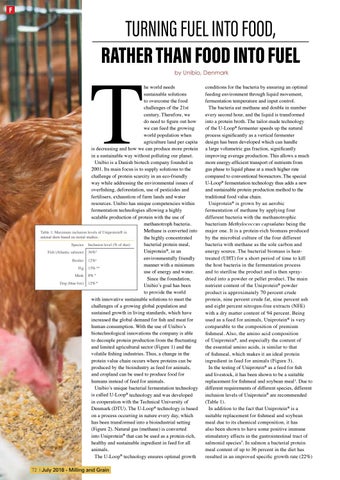
he world needs sustainable solutions to overcome the food challenges of the 21st century. Therefore, we do need to figure out how we can feed the growing world population when agriculture land per capita is decreasing and how we can produce more protein in a sustainable way without polluting our planet. Unibio is a Danish biotech company founded in 2001. Its main focus is to supply solutions to the challenge of protein scarcity in an eco-friendly way while addressing the environmental issues of overfishing, deforestation, use of pesticides and fertilisers, exhaustion of farm lands and water resources. Unibio has unique competencies within fermentation technologies allowing a highly scalable production of protein with the use of methanotroph bacteria. Methane is converted into Table 1: Maximum inclusion levels of Uniprotein® in animal diets based on initial studies. the highly concentrated Species Inclusion level (% of diet) bacterial protein meal, 2 Uniprotein®, in an Fish (Atlantic salmon) 36% environmentally friendly Broiler 12%1 manner with a minimum Pig 15% 3,4 use of energy and water. Mink 8% 5 Since the foundation, Dog (blue fox) 12% 6 Unibio’s goal has been to provide the world with innovative sustainable solutions to meet the challenges of a growing global population and sustained growth in living standards, which have increased the global demand for fish and meat for human consumption. With the use of Unibio’s biotechnological innovations the company is able to decouple protein production from the fluctuating and limited agricultural sector (Figure 1) and the volatile fishing industries. Thus, a change in the protein value chain occurs where proteins can be produced by the bioindustry as feed for animals, and cropland can be used to produce food for humans instead of feed for animals. Unibio’s unique bacterial fermentation technology is called U-Loop® technology and was developed in cooperation with the Technical University of Denmark (DTU). The U-Loop® technology is based on a process occurring in nature every day, which has been transformed into a bioindustrial setting (Figure 2). Natural gas (methane) is converted into Uniprotein® that can be used as a protein-rich, healthy and sustainable ingredient in feed for all animals. The U-Loop® technology ensures optimal growth 72 | July 2018 - Milling and Grain
conditions for the bacteria by ensuring an optimal feeding environment through liquid movement, fermentation temperature and input control. The bacteria eat methane and double in number every second hour, and the liquid is transformed into a protein broth. The tailor-made technology of the U-Loop® fermenter speeds up the natural process significantly as a vertical fermenter design has been developed which can handle a large volumetric gas fraction, significantly improving average production. This allows a much more energy-efficient transport of nutrients from gas phase to liquid phase at a much higher rate compared to conventional bioreactors. The special U-Loop® fermentation technology thus adds a new and sustainable protein production method to the traditional food value chain. Uniprotein® is grown by an aerobic fermentation of methane by applying four different bacteria with the methanotrophic bacterium Methylococcus capsulatus being the major one. It is a protein-rich biomass produced by the microbial culture of the four different bacteria with methane as the sole carbon and energy source. The bacterial biomass is heattreated (UHT) for a short period of time to kill the host bacteria in the fermentation process and to sterilise the product and is then spraydried into a powder or pellet product. The main nutrient content of the Uniprotein® powder product is approximately 70 percent crude protein, nine percent crude fat, nine percent ash and eight percent nitrogen-free extracts (NFE) with a dry matter content of 94 percent. Being used as a feed for animals, Uniprotein® is very comparable to the composition of premium fishmeal. Also, the amino acid composition of Uniprotein®, and especially the content of the essential amino acids, is similar to that of fishmeal, which makes it an ideal protein ingredient in feed for animals (Figure 3). In the testing of Uniprotein® as a feed for fish and livestock, it has been shown to be a suitable replacement for fishmeal and soybean meal1. Due to different requirements of different species, different inclusion levels of Uniprotein® are recommended (Table 1). In addition to the fact that Uniprotein® is a suitable replacement for fishmeal and soybean meal due to its chemical composition, it has also been shown to have some positive immune stimulatory effects in the gastrointestinal tract of salmonid species7. In salmon a bacterial protein meal content of up to 36 percent in the diet has resulted in an improved specific growth rate (22%)