STORAGE
F
U
Pinpointing possible grain problems by Vaughn Entwistle, Features Editor, Milling and Grain nderstanding the quality and condition of grain is crucial, and the only way to assess that is through accurate sampling at each stage of the grain chain. Accurate sampling can help to reduce waste and minimise charges, claims, and rejections. As commonly practiced, sampling involves the collection of physical grain, so it can be tested for moisture, temperature, and possible contamination by pests and moulds. For many years, sampling grain has been important in measuring key quality parameters in combinable crops (e.g. Hagberg Falling Number, nitrogen content and specific weight). In recent years, however, other challenges (including Mycotoxins) have emerged, requiring the industry to demonstrate due diligence. Providing grain samples is part of that evidence. Grain sampling is, therefore, even more important and must be undertaken using appropriate methods at the most relevant points along the grain chain. Under the current system typically employed in the United States, when a grain truck pulls up to an elevator, the tarp covering the grain is pulled aside and a six-to-10-feet long probe is thrust into the grain. A chamber inside the probe takes in a sample, which is then tested. Sometimes this sample is manually extracted. At other facilities an automated probe pneumatically takes a sample. But the sample is limited to the loading/offloading process and does not answer the problem of how to test the great depth and quantity of grain being held in a grain bin or silo.
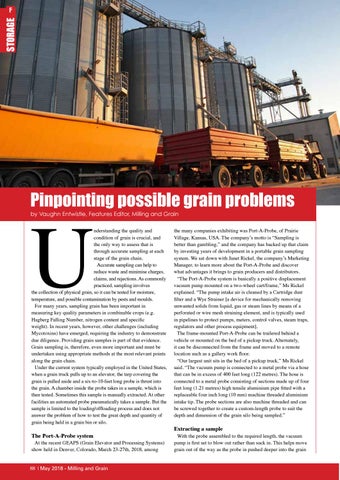
the many companies exhibiting was Port-A-Probe, of Prairie Village, Kansas, USA. The company’s motto is “Sampling is better than gambling,” and the company has backed up that claim by investing years of development in a portable grain sampling system. We sat down with Janet Rickel, the company’s Marketing Manager, to learn more about the Port-A-Probe and discover what advantages it brings to grain producers and distributors. “The Port-A-Probe system is basically a positive displacement vacuum pump mounted on a two-wheel cart/frame,” Ms Rickel explained. “The pump intake air is cleaned by a Cartridge dust filter and a Wye Strainer [a device for mechanically removing unwanted solids from liquid, gas or steam lines by means of a perforated or wire mesh straining element, and is typically used in pipelines to protect pumps, meters, control valves, steam traps, regulators and other process equipment]. The frame-mounted Port-A-Probe can be trailered behind a vehicle or mounted on the bed of a pickup truck. Alternately, it can be disconnected from the frame and moved to a remote location such as a gallery work floor. “Our largest unit sits in the bed of a pickup truck,” Ms Rickel said. “The vacuum pump is connected to a metal probe via a hose that can be in excess of 400 feet long (122 metres). The hose is connected to a metal probe consisting of sections made up of four feet long (1.21 metres) high tensile aluminium pipe fitted with a replaceable four inch long (10 mm) machine threaded aluminium intake tip. The probe sections are also machine threaded and can be screwed together to create a custom-length probe to suit the depth and dimension of the grain silo being sampled.”
The Port-A-Probe system
With the probe assembled to the required length, the vacuum pump is first set to blow out rather than suck in. This helps move grain out of the way as the probe in pushed deeper into the grain
At the recent GEAPS (Grain Elevator and Processing Systems) show held in Denver, Colorado, March 23-27th, 2018, among 88 | May 2018 - Milling and Grain
Extracting a sample