April 2018
YOUR GLOBAL PARTNER
In this issue:
The GRAPAS Award for Innovation • Agribusiness in Africa • Milling wheat
Milling and Grain . Volume 129 . Issue 04 . April 2018
• Impact of dietary sodium diformate on performance and litter quality in broilers • Phytogenic feed supplements • Storage: 3D level sensors • GRAINTECH EXPO
Event review Proud supporter of
Volume 129
Issue 04
millingandgrain.com
Our team of experienced Dealers and Staff
will help you determine the system that will suit your needs. Chief Agri has a full line of grain storage, conditioning, handling, and drying products that can be engineered to fit your site.
chief.co.uk
|
Storage
agri.chiefind.com
Handling & Support Structure
|
Conditioning
silos-phenix.com
Dryers
COMMERCIAL BINS
COMMERCIAL DRYERS
STEEL BUILDINGS
COMMERCIAL SWEEPS
BUCKET ELEVATORS
COMMERCIAL CONVEYORS
• 47.548m Diameter Bins (20320.9-48262.2 mt) • Tower Dryers (22.5-281.2 t/h) • Peak Load Rating (6803.8-45359.2 kg) • QuadraTouch ProTM Controls • Hopper Bins (3.65m-14.6m) • Balanced Moisture Content • Auger & Paddle sweeps available • Capacity includes 140.6-281.2 t/h • Patented Pivot Point • Industrial Grade Pushers
• Low Impact Head Design • Heavy Gauge Trunking • Patented Squaring Plates • Support Towers
• Industrial Strength • Built To Last • Higher Elemental Resistance • Capacity includes (984.3-1687.5 t/h) • Dust-tight and waterproof • Patented hip-style weather-tight cover • Catwalks
Su k u p World Headquarters - S heff ie ld , I o wa USA • www. su ku p . co m • in f o @ su ku p . co m For service in Europe contact:
Sukup Europe A/S Hedensted, Denmark Tel +45 75 68 53 11 • Fax +45 75 68 54 70 info@sukup-eu.com • www.sukup-eu.com
Pneumatic or Mechanical Ship Loaders & Unloaders Port Equipment - Turnkey Projects
1968 2018
1350 machines installed in more than 100 countries! VIGAN Engineering s.a. Rue de l’Industrie, 16 - 1400 Nivelles - Belgium Tél.: +32 67 89 50 41 • Fax : +32 67 89 50 60 • www.vigan.com • info@vigan.com
VOLUME 129 ISSUE 04
April 2018
Perendale Publishers Ltd 7 St George’s Terrace St James’ Square, Cheltenham, Glos, GL50 3PT, United Kingdom Tel: +44 1242 267700 Publisher Roger Gilbert rogerg@perendale.co.uk International Marketing Team Darren Parris Tel: +44 1242 267707 darrenp@perendale.co.uk Tom Blacker Tel: +44 1242 267700 tomb@perendale.co.uk Martha Cornwell Tel: +1 913 6422992 marthac@perendale.com Fred Norwood Tel: +1 913 6422992 fredn@perendale.com Latin America Marketing Team Iván Marquetti Tel: +54 2352 427376 ivanm@perendale.co.uk New Zealand Marketing Team Peter Parker peterp@perendale.co.uk Nigeria Marketing Team Nathan Nwosu Tel: +234 805 7781077 nathann@perendale.co.uk Production Editor Zasha Whiteway-Wilkinson zashaw@perendale.co.uk Features Editor Vaughn Entwistle vaughne@perendale.co.uk International Editors Dr Roberto Luis Bernardi robertob@perendale.co.uk Professor Wenbin Wu wenbinw@perendale.com ˘ Gürkaynak Mehmet Ugur mehmetg@perendale.com Design Manager James Taylor jamest@perendale.co.uk Circulation & Events Tuti Tan tutit@perendale.co.uk Development Manager Antoine Tanguy antoinet@perendale.co.uk ©Copyright 2018 Perendale Publishers Ltd. All rights reserved. No part of this publication may be reproduced in any form or by any means without prior permission of the copyright owner. More information can be found at www.perendale.com Perendale Publishers Ltd also publish ‘The International Milling Directory’ and ‘The Global Miller’ news service
Grain & Feed Milling Technology magazine was rebranded to Milling and Grain in 2015
86 - Industry profile: Satake
Tohoku Satake mark their 50th anniversary
ISSUE HIGHLIGHTS
2
NEWS FEATURES
52 The GRAPAS Award for Innovation 56 The malting business
60 Agribusiness in Africa 62 Milling Wheat
FACES
6-44
70 Impact of dietary sodium diformate on performance and litter quality in broilers
74 Animal health and nutrition fund 76 Phytogenic feed supplements
124 People news from the global milling industry
PRODUCT FOCUS
50
CASE STUDY
94
80 Grinding and packaging
STORAGE
80 Grain preparation for milling The first in a series of articles from the grapas innovation conference 2018
EVENTS
102 Event listings, reviews and previews
88 Store-way to Hunan: China’s grain storage problem
90 Using 3D level sensors to address the toughest grain storage challenges
TRAINING
46 Milling courses offered for industry experts
COLUMNS
12 Mildred Cookson 25 Tom Blacker 38 Chris Jackson
4 GUEST EDITOR Aidan Connolly
96 MARKETS John Buckley
122 INTERVIEW David Perry
COVER IMAGE: Congratulations (from left) to Sander Geelen of Geelen Counterflow in The Netherlands, Andreas Hummel of Bühler, Switzerland and Peter Marriott of Satake/Alapala in the UK who are joint winners of 2018 GRAPAS Innovation Award - see more on page 52
ISSUE HIGHLIGHTS GRAPAS
CHINA
LEVEL SENSORS
The GRAPAS Award for innovation
Store-way to Hunan: China’s grain storage problem
Using 3D level sensors to address the toughest grain storage challenges
Too close to call! That was the result of the compilation of results from a panel of international judges evaluating this year's finalists in for the GRAPAS Innovation Award in Bangkok, Thailand.
PAGE 52 BARLEY
WHEAT Milling wheat
The ‘Beast from the East’ failed to foil millers and Milling and Grain joined up with them to report on the industry insights from the 2018 AHDB Milling Wheat Conference
Seventure Partners, one China is one of the largest stakeholders in ensuring global food security. Informed speculators are taking positions to benefit; they’re putting it all on red.
PAGE 62
PAGE 88
The malting business
Cimbria has been involved in the malting industry for over 40 years and is a leader in supplying cleaning, drying and conveying equipment for malting barley and dry malt processing equipment.
For almost a decade, 3DLevelScanners have been providing highly accurate level and volume measurement in challenging materials contained in bins, tanks, and silos. The only sensor to measure and map the material surface, it sends pulses in a 70° beam angle, taking multiple level measurements and accounting for uneven surface topography when calculating volume.
PAGE 90
PAGE 56
FOOD
STORAGE
FEED
PROCESS
NUTRITION Animal health and nutrition fund
GRAPAS CONFERENCE Grain preparation for milling
Healthy flour and semolina can only be made from healthy grain. Grain is constantly under attack. The weather tries to damage it, insects try to consume it and lay their eggs in it and birds and rodents eat it and leave their evidence behind.
PAGE 82
PACKAGING Grinding and packaging
POULTRY Impact of dietary sodium diformate on performance and litter quality in broiler
SaltWorks® is a sea and mineral salt company located in Woodinville, Washington producing a range of specialty salts for wholesale customers, private label, and direct to consumers.
Animal husbandry suffers from losses due to contamination with pathogenic bacteria. Their resultant impacts in animals include lower weight gains and increased mortality.
PAGE 80
PAGE 70
Seventure Partners, one of Europe’s leaders in financing innovation and a world-leader in Life science microbiome investment, has announced that it has launched AVF, the innovative venture capital fund, targeted at supporting companies in the field of animal health, feed and nutrition.
PAGE 74
“fatti non foste a viver come bruti, ma per seguir virtute e canoscenza.”
“you were not born to live like brutes, but to follow virtue and knowledge.”
Welcome into the World of Wisdom...
IPACK-IMA 2018 (Milan, 29 May-1June) Booth B35-C34
www.paglierani.com
www.ocrim.com
A front-row seat to the man and themind behind some of the most innovative and maverick ideas in agriculture For over 25 years, I was lucky enough to have a front-row seat to the man and the mind behind some of the most innovative and maverick ideas in agriculture. When the founder of Alltech, Dr Pearse Lyons, moved his family to Lexington, Kentucky in the 1980s, no one could have foreseen the transformative impact he would have on the animal health world. For at the heart of Alltech is the energy of an entrepreneurial spirit driven by a vision to sustain our planet and all things living on it. Dr Lyons was a scientist who sought to use his expertise in yeast fermentation to tackle animal health challenges. Strictly speaking, he was an outsider, having worked as a biochemist for Irish Distillers before moving to Kentucky. His background in brewing and distilling enabled him to consider the digestion and fermentation processes in an animal very differently from those trained in animal nutrition. It was this unique perspective from which Alltech’s technologies were born. In 1983, Alltech launched Yea-Sacc® 1026, the company’s first animal nutrition brand, and soon became the first company to launch an enzyme complex, a live yeast culture, buffered organic acids and the application of specific probiotics. Sel-Plex® organic selenium, Mycosorb® for mycotoxins and Bio-Mos®, a yeastbased nutritional solution for gastrointestinal health, arrived in the 1990s and were the first of their kind. These animal health solutions are testament to the significant investment Dr Lyons made in research and development within Alltech’s bioscience centres and with partner universities. In fact, it was through research at the University Kentucky that the actual mode of action of live yeast cultures was first identified. This was transformative to the animal health industry — Dr Lyons brought scientific rigor and proof to the additive market, giving it much-needed validity. This research finally explained how yeast was affecting the rumen function, and when and why its use was most critical. It wasn’t only his technology that was ahead of his time, but also his philosophy. At Alltech’s symposium in 1989, a presenter
spoke about ACE, the idea that the agricultural industry needed to think about the welfare of the animal, consumer and environment. At that time, the industry was primarily driven by the idea of producing cheap and safe food in abundance. The ACE concept was ridiculed and people actually walked out of the presentation. Dr Lyons, being the visionary he was, saw merit in the ACE concept and felt it fit his model for Alltech. ACE became Alltech’s guiding principle from that point forward, ensuring everything the business did was for the benefit of the animal, consumer and environment. What was seen as a radical idea in the early 1990s is now almost a requirement of all modern agribusinesses. His knowledge and understanding of marketing was second to none. He knew there needed to be a stronger connection between the general public and the world of animal nutrition. In 2010, Alltech sponsored the World Equestrian Games in Kentucky and again in France in 2014, bringing Alltech, and animal nutrition, into the living rooms of hundreds of millions of people worldwide. Dr Lyons drove for Alltech to be the best on every level, including pushing his team for “higher than industry” quality standards. What resulted was the Alltech® Quality System, a global quality assurance program has set the gold standard by meeting or exceeding all local requirements globally. We now inherit a truly global company, doing business in over 120 countries. We are not merely present globally, but all these regions are quite evenly balanced by share of the total sales. Dr Lyons always went where others would not dare to go, so Alltech has led the market into most countries. Because we are present globally, we are positioned to observe trends and regulations in one country and foresee their knock-on effects on other countries. We’ve also been able to pick up ideas from one market and carry them over to other markets. Dr Lyons might have started his entrepreneurial journey alone with his young family, but he leaves behind a team of over 5000 people who share his vision and passion. Aidan Connolly, Chief Innovation Officer & Vice President of Corporate Accounts, Alltech
Annual Subscription Rates Inside UK: UK£100 Outside: US$150/€133
ISSN No: 2058-5101
More Information www.millingandgrain.com http://gfmt.blogspot.co.uk
40 YEARS OF TESTED STRENGTH
One Tapco Nylon Elevator Bucket Supports a 9700 Pound* H1 HUMMER Ambient Temperature: 17 °F (-8 °C)
TAPCO’S CC-XD (Xtreme Duty) gray nylon elevator bucket supports a 9700 lb. H1 Hummer vehicle. Testing confirms that it will support over 20,000 lbs., more than two Hummers!
TAPCO’S CC-XD (Xtreme Duty) blue polyethylene bucket will support 9,000+ lbs.
Tapcoinc.com
TAPCO’S CC-HD (Heavy Duty) blue polyethylene bucket will support 5,000+ lbs.
314.739.9191 / St. Louis, Missouri USA No 814
*4399 kg
News
APR 18
Milling
At the time of writing this, Roger Gilbert our CEO and Tuti Tan, Events Manager are holding down the fort at one of the biggest times of the year for Milling and Grain: The GRAPAS conference, held as a one-day miller's conference at Victam Asia 2018. After months of preparation and planning the conference is finally kicking off and there is a plethora of fantastic speakers due to grace the stage on the day in Bangkok, Thailand. We put together a little list of fantastic reasons why you or any milling industry professional should be heading over to our conference of course when reading this you’ll have missed this years', perhaps this will inspire you to be the first to have your name down for the next one in 2019!
Milling and Grain launch new website
P
erendale Publishers Ltd., have launched their new website for the magazine Milling and Grain. Designed by Pablo Porcel, Communications Manager, Latin America division, the website will be updated frequently with the features from the printed copies of the magazine and divided into sections depending on the interests of the interested professional. Also on the website will be an up to date list of events and training within the industry, as well as a comprehensive guide to companies for different industry sectors which will be built up with easy to find contact details and information for those wishing to expand their networks. The sections of the magazine have been divided five different ways; Milling Machinery (including: flour, feed, rice, pasta and oil seeds), Nutrition, divided into feed and food- Feed: swine, ruminants, poultry, aquaculture and pet. Food: wheat flour, rice flour, grain flour and additives.), Raw Materials, Storage and handling: silos, conveying, pneumatic, loading and unloading and bagging and palleting), and Lab Machinery. Please contact: darrenp@perendale.co.uk – if you are interested in advertising on the website. www.millingandgrain.com
Five great reasons not to miss GRAPAS!
The first is to listen to a morning of presentations that delve into all aspects of flour, rice and cereal milling and to hear experts express their thoughts and views on where our industry might be heading in key areas of process and production in the years ahead. The second sound reason is to be on hand to hear about the latest innovations that companies have entered for this year’s GRAPAS Innovation Awards. Several of the nominees will have an opportunity to explain what makes their latest development an innovation deserving to win the award! Be the first to hear first-hand in our afternoon sessions. The third good reason is to take the opportunity to network with colleagues from other countries and throughout the region and make those all-important business connections that will serve you well in the future. GRAPAS is one of just a small number of events held for flour and rice millers in the region, so the opportunity to meet and greet is obviously valuable. Besides learning about issues, innovations and people, GRAPAS offers all registrants free access to the world’s largest regional milling exhibition for feed millers. Many flour, rice and cereal millers produce by-products that find their way into animal feeds. The Victam exhibition is in the same location is an ideal opportunity to see the latest equipment and additives, etc. being used in feed formulations. That’s the fourth good reason! Finally, the fifth compelling reason to be at the GRAPAS & Global Milling Conference is to learn about the industry’s new Charity - Milling 4 Life CIO - which was registered with the UK Charities Commission in April 2017. Learn what it’s plans are and what this might mean for you and your industry in the years ahead. As well as GRAPAS we’ve got Darren Parris our Group President and Vaughn Entwistle our new Features Editor representing the team at this years GEAPs exhibition where they will be hosting a stand. And our Turkish Editor Mehmet Ugur Gürkaynak, who will be hosting a stand at World Mill Tech! So if you weren’t able to make it to any of these brilliant events this year, not to worry – we’ll cover them in such detail you’ll feel like you were there! Check out the grain drying feature written by Vaughn from his visit earlier this month to Perry of Oakley Ltd and the accompanying interview at the back from Managing Director David Perry.
GF
MT
gfmt.blogspot.com 6 | April 2018 - Milling and Grain
Upgrade your roller mill by using Balaguer Rolls only. Ask your roller mill supplier to provide Balaguer Rolls on your machines. Follow us. Facebook
YouTube
www.balaguer-rolls.com
VISIT OUR STAND AT
Stand B20-D31 Fiera Milano - Milan, Italy May 29 - June 1 2018
Dr Pearse Lyons
D
"He planted seeds that will produce a bountiful harvest for the world in the years to come.”
1944-2018
Dr Pearse Lyons, Founder and President of Alltech has sadly passed away
that yeasts, enzymes and certain bacteria could help animals use r Pearse Lyons was described as a “visionary entrepreneur who transformed feed more efficiently – a concept which was not new but lacked scientific data and research. And that first million became two... the agriculture industry” by Alric Blake, “We have never, ever had a month where Alltech has not made a CEO and Treasurer of Alltech. profit, a good profit,” he said. He said that, “Beginning with his “We’ve been growing at 20 percent for the best part of 30 years. innovative application of yeast technology in animal nutrition, By 1985, the animal nutrition side of the business had superseded from farm to field, from market to family dinner table, our world the alcohol side in importance.” is immeasurably better because he was a man who never saw Today, the company is a global animal health company, problems, only a challenge that had not yet been solved.” employing more than 3,000 people with a presence in 128 On Thursday, March 8, 2018 the founder and President of Alltech sadly passed away due to an acute lung condition that had countries and offices in 85 countries, including North America, Latin America, Europe, the Middle East and Asia-Pacific. developed during his recovery from heart surgery. He was 73. Dr Lyons built Alltech Dr Lyons was born and into the fastest growing raised in Dundalk, County company in the global animal Louth, Northern Ireland. He health industry through graduated from University innovative technology, College Dublin with a creative marketing, and strong first-class honours degree branding. It is growing rapidly in biochemistry. Whilst at in the Chinese market. college he worked at Harp 2011 saw Alltech open one Lager in Dundalk, and of the largest commercial graduated with a Master of algae production sites in Science in Brewing Science the world. The US$200 from the British School of million Alltech Algae facility Malting and Brewing (now is located in Winchester, the School of Biochemistry), Kentucky, and the company is University of Birmingham pursuing algae’s applications in 1968. In 1971 he received in animal and human nutrition. a PhD Biochemistry, also Mr Alric Blake summarised from the University of the industry’s thoughts and Biochemistry. He also feelings towards this great received an Honorary industry innovator, “The Doctorate from Heriot-Watt thoughts of our entire Alltech University in 2004. family around the world His work brought him to are with Dr Lyons family, Kentucky in 1976, and in specifically his wife Deirdre, 1980, he set up Alltech in his Dr Pearse Lyons 1944-2018 daughter Aoife, son Mark and garage. Mark’s wife Holly.” With an initial investment His son Dr Mark Pearse of US$10,000 and enough Lyons, Chairman and President of Alltech said of his father money set aside to pay the mortgage and buy groceries for in moving words, “We are all deeply saddened by my father’s the family for a year (by this stage he was married with two passing. He always focused on developing people, and he built an children), Lyons used his fermentation expertise to continue extraordinary team over the years. I know he had full confidence helping brewers. in his team to continue growing the company he built.” Dr Lyons said, “We started in October and we were in profit by He continued, “He saw farther into the horizon than anyone in Christmas. We had to be in profit by Christmas.” the industry, and we, as his team, are committed to delivering on Not only was he in profit by Christmas, but he did a million the future he envisioned. He planted seeds that will produce a dollars’ worth of business in his first year. bountiful harvest for the world in the years to come.” After this he turned his attention to animal feed in the belief 10 | April 2018 - Milling and Grain
Milling News
A science and risk-based approach to plant breeding urged
T
he US Department of Agriculture (USDA) “does not regulate or have plans to regulate plants that could otherwise have been developed through traditional breeding techniques as long as they are not plant pests or developed using plant pests,” says its Secretary of Agriculture Sonny Perdue on March 30, 2018. The National Grain and Feed Association (NGFA) Chief Executive Officer Randy Gordon says, “For grain handlers, grain processors and exporters, it is essential that the US government exert strong and effective leadership in interacting with governmental authorities in other countries to urge adoption of science- and risk-based approaches to the regulatory treatment of plant breeding innovation so there is not a recurrence of the significant and costly international trade disruptions that occurred with some transgenic biotech traits. “Time is of the essence, and we have every reason to believe USDA will do its part within a coordinated and robust US government outreach effort that also needs to involve the US Food and Drug Administration and Environmental Protection Agency.” Engagement with these agencies’ governmental counterparts in US export markets is critical in bringing about development of a coherent international regulatory environment that preserves the benefits and efficiencies of a commingled, fungible grain and oilseed supply chain, while enabling efficient, cost-effective trade to continue unabated, he adds. “It also is fundamentally important that those developing and commercializing innovative plant breeding techniques accept their rightful responsibility to communicate proactively with consumers about the safety and benefits of these new plant-breeding techniques to foster consumer acceptance,” he says. “It also is incumbent upon plant breeders and the seed industry to be forthcoming with accurate and timely information about the specific innovative plant breeding techniques being developed for commercial use in food and feed crops - through
a proactive, comprehensive advance notification and ongoing consultation process - to enable the grain and food industries to respond to commercial demand and inquiries from domestic and international customers and consumers.” The NGFA, established in 1896, consists of more than 1050 grain, feed, processing, exporting and other grain-related companies that operate more than 7000 facilities and handle more than 70 percent of all US grains and oilseeds. Its membership includes grain elevators; feed and feed ingredient manufacturers; biofuels companies; grain and oilseed processors and millers; exporters; livestock and poultry integrators; and associated firms that provide goods and services to the nation’s grain, feed and processing industry. The NGFA also consists of 29 affiliated State and Regional Grain and Feed Associations, and has strategic alliances with Pet Food Institute and North American Export Grain Association.
Milling and Grain - April 2018 | 11
Messrs Cannon and Gaze’s Mills, Erith
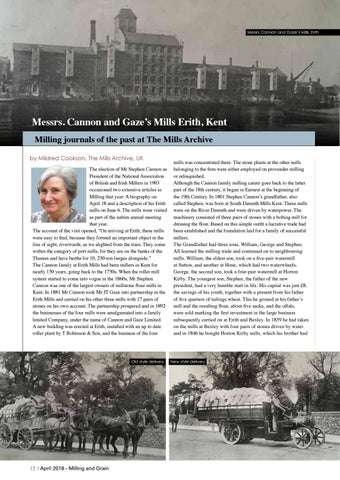
Messrs. Cannon and Gaze’s Mills Erith, Kent Milling journals of the past at The Mills Archive by Mildred Cookson, The Mills Archive, UK The election of Mr Stephen Cannon as President of the National Association of British and Irish Millers in 1903 occasioned two extensive articles in Milling that year: A biography on April 18 and a description of his Erith mills on June 6. The mills were visited as part of the nabim annual meeting that year. The account of the visit opened, “On arriving at Erith, these mills were easy to find, because they formed an important object in the line of sight, riverwards, as we alighted from the train. They come within the category of port mills, for they are on the banks of the Thames and have berths for 10, 250-ton barges alongside.” The Cannon family at Erith Mills had been millers in Kent for nearly 150 years, going back to the 1750s. When the roller mill system started to come into vogue in the 1860s, Mr Stephen Cannon was one of the largest owners of millstone flour mills in Kent. In 1881 Mr Cannon took Mr JT Gaze into partnership in the Erith Mills and carried on his other three mills with 17 pairs of stones on his own account. The partnership prospered and in 1892 the businesses of the four mills were amalgamated into a family limited Company, under the name of Cannon and Gaze Limited. A new building was erected at Erith, installed with an up to date roller plant by T Robinson & Son, and the business of the four
Old style delivery
12 | April 2018 - Milling and Grain
mills was concentrated there. The stone plants at the other mills belonging to the firm were either employed on provender milling or relinquished. Although the Cannon family milling career goes back to the latter part of the 18th century, it began in Earnest at the beginning of the 19th Century. In 1801 Stephen Cannon’s grandfather, also called Stephen, was born at South Darenth Mills Kent. These mills were on the River Darenth and were driven by waterpower. The machinery consisted of three pairs of stones with a bolting mill for dressing the flour. Based on this simple outfit a lucrative trade had been established and the foundation laid for a family of successful millers. The Grandfather had three sons, William, George and Stephen. All learned the milling trade and continued on to neighbouring mills. William, the eldest son, took on a five-pair watermill at Sutton, and another at Hone, which had two waterwheels. George, the second son, took a four-pair watermill at Horton Kirby. The youngest son, Stephen, the father of the new president, had a very humble start in life. His capital was just £8, the savings of his youth, together with a present from his father of five quarters of tailings wheat. This he ground at his father’s mill and the resulting flour, about five sacks, and the offals, were sold marking the first investment in the large business subsequently carried on at Erith and Bexley. In 1839 he had taken on the mills at Bexley with four pairs of stones driven by water and in 1846 he bought Horton Kirby mills, which his brother had
New style delivery
been working, bringing his milling power up to eight pairs of stones. Grandson Stephen, was born in 1836 and was the only son in the family to continue in the milling trade, although his brother, Alfred, went into paper milling, having the mill at Sandford on the Thames near Oxford. Stephen, once his father had died, sold the Horton Mr Stephen Cannon nabim Kirby Mills and continued President-elect, 1903 at Bexley. A new steam mill with four pair of stones was added and then the Erith mills were bought, bringing the milling power up to 13 pairs of stones. In 1881 three more pairs were added and in 1882 a four-pair mill at Hall Place on the River Cray was taken. The Erith mills, described in detail in Milling, were located between the main street and the River Thames. The offices and the powerhouse flanked the street and a large mill yard separated them from the mill and silo which were both adjacent to the river. The premises were built over various periods but had a harmonious appearance; the architecture was described as neat and calculated to suit the business. The engine was placed in the centre of the main building, a compound tandem type built by a Lancashire firm. Steam was also provided by Lancashire boilers which offered the most economic coal consumption. The main drive from the engine was by fly wheel with cotton ropes, six driving the roller shafts, four the machinery on the purifying and dressing floors and six the
Messrs Cannon and Gaze’s Mills, Bexley
screen house, provender mill and large elevator. There was also an auxiliary engine for driving the dynamo for lighting the whole of the premises by electric light. The section with the roller mill plant was between the warehouse and the cleaning house, the silo granary being at the end of the range. On the roller floor were two lines of Robinson double roller mills, arranged lengthwise, the five breaks being carried out on six double mills and the reductions on eleven double sets. The first break rolls were fed by “Moir” feeders. There was also a neat arrangement for storing fresh cut rolls without taking up too much space. On the second floor there were a full line of “Koh-i-N’or” purifiers with an improvement by Stephen’s son Herbert of a hood over the sieves, which was portable, so the top of the sieve could be brushed while in motion. The next floor contained three purifiers, four rotary sieves acting as scalpers, four grading sieves and an “Avery”
Milling and Grain - April 2018 | 13
Milling and Grain supports the aims and objectives of the Mills Archive Trust, based in Reading, England. The history of milling no matter where it has taken place - is being archived by the Trust. For well over 100 years milling technology has been global with many magazines serving or having served our industry from flour and food to feed and oilseed processing and now to fish feeds. A most recent contribution to the Trust’s collection is a complete century of past edition of the now out-of-print ‘NorthWestern Miller’ from the United States. We are proud to present here, front cover illustrations from this valued and longserving publication as a visual reminder of the importance contribution past magazines provided to our industry.
YOUR GLOBAL PARTNER
Art in the Archive We are a charity that saves the world’s milling images and documents and makes them freely available for reference. We have more than two million records. We aim to cover the entire history of milling, from its ancient origins up to the present day. Find out what we have and how you can help us grow.
millsarchive.org The Mills Archive Trust Registered Charity No 1155828
automatic scale, which passed 100lb loads to the break plant. The top floor contained all the dusting and dressing machinery, with 21 centrifugals and three reels. All except six of the former were 27-inch diameter and made by Robinson. The system of purifying the break stock appeared to work well. The plant was able to grind either hard or mild mixtures, with additional roll and silk surfaces being coupled up to the system when the latter was being ground. The cleaning house was fitted with a complete cleaning set, washer, whizzer, dryer, cylinders and scourer, as well as all the minor adjuncts such as separators, dust collectors, graders etc. Nearly all the wheats were washed and conditioned, and when the hard sorts reach the mill they were nearly as mild in structure as the English sorts. The silo granary had a complete set of Robinson wheat mixers. And a barge elevator could lift 30 tons per hour. The provender mill had five pairs of stones and was driven by the main engine. Stabling was provided for 30 horses, but the firm also used two five-ton steam motor wagons, one by Messrs Mann of Hunslet, Leeds, the other by a southern firm. The whole of the premises were protected from fire by “Grinnell” sprinklers, the pressure for which was provided from a tank on the tower as shown in the illustrations. The firm also at the time ran a large country water mill at Bexley, where the provender trade was carried on. A number of horses
were also stabled there for work at both mills and a blacksmith’s forge was kept busy in shoeing work. The Bexley mill was finally sold in 1946 by Stephen’s grandsons and daughters as was the Erith mills and sadly, on May 20, 1966, one of the most beautiful buildings in Kent was totally destroyed by fire. The geographical and historical spread of our holdings at the Mills Archive mean that I can only provide snapshots; if you would like to know more please email me at mills@millsarchive.org.
TIME SAVING AND MAXIMUM SAFETY
Wynveen International Automated Chutes setting a new standard when filling bulk trailers. The new regulating system delivers a combined solution for the automatic positioning and securing of chutes. This ensures optimum safety for the production employees and also saves a considerable amount of time.
WWW.WYNVEEN.COM Milling and Grain - April 2018 | 15
A Triott Company
More info in Casestudy section (P9 4)
Milling News
Enhancing quality management
T
he Brabender GlutoPeak complements raw material quality analysis practices at Kröner-Stärke GmbH’s incoming and outgoing goods departments – quickly and fully automatically. The company developed its innovative GlutoPeak method of quickly and reproducibly analysing the quality of various types of flour and vital gluten to meet the specific needs of the milling, baking and starch industry. Brabender customer KrönerStärke, based in Ibbenbüren in the Tecklenburger Land, Germany, has been using this quick testing procedure to determine gluten quality for about a year now in its incoming goods department and also following gluten production. The (bio-) wheat starch and gluten producer talks about how the GlutoPeak has enhanced its quality
management system in a video that Brabender recently published on its Youtube channel. The GlutoPeak makes gluten quality analysis of the flours delivered every day to Kröner-Stärke more efficient than ever before. Matthias Evers, Quality Manager at Kröner-Stärke explains, “The Brabender GlutoPeak does an excellent job for us several times a day. This enables us to reduce quality control times in our incoming goods
department substantially.” Categorising roughly ten sample flours per hour using this analysis method is a valuable way of easing the pressure on Kröner-Stärke. The GlutoPeak also provides the starch producer with added benefits in the form of rapid information about protein appraisals and for the purposes of making rheological statements about expected baking volumes and integrated quality assessments of the cereals or milled products examined.
NEVER STOP INNOVATING! VIBRONET® THE END OF TEMPER TIME
25 YEARS
ACCELERATION OF LIQUID ENTRY TO REDUCE BACTERIAL GROWTH LIQUID ADDITION OF UP TO 12% IN ONE PASS DRASTIC SAVINGS IN ENERGY, TIME, AND SILO SPACE FIELDPROVEN TECHNOLOGY FOR 25+ YEAR SERVICE LIFE
RAW MATERIAL CONTROL
WEIGHING AND DOSING
16 | April 2018 - Milling and Grain
PROCESS CONTROL
MOISTURE CONTROL WATER ADDITION
VIBRONET® GRÄF GMBH & CO. KG CEREAL DAMPING SYSTEMS NEUMÜHLE 1 35633 LAHNAU GERMANY VIBRONET.COM INFOVIBRONET.COM
IAOM
ATLANTA GA USA
APRIL 9.13. STAND #132
The Raghavan Report The cost of "Anti-industry" propaganda and the need for busting myths and half-truths by Raghavan (‘Ragha’) Sampathkumar Continuing from my last column, let me explain the costs of negative propaganda that is spread by people and organisations with vested interests. Diversity in this world is the primary reason for the very existence of the human species. Diversity in culture, social norms, rules, language, food, culinary preferences, crops grown and ideologies. Here ideologies are critical, and one must understand the differences in perspectives that form belief systems in every culture and race. Asian cultures are typically hierarchical and bound by strong social norms. Often individual choices and preferences are overruled by societal expectations or norms. But this is not the case of Western cultures. All these factors influence how people perceive and respond to information. Of late, we have seen many ideologies are borrowed as such from Western countries, which are nowhere close to the realities – social, economical, cultural, and political – in Asia. One of such borrowed ideology is about “Utopian green” agriculture wherein people want to take precautionary (often negative and time-consuming) perspective towards any new technology but expect agriculture to continue to feed the growing population with affordable, safe and nutritious food. How is it possible? Any technology, be it a drug, a trait, or a chemical, will have its own advantages and disadvantages as well as risks and benefits. Risks are to be weighed against the benefits and that must be the main objective while taking a neutral and balanced stand on assessing any new innovation. However, it does not happen this way in the current world particularly after the explosion of social media. Governments and policy makers are always watchful and most sensitive about public sentiments on any issues. For example, privacy on social media became an important concern for everyone and Governments are
scrambling to act swiftly. Ever increasing clamour and need for sensational news are actually impacting the confidence that public have on the food industry. This is not to say no one is doing anything wrong and everything is correct. Social media is an effective medium to communicate and connect with the public. But, with unfounded claims against the food industry, from red meat consumption, chemical residues, labour and welfare issues to environmental stewardship practices in the food value chain, general public are being influenced heavily. Often the industry is not as vocal or articulate about their perspectives as the other groups and often falls short in terms of money and taking proactive initiatives. It doesn’t end here. Policies are getting heavily influenced by public sentiments and the groups with vested interests aptly gauge this to ensure which ever innovations or technologies that they wish to block or delay, are portrayed negatively in the eyes of the public. They do it steadily and in a concerted manner that the public, unless they care to understand, do not know the real hidden objective of these groups in spreading these claims. The cost of these counterproductive propaganda is enormous if one looks at multiple dimensions. Generally, cost of doing business particularly, regulatory compliance increases. This is true only in case of the organised players who have the responsibilities to fulfil in terms of their ESG mandates. More and more time, efforts and money need to be spent to counter these myths and lies spread by those who don’t have any other objective but to simply spread lies through unjustified scaremongering. Genetic engineering and the myths surrounding it is one of the classic example. For example, innovations like Golden rice can truly benefit millions of underprivileged particularly, children with Vitamin A deficiency. However, due to borrowed ideologies and unjustified negative propaganda, many beneficial technological innovations do not see the light of the day. It is time now for the industry to fight back and let consumers understand the truth. For that it needs to speak in a language that they can understand.
Raghavan Sampathkumar is a food and agribusiness leader with a 360 degree understanding of the complex Geo Political, Environmental, Socio Economic, Techno - Commercial and Cultural perspectives of Agri Food value chain. He worked in various subsectors including agro inputs, international trade, biotech, and animal nutrition across Asia-Pacific and currently he is with Compound Livestock Feed Manufactures Association (CLFMA) of India as its Executive Director. He regularly writes for international publications on agri-food trends, food security and sustainability themes. Also, he pens his poems and thoughts in his personal blog - www.asmalltownkid.wordpress.com. 18 | April 2018 - Milling and Grain
Milling News
Feed security is as important as food security for India
E
nsuring feed raw materials are available at affordable prices at consistent quality year-round is absolutely critical for matching the growing feed demand in India said B. Soundararajan, Chairman CLFMA of India, during his address at the FICCI India Maize summit 2018 at New Delhi.
He added, “We are seeing demand surge in meat consumption in India and correspondingly our demand for feed raw materials such as maize and soybean are increasing. In the last 10 years, Maize demand was hovering around 20 million tonnes in India and it is expected to cross 36 million tonnes by 2025. So, we need to deliberate on how
the shortage of five to six million tonnes, due to slow growth in domestic production, will be met.” Maize is not only an industrial crop, but it is also an important fodder crop as well. Hence, it needs to be given more attention by all stakeholders. He continued, “We cannot afford to be complacent as malnutrition is the greatest challenge for our nation. Protein security is extremely critical to leverage our demographic dividend of being one of the few countries that have a big share of younger population. It is also time for us to look at newer technologies including genetic engineering with a balanced and neutral perspective as we need to improve our productivity from the current low levels of 2.5 tonnes at least to touch the global average of 5.5 tonnes per hectare.” Poultry and livestock sectors consume nearly 70 percent of the maize produced and sourcing non-GM maize particularly when India’s domestic production falls short becomes an extremely difficult task and expensive too. Mr Soundararajan summarised, “We need to look into this holistically with the aim to ensure both sides - farmers and consumers - stand to benefit. On one hand, we need to ensure meat is available at affordable prices and farmers need to get fair remuneration on the other. These can be done with appropriate proactive policy framework and matching budgetary allocations.”
Roller Mill HE
The perfect partner for process automation
A Triott Company
Our Solutions:
Specialist in Pelleting Equipment info@ptn.nl - www.ptn.nl 20 | April 2018 - Milling and Grain
› › › › › ›
Design and engineering Build and installation MCC and PLC panels Software engineering PLC/SDADA MES application Batch Explorer Integration to other software packages Turn Key installations incl. training, service & support
More information? www.inteqnion.com info@inteqnion.com www.inteqnion.com
Milling News
A
Understanding flour
t the beginning of 2018, Mühlenchemie launched a new logo and a new claim, “Understanding Flour” underlines the company’s status as the global market leader in flour standardisation, flour improvement and flour fortification. Lennart Kutschinski, Mühlenchemie’s managing director explained, “We help to make mills less vulnerable to constantly changing climatic, economic and market-related conditions. Thanks to our profound understanding of enzymes, their effects and interactions, we are able to find a tailor-made response to every regional challenge our customers face.” He continued, “That is only possible because of our worldwide presence, with affiliates of our own on the spot, and the short routes that enable us to maintain personal relations with the local millers.” An early evaluation of the quality of the harvest in the countries of origin and a direct assessment of availability and market conditions provide experts with important information for developing individual formulations to meet customers’ needs. Every year, the company standardises and processes over 100 million tonnes of wheat. It exports its products to more than 120 countries and maintains close relations with over 2,000 mills around the globe. Teams of experts in Mexico, Singapore, India, China, Russia and Turkey advise and support the mills on the spot and offer solutions for achieving optimum flour quality. Last year, in Nigeria, The company opened its first Stern-Technology Centre in the African continent. Further locations are planned for this year.
22 | April 2018 - Milling and Grain
The strategy for the milling industry provides for a vigorous exchange of information between the local units and the group’s central Stern-Technology Centre in Ahrensburg, near Hamburg, where 100 research scientists, technicians and applications technologists work together in laboratories covering an area of 3,000 m². In the trial bakery mills, bread factories and manufacturers of baked goods and pasta can simulate processes and test the effects of enzymes and interactions with other active ingredients. The company is in a position to simulate all the stages of production, from the cereal grain to the baked item, with the aid of the latest technology. The results can be implemented under real operating conditions within a short time and applied to the target regions. For example, mills can have their wheat lots tested for their baking properties on a pilot mill in Ahrensburg while the new crop is still being shipped. Mr Kutschinski continued, “That helps to save time, because any need for optimisation can be detected before the grain is processed. It means we start our consultancy work much sooner and help with the production of reliable baking flours at a very early stage.” Wheat lots intended for pasta production can be ground in the milling laboratory, too, and then tested on a pilot plant for pasta. With the aid of its special enzyme systems, they are able to optimise even soft wheat flours in such a way that they have good pasta-making properties. The high-level customer seminars held in the training department of the trial bakery or the lecture rooms of the FlourWorld Museum enjoy an international reputation, too. “Understanding Flour” is Mühlenchemie’s promise to the milling industry worldwide that flours can be optimised and tailor-made to meet customers’ needs.
DESIGN DOES MATTER • Behlen puts steel where it counts for outstanding strength and durability. • Largest capacities in the industry better installed cost per ton. • Wide selection of sizes to meet customer needs.
UNIQUELY DESIGNED WALL SYSTEM. • Flat-sided trapezoidal corrugation provides a superior weather seal.
EXTRA HEAVY-DUTY TENSION PIPE. • Structural eave tension/ compression ring provides superior resistance to wind damage to silos, full or empty.
www.behlengrainsystems.com 800.553.5520
Behlen Mfg. Co. has been ISO registered since 1999.
Milling News
AFIA applaud confirmation of Gregg Doud as USTR Chief Agricultural Negotiator
T
he American Feed Industry Association has congratulated Gregg Doud on his confirmation as Chief Agricultural Negotiator in the Office of the US Trade Representative (USTR). The Senate confirmed Doud following a lengthy hold placed on his nomination, and with myriad trade issues affecting the animal food manufacturing industry, AFIA believes he is the right person for the job. AFIA President Joel Newman commented, “The need for continued and expanded market access into growing areas of the world is critical for the long-term success of the US animal food manufacturing industry. Doud has a strong background in agriculture, and we look forward to working with him on representing the industry’s interest in the ongoing discussions on the North American Free Trade Agreement and the US – Korea Free Trad Agreement.”
The US animal food manufacturing industry relies heavily on trade. Exports support thousands of jobs acorss the feed industry and associated industries. In the case of NAFTA. Specifically, the US animal food exports to Canada and Mexico have almost tripled since its implementation, from just over US$500 million in 1994 to US$3 billion in 2016. Much of this success stems from the tariff-free access the United States with the two countries. Without NAFTA, tariffs on exports to Mexico, and likely Canada, would revert to World Trade Organisation rules, meaning several feed products would no longer enjoy zero tariffs. Withdrawal from this agreement with the United States’ two most valuable trade partners would be devastating for the US feed industry and American agriculture.
Maximizing your grinding efficiency starts with innovative thinking. High capacity feed production. Full grinding flexibility. Healthy business.
The complete grinding solution for high quality, flexible and fast grinding results. The intelligent design of the GD hammer mill with large breaker plates guarantees an extremely effective grinding process which leads to high quality and fast grinding results. This hammer mill combined with an automatic screen exchange system and frequency controlled motor offers full grinding flexibility. By selecting the right screen and adjusting the hammer tip speed, any desired particle size and structure can be produced. The automatic screen exchange positions the screens in just one minute, maximizing the capacity of your hammer mill.
www.aarsen.com/machines/hammer-mills
2018-03-22, Adv. GRINDING 1 24 | April 2018 -190x132mm.indd Milling and Grain
22/03/2018 10:03
Milling News
Joining forces at Anuga FoodTec
A A truly global directory Tom Blacker, International Milling and Grain Directory We are again proving to be an even more global Directory. The distribution of the 2018 edition continues on most continents through our reader audience and at many special industry events this past month. The Directory has been distributed at GrainTech Kyiv in the Ukraine, at TUSAF in Turkey, at Victam Asia in Bangkok plus at GEAPS and IAOM in Denver and Atlanta, USA respectively. Mehmet Uğur Gürkaynak and myself have also visited Directory member companies in Ankara and Gaziantep. Seeing expansion plans, technology, research and development firsthand was a most worthwhile experience, especially to understand the paths which the grain and animal feed industry are finding in their 'route to market.' Making these visits is beyond compare and I recommend to all 'to go do it' and to invite your customers to a tour or meeting in your establishment. The decision to visit Gaziantep may not be on all our minds but it is a sure way to build the business relationships that the sector relies on for its development. There will also be a special report from a flour mill and large grain storage site in the Gaziantep region, later this year, in Milling and Grain magazine, which greatly impressed Mehmet and myself. Despite challenging times in many parts of the world, the success of many member companies to supply the sector worldwide is impressive. There has also been a very international array of new companies join the Directory this past month who are from several different countries: • • • • • • • •
J S Enterprises - India ETP Agri Broker - Russia TMSA - Tecnologia em Moviementação - Brazil JasonMould Industrial Company Limited - China Injection Molds in China Ltd - China Cereatech Inc., - United States of America Clear Creek and Associates, Inc. - United States of America Panhandle Milling - United States of America
As always please get in touch for further assistance for registrations, updates and how to advertise online and in print. More information is also at www.internationalmilling.com @intlmilling facebook.com/internationalmillingdirectory
AND GRAIN
few months after acquiring the Italian Pavan Group, technology group GEA integrated the company into their booth at Anuga FoodTec in Cologne. GEA hosted booth A-090-C-119 in hall 10.2, teaching food industry representatives more about the future of food processing through innovative equipment and integrated solutions. Pavan, a leading supplier of extrusion and milling technology for processing all kinds of fresh and dry pastas, cereal based snacks and breakfast cereals, presented both their technology know-how – from raw material handling to final packaging to booth visitors. Pavans know-how in extrusion technology and their wide range of industrial solutions, constant work in R&D and presence in key international markets are the foundation upon which GEA will strengthen its growth within these sectors, particularly as it pertains to integrated process solutions. GEA’s acquisition marks a new phase of growth for the new subsidiaries, which can rely on the support of a large brand with solid industrial and financial capacity. The merger will enable the development of innovative technologies and commercial synergies, with the goal of offering clients high quality products and services. Keimpe van der Hoeven, Senior Vice President, Product Group Pasta, Extrusion & Milling at GEA commented, “Although still fresh, the cooperation with our new colleagues in the various companies of the Pavan group is excellent, confirming that they will add value to GEA. During the world’s leading Anuga FoodTec fair, we have a great opportunity to demonstrate our new competencies.” Milling and Grain - April 2018 | 25
Milling News
A strategic alliance for the Americas milling sector
K
ice Industries and Sangati Berga have signed an agreement to form a strategic alliance between the two companies. It includes joint distribution, sales and promotional efforts for new and existing grain milling projects in the United States and Canada. “Bringing together over 100 years of combined experience in the milling industry will bring great value to our customers in the US and Canada,” said Andy Forrester, Director of Sales for Kice Industries. “We are excited to be partnering with a company that has a strong history of executing outstanding projects in the milling industry and one that continues to develop innovative and highly competitive technology.” The agreement will allow both companies to combine their resources to deliver turn-key solutions and industryleading customer support. “We are very excited to enter into this strategic alliance with such a renowned company as Kice Industries, who are known for the high quality of their equipment
YOUR GLOBAL PARTNER
and excellent customer service”, said Ricardo Pereira, President of Sangati Berga. “We are confident that together, we will offer the US and Canadian markets excellent solutions, combining the highest levels of equipment and services. Founded in 1946, Kice Industries is a fourth generation, family-owned business based in Wichita, Kansas with a team of approximately 300 employees. Kice Industries designs complete industrial air systems plus pneumatic conveying, dust control and aspiration systems. Kice’s Automation division provides services which include power distribution, controls engineering design, PLC/HMI programming, UL® control panel fabrication, electrical installation. Kice Industries has an extensive history in the grain milling industry. Sangati Berga was founded in July 1992, with a manufacturing facility in the city of Fortaleza, Brazil. At this location Sangati Berga design and build a complete range of technologically advanced equipment for grain milling, mix plants serving the food industry and animal feed plants. Sangati Berga also maintains a technical and commercial office in São Paulo, Brazil, from where they manage equipment sales and the execution of turnkey projects for facilities processing all kinds of cereals and their derivatives on a worldwide basis.
Milling News
Providing an alternative to AGP use
N
utriad participated with species -and product application experts in the Pig, Poultry and Dairy Focus Asia 2018 (PP&DFA) in Bangkok (Thailand). The PP&DFA, organised by VNU Exhibitions and Positive Action Publications is one of the leading technical conferences for the Asian pig, poultry and dairy sectors. The conference hosted more than 300 participants from across the region attended technical presentations that zoomed in on feed efficiency and food safety. BK Chew, Regional Director Asia Pacific for Nutriad commented, “We are excited about our robust growth in the Asian market in recent years. It confirms that we have managed to transform scientific research data into practical solutions that support producers across all species. At the PP&DFA we had the opportunity to share our latest scientific trials in the areas of mycotoxin management and gut health, with the aim to provide an alternative to AGP use, offering new insights to the ever-challenging pig, poultry and diary production.” At the Poultry Focus, Dr. Glenn Ferriol delivered the presentation “Effectively counteracting the effects of Fusarium Mycotoxins.” He stressed the importance of proper mycotoxin management tool as the raw materials in Asia are usually highly contaminated with multiple mycotoxins. Applying
28 | April 2018 - Milling and Grain
the right mycotoxin deactivator product at the right dose is crucial for any successful Mycotoxin Program. The study presented has shown the effectiveness of a multifunctional mycotoxin deactivator in the presence of a very high level of a combination of mycotoxins. Dr Hassan Taweel’s, Business Development Manager Ruminants presented, “Intake in dairy cows: the influence of palatability and fiber digestion.” Dr Taweel emphasised that high producing dairy cows in early lactation fail to consume enough feed to fulfil their energy requirements and consequently suffer from nutritional and metabolic disorders. Combining palatability additives with rumen modifying additives could offer a great opportunity to modulate and improve DMI in dairy cows and other ruminants. Palatability additives would provide improvement in the sensory characteristics of the ration, while rumen modifiers would improve and optimize rumen function and fibre digestion, sending positive postingestive signals and re-enforcing the positive effect on DMI. Trial data on inclusion of Aroma Fruity or Gusti-Plus in the compound feed fed in the robot showed that the number of milking per cow increased from 2.4 to 2.8 times per day. This 15 percent increase led to 0.9 kg increase in milk yield per cow per day and six percent improvement in feed efficiency. Another study on the effect of adding Nutri-Ferm Prime (Nutriad’s specialty DFM) to different rations based on alfalfa and grass hay or grass and maize silage led to a staggering seven to 10 percent improvement in NDF and OM digestibility and six percent improvement in feed efficiency. At the Pig Focus, Dr Wei Wang, Technical Manager Nutriad China, presented “Getting the most out of butyrate to reach AGP potential” centered on the possibility of using butyrate as a part of a strategy to reduce or eliminate the use of AGP-s. The data focused on comparing the mode of action of both and to maximise the effect of butyrate in the entire gastrointestinal tract. Using a unique coating technique, butyrate with precision delivery property (ADIMIX Precision) can improve the animal health and performance under different situations. Research has shown that ADIMIX Precision can improve animal performance, especially the growth of young animals, reduce the impact of epidemic diseases, like porcine epidemic diarrhea (PED) and help avoid Salmonella contamination.
Milling News
Imas Machinery establish first R&D centre of its sector
T
he application of İmaş Machinery to Ministry of Science, Industry, and Technology for R&D center has been approved. Thus, the Company has signed the first R&D center of its sector. The company, an affiliate of İttifak Holding, has received 21 designs and patents within the scope of recent R&D works. Accelerating its activities in this field, the company has become the first company to have the centre in the machinery installation industry. Operating in the machinery installation sector and producing milling plants and milling machinery, band sawbucks used in metal cutting, steel construction feed plants and
30 | April 2018 - Milling and Grain
feed machinery, İmaş Machinery carries out activities such as research and development, product designing, product development, diagram designing, system designing, software, and automation. Stating that they export 90 percent of production to almost 90 countries, Mustafa Özdemir, the General Manager of İmaş Machinery, specified that they believe performing beneficial works for the country will only be possible through added-value products or services, and this will only be achieved through innovation, and they have been focusing on R&D activities within this scope. Mr Özdemir added, “Our company
was represented among top 250 companies according to ‘Companies Making the Most Expenses for R&D Research' by Turkishtime Magazine. Our company ranked the 173rd in general, achieved to be the sole company in the list from Konya. We aim to perform our R&D expenses at the level of 1.5 million try at the end of this year. These investments affected the development of our product quality in a short time. We were able to develop products with higher energy efficiency while reducing our production cost, and this was positively reflected in our export. We are working with a team consisting of 21 people in our R&D department. With this center, we aim to contribute to a creation of a highly efficient and competitive economic environment, while producing high added-value products.”
ŽNOVUS and CIBENZA are trademarks of Novus International, Inc., and are registered in the United States and other countries. Š2017 Novus International, Inc. All rights reserved. 3987_Perendale
Milling News
D
Depart becomes official distributor of Satake
epart has become the official distributor of Satake as of the beginning of 2018. The company hosted the Chairman and members of Rice Millers Association (PDD) at the meeting and dinner held in Istanbul on March 3, 2018. Area Sales Manager Steve Matkin and his team from Satake, which has proved itself in global area of rice and sorting machines with its presence at the innumerable points of the world, grabbed the chance to introduce its products to the market of Rice Millers in Turkey.
At the meeting in cooperation was emphasised, the presentations made by General Manager Cengiz Tiryakioglu, Depart, and Area Sales Specialist Mucahid Odacil attracted a great deal of attention. At the dinner after the meeting, Satake senior executives met Birol Kocaman, who is the Chairman of Rice Millers Association, and 30 association members. Gรถrkem Alapala, Vice Chairman of Alapala, also attended this organisation that strengthens the sectoral links between Turkey and Japan.
When it Comes to Aquafeed Production Carefully Choose Who You Partner With for Equipment Solutions MAX.
393.31 [9990]
MAX.
391.31 [9939]
15.00 [381]
MIN.
29.19 [741] F085 SHIMPO
36.91 [937]
31.19 [792]
MIN.
ฤ 12.00 [305]
67.28 [1709] 39.00 [991] 101.44 [2577]
30.38 [772] BIN Inlet
DCC Inlet
1.93 [49]
In the aquafeed business, you either 18.00 [457] sink or swim. 1.00 Contact Extru-Tech NPT today at 785-284-2153 or visit us online at www.extru-techinc.com
Extru-Tech Offers Smooth Sailing [6855] 3 Purpose Built Aquafeed Equipment Solutions _ 3 Floating or Sinking Feeds from a _ Single System 3 Advanced Densification _ Technology 199.38 3 Consistent Sub[5064]1.0mm Feed with No Waste _ 3 Team of Professional Aquafeed _ 12.56 [319] Equipment Specialists 15.88 [404] 24.59 [625]
03 54
51
06
0
15.00 [381]
256T
108.28 [2750]
P.O. Box 8 1.00 NPT [STEAM] 100 Airport Road Sabetha, KS 66534, USA 57.69 Phone: 785-284-215366.50 [1465] [1689] Fax: 53.25 785-284-3143
2.00 NPT [WATER]
2.00 NPT [STEAM]
3/4 NPT
2.00 NPT 80 NORGREN
0
88.00 [2236]
160
extru-techinc@extru-techinc.com www.extru-techinc.com 48.00
MAXUM SIZE 10
[1219]
32 | April 2018 - Milling and Grain
ET-302.indd 1
102.13 [2594]
52.19 [1325]
2
278.03 [7062]
End of Head
CYL. Disch.
269.88
What the Competition Offers
3 _ High Maintenance 3 _ Many Promises 3 _ Limited Capacity
19.16 [487]
64.83 [1647]
108.59 [2759]
30.00 [762]
[1353]
2/2/18 10:01 AM
284.00 [7214]
漀渀 琀栀攀 眀愀礀 琀漀 琀栀攀 昀甀琀甀爀攀
刀☀䐀 吀伀倀 ㈀㔀
圀攀 愀爀攀 愀洀漀渀最 琀栀攀 琀漀瀀 ㈀㔀 挀漀洀瀀愀渀椀攀猀 琀栀愀琀 椀渀瘀攀猀琀 洀漀猀琀 椀渀 刀☀䐀 猀琀甀搀椀攀猀 椀渀 吀甀爀欀攀礀⸀ 圀攀 愀爀攀 琀栀攀 猀攀挀琀漀爀 氀攀愀搀攀爀 椀渀 刀☀䐀 椀渀瘀攀猀琀洀攀渀琀猀⸀
眀眀眀⸀洀椀氀氀攀爀愀氀⸀挀漀洀 、䴀䄀币 䴀愀欀椀渀愀 匀愀渀愀礀椀 䄀⸀币⸀ 㐀⸀ 伀爀最愀渀椀稀攀 匀愀渀愀礀椀 䈀氀最攀猀椀 㐀 㜀⸀ 匀欀⸀ 一漀㨀㠀 㐀㈀㌀ 䬀漀渀礀愀ⴀ 吀ﰀ爀欀椀礀攀 倀 㨀 ⬀㤀 ㌀㌀㈀ ㈀㌀㤀 㐀 䘀 㨀 ⬀㤀 ㌀㌀㈀ ㈀㌀㤀 㐀㐀 眀眀眀⸀洀椀氀氀攀爀愀氀⸀挀漀洀 ⴀ 椀渀昀漀䀀洀椀氀氀攀爀愀氀⸀挀漀洀
Milling News
Vortex announces new representative
V
ortex Global Limited, a solids and bulk handling components company, is pleased to announce the appointment of Industri-Textil Job AB as its new representative agent in Finland, they will service solely the Finnish market. The company is a major brand owned by the Job Group. The Job Group has realised significant recent growth as a result of its culture of innovation. The group is known for offering an extensive range of market-leading products and services – primarily, those focused on filtration and other “clean tech” solutions. In addition, they are widely known for their hi-tech textile offerings. Tommi Kyllästinen, Area Manager, Industri-Textil Job AB, commented, “We are very excited to represent Vortex’s high quality products in Finland. Vortex’s product lines are well suited for our product portfolio. The quality of the products we
B
N
T
SEARCH &
RE
CR
ECTION SEL
E
R OU N
manufacture is very important to us, and we are proud of our results. We seek that same level of quality in the products we represent. Both companies are renowned for their high quality, professionalism and know-how in the dry bulk industry.” He continues, “By working together, we are able to offer the Finnish market greater knowledge and more comprehensive product offerings to assist customers in their processes.” Industri-Textil will utilise Vortex valves and loading equipment to complement the Job Group’s filtration technologies. These efforts will improve filtration capabilities and overall efficiencies in facilities throughout Finland. Laurence Millington, Managing Director, Vortex Global Limited explained, “Industri-Textil has a proven history working in the dry bulk solids industry in the Finnish market and further afield. Vortex has always strived to increase our opportunities within the Scandinavian markets, they are well-placed to make this happen.”
UIT M E
N O W RE C RU ITING
CHIEF OPERATIONS OFFICERS GENERAL MANAGERS CHIEF MILLERS MAINTENANCE ENGINEERS R&D MANAGERS COMMERCIAL MANAGERS QUALITY ASSURANCE MANAGERS PLANT MANAGERS
BOURNE RECRUITMENT
+44(0)161 226 0269
www.bourne recruitment.co.uk 34 | April 2018 - Milling and Grain
Syngenta completes acquisition of Nidera Seeds
S
yngenta has announced that it has completed the acquisition of Nidera Seeds from COFCO International. Nidera Seeds is an important player in the South American seeds market, diversified across crops, with a pool of proprietary germplasm and a relevant presence in key South American countries including Brazil, Argentina, Uruguay and Paraguay. These capabilities will enhance Syngenta’s ability to be competitive in seeds and bring more value to its customers. Erik Fyrwald Syngenta CEO commented, “Having Nidera Seeds under the leadership of Andre Dias become part of our business is very exciting. They have great germplasm, a strong R&D pipeline and broad footprint across the region. We welcome the passionate and capable team into the business and look forward to achieving great things as one team.” Johnny Chi, CEO, COFCO International remarked, “This transaction allows us to further strengthen our focus on grains, oilseeds and sugar. They have significant growth potential and we believe Syngenta will continue to develop the business with a beneficial outcome for all stakeholders.”
THE REVOLUTION IS COMING Leonardo,
the OMAS roller mill that is changing milling
A
Come to visit us at IP AC Pavillion 3P | Stan K IM dA 01 B NE
18 20 12
| JU
B 04
MAY 2 9
1
Better Living Thanks to its revolutionary, milling process technologies, Omas can provide a milling plant with energy savings of up to 70%. High-quality products and a continued eye on the future means guaranteed better food quality for a healthier lifestyle.
OMAS omasindustries.com
RESEARCH & DEVELOPMENT MADE IN ITALY
Fiera Milano, Milan | Italy May 29 | June 1 2018 Pavillion 3P | Stand A01 B04 B12
Milling News
More grain dust explosions reported nationwide in USA
T
here were seven reported grain dust explosions at US food and agricultural facilities in 2017, two more than in 2016 but still below the 10 year average of 9.3 explosions per year, according to an annual report issued by Purdue University Department of Agricultural and Biological Engineering. The explosions in 2017 resulted in five fatalities and 12 injuries. Incidents were reported at one pet food plant, one grain mill and five grain elevators. There were three fatalities in 2016. Kingsly Ambrose, Assistant Professor of Agricultural and Biological Engineering and lead author of the report said preventative measures can be taken to avoid dust explosions, “Even with a 40 percent increase in the volume of grains handled and processed since the OSHA grain handling standard was
promulgated in 1988, the number of incidents has steadily declined over the past 10 years". He continued, “Keeping the facility clean, training employees and contract workers, keeping equipment in good working condition by preventative maintenance and the use of dust explosion suppression systems and venting systems are good prevention practices.” Indiana, Iowa, Nebraska, Oregon and Minnesota each reported one explosion last year, and two happened in Wisconsin. All dust explosion fatalities in 2017 happened in Wisconsin during a single incident, which also accounted for 11 injuries. The other injury was reported in Oregon. In two cases, the cause was reported as an overheated bearing and electric spark. The remaining five cases had unknown ignition causes, which Ambrose said is often the case due to
the explosion destroying evidence that could confirm the source. Ambrose said dust is generated when grain is moved, which is why most 2017 explosions occurred in the latter half of the year when grain is more likely to be handled. He commented, “Though explosion suppression systems provide some protection, we much keep in mind that grain dust explosions can only be controlled through preventative measures.”
YOUR GLOBAL PARTNER
Have you seen our brand new website? Stay up-to-date with the latest news Read the online version of Milling and Grain for FREE! Find our archive content by topic Try it today at:
millingandgrain.com 36 | April 2018 - Milling and Grain
We gladly go the extra mile for you. Or the extra 100 miles.
We’re Nutriad, producer of feed additive solutions that allow livestock and aquaculture to improve productivity - in a sustainable and profitable way. We make a difference by combining the knowledge and network of a global player with the flexibility and personal service of a small family company. By travelling the extra hundred miles to your farm or production plant, for example. Interested? Why don’t you make a call to Erik, our CEO, on his mobile +31 6 5771 1798. Or visit nutriad.com for your local contact.
A NA001-04
A thirst for knowledge will help improve lifestyles by Chris Jackson, Export Manager UK TAG This month I am writing these notes as I travel again to support our agritec industries. This visit has taken in Vietnam and Thailand, both countries having dynamic and expanding economies but very different. Vietnam still has a rural based economy that their Government is determined to improve as the younger generations leave the farms for greater rewards from city life. This was the first Asian country that I visited many years ago, and over the years the transformation in outlook and economy has been quite extraordinary. The political system means that there are still lots of state control but a very hard working population keep business running expanding and making profits. The population has a thirst for knowledge that will help them improve their lifestyles. Thailand by comparison is now a very sophisticated country with some extremes of big business controlling a large proportion of agricultural outputs, but still with many subsistence farmers, so in this country we see the two extremes of production systems. In common, both countries rely heavily on food exports particularly rice poultry and fish products. Also in common, for livestock and fishery exports, both countries strive to improve their food safety and trace ability systems to enable them to put more product into the lucrative western markets. As an ever increasing population urban based needs to be fed then controls on not only food manufacture but specifically production needs to be ever more stringent, as we see a world evolving where anti microbial resistance is becoming a major issue. The routine use of antibiotics in livestock and fish production has to be controlled, we are fortunate that in the UK, we lead the world in this aspect as we can only use medication under the strict control of veterinary surgeons. Where product is prohibited from reaching the market until it has passed its withdrawal dates an ideal not achieved by many countries, especially those with large agricultural business who 38 | April 2018 - Milling and Grain
should be leading the way in this field. As the scale of farming inevitably increases then supervision and management have to improve Genetics will play their part in the healthy production systems but these will not have full benefit without sophisticated feeds that allow them to express their full genetic potential and most importantly improve the profitability for the farmers. In large scale production control systems are relatively easy for state governments to impose. However for small-scale back yard subsistence farmers problems the problem of disease control is not so easy to challenge and rectify. Isolation being impossible to achieve Educating and training these farmers has to be the only way forward. They need to improve all aspects of production to increase their incomes and standards of living. At village level I believe the states can help considerably by brining trainers to the villages giving practical advise on the farms, demonstrating techniques such as artificial insemination and disease control methods first hand. In addition if regional training farms can be established so that the farmers can see the benefits to them of adapting to modern techniques they will then see how their profits can be increased. Such improvements will lead to more food production from limited resources and long term not only benefit the growing world population but also help the long term sustainability for food production. At the recent VICTAM exhibition held in Bangkok the most innovative feed for animal processing was on display and it is truly impressive in its capabilities to produce a feed source that is both nutritious and palatable at an affordable cost of production with such an industry behind our livestock farmers they should be able to perform to maximum advantage. I hope that we see more of this innovation and technology uptake at our forthcoming exhibitions. @AgrictecExports
11-14 SEPT. 2018 RENNES - FRANCE
More than 1.440 exhibitors in 11 halls in 2017 and 250 booths outdoors. An exhibit area of 16 Ha. Free farm visits program.
More than 114.000 trade visitors, including 14.000 international from 128 countries. More than 70 conferences, Espace for the Furture and Innov’Space. > Obtain your free pass on: www.space.fr
THE INTERNATIONAL EXHIBITION FOR ANIMAL PRODUCTION LE SALON INTERNATIONAL DES PRODUCTIONS ANIMALES
@SPACERennes #SPACE2018 +33 2 23 48 28 90 / international@space.fr
Milling News
Protein developed from high-quality non-GMO wheat
M
GP have developed TruTex® textured protein, which is sourced from high quality non-GMO wheat grown in America’s heartland. The protein is especially ideal for use in vegetarian products, as well as meat, poultry and seafood enhancement applications. When hydrated, it takes on the appearance and texture of meat as the result of its unique qualities. These include a fibrous structure identical to chicken and pulled pork, for instance, as well as selections that resemble crumbled beef and are just right for producing beef-like patties, fillings for tacos, burritos and wraps, as well as principal ingredients for Sloppy Joe mixes, chili and similar dishes.
Unlike various other plant-based proteins, it has a neutral flavor profile with no unpleasant aftertaste, requiring less flavoring in product formulations and delivering a deliciously satisfying eating experience. It also possesses excellent water- and fat-binding capacity for increased yields and reduced formulation costs, along with textural integrity that holds up exceptionally well during processing. It is available in a variety of sizes and shapes that include shreds, flakes and small particles. Depending on type, it is offered in up to three different colors: light tan, caramel and dark caramel. In addition to its use in meatlike applications, this highly versatile textured protein has excellent properties for producing crispy snack foods and breakfast cereals.
WE MANUFACTURE IN ITALY TO SUPPLY ALL AROUND THE WORLD
Australia’s foremost poultry and milling industry conference is set to return to the Gold Coast in 2018 for the biggest and best event yet!
IAN ITAL LOGY NO
TECH
CONVEYOR & ELEVATOR BELTS STEEL CORD & TEXTILE ISO 9001
21055 Gorla Minore (VA) - Italy Via A. Colombo, 144 Phone +39 0331 36.51.35 www.sig.it Fax +39 0331 36.52.15 E-mail: sig@sig.it
40 | April 2018 - Milling and Grain
Milling News
I
Company welcomes fifth generation into family business ’Anson Bros Limited, a family-owned farm feeds business which has been in operation for more than a century, has recently bolstered its staff with an appointment from its own crop. Hattie I’Anson, daughter of Sales Director Will I’Anson and niece of Managing Director Chris I’Anson, has followed in her family’s footsteps, has already been at the company for becoming the first of the fifth generation three years following her agricultural to join the North Yorkshire company. upbringing on the family dairy Hattie joins the firm as a Sales farm in Bishop Thornton. Steph’s Representative, having spent the last main responsibilities will involve two years working in sales roles in the promotion of the company’s London and Leeds following a degree in International Business from Northumbria feed, visiting customers, attending University. agricultural shows and markets, building The role will involve generating sales, relationships, and helping customers with managing customer accounts, creating advice and placing orders. and developing marketing strategies Commenting on Hattie’s appointment, and looking at entry strategies in home I’Anson Managing Director, Chris and overseas markets. The role will also I’Anson, commented, “Welcoming include some product development work, the fifth generation of the family to the business is a real pleasure and something for which Hattie’s experience owning I know all our predecessors would have and riding horses will prove useful. been very proud to see. Hattie has grown Joining Hattie in the Sales Department up with an in depth understanding of is Steph Baul, who is being promoted the industry and she will be a fantastic from her Administration role to become addition to the company as we look to a Feed Sales Representative. Steph AQ18_Aquafeed Ad-W210xH148mm_Apr.pdf 1 2018/3/16 下午 02:43:11
C
M
Y
CM
MY
CY
CMY
K
42 | April 2018 - Milling and Grain
continue to progress in the future.” On her appointment, Hattie remarked, “This company is something I’ve grown up with so to be given the chance to join it and help contribute to its ongoing success is a wonderful opportunity. While it is a little daunting to join the family firm, I can’t wait to put what I’ve learnt into practice.” Chris further commented on the appointment of Steph Baul, “Steph has been an important member of the company for a number of years now and she will continue to be a huge asset to the business through her new role as in feed sales.” Commenting on her promotion, Steph divulged, “After growing up on a working farm, a career in agriculture is a very natural choice for me. I’ve gathered a lot of knowledge of farming over the years and I’m really enjoying using that experience to advise our customers.” I’Anson recently acquired fellow Yorkshire business The Golden Paste Company, which is focused on championing the use of turmeric in feeds and foods through its range of pastes and supplements.
Milling News
European protein plan should focus on how to deliver on improved “protein quality”
T
he European compound feed industry, represented by FEFAC, holds the largest market potential for vegetable protein grown in the EU. In a detailed position paper, made public in the margins of the DG AGRI stakeholder survey on the European Protein Plan, FEFAC raises attention to the “protein quality” dimension of the different protein sources and their use in animal nutrition. FEFAC stresses that different protein sources are needed for different animal nutrition requirements.
FEFAC President Nick Major commented, “We notice the strong political interest to reduce the EU protein deficit and the inherent reliance on imports. It should be clear, however, that market demand from the feed industry for European vegetable protein is based on the nutritional requirements of livestock, i.e. identifying the optimal protein quality in available feed materials and delivering them to food-producing animals. We, therefore, need to ensure that the quality and nutritional composition of the protein is fully taken into account.” The quality of protein is determined by factors such as amino acid profile, digestibility, protein concentration and presence of anti-nutrients. Animal nutrition science has already enabled the continuous improvement of protein efficiency in livestock farming, for example through phase feeding and the use of synthetic amino acids to more closely match the animal’s requirements. However, the adoption of new technologies such as innovative plant breeding will be necessary to further boost the inclusion rate of European proteins in feed formulation. Mr Major continued, “If the EU is serious about reducing the protein deficit, we need to get to a stage where improving protein quality through plant breeding is seen as a key long-term strategic driver for market investments. EU policy development will need to reflect the ambition of wanting to reap the benefits of the most advanced plant breeding technologies, so they can be brought to farm level.” As part of seven key recommendations, FEFAC also advises the European Commission to invest in effective tools that can measure the impact of all relevant EU policies on the strategic protein supply of the European feed sector.
Genuine for over 50 years!
Grain Cooling
GRANIFRIGOR™ The most natural way of grain preservation
S P E C I A L I S T I N S Q U A R E S I LO S
•
Protection against insects & fungi
•
Without chemical treatment
•
Short amortisation period
•
Low energy demand
•
Independent of ambient weather
•
No respiratory losses
www.tsc-silos.com F r i g o r Te c G m b H • i n f o @ f r i g o r t e c . d e • w w w. f r i g o r t e c . c o m
44 | April 2018 - Milling and Grain
Mill
Training Bühler, Inc. partnered with Kansas State University’s IGP Institute to host six participants for the Bühler–KSU Expert Milling course, March 5 - 9, 2018, at the IGP Institute Conference Centre.
Milling courses offered for industry experts Shawn Thiele, flour milling and grain processing curriculum coordinator explained, “This course was particularly beneficial for the more experienced millers who are interested in learning more about the advanced milling techniques.” The course focused on giving participants a theoretical and practical understanding of advanced milling principles. Tim Hill, miller at Siemer Milling Company, West Harrison, Indiana commented, “When you get into a role and have certain jobs to do on a daily basis you sort of forget about the fine points of some of the milling elements. It’ll be good to go back and have that information in mind while helping the new millers that we have.” Mr Hill explains that this was a course that he has heard a lot about. He enjoyed being able to see the different types of millers that were in the small group and gained a better understanding of the milling overview. The training covered topics including wheat tempering, cleaning systems, the perfect break release, purifier techniques, roller mills, sifters, mill pneumatics and more. The content was taught through class presentations and also in hands-on milling exercises at the Hal Ross Flour Mill. Jason Watt, Bühler Instructor of milling at Kansas State remarked that, “During this course, we can take someone with milling experience and fine-tune their skills to optimise their mill.” This is just one example of the trainings offered by the IGP Institute. In addition to grain processing and flour milling,
Learn how to determine the characteristics of various materials and their effects on the selection and sizing of bins, spouting and screw conveyors in GEAPS 552: Materials Handling III. Dates between March 19, 2018 and April 20, 2018. Registration closes March 13. Costs are US$700 for members and US$965 non-members.
Materials Handling III This advanced online course from the GEAPS/Kansas State University Distance Education Program is the final of three courses on materials handling. It will introduce you to key
46 | April 2018 - Milling and Grain
IGP offers courses in the areas of grain marketing and risk management, and feed manufacturing and grain quality management. To learn more about these other courses, visit the IGP website at www.grains.k-state.edu/igp.
information about powered transmission design; system design and other affiliated systems used to move and store grain and related commodities.
GEAPS 550 & 551
While not required, it is recommended that you complete GEAPS 550: Materials Handling I and GEAPS 551: Materials Handling II before taking this course.
GEAPS 552
GEAPS 552 is one of the four courses required for a Specialist Credential in Grain Handling Equipment Management. Three additional courses are also available in March.
Mill
Training The IGP Institute at Kansas State University held an offering of the NGFA–KSU Food Safety Modernisation Act (FSMA) Training for the Feed Industry, February 20–22, 2018 in Manhattan, Kansas.
Feed industry professionals attend animal food safety training The course gave individuals in the animal food industry knowledge of the new safety requirements and implement a plan for animal food safety as required by the Food and Drug Administration (FDA). Brandi Miller, associate director and online education and professional development coordinator at the IGP Institute explained, “KSU in partnership with NGFA was able to deliver another successful offering of Food Safety Modernisation Act Training for the Feed Industry. This continues to be an important course offering, as successful completion is one way to satisfy the FDA’s requirement for a Preventive Controls Qualified Individual.” The training offered an additional component that is accredited by the HACCP (Hazard Analysis Critical Control Points)
Alliance. The separate HACCP component occurred on the first day of the animal food safety training. Upon completion of both courses, participants received two certificates and are able to demonstrate a “preventative controls qualified individual” to the FDA. The curriculum of the course was developed by the Food Safety Preventative Controls Alliance. The topics in the course included the evolution of risk-based food safety preventive controls; current manufacturing practices that work; animal food safety hazards; an overview of the food safety plan; hazard analysis and preventive controls determination; required preventive control management components; process controls; sanitation controls; and supply chain applied controls.
Flour Milling Training Seven steps to success Safety, Health and Hygiene
● Internationally recognised distance learning programme ● Developed for millers by industry professionals ● Studied every year by hundreds of millers worldwide
Wheat and the Screenroom Mill Processes and Performance Product Handling, Storage and Distribution Flour Power and Automation Flour Milling Management
Enrol students and you will benefit from more knowledgeable and competent millers and colleagues, with consequent improvements in performance.
To enrol or find out more, contact: nabim 21 Arlington Street London SW1A 1RN UK Tel: +44 (0)20 7493 2521 Fax: +44 (0)20 7493 6785 email: info@nabim.org.uk www.nabimtraining.com 48 | April 2018 - Milling and Grain
Grain care, our commitment
In Symaga Silos we are passionate about storage and always look forward to the next grain care challenge. Consolidated as one of the main manufacturers of industrial silos, Symaga is currently involved in the biggest storage projects around the world. Our commitment is to offer better, all-technical, global, and tailored services to each project. We account for over 7,000 projects, with more than 28 million m³, in more than 140 countries.
Symaga To Roll Out New Project Department We are improving our technical capacity with a new PROJECT DEPARTMENT, innovating to give tailor-made solutions to every new challenge in grain handling. Our professional team is ready to assist you in your new venture. . New Department made up of Project leaders, focused on - Comprehensive planning with precise timings - Seamless follow-up with a single contact point - Prompt problem-solving
GRAIN TECH INDIA 28 - 30 August, Bangalore, India Stand: G24
symaga.com • +34 91 726 43 04 • symaga@symaga.com
Stand-alone Dust Collector
PRODUCT FOCUS April 2018 In every edition of Milling and Grain, we take a look at the products that will be saving you time and money in the milling process.
The Stand-alone Dust Collector from Flexicon removes airborne dust from upstream processes, and discharges it into containers positioned below the collection hopper, protecting operators and improving plant hygiene, while eliminating material waste. The housing is equipped with a 15 mm diameter side inlet port, dual filter cartridges, a 1.5 kW fan motor, a 70 litre collection hopper with flanged slide gate valve and automated controls. Any upstream process that generates dust can be vented to the system through hard piping or a flexible connection, drawing dust onto dual filter cartridges.
www.flexicon.co.uk
Self-Clean Elevator Boot
Digital display for modbus level sensors
Game Engineering has designed the Self-Clean Elevator Boot. The boot features a two-piece telescopic arrangement and is a direct upgrade replacement for most proprietary elevator boots currently in use. Self-cleaning is achieved using a wiper arrangement located the elevator boot. This wiper removes any trace of the conveyed material from both the boot and buckets on a continuous basis. It is made from either stainless steel or mild steel with a galvanised or painted finish.
DPM-100 digital panel meter from BinMaster, used indoors or outdoors, it has a bright and large LED display – visible in bright sunlight, fog, dust, or yards away. It is compatible with all modbus-enabled sensors and can be programmed as a Modbus RTU master, slave, or snooper. It continuously scans for up to 16 process variables providing realtime data to measure, monitor and control multiple vessels.
www.binmaster.com
UltraPure pump
Fluidwell F130 Batch Controller
The Alfa Laval UltraPure pumps are designed specifically for the most demanding pharmaceutical applications. This product is suitable from high-value, high-risk productions, to reliability and repeatability process driven productions. The product features a high level of attention to hygiene and repeatability to reduce risks of contamination.
This controller combined with a BLFT stainless steel turbine flow meter, ensures that dispensed water flow can be controlled. Providing the highest level of accuracy and performance from the custom batch system. The LCD display connected to the signal output from the turbine flow meter provides the operator with a volumetric on-screen countdown of the required batch volume. Internal control relays actuate the solenoid valve once the desired batch volume has been met, utilising automatic over-run compensation.
www.alfalaval.com 50 | April 2018 - Milling and Grain
www.bellsflowsystems.co.uk
FOCUS
SPECIAL FOCUS Metallic inclusions are the number one contaminant in food products, causing product quality and consumer safety issues. Fortress Technology, one of the largest global suppliers of industrial food metal detectors, evaluates the three key frequency options and how to select the correct one for your food application. The most widely used type of metal detector in the food industry functions on the principle known as the ‘balanced coil’. With a general-purpose search head, these can detect ferrous, nonferrous metals and stainless steels in fresh and frozen products, whether unwrapped, wrapped, or in metallized films. Yet, unlike metal detectors designed for specific applications, these generalpurpose search heads are still unable to detect every particle of metal passing through them. For optimal performance and sensitivity, the search head should be sized appropriately to the product being inspected. Many factors will determine the theoretical sensitivity of a metal detector. Among them are the aperture size (the smaller the aperture, the smaller the piece of metal that can be detected), the type of metal, product effect, and the type and orientation of the contaminant as it passes through the detector. Environmental conditions, such as airborne electrical interference - static, radio or earth loops - vibration and temperature fluctuation may also affect performance. Large volumes of food applications that are inspected inherently have electrical conductivity and/or magnetic permeability within their makeup. For example, any product that has a high moisture and salt content, such as bread, meat and cheese, is electrically conductive. This means sensitivity levels suffer, as you have to deal with the signature of the product. Even wet products will exhibit a very different product effect. For example bread and meat are both conductive, but meat typically has higher water content and thermal changes caused by thawing or warm products cooling can affect the products signal quite significantly and cause a false reject. In addition, meat cuts are different densities, so again the product effect will differ. Conversely, any product that is iron enriched, such as fortified
Most metal detectors use a balanced coil system to detect ferrous, non-ferrous and stainless steel contaminants
Frequencies: Under close scrutiny cereals, supplements and breakfast bars, creates a large magnetic signal that the detector must overcome in order to detect small pieces of metal. These are referred to as ‘dry’ products and tend to be a lot easier in terms of detection capability, because you do not have to worry about the product effect. To identify a metal contaminant within conductive products, the detector must remove or reduce this ‘product effect’. The solution is to change the frequency of operation to minimise the effect of the product. The downside is this can impact your ability to find different metals. When you drop frequency, you tend to enhance your ability to find ferrous metals, yet this limits performance when it comes to non-ferrous metals, since the lower end of the frequency is more responsive to magnetic effects of the contamination. By the same token, the reverse happens when the frequency is taken higher - it starts to limit the ferrous detection capability but enhances the non-ferrous detection. To reduce metal contaminant risks, it is essential to identify the ideal frequency on the metal detector for any product and set it to the right level for your specific food application. There are generally three technology options - fixed frequency, multifrequency and simultaneous frequency. Experts will tend to know what the frequency bands are likely to be. However, it’s always dangerous to be too presumptuous as similar product types sometimes behave in different ways. Critically, with any metal detector, there is no ‘best’ frequency. There are only ranges of frequencies, each better for different purposes. The sensitivity of your metal detector system will depend on a series of variables, from the potential size and composition of possible contaminants to the liquid content and consistency of the product matrix. In some applications it is obvious which system to opt for, since only one of them can reliably detect the contaminants that pose the risk you are trying to mitigate and your final choice may have significant bearing on the number of false rejects. Understanding how these frequency options work and differ is fundamental to selecting the right inspection machine for your food application. If in doubt, seek expert guidance.
Image 2: As metal passes through the aperture and again as it leaves the exit side the coils act like a radio transmitter to signal a disturbance
www.fortresstechnology.com Milling and Grain - April 2018 | 51
#
04
F
52 | April 2018 - Milling and Grain
T
F
The GRAPAS Award for Innovation, Bangkok, Thailand oo close to call! That was the result of the compilation of results from a panel of international judges evaluating this year's finalists in for the GRAPAS Innovation Award in Bangkok, Thailand. Milling & Grain magazine is Patron of the GRAPAS Awards for the cereal milling industries and announced the joint-winners at Victam Asia 2018's Reception which was held at the city's BITEC on the 27th of March. In judging this year's nominations, the international judging panel gave weight to the criteria identified in the entry categories for equipment which is particularly applicable to use in cereal (wheat, rice, maize etc) milling, but could not separate the final three winners. The features required are novel, have significant practical value and be of benefit to the user as well as being clear in terms of efficiency, safety, hygiene and cost effectiveness, say the judges. Of the nine submissions that were short listed, two were specific products for the milling of cereals while the other seven were suitable also for wider applications in the handling of powdered and/or granular materials.
The three winners
Atta Process with PesaMill – Buhler
The ‘Atta Process with PesaMill’ took time to perfect, achieving the right amount of starch and water absorption; in the end success was achieved. It produces a higher yield and one machine can do the work more efficiently than 20 sets of millstones, saving 10 percent energy over the traditional Chakki stone mill. This new process promises to substantially improve on the way that Atta flour is produced by enabling the replacement of the less efficient and hygienic traditional stones for particle size reduction. This innovative new process is a significant
Counterflow Electrical Dryer – Geleen
“Any attempt to reduce energy consumption and improve our CO2 footprint can only be good for the industry and importantly the planet. This air system will enable mills to dry their products without using fossil fuels and will be of significant benefit to those who use it,” says one of the judges. “The new Geelen Counterflow Electrical Dryer, after testing in 2016/17 is due to go into production this March. Meanwhile another judging panel adds, the approach of a combined counterflow cooler with a heat pump seems to be a trend-setting, complete-product to achieve a more efficient production. The outlet air is characterised by its ratio of saturation and its temperature. Regarding the demand of energy and water in future, the solution offered by Geelen Counterflow will be recommends it for a winning position in the GRAPAS Innovation Award 2018. The Counterflow Electrical Dryer has benefits for petfood and aquafeed applications. The costs of drying for other industries is also of increasing concern and thus if it can be applied for the drying of grain before milling it is to be welcomed. application for the Indian subcontinent and East African regions.
Henry Simon Rollermill
The ‘Henry Simon’ rollermill is the submission for the 2018 GRAPAS award which applies most specifically to the milling of cereal grains in the broadest sense. Although this ‘Henry Simon’ rollermill follows established principles in its fundamental design, the incorporation of advanced sensors and controls raises its operating potential to a new level. ‘Rollermills are ‘core’ machines in most milling processes and thus advances in design or operation are of particular importance. It is to the credit of the manufacturer that they have revived a brand that pioneered the original introduction of the rollermilling process and in addition they aim to emulate the ethos of design and innovation for which it was renown.
Milling and Grain - April 2018 | 53
F
The Highly Commended Pikasen FMS2000-F Optical sorter – Satake
Optical (colour) sorters are now well established for the removal of impurities and discoloured kernels in the cleaning of cereal grain. The increasing need in the milling industry to meet ever higher food purity standards has hastened the adoption of this technology. The Pikasen takes this a step further in its ability to detect shape as well as colour in a single pass and thus will have great potential to further simplify and improve the ability to clean grain before milling. The product is not specifically limited to milling and would therefore have wider applications for handling other materials.
Tubex Hopper Scale – Buhler
In this iteration of the well known ‘Tubex’ concept the manufacturer has taken a fundamentally sound and proven concept and raised it to a higher standard with the innovative incorporation of electromagnetics, ergonomic controls and have refined the construction to gain an improvement in hygiene. The design and application of the product is, however, not specific to milling of cereals and could also be used for weighing a wide range of other powdered or granular materials. The Tubex scale offers an energy saving way of weighting products at process time. Its innovative controlling and monitoring for mobile devices and seems to be easily mounted in existing process lines. By its promise of saving up to 95 percent of energy using electrical drives, a more efficient food production can be realised.
“ The features required are
novel, have significant practical value and be of benefit to the user as well as being clear in terms of efficiency, safety, hygiene and cost effectiveness ”
54 | April 2018 - Milling and Grain
Commended
The judges deemed the remaining five submissions ‘Commended’ for introducing innovations which could directly and indirectly benefit grain and milling processes.
M007 Grain Dryer – Agentis Innovations
Most cereal grain processes rely on accurate control of the grain moisture if optimum results are to be achieved in addition to the claimed reduced losses due to spoilage and mould growth. This product offers lower cost of the drying processing as well as ensuring a more reliably consistent feed to subsequent processing.
Laser Marking integration – TMI
Bagged products remain an important sector in the marketing and sale of milled products. For these milled products traceability and thus reliable labelling is of vital importance. The improvements in labelling offered by this product are significant for this purpose as well as reducing wastage.
HRT 3-A Filter – Schenck
Effective dust filtration is an essential requirement in most milling processes, often requiring time consuming upkeep and maintenance. The Shenck design will reduce the process downtime, maintain operating efficiency and improve plant hygiene standards. The filter has applications in many industries and is not confined to cereal processing.
Stud Bolt – Sukup
A small but significant and useful development for elimination of water ingress into bins and other structures. When you consider how many thousands of bolt wholes are needed in a grain silo, making their fixtures waterproof against moisture ingress will have a significant impact of the overall quality of stored grains for milling applications. Mr Roger Gilbert, the publisher of Milling and Grain announced the awards and told the gathered Victam Asia exhibitors when congratulating the winners that here are no losers in the GRAPAS Innovation Awards. "All nominees are winners, winners for our industry and we should not stop encouraging innovation to progress our industry."
F
THE MALTING BUSINESS
C
imbria has been involved in the malting industry for over 40 years and is a leader in supplying cleaning, drying and conveying equipment for malting barley and dry malt processing equipment. In the UK, there are five main malt production companies and they all have three or more sites producing malt for UK brewers and the distilling industry in Scotland. Last year, Cimbria equipment was installed on three projects in the malting sector in different areas of the malting process.
Crisp Malting Group
Starting at the beginning of the malting process – barley dressing Crisp Malting Group needed to replace their old barley dressers and hoped to improve the sample at the same time; they chose the Cimbria Delta 116 for the project. The building was quite restricted in terms of space, but due to improvements in cleaner design they were able to get greater screen area and a more effective aspiration system to clean out the dust and barley awns 56 | April 2018 - Milling and Grain
by Cimbria, Denmark
more effectively with the new cleaner. Improved quality of malting barley going to steep was achieved at a capacity of up to 23 tph. A Cimbria Delta 145 for cleaning malt at 30 tph was also included within the scope of this project.
Bairds at Witham
The dressed malting barley then goes to be steeped, changing the density and flow characteristics of the barley. Moisture content is increased to 45 percent with some germination already taking place. Bairds at Witham, one of Cimbria UK’s longstanding malting customers, had a wet pumped blow line system for conveying steeped barley to the germination vessels that needed to be replaced. The Cimbria proposal was to use six Cimbria Contec screw conveyors of the type SUH 500, discharging the steeps at 90 tph using low flight speeds to reduce damage to the germinating malting barley. De-watering outlets remove excess water from the conveyors, whilst hinged lids allow the machines to be cleaned down manually by pressure washer between batches. The customer is pleased with the robust equipment. Discharge capacity has exceeded expectations and the system has helped improve germination yield of the malting barley.
F Simpsons Malt
Steeped barley then germinates in vessels to become green malt and is kiln-dried to become the final product – malt. The malt is deculmed and dressed prior to going out to customers in bulk or bag. Simpsons Malt wanted to upgrade its existing 20 tph malt dressing plant. The existing equipment was not fast enough, so Cimbria proposed 2 x 146 Combi Cleaners mounted back-toback, which would easily give 60 tph dressing and polishing of the malt prior to bulk discharge for delivery to its customers. Cimbria continues to develop equipment for the malt production process and recognizes the importance of this sector to its business.
Efficient and gently cleaning of malted barley
Cimbria’s partner in the USA, Bratney Companies, provides cleaning systems for Proximity Malt in Laurel, Delaware, and Monte Vista, Colorado. Bratney Companies had confidential discussions with Proximity Malt and their representatives for cleaning/sizing of raw and malted barley to meet their exacting specifications for the growing home and craft beer brewing markets in North America. Cimbria were approached by this new company based on their experience with most of the malt houses in North America and our long tradition of quality equipment and local sales support. Proximity Malt is a start-up malt company, designed to take advantage of under-utilised barley supply chains to bring regional grains to malt users looking for quality, consistency and regional production. The company now produces a full range of malted grains, from pale to roasted. They will build, maintain and sustain access to local grains for quality malt processing on a scale that provides consistency, efficiency and variety in malt sourcing for
Save time, frustration and money. INTRODUCING WENGER’S NEW MODULAR EXTRUSION INTEGRATION (MOXI) Wenger’s plug-and-play solution for extrusion process design and implementation reduces system installation time by up to 60 percent. It literally eliminates the need to design interconnection piping between devices, and reduces the requirement for local contractors – who may be unfamiliar with current extrusion process design standards. With MOXI, there are no floor-mounted extruder components; so the extruder barrel is clear of all system attachments, while providing ready access for maintenance, cleaning and sanitizing. Know more about the extreme benefits and customized options of MOXI. Email us at info@wenger.com today.
Developed and supported by
PHONE: 785.284.2133 | EMAIL: INFO@WENGER.COM | WENGER.COM USA
|
BELGIUM
|
TAIWAN
|
BRASIL
|
CHINA
Milling and Grain - April 2018 | 57
F
the malt user. They were looking for a gentle handling system that would efficiently move and clean the malting barley for their two regional malting facilities in Colorado and Delaware. With plants located in the heart of barley-rich agricultural production areas, Proximity Malt was looking for equipment that would efficiently and gently clean the grain while maintaining husk integrity, which is important for the malting process. The scope for the plants consisted of following Cimbria equipment: Combi cleaners, Aspirators, De-stoning systems and Cimbria JCC metal cleaners for screening of malt prior to bagging. Both Monte Vista and Laurel processing lines has been commissioned and are smoothly running. An important part of the vital craft beer supply in North America, Proximity Malt is
58 | April 2018 - Milling and Grain
using the cleaning systems to provide their customers with clean and consistent malt shipments. Cimbria was established in 1947 and is today an international organisation with 900 employees in 30 companies throughout the world. Since 2016, Cimbria has been a part of AGCO corporation. Cimbria offers storage, equipment and processing plants for the grain and seed industry and transport and conveying equipment for bulk handling. The company has an experienced, highly qualified workforce, its own development and construction department and modern production facilities, which enable it to construct and manufacture all of the solutions in accordance with the individual requirements of each client. www.cimbria.com
SEFAR NYTALÂŽ. The name you can trust.
F
DA
Headquarters Sefar AG Hinterbissaustrasse 12 9410 Heiden – Switzerland Phone +41 898 57 00 filtration@sefar.com
www.sefar.com
NT
O
LI
A
FO
Since 1830, Sefar is the single-source supplier to millers for all products for sieving, grading, and dust filtration as well as connector sleeves, sieve cleaners and tensioning Dequipment. SAFETY
CO MP
F
Agribusiness in Africa: The future was yesterday
M
by Olumide Famakinwa, Agribusiness Development Practitioner/ CEO, Firstling, Lagos, Nigeria
ore than 60 percent of Africa is arable land and there are more than 35 million small farmers, Africa produces just three percent of the world’s rice and wheat, and 10 percent of the world’s maize. Agribusiness is simply the business of agricultural production. Agribusiness touches on health, nutrition, safety, science and environment, however due to more efficient operating practices, new technologies, increased level of partnership and collaboration across the supply chain, the future for the industry is very attractive and still emerging. Clichés describing agribusiness are quite valid from the farm to the fork, soil to the skin, seed to feed, ground to grub, from the earth to the edible, all give credence to the detailed and concise process of the value chain and end to end processes. Key trends shaping agribusiness are the needs for more food, biofuels, raising importance of environmental sustainability, continued food price volatility and globalisation. The catchphrase ‘The Future was Yesterday’ highlights the pragmatic and cautious need to fast track the process of agribusiness transformation and industrialisation in Africa considering the empirical evidence that the developed countries of the world have attained monumental heights and are just consolidating on the gains of a mature and structured market. Presently the developed countries have moved the agribusiness industry platform to the heart of digitalisation, digitalisation is not only widening access to markets and improving efficiencies but it also increasing transparency in terms of costs of production, added value, location, tracking and cost of shipments. In simple words the future of agribusiness is going digital all the way and Africa must meander through the murky waters of the past and
60 | April 2018 - Milling and Grain
present to appropriately direct the future. Technology is playing a huge role in the transformation of agricultural supply chains. The deep roots and contemplation of the main theme of this article is extracted from the historicity of the industrial revolution sandwiched in between the preceding agricultural revolution and post information technology revolution. The industrial revolution reflects our challenges as a continent in terms of scale and scope of transformation, which would involve all stakeholders of the polity, from the public and private sectors to academia and civil society. How integrated and comprehensive is our response to the process of agribusiness industrialisation? It has been agonisingly slow and the methodology seems regressive in planning, implementation and control based on impact and results. The Fourth Industrial Revolution, finally, will change not only what we do but also who we are. It will affect our identity and all the issues associated with it: our sense of privacy, our notions of ownership, our consumption patterns, the time we devote to work and leisure, and how we develop our careers, cultivate our skills, meet people, and nurture relationships. It is already changing our health and leading to a quantified self, and sooner than we think it may lead to human augmentation. The list is endless because it is bound only by our imagination (Klaus Schwab is Founder and Executive Chairman of the World Economic Forum). The first industrial revolution used water and steam power to mechanise production. The second used electric power to create mass production. The third used electronics and information technology to automate production. The fourth is building on the third, the digital revolution that has been occurring since the middle of the last century. It is characterised by a fusion of technologies that is blurring the lines between the physical, digital, and biological spheres. On the scale of 1-100 where is Africa? It appears we are presently going to have a wholesome
F combination of the different phases of industrial revolution simultaneously running to kick-start our transformation. The global future of agribusiness is digitalisation and it started yesterday. The digitalisation challenges of the agribusiness sector in Africa remains numerous and interlocked amongst complexities, with investments, mechanisation and commercialisation at the top of the list. Dubai Multi Commodities Centre (DMCC), a leading government establishment for trading international commodities and reputed to be the world’s fastest-growing free zone teamed up with Future Agenda on an odyssey to discover the future of global trade. A few highlights from their findings after twelve months of extensive research (2015) include the following: • US$40trillion - the total value of global trade, which is a measure of real cross-border economic activity • 85 percent - the reduction in cost of exports with the adoption of a fully digital supply chain • US$29trillion - the potential growth of the value of the digital economy over the next decade • 1.1billion - the size of Africa’s workforce, which is estimated to be the largest in the world by 2040 • 40 – Number of countries needed to collaborate for One Belt One Road trade route to work • $400bn - the total value of world food trade and a vast slice of the global trade pie Dubai Multi Commodities Centre from the summary review above gives credence to how business decisions are shaped and formed. Agribusiness is an important subset within the trade sector and should always play a central role in the policy and life of nations in the African continent. It clearly re-echoes one message – African countries must focus
on developing the real sector and trade with each other to get out of the vicious poverty cycle. All parameters for competitiveness within African countries must start with developing our internal industrial engine and capacity to process raw materials. According to www.worldstopexport.com Singapore’s top trading partners are China (13%), Hong Kong (12.6%), Malaysia (10.6%). Canada’s top trading partners are United States of America (76%), China (4.1%) and United Kingdom (3.3%). Germany’s top trading partners are United States of America (8.9%), France (8.4%) and United Kingdom (7.1%). Underdeveloped countries have a wrong mindset that they are strange bedfellows and cannot do business together. Volume of intra and inter trade within African countries is paltry. Most countries develop primarily by generating substantial domestic capacity for goods and services, which dovetailed into international trade, and others like the Asian tigers build a strong export-oriented market. Elementary economics emphasises the nearness to market mantra as a no-brainer for sustainable growth, profit and consolidation. “The future was yesterday” and as such Africa must start now, policies that would stimulate and generate goods and services for trade and exchange within the country and continent must be our upmost strategy and priority. The internal and external positive ripple effect on our three tiers of government and citizenry is unquantifiable. William Gibson quotes “The future is already here. It is just unevenly distributed.” In conclusion, we have the rare opportunity to stand on the precipice of time and redistribute the future and declare boldly that our generation positively turned the tide around for the future of Africa.
HIGHLY RELIABLE CONVEYING AND DISCHARGING EQUIPMENT. Ottevanger Milling Engineers offers the perfect transport solution for every specific situation and all types of raw materials. All characterized by a very efficient design that results in optimal hygiene, maximum safety and a long and trouble-free service life. Chain Conveyors Ottevanger Milling Engineers Chain Conveyors are the perfect solution for a horizontal way of transporting grains, granulates, pellets, flakes, meals and many other products. The chain conveyors are available in capacities up to 400 m3/h. These conveyors are exceptionally suitable for A Triott Company
conveying over long distances. www.ottevanger.com/conveyors
Milling and Grain - April 2018 | 61
F
MILLING
WHEAT The ‘Beast from the East’ failed to foil millers and Milling and Grain joined up with them to report on the industry insights from the 2018 AHDB Milling Wheat Conference by Vaughn Entwistle, Features Editor, Milling and Grain
I
t was the worst weather day in 30 years in the UK, with snow causing havoc on Britain’s roads and overnight temperatures plunging below freezing. Despite all that, many people still braved the elements to attend to the 2018 AHDB Milling Wheat Conference held in Cambridge. The ‘Beast from the East’, as the weather was dubbed, snarled roads and prevented some of the event’s scheduled speakers from attending, so many of the speakers had to step up and handle additional presentations. But despite the weather, the day was filled with insightful presentations and lively discussion tackling many of the issues impacting the industry with speakers from both sides—milling and farming—coming together to share their expertise. Unfortunately, the weather did take a toll—the conference originally had 184 attendees booked before the bad weather came in. Still, a hardy majority managed to make it the event, many from some farflung places, including two conference-goers from the Netherlands, one from Alabama in the US, one from Pakistan and two from Ireland (one person registered from Zambia but did not attend).
Peter Kendall Chair of the AHDB
Peter formally welcomed attendees and opened with a brief discussion emphasising the need for the British milling industry to increase productivity. After years of steady increases, of late Britain has been falling behind Europe and North America, primarily during the period covering 2014-2018. The British farms that are achieving the highest productivity frequently employ their own agronomists. Peter stressed that we need to follow best practices to ensure that we become, once again, suppliers of preference. 62 | April 2018 - Milling and Grain
Amandeep Kaur Purewal. Senior Analyst, AHDB Market Intelligence
The first session was on Market Outlook and was presented by Ms Purewal, who began with a national and international perspective. 2017/18 saw another record global wheat crop. While that is always good news, there are some complicating issues behind that figure. China is increasing its wheat production but is stockpiling wheat, which puts them out of the world production picture. Other former giants of wheat production are all significantly down. US production has dramatically fallen due to drought and climactic issues. Canada’s wheat crop dipped somewhat, but less drastically. Argentine’s numbers have dropped, and likewise Australia’s harvests have declined precipitously. The Ukraine and the EU both made modest gains, while a 17 percent increase in the Russian wheat crop is putting pressure on sales of EU wheat. Sadly, the UK is no longer a net importer of wheat and suffers the highest production costs of any producer. There are a number of reasons for the record crop. New wheat varieties such as Skyfall and Trinity offer high protein and higher yields, providing much-needed flexibility for wheat growers. The trend, however, is to trade off lower protein levels in the pursuit of higher yield. To summarise: Comfortable global wheat supplies at headline levels; • Higher element of risk has so far been masked by unprecedented run of high output (Although North American milling wheat is looking fragile); • Tighter domestic wheat supply and demand balance in 2017/18, with lower share of Groups 1s meeting full milling wheat spec; • UK no longer an assured net-exporter of wheat – need to adapt mind–set as Brexit approaches;
Industry events • New varieties providing flexibility for milling wheat growers.
Martin Savage, Trade Policy Manager, nabim
Martin provided the meeting with a miller’s perspective on current trends in the marketplace. He began by pointing out the fact that there are a number of challenges to be faced: increased demand for energy, increased demand for food, increased demand for water, and all those issues have to be tackled while mitigating and adapting to climate change. Martin cited a quote from John Beddington, “we have got to deal with increased demand for energy, increased demand for food, increased demand for water, and we’ve got to do that while mitigating and adapting to climate change. And, critically, we have just 21 years to do it.” The UK population (65.6 million in 2016) is projected to rise to 69.2 million over the next decade, pass 70 million by mid-2029, and rise to 72.9 million in mid-2041. Martin continued, “British millers must balance yield versus quality both – bread making wheat quality and biscuit making wheat quality.” “What really matters,” Martin stressed, is the quality and consistency of the protein resulting in good bread making potential. Protein quality and consistency results in good rheology – very extensible with little elasticity, which results in good export potential.” Martin continued, saying that supply and demand is key for both farmers and millers. Consistent availability is key to all markets. S & D determines prices at home and abroad. British exports are determined by the annual surplus, as long as it meets quality requirements.
Milling and Grain - April 2018 | 63
F
F The potential impact of Brexit
The 600lb gorilla in the room—and a topic never far from anyone’s mind—was the looming impact of Brexit. Martin broke it down into a number of likely scenarios for the wheat trade: • Much uncertainty; • A transition period of 21 months to five years; • Most likely scenario is a Free Trade Agreement with Europe, with import declarations and same tariffs as EU; • Customs Union and WTO will continue to exist as a ‘spectrum’; • Any WTO outcome would probably not have tariffs on wheat & flour; • Reform of UK agricultural support and need to reduce costs of growing wheat; • The impact of tariffs would depend on the underlying market. Export tariffs will apply unless there are tariff-free quotas; • They would segment the wheat market; • Trading scenarios may change. The UK is currently a net importer of wheat, to the tune of one million tonnes! Martin then provided some possible future options the industry can take: • Grow more quality wheat for the home market; • Including import substitution – UK farmers are able to grow import equivalents! • Export more but will have to be price competitive (because of Russia) However, the key to all of these steps will be: • Understanding the market; • Achieving consistent high quality; • Reducing production costs. Brexit summary: • Group 3 varieties present favourable opportunities; • In future, costs of production (variable & fixed) will required an even greater focus; • Post-Brexit opportunities may favour greater import substitution; • Post-Brexit, export opportunities may change; • The key is to maintain a close dialogue with merchants and processors.
Stewart Batchelor, Consumer Insight Analyst with AHDB
Stewart provided an insight into what the bread of the future might look like, as influenced by current market trends. AHDB’s Retail and Consumer Insight team actively tracks, monitors and evaluates consumer behaviour. While the loyalty of the British consumer to bread (and bread products) is as high as ever, there is some volatility in the marketplace. Brexit is an obvious one, as it creates uncertainty about wages and the British economy in general. The greying population is another, with sales of large, family-style loaves giving way to demand for smaller packages of bread. The rise of foreign bread alternatives such as pitta, tacos, flatbreads, etc., represents a developing trend, although they all still require flour. The rising demand for healthy food, particularly amongst the young, is increasing sales of bread that is perceived as healthier, such as whole wheat bread and “bread with bits.” These more specialised forms of bread can often command premium prices.
64 | April 2018 - Milling and Grain
“Bread sales seem safe for
the foreseeable future. Bread is Low-cost and filling, perfect for uncertain times where rising food prices are a concern. It is Versatile and familyfriendly, suitable across all eating occasions and Consumers are interested in products that have health benefits, are convenient and exciting"
F So after reassuring that many trends remain positive, Steward addressed the things we worry about.
Cost of living
The economy and the cost of living, especially with the uncertainty of Brexit is always a concern. As prices rise, consumers are mitigating the increases by shopping at hard discount groceries such as Aldi and Lidl.
Summary
Sales seem safe for the foreseeable future, because bread is: • Low-cost and filling, perfect for uncertain times where rising food prices are a concern; • Versatile and family-friendly, suitable across all eating occasions; • Consumers are interested in products that have health benefits, are convenient and exciting.
Sarah Clarke, crop physiologist, ADAS
Sarah was scheduled to speak about “Insights into high yield and quality,” but was prevented from attending by he weather. Likewise, another speaker who could not attend was Jenna Watts, senior scientist crop production systems AHDB, who was to speak on “Varieties and Disease, an integrated approach.” However, slides from their speeches can be accessed on the AHDB web site: www.cereals.ahdb.org.uk/crop-management/ technical-events/milling-wheat-conference.aspx
Andrew Robinson, Farms Manager with Heathcote Farming
Andrew stepped into the breach and provided the farmer’s perspective in his talk, “High Quality Growing.” Andrew grows wheat on two different fields located about nine miles apart (one with light soil and the other with heavy soil). In both cases, Andrew begins his approach with good soil management: • Prevent/remove compaction; • Ensure good tillage practices; • Regular rotational mole ploughing in summer and field drain outlet inspections in winter;
• Increase soil organic matter with introduction of compost/ biosolids into a balanced crop rotation Andrew described how the use of compost on these fields has seen an increase in workability and moisture retention in the soils. Likewise, sewage sludge has also been used pre-OSR to aid building of organic matter. He believes there are six key areas in achieving reliable milling wheat yields and specification: • DAS, soil management; • Seed and seedbed management; • Appropriate fungicide use; • Fertiliser and PGR; • Micronutrient management; • Pre and post-harvest management. Andrew believes there are a number of strategies that need to be employed in the future to ensure high yields and good quality: • A large number of in house trials, looking at various exciting things going forward; • Including our work on variable seed rate trials by looking at both soil type but also looking at varieties as we are noticing different varieties germinating at different rates in the same soil type, fungicide and biostimulent trials; • Artificial intelligence (A.I.) is without doubt going to be the next stage for us with the use of algorithms for various scenarios (e.g. weather patterns determining fungicide programmes); • Camera drone technology – more accurate plant counts along with the ability to see disease up to seven days before we can with the naked eye; • Competent, reliable employees. Andrew employs two exceptional employees n his farm. They have regular, Monday morning meetings to discuss the week ahead but also one big farm meeting every year, open book, they are totally involved in all the trials and some are their trials which they run – this ensues that staff are engaged and understand the business position – vital to increasing wheat yield. • The meeting adjourned early due to the absent presenters and the desire of many to escape home before dark. However, the mood was energised and optimistic, with many expressing their appreciation of the event and resolving to attend next year’s conference.
Extend your product range with your very own idea of malt flours.
www.schulz-craftmalting.com KASPAR SCHULZ Brauereimaschinenfabrik & Apparatebauanstalt GmbH. Bamberg – Germany
Milling and Grain - April 2018 | 67
F
Impact of dietary sodium diformate on performance and litter quality in broilers
A
by Christian Lückstädt and Stevan Petrovic, ADDCON GmbH, Bitterfeld, Germany
nimal husbandry suffers from losses due to contamination with pathogenic bacteria. Their resultant impacts in animals include lower weight gains and increased mortality. On the other hand, evidence of the development of antibiotic resistant strains of bacteria that are pathogenic to humans has mounted over recent decades; and the practice of using sub-therapeutic levels of antibiotics as growth promoters in livestock production has been heavily implicated in this resistance. Worldwide, this connection has led to the erosion of consumer trust in agricultural practices that rely on this valuable medical resource. Increasingly, legislation is limiting their use. Banning the use of in-feed antibiotics in livestock, as has happened in the EU – and currently in a number of Asian countries, placed more pressure on animal producers and feed millers. In this context, organic acids have long been used to counteract Gram-negative pathogenic bacteria in animal feed; and the beneficial effects of feeding organic acids to monogastric animals on animal performance and health are well accepted. One of the first reports of improved broiler performance when diets were supplemented with single acids was for formic acid (Vogt et al., 1981). Later, Izat et al. (1990) found significantly reduced levels of Salmonella spp. in carcass and caecal samples, after including calcium formate in broiler diets. The use of pure formic acid in breeder diets reduced the contamination of tray liners and hatchery waste with S. enteritidis drastically (Humphrey and Lanning, 1988). Hinton and Linton (1988) examined how Salmonella infections could be controlled in broiler chickens, using a mixture of formic and propionic acids. They demonstrated that under experimental conditions, 0.6 percent of this organic acid blend was effective in preventing intestinal colonisation with Salmonella spp. from naturally or
Table 1: Performance parameters and litter quality in broilers fed with or without sodium diformate (Formi NDF) Control
0.1% NDF
P-levels vs. Control
0.3% NDF
P-level vs. Control
Final weight(kg)
2.264±0.19
2.324±0.19
0.20
2.365±0.21
0.09
FCR
1.89±0.11
1.74±0.07
<0.01
1.81±0.10
0.07
57.2
53.2
0.03
54.3
0.04
Faecal moisture (%)
70 | April 2018 - Milling and Grain
F The average level of dietary NDF from the data-set in all treated broilers was 0.28 percent. Typical dosage for NDF in broilers ranges from 1-3 kg/t feed, depending on age (dietary protein level) and hygienic status of the farm. NDF inclusion resulted in a numerical increase in feed intake of 1.1 percent (P=0.22). However, although feed intake was not improved significantly by NDF inclusion, the performance of broilers, based on daily gain was significantly increased by 5.2 percent (P<0.001). Furthermore, the FCR was also significantly improved (4.1%; P<0.01). Survival was increased on average by 2.3 percent (P<0.05). Finally, the EBI improved significantly due to the inclusion of NDF by 12.4 percent (P<0.001). Further such trials tested the use of NDF at two different dosages (0.1% and 0.3% NDF) in a commercial broiler diet, against the same diet containing no acidifier. 384 day-old birds (Cobb 500) were randomly selected and divided into three treatment groups with 96 chicks each. The initial weight of dayold chicks was 46 g. Feed and water were available ad libitum. The effects of NDF on performance (final weight, feed conversion) and litter quality (water content, bacterial load) were examined after 42 days. Data were recorded at the end of the trial. Statistical analysis was based on the t-test and a confidence level of 95 percent was defined for these analyses. Data on final weight after 42 days of trial period, the feed conversion ratio and litter quality are displayed in Table 1. Performance was enhanced in birds fed 0.3 percent NDF. Treated birds tended (P=0.09) to be heavier (2.365 kg vs. 2.264 kg), while the FCR tended (P=0.07) to be improved (1.81 vs. 1.89) as well. It should be noted that the 0.1 percent inclusion of NDF led to a significantly (P<0.01) improved FCR against the control
Extruders and Expanders Almex extruders are used for : » Pet Food extrusion » (floating) Aquafeed extrusion » Animal Feed extrusion » Oil seed extraction » Cereal processing extrusion » Compacting » Pre-conditioning prior to other processes
info@almex.nl
www.almex.nl
Milling and Grain - April 2018 | 71
A Triott Company
artificially contaminated feed. Improving broiler performance or hygienic conditions with the aid of organic acids has been reported by many sources (Desai et al., 2007), as mentioned above. An important limitation, however, is that organic acids are rapidly metabolised in the fore-gut (crop to gizzard) of birds, which will reduce their impact on growth performance. A more complex molecule (sodium diformate - a double salt of formic acid, traded as Formi NDF, ADDCON) has been proven to be effective against pathogenic bacteria, including Salmonella, along the whole gastro-intestinal tract (Lückstädt and Theobald, 2009). The reduced impact of pathogenic bacteria on the broiler, as well as the improved gut microflora, leading to a state of eubiosis in treated chickens, suggests that including diformate in broiler diets will also result in improved bird performance. It was therefore interesting to estimate the potential impact of sodium diformate (NDF) in poultry production, through an analysis of the results of such trials. A study (Lückstädt, 2013) analysed the average impact from all studies on the effect of the additive on the performance parameters weight gain, feed efficiency, mortality and productivity, as measured using the European Broiler Index (EBI). The above-mentioned performance parameters are expressed as the percentage difference from the negative control. The final data-set contained the results of 8 documented, negatively controlled studies, comprising 17 trials with NDF-inclusion, which ranged from 0.1 - 0.6 percent. Those studies were carried out the world-over in China, France, Russia, Taiwan and Thailand under both commercial and institutional conditions and included more than 36,700 broilers from different breeds (Arbor Acres, Cobb, Hubbard) raised to between 35 and 44 days.
F
Figure 1: E. coli load in faeces (MPN/g faeces) of birds fed with or without sodium diformate (Formi NDF)
(1.74 vs. 1.89), whereas the final weight of birds fed with that dosage differed only numerically from the control (2.324 kg vs. 2.264 kg). Litter quality, based on reduced moisture content, was significantly (P<0.05) improved in birds at both NDF-dosages. In conjunction with the improved litter quality, were significantly reduced (P<0.05) faecal levels of Escherichia coli in both treated groups. If looked at the reduction rate, one could say that the use of dietary sodium diformate reduces the E.coli load in faeces by 96-97 percent (Figure 1). The described results are in agreement with previously reported data. Lückstädt and Theobald (2011) found dose dependent
40 YEARS
effects on weight gain in broilers fed over a trial period of 38 days. Likewise, the European Broiler Index was enhanced dose-dependently. Furthermore, an inhibition of E. coli after feeding diets with dietary diformate had been reported by Øverland et al. (2000). The present study therefore confirms once more that dietary sodium diformate in dosages between 0.1 and 0.3 percent has beneficial impacts on the performance of broilers, as well as on the litter quality, measured as bacterial load and faecal moisture. A balanced acidifier, such as diformate, is a sustainable option for improving broiler health as well as growth and efficiency, without resorting to supplementation with an antibiotic growth promoter.
VIV EUROPE 2018 JAARBEURS, THE NETHERLANDS Amsterdam 30 min
JUNE 20-22
WORLD EXPO FROM FEED TO FOOD WWW.VIV.NET 72 | April 2018 - Milling and Grain
F
ANIMAL HEALTH AND NUTRITION FUND
S
by Seventure Partners, Paris, France eventure Partners, one of Europe’s leaders in financing innovation and a world-leader in Life science microbiome investment, has announced that it has launched AVF, the innovative venture capital fund, targeted at supporting companies in the field of animal health, feed and nutrition. The first close of AVF at €24m, is corner stoned by Adisseo, an industry leader in the animal feed sector. The livestock sector is undergoing profound changes requiring the entire food chain to adapt accordingly and respond to strong global pressures and changing consumer expectations. The rapidly growing world population and the increased demand from emerging countries for animal protein present significant challenges to the sector, as well as the requirement to meet environmental objectives and for sustainable production within livestock industry. At a global level, AVF’s investment
74 | April 2018 - Milling and Grain
F strategy focuses on two segments at the forefront of the modern agricultural and livestock revolution: animal health, feed and nutrition and digital technologies serving the livestock industry. Within the animal health sector, food digestibility, its nutritional value and energy potential, and the traceability of the entire animal food chain are major opportunities, as well as addressing the challenges around limiting the environmental footprint of the industry. In addition to the animal health and nutrition sector, the digital agricultural technology field has seen exponential growth, partly driven by climate change and scarcity in resources and biodiversity, as well as heightened pressure from increasingly demanding consumers. AVF will also finance digital innovations applied to the livestock value chain, such as smart breeding and diagnosis, control and traceability tools. AVF will primarily invest in innovative companies in Europe, North America and Israel, but will also be open to strong investment proposals from other geographies, including Asia. Isabelle de Cremoux, CEO and Managing Partner at Seventure Partners, stated, “Since the implementation of our new strategy in 2013, we have launched several institutional funds with defined investment themes, connecting prestigious strategic investors with serial entrepreneurs and financial institutional investors. We have launched funds in Digital technologies as well as in Life sciences. After the successful launch of Health for Life Capital™, which raised €160m with strategic partners such as Danone, Novartis, Tereos, Lesaffre and Bel to invest in the microbiome, digital innovation and in human health/nutrition/food, we are now launching AVF, a new fund in animal health and nutrition.” Commenting on the need for and focus of the fund, Isabelle de Cremoux added, “This new thematic fund was created to address a very specific and expanding need in the market: preserving animal health, gaining a better understanding of the entire food value chain as well as developing technologies to cultivate and produce food in a better way. We are proud to count Adisseo among the privileged partners who share our vision and we will announce our first investments in the near future.” Jean-Marc Dublanc, CEO of Adisseo explained, “Adisseo is a unique company committed to strategic investments in new disruptive technologies, in order to enrich our portfolio of R&D innovations while respecting a mode of sustainable growth. Our ambition is to become one of the leaders in Feed Ingredient Specialties and the experienced partner of choice in animal nutrition. For this reason, we have been investing significantly for many years in our research programs and industrial development projects. With AVF, our goal is to invest in strategic collaborations combining the agility of start-ups with Adisseo’s expertise. As such, Seventure was a natural partner of choice and we are pleased to become a strategic investor in AVF.”
Milling and Grain - April 2018 | 75
F
Phytogenic feed supplements: Natural breeding is the goal by Fabián Alberto Jijón Tinoco, Species Manager Aquaculture, Dostofarm, Germany
Classic livestock owners are counting on phytogenic feed supplements made of oregano, and the aquaculture sector is also showing increasing interest. Fabián Alberto Jijón Tinoco, “Species Manager Aquaculture” with the market leader Dostofarm, explains the area of application.
I
n shrimp or fish farming, the topic of sustainability is omnipresent. Antibiotics and growth promoters can no longer be an option for optimal health management with regards to animal nutrition. Natural phytogenic feed supplements such as oregano are a viable alternative. We concentrate solely on aroma premixes and feed supplements made of pure natural oregano oil and are known as the market leader in this sector. Shrimp and fish farming are gaining in importance, since the demand for seafood from aquaculture is rising. Challenges in this sector not only include new production technologies and special animal nutrition, but also optimal health management. The latter is particularly relevant in view of the occurrence of new viral diseases in shrimp farming, such as the white spot syndrome virus (WSSV) or bacterial diseases like acute hepatopancreatic necrosis syndrome (AHPND). Phytogenic feed supplements Phytogenic feed supplements are used with all livestock species and domestic animals to stabilise the gastrointestinal tract and to promote the immune status. Oregano’s antibacterial mode of action is also interesting for the aquaculture industry. The phytogenic additive can be mixed in directly at the
76 | April 2018 - Milling and Grain
YOUR GLOBAL PARTNER
GO MOBILE
Read all of your favorite Milling and Grain content while on the go with our purpose built app - available on Apple and Android devices
F
compound feed factory or added directly to the feed at the farm. Our goal is to achieve health-stabilising and performanceenhancing effects. Using the example of shrimp breeding, Dostooregano can naturally increase the survival rate and growth of the animals, as shown by current trials in Ecuador. Feed supplements and their use in aquaculture operations is a huge topic worldwide. Through regulation of the use of antibiotics and growth promoters in the animal feed, alternatives must be found for the farms. Natural breeding with high profitability is the goal, both in the organic sector and for conventional breeding. Strengthening of the animal’s immune system is the central factor of testing. Thanks to the improved gastrointestinal health of the animals, they are more resistant to bacterial diseases and are able to overcome them better. We did not observe any side effects. Based on our positive experiences, the same can be expected for other animal species.
which we guarantee thanks to exclusive contract farming and a continuously controlled process chain, from seeding to processing. The constituents of the essential oil are standardised, so we can always ensure constant quality. Moreover, we are extensively certified. This is the requirement for success with livestock owners.
Can you use kitchen oregano?
Formed in 1999 as a “Mittelstand� company from North Germany, we supply customers in more than 40 countries all over the world innovative solutions based on natural active ingredients. We are experts in natural active ingredients, through rigorous product development, production and worldwide distribution of innovative products for animal and human nutrition. We strive to continuously improve our product development by maintaining close relationships with our customers, research centres and strategic suppliers. The safety, efficiency and quality of our product is important: We ensure a reliable product through scientifically supervised experiments in universities, colleges and privately. A large part of the company philosophy is to ensure consistent high quality improvement. This is achieved by the team through a process- oriented quality management system. By consulting with our customers we support the reasonable and effective use of our products. Overall, we strive to contribute to modern, healthy and sustainable animal and human nutrition.
Using kitchen oregano would not deliver the desired results. The same can be assumed for nature-identical oregano. Dostofarm stands for consistent high quality of our products,
78 | April 2018 - Milling and Grain
Is it economical?
Feedstuffs are the most important parameter in livestock farming, since they represent up to 70 percent of the production costs. It can be worthwhile to start here. We can tell you about farms that were able to achieve a higher gross margin per breeding cycle thanks to improved feed efficiency and increased health. Since feed supplements are not subject to pharmaceutical regulations, they can be used continuously up until the fish are caught or the animals are slaughtered.
About Dostofarm
F
S
Grinding and packaging:
Technology for easy cleaning and minimal fines by Andrew Huynh, Sales Engineer, MPE (Modern Processing Equipment Corporation), USA
altWorks® is a sea and mineral salt company located in Woodinville, Washington producing a range of specialty salts for wholesale customers, private label, and direct to consumers. They produce custom order salts with varieties like Himalayan pink, red Hawaiian, Mediterranean black, Andres Mountain, Balinese, Mexican, French, and others; and offer grind sizes ranging from extra coarse, to medium, extra fine, and powder. What makes SaltWorks unique is their infrastructure that applies advanced process technologies such as light sorting, specialty grinding and packaging to their gourmet salts. SaltWorks reached out to MPE because their previous grinder was not doing a great job at grinding to the desired grain size. The yields might contain up to 25 percent fines by weight, which would mean more product was used than necessary to fulfill the order. While excess fines were still valuable for use in other products, they basically had to be processed a second time, which was not ideal in terms of production efficiency. The company wanted to achieve a significantly lower fines rate and give managers repeatable accuracy as they move from one order to the next, something which other competing grinding technologies could not be relied upon. Switching between salts also requires cleaning the inside of the grinder to ensure batch purity and integrity. However, cleaning the old grinder was a laborious and time-consuming process. They wanted a grinder that could be wet-washed and corrosion resistant by design for quick transitioning between varieties. “SaltWorks maintains the highest salt purity standards and the ability to sterilize the grinder without having to hand dry between batches was a huge factor for us moving forward with the MPE Graun-U-Lizer,” says Colin Mclane, Engineering Manager, SaltWorks. MPE engineers set out on delivering an industrial grinder that would solve all of SaltWorks’ needs. 80 | April 2018 - Milling and Grain
Solution
MPE built a custom IMD 79 Gran-U-Lizer for SaltWorks (model IMD79) with two roller stages, affording an ideal amount of control and particle size reduction precision. The programmable logic controller (PLC) allows operators to electronically adjust the roll gaps for nimble transitioning between orders of varying grain sizes—with repeatable accuracy. Additionally the IMD79’s four rolls are stainless steel and can be quickly wet-washed as part of SaltWorks’ CIP system.
Results
SaltWorks production managers are now experiencing a fines rate of only two to three percent and plant managers have never been happier when it comes to their new cleaning process. MPE Gran-U-Lizers achieve on-target yields because of 60 years of R&D behind their roll corrugation designs and roll speed ratios, which cut and sheer particles down to size and not crush them like other grinders that produce the fines SaltWorks wanted to avoid. “Before our IMD 79, certain grain sizes weren’t economical to produce due to the high rate of fines produced. Now we’re able to comfortably manufacture most sizes,” states Maclane. As SaltWorks and many other food processing producers continue to push the limits of their industrial food grinding equipment for particle size reduction, MPE offers the most robust and fines-reducing solutions for all applications; ranging from powders, desiccants, candies, peanuts, spices, to tea and coffee. MPE also produces the leading tubular drag conveyor (Chain-Vey®) and custom process system designs from simple upgrades all the way to greenfield projects. SaltWorks products can be found on their company website www.seasalt.com and Modern Process Equipment offers a full grinding equipment catalog and application specific information on its mobile-friendly site at www.mpechicago.com/sizereduction-machines.
F
#1.GRAIN PREPARATION FOR MILLING THE FIRST IN A SERIES OF ARTICLES FROM THE GRAPAS INNOVATION CONFERENCE 2018
H
by Roger Cook, Technology Manager - Asia & Australia, Petkus Technologie GmbH, Germany
ealthy flour and semolina can only be made from healthy grain. Grain is constantly under attack. The weather tries to damage it, insects try to consume it and lay their eggs in it and birds and rodents eat it and leave their evidence behind. Bacteria, fungus and mildew try
to live on it too. Grain is a precious commodity. We should be doing more to protect it and more to ensure that end consumers can enjoy a consistently healthy product.
Global spoilage
The United Nations estimates that the grain lost to spoilage worldwide is more than 20 percent. If we estimate that the world wheat harvest is about 650 million metric tonnes, that’s 130 million tonnes of post-harvest losses. Can a world with an ever growing population afford to be losing that much grain every year? The majority of this loss is due to insect activity and mildew growth. Therefore, we need better storage methods for grain, better preservation methods and better cleaning systems. It’s a fact that insects adore broken grain and grain with a high amount of screenings or dockage. Research in the 1960s showed that confused flour beetle survival in stored, eight percent moisture wheat was nearly 95 percent after 12 weeks, yet storing that same wheat with the screenings removed reduced the beetle’s survival rate to only five percent. 82 | April 2018 - Milling and Grain
Things we can do
What can we do to minimize grain losses? First, we need to consider the way that the grain is stored. It’s important to select the right type of equipment. Flat bottom silos are a good solution for seasonal storage, but they don’t suit a production environment where consistent discharge or a first infirst out (FIFO) system is required. If we are going to build new silos, should they be sealable in case we need to carry out fumigation? Australia, for example, has adopted specific silo standards to be used for fumigation and these standards include minimum construction requirements and the need for frequent pressure testing. Grain handling produces dust and broken grain. Insects thrive on this broken grain; therefore, we must carefully design the site layout to take account of truck movements, especially with regard to segregation from pedestrian movements, the size/type of trucks and method of discharge. We must carefully think about minimizing conveyor lengths and elevator heights because these cause a lot of grain breakage, use high amounts of energy, and can have high maintenance costs. Petkus has developed new elevating and conveying machines and options to significantly reduce grain breakage. Bucket elevators can now be supplied with a twin-head pulley design that changes the angle at which the grain is discharged from the bucket. The discharge is more by gravity rather than centrifugal force and therefore allows a much slower belt speed to be used without the need for special buckets. The Petkus’ RF Troughed-chain Conveyors feature a round bottom with plastic scrapers and a slow chain speed for gentle handling of grain over long horisontal distances. The round bottom also makes the conveyors self-cleaning.
F
Thorough cleaning
Within the flour milling process, we thoroughly clean the grain before milling, but should we not be taking more steps at the grain storage and mill intake stage to prevent this insect degradation? Mechanical cleaning systems can efficiently remove screenings/ dockage and dust. At truck intake, we can use fans and filter walls to trap dust, helping to remove this unwanted material from the grain and improve the workplace for intake system operators. The Petkus SM30 machine is a new take on the conventional Milling Separator. By splitting the inlet feed 50/50 and using twin coarse and fine separation decks in parallel, the capacity is doubled without any appreciable increase in aspiration system costs and power usage. The SM30 cleaner can reduce the footprint needed for intake/ pre-cleaning equipment. Further, the machine’s galvanised construction lends itself better to silo installation areas compared to painted machines.
For a more thorough pre-cleaning, a higher-capacity cleaner, such as the ‘V’ cleaner, features pre-aspiration, post-aspiration and six screen layers. Its rugged, all-metal construction ensures high strength and long life. It also removes the risk of contamination coming from the timber that has typically been used in the construction of these types of cleaners. The unique top screen area uses a motorised scraper assembly. The scraper is able to positively remove foreign material from the screen much more effectively than ball cleaners, especially on this higher contamination level intake application. The scraper ensures that the grain moves correctly on the top screen. Grain that moves too fast is retarded and grain that moves too slowly is pushed along – allowing for much more efficient use out of the top scalping screen. The “No Weld” design of Petkus machines allows the greater part of the manufacturing process to be automated and the machine assembly area to be extremely clean, since no welding or grinding dust is present in the factory.
AAT18_Milling & Grain Ad-W210xH148mm_Apr.pdf 1 2018/3/16 下午 02:51:56
C
M
Y
CM
MY
CY
CMY
K
Milling and Grain - April 2018 | 83
F
Scanning
Even with all the preservation and cleaning methods in place, we may still encounter grain that is effected by Fusarium or has unacceptable DON content. For these problems, the Roeber OptoSelector has the ability to perform optical sorting based on RGB colour, geometric (shape) sorting and NIR simultaneously. Further, a new version of the machine is capable of RGB transmission sorting and able to analysis the image of light having passed through the kernels. It’s making it possible to detect dent/field corn in popcorn, soft wheat in durum wheat and other hidden properties where the external colours and shape of the grain and defects are identical. 84 | April 2018 - Milling and Grain
Finally
Wheat is a precious commodity, with unstable conditions such as those that we see in around the world, changing weather patterns and ever-growing demands in Asia, we need to reduce the wheat losses that occur post-harvest and better manage the supply chain. Using good technical solutions, modern equipment and process can help us drive towards this goal.
References:
1 – Cotton et al, 1960 www.petkus.com
Solutions from PETKUS
Dry Milling in the biotechnological value chain Grain Handling and Storage
Strong Seed. Member of the PETKUS Group
www.petkus.com
Healthy Grain. PETKUS.
Industry Profile
SATAKE
O
Tohoku Satake mark their 50th anniversary
ne of the Satake group companies and major manufacturing facilities, Tohoku Satake Co., Ltd.”, located in Iwate Prefecture, Japan, marked their 50th anniversary on March 14, 2018. Tohoku region consists of six prefectures in northern Honshu island, and historically well known for high quality rice production. Since it was founded in 1896 as Japan’s first power driven rice milling machine manufacturer, Satake Corporation has been deeply involved in the Tohoku region as one of the major postharvest equipment and facility suppliers. All Satake equipment, both smaller scale for farmers and larger capacity for commercial facilities were manufactured in Hiroshima prefecture, approximately 1,000 km down South from Tohoku region. As rice production grew, there were greater demands for faster equipment delivery, especially with smaller scale equipment for individual farmers, who spread throughout the entire region. In 1968, Satake established a new 79,800 square-metre manufacturing base, Tohoku Satake, to accommodate the market needs. Although it started as a manufacturing facility of smaller equipment for farmers, mostly mass production models, as well as a distribution center for the Tohoku region, Tohoku Satake now manufactures a smaller quantity but much wider range of equipment than before. This is due to the change in market demands caused by Japanese
86 | April 2018 - Milling and Grain
agriculture shifting to consolidating smaller facilities into larger ones of smaller total numbers. To meet the new market demands, Tohoku Satake is proactively improving its manufacturing practices. Automation of manual procedures, employee training, improving the work environment for productivity enhancement, quality improvement and tightened safety standards- are just a few examples of the improvements. This TPM (*1) awarded facility currently manufactures a variety of Satake equipment including the well-known optical sorter “FMS Series”, mainly for rice, coarse cereals, plastics, also exporting to overseas. Factory director, Fumio Yamashita commented, “We’re able to celebrate our 50th anniversary thanks to our customers and many people’s support and patronage. We have experienced both bad times and good times; two massive flood damages and the Great East Japan Earthquake were very painful and heart breaking. Receiving TPM awards three times has been a very honorable and fulfilling experience for the Tohoku Satake team. We continue to improve and manufacture high quality products, and innovate the manufacturing technology to respond the customer demand.” (*1) TPM Award – TPM (Total Productive Maintenance) Award granted by JIPM (Japan Institute of Plant Maintenance) to production facilities worldwide in order to “strengthen the improvement of enterprise constitutions and contribute to the development of industry, by promoting the modernization of plant maintenance and the development of plant maintenance technologies.” JIPM official website: https://www.jipm.or.jp/en/activity/pm/
STORAGE
F
Store-way to Hunan:
C
China’s grain storage problem by Mike Jeapes, Portfolio Director, Global Grain
hina is one of the largest stakeholders in ensuring global food security. Informed speculators are taking positions to benefit; they’re putting it all on red. China’s solution is to control the global grain supply chain. By subsidising recent upgrades on internal loading and transportation facilities, and with its trading firms acquiring interests in origination markets as well transport and logistics firms, China is reducing the risk in ensuring its population’s food needs are met. The well-documented population pressures within China, and increasing taste for meat from its growing middle classes, mean that grain for humans and feed for our animal friends (although they might be slightly less friendly at the point they’re about to be eaten) have placed food security at the top of the government’s list of priorities. China is now turning its attention to the domestic supply chain. One of the country’s main aims to is ensure that internal farming capabilities are on point, and have been improving these by using the most effective incentive known to man; paying more money. Inflated purchase prices for farmers have massively raised recent production rates in Chinese grains. In 2017, Chinese grain output was quoted as reaching the second highest output in history, at 617.9 million tonnes. But the grain is going off. Open air grains storage is being blamed as approximately one sixth of domestic grain – let’s face it, it’s rice – is stored in this way. As such, the government recently announced that they will be removing 95 percent of open grain storage by 2020 to reduce spoilage. A recent Reuters report stated that this target should be achievable given recent policy changes, as well as citing Beijing’s stated aim to “optimise the grain storage capacity” and “improve the modern grain logistics system and efficiency”. I would like to go one further and state that it’s even more achievable as all they need to do is “build roofs”. I am available for all your highly paid government policy consulting needs. Alongside this relatively low-tech – and given it was me who thought of it, it’s probably wrong-tech – suggestion, discussion has centred around the AgTech developments that are shaping the grains and oilseeds sector. An investment boom is being 88 | April 2018 - Milling and Grain
discussed for 2018 across all types of agricultural infrastructure, which should bode well for future storage technologies. This is coupled with the fact that the previously mentioned financial support for the country’s farmers is now being withdrawn, which will have the effect of further reducing the country’s surplus and storage pressures. But perhaps the answer to spoiled grain lies in marketing and innovation. It was reported towards the end of last year that a 5,000 year old granary was recently discovered in East China, containing the remains of “a huge pile of carbonised unhusked rice”. Indeed, “the pile was about 60 cm thick and covered about 5,000 square metres. The pile stored about 100,000 kg of carbonised rice.” I think some health food shops sell that as a delicacy? We will be focusing on the role China will play in shaping the global grain trade in 2018 and beyond at Global Grain Asia. The event will connect over 350 grains and oilseeds professionals in the most important destination market. With Asian consumption dictating global food demand, trade flows and prices, this conference is perfectly placed to connect you to the major international players and inform you as to the future direction of the market. Join the Asian millers, producers and traders who are leading the market, as well as 350 of your industry colleagues at the biggest consumption region in the world. We’ll be welcoming those who provide a vital role in the global supply chain in the regional trading hub of Singapore, bringing you closer to those shaping the market.
Key themes:
Future consumption demand and the impact on trade flows; How international policy will shape global import and export The future for grains and oilseeds as well as ‘competing’ commodities; Asian commodities contrasted against the other major grain import and export regions. We are encouraging millers from all over the world to join us at the event for free. Their actions help shape the market and as such, they are best placed to share how they think it will develop. This article first appeared in the January 2018 edition of the Global Grain blog
SUPERIOR RELIABILITY THAT HOLDS HECTARES
OF EFFORT AND
YOUR FUTURE Superior offers farm and commercial bins that give you storage volume up to 795,000 bushels (21,500 metric tons).
+1.701.428.3853
SUPERIORBINS.COM
STORAGE
F
Image 6
Using 3D level sensors to address the toughest grain storage challenges
F
by Jenny Christensen, MBA, Vice President of Marketing, Garner Industries, home and manufacturer of BinMaster Level Controls
or almost a decade, 3DLevelScanners have been providing highly accurate level and volume measurement in challenging materials contained in bins, tanks, and silos. The only sensor to measure and map the material surface, it sends pulses in a 70° beam angle, taking multiple level measurements and accounting for uneven surface topography when calculating volume. Each sensor comes with 3DVision software that reports the lowest and highest points detected and the average level based upon a weighted average of all measurements in the bin. For the MV and the MVL models, a colorful graphical representation indicates where high and low spots exist in the silo. 3D scanners keep pushing the boundaries – and addressing the concerns of increasingly complex grain storage operations. This article shares a few of the newest innovations.
View multiple silos on a single screen
MultiVision software for inventory visibility across an organisation Inventory management affects multiple departments across grain storage or processing operation. Plant personnel need accurate volume to manage storage and sales, and finance needs accurate valuation for financial statements. To provide corporate-wide visibility, the optional 3D MultiVision software enables users to view data for multiple bins in a single window. Since it is Windows-based, it can be configured for 24/7 access via an organisation’s Local Area Network (LAN). MultiVision software can be used with all versions of the noncontact, dust penetrating 3DLevelScanner including the RL, S, 90 | April 2018 - Milling and Grain
M, MV and MVL models. By clicking on a single bin, users can zoom in on detailed information for the bin including minimum, maximum, and average levels. For the MV and MVL models, they can also see the 3D visualisation of bin contents. The software allows multiple users at multiple locations to view bin level and volume data on a permissions basis. 3D MultiVision software makes it easy to share real-time bin
Image 1 Image 2
STORAGE
F data across the entire organisation (or with vendors using VMI) to improve purchasing, logistics, operational decisions, and financial management. With user-friendly setup and intuitive operation, each user can customise their screen to view all bins or a group of bins and color-code bins by material type. Users can set high and low-level alerts to be notified when bins reach critical levels. Because the software is installed on the LAN, there are no thirdparty applications or data access fees (Images 1 and 2).
Detect and alert to centre of gravity danger
Prevent silo collapse or damage using 3DLevelScanners Grains are known to build up on sidewalls, bridge, pile unevenly, and flow unpredictably from storage vessels. Not only does this make monitoring the volume of material inside the vessel challenging; uneven disbursement of material can also take its toll on the storage vessel itself. Over time, the walls of steel or concrete silos have been known to wear or fail causing cracking, denting, buckling, and bending. In the most severe cases, it can lead to catastrophic silo collapse. This has been seen in grain bins worldwide, where the walls of large storage vessels give way to the weight of grain that has built up on one side of the bin over time. For plant operations that want to detect uneven loading of silos that contributes to structural wear or failures, there is now a software option that uses 3DLevelScanners to identify the location of the center of gravity, display it graphically, and alert when the center of gravity falls outside of a predefined area. A 3DLevelScanner is mounted on the roof of the silo in an optimal location to view the material surface in the silo. Level measurements are used to determine the X, Y, and Z coordinates of the center of gravity based upon the material topography.
Image 3
Image 4
MYCOFI X
MycofixÂŽ
Absolute protection Powered by science to actively defend against multiple mycotoxins* With 3 combined strategies
ADSORPTION BIOTRANSFORMATION BIOPROTECTION *Authorized by EU Regulation 1060/2013.
mycofix.biomin.net Naturally ahead
Milling and Grain - April 2018 | 91
STORAGE
F The coordinates are processed in 3DMultiVision software via a proprietary RS-485 communication protocol. Users define the alert parameters and accepted area into which the center of gravity must fall. A 3D visual will indicate where the center of gravity is located and show if the current center of gravity falls in the acceptable area (Image 3). Operations can use this unique solution to help reduce structural stress when loading or emptying a silo. It is a valuable preventive maintenance tool that can alert to the need for inspection or cleaning. Use over time can prolong silo integrity and create a safer environment by alerting to potential structural stress caused by uneven loading (Image 4).
Measure volume in a wedge or pie-shaped silo
Accurate inventory for ingredients in segmented silos (Image 5) Grain or milling operations routinely handle grains at various stages of processing which can be stored in segmented silos. Tracking inventory by volume in these irregularly shaped spaces can be tricky, especially for flours or grains that want to build up along the interior walls or the outer silo perimeter. Plant operations or purchasing personnel burdened with managing inventory in pie-shaped segments of silos now have a solution that provides very accurate volume data. The 3DLevelScanner measures and models the topography of material contained in these unusual pie-shaped wedges. This newest release of 3DVision software update then applies the measured distances to a 3D model of vessel dimensions and converts it to a highly accurate volume measurement. Other measurement sensors, such as non-contact radar, guided wave radar, or weight-and-cable style sensors measure only a single distance in these formidably shaped segments. The location of the filling or emptying points or lack of material flow may cause uneven piling of material, which could cause inventory estimates based upon a single measurement to be inaccurate. By comparison, the 3DLevelScanner maps the material surface accounting for variations or buildup then factors in the radius and height of the segment being measured, making the volume accuracy very precise. Using a system that provides accurate data about the amount and dollar value of material on hand can help reduce safety stocks, increase inventory turns, and pay for itself by freeing up cash that could be tied up in inventory. This can be especially true for high-dollar rice, grains, and oilseeds being used in many contemporary or organic food products. Additionally, buildup on the outer perimeter of the silo segment or along on the interior walls of each segment can be detected, accounted for in inventory, and addressed by maintenance if needed. The same 3DLevel Scanner can be used for either segmented or round silos, making it a versatile choice over its long sensor life.
Level monitoring in flat storage warehouses
Breakthrough technology measures level per section (Image 6) With grain production worldwide reaching record levels, there is a shortage of grain storage as valuable commodities await further processing. An intermediate step to protect grain is the use of large covered storage buildings where grain is piled using overhead conveyors or vehicles. However, due to irregular piling, it is extremely difficult to estimate the amount of grain in these temporary warehouses. Another revolutionary advancement not offered with any other inventory management system is a new software option that can measure the level of materials piled under structures. Multiple sensors measure and map levels across the material surface, while 92 | April 2018 - Milling and Grain
Image 5 Image 7
MultiVision software separates the piled material into virtual sections. Minimum, maximum, and average levels per section are reported for up to 99 unique sections. The data is aggregated to output a visual showing the topography of the entire storage building (Image 7). This first-of-its-kind solution is used to estimate inventory and improve production efficiency. Identifying high and low sections allows for automating process control and managing the filling or extraction of materials. In proven installations, up to 20 3DLevelScanners have been mounted in the upper structure of the warehouse roof. The building is virtually divided into sections as small as 1.5 by 1.5 meters with 3D sensors continuously measuring changes across the surface and providing unique visual and data reporting of inventory in the massive structure. This cutting-edge technology is ideal for corn or other grains stored in covered warehouses. In 2009, 3D scanner technology started a revolution in precise inventory management. Their evolution continues to address the unique needs of industry as the worlds of sensor hardware and software intersect with new solutions.
Alapala Smart Automation Systems
Perfect mĹll MANAGEMENT AnywherE With Alapala Smart Automation Systems, you can control your mill remotely and instantly, monitor production results and share them with your team. Value your business with Alapala. Experience the ultimate production experience with mentor of milling Alapala’s leading solutions.
www.alapala.com Alapala
info@alapala.com /alapalagroup
/alapala2013
www.alapalaworld.com
F CASE STUDY
CASE STUDY
Time saving and maximum safety To supply a bulk outloading system for an animal feed producer, Wynveen International BV joined forces with Festo in developing automatic loading chutes. The new regulating system delivers a combined solution for the automatic positioning and securing of the chutes used to fill bulk trailers
U
ntil recently, loading a trailer was a time-consuming task. The driver climbed onto the roof of the bulk trailer, installed a safety fence and attached himself securely. Then he inserted the loading hose from each chute into the filler openings. The last step was to unhitch the safety line, climbed off the trailer and controlled the loading of each compartment, from a platform. An unacceptable solution from a health and safety point of view, but Wynveen International BV based in Heteren, part of the Triott Group, identified considerable potential for improvements both in terms of ergonomics and time and hence cost savings.
Automatic positioning
Ronald van Leeuwen and Kilian Bijenhof (Wynveen International) looked into the possibility of automatic positioning of the chutes. “That meant we needed to collaborate with a specialist in control systems to help us deliver a topflight embedded engineering solution. Another challenge was to stay within the budget for the factory control system. At the same time, as is often the case in projects of this kind, there were also considerable time restraints.” Each chute had to be fitted with a hinge section, a position feedback, an in and out function, a control unit and a drive system. A safety device also had to be fitted to prevent the extendable chute descending too far.
Servo-pneumatic solution
When Bas Helderman (Festo) saw the project requisitions (He started to think along), “In the original plan, the intention was to use an air cylinder to operate the chute valve and an electric drive 94 | April 2018 - Milling and Grain
Left to right: Mr. Bas Helderman (Festo), Ronald van Leeuwen (Wynveen)
for positioning. He suggested that a servo-pneumatic solution would both be simpler and more functional. He immediately thought of the DFPD actuator with the new CMSX position regulator from Festo; a combination that offers a solution for both functions and with characteristics that would perfectly suit the application. It also required fewer power supply and control cables. For both actuator and position regulator, a single power supply is sufficient and represents a considerable cost saving. All in all, in terms of pricing, this was an attractive alternative.”
Testing
“Bas was so convincing that we decided to run with the idea, with a team of staff from both Festo and Wynveen”, continued Ronald van Leeuwen. “We recognised the potential of a ‘double pneumatic’ solution, but we first needed to test whether it really worked. At the end of the test period, position regulators with four control valves delivered the best result. From the test phase, we switched to system production.”
Footprint
Due to the time constraint on the project, the chutes were delivered preassembled and fully adjusted. All the functions are achieved with just a single actuator, position regulator and pneumatic power supply. This solution represents a huge parts saving as compared with the original plan, by eradicating the need for a motor, gear unit, controller, power supply and electrical and mechanical protection.
Innovation
Ronald Van Leeuwen is delighted with this innovative solution, “We as a company are constantly trying to be just a little better, for example through strategic innovations. Although the animal feed market is all about welfare, efficiency, flexibility and productivity
F
must not be ignored. The current trend is for feed to be delivered in smaller batches and more variants. Meeting that need calls for more advanced automation, and this chute control system is a perfect example.”
In box:
Position regulator saves time and improves safety The expectation of Wynveen is that this solution will attract the interest of other animal feed producers. The larger the out loading area, the greater the advantages offered by the system. “We completed a project for two streets each with two times ten chutes, in other words forty chutes in total,” explained Wynveen. “While one bulk trailer is being loaded, the contra-sets and the accompanying chutes are
simultaneously filled by the above-mounted loading set, ready for the next trailer. As a result, two vehicles can be continuously loaded at the same time, one in each loading line. The system not only generates timesavings but also offers much higher safety levels. The driver operates the controls from a platform alongside the vehicle. It is no longer required to climb onto the bulk trailer with all the resultant risks and physical demands.” The out loading system at the animal feed producer consists of a series of filling stations suspended below silos, with a matching number of chutes for loading the bulk trailers. Each bulk trailer is made up of (up to 10) individual compartments, each with its own inlet. The distance between the inlets is different on every bulk trailer, so that the chutes have to be repositioned, prior to every loading process.
www.perryofoakley.co.uk sales@perryofoakley.co.uk +44 (0)1404 890300
Since 1947
The UK’s Most Experienced Manufacturer of Materials Drying & Handling Equipment
Capacities of up to 1000tph available - Heavy duty, galvanised construction - Ranges suitable for grain & bulk materials • Continuous Flow Grain Driers • Belt Driers • Chain & Flight Conveyors
• • • •
Belt & Bucket Elevators Belt Conveyors Aspirator Cleaners Levelling Conveyors
• Augers & Screw Conveyors • Ducting & Valves • Twin Trace Conveyors
Call now to discuss your drying & handling needs! Milling and Grain - April 2018 | 95
WORLD FEED & GRAIN MARKET REVIEW ‘Weather market’ lifts crop futures
by John Buckley
Next milestone for the coarse grain markets will be the USDA’s US planting intentions report on March 30 which will show how farmers are responding to a corn/soybean price ratio that has mainly favoured the latter in recent months.
Crop weather issues in the US and South America – and potential for more from West Europe to Russia – saw grain and oilseed futures markets embark on a surprise bull run in the opening months of 2018. On bellwether Chicago futures complex, wheat advanced by a remarkable 32 percent from the one-year lows it reached last December, recently trading seven-month highs. Maize and soybeans have also been up by as much as 15 percent each and soya meal by some 25 percent, to its most expensive for a couple of seasons. It begged the question whether some of these markets had been oversold/undervalued at the tail end of last year when unusually large, even record levels of surplus stocks in some cases, seemed to promise a long-term bonanza of cheap inputs for consumers – albeit alongside pain for farmers struggling to break even in many producing areas. Or did the rally, which spooked funds who earlier sold the markets down into a sudden rush of short-covering, whip up a lot of speculative froth that reasonable 2018 crops would blow away? Looking at the principal factors, wheat’s stellar rise was mainly down to two. One was fear that reduced acreage and a freeze on top of a long drought, would slash the US 2018 autumn-sown crop. That outcome will become clearer in the weeks ahead as crops emerge from dormancy and the early harvests start in southern states around May. The last appraisal from the US Department of Agriculture was for a crop not far off last year’s unusually small 47.4m tonnes. However, that followed a clear ‘surplus’ crop of 62.8m in 2016, which left the US with a massive 32m tonne carryover to start the current 2017/18 season. Even after last year’s small crop, the US is still expected to finish 2017/18 with about 28m tonnes. That’s hardly a tight stock by historical comparison, equal to about 92 percent of US consumption needs or 51 percent of combined domestic and export use. The second important factor has been a succession of rises in the export price of ‘Black Sea’ (mainly Russian and Ukrainian) wheat during 2018 to date. That was underscored by recent purchases by the traditional top importer Egypt, paying Russian suppliers higher prices than for the past three years. Ukraine, which has shipped about four percent more wheat this year than last, has like Russia also been getting its best unit prices since late 2015. The FSU price increases have been attributed to several factors – a response to the rising prices in Chicago, the Russia’s firming ruble currency, Ukraine looking well sold, so less able now to compete and not least, the usual loading/shipping problems Russia sees from harsh weather at this time of year.
“On bellwether Chicago futures complex, wheat advanced by a remarkable 32 percent from the oneyear lows it reached last December, recently trading seven-month highs"
96 | April 2018 - Milling and Grain
Still, it’s slightly ironic that the main price depressant we highlighted in our last review – Russia’s ever-rising 2017 wheat crop estimate – should have turned out this way. One can only speculate that the CBOT price increases might have been even steeper, had Russia not been there as the dominant – and still relatively cheap – wheat export source. It should be remembered that, even with the steep increases we have seen in demand for Russian wheat – exports doubling and its own domestic use up by one third in the past four years alone, Russia’s wheat market remains in clear surplus. The ending stock for the current season, for example is expected to increase by more than a quarter from last year’s 10m tonnes, putting it at two and a half times the level of two years ago. That provides quite a cushion against any unforeseen crop weather problems in the months ahead to the next Russian harvest. At this stage, most observers expect this to be down by 5m to 10m tonnes. However, with a recent freeze apparently doing little
We Deliver.
damage and farmers taking advantage of cheaper fertiliser prices and applying more, a similar Russian crop to last year’s can’t be ruled out. Ukraine’s crop is meanwhile said to be in its best condition for four years, so should also be similar to last year’s. Russia is expanding its transport and handling infrastructure and already seems to be exporting more grain the analysts expected a few months ago (seasonal shipments plus 43% on last year’s to date). Its winter sown crops have so far suffered no major frost damage. Ukraine’s crop is meanwhile said to be in its best condition for four years. And remember that last year’s crop was initially under-rated by 10/15m tonnes and more. Among the other major wheat suppliers, Canada is now expected to expand acres for this year’s mainly spring-sown wheat crop. Australia might sow a bit less (harvest coming on stream towards the end of the year) but expects a La Nina climate event to bestow more rain, raising yields that suffered during drought in the past year. Even so, its currently forecast 23.7m
Your partner for high quality ring dies
Seedburo Equipment Co. has delivered testing, inspection and grading equipment to the grain, feed and seed industries for over 100 years. We pride ourselves on providing quality, stateof-the-art equipment. What can we deliver for you today?
NTEP UGMA Medidor de Humedad GAC2500-INTL
800-284-5779|312-738-3700|sales@seedburo.com
100_WeDeliver_Seedburo.indd 1
WWW.PCE.EU
29/03/2016 13:48
97 | April 2018 - Milling and Grain
tonne crop (last year 21.2m) may not prevent exports falling to a three-year low after its stocks were drawn upon to keep export sales going this season. Having said that, some Australian wheat industry sources have been complaining that the cheap Russian and Ukrainian competition has made big inroads this season into their previously loyal Asian markets for milling wheat. (Discounts on Black Sea wheat versus Australian have recently ranged from US$25 to US$40 per tonne although some of that is down to lower quality.) Argentina’s more recently-harvested wheat crop has turned out not far off the previous year’s at some 18m tonnes, enabling exports to jump from 12.3m to 14m tonnes and providing further cheap competition, not least for European exporters - another factor demanding some restraint from wheat bulls. At the time of writing EU export volume is still running 20 percent under the level achieved this time last year with little immediate sign of an improvement. That has emboldened the USA, in its March world supply/demand estimates, to lop another 1m tonnes off its seasonal EU export forecast, adding that volume to ending stocks. (and it might be noted, the USDA sees EU exports falling by only 8.4% - so more cuts seem on the way). Along with the firm euro (a big factor in slow exports) this has kept the European market well to the rear of the Chicago-led wheat price advance. EU crops also seem to have avoided major damage from the recent deep freeze, most areas getting adequate snow cover – although some problems with excessive rain and waterlogged fields could slow spring planting. The US crop, as mentioned may not drop much, if at all, from last year’s level and, in any event, the difficulty the once-leading exporter is having finding adequate export markets (especially after the recent steep jump in its prices) amid the growing supply from alternative sources, must surely question whether it actually needs the big, usually surplus, crops it has sown in past years. A key supply number for wheat is the global starting stock for the new season that begins around mid-2018. The USDA’s latest appraisal has raised these from 266m to 269m – even bigger than last year’s 253m and compared with the previous three-year range of 195/242m. With crop problems yet to be proved by harvests, wheat prices may have got somewhat ahead of the fundamentals recently. Still, while nearby months have been backtracking toward mid-March, forward futures still point stubbornly ‘North’ (plus 17% a year hence). That set-up may persist until we see what emerges from winter dormancy on both sides of the Atlantic and what spring and summer weather brings. There is also still the need to send an adequate price signal to farmers sowing this autumn. Other recent developments The US crop most at risk from the weather - hard red winter wheat - supplied 43 percent of last year’s and 46 percent of 2016 total US wheat output; US high quality spring wheat has lagged the price rises amid ideas that the US, like Canada, will produce a bigger crop of this class this year; A quarter of the world wheat crop is exported. World wheat trade is edging up but at a far slower pace than for the past two seasons;
98 | April 2018 - Milling and Grain
The USDA annual Outlook Forum in February guessed US wheat planting for 2018 at a higher- than-expected 46.5m acres. Will more of those sowings be abandoned to grazing this year? Last year, less than 82 percent was gathered versus the previous two years’ average closer to 87 percent. The smaller US spring wheat crop, yet to be sown, also faces drought issues in some key areas – a factor that needs to be watched; Canada’s expected larger wheat area partly reflects farmers turning away from less-valuable, pulses; The euro recently hit three-year highs against the US$, not helping slow exports; Indonesia has overtaken Egypt as the world’s top wheat importer; Russia has supplied a probable record 80 percent of Egyptian wheat import purchases this season, the rest going to Rumania.
Argentine drought shears soya surplus, boosts oilmeal costs A drought in top soya meal exporter Argentina has lasted longer and done more damage than expected and along with some emergent problems in neighbouring Brazil, led to steep hikes in prices of soya and other oilmeals. Argentina provides about a third of global soya meal exports – which in turn make up almost three quarters of meal exports in total. Recent appraisals by traders and local consultants have forecast Argentine crop losses of 7m to 10m tonnes, a few even more. USDA’s latest update went for a 7m cut to 47m tonnes – 9m less than it produced last year. That was offset by a 1m tonne increase to Brazil’s crop at 113m – yet that is almost certainly under-rated, with trade estimates ranging to 117m and above (despite some recent reports of rain delayed harvests in some areas and dry
Don’t mix your priorities. Best results with MetAMINO®
Step up mixing precision – and cut out inefficiencies. Some methionine sources are better than others at acceler ating animal growth. In addition to proven superior bio efficacy, you can count on dry MetAMINO® to eliminate caking on equipment, lowering maintenance costs. Delivered in dry crystalline form, MetAMINO® mixes easily and consistently with other feed ingredients. MetAMINO®: not just better – best results. www.metamino.com
weather crimping yields in others). The question mark overhanging Argentine supplies (one recent estimate was as low as 40m tonnes) combined with Brazilian farmers hoarding stocks for better prices – has resulted in a shift of importer buying interest to US beans and meal, helping to further the price rally. Is the market over-reacting to the Argentine losses? Even with the latest production cut, the USDA is still forecasting Argentine 2017/18 seasonal crush will drop by less than 700,000 tonnes from last month’s forecast and a mere 300,000 tonnes from the previous season - so it can still export something close to last season’s 31m tonnes. The reason for this, to which markets seem to be turning a blind eye, is the huge surplus stocks of soybeans the market has been carrying forward from one season to the next. The USDA’s last estimate of 2017/18 starting stocks is a record 96.7m tonnes, the lion’s share (36m) held in Argentina. And for 2017/18, USDA still has stocks finishing at a still massive 94m tonnes (albeit 4m less than it thought last month). Effectively, the soybean market has been carrying forward about 20-30m tonnes more beans than ‘normal.’ The US has benefitted from Latin American supply issues, selling more soybeans and meal recently into export markets after a slow first half to its (Sep/Aug) marketing year. That, and the stimulation to US crush, has also contributed to the price rise in Chicago. Not all fundamentals favour soya bulls. There has been much concern in the US that top importer China may retaliate against President Trump’s new US trade barriers by cutting back on soya imports from the US and favouring the Lat-Am suppliers instead (Brazil has already much enlarged its market share in China this season). Although China has recently started buying more beans from the US, that may be insurance against deeper Lat-Am crop problems emerging – which could be cancelled later if the latter supply proves adequate after all. If a trade war does erupt, the US would certainly feel cutbacks by its largest soya customer. Further forward, the rally in soyabean and product prices may help ensure that the slightly larger US planted acreage many observers expect for 2018 does transpire. If the rally lasts long enough it may also help boost Latin American plantings in the autumn, especially Argentina’s as it tries to make up for this year’s crop and export sales losses.
“Rising maize prices continue to draw strength from declining Latin American crop estimates – and not all the losses may yet be factored in”
100 | April 2018 - Milling and Grain
Rapeseed/canola meal costs have been dragged up by the firm soya market, the Winnipeg futures market recently reaching its highest since November 2017. The rapeseed supply outlook is actually not bad this season, thanks to larger than expected Canadian and European crops more than meeting forecast consumption, helping to replenish previously tight end-season stocks. Early planting forecasts suggest another potential record Canadian canola crop in 2018. The Canadian government forecast a 4.5 percent increase to a new record 9.73m hectares which, even with a retreat in yields from last year’s highs could see a 400,000 tonne crop rise – plus bigger starting stocks than last year’s. Prices on this year’s better-supplied European market have been slower to rise. Output increased more than expected last year in France, Poland and Rumania while more has been shipped into Europe from Ukraine’s bigger 2017 crop too. Europe’s mainly winter-sown crop is not seen changing much from last year’s. Ukraine’s 2018 winter-sown rapeseed crop is currently reported in mostly good/fair condition with local analysts looking for a 17 percent rise from bigger plantings while Russia is expected to sow more spring rape and less sunflower this year. Although EU sunflower sowings could retreat somewhat this spring producing a slightly smaller crop, Ukraine should sow more, raising crop and export potential for the European market. It’s interesting to note that, despite the recent Argentine soya crop losses, the USDA forecast for world production of oilmeals in total has actually been increased from 333.7m to 335.3m (versus last year’s 322.3m tonnes). As usual, the main increase in global meal consumption will be in soya. Maize costs up with Lat-Am crop fears Rising maize prices continue to draw strength from declining Latin American crop estimates – and not all the losses may yet be factored in. The USDA’s March estimates had Argentina’s crop at 36m tonnes compared with 39m last month and 42m at the turn of the year. Estimating Argentina’s carry-in stocks 4m tonnes higher than last year’s, USDA still sees Argentina boosting its exports from 23m to 25m tonnes. However, its customers are taking no chances on that, coming in for much larger quantities of US maize in the past month and helping to fuel Chicago-futures-led price jump to seven and a half-month highs. It’s not only Argentina in trouble. Sowing of Brazil’s more export-oriented second or ‘Safrinha’ crop has been held up by rain-delayed soya harvesting. The USDA projects Brazil’s total maize crop will drop to 94.5m from last year’s record 98.5m tonnes. However, this is still a pretty big crop and, combined with a much larger carryover from last year (14m versus the previous year’s under 7m tonnes) it is still expected to allow exports to
increase from about 20m to some 31m tonnes. Those figures look highly negotiable however, if some of the Brazilian analyst' s much lower crop estimates prove correct (ranging down to 86.2/89.9m tonnes). Some Brazilian supplier caution is already evident. While their February exports of 1.25m tonnes were up by a hefty 157% on the year, they still halved from their a January peak. Customers turning to US maize have now prompted the USDA to add a whopping 4.5m tonnes to its seasonal export forecast. That would be quite a turnaround after a slow first half to the season (running about 31% down recently). USDA has also boosted its forecast for US ethanol consumption (now the largest outlet for the crop) by 1.27m tonnes to a new record 141.6m tonnes. That leaves US ending stocks 3.2m tonnes lower than thought earlier. It also helps reduce the world carryover stock of maize to a forecast 203m tonnes from last year’s near 230m. That’s not a small stock in historical terms but with consumption rising, the revision has helped stiffen prices. Last year’s smaller Russian and Ukrainian corn crops have also reduced some of the competitive pressure in the global export market. A supportive factor in the demand side, European maize consumption is expected to remain buoyant this season with imports reaching a four-year peak of 16m tonnes, making it the largest buyer in the world. Forecasts that the US will again reduce planted acreage this
spring are encouraging some analysts to mark up their price forecasts for latter 2018 although forward futures markets overall currently offer only premiums. Dealers also note China is planning to use a lot more bio-fuel and importing more corn ethanol, largely from the US. It is also taking in a lot more sorghum – the latter reinforcing trade ideas that its feed supplies may be less flush than earlier thought (USDA has also raised its Chinese maize import forecast by 1m tonnes recently). That said, China still has a huge maize surplus stock that it is trying to reduce to save costs. Whether this stock, much of it old, is fit for feed is unclear but more could conceivably go to its ethanol expansion. Maize futures have also drawn strength from a weakening US dollar and ideas inflation could be rising fast enough to warrant more fund/speculative interest in commodities per se. Another factor has been the firm barley market, reaching its highest point in almost three years on lower world production and rising demand. Having been one of the more neglected crops by farmers in recent decades, barley’s global stocks are projected to drop to a 30-year low. As well as steady demand from top importer Saudi Arabia, China has emerged as a growing market for barley for both malt and ethanol production. Next milestone for the coarse grain markets will be the USDA’s US planting intentions report on March 30 which will show how farmers are responding to a corn/soybean price ratio that has mainly favoured the latter in recent months.
101 | April 2018 - Milling and Grain
Industry events MARCH
06 – 08/03/18 - AgraME 2018 UAE WEB: www.agramiddleeast.com 06 - 07/03/18 - Feed Protein Vision 2018 The Netherlands WEB: www.feedproteinvision.com 07 – 09/03/18 - INTL FCStone Global Markets Outlook Conference USA WEB: www6.intlfcstone.com/globalmarkets-outlook-conference-2018/ 08-11/03/18 - TUSAF Congress 2018 Turkey WEB: www.2018tusaf.org/en 10/11/03/18 - Rice Milltech Expo 2018 India WEB: www.ricemilltech.com 11-14/03/18 - 4th Latin American Cereal Conference Mexico WEB: www.cereals2018.cimmyt.org 14 – 16/03/18 - ILDEX Vietnam Vietnam WEB: www.ildex.com.vn 24/03/18 - GEAPS Exchange 2018 USA WEB: https://www.geaps.com
APRIL
09 – 12/04/18 - International Sorghum Conference 2018 South Africa WEB: www.21centurysorghum.com 09 – 13/04/18 - 122nd IAOM Annual Conference& Expo USA WEB: www.iaom.info 19 – 21/04/18 - Livestock Asia 2018 Malaysia WEB: www.livestockasia.com 23 – 26/04/18 - Asian-Pacific Aquaculture 2018 Taiwan WEB: www.was.org 26 – 29/04/18 - TUYEM 12th International Feed Congress and Exhibition Turkey WEB: http://www.yem.org.tr
MAY
02 – 04/05/18 - Food Ingredients Istanbul 2018 Turkey WEB: www.figlobal.com/istanbul 07 – 09/05/18 - Agro-Food Oman Oman WEB: www.agro-oman.com/ 23 – 24/05/18 - Aquaculture UK 2018 Scotland WEB: www.aquacultureuk.com 29/05/18 – 01/06/18 - IPACK-IMA 2018 Italy WEB: www.ipack-ima.com
JUNE
03 – 05/06/18 - PIX/AMC 2018 Australia WEB: www.pixamc.com.au
102 | April 2018 - Milling and Grain
The 63rd FEFAC public general assembly FEFAC and its French member EUROFAC have opened the registrations to the symposia on the role of animal nutrition in animal health management and the European protein plan in Lyon, France, on June 20-21, 2018, in the background of FEFAC’s 63rd Public General Assembly. A first draft version of the programme has also been made available and an early bird offer is available until March 31, 2018. On day one, European Commission Director Food & Feed Safety (DG SANTE), Dr Sabine JÜLICHER, and the Deputy Director for health and animal welfare at the French Ministry of Agriculture (DGAL), Mr Laurent LARIVIERE, will provide keynote speeches on EU and French policy initiatives focusing on AMR reduction and the role of animal nutrition science therein. Professor Leo den Hartog (Nutreco) will elaborate on the scientific dimension of innovative feeding regimes as part of optimal farm animal health management. Professional experts from FVE, AnimalhealthEurope, FEFANA, FEFAC, Copa-Cogeca and a.v.e.c. will jointly present
the respective sector visions and initiatives for improved animal health management as well as discuss synergies and opportunities for developing a holistic, multi-disciplinary approach. To set the scene, FEFAC already developed an information briefing on the way forward for an increased contribution of animal nutrition science to animal health management. On day two, European Commission Director for Agricultural Markets Jens Schaps (DG AGRI) will brief participants on the work progress of the EU protein plan, which is expected to be published before the end of 2018. Jean-Michel Aspar from COCERAL will explain the strategic importance for the EU livestock sector to keep open access to imports of protein-rich feed materials. The potential of alternative protein sources and the challenges & opportunities for plant breeders will be highlighted by speakers from Wageningen University and ETP Plants of the Future respectively, followed by a panel discussion with speakers from Copa-Cogeca, FEDIOL, Terre INOVIA and USSEC.
Future of milling to be determined at IDMA IDMA, an international fair for milling machinery, cereals and pulses processing technologies, is again the event for those who want to make advantageous investments with its overseas promotions, and strong collaborations with sectoral associations. The future of the milling sector will be determined at the event, international flour, feed, semolina, rice, corn, bulgur, milling machinery and pulse, pasta, biscuit technologies exhibition. Grain is one of the most strategic products of today because it constitutes the grist of many foodstuffs and has a very critical place in feeding the world. Many countries are conducting R&D studies towards increasing the efficiency in grains in order to guarantee food safety. FAO has updated its forecast for worldwide cereal production in 2017 now stands at two billion 640 million tons. This figure is a world record. Along with the production, grain trade is also in an increasing trend. According to International Grains Council (IGC), grain trade
will make an unprecedented peak in 2017/18 year with a volume of 361 million tons. This increasing strategic value and corresponding production figures increase the importance of the milling sector which constitutes a critical chain for grain to be processed until it comes to our tables as food. IDMA comprehends this critical matter and has the aim of being a platform providing the milling sector an opportunity for technology and information sharing, organisers are excited to be opening its gates for the eighth time.
cimbria.com
GROWING INTO THE FUTURE TAKING CARE ADDING VALUE SOLUTIONS FOR HANDLING AND STORAGE OF GRAIN AND SEED Cimbria develops and manufactures an entire range of equipment and solutions for seed processing and grain storage. Thorough technical engineering experience and in-depth product knowledge enable us to supply solutions for cleaning, grading and treatment of various seed and grain products. Special focus is kept on effective sorting and cleaning, gentle handling and storage, crop-purity, safe and dust-free operation and low running costs.
CIMBRIA UNIGRAIN A/S Praestejorden 6 | DK-7700 Thisted Phone: +45 96 17 90 00 E-mail: unigrain@cimbria.com
CONVEYING | DRYING | SEED PROCESSING | ELECTRONIC SORTING | STORAGE | TURNKEY | SERVICE
Industry events
GoodMills Innovation focuses on health at Fi Europe
F
rom baking ingredients with added value and innovative concepts for whole grain products right through to process optimisation, at FiE 2017, Europe’s largest milling company showcased its comprehensive portfolio. Fi Europe, GoodMills Innovation presented various products and concepts with a firm focus on health. 2ab Wheat, a newly discovered ancient grain, is an easy-to-digest alternative to modern bread wheat that delivers tasty and high indulgence baked goods that are ideal for wheat-sensitive customers. Additionally, with its Whole Grain Index and its innovative range of light-coloured whole grain flours, GoodMills Innovation presented effective solutions that make whole grain products more attractive to a broader range of consumers. The company also presented functional flours that facilitate processing and fulfill the highest Clean Label and salt reduction standards. With the ancient grain variety 2ab, the GoodMills Innovation experts presented a new product that offers bakers a real alternative to conventional bread wheat. Bakery products made from 2ab flour are particularly well tolerated, and are convincing in taste and texture. They are ideal for wheat-sensitive consumers whose options have thus far been limited to gluten- or wheat-free products with a distinct lack of indulgence. For both industrial and artisan bakeries, 2ab Wheat offers easy handling and excellent baking properties too. GoodMills Innovation also introduced a concept aimed at increasing consumption of baked goods made from whole grain. With an eye on delivering consumer health benefits as well as optimum taste and texture, the company has developed whole grain flours with a light appearance. SNOW® WHEAT, White Gold© and SNOW® SPELT both have the valuable nutritional
104 | April 2018 - Milling and Grain
properties of whole grain, but are finely ground, of a light colour and enable the production of mild-tasting baked goods without the typical bitterness of conventional whole grain products. To communicate the fact that light coloured products can be as healthy as darker coloured ones, the company has created the Whole Grain Index. This allows manufacturers to calculate the precise whole grain content of their products online and then download the information in a graphic file for use on packaging. This then acts as seal of transparency that clears up the myth that browner bakery products are automatically more wholesome than whiter ones. With more and more consumers critically questioning the ingredients in their food, PURAFARIN HydroSoft® is an innovative functional flour that meets Clean and Lean Label standards and ensures high quality results in a broad variety of bakery items, from muffins and puff pastries to white bread and pizzas. Trade visitors to FiE were able to see first hand how the ingredient improves the volume, texture and freshness of bakery products and thus makes emulsifiers and thickeners redundant. PURAFARIN HydroSoft® contains only wheat flour that has undergone special hydrothermal physical processing, and is free from synthetic additives. For the décor segment, GoodMills Innovation’s product developers have been working on solutions for salt reduction. The company’s new Slow Milling® Pretzel Salt Light SG allows bakers to create optically convincing decoration for their pretzels while reducing the salt content 50 percent in total and 75 percent in the décor. The innovative pretzel salt is a special blend of salt and rice flour, and thus looks delicious without having the usual intense and overly salty taste. Thanks to its natural coating, the product is stable during thawing and baking, so it is suitable for frozen items. At the same time, it meets Clean Label standards. For best application results, GoodMills Innovation recommends applying the pretzel salt with GECKO® Ultra seed adhesive. This is based on wheat flour, so is of pure, natural origin, and guarantees much better adhesion of various décors, including seeds and salt. As well as producing visually attractive results and higher customer satisfaction, GECKO® Ultra allows bakers to make significant cost savings through reduced waste and less time and money spent on cleaning. To help reduce the risk of occupational asthma among bakers, GoodMills Innovation has also invested its expertise in the development of low-dust release flours such as TIP-TOP. A special refining process not only reduces the fine dust content of the flour, but also cuts the potentially allergenic effects of wheat proteins. Not only does TIP-TOP bring benefits to bakery employees, it is also better for machinery since it reduces the need for cleaning and prevents mould growth.
Industry events
From feed to food: VIV MEA second edition confirms its regional hub status for industry leaders Good reviews from exhibitors and visitors has set the seal on a successful second edition of regional feed-to-food trade show VIV MEA. Their comments about the February 2018 event confirmed the value of having a truly professional and international show in the region that extends from the Middle East and Africa to Iran and the countries of the Indian sub-continent.
Bigger show welcomed high-quality visitors
Held in the United Arab Emirates February 5-7, 2018, VIV MEA 2018 was already going to be bigger than the 2016 edition because the show had spread into a fourth hall at the Abu Dhabi National Exhibition Centre (ADNEC) to satisfy the extra demand for stands. Final statistics for the 2018 show confirm that it was also bigger on attendance figures. Its three day total of 6,660 visits represented a 6.7 percent increase compared with the first edition. Evidently the expanded exhibition this time was a factor in attracting more visitors, even if it impacted on traffic density around the stands at times by spreading the attendance across more square metres of space. But the key point about the attendees was their quality. A survey conducted during the three weeks after the show has found a satisfaction score of 7.3 out of 10 from exhibitors and an even higher rating of 8.3 from visitors. Many exhibitors commented on the high quality of the VIV MEA visitors in 2018, confirming the evidence from registration details for visitor job title, function and decision-making power.
106 | April 2018 - Milling and Grain
Industry events
Exhibitor views
Among the exhibitors this time was Milan Tyller, geneticist and owner of Dominant CZ from the Czech Republic, who remarked, “VIV MEA has been for me an excellent opportunity to meet our primary target group, the poultry producers who are interested in dual-purpose chickens. People from Russia to Tanzania and from North Africa to Bangladesh have visited our booth. We see a growing interest in our product from all over the region and we will be happy to be present at the next VIV shows.” First-time exhibitor Expert Medical Ltd from Hungary was equally enthusiastic. According to export manager Géza Krasznai, “It is our aim to expand our activities in the MEA region as well as in Asia and this platform has proved to be the right place for us.” Orffa’s international commercial manager Nizar Mahmoud, based in Jordan, expressed approval for the global spread of exhibitors at VIV MEA compared with local shows and for the
Milling and Grain - April 2018 | 107
Industry events accessibility of Abu Dhabi as its location. Visitors remarked that the importance of the regional event had become clearly established, calling VIV MEA an excellent meeting point in the Middle East to expand knowledge and business. Their interest in the 2018 proceedings has now been backed by a new data analysis, relating to the amount of time people spent at the show. Almost all attendees were found to have stayed at least one full day and most of them returned on a second or even a third day.
Conference attractions
People attending VIV MEA 2018 could meet a total of 368 direct and indirect exhibitors from 46 countries in the trade fair, join the on-site networking events and discover the information on offer at a series of conferences and seminars held over the three days. Conference themes included respiratory viruses in poultry, modern ways to market eggs, how dairies thrive in hot and dry climates, extruding feeds for aquaculture, fly control on farms and actions against mould toxins in feed grains. Knowledge in a professional and relaxed setting, was how one delegate described the special atmosphere that VIV MEA created around the conferences. Underlining the fact that the VIV MEA 2018 attracted a quality audience, almost 300 top-level professionals from the Middle East/Africa region were invited and hosted by the show’s organiser via the dedicated Industry Leader program. These leaders, representing the animal protein sectors of poultry meat, eggs, fish, milk or beef, are the owners or main directors of production companies together with important animal feed manufacturers and livestock product traders. They came from a range of countries regionally, but the largest individual contingents were from Morocco, India and Saudi Arabia.
International show wins support from throughout the region
Overall, visitors to VIV MEA 2018 were animal protein industry leaders from 88 countries. The Middle East and Africa accounted for 74 percent of attendees. Almost 69 percent of the people visiting the event came from outside host country UAE, demonstrating further that VIV MEA has already become a truly international hub. Following the UAE that came top for the size of its contingent, as might be expected with the show taking place in its capital Abu Dhabi, Iran moved into second place on visitor attendance numbers. Pakistan, Egypt, Saudi Arabia and India each contributed over five percent of the attendees. The other countries in the Top 10 were Jordan, Iraq, Oman and Sudan. That total of 6,660 visits did not count the many industry professionals who took the opportunity of also visiting VIV MEA in addition to attending the Global Forum on Innovations in Agriculture (GFIA) event that was co-located at ADNEC on the same dates. Including GFIA would in fact have taken the visits total to 7,901. VIV MEA is held every two years and Abu Dhabi in the UAE will again be the location when it returns on March 9-11, 2020, show manager Renate Wiendels confirms. Planning has started already on an enriched programme to reinforce the event’s position as the premier regional hub for knowledge and networking in animal protein production and processing, from feed to food.
108 | April 2018 - Milling and Grain
Industry events
GRAIN TECH EXPO UKRAINE by Tom Blacker, Milling and Grain
With the British Pavilion hosting our exhibition and magazine distribution again, it was a successful and interesting conference for Tom from Milling and Grain. This pavilion was located with six other European national pavilions for Austria, Czechia, Denmark, France, Germany, The Netherlands and collective expositions of Turkey and China. The combination of three themes in the title of the events was just one of the changes and expansions for this year. The new venue in Kyiv for 2018 was on the left bank of the Dnipro river at the International Exhibition Centre, which was the same venue for last May’s Eurovision Song Contest. According to Serhii Vysotskyi, Director of Agroindustrial Exhibitions and event organisers, said in the event programme that over 550 companies were located on 28,000 square metres of floor space, including 150 companies from over 20 foreign countries and 18,000 visitors were expected over the 110 | April 2018 - Milling and Grain
Milling and Grain magazine were again exhibiting and taking part as media partners of the International Exhibitions - Grain Tech Expo 2018, AgroAnimal Show 2018 and Fruit, Vegetables, Logistics 2018 from 21 to 23 February 2018.
Industry events three days. Over 30 conferences meant a focused set of discussions were feeding into an interesting week for all. The three connected exhibition halls were all offering something for all in agriculture. There were machines and products on almost every stand which really gave the visitors interest in whatever hardware from field to processing for their needs. There were also a greater number of conference rooms than before hosting many meetings and industry forums for this, the largest gathering in Ukraine for the year. The awards evening for exhibitors was popular again with around 150 attendees in the European Hall at the President Hotel in central Kyiv on the first evening, 21 February 2018. Awards were given to different exhibitors for industry awards regarding their place in the market - all chosen from a survey of Ukrainian manufacturers. The event was enjoyed by all as a great networking event with
BALANCE IS EVERYTHING!
Leiber brewers’ yeast products for: Improve bioavailability of nutrients & active ingredients Stimulation and support for the body‘s natural defences Binding and inactivation of pollutants & mycotoxins
leibergmbh.de
Milling and Grain - April 2018 | 111
Industry events live music, food and drinks for a pleasant atmosphere. Generally, the country of Ukraine and region is experiencing more stability than in the past. It is a breadbasket for grain production and is located with excellent crop-growing regions. Wheat is in abundance across Ukraine. By 2018’s fourth quarter is due to give Ukraine a bumper harvest on top of an annual economic growth figure of 3.5 percent, rising to four percent closing next year according to the World Bank’s latest spring update. General reforms and European alignment of regulations is set to help the agricultural industry gain further. On the following day, there was a
“Over 550 companies were located on 28,000 square metres of floor space, including 150 companies from over 20 foreign countries and 18,000 visitors were expected over the three days. Over 30 conferences meant a focused set of discussions were feeding into an interesting week for all”
French-Dutch-British joint reception led by the three countries’ respective Ambassadors. The emphasis and importance placed on agriculture by the speeches of the Ambassadors exemplified the strong partnerships, investment and belief in the potential of Ukrainian agriculture now and into the future. Milling and Grain clients such as Bühler were ever present with a stand with products on show such as a colour sorter and a steel roll. There were also Turkish exhibitors such as Tanis and Obial. North American groups such as the Minnesota Chamber of Commerce, Warrior, Sukup and Carter Day were all participating at the event too. There were also large and important agencies for others such as Grain Capital with a large presence who partners with Symaga. Christian Jordan, Director of 112 | April 2018 - Milling and Grain
Industry events Business Development from Superior Grain Equipment gave a short interview about his time at the exhibition. He commented, "great show, a lot of interest, attending for the last 15 years, the market has grown substantially over this time." He also said that his local partners Agrosteel and Mathews Company also featured together. Jordan said further that, “more competition has come into the market - demand is here. US manufacturers face a tax into Ukraine, but we hope to find ways to bring that cost down as we do feel we provide a superior product. As a US manufacturer, we have a good opportunity and a good market share to support this conference and this country.” Topics at the Fourth British-Ukrainian Agribusiness Forum Sustainability for Development on Thursday, February 22, at the exhibition halls brought up some very current issues around interesting trends and new developments. This was a high-level one-day meeting with Cathy Cottrell, First Secretary for Energy from the British Embassy Kyiv, Olha Trofimtseva, Deputy Minister of
Test your grain Falling Number Test Weight Protein Moisture
• 50+ years knowledge and expertise • Farm, elevator, lab & in-line • Grains, oilseeds, by-products and more www.perten.com
Milling and Grain - April 2018 | 113
Agrarian Policy and Food of Ukraine on European Integration, Taras Vysotsky, Director General of the Ukrainian Agribusiness Club and Oleksandr Baskov from Bakery Tilly all providing opening remarks. Later on, Serihy Yaroshenko presented about drone technology providing for easier precision crop farming, with analysis, cause and effects to be understood in better ways. Data gathering is part of an ongoing quest for improvements. Also, Ludek Novak from Randox’s local agent Agrinova Solutions LLC discussed mycotoxins in animal feed around the new innovation of the Mycoflex Biochip product. This can test animal feed to parts per billion (p.p.b.) which means closer management and greater value for money to be made in the value chain from the role of such analysis. Beyond this event, Milling and Grain will attend a reception with the British Ukrainian Chamber of Commerce in London in March and keep interested in infrastructure events and more in the sector regarding Ukrainian agriculture for this sector. It seems there are very positive changes and a bright, open future for agriculture.
CONNECTING COMMUNITIES
Discover the new area Pav. 14
Fiera Milano, Italy May 29 - June 1 2018 www.ipackima.com MEMBER OF:
Get your ticket valid for 2 entries.
PROMOTED BY:
SUPPORTED BY:
INVITATION CODE N° 4200605217 IN CONJUNCTION WITH
This event is being covered by professional packaging journalists from IPPO.
ORGANIZED BY: IPACK IMA SRL (JOINT VENTURE BETWEEN UCIMA AND FIERA MILANO)
Ipack Ima Srl Strada Statale del Sempione km 28 - 20017 Rho - Milan Ph. 02.3191091 - Fax 02.33619826 - ipackima@ipackima.it - www.ipackima.com
IPACK-IMA 2018
21926-IPACK-IMA Milling 152X107 GB.indd 1
114 || April April 2018 2018 -- Milling Milling and and Grain Grain 114
@ipackima
@ipackima2018 #ipackima2018
IPACK-IMA 2018
26/03/18 15:19
116 | April 2018 - Milling and Grain
International symposium on microencapsulation
T
ogether with the Bioactives World Forum, the contract manufacturer SternMaid will be organising an international symposium on the subject of microencapsulation in Hamburg on May 17-18, 2018. Participants may expect a broad and diversified programme with specialist lectures on the technological and economic aspects of different encapsulation methods, interesting examples of applications, tasting of products, and a visit to the SternMaid facility in Wittenburg. Among others, the symposium is directed towards product developers, R&D experts, chemists, technologists and managers from the food and pharmaceutical industries, and manufacturers of food supplements. Whether for creating bright colours in sweets and fruity flavours in chewing gum or for integrating valuable vitamins into tablets: microscopic capsules help to work sensitive ingredients into foods, food supplements and pharmaceutical products. The method offers a multitude of possibilities, but it also poses certain challenges for which the symposium will show approaches to a solution. The topics of the contributions include delayed release and stability of ingredients, enhancement of nutritional properties and the cost efficiency of the process. Among the speakers are well-known scientists and experts
from industry from the USA, Switzerland and Germany. During a tour of the plant, SternMaid will also present its range of products and services and show how hydrocolloids, sugar, salts or minerals, for example, can be encapsulated and processed by means of fluidised bed technology or on the blending lines. The event will be held at the InterCity-Hotel, Hamburg Dammtor-Messe. Since the number of places is limited, SternMaid would ask you to register early. You will find more information at: http://www. bioactivesworld.com/hamburg.html.
CROWN EXPANDER FLEXIBLE PRODUCTION OF SHAPED PRODUCTS PRECONDITIONING OF PELLET MIXTURES
AMANDUS KAHL GmbH & Co. KG Dieselstrasse 5–9 · 21465 Reinbek Hamburg, Germany +49 (0) 40 72 77 10 info@akahl.de · akahl.de
Wenger Manufacturing +1 785-284-2133 www.wenger.com Yemmak +90 266 7338363
To be included into the Market Place, please contact Tom Blacker +44 1242 267700 - tomb@perendale.co.uk
Analysis
Sukup R-Biopharm +44 141 945 2924
www.yemmak.com
Elevator buckets
+1 641 892 4222
STIF
www.sukup.com
+33 2 41 72 16 80 www.stifnet.com
www.r-biopharm.com
TSC Silos
Romer Labs
+31 543 473979
Sweet Manufacturing Company
+43 2272 6153310
www.tsc-silos.com
+1 937 325 1511
www.romerlabs.com
Amino acids Evonik Nutrition & Care GmbH +49 618 1596785 www.evonik.com/animal-nutrition
Bag closing Fischbein SA +32 2 555 11 70 www.fischbein.com/eastern Cetec Industrie +33 5 53 02 85 00 www.cetec.net
www.sweetmfg.com
Westeel
Tapco Inc
+1 204 233 7133
+1 314 739 9191
www.westeel.com
www.tapcoinc.com
Certification
VAV +31 71 4023701
GMP+ International +31703074120
www.vav.nl
www.gmpplus.org
Yemtar Feed Mill Machines +90 266 733 8550
Colour sorters Bühler AG
www.yemtar.com
Elevator & Conveyor Components
+41 71 955 11 11
4B Braime
www.buhlergroup.com
+44 113 246 1800
Imeco +39 0372 496826
Petkus
www.go4b.com
www.imeco.org
+49 36921 980
J-System
www.petkus.com
info@jsystemllc.com
TMI
www.jsystemllc.com
+34 973 25 70 98
Satake
www.tmipal.com
+81 82 420 8560
Lambton Conveyor
www.satake-group.com
+1 519 627 8228
Bakery improvers Mühlenchemie GmbH & Co KG
www.lambtonconveyor.com
Computer software
Petkus
+49 4102 202 001
Adifo NV
www.muehlenchemie.de
+49 36921 980
+32 50 303 211
www.petkus.com
Bin dischargers Denis +33 2 37 97 66 11 www.denis.fr Morillon +33 2 41 56 50 14 www.morillonsystems.com
Bulk storage
www.adifo.com
Sweet Manufacturing Company
Inteqnion
+1 937 325 1511
+31 543 49 44 66
www.sweetmfg.com
www.inteqnion.com
VAV
Coolers & driers Consergra s.l +34 938 772207
+31 71 4023701 www.vav.nl
Enzymes
www.consergra.com
AB Vista
Bentall Rowlands
FrigorTec GmbH
+44 1672 517 650
+44 1724 282828
+49 7520 91482-0
www.abvista.com
www.bentallrowlands.com
www.frigortec.com
JEFO
Chief Industries UK Ltd
Geelen Counterflow
+1 450 799 2000
+44 1621 868944
+31 475 592315
www.jefo.com
www.chief.co.uk
www.geelencounterflow.com
Extruders
Famsun (Muyang)
Almex
+86 514 87848880
+31 575 572666
www.muyang.com
www.almex.nl
Lambton Conveyor
Petkus
Andritz
+1 519 627 8228
+49 36921 980
+45 72 160300
www.lambtonconveyor.com
www.petkus.com
www.andritz.com
Petkus
Sukup
Extru-Tech Inc.
+49 36921 980
+1 641 892 4222
+1 785 284 2153
www.petkus.com
www.sukup.com
www.extru-techinc.com
Silo Construction Engineers
Suncue Company Ltd
Insta-Pro International
+32 51723128
sales@suncue.com
+1 515 254 1260
www.sce.be
www.suncue.com
www.insta-pro.com
Silos Cordoba
Tornum AB
Wenger Manufacturing
+34 957 325 165
+46 512 29100
+1 785-284-2133
www.siloscordoba.com
www.tornum.com
www.wenger.com
Croston Engineering +44 1829 741119 www.croston-engineering.co.uk
118 | April 2018 - Milling and Grain
Yemmak
Sweet Manufacturing Company
Vigan Engineering
+90 266 7338363
+1 937 325 1511
+32 67 89 50 41
www.yemmak.com
www.sweetmfg.com
www.vigan.com
Yemtar Feed Mill Machines
Yemtar Feed Mill Machines
+90 266 733 8550
+90 266 733 8550
www.yemtar.com
www.yemtar.com
Feed nutrition
iness, ce is crucial. me in ours.
preservatives and flavouring substances that all share Production returns will follow suit – be it meat, fish,
Mill design & installation Alapala +90 212 465 60 40
Hammermills
www.alapala.com
Biomin
Alapala
Bühler AG
+43 2782 8030
+90 212 465 60 40
+41 71 955 11 11
www.biomin.net
www.alapala.com
www.buhlergroup.com
Delacon
Bühler AG
Genç Degirmen
+43 732 6405310
+41 71 955 11 11
+90 444 0894
www.delacon.com
www.buhlergroup.com
www.gencdegirmen.com.tr
DSM
Dinnissen BV
Golfetto Sangati
+41 61 815 7777
+31 77 467 3555
+39 0422 476 700
www.dsm.com
www.dinnissen.nl
www.golfettosangati.com
Evonik Nutrition & Care GmbH
Ottevanger Milling Engineers
IMAS - Milleral
+49 618 1596785
+31 79 593 22 21
+90 332 2390141
www.evonik.com/animal-nutrition
www.ottevanger.com
www.milleral.com
JEFO
Viteral
Ocrim
+1 450 799 2000
+90 332 2390 141
+39 0372 4011
www.jefo.com
www.viteral.com.tr
www.ocrim.com
Novus
Van Aarsen International
Omas
+1 314 576 8886
+31 475 579 444
+39 049 9330297
www.novusint.com
www.aarsen.com
www.omasindustries.com
Nutriad
Wynveen
+32 52 40 98 24
+31 26 47 90 699
Ottevanger Milling Engineers
www.nutriad.com
www.wynveen.com
om for your local contact.
Feed milling Oryem +90 332 239 1314 www.oryem.com.tr Ottevanger Milling Engineers +31 79 593 22 21 www.ottevanger.com Wynveen +31 26 47 90 699 www.wynveen.com Van Aarsen International +31 475 579 444 www.aarsen.com Viteral +90 332 2390 141 www.viteral.com.tr Yemmak +90 266 7338363 www.yemmak.com Yemtar Feed Mill Machines +90 266 733 8550 www.yemtar.com
Grain handling systems Cargotec Sweden Bulk Handling +46 42 85802 www.cargotec.com Cimbria A/S +45 96 17 90 00 www.cimbria.com
+90 266 7338363
Petkus
www.yemmak.com
+49 36921 980 www.petkus.com
Yemtar Feed Mill Machines +90 266 733 8550
Satake
www.yemtar.com
+81 82 420 8560
Zheng Chang
www.satake-group.com
+86 2164184200
Silo Construction Engineers
www.zhengchang.com/eng
+32 51723128
Laboratory equipment
www.sce.be Tanis
Bastak +90 312 395 67 87
+90342337222
www.bastak.com.tr
www.tanis.com.tr
Brabender
Wynveen
+49 203 7788 0
+31 26 47 90 699
www.brabender.com
www.wynveen.com
CHOPIN Technologies
Moisture Measurement
+33 14 1475045
Hydronix
www.chopin.fr
+44 1483 468900
Erkaya +90 3123952986 www.erkayagida.com.tr
www.hydronix.com
NIR systems
Petkus
Next Instruments
+49 36921 980
+612 9771 5444
www.petkus.com
www.nextinstruments.net
Level measurement BinMaster Level Controls +1 402 434 9102 www.binmaster.com FineTek Co., Ltd +886 2226 96789
+1 519 627 8228
www.fine-tek.com
Loading/un-loading equipment
Petkus
Golfetto Sangati
+49 36921 980
+39 0422 476 700
www.petkus.com
www.golfettosangati.com
Sukup Europe
Neuero Industrietechnik
+45 75685311
+49 5422 95030
www.sukup-eu.com
www.ottevanger.com
Yemmak
Lambton Conveyor www.lambtonconveyor.com
+31 79 593 22 21
www.neuero.de
Packaging Cetec Industrie +33 5 53 02 85 00 www.cetec.net Imeco +39 0372 496826 www.imeco.org Mondi Group +43 1 79013 4917 www.mondigroup.com Peter Marsh Group +44 151 9221971 www.petermarsh.co.uk
119 | April 2018 - Milling and Grain
TMI
IMAS - Milleral
Silo Construction Engineers
+34 973 25 70 98
+90 332 2390141
+32 51723128
www.tmipal.com
www.milleral.com
www.sce.be
Ocrim
Silos Cordoba
+39 0372 4011
+34 957 325 165
www.ocrim.com
www.siloscordoba.com
Pelleting Technology Netherlands (PTN)
Sukup
Palletisers Cetec Industrie +33 5 53 02 85 00 www.cetec.net Imeco +39 0372 496826 www.imeco.org TMI +34 973 25 70 98 www.tmipal.com
Pellet Press Pelleting Technology Netherlands (PTN)
Top Silo Constructions (TSC)
Tanis
+31 543 473 979
+90342337222
www.tsc-silos.com
www.tanis.com.tr
Westeel
Agromatic +41 55 2562100
Filip GmbH +49 5241 29330
Process control DSL Systems Ltd +44 115 9813700 www.dsl-systems.com
+44 844 583 2134 www.safemilling.co.uk
Rolls
+45 6481 2000 www.supertechagroline.com
Training Bühler AG
Sifters
www.zhengchang.com/eng
Safe Milling
Supertech Agroline
REMBE GmbH www.rembe.com
www.granulatory.com/en
+31 543 49 44 66 www.inteqnion.com
Safety equipment
Plant
+48 52 303 40 20
Inteqnion
www.vibrafloor.com
+49 2961 740 50
Nawrocki Pelleting Technology
www.dol-sensors.com
+33 3 85 44 06 78
www.rentokil.co.uk
www.inteqnion.com
+45 721 755 55
Vibrafloor
www.detia-degesch.de
+31 543 49 44 66
Dol Sensors
Reclaim System
+49 6201 708 401
Inteqnion
www.agromatic.com
www.balaguer-rolls.com
Detia Degesch GmbH
+86 2164184200
www.westeel.com
Temperature monitoring
+34 965564075
www.yemmak.com
Zheng Chang
+1 204 233 7133
Fundiciones Balaguer, S.A.
+90 266 7338363
+44 0800 917 1987
www.symaga.com
www.petkus.com
Roll fluting
Yemmak
Rentokil Pest Control
+34 91 726 43 04
+49 36921 980
www.unormak.com.tr
Viteral
Pest control
Symaga
Petkus
+90 332 2391016
www.ptn.nl
http://viteral.com.tr
www.sukup.com
www.ptn.nl
Unormak
+3 73 54 984 72
+90 332 239 01 41
+1 641 892 4222
+3 73 54 984 72
+41 71 955 11 11 www.buhlergroup.com
www.filip-gmbh.com
IAOM
Petkus
+1 913 338 3377
+49 36921 980
www.iaom.info
www.petkus.com
Silos
IFF +495307 92220
Bentall Rowlands +44 1724 282828 www.bentallrowlands.com Chief Industries UK Ltd
www.iff-braunschweig.de Kansas State University +1 785 532 6161 www.grains.k-state.edu
+44 1621 868944 www.chief.co.uk CSI +90 322 428 3350
nabim +44 2074 932521 www.nabim.org.uk
www.cukurovasilo.com
Ocrim
Entil
J-System
+39 0372 4011
+90 222 237 57 46
info@jsystemllc.com
www.entil.com.tr
www.jsystemllc.com
Fundiciones Balaguer, S.A.
Lambton Conveyor
+34 965564075 www.balaguer-rolls.com Leonhard Breitenbach +49 271 3758 0 www.breitenbach.de
Roller mills Alapala +90 212 465 60 40 www.alapala.com
www.ocrim.com
Weighing equipment
+1 519 627 8228
Imeco
www.lambtonconveyor.com
+39 0372 496826
MYSILO +90 382 266 2245 www.mysilo.com Obial +90 382 2662120 www.obial.com.tr
www.imeco.org TMI +34 973 25 70 98 www.tmipal.com
Yeast products
Genç Degirmen
Petkus
Leiber GmbH
+90 444 0894
+49 36921 980
+49 5461 93030
www.gencdegirmen.com.tr
www.petkus.com
www.leibergmbh.de
120 | April 2018 - Milling and Grain
the interview
David Perry, Managing Director of Perry of Oakley Ltd
David Perry is the Managing Director of Perry of Oakley Ltd. The company has over 70 years experience in the manufacture and design of continuous flow grain driers, chain and flight conveyors and augers, square bins and grain cleaners for the drying and handling of most granular bulk materials. Mr Perry explained of his experience in the industry, “Since I graduated, nearly 28 years ago, I have been in the business all my working life. I have been responsible for purchasing, production, workshop management, design, and sales. Also prior to this in my younger years I worked in all of the positions on the shop floor including welding, painting, assembly and sheet metal.”
How have you seen Perry of Oakley and the industry change over the past decade?
to treat customers the way we would like to be treated as if they were part of the family.
The biggest changes to the company over the last 10 years have been to become more global, expand our product range to offer larger capacity, more industrial specification products to a wider range of industries.
The family term is different now as the key people are not myself and parents it is the family or team of staff that have helped the business grow to what it is today and that help us deliver on our commitments we make to our customers.
In our earlier years we were solely focussed on the UK agricultural sector with a range of lower capacity equipment. The strategy has been to expand the product range to allow entry into other more commercial sectors such as feed mills, large grain stores, breweries etc.
What do you think makes your grain and bulk materials handling equipment stand out in this market?
We increased the capacity of the handling machinery up to 800tph, added belt conveyors and screw conveyors to the range which means we offer the complete mechanical handling solution. At the same time we increased the capacity of our grain driers and increased the specification to a fully commercial level and more recently we added the belt drier to the range to increase the range of biomass, grass and other products that we could dry. We worked hard to expand our export sales into new countries and we are still doing this. These things have helped make us a lot less at risk if a particular country market or sector has a turndown in fortunes. During this time the industry has seen pressures to reduce production costs and increase output volumes. Farms and stores have become larger as a result and have installed more efficient, higher capacity equipment as a result.
Last year your company celebrated its 70th anniversary – does it feel special to be part of a family legacy such as this? Yes it does, for any business reaching milestones is important. History and heritage is something that you cannot buy or create, it’s something you build and my grandfather started to build it, my father strengthened that and now we are building further on that reputation. To be running the family business does make you proud, and to see the equipment operating on site is especially rewarding. Pat and Nigel, my parents, made the transition over the years very straightforward and they still play a part in the background of business today.
As the third generation to manage the company, do you feel being a family business makes a sense of family important in your business practices? Will Perry stay a family heirloom so to speak? My plans are to continue to grow the business and as such we will need to bring new skills into the business. But our reputation is one of making sure our products are well engineered, that they do what we say they will and if they don’t we work hard to make sure they do in the end. We will always support the customer well at home or in export markets. I think this is the extra level of attention that an engineering focussed family business can provide. We try
122 | April 2018 - Milling and Grain
The specification, the value for money, the support from our engineers and how we interact with the customer. We try to build a relationship with the customer to make sure we fully understand their needs as we specify equipment, after all once purchased the customer will probably use the machinery for 20 years plus and they need to know they are purchasing from a reliable company that will still be here in that time to provide support, spares and further equipment as they expand themselves.
Tom Perry designed your first belt and bucket elevator in 1949 – do you still use features of these designs in the equipment you currently make? This particular elevator is the base of our model 280 elevator today. The technology has moved on in terms of the design of the buckets that are used and the design of the heads and boots, but the basics are still the same.
Originally you trained as an Engineer. How much do you use this expertise on a day-to-day basis?
As I am still pretty hands on in my approach it still features. It is never the calculations etc., I am too rusty for that! But the overall engineering approach and training is used when considering design improvements or new products as we discuss these. Plus, of course, as I am on the shop floor I am always looking at what we are producing and weighing up the design.
Focusing on grain and animal feed, how do you see your equipment developing over the next decade and in what general direction do you see the industry going in technologically speaking? Our driers will continue to develop to improve energy efficiency to save fuel and operating costs. Also the range will get larger with higher capacities. Customers want plants to operate more automatically with remote access and monitoring via the internet, which are features that our products already have but these will become more and more important.
Our handling equipment range will have to incorporate ever greater capacities to meet customer demands and there will also be focus on minimising contamination between batches of product as end user demands for cleanliness increase.
PEOPLE THE INDUSTRY FACES Marketing Communcations Manager for Duravant
A
manda Peters has been named Marketing Communications Manager for Duravant, a global equipment manufacturer serving the food processing, packaging and material handling sectors.
Bringing 12 years of marketing experience to the team, she will lead all corporate marketing communications activities, including tradeshows, advertising, public relations, content and digital marketing.
Amanda Peters
She graduated from the University of Illinois at Urbana-Champaign with a Bachelor of Science degree in Advertising/Communications, she currently resides in New Lenox, Illinois.
Nutriad grows North Atlantic team
B
rian Sheley has been announced by Hampshire based Nutriad Inc., a subsidiary of multinational feed additives producer Nutriad, as North Atlantic Sales Manager.
Mr Sheley is an accomplished sales and business manager, with an extensive track record of success in the dairy and agricultural industry. He received his Bachelor of Science degree at Cornell University in Dairy Management and Nutrition.
Brian Sheley
He commented, “I am excited to join Nutriad and thankful to become part of such a dynamic and ambitious team. I am convinced of the added value the Nutriad portfolio can bring to customers in my area and the value of the technical support that Nutriad can offer.”
District Manager for Eastern Region
D
ave Ginn has joined Brock Grain Systems as a District Manager for the Eastern Region of the United States and Canada.
He will be working with Brock’s dealers in the Tennessee Valley and Mid-South regions to grow their business and increase their familiarity with the line of storage, handling, conditioning and structural products for grain.
Dave Ginn
He has been a district manager for a Midwest-based agricultural manufacturer of corn planters and grain carts with responsibilities for dealer management and development. A native of Ohio, Ginn graduated from University of Kentucky, Lexington, Kentucky, with a bachelor’s degree in plant and soil science.
Technical Sales Manager, Biorigin Europe
D
avid Mills has been hired as a new Technical Sales Manager in Europe for the segment of animal nutrition, Biorigin reports.
Mr Mills graduates in Animal/Livestock Husbandry and Production and post graduated in Sustainable Nutrient Management. He has more than 20 years of experience in sales in the segment of animal nutrition, working in the UK and Australia. He will aim to strengthen sales in the regions of Belgium, Netherlands, France and the UK.
David Mills
COO at SternMaid America appointment
W
illiam Solomon has been appointed at as the new Chief Operating Officer of manufacturing business; SternMaid America.
He commented, “I’m looking forward to working in this fast-growing company. SternWywiol Gruppe’s philosophy and high quality services are a perfect fit for the US market. It’s my aim to further develop SternMaid America’s contract manufacturing offerings and to lead the company towards continued success; both now and in the future.”
William Solomon
Previous to the Stern-Wywiol Gruppe, he has worked as the Vice President of Manufacturing for Innovative Food Processors, Director of Operations for Grecian Delight Foods, Inc. and for multinationals such as Ecolab, PepsiCo and Procter & Gamble.
124 | April 2018 - Milling and Grain
Visit us at Ipack Ima May 29 - June 1 Milan, Italy event.buhlergroup.com
Hall 3 Booth B13
Vertical pearler Osiris. For brilliant pasta. The finest innovations for pasta production. As a solution provider in processes from grain processing to finished pasta, Bühler is setting new benchmarks. Innovations like the diamond-coated grinding wheels of the Osiris vertical pearler ensure maximum food safety, the highest possible yields, and speck-free semolina. The best conditions for pasta of brilliant quality. More at www.buhlergroup.com
Receiving, precleaning, and storage
Cleaning and conditioning
Innovations for a better world.
Pearling
Milling
Storage of semolina
Dough preparation
Drying and cooling
Pasta