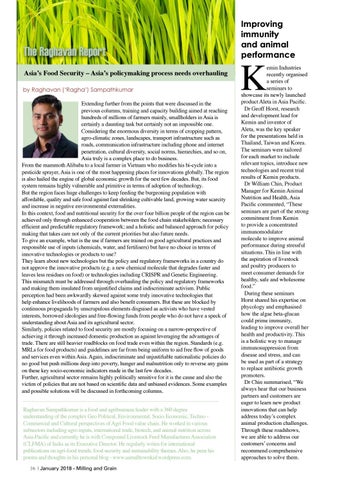
The Raghavan Report Asia’s Food Security – Asia’s policymaking process needs overhauling by Raghavan (‘Ragha’) Sampathkumar Extending further from the points that were discussed in the previous columns, training and capacity building aimed at reaching hundreds of millions of farmers mainly, smallholders in Asia is certainly a daunting task but certainly not an impossible one. Considering the enormous diversity in terms of cropping pattern, agro-climatic zones, landscapes, transport infrastructure such as roads, communication infrastructure including phone and internet penetration, cultural diversity, social norms, hierarchies, and so on, Asia truly is a complex place to do business. From the mammoth Alibaba to a local farmer in Vietnam who modifies his bi-cycle into a pesticide sprayer, Asia is one of the most happening places for innovations globally. The region is also hailed the engine of global economic growth for the next few decades. But, its food system remains highly vulnerable and primitive in terms of adoption of technology. But the region faces huge challenges to keep feeding the burgeoning population with affordable, quality and safe food against fast shrinking cultivable land, growing water scarcity and increase in negative environmental externalities. In this context, food and nutritional security for the over four billion people of the region can be achieved only through enhanced cooperation between the food chain stakeholders; necessary efficient and predictable regulatory framework; and a holistic and balanced approach for policy making that takes care not only of the current priorities but also future needs. To give an example, what is the use if farmers are trained on good agricultural practices and responsible use of inputs (chemicals, water, and fertilisers) but have no choice in terms of innovative technologies or products to use? They learn about new technologies but the policy and regulatory frameworks in a country do not approve the innovative products (e.g. a new chemical molecule that degrades faster and leaves less residues on food) or technologies including CRISPR and Genetic Engineering. This mismatch must be addressed through overhauling the policy and regulatory frameworks and making them insulated from unjustified claims and indiscriminate activism. Public perception had been awkwardly skewed against some truly innovative technologies that help enhance livelihoods of farmers and also benefit consumers. But these are blocked by continuous propaganda by unscrupulous elements disguised as activists who have vested interests, borrowed ideologies and free-flowing funds from people who do not have a speck of understanding about Asia and its agricultural sector. Similarly, policies related to food security are mostly focusing on a narrow-perspective of achieving it through increased domestic production as against leveraging the advantages of trade. There are still heavier roadblocks on food trade even within the region. Standards (e.g. MRLs for food products) and guidelines are far from being uniform to aid free flow of goods and services even within Asia. Again, indiscriminate and unjustifiable nationalistic policies do no good but push millions deep into poverty, hunger and malnutrition only to reverse any gains on these key socio-economic indicators made in the last few decades. Further, agricultural sector remains highly politically sensitive for it is the cause and also the victim of policies that are not based on scientific data and unbiased evidences. Some examples and possible solutions will be discussed in forthcoming columns. Raghavan Sampathkumar is a food and agribusiness leader with a 360 degree understanding of the complex Geo Political, Environmental, Socio Economic, Techno Commercial and Cultural perspectives of Agri Food value chain. He worked in various subsectors including agro inputs, international trade, biotech, and animal nutrition across Asia-Pacific and currently he is with Compound Livestock Feed Manufactures Association (CLFMA) of India as its Executive Director. He regularly writes for international publications on agri-food trends, food security and sustainability themes. Also, he pens his poems and thoughts in his personal blog - www.asmalltownkid.wordpress.com. 16 | January 2018 - Milling and Grain
Improving immunity and animal performance
K
emin Industries recently organised a series of seminars to showcase its newly launched product Aleta in Asia Pacific. Dr Geoff Horst, research and development lead for Kemin and inventor of Aleta, was the key speaker for the presentations held in Thailand, Taiwan and Korea. The seminars were tailored for each market to include relevant topics, introduce new technologies and recent trial results of Kemin products. Dr William Chin, Product Manager for Kemin Animal Nutrition and Health, Asia Pacific commented, “These seminars are part of the strong commitment from Kemin to provide a concentrated immunomodulator molecule to improve animal performance during stressful situations. This in line with the aspiration of livestock and poultry producers to meet consumer demands for healthy, safe and wholesome food.” During these seminars Horst shared his expertise on phycology and emphasised how the algae beta-glucan could prime immunity, leading to improve overall her health and productivity. This is a holistic way to manage immunosuppression from disease and stress, and can be used as part of a strategy to replace antibiotic growth promoters. Dr Chin summarised, “We always hear that our business partners and customers are eager to learn new product innovations that can help address today’s complex animal production challenges. Through these roadshows, we are able to address our customers’ concerns and recommend comprehensive approaches to solve them.