F
“Wheat, Flour and...”
T
by Roger Gilbert
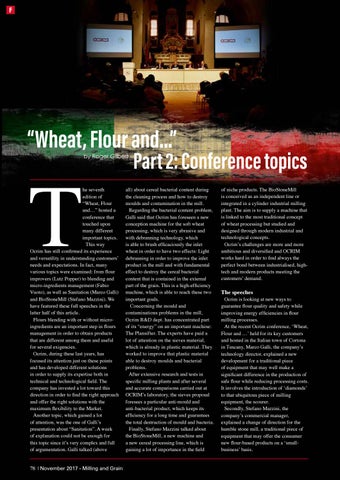
he seventh edition of “Wheat, Flour and…” hosted a conference that touched upon many different important topics. This way Ocrim has still confirmed its experience and versatility in understanding customers’ needs and expectations. In fact, many various topics were examined: from flour improvers (Lutz Popper) to blending and micro-ingredients management (Fabio Vuoto), as well as Sanitation (Marco Galli) and BioStoneMill (Stefano Mazzini). We have featured these full speeches in the latter half of this article. Flours blending with or without microingredients are an important step in flours management in order to obtain products that are different among them and useful for several exigencies. Ocrim, during these last years, has focused its attention just on these points and has developed different solutions in order to supply its expertise both in technical and technological field. The company has invested a lot toward this direction in order to find the right approach and offer the right solutions with the maximum flexibility to the Market. Another topic, which gained a lot of attention, was the one of Galli’s presentation about “Sanitation”. A week of explanation could not be enough for this topic since it’s very complex and full of argumentation. Galli talked (above 78 | November 2017 - Milling and Grain
Part 2: Conference topics
all) about cereal bacterial content during the cleaning process and how to destroy moulds and contamination in the mill. Regarding the bacterial content problem, Galli said that Ocrim has foreseen a new conception machine for the soft wheat processing, which is very abrasive and with debranning technology, which is able to brush efficaciously the inlet wheat in order to have two effects: Light debranning in order to improve the inlet product in the mill and with fundamental effect to destroy the cereal bacterial content that is contained in the external part of the grain. This is a high-efficiency machine, which is able to reach these two important goals. Concerning the mould and contaminations problems in the mill, Ocrim R&D dept. has concentrated part of its “energy” on an important machine: The Plansifter. The experts have paid a lot of attention on the sieves material, which is already in plastic material. They worked to improve that plastic material able to destroy moulds and bacterial problems. After extensive research and tests in specific milling plants and after several and accurate comparisons carried out at OCRIM’s laboratory, the sieves proposal foresees a particular anti-mould and anti-bacterial product, which keeps its efficiency for a long time and guarantees the total destruction of mould and bacteria. Finally, Stefano Mazzini talked about the BioStoneMill, a new machine and a new cereal processing line, which is gaining a lot of importance in the field
of niche products. The BioStoneMill is conceived as an independent line or integrated in a cylinder industrial milling plant. The aim is to supply a machine that is linked to the most traditional concept of wheat processing but studied and designed through modern industrial and technological concepts. Ocrim’s challenges are more and more ambitious and diversified and OCRIM works hard in order to find always the perfect bond between industrialised, hightech and modern products meeting the customers’ demand.
The speeches
Ocrim is looking at new ways to guarantee flour quality and safety while improving energy efficiencies in flour milling processes. At the recent Ocrim conference, ‘Wheat, Flour and …’ held for its key customers and hosted in the Italian town of Cortona in Tuscany, Marco Galli, the company’s technology director, explained a new development for a traditional piece of equipment that may well make a significant difference in the production of safe flour while reducing processing costs. It involves the introduction of ‘diamonds’ to that ubiquitous piece of milling equipment, the scourer. Secondly, Stefano Mazzini, the company’s commercial manager, explained a change of direction for the humble stone mill, a traditional piece of equipment that may offer the consumer new flour-based products on a ‘smallbusiness’ basis.