F
Pasta A miller’s legacy
M
by Clifford Spencer, Chairman, M4L
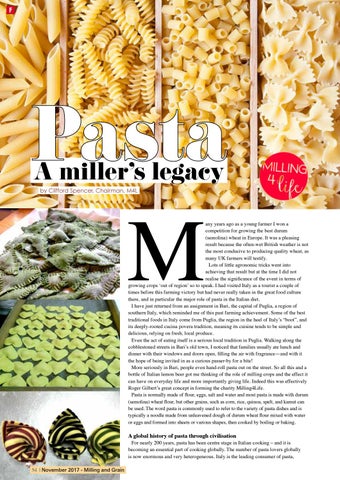
any years ago as a young farmer I won a competition for growing the best durum (semolina) wheat in Europe. It was a pleasing result because the often-wet British weather is not the most conducive to producing quality wheat, as many UK farmers will testify. Lots of little agronomic tricks went into achieving that result but at the time I did not realise the significance of the event in terms of growing crops ‘out of region’ so to speak. I had visited Italy as a tourist a couple of times before this farming victory but had never really taken in the great food culture there, and in particular the major role of pasta in the Italian diet. I have just returned from an assignment in Bari, the capital of Puglia, a region of southern Italy, which reminded me of this past farming achievement. Some of the best traditional foods in Italy come from Puglia, the region in the heel of Italy’s “boot”, and its deeply-rooted cucina povera tradition, meaning its cuisine tends to be simple and delicious, relying on fresh, local produce. Even the act of eating itself is a serious local tradition in Puglia. Walking along the cobblestoned streets in Bari’s old town, I noticed that families usually ate lunch and dinner with their windows and doors open, filling the air with fragrance—and with it the hope of being invited in as a curious passer-by for a bite! More seriously in Bari, people even hand-roll pasta out on the street. So all this and a bottle of Italian lemon beer got me thinking of the role of milling crops and the effect it can have on everyday life and more importantly giving life. Indeed this was effectively Roger Gilbert’s great concept in forming the charity Milling4Life. Pasta is normally made of flour, eggs, salt and water and most pasta is made with durum (semolina) wheat flour, but other grains, such as corn, rice, quinoa, spelt, and kamut can be used. The word pasta is commonly used to refer to the variety of pasta dishes and is typically a noodle made from unleavened dough of durum wheat flour mixed with water or eggs and formed into sheets or various shapes, then cooked by boiling or baking.
A global history of pasta through civilisation
For nearly 200 years, pasta has been centre stage in Italian cooking – and it is becoming an essential part of cooking globally. The number of pasta lovers globally is now enormous and very heterogeneous. Italy is the leading consumer of pasta, 54 | November 2017 - Milling and Grain