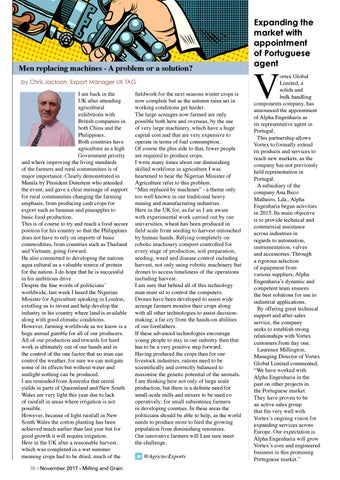
Men replacing machines - A problem or a solution? by Chris Jackson, Export Manager UK TAG I am back in the UK after attending agricultural exhibitions with British companies in both China and the Philippines. Both countries have agriculture as a high Government priority and where improving the living standards of the farmers and rural communities is of major importance. Clearly demonstrated in Manila by President Dutertem who attended the event, and gave a clear message of support for rural communities changing the farming emphasis, from producing cash crops for export such as bananas and pineapples to basic food production. This is of course to try and reach a food secure position for his country so that the Philippines does not have to rely on imports of basic commodities, from countries such as Thailand and Vietnam, going forward. He also committed to developing the nations aqua cultural as a valuable source of protein for the nation. I do hope that he is successful in his ambitious drive Despite the fine words of politicians’ worldwide, last week I heard the Nigerian Minister for Agriculture speaking in London, extolling us to invest and help develop the industry in his country where land is available along with good climatic conditions. However, farming worldwide as we know is a huge annual gamble for all of our producers. All of our production and rewards for hard work is ultimately out of our hands and in the control of the one factor that no man can control the weather, for sure we can mitigate some of its effects but without water and sunlight nothing can be produced. I am reminded from Australia that cereal yields in parts of Queensland and New South Wales are very light this year due to lack of rainfall in areas where irrigation is not possible. However, because of light rainfall in New South Wales the cotton planting has been achieved much earlier than last year but for good growth it will require irrigation. Here in the UK after a reasonable harvest, which was completed in a wet summer meaning crops had to be dried, much of the 38 | November 2017 - Milling and Grain
fieldwork for the next seasons winter crops is now complete but as the autumn rains set in working conditions get harder. The large acreages now farmed are only possible both here and overseas, by the use of very large machinery, which have a huge capital cost and that are very expensive to operate in terms of fuel consumption. Of course the plus side to that, fewer people are required to produce crops. I write many times about our diminishing skilled workforce in agriculture I was heartened to hear the Nigerian Minister of Agriculture refer to this problem. “Man replaced by machines” - a theme only too well known in our traditional heavy mining and manufacturing industries. Here in the UK for, as far as I am aware with experimental work carried out by our universities, wheat has been produced in field scale from seeding to harvest untouched by human hands. Relying completely on robotic machinery comport controlled for every stage of production, soil preparation, seeding, weed and disease control including harvest, not only using robotic machinery but drones to access timeliness of the operations including harvest. I am sure that behind all of this technology man must sit to control the computers. Drones have been developed to assist wide acreage farmers monitor their crops along with all other technologies to assist decisionmaking, a far cry from the hands-on abilities of our forefathers. If these advanced technologies encourage young people to stay in our industry then that has to be a very positive step forward. Having produced the crops then for our livestock industries, rations need to be scientifically and correctly balanced to maximise the genetic potential of the animals. I am thinking here not only of large scale production, but there is a definite need for small-scale mills and mixers to be used co operatively; for small subsistence farmers in developing counties. In these areas the politicians should be able to help, as the world needs to produce more to feed the growing population from diminishing resources. Our innovative farmers will I am sure meet the challenge. @AgrictecExports
Expanding the market with appointment of Portuguese agent
V
ortex Global Limited, a solids and bulk handling components company, has announced the appointment of Alpha Engenharia as its representative agent in Portugal. This partnership allows Vortex to formally extend its products and services to reach new markets, as the company has not previously held representation in Portugal. A subsidiary of the company Ana Beco Malheiro, Lda., Alpha Engenharia began activities in 2015. Its main objective is to provide technical and commercial assistance across industries in regards to automation, instrumentation, valves and accessories. Through a rigorous selection of equipment from various suppliers, Alpha Engenharia’s dynamic and competent team ensures the best solutions for use in industrial applications. By offering great technical support and after-sales service, the company seeks to establish strong relationships with Vortex customers from day one. Laurence Millington, Managing Director of Vortex Global Limited commented, “We have worked with Alpha Engenharia in the past on other projects in the Portuguese market. They have proven to be an active sales group that fits very well with Vortex’s ongoing vision for expanding services across Europe. Our expectation is Alpha Engenharia will grow Vortex’s core and engineered business in this promising Portuguese market.”