F CASE STUDY
CASE STUDY
M In the mix
Nutritional feed company achieves uniformity with Rotary Batch Mixer
icron Bio-Systems is an international biotech company that produces feed preservation additives, mycotoxin remediation treatments and probiotic feed supplements for livestock including beef and dairy cows, calves, lambs, pigs and
chickens. Blending of these nutritional supplements is a critical step of the manufacturing process due to the diverse sizes, shapes and bulk densities of ingredient particles, supplement-to-feed ratios as low as one to 400, and the need to achieve 100 percent batch-to-batch uniformity. Micron Bio-Systems blended its products successfully for more than 40 years using a 708 litre Rotary Batch Mixer from Munson Machinery, Utica, New York, so when increased demand for its products called for higher throughput, the company specified a new 1415 l version of its original mixer design.
Updating a proven process
Shannon Lineberry, Production Manager, Micron Bio-Systems explained, “The original mixer was reliable, and we replaced very few parts on it over the years. The new one also gives us a good homogenous blend with uniform ingredient distribution, even though the materials have varying particle sizes and densities.” Whereas the original unit had a screw drive that augured raw ingredients in from a hopper, the new feed system features an overhead hopper into which an operator manually empties bags of ingredients. The company is also upgrading to an automated bulk bag discharger with programmable logic control to feed primary ingredients into the new mixer.
Achieving uniformity with disparate ingredients, dustfree
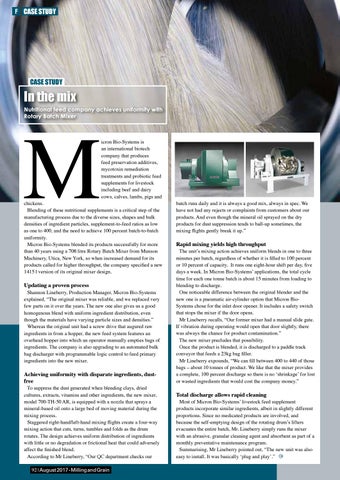
To suppress the dust generated when blending clays, dried cultures, extracts, vitamins and other ingredients, the new mixer, model 700-TH-50 AR, is equipped with a nozzle that sprays a mineral-based oil onto a large bed of moving material during the mixing process. Staggered right-hand/left-hand mixing flights create a four-way mixing action that cuts, turns, tumbles and folds as the drum rotates. The design achieves uniform distribution of ingredients with little or no degradation or frictional heat that could adversely affect the finished blend. According to Mr Lineberry, “Our QC department checks our 92 | August 2017 - Milling and Grain
batch runs daily and it is always a good mix, always in spec. We have not had any rejects or complaints from customers about our products. And even though the mineral oil sprayed on the dry products for dust suppression tends to ball-up sometimes, the mixing flights gently break it up.”
Rapid mixing yields high throughput
The unit’s mixing action achieves uniform blends in one to three minutes per batch, regardless of whether it is filled to 100 percent or 10 percent of capacity. It runs one eight-hour shift per day, five days a week. In Micron Bio-Systems’ applications, the total cycle time for each one tonne batch is about 15 minutes from loading to blending to discharge. One noticeable difference between the original blender and the new one is a pneumatic air-cylinder option that Micron BioSystems chose for the inlet door opener. It includes a safety switch that stops the mixer if the door opens. Mr Lineberry recalls, “Our former mixer had a manual slide gate. If vibration during operating would open that door slightly, there was always the chance for product contamination.” The new mixer precludes that possibility. Once the product is blended, it is discharged to a paddle track conveyor that feeds a 23kg bag filler. Mr Lineberry expounds, “We can fill between 400 to 440 of those bags – about 10 tonnes of product. We like that the mixer provides a complete, 100 percent discharge so there is no ‘shrinkage’ for lost or wasted ingredients that would cost the company money.”
Total discharge allows rapid cleaning
Most of Micron Bio-Systems’ livestock feed supplement products incorporate similar ingredients, albeit in slightly different proportions. Since no medicated products are involved, and because the self-emptying design of the rotating drum’s lifters evacuates the entire batch, Mr. Lineberry simply runs the mixer with an abrasive, granular cleaning agent and absorbent as part of a monthly preventative maintenance program. Summarising, Mr Lineberry pointed out, “The new unit was also easy to install. It was basically ‘plug and play’.”