F IGC Grains Conference 2017
Investing in Nigerian flour milling:
“The time is now”
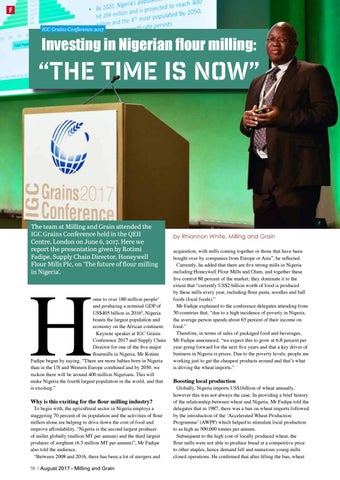
The team at Milling and Grain attended the IGC Grains Conference held in the QEII Centre, London on June 6, 2017. Here we report the presentation given by Rotimi Fadipe, Supply Chain Director, Honeywell Flour Mills Plc, on ‘The future of flour milling in Nigeria’.
H
ome to over 180 million people1 and producing a nominal GDP of US$405 billion in 20162, Nigeria boasts the largest population and economy on the African continent. Keynote speaker at IGC Grains Conference 2017 and Supply Chain Director for one of the five major flourmills in Nigeria, Mr Rotimi Fadipe began by saying, “There are more babies born in Nigeria than in the US and Western Europe combined and by 2050, we reckon there will be around 400 million Nigerians. This will make Nigeria the fourth largest population in the world, and that is exciting.”
Why is this exciting for the flour milling industry?
To begin with, the agricultural sector in Nigeria employs a staggering 70 percent of its population and the activities of flour millers alone are helping to drive down the cost of food and improve affordability. “Nigeria is the second largest producer of millet globally (million MT per annum) and the third largest producer of sorghum (6.5 million MT per annum)”, Mr Fadipe also told the audience. “Between 2008 and 2016, there has been a lot of mergers and 58 | August 2017 - Milling and Grain
by Rhiannon White, Milling and Grain acquisition, with mills coming together or those that have been bought over by companies from Europe or Asia”, he reflected. Currently, he added that there are five strong mills in Nigeria including Honeywell Flour Mills and Olam, and together these five control 80 percent of the market; they dominate it to the extent that “currently US$2 billion worth of food is produced by these mills every year, including flour pasta, noodles and ball foods (local foods).” Mr Fadipe explained to the conference delegates attending from 50 countries that, “due to a high incidence of poverty in Nigeria, the average person spends about 65 percent of their income on food.” Therefore, in terms of sales of packaged food and beverages, Mr Fadipe announced, “we expect this to grow at 6.8 percent per year going forward for the next five years and that a key driver of business in Nigeria is prices. Due to the poverty levels, people are working just to get the cheapest products around and that’s what is driving the wheat imports.”
Boosting local production
Globally, Nigeria imports US$1billion of wheat annually, however this was not always the case. In providing a brief history of the relationship between wheat and Nigeria, Mr Fadipe told the delegates that in 1987, there was a ban on wheat imports followed by the introduction of the ‘Accelerated Wheat Production Programme’ (AWPP) which helped to stimulate local production to as high as 500,000 tonnes per annum. Subsequent to the high cost of locally produced wheat, the flour mills were not able to produce bread at a competitive price to other staples, hence demand fell and numerous young mills closed operations. He confirmed that after lifting the ban, wheat