“Study the past if you would define the future” - Confucius
Roger Gilbert, Publisher and M4L Trustee
As millers we must be acutely aware of our beginnings if we are to address successfully the challenges that confront the food industry of the future. The history of cereals, and wheat in particular, can be traced back over millennia and which was the subject of a keynote presentation made at the recent Global Milling Conference in Hamburg, Germany in May, 2017. And although some of the detail that scientists use to reconstruct the development of wheat from Einkorn to its modern-day varieties on which the planet now depends still leaves much to the imagination.
Einkorn - an ancient cereal out of the ice
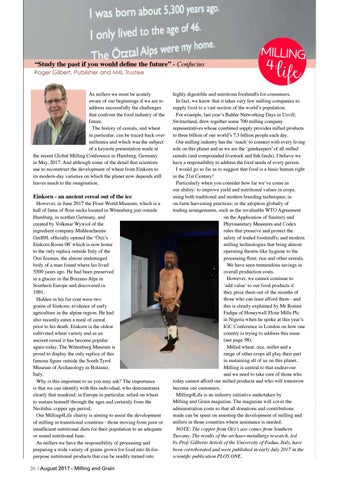
However, in June 2017 the Flour World Museum, which is a hall of fame of flour sacks located in Wittenburg just outside Hamburg, in norther Germany, and created by Volkmar Wywiol of the ingredient company Muhlenchemie GmBH, officially opened the ‘Ötzi’s Einkorn Room 08’ which is now home to the only replica outside Italy of the Ötzi Iceman, the almost undamaged body of a man found where his lived 5300 years ago. He had been preserved in a glacier in the Boizano Alps in Southern Europe and discovered in 1991. Hidden in his fur coat were two grains of Einkorn; evidence of early agriculture in the alpine region. He had also recently eaten a meal of cereal prior to his death. Einkorn is the oldest cultivated wheat variety and as an ancient cereal it has become popular again today. The Wittenburg Museum is proud to display the only replica of this famous figure outside the South Tyrol Museum of Archaeology in Bolzano, Italy. Why is this important to us you may ask? The importance is that we can identify with this individual, who demonstrates clearly that mankind, in Europe in particular, relied on wheat to sustain himself through the ages and certainly from the Neolithic copper age period. Our Milling4Life charity is aiming to assist the development of milling in transitional countries - those moving from poor or insufficient nutritional diets for their population to an adequate or sound nutritional base. As millers we have the responsibility of processing and preparing a wide variety of grains grown for food into fit-forpurpose nutritional products that can be readily turned into 26 | August 2017 - Milling and Grain
highly digestible and nutritious foodstuffs for consumers. In fact, we know that it takes very few milling companies to supply food to a vast section of the world’s population. For example, last year’s Buhler Networking Days in Uzvill, Switzerland, drew together some 700 milling company representatives whose combined supply provides milled products to three billion of our world’s 7.3 billion people each day. Our milling industry has the ‘reach’ to connect with every living sole on this planet and as we are the ‘gatekeepers’ of all milled cereals (and compounded livestock and fish feeds), I believe we have a responsibility to address the food needs of every person. I would go so far as to suggest that food is a basic human right in the 21st Century! Particularly when you consider how far we’ve come in our ability: to improve yield and nutritional values in crops, using both traditional and modern breeding techniques; in on-farm harvesting practices; in the adoption globally of trading arrangements, such as the invaluable WTO Agreement on the Application of Sanitary and Phytosanitary Measures and Codex rules that preserve and protect the safety of traded foodstuffs; and modern milling technologies that bring almost operating theatre-like hygiene to the processing flour, rice and other cereals. We have seen tremendous savings in overall production costs. However, we cannot continue to ‘add value’ to our food products if they price them out of the mouths of those who can least afford them - and this is clearly explained by Mr Rotimi Fadipe of Honeywell Flour Mills Plc in Nigeria when he spoke at this year’s IGC Conference in London on how one country is trying to address this issue (see page 58). Milled wheat, rice, millet and a range of other crops all play their part in sustaining all of us on this planet. Milling is central to that endeavour and we need to take care of those who today cannot afford our milled products and who will tomorrow become our customers. Milling4Life is an industry initiative undertaken by Milling and Grain magazine. The magazine will cover the administration costs so that all donations and contributions made can be spent on assisting the development of milling and millers in those countries where assistance is needed. NOTE: The copper from Ötzi’s axe comes from Southern Tuscany. The results of the archaeo-metallurgy research, led by Prof. Gilberto Artioli of the University of Padua, Italy, have been corroborated and were published in early July 2017 in the scientific publication PLOS ONE.