Roller flourmill buildings in London continued
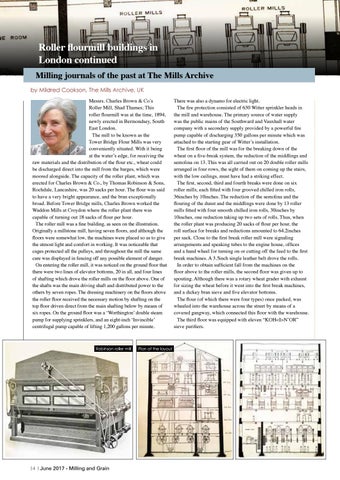
Milling journals of the past at The Mills Archive by Mildred Cookson, The Mills Archive, UK Messrs. Charles Brown & Co’s Roller Mill, Shad Thames; This roller flourmill was at the time, 1894, newly erected in Bermondsey, South East London. The mill to be known as the Tower Bridge Flour Mills was very conveniently situated. With it being at the water’s edge, for receiving the raw materials and the distribution of the flour etc., wheat could be discharged direct into the mill from the barges, which were moored alongside. The capacity of the roller plant, which was erected for Charles Brown & Co., by Thomas Robinson & Sons, Rochdale, Lancashire, was 20 sacks per hour. The flour was said to have a very bright appearance, and the bran exceptionally broad. Before Tower Bridge mills, Charles Brown worked the Waddon Mills at Croydon where the roller plant there was capable of turning out 18 sacks of flour per hour. The roller mill was a fine building, as seen on the illustration. Originally a millstone mill, having seven floors, and although the floors were somewhat low, the machines were placed so as to give the utmost light and comfort in working. It was noticeable that cages protected all the pulleys, and throughout the mill the same care was displayed in fencing off any possible element of danger. On entering the roller mill, it was noticed on the ground floor that there were two lines of elevator bottoms, 20 in all, and four lines of shafting which drove the roller mills on the floor above. One of the shafts was the main driving shaft and distributed power to the others by seven ropes. The dressing machinery on the floors above the roller floor received the necessary motion by shafting on the top floor driven direct from the main shafting below by means of six ropes. On the ground floor was a ‘Worthington’ double steam pump for supplying sprinklers, and an eight-inch ‘Invincible’ centrifugal pump capable of lifting 1,200 gallons per minute.
Robinson roller mill
14 | June 2017 - Milling and Grain
Plan of the layout
There was also a dynamo for electric light. The fire protection consisted of 630 Witter sprinkler heads in the mill and warehouse. The primary source of water supply was the public mains of the Southward and Vauxhall water company with a secondary supply provided by a powerful fire pump capable of discharging 350 gallons per minute which was attached to the starting gear of Witter’s installation. The first floor of the mill was for the breaking down of the wheat on a five-break system, the reduction of the middlings and semolina on 13. This was all carried out on 20 double roller mills arranged in four rows, the sight of them on coming up the stairs, with the low ceilings, must have had a striking effect. The first, second, third and fourth breaks were done on six roller mills, each fitted with four grooved chilled iron rolls, 36inches by 10inches. The reduction of the semolina and the flouring of the dunst and the middlings were done by 13 roller mills fitted with four smooth chilled iron rolls, 30inches by 10inches, one reduction taking up two sets of rolls. Thus, when the roller plant was producing 20 sacks of flour per hour, the roll surface for breaks and reductions amounted to 64.2inches per sack. Close to the first break roller mill were signaling arrangements and speaking tubes to the engine house, offices and a hand wheel for turning on or cutting off the feed to the first break machines. A 3.5inch single leather belt drove the rolls. In order to obtain sufficient fall from the machines on the floor above to the roller mills, the second floor was given up to spouting. Although there was a rotary wheat grader with exhaust for sizing the wheat before it went into the first break machines, and a dickey bran sieve and five elevator bottoms. The flour (of which there were four types) once packed, was wheeled into the warehouse across the street by means of a covered gangway, which connected this floor with the warehouse. The third floor was equipped with eleven “KOH<I>N’OR” sieve purifiers.