March 2017
YOUR GLOBAL PARTNER
In this issue:
Dryers
- Keeping your competitive edge in an ever changing environment
• Fortification - folic acid • Combating poultry stress - Spray-Dried Plasma • Process flow - point level limit detector • Silo cleaning equipment tools • GEAPS 2017
Event review millingandgrain.com
Volume 128 Issue 3
Our team of experienced Dealers and Staff
will help you determine the system that will suit your needs. Chief Agri/Industrial has a full line of grain storage, conditioning, handling, and drying products that can be engineered to fit your site.
Storage
Handling & Support Structure
Conditioning
Chief Agri: +1 308-237-3186 Chief UK: +44 1621 868944 chief.co.uk
|
agri.chiefind.com
|
silos-phenix.com
Dryers
COMMERCIAL BINS
COMMERCIAL DRYERS
COMMERCIAL CONVEYORS
COMMERCIAL SWEEPS
BUCKET ELEVATORS
STEEL BUILDINGS
• 47.548m Diameter Bins (20320.9-48262.2 mt) • Tower Dryers (22.5-281.2 t/h) • Peak Load Rating (6803.8-45359.2 kg) • QuadraTouch ProTM Controls • Hopper Bins (3.65m-14.6m) • Balanced Moisture Content • Auger & Paddle sweeps available • Capacity includes 140.6-281.2 t/h • Patented Pivot Point • Industrial Grade Pushers
• Low Impact Head Design • Heavy Gauge Trunking • Patented Squaring Plates
• Capacity includes (984.3-1687.5 t/h) • Dust-tight and waterproof • Patented hip-style weather-tight cover • Industrial Strength • Built To Last • Higher Elemental Resistance
S u k u p Wo r ld H eadquarters - S heffi el d, I o w a 5 0 4 7 5 - 0 6 7 7 • w w w. su ku p . co m • in f o @ su ku p . com For service in Europe contact:
Sukup Europe A/S Hedensted, Denmark Tel +45 75 68 53 11 • Fax +45 75 68 54 70 info@sukup-eu.com • www.sukup-eu.com
Pneumatic or Mechanical Ship Loaders & Unloaders Port Equipment - Turnkey Projects PNEUMATIC UNLOADING : From 100 to 800 tons/hour Average efficiency 75%-80% All sizes of vessels All types of grains
PORTABLE GRAIN PUMPS up to 270 t/h
PNEUMATIC BARGE UNLOADER up to 600 t/h
LOADER up to 2000 t/h
SIMPORTER up to 1500 t/h
A win-win solution between customer expertise and VIGAN know-how VIGAN Engineering s.a. Rue de l’Industrie, 16 - 1400 Nivelles - Belgium Tél.: +32 67 89 50 41 • Fax : +32 67 89 50 60 • www.vigan.com • info@vigan.com
VOLUME 128 ISSUE 3
March 2017
Perendale Publishers Ltd 7 St George’s Terrace St James’ Square, Cheltenham, Glos, GL50 3PT, United Kingdom Tel: +44 1242 267700 Publisher Roger Gilbert rogerg@perendale.co.uk International Marketing Team Darren Parris Tel: +44 1242 267707 darrenp@perendale.co.uk Tom Blacker Tel: +44 1242 267700 tomb@perendale.co.uk Mark Cornwell Tel: +1 913 6422992 markc@perendale.com Latin America Marketing Team Iván Marquetti Tel: +54 2352 427376 ivanm@perendale.co.uk Nigeria Marketing Team Nathan Nwosu Tel: +234 805 7781077 nathann@perendale.co.uk
72 - Dryers Whether you are farming grain or milling it, each crop and each year brings different challenges to achieving a consistently good quality product with minimum waste and maximum profitability.
Editorial Team Rhiannon White rhiannonw@perendale.co.uk Zasha Whiteway-Wilkinson zashaw@perendale.co.uk Matt Muller mattm@perendale.co.uk Peter Parker peterp@perendale.co.uk International Editors Professor Dr M Hikmet Boyacıog ˘ lu hikmetb@perendale.co.uk Dr Roberto Luis Bernardi robertob@perendale.co.uk Professor Wenbin Wu wenbinw@perendale.com Design Manager James Taylor jamest@perendale.co.uk Circulation & Events Tuti Tan tutit@perendale.co.uk Development Manager Antoine Tanguy antoinet@perendale.co.uk ©Copyright 2016 Perendale Publishers Ltd. All rights reserved. No part of this publication may be reproduced in any form or by any means without prior permission of the copyright owner. More information can be found at www.perendale.com Perendale Publishers Ltd also publish ‘The International Milling Directory’ and ‘The Global Miller’ news service
Grain & Feed Milling Technology magazine was rebranded to Milling and Grain in 2015
ISSUE HIGHLIGHTS
2
NEWS FEATURES
50 Enzymes for enhancing flour quality 52 Is it time that Europe makes folic acid fortification mandatory?
56 Beyond protein and fat
FACES
8-44
60 Combating poultry stress Is Spray-Dried Plasma the best protein alternative?
64 Seed and grain imaging Vs subjective inspection methods
116 People news from the global milling industry
PRODUCT FOCUS
48
CASE STUDY
86
72 Dryers - keeping your competitive edge in an ever changing environment
76 Process flow How to support a smooth process flow with the right point level limit detector
EVENTS
92 Event listings, reviews and previews
COLUMNS
16 Mildred Cookson 22 Raghavan Sampathkumar 24 Clifford Spencer 31 Tom Blacker 32 Christophe Pelletier 38 Chris Jackson
4 GUEST EDITOR Dr Ron Cookson MBE
90 MARKETS Matt Muller
STORAGE
78 Three unique silo cleaning equipment tools
82 Infrared Spark Detection System - CIM-Safe
TRAINING
47 Grain elevator managers gain training for management systems
114 INTERVIEW Gerard Klein Essink
COVER IMAGE: one of JWIs recent installations which incorporates drying, handling and storage. The turn-key project on a new Greenfield site was designed to handle the farmers crop as it’s harvested, removing the need for haulage and external drying and making for a greener, more efficient and cost effective process.
ISSUE HIGHLIGHTS ENZYMES
SILO CLEANING
Enhancing flour quality Bread, is the most widely consumed food in the world and its main ingredient is flour. Most consumed flour for bread making is Wheat Flour and the most important value of wheat is its quality.
PAGE 50 FLOUR
New organic cereal arrives in Europe
FORTIFICATION Folic acid fortification "Today, over 80 countries now have a mandate to fortify at least one staple grain with folic acid, with the notable exclusion of Europe, where we have yet to secure a single mandate"
PAGE 52
Three unique silo cleaning equipment tools Silo Cleaning is an essential facet of maintaining top production levels. Given this fact, one would think also that it would always be a top priority.
PAGE 78
A new cereal that has arrived in Germany has been unveiled at the world’s leading fair for the organic sector, Biofach.
SPARK DETECTION Infrared Spark Detection System - CIM-Safe In the grain processing industry, and especially in grain drying, the risk of sparks has always been present, with various solutions to minimise the risk of devastating damage to equipment needing to be implemented.
PAGE 82
PAGE 12
FOOD
STORAGE
FEED
PROCESS
SPRAY-DRIED PLASMA Combating poultry stress
SEEDCOUNT Seed and grain imaging Vs subjective inspection methods Plant breeders, seed producers and grain traders use subjective inspection methods, i.e., visual inspection, separation and counting to determine quality aspects of grains and oil seeds.
PAGE 64
DRYERS
FISHMEAL / OIL
Keeping your competitive edge in an ever changing environment
The underestimated uses of fishmeal and fish oil in swine and poultry diets
Whether you are farming grain or milling it, each crop and each year brings different challenges to achieving a consistently good quality product with minimum waste and maximum profitability.
PAGE 72
2 | March 2017 - Milling and Grain
Decades ago fishmeal and fish oil were the mainstay of pig and poultry production, but with the growth of aquaculture from the 1960s onwards these materials have been diverted largely towards feeding fish.
PAGE 56
A series of stress factors such as disease (necrotic enteritis, coccidiosis and others) or environmental and production conditions or factors (litter quality, heat stress, stocking density, etc.) can have negative impacts on poultry production.
PAGE 60 MINIMILL
Zheng Chang’s complete process mini mill The capability of Zhengchang SKZH poultry and livestock feed units are 5000-60000t/yr, which are suitable for all kinds of professional feed producers.
PAGE 49
The things we produce today were utopias yesterday. Our task is to give shape to new ideas and innovate what once was magic.
Vertical Intensive Dampening Mixer
SCV
www.ocrim.com
Guest
Editor
The history of milling and two days cramped up inside an eighteenth century cellar! The Mills Archive recently salvaged from the cellars of an old house in Hull, thousands of documents that described in detail the construction of roller flourmills from the start of the last century. Now why, did my wife Mildred, a traditional miller and one of our trustees, and Nathanael, our young archivist, spend two days cramped up inside an eighteenth century cellar saving all this paper? Essentially, to preserve an important part of our cultural heritage destined for landfill within a few days. Without their intervention these architectural records and all that was left of the Gelder and Kitchen roller mill archive, would have been lost forever. It is easy to be sentimental about traditional mills, their history and their place in society, but for some reason the history of the modern milling industry is in danger of disappearing into the mists of time. Gelder and Kitchen started designing Rank’s Clarence mills in the early 1900s and expanded to Allied Mills and many others during the rest of the 20th century. These drawings have now been saved for the nation, but too much of our milling heritage has already been lost. We should all consider what action we could take to rescue the remains, but first we need to address two questions. Why should we care, and what can we do about it? Altruism is the first reason why millers, managers and directors should be particularly concerned with our industry’s heritage. If we can afford the time and the money, it is worth preserving a lasting legacy of what we have achieved over the years. We would be unwise to wait for a philanthropist of some persuasion to fund the work, or allow someone else to document our past. We should take the initiative, or at least support those with the right attitude who are prepared to make the effort. A second more cogent reason to secure our heritage is that it can give participating firms a commercial opportunity. As might be expected, those who move quickest have the most to gain. The opportunity is there in the shape of the Mills Archive, recently awarded the accolade from the UK’s National Archives as the national accredited specialist archive service for mills and milling. Their work is creating exceptional opportunities for interested companies and organisations. This young and energetic archive has flourished, even in an era of funding cuts. It has established itself as the
centre of excellence for the history of traditional mills and milling. It is now responding to the need for a similar resource for the modern flour milling industry, addressing both the need to move quickly and the required increase in scale to encompass the history of modern milling. There are obvious, unique branding opportunities for a commercial partner who wishes to collaborate with this premier documentary and image repository of worldwide milling history. Possibilities include helping to create the world’s first roller flourmill archive and library and laying the groundwork in building the leading research institute on all aspects of the history of milling. Working with the centre of excellence for research, learning and understanding on the history of mills and milling would underline one’s own milling heritage. Apart from taking significant steps towards preserving our heritage, collaboration would send a clear message to shareholders, staff and customers, particularly as the Mills Archive is a registered charity. Founded in the UK with an international remit, their dream is to pay credit to those who have gone before, to inspire those yet to come. At the commercial level, it is possible to identify with a specific aspect of the Archive’s work and make a permanent mark on history. They are responding to an urgent heritage need and span all over the globe, bridging 8,000 years of technology from querns to computer-controlled milling. Many of their 220 collections document the major consequence to peoples and firms of changes over the last 150 years. With more than three million records already, there is plenty of scope to make an early impact in an area best suited to a particular profile. The Archive’s rapid growth provides chances to contribute to the development and care of their collections or the ways in which they make the information available. The appeal of preserving our industry’s heritage goes beyond branding and investment opportunities, it also offers many opportunities for individual employees and representatives of companies to get involved. The National Archives have already commended the Mills Archive for its initiatives in the wider mills heritage community by providing practical help and advice on archiving, cataloguing and effective communication. We have so much to be proud of, so why do we not do more about it? Dr Ron Cookson MBE, Chairman ‘The Mills Archive Trust’
Annual Subscription Rates Inside UK: UK£100 Outside: US$150/€133
ISSN No: 2058-5101
More Information www.millingandgrain.com http://gfmt.blogspot.co.uk
News
MAR 17
Milling
Egypt demands high-level upgrades on flour quality
A
wide scope of Egyptian industry representatives joined together for a conference in Mühlenchemie. In a country that is the world’s biggest importer of wheat, the company has been active for over 20 years and is the leading player in the field of flour treatment. The firm exports its products to over 120 countries and maintains a close relationship with more than 1,500 mills around the globe. Daniel Wiebe, Regional Sales Manager Egypt, Sudan and Libya at Mühlenchemie explains, “Our intention in organising this conference is to strengthen our direct contacts with existing and potential customers and discuss the wealth of new findings in the theory and practice of flour improvement. We regard the meeting as an important part of a network that will make a valuable and lasting contribution to shaping the future of the milling industry.” Around 200 representatives from the country’s milling and processing industry met in Cairo for the event co-organised with the laboratory equipment manufacturer Brabender. Companies ranging from mills, pasta manufacturers, industrial bakeries and government research institutions amalgamated to educate themselves on the latest findings and possibilities of enhancing quality in the flour industry. The main theme of the conference was: ‘Flour quality requirements between present and future’, of which internationally acknowledged experts took to the floor to share their knowledge. The prominent keynote speakers included experts from Mühlenchemie and Brabender and also Dr Mahmoud Riad, Managing Director of North Cairo Flour Mills. The individual examples of success gave the participants valuable insights into the practical use of flour improvers. Not to mention how, the papers offered the participants new information and ideas concerning current changes and challenges in the industry, such as flour improvement, the use of enzymes, pasta production and prolonging the freshness of bakery products. 8 | March 2017 - Milling and Grain
This edition of Milling and Grain has a distinct focus on the scientific research of food and how this impacts the health of everyone around the globe. The use of technology is rapidly expanding, driven by a pool of talent both native and foreign in what could be described as the spirit of change. Our main story is an overview of the drying process, which is crucial for any producer of gain. Delivering a high quality and consistent product is key to any business, and this is especially relevant within our industry where profitability and waste margins must be carefully navigated. The article illustrates how to embrace new and developing technologies to accomplish this task. We have a notable article on the art of bread making, and specifically concerning the need for emulsification of flour. Bread is a staple food for billions of people around the globe everyday, and the use of enzymes enhances quality. Those who have attempted to make their own bread know how difficult it can be to maintain shape, texture and even taste. A more scientific approach of adding micro-catalysts can offset these natural flaws found within flour. Chris Jackson provides us with a column on Ukraine, which is demonstrating the previously mentioned spirit of change. They are fast becoming an agricultural frontrunner providing both crops and livestock for international export. Also find our GrainTech Expo report that Milling and Grain’s Tom Blacker attended. In the pages ahead you will also find a feature on combatting poultry stress. Animal welfare is constantly improving as the industry is alert to the notion that better conditions including high-quality feed, will lead to greater performance and yield. However there are biological, pathological and other concerns that still need to be addressed. The use of Spray-Dried Plasma as a feed alternative is being hailed as a means of preventing these additional stress factors. What we consume is further discussed in our article on folic acid fortification. In the past, congenital birth defects caused by a lack of vitamin B9 were alarmingly high. Now thanks to scientific study, the milling and grain industry is now a key player in preventing this. The article gives a thorough overview of the issues, the history and the future, It asks the vital question, is it time for Europe to make folic acid fortification mandatory? As a change of pace we present a case study from Italy. Molion Piantoni, who has run a distinguished family milling business since 1850 found it was time for renovation and turned to leading producer of milling systems, Golfetto Sangati. The study is a reflection of the advances our industry is making as well as building upon tradition. It shows the challenges faced by Sangati in ensuring that the best possible result could be achieved with the latest technology, whilst the solution was built to ensure the family tradition was maintained.
GF
MT
gfmt.blogspot.com
Milling News
Phytogenics provide positive impact for millennials
8
7 percent of millennial foodies have said that meat and poultry produced with phytogenic feed additives would make a positive impact on their brand choice, according to a recent survey commissioned by Delacon. The online survey conducted December 2016, showed that nine out of 10 participants responded encouragingly to phytogenic inclusion. A figure perhaps related to the somewhat impressive two-thirds (63 percent) respondents who said that they look at the labels closely. A conclusion of these results could suggest that there is an untapped opportunity for food brands to differentiate themselves with the story of phytogenics. Sonny Pusey, Delacons’s regional manager for North America explains, “An increasingly transparent food system means producers need solutions that not only work, but also resonate positively with consumers. Millennials’ are now a quarter of the US population, they embrace food experiences and make buying decisions that align with their values.” He continues, “While they have no prior awareness of phytogenic feed additives, the survey revealed a tremendous opportunity to connect with influential millennial foodies with a story about animal wellness, including how natural plant-based ingredients, such as garlic, cinnamon and thyme, are fed to chickens, pigs and other animals.” The benefits of feeding phytogenics to animals include promoting gut health, reducing ammonia emissions by up to 50 percent and being a proven performer in antibioticfree production, these factors support a compelling narrative in the market of targeting millennial foodies. This is because for them, the three most important attributes they consider when selecting a specific brand of poultry or meat are ‘raised with good animal welfare practices’, ‘raised without antibiotics ever’ and ‘raised in ways that reduce environmental impact’. These attributes of their choices outranked ‘certified organic’ or ‘locally raised’. Food has always been considered a social currency of sorts, and millennials’ are making buying decisions that provide them with satisfaction or a feeling of superiority. 10 | March 2017 - Milling and Grain
Nearly two-thirds (62 percent) say that knowing that animals were fed completely natural phytogenics would make them feel great about their food choices. More than half (55 percent) would choose animals raised with phytogenics to reflect their concerns about the environment, animal welfare and natural ingredients. Delacon aimed to measure whether millennial foodies’ preference for meat and poultry raised with phytogenics would influence their purchase decision. So it was comforting to find that if given the opportunity, six out of 10 (59 percent) would choose this option. Pusey notes, “Our product concept checked out, showing enormous promise among millennial foodies.” Adding, “Several label claims were shown to be influential for this segment. Ranking most influential was ‘a special diet that improves overall wellness and strengthens immune systems’. However, when fed a diet of natural ingredients that actually reduces greenhouse gas emissions by animals and leaves no harmful residues, this too was an influential factor.” Markus Dedl, Delacon’s CEO, explains why he thinks that food brands may be able to motivate purchases by calling out phytogenics on their labels, and what makes them special in the first place. “Phytogenic feed additives are a natural choice for producers, and a cornerstone for both conventional and antibiotic-free feeding programs.” He continues, “Furthermore, survey findings indicate the story of phytogenics resonates with consumers. We believe no other feed additive can better connect the power of nature from farm to fork. They optimise animal performance by supporting nutrient utilisation and make a proven impact on sustainability, and feed and food safety.” Summarising, “Whereas naturally derived phytogenic feed additives are shown to have greater synergistic effects between active substances than synthetic nature-identical substances.” For three decades, Delacon has been using nature to find solutions to animal nutrition challenges. What originally started as a niche has grown into a market of global importance, proving solutions and expertise for US producers. This survey was conducted among 505 millennial adults aged 24-34. For complete survey methodology, contact, Karina Umdasch: karina.umdasch@delacon.com
imeco ABP120UR High speed bag filling line for pre-made open mouth bags. FOUR SPOUTS CAROUSEL DESIGN
Bag filing
FOUR BAG SHAKING DEVICES FOR A QUICK PRODUCT SETTLING CAPACITY UP 16 BPM (capacity depends on product, line configuration, bag size, etc.) CAN HANDLE FLAT OR GUSSET BAGS
DESIGNED TO HANDLE PP WOVEN, PP LAMINATED, PP WOVEN WITH PE LINER, PE, MULTIWALL PAPER, COATED PAPER, ETC. MAINTENANCE FREE BAG DETECTION SYSTEM ON EACH FILLING SPOUT, TO AVOID WRONG PRODUCT DISCHARGE SEVERAL BAG CLOSING SYSTEM AVAILABLE (sewing, heat sealing, pinch, gluing, etc.)
EFFEROBOT
complete packaging solutions for flourY products Palletizing
I TA LY
www.imeco.org sales@imeco.org
imeco.org
@imeco_org
imeco bagging
imeco.org
Your Weighing and Bagging Specialist
Milling News
FLOUR FOCUS
New organic cereal arrives in Europe
A
new cereal that has arrived in Germany has been unveiled at the world’s leading fair for the organic sector, Biofach. Agrasys, Barcelona and Gut Rosenkrantz a German milling company presented the new organic cereal ‘Tritordeum’. Tritordeum is an innovative cereal with countless nutritional benefits whilst being respectful to the environment. The grain is suitable for a wide range of healthy cerealbased products such as, flour, bread, biscuits, pasta, pizza and beer, among others. It is the child of a durum wheat (Triticum durum) and a wild barley (Hordeum chilenese), with the name being a fusion of these crops, and is winning supporters from all over Europe due to its nutritional benefits: high levels of fibre, unsaturated fatty acids and antioxidants such as lutein. Experts consider it a more digestible cereal in comparison to wheat, although it is not suitable for coeliac disease sufferers. The production of this cereal is located mainly in southern European countries like Spain, Italy, South of France and Turkey through local farmers with organic certification. Moreover, it has a respectful and controlled value chain, following the principles of sustainable development and traceability. This presentation in Nuremberg takes place in a context in which the trends for health, wellness and organic food products provides plentiful growth opportunities. Something, which is pointed out in the latest industry survey made by German Trade and Invest and the 2016 IFOAM report. The survey also confirms that companies are 12 | March 2017 - Milling and Grain
constantly improving existing products through the application of the latest advances. This is the reason that Biofach is the event chosen for official launch of this new cereal. The German company has signed a collaboration agreement with Agrasys, who have exclusive rights over the cereal, to be the first milling company selling organic Tritordeum in the country. Getting to know Tritordeum Out of the 2,749 exhibitors from 87 countries, this one stood out at Biofach. Dr Pilar Barceló, Managing Director of Agrasys, explains what he thinks makes this cereal special, “This new cereal is the child of a natural cross (a practice used since agriculture began) between these two species and has nothing to do with GMO. First of all, Tritordeum has particular qualities and functionalities not found in other cereals that make it very suitable for producing innovative products in response to consumer demands and current market trends.” Summarising, “This new cereal has nutritional, agronomical and organoleptic properties that make it special.” In comparison to wheat, it has high levels of dietary fibre, lutein – an antioxidant involved in eye health that projects the retina from UV light and the effects of again – and unsaturated fatty acids like oleic acid, very important in the Mediterranean diet. Furthermore, Tritordeum is considered more digestible than wheat. Although it contains gluten and therefore is not suitable for coeliac sufferers, it can be an alternative for those people with Non-Coeliac Gluten Sensitivity. In agronomic terms, it is a robust crop with good resistance to the stresses of climate change. The organic production takes places in Spain, Italy and the South of France. In addition, the cereal products are also characterised by excellent organoleptic characteristics: sweet flavour, pleasant aroma and an
attractive and distinctive golden colour (due to its high lutein content). German market and prospects This cereal has already reached the market in six countries with a range of products, these include: Spain, Italy, Turkey, France, Switzerland and Germany. The products included ranging from flour, bread and biscuits to pasta, pizza and beer. Louisa Münchhausen, Seed Business Manager of Gut Rosenkrantz, points out that, “Working with organic Tritordeum allows us to combine innovation and tradition simultaneously.” KonaPlus however, brought the first sacks of the product to the market last year; the company is a distributor form the South of Germany who is committed to natural and healthy products. A move from which the first successes are already happening – since the 20th of January, bread, biscuits and cakes of the crop are available in the 37 stores that Exner Bakery has in Berlin and Bradenburg. This of course means that Exner becomes the first bakery in Germany offering these specific baked goods. Dr Barceló reiterates that, “Tritordeum fits very well in the German market because it is a frontrunner in the consumption of organic products and by far the largest market in Europe.” It is also winning supporters in other European countries. More than 600 points of sale – from artisan bakeries to large supermarkets in the prior mentioned countries have also incorporated a wide variety of food products make with the flour of this new cereal. Since the cereal was launched in Spain in 2013, Agrasys has closed various collaboration agreements with different companies that already sell flour or other products made from Tritordeum. The company has a strong commitment to the cereals surrounding philosophy; it has a respectful and controlled value chain following the principles of sustainable development.
Milling News
2017/18 officers elected at USW
T
he US Wheat Associates (USW) Board of Directors have elected new officers for the 2017/18 fiscal year at their meeting on February 2 2017, in Washington DC. The board elected Doug Goyings of Paulding, OH, as Secretary- Treasurer, current Secretary Chris Kolstad of Ledger, MT, as Vice Chairman and current Vice Chairman Mike Miller of Ritzville, WA, as Chairman. These farmers will take their new leadership roles at the USW Board meeting in July 2017 in Annapolis, MD, when current Chairman Jason Scott of Easton, MD, will become Past Chairman. USW is the export market development organisation for the US wheat production industry. Mr Goyings says, “I think it’s important for growers to give back and US Wheat Associates has had such a strong and positive influence on my family’s farming operation as well as many other farms across the nation.” He continues, “With many pressing issues for wheat, we need a strong, united industry guiding us forward and I am honoured to be a part of the leadership team working to continue positively affect US wheat farmers.” Mr Scott on Mr Goyings election, “I’m happy to congratulate Doug Goyings for winning the election, I think he’ll make an excellent Secretary-Treasurer.” He remarks, “UWA has a strong board, filled with dedicated farmers that are willingly taking time out from their own operations to represent wheat farmers. Without this type of leadership our wheat industry would not have the strong foundation and market share it does today. I look forward to working with the team to continue to promote the US wheat grower’s competitive
E
advantage, which is the quality and reliability of supply.” Doug’s family have been farming in northwestern Ohio since 1884. Together with his wife, son, daughter in law and his twin grandsons, Goying’s grows soft red winter and has hosted numerous trade teams on their farm. He has been a member of the USW board whilst serving as a director for the Ohio Small Grains Checkoff Board since 2009, as well as being the past chairman of the USW Long-Range Planning Committee, adding more strings to his bow of more than 35 years experience. Finally, Doug is a past-president of his local Farm Bureau and also previously sat on the board of directors for the Ohio Veal Growers Inc., Creston Veal, Inc. and Paulding Landmark, Inc. Chris Kolstad’s family farm is located in Montana’s “Golden Triangle” region. He and his wife have four children, including their son Cary who is a partner in their operation and the fifth generation of their family to farm. Kolstad grows red winter (HRW) wheat, dark northern spring wheat and durum, barley and dry peas. Chris is a commissioner of the Montana Wheat and Barley Committee and is an active member of the Montana Grain Growers Association and Montana Farm Bureau. He has also represented his state on the USW board since 2012. His community leadership includes serving on his local school board, as treasurer for his family’s church and has been a regular blood donor since 1972. Mike Miller is a fourth generation farmer who operates a dryland wheat farm and grows multiple crops on a separate, irrigated farm in east central Washington. He and his wife have three children to keep them busy while is serving on many local, state and national boards, and is in his third term on the Washington Grain Commission and his fifth year as a USW director
Crop report 2016 vonik’s European raw materials crop report 2016 has been released. The report ‘Europe Raw Material Crop Report 2016’ provides information about the nutrient content of major feed ingredients as well as regional variation for the 2016 harvest. Because climate and weather have such a significant impact on the nutritional value of crops, an annual update is necessary to reflect the result of different growing conditions that occur each year. 14 | March 2017 - Milling and Grain
representing Washington. Mr Miller is also very active in supporting wheat research and development. Jason Scott is the farm manager of Walnut Hill Farms where he produces soft red winter (SRW) wheat, row crops and vegetables. As a sixth generation farmer from Maryland’s Eastern Shore, he is also an Independent Sales Representative for Pioneer Hi-Bred International, under the title Scott’s seed, L.L.C. A founding member of the Dorchester County Young Farmers, part president of the Maryland Grain Producers Utilisation Board and the Maryland Grain Producers Association. Looking at his portfolio, It is clear to see that Mr Scott is no stranger to industry leadership. He has spent eight years on the USW Board, where he represented his state and USW on two board team delegations to Africa and Europe and served as Secretary-Treasurer, Vice Chairman and Chairman and Chairman as well as on several USW committees. In 2011, he was presented the Maryland Young Farmers Achievement Award, something his wife and two children will have no doubt been very proud of. USW mission “To develop, maintain, and expand international markets to enhance the profitability of US wheat producers and their customers.” The companies activities are made possible through producer checkoff dollars and managed by 19 state wheat commissions and cost share funding provided by USDA/Foreign Agricultural Service. They maintain 17 offices located strategically around the world to help wheat buyers, millers, bakers, wheat food processors and government officials understand the quality, value and reliability of all six classes of US wheat. www.uswheat.org
The fifth issue of the report includes analyses of 4,364 samples of common European crops such as barley, rapeseed corn, sunflower and wheat. These samples were collected in 14 countries across the continent. The yield and quality of the grains are affected by climatic conditions. Wheat yield for example, decreased by 12 percent compared to the previous season due to an extraordinarily wet spring in parts of Western and Central Europe.
Milling News
ANIMAL PROTEINS • Hemoglobin • Plasma
• FEED ADDITIVES • INGREDIENTS • RAW MATERIALS
www.internationalproteinllc.com Tel: +1-201-224-3700 Email: info@internationalproteinllc.com Milling and Grain - March 2017 | 15
Machinists at Whitmore and Binyon
The British Engineering Works of Mr William Whitmore
Milling journals of the past at The Mills Archive by Mildred Cookson, The Mills Archive, UK This well-established British Engineering Works featured in ‘The Miller’ of November 2, 1885. Continuing their series of visits to the firms principally involved in the manufacture of flour milling machinery, they reported on the ironworks at Wickham Market. The site benefitted from its closeness to the then Great Eastern Railway, with a telegraph office close by. It was also then, among the oldest established engineering and millwrighting workshops of England. The Wickham Market Ironworks were already more than 100 years old, having been founded in 1780 by the Grandfather of the senior partner running
Whitmore and Binyon’s 6-reel bolting chest
16 | March 2017 - Milling and Grain
the firm in 1885, William Whitmore. William, after serving an apprenticeship in mechanical engineering with a firm in Lincolnshire, was taken into partnership by his father. At that time the firm had started to manufacture steam engines and boilers and had installed them in the Chelmsford and Barking steam mill of Messrs Ridley as well as in the Isle of Thanet steam flourmills. In 1862, Mr John Whitmore senior retired and William succeeded him along with John Whitmore Junior. Mr George Binyon became a member of the firm around 1868, and after working in Wickham Market for ten years, took up offices at 28 Mark Lane, London. This proved a good move as it placed the firm at the centre of the milling trade, enabling them to deal with foreign expansion of the firm, in which they supplied
The Wickham Market workshops
The patent millstone hurst frame and bolting chest
their stone mills, bolting chests and other machinery in which they specialised. In January 1871, the company was approached by Mr Seth Taylor to fit up his flourmill at Waterloo Bridge, which would require 30 pairs of stones. In 1874 Mr Peter Mumford of Vauxhall flourmill made a similar request involving 24 pairs of stones. In 1890 Mr Taylor again requested the firm to fit out St Saviour’s Mills at Dockhead with 20 pairs of stones. All these mills were also fitted out with their patent belt-driven hursts. Many other mills would also be filled with Whitmore & Binyon machinery, for example: Messrs Marriage at Chelmsford, Messrs Press Brother’s; City Flour Mills Lincoln, Town Mills Melksham Wiltshire and Mr Jonathan Mess’s mills in Aberdeen. On the night of December 20, 1880, a fire broke out in a shed at the back of the works. This caused £2000 (US$2491) worth of damage and the loss of several sheds and workshops. The fire raged on for six hours, and the whole premises would have been destroyed but for an inexhaustible water supply from an artesian well on the spot. Work continued thanks to the fact that local firms offered help and their workshops to Mr Whitmore to keep his business going. ‘The Miller’s’ description in 1885, mentioned offices on the right of the main entrance and the manager’s house on the left in the foundry, raw materials went through preparatory stages, with the iron being fed into the cupolas in the usual manner. The blast was obtained from a huge fan outside the building, which was conducted to the two cupolas by a conduit pope passing under the fitting shop. The workshops featured an ingenious moulding machine used for making the moulds for bevel and spur cogwheels. This saved the labour of making a new pattern for each cogwheel. On leaving the foundry the castings went to the fettling shop. The pattern shop was a loft and spacious building full of lathes, drills, planers, shapers, a screwing machine etc. It was described as a forest of patterns from beloved wheels of any diameter up to six foot and millstone hursts and countless rows of teeth patterns. Here parts of the roller mills and other flour milling machinery were turned and fitted. There was a planning machine of special construction for working upon roller mill frames. Also of note was a novel wheat-cleaning machine, consisting of a circular brush and a Cologne stone, working parallel to one another on a vertical axis, similar to a pair of millstones. The runner stone revolved at around 360rpm and was adjustable, while the brush,
WhitmoreandBinyon’sexhaustapparatus
the surface of which formed a disc, was stationary. The bristles of the brush swept over the entire face of the stone that was dressed with furrows. The grain was fed into a hopper placed in the centre of the brush and passing to the stone makes its way between the bristles and the surface of the revolving stone to the circumference or skirt of the millstone where it discharged; the dust particles were aspirated by an exhaust fan. Space at the end of the turnery was occupied by the erecting shop where single and double rollers, as well as millstone hurst frames with stones and spindles, were worked on. Stone mills certainly
Genuine for over 50 years!
Grain Cooling
GRANIFRIGOR™ The most natural way of grain preservation •
Protection against insects & fungi
•
Without chemical treatment
•
Short amortisation period
•
Low energy demand
•
Independent of ambient weather
•
No respiratory losses
F r i g o r Te c G m b H • i n f o @ f r i g o r t e c . d e • w w w. f r i g o r t e c . c o m
Milling and Grain - March 2017 | 17
Milling and Grain supports the aims and objectives of the Mills Archive Trust, based in Reading, England. The history of milling no matter where it has taken place - is being archived by the Trust. For well over 100 years milling technology has been global with many magazines serving or having served our industry from flour and food to feed and oilseed processing and now to fish feeds. A most recent contribution to the Trust’s collection is a complete century of past edition of the now out-of-print ‘NorthWestern Miller’ from the United States. We are proud to present here, front cover illustrations from this valued and longserving publication as a visual reminder of the importance contribution past magazines provided to our industry.
YOUR GLOBAL PARTNER
Art in the Archive We are a charity that saves the world’s milling images and documents and makes them freely available for reference. We have more than two million records. We aim to cover the entire history of milling, from its ancient origins up to the present day Find out what we have and how you can help us grow
millsarchive.org The Mills Archive Trust Registered Charity No 1155828
Milling News Whitmore and Binyon’s flour dressing machine
Mr WN Whitmore
MrGeorgeBinyon
featured as one of the firm’s main export trades, reaching as far as South Africa where over nine of these mills had already been sent to the same satisfied customer. The brass foundry dealt with every species of brass and bronze required for millstone bearings, centrifugal and purifier bearings and others. A well arranged tool store was sited at the end of this workshop alongside the foreman’s office. Next to this were the millwrights’ shops for the manufacture of purifiers and centrifugals, wheat aspirating machines and bolting chests. Behind the workshop was the timber yard holding wood in every stage of seasoning, including large quantities of appletree and hornbeam used for cog work. Finally there was a paint shop where the various machines were carefully cleaned and painted and ready for dispatch. By 1885, the drawing offices of the firm usually had around 200 men working there. The firm exhibited at the usual exhibitions and their exhibits were described as “very credible”. In the exhibiting of 1862, for which they received a medal, they featured their special belt-driven stones allowing delivery of the meal around the entire peripheries of the stones. Apart from our journals, the Mills Archive catalogue (catalogue.miilsarchive.org) holds many archival images from the early days of the firm including for example formal photographs of groups of workers. The geographical and historical spread of our holdings at the Mills Archive mean that I can only provide snapshots; if you would like to know more, please email me at mills@millsarchive.org.
Components for chain conveyors
Conveyor Components and Solutions
www.vav.nl contact@vav.nl +31(0)71-4023701 The Netherlands Milling and Grain - March 2017 | 19
Milling News
A
New facility to optimise blending process new Blender Trials facility at powder processing specialist British Rema will be headed up by Dr. Jose Carmelo Santana Perdomo. He joins the company from The Wolfson Centre for Bulk Solids Handling Technology, part of the University of Greenwich and recognised internationally for its expertise in fields associated with bulk particulate handling. The dedicated facility will allow British Rema to develop test protocols to predict and optimise the process of blending powders and testing in relation to blend development. In particular, it will develop a better understanding of the variables involved in the powder mixing process and help to examine the effects of different types of blenders, as well as process and design parameters. It will also allow the comparison of potential new blend constituents with existing ones and the reformulation of the original blended powder to obtain a homogeneous product when required. This will greatly assist British Rema’s customers in their choice of the right blending solution for their application. Dr Perdomo’s experience and expertise in the field of blending includes a PhD based on the development of a test protocol for industry to predict and optimise flow behaviour of blended powders utilising particle to bulk scale models. He has also worked as a product development engineer in the field of mixing and blending with a manufacturer of polymer granule and master batch mixing equipment, and as a research engineer for powder management at the Manufacturing Technology Centre in Coventry. Here he worked on projects related to Additive Manufacturing (3D Printing), a key growing application for British Rema’s tumble blenders. In addition to heading up the blender trials facility, Dr. Perdomo will also be involved in various aspects of project engineering on milling and classification projects within both British Rema’s equipment and contract processing divisions. British Rema specialises in the blending, milling, micronising and classification of powders and is a leading supplier of powder processing equipment and contract processing services for the Chemical, Food, Metal Powders, Mineral, Pharmaceutical and Plastics industries.
20 | March 2017 - Milling and Grain
Optical sorter to be exhibited in Southeast Asia
S
atake will display their product, Pikasen Alpha Plus at the Philippine Restaurant, Café and Bar Expo and the International Plastic Exhibition, Plastic Vietnam, for the first time. Within the Vietnam and Philippines market, Satake has been establishing its brand in rice and flour milling machineries and their associated processing plant over several decades. Additionally, with its marketing strategy of expanding its businesses beyond the grains they have also been strengthening sales efforts within the coffee bean, cashew nut and peppercorn industry in Vietnam, as well as peanut, sesame seed and dried coconut industry in the Philippines.
Agra Middle East, Dubai Stand 2H28, Hall 21, 10 - 12th Apr
Preservation is key
www.bentallrowlands.com
E: info@bentallrowlands.co.uk
The Raghavan Report Asia’s Food Future: A fresh perspective geo-political issues affecting Asia’s agri-food sector by Raghavan (‘Ragha’) Sampathkumar 2017 brought big surprises in terms of ideological “U” turns. A relatively recent entrant into the global trade, which remained a close economy for a long time, voiced its ardent support for a more globalised world. Contrastingly, one of the foremost and founding members of several global, multilateral and inter-governmental organisations started turning inwards, shunning free trade and stepping back from several agreements. It is even more surprising to see those in the highest echelons of politics in the country being selectively and shockingly oblivious of this simple fact: A massive amount of its agricultural production is exported. For example, nearly half of all agricultural exports from the State of Illinois go to the countries that were negotiating the TPP (Trans Pacific Partnership). Macro-Level Geo-political Issues Nevertheless, leaving trade statistics to the number crunchers, I wish to touch upon a few other macro-level geo-political issues that could have significant impacts on the global milling and commodity trade sectors. Although diets across Asia, driven by growth in incomes over the last few decades, are moving towards higher intake of animal protein, recent geo-political developments pose significant challenges to existing trade arrangements. Firstly, the rise of a new breed of leaders in South East Asia with seemingly nationalistic dispositions has already reflected itself in barriers erupted for grain trade, although its impact was felt higher in consumer prices. This trend is likely to persist however at least until the next change of guard. Interestingly, as the erstwhile progressive West starts retreating from free trade, collaborative efforts are becoming more pronounced, particularly among the Asian neighbours led by some of the fast growing BRICS countries. This will be likely to result in altering free trade agreements between countries and blocks not only within the Asia region but with others that subscribe to free trade. In China, the merger of commodity giants such as Chinatex and COFCO signals the intent to downsize inventories (nearly half for global corn and cotton) and huge appetite for grains such as wheat and rice that once seemed insatiable to the exporters. Shifts in the Geo-Political Equation Furthermore, one of the fast growing and most populous South East Asian countries, while electing its leader seemed to have voted prioritising issues such as curbing crimes and anti social elements over plain-vanilla poverty reduction and economic growth propaganda. It is clear that crime and poverty are closely related and nourish each other, but the shift in perception entails it is a significant shift in geo-political equation between the West (donors) and East (recipients). This might at least temporarily impact aid money that is being spent on large-scale procurement and distribution of food at subsidised rates to the vulnerable sections of the society. However, there does seem to be a growing emphasis on nutrition and public health by the Asian governments as recently India has issued a new regulation on fortification of food products. It sets out to mandate companies to give an undertaking and ensure quality in terms of minimum and maximum levels of nutrients, such as vitamins or iodine, fortified in products like wheat flour, rice, oil or milk. Raghavan (‘Ragha’) Sampathkumar is a seasoned food and agribusiness professional with 360 degree understanding of the complex political, socio-economic, environmental and cultural perspectives of the Agri-Food value chain. He has more than 13 years of experience working in various subsectors of food & agribusiness including agro commodities, international trade, agri-inputs, biotech, and animal nutrition sectors across Asia-Pacific. 22 | March 2017 - Milling and Grain
KSE Process Technology using 3D printed parts
T
he company’s Alfra dosing and weighing systems have been using 3D printed parts since the end of 2016. Originally chosen for efficiency, Michiel Willemse, Manager Mechatronics Development explains how the decision progressed from there.
“The designs and drawings were ready and the delivery time of the parts was simply the shortest when printed in 3D”. He continues, “In addition to that, the costs for the 3D parts are competitive compared to the conventional ways of producing. We supply various machines, each with unique features. This means one and the same part can differ per machine. By using 3D printing, we can produce very flexible parts. This allows us to deploy developments much better and faster in a shorter time.” With the new assembly hall and innovations such as the 3D printing, KSE continue to invest in the future in order to meet their customer requirements.
Investing in your grain care
FLAT BOTTOM SILOS
HOPPER SILOS
DELIVERY SILOS
FEED SILO
Symaga Silos. New corporate image In the last few years Symaga made a great effort investing in cutting-edge technology and in human resources. As a result, we are one of industrial silo leaders worldwide, and we are able to offer better full technical service, more global and tailored to each project. We have surpassed 6,000 projects, with more than 24 million of built m³ and presence in more than 120 countries.
Now, more than ever, Symaga is your reliable storage.
VIV ASIA
Visit us
SIAM
15 - 17 Mar., 18 - 23 Apr., Bangkok, Thayland. Meknes, Morocco Stand: I2-E06 Stand: 99 2265
RICE PRO TECH 21 - 24 Apr., Lucknow, India
symaga.com • +34 91 726 43 04 • symaga@symaga.com
Biotechnology and scientific agricultural progress Clifford Spencer, , Goodwill Ambassador, NEPAD and Chairman, Milling4Life In my diplomatic role I have been spending the last few days interviewing senior bio-scientists from developing countries to gain their views and aspirations in their field of study. It has been a fascinating experience and having preconceived ideas shattered barely describes the experience of these detailed conversations! When discussing milling and grain-associated technologies, as well as developments the area of bioscience is assuming greater importance globally, it helps produce the grains or whichever crop is concerned but it also increasingly involved in the adding of value to waste streams or as they are now called, bi or co products. The areas I was investigating in my interviews were green biotechnology (agriculture and forestry) and white (industrial) biotechnology, is about the use of living organisms and processes to achieve specific outcomes. Composting, bread-making, molecular plant breeding and brewing are all biotechnologies whereas the general public often seems to think it is all about this genetic modification of organisms. What really stood out in the interviews were not only the enhanced scientific rate of progress in developing countries but also the very significant pool of home grown scientific talent. This was accompanied by an immense desire by the interviewees to energise their home countries and social development. This bodes very well for future Milling4Life supported projects, as clearly the necessary homegrown and in-location talent required to give successful outcomes is ready and willing to act. This is a significantly different position to when I was young and projects in developing countries were often conceived and driven externally, never being adopted into the countries in the hoped for way. Often these projects were also exploitative and shunned by the local population who were integrated into them, other than possibly as cheap labour or as a means to secure and use an overseas asset. All this potential bodes very well for milling industries in emerging countries in terms of the large range of indigenous grains available for development. To date, these crops have benefitted from very little scientific input in terms of breeding effort in comparison to the current crops of soy, wheat or rice. Also, bi or co product lines and associated processing techniques are areas of potential development for these under-explored crops. Modern bioscience intimately explores, evaluates and 24 | March 2017 - Milling and Grain
develops living yeasts, enzymes and other chemicals of life to the benefit of us all. Rye, wheat and oats are the temperate grains that are used to produce the breads that I enjoy daily, and durum grains are used for pasta and these benefit daily from significant scientific and financial investment. These are also all temperate grains that grow well in Europe, but as soon as you venture into other geographical and climate areas that are experienced in developing countries then different staple grains rule. Going deeper into the role of science in these developments in the subject of grain, feedstock choice also covers methods of crop production and technological developments in that area. The modern trend is away from synthetic inputs of insecticides, herbicides, fungicides and fertilisers that were developed to challenge nature. We are now moving more and more towards working with nature and using techniques and processes that respect that difference in approach. A basic example of this is our changing treatment of soil, which, in many developed economies including my own in the UK, has been severely damaged, by its treatment as a growing medium rather than the complex living biome that it actually represents. Only a teaspoon of healthy soil contains vast numbers of living organisms. The advent of no-tillage techniques in the Americas and elsewhere is slowly spreading throughout global agriculture. This is where ploughing and soil inversion techniques are eradicated in favour of allowing the soil complex to remain undisturbed and the activity of beneficial bacteria and fungi in the soil is encouraged and complimented to provide crop health, protection and nourishment. The science, knowledge and understanding required to successfully carry this out is immense but this is where emerging economies can score heavily. Link this to the encouragement in production of a wide range of grains being grown and development of the food and other products, and they support an exciting milling industry with numerous markets and opportunity. In a world where many industries, already highly developed, mean that the future of commercial opportunity usually exists somewhere between the wallpaper and the wall, essentially, the business case is often marginal. The encouragement of the development of new grains and processing techniques and new products opens up a veritable Aladdin’s cave of business opportunities. Simultaneously preserving and promoting biodiversity and the sustainable agriculture we all depend on. Our planet took a long while to develop our soils and plants – the milling industry stands to gain from developing them.
HELLO TOMORROW Leonardo: the OMAS roller mill that is changing milling
Revolutionary. Unique. Extraordinary.
omasindustries.com
RESEARCH & DEVELOPMENT MADE IN ITALY
Strategic technology partnership between Ocrim and Kalizea
Milling News
O
crim S.p.A., the historical Italian company that builds milling plants worldwide, and Kalizea, which belongs to Vivescia Group, reached an important milestone in January. Vincent Jacquot, Chief Executive Officer of Kalizea, and Giovanni Gualtieri, Procurement Director of Vivescia Group, signed, at Ocrim’s headquarters, a contract for the supply of a complete milling line for maize grits production. Vivescia is one of the most important farming and food industry cooperative groups in the world. The group entirely manages the supply chain from field to fork, from the consumer to the producer, meeting the requirements and expectations of the customers in the respect of the environment.
Giovanni Gualtieri, Procurement Director of Vivescia Group, Alberto Antolini, CEO Ocrim and Vincent Jacquot, CEO Kalizea
Within the supply chain, Kalizea manages the raw material (maize) processing. The company has affirmed its presence in the world market thanks to its ambition to conceive and develop specific ingredients through a type of maize processing based on the most innovative technology. Futuristic approach and historical experience Kalizea has chosen Ocrim as the ideal partner for this adventure because of its futuristic approach that is known and proved all over the world. Also Ocrim’s historical experience has played a significant role in this choice. Therefore, once again, the innovation/tradition binomial has given the right results that have brought the launch of a “Strategic Technology Partnership between Ocrim and Kalizea”, using Vincent Jacquot’s words. Jacquot also defines Ocrim “an important vehicle to strengthen the position of Kalizea (and of Vivescia in general) in the agribusiness sector, thanks to its historical experience and expertise in the milling sector”. The agreement between Ocrim and Kalizea can be surely considered a historical one since it represents an important opportunity for the International business. Alberto Antolini, Ocrim’s Chief Executive Officer, affirms to “feel honored for this new adventure with Kalizea since the future between the two parts consists in a business founded both on a professional integrity and on a human relationship based on an honest synergy and mutual cooperation”. Milling and Grain - March 2017 | 27
Milling News
Advanced Feature Dryer
Looking to the horizon Tom Blacker, International Milling and Grain Directory
The Complexity of Balancing Sanitary Drying and Efficiency
Already it is March and the industry has been a beehive of activity. I am happy to announce changes on the horizon that should ensure an informative, more user-friendly experience in regards to our websites – something I will touch on again later. So, what’s been happening in February? Well, I’ve just come back from Kiev, Ukraine and the Grain Tech Exhibition. The event was a great success, a huge number of exhibitors and companies eager to show their innovations and solutions. A special mention must be made to the UK pavilion stand, where UK representatives, including myself, could be found promoting Great Britain and her milling technology. Looking briefly at GEAPS 2017, an event we’ve just surpassed at the beginning of this month. An event that we promised would be bigger and better than any that came before it, and boy did it deliver. The expo provided a chance to network with key players in the industry. Combined of course with priceless education for attendees, who learnt first-hand the current issues surrounding grain-handling, processing and storage operations. It is certainly one we enjoyed attending and one for your 2018 calendar! Linking to my previous tenterhooks on our website, we are currently in the process of updating our current online presence. Our websites, including: millingandgrain.com, internationalmilling.com and aquafeed.co.uk, will be redesigned to provide a fresh, updated look. One which will be simpler and easier to use, it will also give you more efficient access to the information you require. Change can often be formidable, however I firmly believe these advancements will enhance your experience whilst simultaneously providing the same high quality you have come to expect. Finally, our directory, I am thrilled that it keeps going from strength to strength. New companies are joining every month – in February alone we welcomed five new companies. Maintaining a heavy presence in the Asian market, making our directory truly global. If you have not already done so, I would strongly recommend you join our elite directory list. Our industry is so network focused; this is the ideal tool for you to connect with fellow industry professionals and new customers alike. AND GRAIN
Has Now Been Mastered The Quick Clean Advanced Feature Dryer from Extru-Tech, Inc., with industry-leading fines handling, ease-of-cleaning access and other key engineered sanitation features, has elevated food safety to the next level. Put your process in compliance and well ahead of industry standards. Contact a dryer specialist today at 785-284-2153 or visit us online at www.extru-techinc.com.
P.O. Box 8 100 Airport Road Sabetha, KS 66534, USA Phone: 785-284-2153 Fax: 785-284-3143 extru-techinc@extru-techinc.com www.extru-techinc.com
@IntMD facebook.com/internationalmillingdirectory ET-280A.indd 1
Milling and Grain - March 2017 | 31
1/7/16 2:11 PM
The Pelletier Column Critical thinking in a world of fake news
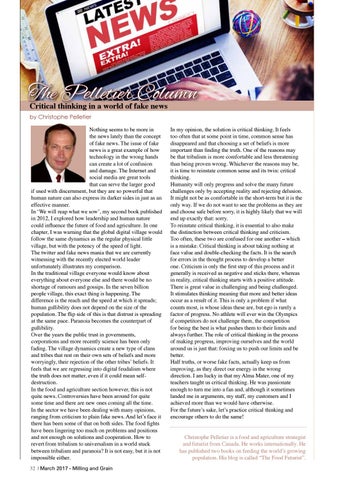
by Christophe Pelletier Nothing seems to be more in the news lately than the concept of fake news. The issue of fake news is a great example of how technology in the wrong hands can create a lot of confusion and damage. The Internet and social media are great tools that can serve the larger good if used with discernment, but they are so powerful that human nature can also express its darker sides in just as an effective manner. In ‘We will reap what we sow’, my second book published in 2012, I explored how leadership and human nature could influence the future of food and agriculture. In one chapter, I was warning that the global digital village would follow the same dynamics as the regular physical little village, but with the potency of the speed of light. The twitter and fake news mania that we are currently witnessing with the recently elected world leader unfortunately illustrates my comparison. In the traditional village everyone would know about everything about everyone else and there would be no shortage of rumours and gossips. In the seven billion people village, this exact thing is happening. The difference is the reach and the speed at which it spreads; human gullibility does not depend on the size of the population. The flip side of this is that distrust is spreading at the same pace. Paranoia becomes the counterpart of gullibility. Over the years the public trust in governments, corporations and more recently science has been only fading. The village dynamics create a new type of clans and tribes that rest on their own sets of beliefs and more worryingly, their rejection of the other tribes’ beliefs. It feels that we are regressing into digital feudalism where the truth does not matter, even if it could mean selfdestruction. In the food and agriculture section however, this is not quite news. Controversies have been around for quite some time and there are new ones coming all the time. In the sector we have been dealing with many opinions, ranging from criticism to plain fake news. And let’s face it there has been some of that on both sides. The food fights have been lingering too much on problems and positions and not enough on solutions and cooperation. How to revert from tribalism to universalism in a world stuck between tribalism and paranoia? It is not easy, but it is not impossible either. 32 | March 2017 - Milling and Grain
In my opinion, the solution is critical thinking. It feels too often that at some point in time, common sense has disappeared and that choosing a set of beliefs is more important than finding the truth. One of the reasons may be that tribalism is more comfortable and less threatening than being proven wrong. Whichever the reasons may be, it is time to reinstate common sense and its twin: critical thinking. Humanity will only progress and solve the many future challenges only by accepting reality and rejecting delusion. It might not be as comfortable in the short-term but it is the only way. If we do not want to see the problems as they are and choose safe before sorry, it is highly likely that we will end up exactly that: sorry. To reinstate critical thinking, it is essential to also make the distinction between critical thinking and criticism. Too often, these two are confused for one another – which is a mistake. Critical thinking is about taking nothing at face value and double-checking the facts. It is the search for errors in the thought process to develop a better one. Criticism is only the first step of this process and it generally is received as negative and sticks there, whereas in reality, critical thinking starts with a positive attitude. There is great value in challenging and being challenged. It stimulates thinking meaning that more and better ideas occur as a result of it. This is only a problem if what counts most, is whose ideas these are, but ego is rarely a factor of progress. No athlete will ever win the Olympics if competitors do not challenge them, the competition for being the best is what pushes them to their limits and always further. The role of critical thinking in the process of making progress, improving ourselves and the world around us is just that: forcing us to push our limits and be better. Half truths, or worse fake facts, actually keep us from improving, as they direct our energy in the wrong direction. I am lucky in that my Alma Mater, one of my teachers taught us critical thinking. He was passionate enough to turn me into a fan and, although it sometimes landed me in arguments, my staff, my customers and I achieved more than we would have otherwise. For the future’s sake, let’s practice critical thinking and encourage others to do the same! Christophe Pelletier is a food and agriculture strategist and futurist from Canada. He works internationally. He has published two books on feeding the world’s growing population. His blog is called “The Food Futurist”.
Milling News
W
Wheat rust continues to spread
heat rust, a family of fungal diseases that can cause crop losses of up to 100 percent in untreated susceptible wheat’s, is making further advances in Europe, Africa and Asia. Two new studies produced by scientists in collaboration with FAO, show the emergence of new races of both yellow rust and stem rust in various regions of the world in 2016particularly in the Mediterranean. These reports were highlighted in the journal ‘Nature’, following their publication by Aarhus University and the International Maize and Wheat Improvement Centre (CIMMYT). At the same time as this new progression, well-known existing rust races have spread to new countries. Underlining the need for early detection and action in order to limit major damage to wheat production, particularly in the Mediterranean basin. Swift action must be taken Wheat is a source of food and livelihoods for over one billion people in developing countries, Northern and Eastern Africa, the Near East, West, Central and South Asia, alone account for some 37 percent of global wheat production. All of these countries are vulnerable to rust diseases. Fazil Dusunceli, FAO Plant Pathologist explains, “These new, aggressive rust races have emerged at the same time that we’re working with international partners to help countries combat the existing ones, so we have to be swift and thorough in the way we approach this.” He continues, “It’s more important than ever that specialists from international institutions and wheat producing countries work together to stop these diseases in their tracks – that involves continuous surveillance, sharing data and building emergency response plans to protect their farmers and those in neighbouring countries.” If not detected and treated on time, wheat rusts turn a healthy looking crop only weeks away from harvest, into a tangle of yellow leaves, black stems and shrivelled grains. The disease can travel long distances and rapidly by wind and although fungicides can help to limit damage, early detection and rapid action are crucial. As are integrated management strategies in the long run. 36 | March 2017 - Milling and Grain
Areas most affected As previously mentioned, the Mediterranean has been the most affected by the new rusts. The Italian island of Sicily had a new race of the stem rust pathogen (TTTF) hit several thousands of hectares of durum wheat in 2016, causing the largest stem rust outbreak that Europe has seen in decades. Experience with similar races suggests that bread wheat varieties may also be susceptible to the new race, which is the most recently identified of the stem rusts. Without proper control, researchers have cautioned that it could soon spread over long distances along the Mediterranean basin and the Adriatic coast. New strains Meanwhile, various countries across Africa, Central Asia and Europe, have been battling new strains of yellow rust never before seen in their fields. Italy, Morocco and four Scandinavian countries have seen the emergence of an entirely new, yet-to-be-named race of yellow rust. Notably, it was most prevalent in Morocco and Sicily where until recently it was considered insignificant. Preliminary analysis suggests that the new race is related to a family of strains that are aggressive and better adapted to higher temperatures than most. In Ethiopia and Uzbekistan, the wheat farmers have been fighting outbreaks of yellow rust AF2012 simultaneously. This is another race that reared its head in both countries in 2016 and struck a major blow to Ethiopian wheat production in particular. AF2012 was originally found in Afghanistan, before appearing in the Horn of Africa country last year, affecting tens of thousands of hectares of wheat. Mr Dusunceli says, “Preliminary assessments are worrisome, but it is still unclear what the full impact of these new races will be on different wheat varieties in the affected regions.” He continues, “That’s what research institutions across these regions will need to further investigate in the coming months.” To offer support, FAO, in collaboration with its partners, is stepping up its efforts in training rust experts from affected countries to boost their ability to detect and manage these emerging wheat rust races.
New races emerge whilst old continue to rampage As new races emerge, old ones continue to spread. The already established Warrior (race of yellow rust) has continued its aerial march in 2016 and is now widely present in Europe and West Asia after coming onto scientists’ radars in Northern Europe and Turkey a few years ago. Whereas the Digalu (TIFTTF) continues to devastate wheat’s in Ethopia and the most widely known strain- the highly potent Ug99- is now present in 13 countries. Ug99 has the potential to affect many wheat varieties grown worldwide as it keeps producing new variants. Having spread in a northward trend from East Africa to the Middle East, it has been detected in Egypt, one of the Middle East’s most important wheat producers. Training There will be training repeated this year, which allows rust experts to strengthen their surveillance and management skills. It is an international collaboration where the findings of the Aarhus study build on training sessions conducted in 2016. This is in collaboration between the International Centre for Agricultural Research in the Dry Areas (ICARDA), Aarhus University, CIMMYT and FAO, who are all working together as members of the Borlaug Global Rust Initiative (BGRI). The recently established Regional Cereal Rust Research in Izmir, Turkey, will host the training that will also be coupled with surveys and collections of rust samples for tests and analysis. These efforts have been part of FAO’s four-year global wheat rust programme, which facilitates regional collaborations and offers support to individual countries eager to boost their surveillance capacity. It also helps countries act swiftly to control outbreaks before they turn into epidemics and cause major damage to food security. However, further research particularly into breeding resistant varieties and national response plans need to be backed by adequate resources.
Genç Degirmen expand product range Ukraine: a future agricultural frontrunner? by Chris Jackson, Export Manager UK TAG This month I have had the privilege to visit Kiev for the very first time to see first hand something of Ukraine’s agricultural industry. In a country with more than 4272 million hectares of productive land and a population of only 42.5 million people, agriculture makes up a major part of their GDP. In a system where land cannot be bought or sold, the farming companies have to negotiate leases from the freeholders - who usually own very small parcels of land. The local landowners who individually own very few acres seem very willing to lease their share to some very major corporations, some of who have turnovers running into billions of dollars. The country itself is rapidly developing its very significant rural economy to rank ‘top 10 exporters of foodstuffs worldwide. Its major customers being China, India, Turkey and the EU, outside of which it still remains. 60 percent of its production comes from two regions, Mykolaiv and Potava, with maize/corn, wheat and barley being its main cereal based crops, all responsible for some 60 million tonnes per year. Potatoes however, are the main vegetable crop along with sugar beet and vegetables. It can be believed that with improving road and logistics, this country will become even more influential in the world’s agriculture economy. As well as producing crops, livestock has a major influence - with poultry the main product, annually producing about 1144 million tonnes of which seven percent is for export, with pig production taking second place at 760 million tonnes, most of which is consumed at home. Unlike the western palate, fat meat is sought after. Because of the countries land borders and large-scale intensive units, disease spread is a major problem. This is compounded by a lack of bio-security with many 38 | March 2017 - Milling and Grain
workers having a few pigs at home and a large wild pig population. African swine fever is a major problem, which hopefully will be abated with the help of geneticists who are looking for the health gene, successful vaccination programmes along with increased bio-security. This in addition with the uptake of correct disposal of dead and diseased animals, the outbreaks can be limited and arrested. Not to mention the training of staff, which plays a key role in any successful control measures in raising awareness, control and prevention. The dairy industry, which is heavily reliant on the Holstein breed, is having difficulty with its short life span, something we heard about at one of the seminars given during the exhibition. Perhaps the industry should look at some of the more developed dual-purpose animals which can not only produce quality calves for beef, but also whose milk can make more cheese when the kappa casein B gene is present. In addition, with longer productive lives less expenditure is needed for herd replacement, which could lead to enhanced profitability. Perhaps it is time to look to alternative breeds and methods of production. The vast scale of some of the farming enterprise that we saw are matched in few countries worldwide, along with effective management and their ability to produce high quality food is very impressive. This is where the correct formulation of animal feed becomes imperative. Now, with the technologies available we will be able to trace all farm inputs, so food safety and security can be addressed as the world’s consumers continue to become more discerning buyers. From the Ukraine, my next destination will be Thailand to lead a group of UK companies to attend VIV Asia in March to showcase some of the UK’s expertise. I am looking forward to this event being very successful for all concerned, and I hope to see many of you there. @AgrictecExports
T
he company, who have been working within the milling industry for 26 years and has made more than 300 turnkey projects in 42 countries, has expanded their product range with the GMach. The expansion is aimed to be the company’s global face and is an example of the wide after sale service and the production approach in world standards from the company. The brand entered 2017 with big steps in achieving their goals and is adding new perspectives to the milling industry with the technologies they have developed. They have been realised with Genç Değirmen’s wealth of knowledge and renewed technology. Something GMach offers is to produce special equipment for corn flour, corn semolina mills, animal feed facilities, wheat flour and wheat farina mills. Causing the company to set the new roadmap with the ‘high quality consistency’ motto and plans to increase its share in the world market by bringing this policy to global scale. With intense R & D work, GMach always keeps its policies in the forefront; they guarantee low energy consumption and high performance in all of their products. With the innovative designs in all of their machines, they aim to be the most reliable business partner to their customers in the industry. One of the critical assurances offered to customers with the new product range, is the GMach’s machine tools have a low operational cost as well as user-friendly solutions. The most prominent feature is the special designed equipment reducing maintenance costs and time losses. In addition, GMach equips all installed production facilities with integrated control systems thus ensuring the monitoring and control of all input-output data in the process. This guarantees high yield in production.
Milling News
DISCOVER OUR SECRET!
IAOM
ERNEST N. MORIAL CONVENTION CENTER NEW ORLEANS USA
VIBSMC ONLINE TEMPER TIME CONTROL ©
12.13.04.
WATER ABSORPTION MONITORING AFTER TEMPERING ONLINE DETECTION TO OPTIMIZE TEMPER TIMES PRACTICAL AND EASY INSTALLATION
BOOTH 718
VIBSMC©
INCREASE YOUR PROFIT
OPTIMUM YIELDS MORE WHITE FLOUR TIMELY INTERVENTION UNIFORM END PRODUCTS PRIOR TO MILLING, DRYING, COOKING CORRECT TEMPERING FOR EACH VARIETY RAW MATERIAL CONTROL
WEIGHING AND DOSING
PROCESS CONTROL
MOISTURE CONTROL WATER ADDITION
VIBRONET® GRÄF GMBH & CO. KG CEREAL DAMPING SYSTEMS NEUMÜHLE 1 35633 LAHNAU GERMANY VIBRONET.COM INFOVIBRONET.COM
Milling and Grain - March 2017 | 39
Milling News
EU compound feed estimates for 2016
T
he industrial compound feed production for farmed animals in the EU-28 in 2016 reached an estimated level of 153.4 million tonnes, that is one percent less than in 2015, according to data provided by FEFAC members. As regards cattle feed, the picture is extremely contrasted throughout Europe. The Netherlands and Poland have seen their production of cattle feed increase by more than eight percent, whereas France and Poland moved in the opposite direction, reflecting the diverging national milk production following the abolishment of dairy quotas. Overall, due to low milk prices, dairy farmers were not encouraged to purchase high performing feed to maximise milk production, resulting in an aggregate downturn of EU cattle feed production of 1.5 percent. Although poultry feed production was expected to perform rather well in 2016, the Avian Influenza outbreak at the end of 2016 severely impacted several poultry producing regions of Europe, in particular France where a four percent decrease in poultry feed production was recorded. All-in-all, EU poultry feed production remained almost stable and is still the leading segment of EU industrial compound feed production, well ahead of pig feed. On the pig feed side, after two years of moderate growth, the production decreased by 1.5 percent in 2016. This can partly be explained by the effects of African Swine Fever in Eastern Europe, which weighed heavily on the development of pigmeat production, but also by low market prices for pigmeat in the first half of 2016 and large availability of feed grade cereals at low prices which benefitted on-farm mixing. Leading countries For the third year in a row, Poland was one of the best performing countries, with annual growth of +4.7 percent, boosted by the demand for poultry feed which has turned Poland into the largest poultry producing country in the EU. The Netherlands, boosted by the demand for dairy feed, recorded a one percent growth verses 2015. Germany, Spain and Belgium saw their total compound feed production fall by 1-2 percent, whereas France saw its production drop by four percent. Germany strengthened its position as leading EU country in terms of total compound feed production, ahead of Spain and France. The final estimate and detailed breakdown of the 2016 figures will be issued in June 2017. Outlook for 2017 FEFAC market experts are relatively pessimistic concerning industrial compound feed production in 2017. 40 | March 2017 - Milling and Grain
The dairy sector still needs to recover from the severe milk price crisis, thereby likely negatively impacting the dairy herd in 2017, while also national adjustments to meet environmental criteria play a role. These developments may lead to a further reduction of cattle feed production by two percent. The expected stabilisation of pigmeat production in Europe could induce a moderate reduction in demand for pig feed (-1%). Poultry exports will continue to be affected by Avian Influenza, thus putting pressure on EU poultry production and subsequently the feed segment (-0.5%). Overall, this would lead to a further one percent decrease in compound feed production in 2017 verses 2016. A number of parameters will evidently affect this outlook. The evolution of outbreaks of Avian Influenza and African Swine Fever will be decisive, in particular in terms of EU export capacities preservation. Table 1: Million tonnes
2015
2016
%Var 2016/2015
Cattle feed
42.0
41.4
-1.5
Pig feed
50.2
49.4
-1.6
Poultry feed
53.7
53.6
-0.2
Total
155.0
153.4
-1.0
The scope for re-establishment of Russian imports of EU pork as a result of WTO conclusions on the illegality of the Russian sanitary ban introduced in 2014, may on the other hand offer some opportunities for certain EU countries, although it is unlikely that this development will lead to action in the short term. This case is one among many political factors that undoubtedly will affect the market in the EU and worldwide. Raw material view Cereals market quotations are now on a moderate upward trend, after reaching a record low level in autumn 2016. However, the relatively comfortable level of end stocks at global level, the good prospects on the South American harvest and the good state of EU winter cereals plantings should maintain prices at a low level in the first half of 2017. As regards soybeans, signals from South America are positive both in terms of acreage and yields for the spring harvest. An additional positive indication is predicted increase in the US soybean acreage for 2017. Nevertheless, with the demand for soybeans and soybean products increasing at global level by four percent per year, the balance sheet remains tight. 1 From 2016 on, FEFAC does no longer include dry petfood production in its statistics, considering that a large part of the production was missing in national statistics. 2 Greece, Malta and Luxembourg excluded from FEFAC statistics
In your business, performance is crucial. It’s the same in ours.
Nutriad creates and produces smart additives, preservatives and flavouring substances that all share the same goal: increasing animal performance. Production returns will follow suit – be it meat, fish, eggs or dairy products. Good for your business. Interested? Let’s get in touch: visit nutriad.com for your local contact.
Milling News
Operational safety starts with innovative thinking.
Safe feed production. Healthy business. Reduce the risk of dust explosions and save on operational costs with our new feeding device with built-in heavy parts separator. By preventing stones and heavy parts from entering the hammer mill, the explosion risk is minimized and the lifetime of the screens will increase. The compact, yet robust new feeding device is designed to fit perfectly with the GD hammer mill and the automatic screen exchange. www.aarsen.com/machines/hammer-mills
2016-10-07, Grain & Feed Milling.indd 1
7-10-2016 12:53:06
Excellent firms don’t believe in excellence - only in constant improvement and constant change. —Tom Peters Is it time to shift production to a more favorable continuous process? You can get higher levels of thermal energy than ever thought possible – for a more gentle cooking process compared to high-shear cook. With Wenger’s Thermal Twin Screw Extruder, products high in corn or rice content are processed without the stickiness typically encountered in conventional extrusion systems. The Thermal Twin design allows ingredients to be fully cooked without damage to the starch or protein matrix.
Turning ideas into opportunities. PROGRESSIVE FOOD PROCESSING
Contact us now for details on the revolutionary Thermal Twin Screw Extruder Series to learn how it can transform your process and your bottom line.
Imagine the possibilities wenger.com BElGIum
42 | March 2017 - Milling and Grain
Wenger14.TT.Steam.Food.Ad.210x147.indd 1
TaIwaN
BRaSIl
ChINa
TuRkEy
INDIa
9/30/14 10:31 AM
World’s future food security “in jeopardy”
N
ew findings from FAO report suggest that without additional efforts, the target of ending hunger by 2030 will not be met. Mankind’s future ability to feed itself is in danger due to intensifying pressures on natural resources, mounting inequality and the fallout from a changing climate warns the report. The Future of Food and Agriculture: Trends and Challenges says, “Very real and significant progress in reducing global hunger has been achieved over the past 30 years, expanding food production and economic growth have often come at a heavy cost to the natural environment.” Further noting that, “Almost one half of the forests that once covered the Earth are now gone. Groundwater sources are being depleted rapidly. Biodiversity has been deeply eroded.” José Graziano da Silva, FAO Director-General, warns, “As of a result of the deforestation, planetary boundaries may well be surpassed, if current trends continue.” By 2050, humanity’s ranks will likely have grown to nearly 10 billion people. In a scenario with moderate economic growth, this population increase will push up global demand for agricultural products by 50 percent over present levels, intensifying pressures on already-stained natural resources. At the same time, greater numbers of people will be eating fewer cereals and larger amounts of meat, fruits, vegetables and processed food – a result on an on-going global dietary transition that will further add to those pressures, driving more deforestation, land degradation, and greenhouse has emissions. Alongside these trends, the planet’s changing climate will throw up additional hurdles, including greater variability of precipitation and increases in the frequency of droughts and floods. The report says, “Climate change will affect every aspect of food production”. To reach zero hunger, we need to step up our efforts The core question raised by today’s
FAO publication is whether, looking ahead, the world’s agriculture and food systems are capable of sustainably meeting the needs of a burgeoning global population. The short answer is that the planet’s food systems are capable of producing enough food to do so, and in a sustainable way, but unlocking that potential – and ensuring that all of humanity benefits – will require “major transformations”. The report warns that without a push to invest in and retool food systems, far too many people will still be hungry in 2030 – the year by which the new Sustainable Development Goals agenda has targeted the eradication of chronic food insecurity and malnutrition. It points out that, “Without additional efforts to promote pro-poor development, reduce inequalities and protect vulnerable people, more than 600 million people would still be undernourished in 2030,” In fact, the current rate of progress would not even be enough to eradicate hunger by 2050. Where will our food come from? Given the limited scope for expanding agriculture’s use of more land and water resources, the production increases needed to meet rising food demand will have to come mainly from improvements in productivity and resource-use efficiency. However there are worrying signs that yield growth is levelling off for major crops. Since the 1990s, average increases in the yields of maize, rice, and wheat at the global level generally run just over one percent per annum. To tackle these and the other challenges outlined, ‘business-asusual’ is not an option, The Future of Food and Agriculture argues. “Major transformations in agricultural systems, rural economies and natural resource management will be needed if we are to meet the multiple challenges before us and realise the full potential of food and agriculture to ensure a secure and healthy future for all people and the entire planet”. It adds, “High-input, resourceintensive farming systems, which have caused massive deforestation,
Milling News
water scarcities, soil depletion and high levels of greenhouse gas emissions, cannot deliver sustainable food and agricultural production”. More with less The core challenge is to produce more with less, while preserving and enhancing the livelihoods of small-scale and family farmers, and ensuring access to food by the most vulnerable. For this, a twin-track approach is needed which combines investment in social protection, to immediately tackle undernourishment, and pro-poor investments in productive activities — especially agriculture and in rural economies — to sustainably increase incomeearning opportunities of the poor. The world will need to shift to more sustainable food systems which make more efficient use of land, water and other inputs and sharply reduce their use of fossil fuels, leading to a drastic cut of agricultural green-house gas emissions, greater conservation of biodiversity, and a reduction of waste. This will necessitate more investment in agriculture and agrifood systems, as well as greater spending on research and development in order to promote innovation, support sustainable production increases, and find better ways to cope with issues like water scarcity and climate change. Along with boosting production and resilience, equally critical will be creating food supply chains that better connect farmers in low- and middleincome countries to urban markets — along with measures which ensure access for consumers to nutritious and safe food at affordable prices, such as such as pricing policies and social protection programs. Milling and Grain - March 2017 | 43
Milling News
MOU signed over Panama Canal importance
M
ore than 350 attendees had a look at the new Panama Canal expansion, kicking off the US Grains Council 14th International Marketing Conference and 57th Annual Membership Meeting in Panama City, Panama. The tour of the canal, which opened on June 30, 2016, was a unique opportunity to see trade in action. As well as an important reminder of the dynamic global trade environment for those who last visited the canal shortly after construction on the new locks began. The new locks will open opportunities for larger and more efficient shipments of all products. Before the tour of the Agua Clara locks in Colon, Panama, meeting attendees in a general session were welcomed to the region by USGC Western Hemisphere Regional Director, Marri Carrow and Erik Hansen, Agricultural Counsellor at the US Embassy in San Jose, Costa Rica. Chip Councell, USGC chairman and a grain farmer in Maryland explains the interest in the visit to the canal, “When USGC last met in Panama, the canal expansion was only a construction site. Visiting the new locks reflects the long-term commitment of the council and its members to enabling more and expanded trade opportunities for American agriculture.” This tour was alongside witnessing Councell and Manuel Benitez, Panama Canal Deputy Administrator, sign a formal memorandum of understanding between the two
Destoner
Pre - Cleaner
Sheller
Chip Councell and Manuel Benitez, Panama Canal Deputy Administrator, sign a formal memorandum
organisations on the importance of the Panama Canal to US grain trade. During the conference, Benitez told the crowd that, “69 percent of all cargo travelling through the Panama Canal originates from or is destined for the United States. This includes roughly one-third of total US grain exports.” This information was part of the extensive briefing he offered the famers, agribusiness representatives and others in the audience. Delegates will also have the opportunity to visit the Miraflores locks, where ships cross below the Bridge of the Americas that connects North and South America. This prospect runs alongside the continued meetings on trade perspectives on the grain market and set strategy for the organisation’s work.
Tray Separator
Whitener
Polisher
END TO END RICE MILLING SOLUTIONS
length Grader
MILLTEC ISO 9001:2008 / ISO 14001:2004
Parboiling & Dryer
Color Sorter
POWER PLANTS
SILICA EXTRACTION
MILLTEC MACHINERY PVT. LTD Boiler
No. 51/A , 1st Phase, KIADB Indl Area Bommasandra, Bangalore -560099 Karnataka, India
For More Details Contact: MR. SUNIL KUMAR Manager – International Marketing +91 - 9108459241 exports2@milltecmachinery.com
44 | March 2017 - Milling and Grain
Follow us on
TEL: +91-80-28016666+91-80-27831128 Email: marketing@milltecmachinery.com W e b s i t e : w w w. m i l l t e c m a c h i n e r y. c o m w w w. m i l l t e c m a c h i n e r y. i n
www.twitter.com/MilltecMMPL www.facebook.com/Milltecmachinerypvtltd www.linkedin.com/Milltecmachinerypvtltd
Packing
TOLL FREE: 18001028431 (INDIA)
Mill
Training The IGP Institute at Kansas State University held training for grain elevator managers interested in proper grain storage techniques. The IGP-KSU Grain Elevator Managers course offering was held January 30 – February 3, 2017, at the IGP Institute Conference Centre in Manhattan.
Grain elevator managers gain training for management systems The course benefitted grain elevator managers who were interested in learning the logic behind the management practices. Efficient management in any operation is a key factor not only for production for the company, but also for precautions taken in the workplace. During this course participants learnt new techniques of management operations for grain elevators. It also provided new managers information that is needed to correctly interpret the experiences that they will have in managing grain quality, and the insight acquired when they evaluate the practices used by prior supervisors. Garrett Martin, grain operations manager at Skyland Grain in Johnson, Kansas, remarks, “What I enjoyed the most about this course was all of the information that you get over a five-day span. It was really good and useful information that I think I’ll be able to use down the road.” With manager gaining knowledge of the management techniques taught in this course, the efficiency of operation systems could improve overall for the grain industry. A sentiment echoed by Carl Reed, IGP Institute grain storage speciality and course coordinator, “The greatest benefit is an appreciation of the importance of system and documentation in grain management. I hope they learn this from the formal presentations and from interaction with grain managers from other companies with other cultures.” He continues, “The main purpose of this course is to provide grain management information that may not be available elsewhere to help
Milling
TRAINING internationalmilling.com ONLINE | PRINT | MOBILE
the grain managers be able to properly understand how to avoid errors and develop a more efficient operation.” The different topics discussed in this course were personnel management, grain quality assessment, grain handling equipment, grain drying, grain operations costs, grain inventory management, grain receiving and shipping, grain condition monitoring, grain aeration principles and strategies, and grain fumigation. The IGP Institute offers several other training courses in addition to feed manufacturing and grain quality management. They hold training opportunities in flour milling, grain processing, and grain marketing and risk management.
The Training Register operates on the same platform as the highly successful internationalmilling.com Events Register. Our vision is to produce an easily accessible hub which will list both milling and aquaculture related training courses, workshops and educational opportunities from around the world, much the same as the Events Register does for conferences and expositions. “If you, your company or organisation is organising a milling or aquaculture course we would love to work with you. No training course is too big or too small for any of our readers to attend.” Milling and Grain - March 2017 | 47
PRODUCT FOCUS MARCH 2017 In every edition of Milling and Grain, we take a look at the products that will be saving you time and money in the milling process.
Imeco’s Electronic Single Weighing Hopper Process Weigher Suitable for totalising of granular and powdery products flow (typical installation screenings monitoring, first cleaning scale, finished products monitoring). This process weigher has high sanitation tubular design, heigh adjustable supporting legs as well as a user-friendly operator interface. Available in four sizes up to 84m3/h, this machine offers easy access and Modbus RTU, Modbus Ascii, CL, profibus DP communication interfaces. Prepared to drive additives feeders and boasts a trough analog signal.
www.imeco.org
ANDRITZ Sprout pellet mill Designed, built and serviced in North America, the Sprout gear-driven pellet mills deliver quiet, efficient operation at all production levels. The single-reduction gear system in our Sprout gear-driven mills ensures efficient power transfer, resulting in low energy cost per ton and long service life. The quick-change cartridge assembly allows you to change dies in a matter of minutes and simplifies maintenance. The Sprout pellet mill’s tapered die mounting is designed to make changing dies easier and faster. The symmetrical design of the die provides reversibility for longer service life.
THIS MONTH WE TAKE A LOOK AT MACHINERY FROM COMPANIES THAT WERE EXHIBITING AT IPPE 2017
www.andritz.com
Liyang Heclat Machinery Mill Liyang Heclat Machinery mill was founded in 1997. It supplies more than 20,000 pcs roller shells, dies, and components of feed machinery to Europe, America and Canada every year. Their products include corrugated roller shells, dimpled roller shells, dies in material, dies for sawdust, roller shells with keyway and stainless flanges. Heclat is an individual-owned enterprise located at the Tianmuhu tourism destination; the factory with modern workshops and offices covers more than 5,000 suare meters.
www.heclat.com 48 | March 2017 - Milling and Grain
Electro Sensors’ HazardPRO Electro-Sensors is revolutionizing the way hazard monitoring is done, with its turnkey HazardPRO systems. Rugged sensors and the most advanced wireless technology combine to create the best hazard monitoring solution with the lowest installed cost. You can quickly view what processes are running and their condition from the status screen, whilst easy touchscreen navigation guides the user through equipment information. Intelligent transmitter nodes send information both on a scheduled periodic basis and when important changes are detached, ensuring that there are no polling delays or lapses in monitoring.
www.electro-sensors.com
FOCUS
SPECIAL FOCUS FEED FOCUS As one of the biggest feed machinery and complete project suppliers in China, Zhengchang has successfully developed a series of multi-fuctional simple feed machinery for the demand of small and medium breeding farms. The capability of Zhengchang SKZH poultry and livestock feed units are 5000-60000t/yr, which are suitable for all kinds of professional feed producers, private enterprises and aquatic product farms, to produce various high-grade fish feed and shrimp feed. They can help you to realise one-line standard breeding to greatly save the cost and obtain higher repayment. Zhengchang complete feed units use the frame structure and are therefore convenient for users to deliver and install. The Zhengchang economical premix mill set comes equipped with high quality pellet mill, grinder, mixer etc that promises less investment, quick profit return, easy installation and operation
Zheng Chang’s complete process mini mill and easy management. The small set has the similar technology process as the large pig farm which is flexible, highly adaptable and profitable. All round after-sales service is provided whilst Zhengchang Bairuier formula is supplied at preferential price. Zhengchang also manufactures various feed sets for laboratory experiments of the scientific institutes. It is applicable for self-construction of premix line of large feed factories as well as the expansion of easy projects of premix factories. It features building block design, easy construction and many strong points. Zhengchang single shaft mixer is adopted so that there is little dust, less residue and the mixing accuracy is very high. It also conveniently occupies less space. Alternatively, you can fit a single machine such as Zhengchang’s Cylinder Pellet Screener, Winner Hammer Mill and High-grade Triple-roller Crumbler.
www.zhengchang.com
Milling and Grain - March 2017 | 49
#
03
F
by Pinar Erdal, R&D Manager of Mirpain Bakery Ingredients, Turkey
Bread, is the most widely consumed food in the world and its main ingredient is flour. For making bread, the most consumed flour is Wheat Flour and the most important value of wheat is its quality.
T
he quality of the wheat flour depends on its compounds which depends on wheat variety its compounds, harvest season (winter or spring), climatic effects (rainfall), storage conditions-durations, crop and after crop treatment, planting regime, biological effects and so on. These conditions affect the bread’s characteristics like crumb and crust colour even and smooth crumb texture, higher water absorption, uniform loaf shape, better-knife opening and higher tolerance to various processes. When your flour cannot meet these factors, functional ingredients especially ultra concentrated enzymes that catalyse chemical reactions in the case of flour/dough, take a big role in improving the flour. As a result of being ultra concentrated, when a little enzyme is used it yields desired effects on the flour quality. For example, they enhance gas production by yeasts and can help control the strength of the dough. Each enzyme acts upon only one specific substrate and ignores the others. Like proteins, they have an optimum temperature
50 | March 2017 - Milling and Grain
and pH to react. On top of these factors, water content, enzyme amount, substrate content and the given time for reaction are also important. Also it is known that amylases and xylanases are the enzymes most added to dough.
Amylases
Most widely used Amylases are reported as being the first enzymes to be added to bread dough. They are also the topic of most current research on enzymes in dough. While the initial use was for generating fermentable sugars (increasing gassing power), current interest focuses on their ability to delay crumb firming, the anti-staling effect. Amylases action on damaged starch granules produces dextrins and oligosaccharides. The key factor of amylase in wheat flour is to break down complex starches into simple sugars. The presence of amylase is essential for fermentation of dough because yeast requires simple sugars to produce carbon dioxide. Although flour contains a tiny amount of sugar, one to two percent, this amount is not enough to make dough rise during fermentation. However, wheat kernels contain naturally occurring alpha amylase because they need to break starch molecule into sugar to have the needed energy during the germinating of the kernels. The amount of naturally occurring amylase is affected by wheat variety, harvest season (winter or spring), climatic effects (rainfall), storage conditions-durations, crop and after-crop treatment, planting regime, as well as biological effects of the wheat. Falling Number Method is a key analysis to determine the quality of flour by figuring out indirectly the alpha amylase activity. In the case of deficiency in naturally occurring amylase, the flour is supplemented by adding commercially available amylases or it is possible to blend flours to balance the amount of amylases.
F Hemicellulases
Hemicellulases transforms water-insoluble hemicellulose into soluble form, which binds water into dough then dough. Thus firmness of the dough decreases, specific volume increases and crumb texture properties are affected positively (finer and uniform crumb). It also significantly improves the machinability of the dough. The increased stability and improved machinability of the dough are obtained by hemicellulase besides it increases the elasticity of gluten network. Hemicellulases also have a softening effect.
Mirpain Alphamill
Mirpain Alphamill is an alpha amylase enzyme with different concentrate types depending on requirement profiles. Its benefits include improved levels of dough rising, improved volume of the final product, and improved crust colour by participating in browning reactions are amongst its benefits. It also improves the shelf life of the final product.
Table 1: BREADS
5 PPM COMPOMILL
8 PPM COMPOMILL
10 PPM COMPOMILL
12 PPM COMPOMILL
1888,368
2224,814
2274,289
2416,068
Specific volume (ml/g)
4,769
5,61
5,69
5,958
Length (cm)
16,3
16,4
16,4
16,5
Height (cm)
13
14,7
14,9
15,8
VOLUME (ml)
Mirpain Hemimill series
Mirpain Hemimill is hemicelullase enzyme with concentration and type depending on the customer profiles. The most consumed is Hemimill spring. Indeed, after our long research and development studies, we have created this specific hemicellulose. Hence the name of it, it is mostly used for its significant effect on Oven-spring. Some of the benefits of the Hemimill spring include improved extensibility and machinability of the dough, improved volume of the final product and greater fermentation tolerance. Finally, it improves oven-spring.
Alpha amylase and hemicellulase combinations
At times, bakers and flour millers have difficulties in deciding the correct dosage of the enzymes. Subsequently, this causes wrong classifications of the quality of the enzyme. Therefore after our R&D studies, we created and launched the Compomill, as an optimum combination of alpha amylase - hemicellulase to reduce the possible headaches of the end users and to maximise the benefits of synergistic action of these enzymes. Not only does it improve gas production and protection, machinability and stability, and optimises dough consistency, it also improves visual appearance of the final product (crust colour, finer crumb, finer structure). It improves the volume of the final product and improves oven spring.
Future trends
Regarding baked goods, the usage of enzymes will exist for the development of gluten-free products and for obtaining dietary fiber-enriched bread and products with increased contents of arabinoxylan oligosaccarides with prebiotic potential. Offering label-friendly answers with clear-cut activity, today’s enzymes are also used as shell-life extenders of the end-product.
The Next Generation of NIR Analysers for the Milling and Grains Industry
CropScan 3000F Grain and Flour Analyser
Measures Protein and Moisture in Wheat Measures Protein, Moisture, Ash, Water Absorption and Starch Damage in Flour and Semolina Touch Screen Operation Weighbridge software available Internet software available
Visit our web site www.nextinstruments.net or email us at sales@nextinstruments.net Milling and Grain - March 2017 | 51
F
Is it time that Europe makes folic acid fortification mandatory?
H
by Martine Austin and Renée Jopp, International Federation for Spina Bifida and Hydrocephalus, Belgium
"Today, over 80 countries now have a mandate to fortify at least one staple grain with folic acid, with the notable exclusion of Europe, where we have yet to secure a single mandate"
ow does Neural Tube Defect relate to the milling and grain industry? 2017 marks the 26th anniversary of a ground-breaking international study that changed the future for the global prevention of some of the world’s most common congenital birth defects, Neural Tube Defects (NTDs). The 1991 study conducted by the Medical Research Council (MRC), led by Professor Sir Nicholas Wald, confirmed the protective benefits of folic acid in the prevention of NTDs, with this B vitamin reducing the risk to unborn babies by up to 72 percent. The positive correlation was so overwhelmingly that the trial was ended ahead of schedule, as it was deemed unethical to continue withholding folic acid from women in the control group. A quarter of a century later and the milling and grain industry has become a vital player in the worldwide strategy to prevent these serious conditions. Having said that, there is still much more to be done.
What is folic acid?
Folic acid (vitamin B9) is the manmade version of folate, which is found naturally in green leafy vegetables, some fruits and pulses, the kinds of food that we’re all encouraged to eat more of. However, whilst a healthy balanced diet is always beneficial, food folates are very unstable, and they can lose much of their nutritional content as a result of cooking and poor or prolonged storage. Folate/folic acid plays an essential role in cell growth and development and the formation of DNA, consequently its role becomes even more vital in the early stages of pregnancy, when cell growth and reproduction is at its most rapid. Most of us will 52 | March 2017 - Milling and Grain
get enough of this essential vitamin through a healthy balanced diet, but it’s impossible for women to obtain the daily additional folate they need to support a healthy pregnancy through diet alone. Folate insufficiency at the time of conception is known to increase the risk of serious birth defects, NTDs, which occur in the very early stages of pregnancy when the brain and spine fail to form properly, with around 70 percent of babies affected also developing the commonly associated condition hydrocephalus (often termed, water on the brain). The instability of natural folates makes it very difficult to accurately gauge how much of the original vitamin content has been preserved to benefit the consumer, yet its manmade counterpart is considerably more stable. Both forms are water soluble, so our bodies can’t retain them very effectively, making daily consumption essential. As a result, since 1992, most countries around the world have advised all women that could become pregnant to take a daily supplement containing 400mcg of folic acid to help reduce the risk of their pregnancy being affected by NTDs. Despite this measure, NTDs still affect around ½ million pregnancies every year, resulting in thousands of late terminations every year (most NTDs are first diagnosed during a 20-week ultrasound), and many babies being born with a wide spectrum of both physical and learning disabilities. Many of these cases could have been prevented with daily additional, timely folic acid.
Breaking the myths
Whilst the solution may appear simple, there are a number of barriers to successful prevention through supplementation alone, and to date, strategies have been relatively unsuccessful due to a complex combination of social, personal and economic factors. ‘Timeliness’, is one of the key barriers to prevention, as to provide effective protection against NTDs, folate levels need to
F Figure 1: Reductions in NTDs after flour fortification with folic acid was initiated
are still presented with a considerable global public health issue. The milling and grain industry has been instrumental in helping overcome many complex global barriers to NTD prevention through both voluntary and mandatory fortification of staple grains and flour with folic acid. All over the world, people commonly consume wheat flour, maize flour, or rice as a staple part of their diets. Fortifying one or more of these grains is a costeffective way to improve the population’s nutrient intake.
Food fortification with folic acid
be raised to protective levels before conception occurs. In addition to this, successful supplementation is dependent upon a variety of factors such as pregnancies being planned (over 50 percent of the world’s pregnancies are unplanned); essential human behaviour change within the target group; availability and access to supplements (lacking in many developing countries). Further to this, it depends upon correcting the many common misconceptions about folic acid i.e. that folic acid ‘is something that you can choose to take when you’re pregnant because it’s good for the baby’, rather than something that’s essential preconception to prevent some very serious consequences; or that you can get all the additional folic acid you need through a healthy diet; and even that folic acid prevents pregnancy (a misconception held by many men in the developing world). So, despite 26 years of scientific knowledge to enable prevention, we
In 1996, Oman became the first country to introduce national scale mandatory fortification of wheat flour with folic acid. The USA followed in 1998, introducing fortification (in addition to supplementation), as part of a national strategy to maximise prevention of NTDs. Through this action, the milling and grain industry has contributed towards an estimated 35 percent decrease in the birth prevalence of NTDs across the USA, which in real terms equates to 1,300 fewer babies being born with these conditions. A major public health success story! But, not only does fortification with folic acid reduce the risk of NTDs, it also reduces the risk of folate deficiency and folate deficiency anaemia across the wider population. Today, over 80 countries now have a mandate to fortify at least one staple grain with folic acid, with the notable exclusion of Europe, where we have yet to secure a single mandate. Whilst Europe remains reliant on supplementation (with its associated shortcomings) and voluntary fortification (which has a positive, but limited impact), mandatory fortification is proven to be considerably more effective in producing positive equitable public health outcomes. For example, when voluntary fortification began in Australia in 1995, two in 1,000 babies born to aboriginal
Grain and Flour Analyzer Experts
• 50+ years knowledge and expertise • Functional and compositional analysis • Flour, grains and oilseeds www.perten.com Ad_Milling and Grain_deadline20170111 - 190x132.indd 1
Milling and Grain - March2017-01-11 2017 | 10:54:48 53
F mothers were affected by an NTD (double the rate born to nonindigenous mothers). The introduction of mandatory fortification in 2009, resulted in a staggering reduction, to 0.5 in 1,000 of these pregnancies being affected. This also serves to demonstrate the unique ability of mandatory fortification with folic acid to reduce the significant impact of socioeconomic inequality in the aetiology and prevention of these complex conditions.
Advocacy efforts
The International Federation for Spina Bifida and Hydrocephalus (IF) has maintained a high profile presence throughout ongoing global fortification activity. When the Regulation (EC) 1925/2006 on the addition of vitamins and minerals to foods was introduced in the EU, IF strongly advocated for the mandatory fortification of flour with folic acid within Europe, and submitted a statement to the United Nations, calling on them to ratify a policy urging all Member States to fortify a staple food with folic acid. To make greater progress, IF joined the Flour Fortification Initiative, (now the Food Fortification Initiative - FFI), an international public, private and civic partnership, working to improve health through fortification of industrially milled grain products. As IF’s President Margo Whiteford recalls, “The primary prevention of neural tube defects became a recurring topic during IF’s annual international conferences, starting in 2007 in Kampala, Uganda, where Prof. Dr. Glen Maberley, then coordinator of FFI, gave an overview of mandatory food fortification worldwide. That same year, IF and FFI organised a meeting in Europe, with the aim to develop a strategy to influence European authorities to support the mandatory fortification of flour with folic acid. The event brought together interested partners from the scientific world, international organisations, industry, and the disability movement. In 2008, IF took part in the 1st Central and Eastern European Summit on Preconception Health and Prevention of Birth Defects in Budapest, Hungary. Speakers from both the US and South America emphasised the effectiveness, sustainability and cost-effectiveness of folic acid fortification as a public health intervention, tackling both folate insufficiency and effecting an average reduction in NTD incidence of 46 percent in countries where fortification had been implemented. The preventative benefits of this intervention were notably magnified in countries with greatest incidence (i.e. Brazil, Peru, Chile). The recent addition of corn masa flour (a food staple in Latin America) to the US fortification programme aims to further address the distinctly higher risk of NTD among Hispanic women.”
Global partnerships and activities
Through a partnership including AkzoNobel, Helen Keller International, FFI, and IF, the project Smarter Futures was launched in 2009 with funding from the Dutch government to improve health in Africa through the enrichment of wheat and maize flour with essential vitamins and minerals. Smarter Futures provides technical support and training for flour millers as well as government food control staff, vitamin and mineral suppliers, international organizations, and academic institutions in Africa. Whilst the emotional, psychological, personal and health consequences of these largely preventable conditions remains the primary motivation for maximising their primary prevention, the cost benefits of doing so (particularly at a time when healthcare budgets and resources are at breaking point) are also undeniable. IF presented the case of flour fortification with folic acid as a cost-effective way to prevent birth defects at the 4th International 54 | March 2017 - Milling and Grain
Mühlenchemie Symposium “Future of Flour” in 2011, and in 2012 IF and FFI organised a workshop to highlight opportunities for flour fortification to improve nutrition and prevent birth defects at the 15th European Health Forum Gastein in Austria. In 2013, IF also cooperated on a review article with FFI, the Emory Centre for Spina Bifida Research, Prevention and Policy, and UNICEF, “Folic acid fortification of wheat flour: A costeffective public health intervention to prevent birth defects in Europe ”, published in the June issue of the Nutrition Bulletin. At the Future Fortified Global Summit on Food Fortification in Tanzania, organised by GAIN in 2015, IF participated in the panel “Protecting life before it begins: The impact of Spina Bifida” and emphasised how difficult the optimal folate levels in the preconception period is to be achieved with supplements. With FFI, Boston Children’s Hospital and CURE Hydrocephalus, the Hydrocephalus Association, the U.S. Spina Bifida Association, and the University of Toronto, Sunnybrook Health Sciences Centre, IF initiated the PUSH! Global Alliance, with advisory support of the U.S. Centres for Disease Control and Prevention, National Centre on Birth Defects and Developmental Disabilities. This was in order to accelerate spina bifida and hydrocephalus prevention, and to realise optimal care and a better quality of life for those affected.
The way forward
NTDs remain an important cause of perinatal mortality and disability worldwide, with the mandatory fortification of flour with folic acid proving to be the most successful public health intervention to date towards reducing the global prevalence of NTD-affected pregnancies. Whilst we have yet to achieve a mandate for folic acid fortification in Europe, IF maintains its commitment to achieve this goal, and will consequently be issuing a renewed call to action to governments to commit to this vital public health action. IF President Margo Whiteford commented, “IF calls on the EU to implement forthright policy propositions that will contribute to the effective reduction of NTD through increasing awareness, and folic acid food fortification and supplementation plans. IF proposes the creation of an international policy for mandatory food fortification to actively encourage all countries to adopt this measure”. In a bid to consolidate the global effort towards maximising NTD prevention, IF launched its Global Prevention Initiative (GPI) at its international conference in 2016. Its first action was declaring the first World Folic Acid Awareness Week in January 2017. The GPI is the first initiative of its kind, aiming to maximise the risk reduction of NTDs (and the often associated condition, hydrocephalus) as a united global community, through the engagement of its members, academics, health professionals, governments, educators, commercial and NGO partners. With a world renowned panel of global experts (in both NTDs, hydrocephalus and prevention), board membership of the Food Fortification Initiative, history of global engagement in supplementation recommendation, and unprecedented understanding of the lifelong impact of these conditions (as a long serving international patient organisation) IF is ideally positioned to lead on this drive, at the heart of which remains a global mandate for folic acid fortification. Importantly, while IF actively supports primary prevention measures to reduce the prevalence of NTDs, it also emphasises that prevention campaigns should safeguard the dignity of people with disabilities and must not be seen to carry messages that may increase stigma and discrimination. www.ifglobal.org
䄀 䐀 䐀 匀 嘀䄀 䰀唀 䔀 吀伀 夀伀 唀
伀 一 吀 䠀 䔀 圀 䄀 夀 吀伀 吀 䠀 䔀 䘀 唀 吀 唀 刀 䔀
匀椀渀挀攀 㤀㠀㤀Ⰰ 眀攀 栀愀瘀攀 戀攀攀渀 戀爀椀渀最椀渀最 椀渀搀甀猀琀爀椀愀氀 洀愀渀甀昀愀挀琀甀爀攀爀猀 琀漀最攀琀栀攀爀 眀椀琀栀 琀栀攀 瀀爀漀搀甀挀琀椀漀渀 琀攀挀栀渀漀氀漀最礀 漀昀 琀栀攀 昀甀琀甀爀攀 椀渀 洀漀爀攀 琀栀愀渀 㘀 挀漀甀渀琀爀椀攀猀⸀ 䘀漀爀 琀甀爀渀欀攀礀 最爀愀椀渀 洀椀氀氀椀渀最 猀礀猀琀攀洀猀Ⰰ 椀渀挀氀甀搀椀渀最 猀琀攀攀氀 挀漀渀猀琀爀甀挀琀椀漀渀 愀渀搀 猀椀氀漀猀 眀椀琀栀 倀爀漀 匀甀瀀瀀漀爀琀 愀昀琀攀爀猀愀氀攀 猀攀爀瘀椀挀攀猀Ⰰ 倀爀攀昀攀爀 䴀椀氀氀攀爀愀氀
F
BEYOND PROTEIN AND FAT:
The underestimated uses of fishmeal and fish oil in swine and poultry diets
D
by Dr Neil Auchterlonie, Technical Director, IFFO ecades ago fishmeal and fish oil were the mainstay of pig and poultry production, but with the growth of aquaculture from the 1960s onwards these materials have been diverted largely towards feeding fish. With a very broad nutritional profile, their use as feed ingredients for pig and poultry does have large potential advantages, not least of which relate to farmed animal health and welfare. Their high quality is reflected in the market price, but least cost formulations may not always produce higher profit margins once the production benefits are taken into account.
Introduction
Animal protein sources have been known to provide performance advantages in feeds for the production of both swine and poultry since at least the 1880s, when the rendering industry became established with developments in infrastructure, logistics and technology (Denton, et al., 2005). Periods when animal protein sources have not been available, and where feeds were vegetable-based, such as during the Second World War, coincided with a dip in production efficiency (Ibid.), so their importance is clear, and more recent science continues to validate the position (e.g. Yun et al., 2005). Fishmeal, as one of those animal protein sources, has a long history of use as an ingredient in pig and poultry feeds. Records of fishmeal and fish oil as ingredients in pig feed stretch back at least a century (Ashbrook, 1917), and have been known in poultry feeds for a similar length of time. Today, they are important strategic ingredients in feeds for both animals, where the nutritional benefits provided in weaning and other early life-stage diets are known to extend throughout the production cycle.
Background
Excellent nutritional benefits are provided by fishmeal through the relatively high protein content (62% to >70%, Sauvant et al., 2004) as well as the wide range of micronutrients including the amino acid profile, and the vitamin and mineral composition. A 5 percent or less inclusion (dry weight basis) is typical in terrestrial livestock feeds, and a review of the performance advantages including sows, weaning pigs and broilers is provided by Cho & Kim (2011) clearly illustrating some advantages in growth. Two IFFO-sponsored studies, one in 2009 (conducted by Prof. Haifeng at the Animal Husbandry and Veterinary Research Centre of the Beijing Academy of Agriculture and Forestry), and one in 2014 (conducted by Prof Ma at the China Agricultural University in Beijing) have shown how both fishmeal and fish oil can improve both the growth performance and health of weaned pigs. Whilst acknowledging the high cost of the material, this work shows that fishmeal and fish oil may also support achievements in improved bioeconomic efficiency of production. Even though fishmeal carries a high value and is a relatively expensive ingredient, therefore, the benefits from its incorporation may outstrip competitor ingredients through an influence on the economic production model to achieve improved profit margins. Fishmeal is known to have a comparatively high digestibility, often supporting improved feed conversion ratios (FCRs) and faster growth in both young pigs and poultry. Improved digestibility and FCRs also have a bearing on environmental performance of the feed, where less unabsorbed nutrients results in the excretion of less faces and lower levels of nitrogen and phosphorus (Fishmeal Information Network, 2000), and so their use can support ecologically responsible initiatives. Fish oil is often present in the fishmeal, in the polyunsaturated form, often rich in the omega-3 fatty acids eicosapentaenoic acid (EPA), and docosahexaenoic acid (DHA), with the levels variable depending on the source species (Cho & Kim, 2011). At a level of 8-12 percent fat, fishmeal is a rich source of these materials (Windsor and Barlow, 1981). Overall, fishmeal is nutritionally dense, possessing a gross energy of 21.9 MJ kg dry matter, and is an excellent source of digestible energy for the farmed animal, whether pig, poultry or fish. In contrast to many of the competitor ingredients, the nutritional benefits of fishmeal and fish oil are more than just the supply of protein and energy, with many of the micronutrients known to have positive impacts on health and welfare of farmed animals, and potentially the quality of the end product. It is not just about crude protein 56 | March 2017 - Milling and Grain
F supply when it comes to fishmeal as a feed ingredient. Annual production of fishmeal and fish oil is relatively stable. IFFO provides estimates for global fishmeal and fish oil production on a per year basis, as well as figures for the market consumption of these ingredients. In a normal year, fishmeal production is estimated to be in the region of five million tonnes, and fish oil to be one million tonnes or slightly less. With the South American fisheries of Peru and Chile so important to global production, these figures are often affected and may show a decrease in years where there may be an El NiĂąo event, such as experienced over 2015 and into 2016, but on the whole the production sits at roughly the 5:1 million tonnes ratio. For the year which we have the most recent complete figures, 2015, 4.75 million tonnes of fishmeal and 0.86 million tonnes of fish oil were produced (IFFO statistics). The pattern of the market for fishmeal and fish oil has changed over time. For fishmeal, over a period of the last six decades, the market has moved from one where pig and poultry (chicken) production dominated to one where the aquaculture sector is the major proportion (Figure 1). Pig and poultry production, has, in the past, been reliant on fishmeal, and it is interesting to note that the destination has changed in the market alongside the growth of the aquaculture industry, with fishmeal and fish oil being essential ingredients in some fish species feeds.
Strategic ingredients
Once regarded as commodities, fishmeal and fish oil are now rightly positioned as strategic ingredients in the marketplace. Increasingly they have been used to meet the more demanding nutritional needs of the juvenile or maternal animal, or in customised diets for specialised products.
Figure 1: The changing market for fishmeal 1960-2014 (IFFO data)
Aquaculture
Chicken
Pig
Other
Their high value in animal feeds extends beyond the immediate contribution to the growth performance of the animal, with some of the micronutrients in particular known to support good physiological function. The bioavailability of the essential amino acids is high, and fishmeal is particularly rich in lysine and methionine. A broad
"Although there are very real drivers to improve the consumption of omega-3 fatty acids in the human population, there are also important farmed animal health and production reasons to use these ingredients in feed"
Milling and Grain - March 2017 | 57
F range of minerals is also provided by fishmeal including calcium, phosphorus, magnesium, potassium, selenium, as well as vitamins such as B1, B2, B6 and B12 as noted by the FAO, and Windsor and Barlow (1981). This is a comparatively wide and rich nutritional spectrum for a feed ingredient, supporting growth and optimal physiological function at the most sensitive stages of the life cycle.
Fishmeal – more than just protein and fat
The original reason for using fishmeal in feeds for pig and poultry was based on the ability of fishmeal to provide high levels of protein, with a good amino acid profile, in a highly digestible format for the animal. Cho & Kim (2011) compare fishmeal with other animal feed ingredients such as rendered meat meal, poultry byproduct meal, blood meal and soybean meal, illustrating that it is the balanced amino acid profile of the fishmeal (and especially being rich in methionine and lysine) that provides fishmeal with nutritional advantages. Those authors also point out the role that lysine has in farmed animal immunecompetence. Fishmeal provides a very favourable nutrient profile for terrestrial animal feed, and it does not suffer from some of the drawbacks often seen with vegetable-based meals, such as antinutritional factors. It is not merely the contribution that fishmeal provides in relation to the macronutrients, however, as this high performance ingredient is rich in a number of other vitamins and minerals. Again, it is important to look at these factors in comparison to other feed ingredients. One aspect is that least cost formulations based on crude protein may require the addition of synthetically produced amino acids to meet the precise nutritional requirement of the farmed animal (Beski, Swick, & Iji, 2015). This situation is particularly relevant to lysine, but also to some of the other amino acids such as methionine and tryptophan. Appetence and palatability of the feed are also important factors in the nutrition of young animals and getting them onto the feed quickly can be one of the most important aspects of husbandry. This has been highlighted as of great importance in weaning pigs by Dong & Pluske (2007) where the weaning period imposes nutritional, psychological and environmental stresses on piglets. Those authors reviewed the literature highlighting several studies where the inclusion of fishmeal in the feeds indicated improvements in feed intake and growth. Fishmeal has also been shown to have advantages in palatability (and hence feed consumption) with broiler chicks (Karimi, 2006). Like fishmeal, fish oil also carries wider benefits than the calorific or energetic contribution to the diet.
Omega-3 fatty acids and health benefits
There is a broad body of literature on the benefits to humans of consuming omega-3 fatty acids, and the evidence 58 | March 2017 - Milling and Grain
base continues to grow. IFFO’s partner organisation GOED (the Global Organisation for EPA and DHA Omega-3) reports that in the region of 30,000 scientific papers or more have been published to date with 80 percent indicating positive benefits of the consumption of EPA and DHA (in Nichols, et al., 2016). There is therefore a considerable weight of evidence in support of the benefits of fish oil relating to EPA and DHA, and especially to its anti-inflammatory properties. Those benefits to humans are wide-ranging and include positive effects on cardio-vascular health, immune function, neural development and mental health, and may well be based on a requirement that stems from our evolutionary past and relates to the large brain size in Homo sapiens relative to other primates and land animals (Bradbury, 2011). In an attempt to improve consumption rates of EPA and DHA in the population, there has been some research on the use of fish oil in feeds to achieve an enhancement of omega-3 content in both pig (Leskanich, et al., 1997) and poultry (Rymer and Givens, 2005) meat. Studies have also looked at the influence of omega-3 fatty acids in the maternal diet on suckling pigs (Fritsche, et al., 1993). Although there are very real drivers to improve the consumption of omega-3 fatty acids in the human population, there are also important farmed animal health and production reasons to use these ingredients in feed. Similar to humans, omega-3 fatty acids have been shown to provide direct benefits to pigs and poultry. Key amongst those benefits relates to immune system functionality (Murray et al., 1991; Murray, et al., 1993; Wang, et al., 2002), and at a time when the use of antibiotics in animal production systems is widely criticised due to the possible impact on human medicine and regarded as “one of the biggest threats facing mankind” (O’Neill, 2015), there is a need to optimise the farmed animal’s resilience as far as possible and reduce the reliance on chemotherapeutants. There may also be benefits in how the farmed animal copes with stress (Carroll, 2004), which also relates to immune-competence and the ability of the farmed organism to deal with pathogens. Those benefits have the potential to reduce stress, reduce disease and improve survival rates in farmed populations, and so have great value in these farming systems. Overall, the benefits of the use of fishmeal and fish oil in terrestrial animal feeds extend well beyond the obvious contribution of crude protein, fat and dietary energy supply. From that perspective, their value is greater than the majority of other ingredients in their potential contribution as functional ingredients to the growth and health of the farmed animal.
References
http://www.iffo.net/system/files/China%20Pig%20feeding%20 trial%20-%20Full%20report.pdf
http://www.iffo.net/system/files/IFFO%20China%20Report%20 -%20Effects%20of%20different%20quality%20fishmeal%20 and%20other%20protein%20sources%20on%20growth%20 performance%20of%20weaned%20piglets%20-%20Feb%20 2015_1.pdf http://www.feedipedia.org/node/208
https://research.rabobank.com/far/en/sectors /animal-protein/the-appeal-of-fishmeal.html
http://www.fao.org/wairdocs/tan/x5926e/x5926e01.htm http://www.goedomega3.com/
Full references available on request from rhiannonw@perendale.co.uk
For more information please contact nauchterlonie@iffo.net
F
COMBATING POULTRY STRESS:
A
Is Spray-Dried Plasma the best protein alternative? by Dr Javier Polo, Victor Deike, APC Europe
series of stress factors such as disease (necrotic enteritis, coccidiosis and others) or environmental and production conditions or factors (litter quality, heat stress, stocking density, etc.) can have negative impacts on poultry production. Depending on the nature and extent of the stress, various consequences such as increased mortality, higher feed/weight gain ratios, bodyweight reduction or reduced pigmentation can occur, which all influence the profitability of the system. Stress factors can have subclinical effects in the body, including, the overreaction of the immune system that can cause impairment of the intestinal barrier function and reduce utilisation of nutrients for productive functions. As a result, nutrient uptake in the intestine is disturbed during the first days of life of the bird, when the digestive tract is still developing. This can lead to increased stress due to toxins or pathogens from the environment, unleashing the immune response of the animal, usually causing inflammation and other consequences. Producers try to manage diseases with coccidiostats, anti-microbials, and vaccines to control infections, and use good husbandry practices to reduce the environmental impact as much as possible. However, through innovative feeding practices, a grower can also target a better overall production performance and animal wellbeing in the first phases of life. An alternative protein like spray-dried plasma (SDP) can be a critical feeding tool, especially during the first age of the animal. SDP is a varied mixture of functional components, including immunoglobulins, albumin, fibrinogen, lipids, growth factors, biologically active peptides (defensin, transferrin), enzymes and other proteins with a positive biological response when fed to the animal. Its production method is based on a careful and safe collection of the raw material, further processing and spray-drying of animal blood from healthy animals bound for human food consumption, sourced from approved abattoirs, monitored by the corresponding authorities. All this ensures that high value nutrients and functional substances are retained in a safe manner. In pig feeding, administering spray-dried plasma has already been used extensively for a long time to improve uptake, growth and feed utilisation (Torrallardona et al., 2011; Coffey und Cromwell, 2001). The advantages of SDP are seen in a better gut health of the animal, with an improved response under commercial production conditions (Campbell et al., 2006, Coffey und Cromwell, 1994). A large number of studies conducted on stress infections with pathogenic bacteria, viruses or protozoa with different animal species such as pigs, calves, chicken, turkeys and shrimp have shown reduced mortality and morbidity when spray-dried animal plasma has been added to the feed (Russell and Campbell, 2000; Arthington et al., 2002; Hunt et al., 2002; Campbell et al., 2004; Torrallardona et al., 2011). The multiple modes of action of SDP can be explained in different ways. In summary, the studies on this show that the intake of functional plasma proteins supports and maintains the immune system, thus preserving the gut barrier function and increasing the overall efficiency of the production systems (MoretĂł and PĂŠrez-Bosque, 2009). The present article examines the nutrients supply with SDP in poultry feeds, and the impact of these feeding practices on productive performance parameters, as well as on meat yield.
Spray-dried Plasma in poultry feeding
According to research results, growth and efficiency of broilers are improved with the feeding of SDP. The higher the general and specific stressors of the production environment and practices, the better the comparative performance will be (Campbell et al., 2003, Bregendahl et al., 2005). In a study, broilers were fed under typical production conditions and those fed with the addition of SDP displayed an increase in growth, homogeneity and breast meat yield (Bregendahl et al., 2005). The reaction was weaker in the case of broilers fed with SDP in an environment with lower stress factors or in a research environment. In subsequent examinations conducted by Henn et al. (2013), broilers bred in research poultry houses under subtropical conditions and fed SDP in titrated concentrations displayed 60 | March 2017 - Milling and Grain
F improvements in performance. In the initial phase the poultry were fed higher concentrations (up to 3.0% SDP), and in the final in lower concentrations (for example 0.5 to 0%). Summarising multiple poultry studies encompassing approximately Table 1. Percent improvement in performance in broilers fed spray-dried 3,000 broilers fed different SDP plasma. levels and housed under various Percent Improvement environmental conditions or stress, Average Daily Average Daily resulted in 4.1, 0.7, and 2.6 percent Gain Feed Intake Gain:Feed improvement in ADG, ADFI, and D 0-7 4.1 0.7 2.6 feed efficiency in the first week of To Market, D production. In a subset of studies that 0-42 10.0 8.0 1.2 continued to market of approximately 42 days, improvements noted resulted in 10, 8, and 1.2 percent of ADG, et al., 2006). Two experiments evaluated the effect of pelleting ADFI, and feed efficiency. temperature on growth and efficiency of broilers fed diets Overall, nutrition provided by dietary inclusion of SDP containing SDP. improved performance of broilers reared in challenge or Results of these broiler experiments reported an improved production type conditions, with the effect more pronounced in average daily gain and feed intake for broilers fed SDP during the first feeds or pre-starter period. days 0 to 28. Overall results of these experiments indicate that pellet temperatures up to 95ºC do not limit the positive growth effects of SDP in broiler feed. Pelleted poultry feed and spray-dried plasma Most commercial broiler feeds are pelleted at approximately 80ºC or higher. Concern that pelleting conditions would denature Feeding of Spray-Dried Plasma under pathogenic stress functionality of SDP and diminish potential improvements in Intestinal or respiratory diseases caused by viruses, bacteria, growth and efficiency, led to a series of experiments to evaluate or protozoa have negative impacts on poultry performance and the impact of pellet temperature on the beneficial effects of SDP economics. Necrotic enteritis is a common intestinal disease when added to broiler feed before or after pelleting (Campbell experienced in commercial conditions. Campbell et al. (2006)
MYCOFI X
Mycofix®
Absolute protection Powered by science to actively defend against multiple mycotoxins* With 3 combined strategies
ADSORPTION BIOTRANSFORMATION BIOPROTECTION *Authorized by EU Regulation 1060/2013.
mycofix.biomin.net Naturally ahead
Milling and Grain - March 2017 | 61
F used litter or litter in relatively poor condition, followed by floor pens with clean litter and battery pens. Stocking density can also impact live performance and overall production efficiency (Dozier et al., 2006). Recently, use of dietary functional plasma proteins was evaluated as a management tool to reduce the negative effects of stocking density as another environmental stress model (ANECA reference). Broilers were challenged with coccidia vaccination at one day of age. Body weight, feed intake, and mortality were determined after each feeding phase. Productivity index and kilos of live broiler sold per square meter of floor space were calculated. Increasing stocking density reduced broiler performance and increased mortality. Inclusion of plasma in broiler feeds reduced the negative effects of increased stocking density resulting in an increased economical return.
Spray-Dried Plasma fed to Layers
evaluated functional SDP in feed from hatch to finish in broilers that had a veterinary confirmed natural occurrence of severe necrotic enteritis. Broilers consuming SDP diets had greater weight gain, improved feed efficiency, and improved survival during the necrotic enteritis challenge compared to broilers not consuming SDP. Pasteurella multocida in turkeys (fowl cholera) is a respiratory disease that can result in increased morbidity and mortality in the flock. Campbell et al. (2004) evaluated the use of spray-dried serum proteins in the water system for turkey poults challenged with P. multocida. Survival of the poults given drinking water with or without spray-dried serum proteins was recorded for
Heat stress (HS) is another type of environmental stress experienced by poultry producers. Heat stress can disrupt the intestinal barrier function (Lambert, 2008). Koelkebeck et al. (2014) evaluated the use of functional plasma proteins in the diets of laying hens exposed to acute heat stress. Hens were exposed to heat stress or thermo-neutral conditions (21°C) from lay weeks one to five. Groups were fed plasma and the results indicate that HS negatively affected short term production, while feeding a control diet with 1.5 percent functional plasma protein positively affected egg production during this short-term HS exposure.
Recent Field Experiences
Recently, commercial farm trials have confirmed previous studies demonstrating the beneficial effect of SDAP on starter diets. In Table 2: Productive results in a European commercial farm using SDAP during the first 10 days. a European trial the use of SDAP Flock 1 Flock 2 Average in starter diets was evaluated in a Control SDAP Diff. Control SDAP Diff. Difference. commercial farm (source: APC, Final wt, g 2.168 2.242 74 2.242 2.289 47 60 unpublished). Test diets contained FCR 1,650 1,591 -0,059 1,595 1,510 -0,085 -0,072 1.5 percent SDAP during the first 10 days of age, followed Mortality, % 4,24 2,94 -1,30 4,11 3,39 -0,72 -1,01 by common diets until reaching Commercial profit vs control (â‚Ź) 0,008 0,085 0,078 0,115 0,175 0,060 0,069 the market weight. The chicks consumed and average of about 4.5 g of SDAP / chicken during this initial 10-day period (Table 2). 14 d after challenge. Poults given the plasma serum proteins in Results of this commercial field test conducted on a farm under drinking water during the respiratory challenge had improved survival (94% vs. 63%) compared to poults not consuming spray- European management conditions confirm a better final weight of 60g and an improvement in feed conversion of more than seven dried serum proteins. points. An apparent greater resistance to digestive pathogens was observed in the groups fed with SDAP. The production Feeding of Spray-Dried Plasma under pressure of improvement of 1.7kg/m2 improved yield by 0.07â‚Ź/chicken. typical production environment factors The environment in which animals are reared can influence production parameters such as body weight gain and feed Conclusions efficiency as previously demonstrated by Coffey and Cromwell Nutritional supply of SDP brings advantages in practical breeding (1995). Research in poultry has noted that the beneficial effects of of animals. The use of SDP can help to improve performance functional proteins are more pronounced in production conditions under the pressure connected with production, environmental with higher stress (ie. high pathogen exposure) than with lower conditions, stress and illnesses by improving the barrier function stress (ie. low pathogen exposure). Campbell et al. (2003) and reducing the negative consequences connected with an oversimulated different environments in a series of experiments by reaction of the immune system. By supporting and maintaining housing broilers in battery cages, floors pens containing clean the immune system, nutrition provided by SDP conserves nutrient litter, or floor pens containing used litter. Within these different utilisation and allows nutrients to be utilised for productive environments, broilers were fed titrated levels of functional functions. The strategic use of SDP in the starter feeds or during plasma proteins. stress periods can help producers to increase productivity, animal The greatest magnitude of improved growth response to SDP wellbeing and profitability. addition was noted when broilers were housed in floor pens with References are available on request from rhiannonw@perendale.co.uk 62 | March 2017 - Milling and Grain
F
Seed and grain imaging Vs subjective inspection methods
P
by Phillip Clancy, Next Instruments International, Sydney, Australia
hues than red, as compared to a halogen lamp. Daylight is another light source but it changes depending on the time of the year, time of the day and whether it is overcast or sunny. The image that is collected from the Image Analyzer provides a permanent record of the sample that was analysed. A subjective measurement of a sample on the other hand has no record other than the count that was made by the inspector. If the same image is re-analysed by the SeedCount software, the results will be same. If a sample that has been subjectively assessed by a human is given to another human, then the results will probably be different. There is one major problem with Image Analysis in that it is never going to be the same as the subjective measurement. Subjective Vs Objective measurements The human eye can look at a seed, which has several colored The human eye and brain have an amazing ability to pick sections, and compare it with a printed standard and a subjective between two objects and decide differences in size, color, measurement can be made. It may not be 100 percent correct, defects and other physical parameters, however the brain cannot however the eye and brain can make an retain the exact image and provide assessment. An Image Analyzer often a quantitative evaluation of these cannot differentiate between subtle color parameters. Not to mention, humans differences or complex shapes etc. have different perceptions of color As such, the decision to change from and defects. subjective measurements to objective An Image Analyzer does not have measurements should not be based on the differentiation capability of a the objective measurement producing human, however an Image Analyzer the same results as the subjective can quantify the parameters, i.e., measurement, which will change from assign numbers to the parameter, person to person, but rather based on the which can be stored and compared to a ability of the machine to reproducibly set of standards for that parameter. assess samples no matter who is Subjective measurement is performing the test. how humans measure physical Where the machine cannot parameters, where as an Image make the assessment due to the Analyzer makes an objective differences being too subtle or measurement. too complex, then the machine Another aspect of Image should be used to make the Analysis is that the lighting is kept measurements that it can do well constant from machine to machine and to combine it with a user option where as lighting used in subjective to classify the seed shown on the measurements can vary. A fluorescent Figure 1: SeedCount screen using a pull down options menu. lamp will show an image with more blue scanner, touch screen
lant breeders, seed producers and grain traders use subjective inspection methods, i.e., visual inspection, separation and counting to determine quality aspects of grains and oil seeds. Depending on the sample and the inspection standards, subjective inspection can take 15 minutes per sample or more. On the other hand, machine vision inspection offers a rapid and more reproducible method of inspecting grains and oil seeds at a fraction of the cost of manual inspection.
64 | March 2017 - Milling and Grain
PC and tray
F
Figure 2: Screen shot of SeedCount Long Grain Rice Analysis
Figure 3: Typical results screen showing the analysis of long grain rice using the Indian Standard.
Figure 2 shows an example of where the operator selects a seed from the screen image and a table shows the machine assigned parameters. By clicking on a parameter, the operator can change the assessment. This hybrid system at least provides a permanent record of the assessment that can be emailed to the buyer or end user to validate the analysis.
SeedCount Image Analyzer
This following describes the SeedCount Image Analyzer system for measuring corn and rice for physical parameters including length, width and thickness as well as color, broken seeds, discolored seeds, and corn specific attributes such as Horneous Endosperm count.
So what exactly is it?
SeedCount is a purpose built system for objective measurements of a wide range of cereal and oil seeds including wheat, barley, rice, oats, sorghum, corn, soybean, lentils, canola (rape seed) and coffee beans. Other seeds can also be assessed using a generic module and a seed specific tray. SeedCount uses a flat bed scanner that is setup for either reflectance images or reflectance and transmission images of the seeds. A tray is used to present the seeds to the scanner and the inbuilt PC with a large touch screen controls the scanning process and computes the parameters specific to the seed. Figure 1 shows the SeedCount scanner and touch screen PC with a tray filled with long grain rice seeds. The process of loading the seeds into the tray is simple but effective. A volumetric cup is filled and leveled, then weighed. The contents are poured onto one side of the tray. The tray is gently shaken back and forth to allow the seeds to spread over the tray and drop into the specifically designed holes. A quick manual manipulation can be performed to move the seeds around to
SeedCount Image Analysis System Measures Thickness, Width, Length, Colour and Defects in: Long Grain Rice Medium and Arborio Rice Parboiled Rice Paddy Rice Wheat and Durum Barley, Oats, Corn, Sorghum Canola Lentils Coffee Beans For information contact us at: Tel: +61297715444 sales@nextinstruments.net Visit or web site
www.nextinstruments.net Milling and Grain - March 2017 | 65
F reduce the number of instances where two seeds are in the same hole. However the software will detect doubles and triples and exclude them from the analysis. The tray is inserted into the scanner and the scan initiated from the touch screen. After pressing the Scan and Analyse button, the software asks for the weight of the sample. Type in the weight and press OK. The weight is used to calculate the parameters such as Test Weight and 1000 Kernel Weight. After 15-30 seconds the results are displayed on the screen. Figure 2 shows the analysis of long grain rice samples using the Indian Standard of inspecting long grain rice. Recognising that there are several different international and region standards for inspection of rice, the SeedCount software offers standards for India, Thailand, Malaysia, USA, ISO and Australia.
Corn reflectance tray
Corn transmission tray
How does SeedCount work?
The SeedCount software is a Parametric type system rather than a learned or Neural Network system. The first step in the process is to marquee each seed. A line is drawn around each seed. The length, width, thickness and color of each seed are then determined by the software. Using these four measurements, a linear decision process is created to then determine the other parameters. For example, to measure blacktip in barley, the next step is to identify those seeds that have the crease showing upwards to the scanner. Since Blacktip is visible on seeds with the crease facing down, then all the up facing seeds are ignored. The next step is to identify the narrow end of the seed. The software then compares the color of the middle of the seed to the other end. If the color gradient is more that the set point, then the software considers the seed to exhibit Blacktip. The severity of the Blacktip is determined by the area of the end of the seed that is black and how many dark pixels are within the seed outline. This linear sequence of decisions to determine the state and specifics of the parameter is known as Parametric Analysis. It should be noted that there are no training sets required for Parametric Analysis, although there is some method development required to establish the decision sequence and then to test and fine tune the process.
SeedCount analysis for rice
There are several application modules available for different rice types and preparations, including small, medium and arborio: White and Brown, Paddy Medium and Arborio, long grain: white and brown, parboiled long grain, paddy long grain. Different trays are designed to hold different seeds. The length and width of the whole are designed to fit a certain type of seed. Broken seeds need to be placed into individual holes otherwise the software detects them as doubles or triples and excludes them from the analysis. Figure 4 shows a blown up section of a rice tray where the two different sized holes are used. The rice kernels lie flat in the left hand side of the tray where the holes are wider and the rice kernels lie on their sides on the right hand side where the holes are thinner. The Thickness measurement of the seeds is made in one half of the tray where the holes are narrower and the Width measurement is made in the other half of the tray. The Length measurement is made for both sides of the tray. A common parameter in the assessment of rice is to classify the seeds based on the extent to which they are broken during the milling process. In the Thailand Standard, kernels are classified as C1, C2, C3, Short, Paddy, Immature, Head, Large Broken, Medium Broken, Small Broken and Chips. Color is also used 66 | March 2017 - Milling and Grain
Figure 4: shows a blown up section of a rice tray
to classify seeds including, Red, Red Streaked, Red Speckled, Green, Yellow, Black, Black Specked, and Discolored seeds. Chalkiness is another key parameter used in many countries. Chalk is the presence of a white mass inside the seed. If the percentage of the white mass exceeds 50 percent then the seed is considered Chalky. The number of seeds exhibiting 50 percent chalk is used to determine the Chalkiness of the sample of seeds. Some plant breeders want a more detailed description of the chalk content by calculating the percentage of seeds that have between 0-10%, 10-25%, 25-50%, 50-75% and 75-100%. Figure 4 shows the results screen from SeedCount used to display the analysis of the parameters in long grain rice using the Thailand Standard.
SeedCount analysis of corn
Maize or corn is traded based on many physical parameters as well as some chemical parameters. Corn that is milled to make flakes is assessed differently from corn used for animal feed. Popping Corn is a different seed variety and is assessed for different parameters. CornCount is a version of SeedCount that is specifically designed to measure corn kernels in both reflectance and transmission modes. In reflectance mode the parameters including Color (Hue), Dents, Crowns, Red Streak, Length, Width, Perimeter, Area and Sphericity. In transmission mode the parameters are Horneous Endosperm and Stress Cracks. There are three types of trays available for corn analyses. The reflectance tray has a central section where kernels are placed on the end so that the crowns of the kernels can be examined for Dents. The outer sections are used for measuring the other parameters. The transmission tray has a central section that is transparent. Kernels are loaded on the transparent section so that light can be passed through the seeds and the image detected by the scanner. Kernels can also be scanned in reflectance by loading them into the outer section of the tray. The Popping Corn tray is similar to the transmission tray however the holes are smaller.
Cost savings
It is difficult to place a dollar saving by using an Image Analyzer versus a human assessment. You still require an operator to load the trays and perform the analyses. However it is the speed of analysis using the Image Analyzer that realises a return on investment. Ricetec Inc, Houston, Texas,
F
Screen shot of the Results Screen from SeedCount
has been using the SeedCount Image Analysis system for several years. The laboratory manager provided the following feedback on their experience with SeedCount for analysing thousands of rice samples each year as part of the plant breeding programs. “I am very pleased with the SeedCount. It has more than doubled our throughput and has proven to be more accurate and repeatable than any other system we have used in the past. The added benefit of getting three dimensional grain measurements particularly thickness has improved our testing abilities dramatically.” Anna Ochoa, Ricetec Houston TX.
CornCount Results Screen
Conclusion
Objective measurement of grains and seeds provides growers, buyers, traders and producers a means of more reliably assessing the physical parameters used to decide on their quality. Once setup, the SeedCount can process approximately 30 samples per hour versus manual inspection that may be as slow as four samples per hour. Not only does the SeedCount improve productivity but it does not suffer from eyestrain or fatigue nor does it require training.
Introducing
AgraStrip® WATEX Fast and simple mycotoxin testing 1
Extract
2
Dilute
3
Analyze
For more information visit www.romerlabs.com/en/watex
68 | March 2017 - Milling and Grain
F
KEEPING YOUR COMPETITIVE EDGE IN AN EVER CHANGING ENVIRONMENT
W
by James White, JWI
hether you are farming grain or milling it, each crop and each year brings different challenges to achieving a consistently good quality product with minimum waste and maximum profitability. An ever-increasing population means there’s more demand from the outset of the food chain to reduce waste through efficient production and the use of energy efficient machinery. Add to this the many variables out of your control such as the weather and the changing environment, and it’s evident that looking at how you adapt the processing and milling of your grain to rise to these challenges and achieve the best product is crucial. Investing in reliable, high quality and easily maintained grain drying and processing machinery can help you gain and keep your competitive advantage. Finding the right equipment for your needs, however, can be a daunting task. JWI have more than 30 years experience working with a variety of trusted manufacturers, and offer unbiased advice to deliver competitively priced, high quality seed and grain conditioning solutions. JWI Director, Charles White comments, “We only work
72 | March 2017 - Milling and Grain
The above aerial photo shows one of JWIs recent installations which incorporates drying, handling and storage. The turn-key project on a new Greenfield site was designed to handle the farmers crop as it’s harvested, removing the need for haulage and external drying and making for a greener, more efficient and cost effective process. Tornum’s Intelligent Dryer Control system and a highly efficient Aeration System for cooling the grain once in store also help reduce waste at the point of processing.
with well known and well established brands that have built a reputation for being customer focused and forward thinking. Coming from a farming background ourselves, we understand the importance of working as efficiently as possible at the production stage and of meeting specific customer needs by ensuring we find the right machinery for their product.” He continues, “If we look at grain drying for example, doing it precisely is a complex process. Relying on manual drying can risk either not attaining the desired moisture content, or overdrying the grain, which results in waste and is a costly exercise. Overstepping the mark by drying to 13 percent instead of 14 percent can typically add up to 20 percent to your energy bill, whilst at the same time reducing your dryer’s capacity by up to 16 percent.” However get this process right and you keep waste to a minimum and achieve the best possible grain quality for the best price. Charles added, “For many years, our dryers have been developed to reduce energy consumption in grain handling and to offer effective, reliable and energy-efficient heat sources. This allows us to help keep our customers’ costs and environmental
2017
F
A ONE-DAY CONFERENCE FOR MILLERS FOCUS:
FOOD, FLOUR & RICE MILLING
JUNE 13, 2017 COLOGNE MESSE, GERMANY
3
1-1
SESSIONS Raw materials, additives and product development The above Allmet dryer was installed with a biomass boiler using 100% straw as its heat source and removing any reliance on fossil fuels. Utilising renewable energy during processing helps to improve the carbon footprint of the final product.
NETWORKING OPPORTUNITIES
Technological developments in the milling industry
taking place on
JUNE 14, 2017
Challenges facing the food industry
impact down and on a wider scale contribute to both the environmental and economic sustainability of the industry.”
How efficiency is improved
Fellow JWI Director, James White explains how the latest dryers tackle these challenges, “Our Allmet range of grain dryers is easy to operate and benefit from the latest improvements in efficiency and low energy consumption. They provide a choice of heating sources from traditional diesel, kerosene, gas and hot air furnaces to hot water coils. “Hot-water coils are especially adapted for Allmet’s modular systems. Working to a counterflow principle they are highly efficient and offer customers the option of using alternative, greener energy sources including straw, chips and pellets. “Also thanks to our partnership with Tornum AB, one of Europe’s largest grain dryer manufacturers, we are able give you total control over the drying process by installing the Tornum Intelligent Dryer Control (IDC) system on the newer models. A software based control system, the IDC is used in continuous flow dryers. It takes the guesswork out of drying by monitoring and controlling the out-going moisture content. This in turn sets the speed of the dryer discharge and so obtains the
Part of the FVG Select 2017 event, 13 & 14 June, 2017, Cologne, Germany
Online registration will open NOW! ORGANISED BY
For more information and to register visit:
victam.com Milling and Grain - March 2017 | 73
F
Keeping abreast of all Westrup can offer customers, JWI’s dedicated sales team during a recent visit to the company’s HQ in Denmark.
required average moisture content of the grain, irrespective of the outside weather. The benefits are numerous from reducing waste by reducing the risk of over drying and increasing drying capacity to reducing labour costs because fewer man hours are needed to monitor drying.” To further improve efficiency JWI also offer Tornum’s Heat Recovery (HR) dryer. This has been developed specifically by Tornum for the purpose of reducing the energy consumption of grain dryers. It makes use of the energy that would be lost in a traditional dryer, recovering up to 30 percent of the heat. Indeed its unique design also provides a quieter and cleaner work environment.
Post-drying stage
Once dry, the process of sorting and eliminating bad grains requires cleaning equipment that can be closely monitored and easily adjusted to adapt to changing crops. For milling and for the seed market, it’s all about purity to achieve the best end product. Worldwide manufacturers of seed and grain conditioning machinery, Westrup offer more sizes and types of seed machines than any competitor. As the UK importer for Westrup equipment, JWI are well placed to advise on everything from pre and fine cleaners to indented cylinders and gravity separators.
74 | March 2017 - Milling and Grain
JWI’s Director, James White further commented, “Westrup are really focused on what their customer needs, producing equipment that is reliable, easily maintained, looking at adaptability, productivity and profitability. Their modular system cleaners are a great example of this as they were designed as a direct result of customer focused research. There are more than 60 different modules to choose from. They can be combined with special features to suit your specific cleaning and capacity needs and they are easy to upgrade and change according to your future requirements. If there isn’t already a solution for a cleaning job, Westrup will work to invent one. This is important to us as suppliers because we need to be responsive to our customers needs, to be able to supply efficient, adaptable and sustainable machinery.” Of course, after making the right choice of seed and grain conditioning equipment, you want to protect your investment by ensuring the installation and after care are in safe hands. JWI only use approved contractors for installation and they are one of the few suppliers with a dedicated sales force and spares and servicing departments. Regular, planned maintenance and affordable and easy to access parts all contribute to keeping down-time and longterm costs to minimum, which in turn help you to stay on top in this ever changing and competitive business. www.jwi.ltd
One of the 60 different modular system cleaners Westrup offer customers
甀猀Ⰰ 昀攀 栀 琀 椀 圀 猀愀 猀 椀 攀 爀 甀琀甀 昀 爀 甀 礀漀
圀攀 挀漀洀戀椀渀攀 甀渀椀焀甀攀 猀漀甀爀挀攀猀 漀昀 琀栀攀 渀愀琀甀爀攀 眀椀琀栀 漀甀爀 攀渀栀愀渀挀攀搀 琀攀挀栀渀漀氀漀最礀
㐀⸀ 伀爀最愀渀椀稀攀 匀愀渀愀礀椀 䈀氀最攀猀椀 㐀 㜀 匀漀欀愀欀 一漀㨀 㠀 㐀㈀㌀ 匀攀氀甀欀氀甀 ⴀ 䬀漀渀礀愀 ⼀ 吀唀刀䬀䔀夀 倀栀漀渀攀㨀 ⬀㤀 ⠀ ㌀㌀㈀ ⤀ ㈀㌀㤀 㐀 ⠀ 瀀戀砀 ⤀ 䘀愀砀 㨀 ⬀㤀 ⠀ ㌀㌀㈀ ⤀ ㈀㌀㤀 㐀㐀 眀眀眀⸀瘀椀琀攀爀愀氀⸀挀漀洀⸀琀爀 ⴀ 椀渀昀漀䀀瘀椀琀攀爀愀氀⸀挀漀洀⸀琀爀
F
PROCESS FLOW
W
How to support a smooth process flow with the right point level limit detector by Graeme Hughes, UWT UK Ltd
heat, barley, rye, maize, semolina, bran, groats or oats are just a few of the many officially approved cereal varieties you can find during processes in a mill. To guarantee a smooth process flow, each stage needs reliable level control of the material with sophisticated sensor techniques. Today’s animal feed mill is a high-tech, complex manufacturing plant with fully automated processes. The demand for measurement sensors is to work with innovative techniques to meet the variable and complex challenges of this industry. Level controls need to handle granular material, light powders, sticky atmospheres and abrasive process conditions.
Feed additive measurement
The Mononivo vibrating rod level switch has recently been used by a leading UK pet food manufacturer to accurately measure the powdered components during the production of a number of their most popular dog food products. The manufacturer had tried various types of level measuring devices, including capacitance and vibrating forks, within the product transfer system, however they’d experienced problems due to the small diameter of the ducting. Level control devices using the capacitance principle had proven to be problematic as the level switch experienced interference from the close proximity of the duct wall resulted in the creation of false level alarms and thus halted the manufacturing process. Leading manufacturer of level measurement technology, UWT UK Ltd, proposed the use of their Mononivo MN4020 level switch, which uses the vibration principle, as a successful solution to reliably measure the feed additive which was a light powdery consistency with a relatively low density when in transfer. The availability of a 1” BSP connector ensured that the Mononivo 76 | March 2017 - Milling and Grain
could replace the capacitance switch in the transfer duct without the need for any modifications. Other advantages for the customer included the ability to adjust the sensitivity of the Mononivo easily via an internal switch meaning that the device was versatile enough to use to measure different materials, whatever the product size or density. On top of this, the IP67 enclosure allowed them to use the Mononivo not only inside the plant but also in applications on the external storage silos. The 316 stainless steel shaft also met the high hygiene standard requirements. Since installing the UWT Mononivo level sensor, the false alarms that the customer had been previously experiencing have ceased which in turn has reduced the plant down-time and so production has increased. Individual product concepts - flexible, modular and economical UWT configured the appropriate measurement technology with the vibrating rod probe Mononivo® 4000 so that with its modular design, it could be flexibly configured for several of the mill’s applications - even under constantly changing conditions. It can be used in silos and tanks as a full, demand or empty detector. Sensor, process fitting, electronics and housing were matched to the specific requirements so that the installation was provided with an effective and reliable measurement technology. To detect any type of bulk solids the technology with adjustable sensitivity, compact design and robust construction is universally applicable for the varying bulk materials. To ensure the smooth, safe and efficient operation of every single process, a comprehensive range of innovative measurement technology is needed. After the quality control of the incoming raw material, the miller entirely, automatically regulates the whole process-flow so that nobody comes into contact with the grain materials during the manufacturing steps. Due to the compact construction of the vibrating rod Mononivo® MN 4020 including available threads from 1” the unit is also appropriate as an overfill detector within pipes and shafts where space is limited. Vertical, horizontal and/or oblique installation is
F
BALANCE IS EVERYTHING!
possible. With the adjustable sensitivity the device is suitable to measure light bulk solids from 20g/l. Electronically stimulated piezos cause the probe to vibrate. As soon as the sensor is covered with material, the vibration is dampened and the resulting electrical current change causes the output signal to switch. For the conveying system the point level detector can generate a blockage alarm for elevators and for the chain and screw conveyors. Within mills, the grinding processes are areas with potentially explosive environments caused by dust from grain. These areas have to be assessed and classified into corresponding zones. Plant technology also has to be adjusted and approved according to these individual zones. For level control within the milling industry, MN sensors fulfil the requirements of the ATEX, IECEx and FM directives. Thus the Mononivo® can be installed for safe and reliable use in potentially explosive environments. The dustproof product design of the MN device and the abrasion resistant device materials offer a reliable long-life solution for the miller. The Mononivo® offers a measurement solution that can be quickly and easily achieved. Focus is on the device’s particularly high compatibility for different container vessels and conditions, which means more flexibility for users and plant operators.
Leiber brewers’ yeast products for: Improve bioavailability of nutrients & active ingredients Stimulation and support for the body‘s natural defences Binding and inactivation of pollutants & mycotoxins
Experts in level measurement
For over 40 years, UWT has been principally focused on the field of bulk solids. With its head office, development and production facilities in Germany, an additional production facility in Malta and its own dedicated sales subsidiaries in the United Kingdom, United States, Russia and in the growth regions of China and India, the company can meet the needs of the world market with the utmost flexibility that customers require.
leibergmbh.de
Milling and Grain - March 2017 | 77
STORAGE
F
S
The Mole•Master Junior™ 360º Whip Machine and the Arch•Master™ Portable Auger System remove the need for dangerous human entry
Three Unique Silo Cleaning Tools by Dave Laing, MoleMaster, USA
ilo Cleaning is an essential facet of maintaining top production levels. Given this fact, one would think also that it would always be a top priority. Like so many preventative measures, unfortunately, companies often wait until there is a problem until a silo-cleaning expert is called. In some cases, even then, a company may try to make silo cleaning a “DIY project.” Silo cleaning can represent an investment, and companies at times have to be convinced, or reminded, that it is an investment that will pay dividends for a long time to come. Silo cleaning can unfortunately be a risky business, especially if a company decides to assign employees to do the work. Many workers, while cleaning the inside of a silo, have been caught in a material collapse. In a worst-case scenario, this can mean that the worker 78 | March 2017 - Milling and Grain
will die, having been suffocated under the weight of feed or grain materials. At the minimum, a worker will be put through the traumatising scenario of a stressful rescue. All of this can be avoided with the use of Mole Master’s silo cleaning equipment. Human entry is not required, so the potential for injury or other issues is dramatically reduced. Whether we bring equipment to clean out your silo or whether you purchase or rent the equipment yourself, these three unique tools will get the job done.
The Junior™ 360º Whip Machine – avoid contamination of material
Mole Master manufactures two different models of the Junior™ 360º whip type machine, but the basic characteristics of the equipment remain the same. The fully adjustable boom and crane-bearing mount allows the unit to provide 100 percent (360º)
STORAGE
F
Safe-T-Shot™ CO2 Blasting System
coverage of the vessel’s interior walls from the initial set-up position. The modular design of the unit allows it to be placed in virtually any vessel, regardless of what that vessel’s size or shape may be. The two different models of the Junior™ 360º are the JR360H Hydraulic Unit and the JR360P Pneumatic unit. The JR360H features a hydraulically-actuated cutting head that is significantly smaller than any head on the market. The small size of the head (5” in diameter) enables the Junior™ to fit into extremely small flow channels or rat holes without losing any power or cleaning capacity. A smaller diameter cutting head lessens time to enlarge the flow channel. The JR360P features a pneumatically actuated cutting head and is ideal for applications where contamination of the material might be an issue. It is ideal for applications where contamination of the material might be an issue.
Both the JR360H and JR360P feature a lightweight aluminum construction, positive mounting to the vessel opening for safe operation, a hose reel that is independent from the boom assembly, and interchangeable blades, flails, or chain cutters engineered to safely remove a wide variety of materials. Regardless of which model you choose, the Junior™ 360º will help eliminate any blockages in your grain silo or grain bin in the most safe, effective, and efficient manner possible.
The Arch Master™ Portable Auger System – keeping workers safe
This can work independently or it can work in combination with the Junior™ 360º. Designed to create flow channels (up to 150 feet or 48 meters deep) in arched or bridged material, the Arch Master is perfect for low- to mid-level degree of difficulty jobs, and it is safe and easy to use if you choose to purchase or rent the equipment. It features a high-torque, variable speed power head for rapidly drilling hard, compacted material. The overall height of 7’7” (2.3m) will accommodate low head-room clearance. The standard drilling depth of 150’ (46m) is made possible by heavy-duty 3” (7.6cm) augers, specialty bits, and a special duty hydraulic motor ideal for variable speed drilling. The Arch Master is fast and powerful, but like the Junior™ 360º, its construction is lightweight aluminum, so it is easy to set up and easily portable. Using it will keep workers safe and silos cleared of blockages.
Safe-T-Shot™ CO2 Blasting System – save hours of manpower
Last, but certainly not least, is Safe-T-Shot™. While this is the newest of our silo cleaning equipment, Mole Master has used CO2 blasting equipment for decades. Safe-T-Shot™ is particularly suited for the toughest of build-ups. The CO2 blasting system will not damage the silo walls, nor will it contaminate the material. The most important benefit is that it can loosen a very specific compaction of material. Single electrically ignited cartridge can save hours of manpower by loosening up a blockage immediately. Like the Junior 360º and the Arch Master™, Safe-T-Shot™ can be purchased or you can contact Mole Master for CO2 blasting services. We will also test your existing blasting system, and can recertify your current equipment. Whether you decide to utilise our silo cleaning services or whether you decide to purchase/rent this equipment for your own use, Mole Master has proven that these truly work. If you wish to utilize the gold standard of silo cleaning equipment, Mole Master Services Corporation is a good place to start. 80 | March 2017 - Milling and Grain
STORAGE
F
Milling and Grain - March 2017 | 81
STORAGE
F
I
STORAGE EQUIPMENT
CIM-Safe princip installation on a continuous flow dryer – demonstrated by Business Area Manager Palle Dybdal on the left
Infrared Spark Detection System - CIM-Safe n the grain processing industry, and especially in grain drying, the risk of sparks has always been present, with various solutions to minimise the risk of devastating damage to equipment needing to be implemented. For the past 30 years, the solution Cimbria has used in our grain dryers is the well-known CW-4 overheating alarm – a system that registers temperature increases via heat sensitive cables, sends an alarm to the operator and shuts down the dryer, thereby preventing a fire from developing. As the market has developed with fewer but larger process plants where efficiency and reliable operation is key to maintaining productivity and profitability, it is also increasingly important to focus on safety equipment that ensures operation of the plant and detects sparks and embers as early as possible. Furthermore, legislative measures such as OSHA in North America and ATEX in Europe have forced the industry – both equipment suppliers and processors – to reconsider and improve plant design. In order to comply with legislation and to safeguard equipment, Cimbria has recently launched a new Infrared Spark Detection System called CIM-Safe. It has already been implemented as a new safety device on our dryers, mainly because the system features faster reaction compared to the CW-4 cable solution, no adjustment required, i.e. the system is always engaged regardless of the product being processed and easy installation with high-sensitivity infrared sensors. The CIM-Safe system has been reviewed by the Danish AgriBusiness insurance company and is recommended as the only The Spark solution that qualifies for a Detector premium reduction, just as and the Air Cleaning the CW-4 also did. Nozzle Due to the compact and sturdy design of the die-cast aluminium sensor housing with
82 | March 2017 - Milling and Grain
infrared detection sensor well protected behind scratch resistant sapphire glass, the CIM-Safe system offers increased protection on a wide range of equipment within the agro-industrial sector: • Bucket Elevators • Belt Conveyors • Chain Conveyors • Transfer Points / Intake systems • Aspiration Systems • Pneumatic Systems • Milling Equipment CIM-Safe is easily incorporated on a.m. equipment and connected to a remote control panel that activates an acoustic alarm and flashing warning light upon detection. For added protection, a second alarm is activated upon extended detection. This second alarm can be user-adjusted and is used for automated process shutdown. CIM-Safe can be further equipped with an Automatic High Pressure Water Extinguishing System to provide an effective water barrier for extinguishing sparks when installed in a confined space. In short, in all areas where a potential risk of explosion exists, CIM-Safe can be considered as a measure to minimise costly damage to equipment and – perhaps even more importantly – consequential losses due to production stop. CIM-Safe provides an acoustic alarm by activation – for added safety, a remote alarm to e.g. a mobile phone can be added
Industry Profile
A tradition of being innovative: F.H. SCHULE Mühlenbau GmbH reaches milestone of 125 years
A
s early as 1910, the following entry could be found in the F.H. Schule sales catalogue: “On October 11, 1897, the Rangoon-based company Walker & White wrote to us: Several rice millers visited us who had seen your machines in operation. They were all highly satisfied and spoke favourably of them back in their companies. Since then, we have delivered more than 400 large Paddy separators to Rangoon, the largest rice processing centre in the world.” Since 1892, our company has been well acquainted with all cerealproducing countries in the world - and the corresponding cereal treatment methods. Patent No. 77,786 for the table separator made the inventor Friedrich Hermann Schule, and the company of the same name, known in the rice milling industry at a very early stage. It all began on February 2, 1892 with the establishment of an association of F.H. Schule Mühlenbau GmbH with a steel foundry in Hamburg. At the same time, the above-mentioned patent for the table separator was filed with the patent office. Since then, the Schule table separator has been the best-selling machine of our production programme worldwide with more than 40,000 machines sold. The first machines to be sold successfully on a national scale were seed cleaning machines. Later on, a second production site was established in Hamburg. Being located directly at the Hamburg waterways, direct loading onto ships was possible. The “Gateway to the world” had opened. As early as 1920, Schule delivered turnkey rice mills all over the world. Among them was a rice mill including a building with an incredible processing capacity of 2,000 tons of paddy a day. In the 1960s, a new generation of Schule machines was introduced, including the first rubber roll sheller, the revised table separator, as well as the first complete rice parboiling plant. In 1994, the company F.H Schule Mühlenbau was taken over by the Kahl Group. The Schule machines and plants are manufactured in Reinbek near Hamburg. So they are “made in Germany”, which only adds to the very high-quality standard. In the modern Schule pilot plant, tests are carried out together with the customers, whilst machines are continuously modernised, and new machines and processes are studied and developed.
A new shelling process for quinoa
In recent months, Schule has successfully commissioned a processing plant for quinoa that uses the dry method. The plant is the first of this type worldwide. It was developed, installed and 84 | March 2017 - Milling and Grain
commissioned successfully together with the customer in the largest cultivation area of quinoa in South America. Already a staple food in South America for 6,000 years, quinoa is enjoying rapid growth in popularity worldwide. It is a pseudo-cereal, as it has a similar composition to cereals. Unprocessed, quinoa is inedible because of the bitter-tasting saponins on its seed coat for protection against pests. Classical industrial plants use water for removing saponins. By repeated washing of the quinoa, the saponins are removed. Schule Mühlenbau has developed a drying process in which the saponins are removed without the use of water. Using the drying process, the enormous water consumption required in other processes and thus the increasing wastewater problem are avoided.
Order for a complete oats plant with a capacity of 12t/h
Schule received a major order for the supply of a complete 12t/h oats plant. The scope of supply comprises a 40t/h intake / silo section, a cleaning and shelling line, a stabilisation section, a flaking unit as well as a bagging station. To produce further special products at the highest level, an oatmeal production plant and other special processes were integrated into the plant. From intake to packaging –all from one source!
Delivery of a 50t/h rice mill to Bangladesh
In 2013, Schule delivered the first main machines for a 20t/h long grain parboiled paddy rice mill to Bangladesh. In the last two years, the customer extended this rice mill by further lines to a total capacity of now about 50t/h or 1,200 t paddy processing capacity per day.
Development of a new shelling process for buckwheat
In the pilot plant in Reinbek, Schule has developed a new shelling process for buckwheat. Usually, Russian shelling processes are used; however, they require a large number of machines. In these processes, the non-homogeneously shaped buckwheat has to be classified into four to eight grain sizes and each size has to be shelled separately. Subsequently, the husks are separated by means of screening machines and air - once again separately for each grain size. The underrunner disc sheller, which is commonly used, produces a relatively high percentage of broken grains, which considerably reduces the yield of accepted product. The high service and maintenance demand is another disadvantage. The new Schule shelling process does not require any separation and it uses a new innovative shelling process. Due to this newly developed method, the number of machines, as well as the service and maintenance demand, are reduced to a minimum whereas the yield of whole grains is increased considerably.
Industry Profile
New drum groat cutter, highest capacity worldwide
Since the beginning of the 19th century, Schule has built the drum groat cutter. With the consumption of oats and other cereals rapidly increasing, the demand for the drum groat cutter has increased as well. For this reason, the drum groat cutter TGS 2000 and the TGS 3000 have been developed. The complete functional unit has been redesigned, which has significantly reduced the service and maintenance time. Thanks to the new knife basket, which, unlike the former models, does not have any loose shims, the time for the knife change is reduced by 75 percent. This enables the operator to replace the knives within a space of only one to two hours. Another advantage is the fact that each operator will be able to replace the knives on his own after a short training period. Furthermore, the new design prolongs the service life of the knives. Due to the extremely precise position of the knives, the cutting quality is greatly improved. Thus the use of indented cylinders for post-sorting may no longer be necessary in the future. The biggest advantage, however, is the highest production capacity worldwide.
Delivery programme and services of Schule Mühlenbau
The programme comprises plants for oat processing and machines for the treatment of barley, millet, sorghum, legumes and specialties such as old varieties of cereals. Furthermore they supply plants for oilseeds processing (sunflower seeds, soybeans and rape) for the extraction of oil or the production of whole grains for bakeries. Schule also delivers customised rice mills and supplementary plants such as rice shelling and whitening machines alongside plants for the production of instant food, special rice and oat flour, plants for hydrothermal treatment of parboiled rice, bulgur, cereals and legumes and plants for pelleting by-products from the above processes. Pilot plant for tests with the customers’ products, agencies, sales, and service worldwide are also provided. Schule, a member of the Kahl Group, offers comprehensive and rapid service from planning of the plants and operator training to repair. Besides, we can rely on a worldwide network of dealers. The permanent constructive advancement of our machines, plants and turnkey production factories makes us a competent partner when it comes to the treatment of rice, other grain types, oilseeds and legumes,
nowadays. Due to the permanent technical advancement, 125 years of know-how and practical experience in the construction of grain mills, the company F.H. Schule Mühlenbau has become a competent supplier all over the world. Ever since Schule has become a member of the KAHL Group of companies with more than 800 employees, Schule has been able to safeguard and even increase its market share. The five member companies of the Kahl Group are independent medium-sized enterprises in the field of process technique, machine construction, plant construction, and the erection of turnkey production plants for many industries. The companies make it their business to provide “tailor-made” solutions with competence and the latest technique to specific customer problems. Research, design, development, and synergies within the Group are essential functions of the companies.
Amandus Kahl
Complete compound feed factories, plants and machines, wood pelleting plants, domestic and industrial waste pelleting plants and waste tyre recycling plants.
Neuhaus Neotec
Green coffee centres, coffee roasting plants, continuous and batchwise fluidised bed processes for the food industry, roll grinders for the chemical industry.
Heinen Freezing
Partner of the international food industry in the field of industrial pasteurizing, proofing, cooling and freezing systems.
Devex
Extraction plants and equipment for continuous and batch-wise recovery of essential oils, oleoresins, aromas, and natural extracts, drying and evaporation technology.
Services of the Kahl Group
More than 800 employees, engineering, turnkey plants, machines for all capacities, in-house pilot plants, a worldwide network of agencies, service technicians, subsidiaries and sales offices, rapid delivery of spare and wear parts. Milling and Grain - March 2017 | 85
CASE STUDY
Complete renovation of milling sections
T
Molino Piantoni entrusted Golfetto Sangati with the task of setting up its new grinding section
he Italian market for cereal processing systems is showing modest signs of recovery after years of standstill due to the global economic situation that put a hold on investments; as elsewhere, only top companies have continued to operate and are now starting to invest once again to consolidate and make their systems more productive. This is true in the case of Molino Piantoni, an Italian familyrun milling business that has continued to focus on quality and tradition since 1850. The company is proud of its roots and strongly committed to internationalisation. It serves around 2,500 customers in Italy and abroad, from small bakeries to pizzerias, artisan confectioners and industrial producers of fresh pasta and baked products, with specific products to cater for different needs.
86 | March 2017 - Milling and Grain
This company in Chiari (Brescia, Northern Italy) is now in its fifth generation. It is specialised in the production of soft-wheat flours and has decided to make investments to completely renovate the sections for milling and transportation of the finished products to the flour silos. For this delicate and important process, the Piantoni family has once again turned to Golfetto Sangati, a leading producer of milling systems. The financial solidity guaranteed by its recent entry into the Pavan Group, the skills of the technical department for the design and manufacturing of systems that are specifically geared to the customers’ requirements, and the ability to create “turnkey� systems or specific sections, gave Golfetto Sangati the opportunity to renew the heart of the milling plant in a very short time set and with an increase in the production capacity. The entire process involved major renovation works, such as fitting a new roof and flooring, especially in the rollermill room.
CASE STUDY F
In addition to the eight existing Synthesis rollermills, three more rollermills with four 1000m rollers and one rollermill with eight 1250mm rollers have been installed, all from the Synthesis range and with a roller diameter of 300mm. All the milled products are now transported by means of the new pneumatic system to the top floor of the building, where they are sieved in the two new modular plansichter respectively with 10 and six channels. They reach together a total sieving surface of around 200 sqm. These plansichters are distinguished by their extremely precise selection process, high output and long-term reliability. On the lower level, the bran is treated by four new horizontal GSO-type bran finishers, which separate any floury endosperm that is still attached to the bran during milling, so maximising the flour output. It then undergoes a further process to purify the semolina: by means of the three Semolina HP purifiers, the semolina obtained during the milling process is cleaned and classified, so assuring a lower content of ashes and a higher quality. These machines are exceptionally easy to use and reliable, and are further optimized by the Flyback patent; exclusive to Golfetto Sangati, it allows all the sieves to be used, even in the second and third row. All sieves are made in an extruded aluminum alloy 6060. All the flour is collected in special self-cleaning chain conveyor made in stainless steel; it conveys flour to a control system consisting of 12-sieve plansichter machines. After the security check, the flour is then weighed on
Digital Microwave Moisture Measurement Reduce Energy Costs - Reduce Waste - Improve Quality NEW
Hydro-Mix Sensor Installing a Hydronix digital moisture sensor into your process is a simple and cost effective way to accurately control your dryer and to improve the quality of your final product:
• • • • • • •
Digital technology with precise linear output Easy integration into new or existing systems Install in silos, conveyors or before / after dryers Wide moisture measurement range
Hydronix Ducting System with a Hydro-Mix sensor installed To make installation of our sensor even easier, Hydronix has designed a ducting system specifically for grain, rice and pulses. Available in both round and square ducting and with vertical or angled options, the system diverts a portion of the main flow of material across the sensor head providing the most accurate, real time moisture measurement available.
Not affected by dust or colour Temperature stable Local service & support
enquiries@hydronix.com
www.hydronix.com
Milling and Grain half page horizontal 190 x 132 plus 3mm bleed.indd 1
07/09/2016 08:34:38 Milling and Grain - March 2017 | 87
F CASE STUDY
Pond-type scales and sent to the silos for storage and blending. The entire conveying system is made with stainless steel tubing to ensure maximum levels of safety and hygiene, and gives Piantoni a further guarantee that the quality standards will be met. “Our target is to continue to carry out our own identity, tradition and values through innovation and improvement”, explains Michelangelo Piantoni, Director of Molino Piantoni. “In addition to the rigorous selection of our raw materials, to guarantee that our name continues to be associated with products of a very high quality our mill must be equipped with the very latest technology. It must be safe and reliable, and
be engineered with the highest accuracy and expertise. This is the reason why we have decided to renew our confidence in Golfetto Sangati by entrusting this company with the development and creation of this project”. For Golfetto Sangati this installation was a particularly important and rewarding challenge: this project was paramount for the perpetuation of the family tradition that has distinguished the Piantoni brand for one and a half centuries. Golfetto Sangati has thus used its finest resources to guarantee the best possible result for this project and the full satisfaction of its customer.
DESIGN BUILD
Norwood and Company
EXPAND With four generations of experience in the grain, feed, flour milling and wood industries our family would be more than happy to help you design, build, repair or expand any new or existing grain facilities We also offer a large variety of new and used grain equipment to help meet your needs 88 | March 2017 - Milling and Grain
norwood_hp.indd 1
REPAIR Contact us on: Fred Norwood, President; Tel: +1 405 834 2043 Brandon Norwood, Vice President; Tel: +1 785 822 4109
www.norwoodandco.com 10/02/2015 17:30
February Fallers by Matt Muller
The global grain market fell again briefly for February following the lull of Presidents Day in the US. The extended weekend ensured that lack of trading, combined with uncertainty within the market, facilitated a bearish trade of commodities
Wheat futures took a tumble as the front-month option expiry looms. “Pressure came on wheat as funds liquidated positions ahead of the first notice day for the March 2017 expiry,” said CRM AgriCommodities. The fall comes, as no one is willing to accept physical delivery of wheat in the face of potential large deliveries against March contracts. USDA said all wheat plantings would fall to 46 million acres, the lowest since World War I, while carryout would fall to 905 million bu., a 20 percent reduction from 2016 crop levels. In addition, the US market faced export news that was not positive. Egypt bought 360,000 tons of wheat, but not from US suppliers. Russia, Romania, and Ukraine are due to supply the crop as the US suffered from significantly higher prices and in turn, a greater freight cost. However the global markets can look forward as the sixth-month marketing window is due to end soon. Northern Brazil is ready for harvest, and this shifts focus on exports from South America. Only unpredictable harvest surprises or early planting news here will impact prices. The market is hoping for no more surprises such as the recent stream of stories coming out of Latin America, Brazil and Argentina alike. Any future incidents could have a greater impact on trade confidence.
Mexico There are conscientious efforts within Mexico to develop a bargaining chip ahead of talks with NAFTA (North American Free Trade Agreement). The Consejo Coordinador Empresarial is examining countries such as Brazil and Argentina to add new sources for soy, corn and wheat, according to Juan Pablo Castanon, the group’s president. The key is that exports from South American could offset any changes or difficulties that NAFTA present. Mexican businesses importing raw materials from other countries could hit US farmers hard. Mexico is the largest buyer of US -produced corn, spending $2.5 billion in the 2015-2016 season, ahead of Japan’s US$1.8 billion, according to the US Grains Council. Mexico has spent $800 million on US corn so far in the current season. The country is gearing up for talks with Canada and President Donald Trump, who has threatened to withdraw from NAFTA if his partners aren’t willing to renegotiate a deal that he blames for destroying American jobs. “We’d like to keep the trade deal as it is, but right now we have to look for alternative producers and Brazil and Argentina could work” Castanon said. Brazil & Argentina An ever-changing shift in South American weather has kept the market waiting to see what would happen to actual crop levels against projected yields. There was one bout of heavy rain in Argentina that pushed USDA to lower the Argentine soybean crop 1.5 mmt in the February USDA report. In contrast, optimal weather in Brazil caused USDA to raise the Brazilian production estimate two mmt in the January report. “The showers likely led to some slowdowns in soybean harvesting and safrinha corn planting in northern Mato Grosso and Goias, but no major delays are expected,” said Kyle Tapley, at MDA Weather Services. However, Deanna Hawthorne-Lahre, StatFutures co-owner and trader, says that global crop estimates are moving markets. Speaking of the wheat market, Hawthorne-Lahre says, “Argentina upped its 2017 crop estimate to 18.5 million metric tons from 15 mmt. That really caught the pit traders with their pants down.” Sugar has seen the same decline as March approaches. Marex Spectron, a leading global commodities broker, suggested that, “the market is suffering from disappointment that the March New York contract is approaching expiry, not with a bang, but a whimper". Sugar dropped to its lowest level for nearly two months at 19.15 cents a pound. The outlook will remain open to speculation, although the chief agricultural economist for Wells Fargo said he expects the current, low commodity prices to stay on a flat course in the near future. Economist Michael Swanson, who spoke at the February 8, 2017 Ag Forum in Nampa, told the crowd overall growth in global population is facing a downward trend, with growth projected globally at 1.1 percent annually. The message went on to suggest that producers adapt with what they can change, and to not focus on futures too heavily. He highlighted that North America is the largest producer of grain and oilseeds, with a supply of 2,000 kilograms of oilseeds per capita alone. This currently exceeds the supply demands of the US, and that by diversifying, producers can offset dramatic changes in the market.
90 | March 2017 - Milling and Grain
Industry events APRIL nn 10 - 12/04/17 - AQUAME
United Arab Emirates WEB: aqua-middleeast.com
nn 10 - 14/04/17 - 121ST IAOM ANNUAL CONFERENCE & EXPO USA WEB: iaom.info IAOMillers iaomevp
n 19 - 21/04/17 - SEAFOOD EXPO NORTH AMERICA USA WEB: seafoodexpo.com
nn 20-21/04/17 - GLOBAL MILLERS’ SYMPOSIUM 2017 Germany WEB: global-millers-symposium.com
n 21 – 23/04/17 - 16TH INTERNATIONAL RICEGRAIN PRO TECH EXPO India www.indiariceexpo.com
nn 10 - 14/04/17 - 121ST IAOM ANNUAL CONFERENCE & EXPO USA WEB: iaom.info IAOMillers iaomevp
nn 20-21/04/17 - GLOBAL MILLERS’ SYMPOSIUM 2017 Germany WEB: global-millers-symposium.com
n 21 – 23/04/17 - 16TH INTERNATIONAL RICEGRAIN PRO TECH EXPO India www.indiariceexpo.com
n 04 - 07/05/17
IDMA 2017 Turkey WEB: idma.com.tr idmaexhibition idmaexhibition /in/idma-exhibition-a0886a77?
MAY n 17 - 19/05/17 - INDOLIVESTOCK Indonesia WEB: indolivestock.com
92 | March 2017 - Milling and Grain
B
Bridge2Food awards launch
ridge2Food launches its 2nd Sports and Active Nutrition Awards on March 1, 2017. The international food industry networking company will celebrate the innovators creating the next generation of ingredients, categories and products to delight an increasingly health conscious consumer and achieve mainstream appeal. Gerard Klein Essink, Director, Bridge2Food remarked, “These are exciting times in the sports nutrition industry as consumers adopt healthier lifestyles across all life stages and traditional retailers allocate more shelf space to active nutrition products. Our awards will recognise and celebrate companies developing products and ingredients to meet this growing demand that demonstrate nutritional and functional benefits whilst being sustainable.” The awards are part of Europe’s largest and leading 7th Sports and Active Nutrition Summit 2017 (12-14 June, Amsterdam), bringing together more than 200 experts in sports, weight management, nutrition, health food, beverage and bars industries to discuss the latest innovations in ingredients, products, business and markets. Award finalists and winners will benefit from global marketing exposure through Bridge2Food’s online community of 40,000 food specialists, its website, newsletters to 28,000 subscribers, media partners, marketing and public relations. Last year’s winners – Muscle Food’s ‘Meat Feast Protein Pizza’, Creation Nation’s ‘DIY Protein Balls Bars Bites’ and Nutralysâ ‘S85Plus pea protein’ from Roquette – showcased the increasing trend to adapt and target products to mainstream consumers. The expert panel of judges include, Colinda Hoegee, MD, Holland and Barrett Benelux; Claire Nuttall, founder The Brand Incubator; Robert Walker, CEO Voff Science, Asker Jeukendrup director, mysportsscience and Pieter-Paul Verheggen, CEO Motivaction. The three categories include; Best New Category Development: Awarded to a company that has created a new category or made significant changes to an existing category; Best New Sports and Active Nutrition Product: Awarded to a new disruptive and innovative product that delights the consumer and finally, Most Novel Ingredient: Celebrates new ingredients that are truly innovative and offer measurable benefits. For entry forms please contact: awards@bridge2food.com. The closing date for entries is April 30, 2017 when the judges will select a shortlist of finalists; the winners will then be announced on June 13, 2017 at the Bridge2Food 7th Sports and Active Nutrition Summit in the Netherlands. For more information, please visit: 2017 Sports and Active Nutrition Awards online where you can also download a brochure, or you can contact Sue Wilson at info@bridge2food.com.
Industry events
VIV Asia 2017 introduces e-Novations gallery and awards
P
rospective visitors will not have to wait until March to discover in detail what VIV Asia 2017 March 15-17, in Bangkok - has to offer. VIV worldwide introduces the e-Novations Gallery and Awards at VIV Asia 2017. The video contest is a new feature focusing on showcasing innovative products and services online, pre-show as well as onsite. A digital pathway is being created through the newly relaunched VIV Asia website and social media channels. As from January 2017 the array of online pre-show content will grow with the addition of a new video innovations contest called the e-Novations Gallery, which presents short video clips about products and services that exhibitors are introducing for the first time in Asia.
Voting for awards
Visitors will have chance to vote for their favourite innovation, either online or while at the show, in each of the main show categories of farm production, breeding and hatching, processing and handling, nutrition products, feed manufacturing and animal health. The winning entry per category is to receive a special e-Novation Award in a ceremony on the second day of the show.
New record number of exhibitors
There are a thousand great reasons to visit VIV Asia 2017, says show manager Zhenja Antochin. A significant growth in demand for stands at the March 2017 event has meant that the available space is effectively sold out and that there will be a new record of about 1,000 exhibitors - top names from around the world in supplies and services for the businesses of animal protein production and processing. “We are inviting everyone to begin by checking out the new vivasia.nl website where they will find clear pre-show information,” Zhenja Antochin comments. “The website also provides all they need to pre-register as a visitor, which we really hope they will do because it puts them on the fast track into the show.”
Visitor-friendly show layout
Where before VIV Asia was divided into separate halls, now it is occupying a single large space at BITEC in which the only subdivisions are by signs to mark the groups of exhibits according to category. When visitors walk in from the newly built entrance they come to a broad boulevard path running the full length of the exhibit area. This has been specially designed to provide easy access to each individual section and make sure that all parts of the show are fully visible. What is more, the so-called Grand Boulevard leads to two 94 | March 2017 - Milling and Grain
Squares that have been named Utrecht and Abu Dhabi in honour of the VIV flagship trade shows VIV Europe and VIV MEA. Each Square has its own digital screen and it will also act as a convenient stage for some exhibitor events during the show.
Seen on screens
He reveals that the digital influence continues when VIV Asia 2017 opens for business at the BITEC showground in Bangkok. Six big screens are planned for strategic locations around the exhibit floor. Besides continually giving alerts about news or special features and advertisements of companies, at regular intervals throughout the day each screen will display a short compilation of the e-Novation video clips.
Special segments
The edition of March 2017 sees the return to VIV Asia of Specials on the themes of DairyTech and Aquatic as the satellite event called Pet Health and Nutrition. DairyTech and Aquatic will have a package of conference, seminars and an expo pavilion. The arrangement of the Specials within the show’s layout has been changed. Previously, they were stand-alone segments combining the stands that referred directly to their part of the animal protein story. In 2017 they become integrated. The satellite event is a conference-only feature, covering the pre-show conference PETSConnect Asia (jointly organised with Pets International), the Pet Health & Nutrition Conference and the Post-show Pet Health & Nutrition Course.
Show benefits from VIV worldwide network
The organisers at VIV worldwide are confident that the show in 2017 will be bigger for attendance as well as for the number of exhibitors. “We have set ourselves a target of receiving 40,000 visitors over the three days" Mr Antochin comments, “This would compare with an attendance of 38,425 people in 2015 and 33,229 in 2013. Having around 1,000 exhibiting companies would be about 14% more than two years ago, when we had 867 exhibitors. For me, another exceptional set of numbers about the 2015 show was that our visitors came from 124 countries, while the exhibitor list contained companies from 47 countries. It will be hard to increase such numbers even higher, but strong promotion campaigns have been running in China and other parts of Asia, and also in places such as East Africa. In addition to that we have the added benefit that VIV now has a network in the Middle East and North Africa with the creation of VIV MEA as its newest international hub event, plus an enhanced Latin American presence with the first Poultry & Egg Summit Latin America recently held in Argentina.”
Industry events
Milling and Grain - March 2017 | 95
New event
13 – 14
JUNE
2017 . KOELNMESSE, COLOGNE, GERMANY
FVG Select 2017 is a new event which will be organized by Victam International BV. The event will focus on a series of high quality industry conferences and matchmaking with colleagues and clients in the animal feed processing, grain processing, ingredients & additives, aquafeed, petfood and biomass pelleting industries. The event will be complemented by an industry expo for a select group of companies. THE CONFERENCES AND DELEGATE PROFILES Tuesday 13th June
Wednesday 14th June
1. PETFOOD FORUM EUROPE Production technology and specialist ingredients for dry petfoods. Organizer: WATT Global Media Delegate profile: CEOs, directors, mill and plant managers, head and senior nutritionists, formulators from dry petfood production plants.
1. FIAAP ANIMAL NUTRITION The use of specialist additives and ingredients used within the production of animal feeds. Organizer: WATT Global Media Delegate profile: Head and senior nutritionists, feed formulators, CEOs, directors, mill and plant managers from commercial feed production plants, integrators, specialist feed producers, etc.
2. THE GLOBAL MILLING CONFERENCE WITH GRAPAS Processing technology and additives used within flour milling and grain processing. Organizer: Perendale Publishing Delegate profile: CEOs, directors, mill and plant managers, nutritionists from flour mill, rice mills and grain processing plants. 3. VICTAM FEED PROCESSING CONFERENCE Production technology and equipment used within the animal feed production processes. Organizer: Wageningen University and IFF Delegate profile: CEOs, directors, mill and plant managers, head and senior nutritionists, feed formulators from commercial feed production plants, integrators, etc. A cocktail party on the evening of Tuesday 13th June will be organised for exhibitors and delegates.
2. AQUAFEED HORIZONS Production technology and specialist ingredients for aquaculture feeds. Organizer: Aquafeed.com Delegate profile: CEOs, directors, mill and plant managers, head and senior nutritionists, feed formulators, integrators, specialist aquaculture feed producers, etc. 3. BIOMASS PELLETING Production technology for the pelleting of bio-degradable materials for biomass pellets. Organizer: AEBIOM (The European Biomass Association) Delegate profile: CEOs, directors, mill and plant managers from biomass pelleting plants.
A fee of â‚Ź95 per person (valid for two days) will be charged to each individual attending the event, both exhibitors and visitors, and includes lunch, two coffee and tea breaks a day, the cocktail party and access to our matchmaking service. A separate fee will be charged for each conference. More details can be found on our website.
THE INDUSTRY EXPO
EVENT ORGANIZERS
There will be 9m2 and 18m2 standard shell scheme booths available during the two day event. The expo will take place in the adjoining hall to the conference rooms and will also be the venue for all the refreshments.
Victam International BV P.O. Box 197, 3860 AD Nijkerk, The Netherlands T: +31 33 246 4404 F: +31 33 246 4706 E: expo@victam.com
www.fvg-select.com
T
Industry events
Investors to meet at IDMA 2017 he first and only international technology exhibition to gather flour, feed, rice, pulse, pasta and biscuit industries, IDMA will draw together the investors for the seventh time in Istanbul on May 04-07, 2017 The exhibition, where more than 200 brands will display their latest technologies, will be attended by 30 associations in groups, and 15 associations
with their booths. At IDMA 2017, where Ethiopia will have a national booth with its commercial committee, the representatives of Nigerian milling industry will hold bilateral negotiations. Seventh edition of IDMA, The International Flour, Semolina, Rice, Corn, Bulgur, Feed Milling Machinery and Pulse, Pasta and Biscuit Technologies Exhibition, will be held at Istanbul Exhibition Center (CNR Expo) on May 04-07, 2017 with thousands of professional visitors from 144 countries around the world. The exhibition will be held across three halls, totaling an area of 33,000 square meters, at CNR Expo, and more than 200 companies will be participating. Technology manufacturers and suppliers, who are in a busy preparation process for the exhibition, will present their latest innovations to the taste of the industry at IDMA 2017.
30 associations with 30 groups at IDMA
Getting ready to introduce the new vision of customised areas to pulse and grain industry at IDMA 2017, Parantez Fair is ambitious
98 | March 2017 - Milling and Grain
about the number of expected visitors. Parantez Exhibitions is undertaking promotional activities in 144 countries in five languages, and has intensified its operations via its agencies in Italy, UK, India, Argentina and China. With its close communications with the leading associations, unions and other non-governmental organisations through its promotional activities around the world, the company has full support from 30 leading associations of the industry in 22 countries. As a result of the negotiations, 30 associations and unions will participate at IDMA 2017 as a group, and 15 associations will also have their own booths at the exhibition.
Ethiopia pavilion
The Ethiopian Chamber of Commerce, Ethiopian Association of Millers and Ethiopian Union of Exporters will meet the participants and visitors at their national pavilion at IDMA 2017. Before the exhibition, a meeting will be held with the members of Ethiopian Chamber of Commerce, Ethiopian Association of Millers and Ethiopian Union of Exporters. The participants of the meeting will be briefed about the IDMA 2017 Exhibition and the Certified Milling Training to be held during the exhibition, and their participation in the exhibition will be organised. The Ethiopian Association of Millers will be participating as visitors with their members, while Ethiopian Union of Exporters will be handling the procedures of the Ethiopian participants who will be featured in the pavilion. Primarily consisting of exporters, the participants will hold
Industry events negotiations on the trade of pulses and grain products during the exhibition.
Nigeria at IDMA for bilateral negotiations
The African Trade Centre will hold bilateral negotiations during its event titled “Discovering Business and Investment Opportunities in the Nigerian Flour, Semolina, Rice, Corn and Feed Milling and Pasta and Biscuits Industry” at the IDMA 2017 exhibition on May 06, 2017. The participants of bilateral negotiations, which will feature leading members of the African Trade Centre, including food processing companies, importers and distributors, will discuss purchasing, cooperation and trade opportunities with the participants of IDMA 2017.
Right place and right time for a profitable investment: IDMA 2017, May 04-07
IDMA 2017, which is waited impatiently in the flour, feed, rice, pulse, pasta and biscuit industry, will once again introduce all technological alternatives to the visitors. The visitors will have the opportunity to see all machinery, products and services for their companies under the roof of IDMA 2017, where approximately 200 companies will have booths. The visitors, who will have the chance to closely see and examine the latest technologies in their areas of expertise, will also able to meet the leading companies of the global flour, feed, rice, pulse, pasta and biscuit industry, and to compare the companies with similar technologies and all of the other alternatives to make a profitable investment.
SOLIDS SOLIDS EUROPEAN SERIES
DORTMUND
10 – 11 May 2017 | Messe Westfalenhallen Trade show for granules, powder & bulk solids technologies In parallel with: RECYCLING-TECHNIK Dortmund 2017
Get your free ticket with code 4066 at www.solids-dortmund.com
PREMIUM PARTNER:
Milling and Grain - March 2017 | 99
Industry events
The best in the West GEAPS 2017 exceeds all expectations
T
he Kansas City Convention Centre in Kansas, Missouri played host to this year’s GEAPS Exchange 2017. This massive public facility, which covers seven city blocks in downtown Kansas, proved an excellent venue for both exhibitors and visitors alike. The event was the organisations biggest yet. It covered more floor space to accommodate the 430-plus companies displaying equipment. The expo is the largest and best venue for operations professionals and suppliers working in the grain storage and grain handling business anywhere, despite this, it forms just part of this four-day extravaganza. The emphasis at the show is on membership and addressing members’ needs. As a result, this show is one of comradeship and socialising above all else, with the registration and entrance fees to cover the cost of lunches and refreshments breaks throughout the day. Combined with the educational sessions, another key feature of this growing event, that has seen marked improvement over recent years despite its annual rotation around major cities within the continental USA. The goal of the event is to provide a learning environment that talks about solutions to problems, and the avoidance of dangers when dealing with grain and grain handling equipment, which will positively impact attendees at their own facilities.
The GEAPS marching band
102 | March 2017 - Milling and Grain
"Hot on the heals of the opening event 'The Idea Exchange', a Kansas City marching band gets GEAPS Exchange 2017 properly underway. This year's event proved to be the biggest yet with over 900 new attendees and an extended exhibition"
Industry events From the start
Carl Swisher, Tor Hansson, Johny Wheat, Cedric Tchatchouang, Ares Masanes, Anthony Leali, Darren Zink, Konstantin Anissimov, Roger Bruere from 4B
The whole event kicks off with committee meetings on a Saturday followed by a GEAPS Foundation Barbecue at midday, workshops throughout the afternoon and the ‘Kansas-City Mixer’ for new recruits and finally a ‘GetAcquainted’ party - all on the set-up day for the Expo. In keeping with the relaxed nature of this gettogether, Sunday starts with a fun walk/run before the most important event of the four days takes place - the ‘Idea Exchange’. This is a hugely popular event moderated once again by Steve Schmitt of TE Ibberson Co of Hopkins MN, with witty humour, that attracted more than 500 from the 1000s of visitors that attend over the four days. There were over 900 new attendees this year. This year some 13 new ‘ideas’ were presented at by companies at the ‘Idea Exchange’, something
Joe Escamilla with Patric c. Pike from SATAKE Eric, Yassine and Jake from Tapco
Milling and Grain - March 2017 | 103
Industry events Milling and Grain will report on in ‘Managing grain’ separately in its April edition. At most industry exhibitions-conferences, it is the expo that takes precedence. Not at GEAPS. The hours of the exhibition are limited in order to allow both exhibitors and attendees to network at the various events, to take the opportunity to talk and exchange information. The event team are located at the centre of the exhibition to help with any potential issues, and to point attendees to their prospective events. There were ample sponsored areas for meeting and refreshment, all on the house. This was a working environment that only the Americans can put together. Somewhere big businesses and the grain industry in the USA come together amidst a laid-back casualness and good humour that exudes confidence and trust. GEAPS members may well consider themselves part of an industry family, as their organisation awards them and recognises their support and service. This feeling however, should not overlook the seriousness of the exchange when it comes to topical issues such as GMO, for example. Educational sessions covered the ‘Effects of GMOs on ethanol production and by-products’, ‘Preventing losses with construction quality control plans’, ‘ Concrete Vs Steel bins’, ‘Temporary Vs Bulk storage’ and ‘NFPA 652 and 61: Changes that impact the grain feed and
Abhi Bhargava, Gerd Ph. Mayer PhD and Helen Sztarkman from Rembe
What makes Sweet® grain handling systems the best choice for you?
Malinda Farris and Angela Jenness from IAOM
Left to right, Drew Lassiter, Danny Noordeloos (Muller Beltex), Sean Morgan and Tom Runyon from Seedburo Bo Fisher, Angela Rutledge, Byron Smith from Maxi Lift Tyler Ginder, Wade Stewers and Bill Winchall from Brock
Seth Bryan from CHOPIN
Ivy Cho, Charles McGuill and Kristen Mintle from Romer Labs Brent Whitefoot and Ross Carlson from Chief
Regan Heaton, Danny Wambeke and Jim Mcdonald from Scafco
Commitment to Excellence SUPERIOR CRAFTSMANSHIP
INTEGRATED FLEXIBLE DESIGN
SERVICE, SERVICE, SERVICE
Made in the USA
www.sweetmfg.com
Industry events processing industries’ to name a few. Inside the exhibition itself, four Expo Pods provided additional insight and learning from measuring air, filter media options, dust collection in grain dump pits and air curtain fan applications. Finally, there were sessions on property and casualty risk management such as ‘Rescue workers and the grain industry – learning to communicate, educate and co-ordinate’, ‘Creating and maintaining a safety culture’ and ‘Energy management’ to name a few. With the recent rundown in commodity prices, this year’s GEAPS Exchange set itself up to highlight financial responsibility from available resources as one way of encouraging members to save money and increase production to maximise operational efficiency. To my mind it worked. All side events to the expo were well attended and visitors were looking for products and services that would save them money in running their businesses. GEAPS represents the very best in grain handing and storage and is the premier event worldwide for this sector. We would encourage all those involved in grain handling and storage to consider attending (it will be hosted by Denver in 2018) in the near future. This is one area that America is clearly great in and can teach a wider audience than just those in continental North America.
Dale Niemi and Mike Hustad from S-M Enterproses
Johnny Wacker, Anders Malm and Oskar Persson from Tornum
Jason Kilic KE Agri International from Australia with Global Industries Craig, Roger abd Kirk from Behlen in Nebraska Harold Mauck and Matt Mclean from The Essmueller Company
Jim and Brent from SUKUP Jory Harris and Tom Sliffe from Perten Susanna Karcher, Dirk Maier and Johannes Karcher
106 | March 2017 - Milling and Grain
Confidence in our grain systems now, durability we can pass on. Brock grain systems and Brock dealers have
handling, conditioning and structures.
been helping grain facilities protect their grain since 1957. It is a relationship built on trust,
BROCK SOLID™ means you can count on your
commercial-grade quality and long-lasting
grain systems today and for years to come.
results. Bushel after bushel, you can count
Contact your Brock dealer at
on Brock for reliable grain storage,
brocksolid.com/dealers.
Storage | Handling | Conditioning | Structures
+1 574.658.4191
Industry events
Ukraine: A country with changing fortunes
U
“Every disadvantage has its advantage” – Ukrainian Proverb by Matt Muller and Tom Blacker, Milling and Grain
kraine can now look toward a brighter future, historically, politically and economically, thanks to an upsurge in trade, technological development and policy spearheaded by the IMF. Whilst there is still work to be done, firm plans are in place to attract investment, create opportunity and notably, enhance the agricultural industry, which seen as a key component in regenerating the country. When the former Soviet Union was disbanded in late 1991, Ukraine endured years of mismanagement, corruption, currency devaluation and recession. Statistics for this period are understandably unreliable, but it is said that GDP fell to just $1,307 per capita. Only Georgia, Azerbaijan and Uzbekistan lagged behind them. Due to a lack of access to financial markets, and government spending exceeding output, Ukraine was still suffering a Soviet hyperinflation hangover. In 1996 the National Bank of Ukraine replaced the Karbovanets currency with the Hryvina. This was done as an attempt to maintain stability with the US Dollar, however it was not until the year 2000 that stabilisation was seen. The economy boomed from 2000 to 2008 thanks to a 50% rise in exports of metals, chemical and engineering.
In 2014, the ‘Maidan’ Revolution in Kiev resulted in clashes between protesters and police over the sovereign power of Yanukovych. The conflict was widely condemned by the UN and nations around the world, but after five days, the former president was finally ousted. In the aftermath, a pro-Russian Government was replaced with a pro-European Government, which opened doors of opportunity. The road to recovery was not easy, and in 2015, the IMF approved a four-year loan worth $17.5 billion. Along with monetary assistance, the IMF insisted on a number of measures to eradicate corruption, and although this was a difficult task, great strides were made. In 2016, it was reported that real wages had increased by 17.3% and inflation fell to 13.9%, compared with 43.3% in 2015 and 24.9% in 2014 respectively. This positive upturn of event was due in part to agricultural exports and trade Ukraine has always had a strong agricultural industry. Known as a, ‘global breadbasket’ the country is blessed with extensive fertile farmlands and is now one of the largest grain exporters in the world. The soil, called Chernozem, or, ‘black earth’ is rich in nutrients, and it shows, with commodity
In 2008 Ukraine felt the crunch of the Global Recession. As a result of capital flows being withheld, the Hryvina was devalued to 8:1 against the US Dollar. The decline continued through 2009 to 2013 with GDP falling, unemployment rising, and the political view that 40% of the country economy was now due to a thriving Shadow Economy. Political corruption was also to blame. It is speculated that in 2014, under the rule of Viktor Yanukovych, an estimated $37 billion of loans had, ‘disappeared.’
trade figures boasting $7.6 billion in 2015. It is estimated that by the 2020’s, “Ukraine will be number three, after the US and Brazil, in food production worldwide” says Martin Schuldt, the top representative in Ukraine for Cargill, the world’s largest grain trader. This year, the GrainTech expo was held in Kiev. The aim of the February event was to further repair the public image of Ukraine, to promote their innovation and achievements, and to extend the
108 | March 2017 - Milling and Grain
Industry events spirit of co-operation to other countries. The event held at the KyivExpoPlaza had an area of 28,000 square metres, which was filled with over 20,000 visitors in three days. This increase in visitors, compared with last year’s exhibition, allowed them to visit over 500 exhibitors from 23 counties. The UK is a world leader in technology, innovation and sustainability. Agriculture contributes around UK£ nine billion, with the wider sector of the food industry contributing £26 billion. The UK’s Ambassador to Ukraine, Ms Judith Gough, attended the first day of the exhibition. The UK had strong representation as the British-Ukrainian Agribusiness Forum organized for a third time a number of talks with speakers sharing their collective knowledge and experience. At the British-Ukrainian Agribusiness Forum, Ms Creena Lavery, the First Secretary of the British Embassy in Ukraine noted in her opening speech that she hoped ‘to step up our presence on the Ukrainian market and increase the number of joint activities.’ Mr Oleksandr Baskov, representative of Baker Tilly, commented on the growth of the Ukrainian economy, with agriculture amongst the leaders. In his opinion, it is, ‘high time for the domestic agricultural producers to show their capabilities.’ He elaborated that oil and fat remained profitable and that choosing high oleic over palm oil gave a significant opening that could be exploited. To credit this statement, Mr Serhii Tymoshencko, an oil expert of Syngenta predicted the bonuses for growing sunflowers could reach $25. This was due to the decline in yields from EU and South America, which have fell in some areas from 10% to 6%. In 2015 these oils occupied 10 percent of the sunflower area in the Ukraine, and the opportunity to fulfill this shortage of around 200 to 300 thousand tons is promising. Advice and discourse on livestock was another topic to feature. Mr Mike Button of Coventry Chemicals, and Honorary Bachelor of Veterinary Science, spoke about the critical nature of biosecurity for pigs and cattle, as well as biosecurity plan during an outbreak of the disease. These outbreaks, if not properly contained can spread with devastating consequences. The fight alone against African Swine Flu – a current cause for concern in Ukraine – yearly costs a total of close to 10 billion across the EU. Ukraine has seen a seismic shift downward in animal production since 1991. However with signed EU trade deals in place, the production is expected to rise dramatically. In the past three years, the Ukraine’s Club of Agricultural Business reports that cattle numbers have decreased by 10%, sheep and goats by 20% and poultry by 12%. The loss of crucial tax breaks for breeders and farmers are responsible in part for this deterioration. The lack of proper Government policy has dogged efforts to turn around this trend but the appetite for animal farming and feed supplies seemed promising amongst visitors. On Wednesday 15th February, the Exhibitor’s Reception evening was held after the exhibition at the President Hotel in Kiev. At this reception a number of awards were given out for recognition of innovation and excellence. Agrovet Atlantik managed to win the, ‘Brand Feed’ award. There were also awards for KMZ Industries, Lubnymash, JCB and Sukup who won the ‘Grain Dryer’ award. Overall the exhibition was a success, a positive start, and a roadmap for future development. If Ukraine can rectify its internal conflicts then it has the potential to join other world leaders in the agriculture industry. Milling and Grain - March 2017 | 109
VAV - Conveyor components and solutions +31 71 4023701 www.vav.nl Yemtar Feed Mill Machines
To be included into the Market Place, please contact Tom Blacker +44 1242 267700 - tomb@perendale.co.uk
Analysis
Westeel R-Biopharm +44 141 945 2924 www.r-biopharm.com Romer Labs +43 2272 6153310 www.romerlabs.com
Amino acids Evonik Nutrition & Care GmbH
+90 266 733 85 50 www.yemtar.com
Elevator & Conveyor Components
+1 204 233 7133
4B Braime
www.westeel.com
+44 113 246 1800
Certification
www.go4b.com J-System
GMP+ International
info@jsystemllc.com
+31703074120
www.jsystemllc.com
www.gmpplus.org
Lambton Conveyor
Colour sorters
+1 519 627 8228 www.lambtonconveyor.com
+49 618 1596785
Bühler AG
www.evonik.com/animal-nutrition
+41 71 955 11 11
Sweet Manufacturing Company
www.buhlergroup.com
+1 937 325 1511
Bag closing Fischbein SA +32 2 555 11 70 www.fischbein.com/eastern Cetec Industrie
www.sweetmfg.com
Satake
VAV - Conveyor components
+81 82 420 8560
and solutions
www.satake-group.com
+31 71 4023701
Computer software
www.vav.nl
+33 5 53 02 85 00
Adifo NV
www.cetec.net
+32 50 303 211
Imeco
www.adifo.com
+39 0372 496826
Cultura Technologies Ltd
www.imeco.org
+44 1257 231011
ItalPack
www.culturatech.com
JEFO
+39 0541 625157
Format International Ltd
+1 450 799 2000
www.italpack.net
+44 1483 726081
TMI
www.formatinternational.com
+34 973 25 70 98 www.tmipal.com
Bakery improvers Mühlenchemie GmbH & Co KG +49 4102 202 001 www.muehlenchemie.de
Bin dischargers
Enzymes AB Vista +44 1672 517 650 www.abvista.com
www.jefo.com
Equipment for sale
Coolers & driers
ExtruTech Inc
Consergra s.l
+1 785 284 2153
+34 938 772207
www.extru-techinc.com
www.consergra.com FrigorTec GmbH +49 7520 91482-0 www.frigortec.com
Extruders Almex +31 575 572666 www.almex.nl
Denis
Geelen Counterflow
+33 2 37 97 66 11
+31 475 592315
Andritz
www.denis.fr
www.geelencounterflow.com
+45 72 160300
Morillon
Famsun (Muyang)
www.andritz.com
+33 2 41 56 50 14
+86 514 87848880
www.morillonsystems.com
www.muyang.com
Bulk storage
Suncue Company Ltd
Bentall Rowlands
sales@suncue.com
+44 1724 282828
www.suncue.com
www.bentallrowlands.com Chief Industries UK Ltd +44 1621 868944 www.chief.co.uk Lambton Conveyor +1 519 627 8228 www.lambtonconveyor.com Silo Construction Engineers
Tornum AB
Wenger Manufacturing +1 785-284-2133 www.wenger.com Yemtar Feed Mill Machines +90 266 733 85 50
Wenger Manufacturing +1 785-284-2133 www.wenger.com
Elevator buckets
www.sce.be
+33 2 41 72 16 80 www.stifnet.com
+34 957 325 165
Sweet Manufacturing Company
www.siloscordoba.com
+1 937 325 1511 www.sweetmfg.com
+31 543 473979
Tapco Inc
www.tsc-silos.com
+1 314 739 9191 www.tapcoinc.com
110 | March 2017 - Milling and Grain
www.insta-pro.com
www.tornum.com
STIF
TSC Silos
+1 515 254 1260
+46 512 29100
+32 51723128
Silos Cordoba
Insta-Pro International
www.yemtar.com
Feed nutrition Biomin +43 2782 8030 www.biomin.net Delacon +43 732 6405310 www.delacon.com DSM +41 61 815 7777 www.dsm.com Evonik Nutrition & Care GmbH +49 618 1596785 www.evonik.com/animal-nutrition
JEFO
iness, ce is crucial. me in ours.
+1 450 799 2000 www.jefo.com Kemin Industries Inc +1 800 752 2864 www.kemin.com
preservatives and flavouring substances that all share Production returns will follow suit – be it meat, fish,
Hammermills
Genc Degirmen +90 444 0894
Alapala
www.gencdegirmen.com.tr
+90 212 465 60 40 www.alapala.com
IMAS - Milleral +90 332 2390141
Bühler AG
Novus
+41 71 955 11 11
+1 314 576 8886
www.buhlergroup.com
www.milleral.com Ocrim +39 0372 4011
www.novusint.com
om for your local contact.
Nutriad
Dinnissen BV
+32 52 40 98 24
+31 77 467 3555
www.nutriad.com
www.dinnissen.nl
Sibelco Europe + 44 1270 752 700 www.sibelco.co.uk
Feed milling Nawrocki Pelleting Technology
www.omasindustries.com Satake
www.viteral.com.tr
+31 79 593 22 21 www.ottevanger.com
+90 266 733 85 50 www.yemtar.com
NIR Online
Laboratory equipment
+49 6227 732668 www.buchi.com/nir-online
Bastak
Brabender
Van Aarsen International
+49 203 7788 0
+31 475 579 444
www.brabender.com
www.aarsen.com
CHOPIN Technologies
www.yemtar.com
Next Instruments www.nextinstruments.net
www.wynveen.com
+90 266 733 85 50
NIR systems
www.zhengchang.com
www.bastak.com.tr
Yemtar Feed Mill Machines
www.sce.be
+612 9771 5444
+31 26 47 90 699
www.viteral.com.tr
+32 51723128
+86 21 64188282
+90 312 395 67 87
+90 332 2390 141
Silo Construction Engineers
Zheng Chang
Wynveen
Viteral
www.satake-group.com
+31 475 579 444
Yemtar Feed Mill Machines
Ottevanger
+81 82 420 8560
Van Aarsen International
www.granulatory.com/en
www.oryem.com.tr
+39 049 9330297
+90 332 2390 141
www.aarsen.com
+90 332 239 1314
Omas
Viteral
+48 52 303 40 20
Oryem
www.ocrim.com
Thermo Fisher Scientific +1 9786 421132 www.thermoscientific.com
Packaging Cetec Industrie +33 5 53 02 85 00 www.cetec.net
+33 14 1475045
Imeco
www.chopin.fr
+39 0372 496826
Erkaya
www.imeco.org
+90 3123952986
Mondi Group
www.erkayagida.com.tr
+43 1 79013 4917
Hydronix
www.mondigroup.com
+44 1483 468900
Flour
Peter Marsh Group
www.hydronix.com Rank Hovis +44 1494 428000 www.rankhovis.com
Grain handling systems
www.petermarsh.co.uk
BinMaster Level Controls
TMI
+1 402 434 9102
+34 973 25 70 98
www.binmaster.com
Cargotec Sweden Bulk Handling
FineTek Co., Ltd
+46 42 85802
+886 2226 96789
www.cargotec.com
www.fine-tek.com
Cimbria A/S
+44 151 9221971
Level measurement
Loading/un-loading equipment
www.tmipal.com
Palletisers Cetec Industrie +33 5 53 02 85 00 www.cetec.net
+45 96 17 90 00
Neuero Industrietechnik
Imeco
www.cimbria.com
+49 5422 95030
+39 0372 496826
www.neuero.de
www.imeco.org
Lambton Conveyor +1 519 627 8228 www.lambtonconveyor.com Sweet Manufacturing Company +1 937 325 1511 www.sweetmfg.com
Vigan Engineering
+34 973 21 60 40
www.vigan.com
www.payper.com
Mill design & installation Alapala +90 212 465 60 40
Yemtar Feed Mill Machines +90 266 733 85 50 www.yemtar.com
PAYPER, S.A.
+32 67 89 50 41
www.alapala.com Bühler AG +41 71 955 11 11 www.buhlergroup.com
TMI +34 973 25 70 98 www.tmipal.com
Pelleting aids Borregaard LignoTech +47 69 11 80 00 www.lignotechfeed.com
Golfetto Sangati +39 0422 476 700 www.golfettosangati.com
111 | March 2017 - Milling and Grain
Pellet Press
Rolls
Obial +90 382 2662120
Viteral
Entil
+90 332 239 01 41
+90 222 237 57 46
http://viteral.com.tr
www.entil.com.tr
Silo Construction Engineers
Fundiciones Balaguer, S.A.
+32 51723128
+34 965564075
www.sce.be
Pest control Detia Degesch GmbH
www.obial.com.tr
www.balaguer-rolls.com
+49 6201 708 401
Silos Cordoba
www.detia-degesch.de
Leonhard Breitenbach
+34 957 325 165
Rentokil Pest Control
+49 271 3758 0
www.siloscordoba.com
www.breitenbach.de
+44 0800 917 1987 www.rentokil.co.uk
+49 571 9558 0
www.dancorn.com
www.gencdegirmen.com.tr
Roller mills
www.jacob-pipesystems.eu
Symaga +34 91 726 43 04
Alapala
www.symaga.com
+90 212 465 60 40
Process control DSL Systems Ltd +44 115 9813700 www.dsl-systems.com
www.alapala.com
Westeel
IMAS - Milleral
+1 204 233 7133
+90 332 2390141
www.westeel.com
www.milleral.com
Nawrocki Pelleting Technology
Temperature monitoring
Ocrim
+48 52 303 40 20
Agromatic
+39 0372 4011
www.granulatory.com/en
+41 55 2562100
www.ocrim.com
Safe Milling
www.agromatic.com
Unormak
+44 844 583 2134
Dol Sensors
+90 332 2391016
www.safemilling.co.uk
+45 721 755 55
www.unormak.com.tr
Publications
Ugur Makina +90 (364) 235 00 26
International Aquafeed
www.dol-sensors.com
Training BĂźhler AG
www.ugurmakina.com
+44 1242 267706 www.aquafeed.co.uk
+45 75685311
+90 444 0894
Pipe systems JACOB SĂśhne
Sukup
Genc Degirmen
+41 71 955 11 11
Roll fluting
www.buhlergroup.com
International Milling Directory
Fundiciones Balaguer, S.A.
+44 1242 267703
+34 965564075
IAOM
www.internationalmilling.com
www.balaguer-rolls.com
+1 913 338 3377
Milling and Grain +44 1242 267707
www.iaom.info
Reclaim System
www.millingandgrain.com
Vibrafloor
IFF
+33 3 85 44 06 78
+495307 92220
www.vibrafloor.com
www.iff-braunschweig.de
Safety equipment
Kansas State University +1 785 532 6161
Rembe
PRODUCTS & SERVICES With thousands of products and services listings related to the milling industry and a comprehensive search system - whatever your business is looking for ...
... find it, with the International Milling and Grain Directory
internationalmilling.com
+49 2961 740 50
www.grains.k-state.edu
www.rembe.com
nabim +44 2074 932521
Sifters
www.nabim.org.uk Filip GmbH
+39 0372 4011
www.filip-gmbh.com
Silos
www.ocrim.com
Valves Bentall Rowlands +44 1724 282828 www.bentallrowlands.com Chief Industries UK Ltd +44 1621 868944 www.chief.co.uk CSI +90 322 428 3350 www.cukurovasilo.com J-System info@jsystemllc.com www.jsystemllc.com Lambton Conveyor +1 519 627 8228 www.lambtonconveyor.com
112 | March 2017 - Milling and Grain
Ocrim
+49 5241 29330
+1 785 825 7177 vortex@vortexvalves.com www.vortexvalves.com Rota Val Ltd +44 1249 651138 www.rotaval.co.uk
Weighing equipment Imeco +39 0372 496826 www.imeco.org TMI +34 973 25 70 98 www.tmipal.com
Yeast products
MYSILO
Leiber GmbH
+90 382 266 2245
+49 5461 93030
www.mysilo.com
www.leibergmbh.de
04-07 MAY 2017 Istanbul Expo Center (CNR Expo), Halls 1-2-3 YESILKOY - ISTANBUL - TURKEY
Milling MIllIng
Feed
Pulses & Rice RIce
Pasta & Biscuit BIscuIt
Supplier SupplIer Industry
BE IN THE RIGHT PLACE, AT THE RIGHT TIME
for a profitable investment!
7
th
International Flour, Semolina, Rice, Corn, Bulghur, Feed Milling
Machinery & Pulse, Pasta, Biscuit Technologies Exhibition
Parantez International Fair
+90 212 347 31 64
info@idma.com.tr
www.idma.com.tr
the interview
Gerard Klein Essink
Director and entrepreneur, Gerard Klein Essink set up Bridge2Food 15 years ago in the Netherlands. Having worked internationally in the food industry for over two decades his experience lies in business-to-consumer markets as well as business-to-business industries. He has fulfilled roles from Vice-President of Sales to Business Development Manager with a Pan-European FMCG company, not to mention his roles as a General Manager, Global Business Manager, Asia Pacific Marketing Manager and Research and Application Manager with an international food ingredient company.
How did you come to occupy your current position of Managing Director and owner of Bridge2Food - what experience do you possess in the protein industry?
As Steve Jobs said, “It’s about connecting the dots” I worked during my Food Chemistry masters on a soy protein isolate project, followed by a novel research project on new applications for potato fibre at AVEBE, the leading potato starch ingredient company. In the 90’s I was responsible for an application lab in Singapore for the Asian market and I worked in Asia with Taiwanese Buddhists on meatfree shrimps, abalone and other products. After the Asian period I switched to work at Tivall/Nestle on business-tobusiness marketing of a novel fibrous vegetable protein technology and selling meat-free products in European markets. This led to publishing market research report on the European soyfood industry between 2002-07, when I set up Bridge2Food in 2002.
Who are Bridge2Food, what makes them so unique?
Bridge2Food is a networking organisation, so we have a small office and many, many experts in the food industry, the ingredients and technology industries, the research industries and media. The uniqueness lies in the ability to connect and add value vice-versa in professional, personal and playful way. There is a lot more to gain, create and enjoy when you work together in an open way, looking for a win-win and also challenging each other to raise the bar. So, I like to say that we are an organisation with 7,500 experts, the number of delegates, partners and speakers who have joined the Bridge2Food summit in the past years.
In which areas do Bridge2Food currently focus and do you have any plans to diversify even further by incorporating any other areas of the food industry in the future?
The mission of Bridge2Food is to create and be the place where industry professionals gather to advance and accelerate for a better food world. We like to inspire the industry and food value chain with trends and foresight to create better innovation for a healthier life and sustainable planet. We focus on the following fields via our summits: proteins, healthy ageing and sports nutrition, which we host annually. We train and enable our industries teams with passion and can-do commercial excellence; we try to support and advance growth via our academy, releasing the full potential of every member.
114 | March 2017 - Milling and Grain
Two of the key words in our industry at the moment are sustainability and efficiency. Is this important to Bridge2Food - what ways do you ensure these values are incorporated into conferences, courses and media platforms?
Sustainability and efficiency go hand in hand. Both can lead to a gain in profitability, better utilisation of raw materials and living healthier and longer. An example of sustainability in view of protein streams is we incorporate the usage of new protein ingredients, such as faba beans, pulses, insects as well as animal by-products during our 2016 Protein Summit in Lille in September. Discussions on efficient processes using less water and less waste are then on the table, this is what we can do better and it is a question of how we can cooperate, no company alone can solve these issues.
Do you believe that dietary education in schools is adequate?
That is an interesting question, in the Netherlands scientists and other stakeholders have called on the government to make food and nutrition an obligatory part of the curriculum at primary and secondary schools. Make this topic as important as language, geography, sports etc. Public education on why we need protein and how important it is to balance the intake during the day is a key and important area where the industry can work together; for instance 30 grams of protein for breakfast, lunch and dinner is a good example. A positive change can be implemented for society and public health. It is important to have healthier options, more fruit at school and more exercise, yet the basic education is then not enough. I am excited to see how the discussion will develop in the Netherlands and hopefully the curriculum will soon contain dietary education.
On the website you state, “I have a passion for bringing people together, bridging cultures and combining views and experiences to innovate in business and research.” Do you feel this ethos has influenced the development of Bridge2Food?
I have always felt that there is more to gain with multi-party cooperation as innovation and change is taking place at the edges of the various domains in the value chain. During the last 10 years we have seen the food industry changing and being more open to collaboration. This is a great development; open innovation is often part of corporate strategy. Now it is all about accelerating and raising the bar together. We hope that we can contribute to this evolution by having a great environment where key industry leaders can feel comfortable and safe to develop new joint strategies for a better food world.
PEOPLE THE INDUSTRY FACES Jenny McFarland welcomed as Executive Assistant to the American Feed Industry Association’s president
J
enny McFarland, BA hons, has been brought into the AFIA family as the new Executive Assistant to the president and CEO Joel G. Newman.
No stranger to such a role, Jenny has a wealth of experience under her belt having previously served as an Executive Assistant to the chief operating officer and CEO of the Associated General Contractors of America.
Jenny McFarland
She achieved her degree from the University of Ohio, specialising in English with a minors in psychology and graphic design. As well as her academia, she has a broad range of experience within the company already, having supported C-level executives in the association, corporate and legal sectors. In addition to supporting the association’s president, she handles administrative duties for AFIA’s foundation, the Institution for Feed Education and Research.
President, Mr Newman comments on her appointment, “I am thrilled to have Jenny join our team. With her administrative experience across multiple sectors, she will be a valuable asset in realising the goals of both AFIA and IFEEDER. I’m confident Jenny will make strong contributions to both organisations.”
Dr Thomas Edrington III joins Diamond V as Ruminant Technical Specialist
T Dr Thomas Edrington III
om Edrington, PhD, will work with Diamond V as the new Ruminant Tech Specialist – Field Research and Food Safety.
An academic, Dr Edrington received in BSc in Animal Science and his PhD in Ruminant Nutrition/Toxicology from New Mexico State University. However, his Masters in Animal Science came from the University of Arkansas.
For the past 16 years Thomas has helped lead scientific discovery as a Research Animal Scientist at the USDA Agricultural Research Service in College Station, Texas, performing research to improve preharvest food safety in beef and dairy cattle, as well as swine. Over the course of his career, he has also served as a member of the editorial board, associate editor, and reviewer for a number of microbiology and livestock production journals. To date, he has published 148 peer-reviewed journal articles, including 48 as a senior author. Darin Henry, DVM, Director of Ruminant Business Strategy and Food Safety, remarks of Dr Edrington’s appointment, “I am proud and excited to introduce Dr Thomas Edrington III as a new member of the Diamond V team. Tom will direct North America based beef field research and provide technical support for our team in the rapidly developing field of pre-harvest food safety.”
Adding, “Tom has developed and evaluated pre-harvest interventions. He’s also examined antimicrobial susceptibility and mechanisms of resistance in foodborne pathogens. It is a great please to welcome Tom, his strong background in pre-harvest food safety will help grow the company’s leadership in this emerging field.”
Bryce Chatt revealed as Regional Sales Manager for Diamond V
B
ryce Chatt, born and raised on a grain and cow-calf operation in Nebraska, received his Associate’s degree in crop and livestock production from the Nebraska College of Technical Agriculture; he also earned his Bachelor’s degree in Marketing Management from Bellevue University.
These qualifications and career history seemingly make a perfect fit for his new role as Regional Sales Manager at Diamond V, where he will serve producers, nutrition consultants and feed mills in Ohio.
Bryce Chatt
Chatt began his sales career with Schering Plough Animal Health in 1999. Starting in Nebraska and later relocating to Ohio, where he served the Ohio and western West Virginia dairy and beef markets. After six years, he accepted a position at Agrilabs working with veterinarians, dealers, and producers in Ohio, Michigan, Indiana, and Kentucky for nine years. Following Agrilabs, Bryce joined the animal nutrition industry with Virtus Nutrition where he has helped educate the industry on balancing fatty acids in a range of ruminant diets.
Ken Sanderson, DVM, District Sales Manager for Diamond V, comments, “I’m very happy to introduce Bruce Chatt as a new member of the Diamond V team. Bryce is focused on building strong, long-term relationships with customers, we look forward to adding his tremendous sales experience in the Ohio market to our team.” 116 | March 2017 - Milling and Grain
Innovative solutions for global challenges. World´s population and therefore the demand for food is increasing. Every year, millions of tons of grain are collected, stored and handled around the globe – and the upward trend is unbroken. Only the most up-to-date plant and equipment can guarantee rapidity and quality while minimizing raw material losses. In order to meet the increasingly stringent challenges, Bühler Grain Logistics provides with its capabilities the best possible solutions – for conveying, cleaning, drying, storing, dedusting or loading and unloading the most important commodity on earth. Our contribution to feed the world - together with you! www.buhlergroup.com/grain-logistics
Your grain is our passion.
Innovations for a better world.