February 2017
YOUR GLOBAL PARTNER
In this issue:
The next generation of drying • Calcium - a fortifying force? • Why emulsify? - the art of nutritious bread making • Effect of medium chain fatty acids on feed conversion ratio • Using botanicals to improve calf health • IPPE
Event review millingandgrain.com
Volume 128
Issue 2
Our team of experienced Dealers and Staff
will help you determine the system that will suit your needs. Chief Agri/Industrial has a full line of grain storage, conditioning, handling, and drying products that can be engineered to fit your site.
Storage
Handling & Support Structure
Conditioning
Chief Agri: +1 308-237-3186 Chief UK: +44 1621 868944 chief.co.uk
|
agri.chiefind.com
|
silos-phenix.com
Dryers
COMMERCIAL BINS
COMMERCIAL DRYERS
COMMERCIAL CONVEYORS
COMMERCIAL SWEEPS
BUCKET ELEVATORS
STEEL BUILDINGS
• 47.548m Diameter Bins (20320.9-48262.2 mt) • Tower Dryers (22.5-281.2 t/h) • Peak Load Rating (6803.8-45359.2 kg) • QuadraTouch ProTM Controls • Hopper Bins (3.65m-14.6m) • Balanced Moisture Content • Auger & Paddle sweeps available • Capacity includes 140.6-281.2 t/h • Patented Pivot Point • Industrial Grade Pushers
• Low Impact Head Design • Heavy Gauge Trunking • Patented Squaring Plates
• Capacity includes (984.3-1687.5 t/h) • Dust-tight and waterproof • Patented hip-style weather-tight cover • Industrial Strength • Built To Last • Higher Elemental Resistance
S u k u p Wo r ld H eadquarters - S heffi el d, I o w a 5 0 4 7 5 - 0 6 7 7 • w w w. su ku p . co m • in f o @ su ku p . com For service in Europe contact:
Sukup Europe A/S Hedensted, Denmark Tel +45 75 68 53 11 • Fax +45 75 68 54 70 info@sukup-eu.com • www.sukup-eu.com
Pneumatic or Mechanical Ship Loaders & Unloaders Port Equipment - Turnkey Projects PNEUMATIC UNLOADING (NIV) : Up to 800 tons/hour All sizes of vessels Average efficiency 75%-80%
ALL TyPEs Of GrAIN
PortAble grAin PumPs up to 270 t/h
PneumAtic unloAder up to 600 t/h
loAder up to 2000 t/h
simPorter up to 1500 t/h
A win-win solution between customer expertise and VigAn know-how VIGAN Engineering s.a. Rue de l’Industrie, 16 - 1400 Nivelles - Belgium Tél.: +32 67 89 50 41 • Fax : +32 67 89 50 60 • www.vigan.com • info@vigan.com
VOLUME 128 ISSUE 2
February 2017
Perendale Publishers Ltd 7 St George’s Terrace St James’ Square, Cheltenham, Glos, GL50 3PT, United Kingdom Tel: +44 1242 267700 Publisher Roger Gilbert rogerg@perendale.co.uk International Marketing Team Darren Parris Tel: +44 1242 267707 darrenp@perendale.co.uk Tom Blacker Tel: +44 1242 267700 tomb@perendale.co.uk Mark Cornwell Tel: +1 913 6422992 markc@perendale.com Latin America Marketing Team Iván Marquetti Tel: +54 2352 427376 ivanm@perendale.co.uk Nigeria Marketing Team Nathan Nwosu Tel: +234 805 7781077 nathann@perendale.co.uk
66 - The Pelleting Process Since the late 1800s, Animal feed manufacture has become a huge worldwide business and an essential link in the supply chain to sustain our ever expanding and protein-demanding world.
Editorial Team Rhiannon White rhiannonw@perendale.co.uk Zasha Whiteway-Wilkinson zashaw@perendale.co.uk Matthew Muller mathewm@perendale.co.uk Peter Parker peterp@perendale.co.uk International Editors Professor Dr M Hikmet Boyacıog ˘ lu hikmetb@perendale.co.uk Dr Roberto Luis Bernardi robertob@perendale.co.uk Professor Wenbin Wu wenbinw@perendale.com Design Manager James Taylor jamest@perendale.co.uk Circulation & Events Tuti Tan tutit@perendale.co.uk
ISSUE HIGHLIGHTS NEWS FEATURES
44 Calcium - a fortifying force?
46 Why emulsify? - the art of bread making 50 French wheat production evolves to meet customer demands
Development Manager Antoine Tanguy antoinet@perendale.co.uk
FACES
©Copyright 2016 Perendale Publishers Ltd. All rights reserved. No part of this publication may be reproduced in any form or by any means without prior permission of the copyright owner. More information can be found at www.perendale.com Perendale Publishers Ltd also publish ‘The International Milling Directory’ and ‘The Global Miller’ news service
COLUMNS
Grain & Feed Milling Technology magazine was rebranded to Milling and Grain in 2015
2 6-38
52 Reaping the benefits of Rapeseed Oil
54 Using botanicals to improve calf health and performance 58 Medium chain fatty acids
42
CASE STUDY
84
62 Packaging and bagging lines 66 The pelleting process - The importance of continuing development
STORAGE
70 Reap the rewards of proper grain storage 76 The Next Generation of Drying
78 The AE50 Awards
60 Feather meal
116 People news from the global milling industry 14 Mildred Cookson 20 Raghavan Sampathkumar 22 Clifford Spencer 29 Tom Blacker 30 Christophe Pelletier 36 Chris Jackson
PRODUCT FOCUS
EVENTS
92 Event listings, reviews and previews
4 GUEST EDITOR Erik Heemskerk
COVER IMAGE: The Tornum continuous dryer TK
86 MARKETS John Buckley
TRAINING
41 Milling courses coming in June at the IGP Institute
114 INTERVIEW John Bowes
ISSUE HIGHLIGHTS FORTIFICATION Calcium - a fortifying force?
Globally, 85 countries require millers to fortify their flour with nutrients such as iron, riboflavin, folic acid, zinc, vitamin B12 and vitamin A.
PAGE 44
WHEAT French wheat production
FLOUR Why emulsify? Wheat flour is the main ingredient in yeast-raised bread, and its quality in relation to baking depends very much on the wheat variety, climate and growth conditions.
PAGE 46
SILOS REAP THE REWARDS OF PROPER GRAIN STORAGE The aim of successful calf rearing is to produce a healthy calf that is capable of optimum performance throughout its life from birth through to adulthood to milking and/or finishing.
PAGE 70
France is the 5th world grower of milling wheat. This wheat production is done on a small territory and a total surface of 5.1 Miha whereas the countries that produce more than us (China, India, Russia, USA) are huge countries with bigger growing surfaces, usually around 20 Miha.
DRYING THE NEXT GENERATION OF DRYING Good food quality starts with good raw material management. Caring for nature’s resources and for our climate is and will become even more important to guarantee the best growing conditions possible for generations to come.
PAGE 76
PAGE 50
FOOD
STORAGE
FEED
PROCESS
FATTY ACIDS EFFECT OF MEDIUM CHAIN FATTY ACIDS ON FCR AND BACTERIA PROFILES IN THE GUT OF BROILERS
PACKAGING DESIGNED AND BUILT FOR THE 21ST CENTURY With 97 years of history behind them, it would be fair to say that Fawema´s knowhow and experience in the field of packaging and bagging is quite unique.
PAGE 62
PELLETING THE PELLETING PROCESS Since the late 1800s, Animal feed manufacture has become a huge worldwide business and an essential link in the supply chain to sustain our ever expanding and protein-demanding world.
PAGE 66 2 | February 2017 - Milling and Grain
BOTANICALS USING BOTANICALS TO IMPROVE CALF HEALTH AND PERFORMANCE The aim of successful calf rearing is to produce a healthy calf that is capable of optimum performance throughout its life from birth through to adulthood to milking and/or finishing.
PAGE 54
Many people in our industry talk about MCFAs or MCT. MCFAs means mediumchain fatty acids, which are fatty acids with a chain length of 6, 8, 10 or 12 carbon atoms.
PAGE 58
FEATHER MEAL FEATHER MEAL WITH TWICE THE PROTEIN VALUE OF SOYBEAN Beef and Dairy Cattle has been one of the most important segments for animal based protein in the world.
PAGE 60
The things we produce today were utopias yesterday. Our task is to give shape to new ideas and innovate what once was magic.
Vertical Intensive Dampening Mixer
SCV
www.ocrim.com
Guest
Editor
FVG Select 2017: Your ingredients for success Helping you to develop your business is what we cater to. Your needs are fundamental to how we create live market places around the world. More than 50 years ago a few millers in the Netherlands came together to start an event, which is known today as FIAAP VICTAM GRAPAS International. Born out of the need for feed milling technology, equipment, feed ingredients and additives, the event is also home to flour & rice milling, aqua feed, pet food and wood pelleting technology and equipment. More than 25 years ago we started to explore Asia, resulting in the launch of FIAAP VICTAM GRAPAS Asia in 1991. As Bob Dylan sang ‘The Times They Are A Changin’ we have always been keen to understand how we can make the best contribution to the industries we cater to. Standing still in our vocabulary is equal to becoming less relevant. So the only road we know is the road ahead. As the industry has become much more global, so have our events. Doing business in a global industry means having customers all around the world, from North America to South America and across the Atlantic Ocean to Europe, Africa, the Middle and Far East. As much as excitement and adventure come with doing business on this scale, what also come are challenges. How do you make sure you are as close to your customers as possible? How do you know what is going on in different markets? How do you build a solid and successful agent network? How do you service your customers by the same standards, independent of where they are? Exhibitions have developed over the years as well. Back in the day displaying the technology, products and services was enough to draw a crowd. What we have observed is that the needs differ depending on when and where. The Western world has developed so rapidly post World War II that the economic reality and dynamics are very different from for example Asia where double digit growth has been the standard for the last decade and the promise of Africa on the horizon. The biggest change, starting around the millennium has been the web bringing about Google, LinkedIn, Facebook, Microsoft and Apple to name a few. Today,
everyone is connected, everywhere. It has forced event organizers to think about their role, to reconsider. What does it mean to be an event organizer in the global feed, rice & flour milling, aqua feed, pet food and wood pelleting industries? What can we do, or must we do, to help you get the most out of our events? At Victam, we have come to the conclusion that our exhibitions are very relevant in today’s connected world. Maybe even more so, as they offer an opportunity to meet up with your existing customers, suppliers and be introduced to new ones; to experience the latest technology, products and services available; and to gain or share knowledge by attending one or more conferences, workshops or symposia. But in today’s connected world we also felt something was missing - a forum where the global industry can come together focusing on the exchange and sharing of information and knowledge, of (re)connecting with your network and being introduced to new ideas and players, with a lesser focus on an exhibition. This is how we have come up with FVG Select. A new addition to our portfolio of global events, it is focused to bring together a small, yet relevant and high quality audience in Cologne Germany this year. As people know us so well for our exhibitions, the way we explain the event to them is that it is NOT an exhibition. It feels weird to express ourselves this way, but we want to make sure that people know what they are ‘buying’ when attending FVG Select. What we have on offer for you during the two-day event (June 13-14, 2017) is an extensive Conference Program of six one-day conferences (feed processing, feed ingredients & additives, pet food, flour milling, wood pelleting and aqua feed). Together with a business matchmaking program which is a combination of online tools (web and app) and an investment of more than 500 hours of human time of our matchmaking consultants. Supported by a selection of only 55 exhibitors. Last but not least we will take care of you through coffee breaks, lunch on both days and a network reception on Day 1. We are convinced that this platform is a valuable addition to the event calendar and we look forward to connecting to you in Cologne this summer! Erik Heemskerk, General Manager Victam International
Annual Subscription Rates Inside UK: UK£100 Outside: US$150/€133
ISSN No: 2058-5101
More Information www.millingandgrain.com http://gfmt.blogspot.co.uk
News
FEB 17
Milling
Donations to Atlanta food bank provide 50,000 meals
C
onsidering how tirelessly the feed, meat and poultry industries work to produce healthy and safe food products, it is a disheartening notion how many people suffer from hunger. Especially seeing as how the production and efficiency levels and genetic advancements have developed so much in the last decade alone. One in seven Americans and an estimated 755,400 people in metro Atlanta, GA, rely on food pantries and meal service programmes to feed their families every year. With such a stark and scary figure, it is reassuring that as part of the effort to fight hunger, the 2017 International Production and Processing Expo (IPPE) has raised more than $13,000 for the Atlanta Community Food Bank. This is through the ‘Giving Back to Atlanta’ campaign and has received donations from; IPPE, Hawkins Inc., WinCorp International as well as numerous individual donations. Ben Burgess, a Food Sourcing Specialist at the Atlanta Community Food Bank comments, “We are grateful for the support that IPPE, Hawkins Inc. and Wincorp International has given the Atlanta Community Food Bank this year. Support from these valued partners will help provide more than 50,000 meals to families in Metro Atlanta and North Georgia, where one in four children face food insecurity each day.” IPPE show organisers also remark, “We would like to convey our sincere appreciation to the exhibitors and attendees who contributed to the ‘Giving Back to Atlanta’ campaign. Your contributions will make a difference in fighting hunger in Atlanta.” See more from this years IPPE event on page 102 6 | February 2017 - Milling and Grain
This issue of Milling and Grain takes an expected focus on the major political transitions underway across the world, and what they will mean for the industry in 2017. The transition to the new US administration has been a rollercoaster of controversy, creating great concern in the milling industry. In the UK, Brexit has shaken one of the world’s strongest economies, subsequently fracturing the European Union (EU). Fundamental changes to the largest food economies in the world may loom in the near future, causing uncertainty and sparking action from every side of the international milling community. A piece from Christophe Pelletier comments on the state of “perplexity” that President Trump leaves the world. His ultra-pragmatism and zero-sum mindset may unfortunately create lose-lose scenarios that negatively affect the industry, but strength may be found in his strong patriotism. Though his desire to put America first may result in isolationist policy that could be detrimental to the industry, his pragmatic nature and focus on growing US industries may represent new momentum. It is still too early to know which way America will progress, and in the meantime, the entire industry will be watching. Already, proactive voices of the milling industry have begun their push to preserve their interests in the face of the fundamental changes President Trump may bring. The National Grain and Feed Association has published details on a letter to President Trump, with a total of 87 organisations and companies from the food and agriculture sector, agreeing to lobby for greater access to markets in the Asia-Pacific region. They have used this opportunity to highlight how crucial the food and beverage industry is to the American economy, and to advocate for the further development in areas of trade that the now abandoned, but widely supported Trans-Pacific Partnership would have benefited. In another column, Chris Jackson broadens his discussion to include the recent path that the UK has taken toward a similar isolationist policy. He shines a positive light on a situation that at times seems bleak, emphasising the need for solidarity amongst politicians as the UK fills its new role on the international stage. “Now is the time for all politicians to talk about all of the positives that the UK has to offer,” he says, claiming that in fact it will be the EU, which is positioned to lose the most in the long-term. The massive uncertainty of contemporary UK and US politics will require a close eye on international markets as the year continues. In this issue the industry appears undoubtedly set to deal with whatever comes its way in 2017. Around the world the demand for food continues to rise, and valuable innovations continue to improve products. Despite the challenge of volatile politics, the active discussion contained in the following pages positively represents the strength and commitment of a growing industry. by Alex Whitebrook
GF
MT
gfmt.blogspot.com
“If future US policies are now going to protect the US market then there is a risk that exports from the USA will come under pressure. “There are a lot of question marks surrounding this issue too,” he adds. “Today, all markets are connected. So if you want to close up a market there will be a chain reaction of which we cannot foresee what the effects will be. We shouldn’t forget that the American agriculture industry produces more than the country consumes, so it needs its export markets, that’s the bottom line.”
rik Visser, CEO of Nutriad(Belgium)
The global feed industry needs to avoid trade disputes
M
ake America great again - a proclamation widely expounded by President Trump during his election campaign and a phrase quoted by several exhibitors and visitors attending this year’s IPPE in Atlanta, Georgia in late January and early February, 2017. When MAG put the question of what the new US Presidency might mean for the feed and poultry industries globally to IPPE exhibitor Erik Visser, CEO of feed additives producer Nutriad, headquartered in Belgium, he made two concise observations – a real potential for trade conflicts seems to emerge and the dependence of the USA on international markets for its agricultural products is being overlooked. “Traditionally our industry is conservative, so it likes a conservative President being in power in the USA, but we have difficulty reading what the new presidency will mean for policymaking going forward; especially the potential for trade conflict which would affect the agricultural industry tremendously.” He says that some of the policies being proposed by President Trump are creating uncertainty in the marketplace. “I think the market has already ‘priced in’ the upside of an administration that aims to reduce taxes and regulations and stimulate business. “On the other hand, if the USA gets into a trade conflict with some of its biggest partners then there is the potential for huge shifts in the global flow of raw materials and that includes the flow of protein” he says. 8 | February 2017 - Milling and Grain
A sliver bullet When asked, ‘Do you think freer trade is essential to the transfer of information and technology for the poultry industry in coming years? Mr Visser answered: “If you look at poultry production, technology transfer and the knowledge required is pretty much spread right across the world. It’s a very open sector. “However, in countries where industries are in the early stages of development there is a reluctance to share knowledge because early players believe they have a ‘silver bullet’, the one recipe that makes them different from the rest. Whereas, when they share their knowledge they all grow more efficient together. Sharing knowledge with our partners is a key element of our proposition.” Consumers force antibiotic decrease Regarding the uptake of his own company’s products in the USA, Mr Visser says, “Recently introduced regulation restricts the use of antibiotics in the USA and that opens a doorway for us, one that we have already seen in Europe, to provide alternative solutions that support a responsible use of antibiotics. “We offer essential oils, organic compounds and our sodium butyrate solutions, that provide opportunities for producers. “We don’t think antibiotic usage will disappear completely, but we do think that the pressure on the use of antibiotics will continue. Even if policies from the current government would aim to prevent further restrictions it will not reduce the drive to reduce the use of antibiotics in animal feed, as the pressure is coming from consumers. “That means there is great opportunity for companies like ours to offer alternatives. “So, with natural feed additives, you might have a combination of different feed additives. However, the market still needs to learn how to apply them.
There’s no stopping this movement by consumers wanting there to be less use of antibiotics in livestock production. “What we see for us is that we are becoming attractive for people in the industry. Now, people come knocking on our door.” “There is no quick wins in feed additives business. What we have focused on over the past years is to make sure that technical knowledge is being transformed in to practical solutions. The fact that we are growing means that over the past two or three years we have been making the right decisions which are being recognized by the industry.” Development in Africa Politics are also impacting the development of livestock production in other regions. “The political turmoil in Africa and the Middle East, of course stopped a lot of the development that we had been working on, and has made for a very uncertain outlook. “But I would say that Egypt is a very strong market and so to is Saudi Arabia, Morocco and Jordan. We are now taking the first steps into Iraq and Iran as well, where we were in the past but had moved out for obvious reasons. “Then there are other markets in MEA that are interesting but are being affected by political uncertainties.” The challenges of industry events The rapid development of the food industry within a country and between countries is being stimulated by more and more exhibitions being held within a 12-month period. That sounds like a very good idea. However, their success is creating a growing backlash as exhibiting companies are beginning to find it increasingly difficult to keep up with demand in terms of time and resources. “More events lead to an overflow in the amount of information being made available and it’s a challenge for a business to find the right niche,” says Erik Visser, CEO of Nutriad International NV in Belgium. “The calendar is become overcrowded with events, and pressure is particularly coming from those retaining an annual schedule. Today there are too many events to even highlight the most important. In a 12-month period there must be ten’s if not dozens that need to be attended, he adds.
Milling News
NGFA emphasise importance of engaging with trading partners
I
n response to the recent release of proposals regarding the US government’s premarket regulatory oversight of genetically engineered plants, the National Grain and Feed Association (NGFA) has emphasised the importance of working to achieve consistent regulatory policies globally for products of the latest plant breeding methods to avoid costly disruptions in international trade. The US Department of Agriculture (USDA) and the US Food and Drug Administration (FDA) have published several documents related to the pre-market oversight, derived from certain newer precision of breeding techniques, commonly known as genome editing. The NGFA is still reviewing in detail the USDA’s pre-published proposed rule on the “Importation, Interstate Movement, and Release into the
Environment of Certain Genetically Engineered Organisms,” as well as a companion proposal and guidance document issued by the FDA. They also said that given the global nature of agriculture and the importance of trade to the economic well-being of farmers,
“It is critical that the US government actively engage with our trading partners around the world, and secure alignment in regulatory approaches with US trading partners before these regulations are finalised and take effect.” ranchers and the nation as a whole, consistent regulatory policies among governments for products of the latest plant breeding methods, such as gene editing, are needed so that trade in US commodities, research collaborations
DON’T MISS OUT! Join over 1,600 companies globally that already benefit from the visibility that the world’s premier Directory for the feed, flour, rice milling and grain handling industry provides.
REGISTER FOR FREE - a basic listing, that will appear in our print edition is completely free - visit our website for more details
The 25th pr int ed of the Direc ition tory is available NOW!
internationalmilling.com
ONLINE | PRINT | MOBILE
and global seed movement are not hindered or disrupted. Also noting that, “It is critical that the US government actively engage with our trading partners around the world, and secure alignment in regulatory approaches with US trading partners before these regulations are finalised and take effect.” The proposal recognised that some applications of gene editing result in plant varieties that are essentially equivalent to varieties developed through more traditional breeding methods, and proposes to exclude such traits from pre-market regulatory review. The NGFA also noted that consumer education about the safety of these products should be a top priority. “It will be imperative that the US government and the seed industry, technology providers and the value chain explain the scientific basis and rationale for this regulatory approach to consumers to facilitate understanding and acceptance of these technologies and their commercial application in the marketplace.”
Milling News
AFIA condemns President Trump’s first trade decision
T
he American Feed Industry Association has said they are “extremely disappointed” with President Donald Trump’s executive action today to withdraw from the Trans-Pacific Partnership trade agreement. AFIA President and CEO, Joel G. Newman comments, “TPP, and agreements like it, are key to setting the terms and rules for future trade relationships, creating higher standards and expectations than previous trade deals. While the US economy generally deals with a trade deficit, agriculture is the one segment where our country enjoys a strong trade surplus.” Despite a global slowdown in overall trade, US agriculture exports including commercial feed, are increasing. The US feed industry jobs are therefore created and supported by overseas demand for
American products. This means that trade agreements such as TPP, allow producers to exploit the growing overseas demand. Much of this demand is in the AsiaPacific region, although mounting competition and new trade agreements within that region that exclude the US continue to block opportunities for the feed industry to capture this demand. Mr Newman continues to say, “TPP was intended to assist the US in setting a global trade agenda, addressing international competition and combating continued market share losses in the region. Without TPP, the US feed industry will lose more than the opportunities provided by tariff reductions. We will lose the opportunity to facilitate new trade relationships by addressing larger sanitary and phytosanitary issues, environmental protections, domestic job creation and regulatory cooperation.” CEO Newman goes on to summarise how AFIA hopes to work through
their current concerns with the decision. “As President Trump further assesses US trade relations in the Pacific Rim and any potential trade agreements going forward, we hope components of TPP beneficial to our industry will be preserved. Our industry is proud of its ability to create safe, innovative feed, feed ingredients and pet food supply for the world, and looks forward to working with the new administration to advance our economic interests in this critical region.”
BUCKET ELEVATOR SUPPORT TOWERS / CATWALK SUPPORT TOWERS / GOAL POST TOWERS / SUPER STRUCTURES / CATWALKS / PLATFORMS
A PITTSBURG TANK & TOWER GROUP CO.
FAMILY OWNED SINCE 1919 T: +1 270-830-8512
Ad_allState.indd 3
E: sales@allstatetower.com
www.allstatetower.com 01/08/2016 Milling and Grain - February 2017 | 11
09:49
Milling News
Category winners join American Feed Industry Association at the 2017 International Production & Processing Expo’s Feed Education Program for the announcement of Feed Facility of the Year. [From left: Sarah Muirhead (Feedstuffs); Douglas Vanjoff (Trouw Nutrition); Phil Thomas (Westway Feed Products); Bobby Brown (Tennessee Farmers Cooperative); Gary Huddleston and Joel G. Newman (AFIA); and AFIA Chairman Paul Phillips]
Trouw Nutrition takes home 2016 Feed Facility of the Year award
T
he American Feed Industry (AFIA) announced today that Trouw Nutrition USA of Neosho, Mo. is the 2016 Feed Facility of the Year (FFY) award programme’s overall winner. The recognition was made during AFIA’s Feed Education Program held at the 2017 International Production and Processing Expo in Atlanta, Georgia. FFY is designed to recognise overall excellence in feed manufacturing operations and is co-sponsored by AFIA and Feedstuffs. Plant Manager Douglas Vanioff says, “Trouw’s Neosho plant is committed to excellence in the manufacturing process. The facility strives to meet each of our customer’s needs through the use of computer-controlled systems, focusing on quality, safety and sustainability.” He continued on to say, ‘We sincerely appreciate this recognition of our plant’s operational excellence, and are very proud of this facility and everything that we do. To be recognised as a leader in the industry is a testament to our team’s commitment.” The company hold a total of six quality certifications including AFIA’s Safe Feed/Safe Food Certification Program, Safe Quality Food Level Two, Fami QS, GMP+, hazard analysis and critical control points (HACCP) and
restricted use protein products (RUPP). Formerly the Feed Mill of the Year award, the FFY 2016 program introduced a new format with beneficial changes to position itself as a first class benchmarking program for the animal feed industry. AFIA represents several types of manufacturing plants within its membership, and the new format addresses all types by comparing plants in five categories: commercial dry livestock, integrator, liquid feed, pet food and finally premix, of which Trouw topped. For more information of AFIA’s FFY program, visit: www.afia.org/feedmilloftheyear
Feed Facility of the Year winner Trouw Nutrition, Nesho, Mo., represented by Doug Vanjoff (middle), proudly shows off both category and overall awards. Also pictured: Sarah Muirhead, Feedstuffs (left), and Gary Huddleston, AFIA (right)
The Next Generation of NIR Analysers for the Milling and Grains Industry
CropScan 3000F Grain and Flour Analyser
Measures Protein and Moisture in Wheat Measures Protein, Moisture, Ash, Water Absorption and Starch Damage in Flour and Semolina Touch Screen Operation Weighbridge software available Internet software available
Visit our web site www.nextinstruments.net or email us at sales@nextinstruments.net 12 | February 2017 - Milling and Grain
Milling News
ANIMAL PROTEINS • Hemoglobin • Plasma
• FEED ADDITIVES • INGREDIENTS • RAW MATERIALS
www.internationalproteinllc.com Tel: +1-201-224-3700 Email: info@internationalproteinllc.com Milling and Grain - February 2017 | 13
View of the Bee Hive works at Retford
The British Engineering Works of Mr Charles Hopkinson at Retford in Nottinghamshire
Milling journals of the past at The Mills Archive by Mildred Cookson, The Mills Archive, UK The August 3rd 1885 issue of the Miller reports a visit to the Bee Hive Works of Mr Charles Hopkinson, millwright and engineer. The workshops covered nearly four acres with a spacious courtyard in the middle. They were entirely self-sufficient and within their walls their roller mill plants were made and finished, “providing all that was needed for every part of a modern flour mill�. Passing through the main entrance and the cluster of offices one would walk into the courtyard which featured a railway line allowing the pig iron and other raw materials to enter the works, leaving later as highly finished machinery. This workshop railway siding linked directly with both the Great Northern and Midland, Sheffield and Lincoln lines, allowing railway trucks to be run right into the works. As they passed in and out, all trucks were weighed with their loads on a weigh-bridge, which stood at the very end of the works shown in the engraving. The pig iron delivered from the trucks was first broken for smelting; the fragments were then hoisted up to a landing at the mouth of a cupola to start their treatment. Beside the cupola stood a receiver, into which the molten metal was drained whilst hot. Adjacent to the cupola, the foundry was entered by a small
side door, giving access to a building of imposing proportions. Here the manufacturing process for every kind of metal casting that would be required in a modern flourmill could be observed. In this shop were cast pulleys of every description, the metallic parts of centrifugals, scalpers, bran dusters and rollers of every size. At one end of the foundry was the drying furnace, in which the sand moulds were dried for use after they had been shaped. To ensure accurate work Mr Hopkinson employed, as far as possible, only cast iron patterns, for both small as well as large castings. Separate from the foundry was the engine room where a steam engine served the double purpose of supplying power to the blower, which stood by its side and as well as to a sand mill, located on the other side of the wall in the yard. Next to the engine room, the castings were trimmed, cleaned and stocked the in the fettling shop in preparation for the finishing work in the fitting shop. The various stores separated smaller castings, such as elevator and other pulleys, the smaller parts of centrifugals and similar machines from other stores containing wrought iron and a shed containing all sizes of shafting neatly packed away. The fitting shop provided one of the most interesting sights to be seen in the works. Here, in a spacious and well-lit building, endless rows of lathes and other machinery were busy at work finishing rollers and other components of flour milling machinery. At the lower end of the shop rollers underwent every part of the process of turning, with lathes cutting off the ends and boring out rough rolls. Of special interest was a lathe called a horizontal borer, for boring out the brasses used in various machines.
Part of saw mill showing wood-working machinery
Foundry - Chilled Roll department
Special machine tool shop for chilled rolls
General Machine Shop
Erecting and finishing shop for centrifugals
Roller mill erecting and finishing shop
14 | February 2017 - Milling and Grain
Chilled roll and finishing shop
Once the roller had had its ends trimmed and had been bored, it was fitted with a spindle and again turned. This required great care, and several lathes were employed on this work. For the next stage it was removed to another lathe fitted with an emery wheel, to be smoothed. The roll was then as smooth and bright as polished steel, and here, if it was only intended for middlings reduction, the process finished. Should the roll, however, be meant for a break mill, it would of course need to be grooved. To groove the rollers, special machines of Mr Hopkinson’s own design and make were used. The groover was a lathe with a bed on which the roller was secured, and subjected to the action of the cutting tool, which was made of hardened steel. The roller had a double motion, travelling the length of the bed to meet the grooving steel, while it made a partial revolution on its own axis; the arc traversed being graduated according to the pitch of the corrugations. One of the groovers was furnished with a double bed, on which two rollers could be grooved at the same time. At the end of the fitting shop was a small steam engine, which could be used for night work, providing an important economy for the firm. Here also was a leviathan lathe for turning wheels of larger dimensions, it was provided with double gearing, and had a triple simultaneous action, turning both inside and out, and boring with one movement. Further along were several drilling and planing machines used for the fitting and planing of roller mill and centrifugal frames. Along one side of the room ran a millwrights’ shop where different parts of the roller mills, centrifugals, aspirators, bran dusters, and other machines were put together. The shop also included the smiths’ forge furnished with a steam hammer and a 25 hp engine that was kept in reserve against any breakdown. The end of the fitting shop had been extended right up to the saw-mill, bridging the gap shown on the engraving and separated by an iron door. This department was fitted out with the most modern sawing and planing machinery and gave access to the drying shed filled with large stacks of wood of all kind and sizes as well as wood kept specifically for cogs. Outside, across the timber yard, was the millstone shop, where a millstone miller could choose between the best French burrs and a large assortment of peak stones. Other features of the site included the joiner’s or finishing shops where the centrifugal and other machines were built up and received their final touches, a wood pattern store, which was a building with several stories containing all kinds of patterns in a well ordered museum and, near the offices, a well-lit drawing shop. This complete millwrights and engineering workshop was highly regarded, as evidenced by their advertisements. The geographical and historical spread of our holdings at the Mills Archive mean that I can only provide snapshots; if you would like to know more please email me. mills@millsarchive.org
Hopkinson 1876 advertisement
Genuine for over 50 years!
Grain Cooling
GRANIFRIGOR™ The most natural way of grain preservation •
Protection against insects & fungi
•
Without chemical treatment
•
Short amortisation period
•
Low energy demand
•
Independent of ambient weather
•
No respiratory losses
F r i g o r Te c G m b H • i n f o @ f r i g o r t e c . d e • w w w. f r i g o r t e c . c o m
Milling and Grain - February 2017 | 15
Milling and Grain supports the aims and objectives of the Mills Archive Trust, based in Reading, England. The history of milling no matter where it has taken place - is being archived by the Trust. For well over 100 years milling technology has been global with many magazines serving or having served our industry from flour and food to feed and oilseed processing and now to fish feeds. A most recent contribution to the Trust’s collection is a complete century of past edition of the now out-of-print ‘NorthWestern Miller’ from the United States. We are proud to present here, front cover illustrations from this valued and longserving publication as a visual reminder of the importance contribution past magazines provided to our industry.
YOUR GLOBAL PARTNER
Art in the Archive We are a charity that saves the world’s milling images and documents and makes them freely available for reference. We have more than two million records. We aim to cover the entire history of milling, from its ancient origins up to the present day Find out what we have and how you can help us grow
millsarchive.org The Mills Archive Trust Registered Charity No 1155828
Milling News
A
Validus acquires ADM Crop Risk Services business rcher Daniels Midland Company (ADM) announced today that it has reached an agreement to sell its Crop Risk Services (CRS) business to Validus Holdings, Ltd. for $127.5 million, subject to certain working capital and balance sheet adjustments. The deal includes a marketing services agreement under which the companies will work together to continue to offer ADM grain marketing services as well as a full range of insurance and farmer marketing products and services to CRS customers. Joe Taets, president of ADM’s Agricultural business unit says, “We regularly evaluate our portfolio to ensure that our businesses and assets best fit our strategy to maximise longterm returns.”
He continues to comment that, “As a result of that on-going process, we have identified a better strategic fit for the Crop Risk Services business. In the years since we purchased the company, that team has built it out to become a significant market participant. Equally as important it has become a platform through which our Grain business is able to offer our famer partners a wide array of services that benefit both them and ADM.” The sale, which is subject to regulatory review, is expected to close in the first half of 2017. Nearly all employees will transfer with the business at closing. Validus is a leading global provider of insurance, reinsurance and investment services. With over 800 employees and offices in all major regions worldwide, they have committed to keeping the CRS
business intact, including maintaining its operations in Decatur. Ed Noonan, Validus’ chairman and chief executive officer, states, “I’m very pleased to welcome CRS to Validus. It is a high quality crop insurance provider that has achieved excellent growth in recent years. We will benefit from their commitment to provide superior customer service to agents and farmers via their leading technology capabilities. The addition complements our existing agriculture book and participation in this market is a logical step as we continue to expand our presence in US primary speciality lines. We are excited by the long-term partnership as this transaction further provides the unique opportunity of a marketing services agreement with one of the largest agricultural processors in the world.”
Components for chain conveyors
Conveyor Components and Solutions
www.vav.nl contact@vav.nl +31(0)71-4023701 The Netherlands Milling and Grain - February 2017 | 17
Milling News
European agency recommends zinc oxide withdrawal
T
he European Medicines Agency (EMA) has recommended that all veterinary medicines containing zinc oxide should be withdrawn. The Digestive Performance team of feed additives producer Nutriad examines the impact of such a possible ban. More risks than benefits? The investigation was instigated by the Netherlands and France, following concerns about the potential risk nondegradable zinc oxide presents to the environment, and the risk for coselection of antimicrobial resistance. To evaluate the overall benefit-to-risk balance for the products, consideration was also given to the authorised treatment benefits. The EMA’s Committee for Medicinal Products for Veterinary Use (CVMP), which is represented by all EU member states, has now concluded the treatment benefits of zinc oxide for the prevention of diarrhoea in pigs did not outweigh the environmental risk associated with
their use. Effective measures to manage and reduce the accumulation of zinc in the environment could not be identified. Impact on pig industry The full grounds for the CVMP conclusion will be set out in their Opinion, which is expected to be released within the next few months. Following adoption, the CVMP’s opinion will be forwarded to marketing authorization holders who may, within 15 days of receipt, make a request for re-examination. Prior to adopting a final decision, the European Commission, in consultation with member states, will consider the impact on the EU pig farming industry (changes in pig farming practices to avoid increases in the occurrence of diarrhoea at weaning, to ensure animal welfare and prevent increases in the use of antibiotics) at a meeting of the Standing Committee on Medicinal Products for Veterinary Use. A number of associations related to pig production have already said they will fight
a future ban on the use of zinc oxide in animal feed, as it would remove a key tool in controlling post-weaning diarrhoea. Business development manager at Nutriad, Tim Goossens comments that, “Just as with the current focus on how to decrease the overuse of antibiotics, this is an example of how consumer concerns and regulatory controls continue to make the traditional tools to combat bacterial diseases in animal production less available.” He continues, “As the industry is seeking effective alternatives that can help overcome these challenges, functional feed additives that improve intestinal health receive more attention”. His colleague Daniel Ramírez added that “Especially a product like Sanacore®EN, which is designed to exert a broad antibacterial effect and to strengthen the intestinal barrier, can be of critical importance when considering strategies to reduce veterinary medicines. The fact that we have excellent data from several trials where Sanacore®EN is successfully being used in piglet production programs with a decreased inclusion level of zinc oxide, confirms the potential of this product.”
MYCOFI X
Mycofix
®
Absolute protection Powered by science to actively defend against multiple mycotoxins* With 3 combined strategies
ADSORPTION BIOTRANSFORMATION BIOPROTECTION *Authorized by EU Regulation 1060/2013.
mycofix.biomin.net Naturally ahead
18 | February 2017 - Milling and Grain
The Raghavan Report Milling Milestones- Asia 2016 by Raghavan (‘Ragha’) Sampathkumar To say 2016 was an eventful year would really be an understatement not just for the Americans but also for the world. Among several key developments, as a food and agribusiness professional, I list the following as my favorites. Firstly, the humble grain got glorified as the IR8 rice variety celebrated its 50th anniversary. Hailed “the miracle rice”, IR8 helped prevent famine-induced deaths in the 1960s and brought millions of Asians out of acute hunger. Still rice contributes close to four fifths of all calories consumed by over 4 billion Asians. However, as diets are transforming faster, per capita rice consumption has been declining over the last few decades and consumption of livestock products, fish, fruits and vegetables has grown rapidly. Then, pulses had their fair share of recognition as the United Nations announced 2016 as the International Year of Pulses. Their rich nutritional value as “natural superfoods” and their contribution to environmental sustainability aspects are getting due attention globally, more so in the traditionally animal-protein consuming regions. The third one is a tale of two cities - New Delhi and Beijing. The two Asian giants were fighting for the notorious top spot of “the most polluted” in the world. Unlike the latter, New Delhi’s dangerous air pollution was caused by burning of wheat stubbles after harvest in the neighbouring states of Punjab and Haryana. Strong voices were raised to press the Government to review India’s overemphasis on cereal-based agricultural and food subsidization policies that made these states “the wheat bowl of India”. Further, FAO in Asia Pacific stressed the need for more action on the Anti-Microbial Resistance issue and called for concerted action by all stakeholders in the food chain. Meantime in South Korea, two strains of H5 virus (bird flu) struck in December when global meat demand will probably be at its peak. At 15kg per capita, South Korea is one of the top consumers of chicken meat in Asia. These will have significant biosecurity & food safety ramifications on domestic production and trade of meat, feed and grains globally. The Dairy Declaration of Rotterdam led by the FAO and the International Dairy Federation was a defining moment for the global dairy sector. It promulgates enhanced focus and integrated multi-stakeholder approaches with special emphasis on income, employment and livelihoods of the smallholders; sustainable development goals; nutritious and healthy diets; the need to address environmental degradation and climate change, and to support biodiversity. The final big news of the year was the merger of two behemoths – Bayer and Monsanto – in a deal valued at US$66 billion. With Syngenta’s acquisition by Sinochem and the merger of Dow and DuPont, the global agricultural input sector (crop protection chemicals, seeds and biotech) is slated for greater consolidation in future. All the above developments are important in their own myriad ways in influencing what Asia grows and eats. These in turn create several opportunities for agribusinesses in the short, medium and long term, which will be discussed at length in the forthcoming issues. vnsraghav@gmail.com Raghavan (‘Ragha’) Sampathkumar is a seasoned food and agribusiness professional with 360 degree understanding of the complex political, socio-economic, environmental and cultural perspectives of the Agri-Food value chain. He has more than 13 years of experience working in various subsectors of food & agribusiness including agro commodities, international trade, agri-inputs, biotech, and animal nutrition sectors across Asia-Pacific. 20 | February 2017 - Milling and Grain
Assembly hall opened by KSE Process Technology B.V.
A
brand-new assembly hall has been opened together with staff and retirees on Monday 9th January 2017. Adriaan Smulders, director of KSE explained how this new work environment is a huge stimulation for the cooperation between the different departments. He says, “The special thing is that the crew in the assembly hall is also part f a team, from consultant/salesman up to supervisor/service mechanic.” During the festivities in Bladel, the Netherlands, several employees took to the floor to explain what the new hall means for them, as well as what it will mean for the customer, consequences including; higher quality, shorter delivery times, energy neutral producing and an increased production capacity. In addition to the current production facilities, they have already started producing in the new hall at the end of 2016, resulting in a production record. Looking forward to May, KSE will open its doors to the public. On the 20th everyone will be welcome to admire the hall, with the open house taking place during the national Dutch Technology Week and the corresponding KempenTech in Hapert. About KSE Process Technology A family business that was founded in 1973, KSE has grown into a worldwide company. Supplying dose, weigh and transport materials. Besides the ALFRA dosing and weighing systems, it provides PROMAS automation solutions and services for the animal feed industry and related industries.
Investing in your grain care
FLAT BOTTOM SILOS
HOPPER SILOS
DELIVERY SILOS
FEED SILO
Symaga Silos. New corporate image In the last few years Symaga made a great effort investing in cutting-edge technology and in human resources. As a result, we are one of industrial silo leaders worldwide, and we are able to offer better full technical service, more global and tailored to each project. We have surpassed 6,000 projects, with more than 24 million of built m³ and presence in more than 120 countries.
Now, more than ever, Symaga is your reliable storage.
Visit us
GRAIN TECH
15 - 17 Feb., Kiev, Ukraine Stand: C343
GRAIN EX
10 - 12 Feb., Indore, India
W BENGAL P
12 - 14 Feb., Kolkata, India
symaga.com • +34 91 726 43 04 • symaga@symaga.com
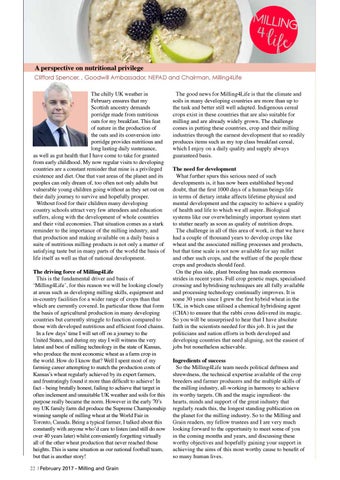
A perspective on nutritional privilege Clifford Spencer, , Goodwill Ambassador, NEPAD and Chairman, Milling4Life The chilly UK weather in February ensures that my Scottish ancestry demands porridge made from nutritious oats for my breakfast. This feat of nature in the production of the oats and its conversion into porridge provides nutritious and long lasting daily sustenance, as well as gut health that I have come to take for granted from early childhood. My now regular visits to developing countries are a constant reminder that mine is a privileged existence and diet. One that vast areas of the planet and its peoples can only dream of, too often not only adults but vulnerable young children going without as they set out on their daily journey to survive and hopefully prosper. Without food for their children many developing country schools attract very few attendees and education suffers, along with the development of whole countries and their vital economies. That situation comes as a stark reminder to the importance of the milling industry, and that production and making available on a daily basis a suite of nutritious milling products is not only a matter of satisfying taste but in many parts of the world the basis of life itself as well as that of national development. The driving force of Milling4Life This is the fundamental driver and basis of ‘Milling4Life’, for this reason we will be looking closely at areas such as developing milling skills, equipment and in-country facilities for a wider range of crops than that which are currently covered. In particular those that form the basis of agricultural production in many developing countries but currently struggle to function compared to those with developed nutritious and efficient food chains. In a few days’ time I will set off on a journey to the United States, and during my stay I will witness the very latest and best of milling technology in the state of Kansas, who produce the most economic wheat as a farm crop in the world. How do I know that? Well I spent most of my farming career attempting to match the production costs of Kansas’s wheat regularly achieved by its expert farmers, and frustratingly found it more than difficult to achieve! In fact - being brutally honest, failing to achieve that target in often inclement and unsuitable UK weather and soils for this purpose really became the norm. However in the early 70’s my UK family farm did produce the Supreme Championship winning sample of milling wheat at the World Fair in Toronto, Canada. Being a typical farmer, I talked about this constantly with anyone who’d care to listen (and still do now over 40 years later) whilst conveniently forgetting virtually all of the other wheat production that never reached those heights. This is same situation as our national football team, but that is another story! 22 | February 2017 - Milling and Grain
The good news for Milling4Life is that the climate and soils in many developing countries are more than up to the task and better still well adapted. Indigenous cereal crops exist in these countries that are also suitable for milling and are already widely grown. The challenge comes in putting these countries, crop and their milling industries through the earnest development that so readily produces items such as my top class breakfast cereal, which I enjoy on a daily quality and supply always guaranteed basis. The need for development What further spurs this serious need of such developments is, it has now been established beyond doubt, that the first 1000 days of a human beings life in terms of dietary intake affects lifetime physical and mental development and the capacity to achieve a quality of health and life to which we all aspire. Biological systems like our overwhelmingly important system start to stutter nearly as soon as quality of nutrition drops. The challenge in all of this area of work, is that we have had a couple of thousand years to develop crops like wheat and the associated milling processes and products, but that time scale is not now available for say millet and other such crops, and the welfare of the people these crops and products should feed. On the plus side, plant breeding has made enormous strides in recent years. Full crop genetic maps, specialised crossing and hybridising techniques are all fully available and processing technology continually improves. It is some 30 years since I grew the first hybrid wheat in the UK, in which case utilised a chemical hybridising agent (CHA) to ensure that the rabbi cross delivered its magic. So you will be unsurprised to hear that I have absolute faith in the scientists needed for this job. It is just the politicians and nation efforts in both developed and developing countries that need aligning, not the easiest of jobs but nonetheless achievable. Ingredients of success So the Milling4Life team needs political deftness and shrewdness, the technical expertise available of the crop breeders and farmer producers and the multiple skills of the milling industry, all-working in harmony to achieve its worthy targets. Oh and the magic ingredient- the hearts, minds and support of the great industry that regularly reads this, the longest standing publication on the planet for the milling industry. So to the Milling and Grain readers, my fellow trustees and I are very much looking forward to the opportunity to meet some of you in the coming months and years, and discussing these worthy objectives and hopefully gaining your support in achieving the aims of this most worthy cause to benefit of so many human lives.
FEED FOCUS
U
Milling News
Mycotoxin levels a cause for concern S feed and livestock producers have cause to be concerned after results of the latest BIOMIN Mycotoxin Survey were revealed, suggesting it may be best to carefully monitor contamination in feed and crops. Heavier DON, ZEN and FUM levels were reported in 2016 US corn and distiller’s dried grains with solubles (DDGS). In total 387 corn samples were sourced and a full 90 per cent of the samples tested positive for at least one mycotoxin. Of the 79 DDGS tested, 100 per cent were positive again for at least one contaminant. The samples sourced were from 14 different states and analysed in three different labs (Romer Labs Inc., USA Veterinary Diagnostic Laboratory at Iowa State University, USA Activation Laboratories, Canada’), in order to identify the presence and potential risk posed to livestock animal production by six major mycotoxin groups including; aflatoxins, zearalenone, deoxynivalenol, fumonisins, T-2 toxin and ochratoxin A. The annual survey constitutes the longest running and most comprehensive survey of its kind. It uses advanced analytic tools on more than 16,000 samples taken from 81 countries worldwide. In this particular survey over 60,000 analyses were conducted to identify the presence and potential risk posed to livestock animal production.
Higher risk
Dr Raj Murugesan, Technical and Marketing Director of BIOMIN states, “The mycotoxin threat was higher in 2016 that in 2015, deoxynivalenol (DON), fumonisins (FUM) and zearalenone (ZEN) in particular present a potential risk to livestock animal production. This gives greater importance to regular monitoring of feed, crops and silages.”
2016 US corn highlights:
DON saw slightly higher occurrence at 75 per cent (72 per cent in 2015) and average contamination levels at 1670 ppb (691 ppb in 2015). FUM’s prevalence reached 72 per cent (52 per cent in 2015) with an average contamination level of 4424 ppb. Zearalenone became a much more prevalent at 42 per cent (17 per cent in 2015) while the average contamination also made a jump to 412 ppb from 247 ppb in 2015. Dr Erika Hendel, Swine Technical Manager at BIOMIN says, “All three major toxins have an increased prevalence in US corn harvested in 2016 in comparison to 2016.” 2016 US DDGS highlights: Dr Paige Gott, Ruminant Technical Manager at BIOMIN notes that, “96 per cent of DDGS samples had more than one myctoxin present in 2016.” All 79 samples tested positive for DON, averaging 2681 ppb. FUM and ZEN were very prevalent at 88 and 71 per cent of sample, respectively. Dr Murugesan explains, “Rainfall during corn’s silking period along with warmer average temperatures are likely to have contributed to greater Fusarium fungi growth.” Fusarium fungi can produce several mycotoxins, which the presences of are associated with poorer feed quality, impaired animal performance and health challenges. Dr Murugesan warns, “Certain combinations are known to have synergistic effects, that means a magnified negative impact to animals, even at reasonably low levels.” Affirming this statement, recent research has shown that either DON or FUM or their combinations even at concentrations allowed under European and US guidelines, can worsen the incidence and severity of necrotic enteritis in broiler chickens. Milling and Grain - February 2017 | 25
Milling News
Advanced Feature Dryer
The Complexity of Balancing Sanitary Drying and Efficiency
Directory Updates Tom Blacker, International Milling and Grain Directory Welcome to another monthly update about the International Milling and Grain Directory. As the New Year has passed, the 25th directory print edition is being distributed worldwide now. You can find your copy at exhibitions and conferences taking place around the world, such as IPPE in the USA. If you would like a copy, you can purchase one through our website at www.internationalmilling.com, or you can contact myself should you wish. In the past month, there have been five new member companies and two company updates. The five new members were; Whirlston Pellet Plant Shank Precision Machining Parts Co. Ltd, Fanway Fish Feed Machinery, China, Multigrain AS, Turkey, Voltage Converter Company, USA, and Dramiński, Poland. As well as this, the agribusiness event in IPPE, Atlanta GA USA, has brought many successes for the 2017 International Milling and Grain Directory. Its reception have been very good, in addition to this, all of our partners around the world have been distributing it to the subscriber base that has both warmly received it and commented with good feedback. GEAPS and GrainTech Kiev are the next upcoming events where the Directory will also be present. At GrainTech Kiev, the UK pavilion organised by the British Embassy, will host us. There will be French, German, Czech and Austrian pavilions too. Ukraine as a country produces seven times more grain than the global production of coffee. Their total grain production in 2015 was 60.1 million tonnes, and I will be looking forward to seeing this important grain-producing country. The efficiencies and scale of this industry does interest me, so I will be sure to bring back some good photographs from this particular exhibition. The planned restructuring of the directory is on going and is going well. It will result in great updates and improvement for all advertisers, users and all involved. More will be revealed when further progress has been made!
Has Now Been Mastered The Quick Clean Advanced Feature Dryer from Extru-Tech, Inc., with industry-leading fines handling, ease-of-cleaning access and other key engineered sanitation features, has elevated food safety to the next level. Put your process in compliance and well ahead of industry standards. Contact a dryer specialist today at 785-284-2153 or visit us online at www.extru-techinc.com.
P.O. Box 8 100 Airport Road Sabetha, KS 66534, USA Phone: 785-284-2153 Fax: 785-284-3143 extru-techinc@extru-techinc.com www.extru-techinc.com
AND GRAIN
@IntMD facebook.com/internationalmillingdirectory
ET-280A.indd 1
Milling and Grain - February 2017 | 29
1/7/16 2:11 PM
The Pelletier Column
Feeding the future: with focus on health and environment
by Christophe Pelletier In my opinion, the food and agriculture sector does not receive enough praise for its performance. Over the past four decades, the world population has increased by 80 per cent, meaning that farmers have been able to supply food for an additional 3.3 billion people during that same time period. Unfortunately, the number of hungry people has remained about stable, around a billion people. Every person who is hungry is a hungry person too many. There cannot be any discussion about that, and there still is a lot of work to be done. This is no small feat. Clearly there is plenty of room for improvement, especially when you consider that about a third of the food produced is wasted. Although this does mean that potential to supply future food demand is there.
stakeholders. It will have to place human physiological needs as the primary focus. Consumer well-being will have to come first, before particular interests and before volume. Making future food and agriculture sustainable requires that we address both production and consumption. Waste and excess do not fit in a sustainable future. Food waste is only a part of the total picture. When food is wasted, all the inputs required, such as water, fertilisers, crop protection and money, are all wasted in the process. Overconsumption is not a sustainable strategy either. It takes a lot of resources to produce all the excess calories and protein that end up producing nothing else other than excess human body fat. Until the rise of mass consumption, our grandparents knew what sustainability meant. It was about saving and moderation. These two concepts vanished from the moment that consumption goods became so cheap that consumers lost touch with scarcity and long-term negative effects, also known as negative externalities.
Production VS Consumption The discussions about meeting future food demand always tend to focus on production volumes. Of course that is the minimum requirement, but to meet all the other challenges it is necessary to broaden the scope beyond volumes. Production is only half the equation. The other is consumption. There is lot of work to help consumption patterns contribute to a balanced future between supply and demand. The on-going increase of obesity and diabetes are at least as worrying as hunger because of the negative health, environmental and economic consequences. One of the most important roles in the future for the food and agriculture sector will be to help people feed themselves properly. There is a need for this and it goes far beyond a marketing exercise.
Quantifying externalities It would be an eye opener to quantify these externalities and include them in the cost structure of consumer products. The consumer price and/or the producer margin would look very different! Although it is quite a difficult exercise to quantify the externalities, just carrying it out would give some good insights about the limitations of the current economic model and in which areas it needs to change. Such a calculation would help rethink many of the existing financial incentives that drive the economics of food and agriculture, in particular many subsidies that find their origin in times where the objectives were quite different than the ones of the future. For example, health issues related to food should be considered as externalities. Many governments have calculated estimates of the cost generated by obesity and diabetes, so if society were able to quantify what part of the amount should be factored in food, as well as lifestyle and distributed between the different links of that chain, it would give a good indication of how to look at future economics of a health and satisfied society. The price of food would change but the key would be to have it change in a way that helps a better nutrition and better health whilst keeping good food affordable.
Sustainability The basis for success will have to be education about nutrition and home economics. There already is action is these areas but it will be necessary to move towards a collaborative education, centred on physiological needs and how any particular food product contributes- or notto healthy meals. The purpose will not have to be about enticing consumers to eat more volumes but to make an educated decision and pick the right ingredients. Changing the focus from always more to always enough will also require a change in which foods to produce and what their future physical and organoleptic qualities will have to be. It will also change the dynamic of markets and on which criteria farmers get paid. Collaborative education will have to be carried out by and with full involvement of all 30 | February 2017 - Milling and Grain
Christophe Pelletier is a food and agriculture strategist and futurist from Canada. He works internationally. He has published two books on feeding the world’s growing population. His blog is called “The Food Futurist�.
Milling News
Research project to valorise wheat and rice proteins Start of Prominent - a Bio-Based Industries public-private partnership project
T
here is a global need to increase dietary intake of plant protein, both from a sustainability, but also food security and nutritional perspective. While searching for new protein crops is one option, efficient use of currently available raw materials also offers large potential for increasing the number and volume of plant protein food ingredients. Wheat and rice are globally the most cultivated grains after corn. Side streams from wheat and rice processing offer large under-exploited raw material potential for recovery and development of new ingredients such as protein and dietary fibre. While addressing the global food security demand for increased amounts of dietary protein, intensification of the current processes by better use of their side streams also offers means to improve the economy of these processes. For food companies, the availability of new protein ingredients offers new business opportunities in terms of development of new high-protein product concepts. Under the project name ‘Prominent’, which stems from ‘protein mining’ of cereal side-streams ‘Exploring Novel Technological Concepts’, various partners have decided to join forces in a bio-based industries project under the Horizon 2020 umbrella (European Union Funding for Research and Innovation). Participants in prominent are: VTT Technical Research Centre of Finland Ltd (project leader), Südzucker AG (Germany), AB Enzymes (Germany), Upfront (Denmark), United Biscuits (United Kingdom), Barilla (Italy), Olvi (Finland), LUKE (Finland) and Bridge2Food (The Netherlands). According to Dr Emilia Nordlund, research team leader of Food Solution at VTT Technical Research Centre of Finland Ltd, "This project is expected to generate innovations on resource efficient value chains for plantbased protein products which will contribute to a more sustainable and competitive bio-based economy”. Südzucker and Beneo, the world’s largest sugar producer and its subsidiary, a leading company in functional ingredients from rice, chicory root, sugar and wheat, and dedicated to nutrition and health, are keen to explore new ways to proteins for the food industry. "Valorizing protein streams by innovative process concepts is therefore a key focus and the reason why we are engaging ourselves in Prominent,” says Dr Alain Graf, research and development protein platform manager at Südzucker/Beneo. “Barilla, the world’s largest pasta producer, wants to be close to the development of new ingredients derived from wheat and rice processing”, said Giovanni Tribuzio, responsible for Research on Primary Processing and Strategic Raw Materials. “This project will bring us in close touch with science leaders and food ingredient innovation, and this can help us develop new sustainable, nutritionally-balanced products, in line with our way of doing business: ‘Good for You, Good for the Planet’.” 34 | February 2017 - Milling and Grain
Natural Resources Institute Finland (Luke) is in charge of sustainability assessment with key know-how to analyse and verify whether the total environmental impacts of new protein ingredients and their supply chains are remarkably lower compared to the animal based protein products. According to Juha-Matti Katajajuuri, Research Programme Manager at Luke and WP leader, "This project fits very well in the current discussions on making economies more circular, where at the same time social aspects should be considered as we do in this important project. “The future of food industry is closely connected to making chains more efficient and sustainable in terms of circular economy.” The Bio-Based Industries The Bio-Based Industries (BBI) Joint Undertaking is a new €3.7 billion public-private partnership between the EU and the Bio-Based Industries Consortium. Operating under Horizon 2020, it is driven by the Vision and Strategic Innovation and Research Agenda (SIRA) developed by the industry, aimed at increasing investment in the development of a sustainable bio-based industry sector in Europe. "Side streams from wheat and rice processing offer large under-exploited raw material potential for recovery and development of new ingredients such as protein and dietary fibre"
"For food companies, the availability of new protein ingredients offers new business opportunities in terms of development of new high-protein product concepts"
It aims at providing environmental and socioeconomic benefits for European citizens, increasing the competitiveness of Europe and contributing to establishing Europe as a key player in research, demonstration and deployment of advanced bio-based products and biofuels. The BBI Joint Undertaking will also play an important role in achieving a bioeconomy in Europe. The objectives are to contribute to a more resource efficient and sustainable low-carbon economy, as well as increasing economic growth and employment, in particular in rural areas, by developing sustainable and competitive bio-based industries in Europe, based on advanced biorefineries that source their biomass sustainably.
Evonik to introduce first own probiotic
A constant challenge to produce more from less by Chris Jackson, Export Manager UK TAG As I write these notes this month from winter conditions here in the UK, it is a constant reminder that in the farming world, we are all reliant on climate for all of our production. Worldwide, farmers have adapted production technique to suit both the land and climatic conditions. Farming in itself is a complex enough subject and my best guess is that it is still the world’s biggest user of labour, even without all of its allied industries needed to get raw materials from point of production to end consumer. With some very notable international large scale integrated companies operating, most production is still in the hands of family businesses that are limited in expansion by lack of capital and resources- as well as their own traditions. Challenges we face As our productive land is increasingly taken over by urban development, those left in the industry have a constant challenge to produce more from less. Here in the UK we are helped by having some of the worlds leading research and development facilities, a fact often overlooked by our potential customers from around the globe- working not only in livestock field, but for crops including; tropical varieties, horticulture, machinery and technology. My own university for example, is working on robotic field machinery, not only because of skilled labour shortage here, but perhaps more importantly because of soil structure damage caused by the ever increasing size of farm machinery. The effects include soil erosion and dust blowing in the vast arable lands of countries such as America or Australia. Whilst crop and livestock development is a constant challenge to increase yields, I believe that our scientists have food safety and sustainability as a bigger challenge. In our modern world the challenges are 36 | February 2017 - Milling and Grain
to produce food on an industrial scale that is free from artificial contaminants, with diseases controlled in the livestock and fish industries by uncontrolled anti biotic use and for crop production by the increase in fungicides, pesticides and weed control with the use of ever increasing amounts of chemical sprays. Genetic development will be crucial in this sphere and the public at large will need to be properly informed, so that production can be safely developed. We need to embrace modern scientific controls and monitor the scientists’ work for our own mutual benefit. Having produced basically cereals and protein crops for both livestock, fish and of course humans, we rely then on our milling industry to turn raw products into digestible and nutritious products. For us, food development is being challenged by the preservatives that have to be used to increase the shelf life of the everyday foods. Foods that we take for granted, biscuits or cereals for example are items, which we are told are not good for our health, because of preservatives such as sugar and salt. These challenges will be met. Moving forward As this country is moving towards leaving the EU, our currency is at an all time low. So this must be a good time for us in the industry to encourage people in all parts of our sectors to come to the United Kingdom, to look at the research and development that is taking place here, that is relevant to their business, and then going to the next step of finding commercial partners with whom they can make mutually profitable trading arrangements. My real time job is to help facilitate this, and with Perendale we will be taking a large group of companies to the VIV Asia Exhibition in Thailand in March to showcase some of the UK’s expertise. I am looking forward to this event being very successful for all concerned, and I hope to see many of you there. To keep up to date you can follow us on Twitter at “AgritecExports” @AgrictecExports
E
vonik, specialists in feed amino acids, will launch their own first developed probiotic product GutCare® PY1. Over the coming years they intend to assume a leading role in the field of sustainable and antibiotic-free livestock management. The product they have developed has a positive effect on the healthy balance of bacteria populations in the chicken gut, especially under stressful conditions. Dr Emmanuel Auer, head of the Animal Nutrition business line at Evonik says, “The product can be part of a set of alternative solutions to reduce the use of antibiotic growth promoters. Thus it can contribute to a healthy and balanced nutrition of livestock.” For the development of the antibiotic, a multi parameter selection process was established to screen more than 500 strains of the bacterial type Bacillus subtilis DSM 32315 to modify the gut microbiota to inhibit the conditions that encourage different necrotic enteritis outbreak isolates. This illness, which is commonly associated with certain pathogenic bacteria of the Clostridium perfringens type, causes losses of billions of US dollars to the global poultry industry every year. The product will initially be introduced into the US market, and then other countries will follow. Since the 2016 acquisition of the probiotic business from the Spanish company Norel S. A., Evonik has two probiotics within its portfolio: Ecobiol® for poultry, and Fecinor® for piglets. Peter Freisler, head of Gut Health Solutions at Evonik states, “Our own developed probiotic product ideally complements our product portfolio and expands our options to serve our customers worldwide.” In edition to expanding their product portfolio, Evonik are developing a unique chicken gut simulation model in order to study the mechanisms of probiotics in animal nutrition. Stefan Pelzer, head of innovation area Gut Health & Diagnostics explains further, “From our perspective, the potential of probiotics for sustainable animal production is far from being exploited. That’s why we want to understand in detail how they work within the gut,”
Milling News
New unique modular design dryer released
D
eveloped and supported by their Corporate Project Services (CPS) division, Wenger have released a new “unique modular design”, called the Wenger Modular Extrusion Integration (MOXI). It hopes to give a worry-free process design and implementation, offering a true “plug in and play” solution for extrusion system installation. The new approach can decrease installation time by up to 60 per cent. It also reduces the requirement for local contractors, who may be unfamiliar with current extrusion process design standards, saving plant operator’s time and money. Safety and sanitation are also enhanced, maintenance simplified and downtime minimised, this is due to optimal access to all crucial components of the system. Among the features included as standard are: an integrated CCP system for pathogen control management, accessibility to all system functions using mezzanine support structures and incorporation of CIP (cleaning in place) solutions for preconditioner and extruder. The MOXI is Wenger’s next evolution in the industry, delivering the platform for addressing ease of maintenance, ease of access to all system components and a comprehensive cleaning and sanitation solution for
the extrusion process. Features may include; separation between dry and wet processing, pass-through sanitation stations, controlled air environment, sanitised die and knife area between runs and data management. Finally there are also customised options available to suit specific process design, installation and food safety needs.
Introducing
AgraStrip® WATEX Fast and simple mycotoxin testing 1
Extract
2
Dilute
3
Analyze
For more information visit www.romerlabs.com/en/watex
38 | February 2017 - Milling and Grain
F
www.entil.com.tr
July 2015 | 63
Mill
Training Courses available for flour millers hoping to gain knowledge and experience in both basic and advanced milling offerings. Multiple courses of basic and advanced skill levels in flour milling are being offered at the IGP Institute Conference Center at Kansas State University. Both of these opportunities are being offered in June; IGP-KSU Basic Milling Principles- June 5-9 and the IGP-KSU Advanced Milling course set for June 12-16, 2017.
Milling courses coming in June What to expect
These two courses will offer knowledge of milling and hands-on learning too. Some of the lessons taught in the Basic Milling course involve; wheat cleaning equipment and optimisation, measuring extraction, impact of wheat quality on milling extraction, wheat conditioning equipment and techniques, advantages of wheat and flour blending, milling different classes of wheat and the flour milling process. This course will provide a comprehensive understanding of the milling process and how employees impact the process. During the Advanced Milling section, participants can expect to learn; information covering analysis of mill flow sheets and design, mill balance and product distribution, roll and sifter surface, impact of wheat quality on flour quality, starch damage, cumulative attribute curves, sifting and sifter design, purification system and process control. The IGP-KSU Advanced Milling course will also help participants to expand on topics from the Basic Milling Principles course to include quantitative techniques to analyse and improve the process flow. It will also provide an understanding of the variables that impact production efficiencies and enhance the troubleshooting skills of mill personnel.
Further information
Shawn Thiele, course instructor and IGP Institute flour milling specialist says, “These courses dive into the technical aspects of optimising the milling process and individual machines, which is
Milling
TRAINING internationalmilling.com ONLINE | PRINT | MOBILE
exciting for the participants and instructors.” He continues, “The diverse milling knowledge that is also brought in from the participants promotes excellent class discussion and provides different views of milling.” Both of these courses will provide useful insight and be most beneficial for milling engineers, operation managers, production managers, head millers and shift managers. For more information about other upcoming courses, visit the IGP website at www.grains.k-state.edu/igp To register for either of both of these course visit the IGP registration website at www.igpevents.ksu.edu
The Training Register operates on the same platform as the highly successful internationalmilling.com Events Register. Our vision is to produce an easily accessible hub which will list both milling and aquaculture related training courses, workshops and educational opportunities from around the world, much the same as the Events Register does for conferences and expositions. “If you, your company or organisation is organising a milling or aquaculture course we would love to work with you. No training course is too big or too small for any of our readers to attend.” Milling and Grain - February 2017 | 41
Robotic Arm Automatic Palletizer
PRODUCT FOCUS FEBRUARY 2016 In every edition of Milling and Grain, we take a look at the products that will be saving you time and money in the milling process.
The EffeRobot is ideal for medium palletizing with speed up to 1200BPH (capacity depends on bag shape, layer pattern, line configuration etc). It is suitable for bag, bundles and boxes with several layouts available depending on customer space. Its features include a bag flattener, an automatic bag gripper, an automatic empty pallet dispenser and a take away motorized roller conveyor. Boasting a user-friendly operator interface, it can handle up to four different bag sizes simultaneously.
www.imeco.org
Twin JDNeuhaus Profi 2 TI hoists Primarily, the JDN air operated products can safely operate in dust-laden environments, which can result from the milling process of food materials such as grain, flour, and sugar. The hoist units and trolleys provide explosion protection as standard to EX II GD IIA T4/II 3 GD IIB T4 levels with increased spark protection to EX II 2 IIC T4 where required. Big bag handling air hoists are available at carrying capacities of 1100 and 2200kg (with 6 bar air pressure). They can be supplied in two configurations of single or twin lift/load hooks. Twin load hook models operate with more complex multipoint crossbeam designs, or for standard lifting beams featuring twin suspension points. In addition, they can be operated with synchronised lifting operation.
THIS MONTH WE TAKE A LOOK AT MACHINERY THAT WAS ON DISPLAY AT EUROTIER
www.jdngroup.com
Flat Die pelleting presses The current production range of KAHL presses consists of 12 different sizes. The product is pressed through a die by pan grinder rollers, formed into endless strands, and then cut to the desired particle length by means of knives. The small presses are driven by slip-on gears, the big presses by low-noise and low-wear worm gears with preceding belt drives.
www.akahl.de 42 | February 2017 - Milling and Grain
SFSP138*60E Winner hammer mill This series hammer mill is for the crushing of various pellet materials like corn, broomcorn, bean, wheat, crushed cake, etc. Specially designed for the crushing of the fiber, wet and oily material and fine crushed material, this machine is the essential equipment in the grinding process of the feed mill. Its features include simple structure, durability, safety, reliability, easy installation, simple operation and high productivity.
www.zhengchang.com
FOCUS
SPECIAL FOCUS The first optical sorters were developed in the 1930s by ESM, a forerunner of Satake. Colour sorters gained popularity in the Japanese rice industry in the 1970s and 1980s when demand for high quality rice increased. Today, industrial applications of colour sorters are numerous – from food to the plastic industries. As one of the world’s leading manufacturers of equipment for the rice, wheat and maize industries, Satake has been responsible for many innovative solutions and processes, which are now considered industry standard. Satake still continue to invent and develop solutions to the ever-evolving needs of its customers. Milling industry customers need robust, low maintenance, versatile, easy to use, economical, yet efficient colour sorters, which can be adjusted easily if circumstances change. Satake develop their colour sorters to meet and exceed these requirements. Satake has recently launched their REZS high capacity colour sorter range that is available in different configurations allowing customers to select a machine that fits with their specific requirements, space and budget. They offer flexible resort options, which are easily changed by the user to adapt to different product and capacity needs. The REZS has shown excellent results on grain sorting to remove ergot, fusarium and other contaminants from wheat, barley, oats, maize and many other grains and seeds. The REZS is used in the entire grain chain from the farmer to the grain stores right through to the mills. There is also a clear place for colour
Satake optical sorters sorters in many food-processing factories. The REZS features full colour camera technology, which enables it to detect and remove defects with subtle colour differences that add to its versatility. If the grain changes the colour, if defects are of different shade or colour, REZS can handle them with ease. Special attention was paid to how the machine operates and how product and defect setup is performed. Historically, colour sorters could be difficult to use without extensive training, to resolve this Satake developed their Smart Sensitivity system (3S), which sets the sorting program automatically. The operator only has to decide which product they want to accept and which product will be rejected and then teach the machine. Another technological advantage present in all Satake colour sorting machines is their ability to automatically recalibrate. Many other optical sorters require a full machine stop and recalibration, potentially pausing the whole production line. Satake’s automatic recalibration allows for continuous use with no calibration downtime. Satake has at its disposal a wealth of experience to provide bespoke solutions from individual machines through to turnkey projects featuring advanced technical innovation. With a worldwide network of Satake Offices, test facilities and agents in all continents, they can supply and support customers anywhere on the Globe.
www.satake-group.com
Milling and Grain - February 2017 | 43
#
02
F
A fortifying force? by Stephanie Santana, FFI Graduate Research Assistant, Emory University
G
lobally, 85 countries require millers to fortify their flour with nutrients such as iron, riboflavin, folic acid, zinc, vitamin B12 and vitamin A. These nutrients have a range of benefits from assisting in cognitive development to strengthening immune systems. A lesser-used mineral with its own set of unique benefits is calcium. However, the United Kingdom is one of the few countries that add it to flour. How did this happen and what results has it yielded? Anticipating a reduction in dairy products because of World War II, the United Kingdom enforced the fortification of flour with calcium carbonate during the early 1940s. A possible concern may have been the increased risk of rickets, which can be caused by a deficiency of calcium, Vitamin D, or phosphate and result in weakened bones. One of the companies following the mandate is Wessex Mill located in Oxfordshire, England. “It was decided after WWII that white flour should have the same nutritional properties as wholemeal flour to boost the health of the population by providing them with vitamins through their bread,” said Emily Munsey, a Trainee Mill Manager at Wessex Mill. Today, millers are also required to include iron, thiamine (Vitamin B1), and nicotinic acid.
Can calcium boost the health of a population?
Young children are encouraged to drink milk to develop strong bones and pearly white teeth. It is the most abundant mineral within a human body, and calcium remains as equally important to adults. According to the United States National Institutes of Health, the mineral is necessary for performing key tasks, such as the transmission of nerve messages, muscle function, or blood clotting. Furthermore, a lack of calcium may lead to an increased risk of osteoporosis. Humans do not produce calcium themselves. We must consume it, and luckily, many foods offer it naturally. Those include cabbage, kale, broccoli, almonds, yogurt, cheese, and of course, milk. In fact, the World Health Organization (WHO) states that dairy products make up 50-80 percent of dietary calcium for most industrialized countries. However, what if someone is allergic to dairy or what if dairy products were scarce in a region? Well, fortified flour can be that steady alternative to maintain adequate calcium levels. 44 | February 2017 - Milling and Grain
Based on North American and Western European data, the WHO’s recommended daily calcium allowance for adults ranges from 1000-1300 mg/day. The values vary depending on a person’s gender, age, and pregnancy status. To measure if a person is actually getting enough calcium, the UK measures intake levels. However, there is no universally agreed-upon cutoff to define deficiency1. In 1981, a committee within the UK’s Scientific Advisory Committee on Nutrition (SACN) reported that flour fortification should no longer be mandatory. But in 1998, that same committee suggested that calcium fortification of flour be maintained over concern of intakes falling below a certain level. In a 2012 report, SACN affirmed that removing calcium from flour would “decrease population intakes of calcium and increase the proportion with intakes below the LRNI (lower reference nutrient intake)”. SACN says this may lead to an increased risk in calcium deficiency, especially for women and low-income groups.
Why do so few countries fortify flour with calcium?
One factor may be that the prevalence of deficiency is just not available in most countries, according to the WHO. Countries can measure bone resorption in urine or plasma, but it is a costly method2. Other reasons may include the challenges of adding calcium. According to Annette Bueter of Mühlenchemie, a German-based premix provider, calcium carbonate can interact with humidity in an acidic environment and produce carbon dioxide. Because carbon dioxide is a gas, it may cause the bags to burst. Quentin Johnson, Training and Technical Support Coordinator of the Food Fortification Initiative (FFI), adds that flow ability, quantity and cost may also be an issue, and “Calcium carbonate and calcium sulphate are not very free flowing, which can cause feeder problems and inconsistency of addition rate.” Johnson says that the levels of calcium are much higher than other minerals, such as iron and zinc. For example, the UK requires 235 - 390 mg calcium per 100 g of flour while it requires not more than 1.65 mg of iron per 100 grams of flour. The typical cost for calcium may also be a limiting factor. Calcium carbonate is about $.50 per kg while calcium sulphate, an alternative form, fetches a price tag of about $1.00 per kg. Jordan fortifies wheat flour with calcium, along with 10 other vitamins and minerals. Cost is not an issue for millers because the Ministry of Health procures the premix and distributes it to all the mills at no cost, said Nicolas Tsikhlakis, Chief Operating Officer and Partner of Modern Flour Mills and Macaroni Factories Co. in Amman, Jordan.
F
Flour premix without calcium carbonate
Flour premix of Calcium carbonate
Images courtesy of Mühlenchemie
A government purchasing premix is unusual, according to FFI records. However, as evidenced by the UK’s long-lasting policy, which requires millers to purchase premix, fortifying flour with calcium can be an economically sustainable process. Munsey says that she purchases 25kg of calcium carbonate for around €3.50 (US$3.77). That’s enough to make 16,000 kg of flour. She confirms that it is a simple process in which the calcium carbonate is fed into the flour stream after the flours have been blended at a constant rate. “The cost of this process is minimal to us as the calcium carbonate is cheaper to include than the wheat flour we have milled,” said Munsey. “The gap in price between
the two, pays for the cost of the other vitamins.” Are you interested in learning more about the possibility of fortifying flour with calcium? For assistance, please contact the Food Fortification Initiative at info@ffinetwork.org or visit ffinetwork.org.
References
http://apps.who.int/iris/bitstream/10665/43412/1/9241594012_ eng.pdf 2 http://www.who.int/nutrition/publications/micronutrients/GFF_ Part_2_en.pdf 1
Milling and Grain - February 2017 | 45
F
Why Emulsify? The art of nutritious bread making
by Bente Simonsen, Bakery Application Specialist, DuPont Nutrition & Health
W
heat flour is the main ingredient in yeast-raised bread, and its quality in relation to baking depends very much on the wheat variety, climate and growth conditions. Two factors are of high importance for bread production. 1) The tolerance towards flour variations and production variations as well as improved volume. 2) The freshness and softness of the final baked bread as well as improved shelf life. Softness is usually used to judge the freshness and, consequently, the quality of bread. The bread producer is therefore interested in keeping bread soft for as long as possible. Emulsifiers are the solutions for these challenges – DATEM and Distilled Monoglycerides. The benefits and effects of these two emulsifiers in bread making include tolerance towards flour variations and production variations as well as improved volume.
Tolerance towards flour quality
The use of Panodan® DATEM improves dough tolerance, helping bakers to overcome fluctuations in flour quality and produce bread of a better and more consistent quality. By way of example, the effect of our product on a weak flour type and a medium flour type is illustrated in figure 1. This figure shows that Panodan® DATEM has a significant impact on weak flour in particular, making it possible to upgrade the flour to a medium or high quality type. Where the optimal dosage is used, bread quality is not affected by variations in flour quality. The effect of Panodan® DATEM is expressed by measuring the specific volume of crusty rolls made from the two types of flour.
Tolerance towards baking process
Panodan® DATEM improves the development of the gluten network in dough, producing a dough which is more tolerant to the whole baking procedure. 46 | February 2017 - Milling and Grain
Improved hydration of the gluten reduces problems encountered during mixing. Over-mixing is better tolerated as the wellhydrated and homogeneous gluten network is better able to withstand the excessive energy input without rupturing. In the later processing stages, the improved gluten structure provides better tolerance to prolonged resting and, especially, proofing times. (figure 2).
The final baked bread
Due to the excellent dough-strengthening effect and improvement of dough-handling properties, Panodan® DATEM produces bread with an attractive, thin crust, which remains crisp for a longer period. It increases the volume of the final bread which also produces a pleasant, light texture for better eating properties.
The mechanics behind it
The unique effect of Panodan® DATEM is due to the structure of Panodan® DATEM as it is an emulsifier molecule with a high hydrophilic/lipophilic balance. This means it is a highly ionic emulsifier. The addition of Panodan® DATEM to a wheat dough will improve the interaction between the various layers of different polarity in the dough and provide a more flexible, tolerant dough. This effect is demonstrated in figure 3. In figure 3A the gluten strands are inflexible and will break when the pressure from the carbon dioxide increases, whereas the addition of Panodan® DATEM makes gluten strands flexible and easy to stretch, resulting in improved carbon dioxide retention within the dough, as shown in figure 3B. Figure 4 shows the effect of Panodan® DATEM in a dough system, as illustrated using confocal laser scanning microscopy (CLSM), where 4A is a dough system without DATEM and 4B is a dough system with DATEM. This clearly demonstrates that the use of Panodan® DATEM results in a more homogeneous and less fragmented gluten network compared to the control system. For
F Figure 1. Effect of PANODAN® DATEM in various flour qualities
this experiment the dough has been stained with FITC and Nile Red. Protein, yeast cells and starch granules (starch protein) are green and lipids red.
Freshness, softness and improved shelf life
Figure 2. Tolerance towards proofing time and mixing time
Figure 6. Formation of amylose-monoglyceride complex
In bread, Dimodan® Distilled Monoglyceride works primarily as a crumb softener, prolonging the shelf life of bread for several days compared to bread without any emulsifier. It forms an insoluble complex with part of the starch, thereby delaying the onset of starch retrogradation and improves the baking process and the properties of the finished bread. This is mainly used for its ability to prolong the shelf life of yeast-raised bread. Depending on the dosage used, shelf life can be prolonged from two days up to a week or more. Figure 5 illustrates firmness measured by Texture Profile Analysis (TPA) versus storage time – the higher the value, the firmer the bread. Measurements have been made on the first, third and seventh day after baking. The control bread without any Dimodan® Distilled Monoglyceride is considered acceptable on the second day after baking. The figure shows a clear time-dependent increase in the firmness of the bread and it shows higher dosages of Dimodan® Distilled Monoglyceride give a softer bread. On the seventh day, bread containing 0.5 percent Dimodan® Distilled Monoglyceride has approximately the same firmness value as the control bread on the second day. The shelf life of the bread is therefore increased by five days. (figure 5).
The mechanism of behind this
Dimodan® Distilled Monoglyceride interacts with starch by forming a water-insoluble complex with amylose. During the
Grain and Flour Analyzer Experts
• 50+ years knowledge and expertise • Functional and compositional analysis • Flour, grains and oilseeds www.perten.com Ad_Milling and Grain_deadline20170111 - 190x132.indd 1
Milling and Grain - February 2017 | 47
2017-01-11 10:54:48
F
baking process when the temperature reaches approximately 55°C, the monoglyceride enters a liquid crystalline state (meso-phase) in conjunction with part of the water present. In this form, it reacts with amylose and forms an insoluble helical complex. This is possible because saturated distilled monoglyceride has a straight carbon chain, which is entrapped inside the α-helix which amylose forms when dissolved in water. The complex formed between amylose and monoglyceride is water insoluble and will not re-crystallise and participate in the staling process. (figure 6). Another theory is that monoglycerides form complexes with some of the longer side chains of the amylopectin, an interaction considered to reduce the speed at which amylopectin retrogrades. DSC analysis of bread has revealed the amount of crystalline amylopectin is reduced and the amount of amylosemonoglyceride complex increased when DIMODAN® Distilled Monoglyceride is added to bread. The amylose lipid complexes are also considered to make water migration more difficult in the breadcrumb and, thus, reduce the speed at which the amylopectin retrogrades (figure 7).
Figure 3. Gluten network
Figure 4. Effect of DATEM evaluated by CLSM
Key results
Panodan® DATEM is the most effective emulsifier when tolerance towards flour variations, bread production variations, volume and dough stability are the targets for the final bread. Dimodan® Distilled Monoglycerides is the most effective emulsifier when it comes to reducing staling rate, improvement of crumb softness and increasing shelf life of the baked bread. DuPont™ Danisco® is the brand for a range of products that help provide enhanced bioprotection, an improved nutritional profile, and better taste and texture with greater cost efficiency and lower environmental impact, meeting the needs of manufacturers of food and beverages, dietary supplements and pet food. Through the work of the global network of food scientists and technologists in DuPont, the Danisco® range is supported by a uniquely broad spectrum of know-how across applications and processing. 48 | February 2017 - Milling and Grain
Figure 5. Effect of distilled monoglycerides in bread
Figure 7. Formation of amylose-monoglyceride complex
F
French wheat production evolves to meet customer demands
F
by Jean-Pierre Langlois-Berthelot, President of France Export CĂŠrĂŠales rance is the 5th world grower of milling wheat. This wheat production is done on a small territory and a total surface of 5.1 Miha whereas the countries that produce more than us (China, India, Russia, USA) are huge countries with bigger growing surfaces, usually around 20 Miha. Our wheat yields of 7.5 T/ha, among the highest in the world, make this possible thanks to the combination of favorable soils, a climate adapted to the crop and farmers using the best production. France exports on average 55 percent of its milling wheat production annually. These exports are usually transformed in the mills of the world. There are other uses of French wheat in the domestic market (livestock feed, starch industry, seeds, industrial use) and a little on export markets that are closest like EU livestock feed. French wheat is on average 78 SW (Specific Weight), 11.2 percent protein, with a Hagberg fall time equal to or greater than 240 seconds to which one can add the balance between the different types of protein making this wheat very suited to the baking process. We can find this kind of bread in many countries in Africa as well as in the Middle East and other countries worldwide. Another important characteristic for the miller is the milling value of the wheat used. We compared French wheat to wheat of other origins in a pilot mill in conditions close to those of an industrial mill. French wheat very regularly achieves among the best milling values. Various parameters explain at least part of these interesting results: a low ash content (around 1.5 percent) and coarse grains of around 45 per 1000 grains. The entire French production chain is constantly working to adapt what it can offer in order to meet the evolving needs of French wheat, and potential, customers. This adaptation work is carried out by the production line such as the breeders offer to the producers about 30 new varieties each year, which must meet technological quality criteria. More and more precise methods of using nitrogen fertilisers are made available to the producer and used by them in order to reconcile yield per hectare and protein content. It is
50 | February 2017 - Milling and Grain
also affected by the links further downstream including improved reception and storage performance in storage agencies and port silos in order to better respond to the need for homogeneity of shiploads and irregular flow of sales to our foreign customers. The 2016 harvest in France is quite atypical. This is a year of low production at 28 MiT compared to the 41 MiT produced in 2015 which obviously makes it more difficult this year to supply all of our customers even though France will remain a major exporter. In addition to this deficit of production, a very low quality has been shown, especially for the SW indicator, which is commercially very important. The agronomists of our technical institute ARVALIS have shown that over the last 60 years, 2016 is the lowest year in solar radiation and that the rain height is from far the highest. These very unusual climatic conditions have affected the harvest. The 2016 harvest of milling wheat in France is a real production accident whose probability of renewal is almost zero. Planting of milling wheat for the 2017 crop is now complete. The weather conditions permitted excellent seeding on soils that were not damaged by autumn crops. The very poor performance of the 2016 crop has obviously affected the economic situation of the cereal farms. Everything has been put in place by input suppliers who are also buyers of grain and banks so that producers can plant the usual surfaces in the best conditions - in particular by choosing the most suitable varieties. The first official figures have just been published. French farmers planted milling wheat on about 5.1 Miha. The crops in this early winter are very satisfactory (more than 90 percent of the milling wheat crops are in a Good or Very Good state according to our weekly CereObs observatory). We are only at the beginning of the cycle for a harvest that will take place in July 2017 but it is always important to start the production cycle on a good basis. The regularity of French milling wheat production is a particularly important feature for our importing customers. The 2016 harvest has called into question this statement, but this very unlikely accident did not call into question the will of the whole production chain to give itself all the means to produce and transport all the wheat our customers need (foreign or domestic).
imeco ABP120UR High speed bag filling line for pre-made open mouth bags. FOUR SPOUTS CAROUSEL DESIGN
Bag filing
FOUR BAG SHAKING DEVICES FOR A QUICK PRODUCT SETTLING CAPACITY UP 16 BPM (capacity depends on product, line configuration, bag size, etc.) CAN HANDLE FLAT OR GUSSET BAGS
DESIGNED TO HANDLE PP WOVEN, PP LAMINATED, PP WOVEN WITH PE LINER, PE, MULTIWALL PAPER, COATED PAPER, ETC. MAINTENANCE FREE BAG DETECTION SYSTEM ON EACH FILLING SPOUT, TO AVOID WRONG PRODUCT DISCHARGE SEVERAL BAG CLOSING SYSTEM AVAILABLE (sewing, heat sealing, pinch, gluing, etc.)
EFFEROBOT
complete packaging solutions for flourY products Palletizing
I TA LY
www.imeco.org sales@imeco.org
imeco.org
@imeco_org
imeco bagging
imeco.org
Your Weighing and Bagging Specialist
F
Reaping the benefits of Rapeseed Oil
R
by Donna Neary, AHDB, UK
apeseedOilBenefits.com is a not-forprofit campaign that was launched in 2008 by AHDB Cereals & Oilseeds, to increase awareness of the culinary and nutritional benefits of rapeseed oil as part of a healthy, balanced diet, and to inspire people to use this cooking oil. AHDB is a statutory levy board, funded by farmers, growers and others in the supply chain, including grain traders and processors. Its purpose is to inspire farmers, growers and the greater industry to succeed in a rapidly changing world. It equips the industry with easy to use, practical know-how, which they can apply straight away to make better decisions and improve their performance.
Why use rapeseed oil?
From spring to early summer it’s impossible not to notice the fields of bright, yellow flowers grown throughout Britain. One of the reasons these plants are grown of course, is for their seeds to make rapeseed oil. But why has this cooking oil grown in popularity so much over the past few years? In short, we think there are five reasons; its nutritional composition, amazing flavour profile, provenance, its sheer versatility in cooking and its affordability. Rapeseed oil is the only commonly used culinary oil that can be widely found both grown and bottled in the UK. Other vegetable oils, such as olive or sunflower, are primarily imported from mainland Europe or further afield. Rapeseed oil is processed by both small and largescale producers and comes in two forms; artisan cold-pressed and refined. Cold-pressing simply involves using a press to squeeze the oil out of the seeds, retaining all its natural flavours, before being filtered and bottled. Refined oil on the other hand, is extracted from the seeds under high temperatures, before being cleaned to create a flavourless oil with a high smoke point.
Nutritional benefits
There’s some evidence that rapeseed oil products are benefiting from a wider consumer trend towards eating more healthily; boosted by its nutritional profile, versatility and affordability. Research done by YouGov, Mintel and IGD shows that a large 52 | February 2017 - Milling and Grain
proportion of the population believes it’s increasingly important to eat healthily. But many people are still unaware of the nutritional benefits of rapeseed oil, such as that it contains less saturated fat than other commonly used cooking oils and fats (e.g. approx. 50 percent less than olive oil). It is high in unsaturated fats, particularly monounsaturated. Replacing saturated fats with unsaturated fats in the diet has been shown to lower/reduce blood cholesterol. High cholesterol is a risk factor in the development of coronary heart disease. It is also a rich source of vitamin E.
Culinary benefits
Nutritional benefits mean very little if the oil doesn’t taste nice and work well in dishes. Luckily, rapeseed oil does both. In its refined form, rapeseed oil is flavourless, making it an excellent carrier of flavour and allowing other ingredients, like spices, to really shine during cooking. Buy a bottle of cold-pressed and you’ll be getting a wonderful delicate, nutty flavour that works amazingly in dressings, dips, marinades and baking amongst other things. Just like fine wine, flavours of these cold-pressed oils may differ slightly, and each producer may have their own unique profile. There are also many delicious flavoured/ infused rapeseed oils on offer. Rapeseed oil has a light, non-greasy texture and is so versatile; it’s the answer to perfect roast potatoes, crusty steaks, vibrant salad dressings and flavourful marinades. It can be used in baking in place of butter in some recipes, reducing saturated fat content. With this versatility and beneficial fat profile, combined with its great flavour properties and the fact that it is usually competitively priced, it’s no wonder more and more people are deciding to use it.
Want to see more?
Visit RapeseedOilBenefits.com and you’ll find everything you need to know about rapeseed oil including nutritional info and delicious recipe ideas for all occasions. Recipes range from cakes and bakes, through to stir fries, soups, salads and pizza. Also look up @RapeseedOilBenefits on Facebook, where recipes, videos, ideas, and food news is shared and discussion is encouraged to show that healthy eating doesn’t have to be boring – it can be surprisingly good!
F
USING BOTANICALS TO IMPROVE CALF HEALTH AND PERFORMANCE
T
By Dr. Hassan Taweel, PhD, Msc, Global Business Development Manager Ruminants at Nutriad, Belgium
he aim of successful calf rearing is to produce a healthy calf that is capable of optimum performance throughout its life from birth through to adulthood to milking and/or finishing. The first three months of life is the most sensitive period for the young calf, with many stress factors including biological, environmental, and nutritional. The success of this first rearing phase depends on establishing a sound calf nutrition & health program. A sound calf nutrition program revolves around early feeding of high quality colostrum and the choice of high quality milk replacer and starter ration. Colostrum provides maternal antibodies (immunoglobulins) to protect the young calf against the common infections that it is likely to encounter in early life. High quality fortified milk replacer and starter, support the calf to remain healthy and achieve maximum growth, which will be reflected in the calf’s future performance. A healthy fast growing calf can produce more milk during its first lactation compared to a slow growing calf that suffered from disease during early life. Recent meta-analysis with data from 15000 heifers, showed that a-225-kg of additional milk in the first lactation can be expected for each 100 g/d extra growth during the first two months of the heifer’s life (calf).
Calf’s health: Scouring and pneumonia
Ensuring that each calf receives sufficient high quality colostrum immediately after calving is not always easy or possible. Colostrum quality depends on many factors; age and breed of the cow, previous exposure to disease, length of the dry period and nutrition and vaccination of the dam. Dairy cows in general produce colostrum with much lower concentration of IgG compared with beef cows (50 vs. 150 g of IgG/l). Dairy calves with low levels of immunoglobulins have the highest incidence of diarrhea, and respiratory disease. Scours (diarrhea) and pneumonia are the main causes of calf morbidity & mortality. The majority of calf scours are caused by six organisms: viruses such as rotavirus and coronavirus, bacteria such as E. coli and Salmonella sp., and protozoa, such as cryptosporidia and coccidia. Traditionally, to overcome this, antibiotics have been used in calf nutrition (in CMR and/or starter feed). It is known 54 | February 2017 - Milling and Grain
Healthy calves without antibiotics in feed
In a post-antimicrobial-growth-promoters era, to ensure a healthy calf, the aim should be to minimize its exposure to disease, and maximize its natural immune system. Options to achieve this include firstly improving colostrum quality, secondly improving colostrum IgG’s absorption, and thirdly stimulating and supporting the calf’s natural defense mechanisms and its
A ONE-DAY CONFERENCE FOR MILLERS FOOD, FLOUR & RICE MILLING
FOCUS:
that viruses are unaffected by antibiotics, however, antibiotic treatment is usually administered to kill off any secondary bacterial infections and offer the calf the opportunity to fight the disease. In 2006, the use of antimicrobial growth promoter for preventative purposes was banned in the EU and is under great pressure in the USA and many other countries around the world. The use of antibiotics for preventative reasons contributes to the ever-increasing antibiotic resistance.
2017
F
JUNE 13, 2017 COLOGNE MESSE, COLOGNE
Table 1: Starter intake, average daily gain and fecal scores of calves fed Apex vs. Positive & negative control Negative Control
Positive Control
Apex® calve 500g/t
Starter Feed Intake (g)
357a
444b
437b
Daily Grain (g)
330a
395b
428b
Hip Width Change (cm)
0.7
0.65
0.72
Faecal Score
1.86
1.75
1.72a
Treatments
b
a
3
Footnote: Positive control (Oxytetracycline/Neomycin)
Treatments
Negative Control
Apex® in CMR only
Apex® in starter feed only
Apex® in CMR and starter feed
ADG 0-6 weeks (g)
291a
378b
348a
433b
ADG 0-8 weeks (g)
404a
491a
501b
547b
ADI Starter 0-6 wk (g)
365
514
441
a
540b
ADI Starter 0-8 wk (g)
675a
844b
824a
878b
Cumulative fecal Score (1-5)
1.85
1.75
1.77
1.71
Hip Width Change (cm) 0-8 wk
3.03
3.73
3.75
3.95
a
b
1-1
SESSIONS
Table 2: effect of feeding Apex calve in either milk replacer or starter or both on performance in young calves
Raw materials, additives and product development
NETWORKING OPPORTUNITIES
Technological developments in the milling industry
taking place on
JUNE 14, 2017
Challenges facing the food industry
CALL FOR PAPERS
digestive system to prevent the establishment of disease and improve digestibility, nutrient absorption and feed utilization. Colostrum quality can be improved by a sound dry cow management and nutrition program; or by the addition of IgG (such as from spray-dried plasma, serum or globulins) to colostrum. Feeding certain botanicals, fatty acids and direct fed microbial (DFM) (especially yeast cell walls) to the dry cow has shown to improve its immune system and stimulate the production of higher quality colostrum, which can improve the health status of the calf during the first 3 weeks of life. Nutriad’s product Sentiguard Dry, a unique combination of DFM, and fatty acids, has been successfully used in dry and transition cow mineral mix to improve cows natural defense and colostrum quality in terms of IgG concentration. Supplementing diets of dry cow with special fatty acids can modify the FA profile of colostrum and influence the efficiency
GRAPAS is offering those supplying products and services to millers working in the food sector to present their latest technological developments
Part of the FVG Select 2017 event, 13 & 14 June, 2017, Cologne, Germany
Online registration will open in February 2017 ORGANISED BY
For more information and to register visit:
bit.ly/grapas
Milling and Grain - February 2017 | 55 GRAPAS_HPV_conf.indd 1
13/01/2017 18:00
F
of immunoglobulin (IgG) absorption in calves consuming this colostrum. A recent study showed that serum concentrations of total IgG and anti-ovalbumin IgG after colostrum feeding were higher in calves born from cows supplemented with palmitic acid (C16:0) compared with essential fatty acids (EFA). Colostrum supplements (composed of bovine colostrum, other milk products, or bovine serum) can be used to improve the quality of colostrum and increase the amount of IgG fed to calves when confronted with low or medium quality colostrum. In recent studies, calves fed bovine serum-based colostrum replacer have performed as well as calves fed good quality maternal colostrum with no differences in IgG levels, efficiency of IgG absorption, incidence of scours, or growth rates.
Botanicals (Apex) and calf health
Botanicals and plant extracts have been used for medicinal purposes in humans and animals for centuries. Recently a renewed interest in using botanicals to stimulate the immune and GIT systems in farmed animals led to the introduction of many products to the market. Botanicals contain active components and metabolites that are able to scavenge free radicals, inhibit peroxidation of membrane lipids, chelate metals, and stimulate the activity of antioxidant enzymes. But the most important activities of most plant extracts are as antimicrobials and antiseptics. Many studies have illustrated the efficacy of plant extracts as antimicrobials against many gram positive and negative 56 | February 2017 - Milling and Grain
bacteria, and a wide range of fungi, parasites, protozoa and viruses. Several other studies have also indicated that plant extracts could influence the neuroendocrine system function of the animal and stimulate the secretion of digestive enzymes (lipases, proteases and lactases). This can lead to better nutrient digestibility especially for less digestible protein sources in milk replacer and starter feed. Therefore many botanicals can be used to stimulate and support the calf’s natural defense mechanisms and its digestive system leading to improved intestinal and general health and feed utilization. Nutriad’s botanicals product for calves, Apex, consists of a combination of five concentrated plant extracts that were carefully selected based on their biological activity. The effectiveness of Apex in stimulating a calf’s health and performance has been confirmed in many studies. In an experiment with young calves fed milk-replacer powder (0.5 kg/d), and had ad libitum access to a starter concentrate during the first 50 days after arrival, starter intake, average daily gain and fecal scores were better (P < 0.05) in Apex fed calves compared to those fed the negative control. More importantly, results of Apex fed calves were similar or slightly better to those in the positive control group, fed anti-biotics (Oxytetracycline/Neomycin) (Table 1). In another study, the effect of Apex on calf’s growth and fecal scores was investigated during the first eight weeks of life. The calves were fed a milk replacer (4 l/d) containing appreciable amount of soy protein and given Apex either in the milk replacer or in the starter or in both at 500 g/ ton, and compared with a control group. The calves fed Apex had better intakes, growth and fecal scores. The best result was obtained when Apex was fed in both milk replacer and starter (Table 2).
Conclusion
A healthy fast growing calf is capable of optimum performance throughout its life. The rearing phase (from birth to weaning) is the most critical period in the young calf’s life, with biological, environmental, and nutritional stressors. The success of this first rearing phase depends on establishing a sound calf nutrition & health program. A sound calf nutrition program revolves around early feeding of high quality colostrum, and the choice of high quality milk replacer and starter ration. Colostrum quality can be improved by a sound dry cow management and nutrition program; or by the addition of IgG (such as from spray-dried plasma, serum or globulins) to colostrum. Feeding certain botanicals, fatty acids and direct fed microbials (especially yeast cell walls) to the dry cow has shown to improve colostrum quality, and influence the efficiency of immunoglobulin (IgG) absorption. Furthermore, botanicals can be used to stimulate the immune and GIT systems and improve health, nutrient absorption and utilization in young calves.
In your business, performance is crucial. It’s the same in ours.
Nutriad creates and produces smart additives, preservatives and flavouring substances that all share the same goal: increasing animal performance. Production returns will follow suit – be it meat, fish, eggs or dairy products. Good for your business. Interested? Let’s get in touch: visit nutriad.com for your local contact.
F
EFFECT OF MEDIUM CHAIN FATTY ACIDS ON FCR AND BACTERIA PROFILES IN THE GUT OF BROILERS by Catharina Nieuwenhuizen, Nutritional & Technical Support Manager, Noba Vital Lipids, Holland
M
any people in our industry talk about MCFAs or MCT. MCFAs means mediumchain fatty acids, which are fatty acids with a chain length of 6, 8, 10 or 12 carbon atoms. This means that we talk about C6fatty acids, C8-fatty acids, C10-fatty acids or C12-fatty acids. These medium chain fatty acids are not bound with glycerine, they are in a free form as free fatty acids (FFA). MCT means medium chain triglyceride, this is an oil, sometimes it is called MCT-oil, for example palm kernel oil. Palm kernel oil contains high levels of C12-triglycerides. MCFAs have strong antibacterial properties. Products with high levels of C8, C10 and C12 are of big interest in the feed industry, because of the antibacterial effect. C8 and C10 fatty acids have a strong antibacterial effect on gram-negative bacteria, like E. Coli and Salmonella, and C12 fatty acids have a strong antibacterial effect on gram-positive bacteria, like Streptococcus and Clostridia. These products have a positive effect on the intestinal integrity of animals and a positive effect on the technical performance. Medium-chain fatty acids are most suitable for pigs, poultry and calves. Noba Vital Lipids has a product range named ‘Vital range’ with different combinations of MCFAs.
Modes of action
MCFAs can have different modes of action. The prime target of MCFAs seems to be the bacterial cell membrane and the various essential processes that occur within and at the membrane. MCFAs can make the bacterial cell membrane porous or even solubilise the membrane in case of high concentration. MCFAs can impair the energy production of the cells caused by interference of the electron transport chain and disruption of the oxidative phosphorylation. Other processes that may contribute to inhibition of bacterial growth or death can be caused by cell lysis, inhibition of enzyme activity or impaired nutrient uptake.
Improvement FCR
Noba Vital Lipids has recently finished a trial with different Noba Vital Products with 1680 Ross308 broilers. Birds were fed with a non-viscous or a viscous diet. The length of the trial was from day 0 till 38. Birds were fed with feed with MCFA’s from day 7 until day 28. Figure 1 shows the feed conversion ratio (FCR) for those groups. This figure shows an improvement of FCR up to 3.9 percent in the Vital groups, in the viscous diets as in the non-viscous diets. 58 | February 2017 - Milling and Grain
F
BALANCE IS EVERYTHING! Figure 1 Effect of Vital products on feed conversion ratio (FCR), P<0,001 - AF+SO = Animal fat + Soy Oil. Vital Plus/SP/Pro/Pure = different combinations of MCFAs, high level of FFA. Vitalcithin= lecithin based fat product with MCFAs.
Figure 2 Bacteria in ileum
Bacteria profiles
Modulating the microbial composition in the gastro intestinal tract, especially in the ileum, is of key importance since it affects to a great extent the intestinal function and nutrient utilization. The ileal digesta contains 108 and 109 bacteria per gram. The bacterial population present in the ileum is highly affected by the diet composition as it affects the substrate availability and the composition of bacterial species at the distal gastro intestinal tract. Figure 2 shows the number of bacteria that are present in the ileum. Lactobacillus spp has the highest concentration (70%) in the ileum. Lactobacillus can deconjugate bile salts, which reduces the emulsification, digestion and absorption, remaining thus more substrate at the distal part of the ileum that will be used for bacteria growth. This will result in disbiosis and loss of productivity. That means that a very high level of Lactobacillus can negatively influence the performance of the birds.
Lower Lactobacillus
In this trial the Total Bacteria, two different groups of Lactobacillus and also Lactobacillus Acidophilus are measured. Vital Plus, Vital SP and Vital Pro has shown a significant lower level total bacteria and lower number of Lactobacillus Acidophilus.
Conclusion
Noba Vital Products are effective products in terms of improving the feed conversion ratio, up to 3,9 percent. The modes of action of MCFAs can be different, but this trial has shown that Noba Vital Products will result in lower bacteria levels and lower Lactobacillus in the ileum of broilers. It seems that there is a relation between feed efficiency and Lactobacillus load in the ileum.
Leiber brewers’ yeast products for: Improve bioavailability of nutrients & active ingredients Stimulation and support for the body‘s natural defences Binding and inactivation of pollutants & mycotoxins
More information
Would you like to see all details of this trial and receive the complete trial results? Please contact Catharina Nieuwenhuizen, catharina.nieuwenhuizen@noba.nl. www.noba.nl/en
leibergmbh.de
Milling and Grain - February 2017 | 59
F
FEATHER MEAL WITH TWICE THE PROTEIN VALUE OF SOYBEAN
B
by The Poultry Protein and Fat Council
eef and Dairy Cattle has been one of the most important segments for animal based protein in the world and poultry renderers are incessantly working to provide the necessary ingredients to meet the nutritional needs necessary in providing consumers with these essential protein sources. The Poultry Protein and Fat Council is a group of renderers of poultry that works within the U.S. Poultry and Egg Association and is the leading source of technical resources and an advocate for the poultry rendering industry. PPFC serves its members through research, education and promotional services. The Poultry Protein & Fat Council grew out of leadership action by the poultry rendering industry. The initial group convened as the By-Products Committee to draft recommendations to the Southeastern Poultry & Egg Association board of directors (now U.S. Poultry & Egg Association). 19 representatives of poultry rendering companies met in Atlanta, Ga., on Nov. 14, 1988, to evaluate the existing production and marketing of byproducts and to review research results from cattle feeding. They also discussed other needs of the rendering industry. The highlight of that meeting was an “eyeopening” study on feather meal for beef cattle, with data showing protein value twice that of soybean meal. The implication was that feather meal would be equally as valuable for dairy cattle. The investment in this research has had a significant impact on the market. Whereas feather meal traded at a discount, on an equal protein basis, to soybean meal, it now trades at a premium due to its superior nutritional value. The renderers concluded that new market potentials should be developed and that feeding the products to poultry may not be the most profitable market. Our markets and customers have expanded in the nearly 30 years of PPFC’s existence and it has moved from primarily providing protein sources for poultry and cattle to supply the ever expanding pet food and aquaculture industries. Our members include the principal suppliers of poultry meal, feather meal, and poultry fat. Feather meal has become a good source of natural protein for almost any animal diet. Feather meal can be used to replace a significant portion of other protein sources in livestock and aquaculture diets. It is an excellent source of sulfur containing amino acids. Poultry by-product meal has been historically A sample of poultry fat, feather meal, and poultry meal used for poultry and swine rations, but its protein profile is excellent to replace fishmeal in many diets. Finally, poultry fat contains essential fatty acids that are excellent in meeting the energy needs for aquaculture feeds. Today we are redirecting our efforts in order to continue providing the highest quality products to meet the growing need for high quality ingredients for feed in most animal industry segments. PPFC is investing in research to provide our customers with up to date information on the nutritional levels of our products including digestibility levels. We are also preparing our members to meet the latest food safety standards and setting up research that will make the ingredients safer for animals and people. The rendering industry is the one of the ultimate “Green” industries recycling what would possibly end up in landfills across the country and converting meat by-product into highly nutritious ingredients for animals. We also help our members get the necessary training to help them meet customer needs. PPFC sponsors educational seminars for members and provides speakers for meetings of potential buyers (such as cattle feeder groups, state feed associations, animal nutrition conferences, pet food associations, etc.) PPFC attends several trade shows year round where more information is provided about products, research, and education. You are welcome to visit our exhibition booth at Aquaculture America 2017 in San Antonio, Texas from February 19- 22, 2017, and at the American Dairy Science Association meeting in Pittsburgh, Pennsylvania from June 25-28, 2017. www.poultryrenderers.org 60 | February 2017 - Milling and Grain
F
Packaging and bagging lines
W
by Mark Wild, Sales Manager at Fawema, Germany
ith 97 years of history behind them, it would be fair to say that Fawema´s know-how and experience in the field of packaging and bagging is quite unique. But while having a long and rich heritage is of course important, ensuring a consolidated and bright future is even more important and it was with exactly this sentiment in mind that Fawema, located near Cologne in Germany, decided in recent years to dedicate their vast technical capability and resources to developing a new range of automatic packing machines, which is today radically revolutionizing the way in which flours and other powder and granulated products are packed into bags.
Servo-drive transmission
In much the same way in which the automobile industry has utilized servo-drive transmission to guarantee reliability and an easy driving experience into motor vehicles, Fawema has successfully introduced servo-drive technology into the new range of FA217 flour packing machines and the results have been truly incredible. Thanks to servo-drive, the new Fawema packing machinery offers the user a modern machine, which is extremely reliable, totally hygienic and delivers high capacity performance of up to 110 bags per minute. An intelligent energy recovery system ensures that no power is wasted and thanks to this incorporated recovery system, the complete machine benefits from substantial overall energy savings. The new range of machines do not require oil sumps, grease or lubrification and with increased dust aspiration ducting it all signifies a machine which is clean, perfectly hygienic and with no risk of contamination. All machine movements are precise and with no mechanical slipping or wear and tear, the results are optimal with vastly reduced costs on parts and service and improved reliability.
About the author
Mark Wild has 28 years´ experience in the packaging machine industry. Born and educated in the U.K. Mark has worked in both Italy and Germany and today travels principally in Africa, Middle East and Asia to develop Fawema´s business interests in these key regions. Fawema GmbH based near Cologne in Germany was founded in 1920. Today, after almost a century in business, the company is globally recognized as being a leader in the manufacture and supply of fully-automated flour packing lines in either paper bags or plastic bags. It was recently calculated that approximately 200 billion bags have been packed on Fawema machinery worldwide to date and the oldest machine still operating at a mill on a daily basis was installed in 1973!
Changing trends: Paper and plastic packaging materials
Kraft paper in the form of ready-made, block-bottom bags has long been the preferred packaging material when it comes to retail-size flour packs from 500 grams to 5kg. Used by mills in Europe, North America, Latin America, Africa, the Middle East and Australia, kraft paper bags lend themselves well to flour packaging for a number of reasons such as competitive cost, easy to source, allow for rapid internal flour settling, easy to store and transport in brick pack form and presents well to the consumer at point of sale. Recently however, a trend in the market towards utilizing plastic packaging material has become evident and Fawema has designed, built, delivered and installed a large number of machines during the last three years for packing flour and flour-based products into retail-size plastic bags. Plastic packaging materials come in two forms – printed reels or ready-made, block bottom bags and the characteristics, quality and thickness of the plastic vary depending on several factors such as the types of packs to be made i.e. pillow packs or stand-up brick packs, weight of the pack to be made and whether or not secondary or tertiary packaging will be utilised. 62 | February 2017 - Milling and Grain
Traditional paper bags shrink wrapped for easy storage & transportation
F
Why are some millers changing to plastic bag packaging?
The millers themselves point to three key factors: 1. Plastic material is stronger than paper hence the mills get far fewer claims and returns on damaged or broken bags. 2. The bags are closed by heat seal and then in the case of brick packs the top is folded and held down either by a resealable label or by hot melt glue. This creates a pack that is leak-proof. 3. Glossy printed plastic is an ideal marketing material, which is attractive and appealing to the consumer. These three points are important although paper producers and paper bag suppliers will argue that there is much more to the debate than just this and that the listed points are general theories rather than specific proven case studies. Quality in both paper and plastic can vary greatly. In the case of SOS kraft paper bags, the structure quality of the bag itself depends on the type of converting machine being employed to make the bag (type of machine, manufacturer of machine, age of the machine, quality of glue used for closing the seams and whether or not the machine is set up perfectly to make consistent quality bags in large volumes). Another major factor is the paper quality. Important paper suppliers such as Billerudkorsnas from Sweden who supply premium-quality paper to converters who then manufacture the flour bags, will rightly argue that if a good quality paper is deployed and the converter uses the correct paper thickness for the bags, the paper bags will be just as strong as plastic bags. Furthermore, a good quality print is achievable on paper bags comparable with that of plastic if the paper quality used is the right one. The paper suppliers will also highlight the environmental issue when comparing plastic v paper and the
The new Fawema packing line FA217 series servo-drive
The new type of plastic brick pack is becoming very popular
Milling and Grain - February 2017 | 63
F simple fact is that paper bags are 100 percent recyclable - something which the plastics industry are unable to claim. The question of sealing is a topic which has many pros and cons. Naturally, if a plastic bag is hermetically sealed then product leakage should not occur and the advantages are obvious. The downside to this is that before a plastic bag can be closed, all of the internal air must first be evacuated otherwise the bag will resemble a balloon, be susceptible to bursting, be unstable and will result in a physically unattractive package. Evacuating air takes time and therefore a longer than standard product settling track is required on the packing machine. Paper bags have the feature of being porous to air so any air inside a paper bag will eventually be evacuated even after the bag is closed.
Versatility and simplicity are key
In today´s ultra-competitive business world, capital equipment investments are essential to stay ahead of the field. Market demands constantly rise and packaging trends driven by consumers who are increasingly more sophisticated in their buying habits are always changing, therefore the milling industry must address the challenges of packaging as one of the primary elements of their business. “Retail is detail� and when it comes to retail food, the consumer is even more conscious of the need for quality in both the food product itself as well as the packaging. The need to make the right investment in a packing machine or system has never been more important and versatility and simplicity are key factors to be considered in selecting the right equipment. A machine must be as versatile as possible in order to meet the ever-changing trends and requirements, but it should also be user-friendly and simple to operate. At Fawema, our belief is
64 | February 2017 - Milling and Grain
New type of plastic brick pack
that we have created a range of flour packing machines that meet these criteria. The new Fawema equipment designed and built for the 21st century is versatile, reliable, simple to use and offers the very best solutions to high-capacity throughputs, weight precision, energy savings and food safety.
Innovation never stops
Innovation is never-ending and research into new technology and future improvements in flour packaging is always a top priority at Fawema. Please watch this space because even more exciting new things are coming soon!
F
The pelleting process
S
The importance of continuing development
ince the late 1800s, animal feed manufacture has become a huge worldwide business and an essential link in the supply chain to sustain our ever expanding and protein-demanding world. Today in the UK alone we produce in the region of 13,3 mT/a of compounded feed (DEFRA October 2016) and 100,000 tonne capacity mills are average size plants. Our crops are more productive and we are producing fresh meat from ‘straw’ to shelf quicker than ever before. There have been significant advances in nutrition and animal processing over the last decades and ever more research is being carried out to push the boundaries of possibility for our all-consuming markets. The demands on feed processing and pelleting operations have subsequently meant these have had to evolve too. A broiler chicken that consumes 110g per day, a pig that consumes 3kg per day, or a cow that consumes over 4kg per day should all be fed the correct diet, each pellet containing the correct nutritional balance. The pellets should also be hard and importantly durable. Feed also needs to be made at high throughput rates e.g. 15 t/hr, which equates to 4kg/second of feed manufactured. Failing to do this, and adversely affecting the performance or welfare of your customers stock, can be very detrimental to a mill’s future business. What makes the pelleting process so challenging is that all of the above needs to be assured every production minute, hour and day of every year. But the following change all the time. • Formulation - a mill can manufacture 20 different formulations per day on the same line. • Raw material changes are usually market price governed. • Climate changes over 365 days, with temperatures variations of 30°C per season. • Operator ability: depending on education, training and the right experience.
Machine wear and tear
A pelleting operation needs to be able to respond to all these changes and still ensure quality consistency whilst operating economically in a competitive market place. In order to be able to deal with this the mill designer, through 66 | February 2017 - Milling and Grain
by Tom Connor, Condex (UK) to the mill operator, must consider the following parameters pre-pelleting: grist size, bound moisture content, mixing CV’s (5 percent being an industry standard) and liquid viscosity and distribution. In order to ensure a good quality pellet, all of these factors can influence your pellet mill capacity and pellet quality. Pelleting is a combination of mechanical forces and chemical changes in the product on a microscopic level that ensure all particles in each pellet adheres to its neighbour to provide better durability and hardness.
Grinding
Reducing particle size increases surface area and materials are easier to compact. Grinding efficiencies play a role in this aspect and a φ 3.2 mm screen tends to be the industry standard for particle size versus grinding cost. Grinding can result in as much as 1.5 percent of bound moisture being lost. By ensuring your grinder screen area doesn’t blind, you can keep this value lower. Inverters are now common practice on grinders and offer more control of the grinding process and produce a more consistent grist spectrum. Pre-sieving on a grinder operation can improve grist, grinder capacity and efficiency.
Viscosity
Viscosity and thorough mixing are also important, as any moisture introduced to the batch that isn’t bound moisture (naturally stored in the product) introduces possible slip issues further on in the system. The liquids added should be absorbed by the feed particles prior to pelleting, giving better pelletability characteristics. The lower the liquid viscosity (Viscosity is the natural resistance of a liquid to flow, for many liquids this is very much affected by temperature) the easier the liquid will be absorbed by the feed particles. This is very important for pellet mills as moisture creates the potential for roller slip. This is the point where the roller looses traction in the layer of material on the die track, resulting in the roll not rotating at the same speed as the die and the die not pelleting. Also, too much moisture acts as a lubricant and reduces the compression forces of the pelleting process as a result of reduced friction, resulting in a less durable/ hard pellet.
Conditioning
The conditioning of the feed prior to the pellet mill is probably one of the most important stages of the pelleting process. At
F to know at the batch mixer stage what percentage moisture your feed contains. Conditioners retain meal for a fixed time at a specific temperature. Some of these parameters vary, the most common retention time being two minutes at temperatures over 73°C. At today’s longer conditioner retention time demands, Sanitizers or Hygienisers are used to increase retention time at higher capacities. The better-designed units will also have ‘hot start’ facilities and properly designed systems will offer steam conditioning at adjustable pressures and volumes.
Pellet mills
this point the operator still has control of the variables prior to pelleting. The material can be conditioned typically with steam, where it can be exposed to high or low-pressure. Steam at 1 bar is 120°C and at 4 Bar is 152°C. Generally about 50kg of steam/T/ hr should be added to the feed at the conditioner. Heat and moisture affects raw materials differently and depending on the design, the conditioner can influence the chemical reaction in the barrel. Here changes are activated and processes such as starches gelatinising, assisting in the particle bonding process improving pellet quality. The gelatinisation process needs water molecules, so it is useful
Pelleting is a relatively simple process that finds a balance between capacity and quality through mechanical power and overcoming friction. Every material has a pelletability factor depending on its composition. Values that a pellet mill is particularly sensitive to are fibre, moisture and oil/fat contents. The internal shear resistance of these products will usually determine how easy it is to process. A vertical die with a two-roller arrangement is the most effective pelleting design. The larger the rolls, the better the ‘angle of nip’, transferring the rotational force of the die and roll to compacting the material on the die track into the holes. This is the Mechanical Advantage (MA), defined as the ratio of the output force exerted on the load to the input force applied The very large pellet mills of today, those with die track area’s over 5,500 cm², should achieve over 15 t/hr (on double pelleting operations) on dairy feeds and over 25 tonnes per hour on poultry feeds. The quill shaft, pulley, die and die flange rotate at over 6.5 m/s for fibrous materials and over 7m/s for easier to pellet formulations and products.
EQUIPMENT AND SERVICE SUPPLIERS TO THE ANIMAL FEED INDUSTRY • • • • • •
Full Range of Pelleting and Associated Equipment Die and Roll Refurbishment and Servicing Consumable Supply and Maintenance Consultancy and Design Services Standard and Food Safe Grease New: Real-time, in-line, moisture monitoring
www.condex.co.uk TEL: 01524 61601 | E-MAIL: info@condex.co.uk CONDEX (UK) LTD, White Cross, Lancaster, Lancashire, LA1 4XQ, United Kingdom
condex.indd 1
Milling and Grain - February 2017 | 67 07/02/2017
16:14
F The combined weight and rotational speed of these parts acts as a flywheel effect. The moment of inertia assists in overcoming the resistance offered, as the roll pushes through the material on the die track and overcomes the friction exerted by the holes in the die. Every time a roll passes a hole a small amount of material is forced into the hole. This is the plug length (PL).
Plug length
The number of holes and the capacity of the pelleting process determine the plug length. The shorter these plugs, the more natural breaks there are in a finished pellet. If the finished feed pellet length is 24 mm and the PL 6mm there will be three natural breaks in the pellet. This would be typically a press run at a higher capacity. If the operator now operates the pellet at a lower capacity and the PL is reduced to 4mm, there will be six natural breaks in the pellet. These natural breaks are the weak points when a pellet is formed. If the durability of the pellet is poor, this is where the pellet will break. The pellets can still be quite hard, but they will still break down to the plug length that was formed during a single pass. These plugs are retained in the die for a number of seconds, typically around four seconds at the rates mentioned. During the pelleting process, pressure and heat are exerting forces that will result in the pellet being formed. Mechanical pressure and chemical reactions will ensure the durability of the pellet.
Parameters
Most of the pelleting parameters such as die specification, roll patterns, die speed, hole patterns are fixed variables. They can only be amended before the pelleting process. There are less variable parameters - material formulations (although there is usually no control over this). Feed rate, this should be set so that the pellet mill draws at least 75 percent of its available power, to ensure high capacity operation and the longest PL. Moisture and fat/oil control of friction and some of the chemical reactions of the material during the pelleting process. Some pelleting operations also use compactors or roller adjustment systems as a means of working the material before the final pelleting pass.
Dies
Hole entry is a critical part of the pelleting operation. A wellmade die, that has been gun drilled, vacuum hardened and ‘run-in’ will ensure a consistent life of the die. Ensuring that all the holes are pelleting is an important part of the operating efficiency of a pellet mill. Both the outer rows of holes of the die should be relieved to ensure even wear of the die track. As material is forced down the holes, a countersunk hole inlet will offer a route for the feed due to pressure exerted by the roll. Extremely thick dyes, or poor countersunk holes will not flow as freely and force material to be pushed over the holes along the track. This increases the wear of the die and rollers and will result in washing out of the die track. The balance between holes and land is also important as less land will result in dies wearing quicker and honey combing. Not enough holes and the capacity and pelleting efficiency will drop. φ 3mm dies have typically 34 68 | February 2017 - Milling and Grain
percent open area and φ 6mm dies 48 percent open area. Dies should be refurbished if capacity or operating consistency drops, typically swaying amps and die blockages due to roller slip. By grinding the track level and reintroducing the countersink there is no reason why a die can’t be refurbished two or three times. These are generally small hole dies, as they are more sensitive to holes rolling over or countersink inlet issues. A refurbished die is still only a fraction of the cost of a new die. Once pellets are formed they should be cut from the die rather than knocked off, to ensure a more consistent product. As the pellet drops into the cooler they are delicate and easily damaged. The right cooler bed-depth, air speed and retention time should be used ensured to that pellets are properly cured. Pellet curing involves the process of - drying, cooling and recrystallising (retrogradation) of the product in the cooler. It would be pointless to expend such a large amount of power, only to unnecessarily damage the product before it has cured properly.
Moisture
Moisture content is also a value often overlooked in mills. Over the course of the seasons, temperatures can vary by as much as 30°C. This affects the ability of air to carry moisture and can therefore draw more or less moisture from your product. Without actively measuring this moisture value and reacting to it, you could be giving away a five to six figure number straight from your bottom line!
Condex Ltd
The industry has to provide the same standards of performance, cleanliness and conformity as other processors in the food supply chain. At Condex (UK) Ltd we like to get involved with our customers’ processes and offer a range of performance assured pelleting and processing machines. We have equipment that will help you monitor and control the ‘water balance’ in your process and be more profitable. We can offer a ‘next day’ spares service from our stock (by arrangement for any specific parts) and a die and roller refurbishment service for every pellet mill. Finally, our industry support package offers design and project services, in-depth process support and advice, including training for operators and staff. Over the years Condex (UK) Ltd has evolved to offer the industry solutions to the market changes and legislative demands. Innovation has always been important for us and the companies that we represent. We look forward to working with you to ensure your operation is working even more effectively and efficiently tomorrow.
STORAGE
F
H
Reap the rewards of proper grain storage by Dave Dell, Global Marketing & Sales Director, Brock Grain Systems (a division of CTB, Inc.), USA
aving adequate grain storage provides great economic benefits, as is evident from the large number of bins constructed worldwide in recent years. It allows producers to better control their marketing programs and sell their grain when prices improve from traditional harvest-time lows. It also allows end users of grain to improve capacity to buy grain when prices provide good margins. However, some of the economic benefits could potentially be lost if care isn’t taken to manage grain correctly. Any type of spoilage, mold, insect infestation or other issues have the potential to hurt the profits of anyone storing grain, from producers and elevators to feed and flour mills, although the effects may differ slightly according to how the grain is used. For instance, dairy cows may have higher allowable mycotoxin content in their feed than poultry, and even more so than hogs, which have very low mycotoxin tolerance. Products for human consumption have stricter qualifications yet, making proper care of grain even more critical for creating a quality end product while meeting regulations. Fortunately, keeping grain in top condition isn’t difficult with the right equipment and knowledge, as well as some time spent maintaining equipment and structures and checking grain condition regularly. The following are some of the basic steps to take in order to help ensure a solid grain storage operation:
Get off to the right start
One of the biggest misperceptions when it comes to storing grain is that it can somehow improve in quality if managed well in storage. However, the fact is that grain can only maintain its condition or deteriorate over time. As a result, it’s important that 70 | February 2017 - Milling and Grain
the grain being put into storage is of good quality. For growers, this means harvesting a quality crop to store in the bin. For feed and flour mills, it is important to thoroughly inspect incoming grain shipments before putting them into storage. Cleanliness, such as the amount of fine material, and insect infestations tend to be two of the biggest problems for millers. If these issues aren’t immediately addressed, the problem can intensify in storage.
Store grain at appropriate moisture levels
One of the most basic steps of grain storage is to ensure the moisture content is within the proper range for the type of grain being stored. If the moisture is too high, the grain may need to be blended or dried to avoid costly spoilage issues. As simple as this principle may seem, storing grain at too high of moisture is one of the most common mistakes in the industry.
Aerate the grain properly
The next step in maintaining grain quality in storage is to aerate the bins to control grain temperature and help prevent issues like moisture migration, which can lead to spoilage. Aerating the grain also helps minimise insect pressure within a bin. Proper aeration is reliant on understanding the quality and moisture of grain being stored in the bin, and then running the fans appropriately according to the grain condition, fan CFM, environment and other factors. The grain bin dealer is often a great source of information on best practices for aeration. To aid with aeration, today’s grain bins are available with a variety of technological features, including temperature and moisture sensing cables for constantly monitoring grain condition inside the bin. The data from those digital cables can be used to make decisions on when to run the fans. In some cases, fan operation may even be automated based on computer analysis of the data.
STORAGE
F Core the bin
As a grain bin is filled, the fine material tends to build up in the center of the bin, while the larger kernels flow to the outside of the bin. When the bin is full, the fines concentrated in the center can hinder airflow unless they are managed. As a result, it is often recommended to core the bin, or remove the grain from the center, after filling it. After pulling the core, the top of the grain can be leveled to help ensure proper aeration throughout the bin.
Invest in proper grain handling equipment
Some of the problems that arise with stored grain are the result of poor grain handling equipment. For instance, some augers, conveyors, drags and other equipment for moving grain through the storage facility are gentler than others. If the handling equipment is rough, it can crack or break the grain, which could lead to faster deterioration, increased susceptibility to insect or fungal infestation and, ultimately, reduced milling quality. Consequently, it usually pays to select gentler grain handling equipment when building a new storage facility. Additionally, it’s advantageous to invest in equipment like distributors and spreaders that evenly distribute grain throughout the bin when filling. This type of equipment helps spread out the fine material in the bin, so all of it doesn’t gather in the center. Using a distributor or spreader helps improve aeration of the filled bin and can reduce the need to core it.
Destoner
Pre - Cleaner
Sheller
Maintain equipment regularly
As with any other facility or piece of equipment, grain storage bins and handling equipment must be maintained appropriately. For instance, the vents must be checked regularly to ensure they’re open and functioning correctly. Check with the bin dealer for a complete maintenance checklist. Additionally, if mycotoxin or other fungal diseases have occurred in a bin, then the walls, floors and unloading systems must be cleaned thoroughly after the bin is emptied to help prevent infection of the next stored grain. If insects were present, the bin may also need to be fumigated.
Tray Separator
Whitener
Polisher
END TO END RICE MILLING SOLUTIONS
length Grader
MILLTEC ISO 9001:2008 / ISO 14001:2004
Parboiling & Dryer
Color Sorter
POWER PLANTS
SILICA EXTRACTION
MILLTEC MACHINERY PVT. LTD Boiler
No. 51/A , 1st Phase, KIADB Indl Area Bommasandra, Bangalore -560099 Karnataka, India
For More Details Contact: MR. SUNIL KUMAR Manager – International Marketing +91 - 9108459241 exports2@milltecmachinery.com
Follow us on
TEL: +91-80-28016666+91-80-27831128 Email: marketing@milltecmachinery.com W e b s i t e : w w w. m i l l t e c m a c h i n e r y. c o m w w w. m i l l t e c m a c h i n e r y. i n
www.twitter.com/MilltecMMPL www.facebook.com/Milltecmachinerypvtltd www.linkedin.com/Milltecmachinerypvtltd
Packing
TOLL FREE: 18001028431 (INDIA)
Milling and Grain - February 2017 | 71
UNIVERSAL RECLAIM SYSTEM
E L P M I S • T R A M S • E F SA FIND THE PERFECT
ing inciple of undermin Based upon the pr les of bulk materials. residual pi e foot of ating action at th A continuous vibr sive layers of product, es a pile abates succ flowing, until complete e cohesive or fre sidual pile. clearance of the re
SOLUTION BIOMASS
ed
Guarante Total Clearance
Pellets • Wood chips • Sawdust Bagass • Coffee grounds
AGROFOOD
Soybean meal • Sugar • Cereals Oil seeds • Flour
INDUSTRIES
Potash • Fly ash • RDF • Plastics
CONTACT US
20 YEARS
OVER WORLDWIDE EXPERIENCE
ISO 9001 : 2015 AB Certification
VIBRAFLOOR
VIBRAFLOOR USA LLC
Z.A. 27 rue de la Tuilerie 71640 Dracy-le-Fort / France
3484 East Country Club Road, Salina, KS / United States
Phone: +33 (0)3 85 44 06 78 Fax: +33 (0)3 85 44 06 79 E-mail: vibrafloor@vibrafloor.com
Phone: +1 405-834-2043 E-mail: f.norwood@vibrafloor.com
w w w. v i b ra f l o o r. co m
Powe re d by innov a tion
F Work with trusted bin dealers and suppliers
One of the most important pieces of advice for storing grain properly is to work with an experienced, trusted and reliable bin dealer and manufacturer. That’s because many grain storage issues can be prevented by having a well-designed and well-constructed storage facility, and by receiving guidance from the bin dealer — before, during and after the sale. Dealers are tremendous resources for designing bins to fit their customers’ exact needs. For instance, Brock dealers use the BrockComm® System to aid them through every detail of the bin specifying process. They also use Brock’s AirSolver® Fan Selection Software to specify the ideal fan types and sizes to meet individual aeration needs, according to the size of bin, type of grain being stored and other factors. These programs combine dealer experience with the manufacturer’s design expertise to develop the ideal, fully customized storage solution for each customer. Additionally, dealers have a great understanding of the specific needs of their territories. In areas with high insect pressure, for instance, dealers should be able to specify and install fully sealed bins that meet local regulations and adhere to best practices for fumigating grain. Communication with the dealer shouldn’t end after the grain storage facility is designed and built. A continuing dialogue with the dealer can be important when managing stored grain. As experts in their geographic areas, dealers can recommend aeration practices according to the climate and other environmental factors
that affect grain condition. The temperature, humidity and time of year are just a few variables that dictate when and how long to run the fans. Also, if a customer changes the type of grain being stored, he can go back to the dealer for recommendations on proper aeration of the new grain. Given the potential economic consequences of poorly stored grain, it’s crucial to follow all of the provided steps for proper management. Perhaps most important is to partner with a reliable dealer and bin manufacturer. This can help make the entire process of storing grain much simpler, while providing peace of mind that the grain will remain in good condition. It really should be the first … and the last … step toward reaping the most rewards from storing grain.
There is strength in numbers. Perhaps the only thing more reassuring than having the extrusion leader work on your behalf is having their dedicated subsidiaries work for you, as well.
Anchored by Wenger and their nearly 80 years of process experience, the Wenger Group includes Corporate Project Services – specialists in complete project planning and food safety requirements; and Source Technology – innovators of inline sampling and analysis equipment, fully integrated with Wenger’s automation for total system communication. Rally the power of three to address the entire scope of your extrusion-based project. You’ll experience the dedication, ingenuity and responsiveness of the one and only Wenger Group.
corporateprojectservices.com
Wenger14.Wx3-210x147.indd 1
sourcetechnology.dk
wenger.com
Milling and Grain - February 2017 | 73
12/18/14 6:11 PM
STORAGE
F
A
STORAGE EQUIPMENT
A briefing on chain conveyors chain conveyor is a bulk (grains, flakes and pellets) handling equipment that allows horizontal and angled transport of bulks with various capacities in a predetermined path by design and having points of loading or discharge fixed or selective. Chain conveyors have three main parts, which are the drive unit, free head and trunk. All parts are manufactured from galvanized sheets and connected together by bolts. A chain conveyor consists of parallel chains that are connected to one another by way of other chains or are lined up in a series of chains, each individual chain being attached to two pulleys that rotate them. When multiple chains are being utilised, their pulleys are synched up to go at the same speed. The speed is controlled by an electric motor, which varies in capabilities. The style of chain conveyor also varies; the track for the chain, the size of the chain and the amount of chains being utilised are all elements that buyers may choose to best suit their needs. Often made of sturdy metal such as stainless steel, iron or aluminum, the chains may also be made of a variety of plastics; the material used to make a chain conveyor often depends on the application it will be used for. Chain conveyors don’t damage the grain thanks to the hardness of the chain and plastic material on the plates. Obial provides various size and capacity
Obial provides various size and capacity chain conveyor options; from 20 t/h to 600 t/h. Chains of all Obial conveyors are forged steel and especially hardened for heavy-duty operational conditions. Grain sweeping plates plastics are made from UHWM 1000 quality materials and mounted by bolts. A plastic coated sheet rail is located under the chains and it gives easy movement to chains.
74 | February 2017 - Milling and Grain
chain conveyor options; from 20 t/h to 600 t/h. Chains of all Obial conveyors are forged steel and especially hardened for heavy-duty operational conditions. Grain sweeping plates plastics are made from UHWM 1000 quality materials and mounted by bolts. A plastic coated sheet rail is located under the chains and it gives easy movement to chains. Gears and shafts are manufactured from extra-hardened steel by cementation. The gears are manufactured as two parts to easy dissemble and assemble by bolts to hubs. All roller bearings are specially designed as quadratic type for our firm with nodular cast iron casing and have oil seal both of side. Spherical roller bearing mandrels are conical, idle gear shaft is manufactured in conical shape and embedded thus notch effect is reduced and resistance is increased on the shaft. Lubrication grooves are extended through lubrication is better than its counterparts and efficient working. The conveyor body sheet roller bearing sections has been reinforced with twisted bearing plate. Dust explosion cover is hinged and switched. In the case of dust compression it will be thrown out from the cover and where necessary switch will stop the conveyor. Conveyor runs will be stopped by adjustable switch mechanism in case of any chain breakage and relaxation. Grain fill rate or other conditions could be viewed from plexiglass window at the side sheets on the body whilst there is an adjustment ruler in both sides of the free head, in order to make correct tensioning. Obial chain conveyors are manufactured as a bolt connected system and it provides easy installation and economical maintenance opportunity.
䄀 䐀 䐀 匀 嘀䄀 䰀唀 䔀 吀伀 夀伀 唀
伀 一 吀 䠀 䔀 圀 䄀 夀 吀伀 吀 䠀 䔀 䘀 唀 吀 唀 刀 䔀
匀椀渀挀攀 㤀㠀㤀Ⰰ 眀攀 栀愀瘀攀 戀攀攀渀 戀爀椀渀最椀渀最 椀渀搀甀猀琀爀椀愀氀 洀愀渀甀昀愀挀琀甀爀攀爀猀 琀漀最攀琀栀攀爀 眀椀琀栀 琀栀攀 瀀爀漀搀甀挀琀椀漀渀 琀攀挀栀渀漀氀漀最礀 漀昀 琀栀攀 昀甀琀甀爀攀 椀渀 洀漀爀攀 琀栀愀渀 㘀 挀漀甀渀琀爀椀攀猀⸀ 䘀漀爀 琀甀爀渀欀攀礀 最爀愀椀渀 洀椀氀氀椀渀最 猀礀猀琀攀洀猀Ⰰ 椀渀挀氀甀搀椀渀最 猀琀攀攀氀 挀漀渀猀琀爀甀挀琀椀漀渀 愀渀搀 猀椀氀漀猀 眀椀琀栀 倀爀漀 匀甀瀀瀀漀爀琀 愀昀琀攀爀猀愀氀攀 猀攀爀瘀椀挀攀猀Ⰰ 倀爀攀昀攀爀 䴀椀氀氀攀爀愀氀
STORAGE
F
Environmental Focus
G
The next generation of drying by Tornum AB, Sweden ood food quality starts with good raw material management. Caring for nature’s resources and for our climate is and will become even more important to guarantee the best growing conditions possible for generations to come. Tornum AB, located in Sweden, is one of the leading companies in Europe, manufacturing and supplying complete grain handling systems for the agricultural and grain industries. It serves customers through its head office in Sweden and with its subsidiaries and representatives in more than 25 countries worldwide. Tornum offers complete solutions for drying, storage and conditioning of grain for new plants and expansions of existing facilities and strives to deliver professional customer guidance to construct and build the best system for their operations. All Tornum dryers are made of galvanized sheet metal. Tornum Heat Recovery dryer, HR, is a continuous dryer recovers up to 30 percent of the energy that would be lost in a traditional dryer. Around a quarter of the hottest air in a HR dryer is recirculated. Air that is recovered is passed through a recirculation zone and then mixed with the heated cooling air. As the recycled air is warmer than the ambient air, you can
76 | February 2017 - Milling and Grain
reduce the energy supply for the gas burner. Nevertheless, you still achieve the desired drying temperature compared to only using fresh air. The design of the HR dryer also means that the exhaust fans at the top require less power. It also provides a quieter and cleaner working environment through its unique design. Dust is always a concern when handling grain. The more dust following the grain loaded into a dryer, the more dust will be released during the drying process – resulting in dust emissions spreading in the area surrounding the dryer. When developing the heat recovery dryer, Tornum had energy and dust emissions in focus. Reducing energy consumption when drying the crop means fewer burdens on nature’s resources. Less dust emissions means a better work environment for the people operating the dryer. Tornum continuous dryer TK is designed to provide the best thermal economy and gentle drying of the grain. Due to the high quality along with design solutions that appeal to the agribusiness the TK-dryer is today used both by farmers and by the grain industry. The TK dryer can be placed both indoors and outdoors. With the new TK BIG series, Tornum can offer the agricultural industry new levels of performance. At full power, the largest version of our new BIG dryer, the TK16-44, have a capacity of 300 tons per hour. Caring for the environment is a priority to us at Tornum. Our products are designed and manufactured using the latest
F technology to minimize environmental impact – in our surroundings as well as yours. Looking at the life cycle cost of a dryer, the combined energy bills outweigh the cost of the investment by far. That is why we have designed the TK-series dryers for efficient drying with low energy consumption. The highly effective Tornum Clean Air Control fans and Centriklons for minimizing dust pollution to the surrounding area and our silencers are examples of dryer accessories that further enhance their environmental credentials.
Tornum IDC
Tornum Intelligent Dryer Control is a software-based control system monitoring and controlling the outgoing moisture content in continuous dryers. Via the user-friendly interface, you have full control over the entire drying process on your PC or tablet. IDC provides precise drying to correct average moisture content regardless of ambient conditions, which takes the guesswork out of the drying process. You can save big money by not overdrying your grain just to be on the safe side. With Tornum IDC, you maximize product quality, weight and income.
Heat Sources
A gas burner can be integrated in the dryer, supplied with all safety equipment required, including an electrical cabinet and temperature sensors. Oil furnaces for indirect heating are available in various sizes. Toxic fumes leave the furnace through the chimney – only the hot air is going through the product being dried. Wherever hot water or steam is available, hot water radiators are an excellent heat source. Our specially designed radiators can be equipped with an automatic cleaning system.
Operational safety starts with innovative thinking.
Safe feed production. Healthy business. Reduce the risk of dust explosions and save on operational costs with our new feeding device with built-in heavy parts separator. By preventing stones and heavy parts from entering the hammer mill, the explosion risk is minimized and the lifetime of the screens will increase. The compact, yet robust new feeding device is designed to fit perfectly with the GD hammer mill and the automatic screen exchange. www.aarsen.com/machines/hammer-mills
2016-10-07, Grain & Feed Milling.indd 1
7-10-2016 12:53:06 Milling and Grain - February 2017 | 77
STORAGE
F
Storage News
AE50 AWARDS
THE AMERICAN SOCIETY OF AGRICULTURAL AND BIOLOGICAL ENGINEERS (ASABE) AWARD THE 50 OUTSTANDING INNOVATIONS OF 2016
Sukup Manufacturing Co. win two AE50 awards Two new products from Sukup Manufacturing Co. have been honoured by the American Society of Agricultural and Biological Engineers (ASABE) as among the 50 outstanding innovations of 2016. Sukup Manufacturing Co. is headquarted in Sheffield, Iowa and employs over 500 people. This makes it one of the largest employers in North Central Iowa. With three lines of family generation now involved in the business they have six distribution centres located throughout the Midwest, their products are sold throughout the US and Canada, as well as in over 80 foreign countries. The award-winning products are the Mixed-Flow Grain Dryer and the Zero-Entry Commercial Paddle Sweep. The awards will be presented February 14, 2017 the ASABE Agricultural Equipment Technology Conference in Louisville, Ky. Charles Sukup, president of Sukup Manufacturing Co. said, “We’re very pleased and honoured to receive AE50 Awards for these two products.” He continues to say the recognition “underscores the emphaisis our company puts on innovation.” A record four products made by the company won awards last year- the Stirring Machine Gear Motor Delay, U-Trough Hanger Bearing, QuadraTouch Pro dryer controls, and Smart Loop dryer operation system. The annual competition is sponsored by Resource magazine, 78 | February 2017 - Milling and Grain
published by ASABE, an international scientific and educational organisation dedicated to the advancement of engineering applicable to agricultural, food and biological systems. To be eligible for an award products must have been introduced and made commericially availible between January 1st and December 31st 2016. Companies from around the world nominate products for the awards before an international panel of industry-leading experts select up to 50 products that best reflect engineering advancements for the agricultural and food industries. Products or systems nominated must be intended principally for use in the production, processing, research, storage, packaging or transportation of agricultural and food products, and have the potential for broad impact.
F PROFILES OF THE AWARD WINNING PRODUCTS The Mixed-Flow Grain Dryer
This product combines the use of mixing/ eating chambers with vacuum cooling technology to produce a dryer that removes moisture from grain more evenly and economically than other dryers. The vacuum-cooling system recycles warmed air back into the dryer, which reduces the amount of fuel needed to reach the optimum drying temperature. Fuel savings may exceed 25 percent compared to traditional pressurecooled cross-flow dryers. The patent-pending design of the Sukup Mixed-Flow Grain Dryer allows for a single center unloading system, compared to two in competitors’ mixed-flow dryers. This new dryer can be ordered with gravity-flow or auger loading and with auger or drag conveyor unloading.
Sukup Manufacturing Co. - Sukup Steel Buildings An innovative winged roof that has taken off at airports is helping propel rapid growth by a newcomer to the steel buildings manufacturing industry, Sukup Steel Buildings. Since its inception in 2011, the division of Sukup Manufacturing Co. has sold more than 350 buildings. See the full story on the Global Miller at www.bit.ly/sukupbuilding
Zero-Entry Commercial Paddle Sweep
This product is a grain unloading machine that sweeps grain from large bins without requiring the operator to enter the bin. The sweep’s A-frame design provides horizontal rigidity that prevents the sweep from bending as it moves through grain, and vertical rigidity that allows use in deeper grain. The A-frame design also helps prevent stalling in the event of a grain avalanche. Vertical loads on sweeps in large bins may exceed 5000 lbs/ft², requiring tremendous design strength to endure such heavy loads. There are three major benefits of this product: safety is vastly improved because the sweep is operated from entirely outside of the bin, its design allows it to be used in deeper grain than other sweeps and its paddles provide a cleaner sweep than machines using augers, thus saving on labour costs. Head over to our interview page where we speak to Sukup international sales director John D Bowes.
Milling and Grain - February 2017 | 79
STORAGE
F
Storage News
AE50 AWARDS
THE AMERICAN SOCIETY OF AGRICULTURAL AND BIOLOGICAL ENGINEERS (ASABE) AWARD THE 50 OUTSTANDING INNOVATIONS OF 2016
Global Industries’ Ezee Dry Bin System wins award Global Industries, Inc. Ezee Dry Bin System designed and manufactured by its MFS/York/Stormor division, has been named a recipient of a 2017 AE50 award for innovative designs in engineering products or systems for the food and agricultural industries. With its newly designed easy-to-erect roof plenum structure, highly efficient and effective drying system, and state-of the art automation with sophisticated control system, the Ezee Dry system brings to market an in-bin drying system that provides safe, easy, and sustainable drying and long term storage for farmers. Global Industries’ products have won this prestigious award several times in previous years and, according to the Global Industries’ Vice President of Engineering Dr. Volkan Kebeli, it is a testament to the skill and creativity of the Engineering Departments at MFS and Global’s other companies. MFS President Dan Faltin agreed, “The engineering teams at MFS and all Global Industry divisions are singularly focused on making our product as productive and efficient as possible and in developing new and creative ways to make our customers lives better and allow them to maximize the profits from their hardearned efforts.” The Ezee Dry system will be featured in the January/February 2017 edition of ASABE’s magazine Resource Engineering & Technology for a Sustainable World. Companies from around the world submit entries to the annual AE50 competition and up to 50 winning entries are chosen by a panel of international engineering experts. The award emphasises the role of new products and systems in bringing advanced 80 | February 2017 - Milling and Grain
technology to the marketplace to assist farmers, food processors and equipment manufacturers increase efficiency, enhance quality, improve safety and increase profits. ASABE is an international scientific and educational organization dedicated to the advancement of engineering applicable to agricultural, food and biological systems. Global Industries, Inc, headquartered in Grand Island, NE, operates four divisions that specialize in the design, manufacture
and distribution of grain storage, handling and conditioning products, as well as other agricultural-related equipment and services worldwide. Those divisions include MFS/York/Stormor in Grand Island; Nebraska Engineering Company (NECO) in Omaha, NE; Hutchinson/Mayrath in Clay Center, KS and Sentinel Building Systems in Albion, NE.
S
Industry Profile
STARMAX AGRI SOLUTIONS
tarmax Agri Solutions is a leading company specializing in the production of animal feed machinery with more than 35 years of experience. Starmax’s mission is to provide for its customers a wide range of quality products from the smallest capacity machines to turnkey feed factories. Our company gains its strength from its qualified staff, long-standing experience and customer-centric business principles. Starmax produces machineries of various categories like pellet feed factories, powder feed plants, feed grinders & mixers, feed grinding machines, feed crushing machines, mixer feeder TMR wagons, hydrophonic green feed systems. All of our machines are produced in our factory located in Izmir, Turkey with special spare parts that are imported from Europe. Customers from around the world trust Starmax with their manufacturing needs, thanks to its qualified and professional production with strong R&D, spare parts and maintenance warranty after sale. Starmax is dedicated to designing and manufacturing the highest quality products for animal feed machines around the globe.
We design for your business
With our long years of experience, we provide special solutions to meet our customers’ needs. Turnkey professional powder and pellet feed factories are designed and manufactured according to requirements. For example, if necessary, we visit your farm for exploration and projecting; we offer the most economical and reasonable solutions for you and we present our project to you with all technical details. Crucially, we also provide technical training for usage and maintenance after installation as well as Spare Parts and Maintenance Warranty After Sale.
Pellet feed factories
Turnkey professional pellet feed factories are manufactured according to customers’ needs starting from 1 ton/hour capacity to 10
82 | February 2017 - Milling and Grain
ton/hour. Economical pellet feed options are also available from 500 kg/hour to 1 ton/hour.
Flake feed factories
Turnkey professional pellet feed factories and economical flake feed systems are manufactured according to customers’ needs starting from 1 ton/hour capacity to 10 ton/hour.
Powder feed plants
Professional and economical powder feed plants can meet your powder feed needs by combining rationing, mixing and bagging operations in a single plant.
Mixer feeder TMR wagons
We produce vertical mixer feeder wagons for small capacities (up to 4m3) and horizontal mixer feeder wagons (up to 14 m3) for big capacities.
Hydroponic green feed systems
You obtain organic and nutritional Green Feed within seven days by using minimum water, energy, and manpower without being affected negatively by climate conditions. 6-10kg Green Feed is obtained from 1 kg barleys on average although capacity depends on the quality of seed.
Feed crushing machines
Feed crushing machines compress and grind cereals such as barleys, corns and make them turn into feed. There are two different product groups: electric powered and tractor powered types.
Feed grinders & mixers
Feed grinding machines can grind all kinds of hay and grain (barley, wheat, corn, corn cobs, rye, oat, cottonseeds etc.) except the oily and humid ones. There are two different product groups: electric powered type and tractor powered type. Feed Mixer machines are used for homogeneous mixing of cereals and spices, which have a humidity ratio between 15 and 20 percent. Homogeneous mixture is obtained with the intertwined doublehelical system.
DESIGN DOES MATTER • Behlen puts steel where it counts for outstanding strength and durability. • Largest capacities in the industry better installed cost per ton. • Wide selection of sizes to meet customer needs.
UNIQUELY DESIGNED WALL SYSTEM. • Flat-sided trapezoidal corrugation provides a superior weather seal.
EXTRA HEAVY-DUTY TENSION PIPE. • Structural eave tension/ compression ring provides superior resistance to wind damage to silos, full or empty.
www.behlengrainsystems.com 800.553.5520
Behlen Mfg. Co. has been ISO registered since 1999.
F CASE STUDY Top view of the Yara Thailand factory where the six bagging lines bring the bags to the two robot lines and four manual lines.
CASE STUDY
Blending, bagging and transport projects in Thailand, Ethiopia and South Africa
B
Based in the Netherlands, EMT is a global supplier of blending, bagging and transport equipment
ased in the Netherlands, EMT is a global supplier of blending, bagging and transport equipment for the fertiliser industry, having installed more than 500 machine lines in over 60 countries. In addition to its own products, EMT supplies equipment made by Doyle. All machines are tailor-made to meet the precise requirements of the customer’s set-up, therefore it is possible to move these systems to different locations. With blenders and bagging lines that are constructed inside containers, the user has a lot of flexibility. EMT’s customers include producers, exporters, importers, distributors and wholesalers, and the EMT team comprises of engineers, 3D cad designers, technicians, administration and management. But besides the blenders, and big and small bagging lines, EMT produces conveyors, elevators and chain conveyors to move the bulk material. All machines are constructed in stainless steel and are made for a fertiliser environment. Additionally, Warehouse filling systems is another specialty, where EMT produces the conveyor systems to fill the warehouse with bulk material. Many times these systems are combined with screening machines to make fertilisers a better quality. EMT has also developed different coating machines to add liquid or powder inhibitors to the fertiliser granules. All bagging lines and the Weighcont blender line are operated with automatic control such as indicators and computers. Therefore it is possible for the EMT engineers to give service to the machines and customers even at a distance, by means of internet connection. The machines are loaded in the production factory in The Netherlands into closed containers to ship to the customers. The EMT engineer will commission the machine line together with the customers’ technicians.
Yara, Thailand
In September 2015, Yara Thailand signed a contract with EMT for the supply of machines for 25–50kg filling bags, fertiliser coating and a transport system of portable conveyors to fill the 84 | February 2017 - Milling and Grain
bagging line directly out of river barges. The project was designed and developed to meet technology, health and safety regulations. Before EMT installed the machines, the bagging process was conducted manually, which required a large workforce. Additionally, the accuracy of the weighing process needed to improve in order to reach Yara’s required standards and quality. EMT constructed, delivered and installed the machine line in 2016. Indeed, 16 x 40ft high cube containers were shipped from the EMT factory in the Netherlands to Thailand. EMT has its own designing engineers so the machines were modularly built and bolted together in the existing warehouse of the customer. This meant no civil works to the building or concrete floor structure was required. Eight fully closed stainless steel conveyors were supplied. These conveyors were mounted on wheels and are used to transport the fertiliser over the quay from the barge to the bagging lines. Two stainless steel harbour intake hoppers were also supplied. When the fertiliser enters the warehouse, three screens with lump breakers are used to eliminate lumpy material. Then three stainless steel elevators, each with a capacity of 120 tonnes, transport the product to quarto bagging lines where a duplex weighing system was installed. Stainless steel air exhausting filters are located on top of these bagging lines and a unique air dryer system is used. The bags are then closed with a four needle sewing system. The third line is a truck/container offloading conveyor system. This line has a weighing belt conveyor to check the product flow and a unique blending scroll auger to coat the fertiliser before bagging. The factory is operated from a central control room, where complete factory visualisation is possible on two 20 inch flatscreen computers. The line is fully controlled by a PLC and PC. All bagging lines are connected to this central control system so that the operator can control the factory from this room. All generated data is stored in the computer system. In this machine set up, six lines are placed next to each other, with a total capacity of 300tph. Two robots are installed in two lines, with the possibility of adding another four robots in a later stage, meaning a total of six robots can be installed. Using robot arms for the heavy work creates a safe working environment for Yara’s employees. As a supplier of blending, bagging and transport equipment for
CASE STUDY F
the fertiliser industry, EMT is constantly improving its machines and plans to work as efficiently as possible when developing new technologies. In the future, EMT expects to extend its network and delivery worldwide.
Global installations
A major project was recently installed for Agricultural Transformation Agency ATA in Ethiopia, which consisted of four production factories for blending and bagging. ATA promotes the agricultural industry and works with local cooperatives and agricultural distribution centres. In these factories, EMT installed a Weighcont blender line, bagging lines and box-fill conveyors, including lump breakers. Following the installation, ATA could fill bags at a rate of 50tph and blend with a capacity of 100tph. A similar project has been installed in Rwanda and other African countries, whilst Agron, in South Africa, has recently installed one Weighcont blender, one Shamrock blender and a few bagging lines for small and big bags, as well as warehouse filling equipment. In 2015, EMT installed a warehouse box filling system and Weighcont blender line at Ekompany in the Netherlands. The company had a control system to fill the raw materials fully automatic into the factory where the customer processes slow release coatings to the fertiliser granules. More than 450 references are available to inform you about the EMT standard quality. The machine supply is a turn-key set up. For advice and system explanation, the EMT sales manager will visit the customer to make sure that the customer’s request and delivery are done in the right way. www.emt.tech
Top view of the Yara Thailand factory where the eight portable conveyors bring the product from the barges to the warehouse with a total capacity of 300 tonness per hour.
甀猀Ⰰ 圀椀琀栀 椀猀 猀愀昀攀 甀琀甀爀攀 昀 爀 甀 礀漀
圀攀 挀漀洀戀椀渀攀 甀渀椀焀甀攀 猀漀甀爀挀攀猀 漀昀 琀栀攀 渀愀琀甀爀攀 眀椀琀栀 漀甀爀 攀渀栀愀渀挀攀搀 琀攀挀栀渀漀氀漀最礀
、洀愀弁 䴀愀欀椀渀攀 匀愀渀愀礀椀椀 䄀⸀币⸀ 䬀漀渀礀愀 伀爀最愀渀椀稀攀 匀愀渀愀礀椀 䈀氀最攀猀椀 䰀愀氀攀栀愀渀 䌀愀搀⸀ 一漀㨀 㘀 㐀㈀㌀ 匀攀氀甀欀氀甀 ⴀ 䬀漀渀礀愀 ⼀ 吀唀刀䬀䔀夀 倀栀漀渀攀㨀 ⬀㤀 ⠀ ㌀㌀㈀ ⤀ ㈀㌀㤀 㐀 ⠀ 瀀戀砀 ⤀ 䘀愀砀 㨀 ⬀㤀 ⠀ ㌀㌀㈀ ⤀ ㈀㌀㤀 㐀㐀 眀眀眀⸀瘀椀琀攀爀愀氀⸀挀漀洀⸀琀爀 ⴀ 椀渀昀漀䀀瘀椀琀攀爀愀氀⸀挀漀洀⸀琀爀
Milling and Grain - February 2017 | 85
MARKETS OUTLOOK WORLD GRAIN & FEED MARKET REVIEW
by John Buckley
One major crop market that isn’t looking more expensive into 2017 is soya, thanks to its current outlook for continuing adequate supplies. The past year’s record US crop has been revised down slightly in the government’s final estimate this month but at some 117m tonnes, remains huge – over 10m up on the previous two years and 26m over the 2013/14 crop. The Latin American crops – which failed to reach their potential after bad weather last year – are also expected to deliver an increase – mainly Brazil’s, rocketing from 96.5m to 104m tonnes.
World wheat crop heading for first drop in five years? Economists often cite the old adage ‘a bear market has a long ‘tail’. It’s often proved true, as has its follow-up: ‘the cure for low prices is – low prices.’ Grains have regularly provided textbook examples of this over past decades. The most recent has been the past three or four years over which a seemingly endless succession of global crop surpluses has halved the dollar value of US wheat and corn and had almost as big an impact on the EU market. However, the cycle may now be turning amid the first signs of a farmer backlash against poor returns in the US - traditionally not only the largest but usually the most reliable grain exporting country. The big news since our last report was the keenly awaited take from the US government on this year’s domestic winter wheat crop sowings. After a rash of stories in the US farming media pointing that way, most trade analysts were expecting a negative planting response towards the low, often loss-making, prices producers were getting from domestic and export markets. However, the consensus appeared to favour a cutback in wheat acreage of around 3 percent to 5 percent less than half the 10 percent that the USDA came up with in mid-January. This would be the lowest US wheat acreage in over 100 years and the second lowest on record. If repeated across the US wheat crop (including spring sowings) and assuming yields similar to last year’s 52.6 bu/acre, it would drop production from almost 63m in 2016 to 56.6m tonnes – not a seismic fall in the grand scheme of global wheat supply. However, if yields went back to the 2014/2015 average (43.65bpa), the crop could drop much more drastically, to around 47m tonnes. Until recently, such a steep yield reversal had been thought unlikely. While large areas of the US Plains have been suffering a long drought, dormant winter crops were still in better condition than last year’s at this time. However, more recently, crop ratings have been dropping off quite sharply, it has stayed dry and there has been talk of frost damage during cold snaps without adequate snow cover. So yields cannot be guaranteed to hold up. What two factors mitigate the bullish potential of this less than stellar US crop outlook? One is the huge stock the country is carrying forward from a succession of past surplus crops. The latest estimate of these has just been raised again to 32m tonnes, enough to meet a full year or US exports or most domestic needs - even before another crop is harvested. In other words, the US has actually been growing too much wheat in recent years, part of the reason for the low price and poor farmer returns. However, that glut has also been down to rising supply pressures from overseas. First it was the EU that overtook the US as the world’s largest wheat exporter. More recently, Russia has expanded output to take first place. Among the other big exporters, Canada has seen some ups and downs with its recent harvests but Australia has had a run of large crops. Former big exporter Argentina is meanwhile making a comeback after years of downturn reversed by more business-friendly government policies. At the same time, Ukraine has emerged in recent years as a solid supplier among the world’s top six exporters. Wheat This more diverse growth of wheat supply has also, over the last few years, resulted in world stocks of wheat jumping from 177m to 253m tonnes, providing a huge buffer against unforeseen crop shortfalls. That said the world price has long been reflecting an assumption – perhaps a complacent one – that a situation of ‘more than enough wheat’ will simply continue for the foreseeable future – or at least, is nowhere near ending yet. So, if supply did start to go into significant reverse, it would probably find markets - i.e. prices - sensitive. A key influence will be the way the ‘outside’ investment community – speculators to you and
86 | February 2017 - Milling and Grain
me - reacts to these developments. Already the influential indexfollowing funds, known for their willingness to hang onto their investments for the long haul – are said to be rebalancing their portfolios to include more ‘cheap’ wheat. It seems a low risk bet that may also attract money in from the hedge and pension funds as well as the general speculative community – indeed any punter who buys into the view that this is a market on the turn. On the side of restraint, at this stage, other wheat producers do not seem to have cut back so much on their wheat sowings. The big southern hemisphere exporters, Australia and Argentina have boosted their 2016/17 season crops (mainly marketed in calendar 2017) by over one third to about 48m tonnes – the highest level for many years (and a record crop for Australia itself). Canada, which grew a bigger crop (+15%) last summer, might be encouraged by improving world prices to keep that up when it sows its mainly spring-planted wheat in a few months’ time. European winter wheat area is seen similar to last year’s. While
some questions have been raised over the last few months about crop weather, the odds might seem against a repeat of last summer’s poor weather – which had a profound impact on both yields and quality, especially in France, the top producing country. The influential French analyst Strategie Grains in January reduced its total EU soft wheat forecast for 2017 to 144.8m tonnes to account for that, although that would still be 8m more than last year’s crop. Russia is estimated to have sown more winter wheat for harvest this year while Ukraine’s crop has had some weather challenges curb its winter sowing plans – but should remain a major player. Among non-exporting large players in the wheat market, India had a major drought-induced crop shortfall last year, has run down stocks and is making it biggest imports for some years. But higher domestic prices have boosted 2017 acreage and the government maintains it is on course for a recovery (though many Indian analysts seem to think that over-rates yield potential).
Milling and Grain - February 2017 | 87
China (the largest single country wheat consumer) continues to produce more than it consumes, will continue to import steady volumes to beef up its flour quality and, amid a massive domestic maize surplus, can easily switch some of its feed demand away from wheat to corn, if needed. While it’s too early to guess how all this might pan out in terms of a 2017 world wheat crop number (which is, as always, in the gift of unknown weather for the main growing period), some observers are at least viewing the possibility that this might be the first year of production falling behind consumption since 2012/13, when the shortfall was about 21m tonnes. The International Grains Council recently put forward a preliminary 2017/18 crop figure of 735m tonnes – about 17m less than this season’s. That was based largely on similar acreage but yields retreating somewhat from last season’s above-average levels.
The world wheat market is meanwhile carrying forward a record stock, estimated by the IGC at 225m and the USDA at 253m tonnes, providing an ample cushion to keep the brakes on prices if some weather issues do trim yields further in 2017. Wheat price evolution in 2017 will also be determined to some extent by how importing nations view the potential for higher prices. Import tender business has been unusually active recently with several million tonnes of wheat trading around normally quiet Xmas and New Year holiday period. Big buyers have been mainly the Middle-east/North African (MENA) region – Egypt, Algeria, Morocco, Ethiopia, Jordan etc. Some have been looking to replenish stocks run down last year, others possibly wanting to ensure they get the type of wheat they need (in a year of widespread quality issues) on their books now - just in case prices do rise further. Over the period Dec/early Jan, the bellwether CBOT wheat price responded to this surge in trade 88 | February 2017 - Milling and Grain
and to the US planting news with an increase of about 10 percent. Compared with last summer’s near 10-year lows, the price is up by about 22 percent European milling wheat quoted on the Paris Exchange has also risen by almost 10 percent since December, nudging its highest level for a year. The forward futures markets in Chicago meanwhile point to wheat prices at the end of 2017 moving about 14 percent higher still than now. EU milling wheat futures for spring 2018 delivery meanwhile suggest wheat prices here will increase by about 6 percent However, it must be noted that while building in the best mix of news and factors available at the present time, futures price ‘revelation’ is not always reliable. At the start of 2016, for example, CBOT forward months promised $5/bushel by now, rather than the $4.00 actually trading in late January. Plentiful coarse grains Maize futures are also pointing ‘North’ price-wise, suggesting the market a year hence will be around 10 percent dearer than it is now. A lot of that optimism (on the supplier side) comes from ideas that the US will cut back sowings this spring, resulting in a significant crop decline. But will that be enough to counter the US carrying forward some 60m tonnes of old crop corn (versus 44m last year and as little as 21m in 2013)? That remains to be seen. Most of the maize supply news in the past couple of months has been fairly supply-neutral. The USDA did, as most analysts expected reduce its estimate of the US 2016 crop but only by 2m tonnes to a still very comfortable385m – a record high that compares with the previous year’s 345.5m tonnes. The Department also reduced its forecast for US domestic use slightly to reflect less consumption in feeds, outweighing more in the bioethanol sector. Surprising some observers, it made no changes to its Latin American crop forecasts, despite Brazil getting ideal weather and Argentina under threat of some flood losses after a spell of perpetual wet weather (which continues even as we go to press in second-half-January). Because its stocks were drawn unusually low last year (after crop shortfalls and over-commitment on exports), Brazil’s crop rebound this year from 67m to 86.5m tonnes will not be reflected in its export trade for the global (Sep/Aug) season. Currently the USDA has Brazil shipping just 22m versus last season’s 35.4m tonnes. However, Argentina is expected to fill some of that gap with an increase in its own exports from 21.7m to 25.5m tonnes. Importers have also been able to benefit from the former Soviet countries shipping more – Ukraine raising its exports from 16.6m to a forecast 18m and Russia from 4.7m to a record 5.3m tonnes. But so far, the US has managed to gain from lower overall competition, raising its own exports from last season’s 51.2m to a forecast 56.5m tonnes – which would be its best performance for many years. Backed by this strong trade, the benchmark CBOT maize futures market has risen by about 10 percent from its early December lows. However, with the approach of Latin American new crop harvests from Jan/Feb onward – and the former Soviet countries still having plenty of old crop to sell, it seems likely that demand for US maize will start to slacken off now, taking some of the upward pressure of prices.
European maize consumption this season is meanwhile seen holding fairly steady at last year’s lower level of around 73/74m tonnes as a disappointing crop for a second year running (around 60.7m tonnes) is again supplemented by larger than usual imports (about 13m). Higher world corn consumption this season (+67m tonnes or almost 7%) is led by the US (+15M) and China (+9.5m) but is not growing fast enough to stop global carryover stocks increasing by about 11m tonnes, mainly in the US itself. The fact that the second largest user, China (which accounts for over a fifth of world demand) has huge surplus stocks to get rid of, tends to neuter the impact of its demand growth on the global maize market. Soya again boosts protein supplies One major crop market that isn’t looking more expensive into 2017 is soya, thanks to its current outlook for continuing adequate supplies. The past year’s record US crop has been revised down slightly in the government’s final estimate this month but at some 117m tonnes, remains huge – over 10m up on the previous two years and 26m over the 2013/14 crop. The Latin American crops – which failed to reach their potential after bad weather last year – are also expected to deliver an increase – mainly Brazil’s, rocketing from 96.5m to 104m tonnes. Argentina has suffered from flooding in the North and some droughts in its South. While
the US Agriculture Department forecasts its crop at 57m tonnes, similar to the previous year’s, some analysts think that will come down by 3m, to 4m tonnes. But even then, Argentina – the world’s largest soya meal exporter – is expected to be able to draw on its relatively good carryover stocks to keep crush up and product markets fed at home and abroad. The USDA, in fact, sees it producing 34.8m tonnes of meal and exporting 32.3m, about 2m more than last season. Brazil should keep its meal exports up over 15m tonnes while the US is expected to ship about 10.5m. Also, Brazil and the US are both expected to export more whole soyabeans this season than last at 59.5m (54.4) and 55.8m (52.7) tonnes respectively, Soyabean supplies should increase further in the year ahead if the US, as experts there predict, raises its sown area on land vacated by less-remunerative maize crops this spring. The respected US analyst Farm Futures, for example thinks plantings may rise as much as 8.5 percent. If the US got the same crop-friendly weather as it did last year, that could deliver a crop as large as
DESIGN BUILD
Norwood and Company
EXPAND With four generations of experience in the grain, feed, flour milling and wood industries our family would be more than happy to help you design, build, repair or expand any new or existing grain facilities We also offer a large variety of new and used grain equipment to help meet your needs norwood_hp.indd 1
REPAIR Contact us on: Fred Norwood, President; Tel: +1 405 834 2043 Brandon Norwood, Vice President; Tel: +1 785 822 4109
www.norwoodandco.com 10/02/2015 89 | February 2017 - Milling and Grain
17:30
127m tonnes, probably resulting in a glutted and cheaper soya market. Another important factor in soya pricing is the outlook for US export trade. In the current season, this has boomed on the back of last year’s disappointing Latin American crop. If that revives as forecast, big buyers will be shifting a lot of their demand back to the southern producers. That shift could be seismic if US president Trump sparks off a trade war with China – by far the USA’s largest soya customer – which would be in a far better position this year to buy switch its demand to rival supplying countries. So the US could find itself holding large stocks, expecting another record crop and facing a major fall-off in demand. We note that China has already slapped punitive import duties on, and cut back imports of, US dried distillers grains. This is an unwelcome move for the US corn ethanol industry (which consumes over 40 percent of US corn supply) and depends on China as its top customer for this by-product. The DDG’s now stuck in the US market are already raising competition with soya meal in the feed sector, threatening to lower prices all-round. Worse still, China may do the same with ethanol imports – for which it is also the USA’s top customer. Where soya – provider of over 70 percent of the world’s oilmeal supply – leads, other items tend to follow. Although some are in relatively tighter supply this season (notably rapeseed meal), they cannot command a price premium over a superior, high- protein product There is also a much better supply of sunflower meal
this season after big crops in the former Soviet countries as well as more cottonseed, palm kernel and groundnut meal – so world supplies of meal in total are abundant in terms of consumers’ requirements. That suggests meal prices will remain below last season’s levels in dollar terms at least. Indeed, so far in 20167/17, soya meal has achieved its lowest average traded price since 2006/07.
Your global technology process supplier for the animal feed industry ANDRITZ is one of the world’s leading suppliers of techno logies, systems, and services relating to advanced industri al equipment for the animal feed industry. With an in-depth knowledge of each key process, we can supply a compatible and homogeneous solution from raw material intake to finished feed bagging.
ANDRITZ Feed & Biofuel A/S Europe, Asia, and South America: andritz-fb@andritz.com USA and Canada: andritz-fb.us@andritz.com
90 | February 2017 - Milling and Grain
www.andritz.com/ft
Industry events FEBRUARY nn 01 - 03/02/17 - IAOM 40TH ANNUAL LATIN AMERICA DISTRICT CONFERENCE & EXPO Guatemala WEB: iaom.info IAOMillers iaomevp
n 15 – 18/02/17 - BIOFACH 2017 Germany WEB: biofach.de
n 19 - 22/02/17 - AQUACULTURE AMERICA 2017 USA WEB: was.org WorldAquacultureSociety wrldaquaculture
n 23 - 25/02/17 - FEED TECH EXPO India WEB: feedtechexpo.com feedtechexpo feedtechexpo feedtechexpo
n 23 - 24/02/17 - WORLD OCEAN SUMMIT 2017 Indonesia WEB: bit.ly/worldos17
n 23 - 25/02/17 - FEEDTECH EXPO India WEB: feedtechexpo.com
n 25 - 28/02/17 - GEAPS EXCHANGE 2017 USA WEB: geaps.com GEAPS GEAPSinfo /groups/3895350/profile
n 26/02 – 02/03/17 - GULFOOD 2017 UAE WEB: gulfood.com
MARCH nn 06 - 10/03/17 - OFFSHORE MARICULTURE CONFERENCE Mexico WEB: offshoremariculture.com
n 30/03 - 02/04/17 - TUSAF CONGRESS 2017 Turkey WEB: tusaf.org UnFederasyonu
Special DairyTech at VIV Asia 2017 tracks milk from grass to glass
A
sia’s fast-growing production and consumption of milk and dairy products guarantees great interest in a special section on dairying at the forthcoming international Feed to Food exhibition VIV Asia 2017, which will take place on March, 15-17 in Bangkok, Thailand. The 2017 edition of VIV Asia will include a milk-focused package of a dedicated conference, seminars and an expo pavilion, as a Special called DairyTech. This next DairyTech Special comes soon after a United Nations declaration on World Milk Day 2016 that the AsiaPacific region is now the world’s largest milk producer, regional production having grown at a rate of almost 4.5 per cent per year over the past 35 years. In 2016, Asia has produced about 327 million tonnes of milk - equivalent to 40 percent of the world total. Out of an increase of 140 million tonnes projected for global output by 2025, almost 60 per cent is expected to come from Asian countries. “It is certainly an exciting time to be featuring the Asian dairy sector at VIV Asia,” comments DairyTech Special coordinator Anel Ćeman of VIV worldwide. “Among individual countries in Asia, India’s milk production has increased by as much as 14 per cent in the last three years while the growth rate in China in that time has been over seven percent. “There has to be a good technical level to support the further expansion of milk businesses throughout Asia and this will be the focus of the DairyTech Special in March. We have been fortunate in securing the co-operation of several major organisations from the sector in putting together a programme that is rich in content for our visitors on the theme of profitable dairy production.”
Special conference and pavilion
He explains that the Special starts with an invitation-only DairyTech Conference in downtown Bangkok on March 14th, the day before VIV Asia 2017 opens its doors. Working with partners who include Global Dairy Farmers, UN-FAO and the Thai Holstein Friesian Association, VIV worldwide has prepared an agenda for the full-day meeting to discuss practical aspects of dairy cow management, farm biosecurity and diet optimisation.
Inspiration
“Our visitors who are involved in dairying will have no trouble finding the exhibitors to inspire them,” he continues. “When they arrive at BITEC they can pick up the VIV Asia Show Guide with a dedicated section on DairyTech. This will identify all the stands of companies offering products or services for dairy production and processing, both in the expo pavilion and across the whole show. “Also a series of DairyTech commercial seminars will be listed, to be held at the BITEC showgrounds during VIV Asia 2017. These seminars on March 15 are being organized by individual exhibitors in association with the publication International Dairy Topics, to present the latest ideas and products for producing milk profitably.”
92 | February 2017 - Milling and Grain
New event
13 – 14
JUNE
2017 . KOELNMESSE, COLOGNE, GERMANY
FVG Select 2017 is a new event which will be organized by Victam International BV. The event will focus on a series of high quality industry conferences and matchmaking with colleagues and clients in the animal feed processing, grain processing, ingredients & additives, aquafeed, petfood and biomass pelleting industries. The event will be complemented by an industry expo for a select group of companies. THE CONFERENCES AND DELEGATE PROFILES Tuesday 13th June
Wednesday 14th June
1. PETFOOD FORUM EUROPE Production technology and specialist ingredients for dry petfoods. Organizer: WATT Global Media Delegate profile: CEOs, directors, mill and plant managers, head and senior nutritionists, formulators from dry petfood production plants.
1. FIAAP ANIMAL NUTRITION The use of specialist additives and ingredients used within the production of animal feeds. Organizer: WATT Global Media Delegate profile: Head and senior nutritionists, feed formulators, CEOs, directors, mill and plant managers from commercial feed production plants, integrators, specialist feed producers, etc.
2. THE GLOBAL MILLING CONFERENCE WITH GRAPAS Processing technology and additives used within flour milling and grain processing. Organizer: Perendale Publishing Delegate profile: CEOs, directors, mill and plant managers, nutritionists from flour mill, rice mills and grain processing plants. 3. VICTAM FEED PROCESSING CONFERENCE Production technology and equipment used within the animal feed production processes. Organizer: Wageningen University and IFF Delegate profile: CEOs, directors, mill and plant managers, head and senior nutritionists, feed formulators from commercial feed production plants, integrators, etc. A cocktail party on the evening of Tuesday 13th June will be organised for exhibitors and delegates.
2. AQUAFEED HORIZONS Production technology and specialist ingredients for aquaculture feeds. Organizer: Aquafeed.com Delegate profile: CEOs, directors, mill and plant managers, head and senior nutritionists, feed formulators, integrators, specialist aquaculture feed producers, etc. 3. BIOMASS PELLETING Production technology for the pelleting of bio-degradable materials for biomass pellets. Organizer: AEBIOM (The European Biomass Association) Delegate profile: CEOs, directors, mill and plant managers from biomass pelleting plants.
A fee of â‚Ź95 per person (valid for two days) will be charged to each individual attending the event, both exhibitors and visitors, and includes lunch, two coffee and tea breaks a day, the cocktail party and access to our matchmaking service. A separate fee will be charged for each conference. More details can be found on our website.
THE INDUSTRY EXPO
EVENT ORGANIZERS
There will be 9m2 and 18m2 standard shell scheme booths available during the two day event. The expo will take place in the adjoining hall to the conference rooms and will also be the venue for all the refreshments.
Victam International BV P.O. Box 197, 3860 AD Nijkerk, The Netherlands T: +31 33 246 4404 F: +31 33 246 4706 E: expo@victam.com
www.fvg-select.com
Industry events
Aquatic Asia 2017
More speakers announced! The Aquatic Asia 2017 conference is coming this March in the beautiful city of Bangkok, Thailand!
more than 30 years conducting research in the field of aquaculture system management, particularly on environmental quality, aquaculture eutrophication, effluent treatment, recirculation systems, material budget and modelling in marine shrimp production. In recent years, from 2011 to early 2015, he has held the position of Director at the Marine Shrimp Research and Development Centre. Concurrently, he has worked for the Thai Department of Fisheries, solving EMS/AHPND problems since the first outbreak occurred in Thailand and helping restoration of national shrimp production. Most recently, he has taken on the permanent role of Marine Shrimp Culture Expert to the Department of Fisheries. Dr Songsangjinda will be speaking on the topic of: Impact of Climate Change in Shrimp Farming and Water Recirculation.
Dr Chalor Limsuwan
I
n total the one-day conference will present 12 highly respected Thai fisheries speakers across three sessions. Each session will be focused on ‘biosecurity’, ‘feed quality’ and ‘water quality’ in farming shrimp and fish species in both ponds and recirculation systems! Additionally, each presentation will be given in both English and Thai! As it is drawing near, the conference organisers are proud to announce an impressive lineup of top international speakers to address the conference topics! A selection of speakers included in the 2017 line-up are:
Soraphat Panakorn – Keynote Speaker
Dr Chalor Limsuwan studied his Bachelor of Science in Fisheries before continuing with a Masters degree in Zoology and a Ph.D. in Fish Pathology. He now works at the Department of Fishery Biology at Kasetsart University, continuing his research in to Fish Pathology. Over his career, Dr Limsuwan has had ample experience researching shrimp culture and disease prevention, becoming renowned as a forefront authority on the topic. He has regularly been required to speak on his research at conferences around the world. Concurrently, he has held positions on various committees including: National Research Council of Thailand (NRCT): Committee of Agricultural and Biological Sciences since 2006-present; Supervisor of Board of Trade of Thailand (Fisheries and Fishery Industry) since 2005-present; and, Committee of National Center for Genetic Engineering and Biotechnology (BIOTEC) in Shrimp Cluster, National Science and Technology Development Agency since 2000-present. Dr Limsuwan will be speaking on the topic of: Feed Quality and Feed Management in Shrimp Culture.
Soaphat Panakorn has 23 years of experience working in Thailand in the field of shrimp farming, with a Bachelor’s degree in Fishery Technology. His expertise in the fields of feed management, farm management, and farming weakness analysis have attracted further opportunities for experience. Internationally, he has served as a technical consultant in China, Vietnam, Malaysia, Indonesia, India, Peru, Mexico, Ecuador, and other countries. Across these experiences, Mr Panakorn has spoken at over 200 shrimp exhibitions and conferences. He is author of many books and articles discussing shrimp farming management, and is deeply involved in organisations across the field of shrimp farming, from the Thai Aquaculture Business Association, to the Thai Shrimp Farmer Association. and many others. Having Dear Aquaculturist, such broad and deep involvement I’m pleased to announce that final with shrimp farming on every level, preparations are made to host the exciting Aquatic Conference 2017 at Novotel in Mr Soraphat has become inextricably Bangkok on Tuesday March 14th both science linked to industry. Therefore, he was an and practise are mixed into a cocktail of obvious choice as keynote speaker for innovative approaches to address biosecurity and feed quality in fish & shrimp farming in the the Aquatic Asia 2017 Conference. APAC region. Mr Soraphat will be speaking on the All presentations are translated in Thai, so topic of: Global Shrimp Industry Update you are welcome to learn and partake in and Specific Challenges in Asia. networking and in-depth discussions. This
Dr Putth Songsangjinda
Dr. Putth Songsangjinda has spent 94 | February 2017 - Milling and Grain
February don’t miss out on the early bird benefits. Learn more on VIVASIA.nl. Roel Schoenmaker
Dr Varin Tanasomwang
Dr Tanasomwang has had experience in many management and research roles across many private and government research centres. Most recently, Dr Tanasomwang has taken on the role of Fisheries Management Expert at the Thai Department of Fisheries studying the development of coastal aquaculture. Dr Tanasomwang’s academic background began with a BSc. in Fisheries, before moving on to a MSc. in Fish pathology and a Doctorate in Aquaculture. She is one of the forefront researchers in these fields today. Dr Tanasomwang will be speaking on the topic of: Holistic Approach to Biosecurity in Aquaculture. Aquatic Asia 2017 will be held at the Novotel Bangkok Sukhumvit 20 on April 14, 2017. While VIV Asia is free to attend if registering in advance, the Aquatic Conference 2017 has an early bird registration of US$29 until end of February, US$49 up until March 13 and US$69 onsite registration. Register at http://www.vivasia.nl For more information, as well as regular updates on aquacultural news and events, go to www.aquatic-aquaculture.com
Industry events
W
ith over 400 exhibitors, delivering more than 40 hours of programming and presenting the opportunity to network with thousands of attendees, heading over to Kansas City, Missouri for GEAPs 2017 really is the best way to learn and network within the grain industry. To be held on February 25-28, the expo promises to be an exceptional extravaganza of all things grain, featuring leading suppliers from all over the world such as Behlen Mfg, Tapco Inc and Brock Grains Systems each showcasing a variety of innovative products and services. There are many ways to show your support and share your brand with the grain industry, from providing lunch in the Expo Hall to sponsoring special events. Exchange 2017 education sessions include the Opening Workshop on Saturday, the Idea Exchange Sunday, hour-long
96 | February 2017 - Milling and Grain
concurrent sessions and hands-on Expo Pods on Monday and Tuesday. The kick-offevent for the Exchange is a three-hour dive into a high profile industry topic presented by a panel of experts. This Saturday session includes a small-group exercise that is reviewed and discussed during the presentation. This year the workshop will focus on maximising operational efficiencies. On Sunday, the ‘Idea Exchange’ features approximately 12 participants delivering six-minute presentations. The program includes two segments: the first is “Small Changes….Big Impact!” which highlights ideas that grain operations managers and workers put into practice to improve safety or efficiency at their facilities or enhance environmental awareness, company culture or community involvement. The second is “What’s New?” which includes new products and services developed for grain operations during the past year. If you’re a student, take advantage of the ‘Student Day Program’ held on the Sunday, where you will then be able to learn about various career paths in the grain handling industry through roundtable discussions with current industry professionals, followed
Industry events Over 40 hours of education Special events
GEAPS has planned a number of special events to help you network with the grain industry! All events are included in the attendee full registration, and event tickets are also available a la carte.
Here are just a few of the highlights - to find out more visit http://bit.ly/geaps17
Opening workshop
Saturday, Feb. 25, 2-5 p.m.
Idea exchange
Sunday, Feb. 26, 9:30-11 a.m.
GEAPS Foundation barbecue extravaganza
Saturday, Feb. 25, 7-11 p.m.
President's Banquet and Club GEAPS
Expo pods
Kansas city mixer
Saturday, Feb. 25, 6-7 p.m.
Get-acquainted party
Tuesday, Feb. 28, 5-11 p.m.
Expo 2017
The Expo will feature suppliers from all over the world with a variety of products and services.
Companion welcome reception
Sunday, Feb. 26, 9:30-11:15 a.m.
GEAPS celebration
Sunday, Feb. 26, 7:30-9:15 a.m. The Exchange draws thousands of attendees each year, and the Expo at Exchange 2017 will be the biggest in GEAPS history! No matter what product or service you are interested in, you are sure to find it and more at the expo
Concurrent sessions
Monday, Feb. 27, and Tuesday, Feb. 28, times vary These hour-long presentations are delivered by industry professionals who volunteer their time and effort to develop industry-specific education. Session topics are based on GEAPS seven Core Competencies.
Saturday, Feb. 25, Noon-2 p.m.
Welcome reception
Sunday, Feb. 26, 4:30-6:30 p.m.
Fun run/walk
Sunday, Feb. 26, 6 a.m.
Monday, Feb. 27, and Tuesday, Feb. 28, times vary The most interactive learning opportunity at the Exchange, Expo Pods offer hands-on learning opportunities in the Expo Hall. Designed for small groups of up to 40 attendees, these sessions feature interactive presentations and equipment demonstrations. Presentations include hands-on time and question-and-answer sessions. This year the pods will cover dust suppression and collection equipment and techniques.
Name badges
GEAPS Exchange badges have a color-coded stripe to assist attendees in identifying an individual’s affiliation: Green-stripe badges: individuals directly engaged in grain handling, feed, milling and processing industry operations. Red-stripe badges: individuals representing businesses or organizations that supply equipment, products or services to the grain handling, feed, milling and processing industries. Orange-stripe badges: individuals who represent a governmental body or academic institution. Blue-stripe badges: companions of registered Exchange attendees, usually a spouse or significant other.
Milling and Grain - February 2017 | 97
Industry Industry events events
OVER 1 MILLION Bushel Grain Bin Capacities
by an afternoon meeting the Exhibitors in the Expo Hall to see the latest technology in the industry. The event is free for all full-time students and accompanying faculty. In the evening, go along to the networking event, which allows students to interact with each other and grain industry professionals in a casual environment. The most interactive learning opportunity at the Exchange, Expo Pods is on Monday and it will offer hands-on learning opportunities in the Expo Hall. Designed for small groups of up to 40 attendees, these sessions feature interactive presentations and equipment demonstrations. Presentations include hands-on time and question-and-answer LBS./ YEAR sessions. This year the pods BUSHEL WARRANTY will cover dust suppression and collection equipment and techniques. Not to forget! GEAPS has planned a number of special events to help you network with the grain industry including Dust Suppression Hoppers ‘Kansas City Mixer’, ‘President’s Banquet’ and Reduce total dust by 98% at your workplace. Easy to install, ‘Foundation Barbecue easy to operate, perfect solution. Extravaganza’! All events are included in the attendee full registration, and event tickets are also available a la carte. www.cteusa.com/geaps
70 10
NEW SWEEP! 12,000 BPH Unload
180’ Wide Pro•Tec Sentry Buildings
Heavy-duty, high-capacity paddle sweep unload for 72’ to 139’ commercial grain systems.
3 million or more bushel capacity. Outstanding height & sidewall clearance for optimum capacity.
1-800-557-4689 • 1-605-336-1750 • info@siouxsteel.com • www.siouxsteel.com 98 | February 2017 - Milling and Grain
FEBRUARY
25-28
REGISTER FOR GEAPS
Exchange 2017 Today! • Find solutions in the Expo Hall • Network with grain industry professionals • Learn about the latest trends and technologies
GEAPS Exchange 2017 features more than 400 exhibitors in the Expo Hall, over 40 hours of educational programming and networking events that allow you to connect with peers across the industry.
For more information and to register, visit www.geaps.com/Exchange. GEAPS Exchange 2017 | Feb. 25-28 | Kansas City Convention Center | Kansas City, Missouri
Industry events
IPPE adopts integrated layout for production and processing
H
ot on the heals of President’s Trumps election to the White House, IPPE 2017 opened its doors to the world of poultry, feed and meat production and processing. IPPE, which is an annual event sponsored by U.S. Poultry & Egg Association, American Feed Industry Association (AFIA) and North American Meat Institute (NAMI), is one of three key exhibitions serving the intensive livestock and feed industries globally and is critically important for the continued development in regions such as Latin America. Unlike previous years it wasn’t the weather attendees had to contend with, but a new layout of exhibitor stands following the show’s move from its traditional Halls of A and B to Halls B and C. That masked somewhat the impact – if any – of President Trump’s Executive Order excluding visitors from certain Middle East countries from entering the USA. Whether foreign visitor numbers were up or down on previous years or similar, there was ample antidotal comment suggesting Mexican visitors were down in number although visitors from other Latin countries were clearly evident. There was also a feeling that Asian and Middle East attendees were fewer. However, MAG’s end-of-show interview with Nath Morris, Vice-President of IPPE Expo for the US Poultry and Egg Association, suggested it was “too early to tell if that is the case.” “We’ve had three good days. I felt we had full isles on the first two days although the last day is always slower. We had over 32,000 registered visitors to attend and feedback from exhibitors say they had good attendees and good leads. “We also know from last year that we had over 102 | February 2017 - Milling and Grain
Above: Darren Parris from the Milling and Grain team, alongside some of the Van Aarsen team behind his August 2015 article on their “Feedmill of the future- here today, built for tomorrow - to see the article visit: http://bit.ly/feedmillofthefuture
141 countries represented among attendees. I haven’t looked at those numbers yet for this year, but the total number of registrants is almost 1000 more for international visitors this year as compared to last year. “It’s important that we all realise that this show not only has a huge impact on the City of Atlanta, but on the USA’s business world, the GDP and economic prosperity in bringing buyers to Atlanta to look at meat, poultry and feed equipment, their suppliers and their products. “If we close the gate to certain countries this will certainly affect our attendee numbers and the future opportunities they provide. And it will go on to affect our exhibitors, who might think that if they can’t get to these markets they might not be in the right place in Atlanta.” When asked how total show attendees compares with last year, Mr Morris says the numbers are up. “We are about 1800 attendees up this year on last year.
Change in floor plan
For returning visitors and exhibitors the revised floor plan made everyone think about the show as a total entirety. The feed exhibitors had been split up as had the meat production and processing stands. There were no sections exclusively dedicated to one aspect.
Milling and Grain - February 2017 | 103
Industry events The result was two-fold: the visitor had to check every stand to avoid something of interest and had to be prepared to walk the entire expanded show. This magazine believes both outcomes were beneficial! While the show addresses both ‘production’ and ‘processing’ it could no longer group them all together. “We knew that neither all of production nor all of processing could fit in the larger C Hall. So we split both halls down the middle, each hall having half processing and half production. “C building is much larger than A and we were 70,000 square feet more this year than last year.” “We hoped that the attendees would spend a couple of days and hit their segments in both of the halls. We have had good feedback, I think there might be a few more feed people who might not be as convinced, but overall it has been positive.” Mr Morris quoted one attendee who told him he’d liked what had happened: "We need to be educated on all components of this industry so we need to see what is out there, what technologies are being introduced and if visitors are key buyers then they need to know what’s out there on the feed side on the production side and on the processing side and the health side. “C Hall is a good building. C Lobby is outstanding. We have got a lot of natural light and we bought all our busses through to C Building.
What makes Sweet® grain handling systems the best choice for you?
104 | February 2017 - Milling and Grain
Industry events
Commitment to Excellence SUPERIOR CRAFTSMANSHIP
INTEGRATED FLEXIBLE DESIGN
SERVICE, SERVICE, SERVICE
Made in the USA
Milling and Grain - www.sweetmfg.com February 2017 | 105
Milling News It’s a good building but this is a change and people aren’t use to it yet,” he acknowledged.
International promotion
Mr Morris accepts that more needs to be done to make IPPE an international meeting point. “In recent years numbers show we run at 24 percent of all visitors coming from outside the USA. This year that figure is around 26 percent. We run educational programs and some allSpanish programs. We want to expand those to include the production side, the pork side and the commercial eggs side and to develop all those components that will attract Latin American and South American attendees. “Anything we can do to provide education and interest and give something to attendees to take back to their businesses and to make their companies more efficient is going to be helpful. “One of our partners is the US Department of International Commerce and we have an ‘International Buyers Program’ with them so that we can get delegations together from a country that wants to participate – they arrange a chaperon and discounted prices to attend. “If people want to attend they should first contact our embassy to see if their country is participating in a program already, if not contact me direct and we’ll work with the Department of Trade to put one together in those countries where there is interest,” he added.
106 | February 2017 - Milling and Grain
Industry events
Welcome to the Centennial Club
Two major US companies serving the global poultry industry celebrated 100 years at this year’s IPPE event in Atlanta, Georgia and join Milling and Grain as centurions in the feed and poultry sectors. WATT Global Media, a 4th generation family led business has served the poultry industry since 1917 and began a year of special events starting at IPPE 2017 to mark its centennial while the other, the breed company Cobb, wrapped up a year of festivities with a display of historic milestones on its stand at the show. Cobb-Vantress began celebrating its first 100 years in 2016. The past century has seen the industry move from small-scale pedigree breeders to the world of hi-tech genomics today. The breed company had its origins on a family farm at Littleton, Massachusetts, in the north eastern corner of the USA in 2016, where two generations of the Cobb family pioneered the development of the modern broiler from the traditional dualpurpose breeds that were primarily egg layers. Watt Publishing Co was incorporated on July 6, 1917 as the Poultry Tribune Company by founders J.W. Watt and Adon A. Yoder. In 1929 it was renamed as Poultry-Dairy Publishing Company and in 1944 as Watt Publishing Company of Mt Morris, Illinois. In recognition of the spectrum of media channels now on offer, the company was rebranded Watt Global Media in 2014.
Confidence in our grain systems now, durability we can pass on. Brock grain systems and Brock dealers have
handling, conditioning and structures.
been helping grain facilities protect their grain since 1957. It is a relationship built on trust,
BROCK SOLID™ means you can count on your
commercial-grade quality and long-lasting
grain systems today and for years to come.
results. Bushel after bushel, you can count
Contact your Brock dealer at
on Brock for reliable grain storage,
brocksolid.com/dealers.
Storage | Handling | Conditioning | Structures
+1 574.658.4191
VAV - Conveyor components and solutions +31 71 4023701 www.vav.nl Yemtar Feed Mill Machines
To be included into the Market Place, please contact Tom Blacker +44 1242 267700 - tomb@perendale.co.uk
Analysis
Westeel R-Biopharm +44 141 945 2924 www.r-biopharm.com Romer Labs +43 2272 6153310 www.romerlabs.com
Amino acids Evonik Nutrition & Care GmbH
+90 266 733 85 50 www.yemtar.com
Elevator & Conveyor Components
+1 204 233 7133
4B Braime
www.westeel.com
+44 113 246 1800
Certification
www.go4b.com J-System
GMP+ International
info@jsystemllc.com
+31703074120
www.jsystemllc.com
www.gmpplus.org
Lambton Conveyor
Colour sorters
+1 519 627 8228 www.lambtonconveyor.com
+49 618 1596785
Bühler AG
www.evonik.com/animal-nutrition
+41 71 955 11 11
Sweet Manufacturing Company
www.buhlergroup.com
+1 937 325 1511
Bag closing Fischbein SA +32 2 555 11 70 www.fischbein.com/eastern Cetec Industrie
www.sweetmfg.com
Satake
VAV - Conveyor components
+81 82 420 8560
and solutions
www.satake-group.com
+31 71 4023701
Computer software
www.vav.nl
+33 5 53 02 85 00
Adifo NV
www.cetec.net
+32 50 303 211
Imeco
www.adifo.com
+39 0372 496826
Cultura Technologies Ltd
www.imeco.org
+44 1257 231011
ItalPack
www.culturatech.com
JEFO
+39 0541 625157
Format International Ltd
+1 450 799 2000
www.italpack.net
+44 1483 726081
TMI
www.formatinternational.com
+34 973 25 70 98 www.tmipal.com
Bakery improvers Mühlenchemie GmbH & Co KG +49 4102 202 001 www.muehlenchemie.de
Bin dischargers
Enzymes AB Vista +44 1672 517 650 www.abvista.com
www.jefo.com
Equipment for sale
Coolers & driers
ExtruTech Inc
Consergra s.l
+1 785 284 2153
+34 938 772207
www.extru-techinc.com
www.consergra.com FrigorTec GmbH +49 7520 91482-0 www.frigortec.com
Extruders Almex +31 575 572666 www.almex.nl
Denis
Geelen Counterflow
+33 2 37 97 66 11
+31 475 592315
Andritz
www.denis.fr
www.geelencounterflow.com
+45 72 160300
Morillon
Famsun (Muyang)
www.andritz.com
+33 2 41 56 50 14
+86 514 87848880
www.morillonsystems.com
www.muyang.com
Bulk storage
Suncue Company Ltd
Bentall Rowlands
sales@suncue.com
+44 1724 282828
www.suncue.com
www.bentallrowlands.com Chief Industries UK Ltd +44 1621 868944 www.chief.co.uk Lambton Conveyor +1 519 627 8228 www.lambtonconveyor.com Silo Construction Engineers
Tornum AB
Wenger Manufacturing +1 785-284-2133 www.wenger.com Yemtar Feed Mill Machines +90 266 733 85 50
Wenger Manufacturing +1 785-284-2133 www.wenger.com
Elevator buckets
www.sce.be
+33 2 41 72 16 80 www.stifnet.com
+34 957 325 165
Sweet Manufacturing Company
www.siloscordoba.com
+1 937 325 1511 www.sweetmfg.com
+31 543 473979
Tapco Inc
www.tsc-silos.com
+1 314 739 9191 www.tapcoinc.com
110 | February 2017 - Milling and Grain
www.insta-pro.com
www.tornum.com
STIF
TSC Silos
+1 515 254 1260
+46 512 29100
+32 51723128
Silos Cordoba
Insta-Pro International
www.yemtar.com
Feed nutrition Biomin +43 2782 8030 www.biomin.net Delacon +43 732 6405310 www.delacon.com DSM +41 61 815 7777 www.dsm.com Evonik Nutrition & Care GmbH +49 618 1596785 www.evonik.com/animal-nutrition
JEFO
iness, ce is crucial. me in ours.
+1 450 799 2000 www.jefo.com Kemin Industries Inc +1 800 752 2864 www.kemin.com
preservatives and flavouring substances that all share Production returns will follow suit – be it meat, fish,
Hammermills
Genc Degirmen +90 444 0894
Alapala
www.gencdegirmen.com.tr
+90 212 465 60 40 www.alapala.com
IMAS - Milleral +90 332 2390141
Bühler AG
Novus
+41 71 955 11 11
+1 314 576 8886
www.buhlergroup.com
www.milleral.com Nawrocki Pelleting Technology +48 52 303 40 20
www.novusint.com
om for your local contact.
Nutriad
Dinnissen BV
+32 52 40 98 24
+31 77 467 3555
www.nutriad.com
www.dinnissen.nl
Sibelco Europe + 44 1270 752 700 www.sibelco.co.uk
Feed milling Nawrocki Pelleting Technology
www.ocrim.com Satake
www.viteral.com.tr
+31 79 593 22 21 www.ottevanger.com
www.satake-group.com
+31 475 579 444
Yemtar Feed Mill Machines
Ottevanger
+81 82 420 8560
Van Aarsen International
www.granulatory.com/en
www.oryem.com.tr
+39 0372 4011
+90 332 2390 141
www.aarsen.com
+90 332 239 1314
Ocrim
Viteral
+48 52 303 40 20
Oryem
www.granulatory.com/en
+90 266 733 85 50 www.yemtar.com
Silo Construction Engineers +32 51723128 www.sce.be
NIR systems NIR Online
Zheng Chang
+49 6227 732668
+86 21 64188282
www.buchi.com/nir-online
www.zhengchang.com
Thermo Fisher Scientific
Laboratory equipment Bastak
+1 9786 421132 www.thermoscientific.com
Packaging
Wynveen
+90 312 395 67 87
+31 26 47 90 699
www.bastak.com.tr
Cetec Industrie
www.wynveen.com
Brabender
+33 5 53 02 85 00
Van Aarsen International
+49 203 7788 0
www.cetec.net
+31 475 579 444
www.brabender.com
Imeco
www.aarsen.com
CHOPIN Technologies
+39 0372 496826
+33 14 1475045
www.imeco.org
www.chopin.fr
Mondi Group
Viteral +90 332 2390 141 www.viteral.com.tr Yemtar Feed Mill Machines +90 266 733 85 50 www.yemtar.com
+43 1 79013 4917
Erkaya
www.mondigroup.com
+90 3123952986 www.erkayagida.com.tr
Peter Marsh Group +44 151 9221971
Hydronix
www.petermarsh.co.uk
+44 1483 468900
Flour
www.hydronix.com Rank Hovis +44 1494 428000 www.rankhovis.com
Grain handling systems
+34 973 25 70 98
Level measurement BinMaster Level Controls +1 402 434 9102
www.tmipal.com
Palletisers Cetec Industrie
www.binmaster.com
Cargotec Sweden Bulk Handling
FineTek Co., Ltd
+46 42 85802
+886 2226 96789
www.cargotec.com
www.fine-tek.com
Cimbria A/S
TMI
+33 5 53 02 85 00 www.cetec.net Imeco +39 0372 496826
Loading/un-loading equipment
www.imeco.org PAYPER, S.A.
+45 96 17 90 00
Neuero Industrietechnik
www.cimbria.com
+49 5422 95030
+34 973 21 60 40
www.neuero.de
www.payper.com
Vigan Engineering
TMI
+32 67 89 50 41
+34 973 25 70 98
www.vigan.com
www.tmipal.com
Lambton Conveyor +1 519 627 8228 www.lambtonconveyor.com Sweet Manufacturing Company +1 937 325 1511 www.sweetmfg.com
Mill design & installation
Pelleting aids Borregaard LignoTech
Alapala
+47 69 11 80 00
+90 212 465 60 40 Yemtar Feed Mill Machines +90 266 733 85 50 www.yemtar.com
www.lignotechfeed.com
www.alapala.com Bühler AG
Pellet Press
+41 71 955 11 11
Viteral
www.buhlergroup.com
+90 332 239 01 41
Golfetto Sangati
http://viteral.com.tr
+39 0422 476 700 www.golfettosangati.com
111 | February 2017 - Milling and Grain
Pest control
IMAS - Milleral
Obial
Detia Degesch GmbH
+90 332 2390141
+90 382 2662120
+49 6201 708 401
www.milleral.com
www.obial.com.tr
www.detia-degesch.de
Ocrim
Silo Construction Engineers
Rentokil Pest Control
+39 0372 4011
+32 51723128
+44 0800 917 1987
www.ocrim.com
www.sce.be
www.rentokil.co.uk
Unormak
Pipe systems
Silos Cordoba
+90 332 2391016
+34 957 325 165
JACOB Söhne
www.unormak.com.tr
+49 571 9558 0
Ugur Makina
www.jacob-pipesystems.eu
+90 (364) 235 00 26
Sukup
www.ugurmakina.com
+45 75685311
Process control DSL Systems Ltd
www.siloscordoba.com
www.dancorn.com
Roll fluting
+44 115 9813700
Fundiciones Balaguer, S.A.
Symaga
www.dsl-systems.com
+34 965564075
+34 91 726 43 04
www.balaguer-rolls.com
www.symaga.com
Nawrocki Pelleting Technology +48 52 303 40 20
Reclaim System
www.granulatory.com/en Safe Milling +44 844 583 2134 www.safemilling.co.uk
www.westeel.com
Safety equipment
Dol Sensors +45 721 755 55
+49 5241 29330
www.internationalmilling.com
www.filip-gmbh.com
Rolls
www.agromatic.com
Sifters
+44 1242 267703
www.millingandgrain.com
+41 55 2562100
www.rembe.com
Filip GmbH
+44 1242 267707
Agromatic
+49 2961 740 50
International Milling Directory
Milling and Grain
Temperature monitoring
Rembe
International Aquafeed www.aquafeed.co.uk
+1 204 233 7133
+33 3 85 44 06 78 www.vibrafloor.com
Publications +44 1242 267706
Westeel
Vibrafloor
www.dol-sensors.com
Training Bühler AG
Silos
+41 71 955 11 11 Bentall Rowlands
www.buhlergroup.com
+44 1724 282828
IAOM
www.bentallrowlands.com
+1 913 338 3377
Entil
Chief Industries UK Ltd
+90 222 237 57 46
+44 1621 868944
www.entil.com.tr
www.chief.co.uk
Fundiciones Balaguer, S.A.
CSI
+34 965564075
+90 322 428 3350
www.balaguer-rolls.com
www.cukurovasilo.com
Kansas State University
Leonhard Breitenbach
J-System
www.grains.k-state.edu
+49 271 3758 0
info@jsystemllc.com
www.breitenbach.de
www.jsystemllc.com
www.iaom.info IFF +495307 92220 www.iff-braunschweig.de
+1 785 532 6161 nabim +44 2074 932521
Lambton Conveyor
www.nabim.org.uk
+90 444 0894
+1 519 627 8228
Ocrim
www.gencdegirmen.com.tr
www.lambtonconveyor.com
+39 0372 4011
Genc Degirmen
Roller mills
www.ocrim.com
MYSILO Alapala
+90 382 266 2245
+90 212 465 60 40
www.mysilo.com
www.alapala.com
Valves +1 785 825 7177 vortex@vortexvalves.com
2017 EDITION
The print edition, the world’s premier directory for flour, feed, seed, rice and grain milling and handling industries
OUT NOW
www.vortexvalves.com Rota Val Ltd +44 1249 651138 www.rotaval.co.uk
Weighing equipment Imeco +39 0372 496826 www.imeco.org TMI
www.internationalmilling.com T: +44 1242 267703 / F: +44 1242 292017 / enquiries@internationalmilling.com 112 | February 2017 - Milling and Grain
+34 973 25 70 98 www.tmipal.com
Yeast products Leiber GmbH +49 5461 93030 www.leibergmbh.de
the interview
John Bowes
International Sales Director at Sukup Mfg. Co., John Bowes is currently based at the Sukup Europe/Dan Corn facility in Hedensted, Denmark. From there he assists leadership with those efforts as well as maintaining his role as International Sales Director. He is constantly working on dealer development globally and travels approximately 50 percent of the time. For the past few years, Sukup Manufacturing Co. has established dealers in the countries of India, South Africa, Vietnam, Thailand, Philippines, Japan and Indonesia while growing global market share in Europe, Canada and Mexico. An ongoing project now is 12 each of 5,000 metric ton silos for wheat in the Philippines, which is being handled by an experienced Sukup dealer located in that country.
How did you come to occupy your current position at Sukup and what relevant experience did you possess concerning grain storage? I was previously the president for Behlen International so when I joined Sukup eight years ago, I had the specific experience necessary to transfer suitably into my role here.
What makes Sukup unique?
Being part of a family business, you’re never far from decision-making, and what this means for a customer is that they are taken great care of because ultimately, Sukup’s family name is on their products. As a family business, there is a family ethos that runs throughout the structure and mentality of the business. We’re certainly seeing a second generation with Steve and Charles and now their sons and daughters are also in the business including Emily, Steve’s daughter who is the company’s corporate attorney. So we’re seeing some very promising synergies between generations.
Given the turbulent political year we’ve just had, what challenges does Sukup face and how might you overcome these? Well one thing Sukup has is total product offerings, so they don’t concentrate on just one product allowing them to work through the kind of peaks and valleys compared to if you were just to have a single product line. For example, if grain storage is down, material handling might still be up – millwrights still need to upgrade and do their conveying and so on. Significantly, the market is taking us in certain directions just because of the growth of feed and food mills globally in general, but especially in Asia and developing countries. So it is exciting for us to see tremendous potential and growth in new international markets.
Current buzzwords of the industry include ‘sustainability’ and ‘efficiency’ – how does Sukup incorporate these values/industry demands into its business strategy?
One of Sukup’s primary strengths and advantages over other companies is that they want to make everything themselves. In other words, they don’t do a lot of buy-outs because they know that if they make something, they’re able to control the quality and availability. An example of this is gearboxes whereas most companies buy them from other countries, we actually make our own.
114 | February 2017 - Milling and Grain
What would you say is the most inspiring way to get younger generations more involved in, and excited by, the grain storage industry?
As an example, we work closely with Iowa State University offering internships and recruiting college students. When they become involved with the industry and our company, they get excited about the opportunities in working with a global company.
As an industry leader, how do you motivate your team and what advice might you give to someone starting out as a manager? At Sukup we like to “hire” and promote from within our company when possible, giving our employees a lot of opportunity to grow and advance their careers. It’s not so much a “corporate ladder”, but an environment/culture encouraging learning and growth.
Sukup is well known for its leading innovation - can you elaborate on how Sukup has been offering innovative products since its inception?
Yes. We talk a lot about “solutions” at Sukup and that’s because finding “solutions” is the heart of innovation, and innovation is the driving force behind every product we make. It is the principal our company was founded on. Eugene Sukup started the company over 50 years ago when he was trying to speed up the process of drying his shelled corn and solve the problem of spoilage in his bin. His fist solution was to modify a stoker auger, which he then put in an electric drill and used it to stir his grain. When his new product didn’t succeed commercially, he went back to the drawing board and came up with a design for an automatic stirring machine, which he patented and the Stirway stirring machine was born. It’s that same spirit of innovation that drives us today. It starts with listening to the feedback of our customers and dealers, determining the different issues and problems they are having, and adjusting our products or designing new ones to solve those issues and ultimately help our customers to become more profitable. In reflecting on my achievements while at Sukup, they really boil down to Dealer and Customer development. It is a tremendous pleasure for me to represent the Sukup company and family, as I meet with prospects from around the globe. Dealers and customers soon after working with them come to realize their values of honesty, integrity and fairness as it pertains to all facets of their business. I have been successful establishing new business because of who they are and how they treat customers and employees.
PEOPLE THE INDUSTRY FACES Zasha Whiteway-Wilkinson appointed as Sub Editor of Milling and Grain magazine
Z
asha Whiteway-Wilkinson has joined us here at Milling and Grain Magazine; she is a Journalism graduate from the University of Gloucestershire, England.
Zasha Whiteway-Wilkinson
“I am very excited to be joining the Perendale publishing team, the opportunity to be a part of endeavours at the forefront of the biggest challenges of our time- feeding an ever-expanding population and making our resources, nutrition and way of life sustainable- is something I am thoroughly looking forward to getting my teeth into. At university I formed two goals; to work with magazines and to make a quantifiable difference with my work. Seemingly hitting the jackpot here at Milling and Grain, I am really looking forward to developing my skills, knowledge and network within the Agricultural industry. I have been heavily involved with charities nearly all my life, so being on the frontline and working with the dedicated and passionate people at the face of ‘Milling4Life’ is a stirring prospect. I have heard many things from my colleagues here at Perendale about what a driven and person orientated industry we’re at the heart of, and I look forward to bringing my skills and drive to this community that supports one of the oldest and arguably most integral sectors of our world.”
Matthew Muller appointed as Industrial Editor at Milling and Grain Magazine
M
atthew Muller of Cheltenham, England, has joined the team here at Perendale Publishers as the new Industrial Editor. Responsible for ensuring the ‘International Milling Directory’ is of a top class standard, Matt graduated from the University of Wales with a Bachelors of Arts Honours degree in Film and Creative Writing.
Matthew Muller
“I am thrilled to be able to use my skill set to deliver high quality content to readers of this magazine and our other publications. Working within an industry that impacts every person on the planet- is not something many people get the opportunity to experience. I have previously worked with DEFRA, during the first foot and mouth epidemic, therefore I feel in a unique position for this role as I am personally familiar with the issues that face the Agricultural community as a whole.” Matthew has an extensive career background within the IT Sector, with experience spanning over a period of two decades and is a welcome addition to the team here at Perendale.
New Commissioner announced for the Canadian Grain Commission
L Lonny McKague
onny McKague was announced today as the new Commissioner of the Canadian Grain Commission (CGC). Agriculture Minister Lawrence MacAulay made the announcement for the four-year term, which becomes effective from February 13, 2017. He said of the selection, “I am pleased to announce the appointment of Lonny McKague to the Canadian Grain Commission. The CGC is responsible for maintaining a competitive and efficient grain sector and I know Mr McKague will bring his knowledge and experience to ensure the Commission is properly equipped to carry out this important role.”
The appointment is part of the rigorous new approach to Governor in Council appointments, an approach that uses open transparent and merit based selection processes that strive for gender parity and reflect Canada’s diversity. The CGC is the regulator of Canada’s grain handling industry and the official certifier of Canadian grain. They are responsible for establishing and maintaining Canada’s grain grading system, and are also one of the countries scientific research organisations on grain quality.
Mr McKague has extensive experience as an owner and operator of a farm in South Central Saskatchewan. His forty years of experience as a primary producer have provided him with knowledge of current social and economic issues facing producers and their businesses. He has successfully navigated a farming operation through all of the production, handling, transportation and marketing challenges that have occurred in the ever-changing global market. Lonny served as a Director and Founding Member of Ogema Elevator Ltd, a provider of grain elevator products and services in Ogema, Saskatchewan- and also a former president of the Canadian Limousin Association, the Ogema Agricultural Society and of the local Saskatchewan Stock Growers Association. Finally to add to and summarise his very impressive resume, he studied Vocational Agriculture and Agriculture Business Management at the University of Saskatchewan. 116 | February 2017 - Milling and Grain
Innovative solutions for global challenges. World´s population and therefore the demand for food is increasing. Every year, millions of tons of grain are collected, stored and handled around the globe – and the upward trend is unbroken. Only the most up-to-date plant and equipment can guarantee rapidity and quality while minimizing raw material losses. In order to meet the increasingly stringent challenges, Bühler Grain Logistics provides with its capabilities the best possible solutions – for conveying, cleaning, drying, storing, dedusting or loading and unloading the most important commodity on earth. Our contribution to feed the world - together with you! www.buhlergroup.com/grain-logistics
Your grain is our passion.
Innovations for a better world.