F
Minimising the risk of explosions The causes of explosions and the recommended ‘safe’ cleaning method equipment that does not do the job.’ by Steve Whiting, Spinaclean
A
TEX is an acronym for “Atmospheres Explosive”. Explosive atmospheres can be caused by flammable gases, mists, vapours or by combustible dusts. If there is enough of the substance, mixed with air, then all it needs is a source of ignition to cause an explosion. Handling, processing, milling and the movement of grain, feed, rice and cotton is becoming less hazardous each year as businesses become more focused on keeping safety first on the agenda – but that is no reason to be complacent. According to the trade body The National Association of British and Irish Millers (NABIM), there has fortunately not been a serious explosion in milling for several years – but that’s not a total elimination of the chance of small or even large explosions occurring tomorrow. The fact that flour and other wheat products such as gluten, when dispersed in air, are capable in some circumstances of giving rise to a dust explosion has been known for a great number of years. In the UK, NABIM has always been well aware of this hazard and has, since the 1960s, produced several guidance documents on the prevention of fire and dust. NABIM has commissioned research into the explosive characteristics of flour dust, providing essential information for safety officers and mill engineers. There is always the potential for an explosive situation to arise so mill owners and safety officers must continue to work hard to minimise the risk. 80 | January 2017 - Milling and Grain
First explosions usually happen in the machines when there is a build-up of pressure and ignition is created by friction. This fills the air with potentially explosive dust magnifying the hazard many times, and then all it needs is just one spark. Preventing a source of ignition is the best way to reduce the risk. Using the correctly tested conductive equipment can greatly help to achieve this; failure to do so is not an option.
Understanding the issues and risk factors
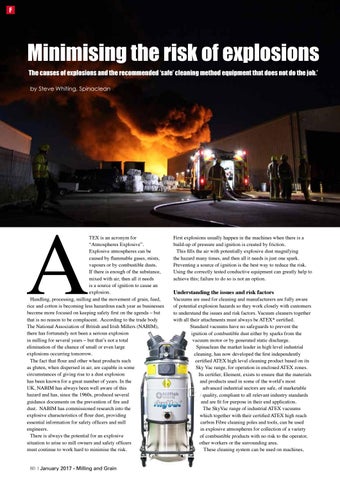
Vacuums are used for cleaning and manufacturers are fully aware of potential explosion hazards so they work closely with customers to understand the issues and risk factors. Vacuum cleaners together with all their attachments must always be ATEX* certified. Standard vacuums have no safeguards to prevent the ignition of combustible dust either by sparks from the vacuum motor or by generated static discharge. Spinaclean the market leader in high level industrial cleaning, has now developed the first independently certified ATEX high level cleaning product based on its Sky Vac range, for operation in enclosed ATEX zones. Its certifier, Element, exists to ensure that the materials and products used in some of the world’s most advanced industrial sectors are safe, of marketable quality, compliant to all relevant industry standards and are fit for purpose in their end application. The SkyVac range of industrial ATEX vacuums which together with their certified ATEX high reach carbon Fibre cleaning poles and tools, can be used in explosive atmospheres for collection of a variety of combustible products with no risk to the operator, other workers or the surrounding area. These cleaning system can be used on machines,