F CASE STUDY
CASE STUDY
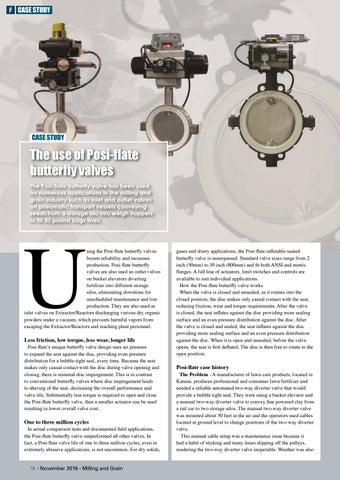
The use of Posi-flate butterfly valves The Posi-flate butterfly valve has been used for numerous applications in the milling and grain industry such as inlet and outlet valves on pneumatic transport vessels conveying seeds from a storage silo into weigh hoppers to fill 50 pound bags lines.
U
sing the Posi-flate butterfly valves boosts reliability and increases production. Posi-flate butterfly valves are also used as outlet valves on bucket elevators diverting fertilizer into different storage silos, eliminating downtime for unscheduled maintenance and lost production. They are also used as inlet valves on Extractor/Reactors discharging various dry organic powders under a vacuum, which prevents harmful vapors from escaping the Extractor/Reactors and reaching plant personnel.
Less friction, low torque, less wear, longer life
Posi-flate’s unique butterfly valve design uses air pressure to expand the seat against the disc, providing even pressure distribution for a bubble-tight seal, every time. Because the seat makes only casual contact with the disc during valve opening and closing, there is minimal disc impingement. This is in contrast to conventional butterfly valves where disc impingement leads to shaving of the seat, decreasing the overall performance and valve life. Substantially less torque is required to open and close the Posi-flate butterfly valve, thus a smaller actuator can be used resulting in lower overall valve cost.
One to three million cycles
In actual comparison tests and documented field applications, the Posi-flate butterfly valve outperformed all other valves. In fact, a Posi-flate valve life of one to three million cycles, even in extremely abrasive applications, is not uncommon. For dry solids, 76 | November 2016 - Milling and Grain
gases and slurry applications, the Posi-flate inflatable-seated butterfly valve is unsurpassed. Standard valve sizes range from 2 inch (50mm) to 30 inch (800mm) and fit both ANSI and metric flanges. A full line of actuators, limit switches and controls are available to suit individual applications. How the Posi-flate butterfly valve works When the valve is closed and unsealed, as it rotates into the closed position, the disc makes only casual contact with the seat, reducing friction, wear and torque requirements. After the valve is closed, the seat inflates against the disc providing more sealing surface and an even pressure distribution against the disc. After the valve is closed and sealed, the seat inflates against the disc providing more sealing surface and an even pressure distribution against the disc. When it is open and unsealed, before the valve opens, the seat is first deflated. The disc is then free to rotate to the open position.
Posi-flate case history
The Problem - A manufacturer of lawn care products, located in Kansas, produces professional and consumer lawn fertilizer and needed a reliable automated two-way diverter valve that would provide a bubble tight seal. They were using a bucket elevator and a manual two-way diverter valve to convey fine powered clay from a rail car to two storage silos. The manual two-way diverter valve was mounted about 50 feet in the air and the operators used cables located at ground level to change positions of the two-way diverter valve. This manual cable setup was a maintenance issue because it had a habit of sticking and many times slipping off the pulleys, rendering the two-way diverter valve inoperable. Weather was also