STORAGE
F
I
Storage project
Grainpro® levels up effort to stop aflatoxins in Nigeria n February, Chief Audu Ogbeh, Nigeria’s Minister of Agriculture and Rural Development, met with Tom De Bruin, President of GrainPro® Philippines, and Daniel Haileselassie, GrainPro Continent Manager for Africa, to discuss appropriate measures to ensure food security in the country. The GrainPro delegation presented modern drying and Ultra Hermetic™ grain storage innovations to the minister and his team. As a result, the minister is advising stakeholders in the country’s agricultural sector to ensure hygiene in the production and storage of agricultural commodities. The minister stressed the need to use modern grain storage solutions that don’t require
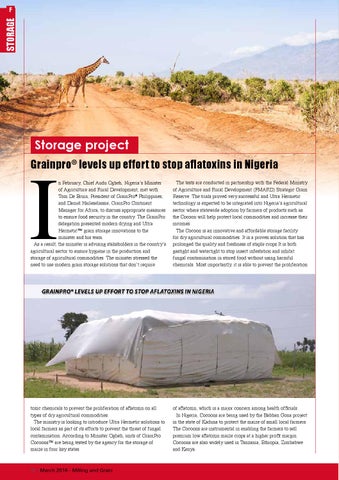
The tests are conducted in partnership with the Federal Ministry of Agriculture and Rural Development (FMARD) Strategic Grain Reserve. The trials proved very successful and Ultra Hermetic technology is expected to be integrated into Nigeria’s agricultural sector where statewide adoption by farmers of products such as the Cocoon will help protect local commodities and increase their incomes. The Cocoon is an innovative and affordable storage facility for dry agricultural commodities. It is a proven solution that has prolonged the quality and freshness of staple crops It is both gastight and watertight to stop insect infestation and inhibit fungal contamination in stored food without using harmful chemicals. Most importantly, it is able to prevent the proliferation
toxic chemicals to prevent the proliferation of aflatoxin on all types of dry agricultural commodities. The ministry is looking to introduce Ultra Hermetic solutions to local farmers as part of its efforts to prevent the threat of fungal contamination. According to Minister Ogbeh, units of GrainPro Cocoons™ are being tested by the agency for the storage of maize in four key states.
of aflatoxin, which is a major concern among health officials. In Nigeria, Cocoons are being used by the Babban Gona project in the state of Kaduna to protect the maize of small local farmers. The Cocoons are instrumental in enabling the farmers to sell premium low aflatoxin maize crops at a higher profit margin. Cocoons are also widely used in Tanzania, Ethiopia, Zimbabwe and Kenya.
78 | March 2016 - Milling and Grain