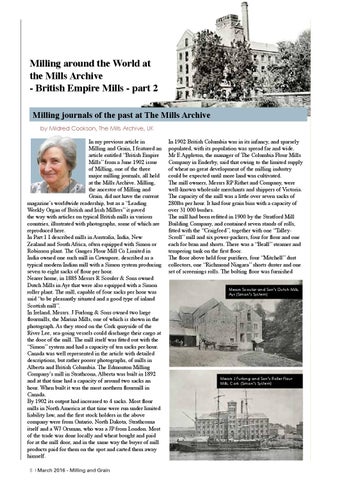
Milling around the World at the Mills Archive - British Empire Mills - part 2 Milling journals of the past at The Mills Archive by Mildred Cookson, The Mills Archive, UK In my previous article in Milling and Grain, I featured an article entitled “British Empire Mills” from a June 1902 issue of Milling, one of the three major milling journals, all held at the Mills Archive. Milling, the ancestor of Milling and Grain, did not have the current magazine’s worldwide readership, but as a “Leading Weekly Organ of British and Irish Millers” it paved the way with articles on typical British mills in various countries, illustrated with photographs, some of which are reproduced here. In Part 1 I described mills in Australia, India, New Zealand and South Africa, often equipped with Simon or Robinson plant. The Ganges Flour Mill Co Limited in India owned one such mill in Cawnpore, described as a typical modern Indian mill with a Simon system producing seven to eight sacks of flour per hour. Nearer home, in 1885 Messrs R Scouler & Sons owned Dutch Mills in Ayr that were also equipped with a Simon roller plant. The mill, capable of four sacks per hour was said “to be pleasantly situated and a good type of inland Scottish mill”. In Ireland, Messrs. J Furlong & Sons owned two large flourmills, the Marina Mills, one of which is shown in the photograph. As they stood on the Cork quayside of the River Lee, sea-going vessels could discharge their cargo at the door of the mill. The mill itself was fitted out with the “Simon” system and had a capacity of ten sacks per hour. Canada was well represented in the article with detailed descriptions, but rather poorer photographs, of mills in Alberta and British Columbia. The Edmonton Milling Company’s mill in Strathcona, Alberta was built in 1892 and at that time had a capacity of around two sacks an hour. When built it was the most northern flourmill in Canada. By 1902 its output had increased to 4 sacks. Most flour mills in North America at that time were run under limited liability law, and the first stock holders in the above company were from Ontario, North Dakota, Strathcoma itself and a WJ Orsman, who was a JP from London. Most of the trade was done locally and wheat bought and paid for at the mill door, and in the same way the buyer of mill products paid for them on the spot and carted them away himself. 8 | March 2016 - Milling and Grain
In 1902 British Columbia was in its infancy, and sparsely populated, with its population was spread far and wide. Mr E Appleton, the manager of The Columbia Flour Mills Company in Enderby, said that owing to the limited supply of wheat no great development of the milling industry could be expected until more land was cultivated. The mill owners, Messrs RP Rithet and Company, were well-known wholesale merchants and shippers of Victoria. The capacity of the mill was a little over seven sacks of 280lbs per hour. It had four grain bins with a capacity of over 31 000 bushes. The mill had been refitted in 1900 by the Stratford Mill Building Company, and contained seven stands of rolls, fitted with the “Craigfeed”, together with one “TalleyScroll” mill and six power-packers, four for flour and one each for bran and shorts. There was a “Beall” steamer and tempering tank on the first floor. The floor above held four purifiers, four “Mitchell” dust collectors, one “Richmond Niagara” shorts duster and one set of screenings rolls. The bolting floor was furnished Messrs Scoular and Son’s Dutch Mills, Ayr (Simon’s System)
Messrs J Furlong and Son’s Roller Flour Mills, Cork (Simon’s System)