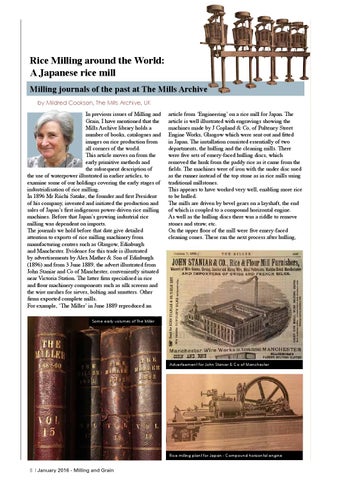
Rice Milling around the World: A Japanese rice mill Milling journals of the past at The Mills Archive by Mildred Cookson, The Mills Archive, UK In previous issues of Milling and Grain, I have mentioned that the Mills Archive library holds a number of books, catalogues and images on rice production from all corners of the world. This article moves on from the early primitive methods and the subsequent description of the use of waterpower illustrated in earlier articles, to examine some of our holdings covering the early stages of industrialisation of rice milling. In 1896 Mr Riichi Satake, the founder and first President of his company, invented and initiated the production and sales of Japan’s first indigenous power-driven rice milling machines. Before that Japan’s growing industrial rice milling was dependent on imports. The journals we hold before that date give detailed attention to exports of rice milling machinery from manufacturing centres such as Glasgow, Edinburgh and Manchester. Evidence for this trade is illustrated by advertisements by Alex Mather & Son of Edinburgh (1896) and from 3 June 1889, the advert illustrated from John Staniar and Co of Manchester, conveniently situated near Victoria Station. The latter firm specialised in rice and flour machinery components such as silk screens and the wire meshes for sieves, bolting and smutters. Other firms exported complete mills. For example, ‘The Miller’ in June 1889 reproduced an
article from ‘Engineering’ on a rice mill for Japan. The article is well illustrated with engravings showing the machines made by J Copland & Co, of Pulteney Street Engine Works, Glasgow which were sent out and fitted in Japan. The installation consisted essentially of two departments, the hulling and the cleaning mills. There were five sets of emery-faced hulling discs, which removed the husk from the paddy rice as it came from the fields. The machines were of iron with the under disc used as the runner instead of the top stone as in rice mills using traditional millstones. This appears to have worked very well, enabling more rice to be hulled. The mills are driven by bevel gears on a layshaft, the end of which is coupled to a compound horizontal engine. As well as the hulling discs there was a riddle to remove stones and straw, etc. On the upper floor of the mill were five emery-faced cleaning cones. These ran the next process after hulling,
Some early volumes of The Miller
Advertisement for John Staniar & Co of Manchester
Rice milling plant for Japan - Compound horizontal engine
8 | January 2016 - Milling and Grain