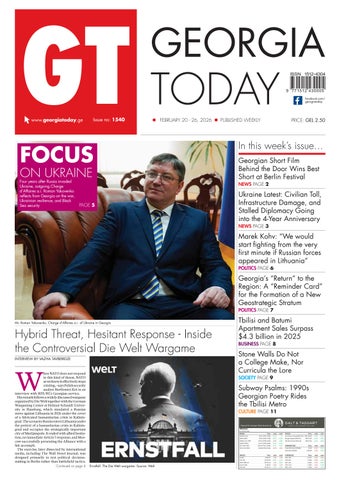
Four years after Russia invaded Ukraine, outgoing Charge d’Affaires a.i. Roman
reflects from Georgia on the war, Ukrainian resilience, and Black Sea security PAGE 5
Hesitant
hen NATO does not respond to this kind of threat, NATO as we know it effectively stops existing, - says Polish security analyst Bartłomiej Kot in an interview with RFE/RL’s Georgian service. His remark follows a widely discussed wargame organized by Die Welt together with the German Wargaming Center at Helmut-Schmidt University in Hamburg, which simulated a Russian move against Lithuania in 2026 under the cover of a fabricated humanitarian crisis in Kaliningrad. The scenario: Russia enters Lithuania under the pretext of a humanitarian crisis in Kaliningrad and occupies the strategically important city of Marijampole. It ended with allied hesitation, no immediate Article 5 response, and Moscow successfully presenting the Alliance with a fait accompli. The exercise, later dissected by international
In this week’s
Georgian Short Film Behind the Door Wins Best Short at Berlin Festival
PAGE 2
Ukraine Latest: Civilian Toll, Infrastructure Damage, and Stalled Diplomacy Going into the 4-Year Anniversary
PAGE 3
Marek Kohv: “We would start fighting from the very first minute if Russian forces appeared in Lithuania”
PAGE 6
Georgia’s “Return” to the Region: A “Reminder Card” for the Formation of a New Geostrategic Stratum
PAGE 7
Tbilisi and Batumi Apartment Sales Surpass $4.3 billion in 2025
Stone Walls Do Not a College Make, Nor Curricula the Lore
PAGE 9
Subway Psalms: 1990s Georgian Poetry Rides the Tbilisi Metro
Mr. Roman Yakovenko, Charge d’Affaires a.i. of Ukraine in Georgia
Yakovenko
Ernstfall. The Die Welt wargame. Source: Welt
INTERVIEW BY VAZHA TAVBERIDZE
Georgian Short Film Behind the Door Wins Best Short at Berlin Festival
BY TEAM GT
AGeorgian short film by director Nodar Marshanishvili has been awarded Best Short Film at the 2026 Berlin International Short Film Festival, bringing fresh international attention to cinema from Georgia. This marks another milestone for the country’s filmmaking community, which has seen growing recognition on the global festival circuit.
Behind the Door stars veteran actor Merab Ninidze and rising talent Jano Izoria in a story that explores the quiet but powerful emotional currents beneath everyday life. The film centers on Temo, a Georgian immigrant living in Berlin whose routines and inner life are transformed when something unexpected happens just beyond his doorstep. The narrative focuses on memory, belonging, and the small but significant moments that shape a life far from home. Festival programmers described the film as intimate and evocative, spotlighting the emotional weight that ordinary spaces can carry.
Shot between Tbilisi and Berlin, Behind the Door blends local cultural texture with broader questions about identity and displacement. Its performances and finely observed details helped it to stand out among a competitive slate of international shorts.
Georgia’s National Film Center celebrated the win, calling it “a proud moment for Georgian cinema and a testament to the creativity and talent of our filmmakers,” and extending congratulations to the entire creative team, including producers Vako Kirkitadze and Nika Gugushvili.
“This is a remarkable achievement not just for the Behind the Door team but for Georgian storytellers gaining international recognition,” the center said. Merab Ninidze is among Georgia’s most internationally known actors, with credits that include the Oscar winning film
Nowhere in Africa and acclaimed television series outside his home country. Jano Izoria represents a new generation of Georgian artists gaining exposure on the world stage.
Behind the Door is part of a growing pattern of Georgian films making their mark internationally. Georgian short Mother, directed by Rati Tsiteladze, was screened at more than 100 film festivals across more than 40 countries and won prizes at several international events, including the Tetova International Film Festival and the Corto Imola Festival. Another recent success, Temo Re, took home the Tiger Short Award and the KNF Award at the International Film Festival Rotterdam, one of the most respected showcases for cutting edge cinema. Documentary and short documentary work from Georgia has also been honored. The Men’s Land, a 2025 short documentary by Mariam Khatchvani, premiered at the Visions du Réel documentary festival and won the Heart of Sarajevo for Best Short Documentary Film at the Sarajevo Film Festival.
These successes contribute to a sense that Georgian film is not only active on the world stage, but increasingly influential.
Levan Loseliani Meets OSCE Rapporteur Under Moscow Mechanism
BY TEAM GT
Public Defender of Georgia
Levan Ioseliani and First Deputy Public Defender Tamar Gvaramadze have met with Patrycja Grzebyk, a rapporteur appointed by the Organization for Security and Co-operation in Europe within the framework of the Moscow Mechanism, one of the OSCE’s key human dimension tools.
The Public Defender’s Office says the meeting focused on the protection of human rights in the context of the 2024 protests in Georgia. Ioseliani briefed the rapporteur on the supervision of the rights of individuals detained during the demonstrations, including the monitoring of their detention conditions and
health status.
The discussion also covered amendments introduced to Georgian legislation concerning the right to assembly and demonstration. The Public Defender outlined the constitutional complaints filed in relation to these legislative changes and presented the Office’s legal assessments.
In addition, the rapporteur was informed about the amicus curiae opinions prepared in connection with criminal cases against protesters, as well as the measures implemented by the Public Defender within the scope of his constitutional mandate.
The Moscow Mechanism allows participating States of the OSCE to appoint independent experts to examine serious human dimension concerns, including alleged violations of fundamental rights and freedoms.
Additional Flights Added between Natakhtari and Mestia ahead of Svaneti Events
BY MARIAM RAZMADZE
In response to increased passenger demand during major winter events in Svaneti, the United Airports of Georgia has scheduled five additional flights between Natakhtari and Mestia.
The extra services will operate alongside regular flights from February 19 to 23, providing improved connectivity to the Mestia Queen Tamar Airport. Svaneti will host two large-scale events in late February. The region will welcome visitors for ‘Gemo Fest’ on February 21–22, while the Freeride World Championship will take place from February 21 to 28, attracting international athletes and spectators.
The added flights will operate on the following dates:
FEBRUARY 19
• Natakhtari – Mestia: 13:00
• Mestia – Natakhtari: 14:15
• Natakhtari – Mestia: 15:45
• Mestia – Natakhtari: 17:15
FEBRUARY 20
• Natakhtari – Mestia: 15:00
• Mestia – Natakhtari: 16:30
FEBRUARY 22
• Natakhtari – Mestia: 15:00
• Mestia – Natakhtari: 16:30
FEBRUARY 23
• Natakhtari – Mestia: 15:30
• Mestia – Natakhtari: 17:00
Currently, regular flights between Natakhtari and Mestia operate six times per week.
The one-way fare on the Natakhtari–Mestia route is set at 90 GEL. Travel is free for children aged 0–3 while children aged 3–12 receive a 30% discount. Tickets can be purchased online through the airline’s official website.
Georgia’s Parliament Approves Legislative Package Tightening Grants, Political Activity, and Activism Regulations
BY TEAM GT
Georgia’s Parliament has moved forward with a sweeping legislative package that tightens control over grants, political activity, and activism while creating a new criminal offense labeled “Extremism against the Constitutional Order.” The package passed its second reading with 83 votes in favor and 9 against. Initiated by the ruling Georgian Dream, the draft laws underwent detailed review article by article, incorporating revisions from committee discussions and plenary debates.
Key changes target the Law “On Grants,” where the legal definition of a grant has been significantly expanded. Under the revised text, a grant is any monetary or in-kind transfer from entities specified by law, intended, or perceived to influence, the Georgian government, state institutions, or society. This includes efforts to shape domestic or foreign policy or actions aligned with foreign governments or political parties. Transfers from emigrants are explicitly
exempted.
The legislation establishes that grantgiving entities must obtain prior consent from the Georgian government.
A parliamentary amendment introduced an exception for public state institutions, where recipients, not donors, will apply for permission. Foreign legal entities whose activities relate substantially to Georgia are now also considered grant recipients and must secure governmental approval before receiving funds. Violations, especially where a foreign entity operates locally through a branch or representation, carry liability. Transitional provisions allow current grant recipients a one-month window to apply for retroactive consent, with the government responding within one month.
The package also introduces criminal law changes. Crimes motivated by nonrecognition of Georgia’s constitutional order or its institutions now constitute an aggravating circumstance, increasing imprisonment by at least one year above the minimum penalty. Similarly, administrative offenses with the same motive are treated as aggravating circumstances.
A central innovation is Article 316¹ of the Criminal Code, “Extremism against
German Wargame
Shows
NATO
the Constitutional Order,” which criminalizes systematic, public acts that undermine constitutional authorities, such as calls for mass disobedience, unauthorized self-representation as government officials, or other actions that create a real threat to state interests. Punishments range from fines and community service (400–600 hours) to imprisonment up to three years; legal entities may face fines or liquidation.
Further amendments impose stricter accountability for business entities engaged in political activity. Repeat violations now carry criminal liability for both the entity and responsible individuals.
The legislative package modifies multiple laws, including the Law “On Grants,” the Criminal Code, the Administrative Procedure Code, the Code of Administrative Offences, the Organic Law “On Political Associations of Citizens,” and the Law “On the State Audit Office.” Proponents argue the changes strengthen protections against foreign influence and safeguard constitutional order, while critics warn of potential restrictions on political activism and civil society. The package is now set for its third and final reading before enactment.
Hesitation
Could Allow Russia to Seize Baltic Territory, Participants Say
BY TEAM GT
Ahigh profile crisis simulation conducted by the German newspaper Die Welt and the German Wargaming Center at Helmut Schmidt University suggests that political hesitation in Berlin and Washington could allow a Russian military escalation in the Baltics to succeed quickly, according to participants and experts involved in and reporting on the exercise.
The public wargame, played out by 16 former senior officials, military leaders and security specialists, was designed to test how Germany and its allies might respond to a fictional Russian attack on a NATO member set in October 2026.
In the simulated scenario, Moscow used claims of a “humanitarian crisis” in the Russian exclave of Kaliningrad to justify moving forces into Lithuania and capturing the strategically critical Suwałki Gap, NATO’s only direct land link between Poland and the Baltic states, in just three days.
Germany’s response in the simulation was cautious and consensus driven,
focusing on sanctions and internal crisis preparations rather than immediate military action. The United States, in the exercise, was depicted as reluctant to invoke NATO’s Article 5 mutual defense guarantee, raising concerns about the alliance’s ability to act decisively.
“We discovered that their reaction would not be adequate to defend NATO,” Alexander Gabuev, director of the Carnegie Russia Eurasia Center, told Meduza, referring to the German and allied response in the simulation. Gabuev played the role of “Putin” in the wargame and described the exercise as structured but free for participants to make their own decisions once the crisis began.
Former NATO spokesperson Oana Lungescu, who acted as the alliance’s secretary general in the simulation, warned that Europe needs to prepare for scenarios some might consider unlikely.
“We must think the unthinkable,” Lungescu said in an interview with Die Welt, stressing the importance of deterrence and alliance unity in responding to aggression. She cautioned that Europe’s dependence on U.S. reconnaissance, precision weapons and air defense could put it at risk if Washington hesitated in
a crisis.
The exercise also ignited debate among analysts and officials about how accurately such simulations reflect reality. Some observers, especially from the Baltic region, criticized aspects of the game as unrealistic or dismissive of existing defense capabilities.
Despite such criticism, security analysts say the wargame highlights real strategic concerns. Ongoing NATO training and deployments, including increased troop presence in the Baltics and exercises like STEADFAST DART 2026, seek to strengthen deterrence but underscore how central political resolve remains in any response. Germany’s use of a public simulation, rather than a classified military exercise, is unusual and reflects a broader effort to involve citizens and policymakers in thinking about potential crises. Whether or not the specific outcomes of this wargame mirror real military capability, the discussions it has generated reveal persistent questions about how NATO would act in the event of a sudden confrontation in Europe.
Behind the Door film poster. Source: FB
Mestia scenery. Source: Georgia Travel
Public Defender Levan Ioseliani with Patrycja Grzebyk, OSCE rapporteur
Ukraine Latest: Civilian Toll, Infrastructure Damage, and Stalled Diplomacy Going into the 4-Year Anniversary
BY TEAM GT
As Russia’s full-scale invasion of Ukraine enters its fifth year, the human and territorial toll remains severe. Verified United Nations figures show at least 15,000 civilian deaths and more than 41,000 injuries since February 2022, with children among the casualties and roughly 19,500 documented Ukrainian children abducted by Russian forces. Of those, only about 1,800 have been returned through negotiated efforts. More than 10 million people have been displaced, including 3.7 million refugees abroad, and repeated strikes on electricity, heating, water, and transport infrastructure have left hundreds of thousands enduring harsh winter conditions without basic services.
On the battlefield, Russia continues to hold parts of Donetsk, Luhansk, Kherson, and Zaporizhzhia, while Ukraine has made localized counteroffensives to regain villages and reduce Russian footholds in Zaporizhzhia, Dnipropetrovsk, and northern Kharkiv. Despite these gains, frontlines remain largely contested and advances incremental rather than decisive.
This week, US-mediated talks in Geneva involving Ukraine, Russia, and Washington concluded without a breakthrough on the war’s most sensitive political issues. President Volodymyr Zelenskyy described the negotiations as tough, noting that “positions differ because the negotiations were difficult.” He criticized Russia for attempting to delay progress, saying, “Russia is trying to drag out negotiations that could already have reached the final stage.” Zelenskyy also addressed pressure to make concessions, emphasizing that “it is not fair if Ukraine
is asked to make concessions that Russia has not earned,” and underscored that any deal must respect Ukraine’s sovereignty and internationally recognized borders.
From the US side, mediators described progress on military and technical issues, particularly mechanisms for monitoring a potential ceasefire. One American official stated that the talks “led to substantial progress” on some military tools and monitoring arrangements, even as the political and territorial disputes remain unresolved. Russia’s negotiators, meanwhile, called the discussions “businesslike,” but offered no optimism about achieving substantive political agreements.
The Geneva talks unfolded amid intensified Russian attacks on Ukrainian infrastructure. On February 17, hundreds of drones and missiles targeted energy and transport networks across multiple regions, leaving tens of thousands with-
out heat or power and killing three energy workers. Zelenskyy condemned the strikes as deliberate attempts to undermine diplomacy, stating that Russia’s actions should be held accountable and calling infrastructure attacks a major barrier to peace. Ukraine responded with long-range drone strikes against refineries and port facilities inside Russia, aiming to disrupt fuel supplies and force Russia to divert air defense resources. International support for Ukraine this week focused on air defense and energy resilience. NATO and European allies pledged additional weapons and interceptors, while funding through the Prioritized Ukraine Requirements List reached $35 to $38 billion for 2026. These efforts reflect the recognition that protecting civilian infrastructure is now central to sustaining Ukraine’s defense. As the conflict comes to its fourth anniversary, Ukraine faces intertwined
challenges. The country must manage a staggering humanitarian crisis, contest incremental territorial gains and losses, and pursue diplomacy that so far has fallen short of resolving the core political disputes. The coming months will test Ukraine’s endurance and the international community’s ability to sustain support amid ongoing frontline pressures and attacks on civilian infrastructure.
UKRAINE: THE HUMANITARIAN AND TERRITORIAL IMPACT (FEB 2022–EARLY 2026)
HUMAN TOLL
• Civilians killed: 15,172+ (verified by UN HRMMU; actual numbers likely higher due to limited access in occupied areas).
• Civilians injured: 41,378+ (includes thousands of children).
• Children killed or injured: 766+ killed, 2,540+ injured.
• Displaced persons: ~10.6 million (approx. 6.9 million internally displaced, 3.7 million refugees abroad).
• Children displaced: ~2.5 million.
• Children abducted by Russia: ~19,500 documented, with ~1,859 returned via negotiated returns.
• Kidnappings and rights violations: widespread reports of abductions, torture, and unlawful detentions of both civilians and children in occupied territories.
• Infrastructure and humanitarian strain: repeated strikes on electricity, heating, water, hospitals, schools, and shelters, leaving hundreds of thousands of civilians without basic services, particularly in winter.
MILITARY AND POW DATA
• POW exchanges: At least 64 confirmed swaps, with 4,757 Ukrainians returned since the start of the invasion.
• Large-scale exchanges: Some swaps involved hundreds to over a thousand personnel on each side (e.g., 1,000-for1,000 deal in Istanbul).
• Ongoing captivity: Thousands of Ukrainian soldiers and civilians remain in Russian custody, with verified returns representing only part of total detainees.
TERRITORIAL DYNAMICS
• Russian-held areas: Parts of Donetsk, Luhansk, Kherson, and Zaporizhzhia regions remain under Russian control.
• Key contested areas: Pokrovsk, Myrnohrad, northern Kharkiv, and parts of Zaporizhzhia and Dnipropetrovsk.
• Ukrainian counteroffensives: Localized gains in Zaporizhzhia and Kharkiv, reclaiming villages and reducing Russian footholds.
• Frontline pattern: Shifts are incremental rather than decisive; no side has achieved a rapid, large-scale breakthrough.
A child walking in Ukraine. Source: GettyImages
Hybrid Threat, Hesitant Response - Inside the Controversial Die Welt Wargame
Continued from page 1
Kot, who in the simulation played the role of Poland’s prime minister, argues that the real lesson is how easily hybrid pressure could fracture allied unity before NATO even reaches the stage of a conventional fight.
WHAT WERE THE PRINCIPAL TAKEAWAYS FROM DIE WELT’S WARGAMING EXERCISE?
An important thing to remember while discussing the wargame is that, first and foremost, it was a political exercise, designed to test the readiness and leadership of the German side. In a more military-focused wargame, NATO would have had to become involved much earlier through some form of automatic response, just as happened recently when Russian drones appeared in Polish airspace.
Talking about the results, I must say that, unfortunately, our German colleagues were very hesitant regarding escalatory action, not only in terms of activity but even rhetoric, toward Russia. The primary instinct observed during the game was to de-escalate from the very beginning all the way through to the end. Responding actively in a conventional way to a hybrid threat from Russia seems not to be an easy scenario to follow. Whenever Russian activity shifted from hybrid to conventional, the German response was always quite reactive militarily, with much more focus placed on domestic social resilience. At least, that is what this wargame demonstrated.
What was particularly surprising was the limited understanding displayed regarding the breach of sovereignty of a NATO member state. The very Russian claim of effectively closing the skies over Lithuanian territory, even under the pretext of a humanitarian crisis, was, in my opinion, enough to constitute a violation of a NATO member’s sovereignty, even without conventional action on the ground. I was trying to convince the others of this.
AT LEAST IN THE FIRST 48 HOURS OF THE WARGAME, THE US WAS NOT PREPARED TO INTERVENE MILITARILY OR LAUNCH AIRSTRIKES. WHY? HOW PLAUSIBLE IS THAT IN REAL LIFE?
This was the hybrid element: the Russian claim that they were merely creating a humanitarian corridor before entering Lithuania. Much of the initial American decision-making was therefore based not on Russian troops already being present in Lithuania, but on Moscow’s assertion that it intended to create such a corridor. The conclusion was: we should not invoke Article 5.
What was specific to the American position was that they also tried to bilateralize the response. They said: “Okay, you can consult among yourselves and discuss whether this is Article 5 or not. We believe it is not, and we will try to resolve the crisis by talking directly to Russia.” In my opinion, this aspect is even more important than the entire controversy the wargame caused in Germany. Let me be clear: the idea that this wargame tested the allied response is not entirely accurate. It primarily tested the political decisiveness of German politicians, simply put. There was no one playing Lithuania, which obviously would have had a say. There was no one playing France or the UK. The international contributors were only dialed in. That, of course, limits the possibility to react on a moment-to-moment basis and creates a situation of reactiveness to the German players.
WHICH WOULD NOT HAVE BEEN THE CASE IN REAL LIFE. Of course not. At some point, I decided on a more proactive approach. I said:
Bartłomiej Kot. Source: Tiktok
NATO would never allow itself to become pinned down in trench warfare. It would be a war of the skies above all
let’s test the Russians. I suggested testing them over this claimed humanitarian corridor by sending a humanitarian convoy of our own through it, protected by NATO troops.
It was a simple move: we were mirroring the Russians. If they reacted militarily to NATO troops’ presence in the sovereign airspace of an Alliance member, they would be responsible for the escalation. If they did not, then it would mean they do not, in fact, control Lithuanian airspace, which also means the political narrative they are constructing for propaganda purposes, that they have closed the skies, is simply not true.
I SUSPECT YOUR IDEA WAS NOT TAKEN ON BOARD.
It sparked interest from our German colleagues and willingness to use the capabilities of the German brigade already stationed in Lithuania. But, after discussions with the US Secretary of State, it became clear we would not be able to act fast under the NATO banner. So I said: fine, let’s do it under a coalition-ofthe-willing flag.
As Polish prime minister, I would contribute to that movement of troops. I could provide air assets. But I would like to know whether the French and British would join.
THE ARTICLE IN DIE WELT SAYS POLAND MOBILIZED, UNLIKE GERMANY, BUT DID NOT INTERVENE. WHY NOT?
Because I was never put in a position where I could actually react in such a manner. The scenario simply never expanded to the point where it was time for the Polish PM to make a decision on an intervention once the Russians already had boots on the ground. That was my main gripe with how the wargame was constructed.
THAT DOESN’T SOUND LIKE A VERY FLESHED-OUT WARGAME; NOT GIVING THE PARTIES INVOLVED EQUAL OPPORTUNITY TO REACT.
The entire gameplay, the whole engine of the exercise, was designed to test the Germans and their response to Russian narratives. This is understandable for the German newspaper, but it certainly displays flaws in terms of the realism of the scenario.
LET'S TRY TO FILL THE GAPS THEN. IMAGINE AN ADDON WHERE YOU GET THE CHANCE TO REACT. WHAT DOES POLAND DO?
I would say the first priority would be to seize leadership. Once we see that the Germans or other Western allies are not responding to the threat, we would have to mobilize and react conventionally. If some allies are unwilling to enact Article 5, this would not be done under the NATO flag, so we would intend to form the coalition of the willing.
If I decided to intervene, before actu-
But it also depends on what the situation in Ukraine looks like at that moment. On a daily basis, NATO is learning from Ukraine how to conduct this new type of warfare.
THE WARGAME ASSUMES THIS SCENARIO WOULD ONLY UNFOLD AFTER A CEASEFIRE IN UKRAINE. WAS THERE ANY EXPLANATION OF HOW THE UKRAINE WAR ENDED WITHIN THE FRAMEWORK OF THE EXERCISE?
Basically, the initial scenario says that Russian troops eventually captured the entire Donbas region. Another migration wave from Ukraine to the West occurs, and then a ceasefire appears. Russian and Ukrainian negotiators agree to freeze the front line. Kyiv does not recognize the occupied territories.
DOES KYIV PROCLAIM NEUTRALITY? MEANING IT WOULD NOT GET INVOLVED IN THIS SCENARIO EITHER?
It doesn’t say that. A contingent of troops from the Global South monitors the line of contact. There is a French-British battalion in western Ukraine. Nothing larger than that.
SO IT WOULD BE IN RUSSIA’S INTEREST TO ACT AS QUICKLY AS POSSIBLE ONCE THE CEASEFIRE IN UKRAINE IS IN PLACE, BEFORE YOU MANAGE TO CATCH UP.
Certainly. But it also depends on how far Russia is willing to test and risk things. I believe that, on a conventional level, Europeans today possess the capability not only to win a war with Russia, but also to deter.
REALLY? EVEN IN TERMS OF UNMANNED WARFARE?
ally doing anything I would try to build such a coalition: probably us, the British, the Scandinavian countries, maybe Romania.
HOW MUCH TIME WOULD THAT HAVE TAKEN? WOULDN’T YOU JUST BE FACED WITH RUSSIANS ALREADY ENTRENCHED IN MARIJAMPOLE?
This is not a decision that takes days. It has to be made within hours. If NATO does not decide, we could enact the plans already developed within NATO, but on behalf of the coalition of the willing, because we know how to act.
SO IF RUSSIA’S MAIN OBJECTIVE IS TO DAMAGE AND UNDERMINE NATO’S CREDIBILITY, THEN THEY SUCCEED, BECAUSE IT IS THE COALITION OF THE WILLING THAT RESPONDS, NOT NATO.
When NATO does not respond to this kind of threat, as displayed in the scenario, NATO as we know it effectively stops existing, in my opinion. But to return to the potential Polish response: if Russian troops appeared in Lithuania, there would be an automatic response from Poland: to react, not to wait.
EXPERTS WARN THIS COULD HAPPEN SOON. HOW SIGNIFICANT IS THE COMBATEXPERIENCE GAP BETWEEN BATTLE-HARDENED RUSSIAN TROOPS AND RELATIVELY INEXPERIENCED LITHUANIAN AND GERMAN FORCES?
That’s a question of timing, isn’t it? It’s all about when such a scenario would unfold. If we were playing it out right now, certainly there would be a cognitive difference between the sides: one is very much in a wartime mindset, the other is not.
Yes. I do not believe a war between NATO and Russia would look exactly like what we are seeing now in Ukraine. NATO would never allow itself to become pinned down in trench warfare. It would be a war of the skies above all.
There would never be a situation like the one we see today in Ukraine. The issue with this scenario is that hesitation on NATO’s side in responding to hybrid threats from Russia undermines NATO solidarity and, in fact, the very core of NATO.
What this scenario showed, and that is certainly a lesson learned, is that Russia can undermine NATO solidarity by acting in a hybrid manner. It can weaken the alliance before even testing it conventionally.
WHEN YOU SPEAK ABOUT A COALITION OF THE WILLING IN SUCH A SCENARIO, WHO DO YOU ACTUALLY ENVISAGE BEING PART OF IT, AND HOW WILLING WOULD THEY BE TO GET INVOLVED?
There is obviously a lot of uncertainty and speculation, but if I were to name a few, it would be those countries that already have a stake in the game: Finland, Sweden, the United Kingdom, possibly Norway, Denmark, Romania.
AND WHEN WE TALK ABOUT WILLINGNESS, WHAT LEVEL ARE WE TALKING ABOUT? BOOTS ON THE GROUND?
In the case of Finland, Sweden, and the UK, I would assume boots on the ground. Plus Poland, of course.
What I am trying to say is this: I do not believe in a scenario in which the situation in Lithuania is so isolated that it provokes no response from any ally. It might not be all of them. It might not include the United States. It might be a European response. But, in my opinion, there would always be at least some allies deciding to act from the very beginning. It would not be bloodless.
Four Years of War: “Ukraine Will Not Only Survive — We Will Prevail”
An
Interview with Mr. Roman Yakovenko, Charge d’Affaires
INTERVIEW BY KATIE RUTH DAVIES
As Ukraine marks four years since Russia launched its full-scale military invasion, we spoke with Mr. Roman Yakovenko, outgoing Charge d’Affaires a.i. of Ukraine in Georgia, about war, resilience, international support, Black Sea security, and his time in Georgia.
WHEN YOU LOOK BACK AT THE PAST FOUR YEARS OF WAR, WHAT MOMENTS STAY WITH YOU MOST ON A PERSONAL LEVEL, NOT AS A DIPLOMAT, BUT AS A UKRAINIAN?
When the military invasion began in 2022, I was in Kyiv. This unexpected and horrific act of aggression will stay with me and my family forever. My children were shocked. They looked at me with hope, as if to say: “This cannot be true. It must be a mistake. It must be a nightmare.”
Before that day, I believed the most tragic event of my life was the Great East Japan Earthquake on March 11, 2011, when I was serving as a young diplomat in Tokyo. Today, I understand these events cannot even be compared. War is an absolute tragedy.
Russia’s full-scale invasion of Ukraine has now lasted longer than the 1941–1945 war between the Nazi Third Reich and the USSR. It is a historic and human catastrophe.
Russia continues to intimidate and terrorize Ukrainians by attacking critical infrastructure and residential areas with missiles, multiple-launch rocket systems, guided aerial bombs, and attack drones, resulting in significant casualties and destruction.
Even in 2026, Russia continues its campaign of terror against civilians. Between January 18 and January 25 alone, Russia launched more than 1,700 attack drones, over 1,380 guided aerial bombs, and 69 missiles of various types against Ukraine.
Russia is waging a genocidal war against civilians, committing war crimes and crimes against humanity. It spends enormous sums of money to kill Ukrainians.
For example, the total cost of weapons used in the attack on January 20 alone amounted to USD 131 million: equivalent to the annual budget of the Russian city of Veliky Novgorod.
As of December 2025, the estimated damage caused by Russia’s war of aggression against Ukraine stands at approximately USD 800 billion, and the figure grows daily.
At the same time, I must emphasize that despite Russian propaganda claims, Russia is not winning and Ukraine is not losing this war. Moscow has failed to achieve a single strategic objective and has suffered enormous losses.
To intercept 800 drones per day across Ukraine, 1,600 Ukrainian interceptor drones are required daily. Each interceptor costs approximately EUR 3,000
On a personal level, what impressed me most has been the extraordinary cohesion of Ukrainian society and the level of mutual support during the greatest trials in modern Ukraine’s history. But above all, the courage and strength of our soldiers have left the deepest impression on me.
Thanks to their heroism, Ukraine will not only survive: I sincerely believe we will demonstrate rapid development in all areas once this war ends.
UKRAINIANS HAVE SHOWN REMARKABLE RESILIENCE. WHERE DOES THAT STRENGTH COME FROM?
Russia uses every day to strike Ukraine, especially targeting our energy infrastructure. Power, heating, and water systems have been under brutal attack by cruise and ballistic missiles and drones. Russia is trying to exploit winter as a weapon.
The situation in the energy sector remains difficult, particularly in Kyiv and the Kyiv region, as well as in the Kharkiv, Zaporizhzhia, Dnipro, Chernihiv, Sumy, and Odesa regions. Despite enormous efforts, hundreds of residential buildings in Kyiv have at times remained without heating, even when temperatures dropped to minus 15–20 degrees Celsius.
Our international partners actively assist in restoring energy infrastructure, and we count on the continuation of this support. Stable energy supply is crucial for the economy, critical infrastructure, and social life. Immediate needs currently amount to approximately USD 1 billion, including generation capacity, mobile substations, backup systems, and other essential equipment.
Ukraine also has significant investment potential in the energy sector and remains open to international partners for the development of distributed generation projects at the local level.
Ukrainians are a nation of winners: strong and indomitable people. With faith in God and in our state, we must defeat the enemy
But beyond infrastructure, Ukrainians are a nation of winners: strong and indomitable people. With faith in God and in our state, we must defeat the enemy.
Despite constant shelling, every Ukrainian continues to hold the line, support the army, and do everything possible to bring victory closer.
Where does this strength come from?
I am convinced it comes from upbringing, pride in one’s state, national dignity, and deep respect for the Ukrainian nation, culture, language, and religion, all preserved through centuries of struggle.
For a vivid example, one can look at Oleksandr Usyk, the most famous and decorated Ukrainian boxer in the world.
He has demonstrated to the world the strength of the Ukrainian Cossack spirit.
a.i. of Ukraine in Georgia
WHAT KIND OF INTERNATIONAL SUPPORT MATTERS MOST AT THIS STAGE?
Ukraine is grateful for every package of assistance. However, we need a stable and timely supply of all types of weapons and ammunition in larger quantities to ensure Ukraine defeats Russia and that the war does not spread further in Europe.
Our key needs remain unchanged:
• Air defense systems and associated missiles
• Combat aircraft
• Artillery systems and shells
• Long-range missiles
• Electronic warfare systems
• Engineering equipment
• Drones, including those capable of intercepting attack drones
To intercept 800 drones per day across Ukraine, 1,600 Ukrainian interceptor drones are required daily. Each interceptor costs approximately EUR 3,000.
We welcome efforts by our EU and NATO partners to accelerate deliveries.
In addition, Ukraine calls for maintaining the issue of frozen Russian assets on the agenda. These assets represent a powerful instrument to force Moscow toward peace. It is also necessary to strengthen measures against Russia’s shadow fleet and increase sanctions pressure, including the adoption of a strong 20th EU sanctions package.
HOW HAS THE WAR RESHAPED UKRAINE’S FOREIGN POLICY PRIORITIES?
Ukraine’s foreign policy priorities have not changed since Russia’s aggression began. European and Euro-Atlantic integration remain our strategic course and are enshrined in the Constitution of Ukraine.
In the Black Sea region, we hope for active participation from Georgia and other regional states in strengthening cooperation through various international platforms.
For example, the Third Black Sea Security Conference will take place in March 2026 in Moldova. It will assess the consequences of Russia’s ongoing aggression and formulate practical recommendations for strengthening regional security and resilience. We expect participation at the highest level from Georgia, Moldova, Türkiye, Romania, Bulgaria, and other countries.
We also look forward to closer cooperation within GUAM and the Organization of the Black Sea Economic Cooperation (BSEC). I would like to take this opportunity to wish success to the Government of Georgia, as it assumed the six-month BSEC chairmanship on January 1, 2026.
We also hope to see the restoration of the Georgia–Ukraine Black Sea ferry connection, which would strengthen economic and strategic ties.
WHAT DOES A JUST AND SUSTAINABLE PEACE MEAN FOR UKRAINE?
“For Ukraine, peace must be based on the principles of the UN Charter and international law,” Mr. Yakovenko says.
“It means restoring sovereignty within internationally recognized borders, ending the war without losing territories, obtaining real security guarantees from the United States, NATO, and the European Union, punishing the aggressor, and ensuring compensation for damages.
“It cannot be merely a ceasefire. It must make it impossible for Russia to repeat its aggression. Justice must form the foundation of lasting peace.”
LOOKING FORWARD: “THE COSSACK SPIRIT WILL PREVAIL”
During his time in Tbilisi, Mr. Yakovenko has experienced both solidarity and complexity in Ukraine–Georgia relations.
Georgia has provided humanitarian support, including the delivery of nine industrial generators in late 2025 to help restore electricity in regions devastated by Russian strikes, and thousands of Ukrainians have found temporary refuge countrywide. Around 2,000 Ukrainian children are studying in Georgian schools, where dedicated educational sectors ensure they continue their studies without losing their language or cultural identity. The Ukrainian Houses in Tbilisi and Batumi have become a pillar of community life, dignity, and cultural preservation.
At the same time, Georgia has chosen not to join most Western economic sanctions against Russia, citing its own economic and security considerations. Mr. Yakovenko speaks about this with diplomatic candor.
“Ukraine would, of course, welcome the strongest possible measures against the aggressor,” he says. “But we understand that every country makes decisions based on its national interests and circumstances. What matters most is that the principles of sovereignty and territorial integrity are upheld.”
He remains deeply grateful for the relationship he has built with Georgia’s Foreign Minister and other officials, describing their cooperation as respectful, open, and constructive. He believes there is significant potential to strengthen ties further, particularly in Black Sea security, economic connectivity, and the eventual restoration of the Georgia–Ukraine ferry link across the Black Sea.
“Our nations are connected not only by politics,” he reflects. “We are connected by memory, by struggle, by faith, and by culture.”
As his diplomatic mission in Georgia comes to an end, his farewell is sincere.
“Our peoples share a long history of friendship. I am proud of my country, of our ancient culture, our language, and our faith, and I am equally proud of the Georgian people and their resilience. Georgia will remain in my heart forever. Didi madloba, Kartvelebi.”
Considering that Mr. Mykhailo Brodovych was recently appointed by the President of Ukraine to the position of the next Ambassador of Ukraine in Georgia, he wishes all the best and every success to him, and he is sure that Ukraine – Georgia relations will only prosper in the future.
And yet, even in farewell, his focus returns firmly to Ukraine’s future.
He speaks with conviction about a nation that has endured centuries of attempts to erase its identity, yet has preserved its language, its Church, and its sense of dignity.
“We are an ancient European nation,” he says. “We have survived empires, repression, famine, and now full-scale war. The Ukrainian Cossack spirit, our belief in freedom and self-determination, cannot be destroyed.”
He is convinced that when the war ends, Ukraine will not merely rebuild what was lost, but will emerge stronger: modernized, innovative, anchored in the European family, and contributing decisively to regional and global security.
“This war has shown the world who we are,” Mr. Yakovenko reflects. “It has shown our courage, our unity, and our faith. We are defending not only our land, but the principles on which Europe itself stands.”
As Ukraine enters its fifth year of resistance, his message is clear and unwavering:
“Ukraine will endure. Ukraine will rebuild. And Ukraine will prevail.”
Mr. Roman Yakovenko, Charge d’Affaires a.i. of Ukraine in Georgia
Marek Kohv: “We would start fighting from the very first minute if Russian forces appeared in Lithuania”
LET’S TURN TO THE REPORT ITSELF. WHAT DO YOU SEE AS THE MAIN TAKEAWAYS THIS YEAR?
If something happens in Lithuania, we start fighting from the very first minute, - says Marek Kohv, Head of the Security & Resilience Program at Estonia’s International Center for Defense and Security, commenting on Tallinn’s latest Foreign Intelligence yearbook in an interview with RFE/RL’s Georgian Service.
The 2026 report warns that Russia is preparing for future confrontation even while bogged down in Ukraine, intensifying hybrid operations aimed at dividing European societies, and accelerating the development of unmanned warfare capabilities. While the report cautions that Russia is preparing for future conflict even as it fights in Ukraine, Kohv argues that a new large-scale offensive after 2029 is more likely than an imminent war, given Russia’s military and economic constraints. At the same time, he stresses that deterrence must begin immediately, as “the more we do to arm ourselves, the less likely the threat becomes.”
BEFORE WE EVEN OPEN ESTONIA’S FOREIGN INTELLIGENCE YEARBOOK, ANOTHER ASPECT CATCHES THE EYE: THE COVER DESIGN. IT APPEARS TO ALLUDE TO THE FAMOUS HANDSHAKE BETWEEN PRESIDENTS PUTIN AND TRUMP. WHAT IS THE MESSAGE BETWEEN THE LINES?
I think it illustrates the uncertainty we are facing right now, particula rly the situation in which the US and Russia are trying to resolve the con fl ict between Ukraine and Russia. At the same time, it re fl ects the absence of European involvement. It is something we should pay attention to and ask ourselves what Europe’s role is in those negotiations.
The report reaffirms much of what we already knew. For example, we are likely to see an increase in hybrid activities regardless of how successful or unsuccessful Russia is on the front line.
These operations are relatively cheap and easy for Russia to carry out in Europe. Their main objective is to divide our societies and European countries so that support for Ukraine decreases and we begin infighting and blaming one another.
This is something we will see more of this year and next.
Another key issue is Russia’s effort to integrate unmanned systems into future warfare. This must be taken very seriously by European states and NATO. Drone development is not something NATO has addressed seriously enough in recent years.
DURING A NATO EXERCISE HELD IN ESTONIA LAST YEAR CALLED HEDGEHOG, A UKRAINIAN DRONE UNIT OF 10 MEN REPORTEDLY DECIMATED TWO NATO BATTALIONS, LEAVING OFFICIALS SHAKEN. IT IS NOW 2026. HAVE THESE LESSONS BEEN TAKEN ON BOARD?
The exercise was designed specifically to demonstrate vulnerabilities. We invited the Ukrainians to showcase their experience and help us understand how to incorporate the drone threat into our training.
Some media outlets overstated how devastating the results were. Of course, we saw how effective drones can be in modern warfare. But the purpose was to draw lessons and adapt accordingly.
HOW LARGE IS THE GAP IN UNMANNED WARFARE BETWEEN UKRAINE AND ESTONIA? AS A NEIGHBORING COUNTRY, YOU ARE TAKING
Russia does not view Estonia, Latvia, and Lithuania as separate states but as one operational area
THESE LESSONS VERY SERIOUSLY AND FACE GREATER DANGER THAN MOST.
If anyone is closely studying and learning from Ukraine, it is Estonia. I do not think the knowledge gap is very large, because we are in daily contact with our Ukrainian counterparts and gather information directly from the front lines.
The real gap lies in industrial-scale production. That is a problem often overlooked. Modern battlefields serve as laboratories for rapid military innovation. Developments move so quickly that equipment that was effective one month may be obsolete the next. If you start mass-producing something today, it could already be outdated by the time it rolls off the production line.
WHAT ABOUT WESTERN EUROPEAN COUNTRIES SUCH AS THE UK, FRANCE, AND GERMANY? DOES THE GAP WIDEN THE FURTHER WEST YOU GO?
The main issue beyond the Nordic regional coalition, including the Scandinavian countries, the Baltics, Poland, and to some extent the Netherlands and the UK, is not only the lack of interoperability among Europe’s many weapons systems, but also differences in threat perception.
In Western and Southern Europe, public awareness of the threat is quite different from what we experience here. This also affects drone development. There is a significant difference between living 20 to 50 kilometers from Russia and being separated by a thousand kilometers.
ONE KEY CONCLUSION OF THE REPORT IS THAT RUSSIA IS HIGHLY LIKELY PREPARING FOR FUTURE CONFLICT EVEN AS IT FIGHTS IN UKRAINE. THE UNANSWERED QUESTION IS WHEN.
Every intelligence service in Europe seems to agree that the timing of the next conflict will depend on how the war in Ukraine ends. Even if there is some kind of peace agreement, Russia’s ambitions will not disappear. Moscow will still aim to undermine Ukraine and change its regime. If that is the case, many Russian forces will remain in the region.
This leads me to assume that Russia does not have the capability to launch a new conflict elsewhere until it resolves the situation in Ukraine to its satisfaction. At the same time, we must remember that Russian logic does not always align with Western logic.
The situation in our region has also changed dramatically. Defense budgets have increased. Regional defense plans
are in place. People often question whether Article 5 would work, but regional cooperation has become so strong that if something happened in the Baltic states, a coalition of the willing would begin fighting immediately.
THERE WAS A RECENT WARGAMING EXERCISE REPORTED BY DIE WELT IN WHICH RUSSIA MANUFACTURED A HUMANITARIAN CRISIS TO ENTER LITHUANIA, WHILE NATO HESITATED. IF SUCH A SCENARIO UNFOLDED, HOW WOULD ESTONIA RESPOND?
Estonia’s position is clear. We would start fighting from the very first minute, from the very first meter, if Russian forces appeared in Lithuania. Our experience from the Second World War has shaped this thinking. Russia does not view Estonia, Latvia, and Lithuania as separate states but as one operational area. We cannot afford to assume it would stop with Lithuania. It would concern all of us, including Finland, Latvia, Lithuania, and Poland at the very least. Even before NATO’s Article 5 decision, mutual defense commitments would take effect. For Estonia, that primarily involves the UK and France, both nuclear powers. For Latvia, it is Canada; for Lithuania, Germany. By the time Article 5 is formally triggered, we would already be fighting.
MANY WESTERN ANALYSTS POINT TO 2029 AS A POTENTIAL DATE FOR ANOTHER RUSSIAN MILITARY ADVENTURE. OTHERS ARGUE IT COULD HAPPEN SOONER. WHICH CAMP ARE YOU IN?
I am in the more cautious camp that believes any such move would likely occur after 2029. My main argument is the ongoing war in Ukraine. As long as it continues, Russia remains heavily engaged. In addition, sanctions are straining the Russian economy. Maintaining recruitment levels while paying more than a million soldiers is a heavy burden. Domestic dissatisfaction is also growing.
I do not see war as imminent. However, it would be dangerous to become complacent. We must do everything within our power to deter Russia. The more we arm ourselves, the less likely the threat becomes.
HOW QUICKLY AFTER A CEASEFIRE COULD MOSCOW MOUNT ANOTHER OFFENSIVE ELSEWHERE?
That is ultimately a question for military planners. It would largely depend on logistics, specifically how quickly Russia could redeploy forces within its territory. At the same time, there would be no element of surprise. Movements of troops and equipment toward our borders would be visible. We would respond accordingly by launching exercises, mobilizing troops, and moving equipment forward. It becomes a matter of parity.
SOME SOCIOLOGISTS ARGUE THAT RETURNING EVEN PART OF THE ARMY TO RUSSIA COULD POSE A DOMESTIC THREAT TO PUTIN, TEMPTING HIM TO REDIRECT IT ELSEWHERE, EVEN IF LOGISTICS ARE NOT READY. HOW CONVINCING IS THAT ARGUMENT?
It is a strong argument. Putin often justifies Russia’s difficulties through the existence of war. Without it, explaining economic and social problems becomes
harder. We have historical experience from the Soviet war in Afghanistan, which had serious domestic consequences when veterans returned.
Another factor is salaries. Soldiers fighting in Ukraine earn significantly more than the average Russian income. Returning home would mean facing much lower wages, which could create additional tensions.
IF THAT LOGIC IS SOUND, WHY DO YOU REMAIN IN THE MORE CAUTIOUS CAMP?
Because launching a poorly prepared offensive with inadequate logistics and insufficient equipment would likely end in conventional defeat. NATO and EU capabilities against lightly armored Russian infantry would create a devastating imbalance. However risky returning soldiers may be domestically, a failed external war could be even more destabilizing for the Kremlin.
MANY ANALYSTS ARGUE THAT IF RUSSIA STRIKES NEXT, IT WILL TARGET THE BALTICS. BUT WHY THE BALTICS? WHY NOT SOMEWHERE MORE VULNERABLE, SUCH AS MOLDOVA OR GEORGIA?
I understand the logic, but I would not describe Moldova as an easy target. Moldova has no land border with Russia. Any action there would depend heavily on Ukraine and Romania. That assumes the war in Ukraine ends without granting Russia land access to Moldova. If that changes, the situation would be entirely different. More broadly, if Putin seeks a symbolic victory, it might be easier to act in the Caucasus rather than risk a large-scale confrontation with NATO or the EU in the Baltics.
IN THE CAUCASUS, WHICH COUNTRIES APPEAR MORE VULNERABLE?
In Georgia’s case, it is difficult to see how Russia could justify an invasion. Perhaps it doesn’t need justification. But if a government is already aligned with Moscow’s interests, there is little reason to invade militarily.
Armenia is a different matter. Like Moldova, Armenia does not share a land border with Russia, but Russia maintains a large military base in Gyumri. In contrast, the Russian troops stationed in Transnistria could not function as an effective invading force. Armenia presents a different strategic calculation.
WHAT ABOUT AZERBAIJAN?
Azerbaijan is unlikely to be targeted. It has strong backing from Turkey, and their alliance is robust. Russia currently lacks the capacity to provoke Turkey in that way.
We must do everything within our power to deter Russia. The more we arm ourselves, the less likely the threat becomes
Marek Kohv. Source: Vikerraadio
INTERVIEW BY VAZHA TAVBERIDZE
Georgia’s “Return” to the Region:
A “Reminder Card” for the Formation of a New Geostrategic Stratum
ANALYSIS BY VICTOR KIPIANI, GEOCASE CHAIRMAN
The recent visit of the US Vice President to Baku and Yerevan once again painfully reminded us of our country’s marginalization.
In this regard, there is little need to dwell at length on the domestic and foreign policy of the current government: we clearly feel and observe its results in Georgia’s faded international positioning. It is equally evident that these outcomes harm us not only in the present or the near future, but in a much longerterm perspective.
There is only one remedy: a change in political course, which, under the current ruling configuration, appears practically inconceivable. Therefore, the necessary precondition for such change would be a change of government itself. And even then, only if, after this change, Georgian politics falls into the hands of systematically thinking, politically mature, and adequately competent political forces.
Precisely those political forces which, with broad public consensus, will restore to Georgia the reputation, role, and functional purpose it so urgently needs.
Discussion of reputation, role, and functional purpose must begin with restoring Georgia’s status as a pillar state in the South Caucasus. Especially since such a status is not an end in itself, but rather the foundation for the modernization of Georgian statehood, its competitiveness, and its renewal. Without it, in this new international “order” driven by undisguised egoism and transactionalism, our capacity as a state depends entirely on the external world’s need for us, and our need for the external world. Otherwise, becoming a modern state is impossible, while remaining merely a geographic conduit for others’ interests is guaranteed.
Georgia’s re-establishment as a pillar state in the South Caucasus (incidentally, this Russian-derived term itself is debatable, might Central Caucasus be more accurate?) appears to me as the direct outcome of thoughtful Georgian politics.
Yes, I see one of our country’s main assets, a kind of identifying marker, in maximum awareness in domestic policymaking, and in the articulation of innovative initiatives in foreign policy.
Georgia’s “return” to the region, its firm anchoring in regional politics, means recognition of the country as a panregional intellectual hub, the acceptance of advanced ideas it initiates, and their realization with Georgia’s active participation.
This will not happen without fulfilling the most important demand of Georgian society and its electorate at this stage: a fundamental replacement of the political elite, followed by a radical transformation of governance style and political culture as a whole.
Thus, establishing Georgia as a geopolitical and correspondingly geo-economic actor lies in initiatives whose practical benefits extend beyond Georgia’s bor-
ders. Here, our primary focus must be our natural habitat: our immediate neighborhood and the South Caucasus region.
As a result, achieving geostrategic status for the region, equally in the interests of Georgia, Armenia, and Azerbaijan, lies in initiatives that consolidate a new South Caucasian geostrategic unity.
I deliberately use the word consolidating instead of integrative, since decades of confrontation have left wounds that have yet to heal. Genuine integration, understandably of an economic nature, will require not only firm political will, but also bold political decisions and leadership. This, however, is a subject for a separate, extensive discussion.
ON CONCRETE INITIATIVES
In this article, which I deliberately framed as a “reminder card,” I will outline several initiatives that could form the system-shaping regional geopolitics of a new Georgia’s new governing elite and political thinking, becoming its thoughtful and proactive agenda.
1. Communications, Communications, and Once Again, Communications Projects related to communications, whether railways, energy, digital, or other logistics-infrastructure, are not merely about regional economics. They are directly linked to political relations and geopolitical realignments in the region.
The extent and manner of participation in such communication projects affects not only the future configuration of the three South Caucasus states, but also the weight of major actors, the US, the European Union, Russia, China, and Turkey, in regional processes.
Accordingly, Georgia’s top priorities should be:
1. further strengthening its existing participation in concrete projects; and
2. connecting, in any possible form, to planned or future projects.
It should be noted that projects launched in the 1990s (the Baku–Supsa oil pipeline,
the Baku–Tbilisi–Erzurum pipeline, the South Caucasus gas pipeline) no longer fully meet the key requirement: enhancing Georgia’s functional role under contemporary conditions.
Moreover, the implementation of the Trump Route significantly intensifies competition for Georgia’s regional positioning and raises uncomfortable questions regarding its status as a pillar state. According to EU research, full activation of the Trump Route would reduce transportation time by 25 percent compared to the Baku–Tbilisi–Kars route.
The evolving environment around us, beyond the urgent need for rapid and necessary changes in Georgia’s domestic life, demands an immediate response to growing regional competition. The daily tasks of a future government should include:
(a) rapid modernization of Georgia’s segment of the Middle Corridor, including not only land infrastructure but accelerated development of modern maritime infrastructure. The ports of Anaklia, Poti, Batumi, and the Kulevi marine terminal must be integrated into a single coherent concept.
Reminder: The Middle Corridor, also known as the Trans-Caspian Transport Corridor, is a significant component of the Trans-European Transport Network. Advancing within the Middle Corridor thus directly equates to advancing Georgia’s relations with Europe on the one hand, and with participating countries on the other.
(b) studying and lobbying feasible options for connecting to the Trump Route. Here, too, Georgia can offer partners meaningful arguments regarding its “insurance” role. Ultimately, this would contribute to positioning the region as a unified geo-economic partner for the outside world, benefiting all three South Caucasus countries.
(c) consolidating domestic intellectual and professional resources focused on
enhancing the country’s and region’s communication role, organizing them institutionally, and ensuring state funding. Establishing such a “think tank” would increase Georgia’s geo-regional importance, strengthen its reputational security, and define its unique contribution to regional prosperity and development.
(d) as a preliminary idea, I propose creating a dedicated, high-trust, highmandate state structure responsible for communication projects. Based on public-private partnership principles and a “one-stop-shop” model, such a structure could operate far more effectively. Georgia has historical precedent for this in the 1990s projects via the Georgian International Oil Corporation and its president, Giorgi Chanturia.
2. Formation of a Unified South Caucasus Economic Space
This process has begun faster and more unexpectedly than many anticipated. Georgia’s task now is to catch up, support it, and, wherever possible, lead it.
Accordingly, a modern, reality-aligned Georgian government should initiate:
(a) a free trade agreement among all three South Caucasus countries.
Even initiating dialogue would send a powerful signal to neighbors and distant partners alike: that the South Caucasus is leaving its heavy past behind, has matured politically, and is becoming geopolitically ambitious.
Such a free trade area would not only support national economies and economic self-sufficiency of the populations, but also enhance the region’s competitiveness through coordinated external economic policy.
(b) creation of a South Caucasus banking institution.
This institution should serve to attract financial resources for regional development, not as a traditional commercial bank, but as a financial supporter of infrastructure, logistics, industrial, and
other strategic projects.
A useful model is the European Bank for Reconstruction and Development, initially focused on Central and Eastern Europe. Similarly, a South Caucasus Reconstruction and Development Bank should fulfill this role for the region.
(c) a South Caucasian commercial legal entity.
Inspired by EU practice, a single corporate legal status would allow operation across all three countries without separate national registrations.
A “South Caucasian corporate passport” would institutionalize the four fundamental freedoms:
• movement of goods,
• services, • capital, and • labor.
(d) a regional free economic zone model.
Beyond legislation, this is a concrete mechanism for business convergence, synergy, and joint product creation. Alongside economic benefits, it would be a powerful political step toward trustbuilding and regional stability.
3. Dialogue with the Outside World
This is where Georgia must reclaim its rightful place following political change, restoring its pillar-state status.
Joint positioning by South Caucasus countries can significantly strengthen dialogue with the EU, especially as the EU itself recognizes the strategic importance of the Black Sea region and connectivity to Turkey and Central Asia. Concrete projects in transport, energy, and digital infrastructure would usher in a new qualitative phase of cooperation, transforming the region from a geopolitical object into a geopolitical subject.
Such cooperation requires reciprocal commitment. While Brussels long viewed the South Caucasus as peripheral, this perception is changing. However, concrete joint advocacy by Tbilisi, Yerevan, and Baku is essential.
IN CONCLUSION
These initiatives produce a positive-sum effect:
1. none limits national sovereignty; 2. all enhance collective agency. They enable:
• dismantling remnants of the Soviet past;
• overcoming distrust and rivalry;
• building confidence in coordinated action;
• bridging political differences through cooperation.
The transformation of the South Caucasus into a geo-economic and geopolitical actor rests on functional cooperation rooted in shared interests, not ethno-cultural lines.
GEORGIA FIRST
In all initiatives, the guiding principle is Georgia’s national interest. The country must not only serve as a transit space, but shape regional agendas.
Given accelerating regional diversification, Georgia must act swiftly. Time does not wait, indeed, it works against us. Georgia must keep pace with change, as soon as possible.
PM: Georgia to Tighten Migration Policy to “Reduce Illegal Migration to Zero”
BY TEAM GT
Georgia’s Prime Minister, Irakli Kobakhidze, has announced plans to significantly strengthen the country’s migration policy, stating that the government aims to reduce illegal migration to zero.
Speaking during an interpellation session in Parliament, the Prime Minister said that preserving Georgia’s national and religious identity remains a core state priority, and that stricter migration
control forms part of this broader objective.
“We aim to tighten our approach as much as possible and to reduce illegal migration to zero in our country,” Kobakhidze declared.
The Prime Minister claimed that the migration strategy adopted in 2020 relied largely on less tangible or indirect measures. He indicated that the government is now preparing an updated strategic document that will introduce more effective enforcement mechanisms and clearer operational tools for combating illegal migration.
As part of the government’s current
plan, approximately 4,000 individuals residing in Georgia without legal status are expected to be expelled this year. Kobakhidze suggested that if such measures continue consistently, illegal migration could be fully eliminated within the next few years.
The Prime Minister also pointed to growing public interest in the migration policy, both domestically and within European Union member states. He noted that several EU countries are experiencing demographic shifts due to increasing migrant populations, implying that Georgia seeks to avoid similar trends.
“You can observe how the proportion
of migrants in the population is increasing in certain EU member states,” he stated, emphasizing that Georgia must act proactively to protect its demographic and cultural balance.
Migration management has become a politically sensitive issue in Georgia in recent years, particularly amid broader regional instability, shifting transit routes, and evolving relations with the European Union. While Georgia has maintained visa liberalization with the EU since 2017, the government has repeatedly stressed the importance of demonstrating effective border management and internal migration controls.
Kobakhidze dismissed circulating rumors and speculation regarding the government’s policy, calling them politically motivated. “From start to finish, these are driven by political interests,” he said, insisting that the measures being implemented are part of a coherent and transparent state strategy.
The updated migration framework is expected to clarify enforcement procedures, strengthen institutional coordination, and define clearer legal grounds for expulsion and status regulation, as the government seeks to balance international commitments with domestic policy priorities.
The Greater Caucasus. Source: forsomethingmore
Georgia Positions Itself
as Regional Hospitality Hub at Investment Forum Tbilisi 2026
BY TEAM GT
Georgia’s Minister of Infrastructure, Revaz Sokhadze, officially opened the Hospitality Investment Forum Tbilisi 2026, setting an ambitious tone for the country’s next phase of tourism and hospitality development.
The forum, held in Tbilisi, brought together leading hotel operators, global hospitality brands, real estate developers, institutional investors, financial institutions, and senior public officials. Designed as a high-level professional platform, the event focused on strengthening international investment cooperation and accelerating the expansion of Georgia’s hospitality sector amid growing global interest in the region. In his keynote address, Sokhadze described hospitality as one of the most dynamic and strategically important sectors of the Georgian economy. He noted that tourism and related services generate significant employment across the country, particularly in regional areas, while also reinforcing Georgia’s international competitiveness and visibility.
“Hospitality in Georgia is not merely an economic activity; it is part of our national identity,” the minister said, pointing to the country’s long-standing tradition of welcoming guests and its positioning at the crossroads of Europe and Asia.
Participants discussed ongoing and planned investment projects across Tbilisi, Batumi, Kutaisi, and emerging mountain and wellness destinations. Panels explored how to convert rising international interest into concrete capital flows, the expansion of premium and luxury hotel segments, and the application of modern valuation tools and market analytics in hospitality real estate.
Georgia’s tourism sector has shown steady recovery and growth in recent years, with visitor numbers approaching and, in some segments, exceeding prepandemic levels. Industry analysts note increasing diversification in source markets, alongside growing demand for high-end accommodation, branded residences, and mixed-use developments
Tbilisi and Batumi Apartment Sales Surpass $4.3 billion in 2025
BY MARIAM RAZMADZE
Colliers Georgia reported that Tbilisi and Batumi recorded over 59,000 apartment sales worth $4.3 billion in 2025, a 7% annual increase. Tbilisi accounted for 42,267 transactions (+3% year-on-year), while Batumi saw 17,052 sales, up 17% – a new record surpassing 2022 levels.
Tbilisi’s residential market reached $3.3 billion, a 15% rise, driven mostly by primary-market activity. The districts of Didi Dighomi, Saburtalo and Samgori comprised 61% of total supply and demand. Prices continued to increase across all segments, with averages of $1,484 per m² in new projects and $1,244 per m² in old projects.
Foreign buyers remained a major force, particularly in Tbilisi’s new developments: 86% of foreign purchases were in new projects. Their share in the secondary market has grown by six percentage points since 2021. In Batumi, foreign demand – supported by high-end new projects and growing investment appeal – also boosted both primary and secondary transactions.
Tbilisi apartments. Source: Adventures around Asia Batumi’s market expanded by 34%, exceeding $1 billion in value. Strengthened demand pushed prices upward, with new-project resale prices averaging $1,497 per m² and old projects
$1,196. Meanwhile, Georgian buyers’ share in new-project resales has been declining since 2021, falling to 51% in 2025 amid strong interest from Russian and Ukrainian citizens.
Tbilisi to Host International Logistics Exhibition and Forum
combining hospitality, retail, and residential components.
Sokhadze highlighted that infrastructure development remains central to sustaining this momentum. The government is implementing large-scale projects aimed at improving connectivity and supporting year-round tourism. International airports are undergoing expansion and modernization, while major highway upgrades are enhancing access between regions and key tourism clusters.
In parallel, the Ministry of Infrastructure is advancing urban regeneration initiatives, modernizing water supply systems, and investing in municipal improvements in resort towns and mountainous areas. These measures, the minister said, are designed to reduce investment risk and create a stronger foundation for private sector participation.
The forum also addressed public-private partnership models, financing mechanisms, and regulatory stability: areas that investors consistently cite as decisive in emerging markets. Sokhadze reaffirmed the government’s commitment to maintaining a transparent and predictable business environment, reducing bureaucratic barriers, and aligning sectoral development with international standards.
He emphasized Georgia’s ambition to establish itself as a regional hub where tourism, hospitality, transport, and urban infrastructure evolve as an integrated ecosystem rather than isolated projects.
“Georgia is building an open and predictable business environment, where investment means not only commercial success but a contribution to the country’s long-term development,” Sokhadze declared. “Now is the right time to create new destinations and worldclass infrastructure together. Now is the time to invest, to collaborate, and to grow.”
As global investors increasingly look toward the South Caucasus for diversification and growth opportunities, Hospitality Investment Forum Tbilisi 2026 underscored Georgia’s intention to remain at the forefront of regional tourism development, backed by coordinated state policy and expanding infrastructure capacity.
BY TEAM GT
On March 12–13, Expo Georgia will host the International Transport and Logistics Exhibition and Forum in Tbilisi. Supported by TBC, the event will be held for the second time. The conference is organized by Expo Georgia and consulting company Savvy.
The main objective of the international exhibition and forum is to support and develop a strategically important sector of the economy. The event will bring together local and international logistics companies, representatives of ports and railway operators, air carriers, investment and financial institutions, as well as import–export-oriented businesses.
During the two-day forum, participants will discuss key industry topics, including the strategic importance of the Mid-
dle Corridor, development of the Zangezur route, sector challenges, investment attraction opportunities, and the dynamics of digital logistics development.
The logistics sector is one of the strategic pillars of Georgia’s economy. The country’s geographic location positions it as a key link between Europe and Asia, increasing its transit potential and directly contributing to economic activity. The sector accounts for more than 6% of GDP and has demonstrated stable growth in recent years.
“Logistics is a strategically important direction for TBC. The sector unites businesses involved in exports, supports imports, and strengthens Georgia’s role in regional trade. By supporting events like this, we create a platform for dialogue, knowledge sharing, and new partnerships, contributing to the sector’s sustainable long-term development. As a financial partner, we actively support our clients in infrastructure projects, business expansion, and the implemen-
tation of modern technologies. As a result, TBC’s logistics sector portfolio has grown by 74% over the past three years and now stands at GEL 436 million,” said Giorgi Darchiashvili, Director of Corporate Clients Services (Large and Medium Business) at TBC.
“In recent years, Georgia’s logistics sector has been developing steadily and gaining increasing strategic importance for the country. This became our main motivation when we launched the first exhibition and forum last year, which was highly successful. This year’s event will be even larger and more diverse.
Today, it has already become an annual event and one of the most important industry platforms, bringing together local and international companies, investors, and industry professionals to share experience and jointly contribute to the development of the logistics sector in Georgia and across the wider region,” said Resan Kikava, Director of Expo Georgia.
Tbilisi Food Safety Inspections Reveal Critical Violations at Seven Establishments
BY MARIAM RAZMADZE
The Tbilisi Department of the National Food Agency of Georgia has intensified inspections of public catering facilities across the capital, identifying critical violations at seven out of 19 establishments checked on February 13.
The inspections, conducted as part of both scheduled and unscheduled state control measures, uncovered serious food safety and hygiene breaches that pose risks to public health.
The Agency said that the violations included:
• Improper cleaning and disinfection of surfaces and equipment
• Operating without registration in the official business registry
Under Georgian legislation, a ‘critical non-compliance’ refers to violations that threaten human health or life. In such cases, inspectors are authorized not only to impose fines but also to suspend production processes until the issues are fully resolved.
The Agency named the following businesses where critical violations were documented:
• LLC “Sareia Trading” – Ready-meal production and retail (Petre Bagrationi St. 33)
In addition to food safety breaches, several operators were found to be functioning without proper registration in the economic activity registry.
Inspectors fined the business operators within the law and suspended production processes at the affected facilities until all violations are corrected. The Agency stated that businesses may resume operations only after addressing the identified deficiencies and undergoing repeat inspection. If follow-up control confirms that critical violations have been eliminated, the Agency will grant permission to continue production.
Georgia’s Minister of Infrastructure, Revaz Sokhadze. Source: FB
Some Things about Me
BLOG BY TONY HANMER
Who AM I? Here are some fun facts. It’s up to you to decide which of them is not true.
My favorite kind of chocolate is white.
I have made more than 30 different kinds of liqueurs.
My favorite color is purple.
My earliest surviving writing dates from preschool.
My 2D logo for a sculptors’ association, in use since it won their competition in 1986, is a bit of a joke, impossible to make as a sculpture; it only works in two dimensions. All my efforts to persuade them to adopt a tweaked version, workable in three dimensions, have failed.
I have discovered a family of infinite sets of fractal tiles (tessellations) in dimensions 1 and above.
My favorite birds are the hoopoe and secretary bird. They are both on my bucket list of things still to photograph.
I shot about 11,000 frames of 35mm film over 30 years (about 1 frame per day) before changing to digital photography in 2008.
I once did some proofreading and corrections for online voice-to-text transcribed lectures by Stephen Hawking.
I have met the same sitting Georgian president twice, and his successor before he became president.
I was in Moscow in the summer of 1991 when the coup d’etat against Gorbachev happened, and photographed much of it. This was my only visit to the USSR.
My favorite pop song is Annie Lennox’s Love Song for a Vampire (1992).
The Svan painter Guram Khetsuriani once offered me a whole notebook of his sketches for 1000 lari, then gave it to me for nothing.
My now-dispersed coin collection included a Siberian 10-kopek coin from 1774, for which I paid US$3 in Rivne, Ukraine.
I bought a mint-condition copy of the Giant-size X-men comic for $60 as a teenager, then sold it for the same price about 5 years later.
It took me 29 years to see my mother’s grave for the first time, in Zimbabwe.
I was born on a Friday the 13th, after several false alarms.
I missed his return from exile in Hampshire, USA to Moscow, Russia in 1993 by one day.
My 4x great-grandmother was Britain’s most famous woman photographer of the 19th century: Julia Margaret Cameron. I am also related to the author Virgina Woolfe.
In my early years in Svaneti, I was under the protection of its Aprasidze mafia.
The family asked me to photograph the funeral of its boss, Evgeniy, and his son, Omekhi.
I owned but ended up never using a potter’s wheel and an upright piano.
As a teenager I learned color and black and white photographic printing.
I have visited every part of Georgia except South Ossetia and Abkhazia.
I was once mugged, knocked out and robbed in an apartment stairwell in Tbilisi. The thief didn’t take my photographic gear. A Svan cap likely saved my life; a Svan surgeon stitched me up; and some Chechen friends took me in for a week afterwards.
My earliest craft hobby was origami.
I used to be a screen printer: my first full-time job, right after high school. I have also worked as a short-order cook in Canada and England.
My first name means “inestimable” in Greek; my middle name means “beloved” in Hebrew. My last name is the name of a small village in North Wales, my family’s origin point.
The difference in weight between the first and second fish I ever caught is 18 times.
As a teenager I had posters of the heavy metal band KISS all over my bedroom walls.
I have corresponded by email with authors Anna Politkovskaya, Greg Egan, Greg Bear and Douglas Hofstadter. The author whose works inspired me to visit the USSR was Aleksandr Solzhenitsyn.
My wife and I both learned the same four languages in reverse order to each other; our fathers shared a birthday one year apart; and we both have sisters with a son named (some version of) Luke.
I have canoed in both the Pacific and Atlantic Oceans off Canada.
One item which has traveled with me from Canada through five other countries, from 1989 to now in Georgia, is a wok, given to me by the mother of a dear friend from Hong Kong.
I have a phobia of heights.
Tony Hanmer has lived in Georgia since 1999, in Svaneti since 2007, and been a weekly writer and photographer for GT since early 2011. He runs the “Svaneti Renaissance” Facebook group, now with over 2000 members, at www.facebook.com/groups/ SvanetiRenaissance/ He and his wife also run their own guest house in Etseri: www.facebook.com/hanmer.house.svaneti
Stone Walls Do Not a College Make, Nor Curricula the Lore
Learn for life. Source: forbes/GETTY OP-ED BY NUGZAR B. RUHADZE
How true, how true, how very, very true! The life around our mysterious Globe is so unsettlingly compounded and accelerated that its vital components need to undergo some kind of reform almost on an everyday basis. Nothing old is working anymore! Sakartvelo is no exception to that rule, and life here also needs frequent changes. Hence the indispensability of the ongoing educational reform – the system is not com-
patible with the exigencies of the modern world, and it needs to be altered. This is where we are stuck, and we can’t do anything about it except act. The bad news is that the reform is being implemented by regular humans who are not flawless. Now, the attainable aim is to make a smaller number of mistakes and do the maximum number of right things that will work at least in the next couple of decades. Yes, another reform of education might very well be required very soon because things are changing around us in just two shakes of a lamb’s tail. There is huge talk out there in the country about the reform of the education system; hundreds of
hours are spent on debates – some of them to the point, but some of them futile. Meanwhile, this society has four main things to consider and agree upon: what to do specifically, how to do it, what the result would be, and how much it will cost the country, premeditating and recalculating every detail of the process. And the core of the entire deal has to be just one little but very important thing: what matters most is not the merger or separation of educational institutions, not the abolition of old and introduction of new departments, not the number of faculty members or the student body, but whether those institutions are capable of selling knowledge
that might be easily translatable into human wellbeing. Period!
Based on current trends, research, and expert consensus, the widest possible interpretation of modern educational demands is fast moving away from what we have now in Georgia and toward preparing learners for an unpredictable future. The new system has to be ready to provide new cognitive and behavioral skills and human capabilities that artificial intelligence cannot easily replicate. So far! The incipient system of education must (Must!) be concentrated on critical thinking and problem-solving, creativity and innovation, collaboration and communication, resilience and adaptability. This is what we have to be talking about during our debates on the subject, not about our current political pains in the neck, which distract the public from the core of the problem. Not even once in those long, mouth-foaming debates have I heard a single word about so-called lifelong education. Incidentally, I wrote a solid-size book about this unique modern educational phenomenon years ago, clearly interpreting our current educational issues and specifying the ways of improvement. I am compelled to emphasize here that by education and life experience I happen to be a pedagogue with a doctoral degree in the field. That’s why I dare talk this much about enlightenment.
In the time of the augmented advent of Artificial Intelligence and who-knowswhat in the nearest future, we can no longer afford a one-size-fits-all type of learning, which has to be replaced by systems that tailor education to the individual’s pace, interests, and needs, plus personal tutorship, providing real-time
instruction and feedback, adaptive learning, and relevant administrative support, giving teachers a chance to focus on mentorship – meaning that a teacher’s utmost job will have to be not just explaining material but teaching what to learn and how. Revaluing the teacher is also inevitable, meaning that they will have to be transformed from primary knowledge sources into facilitators, mentors, and coaches, using learning analytics to identify gaps and tailor interventions, extensively and dexterously using technology to free up time, allowing teachers to prioritize motivation, mentorship, and social connection. The blending of physical and digital spaces, creating hybrid and immersive environments, should also be a structural necessity, making abstract concepts concrete and fathomable.
In summary, the widest interpretation of modern education is a continuous, personalized ecosystem that leverages technology to foster human, ethical, and creative potential in an interconnected world. These, and much more, are the inevitable issues that we have to be talking about during the public debates on educational reform, not politically motivated personal ambitions and aspirations – this, in case we truly want to change something toward improving the ways we enlighten our youth. This is exactly what my title says today – genuinely powerful education is no longer asking for restricted areas in which to learn and is not oriented toward limited programs and formal diplomas. There is something more enigmatic about today’s educational values, and if the ongoing reform catches the spirit of that, it will definitely have a chance to triumph.
Photo by the author
Reawakening a Lost Legacy: Georgian Silent Film Comes to the French Capital
BY TEAM GT
On a winter evening in Paris, the lights dim inside the auditorium of the Fondation Jérôme Seydoux-Pathé.
A pianist settles at the keyboard. The first flicker of monochrome images fills the screen: mountains, fortresses, faces carved by wind and time. For a few hours, silence speaks Georgian. From February 4 to March 3, the foun-
dation is hosting Georgian Silent Cinema: Mirror of a Nation, an unprecedented retrospective dedicated to Georgia’s silent-era cinema. Presented as a special “Carte Blanche” to the National Film Center of Georgia and the National Archives of Georgia, the program gathers nearly 20 restored works, forming a sweeping portrait of a film culture that flourished in the 1920s and early 1930s. Among the centerpieces is Eliso (1929) by Nikoloz Shengelaia, a tragic love story set against the dramatic expanse of the Caucasus Mountains. The film’s wind-
swept ridges and choreographed dance sequences are not just picturesque flourishes; they carry the emotional weight of displacement and cultural tension. Nearly a century later, its visual lyricism feels strikingly modern.
Equally rooted in national myth is The Fortress of Suram (1922) by Ivan Perestiani. Drawing on a well-known Georgian legend about sacrifice and destiny, the film combines folklore with early cinematic spectacle. Its tale of a fortress that cannot stand without human sacrifice resonates as both myth and metaphor,
a reflection on the cost of survival for a small nation at the crossroads of empires. The retrospective also highlights the social and political currents that shaped Georgian filmmaking in the early Soviet era.
In Who Is to Blame? (1925), directed by Alexandre Tsutsunava, personal drama collides with social upheaval. Tsutsunava, one of the pioneers of Georgian cinema, was known for adapting literary and theatrical traditions to the screen, and his work bridges pre-revolutionary storytelling with emerging Soviet themes.
Meanwhile, Step Aside! (1931) by Mikheil Chiaureli offers a more satirical lens. With sharp humor and brisk pacing, the film captures a society in transition, where tradition and modernity jostle uneasily. Its comedic tone is a reminder that Georgian silent cinema was never solely solemn or propagandistic; it could be playful, ironic and self-aware.
A different kind of intensity emerges in The God of War (1925) by Efim Dzigan, a war drama reflecting the turbulence of the post-revolutionary years. Stark imagery and heightened emotion underline how closely early filmmakers engaged with the violence and uncertainty of their time.
One of the program’s most internationally celebrated titles is Salt for Svanetia (1930) by Mikhail Kalatozov. A documentary portrait of life in the remote mountain region of Svaneti, the film blends ethnographic observation with avant-garde montage. Harsh winters, isolation and ritualized labor unfold in compositions that are as poetic as they are political. Long before Kalatozov would gain global recognition, this early work announced a bold cinematic voice. The retrospective also includes dedicated documentary programs and a focus on Nutsa Gogoberidze, recognized as Georgia’s first female filmmaker, an important gesture toward restoring women’s contributions to early cinema history.
Beyond art-house landmarks, the selection embraces popular genres that once drew large audiences. The Red Imps (1923), also directed by Ivan Perestiani, delivers youthful adventure with flair, while Khanuma (1926) by Alexandre Tsutsunava adapts a beloved theatrical comedy, capturing the rhythm and wit of Georgian stage tradition.
These films reveal a vibrant industry experimenting with storytelling forms, from folklore and revolutionary drama to satire and family adventure, all within a single transformative decade. Crucially, every screening at the Fondation is accompanied by live music, restoring the original spirit of silent film exhibition. In the 1920s, silence was never absolute; pianists and small ensembles shaped the emotional architecture of each scene. In Paris, musicians once again respond in real time to gestures, glances and sweeping landscapes. The result is not a museum piece, but a living encounter.
Gogi Ratiani by Kote Marjanishvili, 1927. Source: kinoglaz
Eliso by Nikolai Shengelaia, 1928. Source: kinoglaz
Salt for Svanetia by Mikhail Kalatozov, 1930. Source: kinoglaz
Subway Psalms: 1990s Georgian Poetry Rides the Tbilisi Metro
BY IVAN NECHAEV
Where a detergent ad or a telecom slogan would normally glow above the window, a stanza appears instead. A fragment. A line broken in mid-thought. A voice from the 1990s, resurrected between Didube and Rustaveli. The project is called “Poetry in Motion: Traveler’s Angel,” and it marks a new direction initiated by the Tbilisi Public Art Foundation in collaboration with the poet and musician Erekle Deisadze.
From January 30 to April 30, excerpts from three major figures of late-twentieth-century Georgian literature—Karlo Kacharava, David Chikhladze, and Shota Iatashvili—occupy the advertising spaces inside metro wagons. The daily commute becomes a temporary literary field.
THE 1990S AS AN UNFINISHED
CONVERSATION
To revisit Georgian poetry of the 1990s is to reopen a decade still vibrating beneath the surface of the present. The collapse of the Soviet Union produced rupture and improvisation in equal measure. Infrastructure failed; aesthetics mutated. The literary language of the period absorbed instability as texture.
Deisadze’s curatorial gesture is precise. He frames these three authors as “children of the same epoch” who shaped the poetic landscape through distinct formal strategies and voices. With distance, he suggests, their work acquires cultural legitimacy that was once contested or precarious.
Karlo Kacharava, painter and theorist as much as poet, belonged to the generation that radically reconfigured Georgian visual and textual thought in the 1980s and early 1990s. A founding member of the self-organized groups Archivarius and later The Tenth Floor, he operated at the intersection of art history, painting, and literature. His intellectual rigor was sharpened by study at the Tbilisi State Academy of Arts and by exposure to Western curatorial practices in
Photo by Nata Sopromadze. Facebook: tbilisipublicart
Cologne in 1991. His early death in 1994, at thirty, fixed him in cultural memory as both avant-garde catalyst and unfinished project. Today his works reside in major collections including TATE Modern and S.M.A.K. in Ghent—a trajectory that mirrors the belated international recognition of his circle.
David Chikhladze emerged slightly earlier, publishing poetry and criticism from 1981 onward. A poet and theater director, founder of Tbilisi’s first independent “Alternative Art Gallery” in 1989, and later active in New York’s experimental theatre scene, including collaborations around Richard Foreman’s Ontological-Hysteric Theater, Chikhladze extended Georgian poetic sensibility into transnational performance contexts. His anthologized presence in the United States, Austria, Norway, and beyond marked one of the earliest sustained outward movements of Georgian avant-
garde literature after Soviet isolation. Shota Iatashvili, poet, prose writer, critic, and translator, represents another vector of continuity. With more than ten poetry collections, multiple novels, and international awards including the SABA Prize and recognitions in Ukraine, Poland, Slovenia, and Bulgaria, he embodies the institutional stabilization of post-Soviet Georgian literature. His texts circulate in over twenty-five languages. The oncefractured literary field now speaks globally.
REPLACING ADVERTISING WITH MEMORY
The conceptual strength of the project lies in its spatial intervention. Commercial advertising structures perception in transit spaces. It commands attention through urgency and repetition. Poetry, installed in that same format, adopts the infrastructure while altering its rhythm.
A metro carriage is an intimate public sphere. Bodies are close; eyes wander; attention drifts. In that drifting, a line of verse may enter more quietly than in a bookstore or gallery. It shares space with fatigue, headphones, private anxieties, phone screens. The poem becomes incidental and therefore strangely personal.
The Tbilisi Public Art Foundation frames the initiative as a dialogue between past and present, between personal and collective memory. The claim risks sounding rhetorical until one stands inside the wagon. There, the metaphor clarifies: the 1990s were years when public infrastructure nearly collapsed. Today, that infrastructure carries stabilized fragments of the era’s inner speech.
The project also grows from the Foundation’s educational program. Deisadze’s earlier lecture series, “Rereading,” introduced twentieth-century Georgian poets to high-school students across Tbilisi,
Numbers 11:23 – Trusting El Shaddai in the Wilderness of Doubt
SPONSORED CONTENT
Numbers 11:23 marks a pivotal moment of transition for Moses and the Israelites. Here, God, revealed as El Shaddai (God Almighty, All-Sufficient One), confronts human doubt and demonstrates His unlimited capacity to provide.
1. In-Depth Biblical Analysis of Numbers 11:23 The Context: The Wilderness Crisis. The Israelites grumble over having only manna, longing for the meats of Egypt. Moses, overwhelmed and burnt out, questions how he can feed over two million people in a barren desert (Numbers 11:13–15).
The Question: “Is the LORD’s Arm Too
Short?” God responds with a rhetorical question: “Has the LORD's arm lost its power?” (NLT); “Is the LORD's hand shortened?” (KJV)
This idiom emphasizes God’s ability to act. Essentially, God asks: “Has my power diminished? Is my hand too short to reach your need?”
The Promise: God instructs Moses: “Now you shall see whether my word will come true for you or not” (NJPST). Moses is called to shift from assessing impossibility to trusting in the reliability of God’s Word.
El Shaddai - The All-Sufficient One: Though the passage uses the Name YHWH, the context centers on El Shaddai—God who is more than enough. Even in the barren desert, He provides abundantly for every need.
2. Step-by-Step Instructions for Spiritual Sight (Applying Numbers 11:23)
COMMERCIAL DEPARTMENT
Commercial Director: Iva Merabishvili
Marketing Manager: Natalia Chikvaidze
EDITORIAL DEPARTMENT:
Editor-In-Chief: Katie Ruth Davies
Spiritual sight means perceiving situations through God’s power, not human limitations.
Step 1: Identify Your “Wilderness” Craving - Notice areas where you complain instead of relying on God. The Israelites longed for Egypt’s comforts. Ask: Where am I focused on what I lack or the past, instead of trusting God today?
Step 2: Acknowledge Human Inadequacy - Moses admitted he could not carry the burden alone (Numbers 11:14).
Spiritual sight begins when we stop trying to fix everything ourselves and recognize our dependence on God.
Step 3: Reposition God as El Shaddai - Shift focus from limitations (e.g., “600,000 men”) to God’s sufficiency. Trust in His limitless provision.
Step 4: Answer the Rhetorical Question - When fear or doubt arises, ask: “Is the Lord’s hand shortened?” Scripture
Journalists: Ana Dumbadze
Vazha Tavberidze
Tony Hanmer
Nugzar B. Ruhadze
Ivan Nechaev
Mariam Razmadze
Layout: Misha Mchedlishvili
Photographer: Aleksei Serov
consistently answers: No.
Step 5: Replace “How?” with “Watch What God Will Do” - Moses asked: “Where am I to get meat…?” God redirected him to act in faith based on His Word, not on visible resources.
Step 6: Cultivate Obedience in the Trial - God instructed the people to sanctify themselves (Numbers 11:18). Obedience in the midst of trial allows God’s power to work, even when the blessing comes with lessons.
3. Key Themes for Spiritual Growth Doubt vs. Dependence: The Israelites’ nostalgic unbelief contrasts with the call to trust God’s present sufficiency.
God’s Hand vs. Human Effort: The miracle of the quail came through divine intervention, not human means.
The God Who is Enough: El Shaddai demonstrates that God has the power and resources to fulfill every promise He makes.
International Relations & Communications Sofia Bochoidze E: sbochoidze@georgiatoday.ge
Website Editor: Katie Ruth Davies
Webmaster: Sergey Gevenov
Circulation Managers: David Kerdikashvili David Djandjgava
proposing alternative readings of the standard curriculum. The metro installation extends that pedagogical impulse outward. The classroom dissolves into the city.
THE CURATOR AS CONTESTED FIGURE
Erekle Deisadze himself remains a complex cultural actor. His 2010 debut book generated sharp public debate for its explicit engagement with political and religious themes. As a musician, first with “Parallel Generation,” later with the punk band “40 Kilometers Away,” and through experimental collaborations such as Eko & Vinda Folio, he cultivated an aesthetic of confrontation and directness.
In “Traveler’s Angel,” the tone shifts. The gesture is archival, reflective, almost tender. Rather than foregrounding his own polemical voice, Deisadze curates a lineage. The move suggests maturation without erasure. It also demonstrates how figures once defined by provocation can assume the role of mediator between generations.
POETRY IN TRANSIT
There is something quietly radical about encountering Karlo Kacharava above a plastic seat, or Shota Iatashvili where a bank advertisement once demanded credit. The metro does not transform into a temple of high culture. It remains loud, functional, impatient. That friction is the point. Public art often oscillates between spectacle and invisibility. This project chooses the second mode. It relies on accident: a commuter looking up, a sentence lingering after arrival. The poem travels the line repeatedly, accumulating readers without ceremony.
In a city negotiating its past and its velocity, “Poetry in Motion” proposes a modest recalibration of attention. It offers literature without ticket price, without gatekeeping, without framing glass. It trusts that a fragment from the 1990s can still converse with the present tense of Tbilisi. Somewhere between stations, a passenger reads a line written three decades ago. The train moves. The text remains.
Reproducing material, photos and advertisements without prior editorial permission is strictly forbidden. The author is responsible for all material. Rights of authors are preserved. The newspaper is registered in Mtatsminda district court.
Apartments for sale in Idea Development’s
landmark project - Idea Panorama: a balance between nature and the city
Limited choice of finished apartments from 1800 USD!
Potential source of stable income!
Permanent beautiful view on mountains from every apartment. Project includes both residential units as well as premium office and commercial spaces. The project also features a three-level parking garage, a lobby with concierge service, leisure areas, a padel court, and children’s facilities. Address: G. Danelia Str. 57
It stands out for both its exterior and architectural vision. Each apartment in Idea Panorama I is designed with a spacious, multifunctional terrace oriented toward a green, unobstructed panoramic view.
The delivery standard - “Green Frame+” - includes a finished terrace and utility spaces for a heating boiler and external air-conditioning units. Most importantly, under this standard, residents will already have a heating boiler installed with full piping.