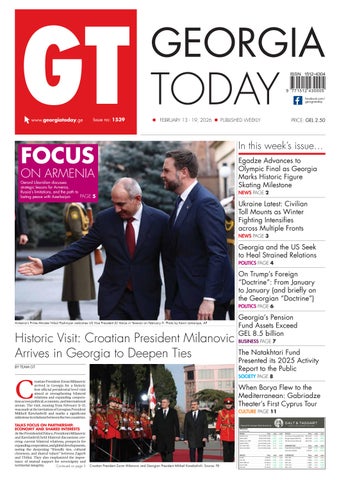
FOCUS ON ARMENIA

![]()


In this week’s issue...
Egadze Advances to Olympic Final as Georgia Marks Historic Figure Skating Milestone
Ukraine Latest: Civilian Toll Mounts as Winter Fighting Intensifies across Multiple Fronts
Georgia and the US Seek to Heal Strained Relations
4
On Trump’s Foreign “Doctrine”: From January to January (and briefly on the Georgian “Doctrine”)
6
Georgia’s Pension Fund Assets Exceed GEL 8.5 billion
The Natakhtari Fund Presented its 2025 Activity Report to the Public
8
When Borya Flew to the Mediterranean: Gabriadze Theater’s First Cyprus Tour


Continued from page 1
“Barriers are being imposed on Georgia, placing it in a moral dilemma. It is accused of acting as a Moscow agent. This amounts to moral blackmail, an attempt to pressure and coerce the country. That is why I came, to say this clearly,” President Milanovic said in his press briefing.
A meeting of Croatian and Georgian business representatives was also scheduled during the visit, underlining interests in boosting trade and investment.
Companies such as Koncar – Elektroindustrija, Podravka, Franck, Kraš, and Sano have shown interest in expanding into the Georgian market, and about 20 Georgian companies were expected at the roundtable.
Economic ties between the two countries have historically been modest but growing. In 2025, bilateral trade reached a record value of around $22.7 million, with Croatian exports to Georgia dominating and Georgian exports modest in comparison.
“I arrived with a broad delegation, including economists and representatives of leading Croatian businesses.
They are highly interested in Georgia’s market and in the wider Caucasus region,” the Croatian president said.
STRATEGIC CONTEXT
This visit takes place against the backdrop of broader regional geopolitics.
Georgia continues to pursue closer ties with the European Union and NATO, while Croatia has publicly supported those aspirations, having previously hosted Georgian officials and discussed deepening cooperation at ministerial levels.
President Milanovic’s approach on foreign policy has occasionally been outspoken, sometimes critical of European institutions, and his second presidential term reflects a focus on asserting Croatia’s interests on the global stage. The official visit to Georgia reinforces that commitment to direct dialogue and partnership with countries beyond the EU core, even amid international challenges.
In addition to the bilateral meeting with President Kavelashvili, Milanovic met with Prime Minister Irakli Kobakhidze and Parliament Speaker Shalva Papuashvili, followed by a wreath laying ceremony at Tbilisi’s Heroes’ Square.

BY TEAM GT
Georgian figure skater Nika Egadze has qualified for the men’s singles final at the 2026 Winter Olympic Games, currently underway in Italy.
Competing in the short program, Egadze delivered a composed and technically solid performance, earning 85.11 points and placing 15th among 29 competitors. The top 24 skaters advanced to the free program, where the final medal standings will be decided.
Heading into the free skate, the top three are: Ilia Malinin (USA) – 108.16 points; Yuma Kagiyama (Japan) – 103.07 points, and; Adam Siao Him Fa (France) – 102.55 points. The men’s free program is scheduled for February 13, when skaters will com-
BY TEAM GT
The Georgian government has announced plans to prohibit the sale of most beverages in plastic bottles in domestic markets beginning February 1, 2027, as part of a broader strategy to reduce plastic waste. The Ministry of Environmental Protection and Agriculture stated that sunflower oil and drinking water in containers larger than 10 liters will be exempt from the ban, as will products intended for export.
Solomon Pavliashvili, Deputy Minister of Environment and Agriculture, told Business Partner that the measure is part of a phased reform designed to give businesses time to adapt to the new regulations. He added that alternatives such as aluminum cans and reusable packaging are already available, and public awareness campaigns will be crucial to ensuring a smooth transition.
The beverages-in-plastic ban represents the final stage of Georgia’s anti-plastic policy, which has been gradually introduced over the past year. Since January 1, 2026, the production, import, and sale of certain single-use plastic items— including cutlery, plates, straws, and specific polystyrene containers—have been prohibited, with a three-month transition period for existing stock.
Additional steps are scheduled in the coming months:
• April 1, 2026: Most government agencies will be prohibited from purchasing

plastic cups, containers, and bottles of up to three liters.
• July 1, 2026: Restaurants, cafes, and other food service establishments will no longer be permitted to serve food in plastic containers.
• February 1, 2027: The comprehensive ban on plastic-packaged food and beverage products will come into force.
Authorities acknowledge that the regulation may initially lead to higher prices due to adjustments in packaging and supply chains, but they expect long-term costs to decline as reusable containers gradually replace single-use plastics.
The ministry emphasized that Geor-
gia’s approach does not replicate any specific foreign model. Instead, it combines phased product bans with regulatory and institutional mechanisms tailored to the country’s context. Consultations were held with private sector stakeholders, including beverage producers and business associations, to present the timeline and discuss implementation details.
The overarching goal of the reform is to significantly reduce plastic pollution while promoting more sustainable consumption practices. Businesses are now awaiting further guidelines on implementation.
in US–Azerbaijan

BY TEAM GT
pete for Olympic medals.
HISTORIC MOMENTUM FOR GEORGIA
Egadze’s advancement comes on the heels of a landmark achievement for Georgian figure skating. At these Games, Georgia secured fourth place in the team competition: the country’s best-ever result in Olympic figure skating and a major milestone for the sport’s development in Georgia.
Over the past decade, Georgian figure skating has steadily risen on the international stage, with athletes increasingly competing at European and World Championship levels. The fourth-place team finish in Milan-Cortina signals Georgia’s growing strength in a discipline traditionally dominated by powerhouse skating nations.
Now, with Egadze through to the final, Georgia will once again be represented on one of the sport’s biggest stages as the fight for Olympic medals continues.
US Vice President James David Vance paid an official visit to Azerbaijan, where he met with President Ilham Aliyev. Following the meeting, the two sides signed the Charter on Strategic Partnership between the Government of the Republic of Azerbaijan and the Government of the United States of America.
In a joint statement to the press, President Aliyev said that relations between the United States and Azerbaijan are entering a “completely new stage.” He noted that the signed document outlines multiple areas of bilateral cooperation, including security, counterterrorism efforts, and energy security.
Aliyev stated that the charter had been developed over a six-month period and described it as the result of “sincere and consistent work.” He placed particular emphasis on cooperation in the security sphere, noting that Azerbaijan and the United States will continue close coor-
dination on counterterrorism operations.
On energy, Aliyev highlighted Azerbaijan’s role in Europe’s energy security, noting that the country currently supplies natural gas to 16 states, 11 of which are NATO members and US allies.
“The signing of today’s strategic partnership charter is the result of sincere cooperation,” Aliyev said.
He also thanked the US administration and former President Donald Trump for their contribution to the peace process in the Caucasus, stating that the region is now “living under conditions of peace.”
“Where there was once conflict, we will create prosperity,” he added.
Vice President Vance said that the United States and Azerbaijan share a long-standing strategic partnership. He particularly highlighted the role of Azerbaijani troops in Afghanistan, noting that they were among the last to leave the country and had earned a strong professional reputation while serving under difficult conditions.
Vance also focused on economic cooperation, referring to the ongoing TRIPP project. He said the initiative would create additional economic opportunities
for Azerbaijan and facilitate more efficient exports of natural resources and strategic minerals.
Vance said that deeper economic cooperation and improved infrastructure connectivity would play an important role in ensuring the sustainability of a potential peace agreement between Azerbaijan and Armenia.
“We want the peace agreement between Azerbaijan and Armenia to be durable,” Vance said, adding that cultural and economic exchanges between societies are among the key factors in preventing future conflicts.
“Working together creates far more prosperity than confrontation,” he noted. Vance also underlined Azerbaijan’s regional importance, noting that President Aliyev maintains close relations with both Turkey and Israel, which he said further strengthens Azerbaijan’s diplomatic role in the region.
Both sides said the new strategic partnership framework is intended to serve as a foundation for strengthening bilateral relations and promoting long-term peace and economic development in the South Caucasus.
COMPILED BY ANA DUMBADZE
Russia’s campaign this week combined steady, persistent pressure along key ground axes with a renewed focus on long-range strikes against Ukraine’s power and heating systems, a pattern that has become sharper as temperatures remain low and diplomacy stalls. Ukraine has maintained a two-track approach: holding the line where Russian assaults are most intense, while widening its own strike capabilities against Russian military logistics and infrastructure deeper inside Russia and in occupied territory. The result over the past seven days has been limited territorial change, but ongoing tactical churn, with small advances and reversals around villages and treelines, alongside a notable rise in attacks on energy facilities and the human cost that follows.
On the battlefield, Russia’s most consequential ground activity remained in the east, with multiple “microadvances” reported by open-source geolocation and Ukrainian and Russian statements. In the broader Donetsk theater, geolocated footage analyzed by independent experts showed Russian forces advancing toward Slovyansk, including movement in southern Nykyforivka, southeast of the city. The same reporting pointed to Russian advances in the Kostyantynivka–Druzhkivka area, with units pushing within and around settlements southeast of Kostyantynivka, such as Pleshchiivka and areas near Ivanopillya. These movements reflect ongoing efforts to compress Ukrainian defenses around the “fortress cities” belt. While incremental, these advances are operationally significant, enabling heavier artillery and drone pressure on Ukrainian supply
routes and raising the cost of holding fixed positions.
In the northeast and along the northern border, the week also saw active Russian probing. Geolocated footage indicated advances in northern Sumy Oblast, north of Nova Sich, consistent with Russia’s goal of creating a buffer zone along the border. Elsewhere in the wider Kharkiv–Luhansk interface, Russian forces were reported advancing in central Bohuslavka, northeast of Borova, highlighting that the Oskil River line remains a live pressure point even when major headlines focus elsewhere. These moves did not produce a breakthrough, but they reinforce an emerging winter pattern, with Russia attempting to stretch Ukrainian reserves by forcing Kyiv to respond simultaneously in Donetsk, along the Oskil axis, and on northern approaches.
Ukraine recorded some limited but notable tactical responses during the same period. Analysts reported that Ukrainian forces cleared Chuhunivka in the Velykyi Burluk direction, after earlier Russian claims suggested temporary Russian entry into the settlement. In the south, Ukrainian activity around Hulyaipole appeared more dynamic than in recent weeks. Ukrainian forces reportedly cleared several villages northwest of Hulyaipole, in Ternuvate, Tsvitkove, and Staroukrainka, and also cleared Zaliznychne west of Hulyaipole. Geolocated footage also suggested Ukrainian movement in Kosivtseve. These actions were primarily clearing operations and the removal of infiltrating groups rather than a major offensive, but they demonstrate that Ukraine can still generate local counterpressure, especially where Russian forces rely on small-unit infiltration and drone-enabled harassment.
The human cost of the week’s ground and air campaigns remained heavy, with several strikes standing out for both lethality and symbolism. In the Ukrainian-controlled part of Donetsk region, a Russian airstrike killed an 11-year-old girl and her mother in Sloviansk and wounded 14 others, including a 7-yearold girl. In Dnipropetrovsk region, Russian strikes killed four civilians in localities near Synelnykove, with additional injuries reported in separate incidents. Across southern and northern arcs, Russia’s expanding drone campaign again hit homes as well as infrastructure. A Reuters account of overnight attacks reported at least four deaths across Ukraine, including a mother and child in Kharkiv region. The same wave included a fatal strike in Odesa and a separate death in Chernihiv region, along with multiple injuries in Dnipropetrovsk region. These incidents, clustered across multiple oblasts, illustrate how Russia’s air campaign aims to create nationwide strain rather than only frontline attrition.
Energy infrastructure was a central target, and this week’s strikes repeatedly caused widespread outages. On February 7, Russia launched a large missile-and-drone attack that Ukrainian officials said hit two thermal power stations in western Ukraine and key electricity distribution elements, including substations and major distribution lines. This prompted emergency power cuts and requests for cross-border support, including imports from Poland. Odesa region was hit again on February 10, when Russian forces struck energy facilities, leaving over 95,000 people without power, with local officials warning that thousands depended on electricity for heat and repairs could take a long time. The week culminated overnight on Febru-
ary 12 with another large-scale strike described by Ukrainian offi cials as involving “hundreds” of drones and ballistic missiles targeting energy systems. Injuries were reported in Kyiv, Dnipro, and Odesa, and officials said the attacks disrupted power, heating, and water supplies. The operational logic is clear: repeated hits on energy nodes turn restoration into a race against continuing strikes, making even successful air defense a partial shield rather than a full solution.
UKRAINIAN RETALIATION AND DEEP STRIKES
Ukraine’s response combined air defense and long-range retaliation. Kyiv frames its deep strikes as a mirror response to Russia’s energy attacks, aiming to raise the cost for Moscow by targeting refinery output, fuel storage, and logistics supporting Russian forces. This week, Ukrainian drones reportedly struck the Volgograd oil refinery, linked to Lukoil, sparking a fire and forcing local authorities and Russian channels to acknowledge disruption. Ukrainian officials also reported longer-range strikes on Russian military infrastructure, including missile facilities, as part of an effort to complicate Russia’s ability to sustain high-tempo missile salvos. In occupied and near-front areas, Ukraine struck fuel and lubricants depots and other military facilities, highlighting a sustained focus on Russian rear support rather than purely symbolic targets.
DIPLOMACY CONTINUES
Diplomatic activity continued in parallel with the fighting, but it did not slow attacks. US-brokered talks in Abu Dhabi produced a prisoner exchange of 314 individuals, 157 from each side, and an agreement to continue discussions. Key issues, including Donetsk and other core territorial demands, remained unresolved. Ukrainian officials argued that ongoing strikes, particularly those targeting energy and civilian areas,
undermine the credibility of Russia’s negotiating position. The timing of the heaviest attacks this week reinforced that message. On the ground, the battlefield still appears to shape the negotiating table rather than the other way around, with Russia pressing for leverage through incremental advances and infrastructure pressure, while Ukraine emphasizes that any pause without enforceable guarantees risks locking in Russian gains and enabling future coercion.
International support for Ukraine also advanced this week, especially for sustaining air defense and munitions amid uncertainty over new US appropriations. The United Kingdom pledged £150 million (about $205 million) to the NATO-backed “Prioritized Ukraine Requirements List” (PURL), financing purchases of US-made weapons for Ukraine, a step designed to keep airdefense and other critical systems flowing. Separately, EU institutions advanced a large 2026–2027 support framework tied to financing Ukraine’s budget and strengthening defense industrial capacity. On Wednesday, the European Parliament announced it had approved a €90 billion loan for Ukraine, providing a financial lifeline to the country four years into Russia's invasion. MEPs voted by 458 to 140 in favor of the loan, intended to cover two-thirds of Ukraine's financial needs for 2026 and 2027 and backed by the EU's common budget - after plans to tap frozen Russian central bank assets fell by the wayside. "Support for Ukraine rests on a small number of countries and most if it comes from Europe," centrist MEP Nathalie Loiseau said ahead of the vote. While not immediate battlefield game-changers, these measures are crucial in the cumulative math of air defense interceptors, spare parts, and ammunition, precisely the categories strained by Russia’s intensified winter strike campaign.


BY TEAM GT
Aforum titled “A New Social Contract – For the Sake of Georgia” was held in Tbilisi on February 8, organized by Freedom Square.
The large-scale forum focused on a central question: “What kind of Georgia do I want to live in?” — a theme around which the speakers shared their views and reflections.
“It is very rare that we manage to reach agreement in the present moment. That is why, for me as a researcher and as the head of an institution, participation in civic forums where society tries to find points of consensus is always extremely important,” said Nino Doborjginidze, Professor and Rector of Ilia State University.
Actress Nino Kasradze, one of the forum’s speakers, criticized recent devel-
opments in the cultural sphere during her address:
“Just a few days ago, Batumi State Theater canceled a performance because the director expressed his subjective political views, claiming that theatre is not a place for such expression. This is no longer the beginning of the end: this is the end of the end,” she said.
Teacher Datia Badalashvili also spoke at the forum, which was held at Expo Georgia, expressing concerns about fear and repression:
“What kind of Georgia do I want to live in? I don’t want to leave this meeting and receive a message from a relative telling me that after the library, I might lose my job at a school as well. I don’t want a friend to tell me that someone might be waiting for them on the street to beat them.”
The forum was organized by Freedom Square, and one of its leaders, Levan Tsutskiridze, also addressed the participants.

BY TEAM GT
Georgia is moving cautiously but optimistically to restore its relationship with the US after a period of tension that Georgian leaders say was caused by past US policy missteps. President Mikheil Kavelashvili described a series of recent meetings with US officials, including Secretary of State Marco Rubio and Vice President J.D. Vance, as both productive and candid. “We had the opportunity to speak again,” he said. “JD Vance greeted us, and then Secretary of State Marco Rubio stayed with us longer. The conversation became more substantive and business-oriented.”
During the talks, Rubio reportedly acknowledged problems inherited from the previous US administration. “He noted that the previous administration left great negativity toward Georgia. He even used an expression close to ‘stink,’ meaning a deep and damaging legacy,” Kavelashvili said. “He said they themselves realize that this approach was unrealistic and inappropriate toward our country.”
The Georgian president stressed that the US has begun taking concrete steps to address these issues. “Last Monday, they analyzed this issue thoroughly and are now in the process of cleaning up that negativity. They need time to fully examine what happened, and in the near future, they will properly prepare for the restoration of relations with Georgia,” he said. He also emphasized that the discussions touched on shared values and the positioning of former President Donald Trump before and after winning the election, highlighting Georgia’s openness and transparency in communicating its positions to both Washington and its own society.
Kavelashvili described another symbolic moment from the trip: attending the ceremonial reception of the President of Italy at the Italian President’s Palace, where only country leaders were present. “It was particularly important for Georgian representatives to be there,” he said, noting that such engagements provided an opportunity to strengthen Georgia’s diplomatic visibility on the international stage.
Parliament Speaker Shalva Papuashvili echoed this hope for renewal, pointing to Georgia’s longstanding commitment to NATO and US-led security efforts.
He noted that Georgia has the highest per capita military losses in Afghanistan among contributing nations. “Instead of standing by us, we witnessed attempts to undermine the foundations of Georgian democracy,” he said, adding that Georgia expects the current US administration to address mistakes made by its predecessor.
From Washington, the picture is more measured. The US State Department suspended the formal strategic partnership with Georgia in 2024, citing concerns about democratic backsliding, though officials continue to reaffirm support for Georgia’s sovereignty and territorial integrity. Congressional engagement, including bipartisan legislation such as the MEGOBARI Act, underscores continued American interest in democratic accountability and Georgia’s Euro-Atlantic integration.
Despite these challenges, both sides appear committed to dialogue. Kavelashvili described the meetings as “an opportunity to speak openly,” while Papuashvili concluded: “We are ready and remain in a state of expectation.” As Georgia and the US navigate a complex history, the shared hope is clear: a renewed partnership rooted in trust, respect, and shared values.

OP-ED BY NUGZAR B. RUHADZE
The ongoing political commentary and the concomitant reports by the opposition media emotionally suggest that Sakartvelo is currently isolated from the Western international community, corroborating statements like this with geopolitical developments of the past couple of years.
The opposition’s branded and frequently voiced argument is that the country has shifted away from a pro-Western foreign policy toward an isolationist and more
pro-Russian stance, resulting in deferred integration efforts into the Euro-Atlantic social, political, and economic structures, frozen financial aid from the same part of the world, and diplomatic sanctions from the United States and the European Union. It might be a huge journalistic pain in the neck to fairly stipulate the reasons thereof and define certain favorable steps to be taken to this end, but somebody has to do the job. How true is the statement of isolation? The government argues just as excitedly that the whole thing is merely rhetorical, whereas the opposition says it is indeed tangible. In the summer of 2024, the EU declared our accession de facto paused, triggered
by the adoption of the much spokenabout ‘foreign agents’ law. In exactly five months’ time following this, the government announced joining the Union as early as 2028. America has stopped its habitual aid, and the European Union has halted regular defense assistance, not to mention the visa restrictions. The number of high-level bilateral diplomatic visits to Western countries has shrunk too, and the October 2024 parliamentary elections were severely flawed and deprived of widespread international recognition. This is an overall factual picture, perpetuated by the opposition and strongly repudiated by the government. Now, the right of final judgment
belongs to us, the people, whether it be called isolation or not.
Again, the supporters of the current Georgian government feel ready and adept enough to prove the opposite, but there is zero chance of concurrence on the part of their political opposition, which blames the administration for passing unfair and unnecessary laws, entertaining anti-Western rhetoric, engaging in anti-democratic behavior, and enjoying an unsavory geopolitical predisposition. Hence, the opposition will decidedly persist in qualifying the picture as ‘isolation,’ notwithstanding the adamant contrary stance of the government, absolutely defying the possibility of repealing the ‘Russian-tailored’ law, rejecting even the thought of rerunning the parliamentary elections, calling the return to the constitutional course absurd demagogy, and utterly refusing to agree that continuing a tone of critique toward Western allies is destructive.
Meanwhile, given recent reports, the ruling Georgian Dream party has expressed a well-founded desire and hope to reset relations with the United States, opening a totally new page in the relationship, which opposition political experts describe as impossible, provided the model of conduct and the style of talk both within and outside the country are not changed. So much for the presumable, but not completely proven, isolation!
How about a standoff? Does the situ-
ation sound like a deadlock? Listening to those who are prone to hurl criticism at the ruling power, sometimes the impression is “yes,” but in imaginable reality, this sounds only like a fleeting dispute, based on the fact of deeply appreciating cultural traditionalism and our national character by the force at the helm. Meanwhile, most Georgian people would go for both –to be part of the Western family of nations and to preserve their national roots safe and untouched. Whether this is possible or not is a horse of a totally different color.
And finally, does it look like only a temporary lull between Sakartvelo and the West? Yes, it looks like it, smells like it, feels like it. And if this is true, then the future still seems promising, with the hope that the flags of Georgia, the USA, and the EU remain flying together forever. Will this exacerbate matters and compel Russia to move against Georgia (as has always been feared by this government) and whet her appetite to hurt us? Not necessarily at all! Why not tell all of them now and straight – the West and the East, the North and the South – that Sakartvelo needs nothing except a guaranteed stable peace and mutually beneficial cooperation with the rest of the world, so that we scratch each other’s backs and roll each other’s logs, thus enhancing the standard of living in the country? Why is this so hard to conceive of and unfeasible to accomplish?
INTERVIEW BY VAZHA TAVBERIDZE
In the world of realism, you may have a right to something, but if you lack the means to achieve it, you must be prepared to compromise, - Gerard Libaridian tells Radio Free Europe/Radio Liberty’s Georgian service.
An Armenian-American historian and diplomat, and for many years the senior adviser to former president Levon TerPetrosyan, Libaridian played a central role in shaping Armenia’s foreign policy and was one of the main negotiators in the Karabakh conflict.
In this interview, he analyzes the consequences of the Second Karabakh War, Armenia’s strategic errors, the shifting regional balance of power, and the illusions surrounding reliance on Russia. He also discusses US Vice President JD Vance’s visit to Yerevan and Baku on February 9–10.
IN YOUR RECENT WRITING, YOU SAID, “ARMENIA LOST THE SECOND KARABAKH WAR, BUT MANY ARMENIANS HAVE BEEN PLAYING A DANGEROUS GAME PRETENDING THEY DIDN’T.” WHAT IS THE COST OF CONTINUING THAT GAME?
Policies lead to disaster when they are not based on realities. If you have goals and if you don't have the means and strategy to achieve them, and instead you set maximalist demands, that leads to delusion and self-deception. As I’ve written before, Azerbaijan could lose a war and come back for another many, many times over. They have such a luxury. Armenia can lose a war only once, and it will be very difficult for it to recover. Azerbaijan has the means, friends and allies to do so; Armenia does not. In the world of realism, you may have the right to something, but without the means to achieve it, you have to go to compromises where possible. You have to be pragmatic. Having the right to something is not an adequate response or the equivalent to the other side's military means and strategy. The unrealistic policies of the Armenian side, beginning in 1998, have led to the loss of the most basic right of Armenians in Karabakh: the right to live on their ancestral lands. They have that right, but not the means or a workable strategy to achieve it.
Two years ago, Armenians were extremely concerned about losing Armenia itself somewhere along the way. Some were even sure it was going to happen. Now it seems many have forgotten that and they're reverting to the old pattern of demanding the maximum and making policy on the basis of a right that you have, as opposed to what you can actually do.
WHEN YOU LOOK BACK AT THE SECOND KARABAKH WAR, IT SEEMED A FOREGONE CONCLUSION THAT AZERBAIJAN WOULD WIN WITH THE RESOURCES THEY HAD SUNK INTO THEIR MILITARY. WHAT WAS IT THAT LED ARMENIA TO BELIEVE IT COULD WIN WITHOUT COMPROMISES?
It was a form of self-deception. You focus only on your policy, only on what it is that you want, and you forget or disregard that there is another side that also gets a say. There was a time when some Armenian political forces said that the issue was resolved in the 1990s, that if Baku has a problem, it should resolve it as its own problem. The fact that this problem had two opposing sides didn’t seem to matter to them; they thought they had just won and that’s it, it was done. Obviously, that wasn’t the case.
WHAT PART DID RUSSIA PLAY IN THAT SELF-DECEPTION, AS YOU CALL IT?
There are two points I can make on this. One is that the mentality of Karabakh

leaders indeed was often determined by what it was told by Russia. The Armenian side at that time acted upon its almost instinctive trust in Russia, Russia as its protector, its savior. Armenians believed Russia could not let the Armenian side down.
And the second thing is that both Karabakh and nationalist forces in Armenia argued that if Azerbaijan has oil, Armenia has the diaspora. Somehow, they arrived at the conclusion that the diaspora was equivalent to Azerbaijan's oil, and that was one of the critical factors in the way Armenians deceived themselves. Right now, there seems to be less self-denial or self-deception on the part of the Armenian government and more adjustment to reality. At least you could say that looking at the attitude and disposition of the current Armenian government. And the attitude of the people in Armenia regarding Russian policy is changing too.
WITH THAT IN MIND, HOW CLOSE ARE WE GETTING TO A REAL AND ENDURING PEACE DEAL?
We are close to consolidating the peace that has been agreed upon. The two sides are building on the mutual trust they have developed, with confidence-building measures that are coming out every day. Some issues remain, but the two sides seem committed to resolving them through negotiations. Both sides, Armenia and Azerbaijan, have declared that the war is over, and their actions since the agreement was reached have confirmed that.
It is important to note that the peace agreement was worked out between Armenia and Azerbaijan in direct, bilateral negotiations, and increased trust in each other; also, the interests which both Armenia and Azerbaijan have defined as their national interests. Of course, there can be no absolute assurance that peace will prevail under any and all circumstances. For example, there could be a change of government in Armenia as a result of the coming general elections; the new government may reverse the current policies, reject the peace agreement and return to the maximal statements. And that could trigger a change of policy in Azerbaijan as well. If Armenia changes, Azerbaijan will change accordingly. There's also, of course, the international situation, which can best be described as chaotic. Chaos offers new opportunities, but it can also increase uncertainty and unpredictability among the big players. One hopes that Yerevan and Baku will be able to navigate through the chaos wisely.
WITH THE TRIPP PROJECT,
AT LEAST MEDIUM-TERM US POLICY SHIFT IN THE SOUTH CAUCASUS, OR IS THIS MERELY ANOTHER ARGUMENT TO MAKE FOR THE NOBEL PEACE PRIZE?
Very relevant question. The most important fact to remember regarding the Armenia-Azerbaijan peace process is that it is far less dependent on outside mediators such as the US, including the specifics of the TRIPP agreement.
The second fact is that the US has had an interest in the region since the collapse of the Soviet Union, and the Trump administration's involvement is in essence a continuation of that. Vice-President Vance's visit is yet another indication that the US is being consistent in and continuing its involvement.
The big change is not so much US policy as the changes in the policies of Armenia and Azerbaijan and the US benefitting from that change. I do hope, otherwise, that the VP visit will not inspire overconfidence in US involvement with regard to the fundamental question of security. Especially considering that TRIPP may become less important over the years if all other transit routes are opened and routes that may go through central Armenia instead of veering south and then going north may become more practical. Incidentally, I do wish TRIPP had a different name. Such symbolisms matter too.
YOUR CAUTION CONTRASTS WITH WHAT MANY SEE AS A MASTERSTROKE BY BAKU AND YEREVAN – BRINGING IN THE US TO COUNTER RUSSIA. IN STREET TERMS, IT’S LIKE CALLING THE BIG BOSS FROM ANOTHER BLOCK: ARMENIA AND AZERBAIJAN CAN TELL TRUMP, “VLAD IS IGNORING THE PEACE YOU BUILT, SURELY YOU WON’T LET IT STAND?”
Yes, I would not place such significance in Armenia and Azerbaijan betting on the US to counterbalance Russia. When it comes to the fundamental question of security and defense against possible unwelcome steps by Moscow, there are limits as to what the US and the West will do to counterbalance Russia, at least in the South Caucasus. The case of Georgia is the best example of that.
As long as Yerevan and Baku coordinate their policies and rely on their newly found spirit to pursue peace together as the basis of that, Moscow's leverage will decrease and the two republics will not need to rely on others. Hopefully, such cooperation will lead to the emergence of a regional political identity and a new order in the region, an order that is not opposed to anyone but makes it less of a prey to others.
REGARDING THE BARRIERS AND OBSTACLES REMAINING
BEFORE SIGNING OFF THE PEACE AGREEMENT – HOW INSURMOUNTABLE ARE THEY?
I do not see any major problem between Azerbaijan and Armenia. As I said, the countries have defined their national interests, and those interests align, most importantly in both parties wanting to have peace.
HOW WOULD THIS AZERBAIJAN-ARMENIA PEACE, IF IT WERE TO MATERIALIZE, TRANSFORM THE REGION?
When analysts and commentators think about the region, they have in mind pipelines, transit routes, geopolitical interests and rivalries, and they forget that these republics exist through the people and for the people. So the most important consequence would be that the people of the region would have peace. This means that their young men will not die in new wars, that the domestic economic dynamic will improve, that their budgets, in the long run, will not be based on defense expenditures. Of course, the international communication patterns will change, as far as connecting the East to the West, from China to Europe and beyond, and that will bring additional benefits.
GEORGIA COULD BE IMPACTED BY THESE NEW ROUTES AND DYNAMICS. AT DAVOS, PRESIDENT ALIYEV NOTED THAT WHAT CURRENTLY PASSES THROUGH GEORGIA MAY ONE DAY PASS THROUGH ARMENIA. Georgia will not be denied the position of a transit route, especially as the regional trade volumes increase due to the peace between Azerbaijan and Armenia. It will be beneficial to everyone in the region.
AT DAVOS, PRESIDENT TRUMP SAID PUTIN WAS SURPRISED BY HIS ROLE IN RESOLVING THE ARMENIAAZERBAIJAN CONFLICT AND ADDED, PERHAPS OFFHAND, “THAT’S HIS TERRITORY.” HOW SHOULD WE INTERPRET THAT, AND HOW DOES THE TRIPP PROJECT FIT, OR WAS IT JUST A FIGURE OF SPEECH?
Well, with all respect to the President of the United States, I do not rely on his characterization of discussions with Putin to analyze his discussions with Putin. Of course, the TRIPP project was an important issue for both countries, and, in particular, the specific agreement on how to manage the transit route was an achievement for the US, and, interestingly, an achievement that Russia could have made far earlier, but chose not to.
SPEAKING OF RUSSIA, HOW DO YOU THINK IT WILL REACT ONCE AND HOWEVER THE UKRAINE WAR IS RESOLVED? WILL THERE BE COSTS ATTACHED FOR AZERBAIJAN AND ARMENIA FOR “DISCOVERING” THAT THEY CAN ACTUALLY SOLVE THEIR DISPUTES BILATERALLY?
When and if the Ukraine war is resolved, there's always the possibility that Azerbaijan and Armenia will pay a price. I cannot predict what Russia will do. Maybe others can, I can’t. But what seems inevitable is that Russia's policy in the South Caucasus, especially with regard to Armenia and Azerbaijan, will need to be adjusted. Moscow's preoccupation with Ukraine and the consequences of that war in the international arena have, in a sense, paralyzed the ability of the foreign policy of Russia to be reviewed and to be reassessed. In many respects, Russian policy is still functioning on old instincts; a more defensive mentality has developed that has encouraged nationalist and expansionist policy, so we see a more aggressive policy from Moscow. Second point: Russia has lost a good deal of its leverage in Armenia, which was the traditional pro-Russian attitude of the population and some domestic political players. Russia has lost that
crucial leverage, at least among the people of Armenia, because it failed to honor the commitments it assumed with regard to peacekeeping and security for the people of Karabakh in 2020, and the defense of Armenian borders in 2023. Moscow is refusing to understand the implications of the change in the mentality of the population of Armenia and to adjust its policy accordingly. It continues to expect Armenia to obey Russia regardless of how Russia behaves. That has been Moscow's traditional policy, supported by the maintenance of fear from Turkey – as long as the underlying sentiment of Armenian policy was fear from Turkey, Moscow felt and calculated that Armenia had nowhere else to go but to Moscow. Some Armenian political institutions, including the Church, have embraced that logic, but the people of Armenia have lost their trust in Moscow, and that has opened a path to a new thinking that says Armenia is alone and has no allies, and must therefore consider resolving its problems with its neighbors, namely Azerbaijan and Turkey, the neighbors that are seen as potential threats to Armenian security. And we see that the Armenian government has indeed taken steps in both directions.
AND THEY SEEM TO HAVE WORKED.
The government's policies have worked because Azerbaijan has determined itself that it no longer needs to be in conflict with Armenia, and that it needs peace with Armenia in order to achieve some of its wider policy goals. And Turkey has stated since 1993 that it has no problem with Armenia, but its actual relations with Yerevan depend on Armenia settling its issues with Baku. We are inching closer and closer to the gradual opening of the border and establishment of diplomatic relations between Turkey and Armenia. I do believe that Turkey-Armenia relations will improve and will be normalized. Under these circumstances, Moscow will need to review its position.
MOSCOW COULD USE FORCE OR STIR DOMESTIC CHAOS IN ARMENIA, BUT BOTH WOULD BE DIFFICULT TO EXECUTE AND UNLIKELY TO BE PRODUCTIVE. It is not my intention to offer advice to Russia. As a historian, I've always had great respect for Russian diplomacy, and Moscow will define its own interests, but I can point out that the consequences of either a policy that uses force or produces chaos are unlikely to benefit Russia in the long term. Turning populations against Russia is not the best way to remain relevant in the region or to be able to defend one’s legitimate interests, not in the long run, as the Soviet experience has proven. So, while it is very important to remember that Russia can do things, it doesn't mean that it will produce the result it wants in the long run.
Finally, Russia can use its economic leverage in Armenia; but as Vietnam for the US and Afghanistan for the USSR, you may have superior weapons and economic leverage, but you cannot always use them because the consequences of that are worse than the problem you are trying to solve.
COULD ARMENIA FACE A “GEORGIAN SCENARIO” WITHOUT ALIENATING RUSSIA? IS THAT A REALISTIC OPTION? Russia has attempted to replicate the Georgian scenario, but the Armenian government is actively working to prevent it. Whether through nationalist forces, oligarchs, or the Church, attempts to replicate Georgia’s experience are being met with firm resistance. The government demonstrates a clear ability to distinguish between Armenia’s interests and Russia’s. While Moscow has legitimate interests in the South Caucasus, pursuing more than that through coercive or unacceptable measures is a different matter, and its options are limited. In Azerbaijan, those options are even more constrained.
ANALYSIS BY VICTOR KIPIANI, GEOCASE CHAIRMAN
When referring to Donald Trump’s foreign policy, I did not place the word “doctrine” in quotation marks by accident. From the perspective of well-known directions or recognized schools of thought in international relations, it is probably difficult to identify anything “conceptual” or “doctrinal” in the approach of the current President of the United States of America. However, this is only at first glance.
In reality, a substantive discussion of the system-forming components of the foreign-policy style of the Trump administration is both possible and necessary. The material accumulated over the one year that has passed since last year’s presidential inauguration clearly provides a basis for such a discussion.
Over the past one-year period, I have written and spoken many times about Trump’s U.S. policy. To be honest, after several early observations, later corrections proved necessary, in some cases substantively, and in others in terms of terminology and characterization. Nevertheless, the main message has remained unchanged both then and now: Donald Trump’s character, his personal worldview, and the country’s foreign policy stand so close to one another that separating them often seems almost impossible. However, it only seems so.
The Trump phenomenon did not emerge “out of nowhere” and is the result of a rather complex and contradictory process, both inside and outside the United States. Moreover, observation over the past year allows one to say that with Trump’s presidency the world itself, and, with high probability, our country as well, has entered not into a one-time event, but into a process marking the beginning and breakdown of a globally new era. And this has happened in such a way that looking back at the old order only with nostalgic eyes no longer helps in any practical return to it.
DONALD TRUMP’S FOREIGN POLICY
What are the main, “Trumpological,” characteristics of Trump’s foreign-policy line that distinguish it in substance?
I must begin with what I have already mentioned: Trump’s policy is not selfcontained, nor did it arise from nowhere and completely unexpectedly. More than that, it is a “product” of dissatisfaction linked to the lack of effectiveness of the existing order in recent years and its inability to resolve the accumulated acute set of problems.
When speaking about the United States, these problems are generally divided

Donald
into two categories: first, challenges existing in the country’s domestic life, fiscal issues, immigration, drug trafficking, and others; and second, issues related to the country’s positioning in the international arena. It must also be noted that in the contemporary world domestic and foreign policy are inseparable, and the connection between the two is entirely natural.
However, when speaking about foreign policy, one key aspect has become increasingly clear for certain political groups: the international order based on liberalism was not coping with existing challenges and is not coping with them now. More than that, against the background of the inefficiency of the liberal order, these challenges have deepened, and some have acquired an almost chronic character.
Moreover, the mentioned order increasingly failed to correspond to the interests of its main architect and sponsor, the Western world. At the same time, in parallel with the West’s disappointment, the non-Western world began to derive disproportionately greater benefits from this same order.
As a result, it became necessary to renew and change the rules of behavior characteristic of the liberal order and to offer new ones. Figuratively speaking, it became necessary to place an order for a “new fashion.” It so happened that during the electoral campaign such a заказчик became Donald Trump and his personal worldview considerations. And after his election as president, these considerations, through the use of instruments of power by Trump personally and his camp, became officially declared U.S. policy.
From this point of view, the alarm associated with Trump’s foreign policy is entirely understandable. The issue is that as a result of an unreasonable, sweeping revision, the existing, however imperfect, system of international relations, based on the fundamental principles of international law, may undergo dangerous deformation. And this is not in the interest of the United States, nor of the West, nor of our country.
Taking this into account, the question arises: where do Trump and his team “sin”? At this stage, as a result of the revision currently underway on the part of the United States, the most vulnerable areas of foreign policy are likely the following:
(a) the weakness of the institutionalization of policymaking; in practice, the resource for conducting foreign policy today is concentrated in the hands of an elite that has nothing in common with elected or other formal positions. As a result, the political process flows out of formal institutions into circles of informal influence;
(b) attitudes toward allied alliances and partners; objectivity requires it to be said that allied alliances have remained so stuck in the past that their reboot has become genuinely necessary. However, here too one must not “throw out the child with the bathwater,” the alarming signs of which are already evident today in various examples.
the interests of our country will be formed.
“Playing” with the inviolability of borders and territorial integrity has nothing in common with pragmatic and rational policy.
Moreover, such an approach is fundamentally impragmatic and dangerous, as it weakens and dissipates one of the main stabilizing factors in relations between the Western and non-Western worlds, the territorial status quo.
Another aspect that distinguishes Trump’s approach is remaining one-onone with the target, exerting maximum pressure on it, tariffs and the like, and not overly burdening oneself with alliedpartnership obligations.
In this case as well, the strengthening of this new style of the White House administration will likely have a direct impact on:
(a) relations between the United States and its allies and partners; and
(b) the projection of U.S. power in those geographical regions of the world over which other hegemons, based on their understanding of “zones of influence,” will lay claim.
The fact is that such a negative development will also have a negative impact on the planning and development of our country’s national security.
to make a rule:
– a pedantic inventory of resources; – prioritization of tasks with a cool head; – proportionate allocation of resources to tasks defined as priorities.
One of the hallmarks of contemporary foreign and domestic policy is the use of political instruments for concrete goals, without any ideologicalization. The Trump administration and the elite close to it openly offer this new tonality. We too should support this tonality. When mentioning the modern version of the Monroe Doctrine, I referred to the “backyard” rather indelicately. This time I will try to elaborate on this issue more diplomatically.
The matter is that according to one of the dominant geopolitical views, the unified platform of the “two Americas,” North America and South America, is regarded by the United States as an inseparable part not only of its foreign but also of its domestic policy. With regard to domestic policy, Trump, more distinctly than several of his predecessors, believes that the roots of the challenges existing within the United States, drug trafficking, uncontrolled migration, organized crime, and so forth, lie not only in “one,” but also in the “second America.” As a result, in order to practically restrain these challenges, it is in the interest of U.S. national security to control processes in “both Americas.” It is acceptable that this approach comes very close to governing the world according to zones of influence. However, I believe that here we are talking only about approximation, and not about the United States closing itself within the Western Hemisphere as its zone of influence. As to why, I have already spoken about this in relative detail: the United States, like any superpower, is doomed to involvement in global processes. What is at issue are only new methods and styles of this involvement, which I have also discussed.
Trump’s “doctrine” is probably epochal. It is also clear that historical parallels can be found for it. However, it is equally clear that contemporary realities endow it with a distinctiveness and identifying character peculiar only to it.
It is also clear that Trump’s “doctrine” cannot be neatly titled. Various elements converge in it simultaneously, globally transactional and nationally populistnationalist. And they converge in such a way that in real politics such a coexistence of these elements, given their incompatibility, would previously have been hard to imagine.
Trump’s approach is remaining one- on-one with the target, exerting maximum pressure on it, and not overly oneselfburdening with alliedpartnership obligations
Thus, and for this reason, I believe that Trump himself and the Trumpists are revisionists, and that current U.S. policy is revisionist. I understand that the word “revisionism” may cause discomfort for those who are accustomed to using “revisionist” and “revisionism” with regard to other countries and political leaders. However, if “revisionism” in essence is nothing other than a review of what exists with the aim of changing it, then current U.S. policy can equally be considered revisionist. And this is an absolutely correct, permissible, and natural assessment.
Provided that we agree that the rules of behavior that had been in force for many years required change, that is, revision, the next important question is how justified such a revision will be, and to what degree and scope.
Much can be said about the importance of alliances and partnerships for the United States, but I will single out only a few points: – through healthy alliances, the United States can project its power far more effectively than in isolation and without allies; – allied alliances contribute to the preservation of the image and soft power of the United States as a hegemon; hegemony is the nature of any major state and requires appropriate instruments; – effective alliances will have highly practical value for the United States in relations with other, already existing or emerging, hegemons.
Therefore, any excesses in the revision of alliances and partnerships are irreversibly damaging both for the new “setter of fashion” and for partner countries and, overall, for shared interests.
(c) the territorial status quo; this is an extremely delicate topic that may become one of the possible victims of ongoing processes. As a result, this critical pillar of stability in international relations will be undermined, and a trend harmful to
Trump’s version of the “Monroe Doctrine,” its so-called “Donroization,” has caused major controversy regarding the foreign role of the United States.
Here the main question is as follows: by declaring the “Monroe–Donro” doctrine, is the United States limiting itself only to the Western Hemisphere and thereby renouncing the Eastern Hemisphere?
The answer to this question consists of several layers, namely:
(a) I believe that a country such as the United States of America, given its hegemonic nature, cannot limit itself to only one specific hemisphere;
(b) what we call the “Monroization” of U.S. foreign policy can rather be called a real consolidation of foreign policy.
In practical terms, the first stage of such consolidation should be understood as the concentration, that is, consolidation, of resources in the “backyard,” the Western Hemisphere, in order to strengthen a geopolitical bridgehead. As for the next stage, the activation of consolidated resources from the strengthened bridgehead in the rest of the world, this will take place under conditions of strict prioritization.
In short, the U.S. example demonstrates what we, in Georgian politics, are obliged
The study of doctrinal currents is necessary and useful. Relevant knowledge helps us better understand the external world and to bargain for our national interests within it.
I used the word “bargain” deliberately. The highly egoistic and ruthless environment surrounding us should not be softened or embellished in description. Any such softening or embellishment will relax us, distract our attention, and lead us down the wrong path. Therefore, for acquiring academic knowledge, yes to doctrinal studies; but in practice, rational calculation aimed at tangible benefit. From the standpoint of benefit, Georgian politics should be based on two main principles: 1. the strongest possible economy; 2. the strongest possible security. If you wish, these two principles may be considered the “doctrine” of Georgian politics, based on healthy egoism and realistic capabilities.
And as the foundation of this policy, we should understand patriotism in such a way that the definition of interests and the possibilities for achieving them respond to one another in a timely and proper manner.

BY MARIAM RAZMADZE
Afiling submitted to the Business Registry reveals that DMG Group has acquired Neo City Development, the company that owns the strategically located Laguna Vere complex and the former Silk Factory site in central Tbilisi.
Under the agreement, DMG Group will purchase the company for $64 million. The deal includes the assumption of Neo City Development’s existing financial liabilities, specifically, loans amounting
to $21 million and $20.4 million.
DMG Group is controlled by Kakhi Zhordania, son of businesswoman Maka Asatiani. Asatiani owns the MercedesBenz dealership ‘Aka’ and holds a controlling stake in Black Sea Petroleum which is developing an oil refinery project in Kulevi.
The assets were previously owned by former Member of Parliament Marika Verulashvili. Prior to September 2025, Laguna Vere and the former Silk Factory belonged to Bidzina Ivanishvili’s Cartu Foundation after which ownership transferred to Neo City Development.
With this acquisition, DMG Group strengthens its presence in the area. The company already owns an adjacent land plot on Kostava Street where it is currently developing a five-star Hilton hotel. It remains unclear whether DMG Group will proceed with Neo City Development’s original plan to construct two high-rise towers, 40 and 52 stories, on Heroes Square. The proposed project carried an estimated investment value of at least $200 million but has yet to secure a construction permit from the Tbilisi Architecture Service.

BY MARIAM RAZMADZE
Georgia’s Minister of Economy and Sustainable Development, Mariami Kvrivishvili, said that fees and charges imposed by large supermarket chains are a major factor driving up food prices in the country, outweighing the impact of state taxes.
Speaking on Rustavi 2 during a televised debate on food price formation, Kvrivishvili said the government’s analysis shows that while the state applies six types of taxes, chain supermarkets impose up to nine additional charges, costs that
are ultimately passed on to consumers.
The minister said that a detailed review of the pricing chain revealed that around 86% of price increases occur after goods cross the border and before they reach store shelves. She said nine distinct cost components within this segment of the supply chain contribute directly to higher retail prices.
Kvrivishvili emphasized that the government’s analysis was conducted transparently and involved all stakeholders, including importers, distributors, retailers and producers.
She also noted that the financial burden created by supermarket charges negatively affects local producers, reducing the presence of Georgian-made products in major retail chains. The minister men-
tioned that additional fees imposed by supermarkets make it more difficult for domestic producers to compete with imported goods.
“The discussion correctly highlighted that these extra charges restrict access for Georgian products,” Kvrivishvili said.
The minister stressed that improving affordability for consumers remains a top government priority. She said the administration wants to engage in open and balanced dialogue with market participants to identify solutions that would help lower food prices while supporting the development of local production.
“Our objective is to make food more affordable and ensure that more Georgian-made products are available in chain supermarkets,” Kvrivishvili said.


BY MARIAM RAZMADZE
Georgia’s Pension Fund reported a GEL 300 million increase in assets over the past month, bringing total assets under management to more than GEL 8.5 billion as of January 31, 2026. The fund’s latest monthly report showed that the vast majority of assets, approximately GEL 8.4 billion, are invested in the conservative portfolio while around GEL 100 million is allocated to dynamic and balanced investment strategies. The pension system currently includes about 1.5 million participants, with average individual savings standing at GEL 5,600.
In January, 27,643 beneficiaries received funded pension payments totaling GEL 129.5 million. The fund reported that cumulative investment returns have now reached GEL 2.4 billion, reflecting continued asset growth and the steady accumulation of pension savings.

Fund and the Embassy of Switzerland in
eorgia has begun deploying innovative, 3D-printed weather stations powered entirely by solar energy, delivering real-time climate data directly to farmers to support smarter agricultural decisions.
The smart stations measure key meteorological indicators, including temperature, rainfall, wind speed, solar radiation intensity, and leaf humidity.
This data is crucial for accurate weather forecasting, assessing climate risks, early detection of pests, and effective irrigation planning.
High-quality information collected by the stations is automatically transmitted to Georgia’s agricultural climate application, GECSA, enabling farmers to make informed, climate-smart decisions on a daily basis.
Developed in cooperation with Seoul National University, the technology is already operational in several villages across Shida Kartli and Kakheti, where it is helping farmers adapt to changing weather patterns and improve productivity.
The expansion of Georgia’s agrometeorological network is being implemented under a climate programme led by UNDP, with support from the Green Climate
On the Georgian side, the initiative brings together key national institutions, including the Rural Development Agency, the National Environment Agency, the Georgian Farmers’ Association, the Agricultural Scientific Research Center, and the National Food Agency.
The project forms part of Georgia’s broader efforts to integrate digital innovation and climate resilience into agriculture, ensuring farmers across the country have access to reliable data and modern tools to face growing environmental challenges.


BY TEAM GT
Since 2011, the Natakhtari Fund, with the professional support of the “Association Our Home – Georgia”, has helped up to 750 young people without parental care with a total of 1 192 593 GEL. As a result, hundreds of young people have started living independently and are successfully managing daily challenges. This impact has been made possible through the fund’s three core priorities: higher and vocational education, employment, and psychological support.
Over the past 14 years, the Natakhtari Fund has allocated its resources based on the individual needs of each beneficiary. During this time, with the support of the fund:
• 361 beneficiaries received vocational education;
• 73 young people earned higher education degrees;
• More than 235 young people learned
a craft and completed internships with professionals and local craftsmen in various fields; • 748 beneficiaries received individual psychological support.
Today, 90% of the young people involved in the project are employed, with over 70% holding stable jobs.
Through the joint initiative of the Natakhtari Fund and the “Association Our Home – Georgia”, a social advocacy campaign was conducted in Batumi, Zugdidi, Kutaisi, Rustavi, and Tbilisi. As a result, support for young people who have left the state care system has been strengthened within the framework of local social programs. In Rustavi Municipality, this program has been expanding year by year.
The funding ensures the upholding of the right to education for young people leaving the state care system, providing vocational training, rent coverage, and financial support for essential household items.
THE NATAKHTARI FUND’S 2025 REPORT IS AS FOLLOWS:
In 2025, as a result of the Natakhtari Fund’s activities, 30 young people received services. Notably, 66% of the year’s beneficiaries are employed: 10 hold stable positions, one is a student working parttime, three are periodically employed in the service sector and five are unstably employed. Additionally, one beneficiary moved abroad to continue both studies and work. To support independent living, 12 young people received scholarships. All project participants received psychological counseling and, where necessary, professional career guidance. It should be noted that throughout 2025, cooperation was established with several non-governmental organizations: Association “Life Chance”, “World Vision Georgia” (Crisis Center), and Association “SOS Children’s Villages Georgia.”
The Natakhtari Fund, founded in 2011, aims to prepare youth without parental care for independent living by providing education and employment assistance. The project is carried out in collaboration with an experienced non-governmental organization, “Association Our Home – Georgia”. In the process of pre-
paring young people for an independent life, it is important to provide them with psychological services: psychological counseling, psychodiagnostics, and, if necessary, psychotherapy.
For each young person, the resources are allocated according to their individual needs. Within the framework of
the project, the types of support provided to beneficiaries include: support for receiving professional or higher education, scholarship, coverage of utility costs, payment of travel expenses, purchase of textbooks and daily household items, financing of medical research and treatment, purchase of medicines, etc.


BY TEAM GT
The Georgian government has reversed its decision to merge Ivane Javakhishvili Tbilisi State University (TSU) and Georgian Technical University (GTU), following widespread opposition from students, faculty, and academic councils at both institutions.
Prime Minister Irakli Kobakhidze announced the decision at a briefing held at the Government Administration, after meeting with GTU’s rector and professors. He confirmed that the two univer-
sities will no longer merge and said that, under the “one city – one faculty” principle, GTU will be transformed into a purely technical university.
“We have agreed that the Georgian Technical University and Tbilisi State University will no longer merge. In addition, within the framework of the ‘one city – one faculty’ principle, the Georgian Technical University will be transformed into a purely technical university. Accordingly, only those disciplines that were taught at the Technical University before the 1990s will be taught there in the future,” Kobakhidze said.
The Prime Minister also explained that, starting from the next academic year, admissions will no longer be announced
for programs that were not part of GTU’s curriculum prior to the 1990s. Nontechnical programs currently offered at GTU will continue under an interim regime for the next two years.
The government’s original decision to merge TSU and GTU was announced on January 29 by Education Minister Givi Mikanadze, as part of a broader reform of Georgia’s higher education system. The plan included the creation of a temporary governing council to manage the merger process and the appointment of acting rectors and vicerectors to oversee the reorganization. Government officials said the merger, based on comparative analysis of academic programs and international prac-
tices, would strengthen academic resources, reduce administrative overlap, and position TSU as a leading regional hub for education, research, and innovation.
“The launch of this important reform in the higher education system is grounded in comprehensive analysis, international experience, and the strategic interests of the country,” Mikanadze said. He added that the merger was intended to enhance Georgia’s academic and scientific capacity and improve TSU’s international standing. Legislative amendments to facilitate the merger were also being drafted, and the temporary governing council was expected to manage the transition until the integration was complete.
However, the announcement was met with immediate criticism. The TSU Senate issued a statement arguing that the proposed merger was neither substantiated nor appropriate, calling for the process to be paused and for meaningful dialogue with all stakeholders. Similarly, the GTU Academic Council adopted a unanimous resolution on February 5 opposing any restriction of university autonomy, including a merger without the full participation and consent of the university’s governing bodies. The council emphasized that decisions made without the involvement of the Academic Council, Senate, Student Self-Government, faculty and scientific councils, research institutes, and the Rectorate would violate the autonomy guaranteed by the Constitution of Georgia. While supporting broader higher education reforms, GTU stressed that it would not
accept changes imposed without consultation and consent.
Student opposition also intensified. On February 2, TSU students staged a protest near the university’s main building while the Academic Council met behind closed doors to discuss the proposed merger. Protesters said they were denied entry by security, despite previous assurances from TSU Rector Jaba Samushia that a limited number of students would be allowed to attend. After the meeting concluded, several students were admitted to meet with the rector, while others continued to gather in the campus yard. Students from TSU and GTU coordinated their positions, expressing concerns about governance, academic freedom, potential staff reductions, and the lack of a clear public plan for integrating programs and faculties.
The Academic Council of GTU, one of Georgia’s leading engineering and technical institutions, reiterated its readiness to participate in detailed discussions about reforms, provided the process respects constitutional principles, academic freedom, and institutional selfgovernance. The council stressed that any reform should aim to strengthen the country’s established engineering school rather than undermine it.
Prime Minister Kobakhidze’s announcement signify a significant shift in the government’s higher education reform strategy. Instead of merging the two universities, GTU will now be restructured as a specialized technical institution, following consultations with its representatives and in response to mounting criticism from the academic community.

BLOG BY TONY HANMER
Afew weeks ago, a friend of mine showed a group of us an ad video for an educational program he’s setting up. Its details are not important here. But the clip, a few minutes long, was so perfectly done, using families in multiple home settings and cultures, that I doubted he could have afforded to make it, knowing his currently somewhat limited resources. Nothing else in the video prompted me to ask him if it had been made using AI: it was flawless, unlike anything I’ve yet seen from such a production process. Yes, he admitted, it was AI-made. But there was NO “uncanny valley” at all, nothing to give it away except a rough knowledge of my friend’s spending power.
Flashback to Jurassic Park, the first of those films. Watching its rain-soaked, lightning-lit T-Rex for the first time, I can’t even remember where but likely on the big screen in some cinema, I remember thinking to myself: This is the first demonstration I have ever seen of flawless CGI (computer-generated imagery). That was in 1993, so, quite a while ago. From that revelation to this, in 2026. Not Jurassic Park’s budget of millions upon millions of dollars. Just some guy putting together an ad a few minutes long using free AI and some prompts. That was when I made the next reali-

BY TEAM GT
Tbilisi City Hall has launched a new municipal program to purchase structurally damaged residential buildings located within the capital’s cultural heritage protection zones, Mayor Kakha Kaladze announced at a municipal government meeting.
The initiative, part of Kaladze’s election pledge, is intended to offer residents of severely deteriorated historic buildings an alternative to waiting for private investors to initiate redevelopment.
According to the Mayor, the program empowers property owners to independently decide the future of their homes by selling them directly to the municipality.
“A new program for the purchase of crumbling residential buildings in the cultural heritage protection zone has been enacted with certain conditions,” Kaladze said.
ELIGIBILITY CRITERIA
Buildings will qualify for inclusion in the program if they meet the following mandatory conditions:
• The structure must be classified as Category IV or V — the highest-risk categories indicating severe structural deterioration or risk of collapse.
• All property owners within the building must provide unanimous consent to participate in the buyout.
• Demolition of the building must not pose a threat to adjacent structures.
If demolition could create risks for neighboring properties, Tbilisi City Hall will also involve adjacent landowners in the program under the same terms.
WHAT WILL AND WILL NOT BE PURCHASED
The municipality will purchase all legally registered private property units within eligible buildings, with certain exceptions. The following will not be subject to buyout:
• Common ownership areas of apartment associations, including entrances, corridors, stairwells, shared yards, and other shared-use spaces.
• Garages and parking spaces, as sepa-
zation: That I am becoming less and less willing to trust whatever I see on any screen (not live before my eyes), because it can be perfectly faked. Lights, costumes, faces, voices, setting, music, you name it. The whole slick package. Used to be I could employ my super-sense of skepticism and debunk anything on Facebook or whatever as false. No more, it seems. Now I’m a bit more scared, I admit. I’m sure that many of you, dear readers, are far ahead of me on the timing of such thoughts. But at least I got here eventually, right?
Next: Someone influential posts or retweets online something scary enough that enough powerful people believe it. A war, local or world-scale, breaks out. Because people didn’t bother checking, and ran with their feelings. (Who now is old enough to remember the general panic that a radio play of HG Well’s War of the Worlds produced in the USA? The year was 1938).
Then, even more recently, a close friend of mine whose parenting style I’ve expressed admiration for confided in me that his children, from grade two to teens, don’t take his authority at face value anymore. They always have an answer.
“Why bother to get educated, when X politician in country Y isn’t? When you, Dad, with your two university degrees, are a peasant in a small village?” Now, he’s always been a bit of a pessimist, but this was a new low. They simply have so much less desire, and feel so much less motivation, to learn at all. Sad, because I know how smart and gifted
they are. Me, at that age? You’d have needed a crowbar to pry the books away from my hands. My friend next told me that he had just settled an hour-long argument with one of his kids by resorting, with the child’s agreement, to ChatGPT as arbiter. The program agreed with the Dad, and the matter was resolved: He didn’t like it, but at least he had been proven right. This time, I said. Have you not heard of this or that AI successfully recommending that a teenager commit suicide as the best way out?! And the child went through with the act. He was shocked; not that he had expected ChatGPT to suddenly resolve all his issues with his children, not at all, but at the thought that there could be such danger in it. I don’t have answers, only more questions, and a sense of relief (to be perfectly honest) that I am not a parent of a child in today’s world. To all of you who are, I salute you, and pray for the wisdom and grace you need to navigate. I DO believe that God will have the final word, and all will be made right. But when, how, and after what, I don’t know.
Tony Hanmer has lived in Georgia since 1999, in Svaneti since 2007, and been a weekly writer and photographer for GT since early 2011. He runs the “Svaneti Renaissance” Facebook group, now with over 2000 members, at www.facebook.com/groups/ SvanetiRenaissance/ He and his wife also run their own guest house in Etseri: www.facebook.com/hanmer.house.svaneti
rate municipal programs address their conversion into recreational areas.
• Attics and terraces that are not renovated or used as living space.
Renovated attics and terraces used for residential purposes, however, will be eligible for purchase.
PROPERTY VALUATION AND REDEVELOPMENT PLANS
All qualifying properties will be assessed by the Levan Samkharauli National Forensics Bureau. Residential units will be valued as housing, while non-residential spaces will be evaluated based on their actual condition.
After acquisition, City Hall plans to prepare the sites for investment and future development in accordance with urban planning standards and the architectural characteristics of Tbilisi’s historic districts. The land will then be disposed of in line with Georgian legislation.
Tbilisi has long faced challenges related to its aging housing stock, particularly in historic areas where many buildings date back to the late 19th and early 20th centuries. Although these districts are protected under cultural heritage regulations, decades of structural neglect, informal modifications, and insufficient maintenance have left numerous buildings in hazardous condition.
The issue of so-called “crumbling houses” has remained a recurring topic in municipal policy as authorities seek to balance architectural preservation with public safety and urban development. Kaladze noted that dozens of rehabilitation and replacement projects are already underway across the capital, and said the new initiative expands these efforts specifically within heritage protection zones, where redevelopment is often more complex due to conservation requirements.
Further procedural details, including compensation mechanisms and implementation timelines, are expected to be released in the coming weeks.

BY MARIAM RAZMADZE
Tbilisi City Hall reported that approximately 2,500 Tbilisi residents aged 60 and above have benefited from free access to swimming pools and fitness facilities since the launch of the municipality’s ‘Sports for the Elderly’ program in October 2022.
The initiative, designed to promote physical activity and healthier lifestyles among senior citizens, provides participants with complimentary access to both municipal and selected private sports facilities across the capital.
The program currently operates at the Gldani and Nadzaladevi sports centers,
as well as multifunctional sports complexes in Didi Dighomi, Asatiani Street and Varketili. In addition to municipal venues, several private fitness providers are involved in the initiative, including branches of Aspria Group and Sport Time.
City Hall states that the program has seen consistently high demand. In response, the municipality has been gradually expanding its geographic coverage and incorporating additional public and private sports organizations to improve accessibility for seniors in different districts of the city. To qualify, participants must be Georgian citizens aged 60 or older who have been continuously registered in Tbilisi for at least six months prior to enrollment.
REVIEW BY IVAN NECHAEV
On February 16, 2026, from 18:00 to 21:00, Prospero’s Books on Rustaveli Avenue will host the launch of Manana Kimeridze’s novel The Galata Triangle, now available in English translation by Professor Lela Abdushelishvili. The setting is fitting. Prospero’s, that long-standing sanctuary for multilingual Tbilisi, has always been a place where empires, ideas, and exiles quietly coexist on adjacent shelves. Kimeridze’s novel belongs precisely in such a space.
Born in Tbilisi in 1969, a graduate of Ivane Javakhishvili State University’s Faculty of History, and a member of the Writers’ Union of Georgia, Kimeridze has authored eight novels and a collection of poems. Her literary trajectory, stretching from The White Station to Shadows in Angleterre and The Silent Twilight, reveals a persistent fascination with time as fracture, as echo, as moral test. The Galata Triangle refines this preoccupation into something architectonic: a historical novel that reads like a meditation on collapse.
The book unfolds across Tiflis and Constantinople in the aftermath of the First World War and the October Revolution. Its premise appears straightforward: the turbulence of epochal change as reflected in the lives of ordinary people. Yet Kimeridze’s ambition is larger. She constructs what she calls a “portrait of the epoch”—a term that suggests composition, framing, chiaroscuro. History in her hands becomes painterly, almost theatrical.
Aristocrats wander through narrow streets “wearing shabby and pallid coats and carrying suitcases.” Women with torn fur collars and sun-faded silk dresses shelter in station dining halls. The image recurs: the suitcase. Life compressed into portable fragments. Identity reduced

to what one can physically carry. There is an unmistakable cinematic quality to the prose. A century-old story appears in front of your eyes like a film shot. Streets tremble with wind. Closed shutters leak fading light. Tbilisi “was sleeping,” groaning as though freshly sobered from twilight. Constantinople, overburdened with emigrants, tries “to wake up and recover.” The old wooden clock locked within four walls can no longer sustain time itself; the new epoch tears at the window frame. Time, in this novel, behaves like an

unstable material. Kimeridze writes of it as something that “rips, shreds and wears out the perception of the essence of time.” Change resembles a stone rolling down a collapsed hillside: once set in motion, impossible to arrest. The metaphor resonates with unsettling clarity in our own moment, when political and social tremors across the region revive the sensation of living in a “transitory and transition age.”
What distinguishes The Galata Triangle from many historical novels is its moral quietude. There is no grand ideo-
logical proclamation, no didactic reconstruction of revolutionary fervor. Instead, Kimeridze focuses on alienation; alienation from one’s former values, from familiar streets, from the reassuring continuity of time. “Sometimes there comes the time when everything loses its essence, value and worth,” she writes. The sentence lands with disarming simplicity.
The triangle of the title operates on several levels. Geographically, it gestures toward Galata, that district of Istanbul historically shaped by migration, com-
merce, and layered sovereignties. Structurally, it suggests triangulation between cities: Tbilisi, Constantinople, memory. Psychologically, it evokes the unstable balance between past, present, and the imagined future. A triangle offers stability in architecture; in Kimeridze’s narrative, it becomes a shape of tension. The English translation arrives at a meaningful juncture. Georgian prose of the late twentieth century often remains inaccessible to broader audiences. Bringing The Galata Triangle into English allows the novel to enter a wider conversation about exile literature and postimperial memory. Its concerns echo those of Central European modernists and Russian émigré chroniclers, yet its tonal register remains distinctly Georgian: measured, introspective, haunted by the endurance of cities.
Reading the novel today, one feels its quiet warning. History repeats itself, the text suggests, because societies fail to interrogate the “essence” of upheaval. Similarities between eras blur; values are demolished “all at once.” The past does not vanish. It lingers in architecture, in abandoned dining halls, in clocks that continue tolling.
The forthcoming launch at Prospero’s is more than a ceremonial presentation. It marks the re-entry of a century-old anxiety into contemporary discourse. In a Tbilisi that once again negotiates questions of belonging, sovereignty, and direction, Kimeridze’s evocation of a city suspended between departure and arrival acquires renewed urgency.
The novel closes on an image of movement: days passing drop by drop, grain by grain. Time does not grant clarity on command. It accumulates, erodes, returns. In that sense, The Galata Triangle is less a historical reconstruction than a meditation on recurrence. The past circles back. The suitcase waits by the door. The clock continues to strike.
On Monday evening, amid the shelves of Prospero’s, the conversation will begin again.
SPONSORED CONTENT
In-depth Biblical understanding reveals that the "Daughter of Zion" (personified Jerusalem/the covenant people) is not guided by earthly years, but by divine seasons. While the "Year of the Horse" is a human calendar concept, the Bible often uses horses as symbols of human military strength, worldly power, and judgment. Conversely, the Messiah arrives for the Daughter of Zion on a donkey, symbolizing peace and humility.
Here is an in-depth, step-by-step biblical analysis, 10 key verses, and a comprehensive plan for spiritual sight.
10 VERSES ON THE HORSE, JUDGMENT, AND ZION'S DELIVERANCE
Exodus 15:1 (The Overthrow): "The horse and its rider He has thrown into the sea."
View: God's total victory over human, brute strength.
Psalm 33:17 (The Vain Hope): "A horse is a vain hope for deliverance; despite all its great strength it cannot save."
View: Trusting in human military (horses) brings no salvation.
Psalm 147:10-11 (God's Pleasure): "His delight is not in the strength of the horse... the Lord takes pleasure in those who fear him."
View: God favors humble faith over military power.
Isaiah 31:1 (The False Reliance): "Woe to those who... rely on horses, who trust in the multitude of their chariots... but do not look to the Holy One."
View: Warning against relying on worldly power instead of God.
Zechariah 1:8 (Divine Observation): "I saw by night, and behold a man riding upon a red horse... these are they whom the Lord hath sent to walk to and fro through the earth."
View: God monitoring the earth, often using horses to symbolize judgment.
Zechariah 9:9-10 (The Contrast): "... lowly, and riding upon an ass... And I will cut off the chariot from Ephraim, and the horse from Jerusalem."
View: The Messiah arrives in peace, removing the need for war-horses.
Zechariah 10:3 (The Transformation): "For the LORD... will make them like his proud horse in the battle."
View: God repurposing his people’s strength for his victory.
Revelation 6:2-4 (The Judgments): "And I saw, and behold a white horse... another horse... red [war]... black [famine]... pale [death]."
View: The Four Horsemen symbolize divine judgment during the "last days".
Revelation 19:11 (The Final Victory): "I saw heaven standing open, and there before me was a white horse, whose rider is called Faithful and True."
View: Jesus returns as the ultimate, righteous conqueror.
2 Kings 6:17 (Spiritual Sight): "...behold, the mountain was full of horses and chariots of fire round about Elisha."
View: God's heavenly protection, visible only through spiritual eyes.
COMPREHENSIVE PLAN: FROM HORSE (WORLDLY) TO DONKEY (MESSIAH)
1. Recognize the "Horse" Reliance (The
Trap): Acknowledge when you are trusting in your own strength, bank account, or human connections (the "horse") rather than God.
2. Surrender the "Chariots" (Judgment): In Zechariah 9:10, God cuts off the warhorse to bring peace. This represents surrendering your need to fight battles in your own strength.
3. Accept the Humble King (The Path): Embrace the "donkey" approach—lowliness, peace, and total dependence on Christ (Matt 21:5).
4. Repent of Spiritual Adultery (The Purge): The Daughter of Zion is sometimes rebuked for acting like "horses seized with sexual heat" (Jer 5:7-8), meaning chasing after foreign powers/ idols.
5. Receive the "Fire" (The Power): As in 2 Kings 6:17, ask God to replace your earthly, weak horses with His spiritual, fiery horses of protection.
STEP-BY-STEP INSTRUCTIONS FOR SPIRITUAL SIGHT
Step 1: Pray for Open Eyes (2 Kings 6:17): Ask God to remove the blindness of the "natural" mind that only sees threats.
Step 2: Study the Word (Psalm 119:105): Spiritual sight comes through the Word, not by chasing "signs."
Step 3: Silence the Inner Noise (Zephaniah 3:14-17): Zion is told to "sing" and "shout" before the victory is seen. This is faith.
Step 4: Discern the Spirit (1 John 4:1): Do not trust every "movement" or "year." Test it against Scripture.
Step 5: Trust the "Rider" (Revelation 19:11): Focus your sight on Jesus, not the horse he is riding.

BY IVAN NECHAEV
In Limassol, sometime between Borya Gadai’s first hesitant prophecy and his final glance toward a world that has never quite rewarded innocence, a woman in the third row began to cry — openly, without theatrical restraint. She was not alone. By the end of The Autumn of My Springtime, the Rialto Theater had turned into that rare civic space where adults allow themselves the dangerous luxury of feeling.
Gabriadze Theater arrived in Cyprus for the first time at the end of January. Over seven performances, in Limassol’s Rialto Theater and at Pallas Theater in Nicosia, the company presented Alfred and Violetta and The Autumn of My Springtime. Every evening was sold out. The statistic carries weight, yet the atmosphere carried more. What unfolded on the island felt closer to recognition than to novelty. The tour took place with the support of the VF Foundation and in collaboration with Celebrity Gala. Cultural logistics made it possible; art made it necessary.
Gabriadze Theater, founded by Rezo Gabriadze, has always worked in miniature scale while thinking in metaphysical dimensions. The puppets are visibly
manipulated. The stage machinery remains exposed. Lighting sculpts intimacy rather than spectacle. Leo Gabriadze’s direction preserves the fragile rhythm of the original texts. Veronika Gabriadze sustains the production ethos with curatorial precision. The ensemble of puppeteers, Tamar Amirajibi, Tamar Kobakhidze, Giorgi Giorgobiani, Imeda Guliashvili, Medea Blidze, Mikhail Barnov, perform with disciplined invisibility that paradoxically heightens presence. The audience sees the hands and then forgets them.
The performances were presented with translation in three languages. Linguistic mediation functioned as a bridge rather than a filter. Gabriadze’s dramaturgy rests on gesture, silence, musical cadence, the trembling delay before confession. Meaning traveled easily across languages.
Created in 1983, The Autumn of My Springtime remains one of the most distilled articulations of Gabriadze’s moral universe. Set in post-war Kutaisi, it follows Borya, a small bird who evolves from street fortune-teller to accidental outlaw to wounded romantic. Around him, the city limps forward after catastrophe. His grandmother Donna bends under invisible weight. The organ grinder Varlam carries time in his barrel organ. Love appears, fragile and compromised. History presses in from every side.

COMMERCIAL DEPARTMENT
Commercial Director: Iva Merabishvili
Marketing Manager: Natalia Chikvaidze
EDITORIAL DEPARTMENT:
Editor-In-Chief: Katie Ruth Davies
In Cyprus, this Georgian post-war landscape resonated with particular force. The island’s own twentieth century, marked by division and displacement, lent additional depth to the reception. No explicit parallels were drawn; none were required. The emotional architecture did the work. The audience understood what it means for a child to grow up too quickly. They understood the stubborn dignity of small lives. There was no polite, festival-style quiet in the hall. There were audible sighs. There were suppressed sobs that eventually stopped being suppressed. During Borya’s quiet reckoning with loss, the air in the theater seemed to thicken.

Puppet theater, in lesser hands, invites condescension. Here, it dismantled it.
Alfred and Violetta offered a different temperature: a chamber meditation on love’s fragile geometry. The production traces how a fleeting spark matures into attachment and then collides with fear, expectation, inner fracture. The puppets move with a delicacy that borders on vulnerability; their physical smallness intensifies the emotional stakes. The visible strings become a philosophical proposition: every love story carries its own mechanism of constraint.
Across the seven evenings, the theater generated a rare form of collective intimacy. These are works created for small spaces; they resist bombast. In Limassol and Nicosia, that scale proved trans-

formative. The audience leaned forward. Laughter arrived unexpectedly and dissolved just as quickly, giving way to something heavier and more luminous. Gabriadze theater has traveled internationally for decades, from New York to Paris, yet Cyprus marked a charged debut. The island did not receive the company as an exotic guest. It received it as a mirror. After the final curtain in Nicosia, applause rose slowly, gathered momentum, and refused to subside. People stood. Some wiped their faces. Others remained seated for a moment longer, recalibrating to ordinary reality. As an art form, puppetry often occupies the periphery of serious discourse. Gabriadze’s work renders that hierarchy obsolete. What was presented in Cyprus is a theater of ethical memory. It speaks about childhood without sentimentality, about loss without melodrama, about love without illusion. It insists that fragility can carry intellectual weight. On an island shaped by light, these winter performances brought a different illumination: inward, searching, precise. A small bird from Kutaisi flew across the Mediterranean and, for seven evenings, rearranged the emotional topography of two Cypriot cities.
The measure of success revealed itself in a simple gesture: people leaving the theater in tears, reaching for their phones, compelled to call someone they love. In cultural terms, that remains a rare achievement.
BY MARIAM RAZMADZE
The Georgian film ‘Secondary Role’, produced with the support of the National Film Center of Georgia, has won two major international awards at the International Film Festival Rotterdam (IFFR) 2026: the Tiger Special Jury Award and the FIPRESCI Prize.
The awards were announced during the official ceremony revealing the winners of the Tiger and Big Screen com-
Journalists: Ana Dumbadze
Vazha Tavberidze
Tony Hanmer
Nugzar B. Ruhadze
Ivan Nechaev
Mariam Razmadze
Layout: Misha Mchedlishvili
Photographer: Aleksei Serov
petitions at IFFR, one of Europe’s leading festivals dedicated to innovative and emerging cinema.
‘Secondary Role’, directed by Georgian filmmaker Ana Urushadze, was selected for the prestigious Tiger Competition, IFFR’s main program showing bold, adventurous debut and second features from filmmakers around the world. The competition featured 12 world premieres, with the jury awarding one Tiger Award and two Special Jury Awards.
In its statement, the Tiger Competition jury praised the film for its sensitivity and cinematic craft:
International Relations & Communications
Sofia Bochoidze E: sbochoidze@georgiatoday.ge
Website Editor: Katie Ruth Davies
Webmaster: Sergey Gevenov
Circulation Managers: David Kerdikashvili
David Djandjgava
ADDRESS
22 Janashia Str.
Tbilisi, 0179, Georgia
“Relishing in the detail and texture of the city, the beauty of chance encounter and the deeply felt emotion of reconciling the past. The jury were impressed by the way this film deftly uses the craft of acting as a lens through which to explore the complexities of how we move through the world.”
In addition to the Special Jury Award, ‘Secondary Role’ also received the FIPRESCI Prize, awarded by the International Federation of Film Critics. The Tiger Competition jury at IFFR 2026 consisted of Soheila Golestani, Marcelo Gomes, Ariane Labed, Kristy Matheson and Jurica Pavičić
Tel.: +995 32 229 59 19
E: info@georgiatoday.ge F: GeorgiaToday
ADVERTISING & SUBSCRIPTION
+995 577 72 52 61
E-mail: marketing@georgiatoday.ge
Reproducing material, photos and advertisements without prior editorial permission is strictly forbidden. The author is responsible for all material. Rights of authors are preserved. The newspaper is registered in Mtatsminda district court.
Reg. # 06/4-309


Apartments for sale in Idea Development’s
landmark project - Idea Panorama: a balance between nature and the city
Limited choice of finished apartments from 1800 USD!
Potential source of stable income!


Permanent beautiful view on mountains from every apartment. Project includes both residential units as well as premium office and commercial spaces. The project also features a three-level parking garage, a lobby with concierge service, leisure areas, a padel court, and children’s facilities. Address: G. Danelia Str. 57
It stands out for both its exterior and architectural vision. Each apartment in Idea Panorama I is designed with a spacious, multifunctional terrace oriented toward a green, unobstructed panoramic view.
The delivery standard - “Green Frame+” - includes a finished terrace and utility spaces for a heating boiler and external air-conditioning units. Most importantly, under this standard, residents will already have a heating boiler installed with full piping.


Two-bedroomapartment


One-bedroomapartment