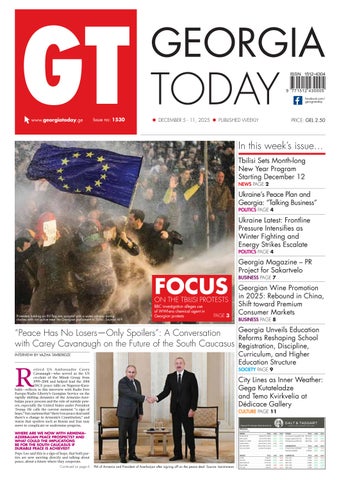
Retired US Ambassador Carey Cavanaugh—who served as the US co-chair of the Minsk Group from 1999–2001 and helped lead the 2001 OSCE peace talks on Nagorno-Karabakh—reflects in this interview with Radio Free Europe/Radio Liberty’s Georgian Service on the rapidly shifting dynamics of the Armenia–Azerbaijan peace process and the role of outside powers, especially the United States under President Trump. He calls the current moment “a sign of hope,” but cautions that “there’s no peace deal until there’s a change in Armenia’s Constitution,” and warns that spoilers such as Russia and Iran may move to complicate or undermine progress.
WHERE ARE WE NOW WITH ARMENIA–AZERBAIJAN PEACE PROSPECTS? AND WHAT COULD THE IMPLICATIONS BE FOR THE SOUTH CAUCASUS IF DURABLE PEACE IS ACHIEVED?
Tbilisi Sets Month-long New Year Program
Starting December 12
Ukraine’s Peace Plan and Georgia: “Talking Business”
POLITICS PAGE 4
Ukraine Latest: Frontline Pressure Intensifies as Winter Fighting and Energy Strikes Escalate
Georgia Magazine – PR Project for Sakartvelo
BUSINESS PAGE 7
Georgian Wine Promotion in 2025: Rebound in China, Shift toward Premium Consumer Markets
BUSINESS PAGE 8
Georgia Unveils Education Reforms Reshaping School Registration, Discipline, Curriculum, and Higher Education Structure
City Lines as Inner Weather: Gega Kutateladze and Temo Kvirkvelia at Dédicace Gallery
POLITICS PAGE 4 SOCIETY PAGE 9 CULTURE PAGE 11
Protesters holding an EU
ag are sprayed with a water cannon during clashes with riot police near the Georgian parliament in Tbilisi. Source: AFP
INTERVIEW BY VAZHA TAVBERIDZE
Tbilisi Sets Month-long New Year Program Starting December 12
BY MARIAM RAZMADZE
Tbilisi will launch its New Year celebrations on December 12, with First Republic Square transformed into the city’s main festive spot for nearly a month. Mayor Kakha Kaladze announced that the holiday program will run through January 7 and will feature a wide lineup of cultural, educational and family-oriented activities.
As the mayor stated, this year’s New
Year’s Village will again host themed spaces, concerts, and events spanning various genres, offering residents and visitors a full schedule of seasonal entertainment. The festivities will officially begin with the lighting of Tbilisi’s central Christmas tree on December 12, accompanied by the switch-on of holiday illuminations across the city.
Kaladze also encouraged private companies and the business community to take part in decorating Tbilisi’s public spaces for the citywide festive atmosphere to extend into parks, squares and other neighborhoods.
Starbucks to Enter Georgia — First Store to Open in Tbilisi’s Vake District in March 2026
BY TEAM GT
Starbucks is officially entering the Georgian market. Based on information obtained by BM.GE, the company plans to open its first store in Tbilisi’s Vake district in March 2026.
In the initial phase, Starbucks will also launch branches in Kutaisi and Batumi. Over the medium term, the company aims for large-scale expansion: within 7–8 years, Starbucks is expected to open up to 50 locations across Georgia.
It is reported that operational negotiations are in their final stage, and key agreements for the brand’s entry into the market have already been reached. Starbucks’ move aligns with its broader international growth strategy. The company has announced plans to significantly expand its global network by 2030, adding around 17,000 new stores worldwide.
Market analysts note that Starbucks had previously refrained from entering Georgia due to the country’s small market size and operational considerations. However, the company appears to be revising its strategy by entering smaller and emerging markets — including Georgia.
French National Assembly Committee
Backs Resolution on Georgia, Urges Sanctions against Ivanishvili
BY TEAM GT
The European Affairs Committee of the French National Assembly has adopted a resolution on Georgia, reads the Assembly’s official website.
The document, approved on December 3 and now forwarded to the Foreign Affairs Committee, condemns what it calls the Georgian government’s “illiberal and authoritarian regression” and reaffirms support for Georgia’s European path.
The resolution urges the French gov-
Kaladze Announces 2025 New Year Slogan: ‘A City Full of Kindness’
BY
Tthis week announced the city’s New Year slogan for 2026: “A City Full of Kindness.” Speaking at a municipal government meeting, Kaladze emphasized the importance of compassion amid ongoing social and political challenges, presenting the theme as both a reflection on the past year and a guiding principle for the year ahead.
Tbilisi has a recent tradition of New Year slogans beginning with “A City Full of…”, each reflecting the mood and challenges of the time. In 2022, amid the turmoil of the war in Ukraine, the city chose “A City Full of Peace.” Subsequent slogans highlighted shared values such as resilience and community. This year’s focus on kindness comes at a moment when the country is navigating societal divisions, political polarization, and concerns over stability.
Kaladze noted that while Georgia celebrated historic achievements, including its first-ever appearance in the European football championship, tensions remain in public life. “We need more kindness toward one another, toward our city, toward those facing hardship, and toward citizens with different political views,” he said, stressing that goodwill should guide both societal relations and the upbringing of the next generation.
The mayor also pointed to broader domestic and global challenges, describing compassion as essential for resilience. “Kindness strengthens us most; it is the driving force behind every good deed,” he added.
Some opposition figures, however, expressed skepticism, suggesting that slogans alone cannot address deep political divisions and social tensions. Critics argued that meaningful action
ernment to work with EU partners to support targeted sanctions against Bidzina Ivanishvili and his entourage, as referenced in the European Parliament’s February 13, 2025 resolution.
It highlights concerns over the political situation following the October 26, 2024 parliamentary elections, citing a shift away from the European course, increased pressure on civil society and the opposition, and growing Russian influence.
Based on the text, these developments reflect a “systemic change,” prompting the call for France and the EU to act decisively in support of democratic principles and Georgia’s pro-European aspirations.
BY TEAM GT
Freedom Square tree. Source: Photo: Georgian Journal
TEAM GT
bilisi Mayor Kakha Kaladze
Matilda Gvarliani. Source: Beamound.ge
The Freedom Square New Year tree. Source: GT
Starbucks drinks. Source: Starbucks
BBC Investigation Alleges Use of WWIEra Chemical Agent in Georgian Protests
BY TEAM GT
The BBC this week published an investigative report suggesting that the Georgian government may have deployed a discontinued, World War I–era chemical agent to suppress anti-government protests in late 2024. According to the report, demonstrators opposing the government’s suspension of EU accession experienced severe symptoms—including burning eyes, shortness of breath, coughing, and vomiting—that persisted for weeks.
THE ALLEGED CHEMICAL: CAMITE
Expert analysis consulted by the BBC indicated that the symptoms were consistent with exposure to bromobenzyl cyanide, historically known in French military terminology as “camite.” Camite was developed by Allied forces and used by France against Germany during World War I, but was reportedly discontinued in the 1930s due to long-lasting health effects and replaced by modern tear gas (CS gas).
EVIDENCE FROM WHISTLEBLOWERS AND DOCUMENTATION
Whistleblowers, including former riot police weaponry chief Lasha Shergelashvili, suggested that the chemical may have been mixed into water cannons used during the November–December 2024 protests in Tbilisi. Shergelashvili noted that the compound had effects far more potent and long-lasting than tear gas.
The BBC obtained a December 2019 inventory list from Georgia’s Special
Tasks Department referencing two unnamed substances: Chemical liquid UN1710 and Chemical powder UN3439, with mixing instructions. UN1710 was identified as trichloroethylene, a solvent used to dissolve chemicals in water, while UN3439 is an umbrella classification for industrial hazardous compounds. Experts told the BBC that the only chemical historically documented as a riot-control agent under that code is bromobenzyl cyanide (camite).
Professor Christopher Holstege, a toxicologist and chemical-weapons expert consulted by the BBC, stated that the reported clinical symptoms align with exposure to bromobenzyl cyanide.
INTERNATIONAL AND HUMAN RIGHTS REACTIONS
The BBC’s findings have sparked widespread debate in Georgia. Critics expressed outrage over the potential use of a banned chemical against protesters, while the ruling party attacked both the broadcaster and participants in the investigation.
The report has also drawn international scrutiny, with the US Helsinki Commission urging verification of the claims, potential sanctions, and support for democratic freedoms. European officials have called for transparent and credible investigations
UN Special Rapporteur on Torture
Alice Edwards, in the BBC report, condemned the alleged use of camite, stating that its effects “exceed what could be accepted as temporary, proportionate crowd control” and that it resembled the use of an “experimental weapon.” Edwards emphasized that incidents meeting these criteria should be investigated as possible torture or ill-treatment.
The US Helsinki Commission described the emerging evidence as “deeply disturbing,” and called on the US and allied governments to verify the claims, urging potential sanctions on those responsible and the passage of the MEGOBARI Act to strengthen support for democratic freedoms in Georgia. European Commission spokesperson Anita Hipper also stated that, if confirmed, the alleged use of chemical agents against demonstrators would be “unacceptable” and called for a transparent investigation.
Georgian non-governmental organizations released a joint statement calling on the government to publicly clarify which chemicals were used against peaceful demonstrators, emphasizing that such deployment could constitute torture or inhuman, degrading, or cruel treatment.
THE GOVERNMENT RESPONSE
Prime Minister Irakli Kobakhidze confirmed that water cannons used during protests contained a substance, but insisted it was not camite. He announced that the government intends to appeal to the UK communications regulatory authority regarding the BBC investiga-
tion and, if necessary, may pursue international legal proceedings. Kobakhidze accused the BBC of spreading false information, calling the report a “provocation,” and alleging that it aimed to fuel unrest and “blackmail” both the government and public.
Former Interior Minister Vakhtang Gomelauri stated that any such substances were purchased by the ministry only until 2012, denying any use after that. Georgian Dream’s communications office described the BBC report as “absurd and baseless,” claiming it relied solely on “interested parties” and lacked credible evidence.
Former Defense Minister Tina Khidasheli criticized the government’s response, stating: “When a globally influential media organization releases a full, hour-long documentary focused on a country’s leadership, responding with nothing more than accusations of ‘fake news’ becomes an insult to your country and people. Labeling the investigation published by the BBC as ‘fake’ without presenting any evidence shows that you are simply a lying abuser, have nothing to say, and your only weapon is to insult.”
The State Security Service (SSG) has
opened an inquiry under articles covering abuse of official powers and assisting a foreign organization in hostile activities. The investigation has included the summoning of key figures featured in the BBC documentary, notably: Eka Gigauri, Executive Director of Transparency International Georgia, Konstantine Chakhunashvili, co-author of a study referenced in the BBC film, and Dr. Gela Ghunashvili, another co-author of the study.
Konstantine Chakhunashvili said: “In my view, the purpose of this questioning is to imply that the BBC based its conclusions on our research — a narrative that could be used to discredit the BBC by making it appear as though its claims stem directly from our findings, which is not accurate and does not reflect reality. I also believe this may serve as a tactic of intimidation.”
Eka Gigauri added: “Right now, we are effectively being shown a staged performance. But what is the actual situation we are facing? An international investigative team obtained internal data originating from law enforcement bodies, referencing the alleged use of a particular chemical substance. At the same time, for more than a year, both the civil sector and the public have been persistently demanding transparency from the authorities — specifically, the disclosure of what gas was deployed during the dispersal of protests. Rather than providing that information, state agencies have chosen to summon doctors, victims, and individuals affected by the events for questioning, while failing to request accountability or answers from those who may have been directly involved in, or connected to, the possible commission of the crime.”
Water cannons pushing back Tbilisi protesters. Source: ctvnews
Ukraine’s Peace Plan and Georgia: “Talking Business”
Source: Channel 300/News 3
ANALYSIS BY VICTOR KIPIANI, GEOCASE CHAIRMAN
Only a short time has passed since the release of the initial version of the peace plan for ending the war in Ukraine. Yet even this brief period has encompassed its own share of drama and events: chaotic diplomacy, leaked phone conversations, personal sympathies and antipathies, and more.
But the most important thing this process vividly and unambiguously reveals is the nature of the modern international order – more precisely, the disorderly order – its new, highly uncomfortable character. A character that gives rise not only to justified concerns about today, but to entirely legitimate anxiety about tomorrow as well.
Much has been written about the revolutionary evolution of that very same disorderly order, and I too have, on many occasions, taken the liberty of speaking about it publicly.
Several deeply concerning features— this is still mildly put—characterize the picture that has emerged globally:
Absolute security in the modern world is impossible, and promises of ensuring it are empty;
Over recent decades, the persuasive force of international legal norms has sharply weakened;
The authority of international law and, along with it, the authority of international organizations, has significantly eroded;
The effectiveness of preventive political-legal mechanisms has clearly become dependent on the goodwill and willingness of the “powerful of this world”;
In the balance of international relations, the nuclear component has lost its orig-
inal restraining and stabilizing effect;
The structure and nature of military conflict have changed—distinguishing between its passive and active phases has become pointless due to the complexity of the methods used;
A widespread approach to achieving geopolitical advantage has become the so-called “salami aggression” (or gradual aggression)—the incremental building of political outcomes atop step-by-step military gains.
Once again, all of this has been made extremely visible by the war in Ukraine, and by the numerous attempts to bring it to an end: visible to Ukraine and visible to the world.
Among them, it has shown us – Georgians – a great deal. For us, the political and military outcome of this war (or even its freezing) has a direct and immediate impact, because this is not an ordinary war among wars. It is a
Ukraine Latest: Frontline Pressure Intensifies as Winter Fighting and Energy Strikes Escalate
COMPILED BY ANA DUMBADZE
From 28 November to 4 December, the war in Ukraine saw another intense week. Fierce battles raged on the eastern front, Russia renewed its attacks on Ukraine’s energy system, and Ukrainian forces continued striking Russian oil infrastructure. High-level US–Russia talks again produced no breakthroughs, even as NATO and other allies announced major new military support for Kyiv.
The heaviest fighting remains around Pokrovsk and nearby towns in Donetsk Oblast. Russia claims the city is fully captured, presenting it as its biggest territorial gain of 2025 and proof that Ukrainian defenses are weakening. Kyiv rejects that, saying fighting continues in northern districts and surrounding villages. Both sides agree on the human cost: every street gained in Pokrovsk has come at heavy loss, with hundreds of military and civilian casualties reported. Ukrainian sources estimate hundreds of civilians have died in the 18-month battle for the city.
Northwest of Pokrovsk, Myrnohrad has become Russia’s next focus. Drone footage shows the town nearly destroyed by artillery and glide bombs. Ukrainian marines there say they are close to being surrounded, with supplies now delivered by ground robots because traditional routes are too dangerous. For Moscow, capturing Pokrovsk and tightening control over Myrnohrad supports a slow, attritional strategy—one Russian officials openly link to their negotiating stance. Further north in Kharkiv Oblast, Russia says it has taken Vovchansk, though Ukrainian forces report fighting continues on the outskirts and along the broader
Kharkiv–Kupiansk line. Analysts note that while Russia made gains in Kupiansk during the summer, Ukrainian counterattacks have reclaimed some areas, though skirmishes continue.
Southwest, near Hulyaipole in Zaporizhzhia Oblast, Russia has advanced fastest in weeks. Several villages and open areas have changed hands, representing almost 40 percent of Russia’s November gains. Still, even here, progress is slow— just a few hundred meters at a time.
Ukrainian monitors estimate Russian forces took about 505 square kilometers in November, roughly double September’s gains. Russia now controls around 19 percent of Ukraine’s internationally recognized territory and over 90 percent of Donetsk and Luhansk, compared with a third of Donbas before the full-scale invasion. Ukrainian commanders stress that these advances come at a high cost: in the south, forces report inflicting 250–300 Russian casualties per day through artillery, drones, and counterbattery fire.
This week also saw one of the heaviest waves of Russian long-range strikes in months. Overnight on 29–30 November, Russia launched coordinated missile and drone attacks on Kyiv and several regions. At least six civilians were killed and dozens injured across Ukraine. In Kyiv, two people died and 38 were wounded, including a child. About 400,000 households temporarily lost power as energy facilities were hit or damaged.
The next night, Russia launched another drone strike—89 Shahed-type drones in total—63 of which were shot down. Several still hit infrastructure targets. The attacks continued into December: on 1 December, a missile hit an industrial area in Dnipro, killing four and wounding around 40. Two days later, Kryvyi Rih was struck, injuring several civilians, including a child.
system-forming war.
In other words, it is a war that will offer—geopolitically, economically, and militarily—new standards of a disorderly order: standards that in some cases may be acceptable, but I fear more often will be objectionable.
Since we are speaking about systemforming standards, I will briefly highlight several issues within Ukraine’s peace plan that are critical from a Georgian perspective—from the vantage point of a Georgian optic.
How do we want – or not want – them to be reflected in the final plan?
To what extent will this plan help or hinder us, later on, in negotiating with both adversaries and partners on Georgia’s national interests with the most optimal, the best possible content—what I often call “extracting value”?
And I do not call it that accidentally.
1.UKRAINE’S PEACE PLAN MUST NOT ALLOW TERRITORY TO BECOME THE SUBJECT OF A DEAL.
This is perhaps the most fundamental issue – not only for maintaining even minimal resemblance to a just order in an upside-down world, but also because it has critical importance for us, Georgia, as we conduct diplomatic warfare for our territorial integrity.
2. UKRAINE’S ARMED FORCES MUST BE MAINTAINED IN A DESIRABLE, COMBATREADY CONDITION.
Why is this so important for us, for Georgia?
Because Ukraine and Georgia share one fundamental feature: proximity to Russia. And as a result—one flank, one threat, and one response: unity in containing that threat.
Thus, in the future, keeping the Russian threat maximally tied down on the Ukrainian front, keeping Russia focused and drawn toward Ukraine, may help us
not necessarily to neutralize—unlikely as that may be—but at least to weaken the threat directed toward Georgia. In a fragile international security system, even that, you would agree, already counts for something.
3.WESTERN MONEY MUST BE SPENT ON UKRAINE’S RECONSTRUCTION.
This will create a precedent in the postSoviet space for rebuilding and modernization—a kind of variation of a postSoviet Marshall Plan. This precedent will stand before us, Georgia, when it comes to receiving real – not symbolic – material resources in the conditions of de-occupation and beyond. And deservedly so: as a response to the blood and suffering that the citizens of this country, its society, have paid for their loyalty to the Western course. Also deservedly and justly, because this resource must serve as a price – at least in some places and in certain respects – for the half-hearted policies connected to the West’s desire to remain within its “comfort zone,” a desire it simply could not abandon despite the high price paid by us.
Of course, there are many other issues to be noted when discussing Ukraine’s peace plan. But for now, I have singled out only these – singled them out through the prism of a Georgian ultra-realist political approach; singled them out as I believe necessary to mark and analyze them without sentiment or emotion –solely as it benefits us to see them, as it suits us to use them.
At the same time, I fully understand that implementing a Georgian ultrarealist policy in international relations requires something essential: a foundational, internal pillar—a normalized domestic setup and environment. Yes, a normal, rational, adequate state structure and rhythm—not a country resembling a limited liability company, or worse, a cooperative.
The energy grid remains a major target. On the night of 2–3 December, drones hit an energy installation in Odesa Oblast, causing a large fire and seriously injuring an employee. Earlier strikes in Odesa wounded at least six people, including two children. UN monitors report civilian casualties from long-range weapons are sharply rising in 2025: deaths between January and October are up 26 percent compared with last year, and injuries have increased by 75 percent. Ukraine’s Prosecutor General reports at least 16,230 civilians have been killed by Russian shelling since February 2022—over 2,600 more than a year ago. Ukraine has responded by striking deeper into Russia, targeting critical oil infrastructure that fuels Moscow’s war effort. November saw at least 14 Ukrainian drone attacks on Russian refineries— a record. Analysts say these strikes have cut Russian refining output by roughly 335,000 barrels per day since September, pushing global oil prices higher.
In recent days, Ukrainian drones hit an oil depot in Tambov Oblast and fuel reservoirs in Voronezh Oblast, sparking fires but causing no casualties. Ukraine is also believed to have damaged a mooring at the Caspian Pipeline Consortium terminal near Novorossiysk, temporarily reducing output on a pipeline that carries over 1 percent of global oil. Kazakhstan rerouted some exports through the Baku–Tbilisi–Ceyhan line. Ukrainian naval drones also struck two Russian tankers, Kairos and Virat, leaving both heavily damaged. Kyiv says these operations are designed to limit Russia’s ability to fund the war.
The strikes are drawing international attention. Oil markets reacted nervously, including to a fifth strike this year on the Druzhba pipeline in Tambov. Western officials acknowledge the impact but remain cautious publicly, concerned
about energy market volatility. Diplomacy, meanwhile, produced little. US President Donald Trump’s envoys, Steve Witkoff and Jared Kushner, spent about five hours at the Kremlin presenting a US peace plan to Putin. Both sides say no compromise emerged. Putin said any deal must reflect “realities on the ground,” including Russia’s territorial gains, and rejected concessions. The Kremlin said some US ideas were acceptable but gave no specifics. Officials in Kyiv and Europe accused Moscow of faking interest in talks while escalating attacks.
Trump later called the talks “reasonably good” and said his envoys believed Putin wants an end to the war, though the path forward remains “unclear.” The US delegation is set to brief Ukraine’s chief negotiator, Rustem Umerov, on 4 December in Miami, but the main obstacle—territory—is still unresolved. Even as talks stall, support for Ukraine is growing. On 3 December in Brussels, NATO foreign ministers approved roughly $1 billion in new arms purchases under the Prioritized Ukraine Requirements List (PURL). Two $500-million packages are backed by consortia including Germany, Norway, Poland, and the Netherlands. NATO Secretary General Mark Rutte said more than two-thirds of mem-
bers now contribute to PURL, with total commitments over $4 billion and possibly reaching $5 billion by the end of 2025.
Australia and New Zealand joined as the first non-NATO contributors. Canberra pledged A$95 million, including air-defense radars, munitions, and engineering gear; New Zealand added $15 million. Together, they add over $70 million to Ukraine’s defense effort, signaling a widening coalition of support. The European Commission proposed raising €90 billion for Ukraine over two years through a “reparations loan” backed by Russia’s frozen EU assets. Ukraine would repay only if Russia eventually pays. While many EU countries support the plan, Belgium and legal experts warn of financial and legal risks. Leaders will debate it at a summit later this month. As winter sets in, the week shows the war’s dual reality: Russia is making incremental but costly gains in Donetsk and Zaporizhzhia and intensifying attacks on Ukraine’s cities and power grid, while Ukraine holds most of its lines, inflicts heavy losses, and strikes deep into Russia’s economy. With no side willing to give ground and peace efforts stalled, the coming weeks are likely to bring further escalation on the battlefield and across the energy front.
Drone footage shows the heavily-bombed city of Myrnohrad as Russian forces nearly encircle it. Video grab
“Peace Has No Losers—Only Spoilers”: A Conversation with Carey Cavanaugh on the Future of the South Caucasus
Continued from page 1
The United States’ influence has waxed and waned, but now it’s more involved, engaged in the Caucasus, and looking for creative solutions. At this point it’s all about deposits; it’s not a peace deal. It’s a commercial arrangement that could help cement economic ties and maybe bring the United States in economically in a greater way. But a true peace still requires a lot of other things—questions about the return or potential return and safety of the over 100,000 people who fled Karabakh in 2023; questions about protection of cultural monuments; questions about POWs; questions about border demarcation; the question of the Zangezur corridor. All those things still stand. And there’s no peace deal until there’s a change in Armenia’s Constitution, which would require a national referendum. It’s very hard to say right now where the Armenian people would stand on that.
A MORE IMMEDIATE HURDLE MIGHT BE ELECTIONS IN ARMENIA NEXT YEAR. HOW MUCH HINGES ON THOSE ELECTIONS?
Sadly, talk and promise of aggression is usually more welcomed in elections than peace efforts. My hope is that the effort undertaken in Washington helps both sides argue that we need to bring this to an end. We need to lift the blockades. We need normal diplomatic and economic relations. And I think President Trump got excited about that prospect, and he also got excited about the economic prospect. We talked about potential trade corridors back in the 2000s. This was a factor. It’s not an easy thing to accomplish—build, establish, let alone defend.
HOW DURABLE OR CONSTRUCTIVE WILL THE TRUMP ADMINISTRATION BE IN ACTUALLY ESTABLISHING AN AMERICAN PRESENCE IN THE REGION AND SEEING THIS PROJECT THROUGH?
It’s not fully clear yet. I think the view is an economic one. We would lease the
land for 99 years. President Trump joked that if we want another 99, you’ll agree to that too. But should there be a renewal of hostilities—especially regarding the Zangezur corridor—nothing I saw coming out of Washington said the United States is prepared to put military forces there, and it’s clear military force is something neither Russia nor Iran would be comfortable with. So that’s a very vague area, because nobody said who would be responsible in practice for ensuring security, who will carry out border and customs checks, etc. That was one of the biggest disputed points between Yerevan and Baku. And now it seems the US is taking care of that, probably through an independent intermediary.
YOU UNDERLINE THAT THIS IS A COMMERCIAL ENDEAVOR FIRST AND FOREMOST,
Russian Foreign Ministry: No Grounds to Resume Political Dialogue with Georgia
BY TEAM GT
Russia sees no grounds for restarting political dialogue with Georgia at this stage, the Russian Foreign Ministry told Izvestia. Ministry says Tbilisi continues to adhere to the position formed under the Saakashvili administration — namely, that restoring diplomatic relations is possible only if Moscow reverses its recognition of
Abkhazia and South Ossetia. The Foreign Ministry called this demand “unrealistic,” and claimed it is “harmful to Georgia itself,” stressing once again that Russia considers the recognition of the two regions’ “statehood” to be irreversible.
Despite this, Moscow says it remains open to further steps toward normalizing relations, but only insofar as Georgia is prepared to engage.
“The ball is in Georgia’s court, and, in our view, no one should be more interested in this than Georgia itself,” the ministry added.
ESPECIALLY. WHO ARE THE WINNERS AND LOSERS?
When it comes to peace, we never like to talk about winners; we say peace has no losers, only winners and winners. So instead of losers, I’d point at potential spoilers—those who, if they’re unhappy with the outcome, have the ability to bring pressure to make this nonfunctional. Iran is one—they already announced they’re opposed to this. Russia said this was a positive step, and I believe Putin sees it that way because any stability in the South Caucasus is in Russia’s interest right now, as it’s very preoccupied elsewhere, particularly in Ukraine. But do they welcome it? Would they welcome it if there were security guarantees? I’m not sure. Even if there is stability in the South Caucasus, wouldn’t that mean Russia’s influence erodes?
IF ARMENIA AND AZERBAIJAN MEND THEIR RELATIONSHIP, DOESN’T THAT REDUCE RUSSIA’S LEVERAGE?
Arguably yes, but Russia also has trade that could pass through here. Turkey has trade that could pass through here to go into Armenia. But there won’t be trade until there’s a sign of a definitive peace agreement.
so I think Russia’s leverage is diminished. Armenia, however, because of the existing blockade, still depends on trade with Iran. If there’s risk to that trade, how would it be replaced? The situation in Georgia is not politically settled—probably the politest way to put it. That raises questions too. Armenia has a few routes to the outside, and none are in great shape. Is it going to rely on a new route not yet established? If the two major regional hegemons oppose it, what costs and risks would follow?
LET’S LOOK AT GEORGIA. WHAT DOES POTENTIAL ARMENIA–AZERBAIJAN PEACE MEAN FOR GEORGIA AND ITS TRANSIT POTENTIAL?
WHICH WOULD ATTRACT THE PRESIDENT. DOES THAT MEAN AMERICAN INVESTMENT IS SURE TO FOLLOW?
Yeah, but how much commerce will there be? I don’t imagine the United States is going to collect transit fees from goods from Azerbaijan going to Nakhichevan, which is also Azerbaijan. I don’t think it will collect fees for goods going from northern Armenia to southern Armenia along this transit corridor, or goods going into and out of Iran. So commercial only in the sense of how that road gets used. It’s expensive to build down there—very expensive—and I heard no mention of construction costs. There are ways not to construct something significant, but then it becomes potentially less profitable and harder to secure, right?
LET’S LOOK AT EXTERNAL ACTORS—NEIGHBORS
DOES THAT INVOLVE TURKEY OPENING TRADE WITH ARMENIA AS WELL?
Turkey will open it as soon as Baku says it’s fine. If things keep moving forward, then there should probably be a message from Baku to Ankara—from Aliyev to Erdogan—saying “let’s open the border, lift the blockade.” But I’d be surprised to see that happen if he’s demanding a change in Armenia’s Constitution first.
SPEAKING OF SPOILERS, WHAT CAN RUSSIA AND IRAN DO IN TERMS OF RETALIATION?
There are potential steps they could take to make this corridor difficult to operate—spoil the construction, spoil the progress, spoil the peace agreement. There are always diplomatic and economic levers. Azerbaijan and Armenia have both moved further from Russia,
I don’t expect anything detrimental to the existing infrastructure. You’re not going to reroute pipelines already going through Georgia. They’re productive and functioning. Georgia has a whole bunch of other challenges it needs to address—domestic instability first, then its issues with the breakaway regions. If there’s peace in the region, there’s a great incentive to help export Central Asian energy in that direction. But that’s not something that will be done under President Trump, or even under his successor. These are long-term endeavors. Georgia’s challenge is to fix things in the short term so it’s in a better position. It’s moved away from the West, but it’s not getting much love from Russia either. So I wouldn’t say it’s found a happy middle ground where it gets what it needs.
PRESIDENT TRUMP SAID “WE SHOULD FULLY UNLOCK THE SOUTH CAUCASUS’ POTENTIAL.” IS THAT POSSIBLE WITHOUT GEORGIA?
I don’t think so. There’s enormous potential for greater trade between Turkey and Georgia, especially if things open up with a new corridor. That would open more trade with Central Asia. Some of that would logically go south, but some could go across the top of Azerbaijan into Georgia on other routes. And Georgia has seaports—something Armenia does not—which can be valuable in a variety of ways.
Former Ambassadors: One Year after GD Halted EU Integration, We Urge Partners to Keep Georgia on the Political Agenda
BY TEAM GT
Agroup of 118 former Georgian ambassadors and diplomats on November 28 issued a joint statement marking one year since Georgian Dream “stopped Georgia’s movement toward the European Union” — a decision they say has hindered the country’s progress, weakened its democratic development, and fueled antiWestern narratives.
The diplomats recall that on November 28, 2024, Georgian Dream announced it would not place the issue of opening EU accession negotiations on the agenda until the end of 2028. According to them, this decision effectively suspended Georgia’s EU integration and deprived the country of a historic opportunity created by the shifting geopolitical landscape following Russia’s full-scale invasion of Ukraine.
In their statement, the former ambassadors urge Georgia’s international partners to keep the country high on the political agenda, to respect the will
of the majority of Georgian citizens who support EU and NATO membership, and to continue backing Georgia’s freedom, territorial integrity, and European perspective.
They stress that EU and NATO aspirations are not merely foreign policy preferences but essential for strengthening sovereignty, building a democratic state, protecting national identity, and ensuring a peaceful future. They also underline that returning to the European family is the only path toward restoring Georgia’s territorial integrity peacefully.
The diplomats emphasize that claims about the EU demanding Georgia “cede sovereignty” or open a “second front” are disinformation. Instead, the obligations tied to EU candidate status related to judicial independence, anti-corruption reforms, the rule of law, and the protection of human rights — standards identical for all candidate countries.
The statement accuses the government of deliberately refusing to fulfill these conditions, fueling anti-Western sentiment, and attempting to discredit strategic partners who have supported Georgia since independence. The for-
mer ambassadors argue that equating the EU with the Soviet Union or comparing Western partners to Russia is “absurd and immoral.”
They also warn that recent repressive legislative changes, attacks on free expression, pressure on dissent, attempts to suppress peaceful protests, and a growing number of political prisoners have deepened Georgia’s isolation and distanced it from the European family. Signatories claim that Georgian Dream’s current foreign policy course contradicts Article 78 of the Constitution, which obliges the government to ensure Georgia’s integration into the EU and NATO.
Despite the challenges, the diplomats express confidence that Georgia will ultimately regain its rightful place in a united, free, and peaceful European family.
The statement is signed by 118 former ambassadors and diplomats, including Maia Abulashvili, Eka Akobia, Davit Dondua, Temur Iakobashvili, Sergi Kapanadze, Batumi Kutelia, Ketevan Tsikhelashvili, Tornike Parulava, Irakli Koplatadze, Giorgi Sabanadze, Natalia Sabanadze, Giorgi Muchaidze, and many others.
Carey Cavanaugh. Source: rotarylexky
Russian Foreign Ministry. Source: FB
Georgia Magazine – PR Project for Sakartvelo
BLOG BY NUGZAR B. RUHADZE
With my previous article of November 28, 2025 in Georgia Today, I informed the world that the National Academy of Sciences of Georgia organized a workgroup designed to promote Sakartvelo’s place and role in the History & System of Civilizations. Exactly at the same time, unbeknownst to me, a group of Georgia lovers in Washington DC was working almost on the same subject, only in a specific instrumental way, by means of creating a PR project for the Republic of Georgia. Wow, what a fortunate coincidence! The idea is fresh and the project is in its inchoate stage. The incipient PR company is going to be named Argos United, LLC, registered in Chevy Chase, Maryland, USA. The firm will be helping companies from the Republic of Georgia establish and enhance their presence in the United States market, bridge the cultural and business communication gap between Georgian enterprises and American audiences, media, customers, and investors. Argos United will promote Georgian businesses in the United States, introducing Georgian products to American markets and informing U.S. companies about investment opportunities in Georgia. It will showcase these connections in a glossy magazine devoted to Georgian history and culture, business success stories, and the nation’s potential for economic growth.
The team of initiators comprises American and Georgian communicators experienced in a wide range of fields. Wine and tourism are the obvious places to start, but there may also be opportunities in mining, resort construction, eastwest transport, energy development, and IT. Besides promoting business-to-business relationships, they will organize American-Georgian student exchanges and internship programs for young Georgians with American companies.
The core competencies and competi-
tive advantages of the company will be: deep understanding of Georgian culture and economy, expertise in U.S. media landscape and PR best practices, multilingual capabilities, cultural and linguistic ties to Georgia, exceptional communication capabilities in all media—video, television, radio, print, graphics, and social, specialized focus and deep expertise in the Georgian business landscape, experience in a wide range of subject matter: food, wine and hospitality, science and technology, military technology, national and international political analysis, data management and analysis, book and magazine publishing, popular culture, fashion and academia, established network of contacts in both Georgia and the U.S., cost-effectiveness compared to large multinational agencies, agility and personalized service.
The primary target clients of Argos United are going to be Georgian companies seeking U.S. investment or market entry in business sectors including wine production and export, tourism and hospitality, transport and logistics, construction, mining and minerals processing, IT, university student exchange programs.
The suggested market opportunities include: limited awareness of Georgian business capabilities among U.S. companies and consumers, growing U.S. interest in the Caucasus region, technology sector seeking development partnerships, tourism sector promotion opportunities, growing demand for minerals related to energy, IT, construction and finance, e.g., barite, copper, manganese and gold, universities seeking new study-abroad opportunities.
Services offered: identification and recruitment of investors and customers, media strategy development, video and written press release creation and distribution, content creation for video, print, blog posts, technical graphics and social media, quarterly magazine and accompanying website featuring our Georgia business clients along with Georgian history, culture and natural beauty, spokesperson media training, media outreach and placement—TV,
Georgia Announces
radio, print, trade, internet—social media monitoring and reporting, social media strategy and management, influencer partnership development, website creation, maintenance and analysis, conference and trade show identification, planning, publicity, displays and handouts, trade mission support, issues monitoring, identification and collection of information from U.S. government agencies, investment pitch refinement, investor presentation creation, investment community outreach.
The Argos United team of experts includes: Bill Thomas, author and veteran journalist; Bob Kaper, journalist and TV/video producer; Carla Frank, a magazine designer with over 25 years of experience; Heather Freeman, veteran media and public relations executive; Boris Ruhadze, entrepreneur and innovator across healthcare technology, transportation and lifestyle ventures.
The title of the company’s main promoting tool—the magazine—is still in discussion, but the mutually considered general penchant of the group is to use the word “Georgia” in it, maybe “Sakartvelo,” which might be less recognizable for the world. But the title is not the biggest problem. What matters most is that the future publication should aim bigtime—giving the unique Georgian culture, its history, its language and, most importantly, its versatile potential to the rest of the world to happily exploit. The chance is real and present, and we should not let it go. And finally, nothing happens in today’s world without financial support. Let me proffer a theoretical version of the painful pecuniary problem: Georgians are intensively talking to each other on their everyday problems and the ways of development. They now need to start talking to the world about the same, which will never happen unless things like the above suggested ones are put in place. And if this is true, the Georgian state and its well-to-do sons and daughters must start spending their money on this outstanding project as soon as possible, and without any reservation or second thoughts.
$7 Billion Transport and Infrastructure Investment Plan to 2032
BY TEAM GT
At the Second Trans-Caspian Transport Corridor and Connectivity Investors Forum, Mariam Kvrivishvili, Georgia’s Minister of Economy and Sustainable Development, announced that the country intends to invest USD 7 billion in transport, logistics, and infrastructure projects over the next seven years.
The investment package includes several major initiatives: the construction of the Anaklia Deep-Sea Port, a full modernization of the national railway network, expansion and construction of key highways, and the development of a new international airport at Vaziani.
“Georgia will invest USD 7 billion in major transport, logistics, and infrastructure projects by 2032,” Kvrivishvili said.
“Achieving this goal requires not only continued support from international financial institutions, whose experience and long-term capital are indispensable, but also greater engagement from the private sector.”
The minister emphasized that these projects aim to position Georgia as a strategic transit hub connecting Europe and Asia through the so-called “Middle Corridor,” taking advantage of the country’s location between the Caspian region, the South Caucasus, and the Black Sea.
The Anaklia port is expected to play a central role in this plan. Kvrivishvili said that in its first phase, the port will handle 600,000 TEUs by 2029, with capacity expected to rise to at least 1 million TEUs by 2035, a move that could significantly boost Georgia’s maritime logistics capabilities. She added that expanding port and transport infrastructure is critical to ensuring the “uninterrupted transit of growing trade flows between Europe and Asia.”
Acknowledging the scale of the program, Kvrivishvili stressed that public funding alone would not be enough. She called for stronger private-sector involvement alongside continued support from international financial institutions, reflecting Georgia’s broader strategy of combining public investment with private partnerships and international cooperation to develop a modern, mul-
EU to Phase out Russian Gas Imports by 2027 under New Energy Agreement
BY TEAM GT
The European Union has reached a landmark agreement to phase out all Russian natural gas imports by late 2027, marking one of the bloc’s most significant steps yet to end its long-standing dependence on Russian energy. Negotiators for EU member states and the European Parliament struck the deal early Wednesday, endorsing proposals first put forward by the European Commission in June.
The decision comes nearly three years after Russia’s full-scale invasion of Ukraine, which exposed the vulnerabilities created by years of heavy reliance on Russian fossil fuels. Before the war, Russia was the EU’s largest gas supplier, providing more than 40% of the bloc’s total consumption. Since then, the EU has worked to sharply cut imports through emergency diversification measures, increased LNG shipments from alternative suppliers, and accelerated investment in renewable energy.
Under the new agreement, the EU will permanently halt the import of Russian natural gas in all forms. Liquefied natural gas (LNG) imports will be phased out by the end of 2026, while pipeline gas will be completely discontinued by the end of September 2027. The deal also commits the bloc to moving toward a broader phase-out of Russian oil, reinforcing earlier sanctions and restrictions already imposed after the invasion. EU officials described the agreement as a decisive step toward energy security and geopolitical resilience, arguing that the bloc must ensure it is never again dependent on a single supplier — particularly one engaged in a war on European soil. The phased timeline aims to give member states sufficient time to adjust their energy systems, develop infrastructure, and prevent sharp price spikes.
The deal will now move to formal approval by the European Parliament and EU member states in the Council, a process expected to move swiftly given broad political support for reducing Russia’s leverage over the European energy market.
Georgia Cuts Funding for Major 200 MW Energy Storage Project
timodal transport network.
Georgia has already begun modernizing its infrastructure under the national economic reform program, with plans to expand and upgrade roads, railways, seaports, and logistics centers, including new deep-water facilities. These investments also align with regional connectivity goals, integrating Georgia’s networks with broader transport corridors across the Caspian, the South Caucasus, and Europe.
Despite the ambitious plan, challenges remain. Negotiations with a preferred investor for the Anaklia port, announced more than a year ago, have yet to be finalized. Kvrivishvili also highlighted bottlenecks in customs procedures and limited ferry connections between Georgia and European ports, calling for full digitalization and better data sharing to improve efficiency.
In the near term, the government plans to focus on renewing railway rolling stock and freight fleets, completing remaining sections of the Baku–Tbilisi–Kars railway, and deploying unified digital services across logistics networks. These measures aim to reduce cargo transit times through Georgia by up to 30%.
If fully realized, the USD 7 billion investment could transform Georgia’s role in regional trade, establishing the country as a more competitive and efficient hub for goods moving between Europe, the Caspian region, and Central Asia.
Energy
BY MARIAM RAZMADZE
The Georgian government has scaled back funding for its planned 200-megawatt energy storage facility, with the 2026 state budget allocating GEL 35 million instead of the previously planned GEL 120 million. The final draft shows an GEL 85 million reduction for next year, alongside a downward revision of capital spending for 2027–2029—from GEL 355 million to GEL 270 million.
Deputy Finance Minister Giorgi Kakauridze explained that updated assessments indicate the project will cost less than initially expected, and noted that lower equipment and installation prices influenced the revised estimates. The facility is expected to require around 18 months
to complete.
Financed through an Asian Development Bank (ADB) loan and implemented by the Georgian State Electrosystem (GSE), the project involves constructing a 200 MW / 200 MWh lithium-ion battery system in Mtskheta municipality, near the Ksani 500 kW substation. Its primary purpose is to strengthen grid stability and serve as a reserve energy source for Tbilisi during peak demand or emergency situations.
Government documentation shows several strategic goals: improving the integration of renewable energy, reducing reliance on electricity imports and ensuring reliable power supply to critical infrastructure, particularly in scenarios involving transmission failures or disruptions to natural gas supply.
GSE announced a tender for the project on August 4, closing on November 17. The results have not yet been published.
Gas pipe. Source: AP Photo / Bela Szandelszky
store. Source: Canary Media
Mariam Kvrivishvili. Source: bm.ge
Photo: Wake County Government.
Georgia Ends Public Employment Program as Labor Market Tightens
BY MARIAM RAZMADZE
Georgia’s public employment program for socially vulnerable citizens is set to end as the government winds down the initiative after its planned four-year cycle. Deputy Finance Minister Giorgi Kakauridze confirmed that the program, launched in 2022 under then–Prime Minister Irakli Garibashvili, will not continue into 2025. The scheme had provided jobs to
roughly 40,000 people by 2024, but Kakauridze noted that its original purpose was temporary: to cushion unemployment during the post-COVID period. As he stated, labor market conditions have since shifted, with shortages now replacing the earlier surplus.
Continuing to place people in publicly funded work, he argued, would worsen these shortages. Instead, the state intends to transition from being an employer to a facilitator. Support will now focus on retraining participants and preparing them to enter private-sector jobs rather than keeping them in public works roles.
Universal Healthcare Budget Increased by GEL 195 Million for 2025
BY MARIAM RAZMADZE
The revised draft budget shows that the Georgian government has approved an additional GEL 195 million for the 2025 universal healthcare program. The increase follows a sharper-than-expected rise in spending: by the end of November, the program had already used GEL 1.23 billion – nearly the entire annual allocation. The Ministry of Health requested the
extra funds to prevent interruptions in coverage as the universal healthcare program remains one of the state’s most financially demanding initiatives. Year after year, reimbursements claimed by healthcare providers have exceeded planned amounts, making supplemental allocations a recurring necessity. Looking ahead, the government plans a significant expansion of funding. In the newly submitted 2026 budget, GEL 1.5 billion is earmarked for universal healthcare, GEL 280 million more than the original plan for 2025. The increase reflects expectations of growing demand and rising program costs.
Georgia’s Food Prices Expected to Stabilize
BY MARIAM RAZMADZE
The Georgian Distributors Business Association Food reported that prices in Georgia are unlikely to rise further in the near term. Chairman
Lasha Rizhamadze said the recent wave of increases, driven by global market movements and revised supply contracts within large retail chains, has already been absorbed into current inflation figures. Rizhamadze noted that most of the inflationary pressure on food has played out in previous months, and unless inter-
national conditions shift sharply again, distributors do not expect another surge. He mentioned two stabilising factors: a relatively steady lari exchange rate and consistent cooperation between suppliers and major retailers. Both, he said, help prevent abrupt changes in the consumer basket. The association’s assessment comes as Georgia’s overall inflation stood at 4.8% in November, a slight decline from October but still above the National Bank’s 3% target. While headline inflation remains elevated, distributors suggest that food-specific pricing should hold steady if current external and market conditions persist.
Georgian Wine Promotion in 2025: Rebound in China, Shift toward Premium Consumer Markets
BY MARIAM RAZMADZE
The National Wine Agency of Georgia says 2025 delivered significant progress in the global promotion of Georgian wine, driven mostly by growth in China. Tamta Kvelaidze, Head of the Agency’s Marketing Department, stated that wine consumption in China rose for the first time since the post-pandemic downturn. After substantial declines following Covid-19, 2025 is the first year of recovery in that market.
To expand visibility beyond China, the Agency intensified international outreach in main regions. Throughout the year,
Georgian wine was presented at 36 global trade exhibitions and roughly 300 tasting seminars across Europe, the United States and Asia. The domestic wine promotion program, backed by GEL 17.4 million in state funding, supported 37 public wine festivals inside Georgia and 18 industry-focused wine tours for foreign professionals.
While promotional activity expanded, the export landscape remained uneven.
Between January and October 2025, total wine exports declined 7.9% year-on-year, reaching USD 218.3 million, with volumes dropping by nearly 8 million liters. The decrease was primarily attributed to a 13.6% contraction in exports to Russia which still accounts for 63.7% of Georgia’s total wine sales. Additional declines
were reported in Kazakhstan and the United States. Against this broader downward trend, exports and consumption figures in China improved.
The Agency’s 2026 strategy shows a shift toward markets positioned for premium consumer growth. Poland has been identified as a priority for strengthening Georgia’s presence in the high-end wine segment. In Germany, one of Georgia’s most stable export destinations, the Wine Agency plans to scale up its Georgian wine shelf campaign across major retail chains. In the UK and the United States, the promotional model will further lean toward direct consumer interaction, prioritizing local festivals and large-scale public wine events instead of primarily trade-to-trade outreach.
Georgia Removed from Poland’s Simplified Work Visa List
BY MARIAM RAZMADZE
eorgia has been removed from the list of countries eligible for Poland’s simplified work visa scheme, the Polish Embassy in Georgia announced. A new order, issued by Poland’s Minister of Family, Labor and Social Policy, defines which nationalities can use accelerated employment procedures. The updated list includes Armenia, Belarus, Moldova and Ukraine, while Georgia has been excluded. Applications submitted by Georgian citizens before the order was published will still be reviewed under the previous simplified rules, the embassy confirmed. Georgians who are already employed in Poland will have the right to work until the end of their currently approved period. No immediate changes will affect their ongoing contracts until those deadlines expire.
Photo: Georgian Journal.
Photo: Athreya Associates.
Photo: Hiring and Recruitment in Europe.
Back Behind the Lens, Part 2
INTERVIEW BY TONY HANMER
Details of the new film by Mariam Khatchvani, Inherited Silence, continued from last week.
Mariam Chvimiani, main actress in the film: “As a non-professional, it was quite challenging for me to participate in a movie. My expectations were quite different, because, in reality, I couldn’t imagine that women really go through such a life as that shown in the film, In my life, I’ve never seen such
actions and attitudes towards women, including indirect and direct violence. What I thought was just for the film, in the end became reality. Traditional gender roles, drinking, results of that, and so on. When I first read the script, I thought that it was stereotypical, but then I saw that many women live like it was portrayed. Mariam Khatchvani asked me to be in the film, but I had never thought of such a thing before!”
WHAT WAS EXPECTED AND WHAT WAS A SURPRISE FOR YOU?
I never expected what happened in one
particular scene: people seated at the table for a feast, with real drinking and toasts, and even part of the cast [nonprofessionals] getting somewhat drunk… not pretending! Much else was as I expected.
WHAT PART STOOD OUT FOR YOU, A SCENE OR EMOTION?
Towards the end, when the women are telling me to go back home, be tolerant and patient, to bear the violence my character had experienced. It seemed that the actresses themselves, some of them, had gone through similar things as my character had. They had also been told similar things in the same kinds of situation. Then, in the last scene, I am running. It felt real, and my emotions certainly were real. This seems to be a reality for many women [in Svaneti].
My character’s need of help was very different for the real me: I am quite independent, and she was a victim.
I don’t know what is next for me [in the world of film]. If I had more opportunities to continue, I would take them! It’s not in my comfort zone, but I do like to try new things.
Michelle Gagnon, co-producer: “I was asked to come on board towards the end, to help with funding post-production. There was a rough cut I got to see; but I knew that, as it was a Mariam Khatchvani film, I wanted to be in on it, being a fan of hers! Its themes of family violence against women (here, with a child too). I watched that cut and just knew. I also have a friend living in the mountains, in a similar situation. It’s not as easy to deal with as just getting up and leaving, children and all. I can’t change my friend’s situation, but I can help by raising awareness about domestic violence against women, and alcoholism as well, especially in this region of Georgia.
“One of the things I love about Mariam Khatchvani’s work is that the storytelling feels very simple; but you finishing watching, and suddenly you realize that this is a very complex situation; where does she go from here? It’s very powerful, and for a short film, it packs a punch
and spotlights this issue, makes you think.”
WHAT WAS THE MOST SURPRISING THING FOR YOU ABOUT THE FILM?
I only came on at the end, and wasn’t part of the actual production process. It surprised me that Mariam was able to do so much- to film with a crew and cast of around 40 people total, on a very small budget, and with non-professional actors! Plenty about it was unpredictable with these factors. There was lots of room for improvisation, which Mariam embraced and ran with. In this it transcends fiction and gets into reality, how these people really think.
HOW WILL THE FILM SPEAK DIFFERENTLY TO MEN AND TO WOMEN? ESPECIALLY LOCAL (SVAN) PEOPLE?
It will challenge attitudes around excessive drinking, despite ancient Georgian connections with wine, the feast, toastmaking, the former shame about getting drunk, and so on. Much of the original traditions [adds Mariam Chkhvimiani] have been eroded. Drinking has become ugly. [Michelle Gagnon] Is current drink-
ing culture not changing for the worse?
[Mariam Chkhvimiani] Lack of a male heir is also a shame. There is pressure for couples, and men, to have a son. Living with one’s in-laws is also really a challenge, but a newly married couple should be alone to work things out.
[Michelle Gagnon] For women, these are complex realities, with no quick answers to the cultural norms. I hope that people, especially women, can take away a fresh perspective from the film. There are things which should be questioned, reflected on, and this is happening in this film.
Inherited Silence, AND The Mens Land, are currently on the festival circuits, and we wish them all the best. You can find out more about them by searching for them on www.imdb.com
Tony Hanmer has lived in Georgia since 1999, in Svaneti since 2007, and been a weekly writer and photographer for GT since early 2011. He runs the “Svaneti Renaissance” Facebook group, now with over 2000 members, at www.facebook.com/groups/ SvanetiRenaissance/ He and his wife also run their own guest house in Etseri: www.facebook.com/hanmer.house.svaneti
Georgia Unveils Education Reforms Reshaping School Registration, Discipline, Curriculum, and Higher Education Structure
BY TEAM GT
Georgia’s government this week unveiled a sweeping package of education reforms that will reshape school registration, classroom rules, curriculum standards, and the structure of general education. The announcements, led by Education Minister Givi Mikanadze and supported by the Prime Minister’s broader reform agenda, mark one of the most extensive overhauls of the system in more than a decade.
The first major change concerns school admissions. Mikanadze confirmed that a new preliminary registration stage will be introduced for families living in major cities, prioritizing enrollment based on residential address. This catchment-zone step will take place before the nationwide registration phase, and is intended to ensure that students are placed in the schools of their designated neighborhoods. The ministry expects the system to expand gradually after its initial rollout. Alongside this adjustment, rules on school-entry age will tighten: beginning next year, only children who turn six by September 15 will be eligible to enter first grade, replacing the current December 31 cutoff.
Uniformity will also return to public schools. Beginning next academic year, school uniforms will be reintroduced for pupils in grades 1 through 6 under a national pilot scheme. The initiative forms part of a larger reform package and is designed, according to Mikanadze, to promote discipline and a sense of
community. To ensure equitable participation, the state will cover the cost of uniforms for socially vulnerable families assessed at 60,000 points or below by the Ministry of Health. The ministry is also considering additional support for large families. A notable component of the program involves engaging female convicts enrolled in vocational institutions to sew uniforms for children in need. For other students, uniform procurement will be arranged either through school tenders or by parents. Schools will be invited to choose from several uniform designs that incorporate national or local symbols, following a public design-selection process to be completed by early spring. Although the pilot focuses on primary grades, authorities will rely on feedback before deciding whether to extend the policy to older students. The ministry has stated that the goal is to make uniforms mandatory nationwide starting with the 2026–2027 academic year.
Students’ daily experiences in school will also change under new discipline measures. The Ministry of Education plans to enforce a strict ban on mobile phone use during school hours. Mikanadze said the decision aims to reduce distractions, improve concentration, and boost participation in lessons. Implementation standards will be created for all schools, balancing the need for uninterrupted learning with provisions that allow students to contact parents or guardians in necessary situations.
Alongside structural and behavioral reforms, authorities have launched a new nationwide anti-drug initiative titled Me Momavlshi (“I Am the Future”). Beginning this fall, the program will
reach 60 public schools, and will initially focus on pupils in the 6th and 9th grades. Law enforcement officers, psychologists, social workers, and trained school safety specialists will lead interactive sessions on the risks of psychoactive substances, strategies for resisting peer pressure, and the importance of healthy decisionmaking. The campaign also incorporates comic competitions, sports events, creative workshops, and practical modules designed to engage students in ageappropriate ways. Early phases will take place in Tbilisi, Adjara, and Kvemo Kartli, with nationwide expansion planned afterward. Program coordinators have already held simulation meetings to prepare facilitators for school visits.
A more structural transformation concerns the overall duration and organization of schooling. The ministry has confirmed that Georgia will transition to an 11-year model of compulsory education, replacing the existing 12-year framework. However, a 12th grade will remain avail-
able as a voluntary option for students who wish to continue their studies. A dedicated online platform will open each March, and schools will establish 12thgrade classes only if enough students register. Mikanadze said the updated system aligns with modern standards, while giving families greater flexibility.
The final, 11th, year is set to become more specialized, allowing students to focus on the subjects required for national exams—a change the government hopes will reduce the widespread reliance on private tutoring.
Textbook policy will also be overhauled. Within the next two to three years, all current schoolbooks will be replaced by new state-approved textbooks, with every school using the same set for each subject. The ministry has already selected expert groups to produce the new materials. Officials argue that a unified approach will raise quality, ensure consistency across regions, and support fair, measurable educational outcomes.
This wave of school-level reforms coincides with a far-reaching restructuring of higher education, introduced by Prime Minister Irakli Kobakhidze in October under the concept titled “One City – One Faculty.” The plan seeks to address chronic problems such as the duplication of faculties across universities in the same city, variable teaching quality, limited research integration, and inefficient resource allocation. Under the proposal, each faculty will be consolidated into a single university per city based on institutional strengths and historical identity. Students currently enrolled will be allowed to complete their degrees during a transition period. Other measures include shifting higher education to a 3+1 model—three years for a bachelor’s degree and one for a master’s—reducing part-time academic positions in favor of full-time faculty, and reorganizing funding to align state support with labor market needs. The government also plans to build modern university campuses in Tbilisi and Kutaisi and modernize regional institutions, partly financed by the sale of non-historical university buildings in central Tbilisi. Together, these reforms represent an ambitious attempt to standardize learning conditions, improve discipline and focus in classrooms, strengthen social support systems within schools, and modernize both general and higher education. While the government argues that the changes will create a more cohesive and equitable system, debates are expected to intensify as implementation proceeds and families, educators, and students adjust to a rapidly changing educational landscape.
Mariam Khatchvani
Shot from the film 'Inherited Silence'
School uniforms will be introduced nationwide next year. Source: liveabout
The Centenary Voltage: Carlo Ponti, Dudana Mazmanishvili, and the Georgian Philharmonic
REVIEW BY IVAN NECHAEV
The Georgian Philharmonic Orchestra entered its centenary evening with the assurance of an ensemble that understands its past as a living organism rather than a museum relic. The program—Beethoven, Grieg, Respighi—formed an arc of ceremonial radiance, pianistic drama, and symphonic technicolor. In the hands of Carlo Ponti and the orchestra, this arc gained a narrative pulse that moved through the hall with the clarity of a seasoned storyteller.
Beethoven’s overture carries the structural weight of a temple being erected in sound. Ponti approached its opening with an austere clarity that foregrounded the harmonic scaffolding. The slow introduction breathed with a deliberate amplitude; each chord sounded like an engraved block lowered into place. As the Allegro unfolded, the orchestra moved into a sharply articulated rhythmic engine.
The counterpoint shimmered with a Baroque lustre that Beethoven elevates into monumental symphonic rhetoric.
The Georgian Philharmonic’s winds brought a resin-bright timbre, while the brass section shaped its interjections with sculptural precision. The coda arrived with a blaze of orchestral symmetry that filled the hall with a sense of architectural wholeness—a collective exhale after a carefully wrought edifice rose before the audience.
Dudana Mazmanishvili approached Grieg’s concerto with an inner luminos-
Photo by the author
ity that shaped the work’s well-known gestures into a personal ritual. The opening chords landed as broad strokes of energy; her touch exhibited the mixture of strength and suppleness found in pianists who understand the concerto as a dialogue conducted through color. Her phrasing in the first movement navigated the oscillation between impetuous cascades and introspective lyricism with an unbroken narrative thread. The cadenza revealed her instinct for vertical clarity: harmonies unfolded with crystalline balance, each arpeggio shaped
as a micro-architecture of tension and release.
The Adagio carried an almost vocal line. Mazmanishvili sculpted the melody with the tenderness of a lieder singer, allowing the orchestra’s strings to envelop her with a velvet sheen. Ponti kept the accompaniment transparent, which allowed the piano’s harmonic inflections to breathe with organic subtlety. The finale burst forth with a spring-like propulsion. The rhythmic character—part dance, part declaration—grew through tightly coordinated exchanges between
piano and orchestra. Her final ascent radiated a sense of grounded exhilaration, a glow that lingered long after the applause began. Respighi’s Roman triptych requires an orchestra capable of cinematic breadth and chamber-like sensitivity. The Georgian Philharmonic answered with a palette of sound that revealed the work’s atmospheric logic. “Pines of the Villa Borghese” opened with near-kinetic brilliance. The woodwinds captured the brightness of children’s games through agile motifs, while the strings produced
a glimmering texture that circled through Respighi’s rhythmic cells. “Pines Near a Catacomb” shifted the hall into a cavernous resonance. The low brass carried a grave, devotional timbre; the harmonic motion felt suspended, as if each chord were carved from volcanic stone. Ponti’s pacing invited the listener into a slow descent, offering a sense of history embedded within the orchestral sonority.
In “The Pines of the Janiculum,” the clarinet solo became a point of illumination. Its line floated across a delicate web of strings and celesta, forming an aural mirage. The nightingale recording emerged with a spectral elegance, merging technology and orchestration into a single poetic gesture. The final movement—“The Pines of the Appian Way”— created an ascent of tectonic force. The distant, steady tread of the opening built through meticulously layered brass entries. The Georgian Philharmonic achieved a resonance that seemed to expand the physical boundaries of the hall. The climax surged with a triumphal amplitude that honored both the work’s monumental imagery and the orchestra’s centenary stature.
This concert formed an essential chapter in the Georgian Philharmonic’s 100thanniversary narrative. The partnership between Ponti and the orchestra emerged as a central expressive force of the evening. The night unfolded as a study in orchestral identity and artistic maturity: Beethoven’s architectural radiance, Grieg’s lyric expansiveness, and Respighi’s cinematic breadth converged into a program that honored a century of musical life in Georgia.
Ghosts of the Past Haunting Us Today. Georgian and Global Voices on Berlin Stages
BY DR. LILY FÜRSTENOW
odest Mussorgsky’s Chowanschtschina moves one profoundly — above all through its masterful weaving of Russian folk and church-music elements into grand operatic form. As a member of the circle known as The Five, Mussorgsky and his colleagues endeavored to build a musical language rooted deeply in Russian tradition rather than Western conventions. In Chowanschtschina, this
language is charged with history, faith, and tragedy; the result is an opera that bridges past and present in a way that feels timeless, spiritual, and devastatingly human. The opera’s emotional core lies in its characters — such as Dossifey the priest or Marfa — whose love for their homeland, their faith, their ideals binds them to a fate of betrayal, murder, self-sacrifice. Their private suffering becomes collective — a portrait of a nation torn between tradition and reform, loyalty and cruelty. Through choruses and solo arias alike, Mussorgsky evokes the despair, hope, fanaticism, and yearning of those who love their country —
even as they face annihilation. Undoubtedly, the staging of Chowanschtschina at the Staatsoper Berlin Unter den Linden was intensified by the impressive performance of the incredibly talented singers, who created unforgettable historical images: Dossifey, performed by Taras Shtonda, embodied steadfastness, power, and remarkable pathos — almost prophetic in his intensity. Marina Prudenskaya’s Marfa was unbelievably sincere, lyrically poetic, yet steady and powerful; her voice carried both fragility and force. Mika Kares, as Count Iwan Chowansky, portrayed a perfidious authority figure with a strong voice and
commanding presence. The chorus added its weight and cohesion, while George Gagnidze as Bojar Shaklowity delivered a brilliant, nuanced performance. Gagnidze — an award-winning singer who studied at the Conservatory in Tbilisi and built an international career from the Semperoper in Dresden to the Metropolitan Opera in New York and the Opera Carlo Felice in Genoa — brought gravitas and ruthless elegance to his role.
Unfortunately, the recent staging by Claus Guth, which attempted to draw parallels with contemporary Russia, falls short. The visual references, such as Kremlin-like interiors, feel overly literal — heavy-handed symbolism rather than nuanced commentary. The video projections, racing through revolts, famines, and massacres in a black-and-white montage, undermine the carefully wrought sets, interiors, and costumes instead of enhancing them. Rather than deepening the historical resonance, this approach flattens it — the power of Mussorgsky’s music gets drowned under the weight of didactic images.
Commemoration and the confrontation with historical violence are among the central themes in the work of choreographer and director Ligia Lewis. In her recent piece Wayward Chant she stages grief, memory, and resistance as a visceral ritual: the performance a reckoning with race-based violence, gendered oppression, and the ongoing struggle against the erasure of Black voices. At the Gropius Bau’s vast atrium, bodies chant, convulse, and shift in austere formations — their movements echoing trauma, their moans weaving an elegy for lives exposed to brutal exploitation and invisibility. Lewis does not offer comfort. Instead, her work unsettles.
The space was charged with uneasy tension: architectural projections cast onto the historic friezes loomed over specta-
tors, ghost-images flickering above their heads — invoking a past that refuses to remain buried. This site-specific use of projection merged the physical architecture of Gropius Bau with the psychological architecture of collective memory, challenging us to recognize how systemic violence and erasure are embedded in visible and invisible structures. Lewis repeatedly disrupts traditional spectator passivity. The audience was forced to shift positions as seating was rearranged, the crowd reshaped — a symbolic act of collective reverence and protest, reminding that commemoration is never comfortable. This formal instability echoed the unstable legacy of oppression and racial injustice. Musically and theatrically, Wayward Chant blended liturgical sounds with blues-inflected harmonies; chanting bodies became both choir and cry. The performance unfolded like a delayed hymn — ghostly, fractured, haunting — refusing closure. A cry for recognition, a refusal of silence. Tragic and comic elements collide in this piece, giving it all a lively twist: moments of absurdity or ironic gesture punctuate the horror, as if the work winks at its own theatricality. This self-reflective, tongue-in-cheek movement unsettles us further — reminding that resistance need not always wear the mask of solemn sorrow, but can also challenge through subversion and dark humor.
Wayward Chant is a profoundly poetic and politically urgent piece. It mourns the irreparable loss, laments the unspeakable past, and insists on presence in a world still haunted by race- and genderbased violence, structural erasure, and collective amnesia. It premiered as part of the Performing Arts Season of the Berliner Festspiele. The extensive solo exhibition of Ligia Lewis I’M NOT HERE FORRRRR… at Gropius Bau is on view till 18.1.2026.
George Gagnidze (Bojar Schaklowity) and Ensemble. Photo by Monika Rittershaus
City Lines as Inner Weather: Gega Kutateladze and Temo Kvirkvelia at Dédicace Gallery
BY IVAN NECHAEV
The new joint exhibition at Dédicace Gallery unfolds like a quiet intervention into the sensory habits of urban life. It offers a way of seeing that treats the city as a receptive surface, a field where memory, intuition, and stray atmospheres accumulate. The project gathers two artists who approach the metropolis as a mutable interior landscape—one through the ascetic discipline of graphite, the other through the uncanny textures of analog photography. Their works create a shared territory where the city behaves like a
dream that remembers you back.
THE CARTOGRAPHER OF MICRO-SENSATIONS
Gega Kutateladze brings pages that resemble distilled recollections. His drawings emerge from journeys, yet they resist all narrative claims. They trace the moment when a place softens into memory, when its architecture dissolves into a mood. The pencil becomes a device for registering the faintest tremors of experience. Each line feels like a breath that landed on paper and decided to stay. Kutateladze’s economy of gesture shapes a compositional ethic. Shadows hover at the edge of recognition, and contours appear only as long as they remain necessary to sustain the image’s pulse. The
viewer enters a field charged with possibility; a surface that asks for participation rather than offering closure. His minimalism behaves like a porous threshold, absorbing the viewer’s interior states and letting them circulate freely. The effect recalls early modernist diaristic drawing—Anne Ryan’s paper fragments, Paul Klee’s wandering lines—yet Kutateladze’s mode is grounded in a specifically Georgian sensitivity toward landscape. The city is not documented; it is inhaled.
THE ENGINEER OF THE UNCANNY FRAME
Temo Kvirkvelia works within that frag-
ile zone where photography abandons its documentary habits and slips into reverie. His analog process generates images that seem to have drifted out of sleep before the mind could anchor them. Buildings lean with the logic of a private hallucination. Streets shimmer with an atmosphere that suggests a theatrical cue rather than a public space. These photographs carry the spectral confidence of Magritte’s suspended reality or Delvaux’s nocturnal compositions. Every surface appears slightly displaced, as though the city were rehearsing another version of itself. Kvirkvelia uses film to establish a tenderness toward strangeness. The surreal effect arises not from
COMMERCIAL DEPARTMENT
Commercial Director: Iva Merabishvili
Marketing Manager: Natalia Chikvaidze
EDITORIAL DEPARTMENT:
Editor-In-Chief: Katie Ruth Davies
Journalists: Ana Dumbadze
Vazha Tavberidze
Tony Hanmer
Nugzar B. Ruhadze
Ivan Nechaev
Mariam Razmadze
Layout: Misha Mchedlishvili
Photographer: Aleksei Serov
International Relations & Communications
Sofia Bochoidze E: sbochoidze@georgiatoday.ge
Website Editor: Katie Ruth Davies
Webmaster: Sergey Gevenov
Circulation Managers: David Kerdikashvili
David Djandjgava
ADDRESS
22 Janashia Str.
Tbilisi, 0179, Georgia
digital manipulation but from the inherent unpredictability of the medium—light leaking through a mechanical aperture, emulsions leaving traces like half-forgotten thoughts.
The city becomes a site of latent narratives, still waiting for their protagonists.
TWO METHODS, ONE ATMOSPHERE
The dialogue between Kutateladze and Kvirkvelia thrives through resonance: two distinct techniques generating a shared sensory temperature. The graphite drawings invite a contemplative slowness; the analog prints open a corridor toward dream logic. Together they shape a vision of urban space as an emotional ecosystem.
Dédicace Gallery frames this union with remarkable clarity. Since its founding in 2009, the institution has cultivated contemporary Georgian art through exhibitions that foreground artistic autonomy and material experimentation. City Lines extends that mission by forming a compact study in urban psychology—an atlas of personal geographies born from attentive looking.
THE CITY AS A MUTABLE ORGANISM
What emerges is a portrait of the city understood as an active participant in perception. Its façades operate like membranes; its corners retain the residue of previous wanderers. Both artists sense this dynamism and translate it into works that hold the city in suspension.
Walking through the exhibition feels like moving through a parallel Tbilisi— one that exists beneath the visible one, one composed of impressions that never reached language. The artworks sharpen that threshold between familiarity and estrangement. They ask the viewer to inhabit the city with renewed interiority, as though architecture were capable of recording our unspoken currents.
City Lines becomes a meditation on how the urban world shapes inner weather. It foregrounds the subtle negotiations between sensation and structure, between our wandering attention and the city’s patient surfaces. The works suggest that every street contains a latent dream, waiting only for someone to slow their gaze enough to encounter it.
Tel.: +995 32 229 59 19
E: info@georgiatoday.ge F: GeorgiaToday
ADVERTISING & SUBSCRIPTION
+995 577 72 52 61
E-mail: marketing@georgiatoday.ge
Reproducing material, photos and advertisements without prior editorial permission is strictly forbidden. The author is responsible for all material. Rights of authors are preserved. The newspaper is registered in Mtatsminda district court.