issue#1525

Page 1


FOCUS

ON THE BLACK SEA AS THE NEW FRONTLINE

Dr. S. Frederick Starr on Russia’s decline, Georgia’s choices, and the emerging regional order PAGE 4

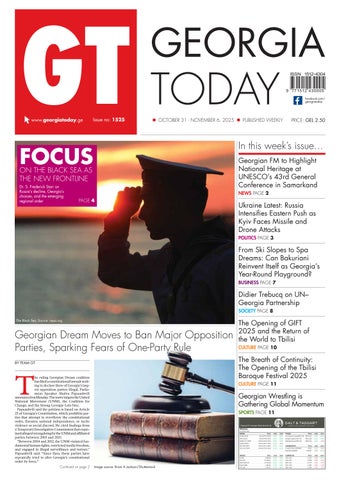
Georgian Dream Moves to Ban Major Opposition Parties, Sparking Fears of One-Party Rule

The ruling Georgian Dream coalition has filed a constitutional lawsuit seeking to declare three of Georgia’s largest opposition parties illegal, Parliament Speaker Shalva Papuashvili announced on Monday. The move targets the United National Movement (UNM), the Coalition for Change, and the Strong Georgia–Lelo bloc. Papuashvili said the petition is based on Article 23 of Georgia’s Constitution, which prohibits parties that attempt to overthrow the constitutional order, threaten national independence, or incite violence or social discord. He cited findings from a Temporary Investigative Commission that examined alleged wrongdoing by the UNM and affiliated parties between 2003 and 2025.

“Between 2004 and 2012, the UNM violated fundamental human rights, restricted media freedom, and engaged in illegal surveillance and torture,” Papuashvili said. “Since then, these parties have repeatedly tried to alter Georgia’s constitutional order by force.”

In this week’s issue...

Georgian FM to Highlight National Heritage at UNESCO’s 43rd General Conference in Samarkand

2 NEWS PAGE 2 CULTURE PAGE 11

Ukraine Latest: Russia Intensifies Eastern Push as Kyiv Faces Missile and Drone Attacks

From Ski Slopes to Spa Dreams: Can Bakuriani Reinvent Itself as Georgia’s Year-Round Playground?

Didier Trebucq on UN–Georgia Partnership

The Opening of GIFT 2025 and the Return of the World to Tbilisi

The Breath of Continuity: The Opening of the Tbilisi Baroque Festival 2025

Georgian Wrestling is Gathering Global Momentum

SOCIETY PAGE 8 BUSINESS PAGE 7 CULTURE PAGE 10 POLITICS PAGE 3 SPORTS PAGE 11

Flags. Source: FB

EU: Georgia–EU Trade Reaches €5 Billion in 2024, EU Remains Georgia’s Top Partner

Georgia’s total foreign trade turnover with the European Union has reached €5 billion in 2024, based on a statement by the EU Delegation in Georgia. The EU continues to be Georgia’s largest trade partner, accounting for about 22% of the country’s overall trade.

The Delegation highlights that trade ties have grown steadily over the past decade thanks to the Deep and Comprehensive Free Trade Area (DCFTA) — the EU–Georgia free trade agreement in force since 2014. The DCFTA allows

Georgian companies access to a market of over 450 million consumers, with zero customs duties on nearly all products, simplified border procedures and closer alignment with European standards.

The number of Georgian businesses exporting to the EU has nearly doubled during this period. The EU notes that alignment with its regulations has improved the quality and safety of Georgian exports and strengthened the competitiveness of local firms.

While many opportunities under the DCFTA are still developing, the Delegation says a decade of growth reflects the resilience and expanding ambitions of Georgian small and medium-sized enterprises on the European market.

Georgian Dream Moves to Ban Major Opposition Parties, Sparking Fears of One-Party Rule

Continued from page 1 INTERNATIONAL RESPONSE

The parliamentary commission conducted 64 public hearings, heard from 139 witnesses, and reviewed 778 citizen submissions, producing a nearly 500-page report that the ruling coalition says provides the legal foundation for the ban. Opposition leaders reacted sharply. Mamuka Khazaradze, head of Strong Georgia–Lelo, posted on social media: “You are right to fear ‘Strong Georgia.’ We will make you pay anyway!”

Critics warn that the lawsuit is a worrying step toward authoritarianism in a country long seen as a democratic and pro-Western model in the post-Soviet space. Reuters described the filing as “a sharp escalation in the drive toward authoritarian rule,” noting that all three targeted parties are strongly pro-Western. The political climate has been tense for months, with repeated anti-government protests, arrests of opposition figures, and new laws making it easier to outlaw political parties. Georgian Dream says these measures are necessary to protect the constitution, while opponents call them a political purge.

The co-rapporteurs of the Parliamentary Assembly of the Council of Europe (PACE) for Georgia, Edite Estrela and Sabina Cudic, warned that banning opposition parties could create a oneparty system incompatible with Council of Europe membership. They urged the ruling party to reconsider the lawsuit and announced plans for a factfi nding visit before the end of the year.

A PACE resolution in October 2025 explicitly cautioned that outlawing opposition groups would weaken democratic checks and balances in Georgia. The Assembly said authorities have “systematically ignored” concerns about democratic decline and hostility toward European institutions.

The Constitutional Court will next decide whether to accept the lawsuit.

Civil society groups and opposition parties are expected to mobilize both domestic and international support.

The outcome could reshape Georgia’s political landscape, influencing media freedom, electoral competition, and the country’s relations with Europe.

Kaladze on Georgia’s Absence from Euronest Session: Our Platform is Our Country and its People

Tbilisi Mayor Kakha Kaladze commented on the Georgian delegation’s non-participation in the Euronest Parliamentary Assembly session, stating that the government’s primary platform remains Georgia itself — its citizens and their support.

“Our platform is our country, our people, their decisions, and their support. There is nothing more valuable or impor-

Georgian Patriarchate Transfers Archimandrite Dorote Kurashvili after Clash over Church Discipline and Politics

The Georgian Orthodox Church has reassigned Archimandrite Dorote Kurashvili, a priest known for his outspoken criticism of both church leadership and the ruling party, following a disciplinary review that found him guilty of “important disciplinary and moral violations.”

The decision, approved by CatholicosPatriarch Ilia II, removes Kurashvili from his post as head priest of the Church of the Nativity — known locally as Kvemobethlemi — and transfers him to the Holy Trinity Lavra under the Patriarchate’s direct authority.

The Mtskheta–Tbilisi Eparchial Commission reached its decision on October 29 without Kurashvili’s participation. He arrived at the Patriarchate earlier that day but refused to enter the hearing after his request for media access was denied. Church officials called the demand “unprecedented and unacceptable,” emphasizing that disciplinary sessions are strictly internal.

In its statement, the commission cited “slanderous statements” and “behaviour incompatible with clerical dignity” as grounds for the reassignment. Kurashvili, however, insists the move is politically driven.

“I will stay as I am; if they defrock me or not, both outcomes will be my victory,” he told reporters after the decision. “I am fighting the Russian regime, fight-

ing those who have seized Georgia and the Georgian Church. I am being judged by Bidzina Ivanishvili and Russia — they found no ecclesiastical deviation in my words.”

The Patriarchate had summoned Kurashvili following a series of televised interviews in which he accused senior clergy — including Metropolitan Shio, the Patriarch’s locum tenens, and Deacon Andria Jagmaidze — of acting in the interests of the Georgian Dream government. He also charged Metropolitan Stepane with promoting “heretical teaching” tied to anti-European narratives.

“They hide it and do not mention Metropolitan Shio’s name, but he has been tasked with punishing me,” Kurashvili alleged. “Andria Jagmaidze has neither the right nor the ability to judge me.”

Deacon Jagmaidze, head of the Patriarchate’s public-relations office, confirmed that media access to the disciplinary process “is not under consideration,” reiterating that such reviews concern internal ecclesiastical discipline rather than public debate.

Kurashvili previously skipped an earlier hearing, earning a “strict warning” from the Church. He maintains that the proceedings reflect growing political influence within Church structures and says he will continue to “fight for Georgia’s European path.”

The dispute has become a flashpoint in Georgia’s ongoing conversation about the role of the Church in politics, freedom of expression among clergy, and the country’s orientation between Europe and Russia.

New Campaign Invites the French to Explore Georgia as Tourism Booms

The Georgian National Tourism Administration (GNTA) is bringing the sights and spirit of Georgia to the streets of Paris. Large banners featuring the country’s unique landscapes, culture, and historic cities have been placed in 170 key locations, from metro stations to central squares, giving Parisians a window into what Georgia has to offer.

“Metro passengers and pedestrians in Paris can now experience Georgia’s natu-

ral beauty and cultural heritage even before they step on a plane,” the GNTA said.

The campaign coincides with a period of strong growth for Georgia’s tourism sector. Galt & Taggart, an investment firm, recently raised its forecast for 2025 tourism revenues to $4.6 billion, up from an earlier estimate of $4.5 billion, citing stronger-than-expected performance in the first nine months of the year.

Data from the National Bank of Georgia shows that the country earned $1.7 billion in tourism income during the third quarter of 2025, a 6.6% increase from the same period last year. From January through September, total tour-

ism revenues reached $3.6 billion, marking a 5.1% year-on-year rise.

Galt & Taggart noted in its latest Weekly Investment Review that this growth reflects solid results from the year’s first three quarters, adding, “Based on actual data for the first nine months of 2025, we forecast that tourism receipts will reach USD 4.6 billion.”

Tourism continues to be a vital part of Georgia’s economy, fueling jobs, foreign investment, and broader economic growth. Analysts expect visitor markets to diversify further and recovery trends to continue, setting the stage for an even stronger year in 2026.

Georgian FM to Highlight National Heritage at UNESCO’s 43rd General Conference in Samarkand

Georgia’s Foreign Minister Maka Bochorishvili will represent the country at the 43rd session of the UNESCO General Conference, opening this week in Samarkand, Uzbekistan. The gathering — running from October 30 to November 13 — brings together world leaders, diplomats, and cultural figures to shape UNESCO’s global agenda in education, science, and culture.

tant than that,” Kaladze said, emphasizing that no government can speak about peace, development, or economic progress without public backing.

Addressing concerns about political polarization, Kaladze claimed that “external forces,” together with “certain diplomats and several individuals,” are encouraging extremist and violent groups in Georgia.

“This is not something new for us, but it is very serious and deeply offensive,” he noted. “The people see everything and always give an appropriate response through elections.”

Bochorishvili is set to deliver a keynote address and hold bilateral meetings with fellow ministers and senior UNESCO officials. Alongside the official proceedings, Georgia will host a dedicated national pavilion celebrating its living traditions — from the ancient clay-jar winemaking method known as qvevri to the country’s world-renowned polyphonic singing.

A highlight of Georgia’s program will be a performance by the acclaimed folk ensemble Basiani at the Samarkand Music and Drama Theater. The showcase,

organized jointly by the Ministry of Foreign Affairs, the Ministry of Culture, and the National Wine Agency, aims to spotlight Georgia’s rich heritage and creative identity.

The qvevri technique — where wine

ferments underground in large clay vessels — and Georgian polyphonic singing are both recognized by UNESCO as masterpieces of intangible cultural heritage. Officials say the pavilion will not only display these traditions but also invite visitors to experience Georgia’s distinctive blend of history, craftsmanship, and artistry.

Hosting the UNESCO conference in Samarkand marks a milestone: it is the first time in more than 40 years that the organization’s top decision-making body has convened outside its Paris headquarters. For Georgia, it is a rare chance to combine diplomacy with cultural storytelling on a global stage.

In addition to the cultural showcase, Bochorishvili is expected to use her meetings to discuss expanding cooperation with UNESCO and its member states, emphasizing cultural diplomacy and heritage preservation as key pillars of Georgia’s foreign policy.

As the world’s attention turns to Samarkand — a crossroads of civilizations — Georgia hopes its presence will reaffirm its role as a guardian of ancient traditions and a forward-looking participant in international cultural dialogue.

Archimandrite Dorote Kurashvili. Source: FrontNewsGeorgia
Foreign Minister Maka Bochorishvili. Source: FB

Ukraine Latest: Russia Intensifies Eastern Push as Kyiv Faces Missile and Drone Attacks

As autumn darkens the plains of eastern Ukraine, the war that began in February 2022 remains fiercely fought and stubbornly inconclusive.

Over the past week, Russian forces have focused their efforts along a narrow but strategically important front in Donetsk and Luhansk oblasts, while Ukrainian cities continue to absorb long-range strikes and launch limited local counterattacks where possible.

Russian commanders have concentrated on towns and logistics hubs in eastern Donetsk, with Pokrovsk emerging as the most contested prize. Ukrainian forces report being pushed back in and around the town as Russian troops use a combination of infantry, armor, and drones to close on supply corridors. Independent reporting and analysts warn that Pokrovsk is increasingly encircled, and its capture would be Russia’s largest gain of urban terrain since Avdiivka in 2023.

Battlefield observers note that Moscow’s gains so far are incremental rather than sweeping. Russian units have expanded control along the Donetsk axis by clearing contested farmland and seizing small settlements that disrupt Ukrainian supply lines, but they have not taken large regional centers beyond previously occupied areas. Moscow appears to be prioritizing the squeezing of logistics hubs to gain an advantage over time rather than launching broad mechanized breakthroughs. Ukrainian forces continue local counterattacks and defensive operations to slow Russian advances. Multiple brigadelevel units have conducted spoiling

attacks in northern Kharkiv and parts of Zaporizhia to disrupt Russian resupply, with mixed results: limited territorial recovery in some areas and attritional losses in others. Frontline commanders report heavy, close-quarter fighting over farmsteads, woodland, and small towns, where artillery and drone coverage often determine who holds the ground.

The war’s civilian toll remains high. Overnight missile and drone attacks continue to puncture Ukrainian air defenses and damage key infrastructure.

In late October, a major night assault — involving dozens of missiles and hundreds of drones — struck multiple regions, killing civilians, damaging power and transport networks, and causing rolling outages. Kyiv’s air force reported intercepting many of the incoming drones, but casualties and damage still occurred.

Major cities have not been spared.

Kharkiv saw drone strikes that damaged a kindergarten and killed at least one person, while Kyiv reported deaths and dozens wounded after a missile strike earlier in the week. Russian strikes in Zaporizhia killed and wounded civilians and damaged homes and utilities. These attacks reflect a continuing Russian strategy of targeting civic and energy infrastructure to undermine Ukrainian resilience ahead of winter.

Late on October 30, Kyiv came under a major combined missile and drone attack. The assault set off citywide airraid alerts, with explosions across multiple districts and reports of damage to residential and utility infrastructure.

Local officials reported at least 11 people injured, including a 36-year-old woman in Boryspil, outside the city proper, after a drone hit. Fires and building collapses required urgent emergency response.

Ukraine’s air force intercepted a large

portion of the drones but acknowledged that the sheer volume pushed defenses close to their limits. Analysts see the strike as part of Russia’s winter-preparation strategy to weaken civilian resilience and stretch air defenses.

President Volodymyr Zelensky condemned the attack, saying it was “an attempt to destroy ordinary life and push Ukraine into submission,” and renewed calls for Western partners to supply additional air-defense systems.

Drones remain ubiquitous on the battlefield. Both sides use them for surveil-

lance and strikes. Russia’s mass-drone tactics aim to saturate Ukrainian defenses, while Ukraine’s drones continue to strike behind the front, hitting railways, energy infrastructure, and Russian rear areas. Analysts note that integrated air defenses favor the defender, but large drone attacks can still cause tactical shocks where defenses are overwhelmed.

Casualty figures remain disputed and politically charged. Independent trackers and local sources report heavy attrition on both sides. Open-source estimates suggest high daily Russian combat losses

in key sectors, while Ukrainian defenders face pressure in isolated towns where ammunition and medevac routes are limited. Civilian casualties continue to rise, adding to the humanitarian strain in frontline regions.

Western support for Ukraine continues but faces political and budgetary challenges. In October, Germany announced a $2 billion military aid package, including air-defense systems and munitions, responding to Kyiv’s urgent requests. The EU and other partners have pledged funding for winter preparedness and civilian resilience. However, aid flows remain uneven: the Kiel Institute reports a drop in declared deliveries during midsummer 2025, raising concern in Kyiv about sustaining ammunition-intensive defense operations into 2026. Kyiv has called for multi-year, predictable support, especially for air defense, artillery, and logistics. Diplomacy remains largely rhetorical. Moscow has occasionally proposed temporary ceasefires in selected areas while continuing military objectives, whereas Ukraine insists any meaningful negotiations must include territorial restoration and credible security guarantees. International actors, from the EU to NATO members, continue shuttle diplomacy, but with limited leverage while battlefield momentum favors Russian incremental pressure.

In late October 2025, the conflict remains a grinding, attritional war. Tactical Russian gains — seizing small towns and pressuring logistics hubs — are significant but not decisive. Ukraine’s survival this winter depends on timely military aid, keeping front-line units supplied, and protecting civilians. Meanwhile, the human toll continues to rise, and diplomacy offers no quick resolution to the grinding campaign.

People take shelter inside a metro station during a Russian missile and drone strike in Kyiv, Ukraine, on October 30. Photo by Alina Smutko/Reuters

The Black Sea as the New Frontline: S.F. Starr on Russia’s Decline, Georgia’s Choices, and the Emerging Regional Order

The Black Sea has been, I would say, somewhat ignored, both in Europe and in America, — says Dr. S. Frederick Starr, a veteran scholar of Eurasian affairs, whose recent testimony before the US Senate Foreign Relations Committee placed the Black Sea at the heart of Washington’s strategic rethink. “It is no less seminal, no less central to our thinking than the Baltic Sea.”

That conviction — that the Black Sea has quietly become the new frontline of world politics — runs through Starr’s assessment of a region reshaped by Russia’s faltering war and by the competing ambitions of Europe, Turkey, and China. Speaking to RFE/RL’s Georgian Service, Starr describes a geopolitical order in flux — one where, as he puts it, “the war is over for Russia,” but its consequences are only beginning to unfold.

In a wide-ranging conversation, Starr dissects the endgame of Putin’s imperial project, the future of the so-called “Middle Corridor,” and the race to redefine the Black Sea’s place in the global order. He warns that Georgia’s leadership, “to a far greater degree than is healthy, has tied its fate to Moscow,” and argues that the country must decide whether it wants to be a peripheral spectator or an active player in what he calls the “new Black Sea organization” — a structure he envisions linking not only Romania, Bulgaria, and Turkey, but the entire Caucasus, “whose fate,” he argues, “is tied to the Black Sea if they are ever to escape the Russian stranglehold.”

THE BLACK SEA HAS BEEN TRANSFORMED BY THE WAR IN UKRAINE, AND IS UNLIKELY TO RETURN TO THE WAY IT WAS BEFORE 2014. WHAT DOES THIS NEW BLACK SEA LOOK LIKE, AND WHO HOLDS SWAY OVER IT?

The Black Sea has been, I would say, somewhat ignored, both in Europe and in America. It is, however, no less significant in economic, political and social terms, than the Baltic Sea. Look at what’s happened there since the USSR’s collapse: the region has been transformed and is now a major focus of Western concern, as it should be, given Mr. Putin’s assaults on the entire Baltic area, including Poland — and the same logic extends down to Romania. The Black Sea is no less seminal, no less central to our thinking than the Baltic. Before 2014, the Russian Navy dominated the Black Sea, centered in Crimea. Now it has been drastically reduced — by a country with no navy, which is astonishing — and has retreated east to Novorossiysk and south to the port in Abkhazia. What remains of the fleet is in hiding. Meanwhile, Russia has tried to impose a narrow transport corridor within the territorial waters of Romania and Bulgaria, threatening all Black Sea traffic. No matter how this ends, I’m convinced the war is over for Russia. Russia has lost — period.

SO WHAT IS IT THAT WE ARE WATCHING NOW THEN? AN AGONY BEFORE DEATH?

Russia is trying to find an escape route from the blind alley into which Putin and his allies have led the country. The question is: what time horizon should we have in mind? If you’re thinking only a year or two ahead, then a defensive posture is necessary — the war goes on; yes, he’s lost, but he persists because he has no way out.

What is beyond question is that the Black Sea is emerging as a region of global significance — in politics and economics — on par with the Baltic, and in many ways more so, given its connection to the broader “Middle Corridor” between Europe and China.

I believe we will see the creation of a new Black Sea organization, with its own structure, regular meetings, and permanent staff. Turkey should have a central, leading role, with Bulgaria and Romania also prominent. Inevitably, Ukraine will be part of it — and so will Russia, whatever the outcome of the war.

The question then becomes: what about the Caucasus? In my recent testimony before the Senate Foreign Relations Committee, I stressed the importance of including all three South Caucasus countries. Some may note that Armenia and Azerbaijan lack coastlines, but their fate is tied to the Black Sea if they are ever to escape Russia’s grip. One could even extend this logic to the Central Asian states, perhaps on a consultative basis, since their only real window to the West — balancing their engagement with China and Russia — runs through the Caucasus and the Black Sea. Now, then, the question arises: what do you do about Georgia in this situation?

Georgia has the Anaklia port project, but one must keep in mind that to build a port is not to create an inevitable Trade Corridor. Those are two quite separate matters, and I have this uneasy feeling that the government in Tbilisi doesn't understand this, that they are operating on the assumption that you build a port and suddenly trade will come rushing to you. That is absolutely not the case. And the question is, what are the circumstances that enable trade to take place? There are alternatives to all three of Georgia's ports, after all, and you have the Russians expanding the port up the coast from you in Ochamchire, not to mention the railroad alternative. You don't have to go to the Georgian coast with your goods.

TRUE, BUT BUSINESS ACTORS ARE TYPICALLY PRAGMATIC WHEN IT COMES TO TRADE; IDEOLOGY RARELY FACTORS INTO THEIR DECISIONS.

Indeed. They're quite indifferent to that when it comes to signing contracts to ship goods, but the Georgian government, whoever it is, has to very soberly acknowledge that it's in an extremely competitive position. It's not necessarily inevitable that that trade will go through

Georgian ports and the Black Sea. One hopes that this will happen. But how much will go there? How much will go by train, all the way directly to the Mediterranean? Well, this depends in part on what's going on in Tbilisi and in the country, and there you have a still more worrisome picture. There’s tremendous enthusiasm, rightly so, for the so-called Middle Corridor, and one hopes Georgia will play a significant role.

However, two major competitors rarely discussed remain. First, the rail route across Russia—a major route that is not going away. Second, the route across Iran. Everyone in Georgia talks about China, China, but what about India? India, rapidly emerging as a major economic and geopolitical power, is strongly backing the Iranian port at Chabahar. This would connect, eventually via new rail routes across Iran, directly to Turkey and the Mediterranean. These are real alternatives to the Caucasus as a whole.

WHAT ROLE WILL MOSCOW PLAY IN THIS NEW ORGANIZATION—AND CAN IT BE ANYTHING OTHER THAN A DESTRUCTIVE, DESTABILIZING FORCE?

Right now, in geopolitical thinking, there is a failure to identify the main alternative paths Russia might take after Putin. This moment is approaching rapidly, and no one knows what will emerge. As a historian who has studied Russia for many years, I don’t exclude a fairly optimistic outcome in the longer term. What we are witnessing now is what didn’t happen in 1991 — when, after that famous meeting in Belarus, the USSR formally ceased to exist. Yet the geopolitical hangover from that moment persists to this day. I believe what we are seeing in Ukraine is, at last, the true death of the USSR and of Russia’s imperial ambitions. Is that correct? We’ll see. But one cannot exclude any outcome — the worst or the best. My main criticism is that strategists, east, west, north, and south, have failed to anticipate the possible trajectories of a post-Putin Russia. HOW REALISTIC IS IT TO EXPECT THAT PUTIN’S SUCCESSOR—NO MATTER WHO THEY ARE—WOULD RETURN THE TERRITORIES RUSSIA HAS OCCUPIED IN UKRAINE AND ELSEWHERE?

Let’s look at previous Russian defeats. In the Crimean War of 1853, Tsar Nicholas I conveniently died, opening the way

for change. He was a Putin of his time: fond of grand parades, elegant uniforms, and soldiers at attention, yet, unlike Putin, he failed to modernize the army, leading to defeat. This was followed by a dramatic generational transformation under Alexander II, who emancipated 90% of the serfs, created elective local councils (zemstvos), and built a new military and legal system inspired largely by Germany. It was a remarkable era of reform — but imperialism remained. When Poles under Russian rule asked for similar reforms, Russian chauvinists reacted violently, and many changes were reversed.

Another defeat, the Russo-Japanese War, led to the creation of the Duma and Stolypin’s serious reform era. I do not rule out a similar generational change in Moscow once Putin is gone, nor the possibility of a true end to Russia’s imperial ambitions — though what remains afterward is unclear.

DURING THE SUBCOMMITTEE

HEARING, YOU TIED THE FATE OF GEORGIA, AND THE LIFE EXPECTANCY OF GEORGIAN DREAM, TO THE END OF PUTIN'S RULE.

What's happening right now is that to a far greater degree than is healthy, the current government has tied its fate to Moscow, directly and indirectly, and this is like an umbilical cord and it has nothing to do with whether Mr. Ivanishvili withdrew his money from Moscow and parked it elsewhere. That's irrelevant. The fact is, this relationship is key, and everyone in the region knows this. They're concerned about it and they don't see it as a wise move, because the situation in Moscow itself is so fragile now, and therefore any sober Georgian, it seems to me, has to be thinking beyond the next move; like in chess, you don't just think about the next move, you think beyond that.

That discussion is for Georgians alone, and it should involve everyone considering all possible directions. While Chinese deals may seem tempting, they are only part of the picture. The real challenge for thoughtful Georgians is to look beyond the immediate horizon, taking into account a Black Sea more integrated with broader European, American, and NATO thinking.

WHAT ARE THE IMPLICATIONS OF HANDING THE ANAKLIA PORT TO CHINESE INTERESTS, ESPECIALLY AS RUSSIA EXPANDS THE OCHAMCHIRE PORT IN ABKHAZIA?

Well, the assumption by and large is that this represents a major geopolitical and geoeconomic shift in the Black Sea. I'm not convinced of that, because, once again, to build a port is not to open trade, however significant a first step that might be. Georgians should have no illusions that building a port creates the trade.

YOU HAVE SAID THAT CONTROL OF THE BLACK SEA WILL DETERMINE THE OUTCOME OF TWO IMPORTANT FROZEN CONFLICTS — IN GEORGIA'S ABKHAZIA AND MOLDOVA'S TRANSNISTRIA. WHAT SCENARIOS DO YOU SEE UNFOLDING?

However one comes down on either or both these issues, I think we can say very confidently that these remain open questions. Anyone who thinks they've been settled is grossly naive. They are becoming more open questions every day.

WE SEE MOLDOVA MOVING WESTWARD, AND THERE ARE HOPES IT WILL FACILITATE

THE REINTEGRATION OF TRANSNISTRIA, BUT GEORGIA SEEMS TO BE GOING IN THE COMPLETELY OPPOSITE DIRECTION.

Yes, that's certainly a concern. However, I think there is a discussion which thoughtful Georgians, whether they're within the existing government or in any state of opposition, need to engage with the West. And this has to be very honest, and it should be done quietly and not in public. And that is to review events between 2008 and 2014. The question that Georgians should be asking the West, what really happened in 2008? What didn't happen? What really happened in 2014? What didn't happen? And on what basis can we trust you in the future? I think that's a serious discussion that any practical-minded Georgian, whether pro-government or anti-government, needs to ask.

THE PRO-GOVERNMENT ONES WILL SAY THEY'VE BEEN DOING THAT WITH THIS OPEN COMMISSION ON THE 2008 WAR, BLAMING THE FORMER GOVERNMENT AND THE WEST FOR THE WAR AND ABSOLVING RUSSIA OF IT. I SUSPECT THAT’S NOT WHAT YOU HAD IN MIND. This is not about PR or rhetoric—it’s about serious strategic clarity. Georgia must analyze these issues rigorously, and the discussion should be reciprocal: Georgia should ask the West what it has done and plans to do, not only be asked about its own intentions. This process cannot be monopolized by government or opposition; all forces in Georgia must participate. Strategy should be thought of in phases: a difficult initial crisis in Russia will inevitably give way to a generational change. Georgia cannot make rigid assertions—it must remain subtle and flexible, which requires unity across the country’s political spectrum, something that is not yet in place.

WILL WASHINGTON CONSIDER A THAW IN RELATIONS WITH GEORGIAN DREAM, OR WILL GEORGIA MISS ITS MOMENT AND PLACE IN THE NEW US BLACK SEA STRATEGY ALTOGETHER?

On Georgia-US relations (as well as Georgia's relations with the West in general) the ball is in Tbilisi's court. Do not expect Washington to take the initiative. Over the years since 1991, a tremendous reservoir of goodwill towards Georgia was built up in both America and Europe. Who doesn't wish Georgia well, as an ancient and honorable part of what began as the Mediterranean and Byzantine world and is today inaccurately called simply "The West"? But the number of frustrations in recent years has left many in both Europe and America wondering if it is worth the effort to remove impediments to their interaction with Georgia.

Of course, sober people in the West must acknowledge their own serious mistakes in both 2008 and 2014, and the negative impact of those mistakes on Georgia. But time marches on, and we must all deal with the playing field as it is and not as we would wish it to be. Georgia dreams of becoming an important port on the emerging East-West routes, but those dreams will never be realized if it does not become a committed and serious participant in the emerging new arrangements in the Black Sea. To achieve this, it must repair its relations with the EU, US, and, yes, NATO. Europe and America will respond positively to any serious initiatives from Tblisi but at this point are unlikely to initiate them.

OP-ED: A Buffer or Beacon - Why the West Cannot Afford to Lose the Last Line of Freedom in the Caucasus

Georgia stands at the edge of an existential cliff. In 2025, the world will witness whether this nation continues as a beacon of hope for democracy and Western values in the post-Soviet space, or collapses into a mere buffer state, a pawn manipulated by Moscow’s ruthless hand. The time for polite hedging is over. The United States and its allies must confront the brutal reality: the Georgian Dream party’s campaign to consolidate power and suffocate dissent is a deliberate pivot away from Euro-Atlantic integration towards the darkness of autocracy and Russian dominion. The stakes for the West could not be higher. The last bulwark between freedom and chaos in the South Caucasus is faltering, and how Washington and Europe respond will shape the region for a generation.

FROM EURO-ATLANTIC ASPIRATION TO AUTHORITARIAN REGRESSION

Since the Rose Revolution, Georgia has been lauded as the South Caucasus’s brightest prospect. It was a country that courageously cast off the Soviet yoke and set its sights on the Euro-Atlantic

horizon. Successive governments invested in reforms, embraced the rule of law, and tethered the nation’s future to the promise of EU and NATO integration. This path was never merely strategic, but existential. Georgia’s soldiers bled alongside Americans in Afghanistan as the largest non-NATO contributor of forces. Its leaders risked everything for the ideals of liberal democracy. For this, the Georgian people earned the world’s respect.

But today, those hard-won gains are being systematically dismantled by a ruling party that has chosen self-preservation over sovereignty. The Georgian Dream regime, under the shadowy influence of billionaire Bidzina Ivanishvili, has abandoned the country’s Euro-Atlantic course. In its place, the government is building a political system that threatens to make Georgia indistinguishable from a Russian satellite. Gone are the days of bold reforms and open society;

in their place, we see manufactured divisions, anti-Western rhetoric, and the steady erosion of democratic norms.

DIPLOMATS DEMONIZED, PROTESTORS BEATEN, VOICES SILENCED

The evidence of Georgia’s slide toward autocracy is stark—and multiplying. In the past year alone, Western diplomats have faced unprecedented hostility from government officials and state-aligned media. Ambassadors from the United States and European Union have been smeared as meddlers and imperialists, targeted in orchestrated propaganda campaigns reminiscent of the Kremlin’s playbook. In May, American and European envoys were publicly denounced simply for expressing support for civil society and the right to peaceful protest — a right now under direct assault in Tbilisi’s streets.

The government’s response to mass, non-violent demonstrations has been nothing short of a crackdown. Peaceful protestors — students, activists, ordinary citizens — are met with batons, tear gas, and water cannons. Journalists documenting the events are harassed, attacked, and in some cases hospitalized. Independent media outlets have been hit with spurious investigations and regulatory harassment designed to bankrupt and silence them.

The message is unmistakable: dissent is treason, and the only “acceptable” narratives are those sanctioned by the ruling party. This is not the Georgia the West supported for two decades. This is Russia’s Georgia.

THE WEST CANNOT AFFORD TO LOOK AWAY

The future of Georgia will be decided in 2025, but the outcome will reverberate far beyond its borders. If Georgia is allowed to slide fully into Moscow’s orbit, it will embolden autocrats across the region and signal to other aspiring democracies that Western promises of support are hollow. If, however, the United States and its allies reaffirm their commitment — through diplomatic pressure, economic incentives, military engagement, and unambiguous political backing — Georgia can still reclaim its path toward freedom. The choice is stark: Georgia as a beacon of democratic resilience, or Georgia as a buffer sacrificed to Russian influence. The West must decide whether it is willing to defend one of the last outposts of liberty in the Caucasus, or watch it extinguished before our eyes.

* Richard Brady is an Advisory Board Member at Geocase, CEO of the Society of Defense Financial Management, and former US Military Attaché in Georgia (2013-2015)

Georgian Foreign Policy: More Realism, More Efficiency, More Effectiveness

The processes taking place in the world require a fundamental, non-politicized, and non-populist diagnosis of Georgian foreign policy. Such work is necessary in order to better see the full depth and contradictions of current processes, to better understand the existing entanglements, and to clearly envision the path forward.

It is advisable to take a brief step back and conduct a so-called “zero-sum” audit. What does such an analysis mean from a practical point of view?

First and foremost, it is a level-headed examination, free from ideological clichés and useless sentiments, of the trends shaping the emerging “disorderly world order.” Such examination aims at:

(1) Objectively and comprehensively assessing the current and evolving situation surrounding Georgia;

(2) Clearly defining short-term, medium-term, and (as far as possible) long-term objectives;

(3) Agreeing on guiding principles for implementing the foreign policy line;

(4) Developing technical means and methods for achieving the relevant objectives, as well as conducting an inventory of the necessary resources.

The “zero” nature of such an exercise lies in assessing the past period without embellishment, romanticization, or heroization. At the same time, the analysis of the future should also be carried out without “rose-colored glasses” and without dividing everything into “black” and “white.”

In other words, a “zero-sum” audit serves to identify “our” and “their” interests, as well as to objectively determine the degree of convergence and divergence between them. This, in turn, will help shape a policy based on Georgia’s realistic capabilities, both domestically and internationally.

KEY ISSUES TO FOCUS ON:

The key issues or topics to be addressed in the aforementioned audit can be broadly outlined as follows: 1. Assessment of the globally established or emerging centers of influence; 2. Analysis of the role of major powers; 3. Evolution of alliances and other multilateral associations; 4. Study of the transformation of

strategic partners’ policies; 5. Identification and prioritization of tactical or situational partners.

At the same time, it is necessary to institutionalize, on a continuous basis, analytical and research directions such as: (a) The Russian civilizational world; (b) The Turkish civilizational world; (c) The Persian civilizational world. That is, those civilizational centers at whose crossroads Georgia is situated, and which have a direct impact on Georgian politics.

Furthermore, observing and studying two major geocenters, the United States of America and the People’s Republic of China, requires institutionalization. For this purpose, their positions should be regularly measured through a “stress test” (in terms of support, skepticism, or direct opposition) regarding the following topics relevant to us: (a) Trade and supply networks; (b) Multilateral institutions; (c) Military-political and economic alliances.

In my opinion, the conclusions drawn in these and other areas will lead to a better and more effective implementation of Georgia’s foreign policy translated into concrete results. Therefore, the usefulness of the theoretical part of the “zerosum” audit will be measured primarily by policymaking in practical terms.

In addition to the so-called traditional topics, the proposed analysis should also address several relatively new developments that have emerged over the past few decades. An analysis conducted without focusing on these developments would be incomplete and could lead to significant miscalculations or mistakes in practical policymaking. Among these “new developments” are:

(1) The distribution/re-distribution of power between state and non-state actors (primarily the corporate world and other “informal” influence groups) on the global stage;

(2) The impact of technological changes on decision-making centers;

(3) Political polarization and the resulting conflicting processes taking place in contemporary society.

I repeat, it is precisely this kind of fundamental research and analysis that will enable the creation of an objective and impartial roadmap for the implementation of Georgia’s foreign (and not only foreign) policy line.

It is also worth noting that the proposed analysis provides a solid basis for the participation of academic thought in the process. This, in turn, allows for the

reconciliation of differing positions and agreement on shared priorities, which is an essential condition for public acceptance of foreign policy.

RESOURCES AND ONCE AGAIN… RESOURCES

The achievement of relevant objectives requires adequate resources (human, material, etc.). Therefore, the “zero-sum” audit necessarily involves the inventory and classification of resources. Otherwise, the audit would resemble “intellectual sadomasochism,” which would justify neither the time spent nor the paper used.

In short, the framework formula of “realistic goal + technical path + accompanying resources” creates one of the solid prerequisites for managing a political line, serving to advance the country while minimizing risks along the way.

A clear understanding of the resource base is important not only for accountability to taxpayers and for maintaining discipline in spending. Additionally, the process requires a particularly refined skill: achieving maximum results with limited resources. Clearly, this is not an easy task, but it is a necessary art that we must master.

This also allows for timely adaptation to changing priorities resulting from external processes and adequate reallocation of resources. Such adaptability in contemporary realities will support official Tbilisi to pursue a flexible “emergent strategy” (particularly for managing crises) instead of a rigid “grand strategy,” thereby promoting greater realism and effectiveness.

At the same time, returning to the

above-mentioned formula, the resource component, in addition to traditional themes like “greater security, greater economic prosperity”, must also take into account challenges such as:

(1) Technological security, which ensures overcoming technological lag and facilitates a leap from the Third World to the First;

(2) Demographic security, which is linked to the recent noticeable changes in the country’s demographic structure; and

(3) Intellectual security, which is tied to the flow of intellectual potential essential for making the leap from the Third World to the First.

THE TRUMP “CHARACTER” FACTOR

The audit of Georgian foreign policy has been a long-matured necessity. However, the world’s shift from the “old order” to a “disorderly order” made this necessity indisputable. And then, Donald Trump’s second presidential term – which offered international relations a kind of “tabula rasa” or “clean slate” – made this necessity unavoidable. A reflection of the new formation’s order and standards can also be seen in Secretary of State Marco Rubio’s remark that the old order has not only “become outdated” but has also been “used as a weapon against us.” Even more dramatic observations can be found regarding this trend – for instance, according to the well-known expert Robert Kagan, “without the American superpower, chaotic jungles will emerge.”

I have written on several occasions about the renewed standards; however,

in the context of Georgia’s “zero-sum” audit, I would highlight one declared principle of the current United States administration. Specifically, based on the notion of convergence in interests (rather than primarily in values), the United States will engage diplomatically with all state actors, regardless of the nature of their political regimes.

In a much broader perspective, Trump’s second term signifies (at least for now) the US’ rejection of the so-called “hegemonic stability” as a maximum. At a minimum, we are witnessing the hegemon’s significant distancing from its commitment to global stability in favor of “plurilateralism” and “overlapping of practical interests.”

Undoubtedly, this is not just a new wave, but a new era in international relations (don’t ask me about the timing), which calls on the Georgian side to be ready to “listen” to everyone, try to “understand what they are saying,” as well as to “convey its own point of view” thereby finding possible points of intersection. We should also remember that in the aforementioned “jungles,” a place will be secured for those who are genuinely strong and self-reliant, not for the weak and dependent.

THEREFORE…

The policy of “Georgia First” rather than “Georgia Only” should form the solid foundation of our actions. The first one, “Georgia First,” is a prerequisite for progress, development, and modernization, while the latter, “Georgia Only” (which is being imposed on us today), is a prerequisite for remaining stuck in the past, in phobias and stagnation.

The Georgian flag. Source: Forbes Georgia
The Mother Georgia statue in Tbilisi. Source: Civil.ge

Georgia Launches Reform of State Water Supply Company

Georgia’s Ministry of Infrastructure has announced a reform of the country’s state-owned water supply company to improve efficiency, transparency and service quality nationwide.

Speaking before Parliament during an interpellation session, Infrastructure Minister Revaz Sokhadze said the initiative marks a new phase in the company’s development. “The water supply company is entering a new stage. The Ministry of Infrastructure is launching the reform,” Sokhadze stated. The reform package includes both structural and operational upgrades. It

envisions aligning employee compensation with current labor market standards, strengthening regional branches and engaging international experts to enhance technical and management capacity.

One of the central elements of the reform will be the introduction of the SCADA system, a digital monitoring and control platform that will enable realtime detection of illegal water consumption, improve technical maintenance and support data-based management decisions.

Sokhadze also announced that the Ministry plans to request a tariff review in 2026, with new water tariffs expected to come into effect in 2027.

The minister stated that the changes are designed to modernize the state water supply company.

Georgia’s Commercial Banks Post GEL 2.4

Billion Profit

The data from the National Bank of Georgia (NBG) revealed that Georgia’s banking sector continued its strong performance in 2025, recording a total net profit of GEL 2.4 billion in the first nine months of the year. The figure marks a GEL 107 million, or 4.6%, increase compared to the same period in 2024, reflecting the sector’s continued profitability despite a competitive financial environment.

Bank of Georgia remained the clear market leader, reporting GEL 1.2 billion

Experts Call for Update to Georgia’s Outdated Property Tax Threshold

The deadline for individuals in Georgia to file their property tax returns is fast approaching, with declarations due by November 3 and payments to be made by November 17. Under current legislation, individuals whose family income exceeded GEL 40,000 in the previous year and who

own taxable property are required to pay property tax. However, experts argue that this threshold, introduced nearly two decades ago, no longer reflects the country’s economic reality.

Zurab Dznelashvili, founder of Tax & Legal Solutions, says the exemption limit should be raised to 100,000 GEL to account for changes in income levels and inflation.

“The GEL 40,000 threshold was established back in 2004. Since then, nominal incomes have increased considerably, even if purchasing power hasn’t

improved at the same pace. It’s simply outdated,” Dznelashvili told BMG. “Raising it to GEL 100,000 would better reflect the financial situation of most families today.”

The Ministry of Finance has been developing a property tax reform that would change the taxation principle for both individuals and companies, ensuring that property tax is no longer tied to income levels.

However, Deputy Finance Minister Giorgi Kakauridze has not yet specified when the reform will be introduced.

IT Residence Permit to Help Georgia’s Tech Sector Competitiveness

in net profit between January and September, an 18% year-on-year increase.

TBC Bank followed closely, earning GEL 904 million, a slight 1% rise from the previous year.

Liberty Bank ranked third with GEL 94.5 million in profit, up 12% year-onyear, supported by stable growth in retail and SME lending. Meanwhile, four commercial banks reported losses during the same period.

The largest deficit was posted by VTB Bank Georgia, which ended the nine months with a GEL 41 million loss. VTB’s operations in the country have remained largely inactive since February 2022, following international sanctions imposed on its Russian parent company.

Representatives of Georgia’s IT sector say that the introduction of a new IT residence permit will help local companies retain foreign specialists and create a more predictable business environment.

Speaking to BMG, Temo Maghradze, Director of Making Science Georgia,

emphasized that the reform will simplify the process for non-resident professionals to live and work in the country.

“The IT residence permit allows foreign specialists to obtain long-term residency more easily and continue working from Georgia. This directly benefits the national economy since salaries earned here remain within the country,” Maghradze explained.

While his own company employs relatively few foreign professionals, Maghradze noted that many other firms

in the ICT Association have faced significant challenges in retaining international staff. “When a company brings in a foreign employee, it needs assurance that the person can stay long-term without uncertainty about their residency status. The new permit helps companies plan their operations in Georgia with greater confidence,” he added. Under a government decree, foreign IT specialists will now be eligible for a temporary residence permit if their annual salary exceeds $25,000.

A tap. Source: WSP
National Bank of Georgia. Source: Immigrant Invest
Property tax. Source: Freepik

From Ski Slopes to Spa Dreams: Can Bakuriani Reinvent Itself as Georgia’s Year-Round Playground?

When the Silk Road Group (SRG) announced its acquisition of Rooms Hotel Kokhta in Bakuriani, the move seemed at once ambitious and familiar. SRG is already synonymous with Georgia’s contemporary lifestyle economy: it owns the flagship Radisson and Telegraph hotels in Tbilisi, curates nightlife and cultural venues such as Republic and Noble Savage, and invests in leisure infrastructures like Iveria Beach and the Neptune sports complex. Now, by turning a historic ski destination into a year-round hub for sport and leisure, SRG is staging what sociologists might call an “infrastructural re-imagining” of place.

The promise, as voiced by founder George Ramishvili, is wrapped in nostalgia: “Memories of Kokhta are precious to me and to many skiers of my generation.” Nostalgia, as theorists from Svetlana Boym to Pierre Nora remind us, can function both as a sentimental refuge and as a tool for re-branding. By embedding personal memory into a corporate vision, SRG seeks to translate the collective aura of Soviet-era ski culture into a 21st-century luxury experience. Bakuriani’s transformation belongs to a wider global story: mountain resorts that once thrived on winter sports alone are forced by climate change and shifting tourist economies to reinvent themselves as all-season playgrounds. The Alps, after the boom of postwar skiing, now increasingly market wellness spas, summer hiking, and cultural festivals. France’s Avoriaz or Austria’s Kitzbühel have long understood that to survive, a resort must diversify beyond the snow. In Bakuriani, the same logic applies. The partnership with Patrick Lang, a French sports journalist and vice-president of Georgia’s Ski Federation, embodies this transnational transfer of Alpine expertise into the Caucasus. Lang’s declaration — that “this could be the beginning of a new era for Bakuriani” — frames the project within a narrative of national prestige. His own biography, entwined

with the 2023 Freestyle and Snowboard World Championships in Georgia, links Bakuriani to the global sporting stage. Resorts are never neutral spaces. They crystallize questions of class, accessibility, and national image. Thorstein Veblen’s theory of the “leisure class” is helpful here: the spa center branded with Anne Semonin, the children’s adventure camp, and the sleek Rooms design all serve as

markers of aspirational consumption. Bakuriani’s reinvention is as much about symbolic capital as it is about ski lifts.

For Georgia, this symbolic capital is twofold. Internally, it presents a new model of domestic leisure for the rising middle class. Externally, it attempts to position Georgia within the international tourist map as a destination where Western luxury aesthetics meet local hospi-

tality. This hybrid model echoes strategies in places like Croatia’s Adriatic coast or Montenegro’s mountain resorts, where post-socialist economies deploy luxury development as a fast track to global visibility.

Bakuriani’s landscape carries sedimented histories: Soviet winter sports culture, memories of childhood skiing trips, even the less glamorous image of

muddy roads and half-forgotten infrastructure.

Yet Bakuriani is not a blank canvas. Its landscape carries sedimented histories: Soviet winter sports culture, memories of childhood skiing trips, even the less glamorous image of muddy roads and half-forgotten infrastructure. The challenge for SRG lies in negotiating between these layers. Cultural geographers like Doreen Massey emphasize that places are not just coordinates but “constellations of social relations.” If Bakuriani is to become a year-round hub, it must reconcile its nostalgic past with its aspirational future, rather than overwrite one with the other.

One might ask: does Georgia seek to replicate the Alpine model, or to invent something distinct? The rhetoric of “clean air, hospitality, and the tastes of Georgia” suggests an emphasis on local specificity — an Alpine dream translated through Georgian sensibilities. If successful, this could create a model where leisure is not only about imported luxury, but also about embedding tourism in cultural identity.

The deeper question, however, concerns sustainability. As climate change alters snowfall patterns, and as global tourism becomes more volatile, the future of mountain resorts everywhere depends less on nostalgia and more on adaptability. If Bakuriani’s new chapter is to become more than a branding exercise, it will require infrastructure that is not merely cosmetic — roads that function, water that flows, and an ecological balance that can support year-round visitors.

Bakuriani today stands at a threshold. Its reinvention under SRG and Silk Hospitality will be watched closely, both as a business venture and as a cultural experiment. Will it become Georgia’s Kitzbühel, a destination of prestige and international allure, or something more nuanced — a resort that integrates Georgian memory, landscape, and hospitality into a sustainable year-round model?

The puddle between the hotel and the ski lift — the trivial yet telling complaint of regulars — is itself a metaphor. If SRG manages to “drain the puddle,” both literally and symbolically, it may well set a precedent for how Georgia builds its future of leisure: attentive to detail, rooted in place, yet open to the world.

The Rising Threat of AI: Warnings from the Scientific Vanguard

Nobody knows the problem with AI better than the international scientific community. They are the only body in the whole world that could best handle the advent of robotic creatures on our Mother Earth—like the ones we’ve often seen for fun on big movie screens. That’s probably why they have to unite their efforts to preempt the threat of the annihilation of humankind by Artificial Intelligence, seen in the scary, weird image of millions of robots either swarming over our poor human heads or emerging right from under our feet.

The rapid development of AI could eventually lead to technology surpassing human intelligence, potentially leading to AI taking control.

To compound the dilemma, the future robotic species might have a more developed sense of self-preservation than today’s regular humans, encouraging them to overwhelm us big time. And it’s not me who is trying to perpetuate this seemingly trivial thought about our future, but Geoffrey Hinton himself—the British-Canadian computer ace, a formidable scientist and cognitive psychologist, and recipient of the 2024 Nobel Prize in Physics for his pioneering work

in Artificial Intelligence. Known for his work on artificial neural networks, which earned him the title ‘the Godfather of AI,’ he is warning that the rapid development of AI could eventually lead to technology surpassing human intelligence, potentially leading to AI taking control.

At 77, Hinton said he is kind of glad that he may not live long enough to witness this outcome, comparing AI’s development to raising a tiger cub: “It’s just such a cute tiger cub. Now, unless you can be very sure that it’s not going to want to kill you when it’s grown up, you should worry.”

The biggest world powers, continues the scientist, should immediately embark on making a strong mutual effort to learn how to continue teaching the AI (it is already extremely smart, though) to keep it from desiring to rule our world—and finally, to destroy mankind. He insists we should eliminate the extant gap between making robots smart and building them kind. He says we will not be able to disconnect them in case of need, and they will be able to easily manipulate people who are using them. Hence, we will turn into infants in their hands, and they will behave like grownups.

Having that serious influence on humans, the robots will have enough capability to persuade those who should disconnect them not to do so. Scary, isn’t it? Concerning the baby tiger case, we

could easily get rid of it, provided we wanted to—but in the case of AI, we will definitely be deprived of that kind of opportunity.

The gist of the matter is that robots will be unimaginably useful to us in many realms of life, including the medical field, education, climate change, and enhancement of the general productivity of labor.

Artificial Intelligence is making progress in strides, and many prominent scientists of the world are urging in black-and-

white to step on the brakes in its rapid development, introducing without any delay stronger regulations. The fears are becoming overwhelming that modern technology in general represents serious risks for humanity.

Artificial Intelligence is making progress in strides, and many prominent scientists of the world are urging in black-and-white to step on the brakes in its rapid development, introducing without any delay stronger regulations.

On the other hand, an interesting question arises—how, in particular, could Artificial Intelligence destroy us? The world scientific community suggests that there are certain arguments that could render the perilous presumption tangible. For instance:

• If humans become the less intelligent species, the chance of their obliteration will indeed materialize;

• The evils and tribulations caused by AI are already real and present, and might very well be conducive to disaster;

• AI might indeed want to see us humans dead—but to make it a lighter responsibility for itself, it will call it a side effect;

• Robots will definitely wish to drive us humans out of business, and for this, they will possess numerous sophisticated levers;

• One of the worst scenarios to imagine might be that some of us would desire to ruin the world.

Incidentally, in our beloved Sakartvelo, where the Tamada-led get-togethers are still commonplace, a Tamada-Robot might someday do a much better job at a festive table than any recognized eloquent speaker in this exotic role. Contemplating all those predictions, a momentary thought might trigger a devastating shudder—but who cares. Things are as they are, and nobody can stop the advancement of the vicious prevailing process.

Bakuriani in winter. Source: Tripadvisor.
A hotel in Bakuriani. Source: anagi.ge
OP-ED BY
FOR GT BUSINESS MAGAZINE
An AI robot. Image Source: Anil Thakur. FB.

Didier Trebucq on UN–Georgia Partnership: Building an Inclusive and Sustainable Future — UN Day 2025

As the United Nations marks its 80th anniversary and celebrates UN Day 2025, UN Resident Coordinator in Georgia, Didier Trebucq, reflects on over three decades of partnership between the UN and Georgia. In this interview, he discusses how the collaboration has evolved, the priorities shaping the upcoming Cooperation Framework for 2026–2030, and the shared vision for an inclusive, resilient, and sustainable future for all.

MR. TREBUCQ, THE UN HAS BEEN A TRUSTED PARTNER FOR GEORGIA OVER MANY YEARS. FROM YOUR PERSPECTIVE, HOW HAS THE UN’S ROLE HERE EVOLVED, AND WHAT DOES THAT PARTNERSHIP LOOK LIKE TODAY, ON THE GROUND?

The partnership between the United Nations and Georgia was formally established in 1992, when Georgia became a member of the UN during an extremely challenging period following its independence from the Soviet Union.

Since then, the UN has been an integral partner in Georgia’s development, providing multifaceted support across a wide range of areas, including health, education, institutional building, infrastructure, agriculture, energy, regional development, social cohesion—especially in conflict-affected areas—human rights, and the rule of law.

The 32 years of partnership have greatly contributed to Georgia’s development, growth, and modernization. The UN has helped strengthen human and institutional capacities, create opportunities, and bring life-changing impact to many people across the country.

As Georgia’s economy has developed, UN support has shifted from providing direct livelihood assistance for basic needs to offering policy advice and connecting the country with global solutions for sustainable development. We help Georgia align with the UN and the global multilateral system, promote partnerships, and encourage knowledge sharing. At the same time, poverty—particularly in rural areas—remains a challenge, so our role is to support policies and strategies that ensure economic growth is inclusive.

Today, the UN is active in areas where our experience and resources are most

needed. Our focus is on inclusion, resilience, and ensuring that development benefits every person and every region. This includes supporting agriculture, rural development, employment creation, strengthening health and education systems, human rights, and climate action. The rapid expansion of regional connectivity in transport, energy, and financial technologies creates important strategic opportunities. Our task is to ensure that these opportunities foster inclusion and do not become new sources of inequality.

WE KNOW THE NEW COOPERATION FRAMEWORK FOR 2026–2030 IS IN THE PIPELINE. CAN YOU SHARE SOME OF THE KEY PRIORITIES, AND HOW THEY REFLECT GEORGIA’S DEVELOPMENT JOURNEY?

In May 2025, we began developing a new Cooperation Framework for 2026–2030, designed to align with Georgia’s dynamic development trajectory. Key priorities include promoting green and inclusive development to reduce the urban–rural divide. The framework emphasizes inclusive economic growth, enhanced wellbeing and social protection, strengthened

democratic governance and human rights, and greater peace and resilience, including improved adaptation to climate change. It also highlights digital transformation and institutional strengthening to deliver better services. These priorities reflect Georgia’s progress as an upper-middle-income country while ensuring that no one is left behind, particularly in rural areas and among vulnerable groups.

HOW HAS THE PROCESS OF SHAPING THIS NEW FRAMEWORK INVOLVED GEORGIAN SOCIETY— GOVERNMENT, CIVIL SOCIETY, YOUNG PEOPLE, THE PRIVATE SECTOR?

Shaping the new Cooperation Framework has been an inclusive and participatory process. We have held national dialogues to ensure that the voices of people from across Georgia are reflected in the priorities we set together. We have engaged government representatives, civil society, academia, youth groups, development partners, and the private sector to ensure that the Framework responds to real needs and reflects the aspirations and insights of the Georgian people.

GEORGIA IS FACING A UNIQUE MIX OF CHALLENGES— FROM RURAL DEVELOPMENT AND INEQUALITY TO CLIMATE RESILIENCE. HOW IS THE UN HELPING TO UNITE LOCAL NEEDS WITH GLOBAL SOLUTIONS?

Georgia faces a range of challenges that require solutions combining local needs with global approaches. The UN helps by supporting rural development, promoting climate-smart farming, and encouraging inclusive social policies to improve access to quality health care and education. It also links these efforts to global initiatives such as the Sustainable Development Goals and the Paris Agreement, helping Georgia access international expertise, funding, and best practices to strengthen resilience and drive inclusive growth.

THE UN80 INITIATIVE, LAUNCHED THIS YEAR, IS ABOUT MAKING THE UN MORE AGILE AND EFFECTIVE. HOW DO YOU SEE THIS PLAYING OUT IN PRACTICAL TERMS HERE IN GEORGIA OR THE WIDER REGION?

The UN80 initiative, launched by UN Secretary-General António Guterres in March 2025, is a major reform effort to make the UN more effective and efficient.

Its goal is to help the UN respond faster to emerging challenges, better support national priorities, and build stronger partnerships with local stakeholders.

In practice, this means more agile program design, streamlined coordination among UN agencies, and greater use of innovation and digital tools. The goal is to build a stronger, better-resourced UN that can support countries’ priorities, foster regional cooperation, and stay closely connected to local needs.

GEORGIA SITS AT A GEOGRAPHIC AND POLITICAL CROSSROADS. WHAT ROLE DO YOU THINK IT CAN PLAY IN TACKLING GLOBAL CHALLENGES LIKE CLIMATE CHANGE, PEACEBUILDING, OR DIGITAL TRANSFORMATION?

Georgia’s strategic location makes it a bridge between Europe and Asia, enabling it to connect, innovate, and contribute to global solutions. This week,

Tbilisi hosted both the Silk Road Forum and the Tbilisi Finance Summit, bringing together decision-makers and leaders from around the world to discuss opportunities for collaboration and partnership. This illustrates how the South Caucasus has emerged as a crucial connectivity hub in an era of major geopolitical, structural, and technological shifts.

Georgia’s diverse landscapes are vulnerable to climate change, but investing in climate-resilient infrastructure and sustainable agriculture can set an example for similar nations. With strong hydroelectric and solar potential, Georgia can scale up renewable energy and become a regional leader in clean energy. Its rich biodiversity also positions it to lead in conservation, reforestation, and sustainable tourism.

Additionally, Georgia is already becoming a digital hub, attracting tech startups and piloting solutions in finance, logistics, and e-governance. Its focus on digital transformation can boost regional connectivity, innovation, and socio-economic development.

IN YOUR WORK ACROSS THE COUNTRY, HAVE YOU COME ACROSS ANY INSPIRING EXAMPLES—LOCAL INNOVATIONS, COMMUNITY PROJECTS, PARTNERSHIPS— THAT SHOW THE REAL IMPACT OF UN SUPPORT?

During my visits to different regions of Georgia, I’ve seen inspiring examples of local innovation and community-driven projects that show the real impact of UN support and lasting change in local communities. These include partnerships empowering youth, refugees, returned migrants, and women entrepreneurs; grassroots initiatives boosting rural livelihoods through environmental tourism and bio-farming; and municipalities piloting innovative green and digital approaches to renewable energy use and welfare improvement.

For example, climate-smart tools are helping farmers cope with increasingly frequent droughts, floods, and harsh winters. The Georgia Climate Services for Agriculture (GECSA) app, developed by UNDP and the FAO, delivers hyperlocal climate data directly to farmers’ phones. I recently visited the women-led Green Maradisi cooperative in Maradisi village, Marneuli Municipality, where they use the app to optimize irrigation, anticipate pests, and plan planting cycles more effectively. Another example is Machakheli Valley, where green practices such as eco-farming, renewable energy, and sustainable tourism are transforming the lives of over 3,000 residents. With UNDP support and funding from donors such as the EU, Japan, and GEF, households have received energy-efficient stoves and solar panels, while locals have been trained in tourism management and supported to open family guesthouses.

AS THE UN CELEBRATES ITS 80TH ANNIVERSARY, WHAT MESSAGE WOULD YOU LIKE TO SHARE WITH THE PEOPLE OF GEORGIA ABOUT THE ROAD AHEAD—AND THE KIND OF WORLD THE UN IS WORKING TO HELP BUILD? My message is one of gratitude and shared purpose. Georgia’s partnership with the UN is about building a future that is fair, inclusive, and sustainable for all communities. The road ahead may hold challenges, but continued collaboration and innovation will help us achieve a peaceful, just, and prosperous future anchored in equal opportunities, solidarity, and shared progress.

UN Resident Coordinator in Georgia, Didier Trebucq, speaks on UN Day in Tbilisi. Source: UN Georgia INTERVIEW BY KATIE RUTH DAVIES

LEGO’s 10th Anniversary in Sarajevo: A Red Carpet Celebration of Imagination

From a small carpentry workshop making wooden toys, LEGO has grown into one of the world’s most beloved toy manufacturers — its colorful bricks now a timeless symbol of creativity and imagination.

Yesterday, I unexpectedly found myself in the middle of LEGO’s 10th Anniversary celebration in Sarajevo, held inside the Alta Shopping Center. I had just arrived from Georgia and was exploring the city when something bright caught my eye — a long red carpet shimmering under the mall lights, completely covered in thousands of LEGO pieces.

The first thing I noticed was a beautiful LEGO elephant displayed on the first floor. Even before I knew the reason behind it, I was amazed. The red carpet wasn’t just for decoration — it had become a stage for creativity, where children knelt side by side, building their own colorful worlds piece by piece.

The atmosphere was alive with laughter, excitement, and a kind of magic that only childhood can create. Watching the children collaborate and proudly show their creations was truly heartwarming. It reminded me how powerful play can be — a universal language that connects us all, no matter where we come from. Growing up in Georgia in the ’90s, most of us, including me, didn’t know LEGO. We didn’t have these small bricks that could turn imagination into something real. Seeing this event now, I realized

Pareidoliac

That’s me. Pareidolia is a Greek word, with “idol” at its root; the “c” at the end (as in mania-maniac) refers to a person described by the noun. But “idol” here is not “something worshiped”; merely “image”. Images of concrete things are what I see in random places: rocks, snow ice, shadows, even clouds. I photograph them often. Most are static enough to capture. But sometimes, a cloud image is gone by the time I raise the camera to my eye… unless I can anticipate, see it coming. And occasionally it appears only when I’m processing the shot later, having not realized until then what I have.

This condition is shared by many other people; plenty of them contribute, for example, to a Facebook group called “Things with Faces”. It might be a torment to some, but for me it’s mostly a joy, even if what I see is not always pleasant. The face of Death, an angry skull, is one such example. It first appeared to me as part of the “mountain wall” across the Enguri River from our village of Etseri, in Svaneti: on the morning of 9/11, 2022, after a light snowfall brought it out. I know now that it is quite sensitive to the amount of snowfall: too much or too little won’t reveal it, though I know where it waits. Its changing appearance must account for the fact that I did not see it for all the years prior to 2022, though. No guarantees.

Many of the things I’ve seen and photographed here have become the bases for fantastic stories I write about this mysterious and wonderful “other life” in nature, particularly in Georgia, mostly in Svaneti. Just when I think the stories are finished, along come new images to

how special LEGO is as a tool for creativity and learning. I have no LEGO architecture skills, but being there, I felt fully energized — almost like a child again.

Even though I couldn’t participate, I felt the excitement deeply and wished I had LEGO-building skills. It was my first time diving into the red carpet LEGO play with kids, and it turned into a joyful, heartwarming moment I won’t forget.

As I stood there, I thought perhaps that’s LEGO’s real legacy — turning every floor into a playground and every moment into a spark of imagination. LEGO Store Sarajevo, where even the red carpet leads to creativity.

And as I watched the children’s faces light up, I caught myself dreaming — what if Georgia had its own LEGOinspired academy? A free creative space where kids could learn architecture, imagination, and problem-solving

deepen them, enrich them.

Rust, particularly light rust on new sheet steel in a particular open-air steelyard in Tbilisi, is another great source for my seeing gift to find fulfillment. There is no guarantee that what I find will be beautiful; but more often than not it is. This is a whole different way of seeing the world, full of delight and wonder, hard to describe.

Tbilisi’s meager ice puddles on the few days when it gets cold enough to produce them also give me much to discover, as does ice anywhere. Often I need a macro lens, or at least one which can get me quite close to my tiny subject; whereas, with rock faces and clouds it’s usually the long lens I need, to zoom in to huge subjects far away.

The bottom of my coffee mug (I don’t drink instant, so there’s always a bit of grounds left). More inspiration, up to three times daily! I never know what I’ll find, anywhere, anytime. Wood grain. Cracked paint. Crumpled fabric. Haphazard arrangements of similar objects of any size.

An awareness of fractal geometry, in both nature and mathematics, also informs the ways that I experience the world. There are patterns which repeat themselves, with variations, at different scales all over the universe, from the unimaginably huge to the barely-discernibly tiny.

Two recent sets of faces I shot from one of our Etseri house’s upstairs windows, in two separate images, come to mind. One is the 3/4 profile of an old man with a beard and possibly an open mouth; the white parts are clouds, the dark ones forest. Him I didn’t see until he jumped out at me as part of a larger image. He is benign, even kindly looking, and I was delighted to find him. He is alone in this image, and so fleeting that I might have missed him had I seen him and then tried for a photo.

The other shot, on the contrary, gave me a face (one of many) through the viewfinder of my camera with a long lens set to 300mm. But here, too, there was much more to see, as a thin dusting of snow picked out textures on our “mountain wall”. Such a jumble of other faces: sharing features, varying in scale, but all with one thing in common. They’re

all evil. So much so that the quotation that first comes to mind is a scene from the Gospels of the Bible, in which Jesus Christ is casting out a demon from the man it was tormenting. It tells Him in departing that its name is “Legion; for we are many”. So, yes, sometimes the things I see are enough to make me shudder. Others bring me joy, hope, peace. I suppose that at some point I need to show my photos to people and simply ask them to describe what they see, with no prompting at all from me. That would be interesting, and would bring an element of objectivity into the process. I’m not the only one seeing these things! Even if not everyone has pareidolia, at least some percentage of the population of the world shares it with me. The “Legion” image would be a good case in point: Does anyone see a single non-evil face in this crowd of visages, or not? Or even a single face, if not evil itself, at least not being tortured?

As good a definition as any for pareidolia could be “a haunting by nature.” I wouldn’t divest myself if it could. It feels like an extra sense which far from everybody has, as well as something which, once identified, can be exercised, strengthened, until it becomes second nature or semi-automatic. I’m glad, in the balance, to have it.

Tony Hanmer has lived in Georgia since 1999, in Svaneti since 2007, and been a weekly writer and photographer for GT since early 2011. He runs the “Svaneti Renaissance” Facebook group, now with over 2000 members, at www.facebook.com/groups/ SvanetiRenaissance/ He and his wife also run their own guest house in Etseri: www.facebook.com/hanmer.house.svaneti

through play. Maybe one day, that spark I saw in Sarajevo will inspire something just as beautiful back home.
Photo by the author
The author at LEGO’s 10th Anniversary in Sarajevo

The Opening of GIFT 2025 and the Return of the World to Tbilisi

There are evenings in the cultural life of a city that carry the weight of tectonic movement — slow, monumental, imperceptible at first, but changing the landscape forever. The opening of the Georgian International Festival of Arts (GIFT) 2025 on October 25 at the Tbilisi Opera and Ballet Theater was one such evening. Under the vast dome of the iconic building, the legendary Japanese Butoh company Sankai Juku performed Meguri – Teeming Sea, Tranquil Land, a work of hypnotic stillness

and cyclical transformation. With this event, Tbilisi did not simply host another international performance; it positioned itself, quietly yet decisively, as a site where the world’s most profound forms of performance art converge to speak of time, decay, and renewal.

THE RETURN OF THE SACRED SLOWNESS

To witness Meguri is to enter a space where time ceases to flow linearly. Ushio Amagatsu’s choreography unfolds, like a geological process, through accumulation and erosion. The title itself — Meguri, meaning “circulation” or “return” — gestures toward the cosmological rhythm of water, seasons, and the shifting skin of the earth.

The stage, draped in spectral white dust, resembles both an archaeological site and a post-apocalyptic plain. Dancers, heads shaved and bodies powdered, move as if awakening from millennia of sleep. They tremble, then float, then collapse, carried by the minimalist and haunting score by Yoichiro Yoshikawa — music that sounds like the slow respiration of an ancient planet.

Amagatsu, the 75-year-old master of Butoh, crafts silence as a living organism. Each gesture exists in suspension, each pause thick with invisible tension. The body becomes a landscape — an extension of stone, sea, and air — embodying what the choreographer calls “the circulation of life.”

Meguri is both a meditation and a lament. It is a requiem for the Anthropocene, yet also an act of faith in continuity. Within its abstract vocabulary lies a subtle political truth: when the world rushes forward at a devouring speed, to move slowly is an act of resistance.

BETWEEN JAPAN AND GEORGIA: A GEOGRAPHY OF EXCHANGE

That Sankai Juku opened GIFT 2025 is no coincidence. Supported by the Agency for Cultural Affairs of Japan and the Ministry of Culture of Georgia, their

return to Tbilisi (after their 2017 appearance at the same festival) signals more than artistic collaboration. It is a quiet dialogue between two cultures that share a deep reverence for ritual, silence, and the sacred in the everyday.

At the opening ceremony, Japan’s Ambassador to Georgia, H.E. Ishizuka Hideki, expressed gratitude to the festival organisers and noted the significance of this exchange — a gesture that might seem diplomatic, yet in this context, felt almost metaphysical. For Georgia, still navigating its post-Soviet identity and global cultural presence, GIFT has become a vessel of dialogue — a platform where artistic gestures transcend the language of geopolitics.

In this sense, the arrival of Sankai Juku was more than an import of high art; it was a mirror held to Tbilisi itself — a city oscillating between ancient and modern, sacred and secular, silence and chaos.

THE MASK AND MEMORY: “ANDRÉ & DORINE” AND THE THEATER OF FORGETTING

Four days later, the Spanish company Kulunka Teatro performed André & Dorine at the Marjanishvili Theater — a poetic counterpoint to Meguri. If Amagatsu’s piece traced the cosmic cycle of the earth, André & Dorine mapped the intimate geography of memory. Performed entirely without words, this masked theater work tells the story of an aging couple — André with his typewriter, Dorine with her cello — whose shared life begins to fade under the slow erasure of Alzheimer’s.

The performers — Garbine Insausti, Edu Cárcamo, and Mikel Insausti — transform latex masks into fragile, almost human faces. Every tilt of the head, every trembling hand, evokes the ache of recognition and loss. Music by Yayo Cáceres weaves through the silence, a gentle reminder of what remains when words vanish.

What makes this performance extraordinary is its paradoxical vitality. Even as

memory disintegrates, theater becomes a space of preservation. The body remembers what the mind forgets.

If Meguri explored the cyclical life of the planet, André & Dorine explored the cyclical life of love — its blooming, its decay, its spectral persistence. Together, the two opening productions framed GIFT 2025 as an inquiry into temporality itself: how humans endure the slow movement of time, whether through ritual or tenderness.

GIFT 2025: THE AESTHETICS OF STILLNESS

Over the past decade, the Georgian International Festival of Arts — “Gift” in both name and meaning — has evolved from a local celebration into one of the most vital international art festivals in the Caucasus. Founded with the vision of bridging Georgia with the global avantgarde, GIFT has consistently brought to Tbilisi artists whose works exist beyond entertainment — artists who investigate what it means to live, move, and remember in the 21st century.

The 2025 edition, curated with remarkable intellectual coherence, seems to consolidate GIFT’s new status: a festival where international art is not presented to Georgia, but presented through Georgia. The selection of Sankai Juku and Kulunka Teatro as opening acts reveals a curatorial sensibility that values the intersection of form and philosophy, ritual and empathy, global aesthetics and local resonance.

In a time when much of the global art market is driven by immediacy and visibility, GIFT insists on duration, process, and encounter. It asks its audience to dwell in the in-between — in silence, in fragility, in the human condition stripped of noise. What unites Meguri and André & Dorine is the courage to slow down. In both, stillness is not absence but plenitude. Amagatsu’s dancers, covered in pale dust, seem to embody geological patience; Insausti’s masked figures, frozen in the half-smile of memory, capture the beauty of forgetting.

Beethoven’s Hidden Concerto and a Reborn Palace:

The Tbilisi Youth Orchestra Opens a New Season

The reopening of the National Palace on Rustaveli Avenue on October 23 marked a rare alignment of heritage, youth, and musical intelligence. Once an imperial residence and later a Soviet youth center, the building now begins a new life as a concert venue. Its inaugural event featured the Tbilisi Youth Orchestra named after Gia Kancheli under Vakhtang Gabidzashvili, with Sandro Gegechkori as soloist. The program— Beethoven’s Piano Concerto No. 6 in D major, Op. 61a and Haydn’s Symphony No. 94 “Surprise”—proved both refined and symbolically charged.

Beethoven’s Op. 61a, his self-arranged piano version of the Violin Concerto, is seldom performed—a hybrid work between concerto and symphony, demanding clarity and restraint over virtuoso showmanship. Sandro Gegechkori, a young pianist already known on the competition circuit, approached it with academic precision and mature self-control. Gegechkori’s sound—bright, centered, never percussive—fit Beethoven’s transparent orchestration.

Vakhtang Gabidzashvili shaped the orchestra with firm architectural disci-

pline. The strings produced a lean, cohesive sonority, and the winds—particularly oboes and bassoons—sustained a balanced tone within the hall’s newly responsive acoustics. Gabidzashvili’s conducting was lucid and proportionate: phrases clearly drawn, dynamics precisely layered, transitions controlled. His restraint gave space for the soloist’s clarity to breathe.

After the interval, Haydn’s “Surprise” Symphony offered a sharp stylistic counterpoint. Gabidzashvili approached it as a study in timing and articulation rather than theatrical humor. The famous chord in the Andante landed with exact calculation—less comic than structural, a jolt of focus. The Minuet revealed clean rhythmic balance, while the Finale displayed the orchestra’s ensemble discipline and energy. For a youth orchestra, this Haydn showed rare stylistic literacy: phrasing without exaggeration, rhythmic vitality without haste. Gabidzashvili’s reading was brisk, grounded, and convincingly Classical.

The newly restored National Palace adds an important mid-sized venue to Tbilisi’s concert map. The acoustics— bright and articulate—favor chamberscale orchestras. The decision to open with a youth ensemble was more than symbolic: it tied the building’s history as a space for learning to its new role as a professional cultural institution. The evening had no sense of ceremony for

its own sake; it was a demonstration of competence and ambition. This was an opening that communicated readiness rather than nostalgia.

The concert’s success lay in its concentration. Gabidzashvili offered struc-

ture, Gegechkori discipline, and the orchestra coherence. The repertoire avoided routine: Beethoven’s rarely heard experiment and Haydn’s sharp wit created a balanced dialogue between curiosity and tradition. The National Palace

reopened not with fanfare, but with intelligence. What resonated most was not grandeur, but the sound of a new generation—technically grounded, stylistically alert, and already aware of its cultural task in contemporary Tbilisi.

The Breath of Continuity: The Opening of the Tbilisi Baroque Festival 2025

There are few voices in early music that command both the intimacy of prayer and the theatrical precision of architecture. Andreas Scholl’s is one of them — a countertenor tone that seems to hover between the sensual and the sacred, a sound made of light as much as breath. On October 28 at the Jansug Kakhidze Music Center, the opening of the Tbilisi Baroque Festival 2025 was built around that sound, as if the entire evening had been tuned to its frequency.

Georgia’s principal early-music event, now in its tenth year, has grown into a cultural phenomenon — part musicological laboratory, part act of identity.

SPORTS

Its opening program, titled “Georgian and European Old Music,” was a study in cultural simultaneity. It paired Stabat Mater by Giovanni Battista Pergolesi with Georgian folk polyphony performed by the ensemble Shavnabada. The structure was deceptively simple: tradition followed by canon. Yet the evening unfolded more like a philosophical experiment — a test of what happens when two sonic civilizations — oral and written, eastern and western, ritual and rational — meet inside a single acoustic space.

Pergolesi’s Stabat Mater (1736), written by a dying twenty-six-year-old, is among the most paradoxical works in the baroque repertoire. It sets the medieval Latin text about Mary at the Cross — a text of tears, silence, and suspended time — to music of unbearable tenderness. Scholl has sung this piece countless times with

ensembles from the Akademie für Alte Musik Berlin to Il Giardino Armonico, yet in Tbilisi, under the baton of German conductor Cornelia von Kerssenbrock, the work gained a different resonance. From the opening duet with the Italian soprano Giulia Bolcato, Scholl’s countertenor did not so much enter the hall as permeate it. The Kakhidze Center’s modernist acoustics — a blend of concrete and air — caught his voice and suspended it, turning the initial “Stabat Mater dolorosa” into a shimmer of overtones that felt almost liturgical. Scholl’s phrasing was austere, stripped of sentimental ornament, his vowels sculpted into spatial forms. Each interval sounded like a moral decision. Where Bolcato projected clarity and brilliance, Scholl brought interiority — his pianissimi thinning to transparency, his vibrato barely perceptible, his melismas tapering

Georgian Wrestling is Gathering Global Momentum

The 25th of October, 2025, will go down in the annals of Sakartvelo’s sporting life and athletic endeavor as a landmark date, when, in the new Sports Palace of Tbilisi, 54 Georgianstyle wrestlers representing 25 nations competed with each other, including the host country: Italy, Tajikistan, Turkmenistan, USA, Latvia, Slovakia, Estonia, Poland, Lithuania, Israel, Hungary, Romania, Bulgaria, Uzbekistan, Egypt, Azerbaijan, Japan, Brazil, Turkey, Armenia, Iran, and Georgia.

Tbilisi-2025 revealed the strongest athlete of the globe in what we call Kartuli Chidaoba – Georgian Wrestling. This was the first world championship in history in the absolute (meaning no-limit) weight category. The unique tournament was organized by the National Federation of Georgian Wrestling, headed by its president Tengiz (Temur) Khubuluri,

retired half-heavyweight judoka, World and European champion, Olympic runner-up, coach, and politician.

The championship was sponsored and supported by the current Georgian government, represented by the country’s Sports Minister Shalva Gogoladze, who opened the official ceremony, bejeweled with fiery Georgian dancing and polyphonic national singing. Together with him, the event was introduced by Necmettin Bilal Erdogan, President of the World Ethnosport Confederation. Incidentally, he is a successful Turkish businessman and the second-born child of President Recep Tayyip Erdogan of the Republic of Türkiye.

During his visit to Georgia, he met with the Georgian Prime Minister Irakli Kobakhidze to discuss the World Wrestling Championship in Tbilisi. The meeting also focused on the friendly relations and strategic partnership between Georgia and Türkiye, as well as cooperation in the field of sports.

The participants in the competition were divided into two main groups –

PUBLISHER & GM

George Sharashidze

COMMERCIAL

DEPARTMENT

Commercial Director: Iva Merabishvili

Marketing Manager: Natalia Chikvaidze

EDITORIAL DEPARTMENT:

Editor-In-Chief: Katie Ruth Davies

Georgians in one pool and foreign athletes in another. Based on this, the final bout and the fight for third place were completed by mixed Georgian–foreign pairs, which was probably the most rational competitive arrangement.

For the third place, the tense sparring took place between Ucha Tabatadze, the wrestler from the city of Zestafoni, Georgia, and an Uzbek sportsman, in which Ucha prevailed, winning the battle by a point in additional time and thus earning the bronze medal.

Concerning the final challenges, the clash was even more exciting. Paired were the Georgian wrestler from Kutaisi and world champion in judo among the youth, Saba Inaneishvili, and an athlete from Mongolia, the well-known judoka Ulzibayer Duranbayer. Saba came out the winner by a point in the final minute, winning the gold medal and leaving the Mongolian contender with only a silver decoration to enjoy. The fight was truly fierce and tense. By the way, Inaneishvili managed to defeat, in the quarterfinals, the favorite

Journalists: Ana Dumbadze

Vazha Tavberidze

Tony Hanmer

Nugzar B. Ruhadze

Ivan Nechaev

Mariam Razmadze

Layout: Misha Mchedlishvili

Photographer: Aleksei Serov

like thought fading into contemplation. The dialogue between the two voices — male and female timbres inhabiting a single lament — became the evening’s metaphysical axis.

Von Kerssenbrock, a conductor with an instinct for theater, framed the soloists with the Georgian Sinfonietta, whose period-instrument ensemble played with remarkable cohesion and restraint. Strings breathed with Scholl’s lines; the basso continuo, discreet and flexible, gave the music an architectural gravity. The Tbilisi Women’s Choir, led by Omar Burduli, entered in the later movements with an angelic lightness, creating a sonic topology that felt both European and distinctly Georgian.

In Scholl’s artistry, the countertenor voice becomes more than a timbral curiosity. It is a philosophical statement — a re-gendering of sacred music, an act of historical recovery, a sound that destabilizes expectations of both masculinity and piety. His career — from Bach’s St. John Passion with Philippe Herreweghe to Handel’s Ombra mai fu that defined an entire era of baroque performance — has re-shaped the instrument’s cultural identity.

In Tbilisi, that history met another kind of antiquity. Georgia’s vocal tradition, embodied earlier in the evening by Shavnabada, predates Pergolesi by centuries. Its polyphony — dense, dissonant, modal — is a living archaeology of human harmony. When Shavnabada sang from both eastern and western Georgian schools, the audience heard intervals that hover between tones of lament and triumph, cadences that refuse closure, harmonies that swell like geological strata. Placed before the Stabat Mater, this folk polyphony acted as a kind of prelude in raw material — a reminder of the preBaroque world in which sound still carried cosmological weight. And when Scholl began to sing, it was as if Pergolesi’s linear sorrow had grown out of

that earth. His countertenor became the bridge: ancient timbre meeting European form, folk metaphysics refined through Western grammar.

For Tbilisi, a city perpetually negotiating its position between East and West, the evening’s structure felt allegorical. The Tbilisi Baroque Festival, founded by the Georgian Sinfonietta in 2015, has always been about more than stylistic authenticity. It is about sovereignty of sound — the right to participate in the global early-music discourse not as a periphery but as a center. To open this year’s edition with both Georgian folk and Pergolesi’s Stabat Mater was to claim that the “old music” of Georgia and of Europe are parallel continuities, not hierarchical opposites.

Scholl’s presence lent that claim gravitas. When an artist who has sung at Glyndebourne, Covent Garden, and Carnegie Hall stands on a Tbilisi stage, the local and global meet on equal terms. His performance re-defined the hall’s air: the sound of Western sacred grief translated into the acoustics of the Caucasus.

Festival openings are usually ceremonial; this one felt initiatory. Its architecture — folk followed by Pergolesi — reenacted the civilizational movement from communal chant to individual expression. Yet in Tbilisi the movement reversed itself. By ending with the Stabat Mater, performed by a choir of Georgian women and an international countertenor, the evening turned lament into collective renewal.

In the end, what the Tbilisi Baroque Festival inaugurated this year was not merely a season of concerts, but an epistemology: a way of listening to heritage as dialogue. Through Shavnabada’s polyphonic earth and Scholl’s crystalline heaven, the festival’s opening night drew an invisible line between the village and the chapel, the collective and the individual, the body and the breath.

athlete of the championship, Guram Tushishvili, captain of the Georgian National Judo Team, threefold absolute champion of Georgia, and world and European champion in judo.

In a word, the entire Tbilisi-2025 turned out to be an extremely interesting worldlevel competition, with an ample number of spectators watching the hot battles and enjoying the show. It should also be noted that the gold, silver, and bronze medals were accompanied by monetary rewards of 20, 10, and 5 thousand dollars respectively.

Just to reminisce, the European Championship in Kartuli Chidaoba, with 20 participating nations, took place in 2023 in the city of Salonika, Greece, where

International Relations & Communications

Sofia Bochoidze E: sbochoidze@georgiatoday.ge

Website Editor: Katie Ruth Davies

Webmaster: Sergey Gevenov

Circulation Managers: David Kerdikashvili

David Djandjgava

Saba Inaneishvili became vice-champion, having lost in the finals. This time, the picture has changed. What an amazing compensation!

The media service for Tbilisi-2025 was provided by journalist Tamaz Gogibedashvili, Public Relations Manager of the Federation of Georgian Wrestling and a true right hand to its president, Temur Khubuluri. To wit, Gogibedashvili is one of those, including myself, who strongly believe that Kartuli Chidaoba – Georgian Wrestling – has quite a chance to someday become one of the Olympic sports categories. There is every sign of this prospect, judging by the world-level excitement surrounding it.

Let’s live and see!

ADDRESS

22 Janashia Str. Tbilisi, 0179, Georgia

Tel.: +995 32 229 59 19 E: info@georgiatoday.ge F: GeorgiaToday

ADVERTISING &

SUBSCRIPTION

+995 577 72 52 61

E-mail: marketing@georgiatoday.ge

Reproducing material, photos and advertisements without prior editorial permission is strictly forbidden. The author is responsible for all material. Rights of authors are preserved. The newspaper is registered in Mtatsminda district court.

REVIEW BY IVAN NECHAEV
Photo by the author
BLOG BY NUGZAR B. RUHADZE
Georgian Wrestlers. Source: National Federation of Georgian Wrestling

Turn static files into dynamic content formats.

Create a flipbook
Issuu converts static files into: digital portfolios, online yearbooks, online catalogs, digital photo albums and more. Sign up and create your flipbook.