
FEBRUARY 20, 2026
THE D.C. ISSUE
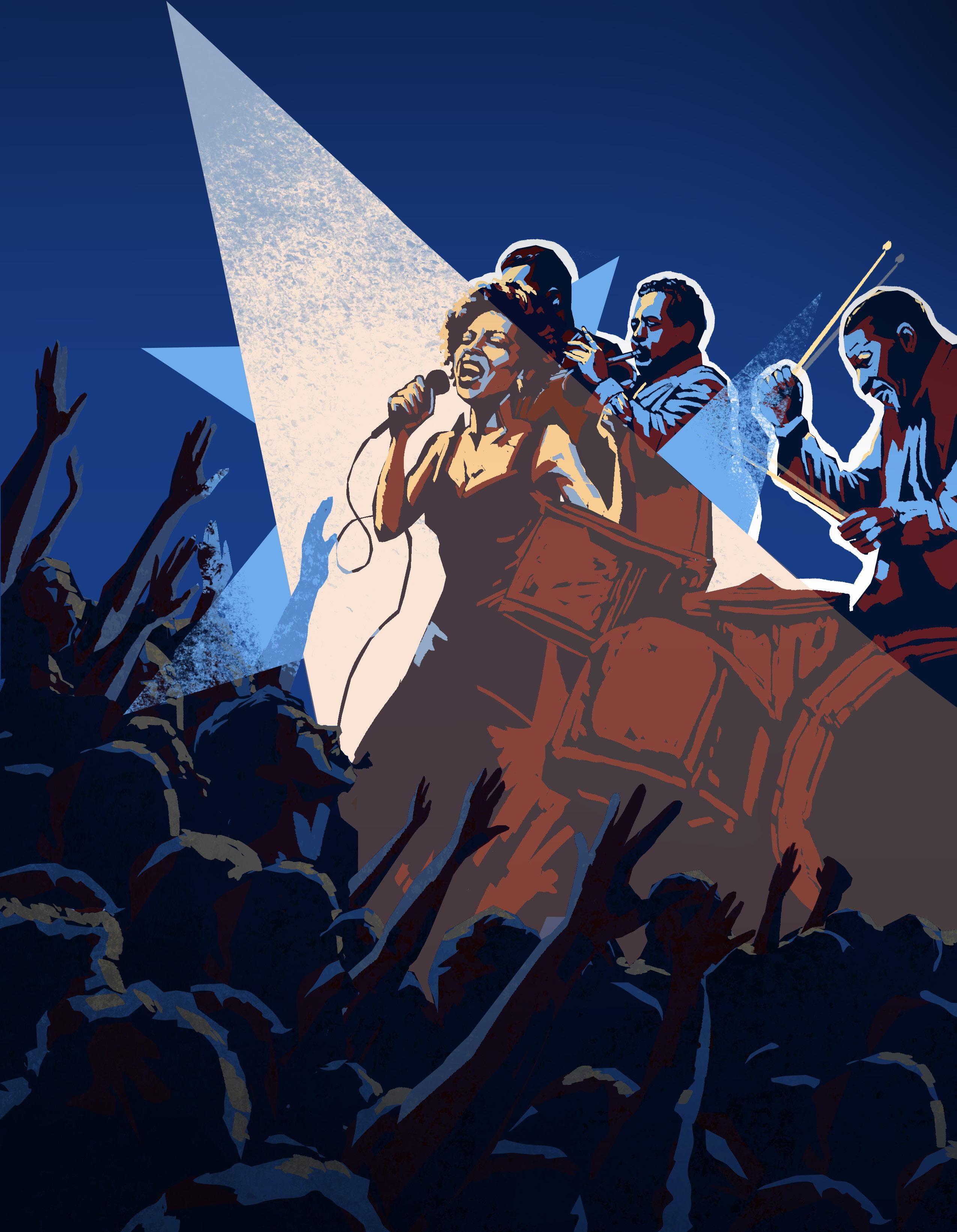
“TIME FOR US TO START TELLING OUR STORY”: CELEBRATING 50 YEARS OF GO-GO
By Alexandra Risi
A LOVE LETTER TO DRUID STONE— AND HATE MAIL TO CONFORMITY
By Paige Benish
IN A CHANGING CITY, D.C.’S REMAINING ETHNIC GROCERY STORES HOLD STRONG
By Sydney Carroll

PAIGE BENISH
QUINN ROSS
ANNA CORDOVA AND EILEEN WEISNER
features “Time for us to start telling our story”: Celebrating 50 years of go-go
ALEXANDRA RISI
In a changing city, D.C.’s remaining ethnic grocery stores hold strong SYDNEY CARROLL
8
features
“Losing that local focus”: What the Post’s layoffs mean for D.C. journalism
PHOEBE NASH
Community, Care, Bagels Etc. EVALYN LEE
D.C. explained: Shadow senators and the fight for statehood
SOPHIA JACOME AND AUBREY BUTTERFIELD
Meet Malikat al Dabke, the all-women troupe keeping dabke alive in D.C.
ROMY ABU-FADEL
on the cover

Editor-in-Chief — Eddy Binford-Ross
Managing Editor of Content — Sydney Carroll
Managing Editor of Operations — Imani Liburd
internal resources:
Exec. Manager for Staff — Chih-Rong Kuo
Exec. Editor for Resources, Diversity, and Inclusion — Elaine Clarke
Asst. Editor for Resources, Diversity, and Inclusion — Renee Pujara
Editor for Sexual Violence Advocacy, Prevention, and Coverage — Olivia Fanders
Social Chairs — Aaron Pollock, Justin Higgins Archivist — Eileen Miller
news:
Executive Editor — Aubrey Butterfield
Features Editor — Alexandra Risi
News Editor — Sophia Jacome
Asst. News Editors — Justin Higgins, Sehr Khosla, Julia Carvalho, Basia Panko
Asst. Features Editors — Sophie St Amand
opinion:
Executive Editor — Evalyn Lee
Voices Editor — Phoebe Nash
Asst. Voices Editors — Olivia Pozen, Jacob Gardner, Colby Kelly, Bridgette Jeonarine
Editorial Board Chair — Darin Eberhardt
Editorial Board — Seth Edwards, Imani Liburd Kamran Darnall-Hirani, Olivia Pozen
leisure:
Executive Editor — Elizabeth Adler Leisure Editor — Lucy Montalti
Asst. Leisure Editors — Ryan Goodwin, Karcin Hagi
Halftime Editor — Aaron Pollock
Asst. Halftime Editors — Joaquin Martinez, Alex Hwang, Quinn Ross
sports:
Executive Editor Anna Cordova
Sports Editor Julia Maurer
Asst. Sports Editors Andrew Swank, Stella Linn
Halftime Editor Eileen Weisner
Asst. Halftime Editors Vince Gude, Lila Gizzie
design:
Design Editor — Paige Benish
Spread Editors — Maggie Zhang
Cover Editor — Michelle Wang
Asst. Design Editors — Pia Cruz, Sophie St Amand, Shabad Singh
copy:
Copy Chiefs — Isabella Baldwin, Madison Weis
Asst. Copy Editors — Lila Wesner, Sonia Pensa, Michelle Lee
multimedia:
Multimedia Executive — Olivia Fanders
Podcast Exec. Producer — Katie Reddy
Podcast Editor — Romy Abu-Fadel
Podcast Asst. Editor — Alaena Hunt
Asst. Photo Editors — Yunji Yun, Ella Qu, Ayman Alam
online:
Online Executive Connor Dwin
Asst. Website Editor Apara Chandavarkar
Social Media Editor Maysam Ider
business:
General Manager Amber Bai
Asst. Manager of Alumni Outreach Elyse van Houten
Asst. Manager of Accounts & Sales Ally Rogers
support:
Contributing Editors Sam Monteiro, Emma Cameron, Alex Lalli, Ninabella Arlis, Eileen Miller, Katie Doran, Tina Solki
Staff Contributors — Izzy Wagener, Ali Chaudhry, Rhea Banerjee, Leah Abraham, Olivia Li, Bradshaw Cate, Cassie Delinsky, Annie Egan, Massimo D’Onofrio, Elle Marinello, Elizabeth Foster, Alexandra Hamilton, Katie Han, Rina Khoury, Michelle Lee, Belinda Li, Aidan Munroe, Rory Myers, Christina Pan, Mahika Sharma, Alexis Tamm, Hannah Yu, Minhal Nazeer
Dearest readers,
It brings me tremendous joy to welcome you to the Voice’s third annual D.C. issue. This tradition, started in 2024, aims to recognize that we do not live in a vacuum on the Hilltop.
In our first D.C. issue, then Editor-in-Chief Ajani Jones wrote that we were presenting “a series of stories that explore the history, culture, injustices, and current events of the city we call home.” This is what we hope to do yet again.
As you flip through this issue, reading these stories and admiring these designs, take some time to reflect on and appreciate the city that we live in. D.C. is a complex, vibrant place that is at once a microcosm of things occurring across our nation and also grappling with its own distinctive set of challenges.
This issue feels particularly necessary after we watched widespread layo!s at The Washington Post earlier this month. With major cuts to the Metro section, which provided the District with its most comprehensive local coverage; the Sports section, one of the nation’s premier athletics desks; and more, local news in D.C. is undeniably worse o! than it was just weeks ago.
Even before then, D.C. was at risk of becoming a local news desert, as many of the journalists here focus on federal politics rather than the District—to the detriment of our city. With these cuts, arguably, the largest newsroom covering D.C. is a
student paper: The Hatchet at George Washington University.
It seems fitting that we are publishing our D.C. issue now, reminding Georgetown students of the city beyond the university’s front gates. This collection of stories is by no means a holistic look at D.C., but we hope that in these pages we’ve captured some of the diversity, community, and challenges that make this city special.
Now is a good time to also remember that our commitment to D.C. coverage does not begin or end with this issue. You can find continued reporting on District arts, news, sports, and more at georgetownvoice.com and in (nearly) every issue we publish. As I wrote in my letter at the beginning of this semester, we always believe that we belong to both the city and the students.
However, I do feel as if there’s something special about dedicating one of our seven issues to the city we call home. This tradition is perhaps what I am most proud to be leaving to the Voice and I hope it continues long after I graduate.


“Time for us to start te ing our story”: Celebrating 50 years of go-go
BY ALEXANDRA RISI DESIGN BY LUCY MONTALTI

own, known for vivid instrumentation, heavy congas, and a call-and-response between the artists and the audience. Guitarist and singer Chuck Brown shaped the style by combining Latin, R&B, and hip-hop sounds to keep people “going and going” on the dance floor in between songs.
As go-go approaches the 50th anniversary of its creation, artists and activists in the District are reflecting on the importance of go-go to D.C. and the ongoing mission to preserve this music through cultural changes.
For Brown, often referred to as the “Godfather of go-go,” success came fast, with countless songs and albums that embodied a distinct identity for D.C. residents. His most popular single, “Bustin’ Loose,” topped R&B charts and helped establish go-go in the national consciousness.
The genre has adapted alongside the city itself, shifting its sound to blend with other popular music styles of each time period, from hip-hop and gangsta rap in the 90s to a modern “bounce beat,” which brings heavy percussion and high energy with a hip-hop rhythm.
However, go-go has previously been harshly criticized by mainstream media and denied support by D.C. officials. In the 1990s, when D.C. was considered the “murder capital” of the U.S., police and government officials characterized go-go as synonymous with violence. Many go-go clubs were forced to close after being blamed for inciting violence, leaving the remaining parts of the go-go community wary of interacting with the greater D.C. area.
Moten explained that Black music has frequently been influenced by other cultures, taking away some of the authority that Black artists have.
its emphasis on call and response and audience interaction continues to define go-go as an inclusive, community-based music style.
From go-go to JoGo
Elijah Jamal Balbed recalls driving down Georgia Avenue and hearing cars and buses blasting go-go music. Later, as a jazz musician at Howard University, Balbed got the opportunity to play the saxophone alongside Brown during the final months of his life. The experience solidified Balbed’s interest in the genre and inspired him to begin his own band.
While doing an artist-in-residence program at Strathmore, a music center in North Bethesda, Balbed founded The JoGo Project, a band that blends go-go and jazz music. For Balbed, however, this meshing of styles isn’t particularly unique.
“If you listen to Chuck Brown in particular—especially Chuck—he was a huge jazz head, but even Trouble Funk, Little Benny and the Masters, Rare Essence. A lot of these bands have, if you will, ‘JoGo’ within them already,” Balbed said.
Nevertheless, distinguishing the band and finding a way to create a unique sound were, at times, challenging for the JoGo Project.
“I think in our early days, it was definitely an experiment for one, but we were also trying to find that balance of, are we a jazz group with some go-go elements? Are we a go-go band that has jazz elements within it, or is it 50/50?” Balbed said.
The band performs across the country and, in 2019, won their first Wammie, an award recognizing talent in the Washington Metropolitan area. They won the award for best go-go song for their single, “Dear
you find that some people come here with the intention of leaving, but they fall in love with it and stay for years and sometimes decades,” Balbed said.
For Balbed, D.C. and go-go are inextricably linked. The artist said that the style is “a part of the breadth and the fabric of D.C.” However, Balbed noted that go-go has not always been celebrated. He said the impacts of gentrification in D.C. have tried to silence go-go, and that officials and some residents have criminalized the music.
In spring 2019, a Central Communications electronic store in Shaw received noise complaints from residents in a nearby building for playing go-go music. While the city monitored the sound and said noise levels were okay, the resident complained to T-Mobile, the corporation overseeing the store, and T-Mobile agreed to stop the music. This sparked the beginning of the Don’t Mute D.C. movement, led in part by Moten, and an online petition to bring back the music that gained more than 80,000 signatures.
The movement aimed to protect Black artists’ right to free expression in D.C., and helped bring the music back to the store.
“All these folks came together, essentially, and actually, I think, to a lot of people’s surprise, advocated for ourselves as a community. And that was pretty monumental,” Balbed said. “It shows what can be done when we all come together.”
A go-go museum for D.C.
Moten’s concern that go-go was not properly celebrated in D.C led him to bring more attention to the genre at the 2009 GoGo Awards. In front of 4,000 people, Moten announced a plan to build a museum purely dedicated to go-go.
“It was D.C.’s official music, but not labelled as D.C.’s official music. Our music was not being supported,” Moten said.
For many D.C. residents, especially Black Washingtonians, go-go has become a defining aspect of their community. Moten founded the Go-Go Museum and Cafe in Anacostia to create a space for Black people to have agency over their music and celebrate go-go’s history.
While it took some time to begin work on the project, a virtual museum launched in 2020. In 2019, construction of the Go-Go Museum & Cafe began, and the brick-andmortar museum launched in 2025.
Nestled in Anacostia, there now lies a quaint building and cafe rich in history. Featuring 60 physical artifacts and 300 digital artifacts, the museum is a celebration of D.C. culture.
For Natalie Hopkinson, helping to found and curate the Go-Go Museum was a continuation of her work to preserve this music. Hopkinson is currently an Associate Professor of Media, Democracy, and Society at American University, as well as the chief curator of the museum. She has done extensive research on go-go as a journalist and for her doctoral thesis.
because of the way that the music had been treated by mainstream media, they just were not interested.”
This was a welcome challenge for Hopkinson, who dedicated time to understanding the world of go-go.
“How I understand go-go is that it’s a Black and Indigenous knowledge system,” Hopkinson said. “Go-go was kind of a cultural information network, kind of a news network, a way of sharing news and building community.”
Hopkinson worked alongside Moten to bring his vision of a museum to life and better understand this community. She felt particularly motivated by the local support she saw for Moten’s ideas.
Initially, the group wasn’t sure if they’d be able to raise money for the museum. They were told by the city that the museum would cost $8 million, but they only had about $3 million to work with. However, seeing the support from the community, particularly during a telethon Moten held for the museum, helped move the process forward.
“I was deeply moved by the reaction to the community, and how people came out, and they gave their money. They pulled over and gave crumpled ones and $5 bills,” Hopkinson
for example, you also have to protect it, and make sure that it can thrive,” Hopkinson said. “And so there’s definitely more that could be done.”
Moten said that the money the Go-Go Museum has received from D.C. is “nowhere near what we need to survive.” He said that more attention and resources dedicated to go-go will result in more people joining the go-go scene as patrons or as artists.
Celebrating 50 years
Over the past few years, and for the 50th anniversary of go-go, D.C. officials have been hoping to bring more visibility to the genre. Through the D.C. Public Library, the D.C. Office of Cable Television, Film, Music, and Entertainment (OCTFME) established “Keep the Beat Week” to archive recordings, photographs, flyers, and oral histories so future generations understand the origins and impact of go-go.
“Protecting Go-Go is not just symbolic; it is also about preserving culture, strengthening neighborhoods, and investing in a creative ecosystem that supports artists and small businesses,” OCTFME wrote to the Voice
OCTFME also mentioned a variety of concerts, community events, and citywide

In a changing city, D.C.’s remaining ethnic grocery stores hold strong
By Sydney Carroll | Design by Shabad Singh
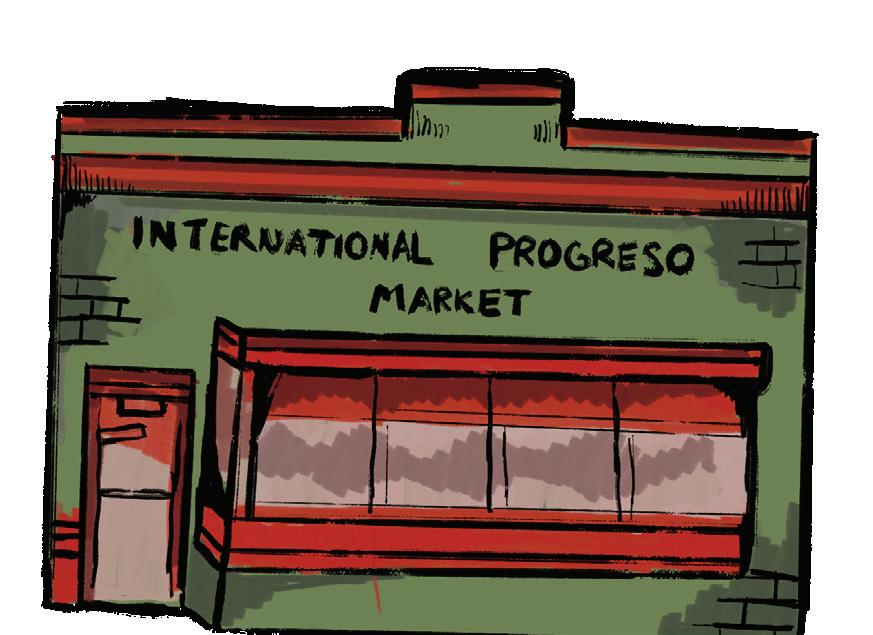
Staffing is a family affair at El Progreso Market in Mount Pleasant. While Meris Ramos sits behind the counter, her parents and her teenage kids can be found working, as customers shop for homemade chorizo, horchata mix, and prayer candles.
Since her family came to the U.S. from El Salvador in the 1980s, hard work has been their way of life.
“That’s how we started—cleaning houses and offices. We come from a working family,” Ramos said.
While El Progreso has been around since the ’80s, the Ramos family took it over around 20 years ago. Today, the market stands as one of D.C.’s last options for Latino customers shopping for tastes of home.
“We have [customers] from Central, South America. We have Caribbeans. We have Africans. It’s a little bit of everything—and the whole neighborhood as well,” Ramos said.
This diverse customer base comes as D.C. has experienced some of the most intense gentrification in the country over the last 50 years, with Black residents making up 71% of the city’s population in 1970, but only 43.4% today. At the same time, D.C.’s population of non-Black minorities has increased. In 1970, Asians made up less than 1% of the District, and “persons of Spanish descent” were around 2.1%. As of 2025, Asian and Latino residents comprise 5.5% and 12.6% of D.C., respectively. D.C.’s immigrant population has also grown, from just 4% of the city in 1970 to 15% as of 2024.
Despite a growth in immigrant and nonBlack minority populations, D.C.’s supply of ethnic grocery stores has shrunk. Pushed out by high rents and increased competition with large chains, many of D.C.’s historic, immigrant-owned grocery stores have been forced to shut their doors.
This has lasting consequences for the shoppers they leave behind, who are now forced to trek into Maryland and Virginia to find the imported ingredients they use every day. Senior
residents in Chinatown, for example, board buses chartered by Wah Luck Adult Day Care Center and ride 30 minutes, foldable shopping carts in tow, to shop for Chinese foods and products at Great Wall Supermarket in Falls Church, Virginia.
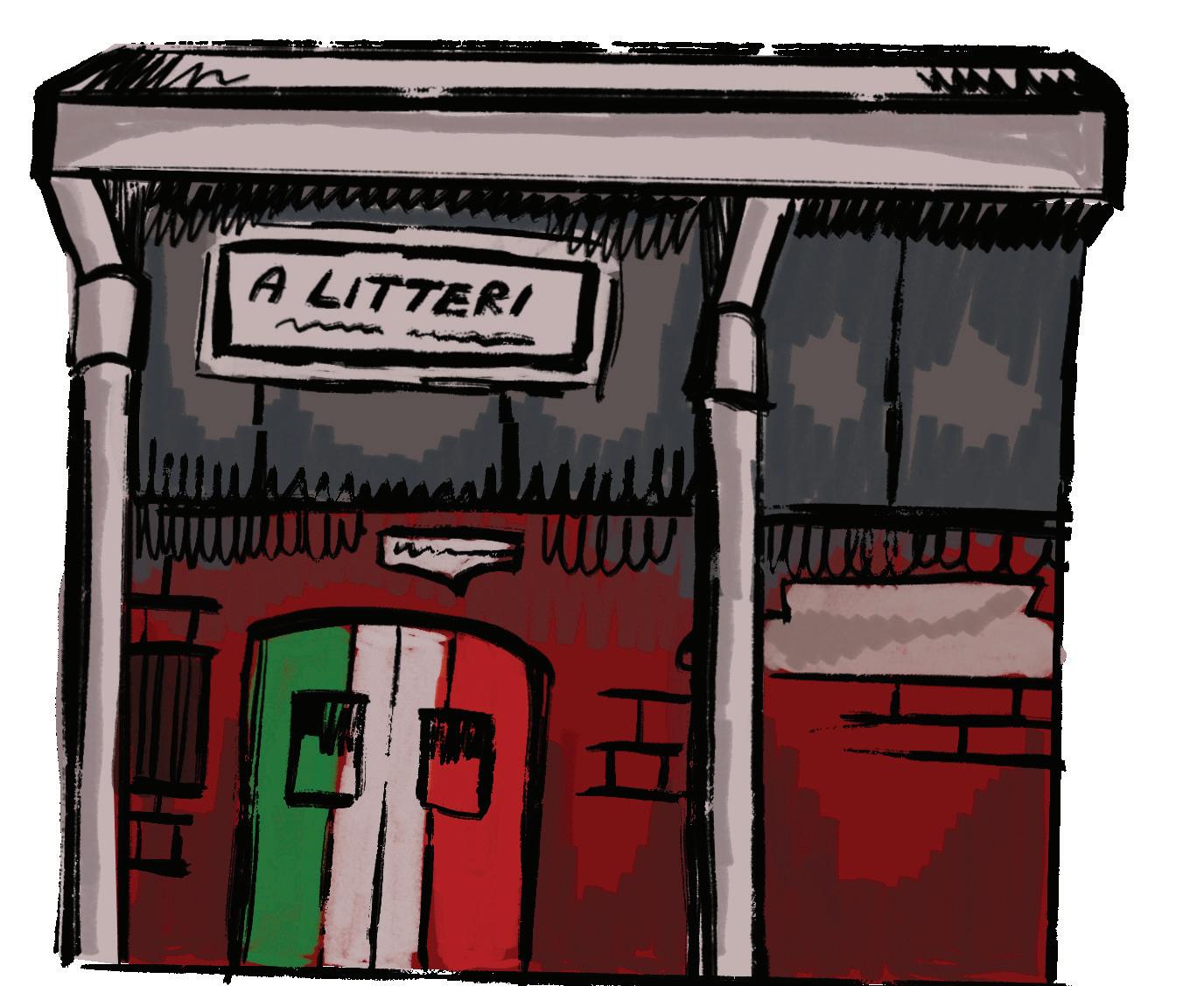
Nestled inside Union Market behind doors painted red, white, and green is A. Litteri, an Italian market selling imported Italian oils, sauces, and snacks, and serving up their own homemade subs, sausage, and cannolis. Owner Max Evans, who acquired the business in 2020 after selling wines to the original family owners, said that even though the neighborhood around it has changed, the store’s legacy is still intact.
“We opened 100 years ago,” Evans said. “There was an Italian community that doesn't really exist so much in the city anymore, but there was at the time, and we’ve been here since then.”
A. Litteri is one of the few ethnic grocery stores left standing in Union Market, which has seen an exodus of working-class ethnic retailers in exchange for chains and private equity-backed ventures. The area, then known as Florida Avenue Market, was pitched for redevelopment in 2009 by the DC Office of Planning.
For much of its history, Union Market’s vendors were mostly “Jewish, Italian and Greek wholesalers, groups eventually succeeded by African, Chinese and Korean immigrants,” according to The Washington Post’s Metro section. This all changed with its renewal. While the market “represents a very diverse and unique pocket of D.C.,” the Office wrote in the 2009 study that the market had come under “substantial pressure” to be
A. Litteri has been able to stay afloat; however, many other longstanding Asian and African wholesale vendors have been priced out in the “redevelopment” process.
A. Litteri was once a centerpiece of D.C.’s Italian-American community, but today its customer base is more eclectic.
“We still have a lot of older customers that come in that are of Italian descent, for sure, but we are a mix of everybody,” Evans said. “I try to keep it as much like it always was as I can, while also catering to a different clientele that didn’t exist in this neighborhood historically.”
Beyond changing demographics of those living in the city and shopping at these markets, recent federal actions have also disproportionately impacted local grocery stores and their clientele. Since President Donald Trump’s inauguration, Immigration and Customs Enforcement has cracked down on the city and, according to the most up-todate data, deported over 12,000 individuals in the D.C. area between January and October 2025. This has impacted businesses across D.C., and El Progreso is no exception.
“A lot of customers have been deported,” Ramos said. “And people are just scared. Some come from Maryland, and [deportations] are still going on in the [outskirts] of D.C.”
However, she said that the community in Mount Pleasant—an area in D.C. with a large Latino population—has stepped up to support El Progreso.
“We haven’t felt it, due to the fact that I think the community here in Mount Pleasant resists,” Ramos said. “We’re just fortunate. We’re very lucky that we’re here in Mount Pleasant, the community is great.”
The key to survival, both stores’ owners say, is this community support. Evans says that A. Litteri is “the busiest that we’ve ever been,” and that they feel incredibly lucky to be in that position. Ramos, too, pointed to the support she’s felt from her neighborhood.
In an age where massive chains and bigbox vendors dominate the space, keeping small stores alive is a conscious effort.
“If you need something, instead of going to the big Giant or Safeway, you can just help your community, moms and pop markets,” Ramos said.
Community, Care, Bagels Etc.
BY EVALYN LEE | DESIGN BY PIA CRUZ
“Hot Bagels” glows on a red and purple neon sign, beckoning to carb-craving customers. Handing out a card with an order number, a woman at the cash register shouts, “Next!” Behind the counter, the workers speak Korean, interspersed with orders in English: “Everything, egg, and cheese!” A line snakes down the length of the store, but moves quickly as brown paper bags, fivedollar bills, and co!ee cups are exchanged between the fast hands of workers and the sluggish ones of hungover customers.
This is Bagels Etc., a Dupont establishment that will celebrate its 40th anniversary this April. In my completely biased (but heartfelt) opinion, Bagels Etc. serves the best bagel.
When I vocalized this claim in the newsroom, it caused a stir. One Voice colleague said her local bagel shop in Boston reigned supreme. Some adamantly defended New York City bagels as incomparable to other ring-shaped posers. Among the East Coast metropoles, this carb source seems to cause much controversy and debate. The bagel is political. And what city is more political than D.C.?
The nation’s political machine runs on bagels. In 2023, Rep. Dan Goldman (D-N.Y.) launched a bagel caucus in Congress, a bipartisan event to taste test D.C.’s bestknown bites. Government officials also fuel bagel businesses themselves. Jeff Zients, Biden’s former chief of staff, was a key investor in Call Your Mother—the first D.C. food establishment Biden visited after his inauguration.
However, unlike the dense $15 bagels at Call Your Mother, Bagels Etc. makes me actually want to call my mom. As a one-and-a-half generation Korean American, I was surprised to find Koreans selling bagels, a breakfast staple that rose to national fame thanks to Jewish immigrants and baker union organizing. Bagels Etc. epitomizes the spirit of American food tradition—one that was started and sustained by immigrants. This is a bagel that actually deserves presidential recognition.
Given my pretty much nonexistent Korean language capabilities, I nervously asked the owners for an interview. The owner, Judy Kang, delegated her son and store manager, SuChan Kang, to have a conversation with me.
SuChan told me his mom used to be a piano teacher and his dad worked at various 7-Elevens. Eventually, they found their way to bagels.
“Before it was a Jewish family that owned this, and I guess my dad came here to just learn. They sold it to us,” SuChan said. “A couple months ago, the previous owner called us because one of his family members came, and they saw this still running, and so he came to congratulate my dad. He was close to 100-something.”
Bagels Etc. is a long-standing Dupont staple, carrying on the legacy of its previous owners. They did not just “pop up” like trendy, line-forming chains such as the aptly-named PopUp Bagels opening on Wisconsin Avenue. Bagels Etc. stays true to tradition, one passed down from Jewish to Korean immigrants, focusing on freshlybaked bagels without fuss.
In addition to serving delicious bagels, the Kangs’ loyalty and dedication to service are evident in their hustle.
“We never close. Open 365 days a year,” SuChan said. “Even when it’s snowing outside, [my parents] sleep next door, and they come to work in the morning. They’re very dedicated. [...] I realize that it’s not easy to do, and I’m trying to keep up with their expectations, and it’s never easy.”
As a cash-only business, I set aside “bagel bills.” My usual order—an everything bagel with egg, cheese, and sprouts plus a large coffee—totals $9, a friendlier price


not, it’s okay. Donation, whatever.”
Their grace and kindness keep customers coming back. Switching to Korean and putting my comprehension skills to the test, Judy explained how one of their customers would bring their kids to get bagels. Then those kids grew up and got married, but continue to visit the shop. Now, they bring their own kids to Bagels Etc.
The Kangs’ bagels raise families. They don’t pander to tourists or social media marketing gimmicks. Bagels Etc., a long-standing local business, preserves the warmth of community and care. Especially with increasing militarization in the District, where the deployment of armed National Guard makes the city feel less welcoming and me feel less safe, businesses like Bagels Etc. retain a sense of home and comfort.

At Bagels Etc., orchids and green plants decorated with bagel ornaments line the windows and any available counter space. The efforts to enliven an urban space with plant life reminded me of my aunt, who decorates her Chicago coin laundry with orchids planted in recycled detergent bottles. I never expected to be reminded of my own family in a D.C. bagel shop. I asked SuChan: “Who is behind the greenery?” He said his mom and an employee, who has worked at Bagels Etc. for over 35 years, both love planting and making the space feel like home.
Before Judy left to address the swell of incoming customers, I asked her what the secret was behind her bagel. She answered simply: “I think bagel is very good bagel. Everybody likes them.”
I told her, “Maybe they like you!”
“Losing that local focus”: What the Post’s layo s mean for D.C. journalism
BY PHOEBE NASH | GRAPHICS BY PAIGE BENISH; LAYOUT BY TINA SOLKI
APost to the sta at the rapid response culture reporter, was among those laid o
Suddenly, the Slack channel for the Post with identical messages reading “I’m eliminated.” Then she saw the names of people on her team.
“Seeing just the sheer number of how every single department basically was hit in some way, I think it was just shocking,” Ferguson said.
That Wednesday, the estimated 44% to 47.5% of its journalists in an e email from Murray to the newsroom. Now, D.C. journalists worry about what these changes will mean for the future of media in the District, especially in a city where local news coverage has faced major cuts for years.
The will close, along with their premiere daily podcast, International sections will be fundamentally reduced. And, as a significant portion of the photo team was cut, the Prize-winning visual coverage is expected to su
After a company-wide call, employees were notified by email whether they were laid o
“I honestly think it was ruthless what they did and how they did it,” Ferguson said. “I mean, to just send a generic email without even putting my name on it.”
For Ferguson and many others, working for the
“It was representation in the sense that, being a young woman of color, I felt like there were so few of us there. And then responsibility, because I’m also from Prince George’s County, so it’s my local paper,” Ferguson said.

Further, Dionne remembers that Watergate, one of the biggest stories in U.S. history, started as a local police story.
“When the Post was covering the federal government, it was covering a local industry,” Dionne said. “When it covered national politics, it was covering a significant part of what made this whole area home. So, it’s losing that local focus.”
Dionne believes that strong local newspapers create a sense of place and bring the community together by “becoming a bundle.”
“When you thought of a local newspaper, it was, yes, local, state, national, and international news. But it was also recipes and supermarket coupons and local sports and crossword puzzles and comics,” Dionne said.
After buying the Post for $250 million in 2013, billionaire Je! Bezos met with reporters and editors to emphasize his goal of continuing the “daily ritual” of reading the Post as a collective paper, not individual stories, according to reporting by the news agency.
“People will buy a package,” Bezos told select sta!, the newspaper reported at the time. “They will not pay for a story.”
Now, many point to Bezos as a threat to the paper’s future, with his widespread cuts significantly diminishing the
Andrew Beaujon, a senior editor at Washingtonian, a monthly magazine focused on D.C., recalled a time when the expanded ambition for local coverage, such as when the paper moved into Annapolis and Richmond, covering state governments in Virginia and Maryland.
“The Post has always done a really good job of covering the whole area, and not just how things a!ect middle-class and wealthy white people,” Beaujon said, adding that this is a major problem for the media in general. He worries that the Post breadth of coverage with the cuts.
supposed to alleviate financial issues, with them comes major losses.
María Luisa Paúl, a national breaking news reporter with a focus on immigration, said that despite rumors about downsizing in the weeks prior, the cuts were still shocking. Paúl and her team did not expect breaking news to be a!ected.
“We’re breaking news, and there’s so much breaking news every single day!” Paúl said. “There were just so many weeks of us theorizing and trying to talk ourselves into reasons of why we wouldn’t be cut, or why
coverage nor the first hits to D.C.’s local news ecosystem recently.
Annemarie Cuccia (SFS ’22)—the editorin-chief of Street Sense Media, a street paper focused on reporting about homelessness and poverty—found the Post’s layo!s to be disappointing, but not shocking.
“It seems like the hits sort of keep coming to D.C. journalism,” Cuccia said.
Cuccia pointed to WAMU shutting down DCist two years ago as an example.
Cuccia, as editor of a paper focused on homelessness, is particularly concerned
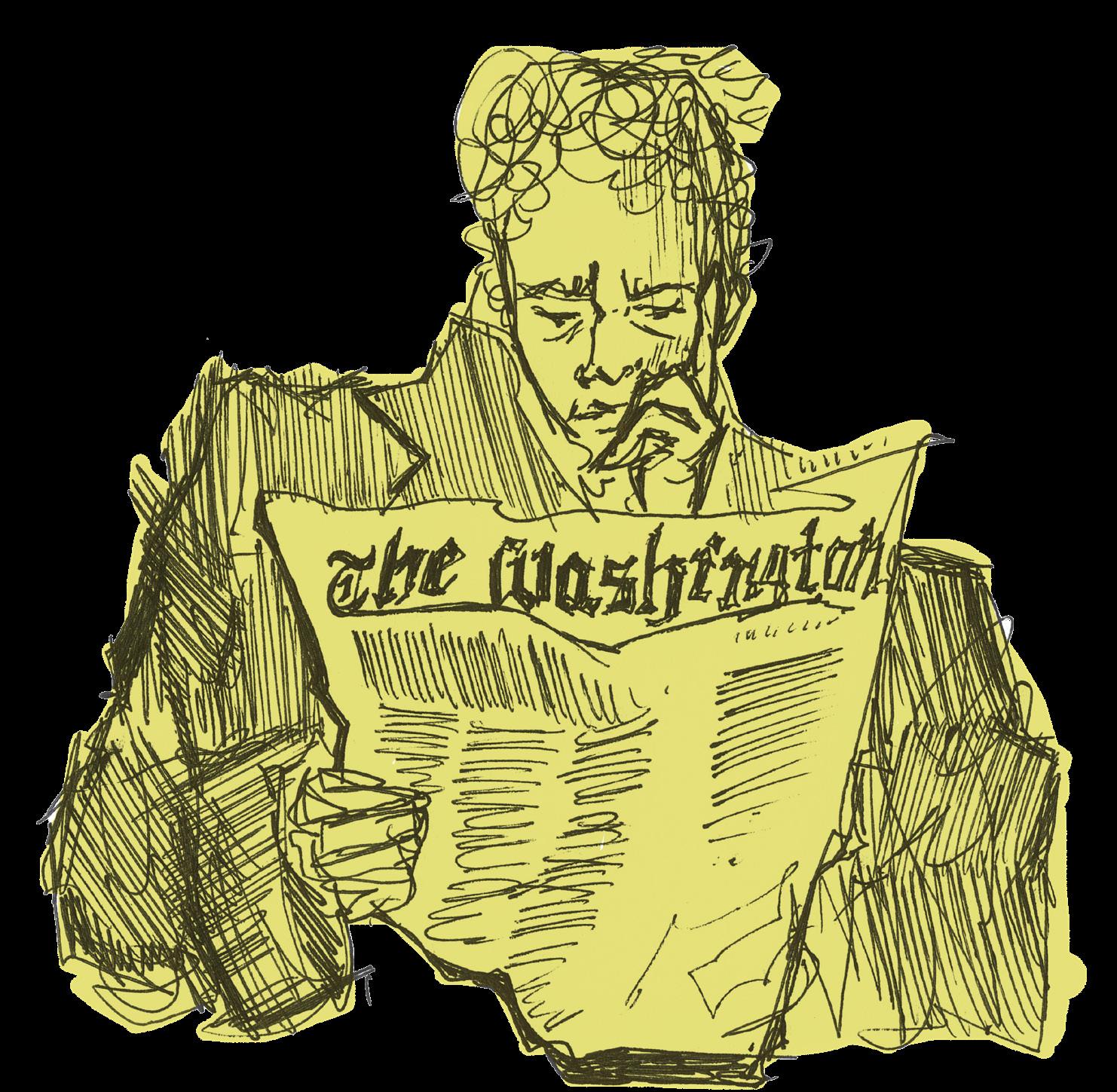
To Beaujon, the Post’s problems are rooted in its leadership issues.
“This is not a content problem that they’re facing,” Beaujon said. “It’s a business problem that one of the world’s wealthiest people and supposed business geniuses who rolled in with all these stupid goals— like that they were gonna get 200 million subscribers—haven’t been able to solve.”
Beaujon fears that with the layo!s, there will be less ability to hold those in power accountable.
“I think Je! Bezos is really ushering in a grand era of political incompetence and corruption. I don’t think he could have done a bigger favor to crooked people in this region,” Beaujon said.
The Post’s problems with Bezos are not new: after he blocked their endorsement of Kamala Harris in 2024, the Post lost over 200,000 subscribers. While the cuts are
output with limited resources. The group, she said, was “truly a microcosm of this country.”
“Each of us brought in our own experiences and our own background, and you could tell how that is important when it comes to storytelling,” Paúl said.
With the cuts, Paúl is worried about the communities that may no longer be covered, including Spanish speakers. Further, she is concerned about what the decline of journalistic coverage means for the U.S.
“The U.S. has a tendency to take [journalism] for granted, because the free press has always existed,” Paúl said. “But I’m from Venezuela, and back home, one of the first things to disappear was the free press. And the moment that journalists stop doing their job, or their outlets start being censored or persecuted, that’s the second you lose democracy.”
The Post’s February layo!s are neither the organization’s first cuts to local
’s housing-related reporting will severely decrease. While the Post once had the capacity to cover the D.C. Housing Authority—particularly coverage of council meetings—Cuccia worries that will be lost, as many housing-related reporters were cut.
’s scope for both local and national coverage di!erentiates it from other District newsrooms, meaning that it cult for exclusively local news agencies to fill in some of the gaps.
“Especially in the coming years, you could see a lot of federally relevant stories coming out of this city, and I think the Post is a good vehicle for that, because it is both,” Cuccia said.
Cuccia pointed to The 51st and as examples of local publications that may expand their local
“I’m curious. There’s one world in which maybe it looks like a lot of Post journalists are still reporting in D.C., but at di!erent outlets,” Cuccia said. “So local reporting is still there, but less concentrated.”
Similar to Cuccia, Mitch Ryals, the Washington City Paper, sees potential for local publications.
“It appears as if there will be sort of, at least initially, a hodgepodge of local outlets that are going to try and make up for will be lacking,” Ryals said. He is worried, however, that the impact of the Post’s layo!s will be hard to track because stories just won’t get reported on. While Washington City Paper has scaled back their print publication, Ryals hopes his team can increase the quantity of local coverage.
“The role of journalists is an essential part of democracy, which we still have here, thankfully, at least for now. So there will always be the need for news and for information and for honest, hard-working, truth-seeking storytellers,” Ryals said.
Ryals also remains hopeful because of community responses to the cuts.
“Seeing all the support and the clamor and all the buzz around people wanting to step up after the announcement of the layo!s is evidence that people recognize the value of this work and of these roles,” Ryals said. “I’m holding on to that for as long as I can.”
D.C. explained: Shadow senators and the ght for statehood
BY SOPHIA JACOME AND AUBREY BUTTERFIELD DESIGN BY ELLE MARINELLO
Ankit Jain has been involved in activism for D.C. statehood for years, handing out flyers and attending rallies. But in 2023, Jain witnessed what he saw as a major slight to D.C.’s local autonomy: Republicans in Congress shut down D.C.’s attempt to rewrite its local criminal code.
“I watched that with a large degree of frustration. I thought a large reason we failed in our efforts was because of poor leadership,” he said in an interview with the Voice.
The voting rights attorney decided to run for office to fight for increased autonomy for the District.
Jain took office last year as one of D.C.’s shadow senators, an elected official working alongside Congress without congressional voting power. Jain represents the people of D.C, with fellow shadow Senator Paul Strauss and shadow Representative Oye Owolewa.
The District also has a delegate to the House, Rep. Eleanor Holmes Norton, who can introduce legislation, make speeches, and vote in committees, though she can’t vote on legislation. Jain, Strauss, and Owolewa can take none of those actions.
Shadow senators and representatives represent subnational polities—political entities under the federal level, like territories—before they achieve statehood. Today, the nation’s capital and Puerto Rico have these elected officials.
D.C.’s shadow delegation lobbies for statehood and legislation that protects the interests of the city and its residents, according to Jain. They also work to prevent congressional interference within District affairs, defending the D.C. Home Rule Act, which allows D.C. to govern itself and elect its own local representatives.
“I have always believed that statehood should not be a partisan issue. It’s about 700,000 tax-paying American citizens being denied the right to vote,” Jain said.
Jain and his colleague, Strauss, frequently travel far from D.C., speaking to state legislative bodies or petitioning the United Nations to build popular support for statehood.
“Sometimes the best way to [achieve statehood] is by getting out of Washington, D.C., going to targeted states, working with leaders in other parts of the country to promote the issue,” Strauss said.
Historically, states like Tennessee,
California, and Alaska used shadow senators to petition Congress for statehood. Each of these states took years to achieve statehood, with Alaska taking nearly five decades.
“Statehood can take a while,” Strauss said. “It’s challenging to have to explain that to a justifiably impatient electorate who is clamoring for change.”
Jain’s office sits in a D.C. government building, not a congressional one, but most of his days consist of meeting with members of Congress.
“I’m like D.C.’s elected lobbyist for our rights before Congress,” Jain said.
He believes his biggest asset in the role is building connections. He meets with the media and other officials to draw attention to bills important for D.C. residents. He also coordinates advocacy strategies with D.C.-based organizations that are fighting for statehood.
Jain said that there’s a lot of work to be done on Capitol Hill to fight for D.C.’s autonomy.
On Feb. 12, Congress voted to block a D.C. Council measure to separate local tax code from the One Big Beautiful Bill Act. This is the fourth time Congress has blocked local D.C. legislation through a disapproval resolution since the 1973 Home Rule Act.
“D.C. is at more risk than it has ever been,” Jain said. “We’re at the point where we can’t even pass a budget.”
With this resolution, alongside the deployment of the National Guard to D.C. last summer, attacks on D.C.’s residents have increased under the Trump administration, Jain said. Jain hopes that this will fuel the fight for statehood.
D.C., believes that D.C. deserves senators who have the same resources and power as the rest of the country.
“They’re not doing the job that a senator does. They’re doing a different job, that hopefully at one point will not be needed because the District will gain statehood,” she said.
For Yass, the fight for statehood is particularly important to enfranchise the historically Black and brown city. Currently,

“The president’s interest in D.C and all these attacks on D.C. are raising awareness around the country about the harms that D.C. has to suffer because we’re not a state,” Jain said.
D.C.’s first shadow senators were elected in 1990, after the D.C. government established the position. Since then, D.C. has elected five. One of the first was Rev. Jesse Jackson Jr., a renowned civil rights leader who died on Feb. 17.
While Strauss and Jain continue to fight for statehood through their elected positions, other organizations are working to lead community-based efforts. Alicia Yass, the supervising policy counsel at the ACLU of

Wh do yOu meAn | n’t sWim in e P omAC?
BY COLBY KELLY / DESIGN BY SHABAD SINGH
When I realized the college I’d be attending was next to a beautiful river, I was ecstatic. Growing up swimming, diving, and eventually becoming a certified lifeguard, I spent every summer submerged in the lakes and rivers of Washington state. I hoped the Potomac could provide me with familiarity in a place that was otherwise new.
A few weeks into the fall semester, I began to yearn for that feeling of jumping into cold, fresh water—shocking your system awake and connecting you to your surroundings. Gazing at the Potomac from the Healey Family Student Center patio, I assumed swimming downtown was off limits, but there had to be somewhere nearby. After a quick search, I found Scott’s Run Nature Preserve, which looked perfect: a quiet trail and a natural swimming hole.
My friends and I arrived optimistic; I was ready to swim, and they were ready to see if I’d follow through. Bets were placed as we drove over but not even two steps onto the trail, we saw it: a Parks and Recreation sign with low-budget, frightening graphics and big letters reading “NO SWIMMING, BATHING, OR WADING.”
So much for that.
Ironically, our group of overachieving academics had clearly failed to do any research beyond looking at the pretty pictures. Not wanting to give up, we debated whether the fine was worth it, ultimately deciding it wasn’t. But I couldn’t stop thinking: there must be a good explanation for the rule, right?
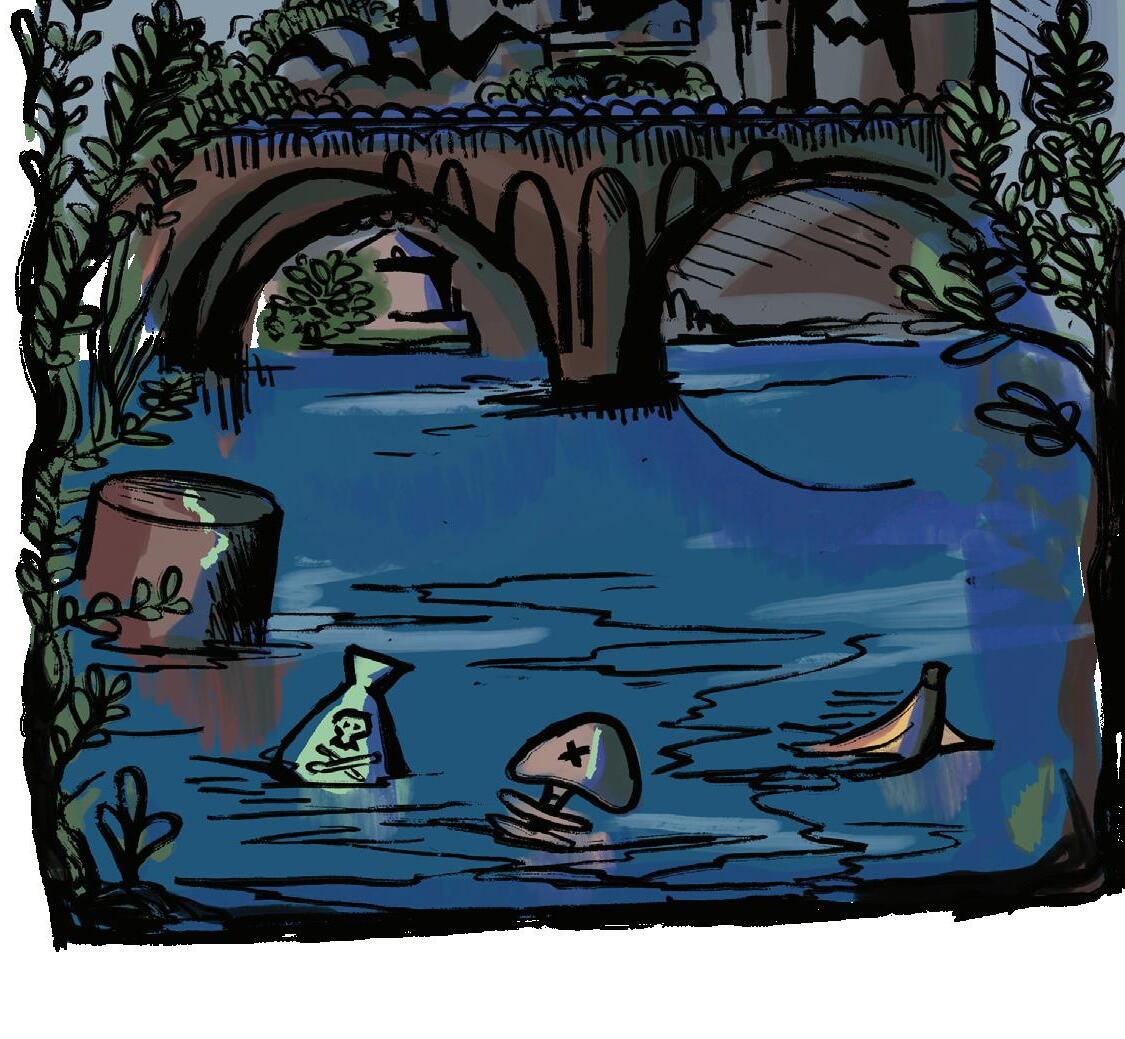
As we kept hiking, that reason became clear fast: dozens of car tires, plastic bottles, shopping carts, and other unidentifiable trash floated downstream.
Back home, the lakes and rivers were meticulously maintained. Washington state has strict water quality standards, regular testing, and aggressive cleanup programs to keep waterways swimmable. I’d spent countless summers jumping off docks without a second thought. It was just a given that the water was clean enough to swim in.
Standing there looking at the Potomac, I couldn’t understand it. This is our nation’s
capital. If Washington state and even its much less relevant neighbor, Idaho, can maintain clean, swimmable waters, shouldn’t D.C.—the place where federal environmental policy is written—be doing even better?
I pulled out my phone to research. Turns out the Potomac isn’t just littered with trash—it’s contaminated. Sewage, wastewater, and agricultural runoff (think pesticides and fertilizers) from shopping centers, developments, and farms upstream flow right into it. It wasn’t just illegal to swim here. It was dangerous.
The longer we walked, the more the severity of the situation hit me. The water was still. No fish, no frogs, nothing. Just a murky, lifeless river choked by human waste. And this isn’t some forgotten industrial wasteland. This is where lawmakers debate environmental policy while the river less than a mile and a half away is too toxic to touch.
I was reminded of that hike recently when the news broke about the recent sewage spill in the Potomac. On Jan. 19, a major sewer pipe collapsed, dumping around 243 million gallons of wastewater into the river. In the following days, DC Water, the city’s utility authority, and University of Maryland researchers tested the water.
The results were horrifying.
Researchers found E. coli levels more than 10,000 times higher than what is considered safe for recreational water. They also detected staph bacteria, including MRSA, a dangerous, antibiotic-resistant pathogen that can cause serious infections via skin contact or accidental swallowing.
While DC Water later updated the report that most downstream sites met federal safety standards, “meeting standards” does not mean it is clean. It means barely acceptable for limited contact—not safe, not healthy, and certainly not swimmable.
If the river running through the nation’s capital is not clean enough for people to touch, what does that say about environmental protection for the rest of the country?
Most concerningly, the pollution isn’t distributed equally.
The Anacostia River, one of the Potomac’s largest tributaries, has been dangerously contaminated for decades. The National Oceanic and Atmospheric Administration reports that the Anacostia contains hazardous chemicals, including pesticides, heavy metals, and other pollutants that are known to disrupt the immune system, cause cancer, and alter children’s cognitive development.
The contamination is not a coincidence; it’s the product of deliberate planning and policy. Federal redlining in the 1930s designated Black and low-income neighborhoods as “hazardous,” turning them into cheap land for industrial development. D.C.’s waste transfer stations and other polluting infrastructure followed. D.C. has since sued the federal government for over a century of dumping pollutants into the river, which has disproportionately burdened these communities. A report on air pollutants found that life expectancy differs by as much as 21 years between wealthier wards and Wards 7 and 8, which are near the Anacostia. The report attributed this gap directly to an unequal concentration of pollution in these neighborhoods.
Ultimately, as frustrating as it is that we can’t swim in the Potomac, it’s unacceptable that the pollution has impacted the health and livelihood of these communities for so long.
In order to connect with our natural environment, or what I like to call going feral, we must ground ourselves with the wild, unpredictable world around us. But we can't reconnect with nature when we’ve destroyed it. We need to hold polluters accountable, demand our policymakers increase funding for cleanup projects, and create measures that improve the health of the environment and those who most directly face its consequences.
The Potomac should be swimmable. It should be alive. And the fact that it’s not—in the capital of one of the wealthiest nations in the world—is a failure we shouldn’t and can’t tolerate.
Meet Malikat al Dabke, the all-women troupe keeping dabke alive in D.C.
BY ROMY ABU - FADEL
GRAPHICS BY MASHA MILLER; LAYOUT BY LUCY MONTALTI
What began as a dance workshop open to dancers of all skill levels has become Washington, D.C.’s first allwomen dabke troupe—a cultural anchor for the five Arab American women who make up Malikat al Dabke.
Dabke is a folk dance that originated in the mountains of the Levant, encompassing Lebanon, Palestine, Jordan, and Syria. The word dabke derives from the Arabic word dabaka, meaning “stamping of the feet.”
In dabke, dancers form a line, join hands, and stomp to a six-count rhythm, following a leader who keeps the pace. Each dancer relies on the two others beside them—chemistry, trust, and an instinctual awareness of the music and changing rhythm are crucial to the tradition.
Shared experience dancing with university teams drew the five women of Malikat al Dabka to each other, as they searched for a way to preserve traditions in spaces so far from home. The space they created, Sonia Abdulbaki said, organically evolved into a collaborative, professional dance troupe in Jan. 2023.
“We had choreographed dabke together in college and wanted to start a team,” Sonia said, speaking of her sister, Mae Abdulbaki. “It felt like a dream

Three years later, Malikat al Dabke now hosts dabke classes and workshops in D.C. and has performed across the United States, including at the Kennedy Center, the New York Arab Festival, and several embassies. However, these opportunities did not come easily.
The women each balance a full-time job while managing the dance troupe. Mae freelances as a film critic while coordinating Malikat al Dabke’s events and managing finances. Sonia, a user experience designer, has taken those skills and acted as their social media manager and
The women say there are
“We have full autonomy over our decisions and can navigate the direction we take toward achieving our goals and creative vision as a group,” Mae said.
“We don’t do it full-time yet, but that would be a dream,” she continued. “We love dabke, we love each other, and I think that translates into our performances.”
Each member’s decade of experience and passion shines through when they perform, hand in hand and smiling brightly. Malikat al Dabke’s collaborative spirit is evident.
“We all take part in choreographing dances. We learn from each other’s strengths,” Sonia said.
The troupe blends traditional dabke styles—Lebanese shamaliyya, Palestinian mish’al, and Iraqi chobi—with each other. They also incorporate newer, more modern variations, representing the varied backgrounds of the troupe’s members.
Washington, D.C. is one of the U.S. cities with the largest Arab American population, according to the Arab American Institute. Despite the approximately 11,000 Arab American residents, there is a noticeable lack of dedicated cultural spaces beyond restaurants and a limited number of art venues.
By studying, teaching, and performing dabke, the troupe aims to honor Lebanese heritage in D.C., reimagining and preserving centuries of history.
“When a lot of people think of dabke, they think of the very basic shamaliyya dabke,” Mae said. “But when you break it down, there are so many variations of dabke to learn, and that’s what makes it fun. The creativity doesn’t stop.”
The varying dabke styles are reflected in the troupe’s costumes. The women don traditional Palestinian tatreez robes, open diamond-patterned vests purchased from Jordan, and shimmery green Lebanesestyle gowns, as well as their black leather boots, the foundation of every costume.
“I have a dream of sketching out designs we really want and finding a designer who can make them,” Mae said. Sourcing traditional costumes in the U.S. is difficult, often resulting in garments that are too thick and stiff to comfortably dance in.
While the women stay connected to their roots through dabke, the context of where they are living and performing is not lost on them. Often, the troupe has to
navigate performing in front of crowds who have never seen dabke live before, and who sometimes lack an understanding of women’s historical role in the tradition.
Dabke is often portrayed as a male-dominated art form—but in Lebanon and across the region, both men and women have historically danced dabke.

“There’s always the random person who will ask a very sexist question,” Mae said. “But usually non-Arab communities are very enthusiastic and want to learn more. They are intrigued by dabke’s origin stories and the dance itself because they have never seen it before.”
When asked if women belong in dabke, Mae answered: “Women have always done dabke. We have always been part of tradition.”
It was a woman, Mae’s own mother, who taught her dabke when she was only six years old.
“She turned on some Arabic music, grabbed my hand, and started dancing,” Mae said. “It’s my first memory of dabke and the music in particular is what has kept me so connected to Lebanon.”
Performing as Arab American women existing between two worlds is also central to Malikat al Dabke’s identity.
“I want Lebanon to keep publicizing our roots and fighting against colonization and the dissipation of our national identity and heritage,” Sonia said. “Dabke is a tradition that’s deeply related to unity. It is a communal dance in every aspect— its history, its circular formations, the holding of hands.”
Aspiring to perform in the Middle East, Malikat al Dabke will continue to perform and teach dabke in the U.S., working tirelessly to preserve Lebanon’s customs abroad.
“Lebanon has been through a lot and its people have been through a lot,” Sonia said. “It’s important for Lebanese everywhere to continue resisting and being who they are while keeping our culture and dabke alive.”
A love letter to Druid Stone— and hate mail to conformi
BY PAIGE BENISH | DESIGN BY PAIGE BENISH
Having been plucked from my Midwest emo basement scene, I’d been wandering around D.C. terribly nauseous from the withdrawals. Where was the screaming and the guitar smashing? The desperate cries for change? Where was the sweat? The mathrock-ri!
one’s ability to truly understand the epic highs and lows of American Football? There wasn’t a single desperate loser at Georgetown trying to sell me their lousy CDs. In this strange new place, I was lost. I had a hypersexualtransgender-anarcho-communist punk bandshaped hole in my heart.
That was, until I found Druid Stone. If you haven’t yet met Pie Shop on H St., it’s a two-in-one pie shop (as the name might suggest) and punk music venue. The venue caters to drag shows, a culture of chain smoking on its porch, and the finest
Right then and there, under the dim black empire’s underground sound and making



Three days, two exhibitions, and one community at the DC Arts Center
BY QUINN ROSS
DESIGN BY KATIE REDDY
After biking from Georgetown to Adams Morgan, I was sweaty and flustered as I stumbled into the DC Arts Center on 18th Street NW. As I gazed upon construction tools and tarps scattered across the gallery floor, the artists—clearly in the middle of something and startled by my noisy entrance—asked, “How can we help you?” Not wanting to interrupt, I explained that I was there to write a story about the Arts Center and was hoping to get a glimpse of the galleries on display. They welcomed me eagerly and allowed me to look around as they finished mounting works on the wall.
I was initially there to see Family Ties: Thingumabob Self-Portraits , a collection of abstract, otherworldly portraits that had been on display for around a month. But, after a short conversation with the two curators, Lucas J. Rougeux and Izy Carney, I found out they were setting up We Mend In End Times , the Arts Center’s newest exhibition. While their display wasn’t fully ready, they allowed me to peruse the portraits and invited me to preview the works before the exhibition’s grand opening on Feb. 13.
Family Ties: Thingumabob SelfPortraits by Maryland-based artist Hyunsuk Erickson is a collection of drawn portraits depicting Erickson’s Thingumabob sculptures. These sculptures—organic, column-like structures made of ceramic, wood, or PVC pipe and embroidered with yarn— were previously on display. In each portrait, the abstract, tubular forms intertwine, diverge, and converse in vibrant explosions of colored pencil, ink, and marker. In four, figures dance and flash across the page like shooting stars, reminiscent of brushstrokes rather than colored pencil lead. Three portraits of the Thingumabobs, titled In the Jungle 1-3 , situate the beings in a more colorfully saturated habitat than their usual blank sheet of paper, coexisting among vibrant plant life. As described in the collection’s title, the Thingumabobs are a family; each individual is unique, but commonalities emerge. This family connection was
endearing to me, humanizing them from simple blobs of color to sentient creatures.
The next day, I returned to a completely transformed gallery. Walking through We Mend In End Times , my initial beliefs about textile art were shattered. As a sewist, I’ve always held flawlessness as a heavenly ideal, comparing myself to the most perfect garment and quilt constructors. Seeing the beautifully imperfect masterpieces in this collection made me realize that imperfection is just as valuable. Each work on display incorporates purposeful imperfection, focusing on making statements rather than conventionally functional pieces.
This collection consists of six artists, and while each has a distinct approach to textile art, the idea of mending as a way to build community and solidarity cuts through these differences. Carney, Rougeux, Milan Warner, Eliza Clifford, Grace David, and Fatima Janneh create quilts, sculptures, garments, and animations that venture beyond any preconceived notion of textile craft.
The Land Grows Through Its Scars by co-curator Rougeux immediately captured my attention. She embroidered beads over gauze to create a wounded field of poppies, where some are healing and some have never been hurt. In the gallery pamphlet, she emphasized that “Poppies, a flower of remembrance and of Palestinian heritage, are both soaked bandages and hopeful possibilities for regrowth: a reality unreached without scars.” They made this piece to show that, through mending, we create meaning and healing. The poppies covered with gauze will never heal, but the act of repairing them creates a sense of pride behind the scars. As I spoke with Rougeux, we agreed that art can never be made in a bubble; art is always created in response to the experiences of communities surrounding it.
This healing motif is continued in Oscillation: birthday quilt #26, a stop-motion quilt created by Carney, the exhibition’s other co-curator. The quilt depicts the oscillation between two people slumping down and standing up, helping each other



get up when the other can no longer move forward. Words embroidered on the quilt form poems that convey the comfort found in this relationship. In our short conversation, Carney and I connected over the painful perfectionism that runs rampant in the quilting community. The fact that she patched the quilt with her loved ones at a birthday party fortifies the idea that a community created through mending is much more fulfilling than a perfect product.
When I arrived at the gallery to attend the premiere event the next night, the space was, yet again, completely transformed. People hugged each other, discussed the artwork, conversed with the artists, and created the bustling atmosphere of a house party rather than an art gallery. In place of beer pong and a DJ, there was a community mending table where visitors could learn and practice mending techniques on one large sheet of fabric.
Though I only arrived in D.C. six months ago, this event made me feel as if I had been a part of this community forever. On Friday, We Mend In End Times and Family Ties attracted a ragtag team of menders, artists, and appreciators who, without trying, filled the missing role in the collection. The lively community I witnessed that night will continue to thrive, as the exhibitions are open until March 13, with multiple sewing and quilting bees taking place over the next month. To quote the title of one of Carney’s stopmotion quilts, Run, don’t walk ! to the DC Arts Center to experience the most important aspect of textile art: the community it creates. !


Trade wizardry in Washington
BY ANNA CORDOVA AND EILEEN WEISNER GRAPHICS BY MARIAM OKUNOLA; LAYOUT BY MAGGIE ZHANG
In a blockbuster three-team deal finalized on Feb. 5, the Washington Wizards sent Khris Middleton, AJ Johnson, Malaki Branham, Marvin Bagley III, two firstround picks, and three second-round picks to the Dallas Mavericks. In return, the Wizards received Jaden Hardy, D’Angelo Russell, Dante Exum, and, most surprisingly, four-time first-team All-NBA selection and 10-time All Star Anthony Davis. These trades mark a possible end to the Wizards’ prolonged rebuilding phase and signal a shift toward immediate competitiveness.
For Washington, acquiring Davis is a calculated gamble. At nearly 33 years old, he is frequently injured—he is expected to miss the rest of the 2025-26 season with a hand and groin injury—and expensive, carrying a $58.5 million guaranteed salary next season. He also comes with a $62.8 million player option for the following year, which allows him to decide if he wants to return to the team under that contract. Nevertheless, he remains one of the league’s most elite rim protectors, particularly in the postseason, and this season averaged 20.4 points, 11.1 rebounds, and 2.8 blocks per game before his injury. His versatility, honed from years as a guard before transitioning to power forward/ center, allows him to impact both ends of the floor.
The trade for Davis is particularly notable because he was a central figure in the controversial Luka Dončić trade. In February 2025, Dončić who had played six seasons with the Mavericks, led them to the NBA Finals and captured fans’ hearts was shockingly traded to the Los Angeles Lakers for Davis. Over the past year, Davis played just 29 games for Dallas before being sidelined by hand and groin injuries. His worst performance arguably came in a loss to the Lakers in Dallas, where he scored 13 points on 5-of-13 shooting returned

In a press release, Wizards General Manager Will Dawkins framed the acquisition as more than a star-level addition, calling Davis “one of the
most accomplished players of his generation” and highlighting the defensive and championship experience he brings to Washington’s young roster.
After Davis was traded to the Wizards, speculation grew that he was unhappy with the move, fueled in part by fans noticing he changed his Instagram profile picture to a black circle.
He denied the rumors in an interview with The Athletic, saying reports about his frustration were inaccurate and emphasizing that his long-term future in D.C. depends on the team’s plan.

“Obviously, at this time, every year, you want to compete for championships and stuff like that,” Davis said. “I want to see the plan, hear the plan, see the vision.”
The Wizards had already made another major move in January, trading CJ McCollum and Corey Kispert to the Atlanta Hawks for four-time All-Star Trae Young, who requested the trade.
“The city can revive me as much as I can revive it,” Young said in an interview with Andscape.
Young, one of the game’s best offensive playmakers, has averaged 9.81 assists per game, third all-time behind Magic Johnson and John Stockton, and 25.18 points per game, ranking 13th all-time. He also has deep playoff experience, having led Atlanta to the 2021 Eastern Conference Finals. However, Young has consistently ranked among the league’s weakest defenders, often targeted due to his size (6-foot-1).
Despite this, Young has made clear his commitment to the team’s youth and success, honoring D.C.’s sports history by wearing jerseys of both Georgetown’s Allen Iverson and the wizards’ John Wall on the bench.
While both Davis and Young are currently out with injuries, Dawkins recently expressed optimism that both veterans could still suit up this season, calling it “highly likely” they’ll play this year once healthy.
Trading older players like Middleton and Bagley III aligns with Washington’s low-risk, high-reward strategy of developing a young core to lower their salary payments and grow team cohesion. Young and Davis do not exactly fit into that strategy, but bring significant
improving the team’s defensive rating inside the paint while increasing scoring possession—areas where the Wizards struggled before the trades.
For the youngest team in the league, adding two players over the NBA average age of 26 brings veteran leadership. Davis (32) and Young (27) have a combined twenty years of NBA experience—nearly equal to the Wizards’ 22 years spread across 14 players for an average of roughly 1.5 years per player.
Until Davis and Young make their debut, the Wizards’ young core, none of whom were traded, can gain valuable experience during the remainder of the season without threatening the chance to earn a higher draft pick. Ideally, when Young and Davis suit up for their first game, they will position Washington to compete immediately.
The Wizards’ recent trades signal a broader long-term development plan rather than a short-term push for wins. In addition, despite gaining high-profile players, Washington did not give away any first-round draft picks for the coming years. Under their current plan, the team’s path forward depends on strong draft picks and development of their young core. Their progress on that front combined with the eventual return of veteran stars may finally give Washington basketball fans something to look forward to next year.